A researcher who studies flood-risk mapping says many politicians aren’t interested in updating maps because it might trigger higher insurance costs and restrictions on construction.
Rents jumped 20 percent after this year’s Los Angeles wildfires, forcing displaced residents to scramble for housing in an already-tough market.
Scientists have known climate change is increasing the severity of hurricanes for years now, but new research suggests it’s also leading to tropical cyclone clusters.
Denver International Airport believes a small modular reactor could help it meet its emissions goals, but getting the community on board presents a major hurdle.
A new type of hydrogen fuel cell operates at much lower temperatures than what’s typically required for existing fuel cells, bringing them closer to widespread implementation.
The new Insta360 Go Ultra might be the action camera that gets me excited about video capture again.
I’m not a connoisseur of action cameras. I used the first few GoPro generations, but was never bowled over by the less-than-user-friendly experience. I also tried Garmin’s long-forgotten Virb, which was easier to use but had less than optimal recording quality capabilities.
After those less-than-satisfactory experiments, I haven’t been impressed enough to step back into the ride-recording fray.
My camera tech experience since then has been limited to having various cameras strapped to me or my bike by our videographer experts over on Bike Radar’s YouTube channel.

Insta360’s new Go Ultra has got me excited about action cameras again. Not just for its clever camera design, but also because of its excellent app with built-in, easy-to-use editing capabilities.
The Go’s super-compact dimensions set it apart from the X series cameras Insta360 is known for.
The Go Ultra camera looks at first glance to have similar dimensions to a GoPro; the clever part is that the camera can be unclipped from its magnetic locator in the base unit, which Insta 360 calls the Action Pod.
The camera is no bigger than an average-sized wristwatch and weighs only 53g.

The new super-compact camera comes with a 1/1.28-inch sensor, 220% larger than the previous Go camera. It also gets a new 5nm AI chip, the most advanced yet for a Go camera. Insta360 claims it can deliver “ultra-smooth, ultra-crisp 4K 60fps video”.
This is combined with Insta360’s PureVideo feature, which uses AI algorithms to reduce visual noise and enhance low-light brightness.

The base unit, or Action Pod, connects to the tiny camera via Bluetooth, enabling you to monitor and control recording from a distance on the 2.5in flip touchscreen.
Like the previous Go 3S, the tiny camera element has a magnetic base, although here the magnet is larger and more powerful.
Included with the camera is a magnetic pendant that the camera locks into, meaning on-bike POV video is easier than ever to capture.

Also included is a hat clip with a magnetic base built into a clip that can be attached to a helmet peak, giving another option for POV video.

Action cam mount adaptors are also included in the package.

Lots of accessories are available at launch, too, with a flexi-strap mount (£13.99 / $14.99) giving lots of bike-mount options and a new angle-adjust cycle mount on the way.
The accessory I find most useful is the new Ring remote (£41.99 / $44.99), a tiny single-button Bluetooth remote that’s attached to a small Velcro strap. Insta360 intends it to be worn like a ring to remotely operate the record function on the camera.
For on-bike users, it’s the perfect size to strap to a handlebar so you can activate the camera while riding, without having to take a hand off the bar.

The Standalone Camera has a claimed run time of 70 minutes on a single charge, and 200 minutes when combined with the Action Pod.
I haven’t managed to get close to 70 minutes, but I’ve only tried the camera on full-fat 4k at 60fps with all the AI stability controls maxed out. So, I’d suggest those claims are for lower resolutions and fewer AI aids in motion.
However, when you do run the tiny camera out, you can simply lock it into the Action Pod and it’ll recharge to 80% after 12 minutes in the base unit.

While the Action Pod isn’t waterproof, the camera is rated to IPX8, so it can be fully submerged down to 10 metres underwater, so it should cope easily on a soggy bike ride.
The Go Ultra also makes the switch to microSD storage; the previous Go 3S only had internal storage. This gives the Ultra Go up to a potential 2TB of storage.

The camera connects to the free Insta360 phone app (available on iOS and Android), via a private Wi-Fi connection. The app’s editing software brings multiple cuts, transitions, a wealth of other effects, music and the ability to overlay cycling data from a Strava account in real time.
The user-friendliness of the Go Ultra has impressed me so far, and it could very well be the gateway to getting me excited about action cameras again.
The Insta360 Go Ultra is available now. The standard bundle includes the camera and Action Pod, along with a quick-release safety cord, magnetic easy clip, magnet pendant, USB-C charge cable and a lens guard.
The standard bundle is priced at £389 / $449.99 / €429.
There is also a Creator bundle package, which includes the standard bundle plus a mini two-in-one tripod, quick-release mount and a Pivot stand, priced at £429 / $499.99 / €479.
With a number of factors influencing what size tyres you should have on your bike, working out what tyres will fit can be difficult.
Bikes these days come in an array of different wheel-size diameters, from 700c found commonly on road bikes to 27.5in found on mountain bikes.
Width has also changed a lot, with wider tyre sizes on all types of bikes proving more popular thanks to their bump-absorbing nature.
Of course, you can always replace like with like, but if you want to try running a different tyre, or maybe just the same tyre in a different width, there are a few things to consider.
In this guide, we’ll run through everything you need to know about bike tyre sizes and delve into the unique size specifications of road bike tyres, mountain bike tyres, gravel tyres and commuter bike tyres.
Use the links below to jump to the section you need – or read on for our full in-depth guide.

The size of a tyre should be printed on its sidewall.
The definitive tyre size is the ETRTO number, which will be embossed on the sidewall of all tyres.
It consists of a tyre width measurement in millimetres, a dash and then the tyre bead diameter, also in millimetres. For example, 25-622 means the tyre is 25mm wide and will fit a 700c wheel, while 65-584 means the tyre is 65mm wide and will fit a 650b wheel.

Because ETRTO numbers are not commonly understood, most tyres will have a metric size such as 700c x 25mm, or an imperial size such as 27.5 x 2.60in embossed on them too, sometimes both.
A tyre’s size may be printed in black, and quite tricky to read, so outdoors or under a bright light is the easiest place to pick it out

There are two parameters that define bike tyre size:
The tyre diameter, or to be more specific the tyre bead diameter, is defined by the size of the wheel that it has to fit on. We’ll cover this in more detail.
Tyre width is also a factor to consider. There are more options here, as well as some variability in the width the tyre ends up when it’s mounted on your wheel rim. We’ll come on to this.

Confusingly, there are multiple ways in which tyre and wheel sizes are designated.
Road bike tyres are typically sized using the traditional European measurement system. Usually, a road bike will have 700c rims and fit 700c tyres.
Mountain bikes, on the other hand, usually have tyre and wheel sizes designated in inches, reflecting the US roots of the sport.
Typical mountain bike wheel sizes and tyre sizes are 29in, 27.5in and, historically, 26in.
29in wheels and tyres have the same bead diameter as 700c; 27.5in is the same diameter as 650b.
The 26in wheels that dominated mountain bikes for years are now more-or-less obsolete.
Like road bikes, gravel bikes have metric-sized wheels, but they tend to be either 700c or 650b.

It gets even more complex, because there’s also an ETRTO sizing that’s typically printed on the sidewalls of tyres, defined by the European Tyre and Rim Technical Organisation.
This is controlled by an ISO international standard and ensures that any tyre of a designated diameter should fit on any rim of the same designated diameter.
The ETRTO number is expressed in millimetres:
With this in mind, there are actually a limited number of wheel and tyre diameters readily commercially available. A tyre of a specified diameter should fit a rim of the same diameter, although, as we’ll come on to, the width of the tyre and rim are also significant factors to consider.
When it comes to tyre size, the wheel/tyre diameter will be combined with the tyre width to give you the full ETRTO number. For example, a 25-622 tyre will have a nominal width of 25mm and a diameter of 622mm (to fit a 700c wheel).
Despite the ETRTO standards outlined above, manufacturing tolerances mean the fit between the tyre and rim can be tighter or looser than expected.
If you need to change a bike tyre fitted with an inner tube, that may just mean the difference between an easy job mounting a tyre and sore thumbs from prising an over-tight tyre onto a rim or off again.
For tubeless tyres, it’s more critical there’s a close fit between the tyre and the rim, particularly for road bike tubeless tyres, where tyre pressures are higher and there’s more risk of a blow-out than with an MTB or gravel bike tyre.
Manufacturers are now making the best tubeless road tyres to much closer tolerances than a few years ago to ensure safety, particularly on the latest hookless rims.
Makers of road bike wheels with hookless rims will often publish a list of tyres recommended for use with their wheels, and it’s best to consult these lists to avoid any mishaps out on the road.

Although there are a limited number of tyre bead diameters to fit discrete wheel sizes, there’s a lot more variation in tyre width.
To start with, mountain bike tyres are a lot wider than road bike tyres. This is one reason why you’ll likely be unable to fit a mountain bike tyre in a road bike frame, although you can in principle fit a mountain bike tyre on a road bike rim.
Road bike and hybrid tyres are typically sized in millimetres, when it comes to width.
Most gravel bike tyres are also sized in millimetres, although super-wide gravel tyres – akin to mountain bike tyres – may be sized in inches.
Mountain bike tyres are typically sized in inches too.

When it comes to choosing the best road bike tyres for you, width is the key factor to consider.
Almost all road bike wheels are 700c (with a beam diameter of 622mm), although some bike brands fit 650b wheels (with a bead diameter of 584mm) to some of their smaller-sized bikes, so they can maintain a similar road bike geometry to larger frame sizes.
In the past, 23mm was the typical width for most road tyres, and some tyres came in a 20mm width or narrower.
Now, 25mm is the narrowest tyre that typically comes fitted to road bikes and many bikes have 28mm tyres, with clearance on some of the latest bikes for 32mm rubber and beyond.
Wider tyres can offer improvements in grip, comfort and rolling resistance. However, you should check the clearance offered by your frame before committing to a wider tyre.
One final point – while millimetres are often used to measure or refer to the width of a road bike tyre, its actual width when inflated will depend on manufacturing tolerances, the rim width and tyre pressure.
As a result, you may see the width referred to in ‘c’. For example, 25c instead of 25mm.
Here’s an overview of common road bike tyre sizes.
| ETRTO | Dimensions |
|---|---|
| 18–622 | 700×18c |
| 23–622 | 700×23c |
| 25–622 | 700×25c |
| 28–622 | 700×28c |
| 30-622 | 700×30c |
| 32–622 | 700×32c |

Mountain bikes are now split between 27.5in and 29in wheels. Some mountain bikes have a 29in wheel at the front and a 27.5in wheel at the rear. These bikes are often referred to as mullet bikes, and it’s a popular setup on trail bikes and enduro bikes.
Wide rubber rules the day with the best mountain bike tyres. Typical widths range from 2in up to 2.6in, depending on the type of riding the tyre is designed for. Increasingly, wider tyres are also available.
Here’s an overview of common mountain bike tyre sizes, across 26in, 27.5in and 29in wheel sizes.
| 26in wheels | |
|---|---|
| ETRTO | Dimensions |
| 50-559 | 26×2.0in |
| 54-559 | 26x.2.1in |
| 55-559 | 26×2.2in |
| 58-559 | 26×2.3in |
| 61-559 | 26×2.4in |
| 63-559 | 26×2.5in |
| 66-559 | 26×2.6in |
| 27.5in wheels | |
|---|---|
| ETRTO | Dimensions |
| 50-584 | 27.5×2.0in |
| 54-584 | 27.5x.2.1in |
| 55-584 | 27.5×2.2in |
| 58-584 | 27.5×2.3in |
| 61-584 | 27.5×2.4in |
| 63-584 | 27.5×2.5in |
| 66-584 | 27.5×2.6in |
| 29in wheels | |
|---|---|
| ETRTO | Dimensions |
| 50-622 | 29×2.0in |
| 54-622 | 29x.2.1in |
| 55-622 | 29×2.2in |
| 58-622 | 29×2.3in |
| 61-622 | 29×2.4in |
| 63-622 | 29×2.5in |
| 66-622 | 29×2.6in |

Choosing the best gravel bike tyres for your bike often means weighing up wheel size, tyre width and tread pattern, to find an option that suits your riding style and the terrain you’ll be taking on.
Gravel bikes come with either 700c or 650b wheels and you’ll need to choose a tyre that will fit the wheel size you have on your bike.
700c gravel bike tyres start off at around 32mm wide, although most frames can take wider rubber and many riders now opt for 40mm or 45mm tyres. Gravel tyres can reach around 50mm if they fit in the frame.
Switch to 650b wheels and tyres are usually wider, to add extra air volume and comfort. 650b gravel bike tyres typically start at around 40mm wide and travel up towards 60mm, by which point, inches may be used to express the width.
A 650b wheel with a wider (and hence deeper) tyre will have a similar rolling circumference to a narrower tyre on a 700c rim, so many gravel bike frames can take either wheel size.
While gravel tyres may appear to share much in common with cyclocross tyres, UCI regulations for cyclocross racing dictate that CX tyres must be 33mm or narrower for competition.
Here’s an overview of common gravel bike tyre sizes for 700c wheels.
| 700C wheels | |
|---|---|
| ETRTO | Dimensions |
| 38-622 | 700x38c |
| 40-622 | 700x40c |
| 42-622 | 700x42c |
| 45-622 | 700x45c |
| 60-622 | 700X50c |

Commuter hybrid bikes have 700c, 650b or 26in wheel sizes, with 700c being the most popular.
Although hybrid bikes tend to have the same-size wheels as road bikes, robustness and comfort are prioritised over speed, so they typically have significantly wider tyres that are heavier and incorporate a more pronounced tread pattern.
Hybrid bike tyres typically start at 30-plus millimetres wide and go up into the high 40s. If you go much wider than this, increased rolling resistance can make for slow progress.
Here’s an overview of common hybrid bike tyre sizes for 700c wheels.
| 700c wheels | |
|---|---|
| ETRTO | Dimensions |
| 30-622 | 700×30c |
| 32–622 | 700×32c |
| 35-622 | 700x35c |
| 38-622 | 700x38c |
| 40-622 | 700x40c |

Although we’ve talked a lot about tyre width, this is only the tyre’s nominal width (i.e. what the manufacturer has stated, rather than the actual width when measured).
A tyre’s actual width will be different when mounted on a wheel. There are two reasons for this:

Wheel rims are getting wider both for road bikes and mountain bikes. So, whereas 17mm used to be a fairly standard road bike rim width, many modern road bike wheels have rims with internal widths of well over 20mm.
The Zipp 303 Firecrest wheel, for example, has an internal rim width of 25mm. That adds significantly to the width of the mounted tyre, so a nominally 28mm Michelin Power tyre measured up at 30.9mm wide in our test of the wheelset.
Among the advantages of wider rims, the extra volume of the tyre means it can be run at lower pressure for a more comfortable and possibly faster ride, without any weight penalty. On the downside, you may have clearance issues in your bike frame if a tyre measures up significantly more than the stated width.
I’ve been on a roll lately, racing each week’s ZRacing event on Tuesdays at 12:10pm California time (join me!) in the B group (450-570). While I haven’t won a race in a while, these provide a good challenge with a large and varied enough field to keep things interesting.
This week’s race is on a single loop of Watopia’s Sand and Sequoias, a popular circuit that takes in both the Fuego Flats desert and Titans Grove, two distinctly different sections of road. My event was full of classic Zwift race fun: an overpowered rider staying off the front, an underreading trainer making me work extra hard, praying to the powerup gods, and even a virtual shifting “mechanical” that forced me to improvise a bit to stay in touch! Let’s get into it…
I got on the bike with plenty of time before the race, giving me a full half hour to wake up the ol’ ticker and spin up the legs. I was already one dirty chai and a few pieces of Neuro caffeine gum into my warmup by the time I got on the bike, so I was nicely caffeinated. I had also rubbed PR Lotion into my legs to keep the burning at bay.


I rode my Cadex Tri bike during the warmup, since I’m working on upgrading it as we head into ZRL. Gotta get those minutes!
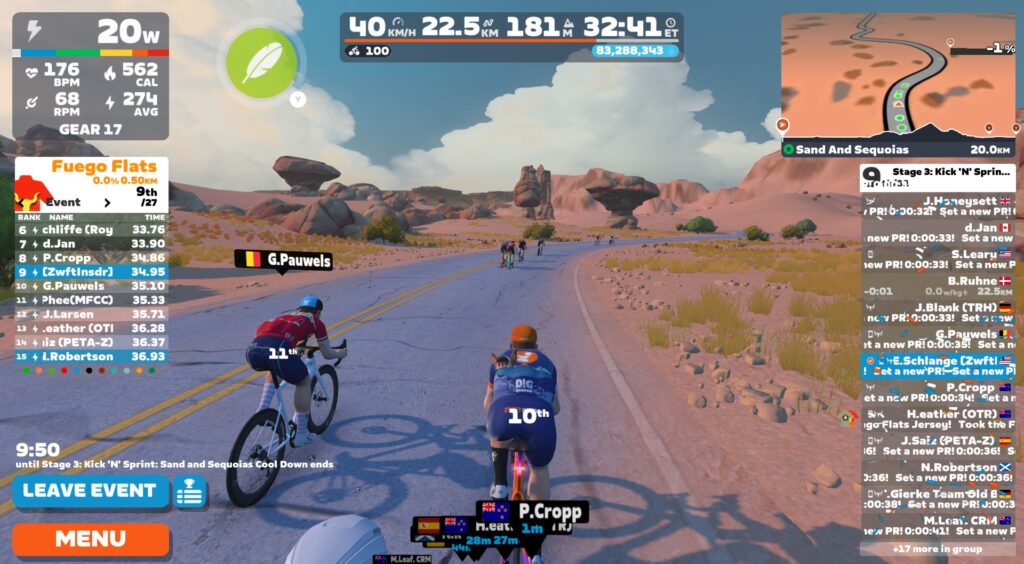
This route is 22.4km long, and the first ~10km takes you from the desert start pens and across Fuego Flats to Saddle Springs. It’s quite flat, and most racers don’t even attempt an attack here, because the pack chasing from behind is simply too fast.
The race was set up to hand out one of two powerups at random at each arch: a feather or an aero. With two arches on the course, the powerups you receive could really affect your race! Everyone wanted a feather as their first powerup, to help them up the Titans Grove KOM. And everyone wanted an aero for the second powerup, to help them in the final sprint.
I got a feather through the first arch. Bingo.
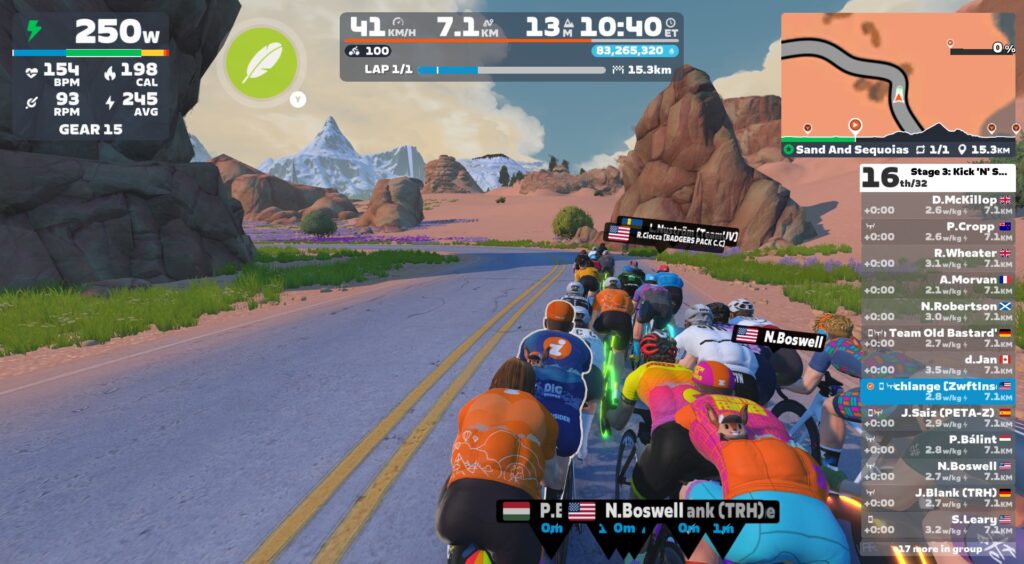
We chugged along, a starting group of 26 riders working at a steady but bearable clip. I averaged 251W for this section, but things started getting spicy near the end as we entered Saddle Springs. One L. Nystrom attacked off the front, and four other riders followed. They soon built a 5-second gap, and seemed to be working hard together as we headed up the Col du Saddle Springs into Titans Grove.
This was gonna hurt. But at least I had my feather!
We hung a right into Titans Grove, and the real work began. One rider from our group put in a hard effort and bridged up to a handful of riders just ahead, but I could see the breakaway had split into two groups. We reeled in the back group at the bottom of the Titans Grove KOM, but there were still three riders up the road.
It helps to know how this KOM lays out. While it’s 2.6km long on paper, the first kilometer is quite flat (less than 2%) and very draftable. So if you want to ride this as efficiently as possible (vs attacking and ripping everyone’s legs off), you want to sit in the pack and draft efficiently for this first bit.
The second portion is steeper, but still only 3-4%. Drafting still helps a lot, so sit on a wheel and just work to hold a good pack position up and over the top.
I stuck to my advice above, and was able to hang with the peloton up and over the climb, triggering my feather with about 600 meters to go. I finished in 4 minutes, 37 seconds with an average power of 330W.
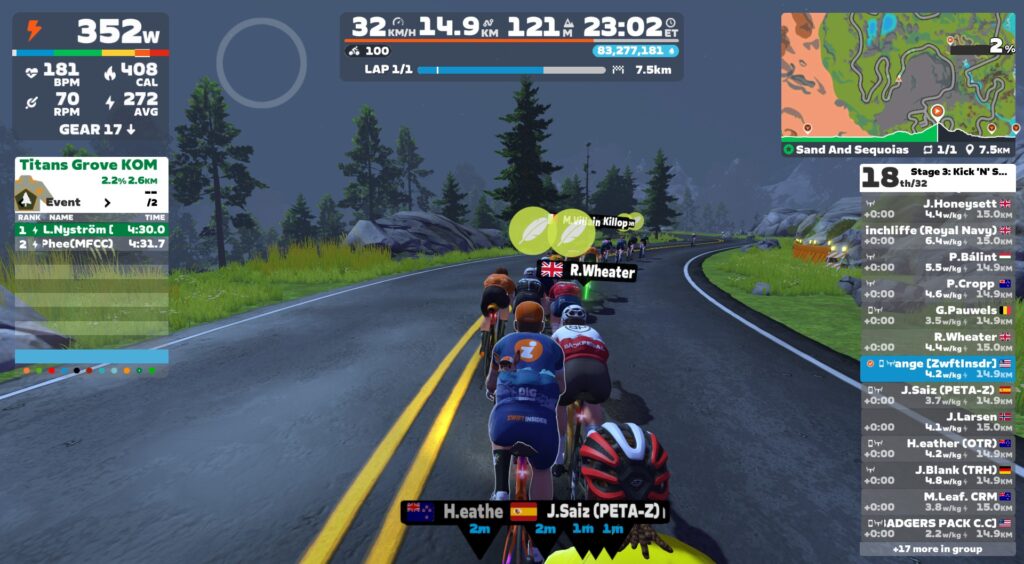
But as we approached the KOM banner, something odd happened: I shifted (virtual shifting), but the resistance didn’t increase as expected! Instead, it hit… slowly… over several seconds. This odd shifting delay would persist through the end of the race.
I had hoped for an aero powerup through at the KOM banner, but alas: it was another feather. You win some, you lose some.
In contrast to the flat, easy start of the race, the 5.3km section from the start of Titans Grove to the top of the KOM required 308W average for me to stay with the group. Ouch!
I tried to recover a bit as we descended from the KOM arch, but my delayed virtual shifting was making things a bit goofy. I also knew there was a sharp little kicker coming up, so I tried to get set into a gear that would work for hammering up and over this rise.
By the time we finished that kicker and began the true rollercoaster descent to the jungle, only two riders were up the road: L Nystrom solo on the front, with B. MacPhee chasing. I didn’t have the legs to chase, so I sat in and hoped our pack of 21 would pull them back.
B. MacPhee got caught with 3km to go, just before we exited Titans Grove. That left only Nystrom, who didn’t seem to be slowing one bit. Just as we all began resigning ourselves to fighting for second place, B. Ruhne, wearing a DIRT kit, jumped hard off the front and got away solo.
I sat in the group, unable to jump hard enough to get away. As we neared the sprint finish, A. Morvan jumped hard with an aero powerup, catching B. Ruhne just before the line. Nystrom won by nearly 20 seconds. And my feather powerup and tired legs proved a poor match against the competition. I crossed the line in 10th.
See ride on Strava >
See results on ZwiftPower >
This race basically unfolded the way past Sand and Sequoias races have unfolded for me. Easy on the flats. On the rivet surviving the Titans Grove KOM. And too knackered to sprint to the podium.
My score increased from 564 to 569 as a result of this race. Looks like I may not be long for the 450-570 group! And neither is L. Nystrom, the rider who jumped off the front ~9km into the race and stayed away to win solo by 20 seconds. He averaged 4.3W/kg for the event, which was his first race since December 2024 according to his ZwiftPower profile. His Zwift Racing Score result for this event was 559, and that includes a seed score upgrade due to some new 90-day power bests.
Generally, I’ve been quite happy with how my Zwift Racing Score-powered races have unfolded in recent months. The algorithm seems to be doing a good job. But today’s race highlights two areas where Zwift Racing Score still needs to improve:
The most annoying bit of information is that I was testing a smart trainer (which shall remain unnamed) during this race, and while it seemed like the trainer may have been reading a bit low as I was warming up, I used it as the power source anyway during the race, while dual recording my Assioma pedals on my head unit.
It turns out that the trainer’s average power was ~15W lower than the pedals for the duration of the race. Ouch. Here’s a chart showing a small portion of the race, with my pedals in blue and the trainer in purple:
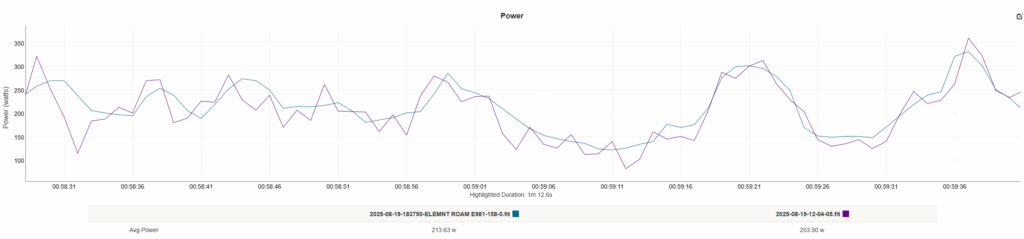
The power readings on this chart may look similar at first glance, but the Strava power curve for this race shows that the difference between the trainer’s numbers and the pedal’s numbers is the difference between a ho-hum effort and setting several new PRs for 2025 in the 10-30 minute window.
I’m not saying I lost because of an under-reading trainer, of course. But it certainly didn’t help. Occupational hazard, I guess, when you’re riding in the Zwift Insider Pain Lab!
Did you race this week’s Sand and Sequoias ZRacing event? How did it go for you?
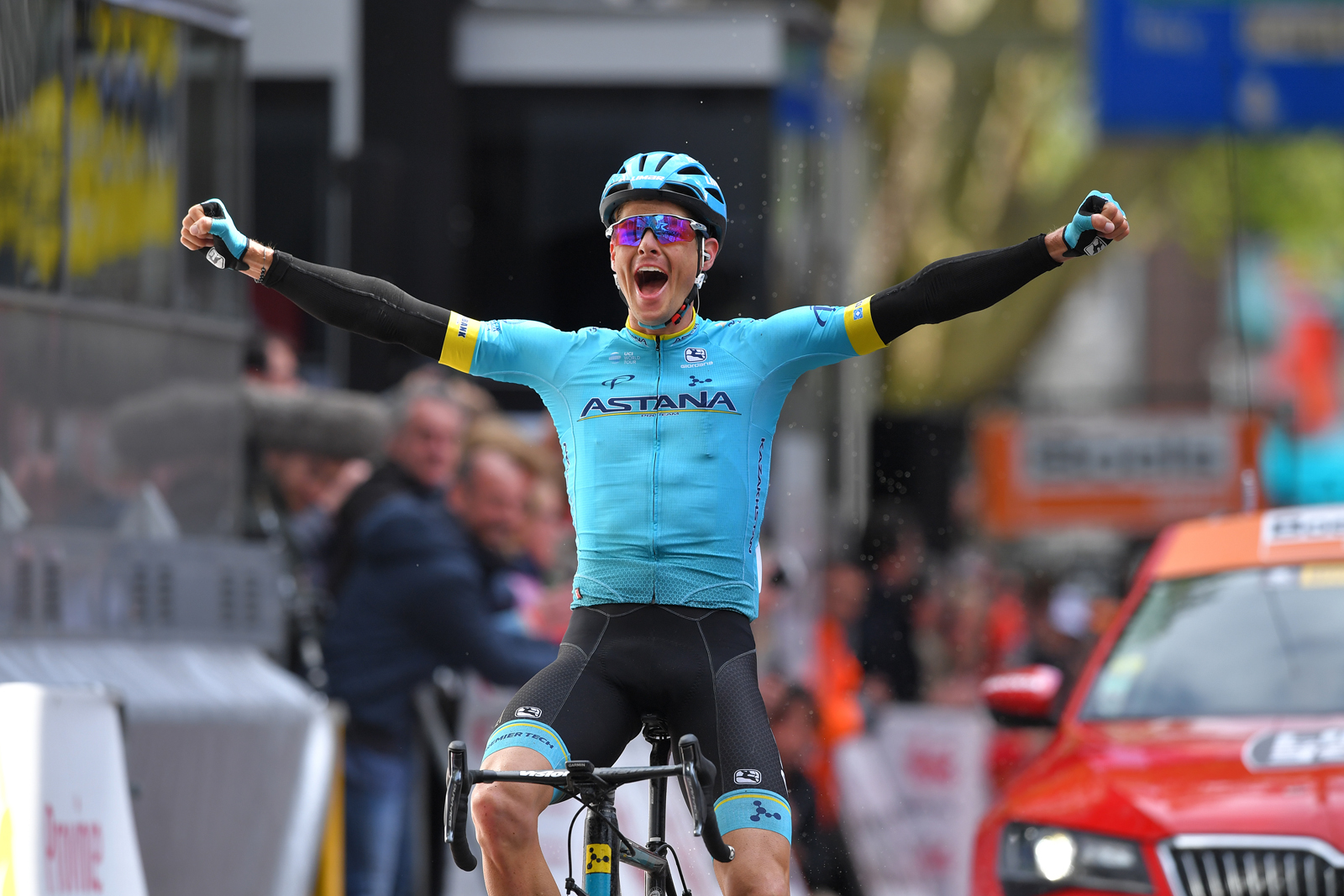
Former Israel-Premier Tech cyclist Jakob Fuglsang has said he feels a sense of relief at no longer wearing the team’s jersey, stating it’s “nicer to ride around without an Israel logo than with it”.
The two-time Critérium du Dauphiné winner and Liège–Bastogne–Liège champion retired in May and rode his last race, the Frederiksberg Criterium, last Sunday. After the race, he spoke to Danish outlet Feltet and said: “It’s of course nicer to be without. I don’t want to get involved in what’s happening politically, but it’s definitely nicer to ride around without an Israel logo than with it.”
The 40-year-old Dane added that he had not had any problems with planned protests targeted at Israel-Premier Tech during big races.
“I haven’t actually experienced that. With or without Israel-PremierTech at the start, there would still have been demonstrations. You also see climate demonstrations during the Tour de France. These are big events where there is a lot of media attention. That said, it’s better to ride without,” he told Feltet.

Fuglsang’s remarks follow former teammate Alessandro de Marchi stating in July he was “happy and relieved” not to be cycling for Israel-Premier Tech.
De Marchi, who moved to Jayco-AlUla in 2023, told The Observer he would no longer feel comfortable riding for Israel-Premier Tech due to Israel’s continued war on Gaza.
“I would have really struggled to be there now and been in great difficulty,” said De Marchi.
De Marchi rode for Israel-Premier Tech between 2021 and 2022. He said the team “gave me a chance to keep riding” and that he was “looking at the house I had to build and my family”.
“Of course now I am older and able to reflect in a way I didn’t five years ago, and I appreciate that in life there are times that, though it may be hard, it’s better to follow your morals. Right now I would do things in a different way,” he added.
Fuglsang and De Marchi’s comments come after the Boycott, Divestment and Sanctions (BDS) movement called for peaceful protests at this year’s Grand Tours.
“As Israel escalates its ongoing genocide against 2.3 million Palestinians in Gaza and its violent military occupation of the West Bank, international sporting bodies have a moral obligation to take all measures to prevent genocide, or risk being held criminally liable,” the BDS movement said.
Protests were visible at the Tour de France, with those present waving Palestine flags and unfurling banners as the Tour rode through Dieulefit on Wednesday 23 July.
An activist from Extinction Rebellion was also arrested in Toulouse after running onto the final straight of stage 11 with a T-shirt that read ‘Israel out of the Tour’ while waving a keffiyeh scarf.
Israel-Premier Tech was founded in 2014 and is co-owned by Canadian-Israeli billionaire Sylvan Adams, who has referred to himself as “self-appointed ambassador at large for the State of Israel”. Adams has described Israel’s invasion of Palestine as “good vs. evil and civilization against barbarism”.
Ron Baron, the team’s other co-owner, has described Israel–Premier Tech as a form of “sports diplomacy”.
Israel-Premier Tech declined to comment.
The U.S. government site climate.gov offered years’ worth of climate-science information — until its production team was fired earlier this summer. The site “is technically still online, but has been intentionally buried by the team of political appointees who now run the National Oceanic and Atmospheric Administration,” reports the Guardian.
But now “a team of climate communication experts — including many members of the former climate.gov team — is working to resurrect its content into a new organization with an expanded mission.”
Their effort’s new website, climate.us, would not only offer public-facing interpretations of climate science, but could also begin to directly offer climate-related services, such as assisting local governments with mapping increased flooding risk due to climate change. The effort is being led by climate.gov’s former managing editor, Rebecca Lindsey, who, although now unemployed, has recruited several of her former colleagues to volunteer their time in an attempt to build climate.us into a thriving non-profit organization… “None of us were ready to let go of climate.gov and the mission….” Lindsey’s new team has received a steady flow of outside support, including legal support, and a short-term grant that has helped them develop a vision for what they’d like to do next…
As multiyear veterans of the federal bureaucracy, at times they’ve been surprised by the possibilities that the new effort might offer. “We’re allowed to use TikTok now,” said Lindsey. “We’re allowed to have a little bit of fun…
The climate.us team is also in the process of soft-launching a crowdsourced fundraising drive that Lindsey hopes they can leverage into more permanent support from a major foundation…. “[W]e do not yet have the sort of large operational funding that we will need if we’re going to actually transition climate.gov operations to the non-profit space.” In the meantime, Lindsey and her team have found themselves spending the summer knee-deep in the logistics of building a major non-profit from scratch.
Read more of this story at Slashdot.

Gearbox knows what the fans hunger for and it’s not subtlety
The post The <i>Borderlands 4</i> Rage Room Is The Most Obnoxious Thing At PAX West And People Love It appeared first on Kotaku.
We may earn a commission from links on this page. Deal pricing and availability subject to change after time of publication.
Labor Day sales are rolling in, and Lifehacker is sharing the best sales based on product reviews, comparisons, and price-tracking tools before they’re over. You can also subscribe to our shopping newsletter, Add to Cart, for the best sales sent to your inbox.
It’s Labor Day weekend, and tech sales are going strong, with deals on TVs, iPads, tablets, and headphones. If you’re looking for a deal on a new MacBook, this is your best chance so far this year: Apple’s powerful M4 MacBook Air already dropped to $799, its lowest price ever, and now, the base 14-inch M4 MacBook Pro is following suit: It’s down to $1299 on Amazon, a $300 discount from the usual $1599. It’s the cheapest price yet for this model MacBook Pro. (The pricier M4 Pro model with the M4 Pro chip and 25GB RAM has already received a $300 cut, from $1999 to $1699.)
The 14-inch M4 MacBook Pro is a step above the M4 MacBook Air. They share the same chip, but the MacBook Pro gets a 10-core GPU instead of an eight-core. You also get 16GB Unified Memory, and 512GB Storage as standard (instead of 256GB for the Air).
The MacBook Pro body and design are also completely different. Unlike the Air, the Pro’s body is fan-cooled, so it can sustain processor intensive workloads for video editing and coding for much longer. The Pro also offers a much better screen, with a 3024×1964 native resolution at 254 pixels per inch, 16,00 nits HDR brightness, up to 1,000 nits of regular outdoor brightness, and a 120Hz refresh rate. The M4 MacBook Pro’s battery backup is also substantial, with up to 24 hours of video streaming and 16 hours of wireless web browsing.
As a Pro model, it comes with three Thunderbolt USB-C ports, an HDMI cable, and a SD card slot. All this tech does make the Pro heavier: It’s 1.55 kg, or 3.4 pounds, versus the Air’s 1.24 kg, or 2.7 pounds. But if you’re the kind of person that wants a really fast MacBook with 120Hz display, long battery, great build, and don’t mind the weight, the M4 MacBook Pro can be a great choice.
If you just want a thin and light laptop for work and school, you can’t go wrong with the M4 MacBook Air, which, again, is discounted to $799 for Labor Day. If you’re looking for a budget option, the still reliable M1 MacBook Ai can be yours for $599.
“A class of drugs called beta-blockers — used for decades as a first-line treatment after a heart attack — doesn’t benefit the vast majority of patients,” reports CNN. And in fact beta-blockers “may contribute to a higher risk of hospitalization and death in some women but not in men, according to groundbreaking new research…”
Women with little heart damage after their heart attacks who were treated with beta-blockers were significantly more likely to have another heart attack or be hospitalized for heart failure — and nearly three times more likely to die — compared with women not given the drug, according to a study published in the European Heart Journal and also scheduled to be presented Saturday at the European Society of Cardiology Congress in Madrid… The findings, however, only applied to women with a left ventricular ejection fraction above 50%, which is considered normal function, the study said. Ejection fraction is a way of measuring how well the left side of the heart is pumping oxygenated blood throughout the body. For anyone with a score below 40% after a heart attack, beta-blockers continue to be the standard of care due to their ability to calm heart arrhythmias that may trigger a second event…
The analysis on women was part of a much larger clinical trial called REBOOT — Treatment with Beta-Blockers after Myocardial Infarction without Reduced Ejection Fraction — which followed 8,505 men and women treated for heart attacks at 109 hospitals in Spain and Italy for nearly four years. Results of the study were published in Mem>The New England Journal of Medicine and also presented at the European Society of Cardiology Congress. None of the patients in the trial had a left ventricular ejection fraction below 40%, a sign of potential heart failure. “We found no benefit in using beta-blockers for men or women with preserved heart function after heart attack despite this being the standard of care for some 40 years,” said Fuster, former editor-in-chief of the Journal of the American College of Cardiology and past president of the American Heart Association and the World Health Federation…
In fact, most men and women who survive heart attacks today have ejection fractions above 50%, Ibáñez said [Dr. Borja Ibáñez, scientific director for Madrid’s National Center for Cardiovascular Investigation]. “Yet at this time, some 80% of patients in the US, Europe and Asia are treated with beta-blockers because medical guidelines still recommend them….”
While the study did not find any need to use beta-blockers for people with a left ventricular ejection fraction above 50% after a heart attack, a separate meta-analysis of 1,885 patients published Saturday in The Lancet did find benefits for those with scores between 40% and 50%, in which the heart may be mildly damaged. “This subgroup did benefit from a routine use of beta-blockers,” said Ibáñez, who was also a coauthor on this paper. “We found about a 25% reduction in the primary endpoint, which was a composite of new heart attacks, heart failure and all-cause death.”
Read more of this story at Slashdot.
We’ll have to wait until May to discover the fate of Earthrealm and Johnny Cage. Mortal Kombat II, the sequel to 2021’s reboot of the video game adaptation, will be pushed back from its original October 24 release date to May 15, 2026. According to a post on X from the movie’s official account, the “tournament demands a new time and place, worthy of its spectacle.”
The delay goes against the trailer and promotional images that Warner Bros. and New Line Cinema already put out, but the studios may be banking on it as a way to maximize the sequel’s potential success. According to Deadline, the movie could avoid a crowded box office in October and instead perform better in a spring debut. The report added that a record-breaking red-band trailer that saw 106 million views in the first 24 hours and a strong performance in research screenings could have influenced the decision to reschedule.
Impatient fans will have to wait until next year for the sequel that stars Karl Urban as Johnny Cage. The trailer revealed a plot that will revolve heavily around Cage as he joins the fight-to-the-death tournament in order to save Earthrealm. As confusing as the Mortal Kombat video game timeline is, the reboot movies could be a more approachable alternative. Starting with the Mortal Kombat movie from 2021 and leading into the upcoming Mortal Kombat II, the story could end with a third film to close out a potential trilogy, as hinted by the movies’ writer, Greg Russo.
This article originally appeared on Engadget at https://www.engadget.com/entertainment/tv-movies/the-mortal-kombat-ii-movie-is-postponed-to-a-spring-2026-release-192515532.html?src=rss
It’s a regrettable reality that there is never enough time to cover all the interesting scientific stories we come across each month. In the past, we’ve featured year-end roundups of cool science stories we (almost) missed. This year, we’re experimenting with a monthly collection. August’s list includes a 3D digital reconstruction of the Shroud of Turin; injecting succulent leaves with phosphors to create plants that glow in different colors; a nifty shape-changing antenna; and snails with a unique ability to grow back their eyeballs.
Perhaps the most famous “holy relic” is the Shroud of Turin, an old linen cloth that retains a distinct impression of the body of a crucified mine (both front and back). The legend is that Jesus himself was wrapped in the shroud upon his death around 30 CE, although modern scientific dating methods revealed the shroud is actually a medieval artifact dating to between 1260 and 1390 CE. A 3D designer named Cícero Moraes has created a 3D digital reconstruction to lend further credence to the case for the shroud being a medieval forgery, according to a paper published in the journal Archaeometry.
Moraes developed computer models to simulate draping a sheet on both a 3D human form and a bas-relief carving to test which version most closely matched the figure preserved in the shroud. He concluded that the latter was more consistent with the shroud’s figure, meaning that it was likely created as an artistic representation or a medieval work of art. It was certainly never draped around an actual body. Most notable was the absence of the so-called “Agamemnon mask effect,” in which a human face shrouded in fabric appears wider once flattened.

The Roborock QV 35A is the most affordable mop and vacuum robot in Roborock’s latest lineup.
The post Roborock’s QV 35A Is Three Times Cheaper Than a Dyson, Now in Clearance on the Brand’s Site appeared first on Kotaku.
We may earn a commission from links on this page. Deal pricing and availability subject to change after time of publication.
Labor Day sales are rolling in, and Lifehacker is sharing the best sales based on product reviews, comparisons, and price-tracking tools before they’re over. You can also subscribe to our shopping newsletter, Add to Cart, for the best sales sent to your inbox.
There’s nothing worse than getting partway through a DIY project and discovering you don’t have the right tool to finish it—and Labor Day sales provide a good way to keep that from happening, providing discounts that make it easier to upgrade your toolkit while keeping to a budget. Even if your budget is relatively miniscule. To that end, here are the best Labor Day tool deals I’ve found under $25.
A good tool kit should include a set of wrenches and a ratchet, which will allow you to drive nuts for multiple sizes of bolts for assembling and disassembling furniture, changing filters on large appliances, or auto maintenance. Here are some great under-$25 deals on wrenches and ratchets.
This Crescent 20-piece ratchet set is on sale on Amazon for $24.98, 41% off its usual price. This set comes with a ⅜-inch ratchet handle, an extension bit, and 8 each of metric and SAE sockets. This is a good beginner kit because it covers most sizes of nuts you’ll encounter, and it’s small and easily portable.
This Ryobi 26-piece 1/4 -inch drive ratchet set is on sale for $19.97 at Home Depot, 33% off its normal price. This set comes with a ¼-inch drive ratchet handle, 24 sockets in both metric and SAE sizes, and a carrying case. This is a good set for smaller home maintenance tasks and because it’s so compact, it’s great for apartment living.
This Craftsman 10-piece combination wrench set is on sale for $19.98 at Lowe’s, 31% off its typical price. The set includes 10 double-ended, SAE wrenches. This set is a good companion to a ratchet set, so you can use a wrench to hold a bolt head as you’re turning the nut, or use the wrenches on their own to drive nuts.
A range of screwdrivers is essential for any basic home toolkit, whether you’re assembling flatpack furniture or swapping out a switch plate. Here are some deals on screwdriver sets on sale for under $25.
The Craftsman 8-piece screwdriver set is on sale on Amazon for $14.98, 49% off its usual price. This set includes 8 screwdrivers with half slotted and half Phillip’s head, in a variety of sizes; it also has two short-handled drivers for turning screws in tight spaces. This is a good starter set.
The DeWalt 2-piece screwdriver set is on sale for $9.97 for Labor day. The set includes two drivers, on Phillip’s head, and one flathead. The tips of these screwdrivers are magnetic, so they’ll hold onto your fasteners, which is convenient if you’re working in an awkward space.
The Craftsman 15-piece ratcheting screwdriver set is on sale at Ace Hardware for $14.99, 41% off the regular price. It’s labeled as a 15-piece set because the bits are double ended, but it actually comes with 7 bits and a ratcheting handle. The bits store inside the handle, so it’s a compact option for your home tool kit if you have limited storage space. It includes Phillip’s head, flat head, square tip, and star drive bits.
Here are a few more standout Labor Day tool deals on tools and accessories.
The DeWalt 20-inch handsaw is on sale at Ace Hardware for $15, 50% off its normal price. This is a basic handsaw for cutting medium sized dimensional lumber, and can be handy for finishing corners when cutting sheet goods with a power saw. The 8-tooth-per-inch blade will provide a medium-to-smooth cut without splintering or tear out on most lumber.
A set of four Vevor bar clamps is on sale at Lowe’s for $24.99. This set includes two 6-inch clamps and two 12-inch clamps with a 2 ½-inch jaw depth and a 600-pound pressure capacity. Clamps are a useful tool for DIY woodworking because you can use them to hold joints flush while you’re driving fasteners or waiting for glue to dry.
A DeWalt 16-oz. Hammer is on sale for $14.99 at Ace Hardware, 44% off its regular price. This is a small, smooth-faced hammer with a curved-claw for pulling nails. This is a good hammer for projects like hanging pictures or driving small finish nails, but it doesn’t have the weight necessary for larger jobs like framing.
“AI web crawlers are strip-mining the web in their perpetual hunt for ever more content to feed into their Large Language Model mills,” argues Steven J. Vaughan-Nichols at the Register.
And “when AI searchbots, with Meta (52% of AI searchbot traffic), Google (23%), and OpenAI (20%) leading the way, clobber websites with as much as 30 Terabits in a single surge, they’re damaging even the largest companies’ site performance…”
How much traffic do they account for? According to Cloudflare, a major content delivery network (CDN) force, 30% of global web traffic now comes from bots. Leading the way and growing fast? AI bots… Anyone who runs a website, though, knows there’s a huge, honking difference between the old-style crawlers and today’s AI crawlers. The new ones are site killers. Fastly warns that they’re causing “performance degradation, service disruption, and increased operational costs.” Why? Because they’re hammering websites with traffic spikes that can reach up to ten or even twenty times normal levels within minutes.
Moreover, AI crawlers are much more aggressive than standard crawlers. As the InMotionhosting web hosting company notes, they also tend to disregard crawl delays or bandwidth-saving guidelines and extract full page text, and sometimes attempt to follow dynamic links or scripts. The result? If you’re using a shared server for your website, as many small businesses do, even if your site isn’t being shaken down for content, other sites on the same hardware with the same Internet pipe may be getting hit. This means your site’s performance drops through the floor even if an AI crawler isn’t raiding your website…
AI crawlers don’t direct users back to the original sources. They kick our sites around, return nothing, and we’re left trying to decide how we’re to make a living in the AI-driven web world. Yes, of course, we can try to fend them off with logins, paywalls, CAPTCHA challenges, and sophisticated anti-bot technologies. You know one thing AI is good at? It’s getting around those walls. As for robots.txt files, the old-school way of blocking crawlers? Many — most? — AI crawlers simply ignore them… There are efforts afoot to supplement robots.txt with llms.txt files. This is a proposed standard to provide LLM-friendly content that LLMs can access without compromising the site’s performance. Not everyone is thrilled with this approach, though, and it may yet come to nothing.
In the meantime, to combat excessive crawling, some infrastructure providers, such as Cloudflare, now offer default bot-blocking services to block AI crawlers and provide mechanisms to deter AI companies from accessing their data.
Read more of this story at Slashdot.
Following news that Escape from Tarkov is escaping its perpetual beta, the pioneering extraction shooter is also about to make its debut on Steam. Nikita Buyanov, head of the Battlestate Games studio that developed Escape from Tarkov, confirmed on X that the game’s Steam page “will be available soon,” only teasing that the full details will come later.
Buyanov’s confirmation comes less than a day after the developer posted a GIF on X of a man spraying steam from an iron. Earlier this month, Buyanov revealed on X that the looter shooter will get its 1.0 release on November 15, 2025, more than eight years after the beta opened up to players in July 2017, and that the studio has plans to port it to consoles. The Steam page for Escape from Tarkov isn’t live yet, and with only vague details to go off of, longtime fans already have burning questions. Most importantly, existing players are eager to know if they will have to buy the game again on Steam and how this change will affect the ongoing cheating problem.
While we don’t have any answers yet, Battlestate Games recently went into damage control mode when it revealed the Unheard Edition of the game that costs $250 and includes a new PvE mode. This move irked longstanding players who previously purchased another premium edition of the game, called the Edge of Darkness, which promised access to all future DLCs. The controversy boiled down to owners of the Edge of Darkness edition claiming they should have access to the new content, but the studio argued that it isn’t classified as DLC. In the end, Buyanov apologized for the debacle and promised the PvE mode would be available for anyone who purchased the Edge of Darkness package.
This article originally appeared on Engadget at https://www.engadget.com/gaming/escape-from-tarkov-is-finally-coming-to-steam-soon-developer-says-181356635.html?src=rss