New Ubuntu Snapdragon X1E Concept ISO Published – Switches To Linux 6.17 Kernel

This week a new Ubuntu X1E Concept ISO was published for Ubuntu 25.04 ARM64 with the latest Qualcomm Snapdragon X Elite/Plus laptop optimizations. With this new ISO the Linux 6.17 kernel is now leveraged for the latest upstream kernel bits. Additionally, the new X1E ISO is finally working again on the Acer Swifth 14 AI laptop that I have used for my Snapdragon X Elite Linux testing…

bsd-user-4-linux Lets FreeBSD Binaries Run Unmodified On Linux

The FreeBSD project on Friday published their quarterly status report to highlight all of the interesting changes for Q2’2025. Among the recent FreeBSD efforts have been on “bsd-user-4-linux” to allow FreeBSD binaries to run unmodified on Linux systems. FreeBSD is also coming up with a policy around AI/LLM usage for contributing to the project. Additionally, Sylve is taking shape as a new web-based unified system management platform for FreeBSD systems…

GitHub engineer claims team was ‘coerced’ to put Grok into Copilot

Platform’s staffer complains security review was ‘rushed’Microsoft-owned collaborative coding platform GitHub is deepening its ties with Elon Musk’s xAI, bringing early access to the company’s Grok Code Fast 1 large language model (LLM) into GitHub Copilot. However, a whistleblower has claimed that the rollout suffers from inadequate security testing and an engineering team operating under duress.…

Did Will Smith Upload an AI-Enhanced Video – and Is This Just the Beginning?

After Will Smith uploaded a video of an adoring crowd, blogger Andy Baio “conducted a detailed analysis that suggests Will Smith’s team might have used AI to turn photos from his recent concerts into videos,” writes BGR. But there’s more to the story:
Google recently ran an experiment for YouTube Shorts in which it used AI (machine learning) to improve the quality of Shorts without asking the creator for permission. People complained the videos looked like they were AI generated. It seems that Will Smith’s YouTube Shorts clip that attracted criticism from fans this week might have been a victim of this experiment… The signs are real. The man who claimed Will Smith’s song helped him cure cancer was there. The woman in front of him was holding the sign with him. The “Lov U” sign appeared in photos the singer posted on his social media channels before the clip was shared.

“Will Smith has not denied the use of AI in these promotional clips,” the article adds.

But the Hollywood Reporter also calls it “just the beginning of AI chaos,” noting that “influencers and spinmeisters have been using AI upscaling for years, if quietly, the way you might round up your current salary in a job interview.”

It’s only going to grow more popular as the tools get better. (And they will — you just need some tweaks to the model and increases in compute to erase these hallucinations.) In fact, when the chapter on the early AI Age is written, the line about this moment is less likely to be, “Remember when Will Smith did something cringily AI?” and more, “Remember when AI was still seen as so cringe that we made fun of Will Smith for it?” Experts differ on the timeline, but everyone agrees it’s just years if not months before we’ll stop being able to spot an AI video. [Will Smith’s video] had the particular misfortune of coming out at this interregnum moment: good enough for someone to use but not so good we can’t spot it.

That moment will be over soon enough, and, I suspect, so will our pearl-clutching. The main effect of this new age of the synthetic is that video will stop being a meaningful measure of truth. We have long stopped believing everything we read, and AI image-generators have killed what photoshop wounded. But video until now has been the last bastion of objectivity — incontrovertible evidence that an event took place the way it seemed to….
But there is an upside. (Really.) Without a format that can telegraph objectivity, we’ll need to (if we care to) turn to other ways to assure ourselves of the facts: the source of the video. That could mean the human-led content creator will matter more. After years of seeing news brands take a beating in the trust department, they’ll soon become the only hope we have of knowing whether something happened. We no longer will be able to trust the medium. But we may newly believe the media.


Read more of this story at Slashdot.

What to read this weekend: Two thrilling horror novels in one

These are some recently released titles we think are worth adding to your reading list. This week, we picked up the Saga Doubles release of Stephen Graham Jones’ Killer on the Road and The Babysitter Lives, and the new Image Comics miniseries, The Voice Said Kill.

This article originally appeared on Engadget at https://www.engadget.com/entertainment/what-to-read-this-weekend-two-thrilling-horror-novels-in-one-201544768.html?src=rss

This Soda Can-Sized Smart Projector Is 35% Off for Labor Day

We may earn a commission from links on this page. Deal pricing and availability subject to change after time of publication.

Labor Day sales are rolling in, and Lifehacker is sharing the best sales based on product reviews, comparisons, and price-tracking tools before they’re over. You can also subscribe to our shopping newsletter, Add to Cart, for the best sales sent to your inbox.


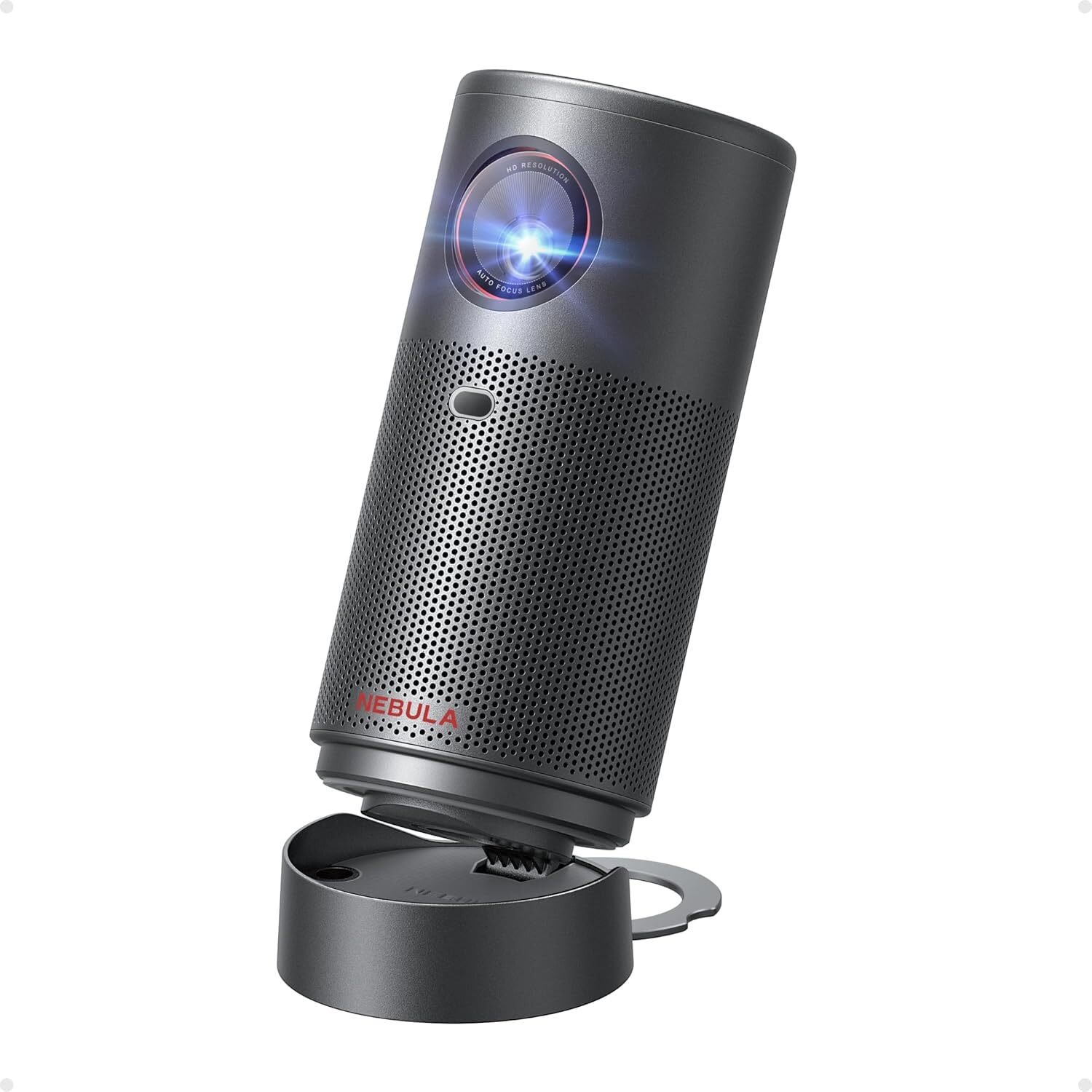
It’s Labor Day weekend, and tech sales are going strong, with deals on TVsiPads, tablets, and some of headphones. If you’re looking to upgrade your movie nights, the Nebula Capsule Air Projector is now 35% off on Amazon. Perfect for an outdoor cinema moment in your backyard or on a camping trip, this soda can-sized mini projector from Anker is a space-saving alternative to a TV.

Weighing in at 1.43 pounds, portability is a great perk for this battery-powered portable smart projector. The included base attachment allows the projector to “lean back” so you can project directly on the ceiling if you prefer.

The Capsule Air offers up to 2 hours of playtime off its 34Wh battery, so while it can handle a single movie or a few episodes, it’s not quite enough for a Netflix binge.  With built-in Google TV, it supports more than 30,000 apps on Google Play, eliminating the need for an external streaming device. While the image quality isn’t full HD, it’s fairly vibrant at 720p, with decent color accuracy (you can play content up to 1080p, which will be automatically down-converted, according to this “excellent” PCMag review.) It has 150 ANSI Lumens of brightness,which means you’ll get the best viewing experience in a darker setting, and it may not work well in brighter rooms. 

Users report that the built-in speaker isn’t very loud, so you may need to pair it with an additional Bluetooth speaker. But if you don’t need ultra-sharp HD visuals and can live with the shorter battery life, the Nebula Capsule Air Projector is a compact choice for on-the-go entertainment.

Deals are selected by our commerce team

Wave Energy Projects Have Come a Long Way After 10 Years

They offer “a self-sustaining power solution for marine regions,” according to a newly published 41-page review after “pioneering use in wave energy harvesting in 2014”. Ten years later, researchers have developed several structures for these “triboelectric nanogenerators” (TENGs) to “facilitate their commercial deployment.” But there’s a lack of “comprehensive summaries and performance evaluations”.

So the review “distills a decade of blue-energy research into six design pillars” for next-generation technology, writes EurekaAlert, which points the way “to self-powered ocean grids, distributed marine IoT, and even hydrogen harvested from the sea itself…” By “translating chaotic ocean motion into deterministic electron flow,” the team “turns every swell, gust and glint of sunlight into dispatchable power — ushering in an era where the sea itself becomes a silent, self-replenishing power plant.”

Some insights:

– Multilayer stacks, origami folds and magnetic-levitation frames push volumetric power density…three orders of magnitude above first-generation prototypes.
– Frequency-complementary couplings of TENG, EMG and PENG create full-spectrum harvesters that deliver 117 % power-conversion efficiency in real waves.
– Pendulum, gear and magnetic-multiplier mechanisms translate chaotic 0.1-2 Hz swells into stable high-frequency oscillations, multiplying average power 14-fold.
– Resonance-tuned structures now span 0.01-5 Hz, locking onto shifting wave spectra across seasons and sea states.
– Spherical, dodecahedral and tensegrity architectures harvest six-degree-of-freedom motion, eliminating orientational blind spots.
– Single devices co-harvest wave, wind and solar inputs, powering self-charging buoys that cut battery replacement to zero…

Another new wave energy project is moving forward, according to the blog Renewable Energy World:

Eco Wave Power, an onshore wave energy technology company, announced that its U.S. pilot project at the Port of Los Angeles has successfully completed operational testing and achieved a new milestone: the lowering of its floaters into the water for the first time. The moment, broadcast live by Good Morning America, follows the finalization of all installation works at the project site, including full installation of all wave energy floaters; connection of hydraulic pipes and supporting infrastructure; and placement of the onshore energy conversion unit.

With installation completed, Eco Wave Power has now officially entered the operational phase of its U.S. excursion… [Inna Braverman, founder and CEO of Eco Wave Power] said “This pilot station is a vital step in demonstrating how wave energy can be harnessed using existing marine infrastructure, while laying the groundwork for full-scale commercialization in the United States….” Eco Wave Power’s patented onshore wave energy system attaches floaters to existing marine structures. The up-and-down motion of the waves drives hydraulic cylinders, which send pressurized fluid to a land-based energy conversion unit that generates electricity… The U.S. Department of Energy’s National Renewable Energy Laboratory estimates that wave energy has the potential to generate over 1,400 terawatt-hours per year — enough to power approximately 130 million homes.

Eco Wave Power’s 404.7 MW global project pipeline also includes upcoming operational sites in Taiwan, India, and Portugal, alongside its grid-connected station in Israel.

Long-time Slashdot reader PongoX11 also brings word of a company building a “simple” floating rig to turn wave motion into electricity, calling it “a steel can that moves water around” and wondering if “This one might work!”
The news site TechEBlog points out that “Unlike old-school wave energy systems with clunky mechanical parts, Ocean-2 rocks a modular, flexible setup that rolls with the ocean’s flow.”

At about 10 meters wide [30 feet wide. and 260 feet long!], it is made from materials designed to (hopefully) withstand the ocean’s abuse, over some maintenance cycle. It’s designed for deep ocean, so solving this technically is the first big challenge. Figuring out how to use/monetize all that cheap energy out in the middle of nowhere will be the next.

“Ocean-2 works with the ocean, not against it, so we can generate power without messing up marine life,” said Panthalassa’s CEO, Dr. Elena Martinez, according to TechEBlog:

Tests in Puget Sound, done with Everett Ship Repair, showed it pumping out up to 50 kilowatts in decent conditions — enough juice for a small coastal town. “We’re thinking big,” Martinez said in a press release. “Ocean-2 is just the start, but we’re already planning bigger arrays that could crank out gigawatts…” Looking forward, Panthalassa sees Ocean-2 as part of a massive wave energy network. By 2030, they’re aiming to roll out arrays that could power whole coastal cities, cutting down on fossil fuel use.


Read more of this story at Slashdot.

TikTok users will soon be able to send voice notes, images and videos in chats

TikTok is taking another step towards becoming more than just a platform for infinitely scrolling through short videos. The social media app told TechCrunch that its users will soon be able to send voice notes, images and videos in direct messages or group chats. According to a TikTok spokesperson, these features will roll out in the next few weeks.

As voice messaging has risen in popularity, TikTok will embrace the trend but is capping the length of its voice notes to one minute. For images and videos, users will be able to send up to nine images or videos, taken from their phone’s camera app or library, in a DM or group chat, according to TechCrunch. The report added that there will still be guardrails with this new chat feature, including not being able to send an image or video as the first message to another user. This new restriction adds to TikTok’s current rules that only allow registered users who are at least 16 years old to use its messaging feature. TikTok is also giving users who are older than 18 the ability to toggle on or off an existing feature that automatically detects and blocks images that have nudity in chats for users between 16 and 18 years old.

Other messaging apps like Messenger and Snapchat already allow their users to send voice notes or media, but TikTok is slowly catching up with the competition. Last year, TikTok added group chats that allow up to 32 people. More recently, TikTok took a page out of X and Meta’s book by adding the Footnotes feature in April, which works similarly to Community Notes.

This article originally appeared on Engadget at https://www.engadget.com/social-media/tiktok-users-will-soon-be-able-to-send-voice-notes-images-and-videos-in-chats-194413622.html?src=rss