This Massive Amazon Fire TV Is on Sale for Less Than $450 for Prime Members

We may earn a commission from links on this page. Deal pricing and availability subject to change after time of publication.

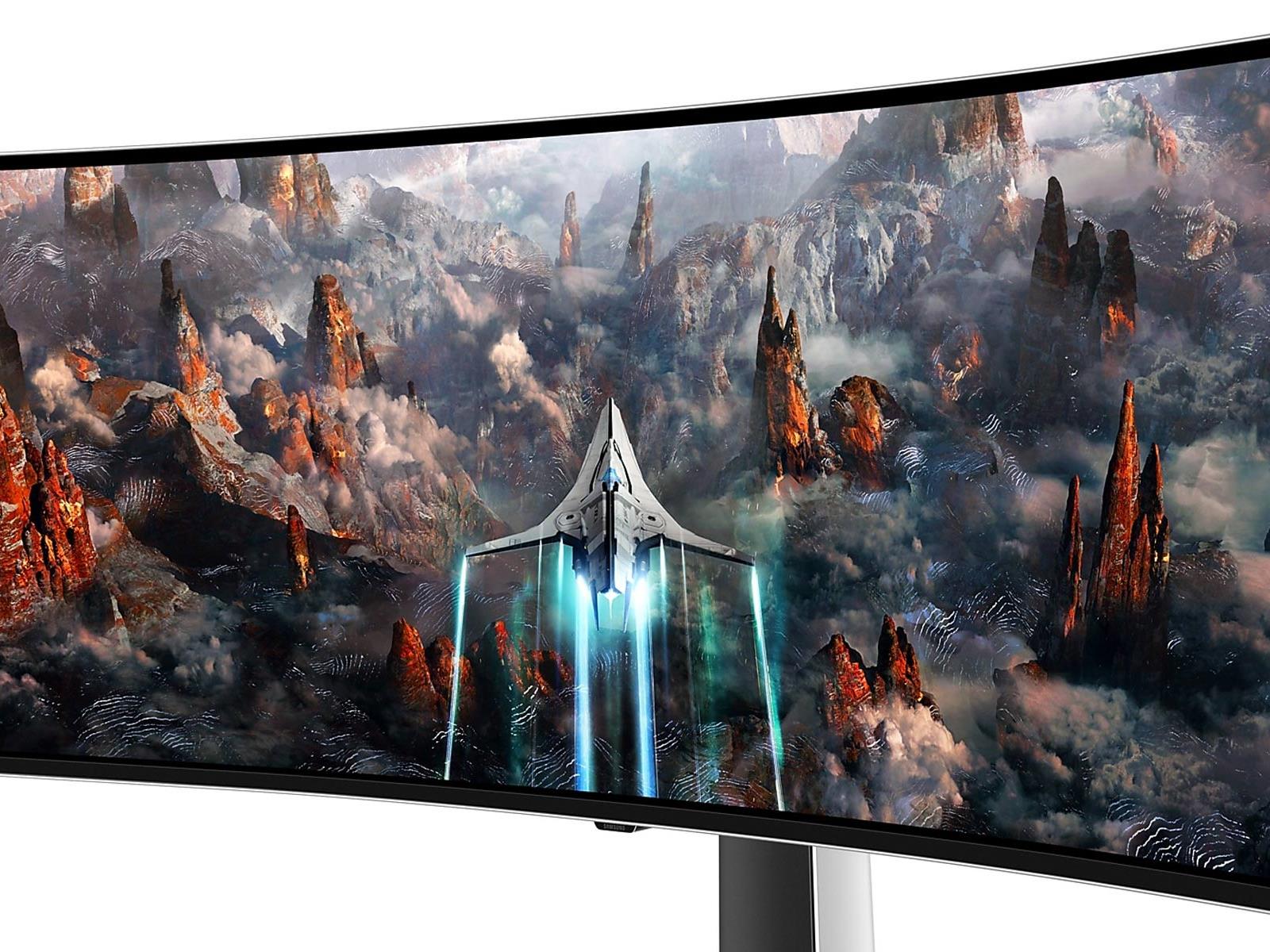
A massive smart TV that PC Mag called one of the best-value options on the market is currently as even better buy—provided you’re an Amazon Prime member. The 75″-inch Amazon Fire TV Omni QLED is currently at a record low price of $449.99, but you’ll only see that price if you’re an active Prime member and logged in to your account.

For anyone looking to upgrade their screen size without overspending, this smart TV is a decent bet, offering features typically found on higher-end models, according to PC Mag’s review. Its QLED display supports Dolby Vision IQ and HDR10+ Adaptive for vibrant visuals, while a built-in sensor adjusts brightness based on your room’s lighting to reduce glare.

One standout feature at this price point is ambient mode, which turns your screen into a customizable digital art display and powers down when you leave the room to save energy. Gamers will appreciate the low input lag, Dolby Vision gaming, VRR, ALLM support, and four HDMI inputs, although the 60 Hz panel may fall short for serious next-gen gaming.

For those who are part of the Alexa ecosystem, the built-in Alexa mics allow you hands-free control, which is a must during those dreaded moments when someone has misplaced the remote. While some Amazon reviewers are underwhelmed by the audio quality, the Alexa Home Theater feature lets you pair Echo speakers via the Alexa app or connect a soundbar for an improved experience. However, the sometimes clunky Fire TV interface might be a dealbreaker, with some reviewers complaining about lagginess and glitching compared to the competition. 

If you’re shopping for an under $500 large-screen 4K QLED TV, the value-friendly Amazon Fire TV Omni QLED is a dependable pick. But if you’re looking for a more polished and tech-savvy option with perfection in details like internal audio or 120 Hz gaming, you may want to invest in a higher-quality model, or at least an additional soundbar or streaming stick that will let you use a different interface. 

All Videos On Facebook Will Soon Be Shared As Reels

Facebook announced it will soon share all videos as reels by default, regardless of their length or orientation. “Up until now, users have been able to share both video posts and reels,” notes TechCrunch. From the report: The company is also renaming the “Video” tab on its platform to the “Reels” tab. The update won’t change what videos are recommended to you, Facebook says. […] The idea behind the changes is to streamline the video-sharing format on the social network. It won’t be the first time that a Meta-owned platform has done so, as Instagram began automatically converting new video posts under 15 minutes into reels back in 2022.

“Previously, you’d upload a video to Feed or post a reel using different creative flows and tools for each format,” Facebook explained in a blog post. “Now, we’re bringing these experiences together with a simplified publishing flow that gives you access to even more creative tools. We’ll also give you control over your audience setting of who sees your reels.” […] The company says it will gradually roll out the changes globally over the coming months.


Read more of this story at Slashdot.

X sues to block copycat NY content moderation law after California win

Last year, X won its fight to block a California law requiring social media companies to report on efforts to remove hate speech and other kinds of content the state deemed harmful.

Now, X has sued to stop New York from enforcing a law that it claims is a “carbon copy” of California’s—which resulted in a settlement blocking the California law after a court ruled it likely violated the First Amendment.

In a complaint filed Tuesday, X revealed that the New York lawsuit came after New York lawmakers rejected X’s attempts to reconcile its social media law with the California ruling. Not only did lawmakers refuse to acknowledge free speech issues that X seemingly views as settled, but in a letter declining to meet with X, they also called out X owner Elon Musk’s controversial personal history of posting as a reason to refuse to engage with X.

Read full article

Comments

Honda Successfully Launches and Lands Reusable Rocket

Honda has successfully conducted a surprise launch and landing test of its prototype reusable rocket as part of its plan to achieve suborbital spaceflight by 2029. Reuters reports: Honda R&D, the research arm of Japan’s second-biggest carmaker, successfully landed its 6.3-meter (20.6-foot) experimental reusable launch vehicle after reaching an altitude of 271 meters (889 feet) at its test facility in northern Japan’s space town Taiki, according to the company. While “no decisions have been made regarding commercialization of these rocket technologies, Honda will continue making progress in the fundamental research with a technology development goal of realizing technological capability to enable a suborbital launch by 2029,” it said in a statement.

Honda in 2021 said it was studying space technologies such as reusable rockets, but it has not previously announced the details of the launch test. A suborbital launch may touch the verge of outer space but does not enter orbit. Studying launch vehicles “has the potential to contribute more to people’s daily lives by launching satellites with its own rockets, that could lead to various services that are also compatible with other Honda business,” the company added.


Read more of this story at Slashdot.

Meta’s Spatial SDK For Engine-Free Quest Development Has Got Significant Upgrades

Since launching it in September, Meta has made significant improvements to its Spatial SDK.

Meta Spatial SDK lets developers build Horizon OS apps using existing Android mobile app development tools, rather than needing to use a game engine such as Unity, Unreal, or Godot. That includes IDEs like Android Studio, the Kotlin programming language, and existing mobile frameworks and libraries.

Meta Spatial SDK Lets Developers Build Quest Apps Without A Game Engine
Meta Spatial SDK lets developers easily build apps for Quest’s Horizon OS with traditional mobile development tools, without a game engine.
UploadVRDavid Heaney

Here are the improvements Meta says it’s made to Spatial SDK since launch:

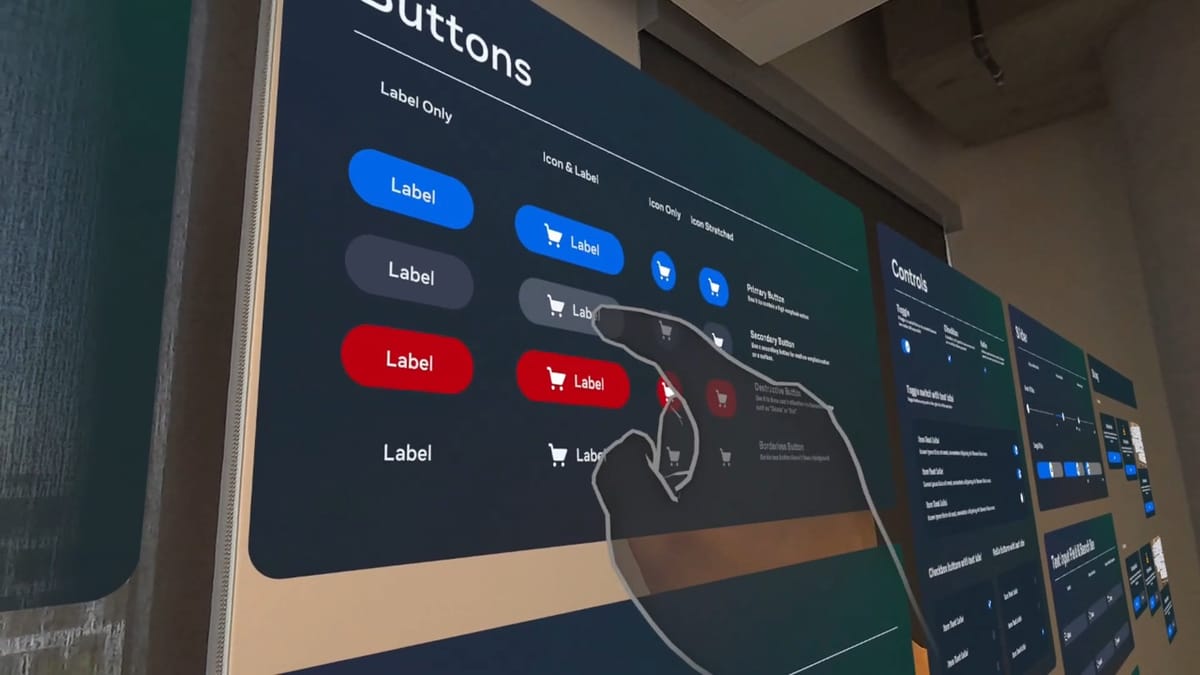
Horizon OS UI Set

Last year Meta finally released a UI kit for Unity, providing Unity developers with the components to build interfaces matching the design language of Quest’s Horizon OS.

UI kits are a crucial part of the development tools for consumer operating systems, letting third-party app interfaces feel cohesive with the rest of the system.

Meta Finally Released A Quest UI Kit For Unity
Meta finally released a Quest UI kit for Unity, meaning developers can easily build interfaces that feel cohesive with Horizon OS.
UploadVRDavid Heaney

Meta Spatial SDK recently got the Horizon OS UI set too, and this means developers of Spatial SDK apps also no longer need to build their own interfaces from scratch, as well as the benefits to cohesion.

0:00

/0:55

It should make developing non-game Quest experiences, such as utility apps, easier than ever.

Interaction SDK (Beta)

While a cohesive UI experience adds a level of polish when using a consumer operating system, in XR the consistency of interactions is arguably even more important.

Since early 2022 Meta has offered an Interaction SDK for Unity, and since last year for Unreal too. This Interaction SDK includes direct object grabbing and holding, distance grabbing, pokable 2D and 3D buttons, teleportation, gesture detection, and more.

For developers, this avoids the need to reimplement these interactions from scratch. And for end-users, it means these interactions will feel consistent, instead of needing to relearn and adjust behavior for each app.

0:00

/0:20

Meta’s Interaction SDK is now available as a beta feature for Spatial SDK, replacing its legacy input system, meaning Spatial SDK apps benefit from the same consistent interactions that Unity and Unreal developers already have access to.

Improved Performance

Meta says it has reduced the performance impact of system scripts, and claims this means Spatial SDK apps “now hit smooth 90 fps more consistently —even with complex scenes”.

“Faster ECS queries and new support for advanced filtering means you can write smarter, more efficient logic without sacrificing performance. Whether you’re building densely interactive environments or running high-frequency updates across many entities, these improvements make it easier than ever to build rich, immersive MR experiences for Horizon OS.”

Passthrough Camera Access

Earlier this year, Meta gave Unity and native apps access to the color passthrough cameras of Quest 3 and Quest 3S.

Examples of how apps can use this include scanning and tracking QR codes, detecting a game board on a table to add virtual characters and objects to it, detecting physical objects for enterprise guide experiences, and integrating the visual AI functionality of cloud-hosted large language models (LLMs).

0:00

/0:21

For Spatial SDK developers, Meta has now released an open-source Spatial Scanner sample that shows how to do this in a performant way.

Android Studio Plugin

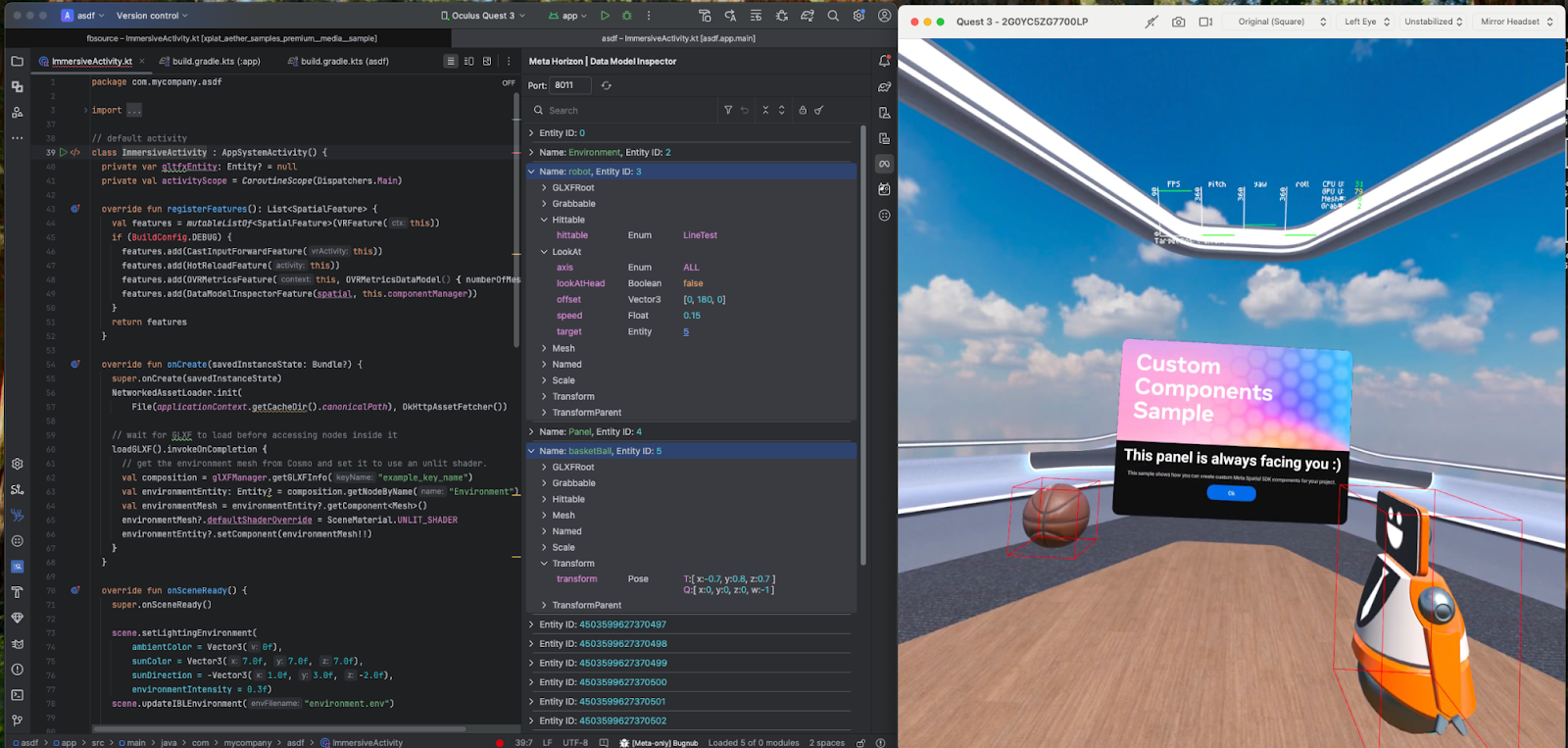
For Android Studio, Google’s official IDE for Android app development, Meta has released an Android Studio Plugin (ASP) which it says “significantly improves the development experience with Spatial SDK by providing project templates, a data model inspector and component/system file templates”.

“For new projects, getting set up is as easy as downloading and installing the plugin and clicking on our template”, Meta claims.

Spatial Editor 2.0

Since its release in October, Meta Spatial SDK has had Meta Spatial Editor, which allows developers to position, scale, and arrange the 2D and 3D elements of their apps without a game engine editor. It’s akin to Apple’s Reality Composer Pro for visionOS.

With Spatial Editor 2.0, Meta says it has introduced “a new component system that lets you define and manage components with XML for enhanced flexibility”, which allows you to generate Kotlin Component code based on XML input.

Premium Media Sample

Meta says one of the most popular use cases of its Spatial SDK is to build simple media apps, from 3D photo viewers to 360-degree video players.

To help developers build media apps, it has released a “Premium Media Sample” on GitHub, showing how to stream 180-degree, 3D, and DRM-protected content.

The company has also added a new section to its documentation explaining the intricacies of media playback.

Grab These Free Vintage Sega Games on Mobile Before They Go Away Forever

Candy Crush, Angry Birds…whatever. My longtime mobile gaming go-to has been vintage Sega, as the company behind my first home video game console has proven surprisingly eager to port its classics to mobile as part of its Sega Forever program. Unfortunately, now that the program has been shut down, it seems that these titles are set to go the way of the Dreamcast. The upside? For a shot time, you can snag them for free—and keep them forever.

The games were part of “Sega Forever”

Sega Forever started in 2017 as a vehicle for the company to produce mobile versions of select titles, released for free. The catch was that the ports all came with ads, but you could pay around $2 (the exact price depended on the game) within the app to remove them. While there are other ways to play retro games on mobile, the Sega Forever program was certainly among the easiest. Technically, the program shut down in in 2023, and while it’s delisted a few games since then (RIP Gunstar Heroes), other titles have stayed on storefronts and even gotten regular updates.

Now, Sega’s pulling the plug on Sega Forever (almost) entirely. Across its suite of remaining Sega Forever titles, players are seeing new pop-ups warning them that support for the games that have yet to be delisted is being discontinued, meaning that they’ll likely be leaving app stores soon. On the plus side, the pop-ups also tell players that they can “continue playing offline,” which means that they will not only keep the games, but that, at least according to my testing, the ads will be gone too, even if you didn’t pay to remove them.

It’s a bit of a win/lose situation, but if you act now, you can get a good selection of pretty competent, ad-free mobile ports to keep for free. And based on the previously delisted games that I have on my phone, you’ll still be able to access them even after they get removed from app stores (although that’s not the case if you delete them from your phone, judging by my experience with Beyond Oasis).

Sega hasn’t made any official announcements about this change, so the in-game pop-ups are all we have to go from for now. With that in mind, it’s unclear exactly when the remaining Sega Forever games are set to leave app stores, so you should act sooner rather than later. Also note that while mobile ports of Sonic the Hedgehog and Sonic the Hedgehog 2 were eventually added to Sega Forever (they had an upfront price beforehand), they don’t seem to be on the docket for delisting, due to a lack of warnings when opening them.

Here’s a full list of the free Sega games you can now get now, on both Android and iOS:

Crazy Taxi Classic

Golden Axe Classics

Shining Force Classic

Sonic CD Classic

Sonic the Hedgehog 4 Ep. II

Streets of Rage Classic

Streets of Rage 2 Classic

Super Monkey Ball: Sakura

Virtua Tennis Challenge

Trump’s EPA to “reconsider” ban on cancer-causing asbestos

Despite touting ambitious goals of making America healthier, the Trump administration on Monday revealed in court documents that it is backpedaling on a ban on cancer-causing asbestos.

Last year, under the Biden administration, the Environmental Protection Agency took a long-awaited step to ban the last type of asbestos still used in the US—chrysotile asbestos, aka “white asbestos.” While use of chrysotile asbestos was on the decline, the dangerous mineral has lingered in various gaskets, brake blocks, aftermarket automotive brakes and linings, other vehicle friction products, and some diaphragms used to make sodium hydroxide and chlorine.

With the ban, the US joined over 50 other countries around the world that had already banned its use due to health risks. Generally, asbestos is known to cause lung cancer, mesothelioma, ovarian cancer, and laryngeal cancer. Asbestos exposure is linked to more than 40,000 deaths in the US alone each year, the EPA noted at the time.

Read full article

Comments

These Eight Landscaping Decisions Will Hurt Your Home’s Value

Landscaping is powerful stuff. Not only does a nicely designed yard become a haven for your family, but good landscaping choices can increase your home’s value by as much as 30%. That’s because well-designed and maintained outdoor spaces allow people to imagine themselves enjoying the property, and signal that the whole place has been cared for.

Unfortunately, poor landscaping decisions—even if they’re expensive and maintained—can actually hurt your home’s value by a similar amount. If you ever plan to sell your home or access its equity, you might want to reconsider any of these choices in order to avoid taking a bite out of the property’s valuation.

Too many trees

Trees usually add value to a property. Aside from their natural beauty, they also provide shade and a sense of stability to a yard. But too many trees can negatively impact the aesthetics of your outdoor space as well as the value of the property:

  • Blocked sunlight. Too many closely planted trees can turn your yard dark and gloomy.

  • Dead lawn. That lack of sunlight can also inhibit everything else in your yard, resulting in bare ground.

  • Expense. Every tree represents a cost in terms of upkeep and (eventual) removal, so seeing a forest growing in the outdoor space around the house will cause buyers to quietly lower the amount they’re willing to pay for it as they imagine the future arborist bills.

Additionally, if the trees are planted close to the house, the potential for damage to the roof and siding will also lower the perceived value of the property.

Overwhelming hardscape

Hardscaping serves a purpose in a well-designed outdoor space: It provides walkways for bare feet, clearly defines distinct areas of the yard, and offers design opportunities.

But turning your entire outdoor space into a concrete or paver jungle will lower property values because prospective buyers often find hardscaping to be impersonal. It’s also much more difficult to change and personalize than a more natural approach, and the lack of ground cover or natural canopy can turn that stone into a griddle during the hotter months.

Lack of light

Too many trees can make your space gloomy during the daytime, but not having enough lighting can make the space unwelcoming at night. While you don’t want your outdoor space to be lit up like a football stadium, soft, well-positioned lighting that’s brighter around a patio, deck, or pool area and dimmer further out makes the space feel homey, comfortable, and safe.

Skimpy lighting also means no one can enjoy your landscaping at night because they won’t be able to see it. Using light to highlight features, mark out pathways, and define spaces will make your landscaping more useful, preserving the property’s value.

Aggressive plants

When people appraise your home, they’re looking at a range of factors. One of those is how much trouble something will be in the future. An old roof covered in moss might not be leaking at the moment, but people will quietly deduct a large sum of money from the home’s value to cover the anticipated expense of replacing it.

Similarly, everything in your landscaping is a potential cost waiting to happen—and nothing is more alarming than aggressive, invasive plants like creeping ivy or bamboo. These plants spread quickly, which can give an outdoor space a quick sense of lush fullness. But they’re also difficult to control or stop, and can quickly transform a carefully designed garden into an overgrown mess.

And a house being slowly enveloped by vines is also probably being slowly destroyed by those vines. You might like the look, but all that ivy is going to make your house less valuable.

Water features

Water features like ponds, bird baths, and fountains can attract wildlife, mask road noise, and add a peaceful vibe to your outdoor space. They can also be a breeding ground for mosquitoes and other pests, algae, and bacteria, transforming into stinky messes over time. Additionally, fountains and other motorized features can break down—and there’s nothing less attractive than a broken, rusted water feature that no longer pumps any water.

As with other outdoor features (or pools, for that matter), water features might as well have flags on them announcing their maintenance costs, and all those costs make prospective buyers think twice about the value of your property. If the trouble of maintaining those water features exceeds the joy and beauty they bring to the space, your home value will go down as a result.

Statues

A whimsical gnome or other figurine can be a fun addition to a well-designed outdoor space. An army of them, or a rag-tag collection of disparate (and heavily weathered) statues makes your yard look like a hoarder is using it. Too many of any outdoor ornament (gazing balls, birdbaths, dreamcatchers, wind chimes, etc.) will make your outdoor space look cluttered and unmaintained—even if it’s otherwise tastefully done and in great shape.

Large lawns

A huge ocean of sun-dappled grass swaying in the breeze might seem like an ideal way to enjoy your property. Until you have to mow it. And water it. And weed it. And hunt critters in it. In other words, a huge swath of unbroken lawn is a lot of work to maintain, and fewer people will be willing to take it on, lowering the value of the property.

Huge lawns also inspire questions like: What is this for? Outdoor space without defined areas can be a blank canvas, which is great if potential buyers are looking for a blank canvas. Otherwise, it might look like a huge yard they’ll only spend time in when they’re mowing and weeding, which is not exactly a value-add for your home.

Lack of paths

A beautiful outdoor space also has to be usable, and a key facet of using it is being able to easily walk around and access different areas. Having to strap on hiking boots and socks just to amble over to the majestic tree for a nap, or to tend to the wildflower beds, isn’t fun. Having some simple but well-defined walking paths that make getting to and from the different areas of your yard is a key aspect of its perceived value—people only assign value to things they can actually (and easily) use.

Pathways also serve to define space in your outdoor areas and offer up dry walkways after a rainstorm so you don’t have to slog through the mud—both things that make the landscaping look thoughtful and refined instead of haphazard.


Nintendo Will Brick Your Switch 2 If You Play Backed-Up Games

As it turns out, most companies aren’t cool with piracy. That’s pretty understandable: The company exists to make money from its products, and if you use their products without paying for them, that’s a rather unsustainable business model. How a company chooses to push back against piracy, however, varies wildly.

Nintendo, for their part, is quite hawkish when it comes to piracy. The company will ban your console from online play if it detects you playing an unauthorized (pirated) game. And last month, the company updated its terms of service for Nintendo Account Services, just in time for the Switch 2 launch. Essentially, the company says that if you do anything to modify your console or software in any way to bypass Nintendo’s policies and restrictions, Nintendo will not only ban you from online play, but reserves the right to render your console unusable.

That’s pretty intense, and is the first time the company has threatened to brick consoles that are modified or run pirated software. But that’s no sweat for you, so long as you don’t steal games, right? Well, if you happen to back those games up in a way that Nintendo doesn’t approve of, and run those copies on your Switch, that’ll count as a brickable offense. In fact, Nintendo has already taken action with some Switch 2 owners.

Don’t use an MIG flash cart with your Switch 2

As reported by Android Authority, Nintendo has started bricking Switch 2 consoles that use MIG flash carts for any reason. For the uninitiated, MIG flash carts are like blank Switch cartridges that allow you to load games from a built-in SD cart slot. That means you can use these carts to play pirated games directly on your Switch as if it were a real game, but you can also use it to back up your purchased games.

While piracy is alive and well across tech, the latter is actually something people use these carts for, and it seems to have worked out fine for the original Switch. The idea is, Switch 1 games each have a unique ID—if you pirate a game, that means more than one of these IDs is active, so Nintendo knows someone stole the game. However, if you backup your legitimate game to a MIG cart, the ID is the same, and since only one ID is active, Nintendo lets it pass—at least, that’s how things seemed to work with the original Switch.

But that’s not the case with the Switch 2. Take a look at this user’s post on the subreddit Switch2hacks. They claim their MIG flash cart contained only backups of their purchased games, but after taking their Switch 2 online with the cart present, Nintendo bricked the console. You can see their now-defunct Switch 2, a console that isn’t even two weeks old yet, in the photo below:

Other users in that Reddit thread shared the same experience—using an MIG flash cart got their Switch 2 banned. Curiously, it seems Nintendo isn’t banning the accounts, only the consoles. One user said their Switch OLED can still run online services, which means Nintendo really is targeting the Switch 2 consoles themselves, rather then both the console and the account it’s attached to. I suppose the company is happy to let you buy another $450 console and try again to play by the rules.

Nintendo has moved pretty quickly against this practice, even when you consider how new the Switch 2 is. It was only last week that the company behind MIG flash cart got the tech working on the console, as the carts previously appeared to not function at all. My advice? Stay away from these. It’s tempting to to reduce your risk of losing your expensive Switch games, but getting your Switch 2 banned just isn’t worth it.

Can you back up your Switch 2 games without getting banned?

You can’t back up the games themselves, but you can back up your save data—as long as you pay for Nintendo Switch Online. Assuming you do, you can highlight the game in question on your console’s home screen, press the or + button on your controller, choose “Save Data Cloud,” choose the relevant user, then choose “Back Up Save Data.”

Intel Nova Lake Tipped For Up To 52 Cores, Faster DDR5 And Big Upgrades

Intel Nova Lake Tipped For Up To 52 Cores, Faster DDR5 And Big Upgrades
We’re welding together a few different Nova Lake rumors in this coverage. Keep in mind that everything here is totally unsubstantiated rumor, so keep the salt shaker handy, but they do come from sources that have been reliable in the past, which is why we’re reporting on them. Here’s the skinny: Intel’s next-generation Nova Lake desktop processors

Prepare to bid farewell to The Sandman with S2 trailer

The second and final season of The Sandman comes to Netflix next month.

Netflix’s The Sandman, an exquisite and largely faithful adaptation of Neil Gaiman’s beloved graphic novel series, proved to be a hit for the streaming giant, racking up nearly 400 million viewing hours between its release on August 5 and September 18, 2022. Yet there was initially some question about whether even those numbers were strong enough to justify a second season of the critically acclaimed series, which cost a bundle to make. Fortunately, Netflix made the right call and renewed The Sandman for a second and final season. And judging by the official trailer, it should be every bit as lavish and riveting as its predecessor.

(Spoilers for S1 below.)

The first half of S1 covered Morpheus/Dream’s (Tom Sturridge) capture and long imprisonment by British aristocrat Roderick Burgess (Charles Dance) and later his son Alex (Laurie Kynaston). Once he escaped, Dream found that his realm, the Dreaming, had fallen into decay, and he had to retrieve his scattered totems (his helm, a pouch of sand, and a ruby) in order to rebuild it. In the second half, Dream tracked an escaped nightmare called The Corinthian (Boyd Holbrook), now a prolific serial killer. Everything converged on a young woman named Rose Walker (Kyo Ra), an unwitting Vortex—someone who can attract and manipulate dreams, with dire consequences.

Read full article

Comments

Toy-maker Mattel accused of planning “reckless” AI social experiment on kids

After Mattel and OpenAI announced a partnership that would result in an AI product marketed to kids, a consumer rights advocacy group is warning that the collaboration may endanger children.

It remains unclear what shape Mattel’s first AI product will take. However, on Tuesday, Public Citizen co-President Robert Weissman issued a statement urging more transparency so that parents can prepare for potential risks. Weissman is particularly concerned that ChatGPT-fueled toys could hurt kids in unknown ways.

“Endowing toys with human-seeming voices that are able to engage in human-like conversations risks inflicting real damage on children,” Weissman said. “It may undermine social development, interfere with children’s ability to form peer relationships, pull children away from playtime with peers, and possibly inflict long-term harm.”

Read full article

Comments

Bungie delays Marathon indefinitely

Marathon isn’t coming in September after all. Bungie said on Tuesday that it’s delaying the shooter indefinitely. “We’re using this time to empower the team to create the intense, high-stakes experience that a title like Marathon is built around,” the company wrote.

Bungie wants to incorporate player feedback from the game’s closed alpha playtest. (It ran from April 23 to May 4.) The company will continue closed testing over the next few months.

The developer wants to drill down on what makes the game “uniquely compelling.” Bungie views this as a blend of survival, mystery, raid-like endgame challenges and combat. Adding more challenging AI encounters is also a priority. Ditto for enhanced visual fidelity and a darker tone that’s more like the ’90s originals.

Gameplay still from the game Marathon. The player (first-person) holds a space rifle. A small ship levitates.
Bungie

Last month, the game made headlines for the wrong reasons. Bungie admitted that Marathon‘s alpha version used stolen artwork. The developer said a former artist on its team pinched the assets without its knowledge. That incident wasn’t mentioned in today’s statement. Still, it’s easy to imagine that could have played a part in the decision.

Delays are never fun for those eager to play. However, early testers had plenty of criticism. “Through every comment and real-time conversation on social media and Discord, your voice has been strong and clear,” Bungie wrote. “We’ve taken this to heart, and we know we need more time to craft Marathon into the game that truly reflects your passion.”

So, it sounds like the delay could be a wise decision in the long run. Bungie says it will provide its next update, along with a new release date, this fall.

This article originally appeared on Engadget at https://www.engadget.com/gaming/bungie-delays-marathon-indefinitely-190832450.html?src=rss

Facebook videos are all just going to be reels now

Facebook is once again rebranding the “video” section of its app. This time, the tab formerly known as “video,” which was also once called “watch,” will become “reels.” The change comes as the company says that all video on the social network will now fall under the umbrella of “reels” regardless of how long the clip is or how it was shot.

According to Meta, the change will make things simpler for users and creators sharing video clips on the platform. Previously, users had to decide whether they wanted a given video to be a “reel,” shorter clips that are recommended throughout the Facebook app, or a “video,” which also included live and longer-form content, as well as video posts intended only for friends. Now, that distinction will no longer matter.

While reels was once explicitly meant for shortform videos of one minute or less, Meta has gradually expanded the format. On Instagram, Reels can now be up to three minutes long. On Facebook, there will be no upper limit on how long a “reel” can be. “You’ll be able to create and share reels of any length or orientation, whether it’s a quick, 30-second vertical clip or an in-depth, 20-minute plus horizontal episode,” Meta explains.

This change could end up being slightly confusing as most people are used to “reels” being shorter, vertical clips rather than long “episodes.” It’s also notably different from how video functions on Instagram, where reels still have time constraints. It could also raise questions from a privacy standpoint as reels are typically public posts, while many Facebook users upload video they only want to share with their existing friends (Meta says it will prompt users to revisit their privacy settings once the change rolls out to ensure their clips only make it to the intended audience.)

Meta notes that the changes will be rolling out slowly “in the coming months,” so people will have some time to adjust to the new format.

This article originally appeared on Engadget at https://www.engadget.com/social-media/facebook-videos-are-all-just-going-to-be-reels-now-185807805.html?src=rss