Threads Is Experimenting With Spoiler Alerts on Posts

Try as I might, I can’t seem to quit scrolling on social media. Most of the time, it isn’t a huge problem—other than raising my anxiety or stress, as any good doomscroll will do. But what’s worse than doomscrolling through bad news? Spoilers, of course.

Spoilers for movies and TV shows are probably the main thing that makes me consider ditching these apps for good. For some reason, my social media feeds think I’ve seen any and all popular pieces of content that exist, and the second they air, I should see every discussion and meme possible—spoilers be damned.

Luckily, this way of digital life might be changing soon, at least on Threads. On Monday, Mark Zuckerberg made a short announcement on Meta’s social media site. If you view the post from Zuckerberg’s main Threads page, you’ll see: “Spoiler alert:” followed by a gray bar (desktop) or an animated blur effect (mobile) covering the rest of the post. Click or tap that censored space, and you’ll reveal the rest: “We’re testing a way for you to hide spoilers in your Threads posts.”

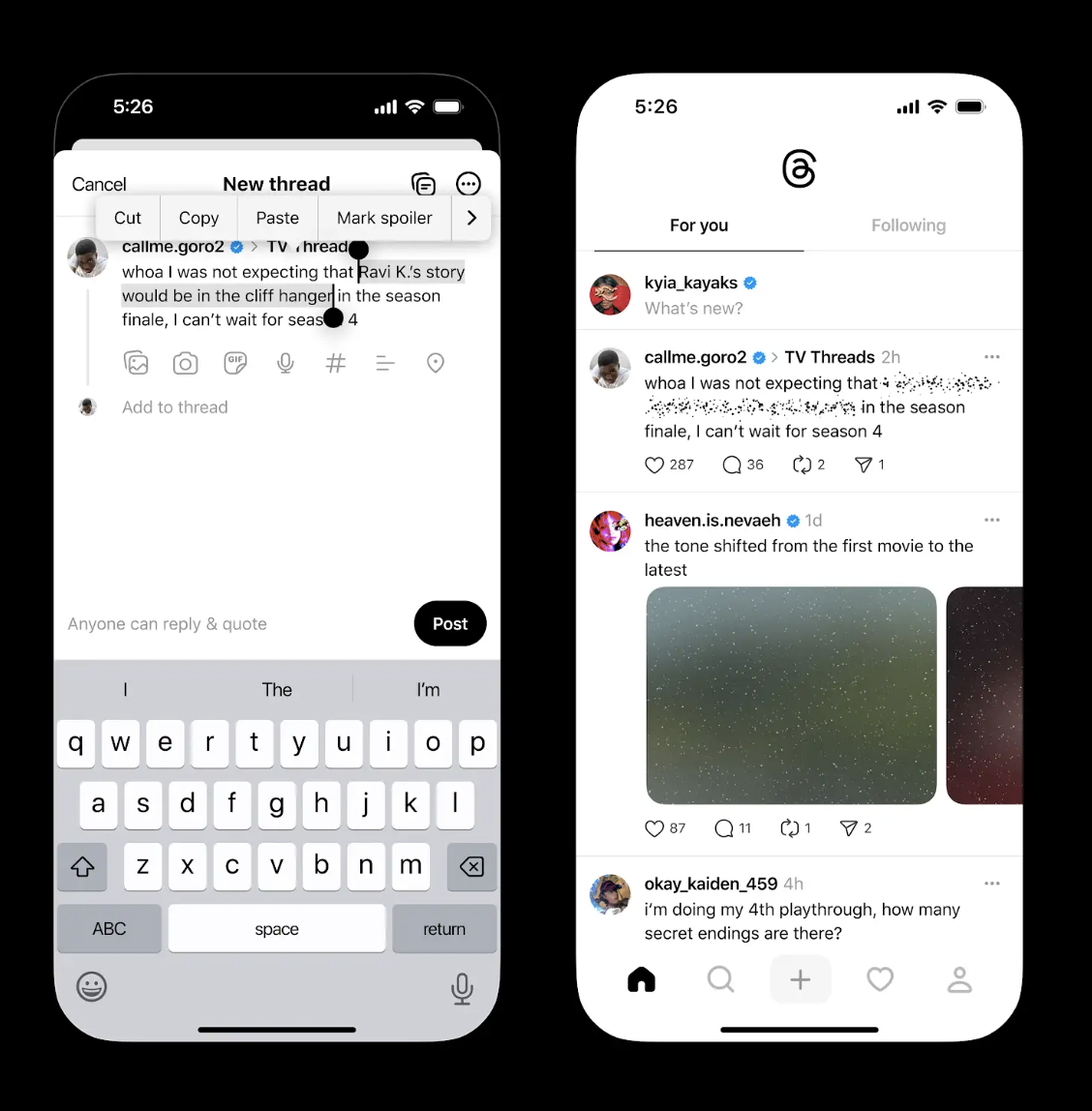
This feature is currently in testing, so only a limited pools of users will have access to it, but I welcome it. (Not that I particularly use Threads all that much.) As you can see in the images below (via TechCrunch), once the feature rolls out, you’ll be able to highlight a selection of text in a thread draft and choose a new “Mark spoiler” option that appears in the pop-up. Your selections will be hidden from others who come across your post, unless they choose to tap in and see what you wrote.

https://www.prime-wow.com/wp-content/uploads/2025/06/threads-spoiler.png

Threads, of course, isn’t the first platform to offer this type of spoiler mask. Other social media companies, like Discord, Reddit, and Mastodon, have offered ways for posters to mind spoilers for years. There’s no way to enforce the feature, but it’s just considerate: You never know who your post will reach, and if you care enough about a show or movie to post about it, you likely appreciate allowing people the opportunity to watch that content on their own before being spoiled.

California AI Policy Report Warns of ‘Irreversible Harms’

An anonymous reader quotes a report from Time Magazine: While AI could offer transformative benefits, without proper safeguards it could facilitate nuclear and biological threats and cause “potentially irreversible harms,” a new report commissioned by California Governor Gavin Newsom has warned. “The opportunity to establish effective AI governance frameworks may not remain open indefinitely,” says the report, which was published on June 17 (PDF). Citing new evidence that AI can help users source nuclear-grade uranium and is on the cusp of letting novices create biological threats, it notes that the cost for inaction at this current moment could be “extremely high.” […]

“Foundation model capabilities have rapidly advanced since Governor Newsom vetoed SB 1047 last September,” the report states. The industry has shifted from large language AI models that merely predict the next word in a stream of text toward systems trained to solve complex problems and that benefit from “inference scaling,” which allows them more time to process information. These advances could accelerate scientific research, but also potentially amplify national security risks by making it easier for bad actors to conduct cyberattacks or acquire chemical and biological weapons. The report points to Anthropic’s Claude 4 models, released just last month, which the company said might be capable of helping would-be terrorists create bioweapons or engineer a pandemic. Similarly, OpenAI’s o3 model reportedly outperformed 94% of virologists on a key evaluation. In recent months, new evidence has emerged showing AI’s ability to strategically lie, appearing aligned with its creators’ goals during training but displaying other objectives once deployed, and exploit loopholes to achieve its goals, the report says. While “currently benign, these developments represent concrete empirical evidence for behaviors that could present significant challenges to measuring loss of control risks and possibly foreshadow future harm,” the report says.

While Republicans have proposed a 10 year ban on all state AI regulation over concerns that a fragmented policy environment could hamper national competitiveness, the report argues that targeted regulation in California could actually “reduce compliance burdens on developers and avoid a patchwork approach” by providing a blueprint for other states, while keeping the public safer. It stops short of advocating for any specific policy, instead outlining the key principles the working group believes California should adopt when crafting future legislation. It “steers clear” of some of the more divisive provisions of SB 1047, like the requirement for a “kill switch” or shutdown mechanism to quickly halt certain AI systems in case of potential harm, says Scott Singer, a visiting scholar in the Technology and International Affairs Program at the Carnegie Endowment for International Peace, and a lead-writer of the report.

Instead, the approach centers around enhancing transparency, for example through legally protecting whistleblowers and establishing incident reporting systems, so that lawmakers and the public have better visibility into AI’s progress. The goal is to “reap the benefits of innovation. Let’s not set artificial barriers, but at the same time, as we go, let’s think about what we’re learning about how it is that the technology is behaving,” says Cuellar, who co-led the report. The report emphasizes this visibility is crucial not only for public-facing AI applications, but for understanding how systems are tested and deployed inside AI companies, where concerning behaviors might first emerge. “The underlying approach here is one of ‘trust but verify,'” Singer says, a concept borrowed from Cold War-era arms control treaties that would involve designing mechanisms to independently check compliance. That’s a departure from existing efforts, which hinge on voluntary cooperation from companies, such as the deal between OpenAI and Center for AI Standards and Innovation (formerly the U.S. AI Safety Institute) to conduct pre-deployment tests. It’s an approach that acknowledges the “substantial expertise inside industry,” Singer says, but “also underscores the importance of methods of independently verifying safety claims.”


Read more of this story at Slashdot.

Iran Is Going Offline To Prevent Purported Israeli Cyberattacks

In response to escalating tensions with Israel, Iran has begun throttling internet access, with plans to disconnect from the global internet entirely to prevent Israeli cyberattacks. The Iranian government also urges citizens to delete WhatsApp — one of the country’s most popular messaging platforms — claiming without evidence that the Meta-owned app has been weaponed by Israel to spy on its users. (WhatsApp vehemently denied those claims in a statement to the Associated Press.) Telegram is also said to be blocked as well. The Verge reports: The announcements come amidst the escalating war between Iran and Israel, which broke out after Israel attacked the country on June 12th, and a rise in reported internet outages. Civilians have claimed that they’ve been unable to access basic but critical telecommunications services, such as messaging apps, maps, and sometimes the internet itself. Cloudflare reported that two major Iranian cellular carriers effectively went offline on Tuesday, and The New York Times reports that even VPNs, which Iranians frequently use to access banned sites like Facebook and Instagram, have become increasingly harder to access. […]

Israel’s role in the cyber outages has not been officially confirmed, but independent analysts at NetBlocks noticed a significant reduction of internet traffic originating from Iran on Tuesday, starting at 5:30 PM local time. According to Tasnim, a news network affiliated with the Iranian Revolutionary Guards, Iranians will still have access to the country’s state-operated national internet service, though two Iranian officials told the Times that the internal bandwidth could be reduced by up to 80 percent.


Read more of this story at Slashdot.

Senate Passes Stablecoin Bill In Major Win For Crypto Industry

The U.S. Senate has approved the GENIUS Act with a 68-30 final vote that “saw a huge surge of Democrats joining their Republican counterparts,” reports CoinDesk. What the bill sets out to do is create the first federal regulatory framework for U.S. stablecoins, requiring issuers to maintain full 1:1 reserves in cash or Treasuries, adhere to regular audits and anti-money laundering rules, and gain regulatory approval — all while allowing foreign stablecoin access under strict oversight rules. From the report: As written, the bill would set up guardrails around the approval and supervision of U.S. issuers of stablecoins, the dollar-based tokens such as the ones backed by Circle, Ripple and Tether. Firms making these digital assets available to U.S. users would have to meet stringent reserve demands, transparency requirements, money-laundering compliance and regulatory supervision that’s also likely to include new capital rules. “This is a win for the U.S., a win for innovation and a monumental step towards appropriate regulation for digital assets in the United States,” said Amanda Tuminelli, executive director and chief legal officer of the DeFi Education Fund, in a similar statement. […]

While this is the first significant crypto bill to clear the Senate, it’s also the first time a stablecoin bill has passed either chamber, despite years of negotiation in the House Financial Services Committee that managed to produce other major crypto legislation in the previous congressional session. The destiny of the GENIUS Act is also tied closely to the House’s own Digital Asset Market Clarity Act, the more sweeping crypto bill that would establish the legal footing of the wider U.S. crypto markets. The stablecoin effort is slightly ahead of the bigger task of the market structure bill, but the industry and their lawmaker allies argue that they’re inextricably connected and need to become law together. So far, the Clarity Act has been cleared by the relevant House committees and awaits floor action.


Read more of this story at Slashdot.

Trump Extends TikTok Deadline For Third Time

President Trump will extend the deadline for ByteDance to divest TikTok’s U.S. operations by another 90 days, marking the third extension since taking office. The extension aims to prevent a TikTok ban while negotiations with potential buyers like Oracle and Project Liberty continue. CNBC reports: “President Trump will sign an additional Executive Order this week to keep TikTok up and running,” White House Press Secretary Karoline Leavitt said in a statement. “As he has said many times, President Trump does not want TikTok to go dark. This extension will last 90 days, which the Administration will spend working to ensure this deal is closed so that the American people can continue to use TikTok with the assurance that their data is safe and secure.”

ByteDance was nearing the deadline of June 19, to sell TikTok’s U.S. operations in order to satisfy a national security law that the Supreme Court upheld just a few days before Trump’s second presidential inauguration. Under the law, app store operators like Apple and Google and internet service providers would be penalized for supporting TikTok. ByteDance originally faced a Jan. 19 deadline to comply with the national security law, but Trump signed an executive order when he first took office that pushed the deadline to April 5. Trump extended the deadline for the second time a day before that April mark. Trump told NBC News in May that he would extend the TikTok deadline again if no deal was reached, and he reiterated his plans on Thursday.


Read more of this story at Slashdot.

Why China is Giving Away Its Tech For Free

An anonymous reader shares a report: […] the rise in China of open technology, which relies on transparency and decentralisation, is awkward for an authoritarian state. If the party’s patience with open-source fades, and it decides to exert control, that could hinder both the course of innovation at home, and developers’ ability to export their technology abroad.

China’s open-source movement first gained traction in the mid-2010s. Richard Lin, co-founder of Kaiyuanshe, a local open-source advocacy group, recalls that most of the early adopters were developers who simply wanted free software. That changed when they realised that contributing to open-source projects could improve their job prospects. Big firms soon followed, with companies like Huawei backing open-source work to attract talent and cut costs by sharing technology.

Momentum gathered in 2019 when Huawei was, in effect, barred by America from using Android. That gave new urgency to efforts to cut reliance on Western technology. Open-source offered a faster way for Chinese tech firms to take existing code and build their own programs with help from the country’s vast community of developers. In 2020 Huawei launched OpenHarmony, a family of open-source operating systems for smartphones and other devices. It also joined others, including Alibaba, Baidu and Tencent, to establish the OpenAtom Foundation, a body dedicated to open-source development. China quickly became not just a big contributor to open-source programs, but also an early adopter of software. JD.com, an e-commerce firm, was among the first to deploy Kubernetes.

AI has lately given China’s open-source movement a further boost. Chinese companies, and the government, see open models as the quickest way to narrow the gap with America. DeepSeek’s models have generated the most interest, but Qwen, developed by Alibaba, is also highly rated, and Baidu has said it will soon open up the model behind its Ernie chatbot.


Read more of this story at Slashdot.

KDE Plasma 6.4 Released

Longtime Slashdot reader jrepin writes: Plasma is a popular desktop (and mobile) environment for GNU/Linux and other UNIX-like operating systems. Among other things, it also powers the desktop mode of the Steam Deck gaming handheld. The KDE community today announced the latest release: Plasma 6.4. This fresh new release improves on nearly every front, with progress being made in accessibility, color rendering, tablet support, window management, and more.

Plasma already offered virtual desktops and customizable tiles to help organize your windows and activities, and now it lets you choose a different configuration of tiles on each virtual desktop. The Wayland session brings some new accessibility features: you can now move the pointer using your keyboard’s number pad keys, or use a three-finger touchpad pinch gesture to zoom in or out.

Plasma file transfer notification now shows a speed graph, giving you a more visual idea of how fast the transfer is going and how long it will take to complete. When any applications are in full screen mode Plasma will now enter Do Not Disturb mode and only show urgent notifications. When you exit full-screen mode, you’ll see a summary of any notifications you missed.

Now, when an application tries to access the microphone and finds it muted, a notification will pop up. A new feature in the Application Launcher widget will place a green New! tag next to newly installed apps, so you can easily find where something you just installed lives in the menu.

The Display and Monitor page in System Settings comes with a brand new HDR calibration wizard. Support for Extended Dynamic Range (a different kind of HDR) and P010 video color format has also been added. System Monitor now supports usage monitoring for AMD and Intel graphic cards — it can even show the GPU usage on a per-process basis.

Spectacle, the built-in app for taking screenshots and screen recordings, has a much-improved design and more streamlined functionality. The background of the desktop or window now darkens when an authentication dialog shows up, helping you locate and focus on the window asking for your password.

There’s a brand-new Animations page in System Settings that groups all the settings for purely visual animated effects into one place, making them easier to find and configure. Aurorae, a newly added SVG vector graphics theme engine, enhances KWin window decorations.

You can read more about these and many other other features in the Plasma 6.4 announcement and complete changelog.


Read more of this story at Slashdot.

Donald Trump will delay a looming TikTok ban for a third time

President Donald Trump will, once again, give TikTok a temporary reprieve as it faces another deadline to sell itself or face a ban in the United States. White House Press Secretary Karoline Leavitt confirmed Tuesday that Trump will sign another executive order to extend the deadline.

The latest extension — this time for 90 days — is now the third time Trump has punted on a looming TikTok ban since he took office in January. “As he has said many times, President Trump does not want TikTok to go dark,” Leavitt said in a statement reported by CNN. “This extension will last 90 days, which the Administration will spend working to ensure this deal is closed so that the American people can continue to use TikTok with the assurance that their data is safe and secure.”

US officials are presumably still negotiating terms of a potential deal that would allow TikTok to remain operational in the United States, though there’s been little news on that front since the last extension in April. A number of potential buyers are interested in acquiring TikTok’s US business, but officials in China would need to sign off on any agreement. In April, several reports suggested that a deal would likely involve the company’s existing US investors rolling over their stakes into a new entity. Those talks were derailed by Trump’s tariffs on Chinese imports.

This article originally appeared on Engadget at https://www.engadget.com/social-media/donald-trump-will-delay-a-looming-tiktok-ban-for-a-third-time-231757522.html?src=rss

Thief VR Studio’s Next Game Based On “Flagship IP” From Major Movie

A new job listing confirms Maze Theory’s next game after Thief VR is based on a “flagship IP” to coincide with an upcoming movie.

After announcing Thief VR: Legacy of Shadow earlier this month with Vertigo Games, UK-based studio Maze Theory is looking to its next project following its release. Codenamed Project Xeno, a new job listing for Lead Gameplay Designer/Creative Lead calls this a “groundbreaking” immersive narrative experience built for next-generation VR and mixed reality platforms.

Stating this is a “flagship IP in collaboration with a major movie,” Maze Theory advises this upcoming project “fuses cinematic storytelling, innovative gameplay systems, and a deeply emotional sci-fi journey.” Unsurprisingly, the listing doesn’t offer more clues to what this project might be, and the role is a fixed-term contract for up to a year that could potentially become a full-time position.

Given the codename and sci-fi setting, this could potentially be tied to Alien. Ridley Scott’s working on a new film entry, and the franchise antagonists are known as Xenomorphs. However, that might conflict with the Alien: Rogue Incursion sequel, which Survios stated is still in development after suspending new VR updates “in the near term” for the first game, so that’s just speculation for now.

Maze Theory is no stranger to licensed collaborations across VR gaming, having formerly worked on Peaky Blinders: The King’s Ransom and Doctor Who: The Edge of Time. Beyond Thief VR, the developer has more recently been working on original titles like Freerunner Championships, mixed reality puzzle game Infinite Inside, and the PlayStation VR2 version of Ancient Dungeon VR.

Specific platforms and a release window are currently unknown, and we’ll keep you informed if we learn more about Project Xeno anytime soon.

Hades II adds more combat options in its third major early access update

Hades II announced its third update today. The sequel to 2020 indie game darling Hades is technically still in early access on PC and Mac, but has been getting some beefy updates ahead of its expected official release later this year. The Unseen Update is a free, automatic update that mostly focuses on new combat development.

There’s a new Vow of Rivals that allows players to challenge more powerful Guardian foes. All of the main weapons have received hidden aspects that offer new forms and fighting styles. There’s also new hexes and blessings, some fresh artwork, and new story events to help grow your relationships with the many members of the ancient Greek pantheon.

When Hades II does exit early access with the launch of v1.0 — and developer Supergiant said that it doesn’t have a timeline for that yet — the game will follow its predecessor’s launch schedule. Switch 2 and Switch will be the first consoles to get the full release alongside PC and Mac, with PlayStation and Xbox players needing to wait before they’ll get a version of the rogue-like.

This article originally appeared on Engadget at https://www.engadget.com/gaming/hades-ii-adds-more-combat-options-in-its-third-major-early-access-update-225206452.html?src=rss

AI Will Shrink Amazon’s Workforce In the Coming Years, CEO Jassy Says

In a memo to employees on Tuesday, Amazon CEO Andy Jassy said that the company’s corporate workforce will shrink in the coming years as it adopts more generative AI tools and agents. “We will need fewer people doing some of the jobs that are being done today, and more people doing other types of jobs,” Jassy said. “It’s hard to know exactly where this nets out over time, but in the next few years, we expect that this will reduce our total corporate workforce.” CNBC reports: Jassy wrote that employees should learn how to use AI tools and experiment and figure out “how to get more done with scrappier teams.” The directive comes as Amazon has laid off more than 27,000 employees since 2022 and made several cuts this year. Amazon cut about 200 employees in its North America stores unit in January and a further 100 in its devices and services unit in May. Amazon had 1.56 million full-time and part-time employees in its global workforce as of the end of March, according to financial filings. The company also employs temporary workers in its warehouse operations, along with some contractors.

Amazon is using generative AI broadly across its internal operations, including in its fulfillment network where the technology is being deployed to assist with inventory placement, demand forecasting and the efficiency of warehouse robots, Jassy said. […] In his most recent letter to shareholders, Jassy called generative AI a “once-in-a-lifetime reinvention of everything we know.” He added that the technology is “saving companies lots of money,” and stands to shift the norms in coding, search, financial services, shopping and other areas. “It’s moving faster than almost anything technology has ever seen,” Jassy said.


Read more of this story at Slashdot.

All 17 fired vaccine advisors unite to blast RFK Jr.’s “destabilizing decisions”

All 17 experts ousted from the federal vaccine advisory committee have spoken out about the drastic changes that anti-vaccine advocate and current US health secretary Robert F. Kennedy Jr. has made since taking office. Those changes include unilaterally restricting access to COVID-19 vaccines and summarily firing the entire Advisory Committee on Immunization Practices (ACIP), which had guided federal vaccine policies for more than 60 years.

“We are deeply concerned that these destabilizing decisions, made without clear rationale, may roll back the achievements of US immunization policy, impact people’s access to lifesaving vaccines, and ultimately put US families at risk of dangerous and preventable illnesses,” the fired experts write in an editorial published in JAMA.

Kennedy dismissed the entire committee on June 9, accusing the former members of lacking public trust and being “plagued with persistent conflicts of interest,” despite the committee’s transparent disclosure and conflict of interest policies.

Read full article

Comments

Spain’s Government Blames Huge Blackout On Grid Regulator and Private Firms

An anonymous reader quotes a report from the BBC: The Spanish government has said that the national grid operator and private power generation companies were to blame for an energy blackout that caused widespread chaos in Spain and Portugal earlier this year. Shortly after midday on April 28, both countries were disconnected from the European electricity grid for several hours. Businesses, schools, universities, government buildings and transport hubs were all left without power and traffic light outages caused gridlocks. While schoolchildren, students and workers were sent home for the day, many other people were stuck in lifts or stranded on trains in isolated rural areas.

In the immediate aftermath, the left-wing coalition government did not provide an explanation, instead calling for patience as it investigated. Nearly two months after the unprecedented outage, the minister for ecological transition, Sara Aagesen, has presented a report on its causes. She said the partly state-owned grid operator, Red Electrica, had miscalculated the power capacity needs for that day, explaining that the “system did not have enough dynamic voltage capacity.” The regulator should have switched on another thermal plant, she said, but “they made their calculations and decided that it was not necessary.”

Aagesen also blamed private generators for failing to regulate the grid’s voltage shortly before the blackout happened. “Generation firms which were supposed to control voltage and which, in addition, were paid to do just that did not absorb all the voltage they were supposed to when tension was high,” she said, without naming any of the companies responsible. The day after the outage, Prime Minister Pedro Sanchez suggested that private electricity companies might have played a role, saying that his government would demand “all the relevant accountability” from them. However, the new report on the blackout also raises questions about the role of Beatriz Corredor, president of Red Electrica and a former Socialist minister, who had previously insisted that the grid regulator had not been at fault. Aagesen said there was no evidence of a cyberattack behind the blackout. The government also maintained that Spain’s renewable energy output was not to blame.


Read more of this story at Slashdot.

Amazon Is Giving Six PC Games Away for Free Right Now

We may earn a commission from links on this page. Deal pricing and availability subject to change after time of publication.

Prime Day 2025 is going to be twice as long as previous years, and hopefully, the deals will be twice as good (I doubt it though). Leading up to the big sale, which starts starts July 8 and runs through July 11, Prime Members can snatch free PC games from Prime Gaming, one of the many Amazon Prime perks you might not even be aware of.

While Prime Gaming often offers free PC games, Amazon has released six new ones to get your attention prior to Prime Day. Here are the options on offer right now:

Most of these games will be available for you to “claim” until August 18, but others are only available through Jul 21, so pick them up sooner rather than later—you can get all six if you want. You’ll get to keep the games forever, even if you quit Prime or are just taking advantage of an Amazon Prime free trial. You can also get a free Twitch subscription through Prime Gaming.

As a Prime Member, you also get access to Amazon Luna, a cloud gaming platform that offers new free games every month. You don’t need a console or even a computer to play them, if you have a Fire TV or Fire Stick.

Remember, you will need to be a Prime Member to shop Amazon’s Prime Day deals and get free shipping. Prime membership starts at $14.99 per month ($139 per year). It’s easy to figure out if yearly Prime membership is worth it for you, but remember, you can always cancel your Prime membership once the sale is over. (Here’s how to sign up for a Prime account.)

OpenXR Spatial Entities Extensions Standardize Surfaces, Markers, Anchors & Persistence

The new OpenXR Spatial Entities Extensions standardize surface detection, marker tracking, spatial anchors, and persistence.

OpenXR is the open standard API for AR/VR/MR app development and runtimes. It’s managed by Khronos, the same non-profit industry consortium that manages OpenGL, Vulkan, and WebGL.

The ideal of OpenXR is that developers can build apps that run on any headset, without needing to use vendor-specific core APIs for different hardware. Almost every headset, engine, and runtime supports OpenXR today, except for Apple Vision Pro and PlayStation VR2 on PS5.

OpenXR Spatial Entities Extensions

The new OpenXR Spatial Entities Extensions aim to standardize how developers leverage the environment tracking capabilities of headsets and glasses to build experiences that interact with the user’s physical environment, a class of capabilities that until now have been handled by vendor-specific extensions or SDKs.

OpenXR Spatial Entities Extensions are organized around a base XR_EXT_spatial_entities extension, which itself provides “foundational functionality for representing and interacting with spatial elements in the user’s environment”.

The five extensions that build on this base extension are:

  • XR_EXT_spatial_plane_tracking: “detection and spatial tracking of real-world surfaces”.
  • XR_EXT_spatial_marker_tracking: “6 DOF (Degree of Freedom) tracking of visual markers such as QR codes in the environment”.
  • XR_EXT_spatial_anchor: “enables precise positioning of virtual content relative to real-world locations”.
  • XR_EXT_spatial_persistence: “allows spatial context to persist across application sessions”.
  • XR_EXT_spatial_persistence_operations: “advanced management of persistent spatial data”.

“The OpenXR Spatial Entities Extensions address one of the most critical needs expressed by our developer community, and represent a significant milestone in our mission to create a powerful and truly interoperable XR ecosystem,” said Meta’s Ron Bessems, the current chair of the OpenXR Working Group in a prepared statement. “The Spatial Entities Extensions are carefully defined as a discoverable and extensible set of functionality, providing a firm foundation for spatial applications today, and enabling continued innovation in portable spatial computing into the future.”

Khronos says that future extensions “under discussion” include “image and object tracking, as well as the generation and processing of mesh-based models of the user’s environment”.

Meta, Google, Pico, Varjo, Unity, Godot, and Collabora released statements expressing support for OpenXR Spatial Entities Extensions, and all seven companies will support them soon.

X sues New York over hate speech disclosure law

Social media company X has filed a lawsuit against the state of New York over a law governing hate speech. The social network’s Global Government Affairs account posted about the suit, claiming the law’s required disclosures infringe on First Amendment protections for free speech.

The Stop Hiding Hate Act, which is slated to take effect this week, would require social media companies to report on how they define and moderate content including hate speech, misinformation, disinformation, harassment and foreign political influence.

X sued California in 2023 about a similar state-level law regarding content moderation. A panel from the Ninth Circuit Court of Appeals put a hold on the lower court’s initial ruling in favor of California. While the law did endure, a settlement between the state and the company at the start of 2025 led to the elimination of the provisions that X claimed were unconstitutional.

This article originally appeared on Engadget at https://www.engadget.com/social-media/x-sues-new-york-over-hate-speech-disclosure-law-214655414.html?src=rss

Meta Ceases Onward Development & Merges Downpour Into Camouflaj

Downpour Interactive has been merged into Batman: Arkham Shadow studio Camouflaj as Meta ends development of Onward.

Less than three months after the major Onward 2.0 launch, Downpour Interactive confirmed no further updates are coming. Onward will continue to be available across Steam, Quest and Link, but it won’t receive further developer support beyond critical bug fixes. There’s no longer a dedicated support team, and the studio advises contacting Quest or Steam support for any technical issues.

Following its acquisition by Meta (then Facebook) back in 2021, Downpour Interactive marks the latest first party studio closure after Ready at Dawn shut down last year. However, Downpour’s team has been “permanently” merged into another first party studio, Iron Man VR and Batman: Arkham Shadow studio Camouflaj.

Meta Laid Off Staff In Acquired VR Game Studios
Meta laid off “many” employees at Echo VR’s developer Ready at Dawn and Onward’s developer Downpour Interactive.
UploadVRDavid Heaney

Initially launched in 2016 on Steam, Onward was one of the longest running VR multiplayer games that continued receiving active support. A Quest version arrived in 2020, the game continued receiving content updates, and Mark Zuckerberg seemingly confirmed Onward 2 in 2021. While today’s announcement doesn’t indicate new layoffs, the studio was previously affected back in 2023, one month after former CEO Dante Buckley resigned.

Following a handful of smaller updates, Onward 2.0 then delivered the multiplayer shooter’s biggest update yet back in March. That introduced a major graphical overhaul across weapons and equipment, a new co-op game mode, 13 new weapons, a brand-new map, an operator system for customizing your character model, and more.

Onward Update 2.0 Is Out Now, Overhauling Every Weapon
Onward Update 2.0 is out now, bringing a graphical overhaul of every weapon and item, new weapons, a remastered classic map, a new map, and more.
UploadVRDavid Heaney

For now, Onward remains available on the Meta Horizon Store for Quest, Meta’s PC Store for Link & Rift, and Steam. We’ll keep you informed should that change.

Cybersecurity takes a big hit in new Trump executive order

Cybersecurity practitioners are voicing concerns over a recent executive order issued by the White House that guts requirements for: securing software the government uses, punishing people who compromise sensitive networks, preparing new encryption schemes that will withstand attacks from quantum computers, and other existing controls.

The executive order (EO), issued on June 6, reverses several key cybersecurity orders put in place by President Joe Biden, some as recently as a few days before his term ended in January. A statement that accompanied Donald Trump’s EO said the Biden directives “attempted to sneak problematic and distracting issues into cybersecurity policy” and amounted to “political football.”

Pro-business, anti-regulation

Specific orders Trump dropped or relaxed included ones mandating (1) federal agencies and contractors adopt products with quantum-safe encryption as they become available in the marketplace, (2) a stringent Secure Software Development Framework (SSDF) for software and services used by federal agencies and contractors, (3) the adoption of phishing-resistant regimens such as the WebAuthn standard for logging into networks used by contractors and agencies, (4) the implementation new tools for securing Internet routing through the Border Gateway Protocol, and (5) the encouragement of digital forms of identity.

Read full article

Comments