GameStop CEO Says The Company’s Future Isn’t In Games

GameStop is leaning heavily to trading cards as part of its future strategy, according to CEO Ryan Cohen. The news comes as a part of larger strategy shift to buy and hold a lot of bitcoin. From a report: Cohen has said that continuing to focus on trading cards, including the incredibly popular recent Pokemon card sets, is a “natural extension” of GameStop’s business. He added that the collectibles could have potential for high profit margins.

Pokemon cards have a seen a gigantic resurgence recently. Stores regularly sell of sets, including the Destined Rivals set that launched on May 30. Cards have become increasingly hard to find as scalpers buy up supply and sell Pokemon card products — including cards, special boxes, and accessories — at exorbitant prices.


Read more of this story at Slashdot.

Dad Embarrasses Son On Last Day Of School With Driveway Performance Of ‘School’s Out’

Your children: they’re for embarrassing in front of their friends. Plus doing the chores you don’t want to do for a very meager allowance. Or no allowance at all. This is a video of father Matt (not a priest) and a group of his dad pals performing Alice Cooper’s ‘School’s Out’ in the driveway on the last day of school as his son Liam gets off the bus. Hey, better than him just waiting there to tell you to mow the lawn. *shrug* Now where’s your dad keep his weed?

These VA Tech scientists are building a better fog harp

A fog harp prototype collects water vapor. Credit: Virginia Tech

Arid coastal regions that are also prone to fog are prime locations for fog-harvesting devices as a water source, especially during prolonged droughts. But the standard technology is prone to clogging. Scientists at Virginia Tech have created an improved version of their earlier “fog harp” alternative design to address that issue, according to a new paper published in the Journal of Materials Chemistry A.

Fog harvesting (or dew catching) is an ancient practice dating as far back as the Incas, who placed buckets under trees to collect condensation. It’s also practiced by certain insects, notably Namib desert beetles, which survive on the water that condenses onto their wings. The wings have alternating hydrophilic and hydrophobic regions to enhance the condensation. Today’s fog harvesters are usually mesh nets mounted onto frames with a trough or basin underneath. Like the beetle’s wings, the mesh filaments are chemically coated to be either hydrophobic or hydrophilic.

The efficiency of these water harvesters depends on decreasing the size of the filaments and the mesh holes. “If the holes were too big, the microscopic droplets would pass through it, and it wouldn’t harvest much water,” co-author James Kaindu, a student in researcher Jonathan Boreyko’s lab at Virginia Tech, told Ars. The trade-off is that smaller filaments and holes are more prone to clogging. “If it was too small, the droplets would coalesce and create a water film on it,” said Kaindu. “It would impede the flow and act as a barrier that would dramatically affect its capture efficiency.”

Read full article

Comments

How to Restrict Users to FTP Access Only on Linux

There are situations when you want to allow a user to access a system solely through FTP, while blocking all other forms of access like SSH or shell logins. This approach is particularly useful in managed hosting environments or shared systems where limiting user capabilities can improve both performance and security. For a deeper understanding of package configurations on Linux systems, check out our article on how to verify if a package is installed in Debian and RHEL-based distros, or explore modern enterprise alternatives like AlmaLinux OS 10.

Restricting shell access while allowing FTP is easy to implement using built-in Linux features. These changes ensure the user cannot initiate an interactive shell session but still has access to FTP services as needed. It’s also a good idea to familiarize yourself with advanced Linux topics such as installing the latest kernel on Ubuntu or understanding symbolic and hard links for better system control.

The post How to Restrict Users to FTP Access Only on Linux appeared first on Linux Today.

Your Questions in the Meta AI App Might Be Posted Publicly

I never thought I’d download Meta AI on my iPhone. After all, people have been mad for over a year that you can’t turn off Meta AI on Facebook and Instagram: Why would you want a dedicated app for this?

Then, I saw the headlines from TechCrunch, Wired, and Business Insider, among many others, that sharply criticize the app’s approach to privacy and security. That’s because Meta AI isn’t Meta’s take on ChatGPT, Gemini, or Claude. Instead, it’s half-chatbot, half-social media platform, where your requests and questions can be shared with the rest of the Meta AI community.

To be clear, your Meta AI interactions aren’t shared by default. You do need to choose to post your queries to the social aspect of the app. Should you choose to do so, your requests are posted to a public Discover feed for all with the app to see. That invites users who want to share their AI creations, of course, as well as trolls who want to spam the feed with silly or offensive requests and generations. But what’s more concerning about the feed, however, is that it hosts posts from users who clearly did not understand they were posting their chats publicly.

Meta AI’s Discover feed is a sight to behold

My first impression when scrolling through this feed was that it does seem like most users are in on the social aspect of the app. Some posts seem geared towards a public audience, with users commenting as they would on an Instagram of Facebook post. And, in fact, most of these posts are pretty harmless: a Maltese dog swimming in a pool; killer clowns from outer space; Nartuo and Deku clashing in an epic multiverse battle; and lots of anthropomorphic animals…so many anthropomorphic animals.

Even some of the personal posts are fine with an audience: I saw a screenshot of someone’s sleep stats presumably tracked from an Apple Watch, and the user was asking Meta AI to analyze the stats and report what it thought. The user was then responding to the comments, including to a user who said “audit looks good” and one who inquired into whether the user sleeps with “these” on—”these” presumably meaning a smart watch? Why you’d want to start a public discussion about your sleep habits with strangers is beyond me, but to each their own.

But every once in a while, you come across something that was clearly intended to remain private—at least between the user and Meta—and is now visible to me. I saw someone post a very close-up selfie asking for a beautiful yet realistic makeover. They didn’t seem happy with the digital, carnival-like makeup the AI used, because they asked once again for it to look realistic. (It didn’t.) Someone asked for a “skinny cute girl anthro lion in pink striped socks, poledancing in the club.” (I can report Meta AI did animate this.) The same man then posted an image of himself with two women kissing in the background (those women were added by Meta AI in a separate request) and asked Meta to keep adding more and more women to the background. The sole comment I saw read: “these are publicly posted, my guy.”

It’s not just that these posts are public: They’re tied to your Meta account, which anyone can tap through to see your entire posting history. One user who asked Meta to generate “muddy bikinis and passionate kisses” also asked Meta AI what to do about a number of red bumps on their inner thigh. Sorry you’re going through that, but, also, why do I and the rest of the Meta AI app know? I’m going to go out on a limb and assume you didn’t mean to share that—unless you’re just messing with us.

Meta AI is a privacy and security nightmare

In general, Meta has a poor reputation when it comes to privacy. (This is the company that allowed 87 million accounts to be exposed to Cambridge Analytica, after all.) But this app is a privacy and security nightmare.

Taking a look at the iOS App Store’s app privacy report card, Meta AI scrapes a ton of your data, including health and fitness, financial information, contact information, browsing history, usage data, your location, contacts, search history, sensitive information, and “surroundings,” which I didn’t even know was a metric. (According to Apple, it means “environment scanning,” including “mesh, planes, scene classification, and/or image detection of the user’s surroundings.”)

But digging through the settings, there are some terrible defaults here. First of all, Meta will suggest your publicly-shared prompts on other platforms, like Facebook and Instagram. (You can turn this off from Meta AI’s in-app settings by tapping your profile icon, then from Data & privacy > Suggesting your prompts on other apps.) Meta AI also keeps “background conversations” enabled, which basically listens to you when you leave the app or put your phone to sleep in case you want to keep chatting with Meta AI at any time. No thanks. (You can turn this off from Settings > Data & privacy > Voice.)

There are also some serious security implications here. One person shared a photo of their computer (one taken with a camera, not a screenshot, mind you), which displayed a warning that their Facebook account would be disabled in 169 days. As it turns out, Facebook had banned their account, but the user had appealed and was confused about what to do next. The user shared their full name, and asked if the bot could “talk to that AI about my appeal?” They then, without prompting, shared what kind of business they run, which was enough information for me to find both their LinkedIn and Instagram accounts. I’m pretty confident this person had no idea their requests to Meta AI were posted publicly, and my guess is if they knew, they wouldn’t be sharing these details so lightly—or conversing with Meta AI at all.

Too many people seem unaware that the posts they share with Meta AI of themselves with friends and family, or the deeply sensitive questions they entrust to the bot, are now public to the community of users scrolling through the Discover tab. Of course, there’s always the chance that any one of these posts is an elaborate troll, especially with the recent media attention on Meta AI’s app. But something tells me the person asking for help with their account ban is a real person, who had no idea their desperate conversation with a Meta product would end up on a public feed, let alone in this article.

Make all your public Meta AI posts private

If you have been posting to the Meta AI app without realizing it, or just regret all of your public posts, you can make them all private in one fell swoop. To do so, head to Settings > Data & privacy > Manage your information. Tap “Make all public prompts visible to only you,” then “Apply to all” to privatize all posts. Or, you can tap “Delete all prompts,” then “Delete all” to get rid of them for good.

The Vaporware That Apple Insists Isn’t Vaporware

At WWDC 2024, Apple showed off a dramatically improved Siri that could handle complex contextual queries like “when is my mom’s flight landing?” The demo was heavily edited due to latency issues and couldn’t be shown in a single take. Multiple Apple engineers reportedly learned about the feature by watching the keynote alongside everyone else. Those features never shipped.

Now, nearly a year later, Apple executives Craig Federighi and Greg Joswiak are conducting press interviews claiming the 2024 demonstration wasn’t “vaporware” because working code existed internally at the time. The company says the features will arrive “in the coming year” — which Apple confirmed means sometime in 2026.

Apple is essentially arguing that internal development milestones matter more than actual product delivery. The executives have also been setting up strawman arguments, claiming critics expected Apple to build a ChatGPT competitor rather than addressing the core issue: announcing features to sell phones that then don’t materialize. The company’s timeline communication has been equally problematic, using euphemistic language like “in the coming year” instead of simply saying “2026” for features that won’t arrive for nearly two years after announcement.

Developer Russell Ivanovic, in a Mastodon post: My guy. You announced something that never shipped. You made ads for it. You tried to sell iPhones based on it. What’s the difference if you had it running internally or not. Still vaporware. Zero difference. MG Siegler: The underlying message that they’re trying to convey in all these interviews is clear: calm down, this isn’t a big deal, you guys are being a little crazy. And that, in turn, aims to undercut all the reporting about the turmoil within Apple — for years at this point — that has led to the situation with Siri. Sorry, the situation which they’re implying is not a situation. Though, I don’t know, normally when a company shakes up an entire team, that tends to suggest some sort of situation. That, of course, is never mentioned. Nor would you expect Apple — of all companies — to talk openly and candidly about internal challenges. But that just adds to this general wafting smell in the air.

The smell of bullshit. Further reading: Apple’s Spin on the Personalized Siri Apple Intelligence Reset.


Read more of this story at Slashdot.

Engineer Builds A Real Life Rideable Transformer

Because some people never give up on their childhood dreams (mine are so far gone I can’t even remember what they were), this is a video of engineer James Bruton (previously) building a rideable Transformer. In drivable car form, it’s about the size of a Power Wheels for tweens, and transforms into a 6-foot standing humanoid. That’s something. But is it more than meets the eye? I’d argue that even with just a quick glance it’s pretty much exactly what meets the eye.

The Internet Archive modernizes its GeoCities GIF search engine

The Internet Archive made it easier to search for ’90s-era GIFs. GifCities contains millions of animations from the decade of flannel shirts and Soup Nazis. The GIFs were pulled from old GeoCities webpages, which (mostly) bit the dust in 2009.

The new version of GifCities is much easier to search. You can now search semantically, based on the animation’s content. In other words, it’s much more likely to bring up the topic or scene you’re looking for by describing it. In GifCities’ old version, you could only search by file name. (If you’re feeling masochistic, you can still access that version under a “Special search” tab.)

The updated GifCities also now uses pagination. That’s a good thing, as the old version’s infinite scrolling could make for slow browsing. You can also create and share “GifGrams.” As the name suggests, these are custom e-greetings made from those ancient GIFs.

GIF search results for Phantom Menace from old GeoCities pages.
Internet Archive

The Internet Archive launched GifCities in 2016 to celebrate its 20th anniversary. If you’re too young to know, GeoCities was the quintessential early internet web-hosting service. A precursor to social media, it was full of embarrassing fan pages, personal photo albums and “Under construction” GIFs. (You’ll find plenty of the latter in this search engine.) Yahoo pulled the plug on most of GeoCities in 2009. (Disclosure: That’s Engadget’s parent company.) However, the Japanese version survived for another decade.

If you’re of a certain age, you’ll likely enjoy browsing the archive. (Or, learn what passed for internet humor before you were born!) Just note that many results are NSFW. I made the mistake of searching for “Mr. T,” and I will now leave you to douse my eyes with bleach.

This article originally appeared on Engadget at https://www.engadget.com/entertainment/the-internet-archive-modernizes-its-geocities-gif-search-engine-192315963.html?src=rss

Google can now generate a fake AI podcast of your search results

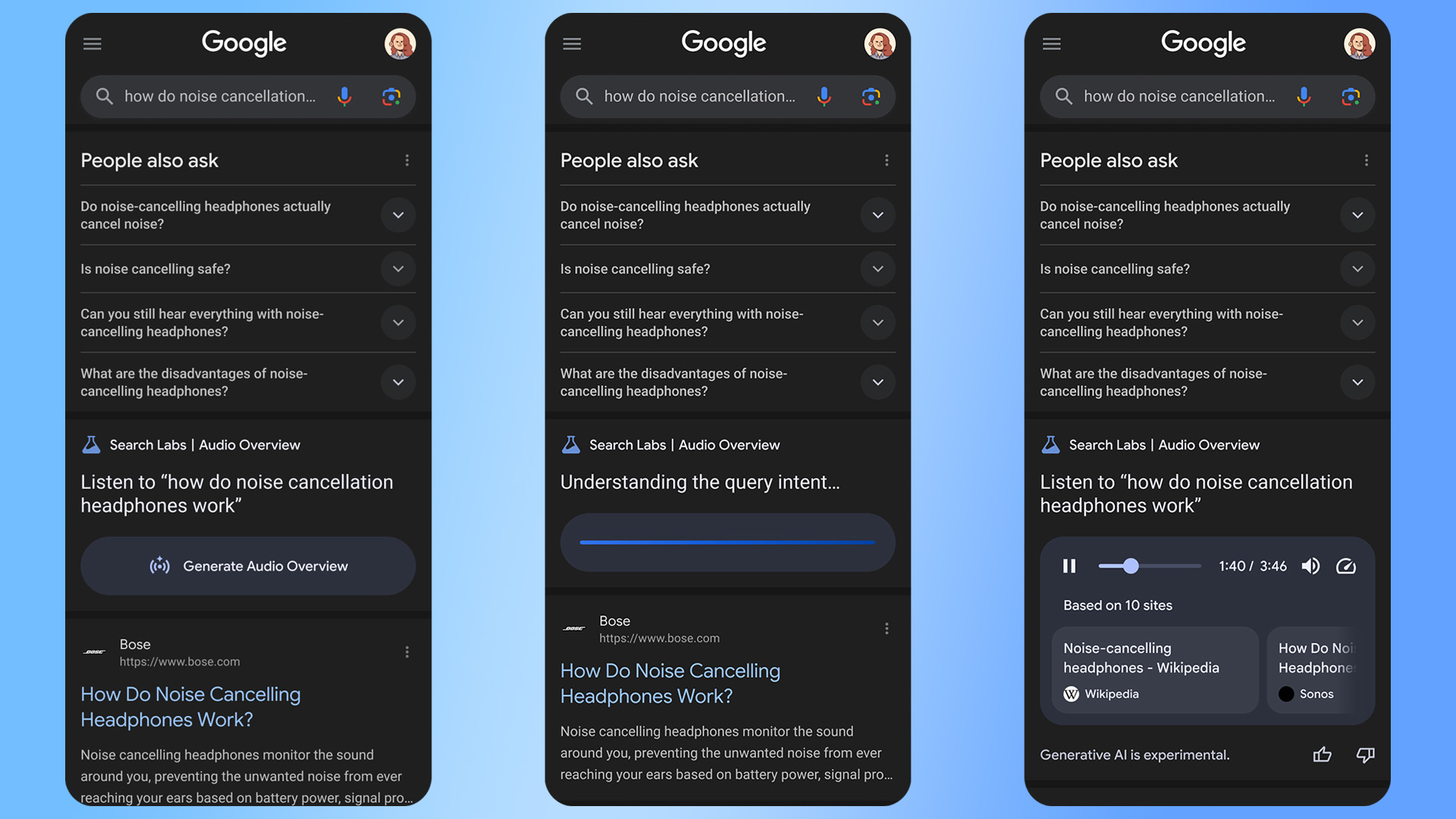
NotebookLM is undoubtedly one of Google’s best implementations of generative AI technology, giving you the ability to explore documents and notes with a Gemini AI model. Last year, Google added the ability to generate so-called “audio overviews” of your source material in NotebookLM. Now, Google has brought those fake AI podcasts to search results as a test. Instead of clicking links or reading the AI Overview, you can have two nonexistent people tell you what the results say.

This feature is not currently rolling out widely—it’s available in search labs, which means you have to manually enable it. Anyone can opt in to the new Audio Overview search experience, though. If you join the test, you’ll quickly see the embedded player in Google search results. However, it’s not at the top with the usual block of AI-generated text. Instead, you’ll see it after the first few search results, below the “People also ask” knowledge graph section.


Credit:
Google

Read full article

Comments

Konami’s Silent Hill Remake Teaser Leaves Gamers In A Cloud Of Mystery

Konami's Silent Hill Remake Teaser Leaves Gamers In A Cloud Of Mystery
After years away from the video game industry, Konami seems to be back in full force. The publisher has been working with several studios to mine its valuable back catalog, with Metal Gear Solid Delta: Snake Eater due to hit later this year. Now, the company is looking to continue its success story by remaking the original Silent Hill, considered

Walmart and Amazon Are Exploring Issuing Their Own Stablecoins

Walmart and Amazon are exploring the possibility of issuing their own stablecoins in the United States, WSJ reported Friday, potentially shifting billions of dollars in transaction volume away from traditional banks and card networks. The retail giants, along with Expedia Group and several airlines, have recently discussed launching corporate stablecoins that would allow them to circumvent the existing payments infrastructure dominated by Visa and Mastercard.

The companies’ final decisions hinge on passage of the Genius Act, legislation currently moving through Congress that would establish a regulatory framework for stablecoins. These digital currencies maintain a one-to-one exchange ratio with dollars and are backed by cash or Treasury reserves, offering merchants the potential for faster payment settlement and significantly reduced processing fees compared to traditional card transactions that can take days to clear.


Read more of this story at Slashdot.

Switch 2 May Get An Unofficial M.2 To MicroSD Express Adapter For Cheaper Storage

Switch 2 May Get An Unofficial M.2 To MicroSD Express Adapter For Cheaper Storage
The Nintendo Switch used regular old MicroSD cards for storage expansion. This was possible because it was a slower machine, and there are plenty of MicroSD cards out there (particularly those with “A2” rating) which could satisfy the Switch software’s I/O needs. The Switch 2 is faster, and needs faster storage, so you’ll have to use expensive

Five of My Favorite YouTube Channels With Free Spin Classes

In-person spin classes are the best kind of spin classes, in my opinion, but I know my perspective is very biased because I teach them multiple times per week. When I’m not teaching, I’m taking classes on my Peloton because that’s a brand I trust to provide me with credentialed, experienced instructors and thoughtful, effective workout routines. I am, however, a woman of the people, so I recognize there is a demand for free options that are still well structured and helpful.

If you’re on a budget, traveling somewhere, or just in need of a quick hit of motivation to hop on a stationary bike, you can approximate the Peloton or in-person class experience on YouTube. Some of the channels and instructors are better than others and there are a few pros and cons. Based on what I know about what makes a good spin class, both in the studio and online, here’s what I recommend.

Kaleigh Cohen

The virtual cycling instructor I give my biggest stamp of approval to is Kaleigh Cohen, who guides her 359,000 followers through not only spinning, but strength workouts, too. (Like Peloton’s app, she offers up a variety, but unlike Peloton’s app, it doesn’t cost you $44 per month to access.)

I like her because she gives straightforward safety and resistance cues and doesn’t chit-chat much. She even offers live classes, which is great for maintaining some accountability and sticking to a schedule. Finally, she actually has real songs—like with lyrics and fun beats—which you won’t find everywhere. Licensing songs is pricey, which is a big reason you have to fork over that $44 to Peloton every month, so a lot of these free channels are serving up straight elevator music. At least Cohen is giving you something fun to ride to, even if you haven’t heard it before.

She also has all the certifications you’d want from an instructor at a real-life gym. Her website actually has a guide that goes over positions, resistance, RPM, and more. She’s as good as it gets, which is why I consider her the best. She offers a variety of workout types, guided stretching (important!), and more, making her well-rounded and genuinely helpful.

Global Cycling Network (GCN)

GCN is closing in on 3.5 million followers, so the brand is clearly doing something right. Much of GCN’s content is about actual outdoor cycling, but it also has some indoor classes, and those are extremely thorough, led by professionals who truly know what they’re talking about.

What I like about the Global Cycling Network is how expansive the content really is. I am not an outdoor rider by any means and have no plans to be, but a lot of my in-person students are, so I try to keep familiar with all of it and produce classes that can be helpful to them. GCN is a great bridge between indoor and outdoor cycling that can help you become familiar with all kinds of bikes, terms, and processes, so whether you’re staying in or actually plan to go out and hit the literal road, you can acquire knowledge from experts that will make you better.

Joe Alvarado

I cannot understand why or how Joe Alvarado only has about 10,000 subscribers, but I do know you should join them. His channel offers two things I think are pretty important for a quality ride: First, he provides dedicated videos that explain key concepts, like how heart rate should play into your cycling workout. Second, he has real music.

However he’s licensing these, we should all be grateful. But his channel is also great because he’s encouraging and the videos are well produced. On the screen, you can see where your resistance should be set and there are even countdown timers to let you know how long you have left on a certain activity, like riding at a moderate effort. He also has actual certifications in teaching group fitness and cycling. I know I sound like a broken record, but that’s really so important.

Kristina Girod

I like Kristina Girod‘s classes because a lot of them are actually filmed POV-style while she’s teaching in a studio. When you’re taking an in-person class, it’s really helpful to see what other people are doing, especially if you’re a beginner, and you get that benefit here. She uses remixes of popular songs, too, which is always engaging and probably a big reason she has 168,000 subscribers.

Two things to keep in mind about Girod’s videos: At times, it can be hard to hear exactly what she’s saying, which I think is just an audio issue that crops up.

Girod also incorporates a lot of different movements. If you’ve ever been to a Soulcycle class and been asked to do pushups on the handlebars or jump in and out of your seat, you might be familiar with this approach, but it’s definitely not done everywhere. From using weights to incorporating some pretty complex moves with your hands on different parts of the handlebars, these classes are challenging. There’s a lot of debate in the cycling instructor world about doing all this stuff and I won’t bore you with it, but I will say I incorporate weights and some choreography into my own classes and am a proponent of it. If you’re used to a more old-school style, you’ll either find Girod’s techniques intriguing or confusing—or maybe both.

Spin Obsession (by Jessi)

Finally, I like what I’ve seen from Spin Obsession‘s Jessi, who teaches outdoors and has high production quality. Again, you see timers on the screen, as well as visual instructions about what you’re supposed to be doing, but she also has a variety of videos available. In some, it’s only music and cues with no chit-chat, while in others she provides more verbal instruction.

The classes come in different lengths and styles, so whether you’re looking for a tabata ride or a hardcore 45-minute grind, you can find something. The channel doesn’t update often and has few followers, but the content that’s there is great.

What to keep in mind when taking YouTube spin classes

There are loads of other channels offering spin classes on YouTube. I didn’t include them because I don’t love them—the video quality sucks on a lot of them, some that seem really promising are in languages I don’t speak, and others just didn’t meet my standards for a good class—but everyone is different and you may find something you’re into by poking around in the “suggested videos” accompanying the ones I linked above. The real benefit of looking into these free classes is that you have so much variety available to you, which isn’t always true when you’re taking a class in-person.

If you’re a beginner, these free classes are a double-edged sword. On the one hand, they can give you a taste of what to expect if you sign up for an in-studio class near you. I’ll be the first to admit the vocab and moves can be hard to grasp if you’re a first-timer (though you should absolutely go early to your first few classes and tell your instructor you’re a beginner, I beg you). On the other hand, the benefit of going in-person is that you get more detailed, specific instruction and there is someone else there to help you or stop you if you’re doing something wrong. If you want to try following along with a class on YouTube, please select one with a knowledgeable, clear instructor and/or on-screen cues and graphics. Watch some videos on topics like bike setup, positions, and resistance before you start. Cohen has a great one and Girod has a very thorough video available to explain all the different kinds of choreography you might be exposed to.

The spiritual sequel to the Pebble smartwatch is on track to ship in July

Eric Migicovsky, the creator of Pebble who’s reviving the e-paper smartwatch with a new company called Core Devices, shared that the first new smartwatches are coming next month. The Core 2 Duo watch is on track to ship to pre-order customers in July and the pricier Core Time 2 is still on track to launch this year.

The $149 Core 2 Duo is “near mass production” according to Migicovsky, and should land in the hands of all pre-order customers during July or August. If you pre-ordered, you’ll be able to confirm your order and shipping details later in June. Migicovsky says he’s also aiming to have “working engineering samples” of the $225 Core Time 2 “within the next month.”

Both the Core 2 Duo and Core Time 2 carry over the basic functionality of Migicovsky’s original Pebble smartwatch, using either black and white or color e-paper displays, with health tracking, access to notifications and the ability to use the back catalog of classic Pebble watch faces and apps. The major difference between the two watches is that the Core Time 2 has a slightly larger screen, a metal frame and a built-in heart rate monitor.

Core Devices is also opening up a beta program to test early watch hardware and its new Android and iOS companion app for syncing notifications and watch faces. You can sign-up to join the beta test via a Google Form and interestingly, Migicovsky writes that the new app will also be compatible with older Pebble hardware like the Pebble Time Steel and Round or the Pebble 2.

This article originally appeared on Engadget at https://www.engadget.com/wearables/the-spiritual-sequel-to-the-pebble-smartwatch-is-on-track-to-ship-in-july-182014025.html?src=rss

Google’s Test Turns Search Results Into an AI-Generated Podcast

Google is rolling out a test that puts its AI-powered Audio Overviews on the first page of search results on mobile. From a report: The experiment, which you can enable in Labs, will let you generate an AI podcast-style discussion for certain queries. If you search for something like, “How do noise cancellation headphones work?”, Google will display a button beneath the “People also ask” module that says, “Generate Audio Overview.” Once you click the button, it will take up to 40 seconds to generate an Audio Overview, according to Google. The completed Audio Overview will appear in a small player embedded within your search results, where you can play, pause, mute, and adjust the playback speed of the clip.


Read more of this story at Slashdot.

Trump’s FTC may impose merger condition that forbids advertising boycotts

The Federal Trade Commission is reportedly pitching a merger condition that would forbid advertising agencies from boycotting platforms based on political content, in a move that could benefit Elon Musk’s X social network and President Trump’s own Truth Social platform.

As the FTC reviews a proposed merger between Omnicom Group and Interpublic Group, two large ad agencies, The New York Times reported yesterday that a “proposed consent decree would prevent the merged company from boycotting platforms because of their political content by refusing to place their clients’ advertisements on them, according to two people briefed on the matter.”

This is one of several moves the FTC has reportedly made to discourage ad boycotts that have riled conservatives. The FTC currently has only Republican commissioners because President Trump fired both Democrats, who allege in a lawsuit that the firings were illegal. Trump also declared sweeping executive power over the FTC and other agencies that were created to operate independently from the White House.

Read full article

Comments

Woman Racer Spotlight: Deb Hodson

Name: Deb Hodson

Hometown: Alamo, CA

How did you get into cycling?  About 25 years I met my partner who raced track. She taught me how to ride track and not kill myself! I learned how to paceline and do leadouts for her as she was a pure sprinter. We also did a lot of road cycling when we were not close to a track. I fell in love with the track bike. Felt like I was one with the bike!

How many years have you been racing on Zwift? I started Zwifting right before the pandemic because my partner was injured. Instead of riding outside alone, I felt safer riding indoors. To be honest, I was running more at the time, and used cycling as my rest days. It’s quite the opposite now. 

Are you part of a Virtual team? OTR (On the Rivet racing) 

What do you love most about racing? I started racing about 2 years ago because my friend signed up and I wanted to ride with her. We joined OTR as a Cat D. I swore I was not going to get addicted to racing, but that soon changed and I love pushing myself. I soon found myself in women’s Cat C. Racing has given me way more confidence in myself. I am now trying to sprint even though climbing for me is much easier. Having a team like OTR has challenged me to be a better cyclist and a better teammate. The other cyclists believing in me encourages me to push myself when I don’t think I can. The support from the team has allowed me to become a faster, smarter racer. It’s truly all about teamwork and an encouraging environment to go like crazy on the bike!

What is your favourite style of race (e.g. points, scratch, iTT, TTT, Chase, duathlon)?  Ladder racing is absolutely my favorite. Bringing different levels of riders to race against another team is like putting together a puzzle. Deciding strategy before and during the race is rewarding. A fantastic way to meet other women cyclists too! Truly a team effort to win a race!

What is your favourite Zwift women’s race series? ZRL women’s division is my main race I have participated in. Being team captain for the women’s team has been such a gift. Watching the teammates support and cheer each other on is so uplifting! Meeting cyclists from other teams while we compete with each other at the back of the pack is so rewarding. I have met the nicest riders racing with me!

What is your most memorable racing experience, inside or outside or BOTH? My most memorable racing experience is when I raced with my friend, and a few of us dropped back and helped and cheered them up the mountains and across the finish. There is nothing better than helping a friend race.

What is your favourite food to eat post-race? My favorite food is peanut butter. I quit sugar years ago, so peanut butter is a treat!! Ok, I will admit to eating chips occasionally… I cherish those chips!

What advice would you give to a woman entering her first Zwift race? If you are entering your first race, warm up first, go hard out of the pen, and celebrate the finish! Jump up and down! We race for fun!

Where can people follow your racing adventures? I post my races on Strava and my races and banjo videos on YouTube. I do have a YouTube channel under my name.

A Minecraft Movie is coming exclusively to HBO Max on June 20

Don’t throw all your popcorn at the screen, but A Minecraft Movie begins streaming exclusively on HBO Max (which used to be Max, which used to be HBO Max) on June 20. The big studio adaptation of the best-selling video game of all time was something of a surprise hit for those unfamiliar with the game’s mammoth audience.

Movie adaptations of video games can be really hit or miss. The Super Mario Bros. Movie set the box office record for the highest-grossing video game movie of all time and was a fun, if safe, movie. On the other end of that spectrum is Borderlands, which was a massive letdown and a box-office failure. With that spotty track record, we were pleasantly surprised when A Minecraft Movie turned out to be…pretty good, actually.

The movie stars Jack Black as Steve, the original player character from the video game, who ends up transported into the voxel world of Minecraft, while Jason Momoa stars as an egomaniacal former gaming superstar. The movie will also debut on the HBO linear cable channel on Saturday, June 21, at 8PM ET.

This article originally appeared on Engadget at https://www.engadget.com/entertainment/tv-movies/a-minecraft-movie-is-coming-exclusively-to-hbo-max-on-june-20-175859982.html?src=rss

Alarming Report Suggests China May Be Spying On Your VPN Browsing Data

Alarming Report Suggests China May Be Spying On Your VPN Browsing Data
If you’re using a VPN service, you most likely do not want others spying on your browsing data. That said, would it surprise you that some apps you use to hide your identity could expose your data without your consent? A recent report suggests that this might be the case, as using certain VPN apps could expose your sensitive data to the Chinese