
As the end of the 1990s approached, a lot of kernel-development effort was
going into improving support for 32-bit systems
with shockingly large amounts of memory installed. This being the 1990s,
having more than 1GB of memory in such a system was deemed to be shocking.
Many of the compromises made to support such inconceivably large systems
have remained in the kernel to this day. One of those compromises —
bounce buffering of I/O requests in the block layer — has finally been
eased out for the 6.16 release, more than a quarter-century after its
introduction.
Monthly Archives: May 2025
Researchers study extinct hominins using enamel proteins from their teeth
The ability to study ancient DNA has revolutionized our ability to understand our own species’ past. It has clarified our relationship with Neanderthals and revealed the existence of Denisovans. But even in the most favorable environments, DNA degrades over time, setting a limit on how far back we can hope to resolve questions about our ancestors. And most of the species we’ve had trouble understanding lived in Africa, where the conditions are far less favorable for DNA’s survival.
But a large international team has now found another way to get some information about the genetics out of far older remains. They’ve extracted fragments of enamel proteins from the teeth of fossils of the species Paranthropus robustus and used them to test whether the remains truly belonged to one species, despite dramatic differences in size. Because one of the proteins is male-specific, they also found the size of the individual wasn’t necessarily related to its sex.
A complicated species
Remains that have been classified as Paranthropus show up in the fossil record nearly 3 million years ago and persist for roughly a million years. That means it overlapped both with australopithecines and early members of the Homo genus. Four different species have been assigned to this genus, but the situation is complicated. It shares a lot of similarities with some species of Australopithecus, raising the possibility of interbreeding. There’s also a lot of variation within remains identified as Paranthropus, notably in the size of individuals. Some have suggested that this might be due to male/female differences in this species (termed “sexual dimorphism”), but that has been difficult to test.
Victoria’s Secret Website Turns Off The Lights After Mysterious Security Incident

Lingerie giant Victoria’s Secret has abruptly taken down its U.S. website and some in-store services, citing an ongoing “security incident.” The move, which has left customers unable to access online shopping and order tracking, comes as the company works with third-party experts to investigate and restore operations. The company has yet disclose
WhatsApp introduces new creative tools for status updates
WhatsApp will soon allow users to post collages, music and new stickers as part of their WhatsApp Status. The status feature within WhatsApp functions similarly to the Stories feature on Facebook and Instagram. Users can share text, photo or video to their status, which will disappear after 24 hours.
Since March, users have had the option to add a song clip to their status and can select songs from the app’s music library. These music clips can be 15 seconds long when posted with photos or 60 seconds long when posted with videos. Now, those clips can be turned into stickers to add some musical flair to your status. Users also have the option to share the song itself as a standalone status update.
A new “Layout” feature will let users create a collage of up to six pictures and share them in their status in a customized layout. A new sticker called “Add Yours” will ask your followers to engage with your status by responding with their own photos. Photos can also now be turned into stickers, which can then be resized and reshaped before being added to your status.
According to Meta, the new status features will start rolling out soon and will become more widely available on WhatsApp in the coming months.
This article originally appeared on Engadget at https://www.engadget.com/big-tech/whatsapp-introduces-new-creative-tools-for-status-updates-180516963.html?src=rss
ASUS Routers Hit By Stealthy Backdoor Botnet Attack That Evades Firmware Upgrades

Heads up if you have an Asus router in your home or office, as there’s a backdoor exploit doing the rounds affecting 9,000 devices and counting. This event came to light by way of the security firm GreyNoise and its Sift AI tool that spotted some odd-looking traffic and flagged it for a closer look.
The page describing the exploit doesn’t
Use This App to Add Windows-Style Auto Scrolling to macOS
You just set up your brand new Mac and are about to scroll through a long document. You press the middle button on your mouse, expecting to be able to scroll by moving your cursor the way you can on Windows or Linux. Nothing happens. What gives?
It turns out macOS doesn’t support this feature, sometimes called auto scrolling. There are all kinds of little annoyances when you switch from one operating system to another, even if you prefer the operating system you’re switching to. This is an example of that but, as usual, there’s an application you can install to get things working the way you expect.
Scrollapp is a free and open-source application that does one thing: Add the fast scrolling feature to your Mac. This simple application can be downloaded from the website and installed by dragging it to your Applications folder. You might see a security warning after trying to run it—you’ll have to head to Security and Privacy in the Settings app to enable the application. After you do that, you’ll see Scrollapp running in the menu bar, as seen above.
After that, you should be able to scroll the way you did on Windows—just click the middle button and move your mouse. You can also enable the feature from the menu bar—just click the Start/Stop Auto-Scroll option—or by pressing the Control key and scrolling a little. That last option is great for trackpads.
The speed of scrolling depends on how far your cursor moves from the starting point, meaning you can scroll more quickly by moving your cursor farther. It’s a great way to power through a long document when you’re looking for something specific.
Disabling the auto scrolling is simple: Just click the left mouse button, or click the middle button again.
This is a simple application, granted, but it solves a specific problem that new Mac users have. If you have more such problems, we’ve got advice about adding the best Windows features to your Mac, so be sure to read that for more tips like this one.
Peacemaker Season 2 Will Feature A Whole New Dancing Intro

The next season of HBO Max and DC’s Peacemaker starring John Cena is bringing back the dancing intro seen in the first season. But this time around, it will feature more characters, new dance moves, and a fresh song. And yes, Eagly fans will get to see the bird shake its tail feathers.
Bonus XP! Route of the Week and XP Express Continues for June
Early this month, Zwift rolled out a new “Route of the Week” feature, plus a slate of XP Express events. Both have proven very popular, so they’re continuing into June. Read on for details…
XP Express Events
Clearly, Zwifters like earning extra XP, with friends, because these events have proven very popular. In fact (checks game), 709 riders are signed up for the event launching 5 minutes from now!
These events are held on Tuesdays and Thursdays. They are 50 minutes long, and you will earn double XP for the duration of the events (so 40XP per kilometer/64XP per mile, vs 20XP per kilometer/32XP per mile).
The rides are open-paced, meaning you can expect the front of the ride to be spicy (race-pace) while there are plenty of groups behind at easier paces.
Upcoming XP Express route schedule:
- June 3: Champs-Élysées
- June 5: 2019 Worlds Harrogate Circuit
- June 10: Gotham Grind
- June 12: Castle to Castle
- June 17: Outer Scotland
- June 19: Park Perimeter Loop
- June 24: Wandering Flats
- June 26: Richmond UCI Worlds

See upcoming XP Express events at zwift.com/events/tag/xpexpress >
Route of the Week
The Route of the Week is located in the Challenges row of your homescreen:
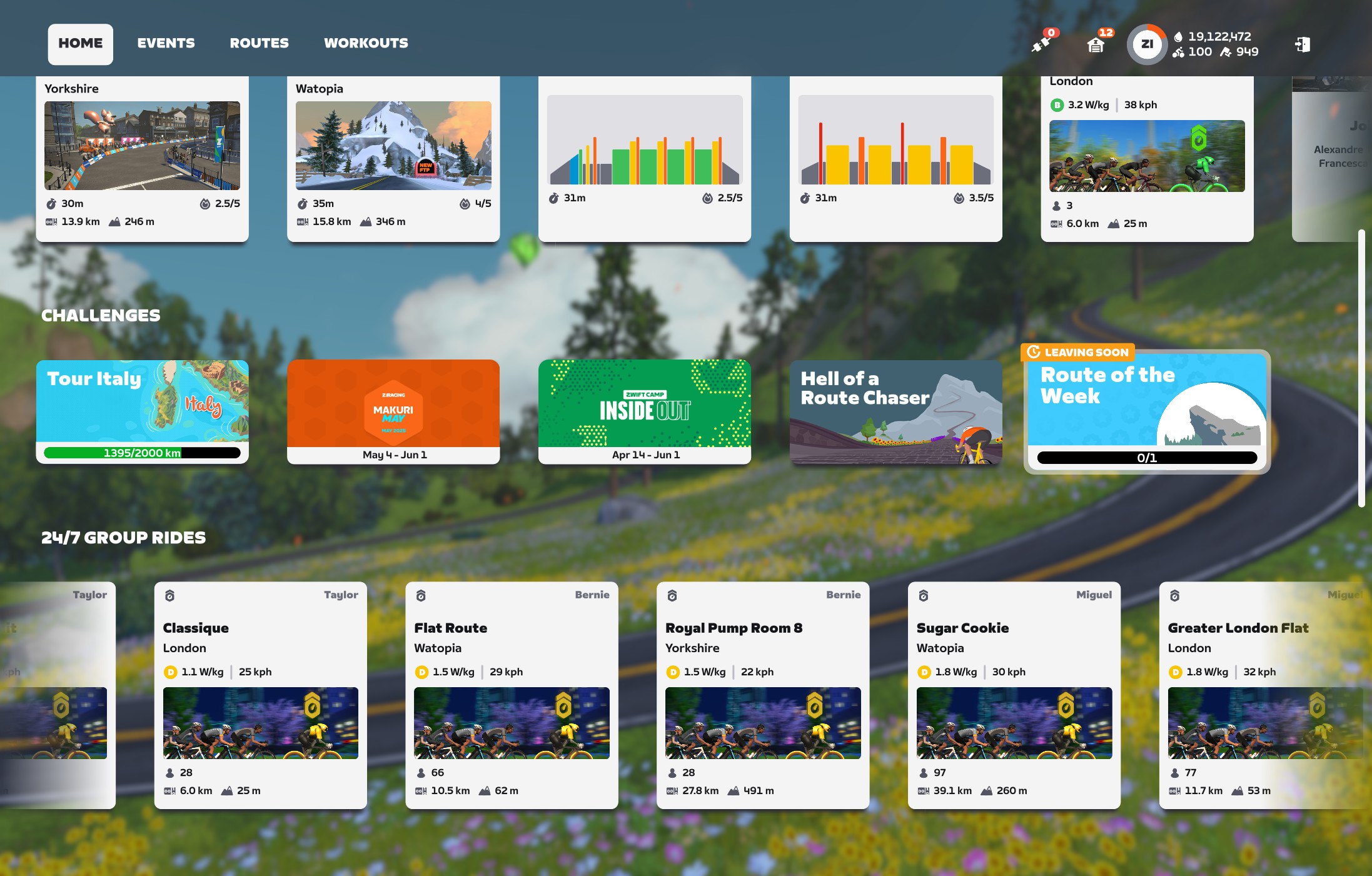
The idea is simple: ride the Route of the Week and earn 500XP:

Note: “accidentally” riding the Route of the Week won’t earn you the XP bonus. You have to click the challenge card, which brings you to the blue screen shown above, in order to “register” for the Route of the Week challenge for that week. Then you can ride the featured route in any way you choose, in order to get the XP bonus.
Upcoming Route of the Week schedule:
- May 26-June 1: Triple Twist
- June 2-8: Waisted 8
- June 9-15: Coastal Crown Loop
- June 16-22: Sand and Sequoias
- June 23-29: Figure 8
More XP Info
If you’re new to Zwift and don’t understand how the XP (experience points) system works, read All About Zwift XP, Levels, and Unlocks for Cyclists.
You may also be interested in XP Farming on Zwift: the Definitive Guide to Earning More XP and Leveling Up Faster.
Your Thoughts
Now that they’ve been going for a month or so… what do you think of the XP Express events and Route of the Week initiative? Have you tried them? What are your thoughts? Share below…
AI video just took a startling leap in realism. Are we doomed?
Last week, Google introduced Veo 3, its newest video generation model that can create 8-second clips with synchronized sound effects and audio dialog—a first for the company’s AI tools. The model, which generates videos at 720p resolution (based on text descriptions called “prompts” or still image inputs), represents what may be the most capable consumer video generator to date, bringing video synthesis close to a point where it is becoming very difficult to distinguish between “authentic” and AI-generated media.
Google also launched Flow, an online AI filmmaking tool that combines Veo 3 with the company’s Imagen 4 image generator and Gemini language model, allowing creators to describe scenes in natural language and manage characters, locations, and visual styles in a web interface.
An AI-generated video from Veo 3: “ASMR scene of a woman whispering “Moonshark” into a microphone while shaking a tambourine”
Both tools are available now to US subscribers of Google AI Ultra, a plan that costs $250 a month and comes with 12,500 credits. Veo 3 videos cost 150 credits per generation, allowing 83 videos on that plan before you run out. Extra credits are available for the price of 1 cent per credit in blocks of $25, $50, or $200. That comes out to about $1.50 per video generation. But is the price worth it? We ran some tests with various prompts to see what this technology is truly capable of.
Video apps like Hulu “cannot be used on Nintendo Switch 2,” says support page
Nintendo’s Switch 2 has a small handful of new releases in its launch lineup, but for the first few months after its release, the main thing you’ll be able to play on it will be your existing library of Switch games. And while Nintendo has promised reasonably comprehensive backward compatibility, the company is still working through the process of testing over 15,000 third-party Switch games with the new console.
With a week to go until launch, Nintendo has updated its compatibility support page with the results of nearly two months of extra testing. Of the “over 15,000” third-party Switch games, Nintendo says roughly two-thirds of them either have “no issues” or have problems that will be resolved quickly at or after launch. On the original version of this support page, Nintendo had only performed its basic compatibility testing on roughly 20 percent of all third-party Switch games.
Nintendo says that nearly all of the roughly 5,000 remaining Switch games will launch just fine on the Switch 2 but that “further tests” are “in progress.” The support page doesn’t say when Nintendo will provide its next update.
Demand For American Degrees Has Already Hit Covid-Era Lows
International interest in American higher education has plummeted to levels not seen since the COVID-19 pandemic, according to new data tracking prospective student behavior online. Studyportals, which operates a global directory of degree programs, reports that clicks on American university courses have reached their lowest point since the early pandemic period.
Weekly page views of US university courses halved between January 5th and the end of April. First-quarter traffic to American undergraduate and master’s degree programs fell more than 20% compared to the same period last year, while interest in PhD programs dropped by one-third. India, which supplies nearly a third of America’s international students, showed the steepest decline at 40%. The data suggests British universities would be the primary beneficiaries of students looking elsewhere.
The sharp drop in interest follows the Trump administration’s escalating restrictions on international students, including stripping Harvard University of its enrollment authority on May 22nd and suspending all new student visa interviews on May 27th. International students contributed $43.8 billion to the American economy during the 2023-24 academic year, with about three-quarters of international PhD students indicating they plan to remain in the country after graduation.


Read more of this story at Slashdot.
Five Tricks Insurance Companies Use to Deny Claims (and How to Avoid Them)
Insurance is a modern necessity—and it can often be a literal lifesaver. When any sort of disaster strikes, whether it’s to your property, your business, or your health, getting a payment on your claim can mean the difference between getting through the emergency in one piece and being buried under bills for years to come.
While it might seem pretty straightforward, anyone who’s actually dealt with insurance companies knows that their least favorite thing to do in this world is pay out on claims. In fact, studies have found that 17% of claims made to HealthCare.gov insurers and 18% of claims made to private insurers are denied—with some insurance companies rejecting nearly 50% of all claims.
In fact, some insurers employ several legal but underhanded tricks to avoid paying out on claims. Here are five common tricks insurance companies will use against you.
Moving as slowly as possible
The simplest trick an insurance company can play is to drag their feet on your claim—there’s a reason the phrase “deny and delay” has become linked to the insurance industry as a whole. This tactic works because your insurer knows you’re desperate for a settlement on your claim; that’s the whole point of insurance. The longer they make you wait, the more likely you’ll accept whatever they offer you, even if you know it’s much less than you’re entitled to.
Delay tactics vary, but can include:
-
Documentation overload. Insurance companies sometimes request huge amounts of (sometimes unnecessary) documentation that takes a lot of time to procure and organize.
-
Personnel swaps. Insurers may change the adjuster and other employees on your case, with each new person requiring some time to review the claim and get up to speed.
-
Claiming no response. Your insurer asked for something, and you provided it. Weeks later they claim they never received it, and ask that you submit it again.
The best way to counter these tactics is meticulous record-keeping. If you feel that your insurer is asking for unnecessary documentation, ask them to explain why they need the documents—this sometimes makes document requests magically vanish. Send all written communications via certified mail and turn on read receipts for emails and other electronic communications.
Love bombing
Insurers are often extremely nice to you when you initially start dealing with them. They express sympathy, use the words “I’m sorry” in the context of your injuries or loss, and generally sound warm and friendly. That’s nice, and may even be genuine. But it’s also a tactic they use to delay or eventually find reasons to deny your claim.
Studies have found that apologies can be weaponized, and that people will tolerate delays and settle for less if they think the other party is taking responsibility or expressing empathy. Being excessively nice to you can fool you into thinking you can rely on the insurer to handle things on your behalf. This lets the company delay as much as possible, stringing you along. Love bombing like this can also get you to say things you shouldn’t say—as we’ll see in the next entry.
Twisting your words
Another reason an insurance adjuster or other employee might apologize to you? Because it can gently goad you into expressing regrets of your own which can then be used against you. Any expression of apology or regret could be interpreted as an admittance of fault. And establishing a friendly, sympathetic rapport with you could be a tactic to get you to say more than you should by speculating on causes or your responsibility in a claim.
For example, while speaking with a friendly adjuster about a car accident you were involved with, you might tell them you wish you’d noticed the other car driving erratically—if you had, you might have avoided the accident. This might seem like a simple observation, but it could be twisted into an admittance that you weren’t paying attention—and thus your claim is denied.
Insurers will also sometimes demand that you submit a recorded statement, often very quickly after the incident covered by the claim. They will sometimes state that this is best for you, as it will get the claim moving more quickly. But a rushed recorded statement can also lead to a denied claim—if you’re wrong or inaccurate about anything in your statement, this could be used as a basis for denial.
To avoid the tactics listed above, follow a few simple rules for dealing with insurers:
-
Lawyer up. Hiring a lawyer to help you deal with insurance claims might seem like overkill, but you should always have a lawyer with you when speaking with insurers. An experienced attorney can ensure you don’t say anything that could hurt your claim.
-
Never record. You’re typically not required to submit recorded statements, so don’t do it. Insist that all communications be done in person or over the phone, with your attorney present.
-
Be suspicious. If an adjuster or other representative of the insurance company is overly friendly, don’t fall for it. Their sympathy might be genuine, but it can still get you into trouble if you let your guard down.
Rushing
Ironically, an effective tactic to delay and deny claims is to rush things. You file your claim, and before you can get organized, hire a lawyer, and recover from whatever happened, the insurer is on the phone, offering a settlement. This is often combined with pressure—like sending you a letter stating that you have two weeks to accept the settlement offer, or the company will “close the file.”
This is usually designed to reduce the payout—that easy, fast settlement is probably for a lot less than the amount you’re actually entitled to—and to force errors on your part. By rushing to pull together information, you’ll probably make mistakes that can then be used to deny the claim.
You can defend against this in two simple ways:
-
Slow down. Ignore pressure to respond immediately or by arbitrary deadlines. Take your time, gather information, and respond when you’re ready. An attorney can help by acting as a buffer between you and the company.
-
Know the statute. If your insurer tells you it will close your claim file, let it happen. It’s a meaningless administrative action. Your state’s laws will have a defined Statute of Limitations on your claim—a period of time when you’re legally allowed to pursue the claim. As long as you’re within that time period, you can force the insurer to re-open the claim.
Lowballing
If your insurer doesn’t think it can totally deny your claim, it may offer you a lowball settlement. You shouldn’t accept an insurance company’s calculations as gospel. In fact, the most important piece of information you can have about the claims process is that you are allowed to hire your own insurance adjuster. A public insurance adjuster works for you, not the insurance company, and will often arrive at a much higher figure for your claim.
Hiring your own adjuster also insulates you from internal delays, as you won’t have to wait on your insurer’s processes or play phone tag with their adjuster. In addition to an experienced lawyer, a public adjuster can also ensure that you have all the support and knowledge you need to navigate the often murky world of insurance claims.
Google Reveals Culprit For Android Battery Drain Bug Following Its May Update

Diagnosing mystery battery drain issues on a smartphone can be frustrating. Broadly speaking, per-app battery usage indicators aren’t all that useful, since they only count usage by the core of the app itself; system call usage usually gets lumped into “System”, “Other”, or similar nebulous categories.
This is precisely the reason why a recent
Cyberpunk 2077 Sequel Hits Key Milestone And Sheds Project Orion Codename

CD Projekt Red is hard at work on the next installment of The Witcher franchise, but it hasn’t forgotten about Cyberpunk 2077. The game has come a long way from its incredibly rocky launch that included it being pulled from the PlayStation 4 storefront for a period of time. The studio says that the Phantom Liberty expansion, which released
NVIDIA 575.57.08 Linux Stable Driver Released With Smooth Motion & Other Updates
NVIDIA just released their v575.57.08 driver as the first stable Linux driver in their R575 release branch…
Who will win Unbound Gravel 2025? Our race predictions and course preview
Despite the UCI running a gravel world championships each year, the star event in the gravel racing calendar remains the Unbound 200 race.
Although there are Unbound Gravel race lengths from 25 miles up to 350 miles, it’s the 200-mile long Unbound Gravel 200 is the highlight event and attracts the elite riders.
The event takes place in the Flint Hills of Kansas, starting in Emporia, with the 2025 race day being Saturday 31 May.
Last year, the men’s race was won from a two-up sprint by Lachlan Morton of the EF Education Pro Cycling team in just over 9 hours. Morton isn’t riding Unbound 200 this year, pitching for victory instead in the 350-mile, unsupported Unbound XL.
But the winner of the 2024 women’s Unbound 200, Rosa Klöser will be defending her title. On the back of her 2024 win, she’s since become a pro road cyclist, riding for Canyon-SRAM zondacrypto.
- How Unbound became the most important gravel race in the world
- How to watch Unbound 2025 for free anywhere in the world
2025 Unbound Gravel 200 contenders

As the flagship gravel race, Unbound attracts a diverse field of elite athletes from a range of disciplines.
Although it’s natural territory for US-based pro gravel racers, they compete with European gravel riders and road and MTB pros.
50 of the world’s top gravel riders are competing in the Life Time Grand Prix series of six US gravel races, with a prize pot for the series of $380,000. But alongside the gravel pros, Unbound 200 attracts a field of former and current WorldTour pros, whose names will be familiar to followers of road racing.

Unbound 200 is the second race in the Life Time Grand Prix and after the first, the Sea Otter Classic, Sofia Gomez Villafane is at the top of the leaderboard for women and Keegan Swenson is for men.
Swenson won Unbound in 2023. They’re both contenders for the 2025 Unbound title, although Gomez Villafane came second to Haley Batten, who is not part of the Life Time Grand Prix Series, at Sea Otter.
In Europe, the Traka 360 (in km, not miles) women’s race at the start of May was won by Karolina Migon and the men’s by Tobias Kongstad, who will both be lining up in Emporia.

Klöser isn’t the only pro or former pro road racer on the start list this year, with perennial breakaway specialist Thomas de Gendt slated for a start in the men’s race. Chad Haga is another former Grand Tour rider now dedicating his time to gravel racing, coming second at last year’s Unbound.
Although one of the top riders normally triumphs, the course can throw a mechanical or a puncture at anyone. Klöser suffered a puncture at the 2024 race, but still came back to win a nine-up sprint to the line. Others have found themselves put out of contention by an ill-timed flat.
2025 Unbound Gravel 200 course
This year’s Unbound 200 course covers 202.4 miles (325.7km) with 10,122 feet (3,085m) of elevation gain.
Heading north from Emporia, Kansas, into the Flint Hills, the route is near-identical to that taken in 2024, although the stated distance is slightly shorter and includes less climbing than the 202.9 mile / 10,750 ft route in 2024.
The race route is unmarked, with 93 per cent on unpaved roads and just 14.6 miles on tarmac. The first 33 miles or so offer an undulating ascent from Emporia at 1,142 ft elevation to 1,588 feet.

That’s followed by a technical section of around 4 miles with steep climbs and descents that starts at mile 40, where a mechanical can make it difficult to get back to the front group and put even an elite rider out of contention.
At 69 miles, the race reaches its lowest elevation, 1032ft at Mill Creek, just before the town of Alma, the site of the first checkpoint at mile 70 and close to the race’s furthest north point.
From there, the course climbs to 1,451 ft at 88.6 miles, then drops to 1,170ft at 98.5 miles.
The second half of the course undulates between 1,228 ft and 1,476 ft before dropping down into Emporia and includes the second checkpoint at Council Grove at mile 148. It’s prone to headwinds when the route passes Lake Kahola, which can promote attacks and split a bunched field over the last 29 miles.
In addition to the two checkpoints, there are water collection points at mile 40 and mile 112. While riders can station a support crew with spares at the two checkpoints, they ride unsupported over the rest of the course, so they must carry enough food, water and supplies to fix mechanicals and flats.
No team cars to swap bikes or hand up a sticky bottle here.
This year, the bulk of the racing will be streamed live on YouTube by its sponsor, Life Time.
My Favorite Amazon Deal of the Day: The Sonos Beam Gen 2
We may earn a commission from links on this page. Deal pricing and availability subject to change after time of publication.
Sonos appears to have co-opted Apple’s business strategy: making premium products that are user-friendly for high prices. People will buy them whether they’re discounted or not, apparently, but it’s always better to get a good price. And that’s what you get with the Sonos Beam Gen 2, currently $369 (originally $499), the lowest price it has ever been, according to price tracking tools.


As the name suggests, this isn’t the first generation of the Beam soundbar. That would be the Sonos Beam Gen 1, which came out in 2018. It was the first smart soundbar to support both Google and Alexa voice assistants, as well as AirPlay, according to CNET’s review. The Sonos Beam Gen 2 then came out in 2021, adding Atmos compatibility, eARC connectivity, NFC connectivity, and a better processor from the features that were already in the Gen 1, according to CNET’s review. The Sonos companion app also improved dramatically, making for a much better experience and extra features, like the Sonos TruePlay (only for Apple phones), which calibrates the speaker based on its environment.
The release of the bigger and more powerful Sonos Arc Ultra last year meant the Beam Gen 2 was no longer the flagship premium soundbar and started falling in price, landing at its current low price, which matches last year’s Black Friday deals.
Getting a Sonos speaker means getting into their ecosystem, which allows you to connect their speakers for multi-room listening (play music in sync, despite where the speakers are in the house, through wifi). It’s important to note that the Beam, like all Sonos soundbars, doesn’t have Bluetooth. You’ll need to play your audio through wifi using the Sonos app, AirPlay, or Spotify.
The Beam Gen 2 is a great option for anyone looking for a premium soundbar in a small, compact space, especially if you want to get into the Sonos ecosystem or add one to the mix.
Linux 6.16 Networking Brings Some Big Performance Improvements & OpenVPN Driver
There is a lot of exciting networking changes to find with the in-development Linux 6.16 kernel both for wired and wireless devices as well as some exciting core networking improvements/optimizations…
Trump allies expect he’ll double down on tariffs after sweeping court block
Donald Trump can’t impose whatever tariffs he wants on a whim, a federal court ruled Wednesday, issuing an opinion that analysts say has only stoked more trade chaos.
The ruling permanently blocked some of the most controversial tariffs and reportedly scrambled Trump’s ongoing trade talks with many countries pressured into negotiations by the threat of those tariffs, CNN reported.
The blocked tariffs—which the court found were implemented unconstitutionally under the International Emergency Economic Powers Act (IEEPA)—included tariffs the administration said were designed to stop drug and human trafficking, as well as retaliatory tariffs placed on all countries that were supposed to put an end to persistent US trade deficits.
The Nintendo Switch Phone App Just Got A Lot Better

The Nintendo Switch 2 launches in exactly one week, and in the lead up to the new console, Nintendo has updated the Nintendo Switch Online app and made it much more useful. It also has a new, pithier name. Say goodbye to the Nintendo Switch Online App, and say hello to the Nintendo Switch App.