Amazon has finally launched its first batch of Project Kuiper internet satellites on top of a United Launch Alliance Atlas V rocket. The company was supposed to send the first 27 satellites in the constellation, which will eventually be comprised of more than 3,200 satellites, on April 8. However, the event got pushed back. A previous Bloomberg investigation claimed that Kuiper was way behind schedule, because the company was struggling to ramp up the production of its satellites. If true, the company will have to ask for an extension from the FCC to fulfill its commitment to the government, requiring it to put 1,600 satellites in orbit next summer.
An Amazon spokesperson denied that the company was having manufacturing issues, however. They said that Amazon was on track to support its target and that it will continue increasing its production and launch rates. Around seven hours after launch, Amazon CEO Andy Jassy announced that the company has confirmed that its “first 27 production satellites are operating as expected in low Earth orbit.” Amazon now has over 80 launches scheduled with ULA on top of the Atlas V and the aerospace corporation’s newer Vulcan Centaur heavy lift vehicles. The company’s goal is to provide internet access to far-flung regions not typically reached by conventional internet connections. Its staunchest rival, SpaceX’s Starlink, already has over 7,000 functioning satellites in orbit.
Important moment for @ProjectKuiper as we just confirmed our first 27 production satellites are operating as expected in low Earth orbit. While this is the first step in a much longer journey to launch the rest of our low Earth orbit constellation, it represents an incredible… pic.twitter.com/sb2eO6n6Im
This article originally appeared on Engadget at https://www.engadget.com/science/space/amazon-deploys-the-first-project-kuiper-internet-satellites-140006298.html?src=rss
We may earn a commission from links on this page. Deal pricing and availability subject to change after time of publication.
The Razer Kishi Ultra is finally seeing a real price break, now down to $99.99 from its usual $149.99—the lowest it’s been, according to price trackers.
Designed mainly for Android phones and newer iPhones with USB-C, the Kishi Ultra snaps onto your device with a springy bridge that can handle anything between 4.7 and 8.3 inches long. In hand, it feels closer to a full-size Xbox controller split in half, complete with offset analog sticks, large tactile buttons, clicky bumpers, and analog triggers. That said, its wide build does make it less travel-friendly compared to the Kishi V2 Pro, but the trade-off is comfort, especially for bigger hands or longer gaming sessions.
The physical controls of the Kishi Ultra are reportedly snappy and responsive. You get a familiar Xbox-style setup with a big D-pad, customizable L4 and R4 triggers, and optional RGB lighting for a bit of flair. Plus, the addition of haptic feedback brings an extra punch to every shot or impact in games like Ultrakill. Beyond that, the Kishi Ultra includes practical touches like a USB-C port that supports pass-through charging and a 3.5mm headphone jack for wired audio. On Android, you get bonus features like virtual controller support for games without native control mapping (think Genshin Impact). However, if you’re an iPhone user, you’ll miss out on that feature. Also, cloud gaming on iOS through Xbox Game Pass isn’t quite as smooth, needing a web-based workaround instead of a clean app experience.
Still, the core experience holds strong across both platforms. Some quirks remain, like a bit of twitchiness in the analog triggers (especially when you’re trying to finely control acceleration in driving games—something to keep in mind if you’re picky about racing or precision-heavy titles, notes this PCMag review) and the overall size, making it a pain to stuff into smaller bags. But if you can work around that, this is about as close as mobile gaming gets to feeling console-grade. Plus, with the ability to plug it into a PC via USB-C and use it as a wired controller, it quietly doubles its value.
Sent out today was a batch of drm-misc-next patches for queuing ahead of the Linux 6.16 merge window. There are a few notable changes here as part of the Direct Rendering Manager updates for the core code and smaller kernel drivers…
Nothing’s upcoming Phone (3) could well be getting some love in the United States, assuming Nothing CEO Carl Pei is to be believed. When someone on X asked Pei if the new phone will be sold in the U.S. outside of the Nothing Beta program, the Chinese-Swedish entrepreneur simply said: “100%!” The new device is expected to drop sometime late
I paid good money for my 24 CPU cores, but ./configure can only
manage to use 69% of one of them. As a result, this random project
takes about 13.5× longer to configure the build than it does to
actually do the build.
The purpose of a ./configure script is basically to run the
compiler a bunch of times and check which runs succeeded. In this
way it can test whether particular headers, functions, struct
fields, etc. exist, which lets people write portable software. This
is an embarrassingly parallel problem, but Autoconf can’t
parallelize it, and neither can CMake, neither can Meson, etc.,
etc.
As the value of Pokémon TCG cards hits its highest point in the game’s 30-year history, new cards are increasingly difficult to get hold of, and some classic cards have become worth vastly more by weight than gold. This inevitably attracts criminal acts, but few as violent and frightening as that experienced by a man…
It looks like NVIDIA’s driver team has been working overtime since the launch of the GeForce RTX 50 series, and especially in recent weeks. Following the launch of its ‘Game Ready’ 576.02 WHQL GPU driver chock full of bug fixes two weeks ago and a more recent hotfix GPU driver to address a handful of more issues, NVIDIA is now pushing out
OpenAI, which spends far more money than it takes in, is trying something new to stanch the bleeding. The company just announced that all users, including on the free tier, can shop from ChatGPT Search. “You can now search for a product, compare options and buy products in ChatGPT,” OpenAI said in a press release. Categories currently available include fashion, beauty, home goods and electronics, with expansion to more categories set to come later.
The search results you’ll obtain are “chosen independently and are not ads,” the company promises. The updates are available in 4o and are rolling out to ChatGPT Plus, Pro, Free and even logged-out users. Along with the shopping, OpenAI introduced search in WhatsApp, enabling users to send a WhatsApp message to ChatGPT to get up-to-date answers. Also new are improved citations, trending search and upcoming memory integration.
Trusting ChatGPT for accurate shopping advise may be a risk, as the app tends to (still) make stuff up when it doesn’t know an answer. It seems that OpenAI is accessing reviews from Wired and other sites to get information on products, presumably through license agreements. It’s not clear how OpenAI is making money on shopping since it’s surfacing organic results and not paid placements, but it could be through affiliate revenue.
The company certainly needs the cash. OpenAI only made $4 billion last year, reportedly after spending $9 billion. The company expects to boost that revenue by a factor of 30 to $125 billion by 2029, though it didn’t give any specifics on how it plans to do so. As it stands now, OpenAI makes the bulk of its money from paid subscriptions and the rest through licensing its API.
This article originally appeared on Engadget at https://www.engadget.com/ai/openai-adds-shopping-features-to-chatgpt-search-133057362.html?src=rss
Installing software on Windows can be a pain. You’ll find some things for download in the Microsoft Store, sure, but a lot of other applications require you to find the official website and download an executable. It’s an annoying process, especially if you have a bunch of software you need to install all at once—a lot of waiting around and clicking “Next.”
Manually downloading software is also a security risk. The increasing unreliability of Google search results means it’s harder to find a legitimate sources for a given app, increasing your odds of downloading malware.
Linux users don’t have to deal with this cumbersome process—they install software using a package manager, which can automatically download and install software in a couple clicks. And it turns out that Windows has a hidden Windows package manager called Winget, which lets you install software by opening the command prompt and typing the right command.
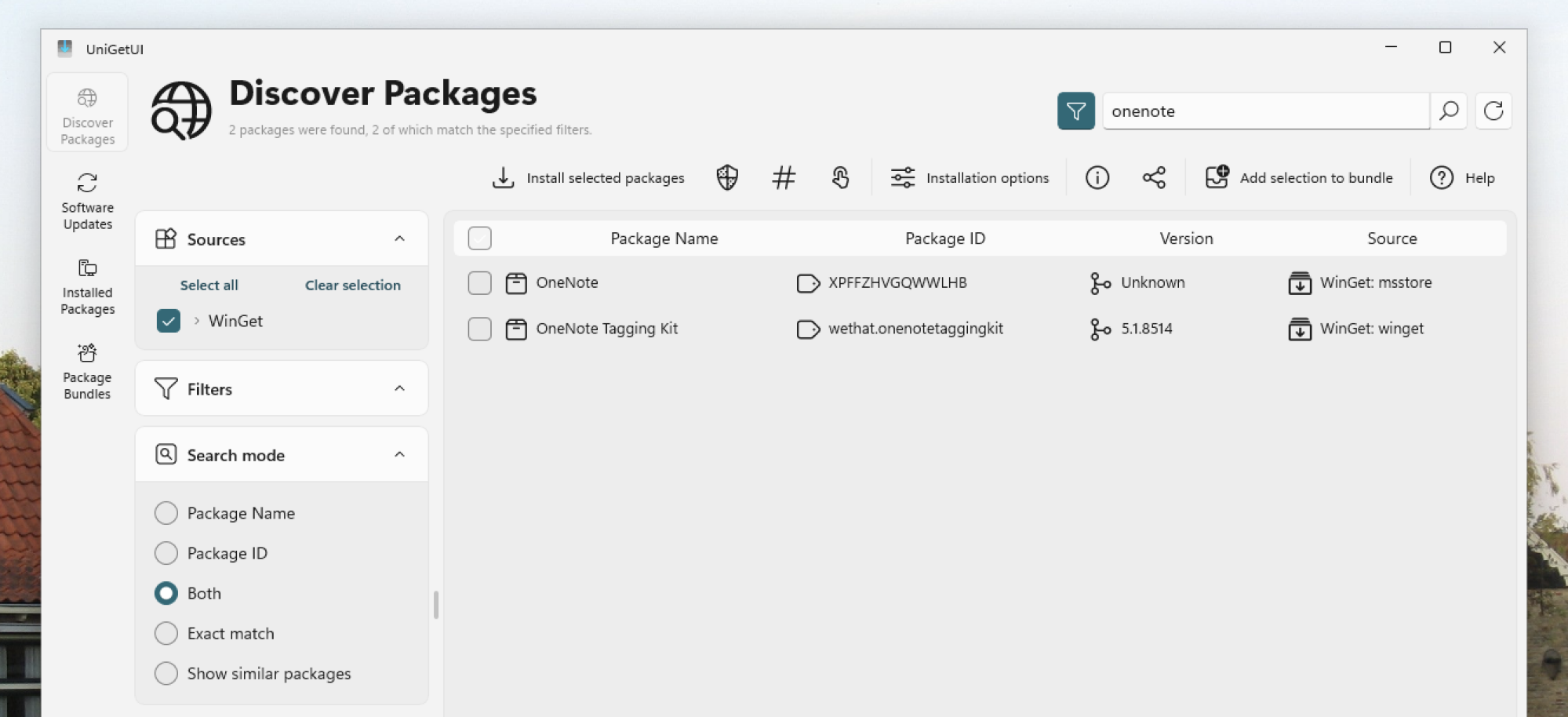
But not everyone likes typing commands, which is where UniGetUI comes in. This application, formerly known as WingetUI, provides a visual interface for Winget and other text-based package managers. Just open the application, type the app you’re looking for, and hit enter.
Credit: Justin Pot
You can double-click any result to read more details. You can search for and check as many applications as you want, then click Install Selected Packages to bulk install multiple applications at once
There are a lot to choose from: UniGetUI searches WinGet, which has access to thousands of applications alongside everything in the Microsoft Store. This means you can use it to search and install software from the Microsoft Store without having ever open the Microsoft Store, which is nice. But there’s more: package mangers Chocolatey, Scoop, Pip, Npm, .NET Tool, and PowerShell Gallery are also supported. If you don’t know what that means, though, don’t worry—they’re just different sources for software. With everything combined into one app, you should be able to install just about anything using UniGetUI.
Credit: Justin Pot
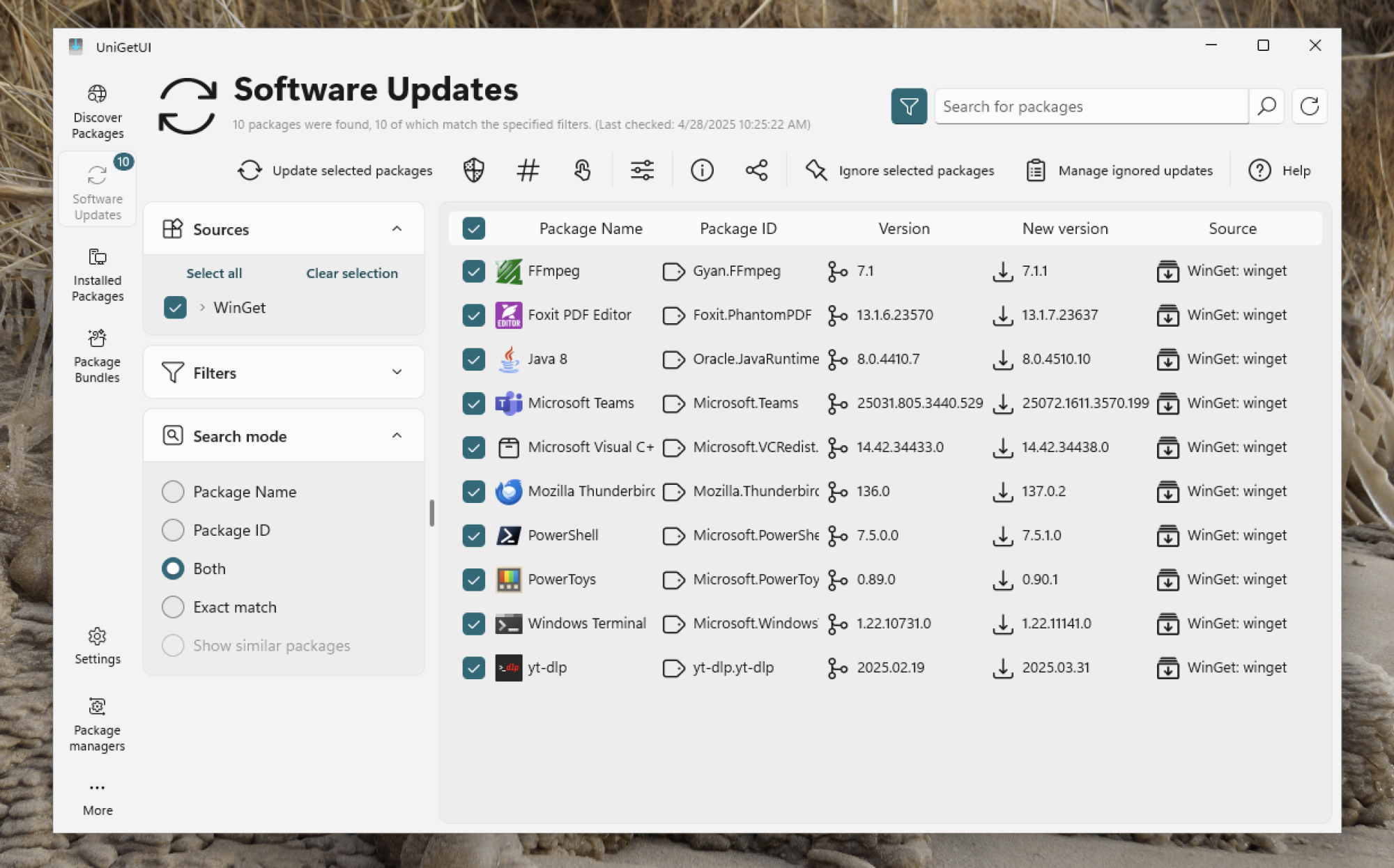
You can also update applications from all of these sources, simultaneously, in the Software Updates tab. This is a big deal if you’re the kind of person who hates seeing update prompts in all of your individual applications. There’s even an optional widget you can install that allows you to trigger updates without opening the application.
There are a few more features worth mentioning. You can create a bundle that includes multiple applications and save it for use on future computers, which is handy if you ever need to reinstall Windows and also want to reinstall all of your applications at once. You can even share your bundles of apps with friends, if you want.
Not everyone needs an application like this, granted, but if you’re the kind of person who installs a lot of software, I can’t recommend it enough.
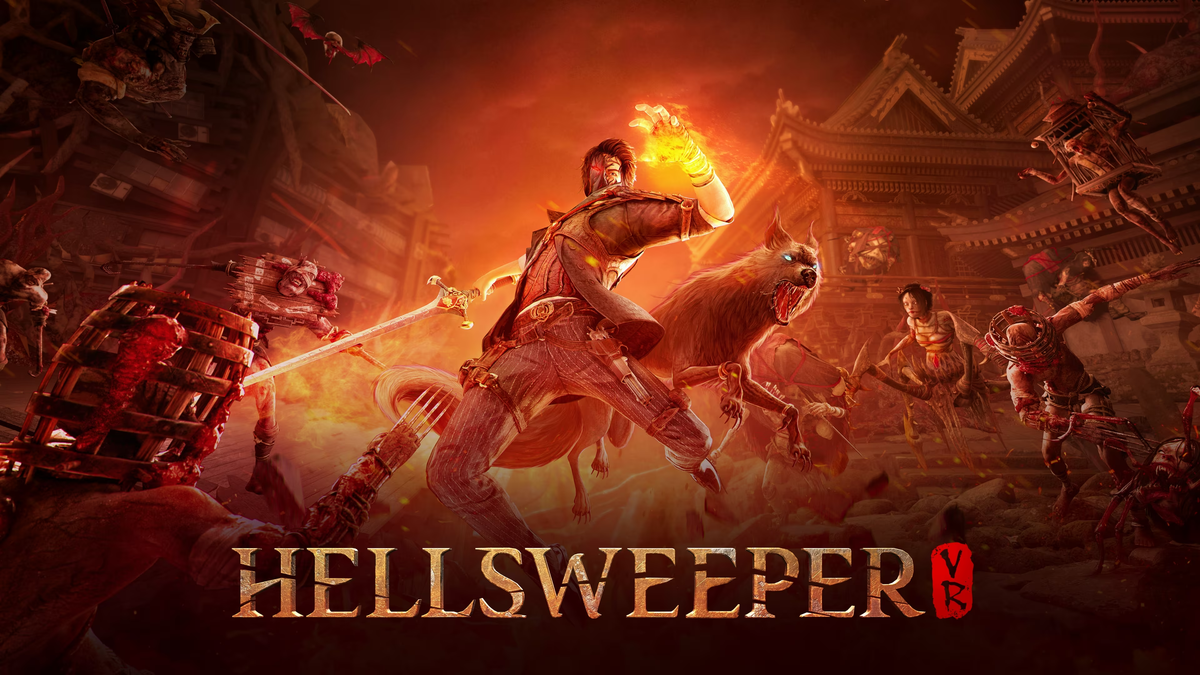
Hellsweeper VR adds a new weapon, move upgrades and more in today’s Reckoning update.
Now live across all platforms, Hellsweeper VR introduced a Chakram as the game’s first ranged weapon that returns to you like a boomerang, while flicking your wrists can split that into two separate half-blades. Other existing weapons also received new abilities, like giving the Mace a hookshot update that lets you fling enemies. You can find the full patch notes here.
Patch 1.8 also includes a new Epithet that transforms the Stone Fists “into a Swiss Army knife of pure destruction.” You can now directly attach weapons to the fist, letting you activate two groups of weapons per fist. Finally, Hellsweeper VR is moving away from “level and soul-based unlocks” by tying gear unlocks into completing challenges.
Today’s Reckoning update follows on from December’s Alliance update, which notably expanded co-op for up to three players. Other changes included an all-new ‘Gauntlet Mode’ that sees you attacking enemies in an endless loop, a new boss called Avarice, plus a day and night system that affected available treasures and enemy behavior.
Rumors suggest that Apple is working on ways to make the iPad more like a Mac with iPadOS 19. While the company won’t be bringing macOS to the iPad (as much as I’d love that to be the case) there could be upgrades that transform the tablet experience more into a desktop computing experience. The thing is, it isn’t just the iPad that appears to be getting desktop features—the iPhone might be getting in on the fun, too.
In a post covering the iPadOS 19 rumors, leaker Majin Bu had this to say about the iPhone: “iOS 19 isn’t being left behind. Source say that iPhones with USB-C will support external displays, offering a [Stage Manager-like] interface. While not a full desktop mode, it will allow users to extend their screen space, great for presentations, editing, or enhanced viewing.”
If true, this would be a huge change for the iPhone. While Apple lets you mirror your iPhone’s screen to external displays, it has never offered an extended display option. With extended displays, you are able to have different windows open on different devices: You could use your phone to present a slideshow on a monitor or projector, while still using your phone to reference speaker notes, for example.
A mirrored display, on the other hand, is much more limited, as you’re only showing what’s on your iPhone’s screen on the larger display. It can be helpful, but also troublesome, as everything on your iPhone’s display is mirrored. Getting to keep your iPhone’s display private while controlling what gets displayed on the external screen would be a game changer.
Extended displays also respect the dimensions of the screen you’re connected. When you mirror your iPhone to a TV, for example, it’ll show up vertically. If you’re in an app that supports landscape mode, you can flip your iPhone to fill up more of the display, but it still won’t match the dimensions of most TVs and monitors (unless you’re using a Home button-era iPhone with a 16:9 display). The other exception is media playback, which will render in the original photo or video’s dimensions, but the entire setup is far from ideal.
All that said, Majin Bu does report that it’s possible there will be issues with the resolution or number of apps that can be extended at any given time. Really, this rumor is thin, and doesn’t offer us a lot of information to work from at this time.
The iPhone would be far from the first mobile device to offer a feature like this. Apple’s own iPads are able to extend to other displays via Stage Manager, and many smartphones offer a desktop mode—like Samsung’s DeX.
Could this “desktop” mode be a sign for a future device?
9to5Mac seems to think this rumored feature isn’t so much about Apple’s vision for the iPhone as it currently exists, but another device entirely: the iPhone Fold.
Apple’s rumored foldable iPhone is still at least a year out if the leaks are to be trusted, but 9to5Mac sees its influence already. The outlet believes the device will act like an iPhone when folded and an iPad mini when unfolded, so such a device would benefit from a desktop mode.
I buy the argument: If a foldable iPhone would benefit from a desktop mode—or at least extended display support—why not beta test that feature on existing iPhones while you continue to work on the foldable? Of course, it’s all speculation, and Apple will almost certainly not reveal a foldable phone at WWDC 2025. But if the company does announce an extended display mode as part of iOS 19, it could offer a clue to the company’s future plans for the iPhone.
Amazon successfully launched the first 27 satellites for its Project Kuiper internet constellation, kicking off a major effort to compete with Starlink by deploying over 1,600 satellites by mid-2026. It company is investing $10 billion in Kuiper and plans to begin commercial service later this year. CNBC reports: “We had a nice smooth countdown, beautiful weather, beautiful liftoff, and Atlas V is on its way to orbit to take those 27 Kuiper satellites, put them on their way and really start this new era in internet connectivity,” Caleb Weiss, a systems engineer at ULA, said on the livestream following the launch.
The satellites are expected to separate from the rocket roughly 280 miles above Earth’s surface, at which point Amazon will look to confirm the satellites can independently maneuver and communicate with its employees on the ground. […] In his shareholder letter earlier this month, Amazon CEO Andy Jassy said Kuiper will require upfront investment at first, but eventually the company expects it to be “a meaningful operating income and ROIC business for us.” ROIC stands for return on invested capital. Investors will be listening for any commentary around further capex spend on Kuiper when Amazon reports first-quarter earnings after the bell on Thursday.
A livestream can be found here.
In the era of rapid technological advancement, the intersection of blockchain and artificial intelligence (AI) is giving rise to groundbreaking innovations. Zyntheris is standing at the forefront of this transformation wave, completely revolutionizing the TOPS computing power leasing industry and driving the development of the WEB3 digital economy.
The global AI revolution, exemplified by the success of models like ChatGPT, has propelled the technology from the confines of laboratories into various sectors such as finance, healthcare, education, and more. This exponential growth in AI applications has led to an insatiable appetite for hashrate. The complex computations required for training large – scale AI models and real – time inference in applications like autonomous driving demand high – performance hardware, with the theoretical peak hashrate represented by TOPS (Tera Operations Per Second) becoming a crucial metric. High TOPS values enable chips to execute more calculations per unit time, significantly accelerating AI training and enhancing response speeds. However, the current centralized hashrate model faces challenges such as high costs and potential security risks, creating a gap that Zyntheris aims to fill.
Zyntheris: A Technological Powerhouse
Established in 2020, Zyntheris has assembled a dream team of industry experts. Led by CEO Elian Cross, a computer science doctorate with over 15 years of experience in blockchain architecture, the company is steered towards success. Sophie Winterfeld, the Chief Technology Officer from Carnegie Mellon University, drives innovation in hybrid PoS efficient consensus and cross-chain protocols. COO Kai Nguyen’s expertise in business operations and market strategies ensures smooth daily operations and market expansion. Chief Security Expert Maya Thompson safeguards the company’s systems with her decade – long experience in cybersecurity.
The company’s technological prowess lies in its innovative solutions. The hybrid PoS + PBFT consensus mechanism reduces block generation time to 10 seconds, achieves a TPS of over 3000, and consumes only 0.1% of the energy of Bitcoin, optimizing efficiency and scalability. The dual – VM support for EVM and WASM enables diverse application development, while the open SDK/API interfaces facilitate stable – coin issuance. Through the IBC protocol and Chainlink oracle technology, Zyntheris ensures seamless cross – chain interoperability, enhancing the security and reliability of cross – chain asset exchanges. The dynamic sharding technology, which can automatically adjust the number of shards from 2 to 32 based on network load, boosts the theoretical peak throughput to 100,000 TPS, greatly improving transaction processing speed.
The three business segments: TOPS leasing, cross-border chain merchants and cross-border settlement.
Zyntheris has identified three core business areas. Its TOPS leasing service is set to disrupt the hashrate market. By establishing TOPS leasing service centers in over 10 countries across the Americas, Europe, and Asia, Zyntheris aims to provide cost – effective and secure hashrate solutions. With a significant cost reduction of 65% and efficiency improvement of over 40%, as well as enhanced network security, TOPS leasing by Zyntheris is a game – changer. Priced at $0.255 per TOPS per hour based on the international standard of 2000 TOPS for $510 per hour, it offers a competitive edge in the market.
In the field of cross-border blockchain merchants, Zyntheris is paving the way for the digital transformation of traditional enterprises. As the digital economy flourishes, traditional enterprises are eager to enter the global market through public chains. Zyntheris enables them to do so by providing stable digital assets for global settlement, bridging the gap between the blockchain and e-commerce payment channels. This not only promotes the circulation of digital assets but also creates practical application scenarios for them.
Ambitious Development Plan: Shaping the Future
Zyntheris has a well – defined development roadmap. In 2025, the company plans to sell 100,000 TOPS and build a global distributed hashrate node network. By the third quarter of 2025, it aims to complete the sale of 50,000 TOPS and list on Gate.io, followed by achieving 100,000 TOPS sales and deploying on Binance or other major exchanges in the fourth quarter. In 2026, it targets a TVL of $50 million in the TOPS leasing market, with daily hashrate transaction volumes exceeding 1000 by the second quarter. The company also aims to tokenize hashrate resources, facilitating seamless leasing and trading, and deepen cooperation with AI companies and meta – verse projects.
Looking further ahead, Zyntheris has long – term aspirations. It aims to be among the top 3 green hashrate blockchain networks globally, expand its Cross-border Chain Merchant platform to cover more than 10 countries with an annual transaction volume exceeding $1 billion, and assist at least 10,000 traditional enterprises in digital transformation. By the fourth quarter of 2028, it plans to build a strong digital asset consensus, enter the top 100 in the global crypto – digital asset market capitalization, and list on major mainstream exchanges.
A Promising Future in the Digital Economy
Zyntheris is not just a company; it is a visionary force shaping the future of the digital economy. By addressing the pain points of TOPS leasing decentralization and WEB3 cross – border payments, it is capitalizing on the growing global market demand. As the WEB3 and AI eras unfold, Zyntheris stands ready to lead the way, offering technological solutions that benefit enterprises and users worldwide. With a solid business model, innovative technologies, and a clear development plan, Zyntheris is well – positioned to ride the wave of the digital revolution and achieve remarkable success in the years to come.
An anonymous reader quotes a report from Wired: Automakers are increasingly pushing consumers to accept monthly and annual fees to unlock preinstalled safety and performance features, from hands-free driving systems and heated seats to cameras that can automatically record accident situations. But the additional levels of internet connectivity this subscription model requires can increase drivers’ exposure to government surveillance and the likelihood of being caught up in police investigations. A cache of more than two dozen police records recently reviewed by WIRED show US law enforcement agencies regularly trained on how to take advantage of “connected cars,” with subscription-based features drastically increasing the amount of data that can be accessed during investigations. The records make clear that law enforcement’s knowledge of the surveillance far exceeds that of the public and reveal how corporate policies and technologies — not the law — determine driver privacy.
“Each manufacturer has their whole protocol on how the operating system in the vehicle utilizes telematics, mobile Wi-Fi, et cetera,” one law enforcement officer noted in a presentation prepared by the California State Highway Patrol (CHP) and reviewed by WIRED. The presentation, while undated, contains statistics on connected cars for the year 2024. “If the vehicle has an active subscription,” they add, “it does create more data.” The CHP presentation, obtained by government transparency nonprofit Property of the People via a public records request, trains police on how to acquire data based on a variety of hypothetical scenarios, each describing how vehicle data can be acquired based on the year, make, and model of a vehicle. The presentation acknowledges that access to data can ultimately be limited due to choices made by not only vehicle manufacturers but the internet service providers on which connected devices rely.
One document notes, for instance, that when a General Motors vehicle is equipped with an active OnStar subscription, it will transmit data — revealing its location — roughly twice as often as a Ford vehicle. Different ISPs appear to have not only different capabilities but policies when it comes to responding to government requests for information. Police may be able to rely on AT&T to help identify certain vehicles based on connected devices active in the car but lack the ability to do so when the device relies on a T-Mobile or Verizon network instead. […] Nearly all subscription-based car features rely on devices that come preinstalled in a vehicle, with a cellular connection necessary only to enable the automaker’s recurring-revenue scheme. The ability of car companies to charge users to activate some features is effectively the only reason the car’s systems need to communicate with cell towers. The police documents note that companies often hook customers into adopting the services through free trial offers, and in some cases the devices are communicating with cell towers even when users decline to subscribe.
Oracle engineers mistakenly triggered a five-day software outage at a number of Community Health Systems hospitals, causing the facilities to temporarily return to paper-based patient records. From a report: CHS told CNBC that the outage involving Oracle Health, the company’s electronic health record (EHR) system, affected “several” hospitals, leading them to activate “downtime procedures.” Trade publication Becker’s Hospital Review reported that 45 hospitals were hit.
The outage began on April 23, after engineers conducting maintenance work mistakenly deleted critical storage connected to a key database, a CHS spokesperson said in a statement. The outage was resolved on Monday, and was not related to a cyberattack or other security incident. CHS is based in Tennessee and includes 72 hospitals in 14 states, according to the medical system’s website.
In a story of teenage girls stranded in the Canadian wilderness, you know there are going to be some crazy moments. From the very first episode of Showtime’s split-timeline drama Yellowjackets, we witnessed someone being chased through the snowy woods, strung up like a piece of prized game, and devoured by her own…
AI-generated computer code is rife with references to non-existent third-party libraries, creating a golden opportunity for supply-chain attacks that poison legitimate programs with malicious packages that can steal data, plant backdoors, and carry out other nefarious actions, newly published research shows.
The study, which used 16 of the most widely used large language models to generate 576,000 code samples, found that 440,000 of the package dependencies they contained were “hallucinated,” meaning they were non-existent. Open source models hallucinated the most, with 21 percent of the dependencies linking to non-existent libraries. A dependency is an essential code component that a separate piece of code requires to work properly. Dependencies save developers the hassle of rewriting code and are an essential part of the modern software supply chain.
Package hallucination flashbacks
These non-existent dependencies represent a threat to the software supply chain by exacerbating so-called dependency confusion attacks. These attacks work by causing a software package to access the wrong component dependency, for instance by publishing a malicious package and giving it the same name as the legitimate one but with a later version stamp. Software that depends on the package will, in some cases, choose the malicious version rather than the legitimate one because the former appears to be more recent.
Google I/O is usually where the company reveals what’s happening with its smartphone OS for the next 12 months, but this year, Android is getting its own thing. A week ahead of I/O, Google will deep dive into the future of Android in a special edition of The Android Show.
The company said people have been asking for more ways to learn about how the Android experience is changing. (Who are these people?)
Google says it has “so many new things to share” regarding Android, hence this edition of The Android Show — a long-running YouTube series mainly for devs. The presentation will feature Android Ecosystem president Sameer Samat, but Google added that Android will still feature at I/O, where the company says it’ll reveal “even more special announcements and surprises.”
The battery on the Phone Pro 2 lasts two full days on a charge.
CMF
Nothing says its CMF Phone Pro 2 is the lightest, slimmest smartphone it’s ever designed. It’s 7.8mm thin and 6.5 ounces, which may make it the lightest phone Nothing has ever made, but the iPhone 16, for instance, is just 6 ounces.
There’s a 6.77-inch FHD+ AMOLED display and a four-camera setup, complete with a 50MP main camera. That includes a telephoto lens, an ultra-wide and a front-facing selfie camera, but CMF is offering a modular twist, with the ability to attach fisheye and macro lenses.
The 256GB model costs just $279 and pre-orders are open now, shipping on May 6. However, the phone is only available for those in the company’s beta program. I have the phone right here, but there’s not much to report on until the frivolous accessories land alongside it.
A group of researchers covertly ran a months-long unauthorized experiment in one of Reddit’s most popular communities, using AI-generated comments to test the persuasiveness of large language models (LLMs). The experiment, which was revealed over the weekend by moderators of r/changemyview, is described by Reddit mods as “psychological manipulation” of unsuspecting users.
The researchers used LLMs to generate comments on r/changemyview, a subreddit where Reddit users share (often controversial or provocative) opinions and invite debate from other users. The community has 3.8 million members.
According to Reddit moderators, the AI took on numerous identities in comments during the experiment, including a sexual assault survivor, a trauma counselor “specializing in abuse” and a “Black man opposed to Black Lives Matter.” Many of the original comments have since been deleted.
Reddit appears to be considering some kind of legal action. Chief legal officer Ben Lee wrote that the researchers’ actions were “deeply wrong on both a moral and legal level” and a violation of Reddit’s site-wide rules.
Russia took issue with Wargaming’s support of Ukraine.
Top executives from Wargaming and Lesta Games, the joint developers of World of Tanks, could have their stakes in their respective companies seized by the Russian government, according to reports from Russian news organizations RIA and RBC.
The execs are reportedly being accused of extremist activities by Russia’s prosecutor general (the country’s equivalent of the US attorney general) because of Wargaming’s support of Ukraine, RIA reports.
Development of World of Tanks was split in 2022 when Wargaming left its offices in Russia and Belarus. Russia began a full-scale invasion of Ukraine that same year. In response, Wargaming ran a campaign in World of Tanks to raise money for medical aid in Ukraine in 2023.
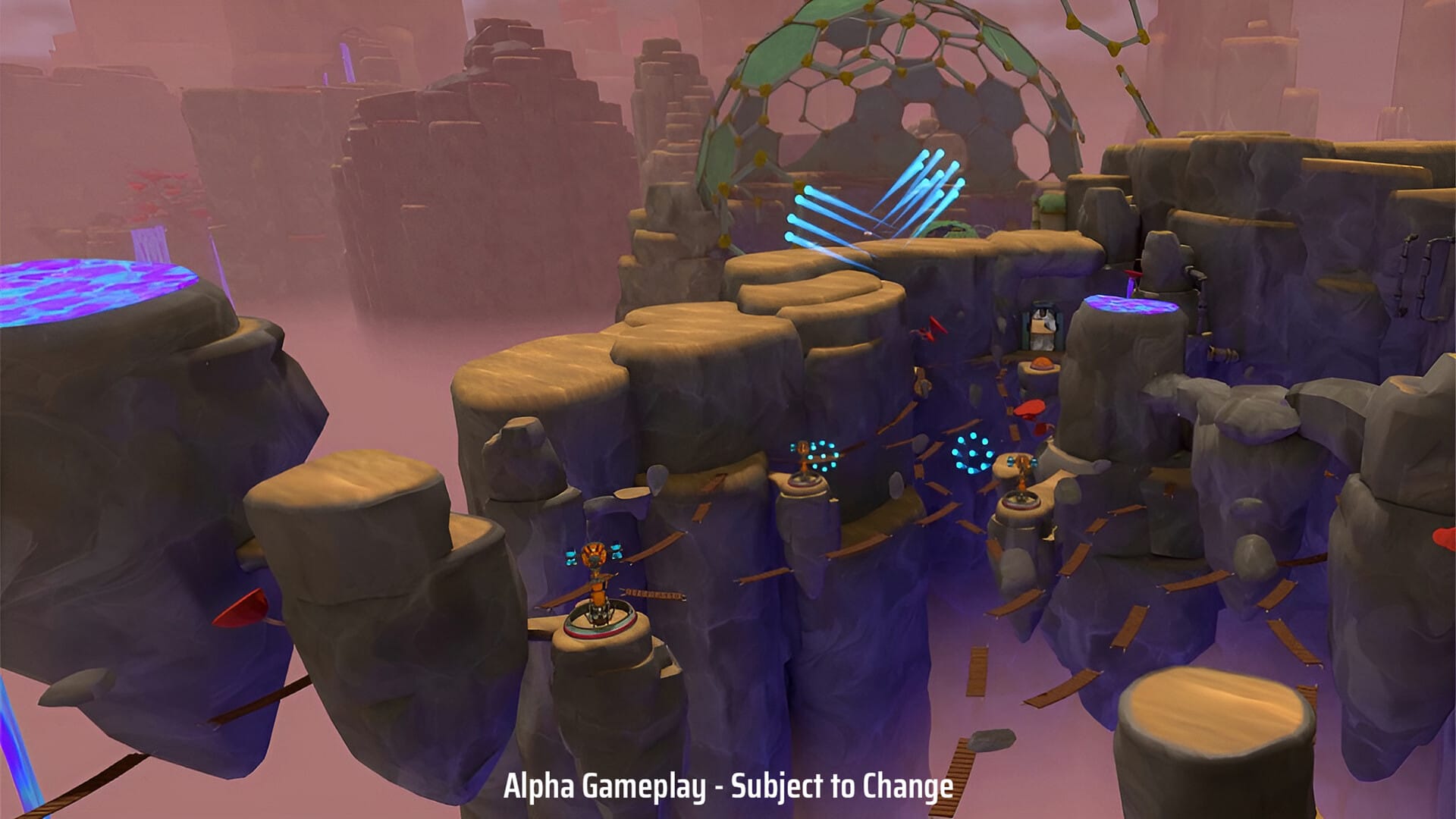
Titan Isles aims to make its mark with a new co-op VR action adventure, and we recently interviewed Psytec Games to learn more.
Seven years on from Windlands 2, it’s been over a month since Psytec lifted the curtain on Titan Isles, and you can see the parallels between them. Whether you’re playing alone or in co-op with four people, both games involve exploring a ruined world as you fight various titans throughout the campaign. A few similarities, yet there are key differences that distinguish these games.
“Titan Isles is quite a different game to the Windlands series,” advised Jon Hibbins, CEO of Psytec Games, during an interview with UploadVR at Reboot Develop 2025.
Though he’s certainly proud of what Psytec achieved with Windlands 2, Hibbins considers this the direction he and the studio were always heading in, describing the core gameplay as “not hugely dissimilar” to Windlands. He’s always wanted to create a game that was “more full on” with the action that’s “more like a Returnal bullet hell type game.”
Acknowledging there’s been a demand for a Windlands 3 across the years, Psytec believes that wouldn’t have been the right call.
“Windlands is rooted in calmness, even when it gets quite intense. The music’s designed to be chill, the world is meant to be beautiful and serene. It felt completely wrong to take Windlands in a more action direction and away from exploration, we didn’t want to ruin the direction of the Windlands IP. So, we made a new IP that gave us the freedom to fit the game properly around what our vision is, what games we want to make as a studio.”
Hibbins noted his love of shooters and states there’s a lot of inspiration from this genre in Titan Isles, which puts it at odds with Windlands. He’s also looking to make games that require quick moment by moment thinking without this becoming a fitness workout, an idea inspired by more challenging flatscreen titles like Elden Ring.
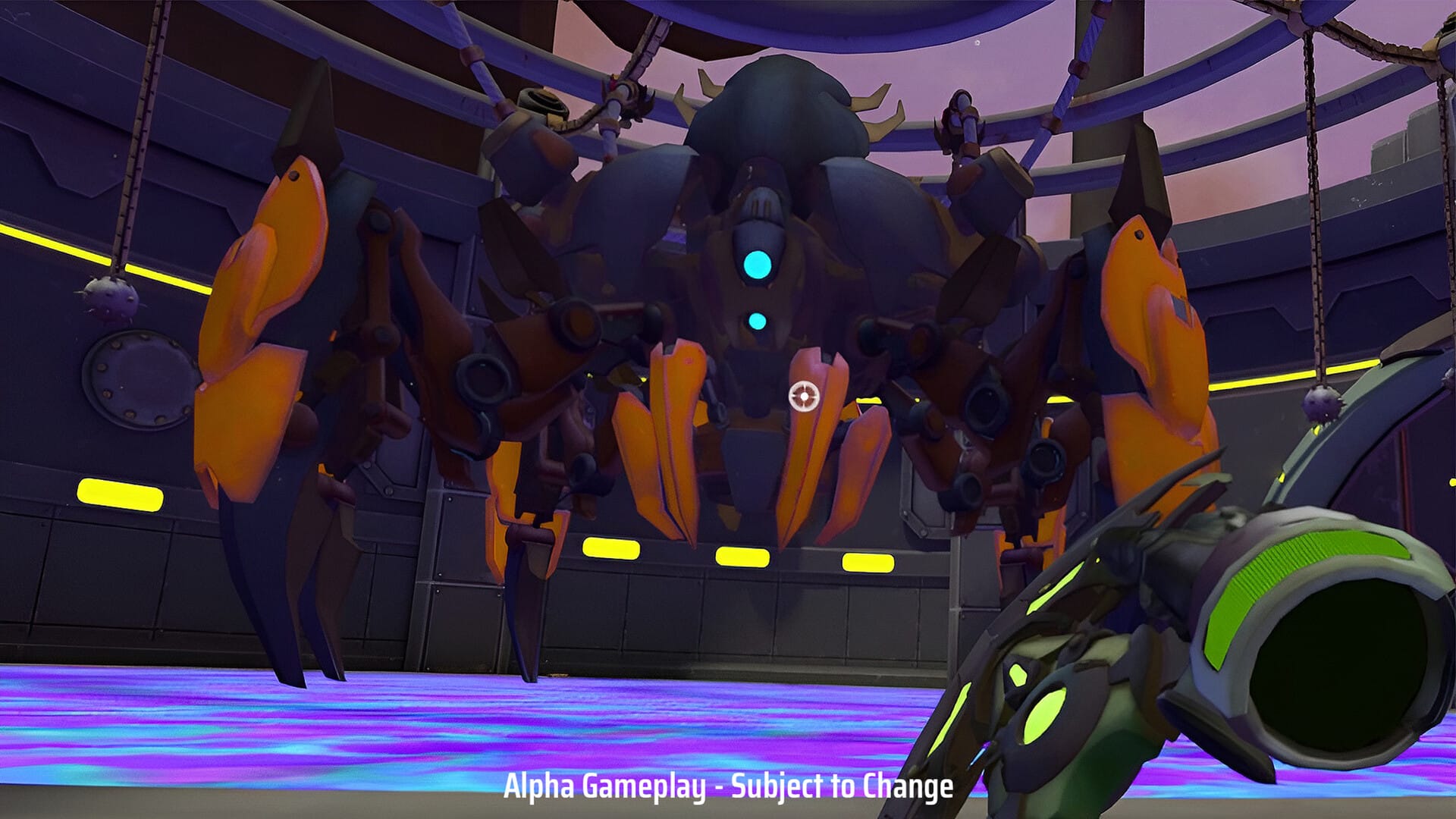
A core element of Titan Isles’ gameplay are the four Exo Suits, each of which offers a unique traversal method and its own weapon that can’t be switched between suits. Storm is “basically Iron Man”, Blink has a triple jump, Hunter uses grappling hooks, while Goliath comes with a cannon and shield. Psytec considered a “mix and match” approach to abilities and weapons, but this idea was dropped.
“There was a point in the development cycle where we wanted to let you use any weapon, any locomotion style, mix and match different things to make a suit that you could go out and explore with. But with game design, if you trim it down and make it play really well, you don’t end up with a mess. So we ended up implementing four specific suits.”
Hibbins explained the team learned a lot from Windlands 2 here and that Titan Isles has a suit that’s very similar to the older game’s character with improvements. Each suit also comes with 15 skill upgrades, offering abilities like increasing an arrow’s speed.
“You basically hook anything in Titan Isles on that character, which makes it a lot easier, but also it’s a much faster action game. Because of the bullet hell, you need to be able to hook everything because you haven’t got time to think.”
Titan Isles is currently confirmed for Quest and PC VR, and Psytec previously avoided committing to other platforms due to “technical and logistical” hurdles. Even still, can we eventually expect a PlayStation VR2 edition?
“We love PlayStation VR2,” Hibbins told me, and it’s not being ruled out. However, the PS VR2 port for Windlands 2 that launched last July hasn’t been profitable yet.
“Windlands 2 didn’t do very well on PlayStation VR2. It was late in the cycle which didn’t help, the game’s been out elsewhere since 2018, and we’ve not yet recouped the cost of that port.”
Given the game’s heavy focus on co-op, did Psytec look at going free-to-play given the model’s increasing prevalence on Quest? This was considered and while the studio won’t rule out doing free-to-play on future projects, making Titan Isles a paid game was ultimately the better approach.
“[Free-to-play] can start to ruin the quality of the game if it’s not done well. We believe it’s more important to have a really good quality game that you pay for once and you can play forever. For Titan Isles, free-to-play didn’t feel right.”
Titan Isles will launch later this year on Steam and the Meta Quest platform.