AMD Drop's Ryzen 3000 Pricing By Up to $50: Official Price Drop Until 31st March

AMD has started a new promotion and will sell its latest 3rd Generation Ryzen desktop processors with a noticeable discount for a few weeks. The campaign is effective worldwide, though in some countries reductions will be more significant, whereas in other regions they will be not. In addition, some buyers will get Xbox Game Pass with their new CPUs.


Starting this week and through March 31, AMD will reduce SEPs (standard e-tail prices) of select Ryzen 3000-series desktop processors by $25 – $50. As a result, the mid-range six-core Ryzen 5 3600 will cost $174, whereas the high-end 12-core Ryzen 9 3900X will be priced at $449. In addition, some buyers will also get a three-months Xbox Game Pass while supplies last. Note that the promotion is run by AMD itself, yet it may vary from retailer to retailer and from region to region. The list of offerings looks as follows.


AMD Ryzen 3000 March 2020 Promotion
  Old SEP New

SEP
Discount Amazon.com Price at Press Time
Ryzen 9 3900X $499 $449 $50 $419
Ryzen 7 3800X $399 $359 $40 $340
Ryzen 7 3700X $329 $304 $25 $290
Ryzen 5 3600X $249 $224 $25 $200
Ryzen 5 3600 $199 $174 $25 $175

It should be noted that retailers are also running their own promotional pricing on top of AMD’s new SEPs, which means we’re seeing items like the 3900X, which should be at its new SEP of $449, even lower at $419.
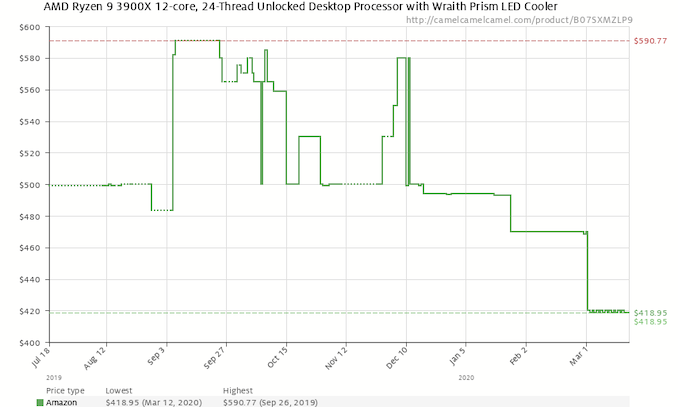


Without any doubts, all discounts are always welcome by the end user, so AMD deserves a kudos. Meanwhile, the said AMD processors have cost lower than their new SEPs for weeks in the USA, so customers in the States will only be able enjoy the free subscription.


AMD is known for running limited time promotions and sell its products at discounts. To that end, it is hard to say whether this particular campaign is needed to boost the company’s retail sales in the final weeks of the quarter, or potentially that AMD might believe demand for PC hardware in the coming weeks will increase as people will turn to digital entertainment due to the outbreak of the COVID-19 coronavirus, so AMD wants to offer more attractive prices to win the market. In any case, enjoy while it lasts.


Related Reading


Source: AMD


Source: AnandTech – AMD Drop’s Ryzen 3000 Pricing By Up to : Official Price Drop Until 31st March
New Comet Lake Mobile CPU Spotted in Intel Documents: Core i7-10810U

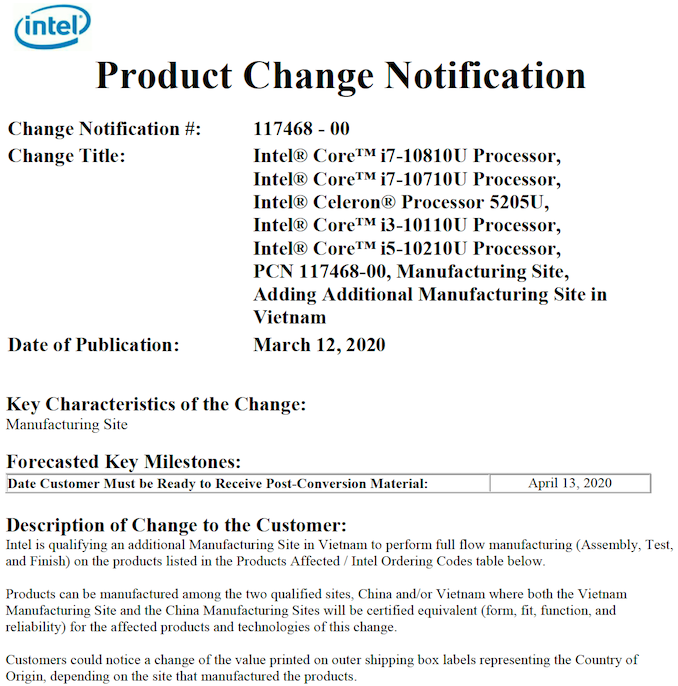
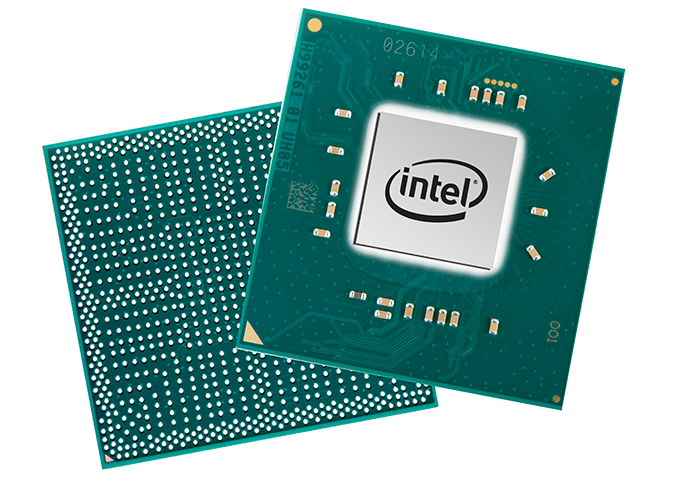
Intel today published a new Product Change Notification today stating that it has started using an additional Assembly, Test, and Finish site to build its mobile Comet Lake CPUs. In the process, it accidentally disclosed model number of an unannounced processor, the Core i7-10810U. The new chip belongs to the Comet Lake-U family, so it was designed primarily for notebooks.


As the name suggests, the Core i7-10810U would be Intel’s new flagship Comet Lake product sitting right above the Core i7-10710U, which was introduced last summer. In this instance, the new CPU uses the A0 core stepping, which we know from previous disclosures that so it does not support LPDDR4X memory. As we reported back in January, only Comet Lake chips with the K1 core stepping support LPDDR4. Unfortunately, we have no idea about other specifications of the processor, but we asked Intel for additional information on the matter.


Intel from time to time refreshes its client CPUs in Spring in a bid to let PC makers to introduce improved lineup of products, so from this point of view an addition of the Core i7-10810U to the family is not surprising. 


Intel Comet Lake-U SKUs
AnandTech Cores

 
Base GHz 1C Turbo

GHz
AC Turbo

GHz
L3

Cache
TDP

PL1
IGP

UHD
IGP

MHz
DDR4 LPDDR3 Cost
i7-10810U ? ? ? ? ? ? ? ? ? ? ?
i7-10710U 6C/12T 1.1 4.7 3.9 12 MB 15W 620 1150 2666 2933 $443
i7-10510U 4C/8T 1.8 4.9 4.3 8 MB 15W 620 1150 2666 2933 $409
i5-10210U 4C/8T 1.6 4.2 3.9 6 MB 15W 620 1100 2666 2933 $297
i3-10110U 2C/4T 2.1 4.1 3.7 4 MB 15W 620 1000 2666 2933 $281
Pentium 6405U 2C/4T 2.4 2 MB 15W 610? 950 2400 ? $161
Celeron 5205U 2C/2C 1.9 2 MB 15W 610? 900 2400 ? $107

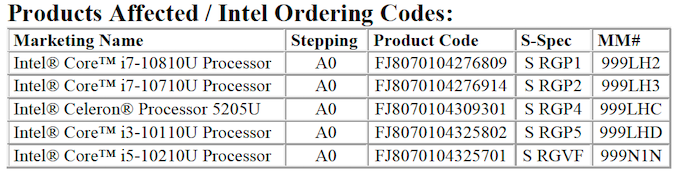
Back to the main topic of Intel’s PCN 117468-00 announcement. Starting from April 13, Intel’s OEM customers should be ready to get Core i7-10810U, Core i7-10710U, Core i5-10210U, Core i3-10110U, and Celeron Processor 5205U processors that were assembled in Vietnam. Previously, Intel only used its Assembly, Test, and Finish site in China to build its Comet Lake-U processors, so an additional site may improve availability. Given the local environment surrounding COVID-19, this is also likely Intel hedging its bets with its facilities, in the case that one isn’t running.


Related Reading


Source: Intel


Source: AnandTech – New Comet Lake Mobile CPU Spotted in Intel Documents: Core i7-10810U

Samsung Galaxy S20 Ultra (Snapdragon 865) Quick Performance Preview: Impressive

Samsung’s Galaxy S20 series phones have been available since last Friday in markets such as the US. And earlier this week we also finally received a unit, in the form of a North American, Snapdragon 865-based Galaxy S20 Ultra. While our review is already underway, we’re also still waiting for public availability in Europe in order to get our hands on our Rest of World, Exynos 990 variant, so that we can take a comprehensive look at both variants of the S20 series. As we’ve seen in previous years, there have been some pretty significant differences between the Snapdragon and Exynos models at times, thanks to the SoC selection impacting everything from performance to image processing.


But first things first: since we have a bit of a lead time with the Snapdragon unit, we wanted to at least publish the performance figures for this model ahead of the full review, to temporarily satisfy everyone’s curiosity on at least this aspect of the phone.


Source: AnandTech – Samsung Galaxy S20 Ultra (Snapdragon 865) Quick Performance Preview: Impressive

Logitech Reveals Wireless Charging 3-in-1 Dock

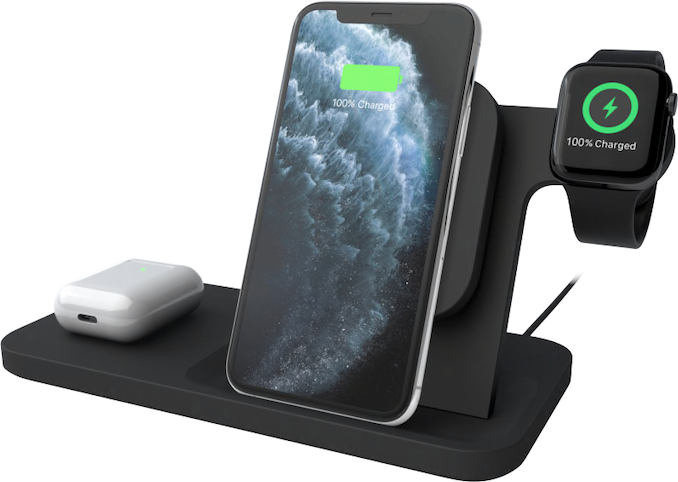
Nowadays many people use more than one mobile device that needs charging, but charging them using separate chargers is sometimes inconvenient since they use too many wires or power sockets and create a mess. After Apple had cancelled its universal AirPower wireless charging mat for three devices, numerous makers of wireless chargers came up with their own 2-in-1, 3-in-1, and even 4-in-1 charging docks. This week Logitech joined the club with its Powered Wireless Charging 3-in-1 Dock, that is also accompanied by a dedicated charging pad, as well as and a charging stand, for those who only need to charge one device at a time.


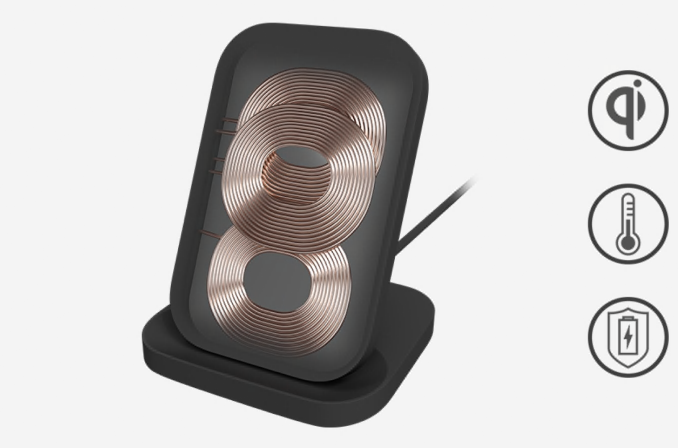
The Logitech Powered Wireless Charging 3-in-1 Dock is designed to charge a modern iPhone, an Apple Watch, and AirPods charging case simultaneously. The device has two triple-coil surfaces (flat pad and upright stand) that can deliver up to 10 W of power (each), as well as a knob for Apple Watch that can deliver up to 5 W of power for a total of 25 W. The dock is fully compliant with the Qi specification, so it can work with other Qi-compliant devices from manufacturers such as Samsung or LG. Furthermore, with two 10-W surfaces, it is possible to charge two smartphones using the regular phone stand as well as the pad for headset.


Logitech says that its “Powered”-series devices feature all kinds of protection, including foreign object detection, protection from overheating, and overcharging.


The Powered Wireless Charging 3-in-1 Dock is made polycarbonate as well as silicone, and comes in graphite or white. The unit costs $129.99, so it is quite a lot more expensive than some of the competing products from less well-known manufacturers.


In addition to the Wireless Charging 3-in-1 Dock, Logitech’s Powered family also includes Powered Wireless Charging Stand for $59.99, as well as Powered Wireless Charging Pad for $39.99. Both feature similar triple-coil internal designs and are rated for 10 W.


Related Reading:


Source: Logitech


Source: AnandTech – Logitech Reveals Wireless Charging 3-in-1 Dock

Oppo’s Find X2 Pro 5G Debuts: S865, 6.7-Inch 120 Hz AMOLED, Periscope Camera, Ceramic or Leather

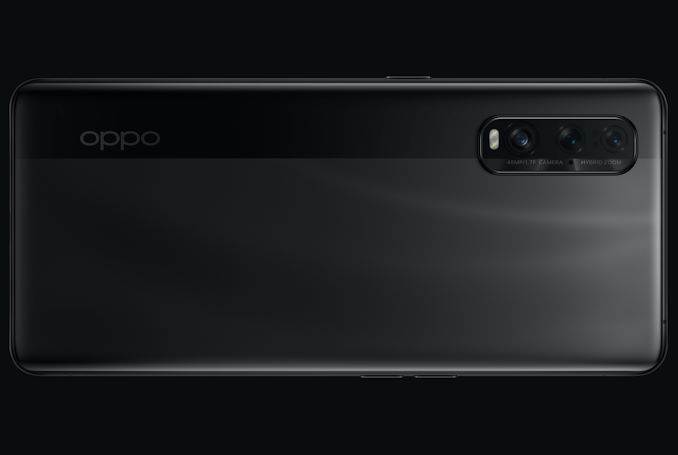
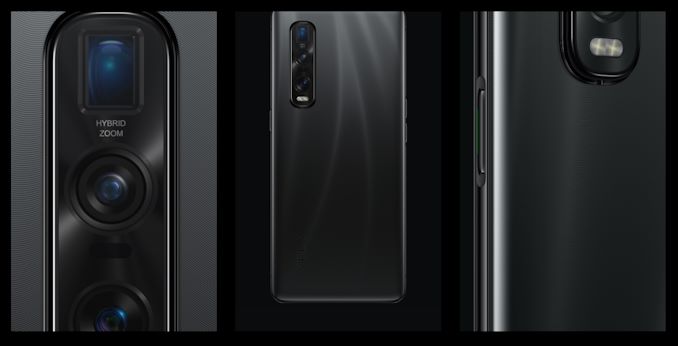
One of the bright sides of sad situations such as event cancellations like MWC, is that vendors don’t have to compete for attention against other vendors announcements within a short timeframe, instead choosing their own launch dates and events. Last week Oppo did exactly this, having unveiled its new top-of-the-range handsets: the Find X2 and the Find X2 Pro. Both models rely on the latest Snapdragon 865 platform from Qualcomm, and come with support for 5G connectivity, with the Pro model also sporting the company’s signature periscope camera that supports 5X optical zoom and ability to shoot 12 MP RAW images.


As expected for this year’s flagship smartphones, the Oppo Find X2 series uses the new Qualcomm Snapdragon 865 SoC that is paired with 8 GB of DRAM, as well as 128 GB, 256 GB, or 512 GB of UFS 3.0 storage. Both the regular Find X2 and Find X2 Pro smartphones are equipped with a 6.7-inch FullVision AMOLED display with a 3168×1440 resolution, a corresponding 19.5:9 aspect ratio, 800 nits luminance (probably regular, not peak HDR), as well as a 120 Hz refresh rate, which should be the phone’s key feature. The screen can display 100% of the DCI-P3 color gamut and is covered with Corning’s Gorilla Glass 6 for protection.


The top-of-the-range Oppo Find X2 Pro handset is equipped with a triple-module camera setup that features Sony’s new IMX689 48 MP RGB sensor as the main unit, using Sony’s IMX586 48 MP as the ultrawide sensor, and a periscope telephoto camera that features a 5x optical zoom (10x hybrid zoom, 60x digital zoom) that is powered by a 13 MP sensor.


Courtesy to the complex triple-module camera, the device can shoot pictures in 12 MP RAW format that allows to edit images heavily using appropriate software on the PC. The vanilla Find X2 uses Sony’s IMX586 48 MP RGB sensor, Sony’s IMX708 12 MP ultrawide sensor, and a 13 MP telephoto camera without periscope. Both phones have OIS on their primary and telephoto modules.


Imaging capabilities are not the only differences between the regular Find X2 and the Find X2 Pro smartphones. Without any doubts, both are premium handsets, both use aluminum frames, and the former X2 comes in a ceramic or glass back, whereas the latter X2 Pro comes in ceramic or leather back, which is a quite rare feature.


Furthermore, while the vanilla version is IP54 splash proof, the Pro model is dust/water resistant (IP68-rated) and can survive for 30 minutes at a 1.5-meters depth. The devices are regular “plus-sized” with 74.4-74.5mm device widths, and weigh from 187 grams to 207 grams, depending on the exact SKU.


On the wireless connectivity side of matters, the Oppo Find X2 smartphones support Wi-Fi 6, Bluetooth 5.1, and NFC. Meanwhile, the handsets lack headphone jacks, only having a USB 3.1 Type-C connector for connectivity and charging. Also, the phone has an under-display fingerprint reader.


Oppo’s Find X2 Series
  Find X2

CPH2023
Find X2 Pro

CPH2025
SoC

Qualcomm Snapdragon 865

1x Cortex A77 @ 2.84GHz 512KB pL2

3x Cortex A77 @ 2.42GHz 3x 256KB pL2

4x Cortex A55 @ 1.80GHz 4x 128KB pL2


4MB sL3

GPU Adreno 650 @ 587 MHz
DRAM 8 GB

12 GB (w/ 256 GB)
12 GB
Storage 128 GB UFS 3.0

256 GB UFS 3.0
256 GB UFS 3.0

512 GB UFS 3.0
Display 6.7″ FullVision AMOLED

3168 × 1440 (19.5:9)
120 Hz

800 nits

DCI-P3: 100%

Corning Gorilla Glass  6
Size Height 164.9 mm 165.2 mm
Width 74.5 mm 74.4 mm
Depth 8.0 mm 8.8 mm (ceramic)

9.5mm (leather)
Weight 196 grams – ceramic

187 grams – glass
207 grams – ceramic

200 grams – leather
Battery Capacity 4200 mAh 4260 mAh
Wireless Charging
Rear Cameras
Main Sony IMX586

48 MP 1/2″ 0.8µm

f/1.7 w/OIS
Sony IMX689

48 MP 1/1.4″ 1.12µm


f/1.7 w/OIS
UltraWide Sony IMX708

12 MP 1/2.4″

f/2.2 16mm

120° field of view
Sony IMX586

48 MP 1/2.0″ 0.8µm

f/2.2 17mm

120° field of view
Telephoto
13 MP

f/2.4 52mm

w/OIS
“Periscope”

13 MP 1/3.4″ 1.0µm
5x optical zoom

w/OIS
Flash Dual-LED dual-tone flash
Front Camera 32 MP 1/2.8″ 0.8μm

f/2.4
I/O USB 3.1 Type-C
Under-screen fingerprint reader
Wireless (local) Wi-Fi 6

Bluetooth 5.1
Cellular GSM, CDMA, HSPA, 4G/LTE, 5G
Splash, Water, Dust Resistance IP54

splash proof
IP68

dust/water resistant

up to 1.5 meters for 30 minutes
Dual-SIM Single nano-SIM/nano-USIM
Launch OS Android 10 with ColorOS 7.1
Launch Price Starting at €999 Starting at €1,199

Oppo’s Find X2 in Ocean Glass and Black Ceramic will be available prices starting €999, whereas the Find X2 Pro in Vegan Leather Orange will cost €1,199. Both smartphones will be available in May.


Related Reading:


Sources: Oppo, GSMArena


Source: AnandTech – Oppo’s Find X2 Pro 5G Debuts: S865, 6.7-Inch 120 Hz AMOLED, Periscope Camera, Ceramic or Leather

The Ultimate Hacking Keyboard Review: A Truly Unique, Truly Expensive Keyboard for Pros

Today we are having a look at the Ultimate Hacking Keyboard, the most overconfident and expensive mechanical keyboard that has ever found its way into our labs. Developed with IT professionals in mind, the keyboard is designed to maximize productivity and ease a tough workday, utilizing a rather unique 60% layout that can even be split in two. Coupled with the manufactuer’s excellent software, it’s an incredibly powerful keyboard. But be warned: the price tag for that power is even higher.


Source: AnandTech – The Ultimate Hacking Keyboard Review: A Truly Unique, Truly Expensive Keyboard for Pros

AMD Officially Launches the Radeon RX 590 GME For China: RX 580 Rides Again

While AMD’s Polaris family of GPUs have surprised us in a few different ways, perhaps the most impressive aspect has been their sheer longevity. First introduced in 2016 as a 14nm update to AMD’s GPU lineup, the GCN 3-derrived chips were the backbone of AMD’s mainstream video cards for over three years. And while it seemed like they’d finally be put out to retirement with the launch of AMD’s 7nm Navi chips late last year, Polaris is getting (another) new lease on life, this time in a video card that’s being released exclusively in China.


Dubbed the Radeon RX 590 GME, the new card isn’t receiving any formal fanfare for its release. But AMD has added it to their product stack and updated their Chinese-language pages accordingly.


So what is Radeon RX 590 GME exactly? Unfortunately, as has become a recurring theme with China-only video cards, AMD and its partners are playing fast and loose with product names. Despite the name, the RX 590 GME is notably slower than a proper RX 590 – about 10% slower, on paper – making it an RX 590-lite at best, and an overclocked RX 580 at worst.


AMD Radeon RX Series Specification Comparison
  AMD Radeon RX 590 GME AMD Radeon RX 590 AMD Radeon RX 580 AMD Radeon RX 5500 XT
CUs 36

(2304 SPs)
36

(2304 SPs)
36

(2304 SPs)
22

(1408 SPs)
Texture Units 144 144 144 88
ROPs 32 32 32 32
Base Clock 1257MHz 1469MHz 1257MHz 1607MHz
Game Clock N/A N/A N/A 1717MHz
Boost Clock 1380MHz 1545MHz 1340MHz 1845MHz
Throughput (FP32) 6.4 TFLOPs 7.1 TFLOPs 6.2 TFLOPs 5.2 TFLOPs
Memory Clock 8 Gbps GDDR5 8 Gbps GDDR5 8 Gbps GDDR5 14 Gbps GDDR6
Memory Bus Width 256-bit 256-bit 256-bit 128-bit
VRAM 8GB 8GB 8GB 4GB/8GB
Transistor Count 5.7B 5.7B 5.7B 6.4B
Typical Board Power N/A 225W 185W 130W
Manufacturing Process GloFo 14nm? GloFo/Samsung 12nm GloFo 14nm TSMC 7nm
Architecture GCN 4 GCN 4 GCN 4 RDNA (1)
GPU Polaris 20? Polaris 30 Polaris 20 Navi 14
Launch Date 03/09/2020 11/15/2018 04/18/2017 12/12/2019
Launch Price N/A $279 $229 $199/$169

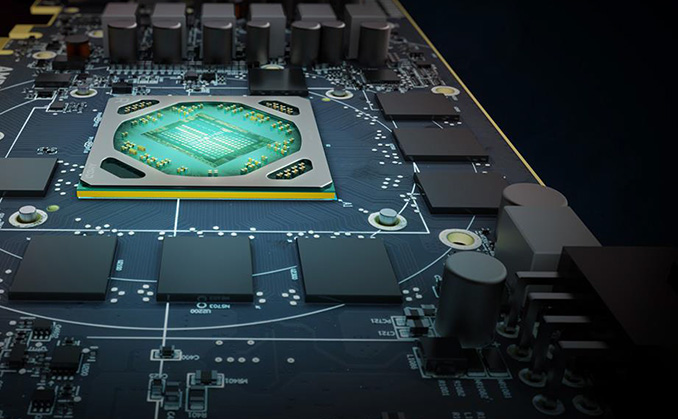
In fact, while AMD hasn’t confirmed which specific Polaris GPU the card is using, the specifications are closer to an RX 580 (Polaris 20) than they are an RX 590 (Polaris 30). The RX 590 GME ships with the RX 580’s 1257MHz base clock, but offers a 40MHz higher boost clock, topping out at 1380MHz. The card’s (listed) specifications are otherwise identical to the 590/580, including a full 36 CU configuration and 8GB of GDDR5 VRAM on a 256-bit bus that’s clocked at 8Gbps.


Otherwise, unverified third-party reports have claimed that the card is indeed using Polaris 20, and these specifications would be consistent with that.


On paper, this puts the peak performance of the card at just less than 3% ahead of the RX 580, which is similar to what AMD’s partners have previously been doing with their own factory overclocked cards. So the performance of the RX 590 GME is by and large a known quantity at this point, with the card set to offer just a bit more performance than AMD’s well-tenured RX 580.


The big question, of course, is why AMD is releasing another Polaris 10/20/30 card almost 4 years after the GPU was first launched. With previous China-only cards this has been to fill specific market needs or to sell off excess stock, and both may be a factor here. Within AMD’s product stack, RX 580-class cards in particularly are wholly redundant; the newer 8GB RX 5500 XT delivers 8% better performance than those cards, which means the new RX 590 GME is going to be slower than AMD’s slowest 8GB Navi cards.


What the RX 590 GME offers that the RX 5500 XT doesn’t however is ease of availability. AMD continues to be somewhat capacity constrained on TSMC’s 7nm process – they have a lot of CPU demand to fill, never mind GPUs – whereas if AMD needed to fab more chips, GlobalFoundries’ 14nm lines are readily available. Furthermore, the RX 590 GME enjoys a lower bill of materials cost as far as memory is concerned: whereas the RX 5500 XT uses newer (and still more expensive) GDDR6, the Polaris-based 590 uses more readily available GDDR5.


Ultimately, while China is still a growing market for technology – both in terms of total scale and in how much consumers have to spend on individual products – it’s still primarily a market dominated by mainstream parts. So if AMD is looking to scrape together a cheaper offering to compete on a purely price/performance basis – and especially if they still have leftover chips lying around – then they could do worse than another Polaris 20 card. That said, they could definitely do better as far as the product name goes.


Source: AnandTech – AMD Officially Launches the Radeon RX 590 GME For China: RX 580 Rides Again

Micron Develops uMCP with LPDDR5 & 96L 3D NAND for Midrange 5G Smartphones

Micron this week has announced that it has started sampling the industry’s first multichip package (MCP) that integrates LPDDR5-6400 DRAM and 96-layer 3D NAND flash memory. The uMCP5 device is aimed at midrange 5G smartphones that require fast DRAM as well as high-performance storage.


Micron’s uMCP5 device packs 12 GB of LPDDR5-6400 memory in a dual-channel arrangement, 256 GB of 96-layer 3D TLC NAND storage with a UFS interface, as well as an onboard controller. The LPDDR5 dies are made on the company’s 2nd Generation 10nm process technology, while the company hasn’t commented on the NAND. Combined, the complete uMCP5 chip uses a 297-pin standard BGA package.


Overall, uMCP packages that integrate both DRAM and 3D NAND enable smartphone manufacturers to reduce the footprint that is needed for RAM and storage. Micron says that its uMCP5 uses 40% less space than two (separate) memory chips, while also providing a 50% increase of memory and storage bandwidth when compared to previous-generation solutions.


All told, Micron’s latest uMCP devices come as demand for LPDDR5 is taking off, and demand for higher performance storage overall is booming. On top of 5G’s faster speeds putting more demand on quick local storage, the latest handsets in general feature increasingly better cameras and displays than predecessors, all of which generates more data to load and store. So there’s a need for faster memory and non-volatile storage, not only for 5G smartphones, but higher-end 4G/LTE smartphones as well.


Micron’s uMCP5 package is currently sampling to select partners.


Related Reading:


Source: Micron


Source: AnandTech – Micron Develops uMCP with LPDDR5 & 96L 3D NAND for Midrange 5G Smartphones

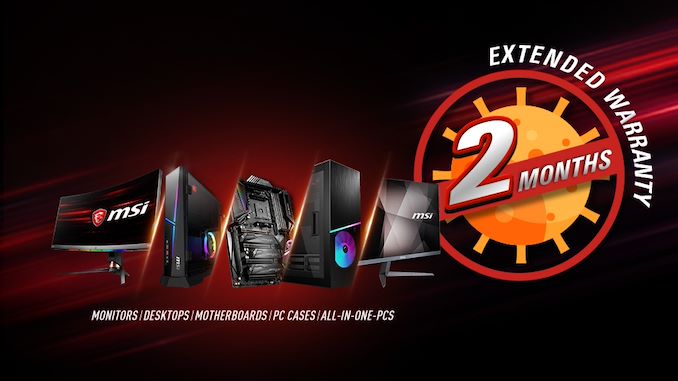
MSI Extends Product Warranties by Two Months Due to Coronavirus

The outbreak of the SARS-CoV-2 coronavirus has already caused the cancellation several major trade shows and will have other kinds of impacts on the high-tech industry. And while the full repercussions are far from over, we’re now seeing what may be the oddest of them all: warranty extensions. Citing this outbreak and a desire to give its customers some peace of mind, MSI this week announced a complimentary extension of its product warranties. As long as owners meet certain conditions, warranties originally set to expire this month have now been extended by two months.


All told, MSI is issuing two month warranty extensions on all its all-in-one (AIO) desktops, desktops, motherboards, monitors, as well as cases (and PC cabinets). This covers many of its consumer products, but notably leaves the company’s popular laptops out of the program. As previously mentioned, the warranty extension is being offered on products with original warranties set to expire by March of 2020 – or in other words, this month.


While the extensions are largely automatic, owners do need to fulfill a couple of conditions. First, the program is only being offered in certain countries: South Korea, Italy, Germany, France, Japan, Spain, USA, Switzerland, Singapore, UK, Hong Kong, Sweden, Norway, Netherlands, Australia, Kuwait, Bahrain, Malaysia, Belgium, Canada. China isn’t being directly covered by this program, but MSI is already offering an independent program there. Second, owners need to be enrolled in the MSI Rewards Program, MSI’s warranty registration and rewards program.


By extending its product warranties, MSI can address several problems at once. Most importantly, perhaps, is that it means that product owners who need warranty service this month can put off service for another month or two, hopefully when the viral situation has subsided. This essentially pauses (or at least greatly reduces) MSI’s warranty operations at a time when they are likely not operating at full capacity to begin with, and minimizes any interactions that could spread the disease. This also lowers the immediate demand for components and/or spare parts, which comes as manufacturing operations in China are still getting back on track.


And of course, the value of good will (and the free press) is immeasurable. MSI is ultimately on the hook for two more months of hardware failures, which will have a very real cost in terms of support. But it is a welcome piece of good news in a month that could use some.


Related Reading:


Source: MSI


Source: AnandTech – MSI Extends Product Warranties by Two Months Due to Coronavirus

Load Value Injection: A New Intel Attack Bypasses SGX with Significant Performance Mitigation Concerns

Microarchitectural attacks have been all the rage. For the past two years, we’ve seen attacks like Meltdown, Spectre, Foreshadow/L1TF, Zombieload, and variants all discuss different ways to probe or leak data from a victim to a host. A new attack, published on March 10th by the same research teams that found the previous exploits, turns this principle on its head, and allows an attacker to inject their own values into the victim’s code. The data injection can either be instructions or memory addresses, allowing the attacker to obtain data from the victim. This data injection bypasses even stringent security enclave environments, such as Intel’s Software Guard Extensions (SGX), and the attackers claim that successful mitigation may result in a slowdown of 2x to 19x for any SGX code.


Source: AnandTech – Load Value Injection: A New Intel Attack Bypasses SGX with Significant Performance Mitigation Concerns

Intel Puts Whiskey Lake on The Bonfire: Penny for the NUC

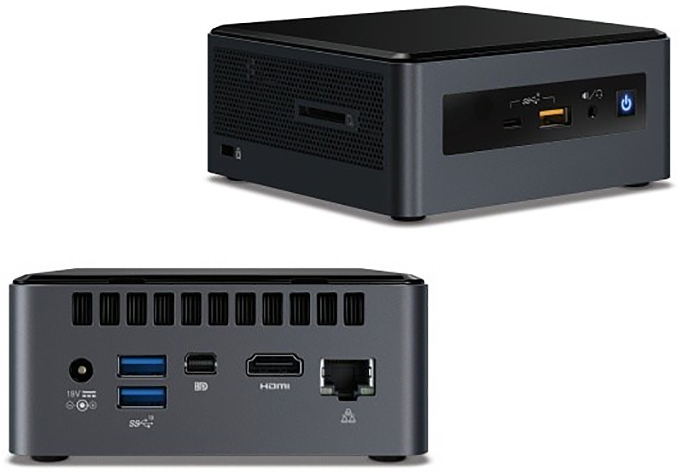
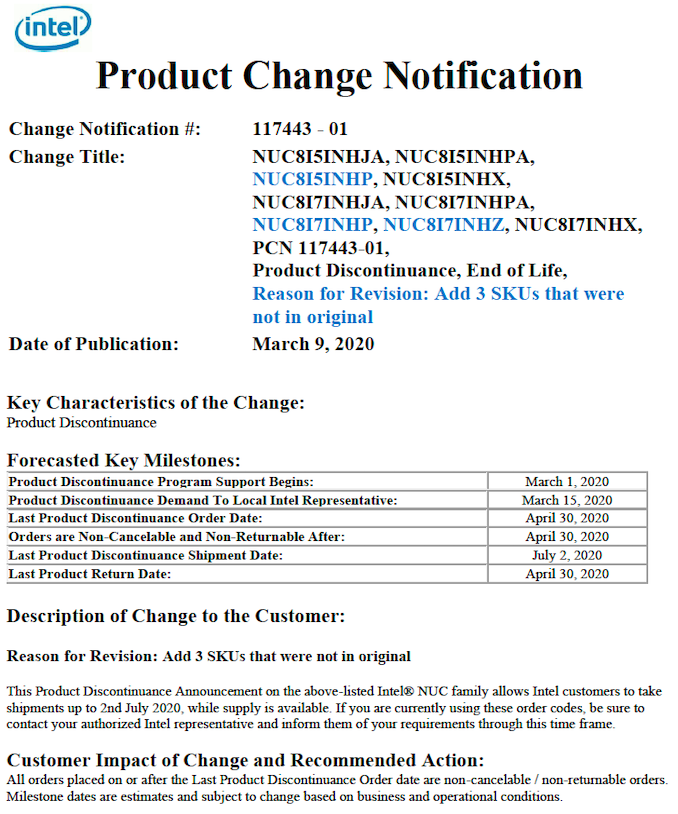
Intel has begun winding down sales of the majority of its Whiskey Lake-based 8th generation NUCs (NUC8 Series). This month  the company issued a product change notification for the UCFF systems, establishing a plan for transitioning the systems to end of life (EOL) status. Like other EOL transitions, Intel is giving themselves and customers a bit of time to prepare, with the final shipments of the systems set to occur in July.


The list of SKUs to be discontinued includes such models as the NUC8I5INHJA, NUC8I5INHPA, NUC8I5INHP, NUC8I5INHX, NUC8I7INHJA, NUC8I7INHPA, NUC8I7INHP, NUC8I7INHZ, and NUC8I7INHX. Intel’s customers are recommended to make their final orders by April 30, 2020, with shipments set to end by July 2nd.


Interestingly, while Intel is discontinuing most of their Whiskey Lake-based NUCs, they aren’t discontinuing all of them, at least not in a single go. This month’s announcement only covers NUC8s using Core i5 and Core i7 chips; the Core i3 models are not part of the EOL plan.


Intel’s Whiskey Lake processors were introduced in August 18, 2018. These CPUs are still widely used by PC manufacturers, so it’s a bit surprising to see Intel discontinue NUCs based on them so soon. But with the company using the same 14++ process for numerous other and newer parts, including Comet Lake and Coffee Lake, there is some definite redundancy in Intel’s chip stack. As well, the company is still working to meet the overall demand for chips made on that process.


Related Reading:


Intel Axes 10nm CPU Based NUC
Intel Confirms Comet Lake-Based NUC 10 ‘Frost Canyon’ UCFF PCs
Intel’s Islay Canyon Mini NUCs Available: Whiskey Lake, Radeon 540X, 8GB LPDDR3
EGlobal’s NUC-Like PC Packs Intel’s Unlocked Hex-Core i7-8750HK CPU


Source: Intel


Source: AnandTech – Intel Puts Whiskey Lake on The Bonfire: Penny for the NUC

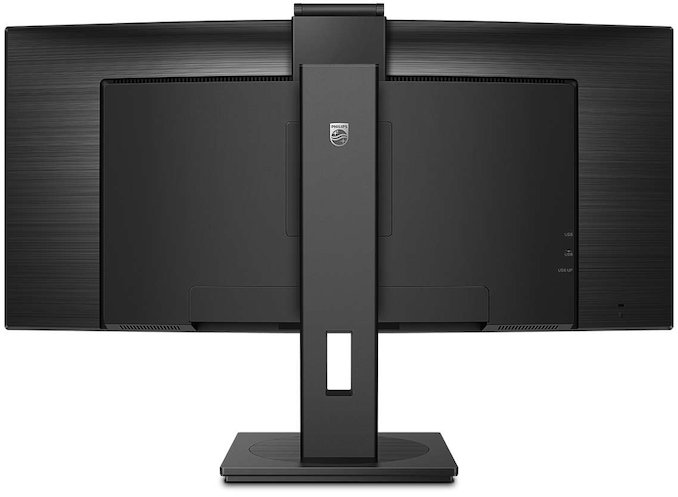
Philips's 346P1CRH Curved Monitor: 34 Inches, USB-C, Webcam, Ethernet, KVM, DCI-P3

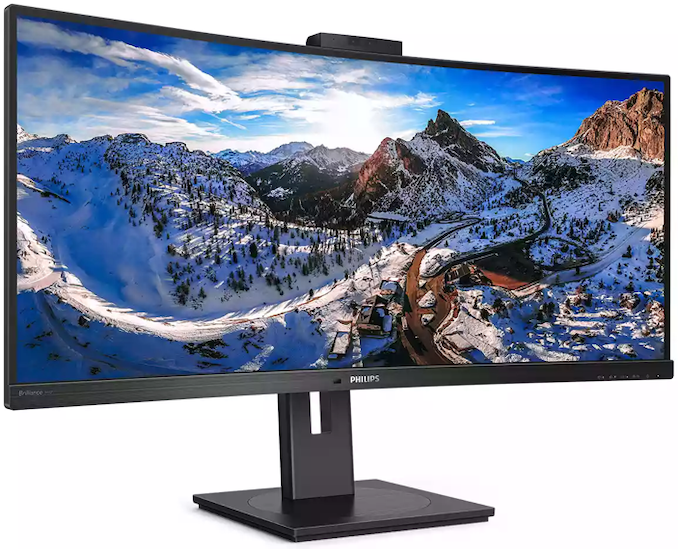
Philips has unveiled a new curved display aimed primarily at business users, while also offering some capabilities for entertainment as well. The Philips 346P1CRH monitor supports USB-C docking, an integrated KVM switch, a webcam, and an Ethernet port.


The Philips Brilliance 346P1CRH is a 34-inch LCD featuring a 3440×1440 resolution, 500 nits brightness, a 3000:1 contrast ratio, 4 ms response time, 178º/178º viewing angles, and a 100 Hz refresh rate with VESA’s Adaptive-Sync variable refresh rate technology on top. The monitor can display 16.7 million colors and reproduce 120% of the sRGB, 90% of the DCI-P3, and 88% of the Adobe RGB color gamut. Furthermore, the LCD is DisplayHDR 400 certified, which — in addition to Adaptive-Sync — will be nice bonuses for those who plan to use the product not only for work, but for entertainment as well.


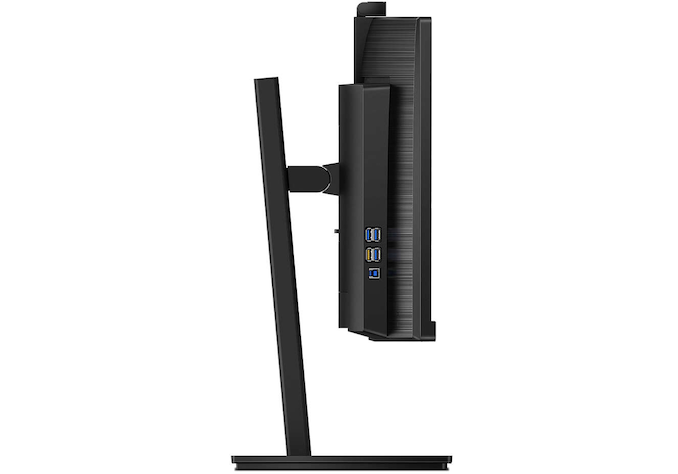
Connectivity capabilities of the Philips 346P1CRH are among the key selling features of the device, as many people use multiple PCs and therefore need a decent set of connectors as well as an integrated KVM switch. The monitor can connect to hosts using one DisplayPort 1.4, an HDMI 2.0 port, and a USB Type-C connector that can also deliver up to 90 W of power. Meanwhile, the display also has a DP output for multi-monitor configurations. In addition, the LCD has quad-port USB 3.2 hub, a GbE port, 5W speakers, a 2 MP Full-HD camera with a built-in microphone, and a headphone jack output.


When it comes to ergonomics, the Philips 346P1CRH monitor is equipped with a stand that can adjust height, swivel, and tilt. Meanwhile, since we are dealing with a curved monitor, it naturally only works in landscape mode.


Philips 34-Inch Curved UltraWide Display
  Brilliance 346P1CRH
Panel 34″ VA
Native Resolution 3440 × 1440
Maximum Refresh Rate 100 Hz
Response Time 4 ms
Brightness up to 500 cd/m²
Contrast up to 3000:1
Backlighting W-LED
Viewing Angles 178°/178° horizontal/vertical
Curvature 1500R
Aspect Ratio 21:9
Color Gamut sRGB: 120%

DCI-P3: 90%

AdobeRGB: 88%

NTSC: 98%
Dynamic Refresh Rate Tech Adaptive-Sync
Pixel Pitch 0.23175 mm²
Pixel Density 110 PPI
Inputs 1 × DisplayPort 1.4

1 × HDMI 2.0b

1 × USB-C with 90W PD
Audio 3.5 mm output
USB Hub 4 × USB 3.2 Type-A connectors
Ethernet 1 GbE port
Webcam 2 MP with IR sensors
Stand Height: 180 mm

Swivel: -/+ 180 degree

Tilt: -5~25 degree
MSRP £499

Philips will start sales of the 346P1CRH already this month for the price of £499 in the UK.


Related Reading:


Source: Philips


Source: AnandTech – Philips’s 346P1CRH Curved Monitor: 34 Inches, USB-C, Webcam, Ethernet, KVM, DCI-P3

NVIDIA Acquires SwiftStack, an Object Storage Company

NVIDIA and SwiftStack have signed an agreement under which the former will aqcuire the latter. SwiftStack develops object storage software that is used for AI, HPC, and accelerated computing applications. As a part of NVIDIA, SwiftStack will continue supporting its existing programs and develop new ones, primarily with NVIDIA’s hardware in mind.


SwiftStack was founded in November 2011 and raised $23.6 million in total. The company is primarily known for its SwiftStack 7, 1space, ProxyFS, Swift, and the Controller products, but market observers do not think that it was a really successful company. Throughout its history, SwiftStack has worked with many companies, including Ebay, Google, NVIDIA, and Valohai. Furthermore, the company has experience with hardware from Cisco, Dell, HPE, and SuperMicro.


After it is integrated as a part of NVIDIA, SwiftStack will continue to develop, support, and enhance its programs. Meanwhile, the key mission of the team will be to work on NVIDIA’s GPU-powered AI infrastructure and accelerate large scale AI DL pipelines.


In the recent years, NVIDIA has been meticulously collecting technologies and IP for datacenters, with supercomputers in particular being a key aspiration, which emphasizes the focus of the company which has moved beyond just computer graphics in all of its forms. Last year NVIDIA announced a plan to acquire Mellanox, which makes connectivity solutions for servers. The takeover of SwiftStack, an object storage company, is another way to collect assets required for scalable GPU-powered infrastructure for deep learning.


Terms and conditions of the deal were not disclosed, but the two companies expect the transaction to close in the coming weeks.


Related Reading:


Sources: SwiftStack, StorageNewsletter


Source: AnandTech – NVIDIA Acquires SwiftStack, an Object Storage Company

Sharp Sues Oppo Over LTE Patent Infringement

Sharp has filed a lawsuit for patent infringement against Oppo and Oppo Japan. Sharp is accusing Oppo of infringing several of its 4G/LTE patents covering communication technologies used in smartphones.


The lawsuits were filed in the District Court Munich I, the District Court Mannheim, and the Tokyo District Court. Sharp has not disclosed which of its patents have been infringed and which damages and remedies it seeks. Meanwhile, many patent infringement cases are filed in order to eventually settle them and sign a broad cross-licensing agreement.


One noteworthy thing about the lawsuit — and that is perhaps an important one for the story in general — is who sues who. Sharp belongs to Foxconn Electronics, the world’s largest contract producer of electronics based out of China. Oppo is a part of BBK Electronics, another Chinese company, which owns brands like OnePlus, Vivo, and Realme. In fact, BBK is one of the world’s largest makers of smartphones in the world, well ahead of Apple. So while Sharp and Oppo aren’t necessarily huge names, the companies behind them are some of the biggest in the business.


All told, an LTE patent infringement suit at this point in time comes off as a bit odd. Widespread use of LTE began almost a decade ago, so companies have been shipping LTE gear for several years now. And, with the exception of perhaps Qualcomm’s legal scuffles, LTE had seemed to be a largely settled matter, with the major patents and patent pools well understood. None the less, here we are.


Oppo yet has to comment on the lawsuit against itself and how it plans to defend itself.


Related Reading:


Source: Sharp


Source: AnandTech – Sharp Sues Oppo Over LTE Patent Infringement

A Peek Into Graviton2: Amazon's Neoverse N1 Server Chip First Impressions

It’s been a year and a half since Amazon released their first-generation Graviton Arm-based processor core, publicly available in AWS EC2 as the so-called ‘A1’ instances. While the processor didn’t impress all too much in terms of its performance, it was a signal and first step of what’s to come over the next few years.

This year, Amazon is doubling down on its silicon efforts, having announced the new Graviton2 processor last December, and planning public availability on EC2 in the next few months. The latest generation implements Arm’s new Neoverse N1 CPU microarchitecture and mesh interconnect, a combined infrastructure oriented platform that we had detailed a little over a year ago. The platform is a massive jump over previous Arm-based server attempts, and Amazon is aiming for nothing less than a leading competitive position.


Source: AnandTech – A Peek Into Graviton2: Amazon’s Neoverse N1 Server Chip First Impressions

Amazon's Arm-based Graviton2 Against AMD and Intel: Comparing Cloud Compute

It’s been a year and a half since Amazon released their first-generation Graviton Arm-based processor core, publicly available in AWS EC2 as the so-called ‘A1’ instances. While the processor didn’t impress all too much in terms of its performance, it was a signal and first step of what’s to come over the next few years.


This year, Amazon is doubling down on its silicon efforts, having announced the new Graviton2 processor last December, and planning public availability on EC2 in the next few months. The latest generation implements Arm’s new Neoverse N1 CPU microarchitecture and mesh interconnect, a combined infrastructure oriented platform that we had detailed a little over a year ago. The platform is a massive jump over previous Arm-based server attempts, and Amazon is aiming for nothing less than a leading competitive position.


Source: AnandTech – Amazon’s Arm-based Graviton2 Against AMD and Intel: Comparing Cloud Compute

NVIDIA Axes GTC Digital Keynote In Favor Of News Releases; Fate Of Major Announcements Unknown

Last week, in light of the ongoing SARS-CoV-2 outbreak, NVIDIA opted to scale down their plans for their annual trade show, the 2020 GPU Technology Conference. At the time the company announced that they would take the show entirely digital, including offering webinars, pre-recorded talks, and of course, CEO Jensen Huang’s annual keynote. However a week later, and those digital offerings are now getting a whole lot slimmer, as NVIDIA is announcing that they have canceled the keynote altogether.


Citing the current coronavirus situation and the potential for it to impact their ability to produce a keynote presentation, the company is “deferring plans to deliver a webcast keynote”. But rather than give up on making any announcements altogether, in place of that NVIDIA now intends to issue a series of news announcements on March 24th that had previously been scheduled to be shared in the keynote. So while NVIDIA has scaled things back even further, there will still be some news coming out of the company later this month.

The big, outstanding question of course is how many “major” announcements NVIDIA will still go ahead with. GTC keynotes in recent years have been an onion of sorts, with core NVIDIA technology announcements surrounded by news about partnerships, projects customers have been working on, NVIDIA’s own research projects, etc. So there is a great deal of (intentional?) ambiguity in today’s announcement from NVIDIA, as it’s not clear if NVIDIA is still going to make some long-expected core technology announcements, or if they’ll withhold them for another time.

Complicating all of this one degree further is that the company’s annual investor day takes place during GTC. That presentation, which typically encapsulates the keynote’s major announcements with a great deal of discussion on NVIDIA’s financials, has been scaled back as well, but not entirely. NVIDIA will still be doing an investor call on the morning of the 24th, which is set to follow the release of their news announcements. As a result, there are several competing factors here in determining what news NVIDIA still needs to or will want to present.


The good news, at least, is that the rest of GTC Digital will still be taking place. That kicks off on March 25th, with NVIDIA set to release more details on how the company will be collecting and sharing that material.


At any rate, AnandTech will be covering all of the news from GTC, regardless of what form it comes in. So be sure to check back in on the 24th to see what NVIDIA is (or isn’t?) announcing this month.


Source: AnandTech – NVIDIA Axes GTC Digital Keynote In Favor Of News Releases; Fate Of Major Announcements Unknown

How Good (or Bad) is a $100 Laptop? The Coda Spirit Review

Back in late 2014, I remember Brett reviewing the HP Stream 11-inch laptop for $200. At the time, it was a great little machine, offering all you need to do basic work flow and get online with a dual-core Atom and a low resolution display. Fast forward to 2019, and I picked up a 1080p IPS 13-inch clamshell laptop, with Win 10 Home and storage expansion, for just $100. On paper, this thing is epic for the price. But is it actually worth it? 


Source: AnandTech – How Good (or Bad) is a 0 Laptop? The Coda Spirit Review

FSP Details T-Wings CMT710 Open-Frame 2-in-1 Chassis

FSP has detailed its open-frame T-Wings CMT710 chassis, designed for hardcore gamers and professional game streamers that want maximum style, allowing for integration of to systems into one chassis. The new case can accommodate an E-ATX as well as an Mini-ITX motherboard at the same time, two PSUs, multiple graphics cards, and several storage drives.


FSP’s open-frame 2-in-1 T-Wings CMT710 chassis has two open chambers semi-covered with 4-mm tempered glass panels: one for the E-ATX side, another for Mini-ITX half. Each chamber can accomodate its own PSU: an ATX one for the former, as well as an SFX/SFX-L one for the latter. The PCs can be cooled down using two liquid-cooling systems with up to 360-mm radiators that promise to provide enough cooling performance even for high-end components.


One of the interesting — and stylish — features of the T-Wings CMT710 case is its addressable RGB LED lightbar that is located between the ‘wings’, or chambers. Obviously, behavior of the RGB lightbar can be controlled using stanard software from leading motherboards vendors.


When it comes to expandability, FSP’s T-Wings CMT710 supports everything that E-ATX and Mini-ITX motherboards have to offer, such as eight expansion cards (i.e., graphics cards of up to 380-mm) for the larger platform, and two expansion cards for the smaller platform. In addition, the case can house two 3.5-inch storage bays as well as three 2.5-inch storage devices. The case also has a 40-mm space inbetween the chamber halves for cable management.


To make usage of the PCs easier in terms of accessibility, the front panel of the T-Wings CMT710 has two 3.5-mm audio connectors, one USB 3.1 Gen 2 Type-C port, and two USB 3.1 Gen 1 Type-A connectors.


FSP did not say when it plans to start selling its T-Wings CMT710 chassis, how much it is going to cost, or whether this is going to be a limited-edition product. Meanwhile, FSP does offer the chance to win the case through a lottery on their website.


Related Reading:


Source: FSP


Source: AnandTech – FSP Details T-Wings CMT710 Open-Frame 2-in-1 Chassis

Rambus Develops HBM2E Controller & PHY: 3.2 Gbps, 1024-Bit Bus

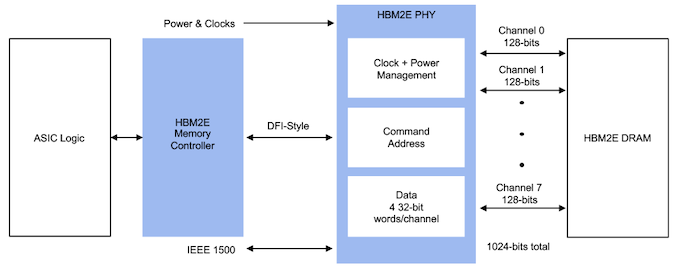
The latest enhancements to the HBM2 standard will clearly be appreciated by developers of memory bandwidth-hungry ASICs, however in order to add support of HBM2E to their designs, they are also going to need an appropriate controller as well as physical interface. For many companies developing of such IP in-house does not make financial sense, so Rambus has designed a highly-integrated HBM2E solution for licensing.


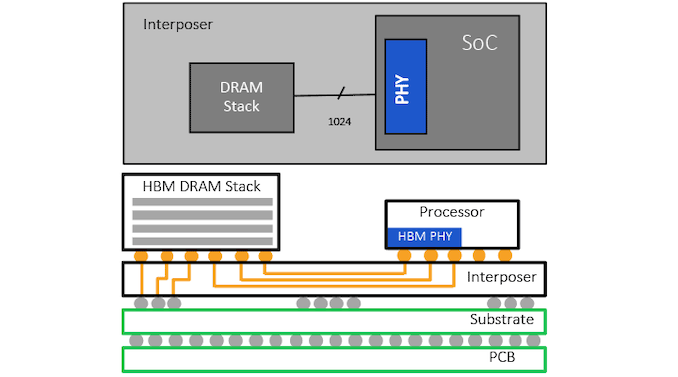
The HBM2E standard supports 12-Hi DRAM stacks as well as memory devices of up to 16 Gbps, thus enabling to build up to 24 GB stacks using a 1024-bit bus. At the same time, the new specification officially supports data rates of up to 3.2 Gbps, which results in 409.6 GB/s bandwidth per stack. Rambus’s HBM2E solution includes a controller that can work with 12-Hi KGSDs (known good stack dies) as well as a verified 1024-bit PHY that supports speeds of up to 3.2 Gbps. 


The Rambus HBM2E controller core (originally developed by Northwest Logic) is DFI 3.1 compatible (with appropriate extensions) and supports AXI, OCP or proprietary interfaces to connect to integrator logic. Meanwhile, the controller also supports Look-Ahead command processing (a standard way to trim latencies) as well as channel densities of up to 24 Gb.


Licensees of Rambus’s HBM2E solution will get everything they need to integrate it into their designs, including source code of the controller (in a bid to synthesize it for a particular process technology) as well as fully-characterized hard macros (GDSII) of the interface. Alternatively, engineers from Rambus can help integrate the HBM2E IP support for a fee.


Related Reading:


Source: Rambus


Source: AnandTech – Rambus Develops HBM2E Controller & PHY: 3.2 Gbps, 1024-Bit Bus