The Z490 Mini-ITX Showdown: GIGABYTE's Z490I Aorus Ultra and MSI's MEG Z490I Unify Reviewed

The mini-ITX form factor is as popular as ever, with a handful of options already available for Intel’s new LGA1200 socket. Over the years motherboard vendors have been perfecting their small form factor models designed to offer all of the performance of the larger-sized models, but with a smaller desktop footprint. Of these, two of the most desirable models based on features and pricing from all the mini-ITX models on the Z490 chipset are the GIGABYTE Z490I Aorus Ultra and MSI MEG Z490I Unify. Offering dual PCIe 3.0 x4 M.2 slots, 2.5 GbE Ethernet ports, and integrated Wi-Fi 6 radios, both GIGABYTE and MSI’s motherboards are designed to address the high end of the market. And with both boards going for the same price as well, it’s easy to see why these Z490 boards have become such worthy adversaries.


Source: AnandTech – The Z490 Mini-ITX Showdown: GIGABYTE’s Z490I Aorus Ultra and MSI’s MEG Z490I Unify Reviewed

AMD Zen now at 6W TDP: Dual Core for Education

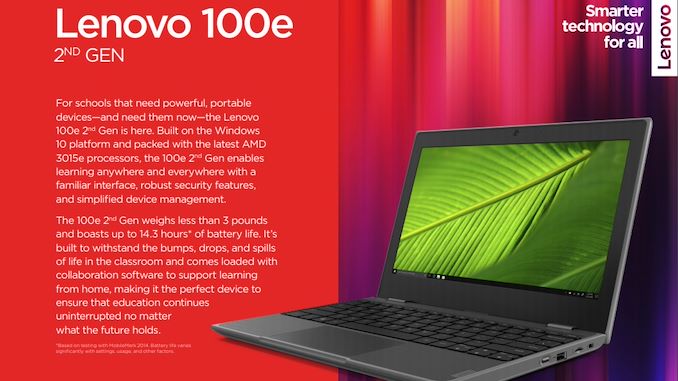
At the low-end of AMD’s portfolio, the company uses Athlon Gold and Silver naming for parts that offer fewer cores and lower power consumption. These parts are still based on Zen or Zen+ microarchitecture, paired with a small amount of Vega graphics, indicating that this market is best served with something that is at a low-cost to manufacture but still of sufficient performance for the markets intended. Sitting below those Athlons, two new APUs have popped up in some new Lenovo education-focused designs today.


The two new processors dispense with the Athlon naming, as AMD gets right into it – the AMD 3015e and 3020e use the same lower case ‘e’ ending we last saw on a product line in 2011, indicating the super low power that these processors are rated for. These processors are given a TDP of 6W with two cores and Vega 3 graphics, traditionally what we see in low cost laptops but sufficient for education-style designs.


The silicon these new processors are based on, we believe, is AMD’s Dali silicon. It is the smallest of all AMD’s Zen APU silicon offerings, already in the market as AMD Athlon Mobile. These new parts come in below those specifications.


AMD Dali-based Zen APUs
AnandTech Cores

Threads
Base

Freq
Turbo

Freq
GPU GPU

Freq
DDR4 TDP
Athlon Gold 3150U 2 / 4 2400 3300 Vega 3 1000 2400 15 W
Athlon Silver 3050U 2 / 2 2300 3200 Vega 2 1100 2400 15 W
Athlon 300U 2 / 4 2400 3300 Vega 3 1000 2400 15 W
 
Athlon Silver 3050e 2 / 4 2800 Vega 3 1000 2400 6 W
AMD 3015e 2 / 4 1200 2300 Vega 3 600 1600 6 W
AMD 3020e 2 / 2 1200 2600 Vega 3 1000 2400 6 W

If the set-up looks a bit odd, well, it is. The 3015e has simultaneous multi-threading but a much lower GPU frequency and DDR4 support compared to the 3020e. This might be the trade-off at the 6W power mode.


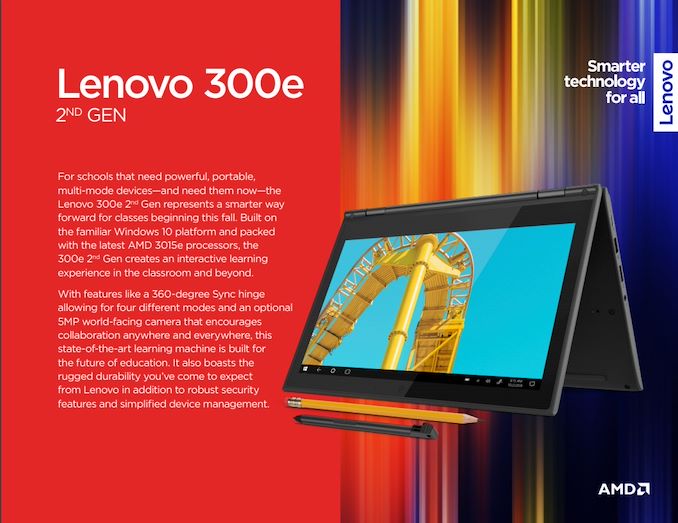
Lenovo is set to use the new AMD 3015e in two of its new education designs.


The Lenovo 100e 2nd Gen will use this new chip, Windows 10, Wi-Fi 6, 64 GB eMMC, 4 GB DDR4, an 11.6-inch 13×7 display (250 nits), but offer a hard wearing design suitable for bumps and scrapes as well as ~12 hours of battery life, with quick charging providing 80% power in an hour.


The Lenovo 300e 2nd Gen is a similar build but offers a 360-degree hinge, pen support, with an optional 128 GB SSD. Battery is 42 Wh, rated at ~12 hours.


The 100e will start at $219 and the 300e will start at $299, available from September. Both devices have a variety of student-focused software options focusing on teaching and security.


Source: AMD / Lenovo


Related Reading


Source: AnandTech – AMD Zen now at 6W TDP: Dual Core for Education

Microchip Announces Flashtec NVMe 3108 Enterprise SSD Controller

Microchip is announcing their first PCIe 4.0-capable SSD controller for low-power and entry-level enterprise SSDs. The new Flashtec NVMe 3108 is the smaller 8-channel derivative of the 16-channel Flashtec 3016, first announced two years ago. The 3016 has since moved from sampling to mass production, and as a derivative based on the same architecture, the new 3108 is expected to make that same transition much more quickly: sampling now, and production sometime in the first half of next year.


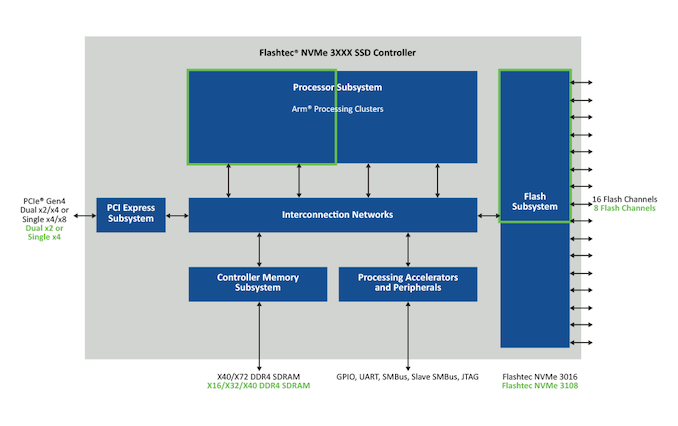
The Flashtec NVMe 3108 isn’t quite literally a 3016 sliced in half, but that was more or less the starting point for developing the 3108. In discussing how the 3016 and 3108 differ, Microchip opened up a bit more about their controller architecture in general, and how their PCIe 4.0 generation 3xxx controllers are different from the earlier PCI 3.0 based Flashtec NVMe 2xxx controllers. First and least surprising, both the 3016 and 3108 are built on a 16nm FinFET process, which is what almost all PCIe 4.0 SSD controllers are adopting.


The external IO interfaces of the Flashtec NVMe 3108 are mostly cut in half relative to the NVMe 3016: 4 rather than 8 lanes of PCIe, 8 rather than 16 channels for interfacing with the NAND flash. The DDR4 DRAM interface on the 3108 can operate as a 16-bit, 32-bit or 40-bit (32+8 bit ECC) bus, while the 3016 uses either a 40-bit (32+8) or 72-bit (64+8) bus width. All together, these changes lead to a drastically lowered pin count, allowing the 3108 controller to use a package small enough to fit on a M.2 SSD. There’s also some significant die space and power savings.


The 3108 runs its DDR4 interface a bit slower than its larger sibling (2400 MHz instead of 3200 MHz), but supports the same NAND interface speeds up to 1200 MT/s — a huge improvement over the 533 MT/s supported by the previous generation Flashtec controllers. This allows the 3108 to hit sequential read speeds of over 6 GB/s and random read speeds of 1M IOPS when paired with sufficiently fast flash memory. This isn’t quite saturating what a PCIe 4 x4 link is capable of, but is competitive with other PCIe gen4 enterprise SSD solutions that have been announced such as the Samsung PM9A3 (6.5GB/s, 900k IOPS) or the 16-channel Kioxia CD6 (6.2GB/s, 1M IOPS).


The Flashtec NVMe 3108 includes fewer processor cores than the 3016, but still more than necessary for implementing basic SSD functionality. Microchip has designed the 3108 and the 3016 with spare processing power to accommodate computational storage use cases. This generation switched from Tensilica CPU cores to Arm cores, making for a more familiar development environment for customers developing firmware for these SSD controllers. Microchip says some customers are even running Linux on a subset of the controller’s Arm cores.


Two major features of the Flashtec NVMe 3016 are outright missing on the 3108. The smaller controller doesn’t include the compression accelerator hardware from the 3016, so it is not as well suited for computational storage duty along those lines. The 3108 also lacks the expansion port of the 3016. The larger chip’s expansion port is intended to allow two SSD controllers to pair up and be used as a 32-channel controller, since Microchip is no longer producing a monolithic 32-channel version of their controllers. This expansion port is unneeded on the 3108 since they already have a 16-channel solution that is simpler and likely faster and more efficient than a dual-chip 8+8 channel setup would be. (Competitors in the enterprise SSD controller space have also used dual-controller designs, such as Marvell’s dual-chip 16-channel solution. Silicon Motion has taken an in-between strategy, designing a single-chip 16-channel controller that is internally organized much like a combination of two 8-channel controllers.)


Aside from those features, the 3108 checks all the same boxes as the 3016: support for cryptographically verified firmware, dual-port PCIe, virtualization. Customers building SSDs with the 3108 should be able to implement the full range of NVMe 1.4 features and probably anything coming in NVMe 2.0, though not everyone will be including all of those optional features in their firmware.


Microchip’s customers for Flashtec SSD controllers include numerous SSD vendors as well as some hyperscale cloud service providers who design their own SSDs. Each of these has their own firmware development and QA processes and few are particularly open about their long-term roadmaps, so it’s hard to say when we’ll start seeing final products using the new Flashtec NVMe 3108 controller. Most of our hands-on experience with Flashtec SSD controllers has come from Memblaze’s PBlaze5 family, which was jointly developed with Micron and related to their 9xxx series SSDs. Memblaze just announced new models using the 2108 controller, so their 3108-based drives are probably over a year away.


Source: AnandTech – Microchip Announces Flashtec NVMe 3108 Enterprise SSD Controller

Netgear Launches WAX610 AX1800 Wi-Fi 6 Access Point for SMBs

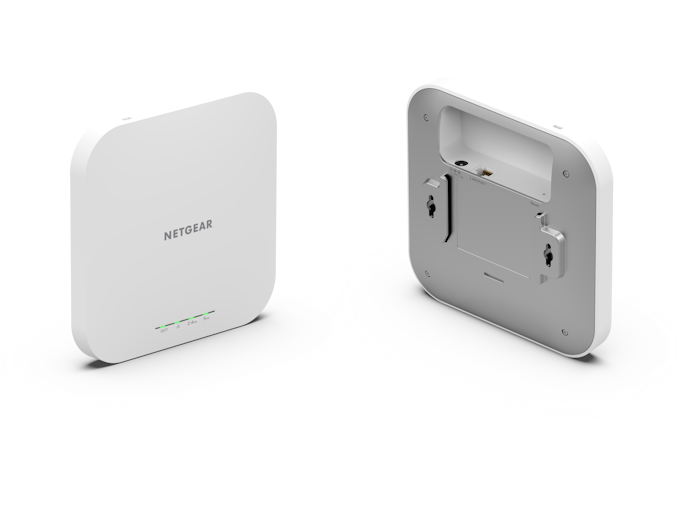
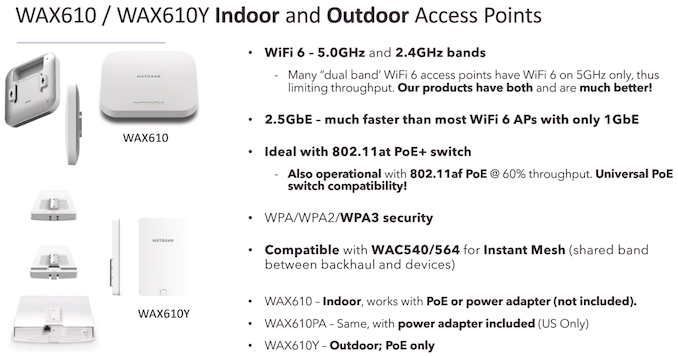
Wi-Fi 6 deployment in the consumer market has achieved critical mass, with almost all modern smartphones and notebooks equipped with support for 802.11ax technology. As expected, we are starting to see the small-business and enterprise access points (APs) moving to support this technology. While vendors such as Aruba Networks, Ruckus Wireless, and others already have Wi-Fi 6 SMB / SME-focused Wi-Fi 6 APs in the market, Netgear is launching their first set of Wi-Fi 6 products targeting this segment today – the AX1800 WAX610, and its outdoor counterpart, the WAX610Y.


Unlike previous Wi-Fi technology upgrades, the move to Wi-Fi 6 brings in the need for some underlying infrastructure changes – support for NBASE-T and PoE+ (802.3at). Some high-performance Wi-Fi 6 APs even require PoE++ (802.3bt) support. Netgear’s WAX610 and WAX610Y can be powered using 802.3at and use a 2.5Gbps RJ-45 port for wired backhaul / power delivery.


The focus in SMB products is more on stability compared to peak performance. Consumers in this space also want the ability to support a large number of concurrent client devices – high-density deployments – much more than what is usually handled by consumer Wi-Fi routers. Some SMBs also have to make do with non-dedicated IT staff, and external management capabilities as well as ease of setup / installation also plays a role in some scenarios. Netgear claims that the WAX610/WAX610Y’s feature set aims at tackling these aspects. The AX1800 (2×2 802.11ax with 1200 Mbps in the 5 GHz band and 600 Mbps in the 2.4 GHz band) APs utilize a Qualcomm chipset. Based on the performance specifications, we do not have 160 MHz support, and Negear also mentioned the absence of uplink OFDMA support. The former is not really important for SMB APs – at least, not without Wi-Fi 6E which brings extended spectrum and the possibility of availing multiple contiguous 160MHz chunks without interference / DFS.


In terms of security, Netgear is offering WPA3 support (as mandated by the IEEE Wi-Fi 6 specifications), as well as support for up to 8 SSIDs with a separate VLAN for each SSID. A number of SMB Wi-Fi 6 APs currently in the market use a 1Gbps wired port, but, Netgear has equipped their two new models with a 2.5Gbps LAN port. While most deployments would use the wired port for backhaul, Netgear has also provided mesh support, enabling the WAX models to mesh over Wi-Fi with other Netgear APs such as the WAC610 / WAC610Y / WAC540 / WAC564. The maximum power consumption for the WAX610 over PoE is rated at 15.3W, while the WAX610Y consumers 16.1W – enabling 802.3at-capable switches to power them easily. The APs will also function with 802.3af (traditional PoE), but ends up getting limited to 60% of its peak performance capabilities.


The APs are part of Netgear’s Insight-capable portfolio – allowing optional cloud-based management access. This is a boon for part-time IT folks as well as resellers wanting to provide value-added services.


I have quite not been sold on the Insight-type cloud-based management scheme for SMB equipment (irrespective of the vendor offering it). However, the value offered to folks who are not dedicated solely to IT maintenance in an organization is undeniable. Now, the increasing prominence of work-from-home culture will bring additional pain-points to solve, and Insight-type cloud-based management can definitely play a role. For example, enabling seamless VPN and/or the ability to securely extend a WLAN from an office location to an employee’s home (for scenarios where mobile devices needs to be in the company network for certain applications) are some challenges that IT administrators might want to solve in a user-friendly way moving forward. Cloud-based management solutions can definitely be of help in those scenarios.


The WAX610 and WAX610Y are Insight-capable (not Insight-only), and expose more functionality for local management compared to what is available over the app / using the cloud. Pricing ranges from $180 (base indoor model without a power adapter) to $250 (outdoor model). Compared to SMB offerings from vendors such as Engenius and ZyXEL (Engenius EWS357AP @ $184 and the ZyXEL NWA110AX @ $200, both AX1800 PoE+ APs without 2.5Gbps LAN), these are very competitive price points in terms of the features offered.


Source: AnandTech – Netgear Launches WAX610 AX1800 Wi-Fi 6 Access Point for SMBs

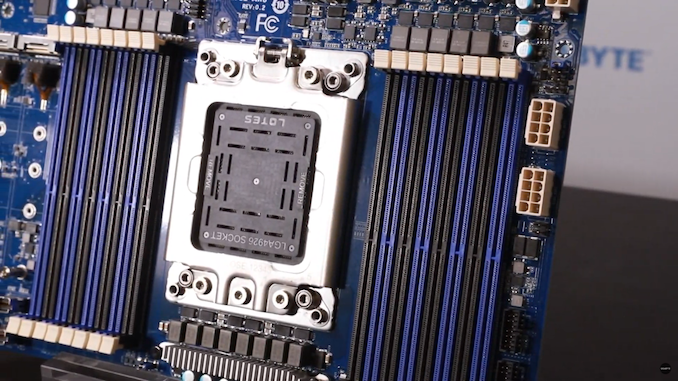
Ampere Altra 1P Server Pictured: GIGABYTE’s 2U with 80 Arm N1 Cores, PCIe 4.0 and CCIX

With the news of Apple moving to Arm SoCs replacing Intel in a few key products, and the success of the new Graviton2 SoC in Amazon’s Web Services, the news-o-sphere is awash with excitement about a new era of Arm-based computing. One of the companies looking to deploy Arm into the cloud is Ampere, with its new Altra and Altra Max compute processors.


Source: AnandTech – Ampere Altra 1P Server Pictured: GIGABYTE’s 2U with 80 Arm N1 Cores, PCIe 4.0 and CCIX

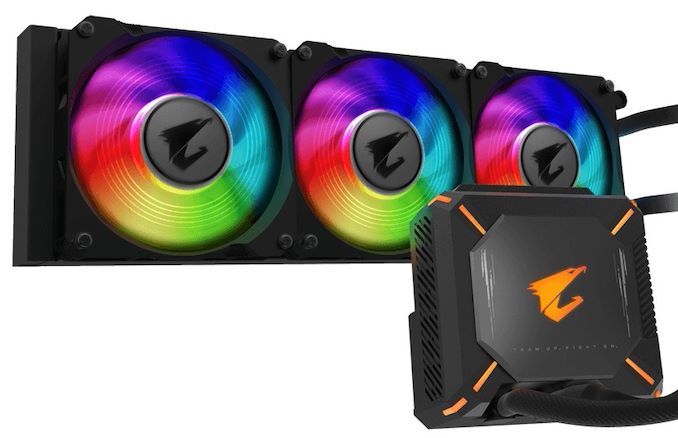
GIGABYTE's New Z490 Aorus Master WaterForce Combo with Bundled 360mm AIO

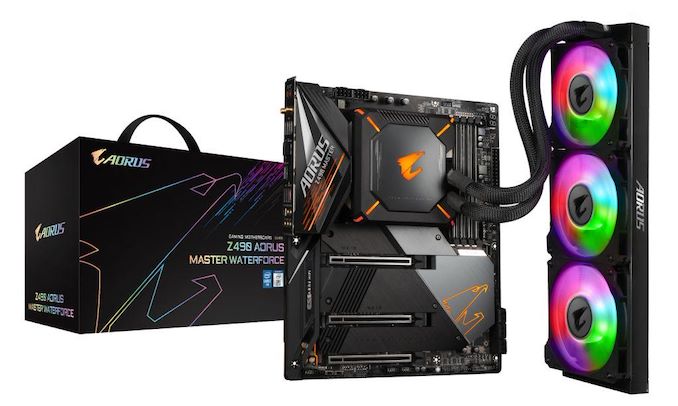
Up until now, GIGABYTE has reserved the monoblock clad WaterForce series for its flagship Aorus Xtreme models. In an interesting move to further enhance the performance of the Intel Core i9-10900K processor and dominate the mid-range space, GIGABYTE has announced the new Z490 Aorus Master WaterForce bundle. GIGABYTE claims it to be the world’s first motherboard to be bundled with a 360 mm AIO CPU cooler with monoblock which covers both the board’s CPU socket and VRM area.


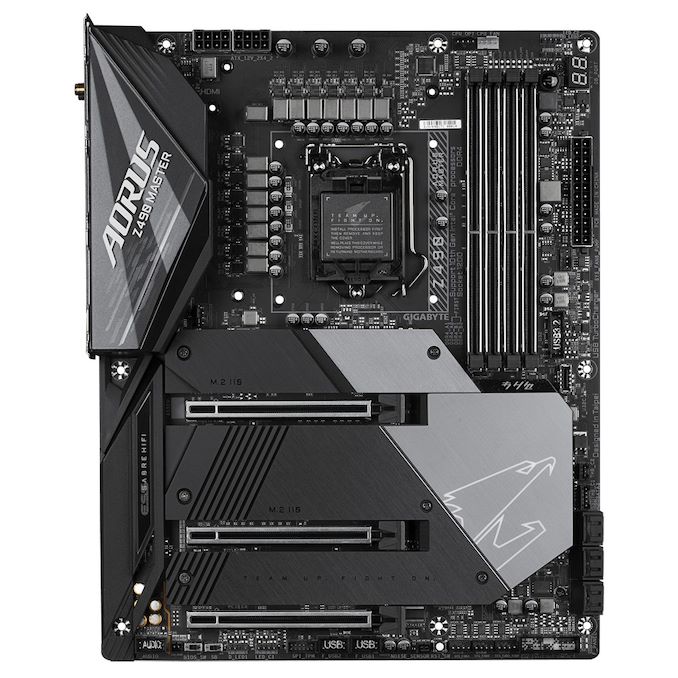
The GIGABYTE Z490 Aorus Master WaterForce is essentially the same on paper as the initial Z490 Aorus Master model and follows a similar aesthetic. It encompasses an Aorus themed design with black PCIe slot armor and a brushed silver chipset heatsink, which includes an integrated RGB Aorus Falcon logo. 


GIGABYTE Z490 Aorus Master WaterForce without the monoblock


It uses a 14-phase power delivery which consists of an Intersil ISL69269 PWM controller, with fourteen ISL99390B 90 A power stages operating with seven ISL6617A doublers. This is cooled by a monoblock which is also designed to cool the CPU, with support for Intel’s latest Comet Lake processors. The board’s other features include three PCIe 3.0 x4 M.2 slots, six SATA ports, an Intel I225-V 2.5 GbE Ethernet controller, with an Intel AX201 Wi-Fi 6 CNVi module. The Z490 Aorus Master WaterForce also includes four memory slots with support for up to DDR4-5000, with a maximum capacity of 128 GB. It also includes a Realtek ALC1220-VB HD audio codec which is assisted by WIMA FKP2 studio-grade audio capacitors.


What makes it unique is that it includes a monoblock which is designed to cool the processor and the board’s power delivery. Supplied with the GIGABYTE Z490 Aorus Master WaterForce is a 360 mm AIO cooler which includes three 120 mm double ball bearing RGB fans which can be controlled with GIGABYTE’s RGB Fusion software. GIGABYTE claims that the AIO cooler is easy to install, with just four screws required to mount it onto the motherboard.


GIGABYTE hasn’t unveiled current MSRP pricing, nor has it announced when the Z490 Aorus Master WaterForce motherboard will hit the retail shelves. We expect this will be within the coming month.


Related Reading


Source: AnandTech – GIGABYTE’s New Z490 Aorus Master WaterForce Combo with Bundled 360mm AIO

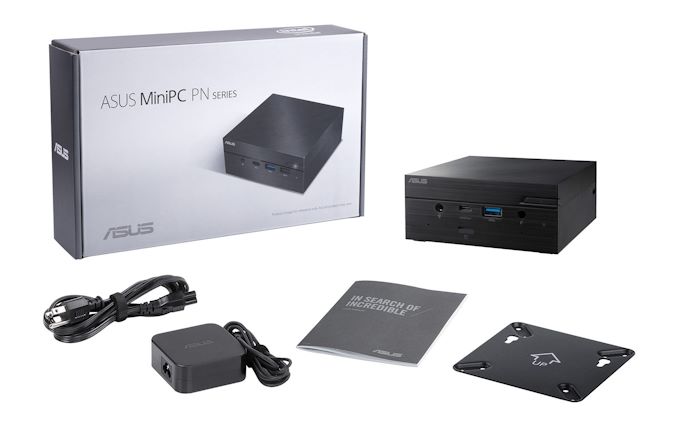
ASUS PN50 Mini-PC, with Ryzen Mobile 4000 APUs, Coming September

AMD launched its Ryzen Mobile 4000 ‘Renoir’ processors in January, and one of our questions was around the appetite for AMD to push mini-PC designs. Processors that have both high performance and low power are ideal for small form factors, and there has always been a dedicated community to this hardware segment. As we’ve seen in previous launches, sometimes these sorts of machines come before laptops, or very quickly after. At the time, AMD said that the focus was on the laptops, however there would be nothing to stop one of its partners going ahead with a mini-PC design. So we waited, and waited…


Source: AnandTech – ASUS PN50 Mini-PC, with Ryzen Mobile 4000 APUs, Coming September

Google Teases Pixel 4a (5G) and Pixel 5 Later This Year

Alongside the launch of the Pixel 4a today, Google has made a mention that it’ll be launching the Pixel 4a (5G) later this year at a price point of $499.


We don’t have any further details on this variant of the Pixel 4a, however if the only feature upgrade on the phone is a 5G compatible SoC and cellular connectivity, it would mean quite a steep price increase.


To achieve 5G connectivity, Google has two options in the mid-range: The Snapdragon 690 and the Snapdragon 765. Both would be good upgrades over the Snapdragon 730G in the 4G Pixel 4a, however only the latter would have a modem which would be capable of mmWave connectivity. It would make sense for Google to go with the Snapdragon 690 in a mid-range device, however the steep price increase of the regular Pixel 4a could point out to a S765 with mmWave connectivity.


Google also confirms that the Pixel 5 is coming, and it will too have 5G connectivity. We don’t know much about the Pixel 5 or how Google will be positioning the phone – either as a premium tier model with a Snapdragon 765 at a more competitive price, or again as a full flagship device with the Snapdragon 865.


Related Reading:


Source: AnandTech – Google Teases Pixel 4a (5G) and Pixel 5 Later This Year

Google Announces Pixel 4a – A $349 Value

Today Google is announcing its 2020 successor to its budget/mid-range line of phones in the form of the new Pixel 4a. Awaited since several months now, but seemingly delayed into August, the new Pixel 4a brings to the table a few key upgrades whilst offering a Google software experience at a $349 price point.

Last year’s Pixel 3a and Pixel 3a XL were seemingly well received devices, with Google’s strategy being mostly focused on offering a “Google Experience” software stack that’s only found on Pixel devices. This year, Google is trying to continue this focus with the Pixel 4a, with the biggest obvious change being that we’re not seeing a 4a XL being released at this point in time.


Source: AnandTech – Google Announces Pixel 4a – A 9 Value

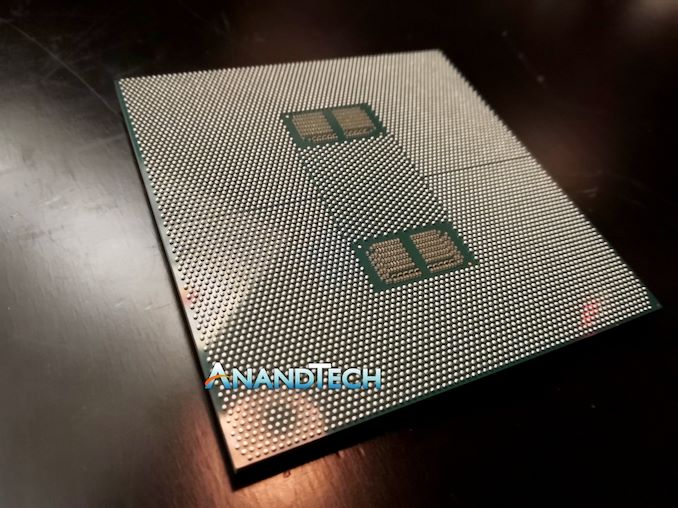
Xeon Platinum 9200 at Scale: Penguin Computing’s new 7616 Cores-Per-Rack Solution

Some aspects of computing rely on density, and need to pack as many compute processing elements in the smallest space possible. Intel’s Xeon Platinum 9200 range was created to solve these problems, however uptake seems to be limited due to the high power consumption, suited only for those with deep pockets and the ability to deploy. Penguin Computing has introduced a new Xeon Platinum 9200 platform, called TundraAP, to enable better power efficiency and higher compute density.


Source: AnandTech – Xeon Platinum 9200 at Scale: Penguin Computing’s new 7616 Cores-Per-Rack Solution

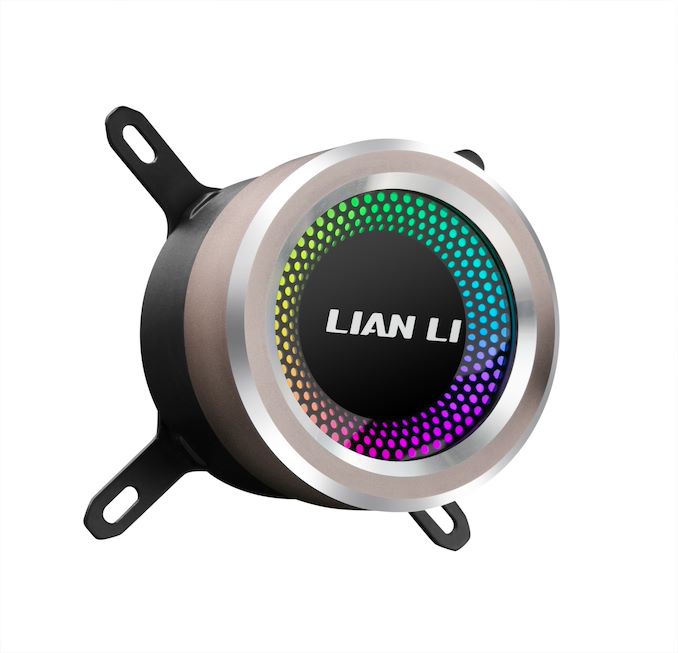
Lian Li Unveils Its First AIO Coolers, The Galahad 360 and 240 with ARGB

Lian Li is highly regarded for its elegant and premium aluminium chassis, most recently its entry-level O11 Dynamic XL E-ATX case, which has become one of its most popular ranges. Its latest product marks the companies first foray into the liquid cooling market with the Galahad AIO series, with two different sizes available, including 240 and 360 mm. 


Source: AnandTech – Lian Li Unveils Its First AIO Coolers, The Galahad 360 and 240 with ARGB

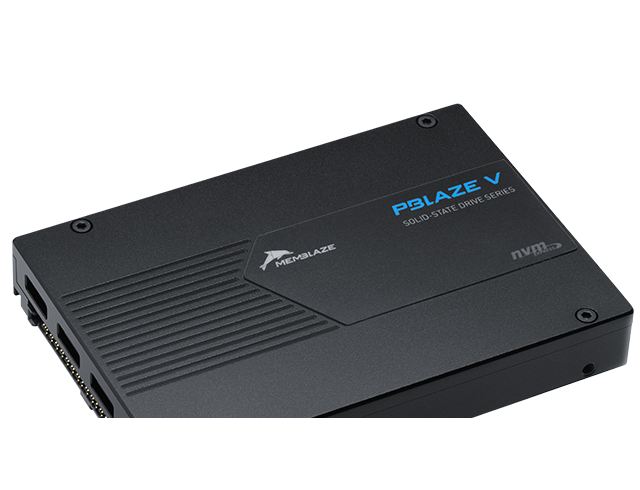
Memblaze Releases New PBlaze5 520 Series Low-Power Enterprise SSDs

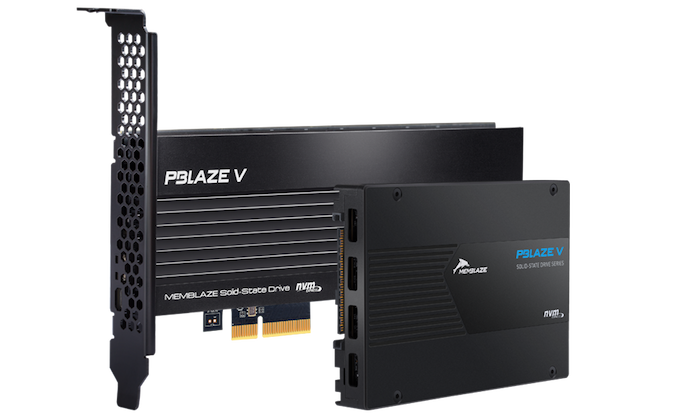
Yesterday we saw Memblaze introducing a new series of low-power server-class NVMe SSDs that focus on providing excellent performance whilst maintaining lower power consumption levels, aiming at enterprises improving their storage energy efficiency. The new PBlaze5 C520, D520, C526 and D526 SSDs come in either 2.5” U.2 or HHHL form-factors in two capacity classes for each model.


Unlike its bigger brethren C900 series models which we had reviewed last year, the new 52X series units limit their performance characteristics by sticking to a PCIe 3.0 x4 interface, with all devices covered today peaking at a sequential read speed of 3.3GB/s.


The 520 models come with in either 1.92TB or 3.84TB variants, while the 526 models feature in 1.6TB or 3.2TB configurations. Random read IOPS come in at a flat 520K for all the models, whilst random write IOPS for the 520 series range from 68K on the 1.92TB unit to 70K on the 3.84TB unit. The D526 and C526 both measure in at 135K random write IOPS.


As opposed to the 900 series SKUs which either use 32- or 64-layer enterprise 3D TLC NAND, the new more energy efficient models use newer 96L chips.


The reason why’d you want to choose these lower power models is of course for deployments which require higher energy conservation or lower heat generating hardware. Compared to the 900 series, idle power consumption is reduced from 7W to down to 4W, whilst operating power reduces from 25W to 9W, with an advertised 12W peak consumption.


Memblaze PBlaze5 Series Specifications
  PBlaze5 D520 PBlaze5 C520 PBlaze5 D526 PBlaze5 C526
Form Factors 2.5″ U.2 Drive HHHL AIC 2.5″ U.2 Drive HHHL AIC
Interface PCIe 3.0 x4 PCIe 3.0 x8 PCIe 3.0 x4 PCIe 3.0 x4
Capacities 1.92TB

3.84TB
1.6TB

3.2TB
Controller ?
Protocol NVMe 1.3
NAND 96L 3D Enterprise TLC NAND memory
Sequential Read 3.3 GB/s 3.3 GB/s 3.3 GB/s 3.3 GB/s
Sequential Write 1.7 GB/s 1.9 GB/s 1.7 GB/s 1.9 GB/s
Random Read (4 KB) IOPS 520,000 520,000 520,000 520,000
Random Write (4 KB) IOPS 68,000

70,000
135,000
Latency Read 85 µs
Latency Write 15 µs
Power Idle 4 W
Operating 9 W typical, 12W max
Endurance 1 DWPD 3 DWPD
Dual-Port Support Yes
Encryption AES-256
Power Loss Protection Yes
MTBF 2 million hours
Additional Information Link

Pricing is not publicly listed for the new 500 series as it’s dependent on the customer order and the exact drive configuration required – the products are now available for enterprise customers.


Related Reading:


Source: AnandTech – Memblaze Releases New PBlaze5 520 Series Low-Power Enterprise SSDs

NVIDIA Launches Rainbow Six: Siege Game Bundle for GeForce RTX 20 Series Cards

Barely a couple of weeks off of their previous Death Stranding game bundle, NVIDIA is back with a new game bundle for GeForce RTX cards. Dubbed the Frames Win Games bundle, NVIDIA is now including copies of Rainbow Six Siege: Gold Edition.


Rainbow Six Siege is a more unusual choice for a video card game bundle. The online-focused first person shooter was first launched back in 2015, and in the last several years has been well-received, leading to Ubisoft giving it ongoing support and expansions. The Gold Edition, in turn, includes the base game and much of this expansion content, including the most recent “Year 5” pass. DLC aside, I cannot recall a game that has been out this long ever being bundled with a high-end video card. This also leads into the name of the bundle, alluding to the fact that NVIDIA’s RTX cards can easily hit 144fps in the game.


NVIDIA Current Game Bundles

(July/August 2020)
Video Card

(incl. systems and OEMs)
Bundle
GeForce RTX 20 Series (All) Rainbow Six Siege: Gold Edition
GeForce GTX 16 Series (All) None

Digging into the bundle itself, as this is a single game bundle, NVIDIA’s deal is pretty straightforward. The company will be including the game with all of their GeForce RTX cards, from the RTX 2060 up to the RTX 2080 Ti. This offer also applies to many desktop and laptop systems including these cards as well, so long as the vendor is a participating NVIDIA partner. Though it bears mentioning that this latest bundle is once again going to be relatively short lived, with the program ending on August 27th.


Meanwhile, NVIDIA is not currently offering any game bundles for its lower-tier cards, the GeForce GTX series.


As always, codes must be redeemed via the GeForce Experience application on a system with a qualifying graphics card installed. More information and details can be found in the terms and conditions. Be sure to verify the participation of any vendors purchased from, as NVIDIA will not give codes for purchases made from non-participating sellers.


Source: AnandTech – NVIDIA Launches Rainbow Six: Siege Game Bundle for GeForce RTX 20 Series Cards

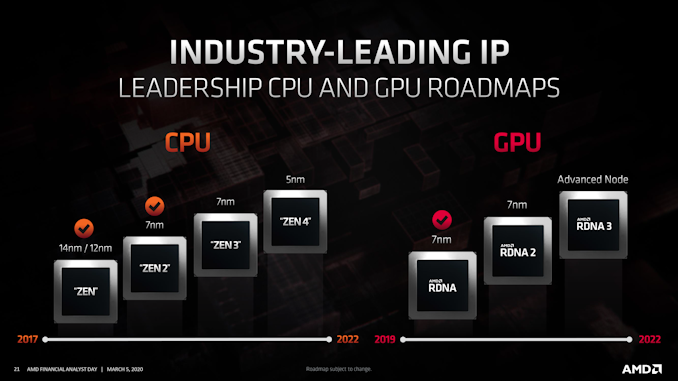
AMD Reiterates 2020 Roadmap: Zen 3 Client & Server, RDNA 2, CDNA Late This Year

As part of AMD’s quarterly earnings presentation, the company has briefly reiterated its product plans for the second-half of the year. The company was previously slated to launch new CPUs and GPUs for the client and server markets late this year, and on today’s call the company has confirmed that those plans are on track.


On the client side of matters, both AMD’s new CPUs and GPUs are currently set to launch late in 2020. The first GPUs based on the company’s RDNA 2 architecture – which is also underpinning the new Playstation 5 and Xbox Series X consoles – will be released later this year. And AMD is confirming that RDNA2 will eventually be a “full refresh” of the company’s GPU product stacks. Meanwhile the eagerly anticipated Zen 3 architecture is set to make its desktop debut late this year as well. Though with these sorts of events it’s prudent to note that a commitment to launch a product by a certain date isn’t a commitment to have it on retail shelves by that same date.


Meanwhile on the server side of matters, the picture is much the same. AMD reports that they are on track to begin shipping the Zen 3-based “Milan” EPYC processors late in 2020. As well, AMD’s first CDNA architecture GPU for the data center market is set to launch late this year as well.


Source: AnandTech – AMD Reiterates 2020 Roadmap: Zen 3 Client & Server, RDNA 2, CDNA Late This Year

AMD Reports Q2 2020 Earnings: Notebook and Server Sales Drive a Record Quarter

Continuing our look at tech industry financial results, AMD this afternoon is celebrating setting some new records in its Q2’2020 financial results. Enjoying a continuing turn-around in its fortunes t hanks in big part to its Zen series of CPU architectures and resulting products, the company has just closed the books on the first year of sales of its Zen 2-based desktop processors, with EPYC following close behind. At this point AMD is now setting quarterly revenue records, and the company is expecting to grow its revenue further over the coming months.


For the second quarter of 2020, AMD reported $1.93B in revenue, a 26% jump over the same quarter a year ago. As a result, Q2’2020 was AMD’s best quarter ever, built on the back of record notebook and server revenue. Overall, all of AMD’s metrics have improved in a year-over-year basis, with net income up $122M (349%) to $157M, while the company’s all-important gross margin improved by 3 points to 44%. In fact the only real knock that can be made on AMD’s quarter is that they didn’t pass their Q1’2020 net income or gross margin, which was due to increased semi-custom shipments, which aren’t as profitable for the company.


AMD Q2 2020 Financial Results (GAAP)
  Q2’2020 Q2’2019 Q1’2020
Revenue $1.93B $1.53B $1.79B
Gross Margin 44% 41% 46%
Operating Income $173M $59M $177M
Net Income $157M $35M $162M
Earnings Per Share $0.13 $0.03 $0.14

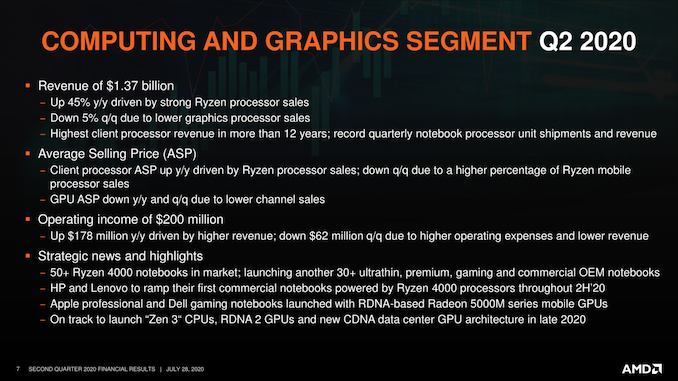
Once again the flag bearer for AMD is their Computing and Graphics segment, which encompasses their desktop and notebook CPU sales, as well as their GPU sales. That division booked $1.37B in revenue for the quarter, $427M (45%) more than Q2 of 2019. The segment’s operating income as up significantly as well, jumping from just $22M a year ago to $200M this year.


These numbers come as AMD closes the book on their first year of Zen 2 product sales – the first retail chips hit store shelves at the very start of Q3’2019. Since then AMD has grown their desktop chip sales significantly, and combined with laptop sales the company is reporting their best client processor revenue in more than 12 years. As previously mentioned, laptop sales saw record revenue – doubling last year’s numbers – thanks in part to AMD shipping a record number of notebook chips.


AMD Q2 2020 Computing and Graphics
  Q2’2020 Q2’2019 Q1’2020
Revenue $1367M $940M $1438M
Operating Income $200M $22M $262M

As for product average selling prices (ASPs), AMD is reporting that client processor prices are up on a year-over-year basis (thanks again to Zen 2). However they have dropped on a quarterly basis due to a greater mix of Ryzen Mobile sales.


Meanwhile AMD’s GPU division looks to have once again been the laggard. While AMD doesn’t break out revenue numbers to specific divisions, on the subject of ASPs they note that GPU ASPs are down on both a year-over-year and quarterly basis, due to lower channel sales. On their earnings call, AMD has noted that while mobile GPU sales are up by double digits, this was more than offset by declines in desktop GPU sales. Overall, with AMD’s Q2’2019 being a somewhat soft quarter for GPU sales to begin with as consumers awaited their heavily-teased Navi architecture products, I’m surprised to see that AMD’s ASPs still slipped this year.


AMD Q2 2020 Enterprise, Embedded and Semi-Custom
  Q2’2020 Q2’2019 Q1’2020
Revenue $565M $591M $348M
Operating Income $33M $89M -$26M

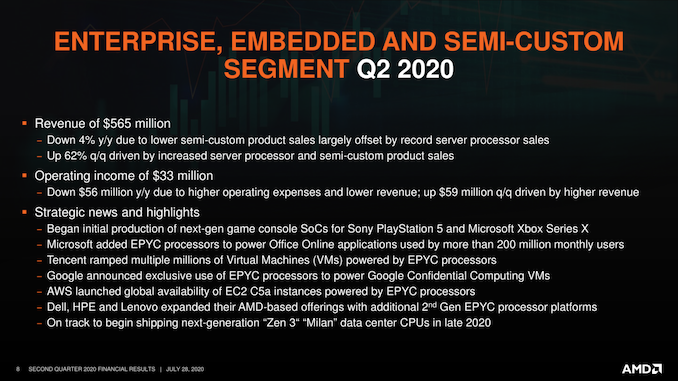
Finally, AMD’s Enterprise, Embedded, and Semi-Custom segment saw a very solid Q2, as the group enjoyed an uptick in EPYC processor sales. In fact AMD has finally, albeit belatedly, finally captured a double-digit share of the server processor market, a major goal for the company. Fittingly, on a year-over-year basis, EPYC revenue has doubled.


None the less, the odd grouping of server CPUs with semi-custom (console) chips means that revenue actually dropped on a year-over-year basis thanks to lower semi-custom sales. The upshot, at least, is that it’s a significant improvement over Q1, where the group ended up in the red. Meanwhile AMD has started production of the PS5 and Xbox Series X SoCs, so revenues here should significantly improve next quarter, but those are still lower margin products.


Looking forward, like much of the rest of the tech industry AMD is looking towards a strong second-half of the year, as the company has been able to successfully weather the immediate challenges from the coronavirus pandemic. As a result, AMD is increasing its full-year projections, and the company is now calling for 32% revenue growth over 2019, and a gross margin of around 45%.


Driving this growth for AMD will be a mix of the slow expansion of server products, as well as new products launched in the second-half of the year. AMD is expecting EPYC sales to continue to grow and for the company to gain market share there as more server vendors further ramp up their EPYC server production. Meanwhile AMD is reiterating that it’s expecting to begin shipping its Zen 3-based “Milan” EPYC processors late this year. AMD’s upcoming CDNA-based data center GPUs are also set to launch around at time.


As for the consumer side of matters, AMD is expecting continued sales success with its consumer products, particularly Ryzen Mobile. None the less, all eyes are going to be on AMD’s future products, as AMD is reiterating their 2020 launch plans. The company reports that it’s on track to launch Zen 3 client CPUs in late 2020, and the company’s eagerly-anticipated RDNA2 products, which will eventually encompass a full stack refresh, will launch in late 2020 as well.


Source: AnandTech – AMD Reports Q2 2020 Earnings: Notebook and Server Sales Drive a Record Quarter

Supermicro SuperServer E302-9D Review: A Fanless 10G pfSense Powerhouse

Intel launched the Xeon D-2100 SoCs in early 2018, with a feature set making them a fit for several verticals including edge servers, networking, and storage. One of the key advancements made in the Xeon D-2100 compared to the first-generation Xeon D-1500 series was the inbuilt support for two additional 10G network interfaces. With TDPs starting at 60W, the Xeon D-2100 SoCs lends itself to some interesting and unique server and edge procesing products. Today’s review deals with one such system – Supermicro’s passively-cooled SuperServer E302-9D.


Source: AnandTech – Supermicro SuperServer E302-9D Review: A Fanless 10G pfSense Powerhouse

CES 2021: Physical Event Cancelled, Moves to All-Digital Format

As the world continues to battle on with SARC-CoV-2, large public events and especially trade shows were cancelled one after another for 2020. Large computing shows such as Computex, even after an attempted delay to September, eventually completely cancelled their plans for the year.


Today, the Computer Technology Association has announced that next year’s CES 2021 event will also no longer take place in physical form, and instead move to an all-digital format experience. CES is usually the world’s biggest consumer electronics show with up to 180,000 attendees assembling in early January in Las Vegas to showcase the newest gadgets and electronics in the consumer market.


The new all-digital format will be a big change for the show which likely will represent a herculean effort on the part of the organisers. CTA President and CEO Gary Shapiro quotes:


“Amid the pandemic and growing global health concerns about the spread of COVID-19, it’s just not possible to safely convene tens of thousands of people in Las Vegas in early January 2021 to meet and do business in person,” said Gary Shapiro, president and CEO, CTA. “Technology helps us all work, learn and connect during the pandemic — and that innovation will also help us reimagine CES 2021 and bring together the tech community in a meaningful way. By shifting to an all-digital platform for 2021, we can deliver a unique experience that helps our exhibitors connect with existing and new audiences.” 


We here at AnandTech had low expectations of CES taking place, so the move to an online format makes a ton of sense given the health and safety concerns of such a large physical event. The current pandemic situation in the US and various travel restrictions as well as quarantine procedures will have played a large role in the CTA’s decision to cancel the physical event. The CTA states that they’re planning to returning to Las Vegas in 2022.


With CES confirmed to moving to an online-only event, as well as yesterday’s announcement of Supercomputing 2020 (SC20) also going online-only, the AnandTech team is likely to be staying at home until well into 2021 as there’s no physical events left to attend for the foreseeable future.


Related Reading:


Source: AnandTech – CES 2021: Physical Event Cancelled, Moves to All-Digital Format

OpenXR Update: First Approved Runtimes Now Available, OpenXR Coming to Minecraft

Among the many technologies to come under the purview of the Khronos consortium have been augmented reality and virtual reality. Looking to fulfill the group’s mandate to develop open standards for new technologies, the group set about creating an open API for use with AR and VR devices, which culminated in the OpenXR standard. The initial version of that standard was released last summer, and now that the wider technology industry has finally had a chance to develop software for it, this morning Khronos is offering a status update on the state of OpenXR, along with a few choice announcements relating to projects using the new API.


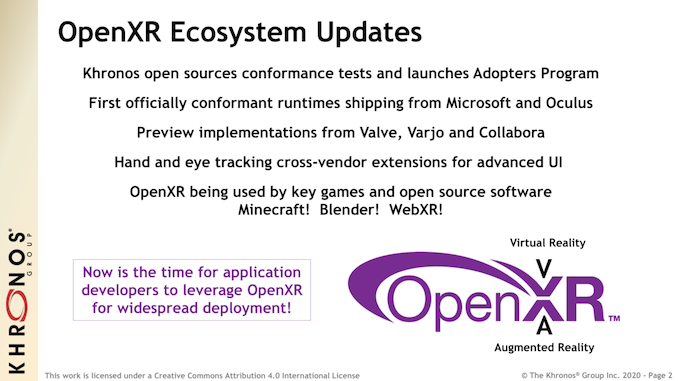
First and foremost, Khronos is announcing that the first standard-conformant implementations for OpenXR are finally shipping. Starting today, both Oculus’s and Microsoft’s respective OpenXR runtimes have passed conformance testing and have been approved by the group, allowing the two companies to promote their support for OpenXR as part of Khronos’s OpenXR adopters program.


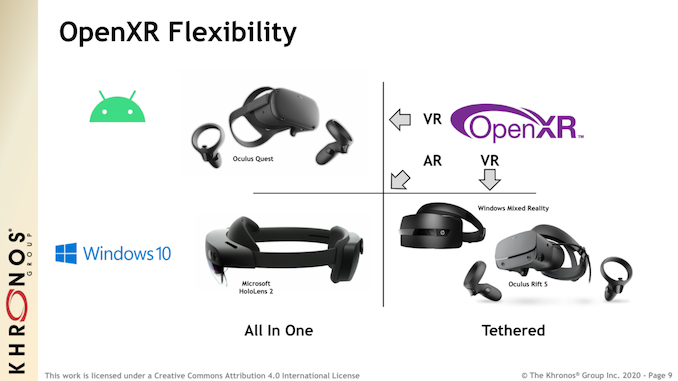
Surprisingly, both tethered and stand-alone headsets are among the newly-compliant devices. Both Microsoft and Oculus now have approved runtimes for Windows, bringing OpenXR support to Windows Mixed Reality devices along with the Oculus Rift family of HMDs. Meanwhile Oculus’s stand-alone, Android-powered headset, the Oculus Quest, has also received OpenXR support, as has Microsoft’s stand-alone HoloLens 2 AR headset. This means that in the span of a year OpenXR support has already expanded to cover the full gamut of devices OpenXR was envisioned for, with both AR and VR devices now supporting the API.


This in turn marks a major milestone for OpenXR, as it means the standard has finally resolved the bootstrapping problem that all new APIs face. With working hardware available, rank and file software developers can finally write software and test against actual devices, making the entire process much easier. Consequently, in many ways it’s this moment, rather than last year’s OpenXR 1.0 launch, that truly kicks off the lifecycle for the API, as Khronos and its members can finally reach out to developers about widespread deployment. Meanwhile, the ranks of supported headsets is slated to grow over the coming months, as Valve, Varjo, and Collabora all have OpenXR implementations currently under development.


Speaking of Valve, the game developer and increasingly ecosystem builder as well has previously announced that it is working to transition its own VR wares to OpenXR. Last month the company launched beta support for OpenXR within SteamVR, allowing SteamVR games to use compliant OpenXR runtimes. Meanwhile Valve is essentially putting development of its own OpenVR standard on hold, shifting its focus to OpenXR as any new SteamVR features are slated to be developed against Khronos’s API.


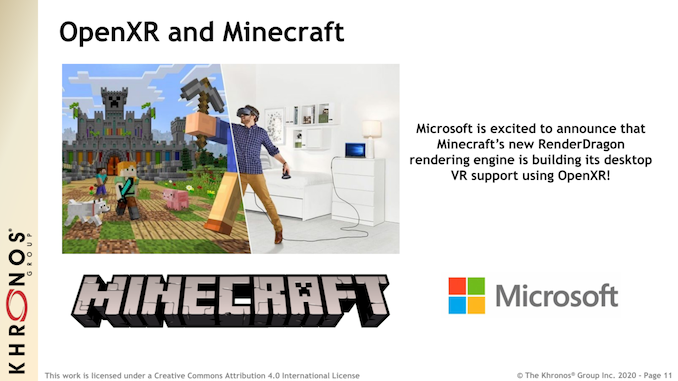
Meanwhile Microsoft is slated to be using OpenXR for some of its own projects as well, most notably a new VR version of Minecraft. Being announced today, Microsoft is adding VR support to the new RenderDragon engine, which was launched earlier this year as part of Minecraft’s ray tracing-enabled graphical overhaul. The new VR implementation will replace the older implementation, which was built against the game’s previous rendering engine and only supported Oculus and Windows MR devices.


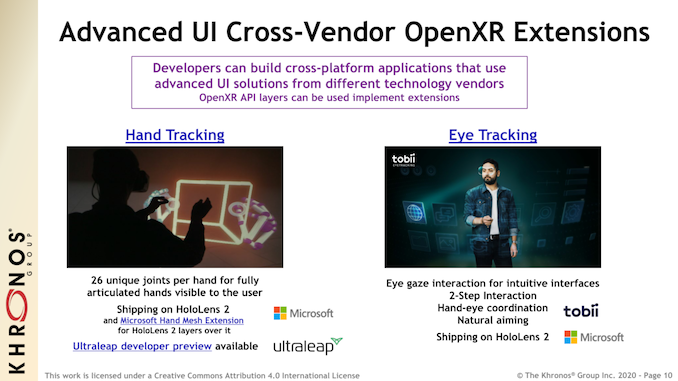
Finally, Khronos is also offering a brief update on the state of hand and eye tracking within OpenXR. Neither of these features made it into the core 1.0 specification, but both are now being developed as cross-vendor extensions. Both of these features are up and running on the HoloLens 2, and while developers can already use them today, anyone planning on sticking to the core specification will be happy to hear that Khronos is planning to adopt these extensions into a future version of the core specification once the extensions have proven their worth.


Source: AnandTech – OpenXR Update: First Approved Runtimes Now Available, OpenXR Coming to Minecraft

Intel Reorganizes In Wake of 7nm Woes; Chief Engineering Officer Murthy Renduchintala To Depart

Coming in the wake of last week’s disclosure that their 7nm yields are roughly a full year behind schedule, Intel this afternoon has announced that they are reorganizing the technology side of the company. Key to this change is that Intel is breaking up its monolithic Technology, Systems Architecture and Client Group (TSCG) into several smaller groups, all of which will report directly to CEO Bob Swan. Meanwhile Intel’s chief engineering officer, Dr. Murthy Renduchintala, who had been leading the TSCG, will be departing the company at the end of next week. The reorganization is effective immediately.


As a result of this reorganization, TSCG is being broken up into five groups focusing on manufacturing and architecture. These are:


  • Technology Development: Focused on developing next-generation process nodes. Led by Dr. Ann Kelleher.
  • Manufacturing and Operations: Focused on ramping current process nodes and building out new fab capacity. Led by Keyvan Esfarjani.
  • Design Engineering: A recently-created group responsible for Intel’s technology manufacturing and platform engineering. Led on an interim basis by Josh Walden while Intel searches for a permanent leader.
  • Architecture, Software and Graphics: Developing Intel’s architectures and associated software stacks. Led by Raja Koduri (continuing).
  • Supply Chain: Handling Intel’s supply chain and relationships with important suppliers. Led by Dr. Randhir Thakur (continuing).

It should be noted that while Intel’s brief announcement does not mention last week’s disclosure, the timing and resulting personnel changes are unmistakably related to the 7nm delay. Today’s reorganization is the second shuffle for Intel in as many months, as the company reorganized a number of product groups after Jim Keller departed for (honest to goodness) personal reasons.


Meanwhile, TSCG’s former president, Dr. Murthy Renduchintala, will be departing the company on August 3rd. Renduchintala joined Intel in 2015, and for most of the past half-decade has been responsible for overseeing all of TSCG’s efforts, and especially involved in the development of the company’s next-generation process nodes. Intel’s reorganization announcement makes no specific mention of Renduchintala beyond his date of departure, however it is difficult to imagine that this is anything other than Intel pushing out Renduchintala in light of their process woes. More than anything else, Renduchintala was the face of Intel’s monolithic, vertically-integrated design and manufacturing strategy; a strategy that is no more as Intel seriously investigates building parts of leading-edge processes at competing fabs.


This is breaking news. More to follow


Source: Intel


Source: AnandTech – Intel Reorganizes In Wake of 7nm Woes; Chief Engineering Officer Murthy Renduchintala To Depart