ADATA External and HP Portable SSDs Review: Featuring the ADATA SE800 and HP P700

Portable flash-based storage solutions are one of the growing segments in the direct-attached storage market. The emergence of 3D NAND with TLC and QLC has brought down the cost of such drives. NAND manufacturers like Western Digital, Samsung, and Crucial/Micron who also market portable SSDs have an inherent advantage in terms of vertical integration. However, the current pace of progress in flash memory has led to competitively priced offerings even from vendors who need to buy flash in the open market. ADATA and HP (Biwin / Multipointe) are two such vendors in this space. Today, we are taking a look at six different portable SSDs – three each from ADATA and HP – forming the bulk of their 2020 portfolio of external flash storage solutions.


Source: AnandTech – ADATA External and HP Portable SSDs Review: Featuring the ADATA SE800 and HP P700

Intel Launches 10nm Atom Embedded CPUs: Elkhart Lake Now Available

The embedded and edge markets for Intel have always been hidden away within its IoT business, however at the Investor Meeting last year it was highlighted as one of Intel’s key growth areas. The requirements for businesses to enable automation and control, as well as apply machine learning or computer vision, have increased as new optimized algorithms and use cases enter the market, and this is the question that the new 10nm Atom Embedded CPUs are set to answer.


Elkhart Lake built upon Tremont with 10nm SuperFin


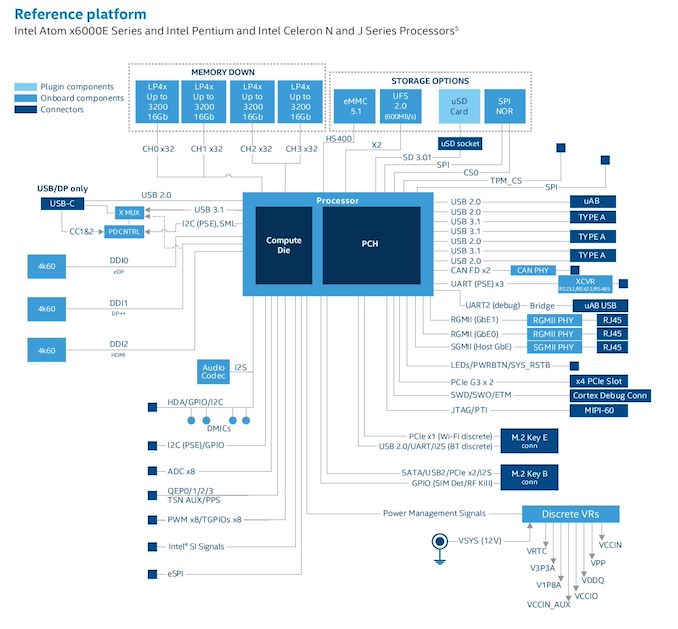
The new processors built with Tremont Atom cores will come as three series of processors: Pentium, Celeron, and Atom x6000E. These are all built with the same silicon die, offering up to four Atom cores with a 3.0 GHz turbo frequency, up to 800 MHz of Gen11 graphics (up to 32 EUs, three 4K60 displays), in TDPs ranging from 4.5 W to 12 W. All processors will support up to LPDDR4X-4267 or DDR4-3200. In-band ECC support is split – the Atom x6000E parts have it, but the Pentium and Celerons do not.


Intel Elkhart Lake

Tremont Atoms for Embedded
AnandTech Cores Base

MHz
Turbo

MHz
GPU

Base
GPU

MHz
TDP

 
TCC TSI
Pentium J/N and Celeron J/N
Pentium J6425 4 1800 3000 400 850 10W
Celeron J6413 4 1800 3000 400 800 10W
Pentium N6415 4 1200 3000 350 800 6.5W
Celeron N6211 2 1200 3000 250 750 6.5W
Atom x6000E
Atom x6425E 4 1800 3000 500 750 12W
Atom x6413E 4 1500 3000 500 750 9W
Atom x6211E 2 1200 3000 350 750 6W
Atom x6000RE: RTOS Support
Atom x6425RE 4 1900 400 12W Yes
Atom x6414RE 4 1500 400 9W Yes
Atom x6212RE 2 1200 350 6W Yes
Atom x6000FE: Intel Safety Island Support
Atom x6427FE 4 1900 400 12W Yes Yes
Atom x6200FE* 2 1000 4.5W Yes Yes
* Has no IGP

Intel is also moving to 10nm SuperFin (formerly 10++) for its Atom nodes, making these the next 10nm-class Atom processors after Intel’s Snow Ridge for 5G networks.


Focusing on IoT Features


Previous embedded processors like this were perhaps not always focused with the Edge market or the IoT market in mind. This time around however, Intel states that these products have been built from the ground up with this market in mind. This lends itself to a number of IoT-specific features.


There is now a new Programmable Services Engine to offload IoT workloads. This is a dedicated ARM processor, specifically an Arm Cortex M7, that supports real-time functionality, network synchronization, time sensitive networking, and low compute requirement workloads without needing to fire up the bigger cores. Some of the models support Time Coordinated Computing to enable worst-case execution time (WCET) and ultra-reliable low-latency communication (URLLC)


Two processors, the Atom x6427FE and x6200FE, are FuSa certified and support Intel’s Safety Island technology to allow integrated functional safety within IP blocks for finding and flagging faults, as well as initiating internal diagnostic tests.


All of these CPUs have three integrated 2.5 GbE MACs, all of which can be enabled for time-sensitive networking. The cores have Intel’s SHA extensions, as well as AES-NI and Intel Secure Key. Note that Intel is the only x86 vendors who does not have SHA-acceleration hardware, instead deciding to rely on instruction-level optimization.


The new processors all support Intel’s OpenVINO toolkit, with pre-optimized libraries for AI, ML, and computer vision acceleration. This is on top of Intel’s new Edge Software Hub, an interface for OEM customers to acquire pre-optimized deployment-ready software packages optimized for Industrial, Retail and Vision, all of which also offer customizability.


OS support is listed as Windows 10 IoT Enterprise, Yocto Project BSP, Linux Ubuntu, Wind River Linux LTS, and Android 10. The boot firmware supports Intel Slim Bootloader as well as coreboot, and the Programmable Services Engine runes on Intel’s own Zephyr RTOS-based platform.


For performance, Intel is claiming 1.7x single thread over previous generation Goldmont Plus Atoms, and 1.5x in multi-threaded workloads. Graphics performance gen-on-gen is listed as 2x. These numbers come from SPEC2006int and 3DMark11, but are based on pre-silicon projections of the new hardware. This would suggest that Intel doesn’t have the silicon in the labs yet to run the tests, which is a little odd if this is the launch day. Nonetheless, these platforms have a 7+ year lifecycle.


Click to zoom


Intel confirmed that the CPU-to-PCH connection is not DMI in this instance, but just a GPIO. The chipset will support eight lanes of PCIe 3.0, four USB 3.1 ports, ten USB 2.0 ports, and two UFS 2.0 ports.


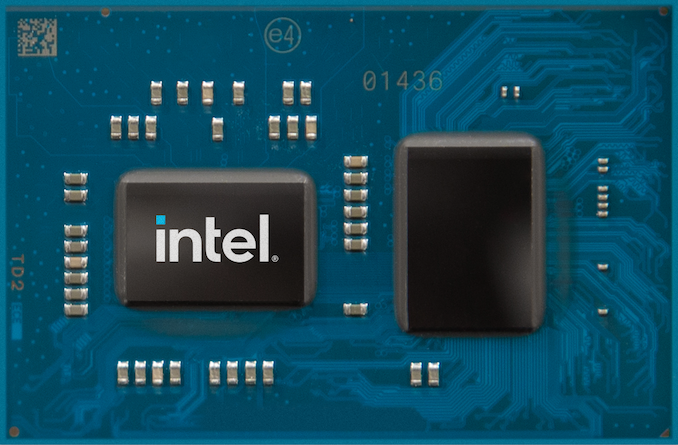
For package, Intel stated that all models will be FCGBA1493 and measure 35x24mm. Interestingly enough, this means we can calculate estimates for the die size.


  • CPU die (left): 9.169 mm * 6.394 mm = 58.63 mm2
  • PCH die (right): 6.369 mm * 9.778 mm = 62.27 mm2

The CPU is built on 10nm Superfin, the PCH die is built on 14nm. Note that in our recent review of the Tiger Lake UP3 processor, the PCH die for that processor with callipers was measured at 56.4 mm2. Given the rough nature of how we calculate these things, I might be inclined to believe that this mockup of Elkhart Lake might simply be the PCH die rotated and changed slightly, rather than a true-to-life example of the processor.


There’s no word from Intel when these might be coming to low-power consumer products. Being built on 10SF, I suspect that the die cost might be higher than what we’re normally used to. These new parts were announced as part of Intel’s Industrial Summit, and as such these product managers wouldn’t necessarily know what the client division would be preparing with the same silicon.


But Wait, There’s More!


Intel isn’t only announcing these new 10nm Atoms today. For the embedded applications that need more performance, there will be versions of the Tiger Lake UP3 mobile processors also for embedded markets. These are the same as the client versions of the processors, however with lower peak turbo frequencies. There will be a focus on enabling industrial workloads though the Xe graphics, AVX-512 units, and onboard neural accelerators. Real Time Computing will be enabled on some parts.


Intel Core Embedded CPUs

Tiger Lake-UP3
AnandTech Cores Base

MHz
Turbo

MHz
GPU

EUs
ECC TDP Temp

ºC
General Embedded
i7-1185G7E 4C/8T 1200 4400 96 No 12-28W 0-100
i5-1145G7E 4C/8T 1100 4100 80 No 12-28W 0-100
i3-1115G4E 2C/4T 1700 3900 48 No 12-28W 0-100

All three are also offered with In-Band ECC and a -40ºC to 100ºC temperature window, however these have the same SKU names as the ones we’ve already listed. Just to confuse things.


Related Reading


Source: AnandTech – Intel Launches 10nm Atom Embedded CPUs: Elkhart Lake Now Available

Western Digital Expands Purple Surveillance Storage Options with 18TB HDD and 1TB microSDXC Models

Western Digital has been marketing their surveillance-focused storage solutions under the Purple branding since 2014. After the SanDisk acquisition, the company started selling WD Purple microSDXC cards as a complement to the SanDisk High Endurance cards, bringing in ruggedness and durability in terms of weather and humidity-resistance as well as extended operating temperature range (-25C to 85C). The Purple drives and cards come with firmware tweaks that make them a better fit for SMB / SME network video recorders (NVRs) and IP cameras.


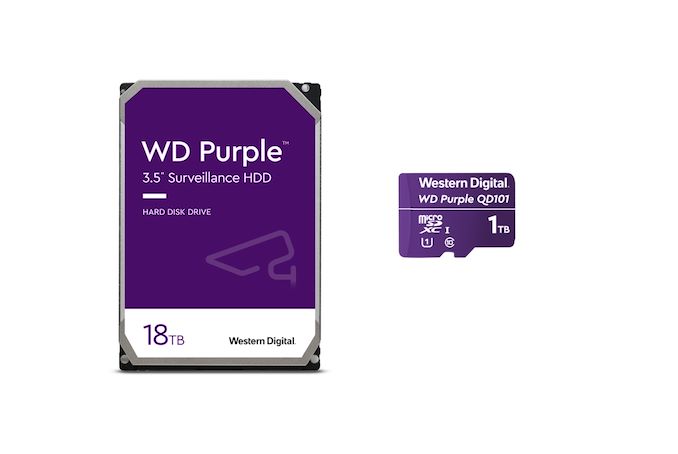
In conjunction with the release of the EAMR-enabled 16TB and 18TB WD Red Pro SMB NAS HDDs, Western Digital is also releasing a 18TB WD Purple Surveillance Hard Drive. WD markets the ATA streaming features and caching support in the Purple hard drives under the AllFrame moniker. There are two variants – the AllFrame 4K is for 6TB and lower capacity drives that are 5400RPM versions with a 180TB/yr workload rating. This allows recording of up to 32 simultaneous video streams. The AllFrame AI version (for 8TB and higher capacity drives operating at 7200RPM with a 360TB/yr workload rating) allows recording of up to 64 video streams simultaneously with the reading of 32 video streams for analytics purposes. Specific NVRs also support the Western Digital Device Analytics feature for monitoring the health of the installed Purple hard drives. These drives carry a 1.5M hours MTBF rating and a 3-year warranty. The 18TB drive availability is scheduled for October 2020.


The WD Purple 1TB microSDXC card is the new capacity flagship in the lineup. Similar to the other microSDXC cards in the WD Purple line, the WD Purple SC QD101 1TB version also utilizes BiCS 4 96-layer 3D NAND flash (500 p/e cycles, QLC-based). The endurance rating is enough for the drive to support up to 512TB of writes. The warranty period is for 3 years from the data of purchase, or the TBW workload limitation (whichever is earlier). Certain IP cameras such as the Tyco Cloud Illustra Series from Johnson Controls also support card health monitoring when microSDXC cards in the WD Purple SC QD101 are used. This allows installers to remotely monitor the remaining lifespan of the installed card, if needed. WD expects the card health monitoring scheme to become available in cameras from other OEMs in the future. Similar to the Purple HDDs, the SC QD101 cards also carry a 3-year warranty. The 1TB version is expected to become available in November.


The prices for the new products are expected to be announced closer to availability.


Source: AnandTech – Western Digital Expands Purple Surveillance Storage Options with 18TB HDD and 1TB microSDXC Models

Western Digital Updates Red Pro Line with 16 and 18TB Capacity Points

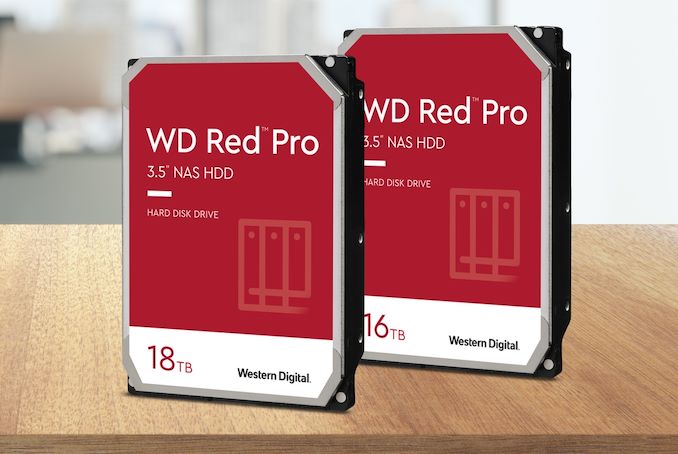
Western Digital recently unveiled their first energy-assisted magnetic recording (EAMR) HDDs for the retail channel. Today, the company is taking advantage of the same hardware platform with some tweaks in the firmware features to introduce the 16TB and 18TB WD Red Pro for SMB network-attached storage (NAS) units.


Like the WD Gold 16TB and 18TB models, the new Red Pro drives are also based on conventional magnetic recording (CMR), with a 7200 RPM spindle speed, and recommended for use in NAS systems with up to 24 bays. Having learnt from the WD Red SMR fiasco, the company explicitly points out the suitability of the new drives for use in NAS systems adopting ZFS and other such modern file-systems, while also supporting stressful RAID array rebuilds and expansions.


WD continues to tout the NASware 3.0 firmware features and multi-axis shock sensors with dynamic fly-height adjustment of the heads for additional reliability. Pricing is slated to be announced when the drives hit retail next month. Given the sub-$600 street pricing of the WD Gold and the Seagate IronWolf Pro 18TB, we expect the 18TB WD Red Pro to be priced in the $580 – $600 range.


Source: AnandTech – Western Digital Updates Red Pro Line with 16 and 18TB Capacity Points

Oracle Announces Upcoming Cloud Compute Instances: Ice Lake and Milan, A100 and Altra

When the name “Oracle” is thrown around, hardware isn’t typically the first thing that comes to mind for most people. But, like other large tech companies that originally made their mark in the world with software, the market for Oracle has grown beyond just companies needing software and SPARC boxes. And as a result, Oracle has spent the last few years increasingly investing in cloud infrastructure hosting, looking to pivot towards becoming a service provider for customers who are becoming increasingly accustomed to contracting out virtually every bit of their computing needs.


Today Oracle is taking the next step towards growing their footprint in the cloud computing market by announcing their next generation of compute instances for their Oracle Cloud Infrastructure (OCI) business. In an atypically high-key event that included the CEOs from no less than AMD, Ampere, Intel, and NVIDIA, Oracle announced that they will be providing computing instances based on new and upcoming processors from all four companies. This not only includes updated systems based on AMD and Intel’s forthcoming EPYC Milan and Ice Lake Server products, but also NVIDIA’s A100 accelerator. And, for the first time for Oracle, there are also plans for Arm-powered instances using Ampere’s Altra processors. Overall, these new instances will be significant jump in hardware for Oracle, and one that’s part of a larger effort to vault into the top echelons of the cloud computing market.


While the market for cloud computing hosting is still relatively young even by rapid tech industry standards, it’s a market that’s quickly come to be dominated by a handful of players – particularly Microsoft (Azure), Amazon (AWS), and Google. The rapid adoption of cloud computing has caught the major players off-guard– at times leaving them struggling to build datacenters quickly enough – but also making them very successful in the process. For Microsoft and Amazon in particular, their cloud computing profits have quickly become a cornerstone of their quarterly earnings, overshadowing some of their more traditional business. In other words, cloud computing has become a growth opportunity (and a highly profitable one at that), and Oracle wants a piece for themselves.


As I mentioned earlier, Oracle isn’t brand-new to the cloud infrastructure game. But the company has needed time to grow, both to better understand the market and to figure out how to best meet customer needs. As a result, it’s only now after almost four years in that Oracle is really hitting the pavement on promoting their cloud services, hosting high-profile presentations, pre-briefing the press, and taking other steps to get their name out in the market. Oracle is in the midst of transitioning from being a database company to a cloud services company, and today is intended to be the inflection point where that transition hits its stride.


Hardware From All: x86, Arm, & GPU


Spearheading this latest phase for Oracle’s Cloud Infrastructure business is a new generation of compute instances, based on processors from vendors across the board. Along with updating their offerings to include the latest x86 processors from AMD and Intel, Oracle is also preparing to launch their first Arm-powered instances based on Ampere’s Altra processors. And of course, on the GPU side of matters Oracle is introducing systems and instances using NVIDIA’s A100 accelerator. In short, Oracle is rolling out the latest and greatest in compute hardware to woo other cloud customers, keep up with the competition, and otherwise entice traditional (on-premises) customers that it’s time to come to the cloud.


For OCI’s traditional CPU-based compute instances, the company is gearing up to launch updated instances with hardware from both Intel and AMD. OCI already offers instances based on Intel’s Cascade Lake Xeon and AMD’s EPYC Rome processors, and going forward the company is continuing to offer systems based on both vendors’ hardware.


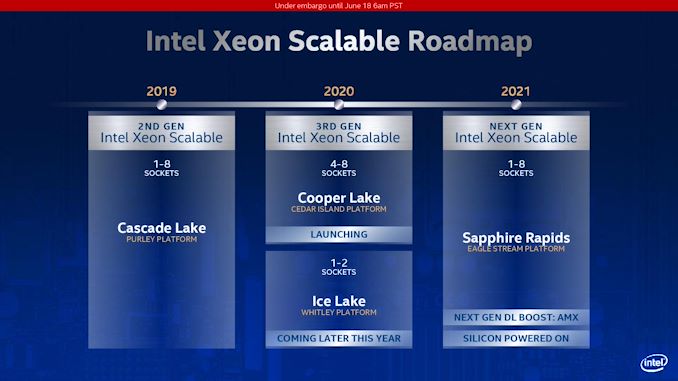
On the Intel front, Oracle is preparing new Ice Lake Server instances, which will be launching next year as Oracle’s high-performance compute-focused X9 instances. Although Intel has largely kept Ice Lake Server details under wraps since the hardware has not yet officially launched, Oracle and Intel are already touting performance gains as high as 30% on some workloads versus their current Skylake-based X7 HPC instances.


Meanwhile not to be outdone, OCI is also preparing new E4 general computing instances based on AMD’s upcoming EPYC Milan processors. Similar to Intel, AMD hasn’t said a whole lot about what to expect from their upcoming Zen 3-based server processors, though with Rome already pushing 64 cores in a single chip, we’re expecting Milan to instead focus on improving per-core performance.


Early next year OCI will also be adding Ampere Computing’s wares into the mix. Oracle will be launching its first Arm-powered instances, becoming the latest cloud provider to incorporate Arm into their compute offerings, following Amazon’s interesting Graviton family of instances. OCI’s Arm instances will offer up to 160 core configurations based on Ampere’s Altra processors, which in turn is based on Arm’s surprisingly potent Neoverse N1 architecture. OCI’s Arm instances will clock as high as 3.3GHz, and Oracle will be positioning them as a cost-effective option for customers who need a lot of cores, but not necessarily maximum single-threaded performance.
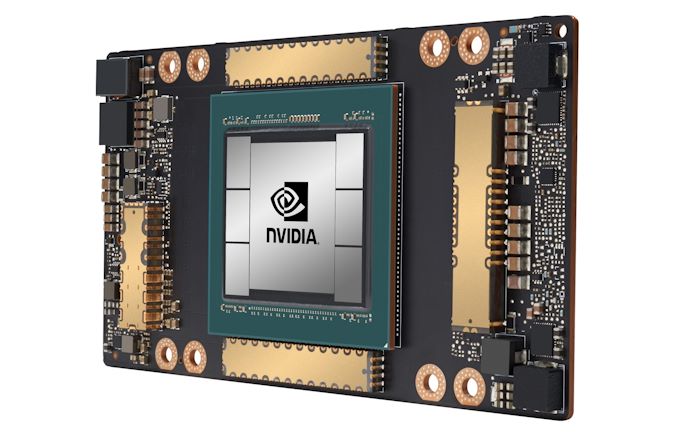


Finally – and more immediately – OCI is refreshing its GPU compute instances. The company’s current P100/V100 instances are being joined by instances based on NVIDIA’s new A100 accelerator, the latest and greatest from the company. The Ampere architecture-based accelerator (not to be confused with the other Ampere) will be available in system configurations of up to 8 GPUs per node, with OCI offering clustered options as well to scale that out to 512 GPU clusters. Also of note, OCI is equipping their nodes with 2TB of RAM, twice as much as the 1TB found in NVIDIA’s DGX A100 boxes. And unlike all of the new CPU instances, which launch next year, the new A100 instances will hit general availability next week, on September 30th.


Growing the Base: Bare Metal and Other Clients


With their new compute instances set to come online over the coming weeks and months, Oracle is setting out to further grow their customer base. Being competitive is certainly a part of that, and rather unusually for Oracle, that includes competing on price. For example, Oracle expects their A100 instances to be the cheapest on the market at $3.05 per GPU hour, and their AMD/Ampere CPU instances are being similarly positioned for cost-effectiveness. So it makes for an interesting state of affairs for the cloud computing market when the traditionally (if not notoriously) profit-focused company is working to become a price leader.


Though while competing with the other major cloud providers is a concern for Oracle and a driver behind these upgrades, it’s not the only factor in Oracle’s cloud offerings. The cloud computing market is still a growing market, and that’s largely because traditional server customers are still in the process of transitioning over to cloud infrastructure. It’s these customers that Oracle is taking a particular interest in – rather than just winning over customers from other providers – to entice them to move their on-premise workloads into Oracle’s datacenters.


But traditional customers are traditional for a reason; while some are merely uninterested in change, others have workloads and use cases that don’t always map well to cloud computing paradigms. Meaning that in order to bring these customers into the fold, Oracle needs to figure out how to solve the “hard stuff” that keeps customers’ computing in on-premises servers and workstations. The low-hanging fruit there is performance, particularly in being able to deliver the kind of performance that customers need so that they can do everything in the cloud and without the benefits of quick uploading and downloading to local hardware.


Meanwhile other roadblocks are things like hardware control, with customers being accustomed to having hardware they can control virtually every aspect of, as opposed to the more abstract, plug-and-play nature of virtual machines and containers. Which is why a big focus of OCI’s efforts (and a major differentiating factor for them) is on their bare metal systems. True to the name, these systems are setup without virtualization and offer customers low-level access to the hardware, including BIOS settings as necessary. For containerized applications it’s completely unnecessary, but for traditional applications and legacy programs that have never been run on anything but bare metal hardware, it offers a more direct route to transitioning towards cloud hosting.


But the real trick, as always, is convincing those traditional customers to make the leap; simply having a hardware offering only goes so far, no matter how solid it is. Which is why Oracle’s efforts in the cloud computing space are as much about marketing as they are technology, and why Oracle is also rolling out use case studies, testimonials, and such, in order to bolster their claims. There’s even more money to be made in the cloud infrastructure business – avenues that AWS and Azure haven’t been able to fully tap thus far – but to reach them, Oracle has to be able to do the things that other cloud competitors cannot.


At any rate, Oracle’s new compute instances will be rolling out in two phases. Their new A100 GPU instances will be available next week. Meanwhile the bigger shift to new CPU instances will take place next year, with Intel’s Ice Lake Server, AMD’s EPYC Milan, and Ampere’s Altra processors all become available.


Source: AnandTech – Oracle Announces Upcoming Cloud Compute Instances: Ice Lake and Milan, A100 and Altra

Intel Hires a New Technical Focused Chief Strategy Officer

The title of Chief Strategy Office is an interesting one for Intel. The C-level executive in this position obviously has the goal of managing strategy within the company, although as it pertains to growth more than anything else. Intel has made it clear that it wants to grow and expand into markets where it hasn’t traditionally been the dominant player, where there is a lot of addressable market such that Intel believes its products could generate a lot more revenue. Despite having this discussion at its 2019 Investor Meeting, showcasing areas such as 3D NAND, FPGA, Connectivity, Edge, IoT, Automotive and as part of that growth market opportunity, Intel has not had a Chief Strategy Officer to guide it at a high level for over 18 months. Today Intel announced a replacement, Safroadu (Saf) Yeboah-Amankwah.


Yeboah-Amankwah will officially take the position effective November 1st, but has a strong track record of being very technology focused. He holds bachelor’s and master’s degrees in Electrical Engineering and Computer Science from MIT, and has been a Senior Partner and Managing Partner of the Technology, Media, & Telecommunications division of consultants McKinsey and Company, where he has been for 26 years. Recent focal points for Yeboah-Amankwah have included the expansion of technology into Africa, noting a $300 billion potential as Africa’s digital economy expands, as well as supporting technology transformations of telecoms, financial instructions, agricultural operations, as well as mergers and acquisitions. His profile at McKinsey lists his expertise mostly across Finance, Operations, M&A, with a focus on technology.


At Intel, his role at Intel as CSO would appear to include driving growth-oriented strategies in the key areas Intel has already highlighted, most of which align with Yeboah-Amankwah’s previous experience. Alongside this, Intel Capital will also fall under his domain, the arm of Intel that acts as both an investment fund as well as finding companies with acquisition potential. Intel Capital is a large business unit of Intel we don’t often talk about here at Intel (I was rather looking forward to attending the Intel Capital event for a second year, before the lockdown occurred), and will likely have increased importance as Intel attempts to move into these markets with a concerted effort.


Saf Yeboah-Amankwah will report directly to CEO Bob Swan, which means that Swan now has even more direct reportees than ever before.


It is also worth noting that Intel seems to be departing from the general ‘Internal Promotion’ model it has held to since the 80s. The number of recent external hires in key positions (some of which listed below) has the potential to cause some internal friction between employees that have been moving up the chain the past 20 years or so with regards to where Intel’s corporate growth sits. Intel’s recent desire over the past few years to bring in external hires to fill key positions is a story in of its own right.


We were afforded a number of interviews of Intel’s previous CSO over the years. It will be interesting if we are given the same opportunity, to get an insight into Yeboah-Amankwah’s goals for Intel in 2021 and beyond.


Source: Intel


Related Reading


Source: AnandTech – Intel Hires a New Technical Focused Chief Strategy Officer

The Samsung 980 PRO PCIe 4.0 SSD Review: A Spirit of Hope

It may be a bit later than originally planned, but Samsung’s first consumer SSD to support PCIe 4.0 is here. The Samsung 980 PRO was first previewed at CES in January, but we didn’t hear anything further until leaks started appearing towards the end of summer. Now the 980 PRO is set to kick off a new wave of PCIe 4.0 SSD releases. These new changes are the most significant changes to Samsung’s PRO SSD line since the debut of its first NVMe drive. We’ve put the drives through our SSD benchmark suite to see if they live up to the hype.


Source: AnandTech – The Samsung 980 PRO PCIe 4.0 SSD Review: A Spirit of Hope

Qualcomm Announces Snapdragon 750G: Cortex-A77 & mmWave in the Premium Range

Today Qualcomm is announcing a new entry into their premium tier Snapdragon 700-series with the brand-new Snapdragon 750G platform and SoC. The new SoC, as its name implies, lies slightly below the popular Snapdragon 765/768 series released earlier this year, but since it’s a newer design, employs some new IP, such as new Cortex-A77 based performance cores.


The chip on paper looks extremely similar to the Snapdragon 690 which was released last June, however the 750G does have some important distinctions such as the inclusion of mmWave 5G connectivity support which enables it to be Qualcomm’s lowest-end chipset with the feature, positioning itself as an important chipset for the US market.


Qualcomm Snapdragon Premium SoCs 2019-2020
SoC Snapdragon

768G

 
Snapdragon

765 / 765G

 
Snapdragon

750G

(NEW)
Snapdragon

730G / 732G

 
CPU 1x Cortex A76
@ 2.8GHz


1x Cortex-A76

@ 2.4GHz


6x Cortex-A55

@ 1.8GHz

1x Cortex A76

@ 2.3GHz / 2.4GHz


1x Cortex-A76

@ 2.2GHz


6x Cortex-A55

@ 1.8GHz

2x Cortex-A77

@ 2.2GHz


6x Cortex-A55

@ 1.8GHz
2x Cortex-A76

@ 2.2GHz / 2.3GHz


6x Cortex-A55

@ 1.8GHz
GPU Adreno 620

+15% perf over 765G
Adreno 620

+20% perf (non-G)
+38% perf (765G)
Adreno 619

+10% perf over 730G
Adreno 618

(+15% 732G)
DSP / NPU Hexagon 696

HVX + Tensor

5.4TOPS AI

(Total CPU+GPU+HVX+Tensor)

Hexagon 694

HVX + Tensor

4TOPS AI

(Total)

Hexagon 688

HVX + Tensor
Memory

Controller
2x 16-bit CH


@ 2133MHz LPDDR4X / 17.0GB/s

2x 16-bit CH


@ 1866MHz LPDDR4X 14.9GB/s

ISP/Camera Dual

Spectra 355 ISP
Dual

Spectra 355L ISP
Dual

Spectra 350 ISP
Encode/

Decode
2160p30, 1080p120

H.264 & H.265


10-bit HDR pipelines

Integrated Modem Snapdragon X52 Integrated


(LTE Category 24/22)

DL = 1200 Mbps

4x20MHz CA, 256-QAM


UL = 210 Mbps

2x20MHz CA, 256-QAM

(5G NR Sub-6 4×4 100MHz

+ mmWave 2×2 400MHz)

DL = 3700 Mbps

UL = 1600 Mbps

Snapdragon X15 LTE


(Cat. 15/13)

DL = 800Mbps

3x20MHz CA, 256-QAM


UL = 150Mbps

2x20MHz CA, 64-QAM

Mfc. Process Samsung

7nm EUV (7LPP)
Samsung

8nm (8LPP)

Looking at the specs, the new Snapdragon 750G upgrades its CPU cores from the Cortex-A76 to newer Cortex-A77’s, clocking them up to 2.2GHz. The A77’s roughly has a 25% performance per clock advantage over the A76, meaning the new chip should be roughly equivalent to the Snapdragon 768G when it comes to CPU performance. Alongside the two performance cores, we also see 6x A55 cores clocked at up to 1.8GHz.


On the GPU side of things, we’re seeing the Adreno 619 GPU which promises a 10% performance boost over the Adreno 618 in the Snapdragon 730G.


Besides the CPU and GPU, the new chip also features a Hexagon 694 DSP and tensor accelerator and promises a combined platform computational throughput of 4TOPs.


Looking at all of the above specifications, they’re oddly familiar and seemingly match those of the Snapdragon 690 SoC, so it’s likely Qualcomm did a lot of design re-use between the two chipset generations.


One further difference from the S690 is the upgrade from 1833 to 2133MHz LPDDR4X memory.


The key difference though to the 6-series sibling however is in the modem: The Snapdragon 750G uses an X52 modem, the same as on the Snapdragon 765/768 chips, with the distinguishing factor to the X51-based variant of the Snapdragon 690 being the additional for mmWave support.


This is an important feature to have for the US market handset designs as it opens up support for the Verizon 5G network, whilst the rest of the world primarily is focusing on sub-6GHz deployments first.


The Snapdragon 750G is manufactured on Samsung’s 8nm process node, and from a device development standpoint is interesting as it’s pin-compatible with the Snapdragon 690 – meaning vendors can pick between the two SoC options without a major platform redesign.


Commercial devices with the Snapdragon 750G are expected to be available by the end of the year, with Xiaomi claiming to be the first vendor to launch a smartphone based on the platform.


Related Reading:


Source: AnandTech – Qualcomm Announces Snapdragon 750G: Cortex-A77 & mmWave in the Premium Range

AMD Enables Ryzen in Chromebooks, Improving Performance

A modern enthusiast will scoff at the concept of a Chromebook – limited performance, capabilities, and a simplistic OS for doing some serious work? The fact is that the Chromebook, and Chrome OS, have been gazumping good portions of the notebook market share in recent years, mostly down to its stripped down nature but also the low pricing. In 2019 AMD relaunched its older A-series APUs for Chromebooks, meeting that market need. However, at CES this year we saw the first indication of premium $700+ Chromebooks from Intel. Now AMD is moving into a higher performance space with its Chromebook offerings with new optimized Ryzen hardware and Vega graphics.


Today AMD is announcing five new processors for Chromebooks.


AMD Chromebook APUs
AnandTech Cores Base

MHz
Turbo

MHz
GPU

CUs
GPU

MHz
TDP Silicon
C-Series Zen+Vega
Ryzen 7 3700C 4C/8T 2300 4000 10 1400 15 W Picasso
Ryzen 5 3500C 4C/8T 2100 3700 8 1200 15 W Picasso
Ryzen 3 3250C 2C/4T 2600 3500 3 1200 15 W Dali
Athlon Gold 3150C 2C/4T 2400 3300 3 1100 15 W Dali
Athlon Silver 3050C 2C/4T 2300 3200 2 1100 15 W Dali
A-Series Excavator + GCN 1.2
A6-9220C 2C/2T 1800 2700 3 720 6 W Stoney
A6-9120C 2C/2T 1600 2400 3 600 6 W Stoney

The first two Ryzen processors are based on the quad core 12 nm Picasso processors, with four Zen+ cores and up to 11 Vega compute units. The final three are based on the dual core 14 nm Dali processors, with two Zen cores and up to 3 Vega compute units. All processors are built with a 15 W TDP in mind, and the idea is for these to cover the mid and high level Chromebooks while the A-series remains for those entry level models.


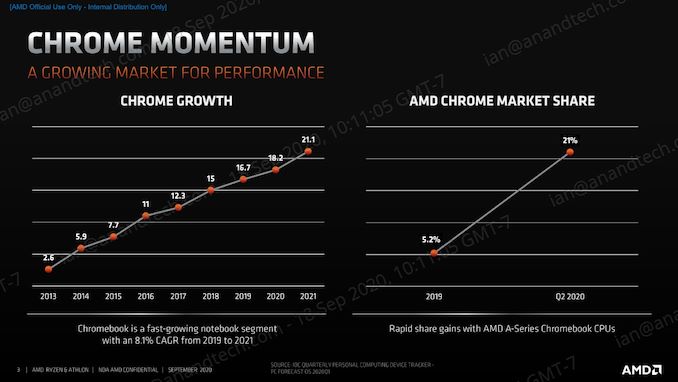
AMD claims to have a 21% market share in the Chromebook space, using IDC data, and Chromebooks currently account for 18% of all notebook sales. The market is largely split into three categories: education, enterprise, and consumer, with education seeing a big uplift in recent months due to the pandemic. Also because of the pandemic, as well as the growth of Chromebooks as a viable tool for these markets, use-cases are expanding with new productivity applications becoming available as well as the need to drive multiple high resolution displays.


These are a few of the reasons why AMD is continuing its march into the Chromebook ecosystem. On a performance level, AMD states that the new Ryzen-class Chromebook APUs will offer double or better web performance than the A-series, and +66-150% performance in productivity and graphics tasks.


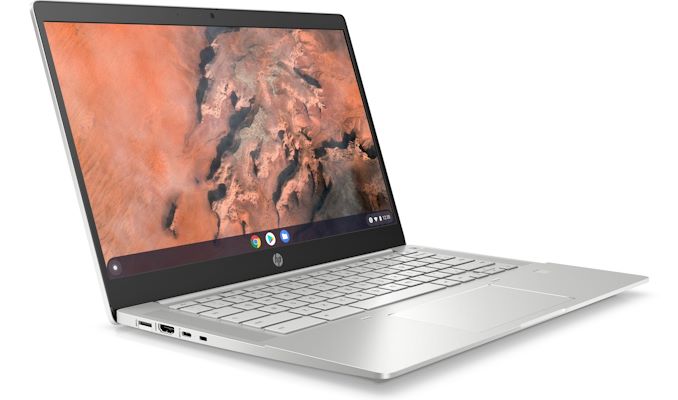
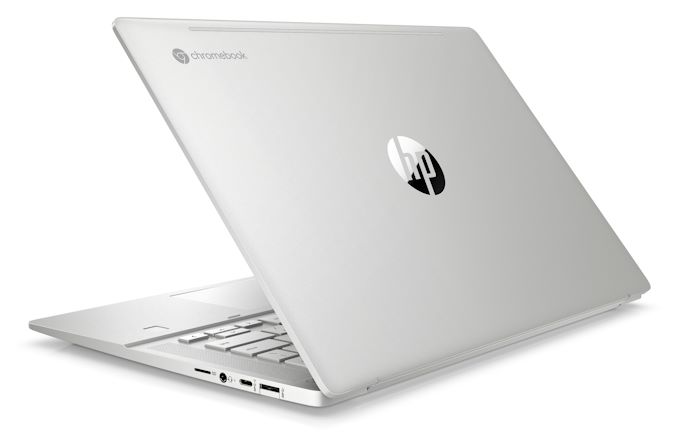
Two of the first of the new Chromebook devices is coming from HP – essentially the same device, except one is for consumer and the other is built for the Enterprise market with extra security features.


The HP Pro c645 will be offered with the new Athlon C-class and Ryzen C-class processors, as well as a HP Privacy Camera shutter and optional fingerprint sensor. Through HP’s management software and the onboard Titan C chip, it can also be externally managed in a corporate environment if required. The 14-inch 1080p or 768p display comes with optional touch, up to 16 GB of DDR4, and up to 128 GB of NVMe storage (the lowest configuration is 4 GB DDR4 with 32 GB eMMC). At 3.4 lbs, the c645 is tested to MIL-STD 810H specifications, is quoted as having 10.5 hours battery with optional fast charging, dual Type-C at 5 Gbps, dual Type-A at 5 Gbps, and an extended 2×2 Wi-Fi 6 design. There is also a microSD slot and a HDMI 1.4 port. The HP Pro c645 and c645 Enterprise will be available in December, with pricing to come later.


Today AMD will also claim that it already has six design wins for Chromebooks in the works, all scheduled to come out later this year from HP, Lenovo, and ASUS.


Related Reading


Source: AnandTech – AMD Enables Ryzen in Chromebooks, Improving Performance

Arm Announces Neoverse V1 & N2 Infrastructure CPUs: +50% IPC, SVE Server Cores

Today Arm is announcing its new Neoverse V1 and N2 microarchitectures. The new microarchitectures represent a ever bigger jump than the already vastly successful Neoverse N1 that’s been adopted in designs such as the Graviton2 or Ampere’s Altra. With a 50% generational IPC uplift, the Neoverse V1 goes for maximum performance in the infrastructure market, with similar design philosophies to the Cortex-X1 in the mobile space. Furthermore, although Arm is being vague on the architecture of these new CPUs, they represent the company’s first ever designs supporting new SVE (Scalable Vector Extensions).


Source: AnandTech – Arm Announces Neoverse V1 & N2 Infrastructure CPUs: +50% IPC, SVE Server Cores

The ASRock Z490 PG Velocita Motherboard Review: It Means SPEED

For the foreseeable future, or at least until Intel’s Rocket Lake is likely to be unveiled, Intel’s main platform for consumers is currently the Z490 chipset for Comet Lake. The options available for consumers offer a wide variety of models, but perhaps one of the most competitively priced mid-range ones is the ASRock Z490 PG Velocita. Some of the board’s main features include dual M.2 slots, eight SATA, 2.5 G Ethernet, and a competitive 13-phase power delivery. This is our review.


Source: AnandTech – The ASRock Z490 PG Velocita Motherboard Review: It Means SPEED

Honor’s First Gaming Laptop: The Hunter V700

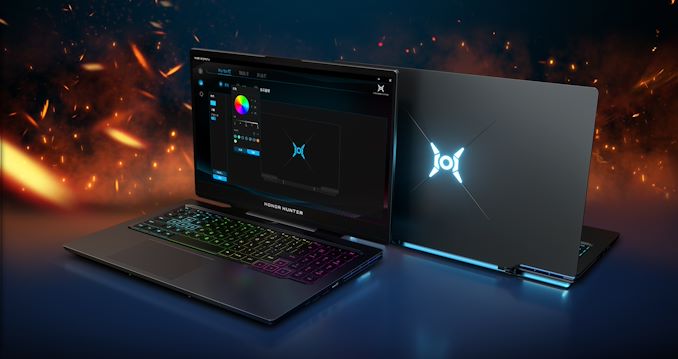
With all the political wrangling going on with Huawei and Honor, one product line that both companies seem to be able to push is the laptop and notebook business. Both Huawei and Honor have announced devices powered by the latest Intel and AMD processors, and despite the first few years of some really nice designs, like the Matebook X Pro or the Magicbook 14, the two companies are now starting to get a bit more adventurous. Enter the first gaming laptop, the Hunter V700.


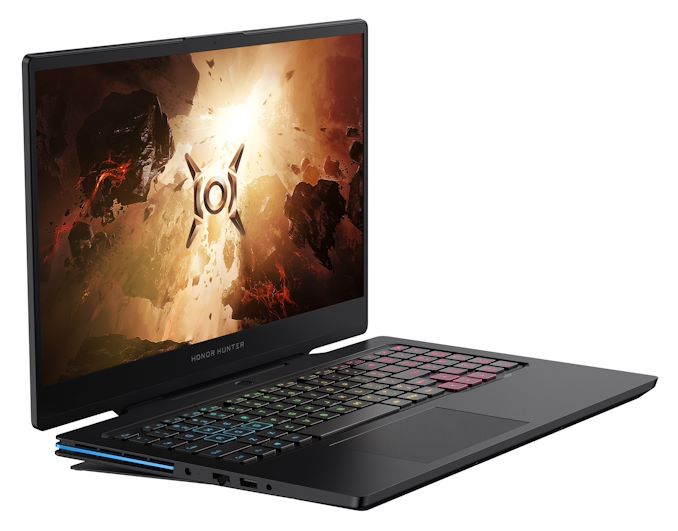
The Honor Hunter V700


This new product line from Honor starts with an interesting concept which takes advantage of the strong identity and product design team that the company has. The Honor Hunter brand can use a single H to identify the marque, and in this instance they put it onto a full bodied gaming laptop.


The standard ‘15.6-inch chassis’ size actually holds a 16.1-inch display, enabled by the 4.7 mm side-to-side bezels. This is a 1080p IPS panel that offers 144 Hz refresh rates, albeit at only a 300 nit maximum brightness. Inside the chassis is what we would normally consider a ‘standard’ gaming notebook setup. There is an Intel 10th Gen Comet Lake processor, up to the Core i7-10750H, paired with an NVIDIA graphics card up to the RTX 2060 6 GB. The top model comes with 16 GB of DDR4-2666, which can be user upgraded to 32 GB, and there are two NVMe M.2 slots, one of which comes preinstalled up to 1 TB.


The chassis itself is an aluminium magnesium alloy, which should prove to be extremely light, as well as assist with cooling. Based on Honor’s own testing, the company states that in full power virus mode (AIDA64 FPU + Furmark for 72 minutes), the CPU will consume 45 W sustained, and the GPU will consume 101 W sustained, peaking at 77ºC, enabling a consistent minimum gaming performance regardless of the title.


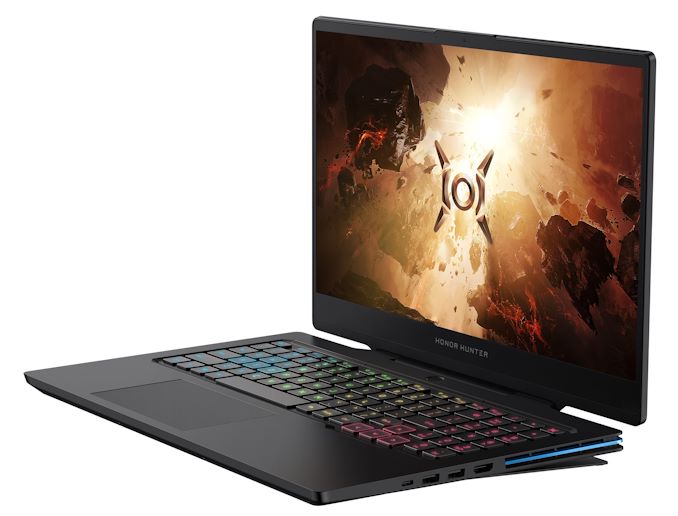
This is partly enabled by the ‘wind valley channel’ created when the laptop is opened, providing an 8.5mm intake for two 12 V fans which Honor says increase airflow volume by 40% over a conventional design – you can see the little extra ‘feet’ that provides this opening. In Honor’s press release, they call the way the chassis opens to help this airflow as a ‘rotating shaft of the wind’, which is one of the more amusing word parings in a laptop press release of late. Honor states that the maximum audible noise from the fans for a user is 49 dBA, and the cooling keeps the WASD area below 31ºC.


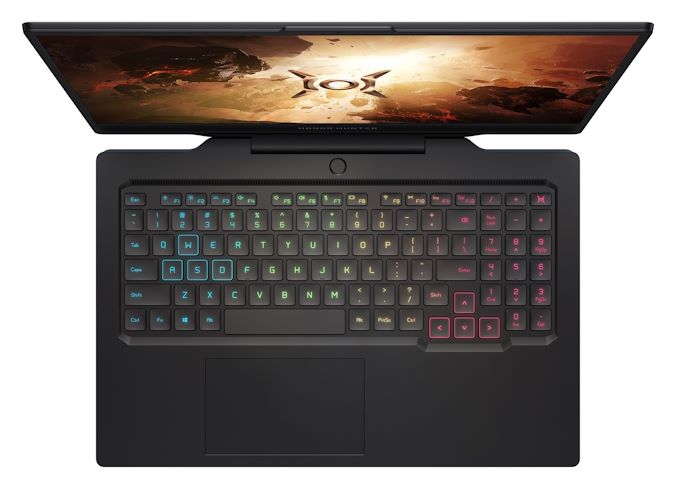
In line with the gaming theme, the keyboard is a 4-zone RGB back-lit implementation, and features 1.8mm key travel on the chiclet design. The WASD area has its own highlight, the space bar has been widened, there is a full number pad, and the arrow keys have been moved down slightly by almost half a key to make them stand out. The motif on the lid of the notebook is also RGB, with control software provided. On the audio front, Honor has licenced Nahimic’s audio software toolkit, enabling 5.1 and 7.1 audio simulation as well as optimized EQ profiles for specific games.


Connectivity starts with Wi-Fi 6 but also includes 3.5mm audio, one USB 2.0 port, two USB 3.2 Gen 2 ports, a Type-C port with DisplayPort, and a HDMI 2.0 output.


In line with other Honor and Huawei laptops, inbuilt NFC allows users to connect up the laptop to their smartphone to enable features such as screen recording for PC games, live streaming for mobile games, file transfer, and call migration. The screen recording and live streaming sections are certainly interesting features.


Availability


As always with new design ideas like this Honor is starting with the Chinese market first. The Hunter V700 will be available in the Chinese market from September 27th, with three different configurations:


  • i7-10750H, RTX 2060, 16 GB, 1x 1 TB, 144 Hz: RMB 9999 ($1300)
  • i7-10750H, RTX 2060, 16 GB, 512 GB, 144 Hz: RMB 8499 ($1100)
  • i3-10300H, GTX 1660 Ti, 16 GB, 512 GB, 144 Hz: RMB 7499 ($999)

*RMB prices are quoted with China 13% sales tax. US prices quoted without sales tax.


I think something might be mislabelled with that middle option, as charging another $200 for extra storage seems extortionate – it is perhaps an i5, or the GTX graphics. As always, Honor is doing a deal for the first few buyers on launch day, with savings of 500 RMB.


We’re unlikely to see the Hunter V700 in the west, but it marks the first step in what could come over to us. I’ve been impressed with the Honor laptop designs I’ve tested so far, so if they can launch a worldwide model at the right price, it should be an interesting product.


Source: Honor VMall


Related Reading


Source: AnandTech – Honor’s First Gaming Laptop: The Hunter V700

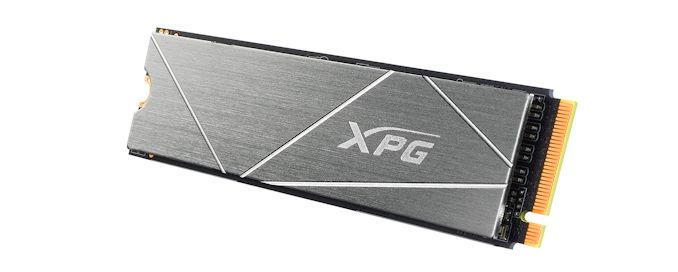
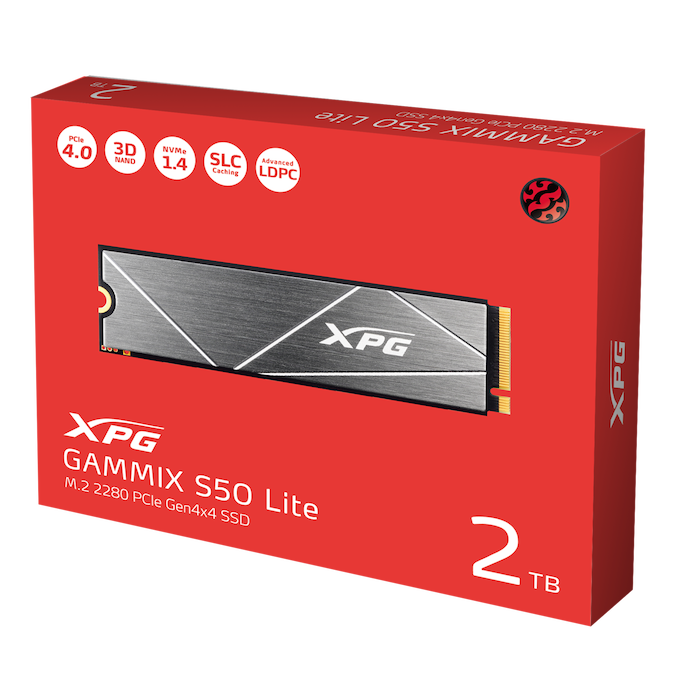
ADATA XPG Launches a PCIe 4.0 x4 NVMe SSD for Notebooks: Gammix S50 Lite

One of the primary issues with most of the PCIe 4.0 NVMe storage drives on the market today is power consumption. The only base solution for OEMs in the market, for 6+ months, can consume up to 5-8 W when in use. This is due to the SSD controller that was originally built for PCIe 3.0 work and not optimized when it was updated for PCIe 4.0. However, as that design was first to market and works in desktops it does what it needed to do. But for laptops, we’ve been waiting on the optimized follow ups. The new ADATA Gammix S50 Lite will use one of those optimized designs.


A Second Wave of PCIe 4.0 SSDs


The first PCIe 4.0 drives on the market used the Phison E16 controller which was, for lack of a better word, a hybrid design: it took the PCIe 3.0 E12 controller, removed the PCIe 3.0 part, and added in PCIe 4.0 connectivity. A controller involves both the connection standard and a compute segment, and the compute segment was not updated in order to enable the product to come to market very quickly. As a result, even though the compute could handle PCIe 4.0, it wasn’t optimized for it, but we had some power hungry drives to play with for a while.


Since then, we have been waiting for the second wave of PCIe 4.0 controllers to come to market. Samsung is making way with its new Elpis controller in the Samsung 980 Pro, and Phison’s own next-gen E18 is expected to come to market later this year, while the E19 has been teased at a couple of industry events. These controllers are all set to offer better performance or better efficiency for the wider adoption of PCIe 4.0 SSDs.


Then there are also SMI controllers, and both SMI and its OEM partners have teased new PCIe 4.0 SSD turnkey designs as early as Computex 2019. At CES this year ADATA teased two PCIe 4.0 drives built with new SMI controllers: a high performance model with the SM2264 for desktops, and a medium performance efficiency model with the SM2267 for notebooks. The SM2267 is what is going into the new Gammix S50 Lite SSD being launched today.


The Gammix S50 Lite


The new drive might not sound like much in the performance stakes, with only 3900 MB/sec read and 3200 MB/sec writes, as well as 490K/540K IOPs, but as a PCIe 4.0 drive it is much faster than a PCIe 3.0 drive and ADATA claims that due to the design it can be up to 20% cooler (in temperature) than other competitive offerings.


This drive uses a four-channel design rather than 8, which goes someway into explaining the performance and the potentially lower power consumption, but it also has a DRAM cache buffer and SLC caching to help with keeping performance high. What all of this comes down to is making the drive more suitable for installation in upcoming PCIe 4.0-enabled laptops featuring Tiger Lake processors.


The Gammix S50 Lite will come in 1 TB and 2 TB capacities initially, offer LPDC error correction, RAID engine support, and AES 256-bit encryption. The drive has a 5 year warranty, and both models are rated to 1480 terabytes written (TBW). The drives will be available in North America from October 1st, with the following pricing:


  • XPG Gammix S50 1 TB:  $150
  • XPG Gammix S50 2 TB:  $300

At these prices, the 1 TB model is $15-$50 cheaper than the E16 PCIe 4.0 drives on the market.


Source: ADATA Product Page


Related Reading


Source: AnandTech – ADATA XPG Launches a PCIe 4.0 x4 NVMe SSD for Notebooks: Gammix S50 Lite

Intel’s Tiger Lake 11th Gen Core i7-1185G7 Review and Deep Dive: Baskin’ for the Exotic

The big notebook launch for Intel this year is Tiger Lake, its upcoming 10nm platform designed to pair a new graphics architecture with a nice high frequency for the performance that customers in this space require. Over the past few weeks, we’ve covered the microarchitecture as presented by Intel at its latest Intel Architecture Day 2020, as well as the formal launch of the new platform in early September. The missing piece of the puzzle was actually testing it, to see if it can match the very progressive platform currently offered by AMD’s Ryzen Mobile. Today is that review, with one of Intel’s reference design laptops.


Source: AnandTech – Intel’s Tiger Lake 11th Gen Core i7-1185G7 Review and Deep Dive: Baskin’ for the Exotic

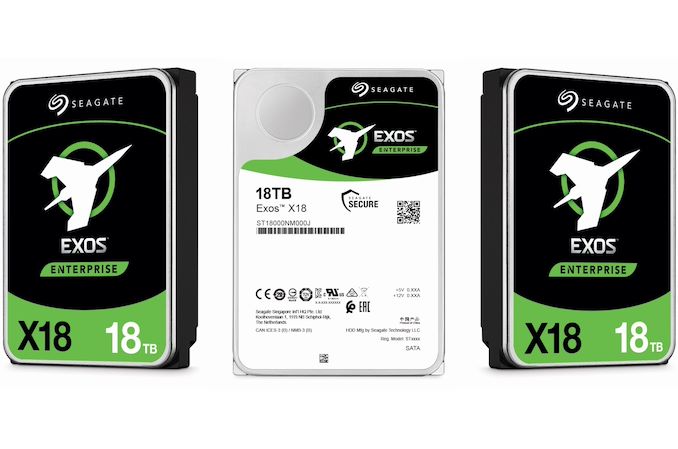
Seagate Unveils Exos X18 18TB Enterprise Hard Drive

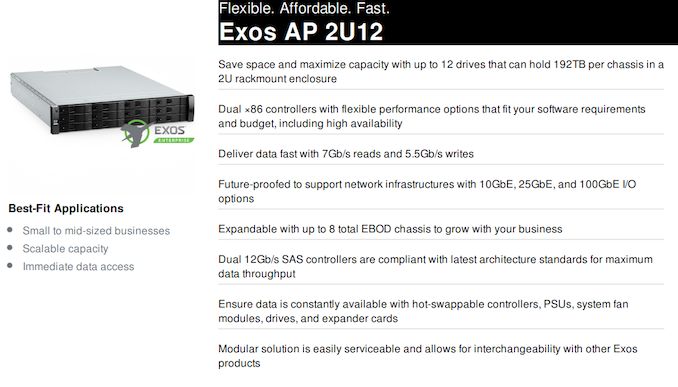
Seagate recently introduced their 18TB flagship IronWolf Pro hard drive for SMB/SME NAS units. Today, the company is unveiling the Exos enterprise version of the same drive. The Exos X18 goes head-to-head against the Western Digital WD Gold 18TB EAMR-based drives introduced in July. Seagate is also taking the opportunity to expand their application/storage server lineup with a 2U 12-bay model – the Exos AP 2U12 Compute and Storage System.


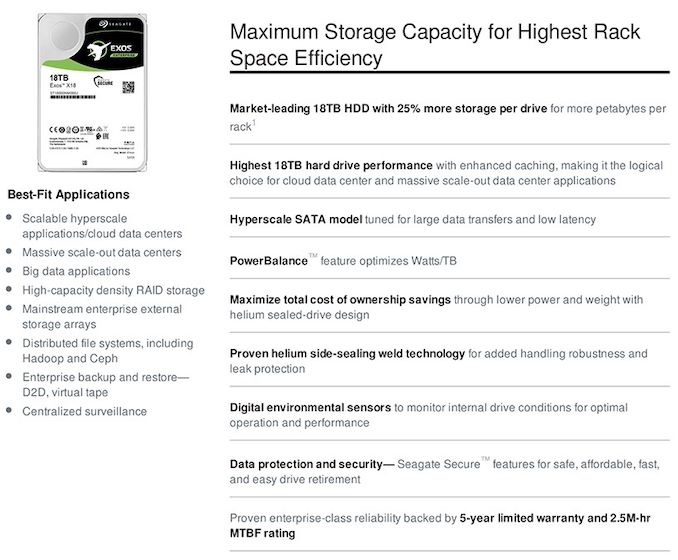
The Seagate Exos X18, like the IronWolf Pro 18TB, is a 7200 RPM CMR (conventional magnetic recording) drive with a 256MB multi-segmented cache. It contains additional reliability features, and firmware tweaks to provide features geared towards data centers and enterprise storage arrays. These include caching tweaks to optimize the drive for low-latency large data transfers, and a power balance feature that allows customization of the power consumption for the best possible watts/TB given a particular set of workloads. The MTBF increases from 1.2M in the IronWolf Pro to 2.5M hours for the Exos X18.


The maximum sustained disk transfer rate also increases from 260 MBps to 270 MBps. Seagate quotes maximum operating power of 9.4W, with idling average at 5.3W. The IronWolf Pro 18TB idles at 5.2W.


Seagate also has a lineup of products under the Exos Systems tag – these include multi-bay rackmount storage enclosures falling under three different categories – the AP series for compute and storage with an in-built x86 server CPU, the X series RAID enclosures, and the E series JBOD enclosures. Today, the company is introducing a 2U12 AP model – as the name suggests, the 2U rackmount server supports up to 12 3.5″ drives and comes with two 10GBASE-T ports and two gigabit ports. The server board is based on the Xeon v5 v4 family, and CPUs with TDP of up to 85W are supported.


Coming back to the Exos X18, Seagate offers it in both SATA and SAS versions. The SATA version has a MSRP of $562, undercutting the WD Gold by $30.


Source: AnandTech – Seagate Unveils Exos X18 18TB Enterprise Hard Drive

Sony Announces Xperia 5 II: 120Hz Full-Fledged Small Phone

Today Sony is following up on one of its newer form-factors that the company had introduced last year with the Xperia 5. The new Xperia 1 II (read as mark two), follows up on the smaller flagship sibling device, retaining its form-factor, but also substantially improving its design as well as maintaining an almost complete feature-parity with the bigger Xperia 1 II.

The new phone also sets out to differentiate itself from other Sony offerings: the company seemingly has focused on the more gaming-centric usability of the device even though externally it does not have the flair of a gaming phone. With a new internal heat dissipation system and a 120Hz refresh rate OLED and 240Hz sample rate touch input, the Xperia 5 II punches above its weight when it comes to fluidity.


Source: AnandTech – Sony Announces Xperia 5 II: 120Hz Full-Fledged Small Phone

Sony Announces PS5 Pricing: $499 For Regular Console, $399 For Digital Edition

At Sony’s PlayStation 5 Showcase this afternoon, the final (and much awaited) pieces of the puzzle with regards to the console’s launch have dropped: pricing and a release date.


Sony’s next-generation console will launch on Thursday, November 12th. The full version of the console, which includes a Blu-ray disc drive, will launch at $499. Meanwhile the “Digital Edition” of the console, which foregoes optical storage entirely, will release for a surprising $399, a full $100 cheaper despite only giving up a disc drive.


This will put Sony’s launch 2 days after Microsoft’s own Xbox Series X/S launch, which is taking place on Tuesday, November 10th. The $499 price tag for the two companies’ respective flagship consoles will put them in direct competition, while the PS5 Digital Edition/Xbox Series S divide should prove far more interesting – if not a bit frustrating for consumers trying to make the best choice. The discless PS5 is every bit as powerful as its disc-capable sibling – making it a spoiler of sorts at $399 – whereas the Xbox Series S gets a significantly weaker GPU than the Xbox Series X. However at $299 the slimmed down console is cheaper still, and still gets to run next-gen games.


Next-Gen Console Specs
  PlayStation 5 PlayStation 5

Digital Edition
Xbox Series S Xbox Series X
CPU 8 Core AMD Zen 2

@ 3.5 GHz w/SMT
8 Core AMD Zen 2

@ 3.6 GHz

@ 3.4 GHz w/SMT
8 Core AMD Zen 2

@ 3.8 GHz

@ 3.6 GHz /wSMT
GPU 36 CU AMD RDNA2

@ 2.23GHz
20 CU AMD RDNA2

@ 1.565 GHz
52 CU AMD RDNA2

@ 1.825 GHz
GPU Throughput (FP32) 10.28 TFLOPS 4 TFLOPS 12.15 TFLOPS
Memory 16GB GDDR6

@ 14Gbps
10GB GDDR6

@ 14Gbps
16GB GDDR6

@ 14Gbps
Memory Throughput 16GB@448GB/sec

(256-bit)
 8GB@224GB/sec

(128-bit)

2GB@56GB/sec

(32-bit)
10GB@560GB/sec

(320-bit)

6GB@336GB/sec

(192-bit)
Storage 825GB PCIe4 x4 SSD 512GB PCIe 4 x2 SSD 1TB PCIe 4 x2 SSD
Storage Throughput 5.5GB/sec 2.4GB/sec
Storage Expansion NVMe Slot

PCIe4 x4
Xbox Storage Expansion Card (1TB)
Disc Drive 4K UHD Blu-Ray No No 4K UHD Blu-Ray
Manufacturing Process TSMC 7nm TSMC 7nm TSMC 7nm TSMC 7nm
Launch Date 2020/11/12 2020/11/10
Launch Price $499 $399 $299 $499

Or if you’re in the mood for a PC (a platform we’re particularly partial towards), over the next couple of months we will be seeing new hardware launches there as well, including NVIDIA’s $500 GeForce RTX 3070, and AMD’s new RDNA2-based Radeon RX 6000 video cards. So there is no shortage of gaming hardware to be had this fall – at least if you have the cash.


Source: AnandTech – Sony Announces PS5 Pricing: 9 For Regular Console, 9 For Digital Edition

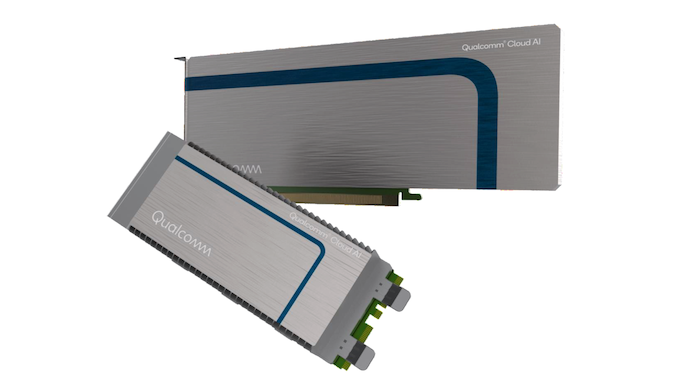
Qualcomm's Cloud AI 100 Now Sampling: Up to 400TOPs at 75W

Today Qualcomm is revealing more information on last year’s announced “Cloud AI 100” inference chip and platform. The new inference platform by the company is said to have entered production already with the first silicon successfully coming back, and with first customer sampling having started.


The Cloud AI 100 is Qualcomm’s first foray into the datacentre AI inference accelerator business, representing the company’s investments into machine learning and leveraging their expertise in the area from the consumer mobile SoC world, and bringing it to the enterprise market. Qualcomm had first revealed the Cloud AI 100 early last year, although admittedly this was more of a paper launch rather than a disclosure of what the hardware actually brought to the table.


Today, with actual silicon in the lab, Qualcomm is divulging more details about the architecture and performance and power targets of the inferencing design.


Source: AnandTech – Qualcomm’s Cloud AI 100 Now Sampling: Up to 400TOPs at 75W

Corsair Announces iCUE Elite Capellix Series: 240, 280, and 360 mm AIOs with Capellix LEDs

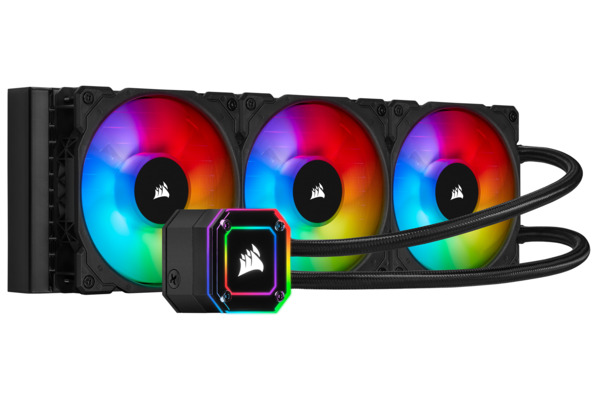
Back in January at CES 2020, we got a glimpse of Corsair’s Capellix LED technology and it certainly piqued our interest. At the time Corsair couldn’t give us details on when Capellix would be more mainstream, but now Corsair is starting to unveil its more intricate RGB ecosystem starting with a new range of AIO CPU coolers. The Corsair iCUE Elite Capellix is available in three sizes including 240, 280, and 360 mm, with very competitive pricing.


The Corsair iCue Elite Capellix includes three new models, including the H100i with a 240 mm radiator, the H115i with a 280 mm radiator, and the largest of the three, the H150i with a 360 mm radiator. Each model includes an aluminum constructed 27 mm thick radiator, with a copper split-flow cold plate and a centrifugal pump which Corsair claim operates quietly. 


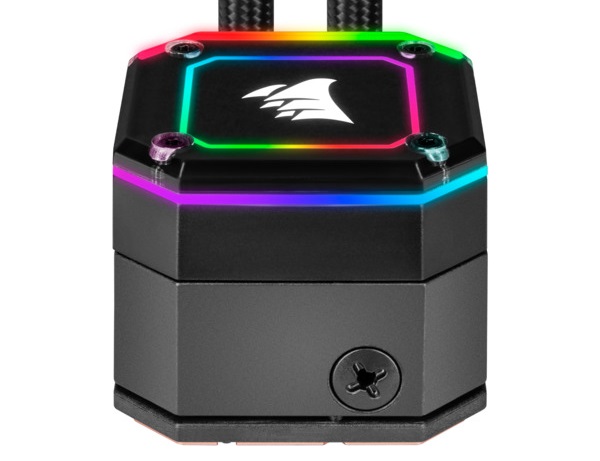
Mounted onto the pump is 33 individual Capellix RGB LEDs which surround the pump itself, with some LEDs integrated around the Corsair logo. Internally, the cold plate on each model includes 128 individual micro-skived fins per inch. Included in the accessories bundle is Corsair’s iCUE Commander Core with RGB lighting and PWM control for up to six fans. Touching on the fans, the H100i includes two 120 mm ML RGB PWM fans, the H115i comes with two ML140 140 mm fans, while the larger H150i has three ML120 120 mm fans. Corsair also includes mounting kits for AMD’s AM4 and STR4 sockets, while the Intel kit includes support for LGA115X, LGA1200, and LGA2066.


The Corsair iCUE Elite Capellix series will be available to purchase from the 15th September, with the H100i Elite available for $150, the H115i Elite for $170, and the H150i Elite for $180. Each model also comes backed by a 5-year manufacturer’s warranty.


Related Reading:


Source: AnandTech – Corsair Announces iCUE Elite Capellix Series: 240, 280, and 360 mm AIOs with Capellix LEDs

Apple Announces 5nm A14 SoC – Meagre Upgrades, Or Just Less Power Hungry?

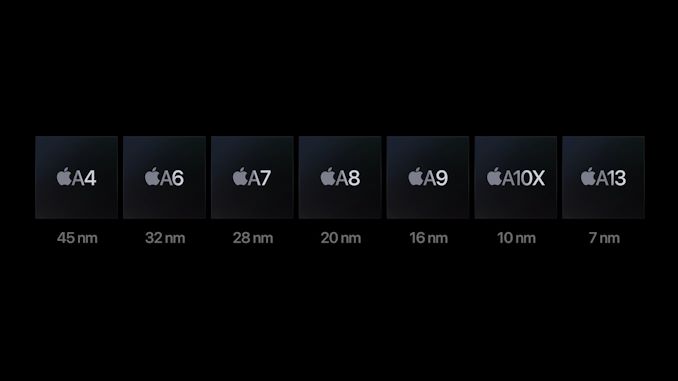
Amongst the new iPad and Watch devices released today, Apple made news in releasing the new A14 SoC chip. Apple’s newest generation silicon design is noteworthy in that is the industry’s first commercial chip to be manufactured on a 5nm process node, marking this the first of a new generation of designs that are expected to significantly push the envelope in the semiconductor space.


Apple’s event disclosures this year were a bit confusing as the company was comparing the new A14 metrics against the A12, given that’s what the previous generation iPad Air had been using until now – we’ll need to add some proper context behind the figures to extrapolate what this means.


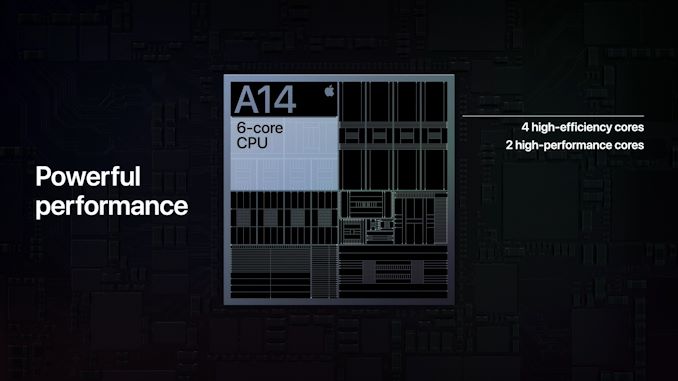
On the CPU side of things, Apple is using new generation large performance cores as well as new small power efficient cores, but remains in a 2+4 configuration. Apple here claims a 40% performance boost on the part of the CPUs, although the company doesn’t specify exactly what this metric refers to – is it single-threaded performance? Is it multi-threaded performance? Is it for the large or the small cores?


What we do know though is that it’s in reference to the A12 chipset, and the A13 already had claimed a 20% boost over that generation. Simple arithmetic thus dictates that the A14 would be roughly 16% faster than the A13 if Apple’s performance metric measurements are consistent between generations.


On the GPU side, we also see a similar calculation as Apple claims a 30% performance boost compared to the A12 generation thanks to the new 4-core GPU in the A14. Normalising this against the A13 this would mean only an 8.3% performance boost which is actually quite meagre.


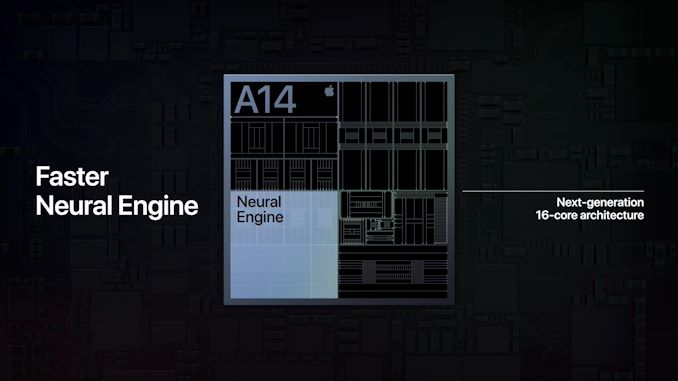
In other areas, Apple is boasting more significant performance jumps such as the new 16-core neural engine which now sports up to 11TOPs inferencing throughput, which is over double the 5TOPs of the A12 and 83% more than the estimated 6TOPs of the A13 neural engine.


Apple does advertise a new image signal processor amongst new features of the SoC, but otherwise the performance metrics (aside from the neural engine) seem rather conservative given the fact that the new chip is boasting 11.8 billion transistors, a 38% generational increase over the A13’s 8.5bn figures.


The one explanation and theory I have is that Apple might have finally pulled back on their excessive peak power draw at the maximum performance states of the CPUs and GPUs, and thus peak performance wouldn’t have seen such a large jump this generation, but favour more sustainable thermal figures.


Apple’s A12 and A13 chips were large performance upgrades both on the side of the CPU and GPU, however one criticism I had made of the company’s designs is that they both increased the power draw beyond what was usually sustainable in a mobile thermal envelope. This meant that while the designs had amazing peak performance figures, the chips were unable to sustain them for prolonged periods beyond 2-3 minutes. Keeping that in mind, the devices throttles to performance levels that were still beyond that of the competition, leaving Apple still being in a leadership position in terms of efficiency.


What speaks against such a theory is that Apple made no mention at all of concrete power or power efficiency figures this generation, which is rather very unusual given they’ve traditionally always made a remark on this aspect of the new designs. We’ll just have to wait and see if this is indicative of the actual products not having improved in this regard, of it’s just an omission and side-effect of the new more streamlined presentation style of the event.


Whatever the performance and efficiency figures are, what Apple can boast about is having the industry’s first ever 5nm silicon design. The new TSMC-fabricated A14 thus represents the cutting-edge of semiconductor technology today, and Apple made sure to mention this during the presentation.


Related Reading:


Source: AnandTech – Apple Announces 5nm A14 SoC – Meagre Upgrades, Or Just Less Power Hungry?