Installing Windows on an Xbox One S APU: The Chuwi Aerobox Review

Ever since consoles moved to the same underlying architecture as modern desktop computers, there has always been an underlying question as to whether those same processors could run regular desktop computer versions of Windows, and subsequently be used for more than just gaming. We’ve had to wait a long while, but for whatever reason one of the 8th Generation Console processors is being enabled for the (mass) market, and the first to jump on that game is the Chuwi Aerobox. We can install Windows, and it’s a crazy ride.


Source: AnandTech – Installing Windows on an Xbox One S APU: The Chuwi Aerobox Review

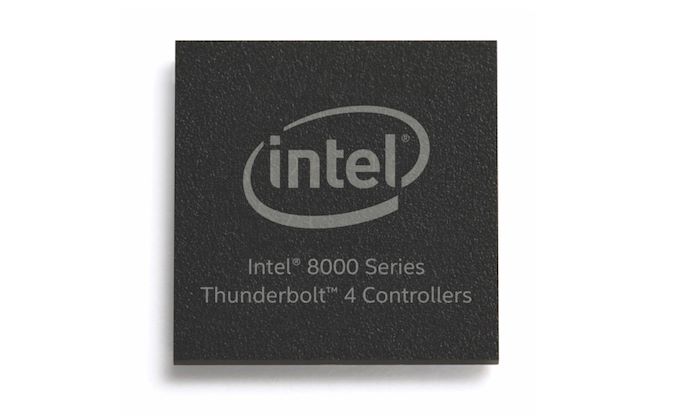
Intel's Maple Ridge (JHL8540) Thunderbolt 4 Controller Now Shipping

Following the launch of Thunderbolt 4 earlier this year as part of Intel’s Tiger Lake CPUs, the next piece of the TB4 hardware stack has dropped this week with the release of Intel’s first stand-alone Thunderbolt 4 controller, Maple Ridge (JHL8540). Previously announced back in July as part of Thunderbolt 4’s reveal, Intel this week updated their Ark database to add a product page for the Maple Ridge controller family and flag that the first part is now shipping. With the release of the discrete Thunderbolt 4 controller, it will now be possible for hardware vendors to build TB4 hosts with additional ports, or in devices not using Intel’s Tiger Lake Silicon.


This late-December launch follow’s Intel’s previous roadmap, which had the launch of standalone controllers set to take place before the end of 2020. These included the Goshen Ridge (JHL8440) device controller – for use in docks and peripherals, and the Maple Ridge (JHL8540 and JHL8340) host controllers – for use in computers, tablets, and other client devices. Goshen Ridge went into production soon after the announcement. And with the release of Maple Ridge Intel has also kept its promise here, getting it out just prior to the end of the year.


For quite some time, Thunderbolt ports were found only on systems with Intel processors. However, last year we saw vendors such as ASRock innovate with the introduction of a Thunderbolt 3 port on the X570 Phantom Gaming-ITX/TB3, an AMD Ryzen platform motherboard. This was followed a few months back by the introduction of M1-based Macs featuring Thunderbolt 3 (backed by Apple’s in-house controllers). The use of Maple Ridge will now enable motherboard vendors to create systems with Thunderbolt 4 ports that do not necessarily need to be based on Intel processors.


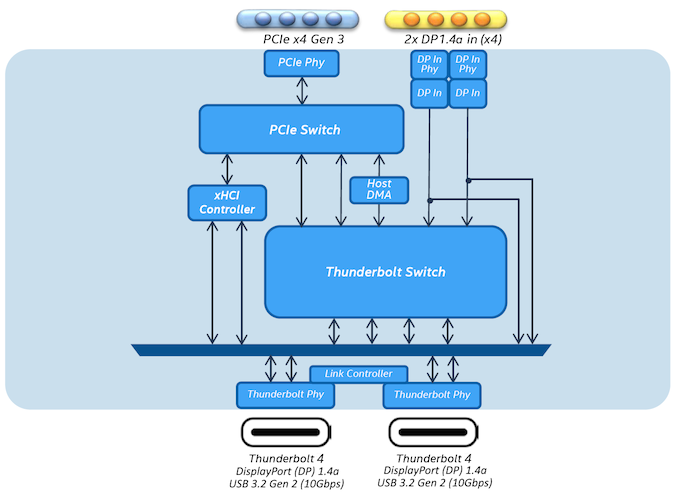
The JHL8540 Maple Ridge controller interfaces with the host processor using a PCIe 3.0 x4 link and also takes in two Display Port 1.4a inputs. On the downstream side, the controller enables two Thunderbolt 4 ports, which along with their native Thunderbolt (packet encapsulation) abilities can also be used as straight-up USB4 ports, or as DisplayPorts via USB-C’s DP alt mode.


The PCIe switch and, in general, the PCIe support in Maple Ridge has been updated to work with many optional features, keeping security in mind and the rich variety of PCIe devices coming into the market. For example, Maple Ridge includes PCIe peer-to-peer support which allows two PCIe devices connected to the two Thunderbolt 4 ports to exchange data with each other without having to make it travel upstream to the host RAM. From a security viewpoint, Access Control Services (ACS) is also supported to provide isolation between different sets of PCIe devices and make them always go through the IOMMU. Precision Time Measurement (PTM) is also a supported feature, allowing different downstream PCIe devices to accurately synchronize with each other and the host system.


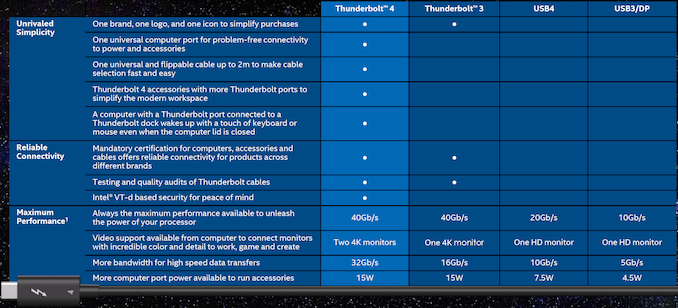
It must be noted that Thunderbolt 4 brings more guaranteed bandwidth to end-users. With Thunderbolt 3, device vendors could skimp on the connection of the controller to the host processor – using only a PCIe 3.0 x2 upstream link instead of PCIe 3.0 x4, but still obtain Thunderbolt 3 certification. This reduced the minimum available PCIe data bandwidth to just 16 Gbps. With Thunderbolt 4, that is no longer possible. Vendors are mandated to use a full PCIe 3.0 x4 link if they desire Thunderbolt 4 certification. Thunderbolt 3’s bandwidth sharing mechanism between video and data also put in some dampeners – even in the absence of tunneling DisplayPort streams, 18 Gbps of bandwidth was always reserved for video traffic, and only 22 Gbps available for actual data transfer. Thunderbolt 4 apparently fixes that with up to 32 Gbps of data traffic (full PCIe 3.0 x4 bandwidth) available, allowing devices such as Thunderbolt 4 SSDs to provide 3GBps+ speeds.


Intel has not published official pricing of the new Maple Ridge controller, however Mouser Electornics is listing the controllers for as cheap as $11.34 in bulk quantities. As for the availability of devices featuring the JHL8540, I suspect we’re going to see them sooner than later. Intel’s next-generation desktop platform, Rocket Lake-S, is not expected to have built-in support for Thunderbolt 4, as this feature was noticeably absent from Intel’s Rocket Lake reveal back in October. So adding Thunderbolt 4 to Rocket Lake-S will likely require using Maple Ridge.


This would consistent with other documentation from Intel, such as the Intel 500 series chipset guidelines, which apparently point to instructions to use a discrete USB4-compliant Intel Thunderbolt 4 controller connecting to four PCIe 3.0 lanes from the chipset for USB4/Thunderbolt 4 support. To that end, we expect that the development of actual hardware by Intel’s partners using the Maple Ridge controller should be well under way by now.


Source: AnandTech – Intel’s Maple Ridge (JHL8540) Thunderbolt 4 Controller Now Shipping

ECS LIVA Z3 Plus Review: Compact Comet Lake NUC Clone Cuts Corners

ECS is a well-known OEM in computing circles, known for building motherboards, computers, and industrial / embedded systems for other vendors. Some of their motherboards and small form-factor PCs are marketed under their own brand name – for example, their LIVA series of ultra-compact form-factor (UCFF) machines serves markets that are not directly addressed by the Intel NUCs. At the 2020 CES, the company introduced the LIVA Z3 Plus and LIVA Z3E UCFF machines based on the Comet Lake-U processors from Intel. The Z3 Plus has four variants, two based on Core i7 processors and one each based on the i5 and i3 SKUs. This review takes a look at the performance and value proposition of the pre-built Core i5-based LIVA Z3 Plus offering available in the North American market.


Source: AnandTech – ECS LIVA Z3 Plus Review: Compact Comet Lake NUC Clone Cuts Corners

Supermicro C9Z490-PGW Motherboard Review: Comet Lake with 32 CPU PCIe Lanes

More widely known for its server-grade models, Supermicro always launches a small number of consumer motherboards, sometimes with some extra flair and hardware we don’t see from the regular vendors. This time around, Supermicro’s top-tier C9Z490-PGW uses a PLX chip which enables the board to operate with dual PCIe 3.0 x16 or quadruple PCIe 3.0 x8 slots. This is combined with dual PCIe 3.0 x4 M.2 slots from the chipset, a 10 gigabit Ethernet controller, and a Wi-Fi 6 interface which makes the C9Z490-PGW versatile for a wide array of users. 


Source: AnandTech – Supermicro C9Z490-PGW Motherboard Review: Comet Lake with 32 CPU PCIe Lanes

Qualcomm Discloses Snapdragon 888 Benchmarks: Promising Performance

Today Qualcomm is disclosing a set of benchmark results for the new Snapdragon 888 SoC that’s set to power next year’s flagship Android devices. Usually, as years past, we would have had opportunities to benchmark Qualcomm’s reference designs ourselves during the chipset launch event, or a few weeks later during CES – however due to obvious circumstances this wasn’t possible this year.

As an alternative, Qualcomm is therefor sharing with the press a set of benchmark results on their new Snapdragon 888 reference design phone. Usually, the point of having the press benchmark the devices themselves is that it adds independent verification of the benchmark scores. This time around we’ll have to make a little leap of faith in the accuracy of Qualcomm’s numbers – of course we still pretty much expect the figures to be accurate and be reproduced in commercial devices.


Source: AnandTech – Qualcomm Discloses Snapdragon 888 Benchmarks: Promising Performance

Samsung Teases CES Announcement For Next Exynos SoC

Samsung this morning has dropped as brief teaser about their next-generation Exynos SoC. Dubbed “Exynos is back”, Samsung is revealing that there will be a proper announcement for the new SoC on January 12, which would fall on the first full day of CES.


Being that this is a teaser, any details are non-existent. But it’s worth noting that Samsung is promising “A whole new Exynos is coming”. Which hopefully is a sign that Samsung has spent the last couple of years hard at work on improving their future designs.


Although the most recent high-end Exynos designs (e.g. Exynos 990) have been decent, they’ve been overshadowed by rival Qualcomm’s designs – not to mention Apple’s own market-leading parts. The last few iterations of the chip have used Samsung’s own in-house CPU core design, which never worked out quite as well as Samsung was hoping for, both in overall performance and in keeping ahead of Arm’s own licensable designs.


Fittingly, Samsung has previously confirmed that they’ll be (back to) using Arm’s cores in future designs, particularly the the Cortex-X1, Arm’s big effort to double-down on overall CPU performance. So it’s pretty much guaranteed that Cortex-X1 will show up in Samsung’s next-gen SoC – especially if they want to compete with Qualcomm’s X1-equipped next-gen Snapdragon.


In any case, we’ll have more on the matter in a few weeks, when Samsung makes their announcement. So stay tuned.


Source: AnandTech – Samsung Teases CES Announcement For Next Exynos SoC

The Ampere Altra Review: 2x 80 Cores Arm Server Performance Monster

Earlier in the year we have a good look at the first ever Arm Neoverse-N1 CPU in the form s of the Graviton2 from Amazon. Whilst that chip was great – it wasn’t really a true competitor in the market as it was availably only to Amazon’s cloud business.

Today’s release of the new Ampere Computing Altra processors is bound to change that. The Altra is aiming for nothing less than top performance, going all in against AMD and Intel. 80 Neoverse-N1 cores at 3.3GHz and 250W, 8x DDR4-3200, 128 PCIe 4.0 lanes for I/O – the new Altra Q80-33 is the best the Arm world has ever seen, and we’ve put the new chip through its paces.


Source: AnandTech – The Ampere Altra Review: 2x 80 Cores Arm Server Performance Monster

The MSI Prestige 14 Evo Review: Testing The Waters Of Tiger Lake

MSI is very well-known for their gaming products for the PC market, from motherboards, accessories, and right up to gaming laptops and desktops. The company was one of the first to focus almost exclusively on their gaming lineup, and that focus has made them very successful in that market. In the laptop space, MSI’s gaming lineup are some of the best systems around, even if they do often come with a price premium. But, while the gaming market has been strong even throughout some PC sales slowdowns, MSI is again dipping their toes in a wider market. The MSI Prestige series of laptops abstain from the gaming nomenclature, design, and marketing. The Prestige series targets a much more traditional Ultrabook buyer, with a thin, light design, quality materials, and less RGB.


The MSI Prestige 14 Evo, as the name suggests, is a 14-inch laptop which offers the modern design touches of an aluminum chassis, with thin display bezels, packing plenty of notebook into a smaller footprint. The 16 mm thick design weighs in at just 1.29 Kg, or 2.84 lbs, making it very portable for a 14-inch device.


Source: AnandTech – The MSI Prestige 14 Evo Review: Testing The Waters Of Tiger Lake

NVIDIA Schedules GeForce CES Presentation for January 12th

Even though the 2021 edition of CES will be an entirely virtual affair due to the ongoing coronoavirus pandemic, a number of major companies have still been lining up to schedule presentations as part or around the event. This has included Intel, AMD, and now NVIDIA, who today is announcing an event for January 12th.


Dubbed “GeForce RTX: Game On”, the broadcasted event will be presented by Jeff Fisher, NVIDIA’s Senior VP for GeForce. NVIDIA has set aside an hour for their CES-adjacent presentation, which will kick off at 9am Pacific on January 12th, 2021.


Today’s reveal is little more than a hold the date teaser, with NVIDIA promising to “unveil the latest innovations in gaming and graphics.” And while the company isn’t offering any more details than that, observationally we’ve seen that over the last several years NVIDIA has frequently used CES to announce new products and technologies. This goes particularly for laptop products, as CES has increasingly transformed into a laptop showcase for the PC OEMs. Fittingly, as NVIDIA continues its Ampere GPU release cadence with smaller and less power-hungry parts, the next chip expected to be released (GA106?) should be a good candidate for use in laptops.


One way or another, we’ll find out for sure next month with NVIDIA’s presentation. So stay tuned.


Source: AnandTech – NVIDIA Schedules GeForce CES Presentation for January 12th

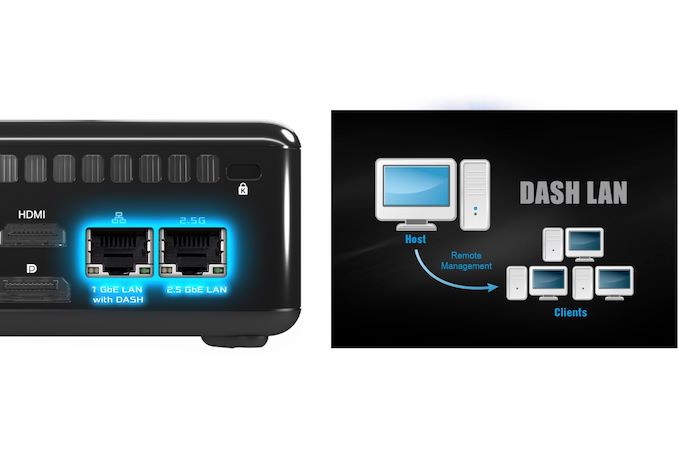
Hands On: ASRock 4X4 BOX-4800U Out-of-Band Management using Realtek DASH

Many computing use-cases require out-of-band management. For example, rack-mounted servers have dedicated LAN ports that connect to a baseboard management controller (BMC) chip for this purpose. PCs used in SMBs / SMEs and business applications do not accommodate a dedicated LAN port for this functionality. Instead, one of the in-band NICs (i.e, one used to provide the primary networking functionality of the system) helps in this aspect.

The DMTF (formerly, Distributed Management Task Force) is a standards organization that focuses, among other things, on a standards-based approach to out-of-band management of computing systems. The Intelligent Platform Management Interface (IPMI) is used in servers based on both Intel and AMD processors, though the focus has shifted to DMTF Redfish for this functionality now.

On the PC side, Intel and AMD have different approaches – Intel’s vPro has gained widespread recognition as a qualifier for systems supporting out-of-band management and inventory-taking in business environments. AMD, on the other hand, has gone in for a more standards-compliant approach using DMTF’s DASH (Desktop and mobile Architecture for System Hardware). The two vendors have been trading the usual marketing blows – AMD’s white-paper denounces vPro as proprietary and tending to make users pay more for features they don’t need. On the other hand, an Intel-commissioned comparison report goes on the offensive by claiming vPro to just be a set of proprietary extensions over standards-compliant infrastructure, and that the TCO turns out to be better for vPro.

The purpose of this piece is not to compare vPro and DASH – readers would be better off reading the two documents linked above and make a decision on which of the two would fit a given use-case. Instead, we take a look at how users can take advantage of the DASH capabilities in the recently-reviewed ASRock Industrial 4X4 BOX-4800U.


Source: AnandTech – Hands On: ASRock 4X4 BOX-4800U Out-of-Band Management using Realtek DASH

Testing The World’s Best APUs: Desktop AMD Ryzen 4750G, 4650G and 4350G

There are two very important levels of graphics performance in modern systems to consider – one is if the graphics system is sufficient for seamless use, and the second is such that it meets a substantial standard for gaming. On one side we use integrated graphics, which take advantage of a unified processor to simplify the system, and on the other we look to a range of options, such as smartphones, consoles, and discrete graphics options. Somewhere in there we have a middle ground – can an integrated option have enough thermal headroom and graphics power to worthwhile for gaming? This is the pitch of AMD’s Ryzen 4000 based APUs, which combine Zen 2 CPU cores with fast Vega 8 graphics. With a 65W headroom, it should surpass anything that mobile processors have to offer, but is it enough to replace the low-end discrete graphics market?


Source: AnandTech – Testing The World’s Best APUs: Desktop AMD Ryzen 4750G, 4650G and 4350G

Intel Announces New Wave of Optane and 3D NAND SSDs

Today Intel is announcing updates to most of their SSD product lines. Their products based on 3D NAND are being updated to use Intel’s 144-layer QLC and TLC NAND. On the Optane side of the business, we have detailed specifications for the first product to use second-generation 3D XPoint memory, and an updated Optane Memory caching solution for client PCs. Intel has also revealed the code name for their third-generation Optane persistent memory modules, which will be launching along Sapphire Rapids Xeon processors.


  • SSD D7-P5510 – Datacenter NVMe, 144L TLC
  • SSD D5-P5316 – Datacenter NVMe, 144L QLC
  • SSD 670p – Client/Consumer NVMe, 144L QLC
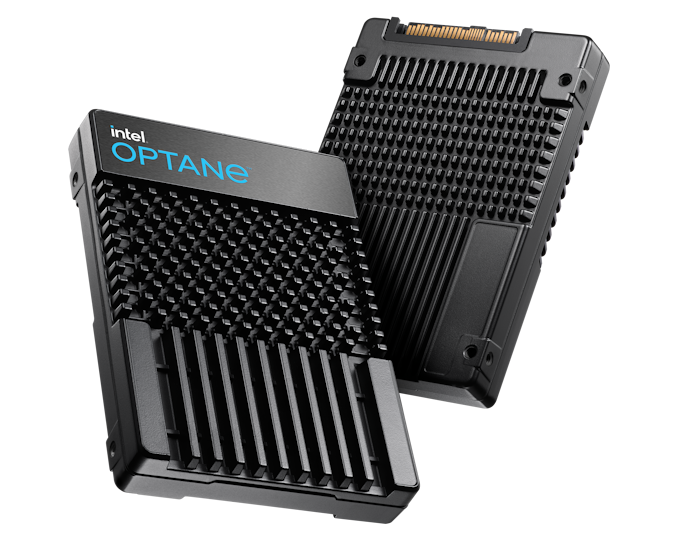
  • Optane SSD P5800X – Datacenter NVMe, Second-gen 3D XPoint
  • Optane Memory H20 – Client NVMe, 144L QLC + 3D XPoint
  • Optane Persistent Memory 300 Series: Crow Pass – 3D XPoint DIMMs

Some of these products have already started shipping and are officially launching this month, while others are merely being announced today and will be launching in 2021, with full specifications and pricing disclosed closer to launch.
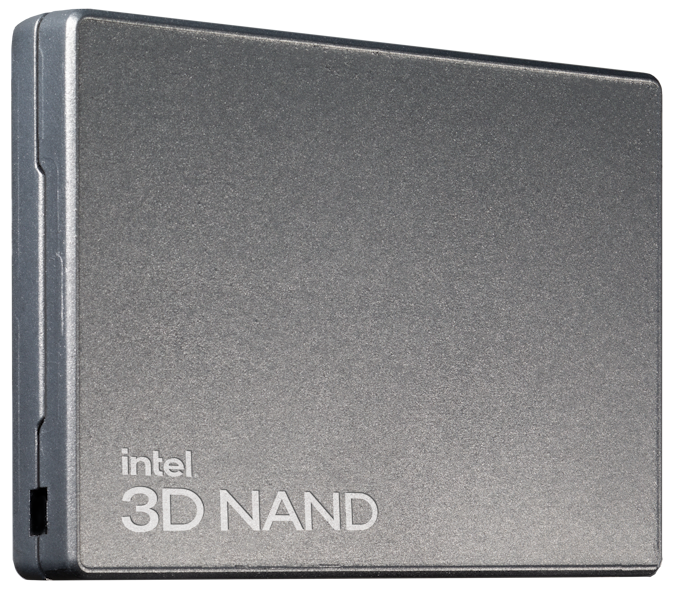


144L 3D NAND For Datacenter SSDs


The first two SSD announcements are updates to Intel’s datacenter SSDs using 3D NAND. The new D7-P5510 uses 144L 3D TLC NAND and is the successor to the D7-P5500 which uses 96L TLC. Since the P5500 was an OEM-only product rather than widely distributed through the channel, the P5510 will also serve as the successor to the P4510 for the portion of the customer base. Intel has not announced a 144L replacement for the D7-P5600, the higher-overprovisioning counterpart to the P5500.
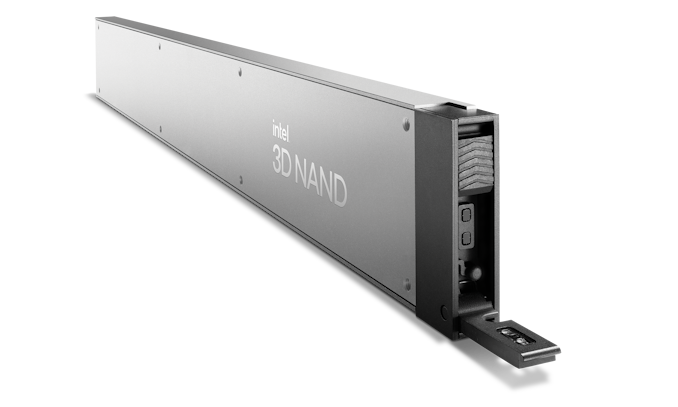


Using Intel’s 144L QLC NAND is the new D5-P5316 SSDs in 15.36 TB and 30.72 TB capacities in either U.2 or E1.L form factors. The E1.L version allows Intel to achieve the original goal of the “Ruler” form factor by enabling 1PB of storage in a 1U server. Since the P5316 is replacing the older P4326 (64L QLC and PCIe gen3), it’s a much more substantial upgrade over its predecessor than the TLC-based P5510 is. Aside from the introduction of Intel’s third-generation enterprise NVMe SSD controller to their QLC product line, the most important change the P5316 brings is a major shift in how the Flash Translation Layer works. The P5316 enables a 16x reduction in DRAM by changing the SSD’s Flash Translation Layer to work with a granularity of 64kB rather than 4kB. We’ve seen a few other enterprise SSDs make this kind of change, such as Western Digital’s Ultrastar DC SN340, which uses a 32kB FTL granularity. The DRAM savings of a more coarse-grained FTL help make high-capacity SSDs more affordable, but at the expense of severely harming performance and increasing write amplification for small block size random writes. The general trend in the industry is to adopt NVMe Zoned Namespaces for such drives, preventing random writes entirely rather than relying on host software to be careful about issuing small-block IOs. However, Intel doesn’t seem to be ready to adopt this approach yet.


Both the TLC-based P5510 and QLC-based P5316 use the same controller platform as Intel’s other P5000-series SSDs announced earlier this year. Those drives introduced Intel’s third-generation enterprise NVMe SSD controller, their first supporting PCIe 4.0. The new 144L drives don’t really push performance or feature set any further, but will be more widely available and should be cheaper than the 96L drives. The TLC-based P5510 has already been sampled to customers for qualification and will be shipping for revenue by the end of this year. The QLC-based P5316 is sampling and will be available in the first half of 2021.


SSD 670p: 144L QLC For Consumers


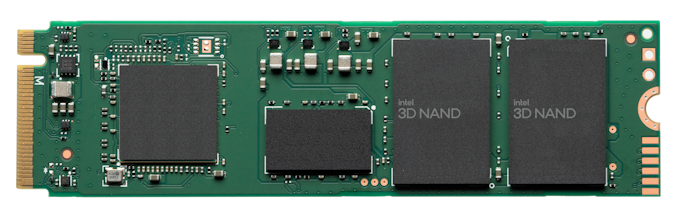
Moving on to the consumer SSD business, Intel will be introducing the 670p QLC NVMe SSD in the first quarter of 2021. This follows in the footsteps of the 660p and 665p with another update to newer 3D QLC NAND, and also brings a SSD controller update to this product line. However, it is still only a PCIe gen3 product. Intel will be reintroducing the 512GB capacity that was missing from the 665p, but they are not yet adding capacities beyond 2TB. Detailed performance specs and pricing will be shared closer to the 670p’s launch.


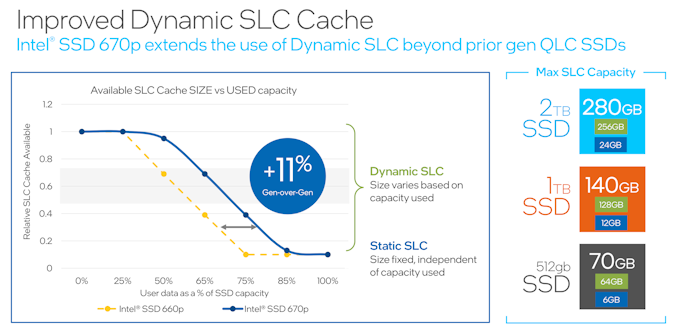
Intel is making an adjustment to the dynamically-sized SLC caching behavior with the new 670p. While the maximum and minimum SLC cache sizes are not changing, Intel has managed to improve the cache size that will be available for a partially-filled drive: A half-full 670p will still have almost the maximum SLC cache size available, and the minimum cache size will not be reached until the drive is over 85% full. This probably won’t change anything for simple benchmarks that write continuously until the cache runs out and performance drops, but it will help real-world usage where writes come in bursts.


Optane SSD P5800X: Alder Stream Arrives


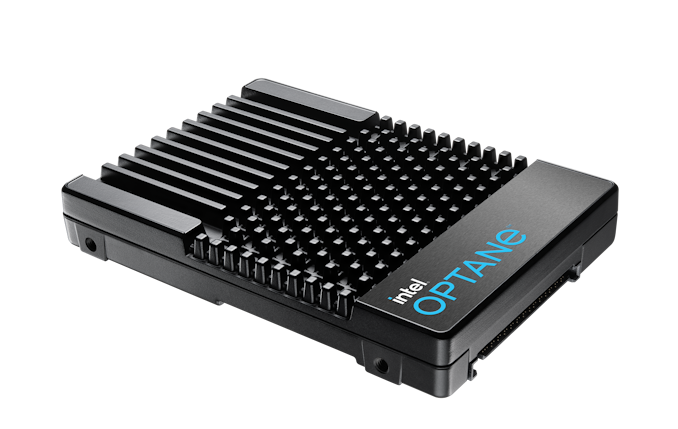
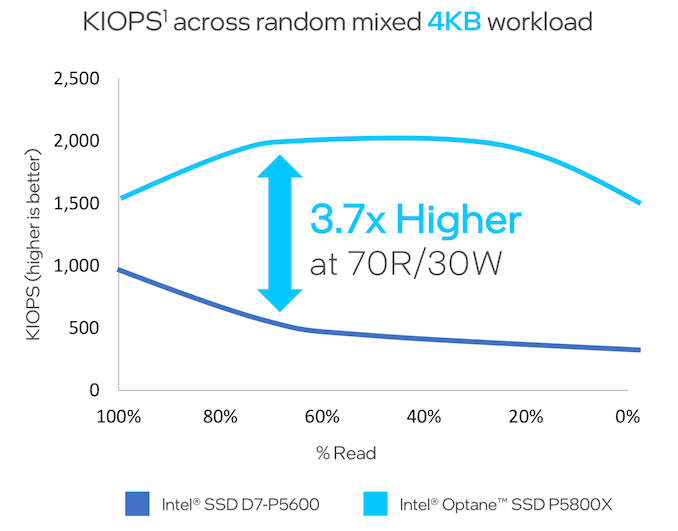
Intel’s long-awaited second-generation Optane enterprise SSD, codenamed Alder Stream, is finally shipping as the P5800X. This is the first product to use second-generation 3D XPoint memory, and it also features an updated controller to support PCIe 4.0. The P5800X pushes the limits of the performance available from a PCIe 4.0 x4 interface with sequential reads, random reads and random writes all supported at more or less line speed, and sequential writes only a bit slower at 6.2 GB/s. And while 1.5M IOPS for either random reads or random writes is already very impressive, the P5800X can even hit 1.8M IOPS on a 70/30 mix—only possible because PCIe is a full-duplex interface. Intel has also made optimizations for single-sector 512-byte random reads, which can hit 4.6M IOPS. (Flash-based SSDs are usually not able to offer any higher IOPS for 512B reads than 4kB reads, and many actually have substantially lower performance for small block IO.)


The first-generation Optane DC P4800X launched with a 30 DWPD write endurance rating, later increased to 60 DWPD. The new P5800X further increases write endurance to 100 DWPD. Capacities will range from 400GB to 3.2TB.
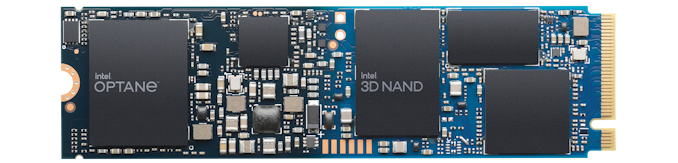


Optane Memory H20


The client/consumer focused portion of Intel’s Optane product family has shrunk considerably. They’re no longer doing Optane M.2 SSDs for use as primary storage or cache drives, and there’s been no mention yet of an enthusiast-oriented derivative of the P5800X to replace the Optane SSD 900P and 905P (though if Intel plans such a product, they are unlikely to announce it until they have delivered a desktop platform supporting PCIe 4.0). The only client Optane product Intel has been talking about lately is the Optane Memory H10 hybrid drive consisting of a QLC NVMe SSD and an Optane SSD on the same M.2 card. A successor is now on the way: the Optane Memory H20 is planned for Q2 2021, incorporating updates on the QLC side that likely mirror the 670p’s updates, and a new controller on the Optane half of the drive. The H20 will still be a PCIe gen3 solution, so we will probably continue to see performance of the NAND side constrained by only having access to two of the four PCIe lanes. Intel is also bumping up the platform requirements: an 11th-generation Core U-series mobile processor and 500-series chipset, and Intel RST driver version 18.1 or later. When the H10 launched, Intel had laid the groundwork for support on their desktop platforms, but this effort was dropped when the H10 became an OEM-only product. The H20 is a mobile-focused OEM-only part from the outset, so the platform compatibility requirements aren’t as much of an issue as they would be for a retail SSD.


The Optane Memory H20 will be available with 512GB or 1TB of QLC NAND flash memory, each paired with 32GB of 3D XPoint memory.


Optane Persistent Memory 300 Series: Crow Pass


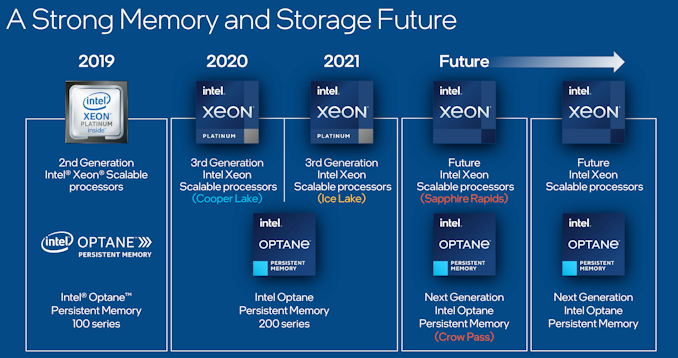
Intel’s Optane Persistent Memory products (3D XPoint in a DIMM form factor) are currently on the second generation 200 series Barlow Pass supported by Cooper Lake and upcoming Ice Lake Xeon platforms. The 200 series Optane Persistent Memory modules still use first-generation 3D XPoint memory. Intel has now disclosed that the next generation on the roadmap is codenamed Crow Pass, which will likely be branded as the 300 series. The Crow Pass modules will be launched for use with Intel’s Sapphire Rapids Xeon processors. Those are expected to use DDR5 memory, so Crow Pass will be a major update to the interface for Optane Persistent Memory. Crow Pass should also bring second-generation 3D XPoint memory to the DIMM form factor, so altogether this is likely to be a much more significant update than the relatively minor improvements brought by the 200 series.


Related Reading


Source: AnandTech – Intel Announces New Wave of Optane and 3D NAND SSDs

NVIDIA Extends GeForce RTX 3090 and 3080 Call of Duty Bundle to January

For the lucky few who can get their hands on a GeForce RTX 3090 or 3080 card during a very competitive holiday shopping season, NVIDIA has opted to sweeten the pot by extending their Call of Duty: Black Ops Cold War game bundle. Previously scheduled to end on December 10th, the bundle has now been extended to January 11th.


NVIDIA has offered Call of Duty bundles a few times in the past, so including this year’s game is quickly becoming a regular tradition for the company. One of the biggest games on the market every year, NVIDIA and its developer relations team have worked with developer Treyarch to implement several technologies, including ray tracing support, NVIDIA’s DLSS, and NVIDIA’s new Reflex latency-reduction tech. So as with a lot of NVIDIA’s RTX series game bundles, it’s designed to show off the capabilities of the hardware as much as it is extra kicker to add to the value of NVIDIA’s cards.


NVIDIA Current Game Bundles

(December 2020)
Video Card

(incl. systems and OEMs)
Bundle
GeForce RTX 3090 Call of Duty: Black Ops Cold War
GeForce RTX 3080 Call of Duty: Black Ops Cold War
GeForce RTX 3070 None
GeForce RTX 3060 Ti None
GeForce RTX 20 Series (All) None
GeForce GTX 16 Series (All) None

NVIDIA is including the standard edition of Call of Duty with the top two cards of their RTX 30-series lineup, the RTX 3080 and RTX 3090, as well as new desktop systems that include those cards. Which at face value is a bit surprising; though game bundles with high-end cards aren’t unusual, RTX 30 series card sales are going so well that NVIDIA hardly needs to include extra swag to sell their cards. With that said, AMD’s recently-launched Radeon RX 6000 series cards are now putting up a stiff fight for the high-end market – and even if they’re in equally short supply, any sale that goes to AMD is a sale that doesn’t go to NVIDIA. So perhaps it’s best for NVIDIA not to rest on their laurels at this time.


At any rate, this is NVIDIA’s only game bundle for the moment. The company is not running the Call of Duty bundle for the recently-launched RTX 3070 or RTX 3060 Ti, nor are they including any games with their previous-generation RTX 20-series or GTX 16-series cards.


As always, codes must be redeemed via the GeForce Experience application on a system with a qualifying graphics card installed. The Call of Duty bundle runs from today through January 11th, and more information and details can be found in the terms and conditions. Be sure to verify the participation of any vendors purchased from, as NVIDIA will not give codes for purchases made from non-participating sellers.


Source: AnandTech – NVIDIA Extends GeForce RTX 3090 and 3080 Call of Duty Bundle to January

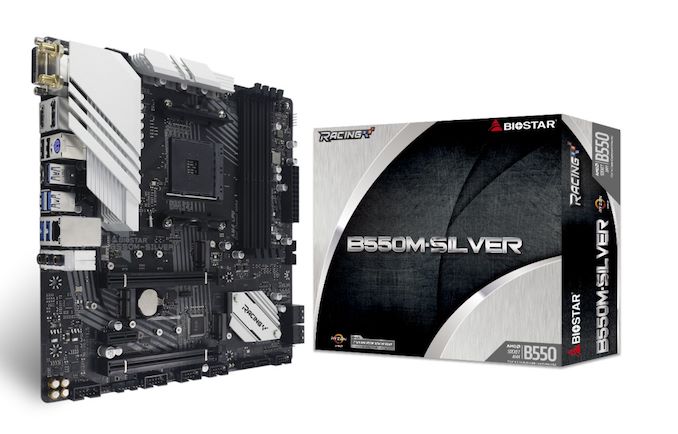
Biostar Launches B550M-Silver: Micro-ATX with 2.5 GbE and Wi-Fi 6

Biostar has launched its latest AMD B550-based board, the B550M-Silver. Aimed at gamers looking to use AMD’s latest Ryzen 5000 processors, it brings a host of premium features to the micro-ATX form factor with USB 3.2 G2 connectivity, a Realtek 2.5 Gb Ethernet controller, Wi-Fi 6, and PCIe 4.0 support. 


Over the last couple of years, premium AMD micro-ATX boards have been few and far between, with the majority of vendors opting to release their micro-ATX models on the more budget-friendly chipsets such as AMD’s A520. The micro-ATX form factor typically offers a convenient compromise, with more expansion slot support than the smaller mini-ITX form factor, but without the overall footprint of ATX. Based on the AMD B550 chipset, the Biostar B550M-Silver offers out of the box support for Ryzen 5000 processors, with support for Ryzen 3000 chips too.


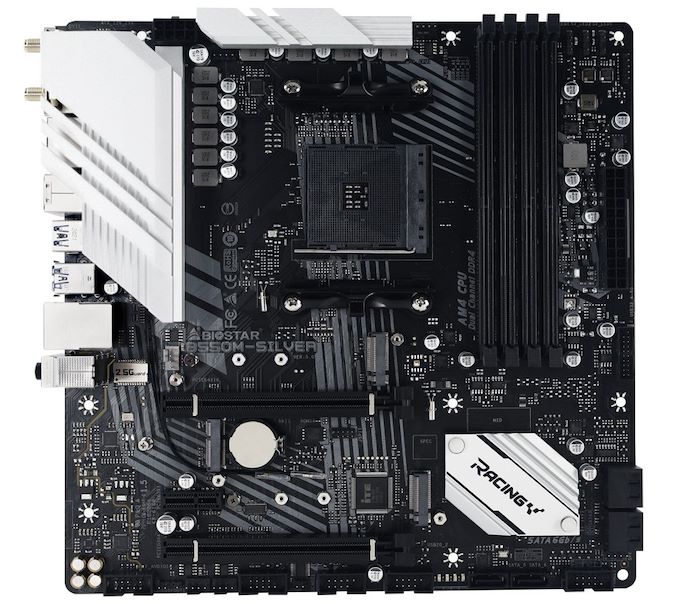
Focusing on the design, the Biostar B550M-Silver uses a wave of silver heatsinks, including a large rear panel cover, which doubles up as one section of the power delivery heatsink. It includes no integrated RGB LED lighting nor any RGB headers, which is either quite strange or a welcome relief given how common RGB is these days in boards aimed at gamers.


The Biostar B550M-Silver includes dual PCIe M.2 slots, with the top slot capable of supporting up to PCIe 4.0 x4 2280 M.2 drives, while the second slot includes support for PCIe 3.0 x4; both of these slots can accommodate SATA based SSDs. For SATA, Biostar includes six SATA ports, with two straight-angled and four right-angled ports, with support for RAID 0, 1, 10 arrays. There are four memory slots with support for DDR4-4933, with a maximum capacity of up to 128 GB. 


There are two full-length slots at PCIe support, including a PCIe 4.0 x16 and a PCIe 3.0 x4 slot, with a PCIe 3.0 x1 slot sandwiched in between. Located under the full-length PCIe 4.0 x16 slot is a Key-E 2230 slot, although the board already includes an integrated wireless module.


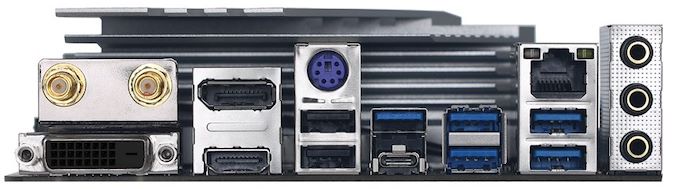
On the rear panel is a variety of connections, including a single USB 3.2 G2 Type-A, one USB 3.2 G2 Type-C, four USB 3.2 G1 Type-A, and two USB 2.0 ports. There is a trio of video outputs including an HDMI, DisplayPort, and DVI-D for use with AMD’s 3rd gen APUs, while the board’s three 3.5 mm audio jacks are powered by an older Realtek ALC1150 HD audio codec. A PS/2 keyboard and mouse combo port sits above the USB 2.0 ports, while a single RJ45 port is powered by a Realtek RTL8125B 2.5 GbE controller, while Biostar is using an unspecified wireless interface with support for Wi-Fi 6. 


At present, we don’t know when the Biostar B550M-Silver will hit retail shelves, nor do we have information in regards to the pricing.


Related Reading


Source: AnandTech – Biostar Launches B550M-Silver: Micro-ATX with 2.5 GbE and Wi-Fi 6

Sabrent Rocket XTRM-Q USB / Thunderbolt 3 Dual Mode External SSD Review: Yin and Yang

The external storage market has shown renewed vigor in recent years, thanks in part to growth fueled by bus-powered flash-based storage solutions. The introduction of 3D NAND, coupled with the increasing confidence of manufacturers in QLC (4-bits per cell) has brought down the cost of these drives to the point where even a reasonably spacious external SSD can be had for an equally reasonable price. And though this means that NAND manufacturers like Western Digital, Samsung, and Crucial/Micron have an inherent advantage in terms of vertical integration, the availability of cheap flash in the open market has also enabled other vendors to come up with innovative solutions.


Today, we’re looking at a unique product in the external SSD market – the Sabrent Rocket XTRM-Q. A true dual-mode Thunderbolt 3/USB drive, the Rocket XTRM-Q can be natively used with both Thunderbolt 3 and USB hosts. This means that it can deliver speeds over 2GBps on a Thunderbolt 3 connection, or fall back to USB mode and still deliver 1GBps or more with a USB 3.2 Gen 2 connection. Compared to most external SSDs on the market, which are virtually always USB-only or Thunderbolt-only, this allows Sabrent’s drive to offer USB-style universal compatibility while still making the most of the host it’s connected to, using USB when it’s available, or upgrading to Thunderbolt as appropriate to let the drive run as fast as it can.


Meanwhile, not unlike their efforts with internal (M.2) products, Sabrent is also at the leading-edge of storage capacity with the Rocket XTRM-Q, offering versions of the drive with up to 8TB of storage. Overall, the Rocket XTRM-Q is available in capacities ranging from 500GB up to 8TB, with Sabrent using QLC NAND across the family to hit their price and capacity goals.


For this review we’re looking at two of the mid-tier Rocket XTRM-Q models – the 2TB and 4TB models – in order to size up the performance of the drives and see how they stack up against the other products in the market.


Source: AnandTech – Sabrent Rocket XTRM-Q USB / Thunderbolt 3 Dual Mode External SSD Review: Yin and Yang

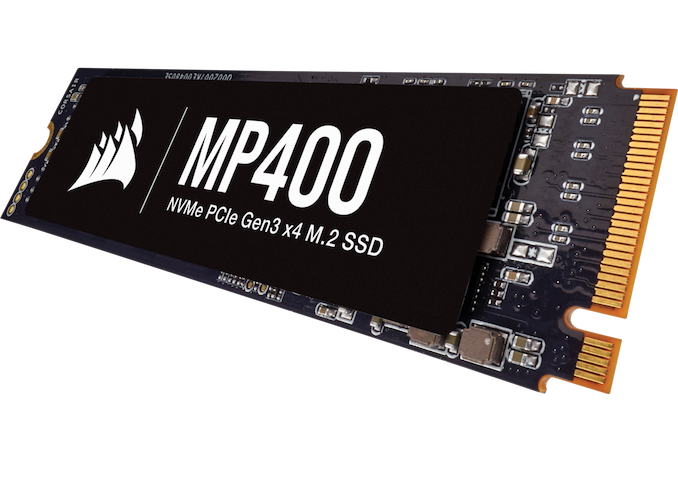
The Corsair MP400 1TB QLC NVMe SSD: A Quick Review

Following up from our recent look at 8TB QLC SSDs, today we’re taking a look at the 1TB Corsair MP400. This is a QLC NVMe SSD using the Phison E12 controller, which puts it a step up from earlier QLC SSDs that used four-channel Silicon Motion controllers. However, at the more affordable 1TB capacity point, the downsides of QLC NAND are more pronounced, and there is much more competition from budget TLC drives that make very different tradeoffs.


Source: AnandTech – The Corsair MP400 1TB QLC NVMe SSD: A Quick Review

Supermicro X12SAE W480 Motherboard Review: For Xeon W-1200 Workstations

We have seen numerous Intel Z490 motherboards over the months since Intel’s platform for Comet Lake was announced back in April. While the Z490 is designed for regular consumers and gamers who intend to use the desktop Intel Core i5/i7/i9 processors, Intel also launched its W480 chipset slightly later which is designed for its workstation orientated Xeon W-1200 series. One such board designed specifically for the Xeon W-1200 processors is the Supermicro X12SAE with support for up to 128 GB of DDR4-2933 of ECC and non-ECC UDIMMs. Also included in the feature set are two PCIe 3.0 x4 M.2 slots, dual Ethernet including a 2.5 Gigabit controller, as well as a dedicated Intel PHY with Intel AMT and vPro support. 


Source: AnandTech – Supermicro X12SAE W480 Motherboard Review: For Xeon W-1200 Workstations

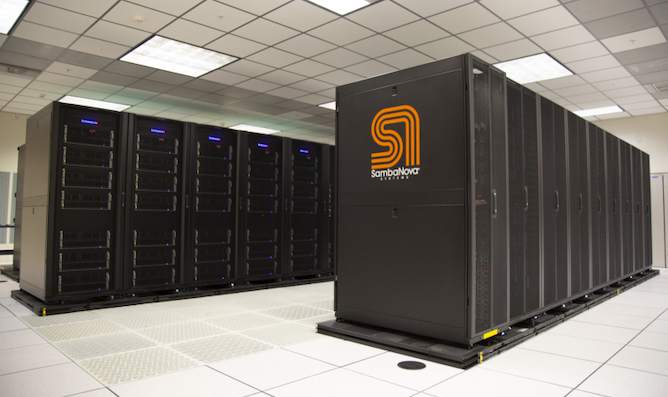
SambaNova Breaks Cover: $450M AI Startup with 8-Socket AI Training Solutions (and more)

Users that follow the AI silicon space will have heard of SambaNova – a quiet company that has made very little noise but has racked up some serious backing. After three funding rounds, led by Google Ventures, Intel Capital, and Blackrock, and semi-hushhush deployments at the US Department of Energy at Laurence Livermore and Los Alamos, there is now a new product offering for limited customers. SambaNova is already making money, and the company is finally ready to break the crust on its very delicate crème brûlée and start talking about its new DataScale SN10-8R (catchy name) systems, built with its new Cardinal AI Processor.


Source: AnandTech – SambaNova Breaks Cover: 0M AI Startup with 8-Socket AI Training Solutions (and more)

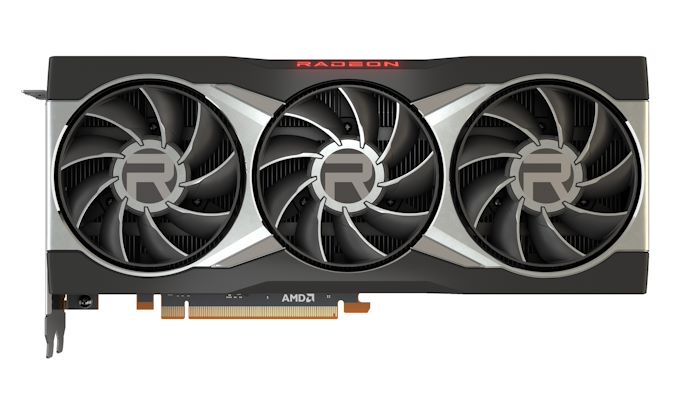
Launching Today: AMD's Radeon RX 6900 XT – A Whole Lot of Radeon for $1000

This morning AMD is releasing the final and most elusive member of their initial wave of Radeon RX 6000 series cards: the Radeon RX 6900 XT. The flagship part for AMD’s new RDNA 2 GPU architecture, the 6900 XT is all the Radeon AMD could muster for this generation, and perhaps a bit more. Marking how far AMD has come in a single generation, the RX 6900 XT is their first real shot at the very top of the market in years; and while AMD doesn’t quite reach that goal, they have still succeeded at putting together an interesting and powerful video card for the $1000 market.


Source: AnandTech – Launching Today: AMD’s Radeon RX 6900 XT – A Whole Lot of Radeon for 00

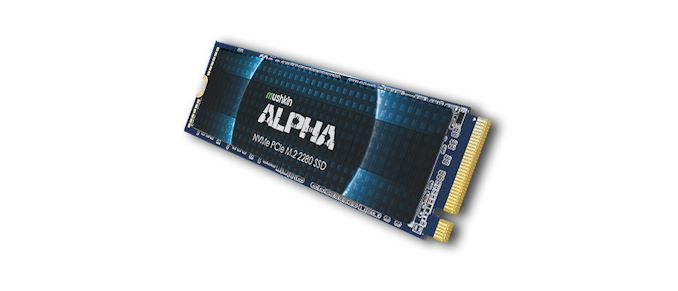
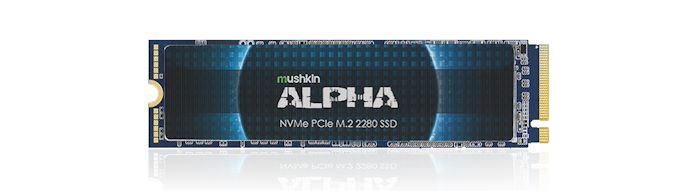
Mushkin Announces 8TB M.2 SSD: ALPHA Series

Anyone in the market for high capacity 8 TB M.2 drives has so far only had one choice on the market. Today Mushkin is coming in as the second vendor to offer an 8TB M.2 NVMe option, with its new ALPHA series of drives. These drives use the same Phison E12S controller and high capacity NAND as those also available on the market, but Mushkin rates its drives slightly differently to the competition.


One of the ways the storage market has amazed me in the last few years is capacity. While physical rotating spinning rust is at 16 TB  or 18 TB and perhaps approaching 24 TB next year, we’ve seen storage drives in similar form factors reach 64 TB and 100 TB without too much trouble. The enterprise is where we see some of those crazy SSD capacities using TLC and QLC, hence the existence of NimbusData and competitors, but the nous that goes into these products trickles down into the prosumer space, where there is demand but at a more palatable cost/GB ratio.


The question is always one of control and cost, and NAND is still more expensive than rotating iron oxides. Consumer grade NVMe SSDs are hovering around the $100/TB mark, depending on the brand, performance, and if it’s in a sale, making high-speed storage a very attractive offer. For the high-capacity prosumer NVMe options, we’ve historically seen this come down as well, from $1000/TB to $500/TB, and now with these new 8 TB drives, we are solidly looking at below the $200/TB mark. This new Mushkin Alpha 8 TB is going to be available for $1300, which puts it at $162.50 per TB.


Here Mushkin is pairing the Phison E12 controller with QLC NAND, and the PCIe 3.0 x4 interface should allow maximum sequential speeds of 3300 MB/s read and 2800 MB/s write, or up to 550K IOPs read and 680K IOPs write. The fact that this is all within the standard M.2 2280 form factor to me is still amazing, whether it’s from Mushkin or anyone else.


Mushkin ALPHA Series
AnandTech 4TB 8TB
Form Factor M.2 2280 Double Sided PCIe 3.0 x4
Controller Phison E12S
NAND Flash Micron 1TB 96L 3D QLC ?
Sequential Read/Write (MB/s) 3200 / 3000 3300 / 2800
Random 4K IOPs Read/Write (MB/s) 550K / 640K 550K / 680K
Power Consumpton Idle/Max (W) 0.3 / 6.5 0.3 / 6.5
Warranty 3-year Limited Warranty
Write Endurance 900 TB

0.2 DWPD
900 TB

0.1 DWPD
Retail Price $650

16.3¢ per GB
$1300

16.3¢ per GB

The drive has a 3 year limited warranty, and is rated to 900 TB written, which equates to 0.1 drive writes per day, or 800 GB of writes per day in that timeframe. For those working with 4K video, this is probably not enough, but for business users that need a high capacity drive for their laptop or mobile workstation, it should fit the bill. Mushkin rates the drive at 0.3 W at idle and 6.5 W max. It is worth noting that the 900 TB rating is half of what Sabrent rates its 8TB drive for. This rating is only for the warranty period cover – the drive will still work after these numbers, but it just won’t be replaced by the manufacturer.


The 8 TB drive (and 4 TB variant) will go on sale near the end of January in the US, but the listings are already up on Amazon, with stock expected on January 23rd.


Source: Mushkin


Related Reading


Source: AnandTech – Mushkin Announces 8TB M.2 SSD: ALPHA Series