Lenovo CES 2021 ThinkPad X1 Lineup: New Designs, New Displays for Flagship Laptops

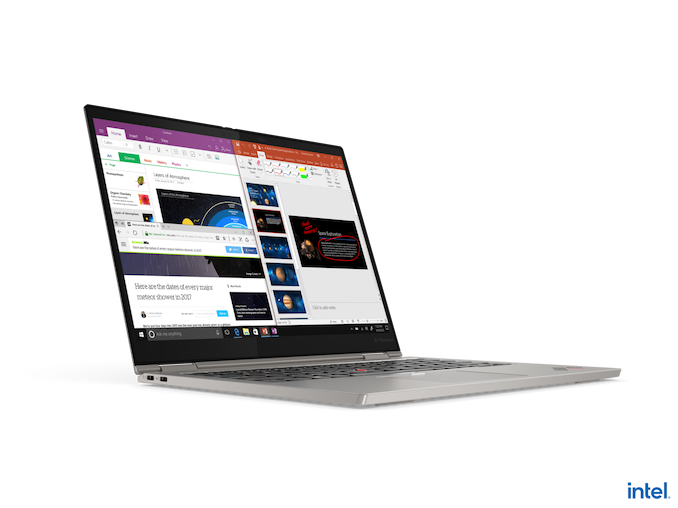
Today at CES, Lenovo is announcing updates to some of their most popular laptops in the ThinkPad X1 series. Lenovo is refreshing not just with the standard new CPUs, but also is following the industry trend of taller aspect ratio displays. The newest model to the lineup is the ThinkPad X1 Titanium Yoga, featuring a 3:2 aspect, and the ThinkPad X1 Carbon Gen 9 and ThinkPad X1 Yoga Gen 6 are both getting 16:10 displays.  Finally, there is a new ThinkPad X12 Detachable 12.3-inch convertible tablet.


Lenovo ThinkPad X1 Lineup
  ThinkPad X1 Titanium Yoga ThinkPad X1 Carbon ThinkPad X1 Yoga ThinkPad X12 Detachable
CPU 11th Gen Intel Core

Up to i7 with vPro
GPU Up to Intel Iris Xe
Display 13.5-inch 3:2 IPS

2256 x 1504

450 nit 100% sRGB
14-inch 16:10 IPS

1920×1200 sRGB

Optional UHD 100% P3 HDR400
14-inch 16:10 IPS

1920×1200 sRGB

Optional UHD 100% P3 HDR400
12.3-inch 3:2 IPS

FHD+ 400 nit
RAM Up to 16 GB LPDDR4x Up to 32 GB LPDDR4-4267 Up to 32 GB LPDDR4-4267 Up to 16 GB LPDDR4x
Storage Up to 1 TB PCIe 3.0 Up to 2 TB PCIe 4.0 Up to 2 TB PCIe 4.0 Up to 1 TB PCIe 3.0
Networking Wi-Fi 6

Optional LTE

Optional 5G
Wi-Fi 6

Optional LTE

Optional 5G
Wi-Fi 6

Optional LTE

Optional 5G
Wi-Fi 6

Optional LTE
I/O 1 x Thunderbolt 4

1 x USB 3.2 Type-C

1 x Nano SIM

1 x Headset
2 x Thunderbolt 4

2 x USB 3.2 Type-A

1 x HDMI 2.0

1 x Nano SIM

1 x Headset
2 x Thunderbolt 4

2 x USB 3.2 Type-A

1 x HDMI 2.0

1 x Nano SIM

1 x Headset
1 x Thunderbolt 4

1 x USB 3.2 Type-C

1 x Nano SIM

1 x Headset
Dimensions 297 x 233 x 11.5 mm

11.71 x 9.14 x 0.45 inches
314 x 222 x 14.9 mm

12.38 x 8.72 x 0.59 inches
314 x 223 x 14.9 mm

12.38 x 8.77 x 0.59 inches
283 x 203 x 8.8 mm

11.15 x 8.01 x 0.35 inches
Weight 1.15 kg / 2.54 lbs 1.13 kg / 2.49 lbs 1.39 kg / 3 lbs 760 g / 1.67 lbs
Price $1899 USD $1429 USD $1569 USD $1149 USD
Availability January 2021 February 2021 February 2021 January 2021


ThinkPad X1 Titanium Yoga


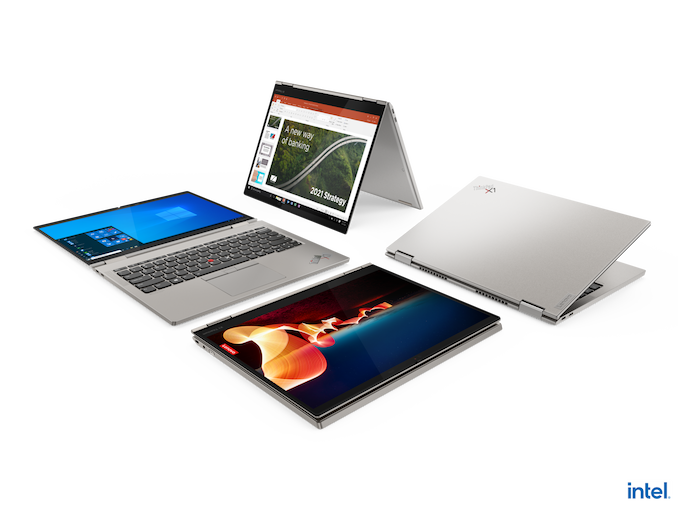
Not just a special edition of the normal X1 Yoga, the new ThinkPad X1 Titanium Yoga is the thinnest ThinkPad ever produced at just 11 mm Z-height. With a weight starting at 1.15 kg / 2.54 lbs, it is also one of the lightest, making this new 13.5-inch laptop one of Lenovo’s most portable ThinkPads ever. Powered by 11th Gen Intel Core up to an i7 with vPro, and this business device will have plenty of grunt to churn through presentations. With up to 16 GB of LPDDR4x memory, and up to 1 TB of PCIe storage, the X1 Titanium Yoga should be more than ample for almost any business application.


Not just Titanium in name, this thin and light 2-in-1 laptop is actually skinned in titanium, giving a unique appearance and feel to the device. The convertible features a 3:2 aspect ratio 13.5-inch display which works enhances the usability in laptop mode, since there is more vertical real estate, but also makes it a much better convertible device for use in the hand.
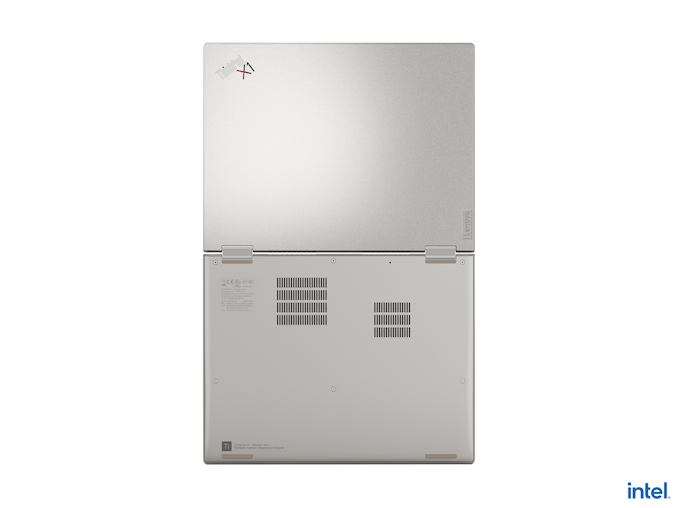


Lenovo claims up to 10.9 hours of battery life from the 44.5 Wh battery, and the device charges over USB-C thanks to the two Thunderbolt 4 ports. There is no USB Type-A available though, so legacy devices will need to be plugged with an adapter, or through a dock.


Lenovo also offers Wi-Fi 6, and cellular connectivity with LTE and 5G options. There is an IR camera with a privacy shutter, and a fingerprint reader.


The new Lenovo ThinkPad X1 Titanium Yoga will be available this month, starting at $1899.


ThinkPad X1 Carbon Gen 9
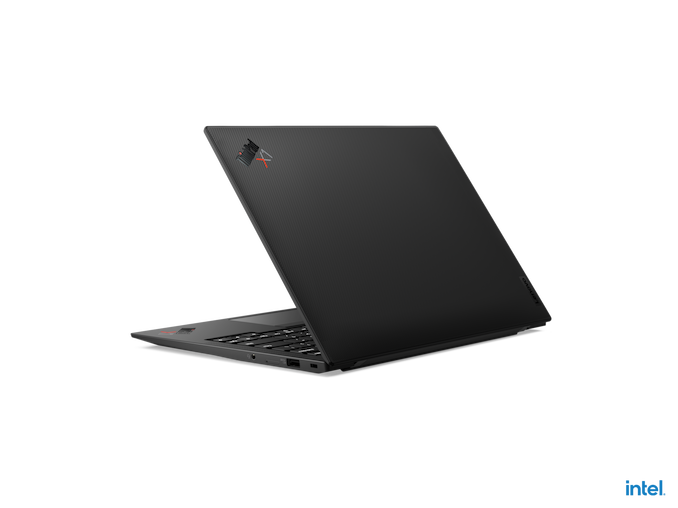


One of the most popular ThinkPad designs around is the X1 Carbon series, which is a traditional clamshell laptop, and for 2021 the laptop has been completely redesigned and now features a 16:10 aspect ratio display meaning there is more vertical space. Lenovo has also added a wider trackpad, and a larger battery. This Intel Evo design also offers Wi-Fi 6 and optional LTE or 5G connectivity.


Powered by the latest 11th generation Intel core processors, aka Tiger Lake, the new ThinkPad X1 Carbon offers up to an i7 with vPro, up to 32 GB of LPDDR4x-4266 RAM, and up to 2 TB of PCIe 4.0 storage. Coupled with the new Tiger Lake Iris Xe graphics, and this 1.13 kg / 2.49 lb laptop offers a lot of performance in an elegant design.


The larger 57 Wh battery is rated for up to 16 hours of life, and the 65-Watt Type-C charger supports Lenovo’s Rapid Charge technology to get back up and running quickly.
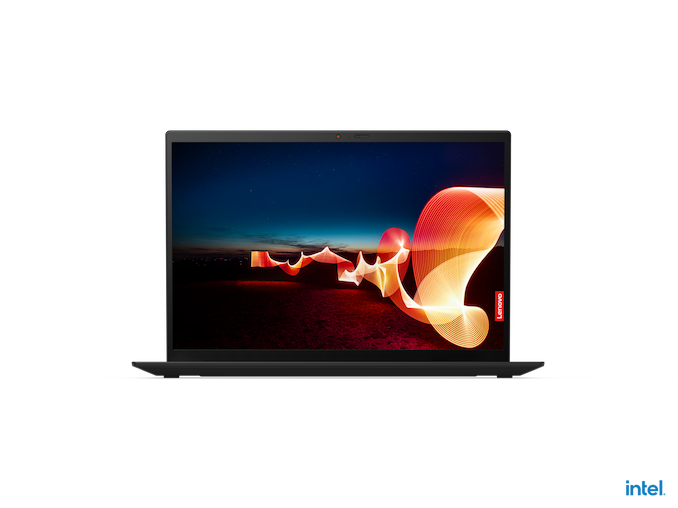


The new 14-inch 16:10 display offers several variations, with 100% P3 gamut coverage and HDR 400 available. Lenovo is also upping the game in terms of communication, with Dolby Voice integrated which uses dynamic leveling to automatically adjust for voice levels and ambient noise levels. The integrated HD webcam also features IR, and the laptop includes a fingerprint reader which doubles as a wake-up button.


The new ThinkPad X1 Carbon will be available in February starting at $1429 USD.


ThinkPad X1 Yoga Gen 6
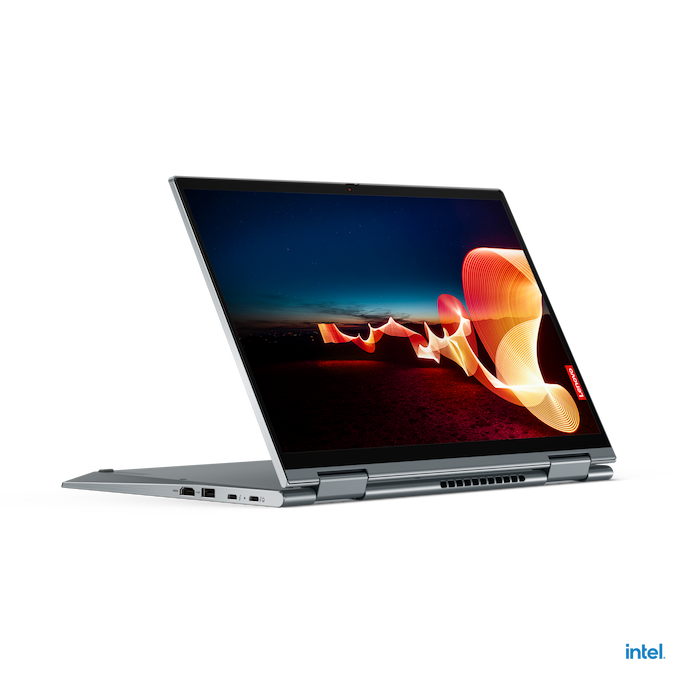


Featuring much of the same features as the X1 Carbon, but with the added versatility of the 360° hinge Yoga design, the ThinkPad X1 Yoga also gets a new chassis this year and 16:10 display support.


Much of the internals are similar to the X1 Carbon, with 11th gen Intel Evo offering up to an i7 with vPro, Intel Xe graphics, and the same 32 GB of LPDDR4x-4266 and 2 TB of PCIe 4.0 storage. The battery capacity is the same, at 57 Wh, and it also features Thunderbolt 4 for charging and data.


The big change is again the move to a 16:10 aspect ratio display, adding more vertical room. The X1 Yoga offers the same display choices as the X1 Carbon, but with Touch being available across the board, as it is a convertible laptop.
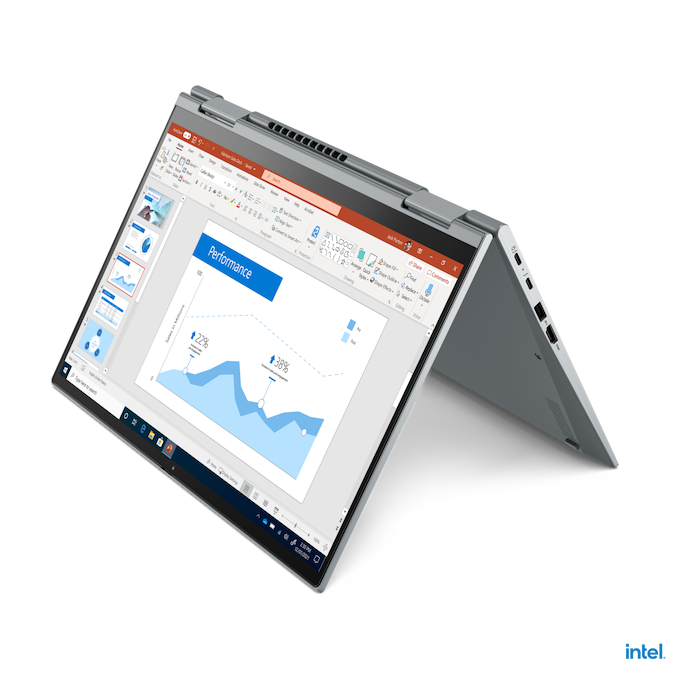


The X1 Yoga does give up some weight over the X1 Carbon in exchange for more versatility with the Yoga hinge, and starting weight is 1.39 kg / 3 lbs. The aluminum laptop is offered in an attractive Storm Gray color.


For those looking at the new Lenovo ThinkPad X1 Yoga, Lenovo expects availability in February, with prices starting at $1569.


ThinkPad X12 Detachable
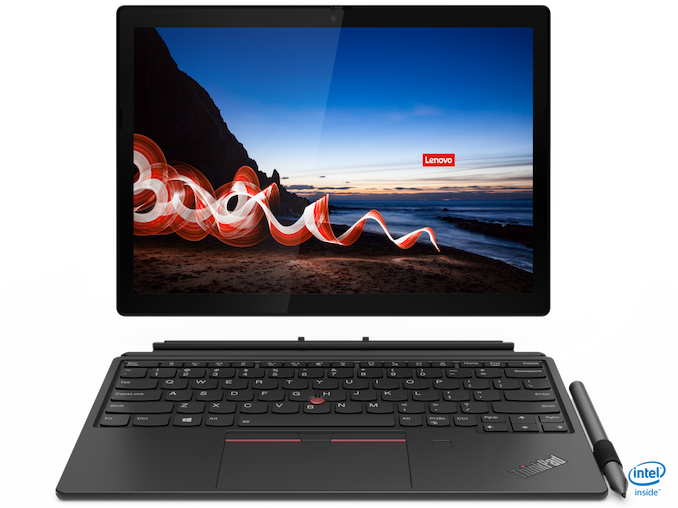


For those that need the ultimate in portability, Lenovo is announcing the new ThinkPad X12 Detachable, which is a new take in the mold of the Microsoft Surface Pro. Featuring a 12.3-inch 3:2 display, and detachable keyboard, the new convertible tablet weighs in at just 760 grams / 1.67 lbs, or 1.1 kg / 2.42 lbs with the keyboard attached.


Despite the small size, the ThinkPad X12 Detachable still features up to a quad-core 11th gen Intel Core i7 with vPro, operating at up to 15 Watts and 4.3 GHz. It also features Intel Iris Xe graphics, and up to 16 GB of LPDDR4x memory. On the storage side, Lenovo has up to 1 TB of NVMe on tap.


The 42 Wh battery is rated for almost ten hours of battery life, and the 65-Watt adapter supports Lenovo’s Rapid Charge. The charger works over USB-C, and the ThinkPad X12 Detachable offers a single Thunderbolt 4 port, as well as a second USB-C port which offers USB 3.2.
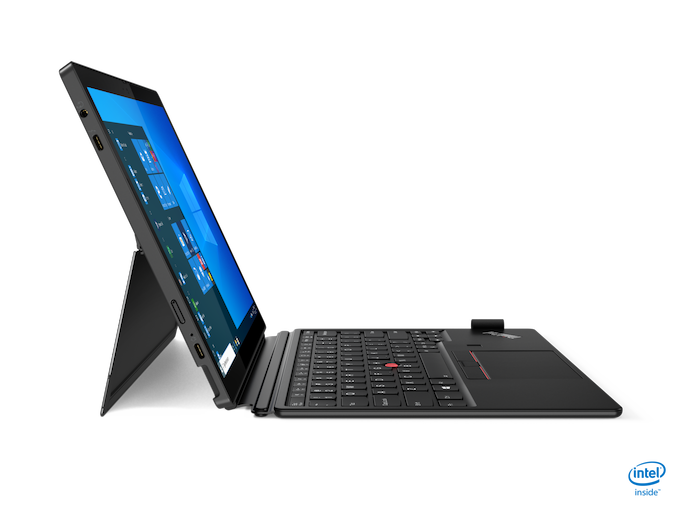


The convertible tablet also offers LTE connectivity, up to CAT9, along with Wi-Fi 6 and Bluetooth 5.1.


The new ThinkPad X12 Detachable will be available in January starting at $1149 USD.


Source: Lenovo


Source: AnandTech – Lenovo CES 2021 ThinkPad X1 Lineup: New Designs, New Displays for Flagship Laptops

Intel at CES 2021: Ice, Tiger, Rocket, Jasper, and Alder Lake

Despite only having a 30 minute press event for this year’s annual CES trade show, Intel has a lot to discuss about its plans through the next 12 months. The company touched upon five key processor architectures and product segments that will dictate where a lot of its FY2021 will come from. This is essentially a yearly roadmap set of announcements, without actually giving us the roadmap.

We’ve had a lot of Intel news today, which we separated out into separate news posts for ease of use. This is a handy quick-use guide to click through to any of our analysis.


Source: AnandTech – Intel at CES 2021: Ice, Tiger, Rocket, Jasper, and Alder Lake

An Interview with Intel CEO Bob Swan: Roundtable Q&A on Fabs and Future

Intel has a very complex year ahead. On the back of what should be strong revenue year for 2020 as well as a widened scope of markets in which it participates, the key fundamentals at Intel such as manufacturing give those that follow the company care for concern.  Throughout its existence, Intel’s key market leadership feature has been its manufacturing excellence, so now in 2021, after several high-profile manufacturing delays, what does Intel need to accomplish this year in order to get back on track? I was joined by several other journalists at a rare roundtable with Intel CEO Bob Swan, to ask about Intel’s future.


Source: AnandTech – An Interview with Intel CEO Bob Swan: Roundtable Q&A on Fabs and Future

Intel Previews 11th Gen Core Rocket Lake: Core i9-11900K and Z590, Coming Q1

Spending five generations on the same base microarchitecture is a long time. The excitement can be sustained through optimizing a process node, adding cores, and extracting every drop of frequency, but at some point the base design becomes the bottleneck and it is time to move on. Intel’s enthusiast desktop market has been waiting for an update for a couple of generations, and while the new 11th Gen Core Rocket Lake doesn’t migrate off of the 14nm process node, we are at least getting a new microarchitecture that promises (according to Intel) a 19% IPC improvement. Promising a Q1 launch, Intel lifted the lid a little on its next consumer flagship, the Core i9-11900K.


Source: AnandTech – Intel Previews 11th Gen Core Rocket Lake: Core i9-11900K and Z590, Coming Q1

Intel Launches Jasper Lake: Tremont Atom Cores For All

One of the more interesting elements in Intel’s 2020 set of disclosures was its 10nm Tremont Atom core. Initially used in the low power Lakefield product, this core design is super interesting due to its dual decoder design, which no other x86 core does. It has been over a year since the launch of Lakefield, and we’ve been hoping for a friendlier platform on which to test these new cores, along with some extra frequency to see the design stretch its legs. That platform is launching today, with Intel’s 11th Gen Core Pentium Silver and Celeron Processors.


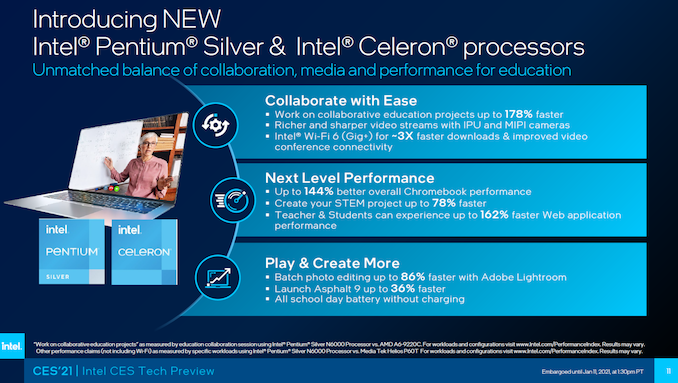
The new 11th Gen Core Pentium Silver and Celeron processors are aimed initially at the education market, and Chromebooks, but will slowly expand into Linux and Windows variants over time. Intel detailed that the laptop market was priority over the mini-PC market, however other form factors are free to be developed. These new processors will follow the same schema as Atom-based Pentium and Celeron processors in the past, with quad-core and dual-core variants on offer. Intel has detailed six processors in total, three each at the 10W and 6W levels.


Intel Jasper Lake
AnandTech Cores

Threads
Base

Freq
Turbo

Freq
DDR4

LP4X
GPU GPU

Freq
10 W TDP
Pentium N6005 4C / 4T ? 3300 2933 UHD 900
Celeron N5105 4C / 4T ? 2900 2933 UHD 800
Celeron N4505 4C / 4T ? 2900 2933 UHD 750
6 W TDP
Pentium N6000 4C / 4T ? 3300 2933 UHD 850
Celeron N5100 4C / 4T ? 2800 2933 UHD 800
Celeron N4500 2C / 2T ? 2800 2933 UHD 750


All the processors will feature 1.5 MB of inclusive shared L2 cache, as Tremont is built around quad-core modules sharing an L2 cache – in this instance the dual-core variants simply have two cores disabled, but full access to the L2 cache. There is also 4 MB of non-inclusive shared L3 cache, which is a sizeable cache for an entry-level processor.


You can read the deep dive into the Tremont microarchitecture here.


All the CPUs support dual channel DDR4-2933, as well as LPDDR4X-2933, which is an odd combination as usually the LPDDR4X transfer rate is higher, such as LPDDR4X-3600. Graphics is provided by Intel’s UHD design, however it isn’t stated if this is Gen or Xe graphics, nor how many EUs these parts have. Through the stack we see a turbo frequency of 3.3 GHz, but Intel doesn’t specify base frequencies. In the footnotes, it does state that the turbo power is 20 W for the 6 W variants.


A new features coming to these processors is Intel’s Image Processing Unit, or IPU, which when paired with a MIPI interface can enable accelerated compute for video calls and techniques, such as blurred backgrounds. Coupled with Wi-Fi 6 support (via additional RF), and the goal here is to provide a machine that can enable an education type workload.


The initial devices with these processors will be Chromebooks, which Intel compares itself favourably to AMD’s A6-9220C, and MediaTek’s Helios P60T. Intel states a 35% generational improvement over Gemini Lake, and 144% better Chromebook performance (using PT’s CrXPRT benchmark) over the competition. Intel expects these devices to be in the market in Q1. Linux and Windows based devices are expected in Q2. Intel states that it will have 170 Chromebook designs in 2021, of which these processors will form a part of that mix.


Related Reading


Source: AnandTech – Intel Launches Jasper Lake: Tremont Atom Cores For All

Intel’s 8-Core Mobile Tiger Lake-H, at 45 W, to Ship in Q1

Since the launch of Intel’s 11th Gen Core mobile processors, known as Tiger Lake, back in September, the hardware was noted for its core count. At a time where its competition were leveraging 8 cores in the same space, Intel seemed limited to only four, and in that 15-28 W power window. At the time, Intel stated that the base Tiger Lake design was aimed to be scalable, and that double sized variants were in the works. Today Intel has confirmed that those double-sized parts will be coming in Q1, in the form of Tiger Lake-H.


Back at Intel’s Architecture Day 2020, lead architect Boyd Philips stated that even though the standard Tiger Lake UP3 design contained four cores and 12 MB of L3 cache, designs with double the L3 cache were in the works. This was instantly interpreted that double core-count versions of Tiger Lake were in the works, given that the higher-powered mobile processor line-up had been left to older 14nm processors to fill the gap, given that Intel normally launches products for both 15 W and 45 W at the same time. We had been expecting a fast follow on, with a launch sometime later in Q3, but it would appear that Intel has pushed this out to Q1. Intel says that these processors will start production and ship in Q1, which likely means that the actual products will come to market in Q2.


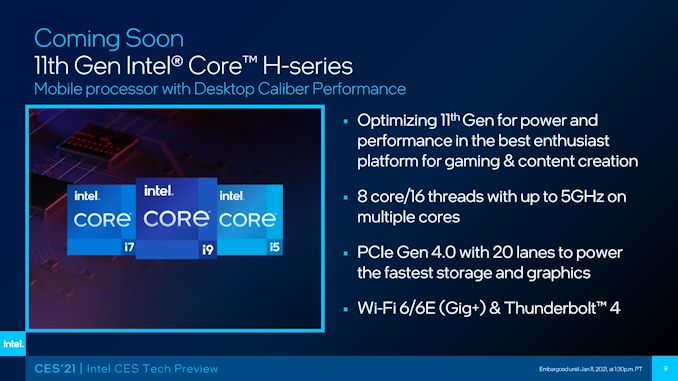
Intel has confirmed that these parts will offer eight cores and sixteen threads, with a highlight being that the top variants will enable 5.0 GHz turbo frequencies on multiple cores. These processors will also have 20 lanes of PCIe 4.0, which will allow for a full PCIe 4.0 x16 link to a discrete graphics card and a single PCIe 4.0 x4 storage drive at the same time, while also having a separate link for the chipset and IO. We expect these processors to also support Resizable BAR. These processors will also have Thunderbolt 4 native support, as well as Wi-Fi 6/6E support through an associated RF module.  


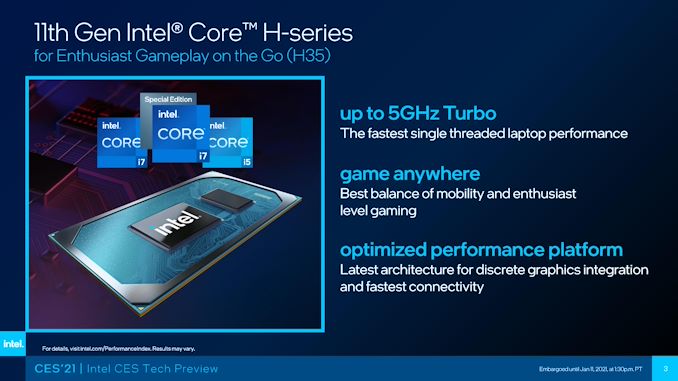
Intel traditionally has a number of overclockable H-series processors, known as HK, however the company has not explicitly stated if any overclocking SKU will make it to market. Typically these H-Series processors target the 45 W market, with a 35 W step-down option. Intel is also announcing today that it has moved its U-series processors, typically 15 W, up into that 35 W market as well (known as H35). We will start to see some overlap between the two, with higher frequency quad-core U-series processors up against eight-core H-series parts.


We wait to see exactly what specifications Intel will target with the new hardware. More detail to come.


Related Reading


Source: AnandTech – Intel’s 8-Core Mobile Tiger Lake-H, at 45 W, to Ship in Q1

Intel’s New H35 Series: Quad Core Tiger Lake now at 35 W for 5.0 GHz

Historically both main x86 processor manufacturers have developed their mainstream mobile processors at a power target of 15 W, traditionally called the U-series. Above this sat the 45 W mobile processors with more cores and higher clock speeds, known as the H-series. For as much as the U-series models were pushed up in power for more performance, to 25 W or 28 W, the H-series was sometimes pushed down to 35 W, meaning that the two never quite met in the middle. Today Intel is changing that, with its first U-series processor making the 35 W mark, with a new processor lineup called ‘H35’.


Because this is the U-series moving up to 35 W, I’m surprised Intel called it H35, rather than U35, which would be more accurate. What Intel has done is taken its 11th Gen Core Tiger Lake processor, with four Willow Cove cores and Iris Xe graphics, and pushed it beyond the usual 15 W or upper 25 W power level, into the 35 W market. One of the key marketing strategies of Intel is that its processor cores are highly scalable, from mobile to server, so pushing this shouldn’t seem too much of a stretch – we already know that the 15 W model will consume 50 W or more for a brief turbo period. The question on raising the sustained power level is usually one of longevity, as well as binning and pricing.


To that end, Intel’s new H35 series will feature three variants.


Intel Tiger Lake
AnandTech Cores

Threads
28W

Base
35W

Base
1C

Turbo
2C

Turbo
4C

Turbo
L3

Cache
Xe

GPU
H-Series
Announced, 8C/16T, 20 PCIe 4.0. More Details Later
H35 Series
i7-11375H SE 4C/8T 3.0 3.3 5.0* 4.8 4.3 12 MB 96
i7-11370H 4C/8T 3.0 3.3 4.8 4.8 4.3 12 MB 96
i5-11300H 4C/8T 2.6 3.1 4.4 4.4 4.0 8 MB 96
U Series (UP3)
i7-1185G7 4C/8T 3.0 4.8 4.3 12 MB 96
i7-1165G7 4C/8T 2.8 4.7 4.1 12 MB 96
i5-1135G7 4C/8T 2.4 4.2 3.8 8 MB 80
i3-1125G4 4C/8T 2.0 3.3 3.7 8 MB 48
i3-1115G4 2C/4T 3.0 4.1 4.1 6 MB 48


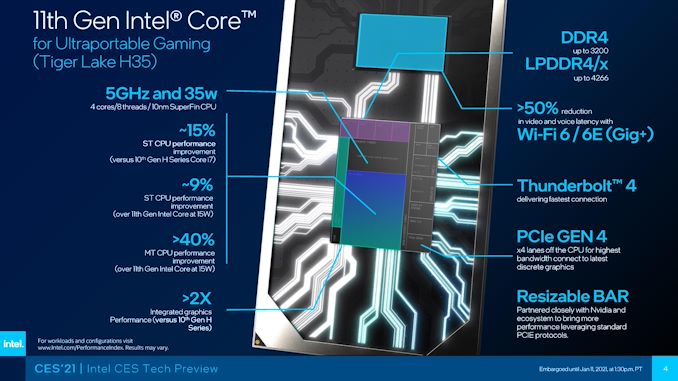
The top model will be the Core i7-11375H Special Edition, with four cores, eight threads, and can be run in 28 W or 35 W mode – the difference being 300 MHz on the base frequency. In either mode, the system will offer 5.0 GHz for single core turbo frequency, 4.8 GHz for dual core turbo frequency, and 4.3 GHz for all-core turbo frequency. 5.0 GHz will only apply when the thermals are sufficiently low, which for mobile processors is typically 60ºC.  This special edition also gets its own logo.


The difference between the Special Edition and the i7-11370H is simply that single core turbo frequency, which is only 4.8 GHz for this part. The base model is the Core i5-11300H, which still offers four cores and eight threads, but a 2.6-3.1 GHz base frequency, a 4.4 GHz two core turbo, and a 4.0 GHz all-core turbo. The stark difference here is that the L3 cache is lower, down from 12 MB to 8 MB.


All three CPUs support DDR4-3200 (64 GB) or LPDDR4X-4266 (32GB), as well as native Thunderbolt 4, and four lanes of PCIe 4.0. Intel has also enabled Resizeable BAR on its processors for NVIDIA GPUs, enabling better memory management with discrete GPUs (Intel has said that this feature will roll out to all Tiger-Lake based 11th Gen processors). Native support for Wi-Fi 6/6E as well as Intel Killer AX1675 is provided with the relevant RF module.


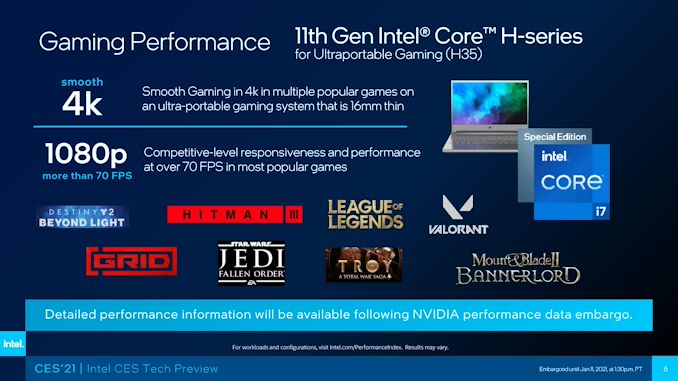
Intel states the goal with H35 is to enable ultraportable gaming – bundled with a discrete GPU, Intel says that H35 will enable 16mm enthusiast laptops with 14-to-15-inch screens offering smooth 4K gaming or 1080p at 70+ FPS. Intel states that they expect to have 40+ designs in the market though the first half of the year, with key OEMs on board, such as Acer, ASUS, MSI, Vaio, Dell, HP, and Lenovo.


For exact performance numbers, Intel states that the i7-11375H single threaded performance matches that of the Comet Lake i9-10980HK in SPEC2006int, and is around 6-9% faster than a standard Tiger Lake 15 W processor. Technically Intel says that these measurements were taken with the i7-11375H at 35 W and the i9-10980HK at 45 W, but as we know those TDP values are for sustained power draw, not single threaded power draw, which is likely to be under turbo.


We expect to see several laptops with Intel H35 processors inside being announced during CES 2021, which is occurring this week.


Related Reading


Source: AnandTech – Intel’s New H35 Series: Quad Core Tiger Lake now at 35 W for 5.0 GHz

Intel Confirms 10nm Ice Lake Xeon Production Has Started

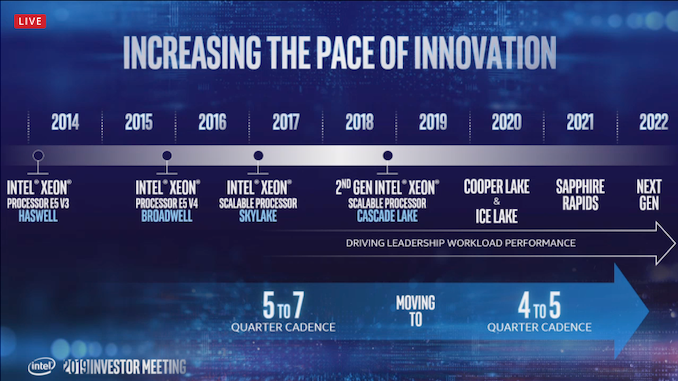
As part of this week’s announcements, Intel has confirmed to AnandTech that it has started production its next generation server processors, known as Ice Lake 3rd Generation Xeon Scalable. This news is somewhat at odds with remarks made by the CEO Bob Swan, and also doesn’t fit into the timeline of how Intel’s processor production usually works, and it appears to go beyond simple terminology.


When a company like Intel creates a new generation of server processor, either using a new microarchitecture or process node (or both), iterations and revisions of that server processor are made as the design is tweaked and optimized. Throughout the process, Intel’s largest customers, notably the hyperscalers in today’s environment, get early access to this beta hardware. Part of the agreement to access is helping Intel debug and tune the design, as well as a big hefty order. Throughout this process, the customer will use the beta hardware to tune their own software platforms, and in some instances, move the product into deployment-level infrastructure. Note that as the product gets nearer launch, these key customers will have thousands upon thousands of ‘engineering samples’ in various states of performance and usability. The line at which the customer gets shipped ‘full retail’ units rather that beta hardware is blurred, especially as these customers will often keep hold of the engineering samples that work as expected.


So not only is there this overlap, but also the key customers that help Intel in this regard get the first production-ready units. More often than not, Intel will hold back any formal public announcement of the product until the quota from the key customers is met, and then Intel can sell it to the wider masses, known as ‘general availability’. This lead time can vary to as much as six months, where in these six months those customers are getting the latest and greatest and the rest of the world doesn’t know it is ready.


So this is where we get into a mix about exact working on when a product, especially when comparing ‘announcements’ to ‘launches’ to ‘shipping for revenue’ to ‘general availability’ or ‘ramping production’ (scaling up manufacturing to build more).


In our interview with CEO Bob Swan, also posted today, he stated that the Ice Lake Xeon Scalable product has been launched in 2020. This is news to us, as there was no formal announcement. However what he might be talking about is that it ‘launched’ to those key customers. In that sense, the product is shipping for revenue. However, in the same instance, he also said that Ice Lake Xeon Scalable was ramping up production in Intel’s 10nm facilities. This would suggest that while Intel has been producing the hardware for a while, it is only now at a point where it feels comfortable adding more volume to meet expected demand.


However, in the official press release from Intel today, the company says that it is ‘starting production’ of Ice Lake Xeon Scalable, with ‘volume ramp taking place during Q1 2021’. This would seem to suggest that Intel only just starting production of a finished version of the hardware, and that the product ramp is still to come later in the quarter.


So either Ice Lake Xeon is launched, or it isn’t. It’s either in production, or it’s starting to ramp, or it is ramping, or production will be ramped as we move through Q1. Whatever Intel is trying to say here, your guess is as good as mine. I know some of my critics might call me out for not accepting what is being said at face value, or claim that what Intel is saying is clear. It’s a bit wishy-washy, and some of it is contradictory. I think we would all hope that Intel would be precise in describing its next generation of revenue generating data-center product.


With Intel’s end-of-year financial disclosures in a couple of weeks, we might get more insight into Intel’s Ice Lake Xeon Scalable status, along with a more public launch somewhere along the line, and discussions about Intel’s plans for its manufacturing beyond 10nm. If Ice Lake is indeed ‘launched’ in FY2020, that would mean Intel met a FY2020 target, which is likely to be important to investors.


Related Reading


Source: AnandTech – Intel Confirms 10nm Ice Lake Xeon Production Has Started

Intel Launches 11th Gen vPro For Tiger Lake Mobile CPUs, Adds CET Security Tech

Among Intel’s CES 2021 announcements this afternoon, the chip giant is using the annual show to launch their updated vPro platform for their latest-generation “Tiger Lake” Core processors. vPro is Intel’s advanced security and manageability technologies for business use, and it is one of the company’s major differentiating features for corporate environments, particularly tightly-managed enterprise installations. Essentially the business-focused offshoot of the Core lineup, Intel typically rolls out an updated vPro platform few months after a new generation of Core CPUs is released, and once again Intel is right on schedule with today’s release.


Source: AnandTech – Intel Launches 11th Gen vPro For Tiger Lake Mobile CPUs, Adds CET Security Tech

Intel's CES 2021 Press Event: The Future of Intel (A Live Blog, 1pm PT)

One of our first events of the annual CES trade show this year is Intel’s press conference on its consumer product lines. Heading up the event with be Intel’s Gregory Bryant, GM of Intel’s Client Computing Group. We’re expecting to hear updates about all the things planned for 2021, which is set to be a pivotal year for the company. With Rocket Lake supposedly around the corner, as well as larger versions of Tiger Lake, it will be interesting to hear what Intel is ready to talk about.


Come back at 1pm Pacific Time (4pm Eastern, 9pm UTC, 10pm CET) and follow along with the AnandTech Live Blog.


Source: AnandTech – Intel’s CES 2021 Press Event: The Future of Intel (A Live Blog, 1pm PT)

CES 2021: Qualcomm Announces 2nd Gen Ultrasonic Fingerprint Sensor

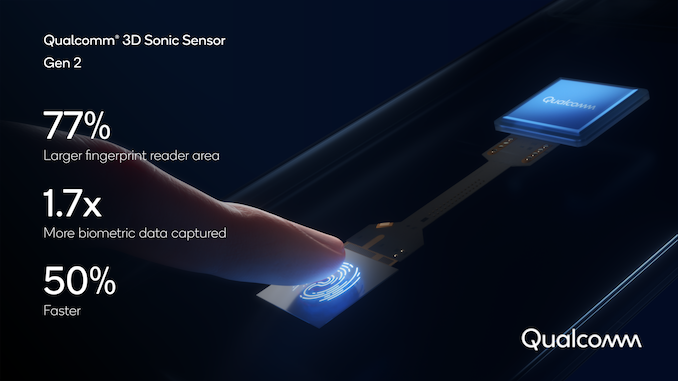
Today Qualcomm is announcing the release of their new 2nd generation ultrasonic fingerprint sensor. Back in 2019, the company had released its first-generation sensor, most notable for being used in Samsung’s Galaxy S10 and S20 series of devices, offering an alternative and very different technology compared to the competition’s optical based fingerprint sensor solutions.


Source: AnandTech – CES 2021: Qualcomm Announces 2nd Gen Ultrasonic Fingerprint Sensor

CES 2021: Dynabook Unveils Satellite Pro C50

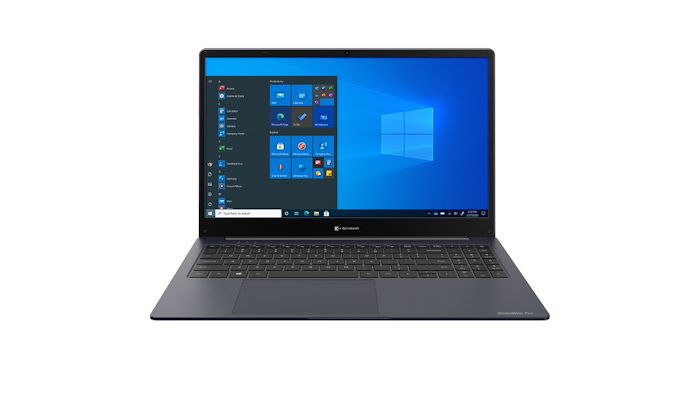
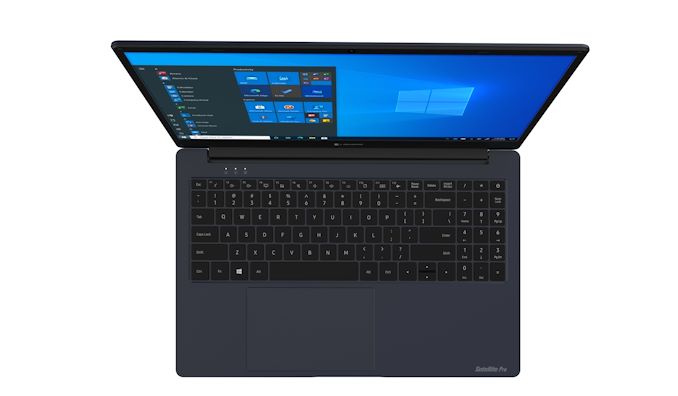
During CES 2021, Dynabook has unveiled its Satellite Pro series of laptops. A blast from the past, the new Satellite Pro C50 includes a professional design with a 15.6-inch screen with a thin bezel and is aimed more at professionals and SMEs.


The Dynabook Satellite Pro C50 has a dark blue frame, which is basic yet elegant, with a coating of Ionpure antimicrobial designed to limit bacterial growth. It includes a large full-size keyboard including a numeric keypad, with an integrated HD webcam along the top of the bezel. It has a large 5.2 x 3.4-inch trackpad and has support for Windows Precision Touchpad. 


Some of the more technical specifications include an Intel 10th generation mobile processor, DDR4 memory, with a solid-state drive for storage. It includes a USB 3.2 Type-C port with charging support, an HDMI video output, with Gigabit and Wi-Fi 5 network connectivity. It weighs around 1.76 KG, with a slim 19.7 mm profile.


In terms of pricing, the Dynabook Satellite Pro C50 starts at just $499.


Interested in more of the latest industry news? Check out our CES 2021 trade show landing page!


Source: AnandTech – CES 2021: Dynabook Unveils Satellite Pro C50

CES 2021: Dynabook Announces New Satellite C40 Pro Laptop

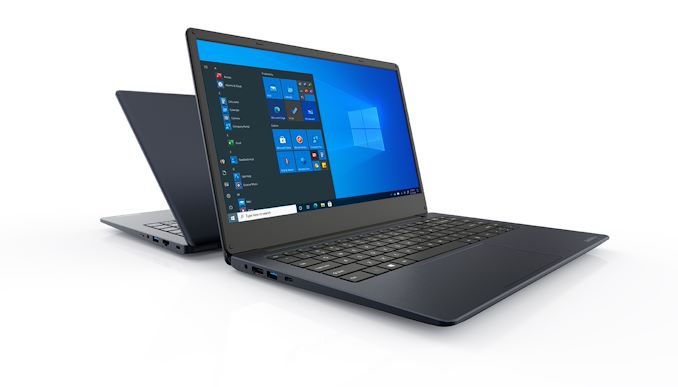
It’s not often that the range becomes the brand, but in the case of Dynabook, which used to be an affordable range of laptops, has announced a couple of new models for 2021. The new Dynabook Satellite Pro C40 is powered by Intel’s 10th generation processors, with a 14″ screen and an integrated HD webcam.


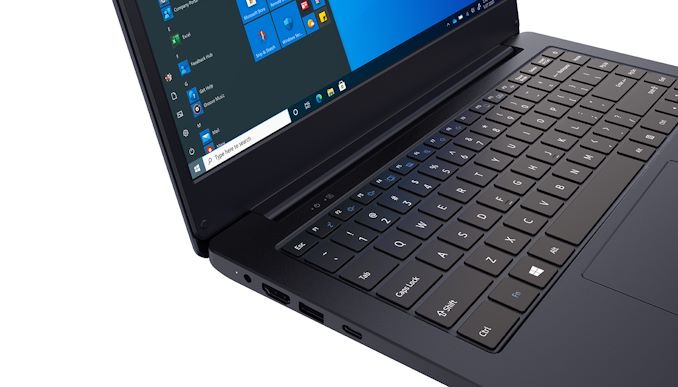
The Dynabook Satellite Pro C40 includes a dark blue chassis, with a thickness of just 18.9 mm and a weight of 1.55 KG. Some of the main features include a full-sized keyboard, an internal HD webcam, with a dual array microphone. It is powered by an Intel 10th generation processor, with a 14 inch 1080p non-glare screen, with a USB 3.2 G2 Type-C port that supports charging, external displays, and data transfer. Networking capabilities include a Gigabit Ethernet port, Wi-Fi 5, with support for Bluetooth connectivity. 


Prices for the Dynabook Satellite Pro C40 will start at $499.


Interested in more of the latest industry news? Check out our CES 2021 trade show landing page!


Source: AnandTech – CES 2021: Dynabook Announces New Satellite C40 Pro Laptop

CES 2021: ADATA SE900G External SSD, With RGB

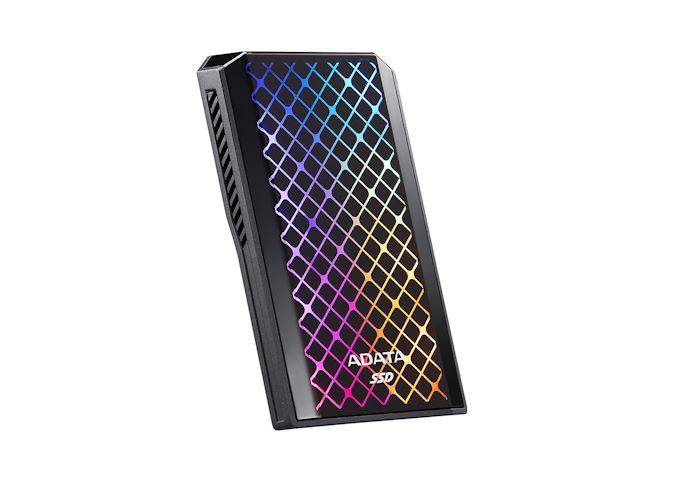
With a varied selection of announcements for CES 2021’s new virtual format, ADATA has unveiled a new external solid-state drive with integrated RGB LEDs. The ADATA SE900G looks to redefine portable storage for all the RGB junkies that also require fast SSD performance, with support for up to USB transfers speeds up to 20Gbps via USB 3.2 G2x2.


The SE900G uses a back shell constructed from metal, which ADATA claims is durable and designed to look premium. On the front is a criss-cross design with an integrated RGB light plate, making it easy to spot with its soft textured neon glare. 


Looking to offer users the fastest possible performance from an external drive, ADATA has equipped the SE900G with a USB 3.2 G2x2 interface, which is backward compatible with older USB Type-C connections, albeit with lower bandwidth and ultimately lower speeds.  ADATA is also claiming peak read and write speeds of up to 2000 MB/s, which is at the high-end of USB 3.2 G2x2’s specification. The USB 3.2 G2x2 interface is capable of up to 20 Gbps, which uses two lanes of 10 Gbps at once to deliver its throughput.


ADATA hasn’t revealed any details about storage capacities or pricing at this time.


Interested in more of the latest industry news? Check out our CES 2021 trade show landing page!


Source: AnandTech – CES 2021: ADATA SE900G External SSD, With RGB

Netgear Introduces RAXE500 – An AX11000-Class Wi-Fi 6E Tri-Band Router

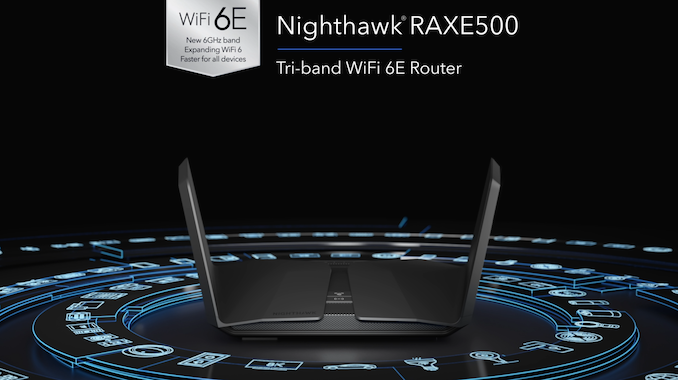
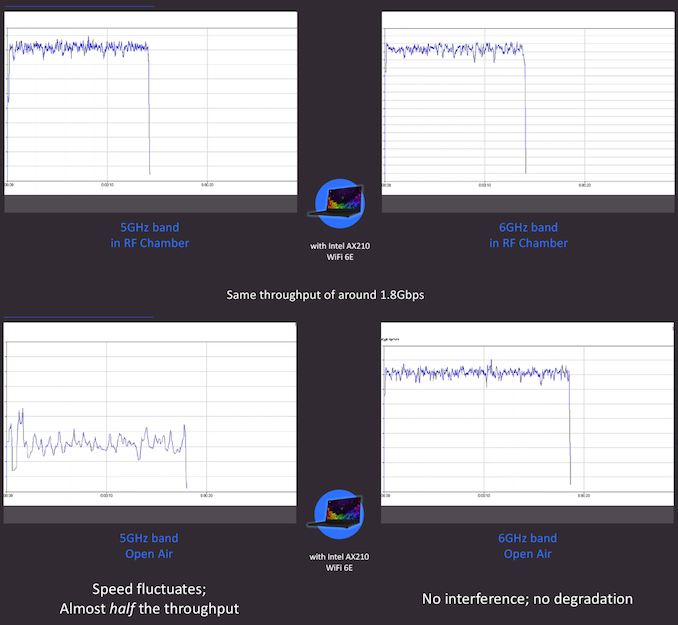
Netgear has a bunch of new product announcements at CES 2021, and the most interesting of the lot is the RAXE500 – their first Wi-Fi 6E router with support for 2.4 GHz, 5 GHz, and 6 GHz bands. The key here is the availability of the wide-open 6 GHz band – while the move to 6 GHz doesn’t deliver any extra bandwidth, the absence of interference (and additional free channels) in that band results in more stable throughput in practical scenarios.


The availability of client chipsets – the AX210 from Intel that is already shipping in some systems, as well as the Broadcom BCM4389 for mobile devices – means that we should see fairly rapid adoption and consumer benefits from Wi-Fi 6E compared to the long road that we had with Wi-Fi 6. Netgear shared some test results of 5GHz and 6GHz connections in a RF chamber and open air scenario to bring out the benefits of 6GHz channels.


Coming to the hardware itself, the RAXE500 follows the same industrial design of the other Nighthawk AX routers from Netgear. On the rear, we have two sets of LAN port pairs capable of link aggregation (one of them is capable of acting as a WAN port). There is also a 2.5Gbps LAN port, and two USB 3.0 Type-A ports. Internally, the WiSoC is a quad-core 1.8 GHz processor, and the radio chains are 4×4 each on the 2.4 GHz (at 40 MHz for 1.2 Gbps), 5 GHz (at 160 MHz for 4.8 Gbps), and 6 GHz (at 160 MHz for 4.8 Gbps) – allowing Netgear to claim up to 10.8 Gbps of theoretical throughput.


The additional radios for the 6 GHz band take the MSRP of the RAXE500 up to what the first AX12 (RAX200) was introduced at – $599. Netgear stated that the router should be available in the market by February 2021.


Interested in more of the latest industry news? Check out our CES 2021 trade show landing page!


Source: AnandTech – Netgear Introduces RAXE500 – An AX11000-Class Wi-Fi 6E Tri-Band Router

CES 2021: ADATA Announces New XPG Levante Pro 360mm AIO

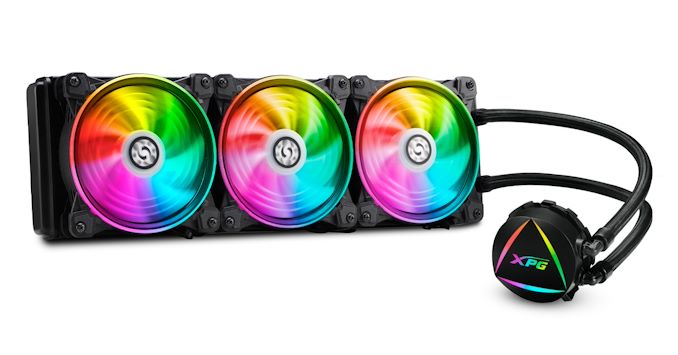
The XPG ‘The Future Of Gaming’ event at the all-digital CES 2021 trade show has given us an insight into what to expect from ADATA’s gaming division. One of its announcements includes an update to its RGB-enabled Levante series of AIO CPU coolers. The new XPG Levante Pro includes a 2.1″ LCD color display on the pump and is equipped with a 360 mm radiator.


The XPG Levante Pro is based on its previous Levante ARB 360 mm AIO cooler, with a couple of notable upgrades. It is now equipped with a 2.1 ” LCD screen built into the pump cap, which users can customize to display images or text and display vital system information such as temperatures and voltages.


The previous generation XPG Levante 360 AIO CPU cooler


XPG states that the Levante Pro uses Asetek’s 7th generation PWM pump and includes three XPG Vento Pro 120 mm ARGB cooling fans with support for PWM to keep the large 360 mm radiator cool. At this time, XPG hasn’t provided us with any images of the new Levante Pro, any technical specifications, or what sockets it will support. Still, it’s likely to include support for the latest Intel LGA1200 and AMD AM4 platforms.


XPG, at this time, hasn’t provided details on availability or pricing.


Interested in more of the latest industry news? Check out our CES 2021 trade show landing page!


Source: AnandTech – CES 2021: ADATA Announces New XPG Levante Pro 360mm AIO

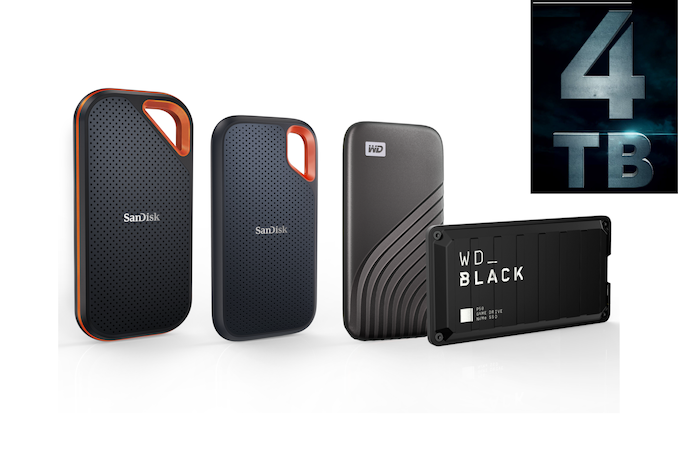
CES 2021: Western Digital's Portable SSDs Get Capacity Upgrades: 4TB of TLC for $680

Western Digital markets portable SSDs under different brands, catering to different market segments. The flagships in each brand make use of of very similar platforms – a M.2 NVMe SSD behind an appropriate bridge chip. The industrial design varies from brand to brand to appeal better to the target market. The WD My Passport and SanDisk Extreme Portable SSDs are USB 3.2 Gen 2 (10Gbps) SSDs using an ASMedia ASM2362 bridge chip and a WD SN550E PCIe 3.0 x4 NVMe SSD. The WD_BLACK P50 and SanDisk Extreme PRO Portable SSDs are USB 3.2 Gen 2×2 (20Gbps) SSDs using an ASMedia 2364 bridge chip with a SN750E and a SN730E PCIe 3.0 x4 NVMe SSD respectively.


Under the WD branding, the My Passport SSD with its hardware encryption capabilities targets the average consumer who wants to back up work files, user-generated multimedia, and personal files securely. The SanDisk Extreme and Extreme PRO targets professional users creating content on-the-go outside a standard office environment with its IP55 rating and two different speed levels – 1GBps-class for the Extreme and 2GBps-class for the Extreme PRO. The WD_BLACK P50 is meant for gamers who need fast and high capacity storage for their games and do not mind paying a premium for a stylish device fulfilling those requirements.


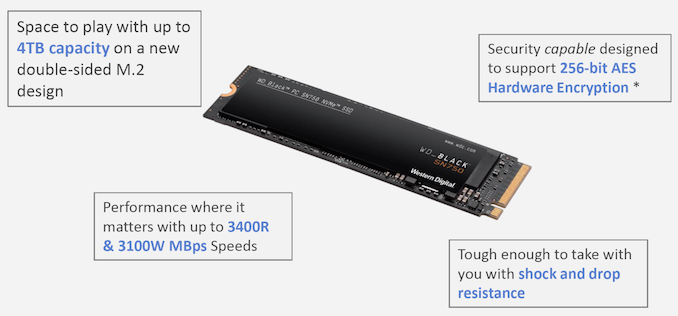
Currently, all four families mentioned above top out at 2TB. Today, Western Digital is announcing 4TB versions in all four, with market availability slated before the end of February. Internally, the four portable SSDs are all moving to a double-sided SN750-class NVMe drive. This means the same BiCS4 3D TLC NAND flash along with an in-house SSD controller. 256-bit hardware AES support is built-in, and enabled on all but the WD_BLACK P50 drive.


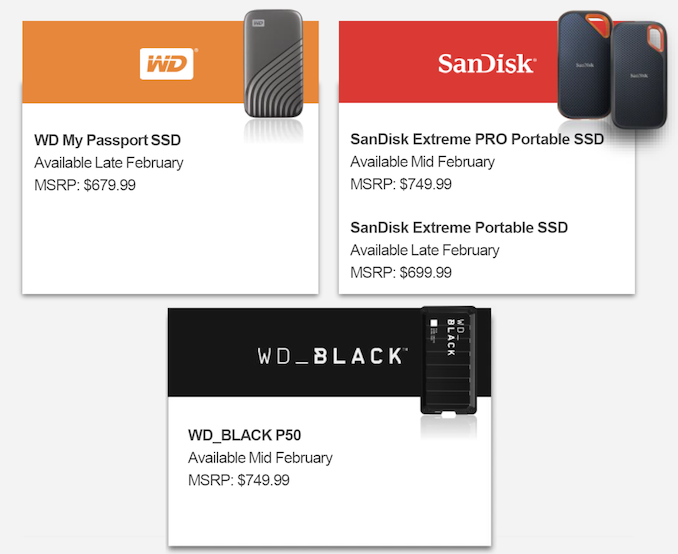
In terms of pricing, the 4TB versions of the 10Gbps-class SanDisk Extreme and WD My Passport SSD are coming out with a MSRP of $700 and $680, while the 20Gbps-class SanDisk Extreme PRO and WD_BLACK P50 for the same capacity are priced at $750. The premium is not only for the bridge chip with better performance, but the premium industrial design with liberal aluminum usage also. Interestingly, the 4TB internal drive is priced at $800 on WD’s site.


The physical dimensions of all the 4TB versions are similar to the lower-capacity ones in each family except for the WD My Passport SSD. The move to a double-sided NVMe drive forces the 4TB version of the My Passport SSD to become 0.8mm thicker (9mm to 9.8mm). The drive’s sleek nature was noted in our review of the 1TB version, and this thickness increase is a small price to pay for the increased capacity.


At price points of $680 – $750, it is evident that these are premium portable SSDs. 4TB of high-performance flash storage in a compact bus-powered enclosure was pretty much unimaginable even 5 years ago, and as the technology makes its way into the market, the premium is only expected. Professionals may not balk at such price points, as they realize the benefits of such drives for their use-cases and be willing to treat them as business expenses. To note, these are not the first such 4TB drives in the market – In fact, Sabrent’s Rocket XTRM-Q is available in capacities up to 8TB, and works with optimal performance in both Thunderbolt 3 (22Gbps) and USB 3.2 Gen 2 (10Gbps) modes. The 4TB XTRM-Q is priced at $700, and the new 4TB portable SSDs from Western Digital straddle that price point. However, Western Digital’s value proposition is in the use of mature and proven 3D TLC flash in the drive (compared to the QLC NAND used in the Rocket XTRM-Q). The Sabrent offering does have Thunderbolt 3 performance up its sleeve. But, this 3D TLC offering at very similar price points should help push the pricing of high-capacity QLC-based drives further down. And, that is definitely good news for consumers.


Interested in more of the latest industry news? Check out our CES 2021 trade show landing page!


Source: AnandTech – CES 2021: Western Digital’s Portable SSDs Get Capacity Upgrades: 4TB of TLC for 0

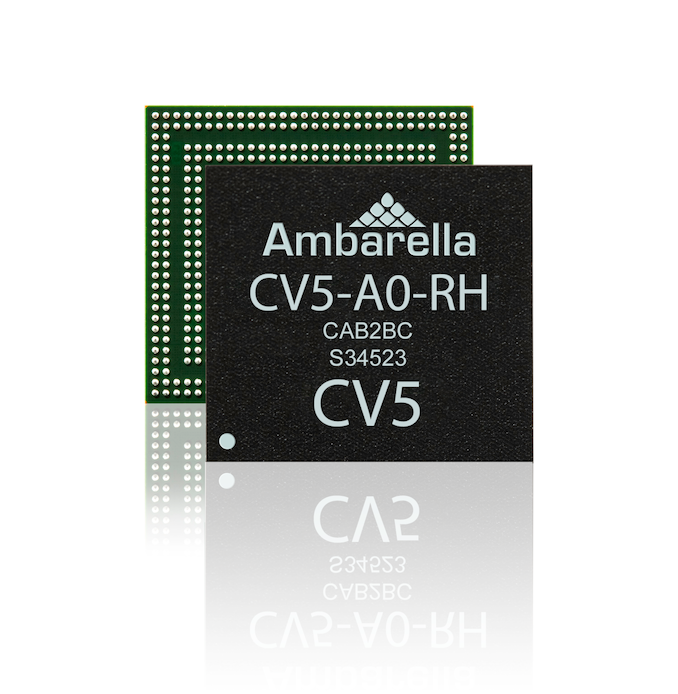
CES 2021: Ambarella Announces CV5 5nm 8K AI Vision Processor

At this year’s virtual CES 2021, Ambarella is launching its new flagship vision SoC – the CV5. Dubbed as a 8K AI vision processor, the new SoC addresses Ambarella’s more traditional core market which includes sports cameras, drones, and the increasing important automotive business of the company. If you’ve had a GoPro or a DJI drone in the past decade, the changes are high these devices were powered by an Ambarella SoC – although many of these companies nowadays also rely on in-house silicon.


The new CV5 is a major leap for the company as it represents the most powerful iteration of the company’s in-house ISP, featuring capabilities such as 8K60 video recording or four independent 4K video streams, includes new powerful AI capabilities, new CPU cores, and promises very low power consumption through it’s new 5nm manufacturing node.


Source: AnandTech – CES 2021: Ambarella Announces CV5 5nm 8K AI Vision Processor

CES 2021: HP Elite Dragonfly Lightweight Laptops

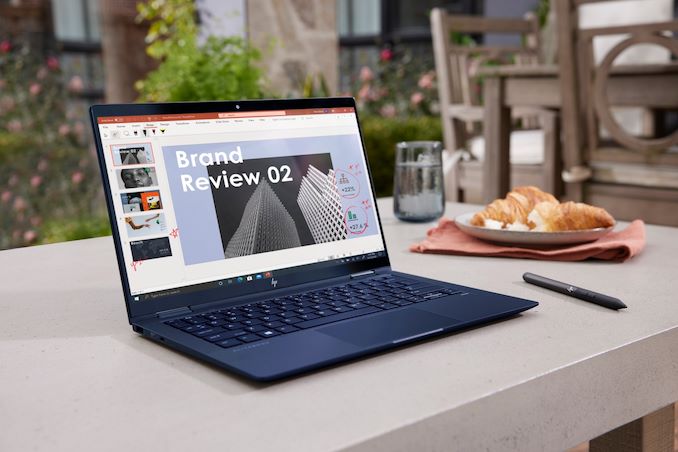
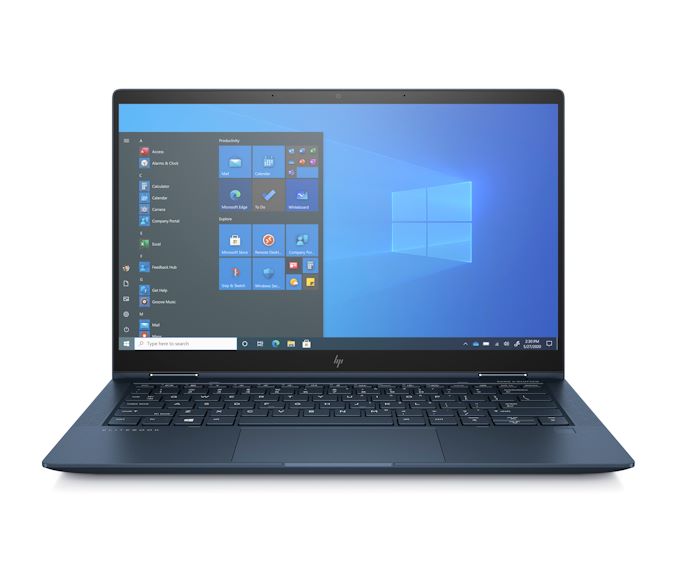
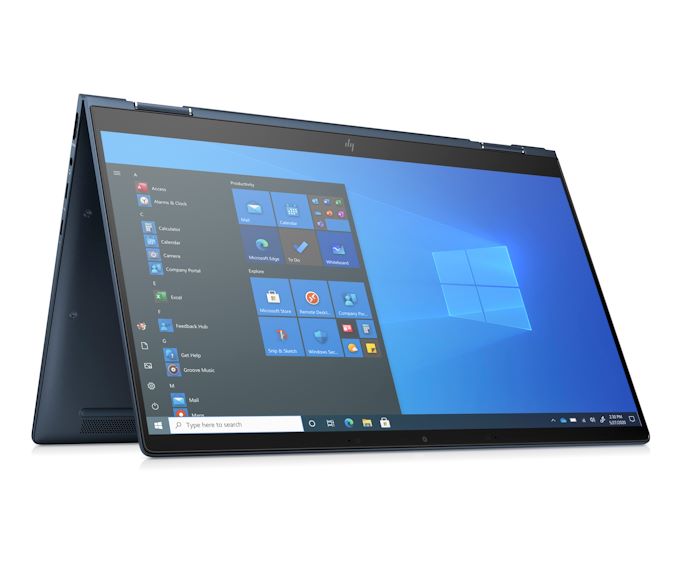
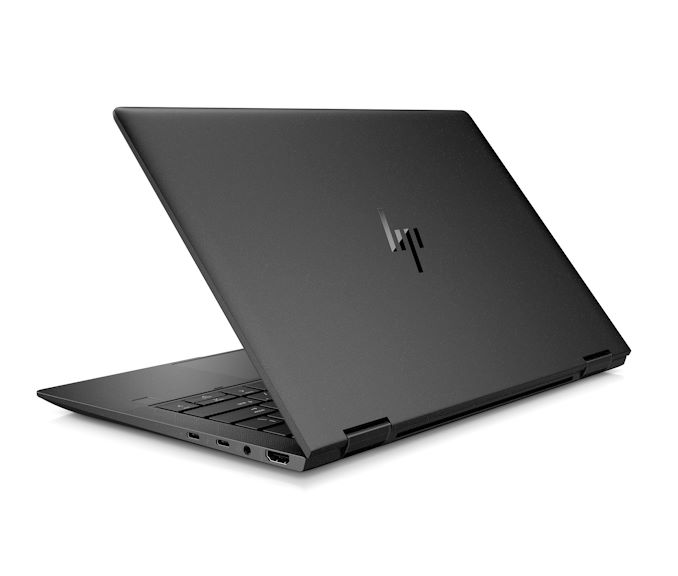
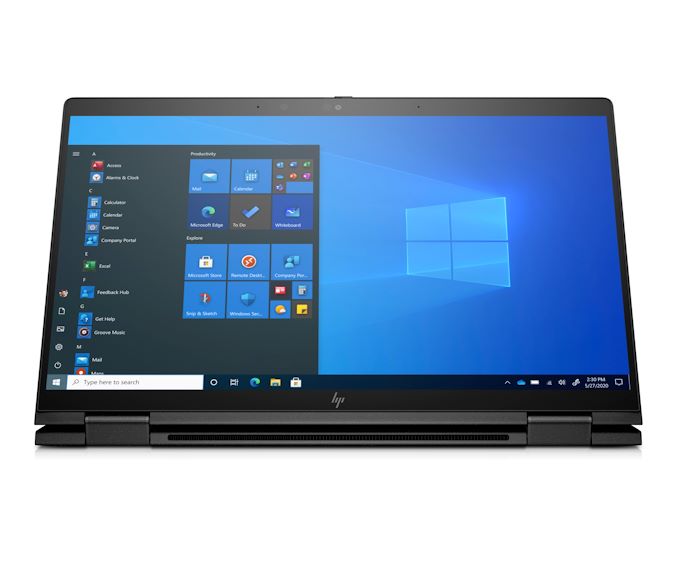
Today at CES, HP is announcing some updates to their Elite Dragonfly series, which are targeted at business users who need portability. Improving on the original Whiskey Lake based model is the new convertible HP Elite Dragonfly G2, powered by the latest Intel Tiger Lake platform with vPro, and the HP Elite Dragonfly MAX, built to be the ultimate for collaboration and conferencing.


HP Elite Dragonfly
  G2 MAX
CPU Intel 11th Gen Tiger Lake

Core i3/i5/i7 (i3 only on G2)

Optional vPro
GPU Intel 11th Gen UHD or Iris Xe depending on CPU
RAM Up to 32 GB LPDDR4
Storage Up to 2 TB M.2 PCIe
Networking Wi-Fi 6

Optional LTE Intel XMM 7360

Optional 5G Qualcomm Snapdragon X55
I/O 1 x USB 3.1

2 x Thunderbolt 3

1 x HDMI 1.4b

1 x Nano SIM
Display 13.3-inch IPS 400 nits Low Power

Optional 1920×1080 1000 nits HP Sure View Reflect

Optional 3840×2160 550 nits HDR 400

Corning Gorilla Glass 5
13.3-inch 1920×1080 IPS

1000 nits HP Sure View Reflect Anti-Sparkle

Corning Gorilla Glass 5
Audio and Video HP Bang & Olufsen Speakers

1.2 MP Webcam with IR

2 user facing mics

1 world facing mic
HP Bang & Olufsen Speakers

5 MP Webcam with IR

2 user facing mics

2 world facing mics
Battery 56 Wh – battery life estimate not yet provided
Dimensions 304 x 198 x 16.1 mm

11.98 x 7.78 x 0.63 inches
Weight Starting at 998 grams

2.2 lbs
Starting at 1.13 kg

2.49 lbs
Pricing and Availability Available January 2021 / Pricing TBD


HP Elite Dragonfly G2


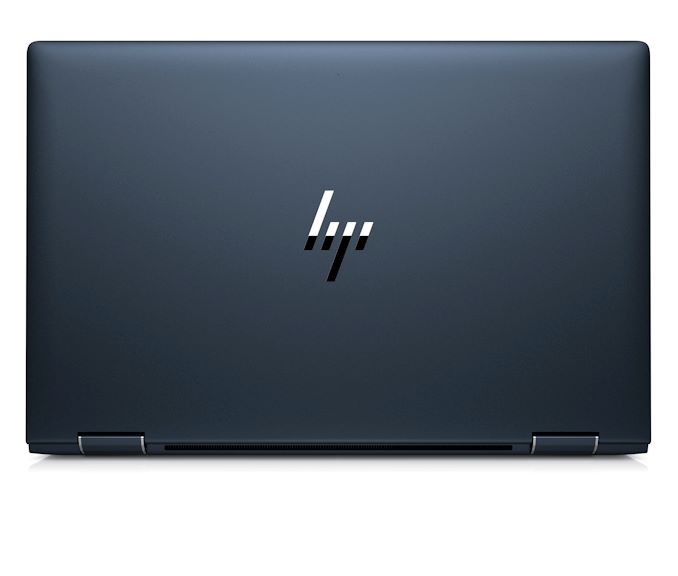
Improving on the original in almost every way, yet without drastically changing the form factor, the new G2 version of the Elite Dragonfly maintains its ultraportable status with a starting weight up 989 grams. The CNC Magnesium comes in Dragonfly Blue, and moves from Intel’s 8th gen Core to the latest 11th gen Tiger Lake platform, bringing about significantly more performance, and much improved graphics. With LPDDR4 support, the new G2 model can also be outfitted with up to 32 GB up RAM, which as is likely expected on such a thin and light machine, is soldered down. Storage is M.2, up to 2 TB.


HP has stuck with the traditional 13.3-inch 16:9 aspect ratio for the displays, with both 1920×1080 and 3840×2160 offerings, with 400 or 1000 nits brightness on the lower resolution panels, and 550 nits along with HDR 400 certification on the UHD display.


The previous model was rated at 24 hours of battery life, and although HP has not yet rated this model, Tiger Lake has shown itself to be very efficient at idle, so expect another excellent result here.


Despite the 16.1 mm thickness, HP has still managed to fit in a keyboard with 1.3 mm of travel, which is also spill resistant, and of course backlit. Audio is powered by Bang & Olufsen, and HP has included three microphones, with two facing the user and a third facing out for noise cancellation. There’s a 720p webcam, with IR capabilities as well.


The new Dragonfly series also features cellular connectivity options, with LTE from an Intel XMM 7360 modem, or 5G with the Qualcomm X55 modem. There is a single USB 3.1 port, as well as two Thunderbolt 3 ports, and as a business device, there is also an HDMI 1.4 output for connecting to a projector.


Pricing has not been finalized yet, but the new Elite Dragonfly G2 will be available this month.


HP Elite Dragonfly MAX


Although in the same chassis as the G2, the Dragonfly MAX is targeted towards people who do a lot of video conferencing and collaboration. Powered by the same Intel Tiger Lake platform, the MAX model sticks with the 13.3-inch Sure Video Reflect IPS panel with 1000 nits of brightness and 1920×1080 resolution.


The MAX differs in that it includes a 5 MP webcam with IR, and adds a fourth microphone for even better noise cancellation. It also comes in both the same Dragonfly Blue as the G2, but also a Sparkling Black option.


The HP Elite Dragonfly MAX will be available this month as well, with pricing TBD.


Source: HP


Source: AnandTech – CES 2021: HP Elite Dragonfly Lightweight Laptops

CES 2021: HP ENVY 14 Refreshed

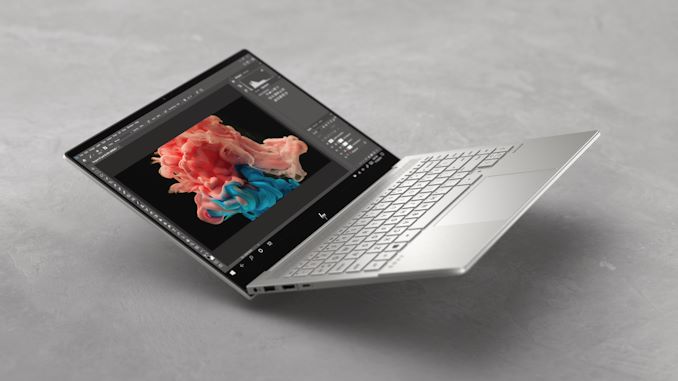
One of the best value laptops in HP’s lineup is their ENVY series. Featuring premium materials, the ENVY lineup brings a lot of the best of HP, without the higher price tag of some of their higher end lineups such as the Spectre series. For 2021, HP has refreshed the ENVY 14 with the latest internals, but also added a 16:10 display.


HP ENVY Laptop
  ENVY 14
CPU Core i5-1135G7

Quad-Core

Up to 4.2 GHz
GPU NVIDIA GeForce GTX 1650 Ti Max-Q

4GB GDDR6
Display 14-inch 1920×1200 IPS

16:10 Aspect Ratio

400 Nits

100% sRGB
RAM 16 GB DDR4-3200 (not accessible)
Storage 256 GB M.2 PCIe
Networking Intel AX201 W-Fi 6

Bluetooth 5.0
I/O 1 x Thunderbolt 4

2 x USB Type-A 5 Gbps

1 x Headset jack

1 x HDMI 2.0

Micro SD Reader
Dimensions 313 x 224 x 18 mm

12.33 x 8.82 x 0.71 inches
Weight 1.60 kg / 3.53 lbs
Price $999 USD
Availability January 2021


HP ENVY 14


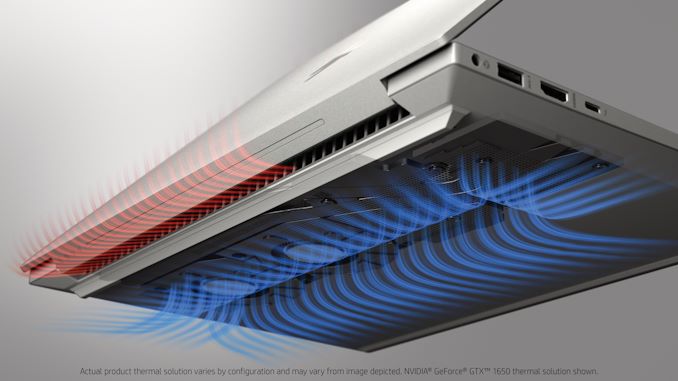
Powered by the latest Intel Tiger Lake platform in the Core i5-1135 G7, the new 14-inch ENVY gets off on the right foot, but the new laptop also features the NVIDIA GeForce GTX 1650 Ti Max-Q graphics card, meaning this portable laptop has some very powerful graphics available in a non-gaming laptop. The laptop offers 16 GB of DDR4-3200, and a 256 GB M.2 SSD.


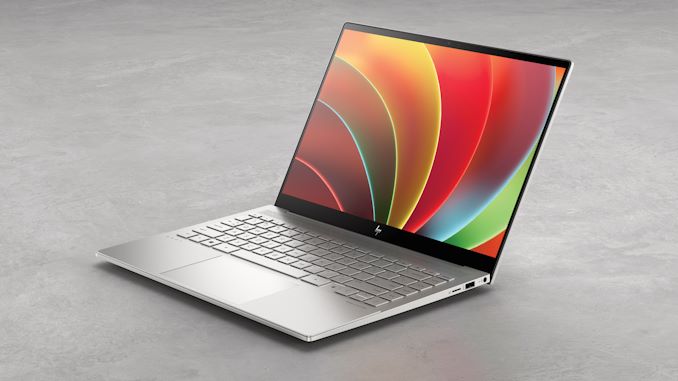
The biggest change for this year though is the introduction of a taller 16:10 display, similar to what we’ve seen in several laptops over the last few months. The 1920×1200 resolution IPS panel offers 400 nits of brightness, and covers 100% of the sRGB color gamut. It also includes touch, and the bezels offer an 87% screen to body ratio.


The laptop features a sandblasted anodized aluminium finish, meaning it should not be as big of a fingerprint magnet as some of the glossier finishes.


The ENVY 14 offers lots of connectivity, with one Thunderbolt 4 port, as well as two USB Type-A ports for legacy devices. There is an HDMI 2.0 output, as well as a Micro SD card reader.


Intel’s Wi-Fi 6 AX201 network adapter powers the wireless, and brings with it Bluetooth 5.0.


The ENVY 14 offers an above average battery capacity, coming in at 63 Wh, so battery life should be quite good. It also features a 135-Watt AC adapter.


The new ENVY 14 will be available in January on HP.com starting at $999.


Source: HP


Source: AnandTech – CES 2021: HP ENVY 14 Refreshed