Intel Appoints Pat Gelsinger as New CEO, From Feb 15th

News is breaking that Intel has announced that Pat Gelsinger, CEO of VMWare, is to take the role of CEO at Intel from February 15th.


Intel today has released a press statement saying that current CEO Bob Swan (who we interviewed only a few days ago!) is to step down in his role, and be succeeded by Pat Gelsinger. Gelsinger, a veteran of the industry, has spent over 40 years at companies such as VMWare, EMC, and spent 30 years previously at Intel, reaching the potisition of Chief Technology Officer. In that role he drove creation of standards such as USB, Wi-Fi, he was the architect of the 80486, and played key roles in 14 generations of Intel Core and Xeon processors. As CEO of VMWare since 2012, Pat has overseen a tripling of annualized revenue to make VMWare a recognized global leader in global infrastructure and cyber security.


Rumors of Intel getting a new CEO have never died down, even since Bob Swan officially took the role from Brian Krzanich in January 2019. Through those two years, Swan has seen successive YoY growth in the companies revenue streams, as well as a turnover of high-profile technical personnel, such as Dr. Murthy Renduchintala. The goal has seemingly been to push Intel into more areas for TAM growth, while at the same time push through the fundamental issues surrounding the delays to manufacturing on the 10nm node, which has been delayed for a couple of years at this point, and the 7nm node, to which delays were announced more recently. The missing piece of the puzzle has been having an engineer at the top of Intel’s food chain, particularly one well versed in Intel’s product portfolio, and for those that wanted this to happen, it appears to be so, from February 15th.


Bob Swan will still head the Intel financial call on January 21st, where the company is set to announce how it will approach its future process node strategy, namely 7nm, in light of recent delays. This call should indicate how much Intel is set to invest in its own manufacturing facilities, and how much it may offload to third party foundries during that timeframe. During our interview with Bob Swan, he mentioned that Intel would only work with third party foundries if it could get preferential treatment for the volumes it needed, as well as integration with all related design tools. Swan also stated that licensing a process node technology from someone else for use in Intel’s fabs was also an option the company could be considering.  No word has been given as to Bob’s future, if this is retirement from Intel, or what future role he may play.


On the new CEO news, the chairman of the board at Intel, Omar Ishrak, has said,


“The board and I deeply appreciate Bob Swan for his leadership and significant contributions through this period of transformation for Intel,” continued Ishrak. “Under his leadership, Intel has made significant progress on its strategy to transform into a multi-architecture XPU company to capitalize on market shifts and extend Intel’s reach into fast-growing markets. Bob has also been instrumental in reenergizing the company’s culture to drive better execution of our product and innovation roadmap. He leaves Intel in a strong strategic and financial position, and we thank him for his ongoing guidance as he works with Pat to ensure the leadership transition is seamless.”


On the announcement, Pat Gelsigner has said,


“I am thrilled to rejoin and lead Intel forward at this important time for the company, our industry and our nation,” said Gelsinger. “Having begun my career at Intel and learned at the feet of Grove, Noyce and Moore, it’s my privilege and honor to return in this leadership capacity. I have tremendous regard for the company’s rich history and powerful technologies that have created the world’s digital infrastructure. I believe Intel has significant potential to continue to reshape the future of technology and look forward to working with the incredibly talented global Intel team to accelerate innovation and create value for our customers and shareholders.”


It is unclear at this time if Gelsinger will be a voice on the financial call on January 21st. $INTC is already up +9% on the news of the new CEO today (as of 9:54am ET).


This is breaking news.


Source: AnandTech – Intel Appoints Pat Gelsinger as New CEO, From Feb 15th

Qualcomm to Acquire NUVIA: A CPU Magnitude Shift

Today Qualcomm has announced they will be acquiring NUVIA for $1.4bn – acquiring the start-up company consisting of industry veterans which originally were behind the creation of Apple’s high-performance CPU cores. The transaction has important ramifications for Qualcomm’s future in high-performance computing both in mobile, as well as laptop segment, with a possible re-entry into the server market.


Source: AnandTech – Qualcomm to Acquire NUVIA: A CPU Magnitude Shift

CES 2021: ADATA Announces XPG Xenia Xe Gaming Ultrabook

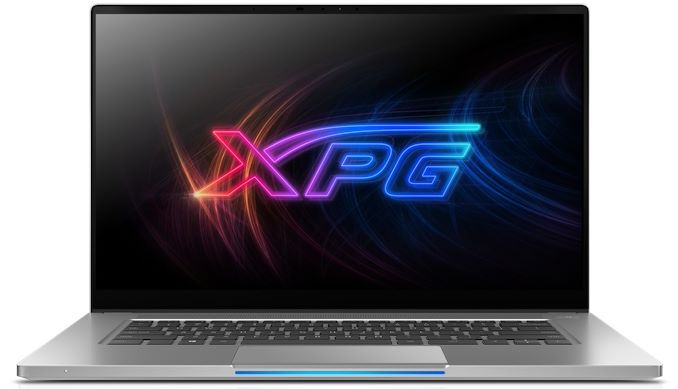
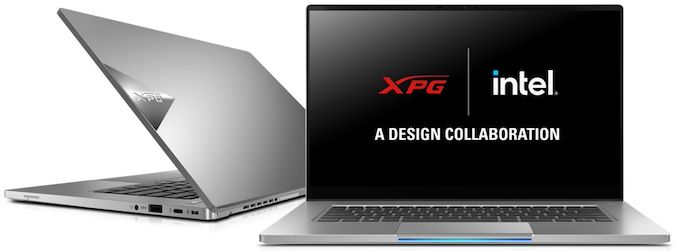
At CES 2021, which switched to a virtual online-only format due to the current Coronavirus pandemic, ADATA has unveiled its latest gaming ultrabook, the XPG Xenia Xe. Based on Intel’s Tiger Lake CPU with Xe graphics, the XPG Xenia Xe looks to offer users a portable lifestyle and gaming solution.


The new XPG Xenia Xe gaming ultrabook includes a 15.6″ 1080p screen, with an IPS touchscreen panel with an 87% screen to body ratio. Available with two different processors, Intel’s Tiger Lake Core i7-1165G7, or the i5-1135G7, it also benefits from Intel’s latest Xe integrated graphics.


Designed for ultra-portability, it measures in at just 11 mm thick, with a total weight of 3.6 lb, making it one of the more lightweight options and has an elegant CNC anodized aluminum chassis. For storage, XPG states that it includes its own 1 TB PCIe Gen 4 M.2 SSD, but XPG doesn’t include any information about memory configuration.


XPG hasn’t revealed details on pricing or when the Xenia Xe gaming ultrabooks will hit retail shelves.


Interested in more of the latest industry news? Check out our CES 2021 trade show landing page!


Source: AnandTech – CES 2021: ADATA Announces XPG Xenia Xe Gaming Ultrabook

NVIDIA Reveals GeForce RTX 3060: Launching Late February For $329

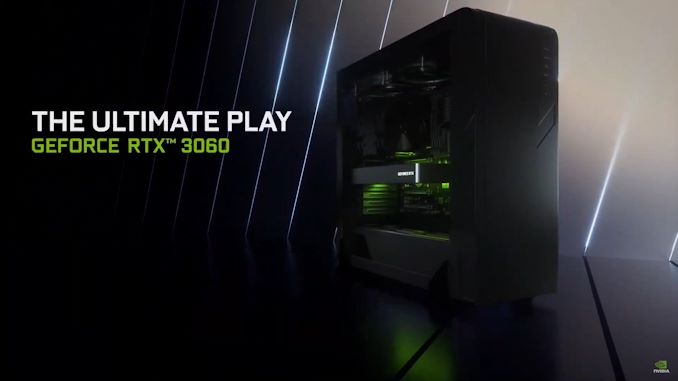
Alongside today’s CES-centric announcement of their new GeForce RTX 30 series parts for laptops, NVIDIA also offered an in-depth reveal of their next desktop graphics card, the GeForce RTX 3060. Reflected the continued progression of the Ampere architecture into smaller and cheaper video cards as NVIDIA continues its product stack rollout, the RTX 3060 marks the introduction of Ampere into their popular mainstream-enthusiast 60-series video card tier. Long the backbone of NVIDIA’s desktop sales in North America and elsewhere, the 60-tier cards typically strike a solid balance between price and performance. And with prices set to start at $329, at launch the RTX 3060 will become the cheapest RTX card that NVIDIA has ever offered.


Source: AnandTech – NVIDIA Reveals GeForce RTX 3060: Launching Late February For 9

NVIDIA Announces GeForce RTX 30 Series for Laptops: Mobile Ampere Available Jan. 26th

As the cornerstone of their CES 2021 keynote, NVIDIA today has announced their GeForce RTX 30 series graphics adapters for laptops. Based on the same Ampere architecture and the same GPUs as NVIDIA’s existing desktop GeForce cards, the RTX 30 series for laptops will bring Ampere’s features and much of its performance to laptops, just tuned to the sub-150 Watt power requirements that come with a laptop. Laptops will be getting versions of the RTX 3080, RTX 3070, and RTX 3060, with the first of these new generation of laptops set to become available later this month, on January 26th.


Source: AnandTech – NVIDIA Announces GeForce RTX 30 Series for Laptops: Mobile Ampere Available Jan. 26th

AMD CEO Dr. Lisa Su: Interview on 2021 Demand, Supply, Tariffs, Xilinx, and EPYC

Following the keynote press conference, AMD invited a number of key press partners for some Q&A time with Dr. Lisa Su. On the table, we were told, was any topic relating to AMD. Given that the company launched a number of products just as the previous year ended, and supply issues are tight for end-users, there were opportunities to quiz the CEO on production demand against supply, AMD’s product cadence, and expectations for 2021.


Source: AnandTech – AMD CEO Dr. Lisa Su: Interview on 2021 Demand, Supply, Tariffs, Xilinx, and EPYC

CES 2021: ASUS ROG Zephyrus G15 With Next Gen AMD Ryzen Mobile

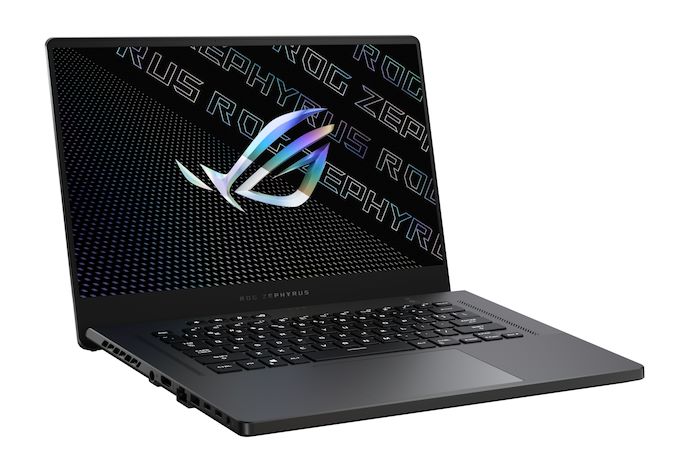
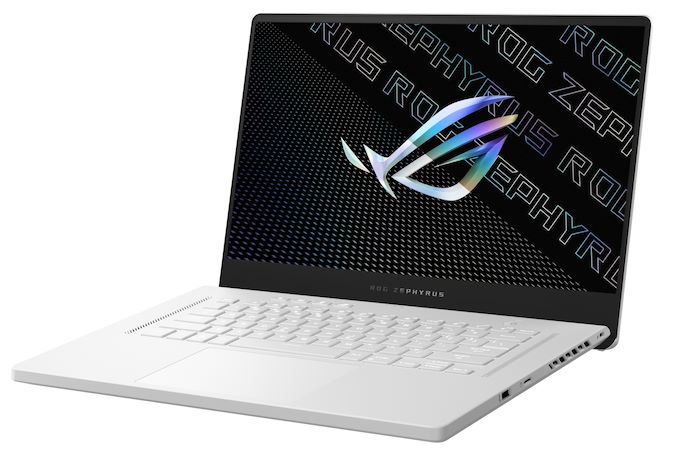
During the new CES 2021 digital event, ASUS lifted the lid on its new updated Zephyrus G15. Designed for gaming, the ROG Zephyrus G15 includes multiple configurations, with a 15.6″ screen with either a 1080p 144 Hz IPS or 1440p 165 Hz panel AMD’s next-generation Ryzen mobile processor.


ASUS has updated ROG Zephyrus G15 with some notable features, including a new 90 Wh battery with a 200 W AC charger. Still, it can be used with its 100 W Type-C charging adapter, which is available separately. ASUS advertises a 10-hour battery life. In terms of size, the ROG Zephrus has a depth of 19.9 mm and weighs just 1.9 KG, which is quite svelte for a gaming notebook.


ASUS ROG Zephyrus G15 2021 in Moonlight White


The ASUS ROG Zephyrus can be had with up to 32 GB of DDR4-3200 SDAM, with AMD’s upcoming next-generation Ryzen Mobile processors, and NVIDIA’s next-generation RTX mobile graphics. Storage options include either a 512 GB or 1 TB NVMe based PCIe 3.0 x4 M.2 drive, with a choice between a 1080p 144 Hz IPS or 1440p 165 Hz with 100% DCIP-3 color reproduction and up to 400 nits of brightness.


There are plenty of connections, including two USB 3.2 G2 Type-C, two USB 3.2 G1 Type-A, a DisplayPort 1.4, and HDMI 2.0b video output pairing, as well as a single 3.5 mm combo port and an RJ45 port with an unspecific networking controller. ASUS does, however, include a Wi-Fi 6 capable interface with support for BT 5.0 devices. Built into the G15 is a trio of microphones with three modes (Cardioid, Omni, and Stereo), six integrated speakers, with a 20% bigger touchpad than the Zephyrus 2020 G15 model. 


ASUS ROG Zephyrus G15 2021 in Eclipse Gray


ASUS hasn’t said when it intends to launch the ROG Zephyrus G15 2021 model, but it’s likely to coincide with an AMD announcement on its Ryzen 5000 H series mobile processors. The ROG Zephyrus G15 will also be available in two different colors, Eclipse Gray and Moonlight White.


Interested in more of the latest industry news? Check out our CES 2021 trade show landing page!


Source: AnandTech – CES 2021: ASUS ROG Zephyrus G15 With Next Gen AMD Ryzen Mobile

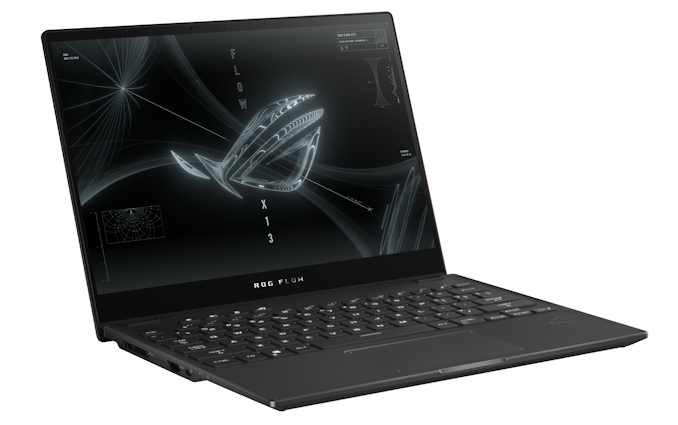
CES 2021: ASUS Unveils New ROG Flow X13 Convertable Gaming Notebook

At the all-digital CES 2021 event, ASUS has unveiled a brand new convertible 14″ gaming laptop, the ROG Flow X13. The Flow X13 can harness the power of AMD’s Ryzen 9 5980HS mobile processor, with an NVIDIA GeForce GTX 1650 graphics card, with a flippable 360° touch screen.


The ASUS ROG Flow X13 represents an interesting segue into the gaming capable convertible space. Some of its most notable design aspects revolve around the 13.4″ display, which has a 16:10 aspect ratio, with support for both touch and stylus input. The screen is coated with robust Corning Gorilla Glass, supports adaptive sync, and includes Pantone color validation. In terms of specification, the panel will be available with either 1080p 120 Hz or at 4K.


One of the biggest features includes its ability to convert into four different configurations on the fly, including a regular laptop, tablet, tent, and stand modes. Looking at the internals, the ROG Flow X13 will support up to and including the Ryzen 9 5980HS mobile processor, with up to and including NVIDIA GTX 1650 graphics. ASUS also states that it will be using AMD’s top binned CPUs for this model to ensure the best performance and highest quality silicon.


Another claim from ASUS is that the ROG Flow X13’s battery can hold out up to 18 hours, with 10 hours of expected battery life during continuous video playback. It comes supplied with its new 100 W USB Type-C PD charger that can charge an empty battery to 60% in around 39 minutes.


ASUS hasn’t revealed when the ROG Flow X13 will be available to buy and hasn’t supplied any pricing information.


Interested in more of the latest industry news? Check out our CES 2021 trade show landing page!


Source: AnandTech – CES 2021: ASUS Unveils New ROG Flow X13 Convertable Gaming Notebook

Razer Updates Blade 15 & Blade Pro 17 For 2021, Adds GeForce RTX 30 GPUs & More

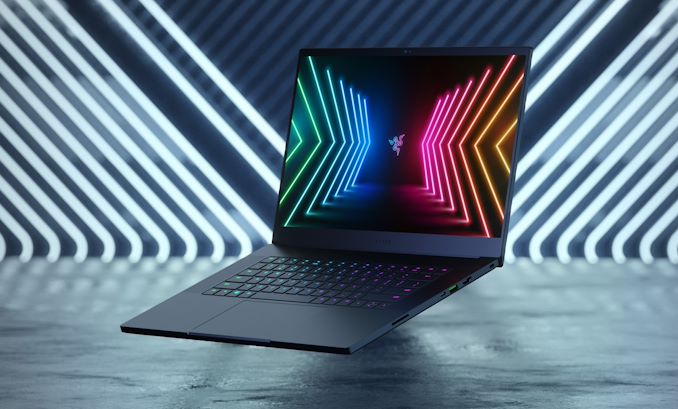
Following NVIDIA’s announcement of their new GeForce RTX 30 series mobile GPUs, Razer is among several laptop vendors today announcing new and updated laptops using the new hardware. Overall, the company is updating its Blade 15 and Blade Pro 17 laptop families to use the new GPUs, all the while the company is also making some updates to the other components they use, and even the Blades; chassis themselves.


Razer Blade 15 Base Model


We’ll start off with the 2021 Razer Blade 15, the latest iteration of Razer’s popular 15-inch gaming laptop.  As has been the case for a few years now, the Blade 15 is internally divided up into two models, the lower tier “Base Model” and higher tier “Advanced Model”, which in many respects are entirely different laptops. Along with the Advanced Model offering additional features, it also uses its own, typically thinner chassis, largely making it a separate model in its own right.
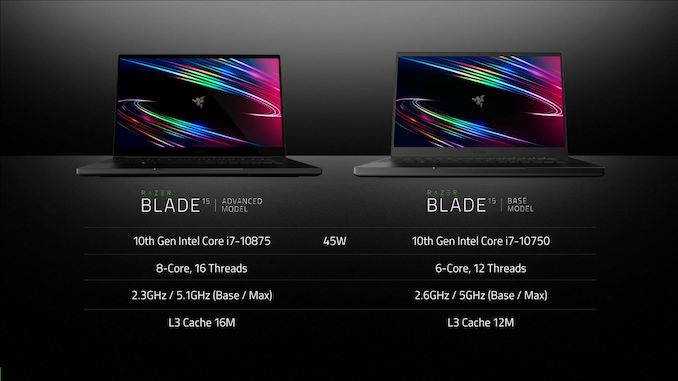


For the base model Blade 15, Razer is sticking with Intel’s 6-core i7-10750H processor as the heart of the machine. Graphics options for the laptop are either a GeForce RTX 3060 6GB or GeForce RTX 3070 8GB as an upgrade option, replacing the RTX 2070 used in the 2020 models. Meanwhile Razer is using DDR4-2933 memory for this laptop, and while 16GB is the only configuration they offer, the SO-DIMMs can be swapped out and the laptop supports up to 64GB of memory.
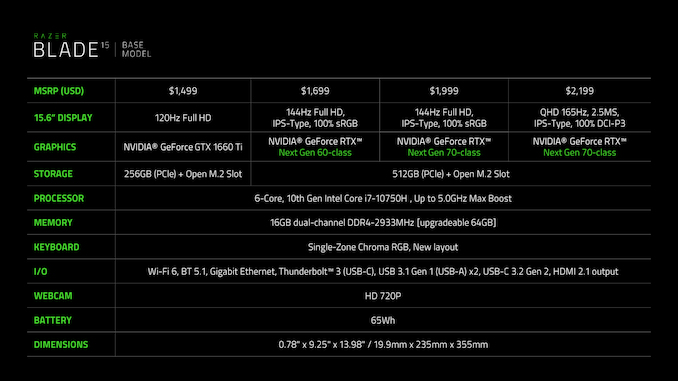


As for display options, Razer is now offering a new 144Hz 1080p panel as the minimum option for the 2021 models.  This IPS-type panel offers 100% coverage of the sRGB gamut (something the previous gen did not) and a matte finish. Meanwhile Razer also offers a 165Hz 1440p IPS-type panel which, along with the higher resolution, can also cover 100% of the DCI-P3 spectrum.  All of these display options come factory calibrated as well, though it’s worth noting that none of the base model panels come with variable refresh support.


For storage, the 2021 base model SKUs all include a 512GB M.2 NVMe SSD. This SSD is replaceable, and like last year’s version, well there’s a second open M.2 slot for adding a second drive altogether. If you need more storage past that, the laptops offer a Thunderbolt 3-enabled USB-C port, along with another USB-C (3.2 Gen 2) port, and a trio of 3.2 Gen 1 USB-A ports.


Razer is also once again using one of their Chroma RGB keyboards. This is a single-zone (rather than per-key) affair, though according to Razer, it does use a new layout. This fits into Razer’s 19.9mm thick aluminum chassis, which has been carried over from their 2020 models. So has its 65Whr battery, which although won’t be enough for long gaming sessions away from a power outlet, is more than enough to drive the laptop for productivity tasks for quite some time.


Rounding out the package, Razer supports the usual networking standards. Along with Wi-Fi 6 support via an Intel AX201 adapter, the laptop also supports Bluetooth 5.1, and even comes with a Gigabit Ethernet jack for hardwired connections. Surprisingly, Razer also supports HDMI 2.1 out, indicating that even though the laptop is using NVIDIA’s Optimus technology, they’ve still hardwired the HDMI port directly to the NVIDIA GPU.


The 2021 Razer Blade 15 Base Model will start at $1699, with pre-orders starting today and will be on-sale/shipping on January 26th.


Razer Blade 15 Advanced Model


Moving up a level, we have the Razer Blade 15 Advanced Model. Which as alluded to earlier, is in several respects a significant step up from the base model in terms of features and performance.
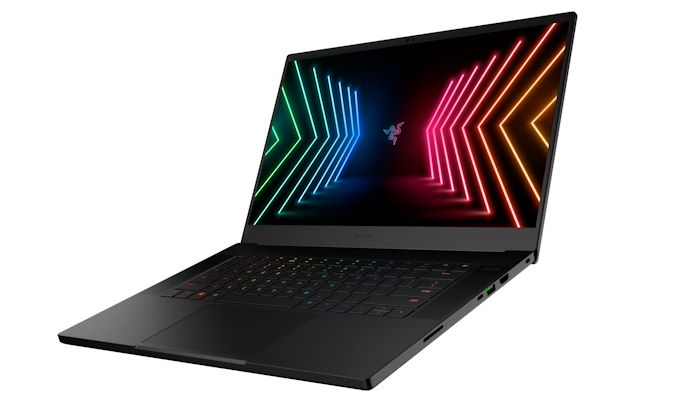


The Blade 15 Advanced Model is built around a full 8-core 10th gen Intel processor, specifically the i7-10875H. Razer is pairing this with NVIDIA’s GeForce RTX 3070 and 3080 laptop adapters, with the highest SKU going half a step further and offering a 16GB version of the 3080 rather than the standard 8GB version. This configuration replaces the RTX 2070 Super/2080 Super from the 2020 models.
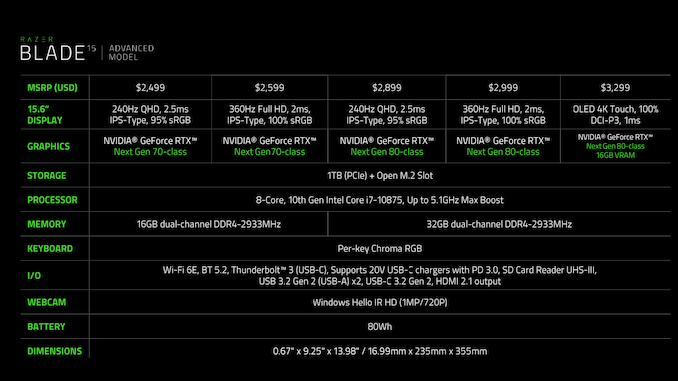


Included memory will depend on the specific laptop SKU; the cheaper models come with 16GB in two DDR4-2933 DIMMs, while the higher-end models come with 32GB of that memory. As with the base model, the machine can be upgraded to hold 64GB altogether.


For display options, Razer is offering no less than three different choices here. The base option for the cheapest Blade 15 Advanced SKU is a 240Hz 1440p IPS-type panel, which can cover 95% of the sRGB spectrum. This also happens to be the only panel with G-Sync support among all of Razer’s options, giving this laptop the best chance to comfortably game at 1440p. Alternatively, Razer also offers a 360Hz 1080p panel for the very fastest refresh rates (G-Sync need not apply), or as a high-resolution option the company is once again offering a 4K OLED touch panel, which is capable of covering 100% of the DCI-P3 spectrum and supports HDR as well.
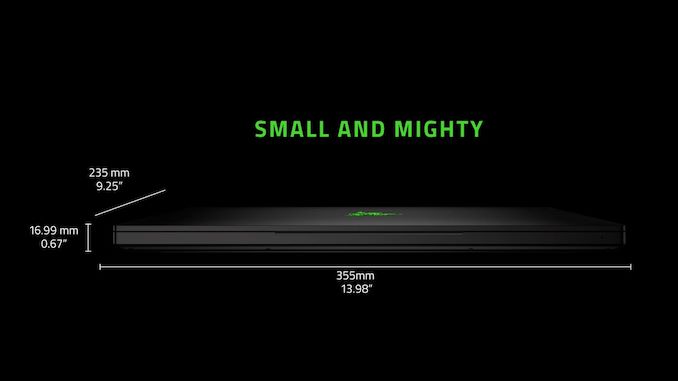


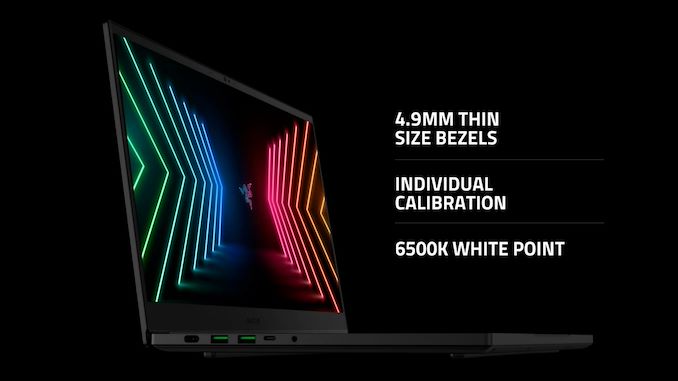
All of this is going into a new chassis for the Blade 15 Advanced, which has seen Razer rework the laptop’s aluminum body to make it even thinner – now it’s just 16.99mm thick – while improving its expandability. The new chassis isn’t a remarkable departure from the old one, but it gives Razer claim to shipping the smallest 15-inch RTX gaming laptop, and more importantly, it opens up space for things like a second M.2 slot.
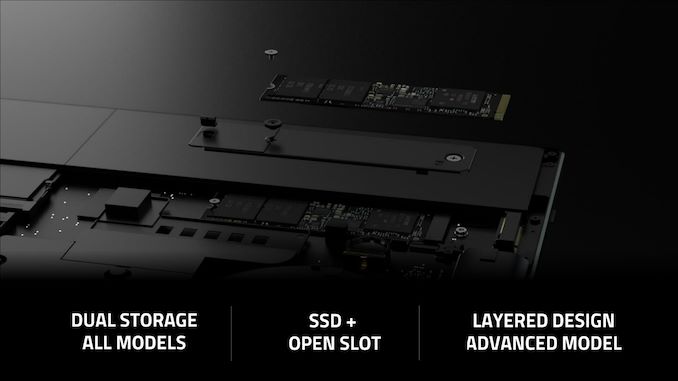


Which brings us to storage: the Blade 15 Advanced ships with a 1TB NVMe M.2 drive, and for the first time for the Advanced Model, also includes a second empty M.2 slot for another drive. To accomplish this, Razer has opted to stack the second SSD on top of the first one, owing to the space constraints of the laptop.


Fitting for the advanced model, this laptop comes with a per-key LED version of Razer’s Chroma RGB keyboard. And in case you like making faces at your laptop, it also packs in an IR camera for Windows Hello login support.
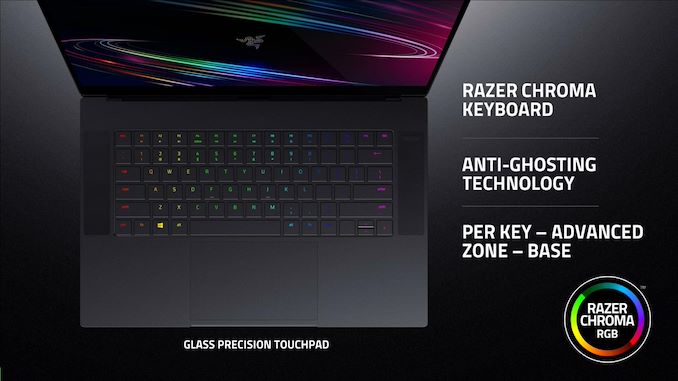


Rounding out the package, for wired connectivity the Advanced Model comes with a Thunderbolt 3-enabled USB-C port, a second USB-C port, and trio of USB-A ports. An HDMI 2.1 port is also present, and while the Advanced Model drops the Gigabit Ethernet port, it picks up an SD card reader instead. Meanwhile wireless support is provided via Intel’s new AX210 adapter, offering Wi-Fi6E as well as Bluetooth 5.2.


Finally, this is the only version of the Blade 15 family that supports charging over a USB-C port. To be sure, the entire Blade 15 family comes with a 230W proprietary adapter, so the max 100W offered by USB-C isn’t enough to charge the laptop at its full rate. But it’s more than enough to keep it powered under non-gaming scenarios, or charge the 80Whr battery in a reasonable period of time.


The 2021 Razer Blade 15 Advanced Model will start at $2499, with pre-orders starting today for shipment in February.


Razer Blade Pro 17


Last but not least, Razer is also updating their largest laptop, the Blade Pro 17. This is a slightly more straightforward update than the Blade 15 – there’s no new chassis involved – but it’s getting the same treatment in terms of upgrading the graphics and display options.
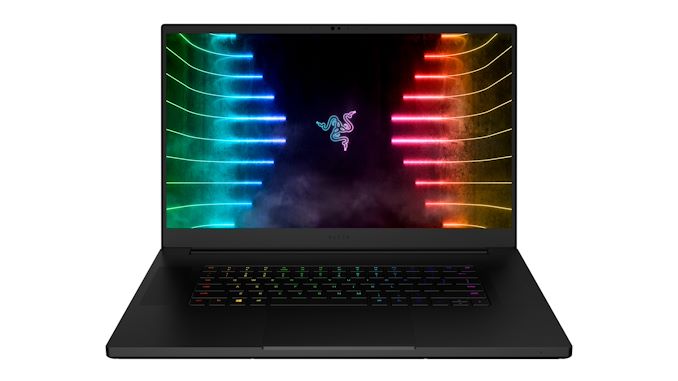


Built around the same 8-core i7-10875H as the 2020 model, the 2021 model replaces its GeForce RTX 2070/2080 graphics options with the new GeForce RTX 3060/3070/3080 adapters. As with the Blade 15 Advanced, the highest-end SKU gets 16GB of memory to go with its RTX 3080, while all the other SKUs come with 8GB or 6GB of VRAM respectively.
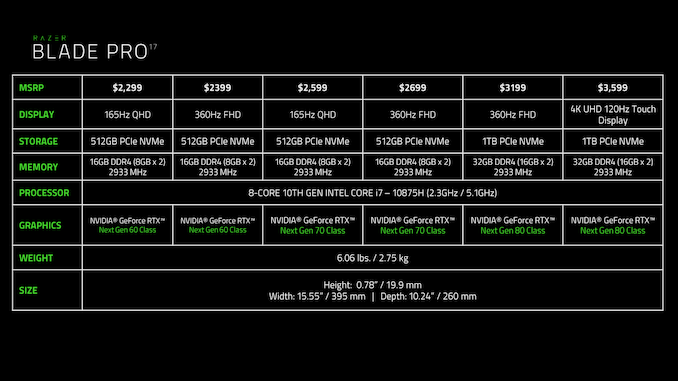


Meanwhile, memory and storage options remain virtually unchanged from the past generation. Lower-end SKUs come with 16GB of DDR4-2933 in two DIMMs, and higher-end SKUs come with 32GB. Similarly, storage is split between 512GB M.2 NVMe drives on some SKUs, and 1TB on others. And of course, the Blade Pro 17 features an open M.2 slot for another drive.


For display options, Razer is expanding their options on the Blade Pro 17 slightly, including a middle-tier 1440p display option to compliment their existing 1080p and 4K displays. At the lower-end is a 360Hz 1080p 17.3-inch IPS-type display, which can cover 100% of the sRGB spectrum. Above that is the 165Hz 1440p IPS-type display, which again offers 100% sRGB coverage. And finally, Razer will once again offer a 4K IPS-type panel, which unique among the options offers touch screen support as well as 100% Adobe RGB coverage.
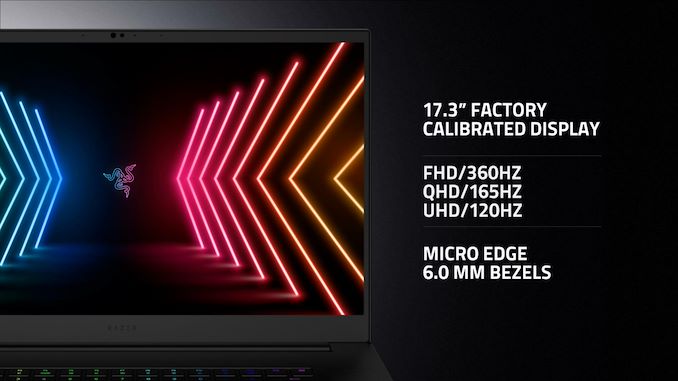


All of the Blade Pro 17 SKUs will feature a per-key lighting version of Razer’s Chroma RGB keyboard, as well as an IR camera for Windows Hello. All models also feature Intel’s AX210 adapter, offering Wi-Fi6E as well as Bluetooth 5.2.


As for ports, the Blade Pro 17 offers a Thunderbolt-3 enabled USB-C port, another USB-C port, three USB-A ports, an HSMI 2.1 port, and a SD card reader. The laptop also surprisingly offers a 2.5 Gigabit Ethernet port for wired networking, and marking the first time I’ve seen a 2.5GbE port on a laptop.
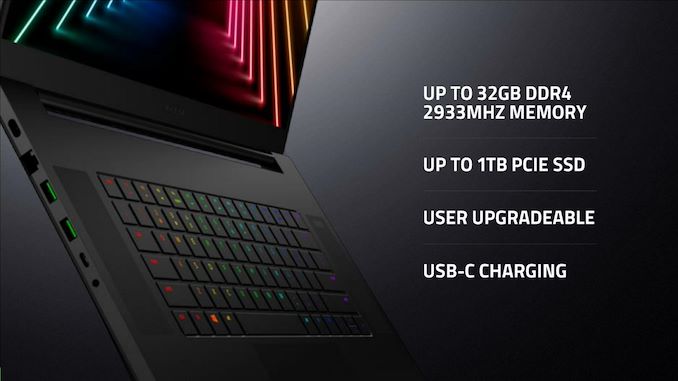


The 2021 Razer Blade Pro 17 will start at $2299, with pre-orders opening up today and orders shipping sometime later in Q1.


Source: AnandTech – Razer Updates Blade 15 & Blade Pro 17 For 2021, Adds GeForce RTX 30 GPUs & More

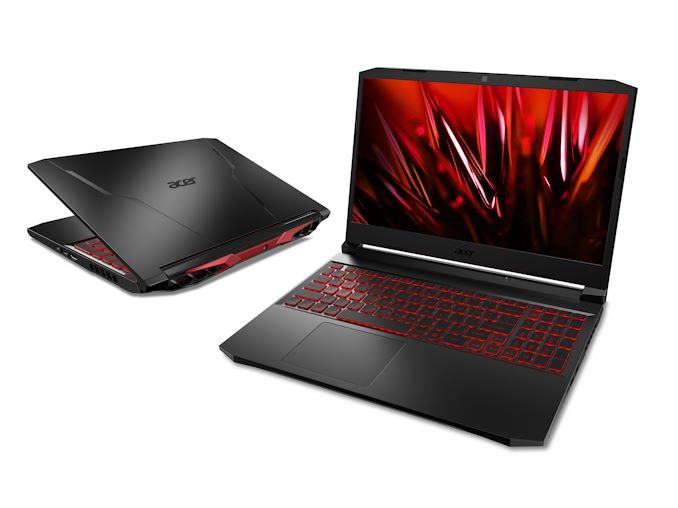
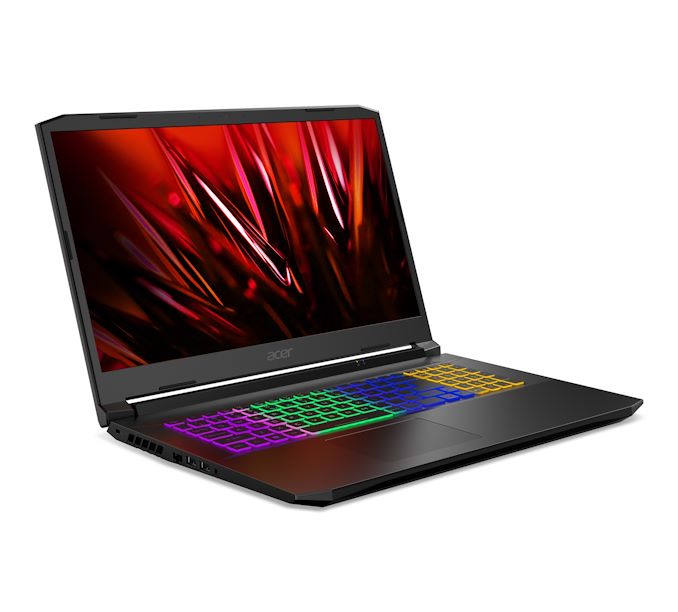
Acer at CES 2021: Gaming Laptops Update With Intel, AMD, and NVIDIA Refreshes

Today at CES, Acer is announcing some refreshes of their gaming lineup as well as a brand-new compact gaming notebook. Acer has been a close partner with AMD over the last several years, and they are one of the first to announce new devices based on the Ryzen 5000 laptop APU, as well as updates to their Intel fleet thanks to the launch of the new Tiger Lake H-Series. Finally, thanks to the launch of NVIDIA’s RTX 3000 series for notebooks, graphics are getting a refresh across the board.


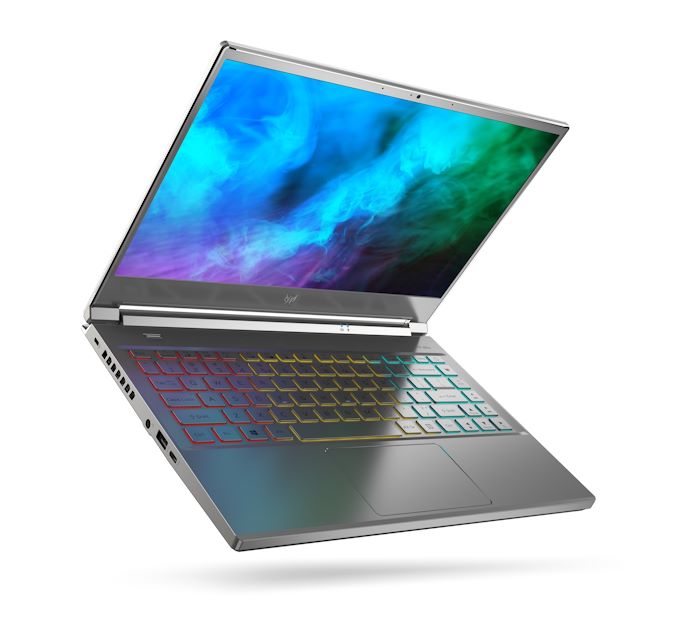
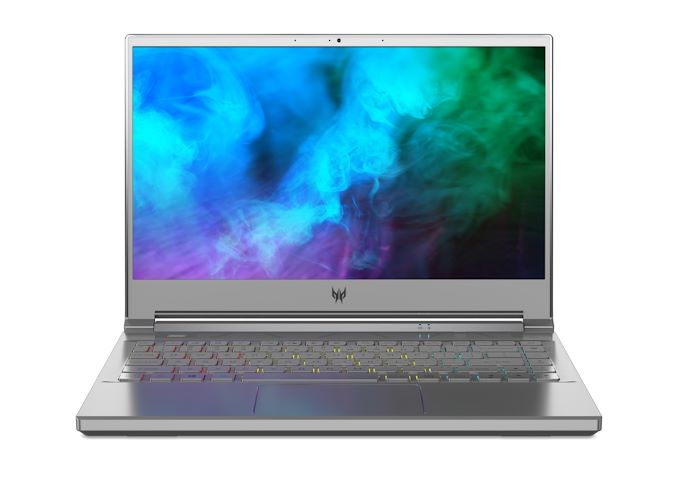
Predator Triton 300 SE


First up is the all-new Acer Predator Triton 300 SE, with the SE standing for Special Edition. This is Acer’s first gaming laptop to offer a 14-inch display, fitting it under the Triton 500 and Triton 700 in their lineup. The SE is also Acer’s first laptop to feature a sandblasted and anodized aluminum exterior, devoid of the typical gaming accoutrements such as large logos and flashy colors. The Predator Triton 300 SE is a sleeper with very subdued styling, but still packing a punch.


Powering the latest in the Triton series of thin and light gaming laptops is the just announced Intel H35 Tiger Lake processors, with up to the Core i7 with 5.0 GHz on the latest 10 nm node from Intel. Acer offers up to 24 GB of RAM, with 8 GB soldered in and one free SODIMM for upgradable memory. For graphics, Acer has turned to the latest and greatest NVIDIA RTX 3060 which should be plenty to power the 14-inch 1920×1080 144 Hz IPS display. On storage, Acer will offer up to 1 TB of PCIe 3.0 NVMe.


The new Predator Triton 300 SE is also one of the first laptops on the market to support NVIDIA’s Advanced Optimus, which means the display can offer variable refresh rates while still allowing the integrated GPU to be used for battery-sensitive workloads. Previously Acer supported a multiplexer on the Triton lineup, but users had to reboot to switch from Optimus to G-SYNC, so moving to Advanced Optimus is a big win for usability.


Despite the powerful internals, the Predator Triton 300 SE is not much larger than a typical 14-inch notebook, at just 0.7 inches thick and weighing just 3.75 lbs. Coupled with the subdued styling, and Acer is hoping to see a wider audience interested in their new design.


As far as cooling, which is always a challenge in a thin and light gaming system, Acer has moved to their fifth generation Aeroblade 3D fans, featuring thinner fan blades at just 0.8 mm, and 89 blades per fan, but to keep noise in check they have implemented a ring design to reduce turbulence. This is coupled with distinct heat zones, with foam insulation between them to keep the heat moving in the direction desired and out of the laptop. Acer’s Predator Sense software has a specific quiet setting as well to let the laptop be used in a productivity environment.

Rounding out the new laptop is Wi-Fi 6 based on the Killer (owned by Intel) NIC, and the Killer software is integrated into Acer’s Predator Sense suite. There is a Thunderbolt 4 port as well, and Acer has added a fingerprint reader into the glass trackpad.


The new Acer Predator Triton 300 SE will be available in March starting at $1399.99 USD.


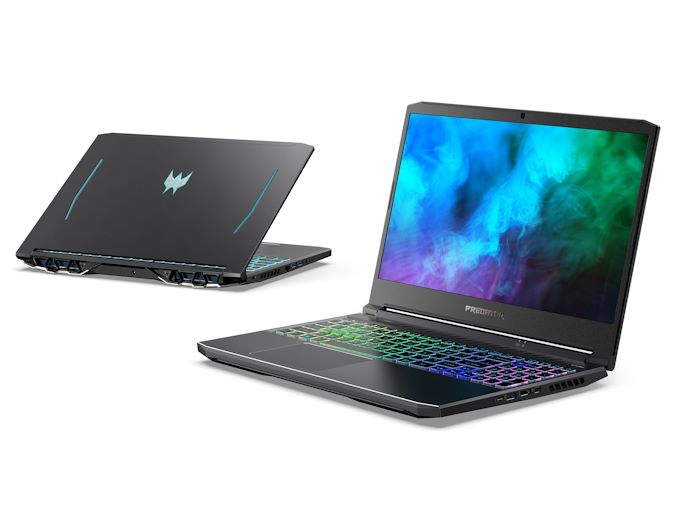
Predator Helios 300


Getting a mild refresh is the Predator Helios 300, which is moving up to the latest NVIDIA GPUs, all the way to RTX 3080. Otherwise this 15.6-inch gaming notebook remains relatively unchanged, and still features the 10th Gen Intel Core H-Series processors, and a 144 Hz IPS 1920×1080 display.


The Acer Predator Helios 300 will be available in February, starting at $1249.99 USD.


Nitro 5


We’ve reviewed several of the Acer Nitro 5 models, and the latest featured the AMD Ryzen 4000 series “Renoir” processors. Although definitely in the budget space, the Nitro 5 delivered excellent performance for the money, and should be on the short list for anyone looking for a budget gaming laptop. At CES today, Acer is announcing a refresh of the Nitro 5 to now include the latest AMD Ryzen 5000 series APUs as well as Intel Tiger Lake based models.


The Nitro 5 lineup is also expanding, and Acer has seen strong demand for more powerful versions of their least-expensive gaming system. The Nitro 5 will be available in both 15.6 and 17.3-inch sizes, and both will offer a base 1920×1080 60 Hz display, with 144 hz and 360 Hz available, and there will also be a 2560×1440 144Hz offering.


On the graphics side, Acer is sticking with the NVIDIA GeForce GTX 1650 at the low end, but massively bumping the high end of the Nitro lineup all the way to the RTX 3080. On the CPU front, Ryzen 5 5600H will be the low end, with some Intel Tiger Lake in the middle, and the Ryzen 9 5900HX at the top.


Despite the powerful internals, Acer claims a 10-hour battery life on the 15.6-inch model, and a 9-hour battery life on the 17.3-inch.


The price range for the Nitro 5 is very wide too, with the base system featuring a Ryzen 5 5600H, 8 GB of RAM in single channel but with a free SODIMM slot, 256 GB SSD, and a GeForce GTX 1650 for $749, but the top of the range Nitro 5 will come in at a staggering $2299. Acer is hoping to capture interest in the crowd who cherish performance over a more expensive design, and it has worked well for them with Nitro 5 so far.


The refreshed Acer Nitro 5 will be available in some regions beginning in March.


Source: Acer


Source: AnandTech – Acer at CES 2021: Gaming Laptops Update With Intel, AMD, and NVIDIA Refreshes

AMD Opens Up Threadripper Pro: Three New WRX80 Motherboards

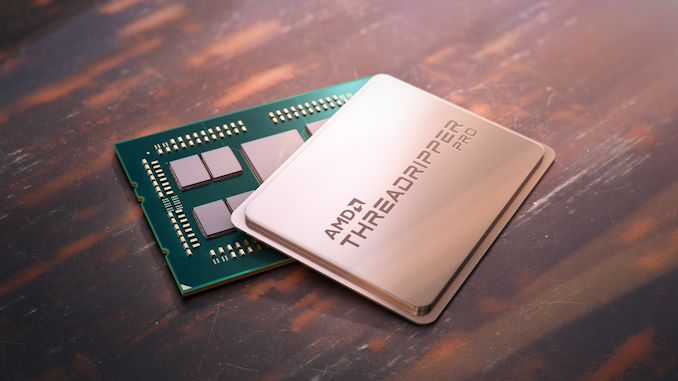
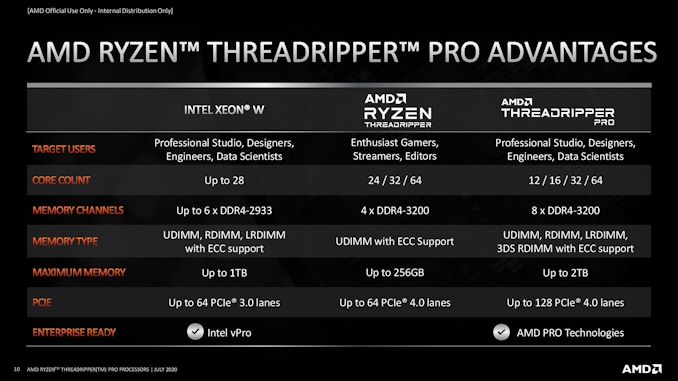
Stepping out of its supposed ‘exclusivity deal’ with Lenovo, who had the first rights to Threadripper Pro in the ThinkStation P620, motherboard vendors have started showing off some of its WRX80 motherboard models designed for AMD’s Ryzen Threadripper Pro processors. Some of the benefits of the new platform over standard Threadripper include eight-channel memory and up to 128 x PCIe 4.0 lanes, which is double that of the non-Pro variants. While this sounds like EPYC, it sits between the two with only 2 TB DRAM support. It’s time to showcase what we know, including three new models based on the WRX80 chipset.


The AMD WRX80 chipset benefits from eight-channel memory for increased bandwidth when compared to quad-channel Threadrippers and dual-channel Ryzen configurations, with capacity for up to 2 TB when used with DDR4 LRDIMM memory. It also includes support for both ECC and non-ECC memory at DDR4-3200. The biggest jump in regards to specification compared to regular TR is in its PCIe support, with up to 128 PCIe 4.0 lanes available, which in turn increases the amount of PCIe slot real estate vendors can use. 


Patrick Kennedy from ServeTheHome has affectionately called this platform ‘WEPYC’, as in ‘Workstation EPYC’, as it is more like an EPYC than it is a Threadripper.


Supermicro M12SWA-TF


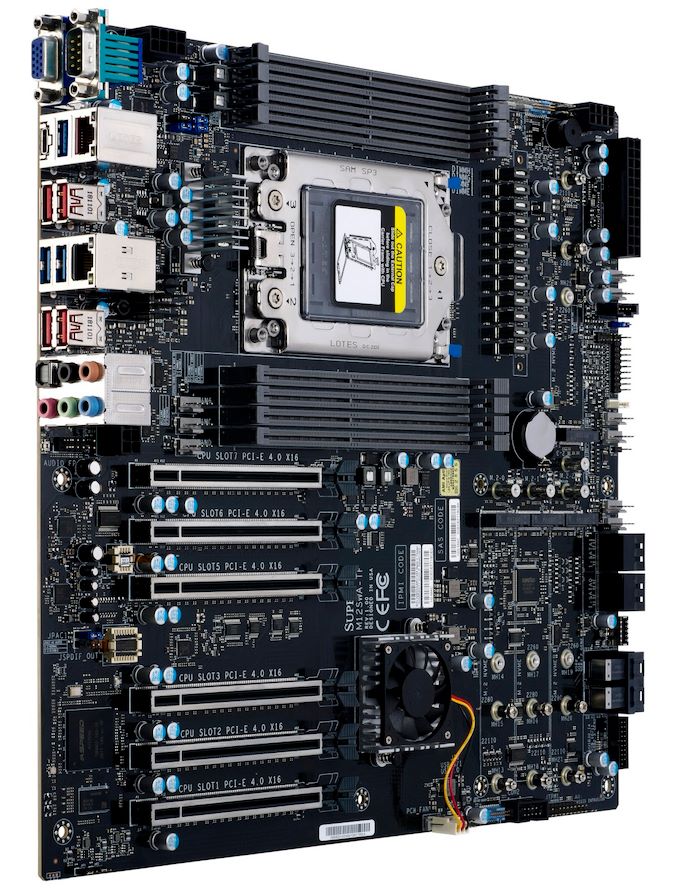
The Supermicro M12SWA-TF is dominated by its transposed sWRX8 socket (LGA 4094) and includes eight horizontal memory slots, with support for up to 1 TB of DDR4-3200. The Supermicro has support for AMD Ryzen Threadripper Pro processors up to 64 cores, including the entry-level 16 core variant. It is using an all-black PCB, with a cooling fan attached to the heatsink, with HEDT chipsets having a tendency to run quite warm. This will be even more apparent with PCIe 4.0 lanes over passively cooled options that use PCIe 3.0. 


It is E-ATX in size, which is fully utilized with an impressive six full-length PCIe 4.0 x16 slots. This includes support for two triple-slot or three dual-slot graphics cards, which will depend on the configuration a user opts for. For storage, the M12SWA-TF includes four SATA ports and four PCIe 4.0 x4 M.2 slots that include support for RAID 0, 1, 5, and 10 arrays. Supermicro has also incorporated two PCIe 4.0 U.2 slots, with support for just RAID 0 and 1 arrays. The M12SWA-TF also uses an ASpeed’s 7th generation AST2600 BMC controller with one D-sub video output on the rear for physical IPMI access. (Ian: Oooh, AST2600 is new, isn’t it?)


The board also includes support for up to five USB 3.2 G2 ports, with four Type-A and one Type-C, and five USB 3.2 G1 Type-A ports including a mixture of support on the rear panel and through internal headers. There’s also two USB 2.0 ports available, with ten 4-pin fan headers, including two for CPU fans and eight for chassis fans. Supermicro is using Realtek’s new and unannounced ALC4050 HD audio codec, with a secondary ALC1220 codec. Networking support includes two RJ45 ports, including one powered by an Aquantia AQC113C 10 GbE controller, with an Intel I120-AT Gigabit controller also allowing for IPMI access.


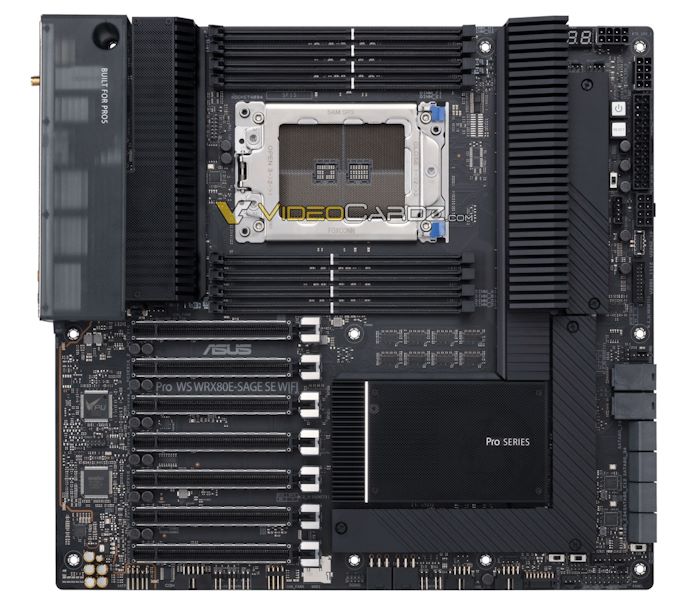
ASUS WRX80 Pro WS Sage SE WIFI


Another model expected for AMD’s Ryzen Threadripper Pro is the ASUS WRX80 Pro Sage SE WIFI. While we don’t have any technical information and specifications from ASUS itself, we do have an image of it that VideoCardz reported on. There’s a lot to go on from just the image, and it looks as though ASUS will fully utilize all of the PCIe 4.0 lanes from Threadripper Pro.


The ASUS WRX80 Pro WS Sage SE WIFI is using seven full-length PCIe 4.0 x16 slots, with eight memory slots in two banks of four flanking the transposed LGA 4094 socket. The design includes an all-black PCB, with contrasting black heatsinks for the chipset, M.2 slots, and power delivery. The memory will operate at 1PDC, with eight slots likely to offer similar memory support to Supermicro’s M12SWA-TF model, although we will find out more when ASUS officially unveils it.


We do know that the WRX80 Pro will include Wi-Fi capabilities, most likely using one of Intel’s Wi-Fi 6 interfaces. From the design, it looks like it will include eight SATA, three PCIe 4.0 x4 M.2, and two PCIe 4.0 x4 U.2 ports for storage, but hopefully, ASUS will shed more light on the official specifications soon.


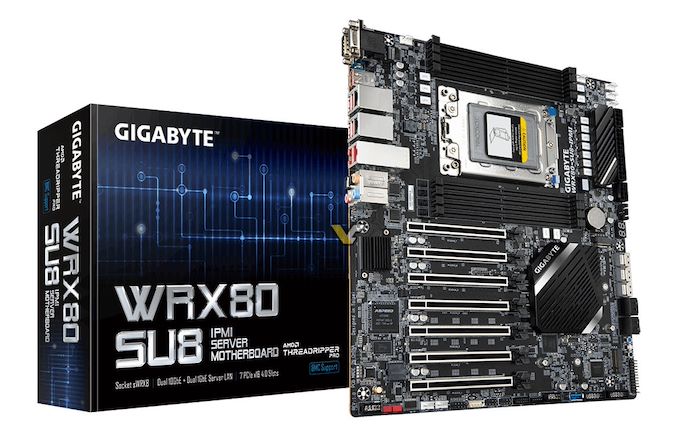
GIGABYTE WRX80 SU8


Based upon a leak from VideoCardz, GIGABYTE is also joining the fray with its WRX80 SU8 model. As it stands, we don’t have official specifications or any details from GIGABYTE itself, it looks to be using a large PCB, likely EEB form factor from what we can see. Like the other WRX80 models, the GIGABYTE includes eight memory slots for eight-channel memory, with ECC and non-ECC types supported. The slots are split into two pairs of four and are horizontally aligned which surrounds the transposed LGA 4094 socket.


The GIGABYTE WRX80 SU8 includes seven full-length PCIe 4.0 x16 slots, with a large chipset heatsink on the right-hand side. While it’s difficult to determine a lot of the storage specifications from the image we have from VideoCardz, we can see it may include three to four Ethernet ports on the rear panel. 


Overall


In speaking with one of the vendors, their main market is going to be system integrators – people who build and sell workstations. I contacted a high-end system integrator and confirmed that they are building a TR Pro machine, although it is very much still a work in process. The vendor, when asked about on-shelf availability, said that they don’t particularly plan on doing a full retail packaging, but should AMD push the TR Pro CPUs into the consumer channel, they will prepare the appropriate boxing. In that light, as it stands, it looks like it will depend on AMD to decide if they want to enable the regular consumer retail channel.


At this time, we don’t have any information on pricing or when the aforementioned WRX80 models for AMD’s Ryzen Threadripper Pro will be launched. 


Interested in more of the latest industry news? Check out our CES 2021 trade show landing page!


Source: AnandTech – AMD Opens Up Threadripper Pro: Three New WRX80 Motherboards

AMD to Launch Mid-Range RDNA 2 Desktop Graphics in First Half 2021

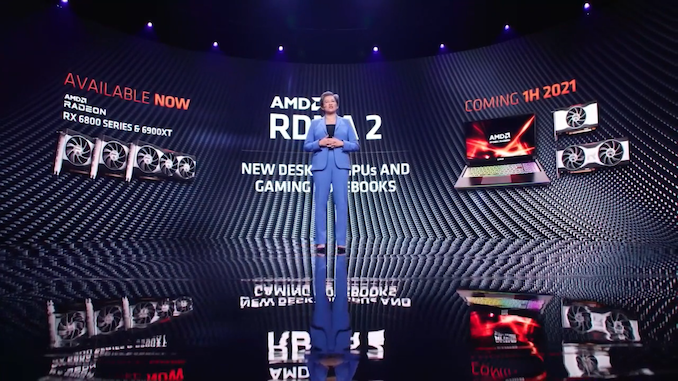
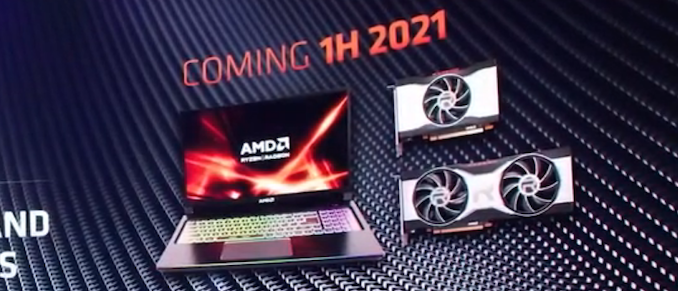
The recent launches of high-end graphics cards from both sides of the aisle has left a number of questions on the table about what will be offered for those of us unwilling or unable to either find $400+ for the latest generation (or more due to low stock pressure). Both AMD and NVIDIA have focused, naturally, on the high-end of the market as that is where a good chunk of the revenue is, however we are waiting for both companies to filter the latest technology into something a little more mainstream. Neither company had said anything about their plans here, until AMD’s keynote at CES today.


The company looks set to bring to market RDNA 2 solutions for mid-range desktop discrete graphics cards models in the first half of 2021 (H1 2021). Based on the images showcased during AMD’s presentation, compared to the current RDNA 2 solutions, these cards appear to be less bulky, along with versions that only need a single fan.


These are almost certainly built on new silicon – rather than the Navi 21 GPUs used in their 6800 series cards, perhaps something like Navi 23, with cut down compute units and/or memory support. There are also questions as to the state of AMD’s Infinity Cache on these lower models, whether it still exists or is reduced, and then how that all ties into performance, power, efficiency, and then ultimately cost. All RDNA 2 hardware supports DX12 Ultimate, and all that entails.


AMD is keeping tight lipped at this time, however AMD did mentioned that mobile graphics solutions will also be coming to market in the first half of the year.


Source: AnandTech – AMD to Launch Mid-Range RDNA 2 Desktop Graphics in First Half 2021

AMD Previews 3rd Gen EPYC ‘Milan’ Performance

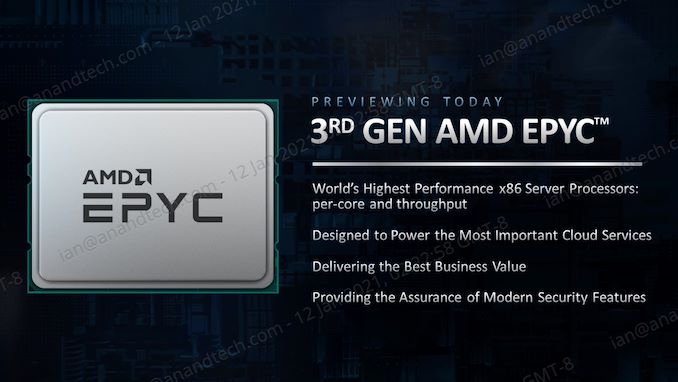
Since the announcement of AMD’s Zen 3 core microarchitecture, we’ve been expecting three series of products to be announced: desktop Ryzen, mobile Ryzen, and enterprise EPYC. So far the desktop parts are now launched and at retail (if you can find them), and the mobile Ryzen processors are part of AMD’s CES disclosures this week for retail in February. That only leaves Zen 3-based EPYC, which AMD has decided to preview as part of its CES keynote presentation today.


As far as the design of Zen 3 EPYC ‘Milan’ processors go, we are expecting an almost seemless transition from the previous Zen 2 EPYC ‘Rome’ ecosystem, with pin-compatible processors offering up to 64 cores and with 128 PCIe 4.0 lanes. For performance, if the desktop processors are anything to go by, we should expect to see +19% IPC gains as well. The question remains as to frequencies and efficiency, and when the time comes for AMD to announce the product stack, we will see where the solution lies relative to the competition – should AMD have a significant competitive advantage, no doubt prices will rise in line as well. The previous generation EPYC 7742 had a ‘list price’ of $6950 for comparison.


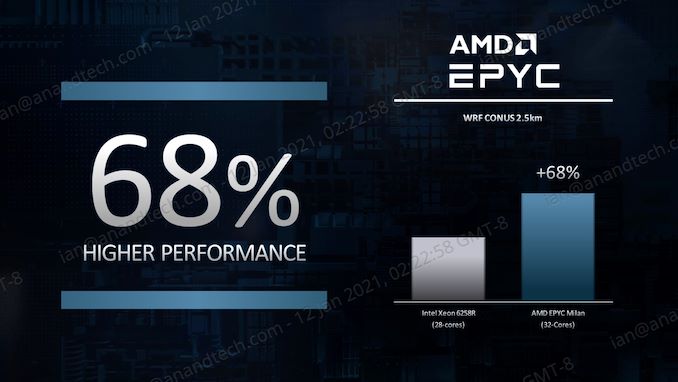
In today’s keynote presentation, AMD CEO Dr. Lisa Su showcased weather prediction simulation code known as WRF, with two of the new 32-core Milan processors up against Intel’s popular 28-core Xeon Gold 6258R (we’ve reviewed these). The demo showcased simulating a 6 hour weather pattern over the continental US, to which dual socket Milan was 46% faster than Intel. This was computed based on the final frame cut-away from the simulation in the keynote, which showed that where Intel was 56% complete, AMD was 82% complete.


+68% for single socket, +46% for dual socket


AMD’s own metric then showed a +68% difference when comparing a single socket solution. AMD did not provide exact details on the rest of the system used in their testing. It should be clear that because this is a preview, we cannot validate AMD’s performance claims.


We are expecting more details about Milan and AMD’s portfolio later this year. Sooner rather than later.


Source: AnandTech – AMD Previews 3rd Gen EPYC ‘Milan’ Performance

AMD Launches Ryzen 5000 Mobile: Zen 3 and Cezanne for Notebooks

It has been a year since AMD launched its previous generation Ryzen Mobile processors. At the time, the update from Zen to Zen 2, as well as moving to TSMC’s 7nm manufacturing process, gave the company the biggest boost in its notebook performance and battery life in AMD’s history. It’s difficult to reinvent the wheel again, but AMD is hoping that its new Ryzen 5000 Mobile processors build on the momentum that started last year. The new processor line-up has 13 new models, targeting the traditional U-series and H-series markets, as well as a couple of new areas AMD is looking to expand into.


Source: AnandTech – AMD Launches Ryzen 5000 Mobile: Zen 3 and Cezanne for Notebooks

The NVIDIA GeForce CES 2021 Live Blog: Game On

Kicking off in a few minutes is NVIDIA’s keynote for CES 2021. Dubbed “GeForce RTX: Game On”, the keynote is going to be presented by Jeff Fisher, NVIDIA’s Senior VP for GeForce.


NVIDIA has not given us any concrete messages about what to expect from today’s hour-long keynote, but based on some of their teasers in the last few days, it looks like we’re in store for the launch of NVIDIA’s GeForce RTX 30 series laptop parts, which typically follow NVIDIA’s desktop parts by a few months. Despite its scaled-down size, CES this year has been a big event for laptop news, so new laptop GPUs would fit right in for today’s news.


Join us at 9am PT (17:00 UTC) for our full live blog coverage of NVIDIA’s latest GeForce event!


Source: AnandTech – The NVIDIA GeForce CES 2021 Live Blog: Game On

Samsung Confirms AMD RDNA GPU In Next Exynos Flagship

Today during the Exynos 2100 launch event, Samsung’s Dr. Inyup Kang, VP and GM of the System LSI division, confirmed that their partnership with AMD on integrating a next-generation RDNA based GPU will be coming to fruition with the next generation flagship Exynos design.


The two companies had originally announced in June of 2019 that Samsung would be licensing and integrating AMD’s RDNA GPU architecture in an extensive collaborative agreement. We had written extensively about the deal and our views on it, and had originally projected a 2022 release date for the first silicon.


Today’s confirmation from Samsung looks to be confirmation that the design-in has been successful, and the next flagship SoC following the Exynos 2100 will be featuring the new GPU. A safe bet for the timing of such a design would be end of 2021 with devices likely in the first few months of 2022 – targeting the Galaxy S22 generation of phones.


Related Reading:


Source: AnandTech – Samsung Confirms AMD RDNA GPU In Next Exynos Flagship

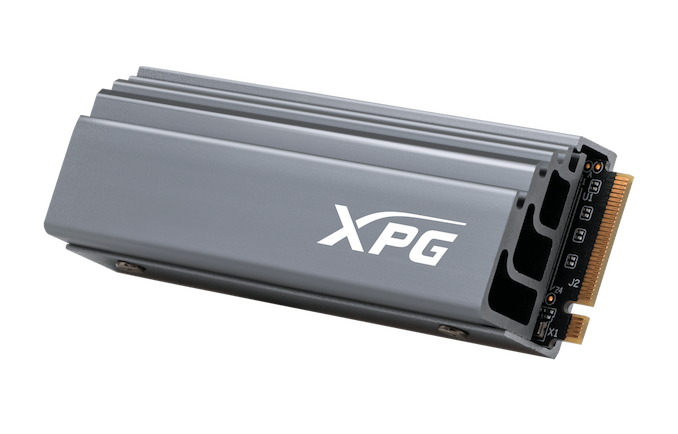
ADATA At CES2021: XPG GAMMIX S70 PCIe 4.0 SSD Now Available

A year ago at CES 2020, ADATA previewed three upcoming PCIe 4.0 consumer SSDs planned for release in 2020. As with many things last year, that didn’t go exactly as planned, but two of those drives have now hit the market—albeit with different model names than ADATA was using a year ago. The XPG GAMMIX S70 has now taken over as ADATA’s top of the line consumer SSD, and it is starting to hit the (virtual) shelves just in time for CES 2021.


Last fall, ADATA launched the XPG GAMMIX S50 Lite as one of the first PCIe 4.0 SSDs targeting mainstream consumer usage. It uses Silicon Motion’s 4-channel SM2267 controller, so it isn’t aiming for the performance crown that most PCIe 4.0 models are vying for. The XPG GAMMIX S70 was also announced last fall, but only recently hit the market. It was listed on ADATA’s own online store before the end of the year, but didn’t hit any third-party retailers until it showed up on Newegg last week.


The GAMMIX S70 is particularly interesting because it marks the debut of a new competitor for high-end consumer SSD controllers. Innogrit was founded by storage industry veterans including a bunch of former Marvell employees. They came out of stealth mode at Flash Memory Summit 2019 with a full roadmap of client and enterprise NVMe SSD controllers, and at CES 2020 it appeared that their IG5236 “Rainier” controller had scored several design wins. The GAMMIX S70 is the first we’re aware of to actually ship.


ADATA XPG GAMMIX S70 Specifications
Capacity 1 TB 2 TB
Form Factor M.2 2280 PCIe 4.0 x4
Controller Innogrit IG5236 “Rainier”
Sequential Read (MB/s) 7400
Sequential Write (MB/s) 5500 6400
Random Read IOPS (4kB) 350k 650k
Random Write IOPS (4kB) 720k 740k
Warranty 5 years
Write Endurance 740 TB 1480 TB
Current Retail Prices $199.99 (20¢/GB) $399.99 (20¢/GB)


The GAMMIX S70 displaces the Phison E16-based GAMMIX S50 as ADATA’s flagship consumer SSD and goes up against other second-wave PCIe gen4 SSD like the Samsung 980 PRO, WD Black SN850 and Phison E18-based drives like the Sabrent Rocket 4 Plus.


The Newegg listings for the GAMMIX S70 are at ADATA’s introductory MSRP of $199.99 for the 1TB model and $399.99 for the 2TB, the same price points as the Sabrent Rocket 4 Plus and slightly cheaper than the Samsung 980 PRO or WD Black SN850. Our initial testing of the 2TB S70 has showed promising performance, but ADATA gave us a heads-up that there’s a firmware update on the way so we’re holding off on drawing conclusions for the moment.


With the Phison E18 and Innogrit Rainier controllers now shipping, and the in-house designs from Samsung and Western Digital, we’re waiting on only Silicon Motion’s SM2264 controller to round out this second wave of PCIe 4.0 NVMe SSD controllers. A year ago, ADATA had planned to make use of the SM2264 in the third PCIe 4.0 SSD they previewed, but there’s no sign of it or any other SM2264 products being ready yet.


Interested in more of the latest industry news? Check out our CES 2021 trade show landing page!


Source: AnandTech – ADATA At CES2021: XPG GAMMIX S70 PCIe 4.0 SSD Now Available

Samsung Announces Exynos 2100 SoC: A New Restart on 5nm with X1 Cores

Today, Samsung LSI took the virtual stage to announce the new Exynos 2100 flagship SoC. The new SoC promises some very large technical upgrades – the aforementioned new Cortex-X1 performance CPU, a very large GPU performance boost, but also very large gains in things like AI performance, a re-integrated leading 5G modem, camera support for up to 200MP sensors, AV1 video decoding, all on a new 5nm process node.


Source: AnandTech – Samsung Announces Exynos 2100 SoC: A New Restart on 5nm with X1 Cores

The AMD CES 2021 Keynote: A Live Blog from 11am ET / 8am PT

For the second year in a row, AMD has an official CES Keynote. A year on from the launch of Ryzen 4000 Mobile series processors, and after a recent hit with Zen 3-based Ryzen 5000 as well as RX 6000 GPUs, we’re going to see what AMD has in store for us at the show this year. We’re still waiting on the other Zen 3-based hardware, as well as more details about GPUs. 


Join us at the following times to follow along with our Live Blog:


  • 8am PT (Pacific, Los Angeles)
  • 11am ET (Eastern, New York)
  • 4pm UTC / UK (London)
  • 5pm CET (Europe)
  • Midnight CST (China)


Source: AnandTech – The AMD CES 2021 Keynote: A Live Blog from 11am ET / 8am PT

Plugable Updates USB-C 7-in-1 Hub with Ethernet and 4Kp60 Display Support

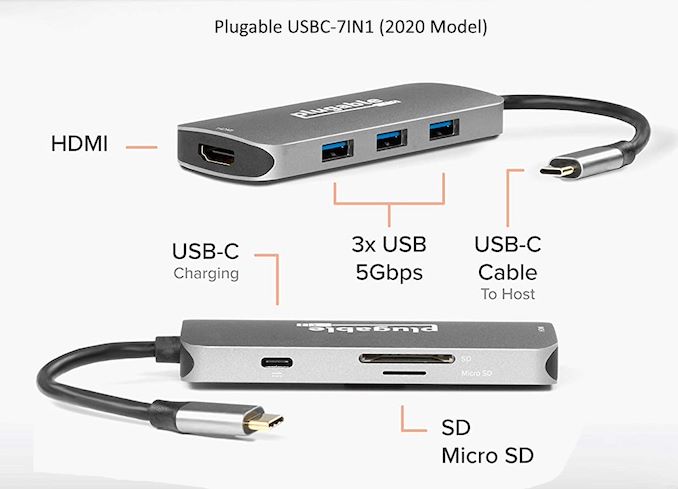
A major issue faced by owners of notebooks and compact SFF PCs such as the NUCs is the paucity of USB ports or even the absence of often-needed functionality like SD /microSD card slots and RJ-45 ports. Multi-function USB hubs come to the rescue here (at the cost of physical system footprint). One of the well-reviewed low-cost offerings in this market segment is Plugable’s 2020 USB-C 7-in-1 Hub. This offering allowed MFDP (multi-functional Display Port) USB-C ports in a host system to support a micro-SDXC, full-sized SDXC, HDMI 1.4 (4Kp30) display output, and three USB 3.2 Gen 1 Type-A ports in a small rectangular unit. While capable of being bus-powered, the hub also includes a USB charging pass-through port, allowing for up to 87W of power delivery to the host system.


Plugable’s 2020 USBC-7IN1 Multi-function Hub


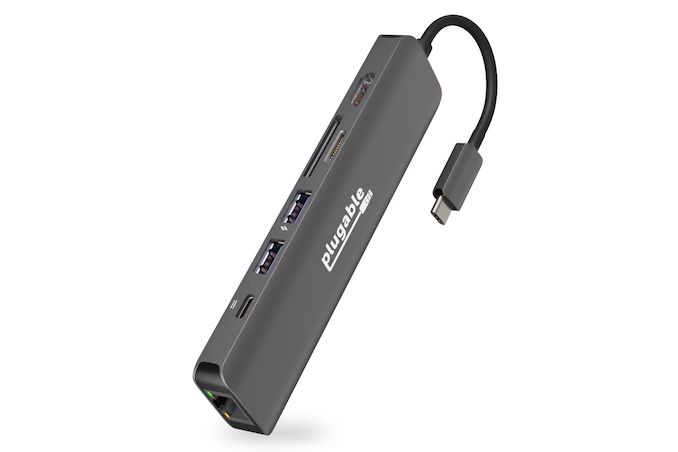
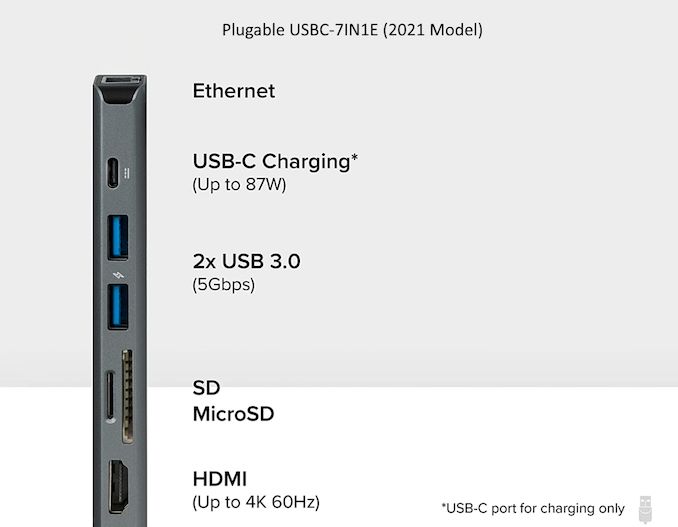
At CES 2021, Plugable is updating the hub with new internals and I/Os. Thanks to the inclusion of a Parade PS186 DP 1.4 to HDMI 2.0 protocol converter, the HDMI 1.4 (4Kp30) port is now replaced by a HDMI 2.0 (4Kp60) port, enabling extended compatibility with DisplayPort 1.4 hosts that are becoming more common now. One of the USB 3.2 Gen 1 Type-A ports is also being replaced by a RJ-45 Gigabit LAN port using a Realtek RTL8153 USB to GbE controller. The other ports and features (including the 87W pass-through charging port to which the host notebook’s original charger can connect – enabled by a VIA Technologies VL103 PD controller) are retained. The USB 3.2 Gen 1 Type-A ports are enabled by the VIA Technologies VL817 hub chip, and the card readers have a Genesys Logic GL3224 chip behind them.


Plugable’s New 2021 USBC-7IN1E Multi-function Hub


The new 2021 Plugable USBC-7IN1E multi-function USB-C hub is now available for $30 (after applying a $5 off coupon on the MSRP of $35).


Interested in more of the latest industry news? Check out our CES 2021 trade show landing page!


Source: AnandTech – Plugable Updates USB-C 7-in-1 Hub with Ethernet and 4Kp60 Display Support