NVIDIA Launches CMP: Dedicated Mining Hardware
One of the critical points during this period of high demand for graphics cards is that a portion of them are being purchased by professional users looking to mine cryptocurrency. The recent launch of new cards coupled with record highs in the cryptocurrency market has led to a rebirth of the mining community, who as of recently could earn ~$10 per RTX 3090 graphics card. These professional miners buy graphics card by the pallet load, sometimes bypassing retailers and going direct to distributors, as they can guarantee a complete shipment sale in one go. The knock on effect is fewer cards available for gamers looking to build new systems, causing prices to increase. On top of all this, the newest generation of graphics cards are rare to find in the first place, despite AMD and NVIDIA stating that they are being produced and sold at record rates.


In order to at least offer a fig leaf to gamers, in the past certain graphics board partners started producing mining-only graphics cards. These had no graphical outputs, making them almost impossible for gaming use cases, but it filtered off some of the mining market into buying those rather than taking stock away from shelves for gamers. This was a poor band-aid, and now NVIDIA has gone one step further to separate mining from gaming.


NVIDIA’s announcement today is two-fold: firstly addressing the upcoming launch of the RTX 3060 graphics on February 25th, and secondly announcing a new range of dedicated mining hardware.


RTX 3060: Halving the Mining Rate


One of the key drivers as to why the new graphics cards are being sold is because they are so good at doing the mining operations for various cryptocurrencies (namely for Ethereum and other derived coins) and earning the users a semblance of return on their purchase. Mining requires hardware and software, and it’s the software side that NVIDIA is tackling with this first announcement.


For the upcoming RTX 3060, the software drivers for this graphics card will automatically limit cryptocoin hashing rates to half – making how much they can earn specifically halved. The software drivers will do this by detecting the math coming through the pipeline and restricting access to the hardware for those operations. At this point we’re not sure if it’s a cut in frequency that the drivers will cause or simply limiting the operations to half of the hardware, but either way NVIDIA is hoping this will detract professional miners from buying these cards if the return on them is halved.


No plans are being announced for cards currently in the market, perhaps because the drivers for those cards already allow a full-rate compute solution, and those can simply keep older drivers installed.


NVIDIA CMP: Dedicated Mining Silicon for Ethereum


In the same way that ‘crypto’ cards without video outputs were pushing into the market for balance, NVIDIA is going a step further and removing the video outputs from the silicon entirely. There are other potential optimizations that could be made for power and performance, but at this point NVIDIA is simply stating as graphics-less silicon. This could be a mix of customized new silicon, or simply silicon already manufactured that had defects in the video output pipeline.


The new NVIDIA CMP HX dedicated mining cards will come in four variants up to 320 W, and from authorized partners including ASUS, Colorful, EVGA, Gigabyte, MSI, Palit, and PC Partner. These cards (along with drivers) are also set to be designed such that more of these cards can be enabled in a single system.


NVIDIA CMP HX Mining Hardware
AnandTech 30HX 40HX 50HX 90HX
Eth Hash Rate* 26 MH/s 36 MH/s 45 MH/s 86 MH/s
Rated Power 125 W 185 W 250 W 320 W
Reference Connectors 8-pin 8-pin 2 x 8-pin 2 x 8-pin
Memory Size 6 GB 8 GB 10 GB 10 GB
Availability Q1 Q1 Q2 Q2
*NVIDIA Measured to DAG and Epoch 394


What’s interesting here is that these states aren’t that great. Here is a breakdown of what NVIDIA’s cards do today, and you can see why:


NVIDIA Hardware Hash Rates
AnandTech Hash Rate Power Efficiency

MH/s/W
RTX 3090 121 MH/s 290 W 0.42
RTX 3080 98 MH/s 224 W 0.44
90HX 86 MH/s 320 W 0.27
RTX 3070 62 MH/s 117 W 0.53
RTX 3060 Ti 60 MH/s 120 W 0.50
RTX 2080 Ti 49 MH/s 240 W 0.20
50HX 45 MH/s 250 W 0.18
40HX 36 MH/s 185 W 0.19
30HX 26 MH/s 125 W 0.21
HX Data from NVIDIA

RTX Data from Minerstat


The only way these new CMP HX mining add-in cards make financial sense is if they are really cheap, around $600 for the 90HX, otherwise the retail gaming GPUs seem to be a lot more efficient.


NVIDIA isn’t giving any more details on when these mining add-in cards will be made available, aside from Q1 for the slower ones and Q2 for the faster ones. No word on pricing, nor on distribution methods – there’s a chance here that these cards will only be sold by distributors direct to professional mining outlets. By the pallet. Note that this doesn’t stop the high demand for power supplies. That market is also feeling the effects.


Related Reading


Source: AnandTech – NVIDIA Launches CMP: Dedicated Mining Hardware
The Samsung 870 EVO (1TB & 4TB) Review: Does the World Need Premium SATA SSDs?

Samsung is one of the few brands still launching new high-end SATA SSDs in the consumer market. The new Samsung 870 EVO is a fine update to a very successful product line, but sticking with their long-time strategy of being the premium option doesn’t make much sense when NVMe has taken over the high-end SSD market segment.


Source: AnandTech – The Samsung 870 EVO (1TB & 4TB) Review: Does the World Need Premium SATA SSDs?

Lenovo ThinkStation P620 Review: A Vehicle for Threadripper Pro

The workstation line of machines from Lenovo have been extremely successful for the company. While ThinkStation might not have as much brand identity as the more recognizable ThinkPad, for the markets that require them Lenovo’s ThinkStation range has been at the front of high-performance under-the-desk offerings since 2008. Lenovo has focused on everything from small form factor entry ThinkStation systems, all the way up to high-end dual socket P-series tower designs. The system we are reviewing today actually marks a major milestone for the ThinkStation business; the ThinkStation P620 is Lenovo’s first AMD workstation system, and it comes in to replace the whole range of Intel-based high-performance ThinkStations previously offered.


Source: AnandTech – Lenovo ThinkStation P620 Review: A Vehicle for Threadripper Pro

Xbox Series X SoC: Power, Thermal, and Yield Tradeoffs

This week at ISSCC (International Solid State Circuits Conference), Microsoft presented a talk titled ‘Xbox Series X SoC: A Next Generation Gaming Console’, with hardware engineer Paul Paternoster presenting. The 30 minute presentation covered a lot about Microsoft’s latest console processor, most of which was a repeat about what we saw at Hot Chips in August last year, however there was a new element in this presentation talking about how the console design team balanced acoustics, power, thermal performance, and processor yield, discussing where the hotspots in the design originate and where the performance/power targets of the final silicon were optimized.


Source: AnandTech – Xbox Series X SoC: Power, Thermal, and Yield Tradeoffs

NVIDIA’s GeForce RTX 3060 Gets a Release Date: February 25th

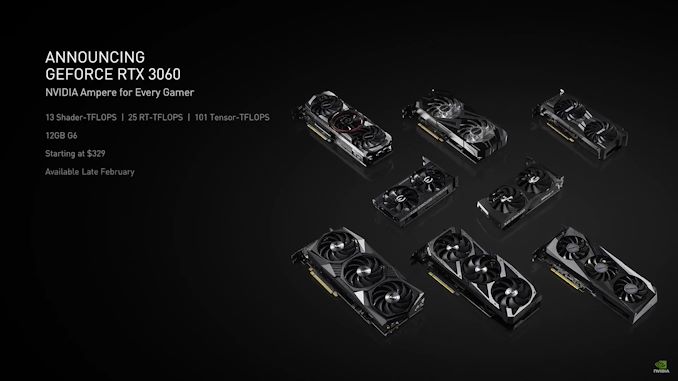
NVIDIA this morning has sent over a quick note revealing the release date for their next GeForce desktop video card, the RTX 3060. The mainstream(ish) video card, previously revealed at CES 2021 with a late February release date, has now been locked in for a launch on February 25th, with prices starting at $329.


As a quick recap, the RTX 3060 is the next card down in NVIDIA’s Ampere architecture consumer video card stack. Using the new GA106 GPU – which is already shipping in RTX 3060 laptops – the RTX 3060 follows the traditional price/performance cadence for video card launches, with NVIDIA releasing a cheaper and lower performing video card for the mainstream-enthusiast video card market. NVIDIA’s 60-tier cards have long been the company’s workhorse parts for 1080p gaming – as well as some of their highest-volume parts in North America – and the RTX 3060 is expected to fill the same role within the Ampere/30-series family.


NVIDIA GeForce Specification Comparison
  RTX 3060 RTX 3060 Ti RTX 2060 GTX 1060
CUDA Cores 3584 4864 1920 1280
ROPs 64? 80 48 48
Boost Clock 1.78GHz 1.665GHz 1.68GHz 1.709GHz
Memory Clock 14Gbps? GDDR6 14Gbps GDDR6 14Gbps GDDR6 8Gbps GDDR5
Memory Bus Width 192-bit 256-bit 192-bit 192-bit
VRAM 12GB 8GB 6GB 6GB
Single Precision Perf. 12.8 TFLOPS 16.2 TFLOPS 6.5 TFLOPS 4.4 TFLOPS
Tensor Perf. (FP16) 51.2 TFLOPS 64.8 TFLOPS 51.6 TFLOPS N/A
Tensor Perf. (FP16-Sparse) 102.4 TFLOPS 129.6 TFLOPS 51.6 TFLOPS N/A
TDP 170W 200W 160W 120W
GPU GA106 GA104 TU106 GP106
Transistor Count ?B 17.4B 10.8B 4.4B
Architecture Ampere Ampere Turing Pascal
Manufacturing Process Samsung 8nm? Samsung 8nm TSMC 12nm “FFN” TSMC 16nm
Launch Date 02/2021 12/02/2020 01/15/2019 07/19/2016
Launch Price MSRP: $329 MSRP: $399 MSRP: $349 MSRP: $249

Founders $299


NVIDIA has already published most of the specifications for the card back in January. Including the fact that it offers 28 SMs (3584 CUDA cores), and 12GB of GDDR6 running on a 192-bit memory bus. As with previous 60-tier cards, the non-power-of-two memory bus means that NVIDIA is shipping with a somewhat odd amount of memory, in this case 12GB, which is actually more than what comes on even the RTX 3080. However with the only other option being an anemic-for-2021 6GB, NVIDIA is opting to make sure that the card isn’t for want of VRAM capacity.


Meanwhile, for better or worse the RTX 3060 is all-but-guaranteed to fly off of shelves quickly. With every video card more powerful than a GTX 1050 Ti seemingly getting shanghaied into mining Ethereum, desperate gamers will be fighting with hungry miners for supplies. Even with the 192-bit memory bus, I would be shocked if the RTX 3060 wasn’t profitable, especially with Ethereum reaching record highs. So for anyone thinking of grabbing the card, best be prepared to camp out at your favorite retailer or e-tailer on that Thursday morning.


On a final note, unlike the other RTX 30 series cards launched to date, NVIDIA will not be producing any Founders Edition cards for the RTX 3060 series. So all of the cards released will be AIB cards with their own respective designs. And, if tradition holds, don’t be surprised if we see the AIBs outfit their cards with premium features and raise their prices accordingly.


Source: AnandTech – NVIDIA’s GeForce RTX 3060 Gets a Release Date: February 25th

Samsung Foundry: New $17 Billion Fab in the USA by Late 2023

Samsung Foundry has filed documents with authorities in Arizona, New York, and Texas seeking to build a leading-edge semiconductor manufacturing facility in the USA. The potential fab near Austin, Texas, is expected to cost over $17 billion and to create 1,800 jobs. If everything goes as planned, it will go online by the fourth quarter of 2023. There is an intrigue about the new fab though: Samsung hasn’t stated which process node it will be designed for. 


Source: AnandTech – Samsung Foundry: New Billion Fab in the USA by Late 2023

Qualcomm Announces X65 & X62 5G Modems on 4nm

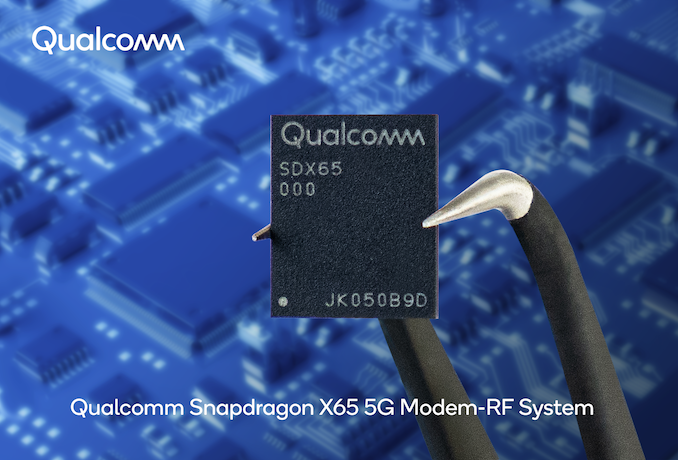
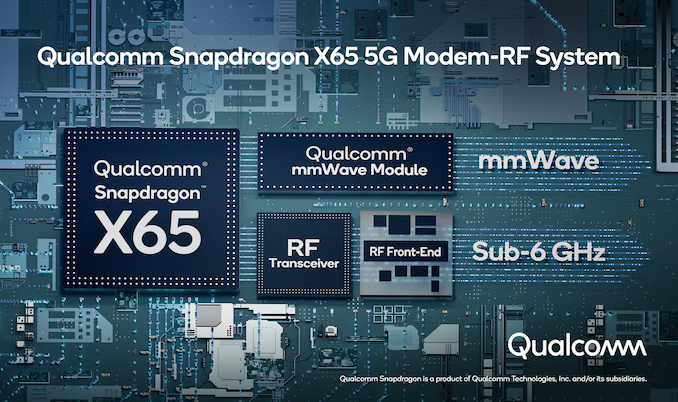
Qualcomm yesterday has announced a slew of new 5G communication platforms, representing their next-generation modems, and RF front-end solutions that will be powering the next flagship devices later in 2021 as well as 2022. This includes two new 5G modems in the form of the new Snapdragon X65 and X62, a new RFFE portfolio with new envelope trackers, new antenna tuners, and new power amplifiers, alongside a 4th generation mmWave antenna module that supports more frequency bands and a larger frequency bandwidth.


Starting off with the new X65 modem, it’s a rather large generational upgrade compared to the current X60 modem that increases the amount of frequency bands as well as bandwidth that a vendor can deploy in an end user device.


In terms of sub-6GHz frequencies, the new X65 modem increases the bandwidth from 200MHz to 300MHz, essentially a 50% increase in aggregate spectrum that can be used. Such a wide breadth of spectrum is currently extremely rate in terms of 5G network deployments, but as the US is freeing up new mid-band frequencies for 5G usage over the next years, as well as other global markets deprecate 3G frequencies and reallocate them into 5G usage, we’ll be seeing more possible carrier aggregation combinations across larger variety of frequency bands.


On the mmWave side, things have also seen improvements as the available bandwidth goes from 800MHz to 1000MHz, and now adopts support for the TDD 41GHz n259 band, important for mmWave deployments in countries such as China and Japan.


The new modem, when aggregating across sub-6GHz and mmWave networks with the new increased bandwidth capabilities thus advertises maximum download speeds of up to 10Gbps. Of course, such peak figures aren’t too realistic in the real world, but they do showcase the vast increase in spectrum bandwidth available, which will translate to better transmission speeds in crowded situations.


Alongside the super-high-end X65 modem, we’re also seeing the release of the X62, which is essentially its little brother. In terms of frequency bands and standards capabilities, it’s of the same calibre as the X65, however it differs in terms of its spectrum bandwidth capabilities; sub-6GHz is reduced to 120MHz, and mmWave is reduced to 300MHz across 4 carriers, rather than 10. Undoubtedly this modem solution will be targeting devices at lower price points than the X65 flagship.


Interestingly, both new X65 and X62 modems are manufactured on a 4nm node – this should be Samsung’s 4LPE node which is a further iterative improvement of their current 5LPE technology.


The new 5G modem solutions and their RFFE companion chips are set to hit the market in late 2021.


Related Reading:


Source: AnandTech – Qualcomm Announces X65 & X62 5G Modems on 4nm

64 Cores of Rendering Madness: The AMD Threadripper Pro 3995WX Review

Knowing your market is a key fundamental of product planning, marketing, and distribution. There’s no point creating a product with no market, or finding you have something amazing but offer it to the wrong sort of customers. When AMD started offering high-core count Threadripper processors, the one market that took as many as they could get was the graphics design business – visual effects companies and those focused on rendering loved the core count, the memory support, all the PCIe lanes, and the price. But if there’s one thing more performance brings, it’s the desire for even more performance. Enter Threadripper Pro.


Source: AnandTech – 64 Cores of Rendering Madness: The AMD Threadripper Pro 3995WX Review

Xiaomi Launches Mi 11 Globally: Starting at 749€

Today Xiaomi is launching their new Mi 11 flagship for the global market, following their domestic launch of the phone in China almost 6 weeks ago.

The Mi 11 is an interesting device as it really balances out its features as a affordable flagship device. The European prices for the new phone start at 749€, featuring the new Snapdragon 888 SoC, and what seems to be a top-of-the line 1440p 120Hz OLED display, all while featuring a high-end 108MP camera module, though the phone compromises on its other cameras.


Source: AnandTech – Xiaomi Launches Mi 11 Globally: Starting at 749€

The Snapdragon 888 vs The Exynos 2100: Cortex-X1 & 5nm – Who Does It Better?

Ahead of our full device review of the Galaxy S21 Ultra (and the smaller Galaxy S21), today we’re focusing on the first test results of the new generation of SoCs, the Snapdragon 888 as well as the Exynos 2100, putting them through their paces, and pitting them against each other in the new 2021 competitive landscape.


Source: AnandTech – The Snapdragon 888 vs The Exynos 2100: Cortex-X1 & 5nm – Who Does It Better?

Intel's Tiger Lake NUC11: Panther Canyon for Asia Alone

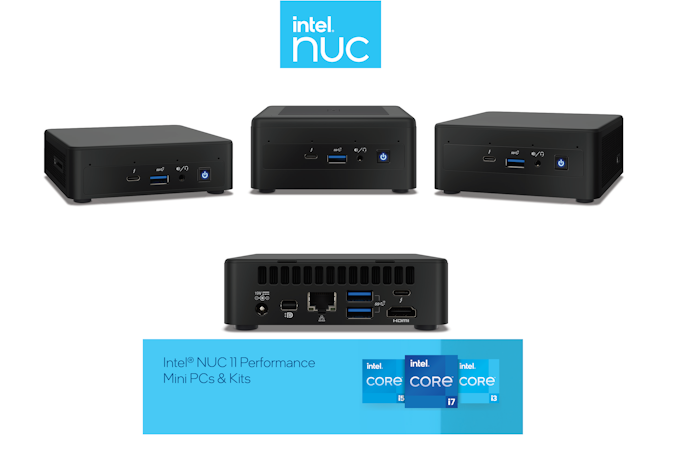
The electronics industry supply chain is facing a number of issues due to the ongoing pandemic. Companies are unable to meet product demand, and are being forced to fine-tune their product distribution strategies. Intel’s Panther Canyon NUC was announced at CES 2021, with no official pricing or availability information. Yesterday, Intel provided some updates with the rather disappointing news that the Panther Canyon NUC family will only be distributed in the Asia-Pacific region.


The other markets will still get a wide range of Tiger Lake-based NUC products such as the NUC11 Pro (Tiger Canyon), Compute Element (Elk Bay), and the dGPU-equipped NUC11 Enthusiast (Phantom Canyon). Intel is citing tight supply of a few third-party components as the cause for the APAC-only focus of Panther Canyon. We expected the NUC11 Performance units to provide an affordable entry point for Tiger Lake mini-PCs. The other Tiger Lake NUC products are bound to be priced higher, given their target markets.


The APAC-only focus of the Panther Canyon products provides an opportunity for vendors such as ASRock Industrial to gain market share elsewhere. The company already has the NUC1100 series of Tiger Lake UCFF PCs available for purchase in the North American market with prices ranging from $600 for the top-end Core i7 version to $350 for the Core i3 one.


Source: AnandTech – Intel’s Tiger Lake NUC11: Panther Canyon for Asia Alone

The Redragon Devarajas K556 RGB Mechanical Keyboard Review: Jack Of Most Trades

Today we are having a close look at the Devarajas K556 RGB gaming keyboard from Redragon, a Chinese manufacturer of gaming peripherals. The company boasts excellent quality, performance, RGB backlighting, and advanced features, all while keeping the retail price very low. 


Source: AnandTech – The Redragon Devarajas K556 RGB Mechanical Keyboard Review: Jack Of Most Trades

Microchip Announces First PCIe 5.0 Switches

Building on their recent announcement of PCIe 5.0 retimers, Microchip has announced their first PCIe 5.0 switches, as part of their Switchtec PFX product line. On paper these look like a very straightforward update to their existing Switchtec PFX switches for PCIe 4.0, carrying over all the important features but doubling the speed.


The final version of the PCI Express 5.0 specification was released in May 2019, but significant adoption is not expected to begin until Intel’s Sapphire Rapids Xeon processors ship, planned for later this year. Microchip is positioning themselves to be one of the most important vendors helping enable the transition, and they expect to be the only company offering both switches and retimers for PCIe 5.0. Components like switches and retimers are becoming increasingly important with each iteration of PCIe as higher speeds are achieved at the cost of range; servers using PCIe 5.0 will only be able to put a handful of devices close enough to the CPU to operate at PCIe 5.0 speeds without some kind of repeater. Retimers like Microchip’s XpressConnect parts are simple pass-through repeaters, while switches like the new Switchtec PFX parts can fan out PCIe connectivity from one or more uplink ports to numerous downstream ports.


As with the PCIe 4.0 members of the Switchtec PFX product line, the new PCIe 5.0 switches will be available with lane counts from 28 to 100. These switches support port bifurcation down to x2 links, with bifurcation down to x1 supported by some of the lanes on the switch. The switches also support up to 48 Non-Transparent Bridges (NTBs), allowing for large multi-host PCIe fabrics to be assembled using several switches. However, initial demand for PCIe is expected to center around GPUs, machine learning accelerators and high-speed NICs, so many of those advanced features will be underutilized early on, and the chips will be primarily used to feed those extremely bandwidth-hungry peripherals with an x16 link each. SSDs using just two or four lanes each are expected to be slower about moving to PCIe 5.0.


The new PCIe 5.0 Switchtec PFX switches are currently sampling to select customers, including a development/evaluation board based around the 100-lane switch. Microchip wouldn’t disclose any pricing information for the new switches, but they are bound to be more expensive than the PCIe gen4 switches with the same lane counts. Power consumption is also going up, but Microchip wouldn’t quantify the change.


Microchip’s lineup of PCIe switches for earlier generations also includes the Switchtec PSX and PAX families with more advanced functionality than the PFX switches. PCIe 5.0 versions of the PSX and PAX families have not been announced, but it’s normal for those versions to come later. Microchip’s only competition for leading-edge PCIe switches comes from Broadcom/PLX PEX switches. Broadcom has not yet publicly announced their PCIe 5.0 switches, but they are doubtless also planning to take advantage of the launch of Intel’s Sapphire Rapids platform.


Source: Microchip


Source: AnandTech – Microchip Announces First PCIe 5.0 Switches

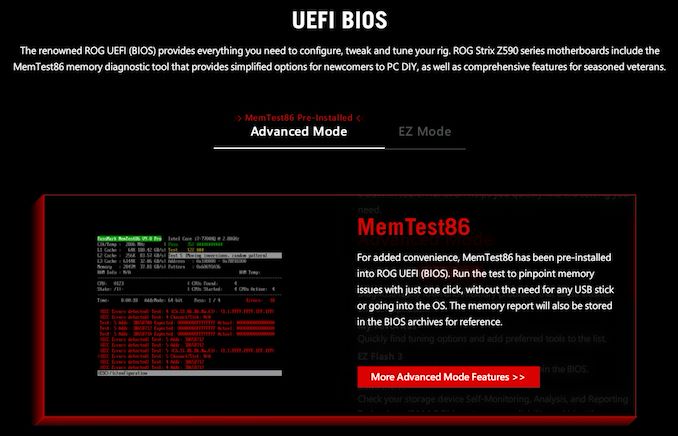
ASUS Bundles MemTest86 With its ROG Z590 Firmware

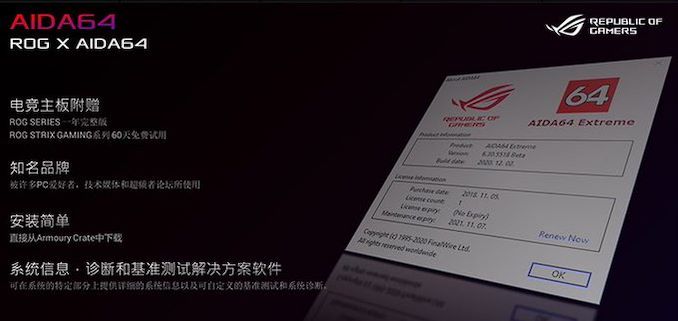
Back at the all-digital CES 2021 trade show, ASUS and the other big motherboard vendors announced its Z590 models designed for Intel’s LGA1200 processors. With many of the models now common knowledge, Twitter technology enthusiast @momomo_us points out that ASUS is bundling MemTest86 inside the BIOS of its Republic of Gamers motherboards.


MemTest86 is a well known piece of software for diagnosing memory failures, not just in faulty memory, but also provides troubleshooting capabilities for unstable memory overclocks. It is known that Intel’s Rocket Lake processors will have a stronger integrated memory controller (IMC) than its current Comet Lake counterparts, as we finally move up to DDR4-3200 native support. This is also prevalent in the available Z590 motherboard memory listings, with many boards including kits as fast as DDR4-5333 in its QVL lists for overclocked memory. 


As per @momomo_US’s tweet, it looks as though ASUS has penned a deal with PassMark software to allow it to integrate MemTest86 directly into its UEFI firmware. This looks as though it will be only available on select Republic of Gamers models. MemTest86 is also available to all users, although without UEFI integration, users can download it onto a bootable USB flash drive and diagnose memory faults and unstable overclocks this way. 


With Intel and AMD both making strides in its out of the box Turbo and Boost clock speeds, it seems ASUS is emphasizing memory performance. It uses its own ‘secret sauce’, which it calls Optimem. It is a primary feature on its motherboards, which ASUS states should allow for tighter memory latencies at equivalent voltages. 


At present, it is not entirely clear exactly which Z590 models will be distributed with MemTest86 integrated into the UEFI firmware. As more Z590 models hit the retail shelves in the coming months, we should see a clearer picture.


Related Reading


Source: AnandTech – ASUS Bundles MemTest86 With its ROG Z590 Firmware

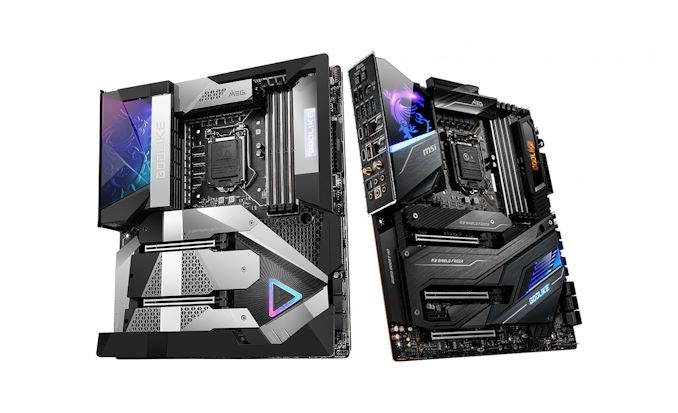
The MSI Z590 Godlike, Comparing it to the Z490 Godlike

One of MSI’s most prominent motherboard ranges is its Godlike series, set as the premium model no matter which platform it is aimed at. As Intel has recently launched its new Z590 desktop chipset, MSI got in contact and shipped us a qualification sample of the new Z590 Godlike model. Designed as the flagship motherboard, in this article we are looking at how the MSI MEG Z590 Godlike has changed from the previous generation for Intel’s Rocket Lake processors.


Source: AnandTech – The MSI Z590 Godlike, Comparing it to the Z490 Godlike

OnLogic’s New Fanless Systems Contain Intel's Elkhart Lake (10nm Atom)

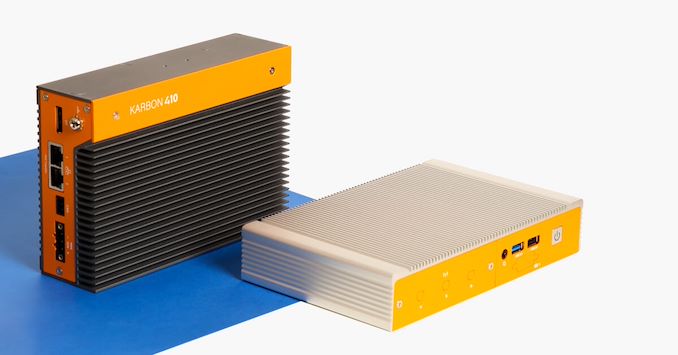
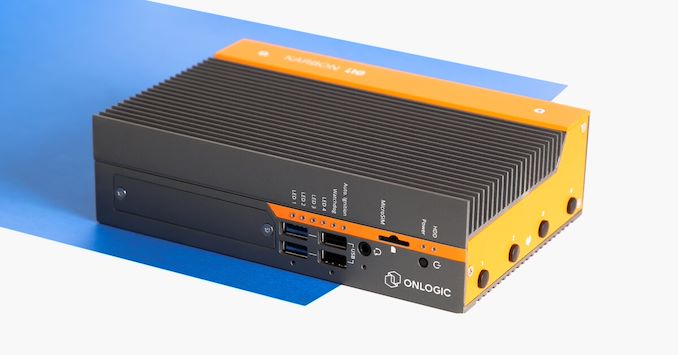
Earlier this year Intel indicated that it was launching its new Jasper Lake platform very soon, built on a foundation of 10nm manufacturing with the latest Tremont Atom cores. While Jasper Lake is geared towards consumers and commercial use cases, Intel also has a similar line of processors built for the industrial and IoT markets, also using Tremont on 10nm, called Elkhart Lake. Onlogic, a business built around supplying the industrial and IoT markets, is introducing new fanless designs built around Elkhart Lake.


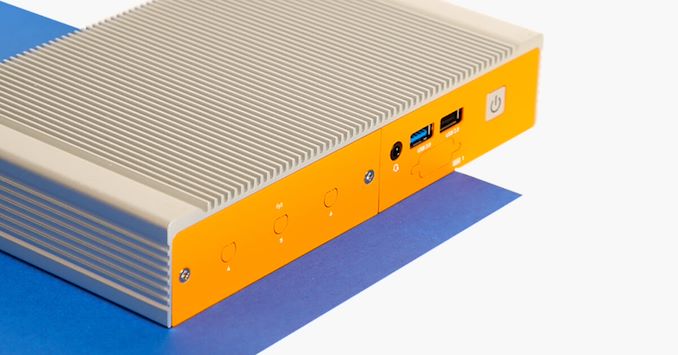
The four new fanless industrial designs from OnLogic are the Helix 310, Helix 330, Karbon 410, and Karbon 430 – all customizable passively cooled systems for ‘Industry 4.0’. The processors at the heart are all the variants of Elkhart Lake, with the Helix models focusing on dual core Celeron N6211 or quad-core Pentium J6425, while the Karbon models go for dual-core Atom x6211E and quad-core Atom x6425E, the main differentiation of these last two models being the wider thermal support from -40ºC to 70ºC.


OnLogic’s main selling point here is the coupling of its ModBay expansion technology, allowing customers additional connectivity through the M.2 and PCIe slots (effectively making the M.2 a simple PCIe x4 link), with Intel’s Programmable Services Engine, or PSE. Intel’s PSE is described by OnLogic as a dedicated offload engine for IoT built from an Arm Cortex-M7 microcontroller, enabling real-time compute and data tracking. Combined with the compute power of Atom cores, the aim is to provide a complete real-time monitoring and communication system for a wide array of industrial deployments. OnLogic provides solution services enabling custom OS deployments, branding, imaging, fulfilment, and lifecycle support.


The Helix 310 and Helix 330 are built on the same platform but afford different levels of customization. Both models include support for 32 GB of DDR4, at least one M.2 slot, 3 USB 3.2 ports, 3 USB 2.0 ports, three DisplayPort outputs and two COM ports. Where they differ is that the Helix 310 is the base model, featuring 1-2 gigabit Ethernet ports and two M.2 slots with optional 4G/DIO/COM/CAN support, but the Helix 330 uses one of those M.2 slots for dual additional gigabit Ethernet by default.


The Karbon 410 and 430 are similarly on a singular platform together, build for a wider temperature window as well as MIL-STD-810H shock and vibration standards. The base platform has up to 32 GB of DDR4, support for M.2 and mSATA storage, dual gigabit Ethernet, two USB 3.2 ports, two USB 2.0 ports, 1 Display Port, 1 CAN bus, 1 micro-SIM slot, dual M.2 slots, 1 mPCIe slot, and optional 4G/DIO/COM/PoE/TPM. The Karbon 410 is the base model, and the Karbon 430 adds in another pair of M.2 slots, a second micro-SIM slot, and allows for additional networking or USB.


In the last couple of years, when Intel had record demand for its silicon, the main market segments to lose out were the low-end compute market, namely Intel’s Atom portfolio. Now that Intel has sufficient capacity for its demand, along with increased production of its 10nm manufacturing node, it is refocusing its efforts in this embedded compute market with product lines such as Jasper Lake and Elkhart Lake. This also means that OEMs like OnLogic can redesign their portfolio using the latest updates, such as PSE, as well as the latest technologies at low power, enabling a new generation of fanless designs.


OnLogic states that the new Elkhart Lake embedded systems will be available for purchase in Q2, with pricing updates available to customers that get in touch.


Related Reading


Source: AnandTech – OnLogic’s New Fanless Systems Contain Intel’s Elkhart Lake (10nm Atom)

Hands-On with the ASUS Pro WS WRX80E-SAGE SE WiFi

One of the criticisms levied at AMD last year was that it released its new Threadripper Pro platform in September but it was vendor-locked at the time to the Lenovo Thinkstation P620. The P620 seems to have sold like hot cakes, and the system design is really neat (we have one in for testing), but the fact that interested parties only have Lenovo as an option was considered a limiting factor for some. Fast forward to the beginning of 2021, and AMD has announced that TR Pro will be made available at retail, allowing other OEMs to also build systems. Alongside this, three motherboard manufacturers have also showcased their upcoming motherboard offerings, and the most anticipated model that received the most plaudits on looks alone was the ASUS. Today, in what appears to be a worldwide exclusive, we have some hands-on access to the ASUS Pro WS WRX80E-SAGE SE WiFi. Yes, it’s a mouthful to say.


Source: AnandTech – Hands-On with the ASUS Pro WS WRX80E-SAGE SE WiFi