AU Optronics OLED Displays: A New Foldable + A New 17.3-Inch 4K120

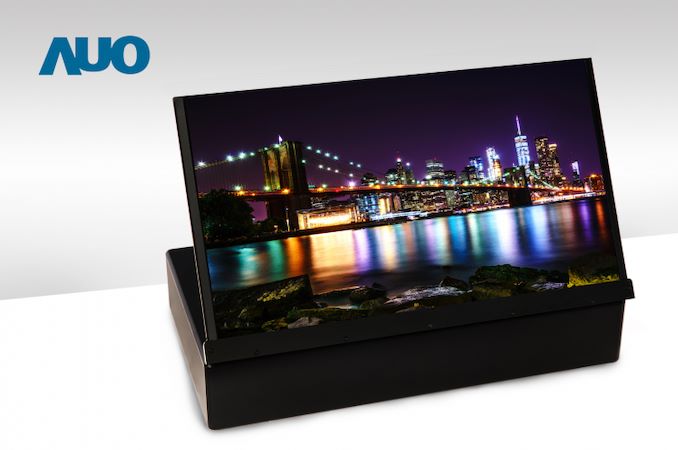
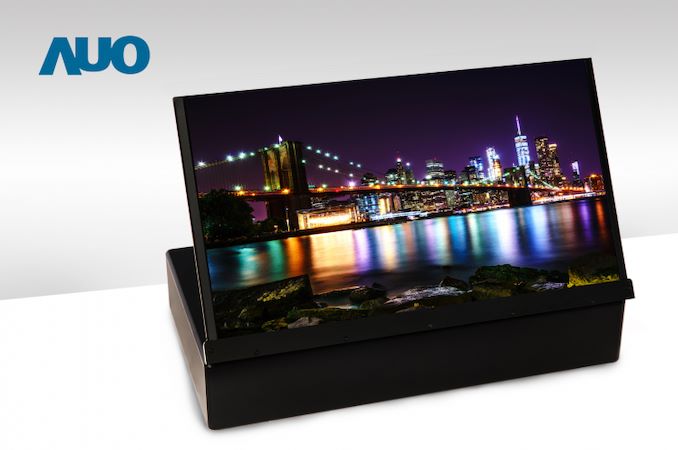
AU Optronics, which is mostly known for its advanced LCDs for televisions and computer monitors, this week demonstrated its latest OLED-type displays for various applications. The company has developed a 5.6-inch foldable AMOLED display for smartphones and similar applications as well as a 17.3-inch OLED for laptops, displays, and small form-factor TVs.


Going for Foldable


AUO’s 5.6-inch foldable AMOLED display can be folded inwards or outwards for 200,000 times at 4-mm folding radius, which is good metric for smartphones. The screen is made using a process technology designed by AU Optronics, it uses a plastic substrate as well as AUO’s proprietary flexible touch panel.


The manufacturer does not disclose resolution of its flexible AMOLED display, but it is logical to expect it to feature a competitive pixel density.


OLED 4K120


The 17.3-inch screen looks somewhat more impressive. It is AUO’s first monitor that relies on ink jet printing OLED technology, it features a 3840×2160 resolution, a 225 PPI pixel density, and has a 120 Hz refresh rate. AUO states that it is an IJP OLED that supports a wide color gamut.


AUO does not indicate when it plans to start commercial shipments of its new OLED-type displays, but the fact that it has a foldable OLED screen indicates that demand for such monitors is going to grow. It is noteworthy that AUO has decided to adopt ink jet printing technology that promises to lower production costs and improve yields of OLED. Large makers of OLED screens yet have to adopt printed OLED technology, but Japan OLED has apparently, and AUO believes that it is mature enough.


Related Reading


Source: AUO


Source: AnandTech – AU Optronics OLED Displays: A New Foldable + A New 17.3-Inch 4K120

AU Optronics's New 85-Inch 8K LCD TV with 1,024-Zone Backlighting

AU Optronics this week showcased a prototype of its most advanced 8K Ultra-HD display featuring an innovative full-area local dimming (FALD) backlighting solution and peak brightness of 2,000 nits. At present, the screen is a proof of concept and AUO does not make any promises regarding its commercial availability of this unit, but it might migrate into a consumer product in the future.


AUO’s most advanced Ultra-HD ALCD TV display relies on an 85-inch panel featuring a 7680×4320 resolution and peak brightness of 2,000 nits. The device has a FALD backlighting with 1,024 zones, so contrast ratios supported by the monitor should be very high. Unfortunately the press release has no word about maximum refresh rate and other features, except that the 8K UHDTV prototype supports high dynamic range, but AUO does not disclose the exact type. 


AU Optronics says that its 8K panel with a 1,024-zone FALD backlighting can be mass produced, but says nothing about its price or potential availability timeframe. Considering the fact that 85-inch 8K LCD panels cost a lot and FALD is very expensive in general, we expect UHDTVs based on AUO’s 85-inch 8K panel with FALD to be extremely pricey. As for approximate ETA date, many makers of 8K televisions and panels plan to offer their next-generation products in time for 2020 Tokyo Olympics.


Related Reading


Source: AU Optronics


Source: AnandTech – AU Optronics’s New 85-Inch 8K LCD TV with 1,024-Zone Backlighting

TSMC Responds to Lawsuit by GlobalFoundries: Allegations Are Baseless

TSMC has responded to GlobalFoundries accusations of patents infringements. The world’s largest foundry said that it would defend itself in courts and that it considered allegations as baseless. The contract maker of semiconductors said that throughout its history it was granted 37,000 patents and naturally considers itself one of the leaders in the industry.


On Monday GlobalFoundries said that TSMC, a number of its customers, as well as makers of various products infringed 16 of its patents covering various aspects of chip manufacturing. In particular, GlobalFoundries claims that TSMC’s 7 nm, 10 nm, 12 nm, 16 nm, and 28 nm nodes illegally use its intellectual property. Among defendants, the company named Apple, Broadcom, Mediatek, NVIDIA, Qualcomm, Xilinx and many others. GlobalFoundries seeks damages from TSMC and wants courts to ban shipments of products that use infringing semiconductors into the USA and Germany.


GlobalFoundries vs. TSMC et al
Fabless Chip Designers Consumer Product Manufacturers Electronic Component Distributors
Apple

Broadcom

Mediatek

NVIDIA

Qualcomm

Xilinx
Arista

ASUS

BLU

Cisco

Google

HiSense

Lenovo

Motorola

TCL

OnePlus
Avnet/EBV

Digi-key

Mouser

Quite naturally, TSMC denies any allegations and claims that it will defend itself in courts. The company stresses that it spends billions of dollars on R&D and has been granted 37,000 patents worldwide. Typically, high-tech companies counter-sue each other in patent infringement cases, so it will not be surprising if TSMC decides to sue GlobalFoundries. In the end, this is what patents are for. Meanwhile, unlike GlobalFoundries, TSMC will unlikely sue fabless designers of semiconductors that use the former’s services to a large degree because the vast majority of chip developers are it slients.


The statement by TSMC reads as follows:


TSMC is in the process of reviewing the complaints filed by GlobalFoundries on August 26, but is confident that GlobalFoundries’ allegations are baseless. As a leading innovator, TSMC invests billions of dollars each year to independently develop its world-class, leading-edge semiconductor manufacturing technologies. As a result, TSMC has established one of the largest semiconductor portfolios with more than 37,000 patents worldwide and a top 10 ranking for US patent grants for 3 consecutive years since 2016. We are disappointed to see a foundry peer resort to meritless lawsuits instead of competing in the marketplace with technology. TSMC is proud of its technology leadership, manufacturing excellence, and unwavering commitment to customers. We will fight vigorously, using any and all options, to protect our proprietary technologies.


GlobalFoundries vs. TSMC et al, GF’s Patents in the Cases
Title Patent No. Inventors
Bit Cell With Double Patterned Metal Layer Structures US 8,823,178 Juhan Kim, Mahbub Rashed
Semiconductor device with transistor local interconnects US 8,581,348 Mahbub Rashed, Steven Soss, Jongwook Kye, Irene Y. Lin, James Benjamin Gullette, Chinh Nguyen, Jeff Kim, Marc Tarabbia, Yuansheng Ma, Yunfei Deng, Rod Augur, Seung-Hyun Rhee, Scott Johnson, Subramani KengeriSuresh Venkatesan
Semiconductor device with transistor local interconnects US 9,355,910 Mahbub Rashed, Irene Y. Lin, Steven Soss, Jeff Kim, Chinh Nguyen, Marc Tarabbia, Scott Johnson, Subramani Kengeri, Suresh Venkatesan
Introduction of metal impurity to change workfunction of conductive electrodes US 7,425,497 Michael P. Chudzik, Bruce B. Doris, Supratik Guha, Rajarao Jammy, Vijay Narayanan, Vamsi K. Paruchuri, Yun Y. Wang,Keith Kwong Hon Wong
Semiconductor device having contact layer providing electrical connections US 8,598,633 Marc Tarabbia, James B. Gullette, Mahbub RashedDavid S. Doman, Irene Y. Lin, Ingolf Lorenz, Larry Ho, Chinh Nguyen, Jeff Kim, Jongwook Kye, Yuansheng MaYunfei Deng, Rod Augur, Seung-Hyun Rhee, Jason E. Stephens, Scott Johnson, Subramani Kengeri, Suresh Venkatesan
Method of forming a metal or metal nitride interface layer between silicon nitride and copper US 6,518,167 Lu You, Matthew S. Buynoski, Paul R. Besser, Jeremias D. Romero, Pin-Chin, Connie Wang, Minh Q. Tran
Structures of and methods and tools for forming in-situ metallic/dielectric caps for interconnects US 8,039,966 Chih-Chao Yang, Chao-Kun Hu
Introduction of metal impurity to change workfunction of conductive electrodes US 7,750,418 Michael P. Chudzik, Bruce B. Doris, Supratik Guha, Rajarao Jammy, Vijay Narayanan, Vamsi K. Paruchuri, Yun Y. Wang, Keith Kwong Hon Wong
Methods of forming FinFET devices with a shared gate structure US 8,936,986 Andy C. Wei, Dae Geun Yang
Semiconductor device with stressed fin sections US 8,912,603 Scott Luning, Frank Scott Johnson
Multiple dielectric FinFET structure and method US 7,378,357 William F. Clark, Jr., Edward J. Nowak
Bit cell with double patterned metal layer structures US 9,105,643 Juhan Kim, Mahbub Rashed
Complementary metal oxide semiconductor (CMOS) device having gate structures connected by a metal gate conductor US 9,082,877 Yue Liang, Dureseti Chidambarrao, Brian J. Greene, William K. Henson, Unoh Kwon, Shreesh Narasimha, and Xiaojun Yu
Hybrid contact structure with low aspect ratio contacts in a semiconductor device DE 102011002769 Kai Frohberg, Ralf Richter
Complementary transistors comprising high-k metal gate electrode structures and epitaxially formed semiconductor materials in the drain and source areas DE 102011004320 Gunda Beernink, Markus Lenski
Semiconductor device with transistor local interconnects DE 102012219375 Mahbub Rashed, Irene Y. Lin, Steven Soss, Jeff Kim, Chinh Nguyen, Marc Tarabbia, Scott Johnson, Subramani Kengeri, Suresh Venkatesan

Related Reading:


Source: TSMC


Source: AnandTech – TSMC Responds to Lawsuit by GlobalFoundries: Allegations Are Baseless

Qualcomm Updates Wi-Fi 6 Lineup: Networking Pro Series for APs and FastConnect for Clients

Qualcomm is announcing an update to its Wi-Fi 6 portfolio today with a host of new access point solutions under the Networking Pro Series moniker. The client side solutions are seeing a re-brand – instead of the staid QCA-prefix, the solutions now carry a FastConnect tag.


Qualcomm was one of the first vendors to announce 802.11ax (Wi-Fi 6) solutions back in February 2017. Both Broadcom and Intel announced their Wi-Fi 6 product portfolio later that year. Qualcomm’s access point solution stood out in the crowd for being a 12-stream solution, enabling it to get traction in the enterprise space. However, the high cost relegated them to the high-end consumer space. Given that the lack of clients had been hampering the adoption of Wi-Fi 6 over the last couple of years, this was a tiny niche to play in. Meanwhile, Broadcom and Intel had plays in the low-end and mid-range segments with solutions supporting between 2 and 8 streams, with routers already shipping to consumers. The Networking Pro Series being launched by Qualcomm today finally gets Qualcomm into the picture across all the segments of the access points / wireless routers market.


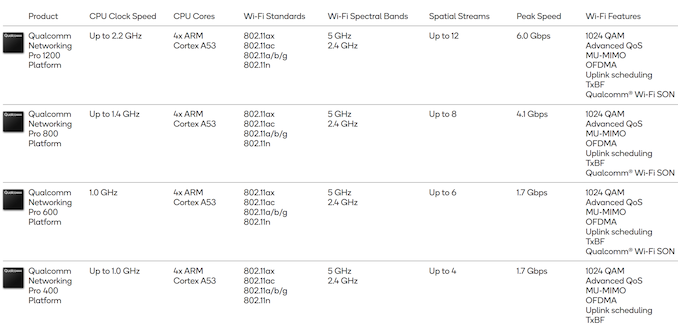
The Networking Pro Series has four members, with support for up to 4, 6, 8, and 12 spatial streams. The 600 and higher products in the stack also support Wi-Fi SON, Qualcomm’s mesh networking feature set. One of the interesting features here is the ability to split up the spatial streams in different ways depending on the end application. For example, a mesh networking product could use the Networking Pro 1200, and split up the 12 streams as two 4×4 for the client devices, and one 4×4 for the backhaul. For a traditional wireless router, it could be configured as 8×8 + 4×4.


Qualcomm is also finally enabling uplink OFDMA in the new products – this was one of the features supported by both Broadcom and Intel in their first-generation portfolio, but not by the Qualcomm IPQ8074 launched in 2017. Qualcomm’s press release for the Networking Pro Series includes quotes from the usual suspects – Netgear, Belkin (Linksys), Ruckus Wireless, and Aruba, a Hewlett-Packard Enterprise company. Netgear’s quote also included the upcoming Orbi Wi-Fi 6 mesh networking solution as one of the products utilizing the new product line.


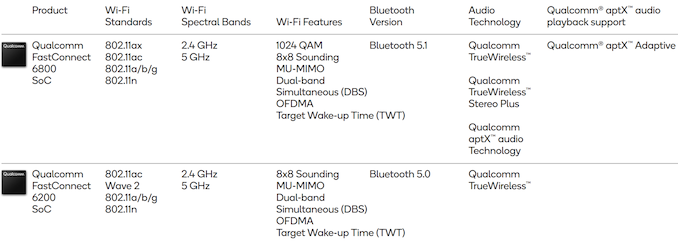
On the client side, we are starting to see some high-end notebooks rolling out with Intel’s Wi-Fi 6 solution. The Samsung Galaxy S10 used Broadcom’s chipset for Wi-Fi 6 support. Most of the currently shipping Snapdragon 855 phones have only 802.11ac support. Qualcomm is re-branding their product stack in this space – the currently shipping solution is getting the FastConnect 6200 branding, while the QCA6390 (announced at MWC 2019) will be marketed as FastConnect 6800. It is highly likely that FastConnect 6800 will feature in many of the upcoming high-end mobile handsets.


Related Reading


Title Image from Anshel Sag


Source: AnandTech – Qualcomm Updates Wi-Fi 6 Lineup: Networking Pro Series for APs and FastConnect for Clients

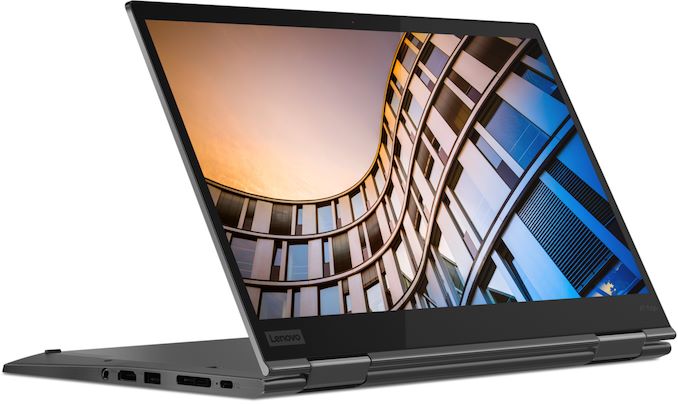
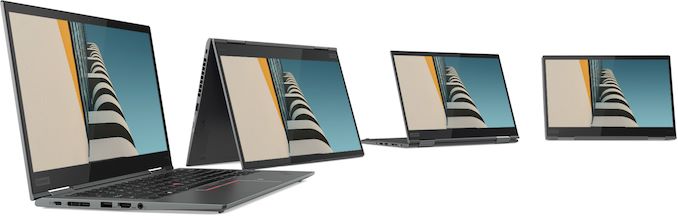
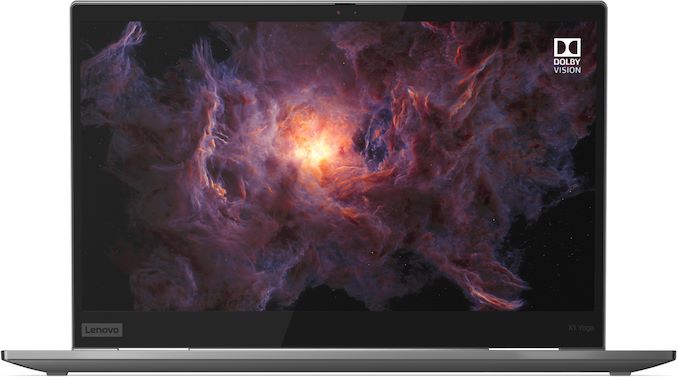
Lenovo’s 2019 ThinkPad X1 Yoga: An Ultralight Convertible with Comet Lake

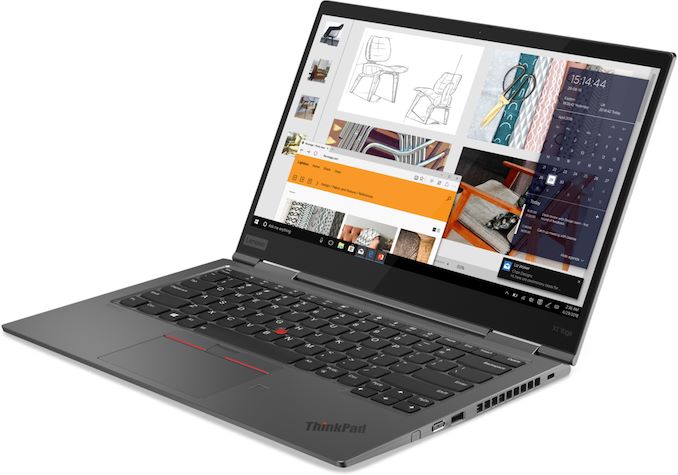
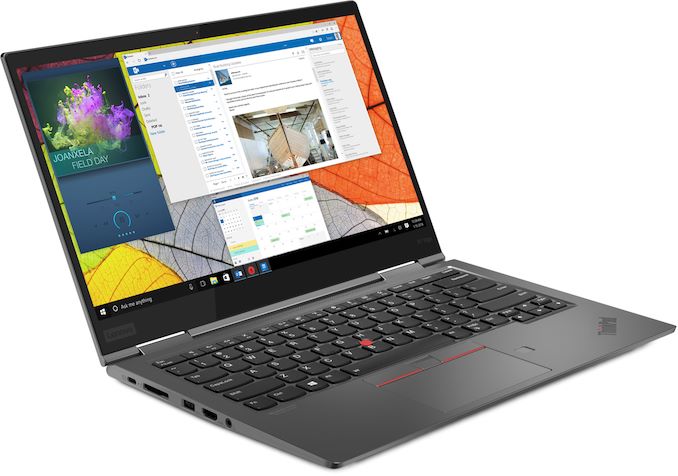
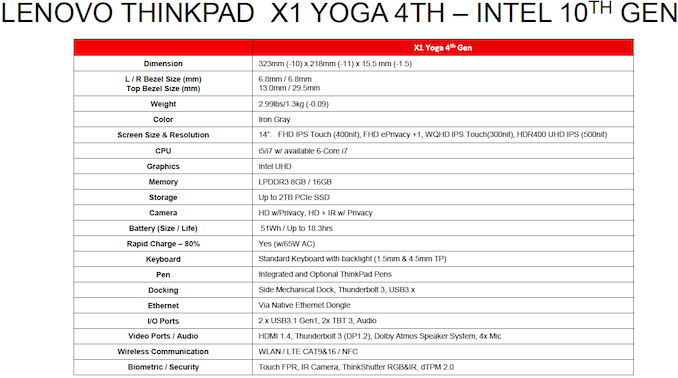
Lenovo on Tuesday formally unveiled its 4th Generation ThinkPad X1 Yoga convertible notebooks aimed at ‘road warriors and corporate users’. The new ThinkPad X1 Yoga comes in an all-new aluminum chassis, features a 14-inch display panel, and Intel’s 10th Generation Core i5/i7 Comet Lake processors with four or six cores. While the new hybrid laptops are the lightest X1 Yoga machines to date, they also claim to be the most powerful at least when it comes to general-purpose performance.


For the first time in history of the ThinkPad X1 Yoga product family, the new 4th Gen machines come in a CNC-machined MILSPEC-graded all-aluminum chassis that is up to 15.5 mm thick and weighs around 1.3 kilograms, making the PCs among the most compact and lightweight convertible with a 14-inch display available today. The new ThinkPad X1 Yoga will be offered with the same touch-enabled LCD panel options as the latest X1: some will will come with a Full-HD with ThinkPad Privacy Guard, others will feature a WQHD panel, whereas range-topping SKUs will be equipped with an Ultra-HD display panel with 500 nits brightness, Dolby Vision support, and VESA’s DisplayHDR 400 certification.


Lenovo’s 4th Gen ThinkPad X1 Yoga is based on Intel’s 10th Generation Core i5 or i7 processors with four of six cores as well as Intel’s UHD Graphics 620 GPU. Unlike some previous-generation convertibles, the new ThinkPad X1 Yoga does not use CPUs with higher-performance integrated GPUs. Meanwhile, the systems will come with 8 or 16 GB of LPDDR3 as well as an NVMe SSD of up to 2 TB.


When it comes to connectivity, the new 4th Gen ThinkPad X1 Yoga PCs feature Wi-Fi + Bluetooth featuring an improved antenna design, an optional 4G/LTE-A Cat9 or Cat16 modem, two Thunderbolt 3 ports, USB 3.0 Type-A connectors, GbE with a dongle, an HDMI 1.4 output, and a 3.5-mm audio connector for headsets.


As far as multimedia capabilities are concerned, the new ThinkPad X1 Yoga has a quad-speaker Dolby Atmos-badged audio subsystem, four far-field microphones, and a 720p webcam with IR sensors that can be covered using Lenovo’s ThinkShutter.


Lenovo will start sales of the ThinkPad X1 Yoga Gen 4 in the coming weeks. Prices will depend on actual configurations.


Related Reading


Source: Lenovo


Source: AnandTech – Lenovo’s 2019 ThinkPad X1 Yoga: An Ultralight Convertible with Comet Lake

Xilinx Announces World Largest FPGA: Virtex Ultrascale+ VU19P with 9m Cells

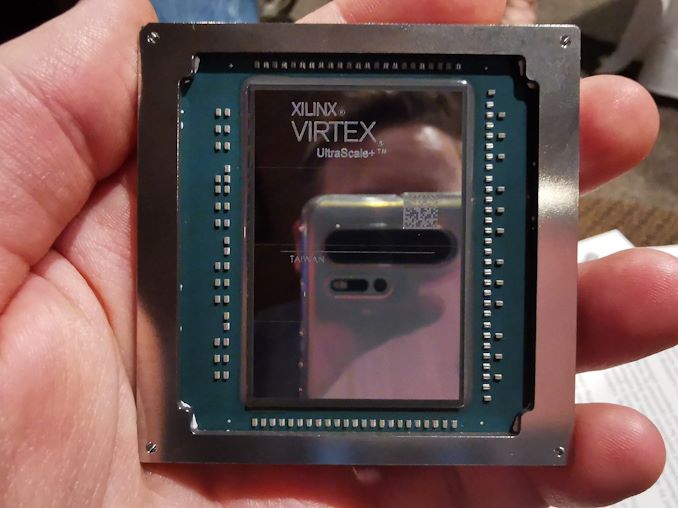
We don’t often cover the FPGA market here at AnandTech, but in the past couple of years we have seen the array of features that FPGAs are implementing expand at an incredible rate. Xilinx has been at some of the forefront of those innovations, with products such as Versal on 7nm and its Alveo family. One key part of Xilinx’s business is emulation and simulation, which requires large FPGAs to fit large designs onto – and the company recently lifted the lid on its latest creation, the Virtex Ultrascale+ VU19P. This new FPGA, when it comes to market, will hold the title of the World’s Largest FPGA.


Source: AnandTech – Xilinx Announces World Largest FPGA: Virtex Ultrascale+ VU19P with 9m Cells

Lenovo Launches ThinkPad X1 Carbon Gen 7: Thinner, Lighter, Comet Lake Inside

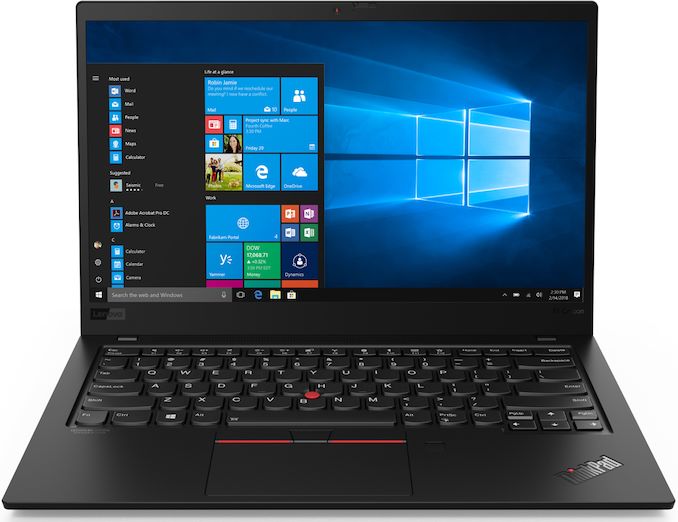
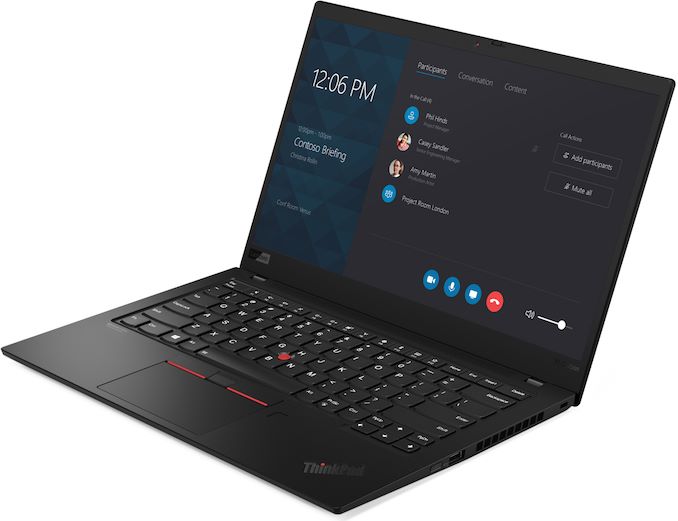
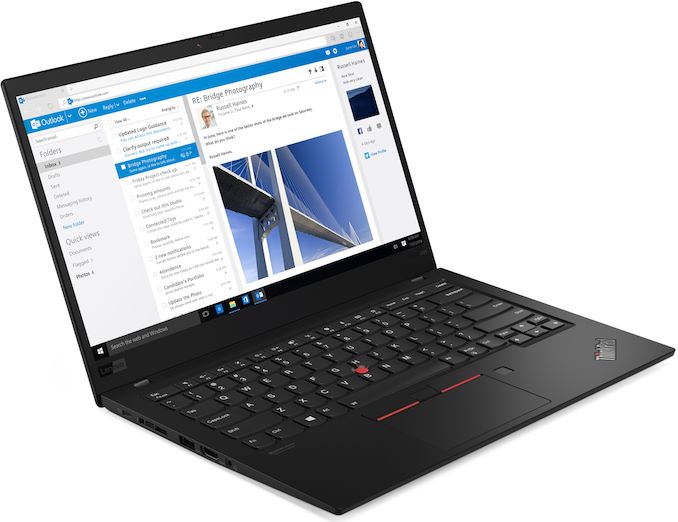
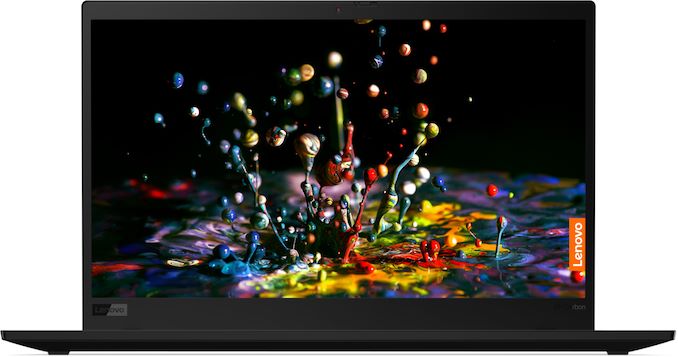
Lenovo has officially launched its 7th Generation ThinkPad X1 Carbon notebook. Originally announced back at CES 2019 earlier this year, the new ThinkPad X1 Carbon got itself a thinner and lighter chassis, an improved 4K LCD featuring a 500 nits brightness and HDR support, as well as Intel’s latest 10th Generation Core Comet Lake processors with up to six cores.


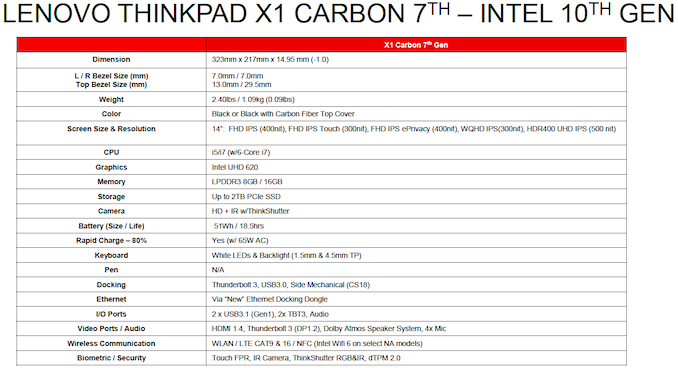
The ThinkPad X1 Carbon Gen 7 — Lenovo’s new flagship ultraportable laptop that promises to offer the best the company has — comes in a brand new carbon fiber chassis that is 14.95 mm thick (down from 15.95 mm before) and weighs 1.09 kilograms (down from 1.13 kilograms before). The laptop has ultra-thin display bezels that allow to install a 14-inch IPS LCD into 13.3-inch-class chassis. Depending on exact model, the new ThinkPad X1 Carbon will come with a Full-HD with ThinkPad Privacy Guard, WQHD, or Ultra-HD display panel. Flagship SKUs with a 4K screen will feature 500 nits brightness and will carry VESA’s DisplayHDR 400 badge.


Apart from the new chassis and new display options, the new ThinkPad X1 Carbon Gen 7 notebooks will get Intel’s latest 10th Gen Core i5 or Core i7 processors codenamed Comet Lake with four or six cores as well as Intel’s UHD Graphics 620 iGPU. The CPUs will be accompanied by 8 or 16 GB of LPDDR3 memory as well as an NVMe SSD featuring capacities of up to 2 TB.


When it comes to connectivity, the 7th Gen ThinkPad X1 Carbon is equipped with Intel’s Wi-Fi + Bluetooth adapter (Wi-Fi 6 will be supported on select models), an optional 4G/LTE Cat 9 or Cat 16 modem, two Thunderbolt 3 ports, USB 3.0 Type-A connectors, a GbE with a new dongle, an HDMI 1.4 output and a 3.5-mm audio connector for headsets.


Among the significant advances of the upcoming ThinkPad X1 Carbon laptops when compared to its predecessors is an overhauled Dolby Atmos-badged audio subsystem with four speakers and four far-field microphones. As for webcam, Lenovo will offer an IR-equipped 720p camera with the company’s ThinkShutter privacy cover.


Being equipped with a 51 Wh battery, Lenovo’s 7th Generation ThinkPad X1 Carbon will work for up to 18.5 hours, though the company does not say which of the SKUs will work for that long. In fact, it is likely that battery life of flagship model based on a six-core CPU and featuring an Ultra-HD display will likely work for less time depending on the usage model.


Lenovo will start sales of the 7th Generation ThinkPad X1 Carbon notebooks in the near future. Prices will depend on exact configurations.


Related Reading:


Source: Lenovo


Source: AnandTech – Lenovo Launches ThinkPad X1 Carbon Gen 7: Thinner, Lighter, Comet Lake Inside

GlobalFoundries Sues TSMC Over Patent Infringement; Apple, Qualcomm, Others Named Defendants

GlobalFoundries has filed a lawsuit against TSMC and its clients in the USA and Germany alleging the world’s largest contract maker of semiconductors of infringing 16 of its patents. Among defendants, GlobalFoundries named numerous fabless developers of chips, including Apple, NVIDIA, Qualcomm, and many others. The plaintiff seeks damages from TSMC and wants courts to ban shipments of products that use semiconductors allegedly infringing its patents into the USA and Germany.


GlobalFoundries says that TSMC infringed 16 of its patents covering various aspects of chip manufacturing (for details, please see the table below), including those chips that use FinFET transistors. In particular, the company claims that TSMC’s 7 nm, 10 nm, 12 nm, 16 nm, and 28 nm nodes use its intellectual property. Considering the fact that the said manufacturing processes are used to make more than a half of TSMC’s chips (based on revenue share), potential damages seeked by GlobalFoundries may count billions of dollars.


GlobalFoundries filed complaints in the US International Trade Commission (ITC), the U.S. Federal District Courts in the Districts of Delaware and the Western District of Texas, and the Regional Courts of Dusseldorf, and Mannheim in Germany. In its lawsuits GlobalFoundries demands damages from TSMC and wants courts to bar products that allegedly infringe its rights from being imported into the U.S. and Germany.


Among the defendants, GlobalFoundries names multiple designers of SoCs, resellers of semiconductors, as well as suppliers of actual devices. Among the big names accused of using GlobalFoundries IP are Apple, ASUS, Broadcom, Cisco, Google, NVIDIA, Lenovo, Motorola, and Motorola. Assuming that the courts take GlobalFoundries’ side, they may ban sales of Apple’s iPhones, NVIDIA GeForce-based graphics cards, smartphones running Qualcomm’s chips made by TSMC, various routers, as well as devices (e.g., PCs, smartphones) by ASUS and Lenovo containing chips made by TSMC.


GlobalFoundries vs. TSMC et al
Fabless Chip Designers Makers of Consumer Products Distributors of Electronic Components
Apple

Broadcom

Mediatek

NVIDIA

Qualcomm

Xilinx
Arista

ASUS

BLU

Cisco

Google

HiSense

Lenovo

Motorola

TCL

OnePlus
Avnet/EBV

Digi-key

Mouser

GlobalFoundries says that it wants to protect its IP investments in the US and Europe. Here is what Gregg Bartlett, SVP of engineering and technology at GlobalFoundries, had to say:


“While semiconductor manufacturing has continued to shift to Asia, GF has bucked the trend by investing heavily in the American and European semiconductor industries, spending more than $15 billion dollars in the last decade in the U.S. and more than $6 billion in Europe’s largest semiconductor manufacturing fabrication facility. These lawsuits are aimed at protecting those investments and the US and European-based innovation that powers them. For years, while we have been devoting billions of dollars to domestic research and development, TSMC has been unlawfully reaping the benefits of our investments. This action is critical to halt Taiwan Semiconductor’s unlawful use of our vital assets and to safeguard the American and European manufacturing base.”


Related Reading:


Source: GlobalFoundries


Source: AnandTech – GlobalFoundries Sues TSMC Over Patent Infringement; Apple, Qualcomm, Others Named Defendants

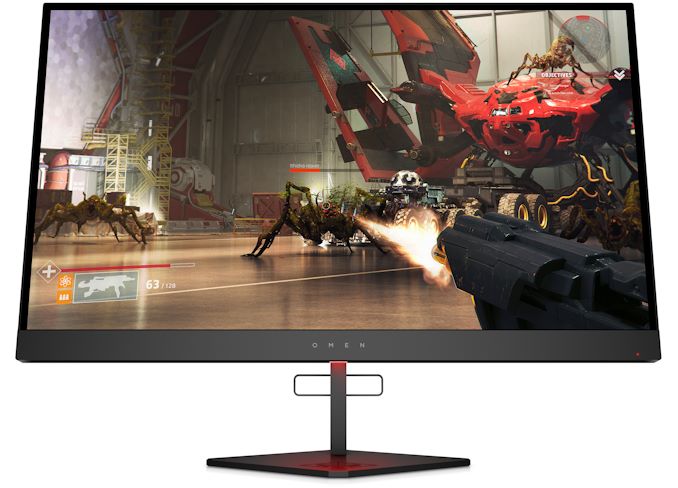
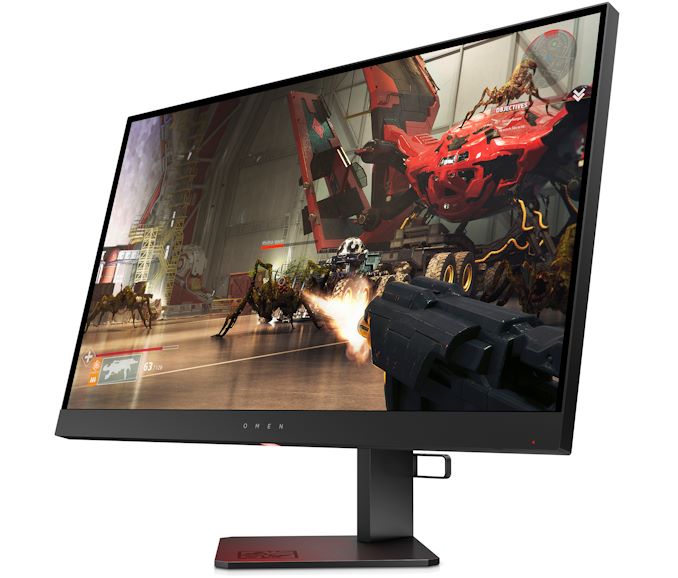
HP Unveils the Omen X 27: A 240Hz QHD Monitor with FreeSync 2 HDR

Among the monitor announcements to come out this week, HP has introduced a new display aimed at hardcore gamers and esports professionals. With a 240 Hz max refresh rate, FreeSync 2 support, and HDR, the Omen X 27 is designed to be a jack of all trades for gaming monitors.


HP’s new gaming monitor is based around a high-performance QHD TN panel, sporting a 240 Hz refresh rate, 300/400 nits brightness (SDR/HDR), and a 90% coverage of the DCI-P3 gamut. Seeing a TN panel show up in a (marginally) HDR-capable monitor like the Omen is a relatively recent advancement; for years, TN displays have lagged IPS monitors when it comes to the color space that could be represented. However, recently developed TN panels and new types of backlighting have significantly improved the ability of such LCDs to cover wide color gamuts, a core requirement for HDR support.


The Omen X 27 is also an AMD FreeSync 2-certified monitor, which means that it not only supports a variable refresh rate technology, but also features Low Framerate Compensation (LFC), HDR, and allows select games to tone map directly to the monitor’s native dynamic range. In accordance with its HDR support, the monitor also features zoned backlighting, with 16 edge-lit zones across the monitor.


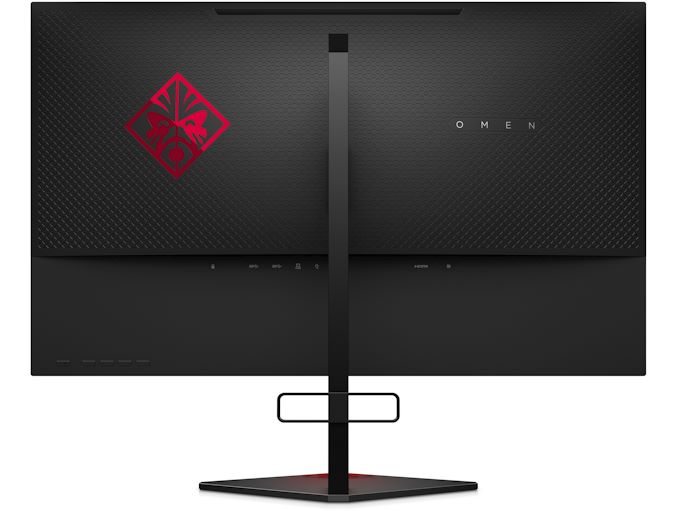
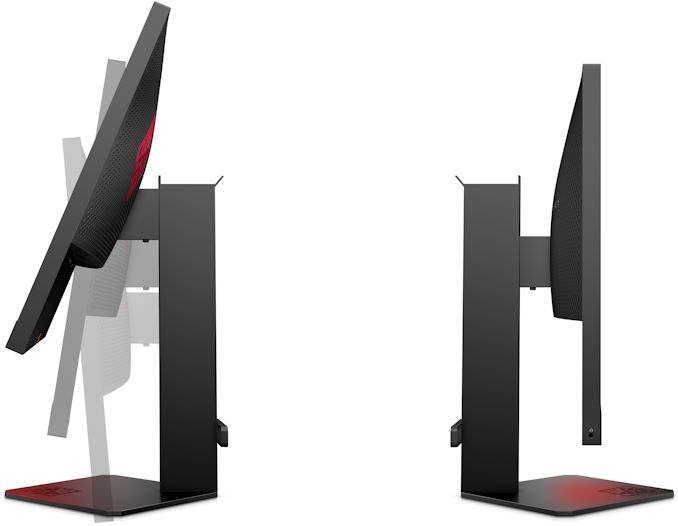
Being aimed at hardcore PC gamers and esports professionals, the HP Omen X 27 has only two display inputs: a DisplayPort 1.4 input and an HDMI 2.0 port. The monitor also features a headphone output, which is common for gaming monitors these days, but it does not have built-in speakers. In addition, the Omen X 27 has a dual-port USB 3.0 hub and an adjustable stand with a headset rest, and a red ambient light.


The combination of a variable refresh rate of up to 240 Hz, HDR, and wide color gamut support will naturally be the key selling point of the monitor. Unfortunately, since HP has not disclosed all the specs of the display, we do not know whether it actually supports the HDR10 transport format, which is important for many. That said, while the monitor is full of interesting features, the whole picture is something that remains to be seen.


The HP Omen X 27
  General Specifications
Panel 27-inch 8-bit TN
Native Resolution 2560 × 1440
Maximum Refresh Rate 240 Hz
Response Time 1 ms GtG with Overdrive

3 ms GtG
Brightness SDR: 300 cd/m²

HDR: 400 cd/m²
Contrast 1000:1
Backlighting 16-zone bottom edge lit
Viewing Angles 170°/160° horizontal/vertical
Curvature none
Aspect Ratio 16:9
Color Gamut 90% DCI-P3

sRGB
DisplayHDR Tier N/A
Dynamic Refresh Rate Tech AMD FreeSync 2
Pixel Pitch 0.2335 mm²
Pixel Density 109 PPI
Inputs 1 × DisplayPort 1.4

1 × HDMI 2.0
Audio Headphone output
USB Hub 2 × USB 3.0 Type-A connectors

1 × USB 3.0 input
Adjustments Height: 0-130 mm

Tilt: -5 to +23 degrees
MSRP $649

HP’s Omen X 27 will be available starting from September in the US at $649 and starting from November in the UK for $£579.99.


Related Reading:


Source: AnandTech – HP Unveils the Omen X 27: A 240Hz QHD Monitor with FreeSync 2 HDR

ASUS Unveils Low-Profile GeForce GTX 1650 Cards

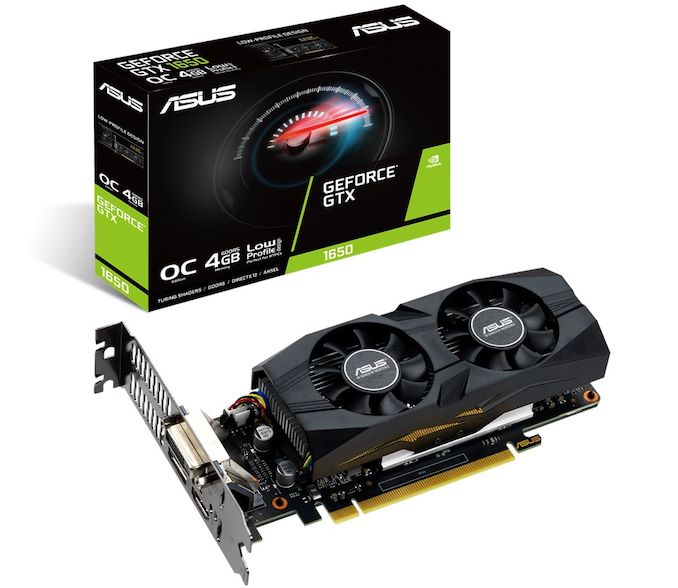
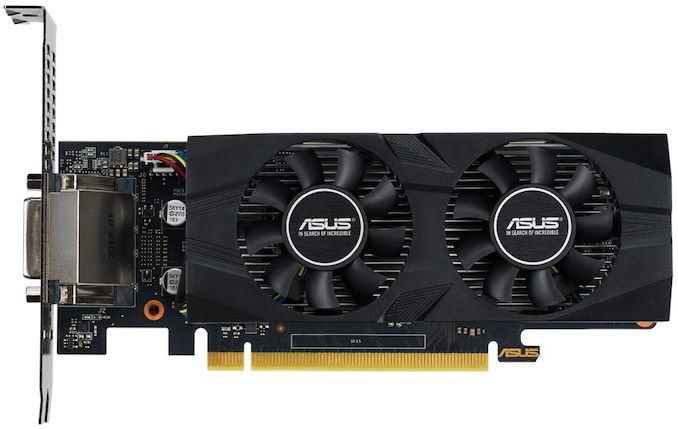
ASUS has quietly added two low-profile GeForce GTX 1650 graphics cards to its products lineup. The boards come with a dual-slot dual-fan cooling system and offer a similar set of essential display connectors.


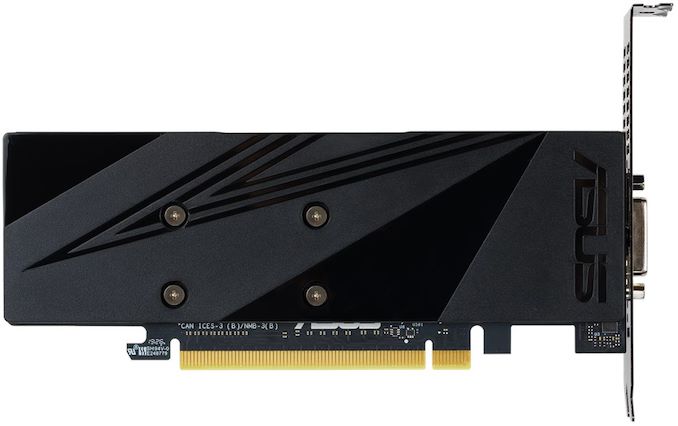
Like other GTX 1650 cards, the ASUS GeForce GTX1650-4G-LP-BRK and the ASUS GeForce GTX1650-O4G-LP-BRK are based on NVIDIA’s TU117 GPU (896 CUDA cores) and are paired with 4 GB of GDDR5 memory. The two cards are nearly identical, with the O4G version featuring a factory overclock for a bit more performance. Both share the same PCB design with a DisplayPort 1.4 output, HDMI 2.0b port, and even a DVI-D port. They also use the same cooling system comprising of an aluminum heatsink, two IP5X-gradeed dust-resistant fans, and a protective backplate, a rare element in this price segment.


In terms of clockspeeds, the base model sports a boost clock of 1665/1695 MHz depending on the mode (Gaming/OC), whereas the factory overclocked O4G hits 1710/1740 MHz (~3% faster).


Since the cards consume no more than 75 W of power even when working in OC mode, they do not need an auxiliary PCIe power connectors, which means that they are compatible with entry-level desktops from well-known OEMs that usually do not have any spare power plugs inside. Furthermore, being small, energy-efficient, and supporting hardware-accelerated decoding and encoding of HEVC (H.265) and VP9 video at 4Kp60 as well as HDR10, both cards are also well-geared for use in HTPCs.


As is often the case for a quiet, low-profile announcement, ASUS did not disclose recommended prices of the new cards. Keeping in mind that we are talking about mainstream products with some perks, expect them to cost slightly more than NVIDIA’s recommended $149.


Related Reading:


Source: ASUS (1, 2)


Source: AnandTech – ASUS Unveils Low-Profile GeForce GTX 1650 Cards

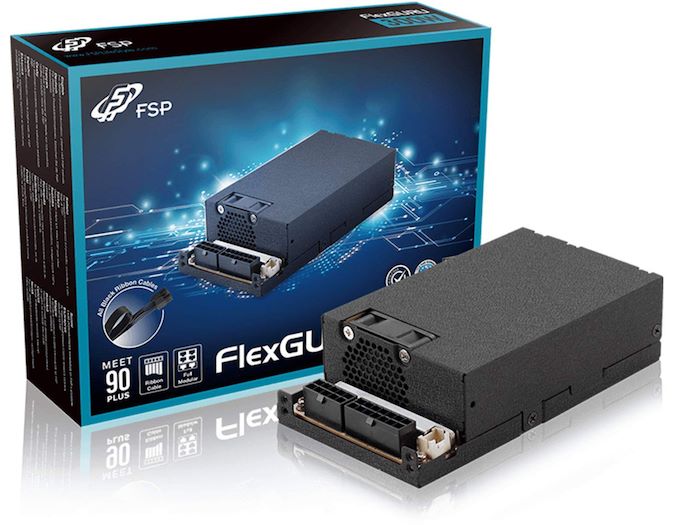
FSP Launches FlexGuru 250W & 300W Modular FlexATX PSUs

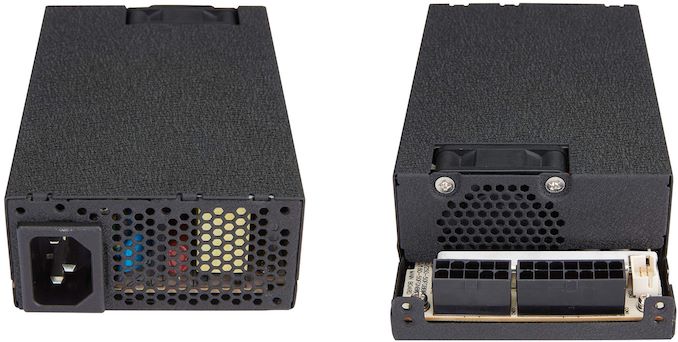
FSP has introduced its first FlexATX power supplies, which will be available through retail channels and value added resellers. The FlexGuru PSUs are fully modular and are rated at 250 W and 300 W. Supporting virtually all technologies that one would expect from a modern desktop power supply, FSP’s FlexATX products are aimed at a broad set of applications from industrial PCs to servers and from HTPCs to NAS.


FlexATX power supplies have traditionally been used for small form-factor desktops by large OEMs, as well as for specialized PCs built in large quantities. As demand for miniature computers is on the rise and the market for specialized edge computing systems is set to rapidly grow in the coming years, it’s a good time for FSP to roll-out its FlexGuru family of modular PSUs. These PSUs are aimed at smaller PC/server makers, VARs, and even DIY enthusiasts (assuming that the latter can obtain a proper chassis and other components) that do not need high capacity PSUs and require some additional flexibility when it comes to cables.


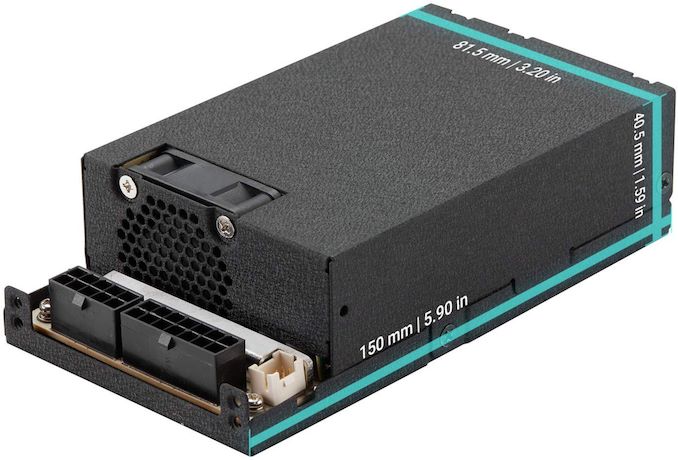
The FlexGuru PSUs measure 150×40.5×81.5 mm and are compatible with the latest Flex ATX 1.22 specification. FSP says that to guarantee compatibility with 99% of Flex ATX chassis (which feature a different PSU orientation), the FlexGuru power supplies come with a special bracket called ‘Beetle’. The power supplies do not officially conform with any 80 Plus requirements, though FSP itself says that the 250 W version is more than 85% efficient, whereas the 300 W model is more than 90% efficient under typical loads. Meanwhile, like other contemporary power supplies, FSP’s FlexGuru support over power, over/under voltage, over temperature, and short circuit protection technologies


The Flex ATX power supplies from FSP use Japanese electrolytic capacitors and feature a single +12 V rail design. Both PSUs are equipped with a 40-mm ball bearing fan that spins at 3000 ~ 6000 RPM depending on the load, producing 30 ~ 38 dBA noise.


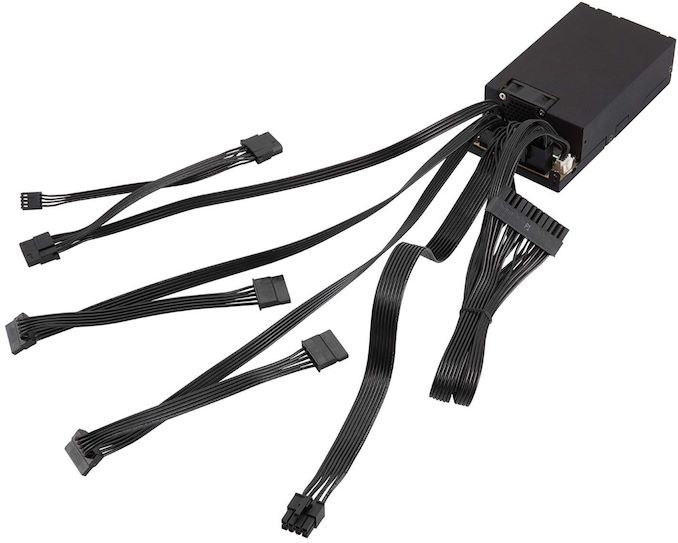
Both FlexGuru PSUs feature a modular design and come with one ATX 20+4 connector, an 8-pin PCIe auxiliary power connector, four SATA power plugs, two Molex power outputs, and two FDD power connectors. To ensure greater flexibility, FSP uses slim ribbon cables.


FSP’s FlexGuru Series Output Specifications
  FSP250-50FGBBI(M) FSP300-57FCB
Rated Combined

(max load)
Rated Combined

(max load)
+3.3V 12 A 39.6 W 12 A 39.6 W
+5V 14 A 70 W 14 A 70 W
+12V 18 A 250 W 25 A 300 W
-12V 0.3 A 3.6 W 0.3 A 3.6 W
+5Vsb 3 A 15 W 3 A 15 W
Total Power 250 W 300 W

FSP’s FlexGuru 250 W and 300 W PSUs are already available from Amazon. The 250 W model costs $86.99, whereas the 300 W SKU is priced at $96.99.


Related Reading:


Source: FSP

Image Credit: Amazon


Source: AnandTech – FSP Launches FlexGuru 250W & 300W Modular FlexATX PSUs

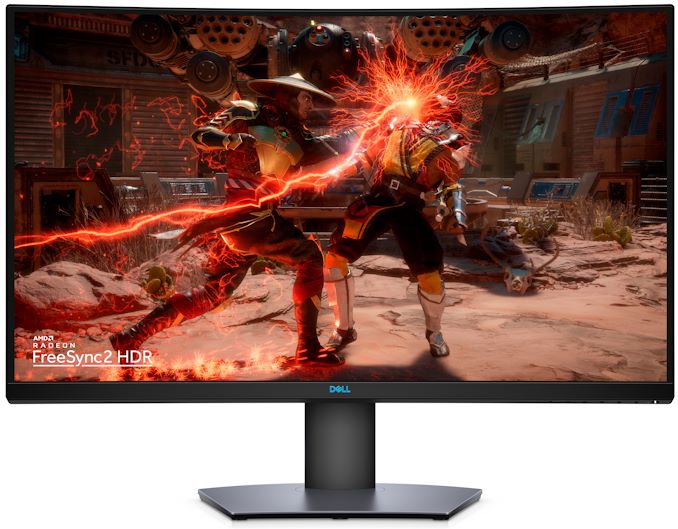
Dell Rolls Out 32-Inch QHD Curved Gaming Monitor (S3220DGF): Up To 165Hz with FreeSync 2

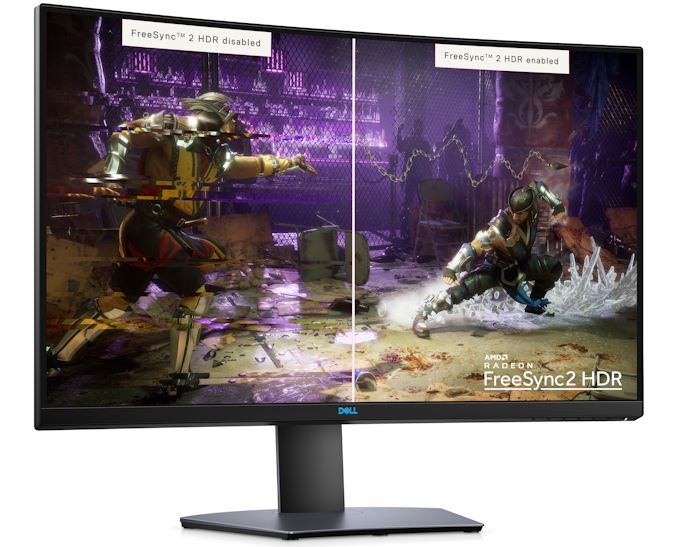
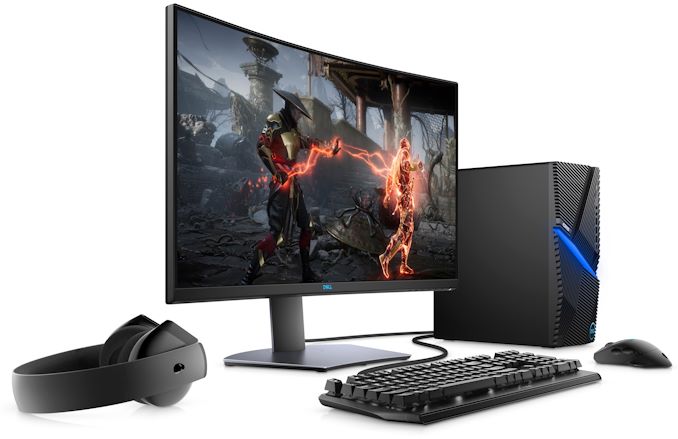
Having launched a revamped version of its flagship Alienware 34-inch curved gaming display, Dell has also put together something similar for the broader mid-range gaming market. Dell new 32-inch QHD Curved Gaming Monitor is slightly smaller overall, but it offers variable refresh support via FreeSync 2 of up to 165 Hz, along with support for HDR content.


Like many other FreeSync 2-enabled displays, the 32-inch monitor (model S3220DGF) uses a 31.5-inch curved VA panel featuring a 2560×1440 resolution, 400 nits brightness (typical), a 3000:1 contrast ratio, 178°/178° viewing angles, a 4 ms GtG response time, and a 165 Hz maximum refresh rate. In fact, Dell’s 32-inch Curved Gaming Monitor is one of the industry’s first FreeSync 2-enabled LCDs of this size and curvature, an important distinction since FreeSync sets requirements for panel quality and HDR support. As for the variable refresh range, it is rather wide: from 48 Hz to 144/165 Hz depending on the connection.


The 32-inch monitor can display 1.07 billion of colors and can reproduce 92.4% of the DCI-P3 color gamut, 99.7% of the sRGB color gamut, and 89.2% of the CIE 1931 gamut. It also carries the DisplayHDR 400 badge, so while it’s only marginally an HDR monitor, it does support at least HDR10 transport as well as some kind of local dimming for added contrasts.


Being a gaming display, the S3220DGF supports a number of features aimed at the target audience, including an on-screen timer, frame rate counter, and what Dell calls a “dark stabilizer” to provide better visuals in dark scenes in games.


As for connectivity, the monitor is equipped with one DisplayPort 1.2 input, two HDMI ports, a triple-port USB 3.0 hub, and two 3.5-mm audio jacks. Meanwhile, the S3220DGF features an adjustable stand with built-in cable management slots.


The Dell 32 Curved Gaming Display
  S3220DGF
Panel 31.5″ VA
Native Resolution 2560 × 1440
Maximum Refresh Rate 165 Hz
Response Time 4 ms GtG
Brightness 400 cd/m² (typical)
Contrast 3000:1
Backlighting LED
Viewing Angles 178°/178° horizontal/vertical
Curvature 1800R
Aspect Ratio 16:9
Color Gamut 99.7% sRGB/BT.709

92.4% DCI-P3

89.2% CIE 1931
DisplayHDR Tier 400
Dynamic Refresh Rate Tech AMD FreeSync 2

48 – 165 Hz over DP

48 – 144 Hz over HDMI
Pixel Pitch 0.2767 mm²
Pixel Density 91.79 PPI
Inputs 1 × DisplayPort 1.2

2 × HDMI 2.0
Audio 3.5 mm output

3.5 mm input
USB Hub 2 × USB 3.0 Type-A connectors

1 × USB 3.0 Type-C input
Stand Adjustments Height: ±150 mm

Tilt: -5˚ – 21˚

Swivel: -30˚ – 30˚
MSRP $599.99

The Dell 32 Curved Gaming Display (S3220DGF) will be available starting from August 28 and will carry a price tag of $599.99, which, it goes without saying, is considerably less than the price of the Alienware 34.


Related Reading:


Source: Dell


Source: AnandTech – Dell Rolls Out 32-Inch QHD Curved Gaming Monitor (S3220DGF): Up To 165Hz with FreeSync 2

Giveaway: Supermicro Z390 C9Z390-CGW Gaming Motherboard

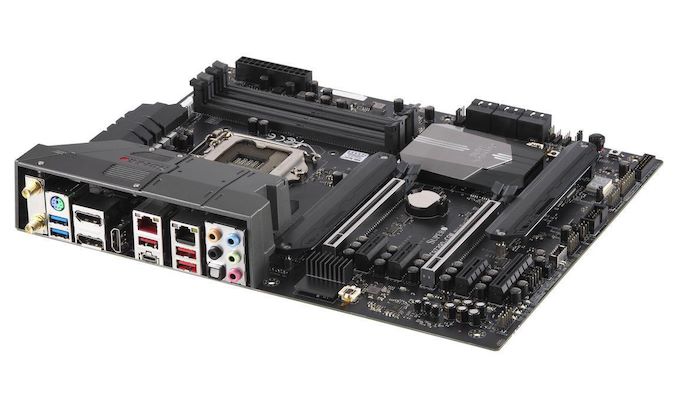
Taking us into the final weeks of the summer, we have a new giveaway courtesy of the always awesome Supermicro. The company has sent our community team one of their Z390 ATX motherboards, the SuperO C9Z390-CGW, and one lucky reader is going to win it. So if you’re angling to build a new gaming system around one of Intel’s Socket 1151 9th Gen Core CPUs, then this may be just the part you need to get started.


The C9Z390-CGW is a premium version of Supermicro’s well-regarded ATX sized C9Z390-CG, taking the important elements from that board while adding some additional features. There are a pair of full-length PCIe 3.0 x16 slot with steel slot reinforcement, as well as an unreinforced PCIe 3.0 x4 slot and a trio of x1 slots. The board also includes two PCIe 3.0 x4 M.2 slots, placed above and below the x16 slots respectively. Also included are the usual six SATA ports, which are angled towards the front of the board.


Supermicro C9Z390-CGW ATX Motherboard
Product Page Link
Price $290
Size ATX
CPU Interface LGA1151
Chipset Intel Z390
Memory Slots (DDR4) Four DDR4

Supporting 128 GB

Up to DDR4-3866
Video Outputs 1 x HDMI 1.4b

2 x DisplayPort 1.2
Network Connectivity Intel I219-V Gigabit

Aquantia AQC107 10G

Dual Band 802.11ac + BT 5.0
Onboard Audio Realtek ALC1220
PCIe Slots for Graphics (from CPU) 2 x PCIe 3.0 x16
Onboard SATA 6 x
Onboard M.2 2 x PCIe 3.0 x4
USB 3.1 (10 Gbps) 3 x Type-A Rear Panel

1 x Type-C Rear Panel

1 x Type-C Header
USB 3.0 (5 Gbps) 2 x Type-A Rear Panel

2 x Type-A Header
RGB 2 x 12v
Power Connectors 1 x 24-pin ATX

1 x 8pin CPU

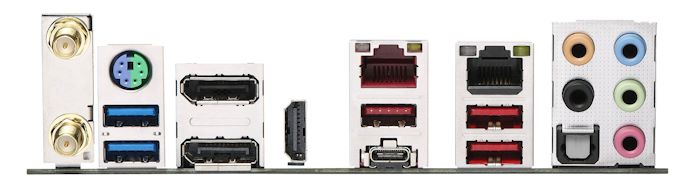
Controller-wise the board is using a Realtek ALC1220 HD audio codec to power the five 3.5 mm audio jacks and S/PDIF optical output on the rear, an Intel I219V Gigabit controller for the GigE LAN port, and a dual-band 802.11ac wireless networking adapter is also included. Unique to this board as a premium feature is a 10GigE controller in the form of Aquantia’s popular AQC107 controller, feeding the board’s high-speed Ethernet port. The rest of the rear panel is comprised of three USB 3.1 Gen2 Type-A ports, one USB 3.1 Gen2 Type-C port, two USB 3.0 Type-A ports, a PS/2 combo port, and a trio of display outputs consisting of two DisplayPort 1.2 outputs and an HDMI 1.4b port.


The gaming-focused board also includes a pair of 12v headers for RGB lighting. The motherboard itself is also equipped with RGB LEDs, offering numerous lighting options. Control is provided via SuperMicro’s SUPERO Booster software.


The giveaway is running through September 6th and is open to all US residents (sorry, ROW!). You can enter below, and you can find more details (and the full discussion) about the giveaway over on the AnandTech Forums.


AnandTech Supermicro Giveaway


Source: AnandTech – Giveaway: Supermicro Z390 C9Z390-CGW Gaming Motherboard

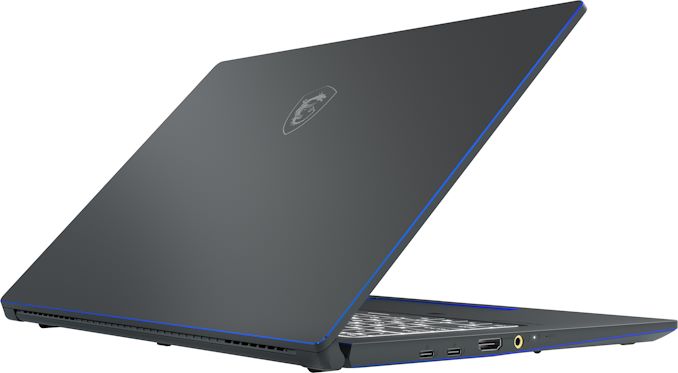
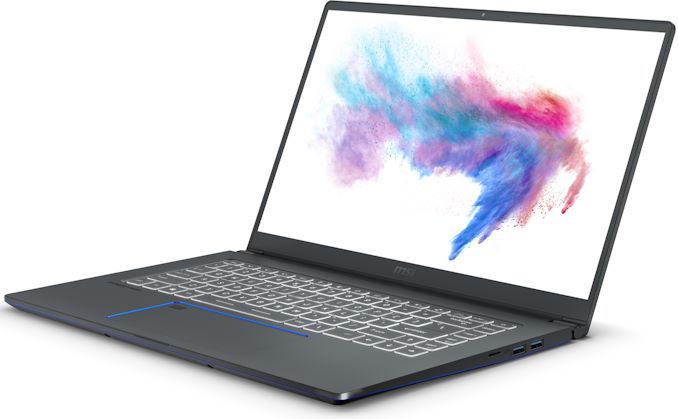
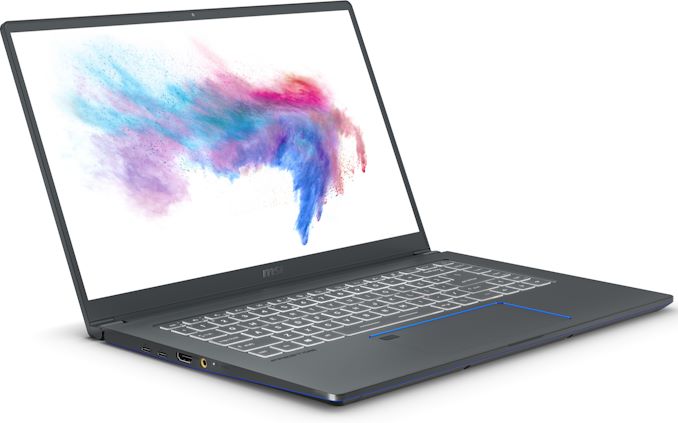
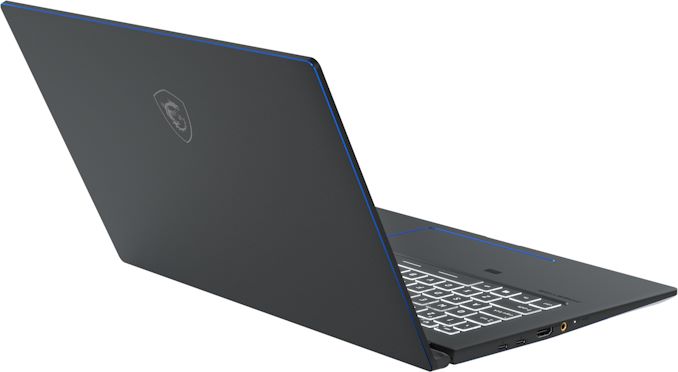
MSI’s New Prestige 14 & 15 Laptops Get Intel's Comet Lake-U CPUs & Calibrated 4K Display

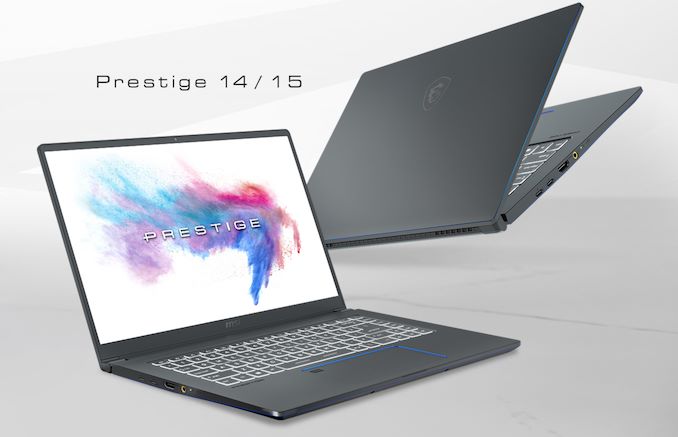
Among the many manufacturers launching new or updated laptops this week alongside the release of Intel’s new Comet Lake processors is MSI. This week the company is introducing its new compact Prestige 14 and Prestige 15 laptops, which feature Intel’s 10th gen Core CPUs, NVIDIA’s GeForce GTX 16-series GPUs, and a factory-calibrated 4K display. The notebooks are aimed at power users running multiple threads at once – such as content creators and photographers – particularly with the machines’ top-end hex-core configurations.


MSI’s Prestige 14 and 15 laptops are based on Intel’s 10th generation Core “Comet Lake-U” processors, which come with up to six CPU cores. Accompanying the CPUs at the high-end is NVIDIA’s GeForce GTX 1650 in Max-Q design configuration. Officially, MSI labels this as an “up to” configuration, however looking at the SKU specs, even the cheapest Prestige 15 inclucdes the 1650. Details on the Prestige 14, on the othe rhard, are harder to come by, and it’s not clear what the baseline configuration is there.


Meanwhile in terms of memory and storage, the 14-inch notebook comes with up to 16 GB of LPDDR3-2133 memory onboard and one M.2 SSD featuring a SATA or PCIe 3.0 x4 interface, whereas the 15-incher can be equipped with up to 64 GB of memory as well as two M.2 drives (see exact specifications in the table below).


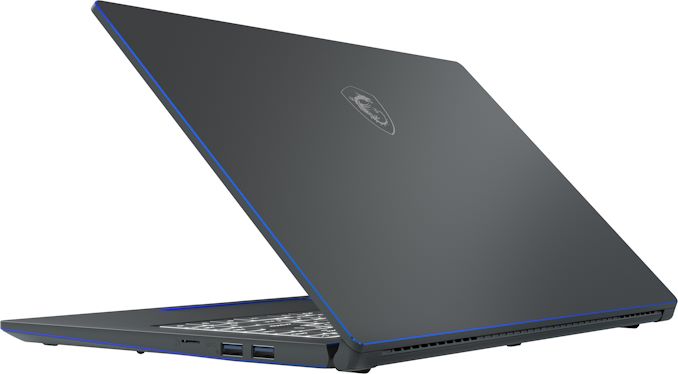
The Prestige 14 and the Prestige 15 laptops from MSI come in sleek sandblasted aluminum chassis with blue accents that are only 16 mm thick in both cases. The bodies house a 14 or 15.6-inch ‘IPS-level’ panel (which probably means AHVA or something similar), with MSI offering 1920×1080 and 3840×2160 options. All panel options cover 100% of the Adobe RGB color gamut and come factory calibrated to Delta-E<2 color accuracy.


Connectivity-wise, the systems are very similar, yet not completely the same. The PCs come with a Wi-Fi 6 + Bluetooth adapter, two Thunderbolt 3 ports, two USB Type-A connectors (2.0 in case of the 14-incher and 3.2 Gen 2 in case of the 15-incher), an HDMI 2.0 output, a 3.5-mm audio connector for headsets, and a microSD card reader. As for multimedia capabilities, MSI’s Prestige 14/15 laptops are equipped with a webcam with IR sensors, stereo speakers, and a microphone array.


It is noteworthy that MSI’s original Prestige laptops introduced in 2018 were aimed primarily at business users seeking a combination of performance and compact form-factor. Meanwhile, MSI’s Prestige 14 and Prestige 15 mobile PCs in their high-end configurations are increasingly targeted at creative professionals, which essentially means that the systems are entering workstation territory. In fact, the Prestige brand plays equally well both for business users who need to show their status and for creative professionals.


Specifications of MSI’s 2019 Prestige Laptops
  Prestige 14 Prestige 15
LCD Diagonal 14-inch 15.6-inch
Resolution 3840×2160
Brightness ?
Contrast Ratio ? ?
Color Gamut 100% AdobeRGB
Touch Support ? ?
Protective Glass ?
CPU  Intel 10th Gen Core processors (Comet Lake-U)
Graphics Integrated Intel UHD Graphics
Discrete up to NVIDIA’s GeForce GTX 1650 with 4 GB GDDR5 w/ Max-Q
RAM up to 16 GB LPDDR3 DRAM (onboard) up to 64 GB of DDR4 DRAM

(two SO-DIMMs)
Storage SSD 1 × M.2 SSD (SATA or PCIe) 1 × M.2 SSD (SATA or PCIe)

1 × M.2 SSD (PCIe)
Card Reader MicroSD Card reader
Wireless Wi-Fi 6 + Bluetooth 5.0
USB 3.1 2 × TB 3 (USB Type-C)

2 × USB Gen 3.1 Gen 2 Type-A
2 × TB 3 (USB Type-C)
2.0 2 × USB Gen 3.1 Gen 2 Type-A
Thunderbolt 2 × TB 3 (for data, charging, DP displays)
Cameras Front 720p HD webcam with IR sensors
Other I/O Microphone, 2 stereo speakers, audio jack, fingerprint reader
Battery ?
Dimensions Width 31.9 cm | 12.56 inches 35.7 cm | 14.05 inches
  Depth 21.5 cm | 8.46 inches 23.4 cm | 9.2 inches
  Thickness 1.6 mm | 0.63 inches
Weight 1.28 kilograms | 2.84 pounds 1.65 kilograms | 3.64 pounds
Launch Price ?

MSI’s Prestige 14 and Prestige 15 notebooks are available for pre-order from Amazon and Newegg and will be released in early September.


Related Reading:


Source: MSI


Source: AnandTech – MSI’s New Prestige 14 & 15 Laptops Get Intel’s Comet Lake-U CPUs & Calibrated 4K Display

Dell Announces Alienware Aurora R9: An Ultimate mATX Gaming PC

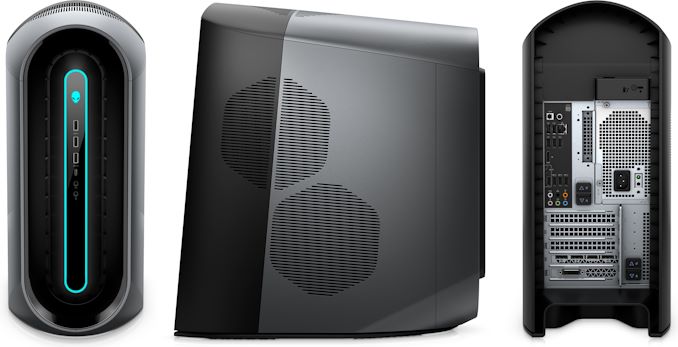
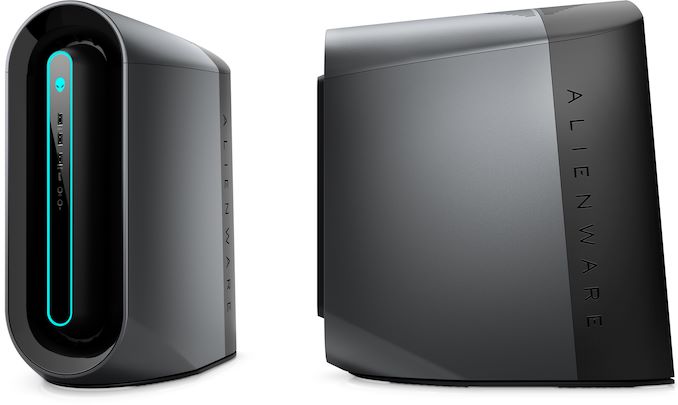
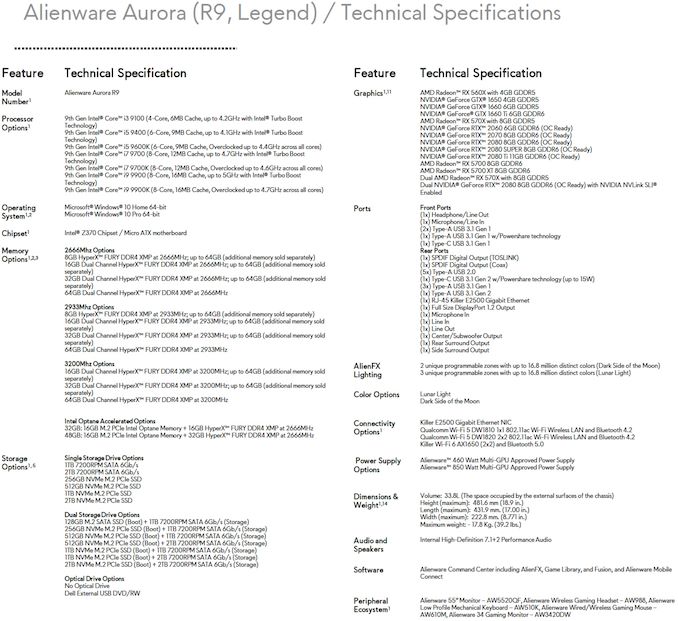
Living up to its status as a high-end, botique system builder, back in early 2019 Alienware rolled out its “Legend” industrial design. Intended to set the brand apart from competitors, the futuristic design ended up being rather different from other gaming PCs available today. Initially Dell used the new industrial design for laptops and monitors, and this week the company rolled out its first Legend-designed mATX desktop in the Alienware Aurora R9.


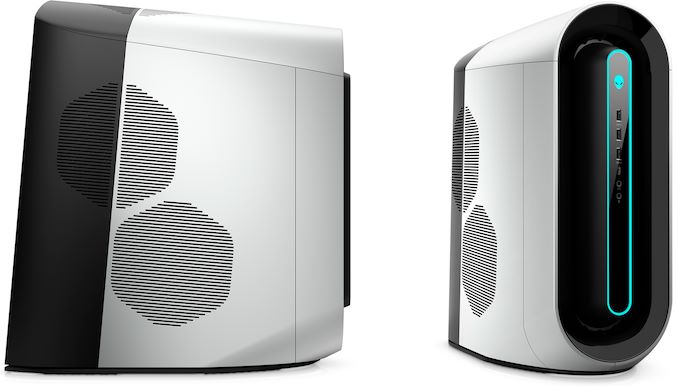
The Aurora R9 comes in a Lunar Light or Dark Side of the Moon chassis that isn’t quite like anything that we have seen before. In fact, it looks more like an item from Portal rather than a desktop computer. It still has AlienFX RGB lighting (two or three zones) for additional personalization, but even out-of-box the system looks unique.


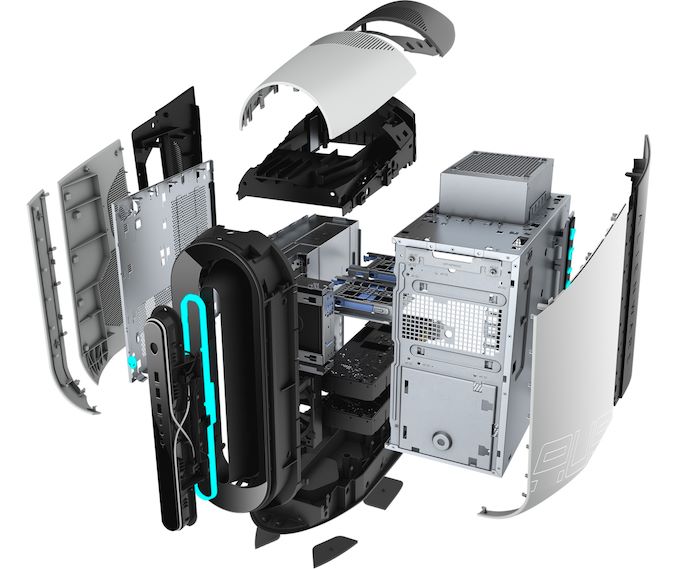
Inside the new Aurora is a Micro-ATX motherboard based on Intel’s Z370 chipset and is compatible with Intel’s 9th Gen Core i3/i5/i7/i9 processors, with the unlocked K-series parts coming factory overclocked to 4.4 GHz – 4.7 GHz depending on the model. Cooling these chips is in turn is a custom Alienware-badged closed-loop liquid cooling system. Meanwhile, as is traditional for Alienware, the chassis features well-thought airflows, allowing the system to keep up with the cooling requirements of the overclocked processors.


Rounding out the package, the CPU can be paired with up to 64 GB of Kingston HyperX DDR4-3200 memory, either an M.2 PCIe 3.0 x4 SSD with capacities up to 2TB or Intel’s Optane Memory caching SSD, and a 2 GB 7200 RPM HDD.


Being aimed at demanding gamers, the Alienware Aurora R9 can be equipped with a wide range of current-generation AMD Radeon RX and NVIDIA GeForce GTX/RTX video cards. The top-of-the-range models will come with either one GeForce RTX 2080 Ti or two GeForce RTX 2080 cards.


When it comes to connectivity, the Alienware Aurora R9 features a GbE port (enabled by the Killer E2500 controller), a Wi-Fi 5 or Wi-Fi 6 adapter (Qualcomm’s DW1810/DW1820 or Rivet’s Killer AX1650), USB 3.1 Gen 1 Type-A and Type-C connectors, and 7.1-channel audio.


As usual for Alienware, the Aurora R9 can be easily upgraded by the end user, with the case feature toolless access. It is worth noting, however, that Alienware only equips the lower-end models with a 460 W PSU, so upgrade options are a little more limited on those models without a PSU upgrade as well.


The Alienware Aurora R9 is available now, with basic configurations starting at $969.99.


Related Reading:


Source: Dell


Source: AnandTech – Dell Announces Alienware Aurora R9: An Ultimate mATX Gaming PC

Philips Launches Gaming Peripheral Brand in the US

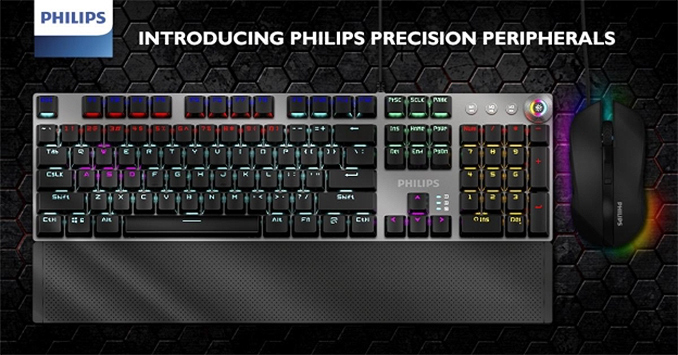
Philips and 3B Tech this week have begun to sell Philips-branded computer peripherals in the USA. The lineup of products includes relatively inexpensive keyboards and mice aimed at gamers and featuring appropriate aesthetics like RGB backlighting. Philips-branded keyboards and mice have been available in China for a while, and now they are formally available in the USA


At present, Amazon sells 13 Philips-branded peripherals: wired or wireless keyboards, mice, and combos. All of the products are aimed at gamers and carry either entry-level or mainstream price tags. Numerous keyboards feature mechanical switches, which are rare in these segments, which will attract attention of those who want quality tactile feedback, but aren’t necessarily looking for a premium-priced device.


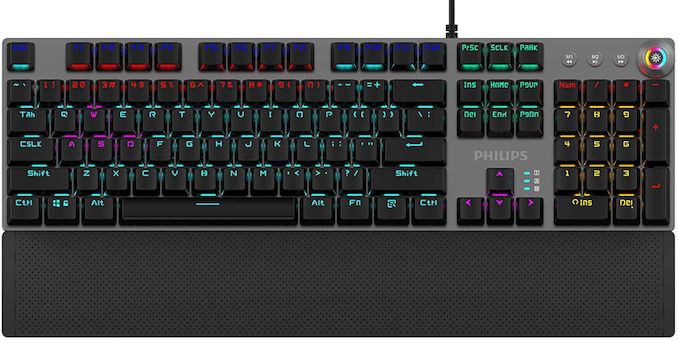
The top-of-the-range Philips-trademarked keyboard currently on sale is the SPK8614. The unit uses custom “Blue” switches that are either made by Philips, or are produced by a switch maker specially for the brand’s keyboards. The switches feature a 2-mm actuation and require 60G/58.8 CN of force. The keyboard also has a detachable wrist rest, Ambiglow Chroma FX RGB accent lighting, customizable key lightmaps, media controls as well as an aluminum top plate. The Philips SPK8614 keyboard is now available from Amazon for $39.99.


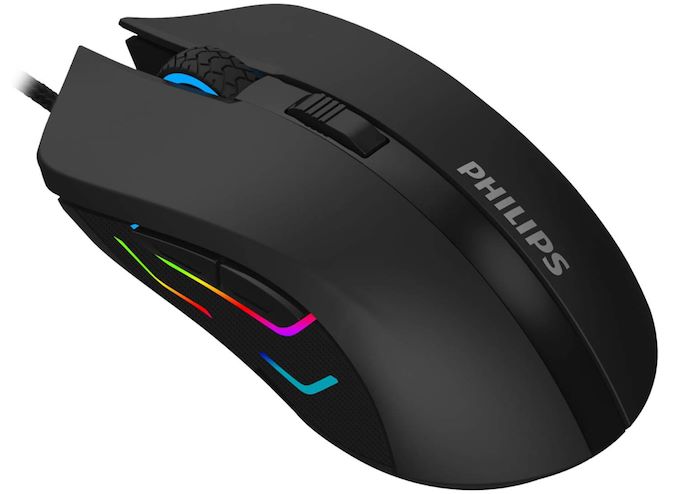
The most advanced Philips-branded gaming mouse sold officially in the USA is the SPK9413, which is equipped with a 2,400-DPI optical sensor and features a 500 Hz polling. The mouse has six programmable buttons as well as Ambiglow RGB breathing light effects. The product is sold for $16.99 at Amazon. Meanwhile, Newegg also offers an advanced Momentum SPK9842 mouse featuring a 16,400 DPI laser sensor, seven programmable buttons, and RGB lights. The product can be ordered via Newegg from China for $96.09.


Being among the best-known high-tech brands, Philips produces a variety of products and also licenses its name to third parties for goods that it does not make itself. This is exactly the case with the peripherals carrying the trademark: the products are made by Shenzhen Youyuan Hongye Electronic based in China that holds an appropriate license. Previously, these devices officially were available only in China, but now the company is expanding their availability to other markets.


Related Reading:


Source: Philips/3B Tech


Source: AnandTech – Philips Launches Gaming Peripheral Brand in the US

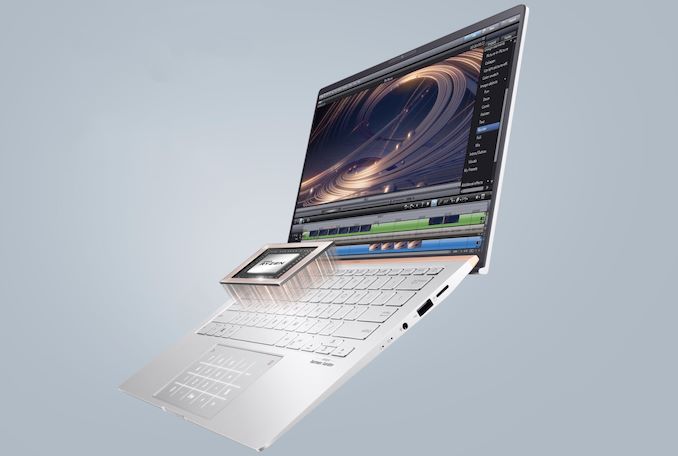
ASUS Launches AMD Ryzen-Based ZenBooks: Two Laptops & a Convertible

ASUS has quietly added three ZenBooks based on AMD’s Ryzen Mobile 3000-series APUs to its lineup. One of the machines is a convertible ZenBook Flip 14, the other two are traditional ZenBook 14 notebooks. All three mobile PCs offer what you come to expect from ZenBook-branded laptops: stylish design, sleek aluminum chassis, high performance components, robust connectivity, and various premium features like Harman Kardon-badged audio or a NumberPad touchpad.
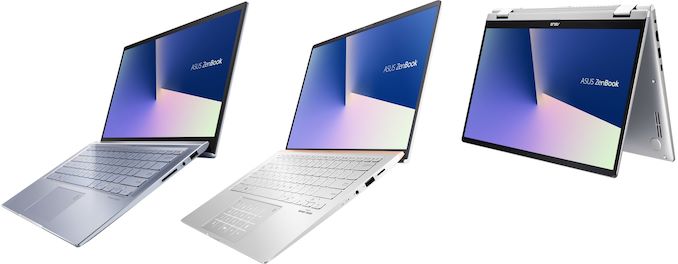


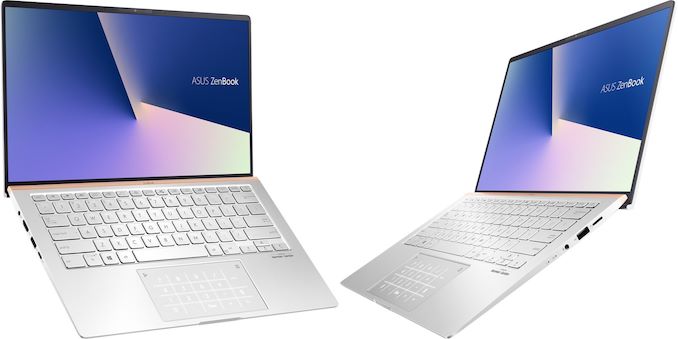
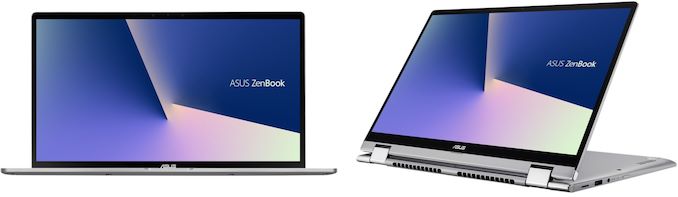
The lineup of ASUS ZenBook notebooks powered by AMD’s 15 Watt Ryzen 7 3700U Mobile or Ryzen 5 3500U Mobile with integrated Radeon Vega graphics currently includes three models: the relatively basic ZenBook 14 UM431DA, the more premium ZenBook 14 UM433DA, and the convertible ZenBook Flip 14 UX462DA.
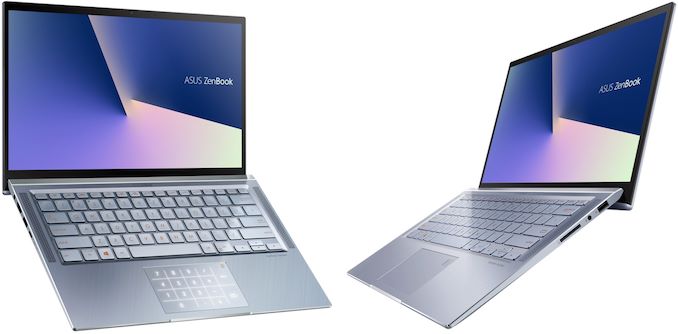


All the ASUS ZenBook systems based on AMD’s Ryzen Mobile APUs feature a 14-inch InfinityEdge Full-HD display with or without touch support that cover 100% of the sRGB color gamut. While all of the mobile PCs feature thin bezels, the UM433DA seems to feature the thinnest bezels, whereas the UM431DA has the thickest. Meanwhile, the ZenBook Flip 14 UX462DA naturally supports touch, can work with the ASUS Pen (1024 pressure levels, 10-300 grams pen-tip force, Windows Ink, etc.), and features the company’s 360-degree ErgoLift hinge


When it comes to internals of the ZenBook 14 UM431DA, ZenBook 14 UM433DA, and ZenBook Flip 14 UX462DA, they are all powered by AMD’s quad-core Ryzen Mobile 3000-series APUs with integrated Radeon Vega graphics that are paired with 8 to 16 GB of DDR4-2400 memory as well as an SSD ranging from 256 GB to 1 TB (see exact specs in the table below). In a curious move (perhaps for cost-cutting reasons) ASUS decided to use SATA or PCIe 3.0 x2 SSDs on most SKUs; only the most expensive 1 TB SSD features a full PCIe 3.0 x4 interface.


From connectivity standpoint, we have a fairly standard machines with 802.11ac Wi-Fi, Bluetooth, USB Type-A and USB Type-C connectors, an HDMI display output, and a 3.5-mm audio jack. Meanwhile, only the model UM433DA supports USB 3.1 Gen 2 despite the fact that AMD’s mobile platform fully supports the technology.


As far as battery life is concerned, the  ZenBook 14 UM431DA and the ZenBook 14 UM433DA are equipped with 47 Wh and 50 Wh batteries rated for up to 12 hours of work on one charge. By contrast, the convertible ZenBook Flip 14 UX462DA comes with a 42 Wh battery rated for 9 hours.


Specifications of the ASUS ZenBook PCs Based on AMD’s Ryzen APUs
  ZenBook 14

UM431DA
ZenBook 14

UM433DA
ZenBook Flip 14

UX462DA
LCD Diagonal 14″ NanoEdge
Resolution 1920×1080
Anti-glare Yes ? ?
Bezels 6.45-mm bezels 2.9-mm side bezels

3.3-mm bottom bezel
4.3-mm bezels
Color Gamut 100% sRGB
Touch Support No Yes

ASUS Pen supported
Protective Glass ? ? ?
CPU AMD Ryzen 7 3700U – 4C/8T, 6MB, 2.3/4 GHz – Radeon RX Vega 10

AMD Ryzen 5 3500U – 4C/8T, 6MB, 2.1/3.7 GHz – Radeon Vega 8
Graphics Radeon RX Vega 10

Radeon Vega 8
RAM (maximum) 8 or 16 GB DDR4-2400 8 or 16 GB DDR4-2400

soldered down
8, 12, or 16 GB DDR4-2400

soldered down
Storage SSD 256 GB PCIe 3.0 x2

512 GB PCIe 3.0 x2

1 TB PCIe 3.0 x4
256 GB SATA

256 GB PCIe 3.0 x2

512 GB PCIe 3.0 x2
Card Reader SD card reader MicroSD card reader
Wireless Wi-Fi 802.11ac
Bluetooth BT 5.0 BT 4.2
USB 3.1 Gen 2 1 × Type-A

1 × Type-C
3.0 1 × Type-A

1 × Type-C
1 × Type-A

1 × Type-C
2.0 1 × Type-A
Display Output 1 × HDMI
Camera 720p 720p + IR camera for face authentication
Fingerprint Sensor Optional ? ?
Other I/O Microphone, stereo speakers, audio jack
Other Sensors ? ? Accelerometer, gyroscope, etc.
Battery 47 Wh

12 hours
50 Wh

12 hours
42 Wh

9 hours
Dimensions Width 34.2 cm | 12.7 inches 31.9 cm | 12.6 inches 32.2 cm | 12.37 inches
Depth 21.2 cm | 8.34 inches 20.5 cm | 8.07 inches 21 cm | 8.27 inches
Thickness 1.59 cm | 0.62 inches 1.58 cm | 0.62 inches 1.89 cm | 0.74 inches
Weight 1.39 kilograms

3.06 pounds
1.25 kilograms

2.76 pounds
1.6 kilograms

3.53 pounds
Launch Price ? ? ?

Wrapping things up, the ZenBook Flip 14 with AMD’s processors is available in many countries in different configurations and at various price points. Meanwhile, the ZenBook 14 UM431DA and the ZenBook 14 UM433DA notebooks will be available shortly, with prices to be determined.


Related Reading:


Source: ASUS (1, 2, 3), NotebookCheck, Liliputing


Source: AnandTech – ASUS Launches AMD Ryzen-Based ZenBooks: Two Laptops & a Convertible

Dell Launches Their Vostro 13 5391 Laptop: 10th Gen Core For Road Warriors

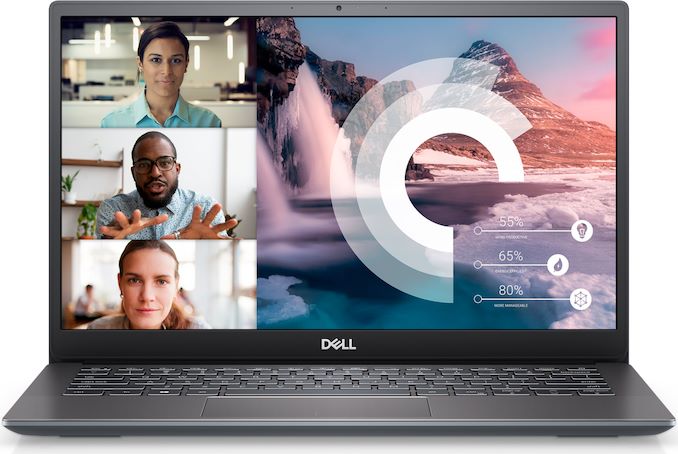
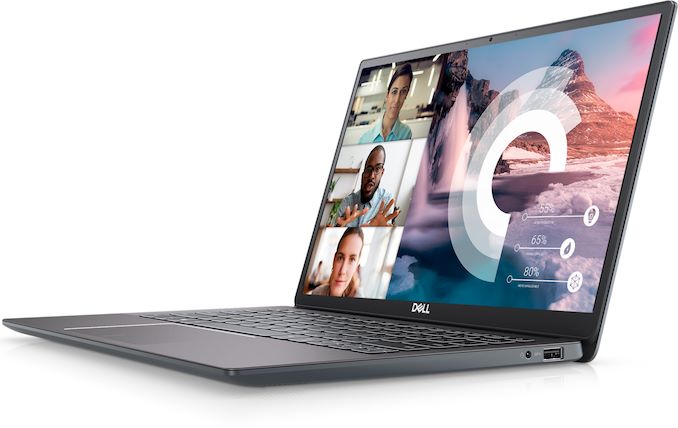
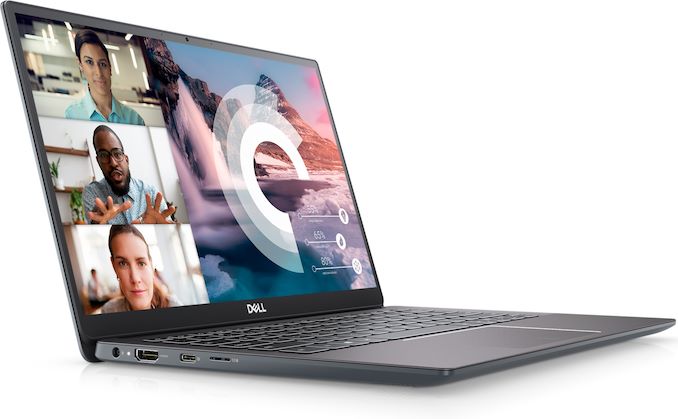
Capping off Dell’s spate of laptop updates, today the company also announced an updated Vostro 13 laptop for small business. The relatively inexpensive Vostro 13 5391-series feature a solid build quality along with numerous enhancements that will be appreciated by business users, road warriors, and even consumers. The new machines pack Intel’s 10th Gen Core processors and a discrete GPU into a thin and light package.


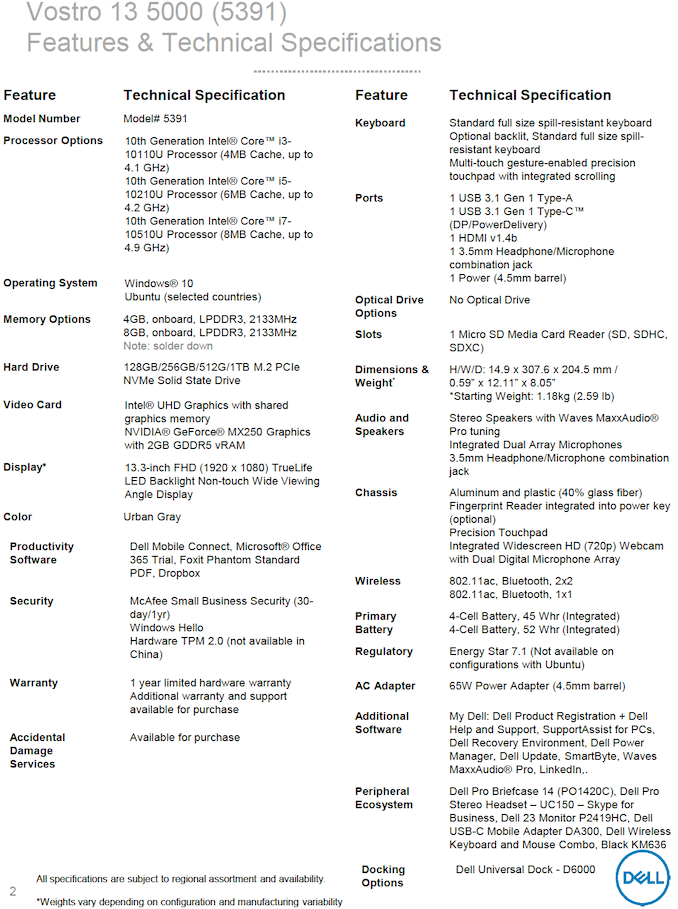
The Dell Vostro 13 5391 comes in an aluminum and plastic chassis that is 14.9 mm thick, with total system weights starting from 1.18 kilograms, which is comparable to modern high-end notebooks such as Lenovo’s ThinkPad X1. According to Dell, the chassis is tested using 50 kinds of reliability, shock, and vibration programs to ensure its robust build quality. Furthermore, Dell will offer optional accidental damage and ProSupport services with this laptop. By default, the Vostro 13 5391 is equipped with a spill-resistant keyboard, whereas premium SKUs will come with a backlit spill resistant keyboard.


The Vostro 13 5391 is based on Intel’s 10th Generation Core i3/i5/i7 CPUs (Comet Lake), and are joined by NVIDIA’s GeForce MX 250 GPU with 2 GB of GDDR5 VRAM, 4 or 8 GB of system DRAM, as well as an M.2 PCIe 3.0 x4 SSD with up to 1 TB capacity. The platform is enhanced with a hardware TPM 2.0 module, which will be appreciated by those concerned with security.


When it comes to display, the mobile PC is equipped with a non-touch 13.3-inch Full-HD monitor with Dell’s TrueLife LED backlighting and wide viewing angles.


Meanwhile for connectivity, the Vostro 13 5391 includes 802.11ac Wi-Fi, one USB 3.1 Gen 1 Type-C port with DisplayPort, one USB 3.1 Gen 1 Type-A, one HDMI 1.4 port, a microSD card reader, a 3.5-mm connector for headsets, and a power plug. On the multimedia side of things the notebook has a Windows Hello-capable IR-enabled webcam, stereo speakers co-designed with Waves MaxxAudio, a microphone array, a Windows Hello-supporting fingerprint reader, and other things.


The manufacturer does not make claims regarding battery life of the Vostro 13 5391, but it says that various SKUs will come with a 46 Wh or a 52 Wh battery.


Dell will start sales of the Vostro 13 5391 this week with prices starting at $849.


Related Reading:


Source: Dell


Source: AnandTech – Dell Launches Their Vostro 13 5391 Laptop: 10th Gen Core For Road Warriors

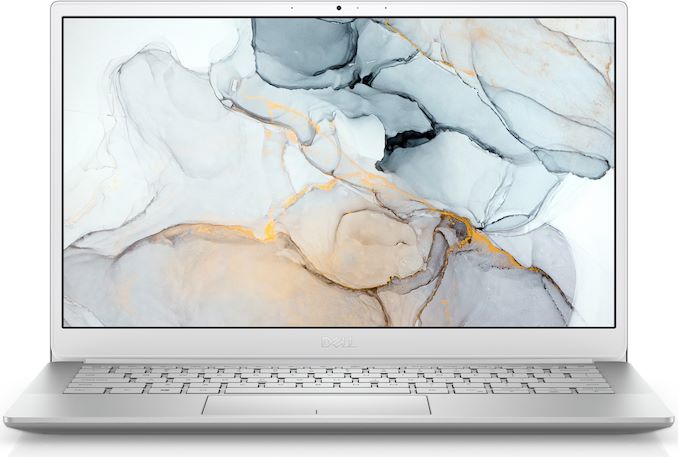
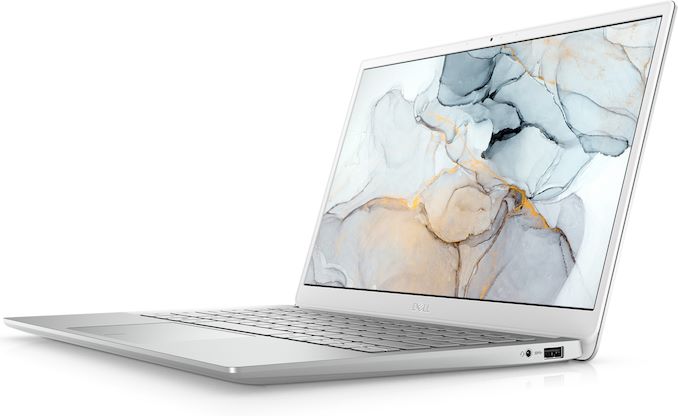
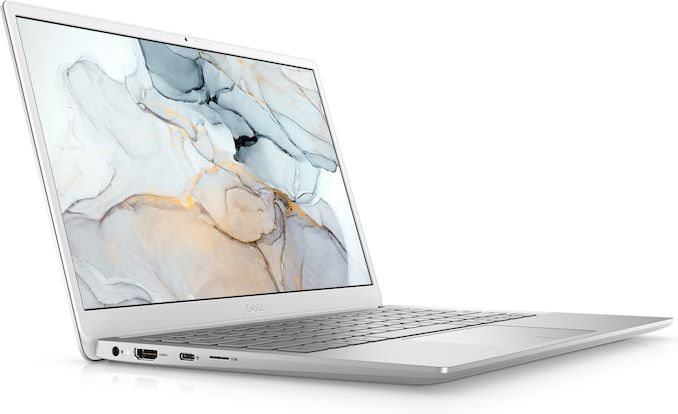
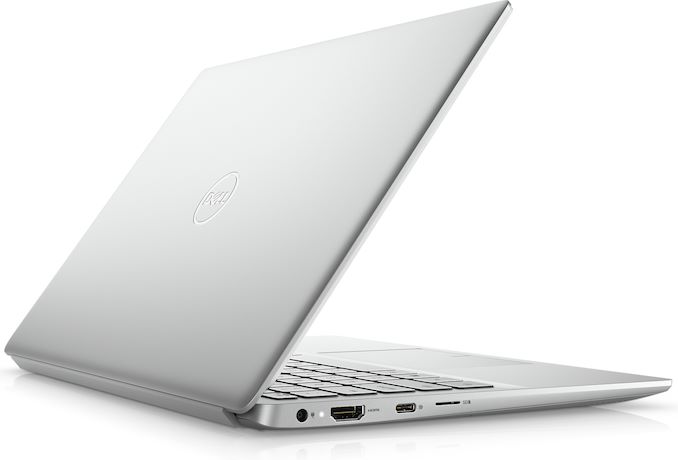
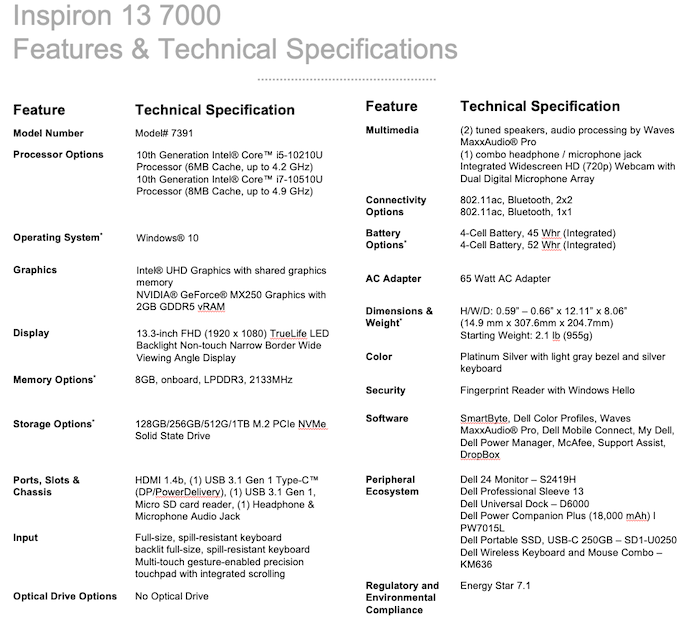
Dell’s Inspiron 13 7391-Series Ultra-Light Laptops: 10th Gen Core & a dGPU at Under 1 Kg

Among the many laptop families receiving updates today in line with the launch of Intel’s 10th gen Core CPUs, Dell has introduced its all-new Inspiron 13 7391-series laptop. The latest Inspiron 13 brings together Intel’s Comet Lake processors, NVIDIA’s discrete GPUs, a spill-resistant keyboard, and an ultra-low weight. In a bid to keep the laptop weight at 955 grams, Dell had to omit usage of a touch-enabled or a 4K display panel, but those who need the lightest notebook possible should find the trade-off worth it.

At the heart of the Inspiron 7391-series is Intel’s 10th gen Core i5/i7 processors, accompanied by NVIDIA’s GeForce MX 250 graphics processor with 2 GB vRAM, up to 8 GB of soldered-down system DRAM, and an M.2 PCIe SSD featuring capacities ranging from 128 GB to 1 TB. The laptop has multiple sensors to determine whether it is used on the desk, in hands, or on lap tops, in a bid to apply appropriate thermal profile to the situation.


The Inspiron 7391 laptop is equipped with a 13.3-inch Full-HD non-touch display panel with thee-sided narrow bezels as well as Dell’s TrueLife LED backlighting. Dell does not disclose the type of LCD it uses, yet it says that it features wide viewing angles. One interesting feature of the monitor is its lid-open sensor that turns on the laptop even when it is completely shut down.


When it comes to connectivity, Dell’s latest laptop offers 802.11ac Wi-Fi, one USB 3.1 Gen 1 Type-C port with DisplayPort, one USB 3.1 Gen 1 Type-A, one HDMI 1.4 port, a microSD card reader, a 3.5-mm connector for headsets, and a power plug. Multimedia capabilities of the notebook include a Windows Hello-capable webcam, stereo speaker, a microphone array, a Windows Hello-supporting fingerprint reader, and other essentials.


The Dell Inspiron 7391-series comes in a chassis made of a painted magnesium alloy that is only 14.9 mm thick. Depending on configuration, the Dell Inspiron 7391 will come with a 45 Wh or 52 Wh battery, so its weight will start at 955 grams, but will get higher depending on the spec.


Unfortunately, however, European and North American customers won’t be able to buy the Inspiron 7391, at least initially. As it turns out, Dell is initially launching the machine in Brazil, China, and Japan. Considering how popular ultralight laptops are in Japan and China, it is not surprising that Dell wants to sell the Inspiron 7391 in these countries. That said, since the market of sub-kilogram notebooks is not crowded in Europe and the US, I would not be too surprised if these machines eventually made it elsewhere after they become available in China (August 23), Japan (September 3), and Brazil (December 11).


Related Reading:


Source: Dell


Source: AnandTech – Dell’s Inspiron 13 7391-Series Ultra-Light Laptops: 10th Gen Core & a dGPU at Under 1 Kg

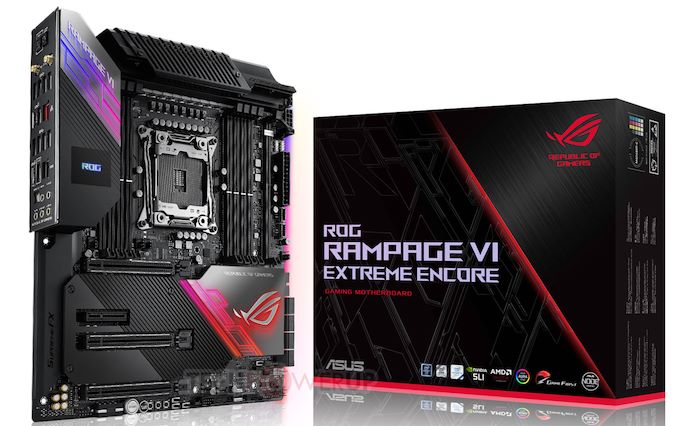
ASUS Unveils the ROG Rampage VI Extreme Encore X299 Motherboard

At the Gamescom trade show in Cologne in Germany, ASUS has unveiled its new high-end premium HEDT motherboard, the ROG Rampage VI Extreme Encore. Built on Intel’s X299 chipset and for the anticipated arrival of the their Cascade Lake-X processors, some of the main features include support for up to four PCIe 3.0 x4 M.2 drives, Wi-Fi 6 802.11ax wireless connectivity, and an Aquantia AQC107 10 G NIC.


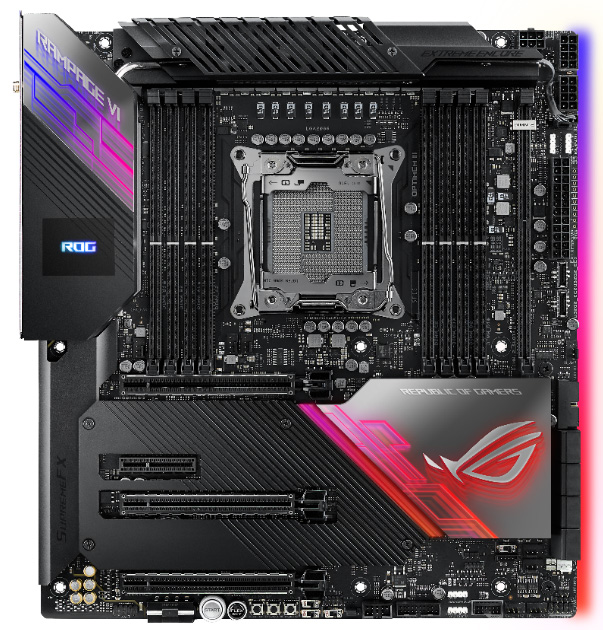
Slotting in just below the ROG Rampage VI Extreme Omega motherboard in its current X299 product stack, ASUS has made some notable improvements to some of the core design aspects for the upcoming Intel 14 nm Cascade Lake-X processors. The extra lanes on the impending Cascade Lake-X processors have led ASUS to include four PCIe 3.0 x4 M.2 slots which feature support for VROC, meaning users can run high-performance NVMe drives in RAID for better performance and parity. Other improved aspects include a tweaked 16-phase CPU power delivery designed to optimize overclocking performance, support for up to 256 GB of DDR4-4266 memory across eight RAM slots, and dual NICs with an Aquantia AQC107 10 G NIC which has been paired up with the commonly used Intel I219-V Gigabit NIC.


Looking at the aesthetics, ASUS has included a 1.77-inch LiveDash OLED display which can be customized with images, display POST codes and system information. There’s also plenty of integrated RGB LEDs as well as additional headers so users can light their system up like a Christmas tree, or the LiveDash and LEDs can be switched off completely for a stealthier look. The ASUS ROG Rampage VI Extreme Encore features ASUS SafeSlot metal reinforcement on the four full-length PCIe 3.0 slots which operate at x16, x16/x16, x16/x16/x4 which disables the ROG DIMM.2 slot, or x16/x8/x4 with the DIMM.2 slot in use. The bottom full-length PCIe 3.0 slot is locked down to PCIe 3.0 x4.


Overclockers are also catered for with a ROG Extreme OC kit with notable inclusions such as switches for LN2 mode, slow mode, and also includes a start, reset, safe boot, and OC retry button. On the rear panel is also packed with one USB 3.1 G2 Type-A, one USB 3.1 G2 Type-C, and eight USB 3.1 G1 Type-A ports Also included is a clear CMOS button, five 3.5 mm audio jacks and S/PDIF optical output powered by a SupremeFX S1220 HD audio codec, and two Ethernet ports controlled by an Aquantia AQC107 10 G NIC, with the other port powered by an Intel I219-V Gigabit NIC. There are two antenna ports for the Intel AX200 Wi-Fi 6 802.11ax wireless interface which also offers users BT 5.0 connectivity.


The ASUS ROG Rampage VI Extreme Encore is set to cost $650 and should be available at retail in the coming months.


Source: ASUS


Source: AnandTech – ASUS Unveils the ROG Rampage VI Extreme Encore X299 Motherboard