Intel Ethernet 800 Series To Support NVMe over TCP, PCIe 4.0

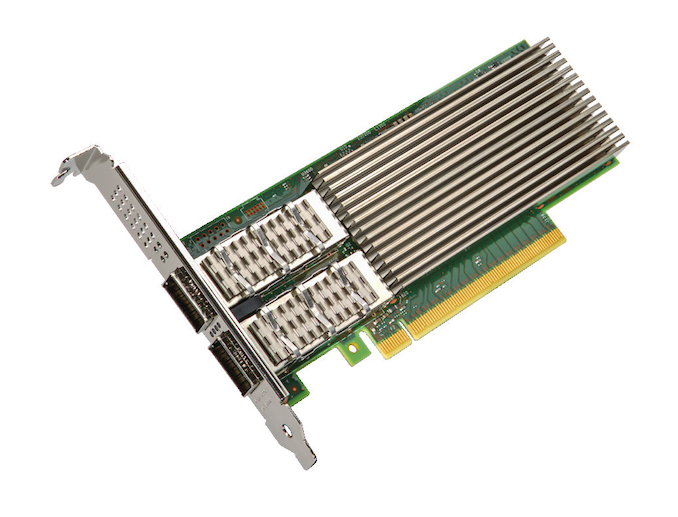
Today at the SNIA Storage Developer Conference, Intel is sharing more information about their 100Gb Ethernet chips, first announced in April and due to hit the market next month. The upcoming 800 Series Ethernet controllers and adapters will be Intel’s first 100Gb Ethernet solutions, and also feature expanded capabilities for hardware accelerated packet processing. Intel is now announcing that they have implemented support for the TCP transport of NVMe over Fabrics using the Application Device Queues (ADQ) technology that the 800 Series is introducing.


NVMe over Fabrics has become the SAN protocol of choice for new systems, allowing for remote access to storage with just a few microseconds of extra latency compared to local NVMe SSD access. NVMeoF was initially defined to support two transport protocols: Fibre Channel and RDMA, which can be provided by Infiniband, iWARP and RoCE capable NICs. Intel already provides iWARP support on their X722 NICs, and RoCEv2 support was previously announced for the 800 Series. However, in the past year much of the interest in NVMeoF has shifted to the new NVMe over TCP transport specification, which makes NVMeoF usable over any IP network without requiring high-end RDMA-capable NICs or other niche network hardware. The NVMe over TCP spec was finalized in November 2018 and opened the doors to much wider use of NVMe over Fabrics.


Software-based NVMe over TCP implementations can use any network hardware, but for the high-performance applications that were originally the focus of NVMe over Fabrics, hardware acceleration is still required. Intel’s ADQ functionality can be used to provide some acceleration of NVMe over TCP, and they are contributing code to support this in the Linux kernel. This makes the 800 Series Ethernet adapters capable of using NVMe over TCP with latency almost as low as RDMA-based NVMe over Fabrics. Intel has also announced that Lightbit Labs, one of the major commercial proponents of NVMe over TCP, will be adding ADQ support to their disaggregated storage solutions.


Unrelated to NVMe over Fabrics, Intel has also announced that Aerospike 4.7 will be the first commercial database to make use of ADQ acceleration, and Aerospike will be publishing their own performance measurements showing improvements to throughput and QoS.


The Intel Ethernet Controller E810 and four 800 Series Ethernet adapters will be available from numerous distributors and OEMs over the next several weeks. The product brief for the E810 controller has been posted, and indicates that it supports up to a PCIe 4.0 x16 host interface—to be expected from a 100Gb NIC, but not something Intel PR is keen to highlight while their CPUs are still on PCIe 3.0.


Related Reading


Source: AnandTech – Intel Ethernet 800 Series To Support NVMe over TCP, PCIe 4.0

Razer's Blade Pro 17 Gets a 4K 120 Hz Monitor

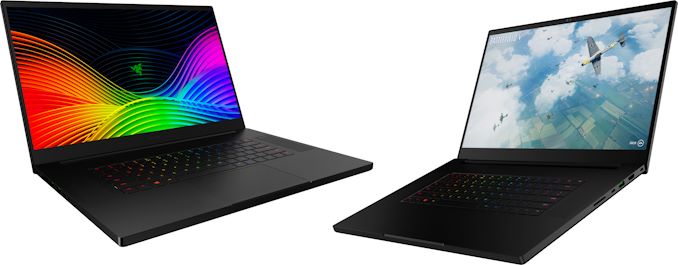
When Razer introduced its revamped 17.3-inch Blade Pro 17 laptops earlier this year, one of the things that caught the eye was the absence of models with an Ultra-HD display, a strange design decision considering positioning of these machines for demanding gamers and prosumers. This week the company unveiled a new version of its Blade Pro 17 notebook with a 4K display featuring a 120 Hz refresh rate.


Being the flagship model in the lineup, Razer’s Blade Pro 17 4K UHD 120 Hz will be offered in only one configuration powered by Intel’s six-core Core i7-9750H processor (2.6 GHz – 4.5 GHz) paired with NVIDIA’s GeForce RTX 2080 Max-Q GPU, 16 GB of DDR4-2667 memory (user upgradeable to 64 GB of DDR4-3200 memory) as well as a 1 TB PCIe 3.0 x4 SSD (expandable to 2 TB) SSD. Just like the rest notebooks in the lineup, the Ultra-HD version comes with Intel’s Wireless-AX200 802.11ax + Bluetooth 5 solution, a 2.5 GbE port, a Thunderbolt 3 connector, three USB 3.2 Gen 2 Type-A ports, one USB 3.2 Gen 2 Type-C port, an HDMI 2.0b output, a UHS-III SD card reader, 1MP/720p webcam with IR sensors for Windows Hello, an array microphone, and Dolby Atmos-supporting stereo speakers, and an 3.5mm audio jack.


The addition of a touch-sensitive display with a 3840×2160 resolution, 400 nits brightness, and a 120 Hz refresh rate did not have any impact on design or weight of the notebook. The machine made of black aluminum is 19.9 mm thick and weighs 2.75 kilograms. It is also equipped with a 70.5 Wh battery, though Razer says nothing about the battery life on one charge.


The Razer Blade Pro 17 General Specifications
  RZ09-02876*92 RZ09-02877*92 RZ09-02878*92 RZ09-03148*92
Display Diagonal 17.3″
Resolution 1920×1080 3840×2160
Response Time ? ms
Brightness 300 cd/m² 400 cd/m²
Refresh Rate 144 Hz 120 Hz
Color Gamut sRGB: 100% AdobeRGB 100%
CPU Intel Core i7-9750H processor:

6C/12T,

2.6 GHz Base

4.5 GHz Turbo

12 MB
RAM 16 GB DDR4-2667

Upgradeable to 64 GB DDR4-3200
Graphics RTX 2060

6 GB GDDR6
RTX 2070

8 GB GDDR6
RTX 2080

8 GB GDDR6
Storage 512 GB PCIe 3.0 x4 SSDs

Spare M.2 slot for PCIe or SATA SSDs
1 TB PCIe 3.0 x4 SSD

Spare M.2 slot
Wi-Fi 2×2 802.11ax Wi-Fi module
Bluetooth BT 5.0
General Ports 1 × Thunderbolt 3 for data, display output

1 × USB 3.12Gen 2 Type-C

3 × USB 3.2 Gen 2 Type-A

1 × HDMI 2.0b

1 × 2.5 GbE
Other I/O HD webcam with IR,

TRRS connector for audio,

speakers,

microphone array,

SD UHS-III card reader
Dimensions (W × D × H) 395 × 260 × 19.9 mm

15.55 × 10.24 × 0.78 inches
Weight 2.75 kg | 6.06 pounds
Battery 70.5 Wh
Price $2,499 $2,799 $3,199 $3,699

Razer’s Blade Pro 17 with an Ultra-HD 120 Hz display will be available in the US and China starting September 23, whereas in the UK and Germany the product will hit the market sometimes in the fourth quarter. In the US the product will cost $3,699.99, whereas in Europe it will be priced at €3,999.99.


Related Reading:


Source: Razer


Source: AnandTech – Razer’s Blade Pro 17 Gets a 4K 120 Hz Monitor

AMD Ryzen 5 3500 & 3500X Support Spotted

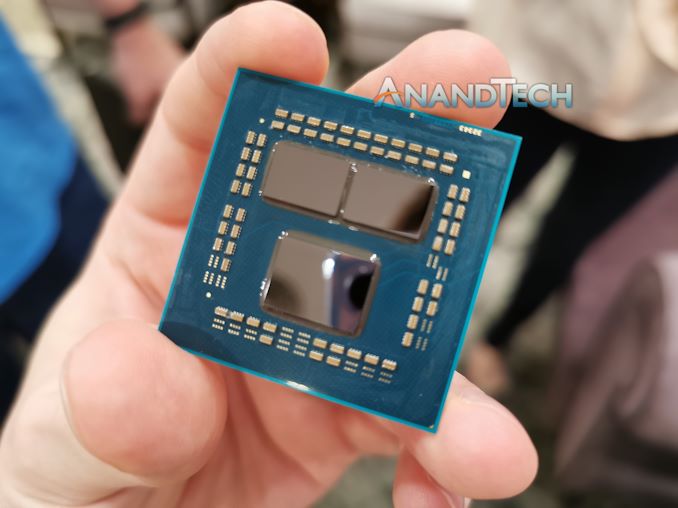
Three partners of AMD this week on their respective websites have begun to list two new yet unannounced Ryzen 5 3000-series processors. The new six-core CPUs — the Ryzen 5 3500 and the Ryzen 5 3500X — look set to be cheaper than already available Zen 2-based processors when they are available.


MSI added support for AMD’s Ryzen 5 3500X CPU to its MEG X570 Godlike motherboard revealing some of its specifications. In the meantime, Amazon began to list HP’s Pavilion gaming desktop based on the Ryzen 5 3500 and NVIDIA’s GeForce GTX 1650 4 GB graphics card that is currently available for pre-order. The system will ship on October 20, 2019.


As it turns out, according to the listings, the six-core Ryzen 5 3500X processor operates at 3.6 GHz default frequency, has a 3 MB L2 cache, 32 MB of L3 cache, and a 65 W TDP. The six-core Ryzen 5 3500 has similar features, but it works at 3.4 GHz and does not support AMD’s XFR technology, according to the listing at Amazon.com.


Considering that the Ryzen 5 3500 processor is already listed by a major PC maker, it is likely that it is either already shipping, or is about to ship. Menwhile, it is unclear when AMD plans to start shipments of the Ryzen 5 3500X, but it reasonable to expext that it will become available around the same time as the Ryzen 5 3500 model.


When it comes to pricing, AMD’s Radeon 5 3500 and 3500X processors will sit below the Ryzen 5 3600 and 3600X CPUs, so think about price points at around or below $200.


Related Reading:


Sources: Amazon, MSI (via Twitter/momomo_us)


Source: AnandTech – AMD Ryzen 5 3500 & 3500X Support Spotted

Samsung’s Galaxy Fold Hits the US on September 27th

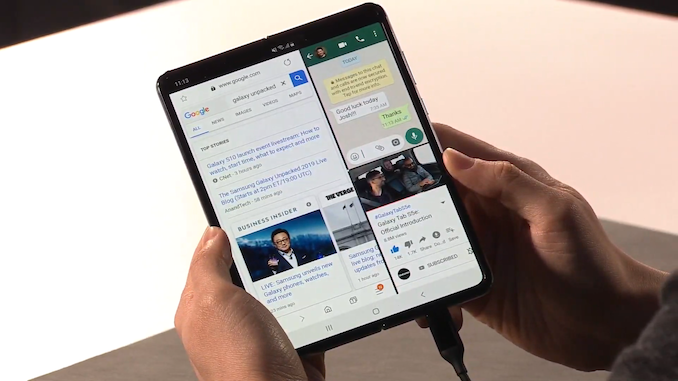
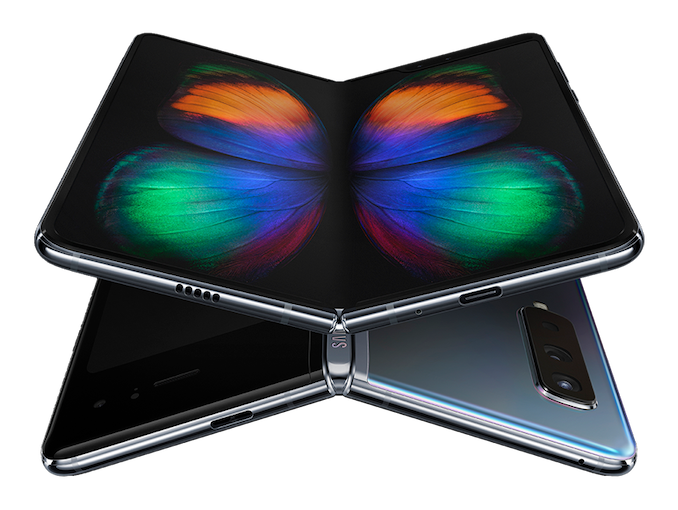
Samsung will start sales of the latest iteration of its highly-anticipated Galaxy Fold smartphone in the US this week. Two colors are set to be available, Cosmos Black and Space Silver, and the device is expected to also make a showing in South Korea around the same time. There is a catch though: the product will be available only in select retail locations initially.


Samsung had to delay the launch of its flagship smartphone from April after journalists who evaluated the unit revealed that that its hinge needed reinforcements, and the top protective layer of the Infinity Flex Display was erroneously mistaken as an optional protective layer, and so had to be remade to make it obvious that it was a part of the handset, not a protective film. All the refinements had been made by late July, so Samsung is now on track to make the phone available this calendar year. In the US and South Korea, the Samsung Galaxy Fold will be available starting on September 27th.


The foldable handset will be available at select AT&T stores, select Best Buy stores, and Samsung Experience Store locations. In its press release covering availability dates, Samsung never mentions its own online stores or large online retailers like Amazon. 


It is unclear why Samsung has not specified if it will its Galaxy Fold online initially. Perhaps the company plans to offer the smartphones at retail stores only to ensure that each sale comes with a sales pitch to teach the customer how to operate it, and how not to break it.


The price of the Samsung Galaxy Fold in the USA when bought without a contract is expected to be at around $1980.


Related Reading:


Source: Samsung


Source: AnandTech – Samsung’s Galaxy Fold Hits the US on September 27th

The GIGABYTE X570 Aorus Xtreme Motherboard Review: Fanless AM4

The introduction of the X570 chipset has heralded some of the most impressive and feature-rich desktop motherboards for an AMD platform in recent times. One prime example of this is the GIGABYTE X570 Aorus Xtreme which includes an Aquantia powered 10 GbE NIC, Intel’s Wi-Fi 6 802.11ax wireless interface, and has support for up to three PCIe 4.0 x4 M.2 drives. Looking to live up to the Xtreme naming, there’s a 16-phase power delivery with dual BIOS for the more extreme enthusiast, whereas users looking to create a clean looking RGB laden system will appreciate the right-angled 24-pin motherboard power input. The X570 Aorus Xtreme is also the only current motherboard to include a passively cooled chipset heatsink, with GIGABYTE looking to make its flagship model unique and to stand out from the crowd.


Source: AnandTech – The GIGABYTE X570 Aorus Xtreme Motherboard Review: Fanless AM4

Intel’s Comet Lake U&Y 495 Chipset Datasheet: x8 Link, USB 3.2 Gen 2 Support

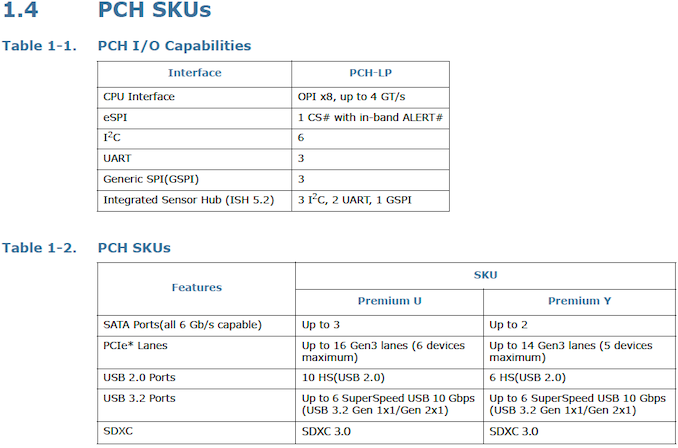
Intel has published datasheet of its upcoming Intel 495-series chipsets revealing their key features. As it turns out, the family will feature two chipsets aimed at different types of premium laptops, one for Y series and one for U series.


Intel’s 495 chipsets will be compatible with ‘Premium-U’ and ‘Premium-Y’ processors featuring an OPI x8 interface with up to 4 GT/s data transfer rate. Intel’s 495-series PCH will also support up to 16 PCIe 3.0 lanes, up to three Serial ATA ports, up to six USB 3.2 Gen 2 ports (10 Gbps), up to 10 USB 2.0 connectors, an integrated GbE MAC, a built-in Wi-Fi MAC that requires a CNVi module, and all the other familiar features of Intel’s modern chipsets (e.g., RST, AMR, TXT, VT, etc.).


Intel does not disclose in its document codenames of CPUs to be supported by its 495 chipsets, but it is likely that the new PCH will support the company’s latest 10th Generation Core processors known as Ice Lake and Comet Lake. Meanwhile, it remains to be seen which Intel’s chipsets support the manufacturer’s upcoming desktop CPUs.


Related Reading:


Source: Intel


Source: AnandTech – Intel’s Comet Lake U&Y 495 Chipset Datasheet: x8 Link, USB 3.2 Gen 2 Support

Huawei CEO Richard Yu Q&A: “Politicians are Playing Games”

As the world’s second largest smartphone manufacturer, the growth of Huawei over the last decade has been immense. Last year the company overtook Apple with smartphone unit sales, despite not being in the US market, by offering some of the best hardware and user experiences in a very competitive market. However, being placed on the US Entity List earlier this year has put a dent in that momentum, especially when it comes to talking about flagship smartphones. Huawei launched its new Mate 30 and Mate 30 Pro smartphones this week, without Google Play Store apps, with CEO Richard Yu committing over $1B to enhance the Huawei app ecosystem. After the launch event, Richard sat down with a group of press and took some questions.


Source: AnandTech – Huawei CEO Richard Yu Q&A: “Politicians are Playing Games”

A Day with the Huawei Mate 30 Pro: Kirin 990 and 7680 FPS Slow Motion Tests

Last week Huawei launched its latest flagship smartphone, the Mate 30 Pro, featuring its latest Kirin 990 chipset. At the heart of the new hardware is a waterfall wrap-around screen, as well as new camera tools to help it record slow motion video up to 7680 frames per second, above and beyond what is currently available. The new smartphones will not come with the Google Play Store and applications, due to the US-China trade war and Huawei being placed on the US Entity List, however Huawei has promised to look into unlocking the boot loader and injecting $1B into its own App Store to drive new applications. 5G versions of the Mate 30 and Mate 30 Pro are due out later this year, but we managed to get access to a device for a day or so for some hands-on experience.


Source: AnandTech – A Day with the Huawei Mate 30 Pro: Kirin 990 and 7680 FPS Slow Motion Tests

ADATA Releases the XPG SX8100 SSD: Make It Fast & Hold the Bling

While many gaming-branded components come adorned in RGB LEDs, there is thankfully still a market for plainer and saner products. To that end, ADATA has introduced its new family of high-end SSDs — the XPG SX8100 — that promises leading-edge performance without any unnecessary bling.


Intending its XPG SX8100 SSDs as high-end parts aimed at performance-demanding consumers, ADATA will offer them in 512 GB, 1 TB, and 2 TB configurations. The drives are based on Realtek’s RTS5762 controller (8 NAND channels, PCIe 3.0 x4, NVMe 1.3, LDPC, etc.) and 3D TLC NAND, and like virtually all mainstream NVMe drives, the SX8100 comes in M.2-2280 form-factor. The new family of SSDs is ADATA’s second lineup of drives (after the XPG Spectrix S40G) to use Realtek’s top-of-the-range controller.


As far as performance is concerned, ADATA rates the drives for up to 3.5 GB/s sequential read speeds and up to 3 GB/s sequential write speeds when SLC caching is used (data based on CDN benchmark, other benchmarks show lower numbers, more information is available here). As for random performance, the SX8100 drives can hit up to 300K/240K random read/write 4K IOPS, which is a bit lower when compared to the XPG Spectrix S40G.


One of the possible reasons why ADATA rates random performance of the XPG SX8100 below that of the blingy XPG Spectrix S40G could be because the new drives are not equipped with a heat spreader. While these are not necessary for moment-to-moment usage, they can help to sustain performance under high loads when these high-end controllers get hot. The upside to forgoing a heatsink however is that it allows the XPG SX8100 to be used with laptops, as well as any other devices that can’t fit an M.2 drive with a heatsink.


When it comes to endurance and reliability levels, ADATA’s XPG SX8100 drives are covered with a five-year warranty and are rated for 320 TB, 640 TB or 1280 TB written, depending on the drive’s capacity. Overall, the drives are good enough for around 0.3 DWPD over a five-year period, which in line with other modern consumer-grade SSDs.


ADATA XPG SX8100 Specifications
Capacity 512 GB 1 TB 2 TB
Model Number ASX8100NP-512GT-C ASX8100NP-1TT-C ASX8100NP-2TT-C
Controller Realtek RTS5762
NAND Flash 3D TLC NAND
Form-Factor, Interface M.2-2280, PCIe 3.0 x4, NVMe 1.3
Sequential Read 3500 MB/s
Sequential Write 2400 MB/s 3000 MB/s
Random Read IOPS 300K IOPS 290K IOPS 290K IOPS
Random Write IOPS 240K IOPS 240K IOPS 240K IOPS
Pseudo-SLC Caching Supported
DRAM Buffer Yes, using Realtek’s Partial DRAM Firmware Architecture

Actual capacity is unknown
TCG Opal Encryption No
Power Management DevSleep, Slumber (0.14 W).
Warranty 5 years
MTBF 2,000,000 hours
TBW 320 TB 640 TB 1280 TB
MSRP $89.99 $159.99 $329.99
Additional Information Link

ADATA will start sales of its XPG 8100 SSDs in the near future for $89.99 – $329.99 depending on capacity. Expect real-world prices of these drives to be below those of the XPG Spectrix S40G (which uses the same controller) and more or less in line with those of the XPG 8200 Pro (which offers similar performance).


Related Reading:


Source: ADATA


Source: AnandTech – ADATA Releases the XPG SX8100 SSD: Make It Fast & Hold the Bling

Western Digital to Exit Storage Systems: Sells Off IntelliFlash Division

Western Digital this week announced that it has made a strategic decision to leave the market for dedicated storage systems, as further development of its IntelliFlash and ActiveScale businesses would require additional investments and management focus. The company will sell off its IntelliFlash business to DDN (a specialist in storage systems, AI, and big data) and will explore various strategic options for ActiveScale.


The storage systems market is rather lucrative, but extremely competitive. Over the years, both Western Digital (as well as its HGST division) and SanDisk acquired numerous companies that specialized on hardware and software for datacenter storage, as well as on all-flash storage arrays in order to build highly-competitive storage systems (more details in our coverage of the Western Digital – SanDisk acquisition). Because many product families overlapped each other when Western Digital took over SanDisk in 2016, numerous lineups were divested.


At present, Western Digital only offers IntelliFlash all-flash and hybrid storage systems as well as ActiveScale cloud storage systems. While both product lines look solid in general, they have to compete against broad families of storage systems designed by such giants as Dell EMC, HPE, IBM, NetApp, and Hitachi that control over 50% of the market (according to IDC). Competing against multi-billion enterprises is tough. Moreover, Western Digital supplies its products to many developers of storage systems and the latter certainly do not appreciate it when their suppliers compete against them.


After closing out its storage systems business, Western Digital will continue to offer its storage servers (including JBOX, JBOD, hybrid, and specialized machines) for customers with their own software and infrastructure. Furthermore, the company will keep developing its scalable and flexible OpenFlex NVMe-over-Fabric composable architecture. Essentially, Western Digital will refocus from storage systems to storage platforms, which is a more hardware-centric business.


Here is what Mike Cordano, president and chief operating officer of Western Digital, had to say:


“As we look to the future, scaling and accelerating growth opportunities for IntelliFlash and ActiveScale will require additional management focus and investment to ensure long-term success. By refocusing our Data Center Systems resources on our Storage Platforms business, we are confident that the Western Digital portfolio will be better positioned to capture significant opportunities ahead and drive long-term value creation.”


Under the terms of the agreement with DDN (DataDirect Networks), the latter will buyout the entire IntelliFlash business unit for an undisclosed sum. Furthermore, the two companies will expand their current collaboration through a multi-year strategic sourcing contract, under which DDN will increase its purchase of Western Digital’s HDDs and SSDs.


Western Digital and DDN expect the deal to close later this year.


Related Reading:


Source: Western Digital


Source: AnandTech – Western Digital to Exit Storage Systems: Sells Off IntelliFlash Division

AMD: Next Gen Threadripper and Ryzen 9 3950X, Coming November

In a shock email late on Friday, AMD has released a statement to clarify the situation it is in with its latest Ryzen processors. There’s a positive, that the next generation of Threadripper processors will enter the market in November, but the negative is that AMD is delaying its release of the 16 core Ryzen 9 3950X until November as well, citing a high demand for these parts and time is needed to ensure that sufficient stock is available.


The statement from AMD says:


We are focusing on meeting the strong demand for our 3rd generation AMD Ryzen processors in the market and now plan to launch both the AMD Ryzen 9 3950X and initial members of the 3rd Gen AMD Ryzen Threadripper processor family in volume this November. We are confident that when enthusiasts get their hands on the world’s first 16-core mainstream desktop processor and our next-generation of high-end desktop processors, the wait will be well worth it.


As far as we understand, this is nothing to do with recent reports of TSMC requiring 6 months for new 7nm orders: the silicon for these processors would have been ordered months ago, with the only real factor being binning and meeting demand. It will be interesting to see how the intersection of the 16 core with next gen Ryzen will play out. 


Related Articles:


Source: AnandTech – AMD: Next Gen Threadripper and Ryzen 9 3950X, Coming November

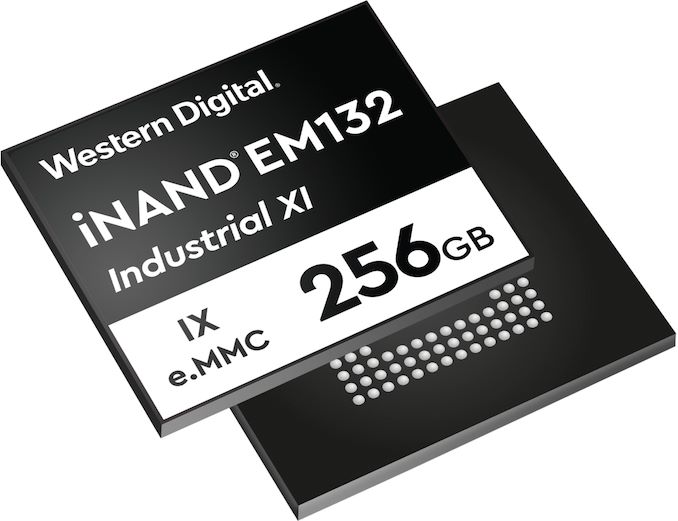
Western Digital Launches iNAND IX EM132: eMMC SSDs For Embedded Industrial Applications

Western Digital this week has introduced its first family of embedded eMMC storage devices for industrial and IoT applications. Based on the company’s 64-layer BiCS3 3D TLC NAND memory, the new iNAND IX EM132 drives offer up to 310 MB/s read speeds as well as enhanced endurance and reliability by supporting various features designed specifically for embedded, commercial, industrial, and similar environments.


Western Digital’s iNAND IX EM132 embedded flash drives are based around an in-house controller that supports an eMMC 5.1 HS400 interface along with an advanced ECC, wear leveling, bad block management, and RPMB (replay protect memory block). The eMMC drives also support smart partitioning (multiple partitions with different features and purposes to provide device makers some additional flexibility), auto/manual data refresh (automatically rewrites all the information to ensure that even rarely accessed data is available when needed), as well as all the usual management and monitoring interfaces you’d expect from a contemporary SSD.


Available in an industry-standard BGA package that measures by 11.5×13×1 mm, Western Digital is offering capacities between 16 GB and 256 GB. When it comes to performance, the eMMC drives are rated for up to 310 MB/s sequential read speeds, up to 150 MB/s sequential write speeds, and up to 20/12.5K random read/write IOPS. As for endurance, the drives are rated for up to 693 TB to be written, though that rating is likely based on the high-capacity SKUs.


Western Digital will offer Commerical, Industrial Wide as well as Industrial Extended versions of its iNAND IX EM132 eMMC drives. The Industrial Wide devices feature an operating temperature rating between -25°C and 85°C, whereas the Industrial Extended can operate in the most extreme environments with temperature ranges between -40°C and 85°C.


Western Digital’s iNAND IX EM132 Embedded Flash Drives
  General Specifications
JEDEC Specification v5.1, HS400
Flash Type 64-layer BiCS3 3D TLC NAND
Density 16 GB, 32 GB, 64 GB, 128 GB, 256 GB
Sequential Read/Write 310 MB/s

150 MB/s
Random Read/Write 20K / 12.5K
Operating Temperature Industrial Wide: -40°C to 85°C

Industrial Extended: -40°C to 85°C
TBW up to 693 TB
Core Voltage 2.7 V – 3.6 V
I/O Voltage 1.7 V – 1.95 V or 2.7 V – 3.6 V
Package 153-ball FBGA (11.5 × 13.0 × 1.3 mm)

Related Reading:


Source: Western Digital


Source: AnandTech – Western Digital Launches iNAND IX EM132: eMMC SSDs For Embedded Industrial Applications

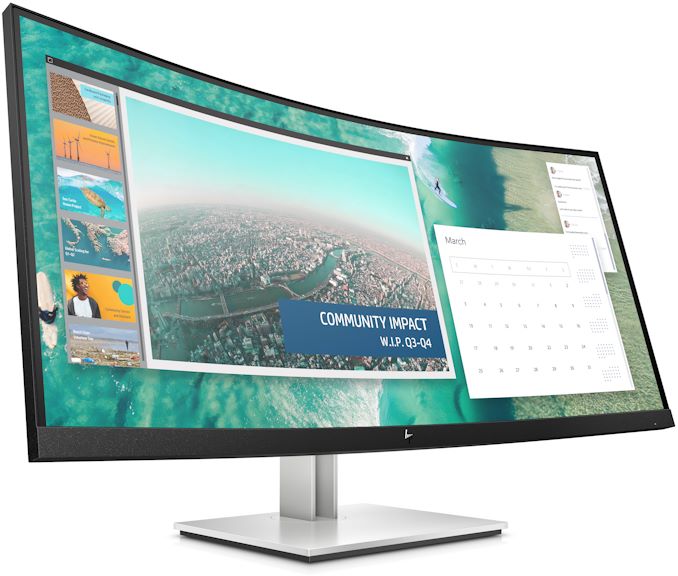
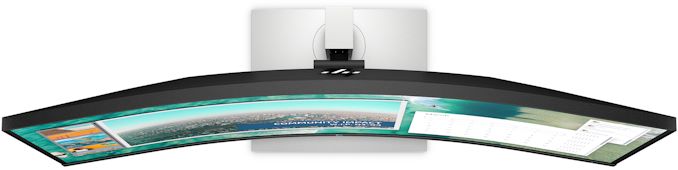
HP’s E344c: A 34-Inch Curved Ultra-Wide Productivity Monitor

Having launched a variety of curved ultrawide displays for gamers in the recent years, HP is rolling out similar monitors for business and professional users from many industries who want to boost their productivity. This week along with its flagship S430c curved LCD, HP introduced its more mainstream E344c Curved Monitor, which brings numerous contemporary features to the table and is aimed at a much broader commercial audience.


Offering a 21:9 ultrawide aspect ratio, the HP E344c Curved Monitor relies on a 34-inch SVA panel with a 3440×1440 resolution, 300 nits brightness, a 1000:1 contrast ratio, a 16 ms GtG response time, a 60 Hz refresh rate, and 178°/178° viewing angles. HP has designed this price-friendly monitor as a day-to-day work horse, so there is no factory calibration to speak of or support for wide color gamuts; in fact the company doesn’t even officially disclose the monitor’s sRGB gamut coverage. In which case, it’s not unreasonable to guess that it may not cover 99% of it like some other models.


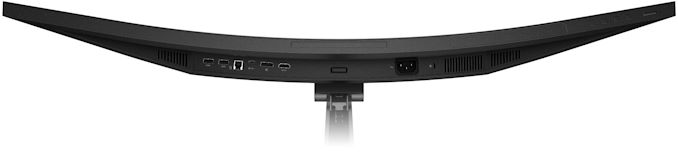
When it comes to connectivity, the E344c Curved Monitor resembles contemporary displays designed for professionals, offering one DisplayPort 1.2 input, one HDMI 2.0 port, and one USB Type-C input (DP alt mode). The LCD also has a dual-port USB 3.0 hub that is fed by a USB Type-B upstream port.


Since we are dealing with a display designed purely for work, HP did not equip it with speakers or even a headphone output. For those who do not want to use an external speaker system, HP proposes to get its S101 Sound Bar that attaches to the bottom of the monitor and uses a USB Type-A connector.


As far as ergonomics is concerned, like many other displays for office/home office environments, the HP E344c features a stand that can adjust height and tilt.


HP’s 34-Inch Curved Display
  E344c Curved Monitor
Panel 34″ SVA
Native Resolution 3440 × 1440
Brightness 400 cd/m²
Contrast 3000:1
Maximum Refresh Rate 60 Hz
Response Time 16 ms GtG
Viewing Angles 178°/178° horizontal/vertical
Curvature ?
Pixel Pitch 0.233 mm
Pixel Density 109 ppi
Anti-Glare Coating ?
Inputs 1 × DisplayPort 1.2

1 × HDMI 2.0

1 ×USB Type-C (with up to 22.5W PD)
USB Hub 2-port USB 3.0 hub
Stand Height: +/- 150 mm

Tilt: -5 to +20°

Swivel: ?
Audio none
Launch Price $599

HP will start sales of its E344c Curved Monitor on October 7. As expected from a ‘working horse’ type of displays, the LCD will not be too expensive and will carry a $599 price tag.


Related Reading:


Source: HP


Source: AnandTech – HP’s E344c: A 34-Inch Curved Ultra-Wide Productivity Monitor

CXL Consortium Formally Incorporated, Gets New Board Members & CXL 1.1 Specification

Over four years ago, Intel started to develop what is now known as Compute Express Link (CXL), an interface to coherently connect CPUs to all types of other compute resources. Over time, Intel collaborated with other industry behemoths, and early this year nine companies organized the CXL Consortium to jointly develop the technology as a new open standard. Over the past few months, dozens of additional companies have joined the consortium, and now the consortium itself has been formally incorporated this week, marking a major step in the development of CXL as an industry standard.


While incorporation itself doesn’t change matters for CXL from a technical perspective, incorporating a group like the CXL Consortium is a fairly big deal, because this typically only happens with an industry standards group gets large enough and gains enough traction that its members are very confident the technology is soon to go into widespread use. This means that the CXL Consortium has been elevated to the same level as the USB-IF, VESA, and other standard groups. Which is to say, all signs point to CXL eventually winning the war of cache-coherent interconnects, and becoming a major, long-term industry standard.


Meanwhile, wasting no time, the newly-incorporated organization has named five additional members of its board of directors, and it has released version 1.1 of the CXL specification.


Support Growth & New BOD Members


Being a CPU-to-everything cache-coherent interconnect protocol, CXL competes in one way or another against such technologies as CCIX, Gen-Z, Infinity Fabric, NVLink, and OpenCAPI, so broad industry support is tremendously important for the technology. Originally founded by Alibaba, Cisco, Dell EMC, Facebook, Google, HPE, Huawei, Intel, and Microsoft, the CXL Consortium has gained over 50 additional members over the past few months. The consortium now counts nearly 70 companies and organizations in its ranks, from developers of CPUs, GPUs, FPGAs, SSDs, interconnects, servers, and other hardware as well as from software developers and cloud service providers.


Among the companies that recently joined the CXL Consortium are AMD, Arm, IBM, and Xilinx. To that end, the organization appointed five new members to its board of directors from AMD, Arm, IBM, Microchip, and Xilinx. The expanded board of directors now includes 13 members and looks as follows.


CXL Consortium: Members of the Board
Company Person Position
Alibaba Di Xu ?
AMD Nathan Kalyanasundharam Senior Fellow at AMD
Arm Dong Wei Standards Architect and Fellow
Cisco Sagar Borikar Principal Engineer, Data Center Systems Engineering
Dell EMC Kurtis Bowman Director of Technology and Architecture in Dell’s Server CTO Office
Facebook Chris Petersen Hardware Systems Technologist
Google Rob Sprinkle Technical Lead for Platforms Infrastructure at Google
HPE Barry McAuliffe ?
IBM Steve Fields Fellow and Chief Engineer of Power Systems
Intel Jim Pappas Director of Technology Initiatives, Intel’s Data Center Group.
Microchip Larrie Carr Fellow, Technical Strategy and Architecture, Data Center Solutions
Microsoft Leendert van Doorn  Distinguished Engineer
Xilinx Gaurav Singh Corporate Vice President

CXL 1.1 Published


Back in March, the nine founding members of the CXL Consortium published version 1.0 of the specification. By now, several refinements have been made, so this week the organization published version 1.1 of the spec. Unfortunately, the organization does not publicly disclose what changes it brings; though coming this soon after 1.0, it’s likely little more than minor tweaks to address underdefined behavior and satisfy the needs of some of the new members.


As a refresher, CXL is designed to enable heterogeneous processing (by using accelerators) and memory systems (think memory expansion devices), the low-latency CXL runs on PCIe 5.0 PHY stack at 32 GT/s and supports x16, x8, and x4 link widths natively. CXL supports three protocols within itself: the mandatory CXL.io as well as CXL.cache for cache coherency, and CXL.memory for memory coherency that are needed to effectively manage latencies. When it comes to performance, a CXL-compliant device will enjoy 64 GB/s bandwidth in each direction when installed into a a PCIe 5.0 x16 slot. In addition, the protocol also supports degraded mode at 16.0 GT/s and 8.0 GT/s data rates as well as x2 and x1 links.


Related Reading:


Source: CXL Consortium


Source: AnandTech – CXL Consortium Formally Incorporated, Gets New Board Members & CXL 1.1 Specification

The TeamGroup L5 LITE 3D (480GB) SATA SSD Review: Entry-Level Price With Mainstream Performance

The TeamGroup L5 LITE 3D is an older SATA drive that has consistently been one of the cheapest drives on the retail market. Since it doesn’t cut corners with a DRAMless design, it is a step up from entry-level drives and is still a reasonable alternative to mainstream SATA SSD from the top tier brands.


Source: AnandTech – The TeamGroup L5 LITE 3D (480GB) SATA SSD Review: Entry-Level Price With Mainstream Performance

Samsung’s PCIe Gen 4 Enterprise SSDs Get Reliability & Performance Boost

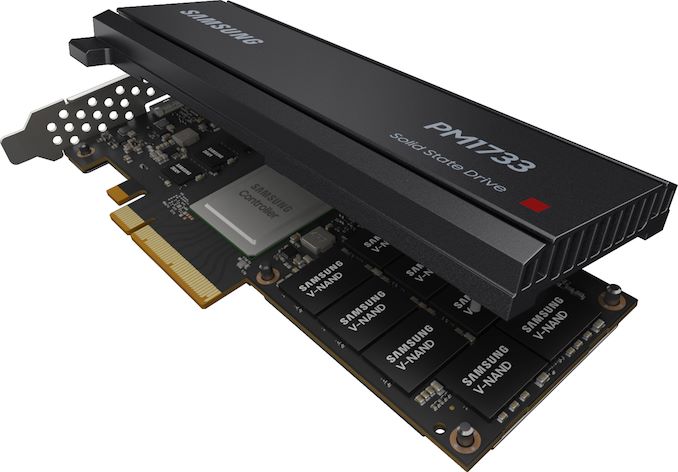
Almost a year after outlining their first roadmap for PCIe 4.0 SSDs, Samsung’s first two models are in mass production: the PM1733 and PM1735 high-end datacenter SSDs. Details about these new models have been slow to come out, but Samsung is now talking about three major improvements they bring over earlier SSDs in addition to the raw performance increases enabled by PCIe 4.0. The list of improvements includes fail-in-place (FIP) technology to boost reliability of drives, SSD virtualization technology to guarantee consistent performance for VDI and similar use cases, as well as V-NAND machine learning technology to predict and verify characteristics of NAND cells.


Fail-In-Place


Samsung’s fail-in-place (FIP) technology promises to allow the SSD to robustly handle hardware failures that would otherwise be fatal to the SSD, up to the failure of an entire NAND die. For the highest-capacity 30.72TB PM1733, the drive can keep running more or less normally even with the loss of any one of its 512 NAND flash dies. The drive will scan for corrupted or lost data, reconstruct it and relocate it to a still-working flash chip, and continue to operate with high throughput and QoS. In essence, this is like a RAID-5/6 array running in degraded mode instead of the whole array going offline. It’s still wise to eventually replace a SSD after it suffers such severe malfunction, but Samsung’s FIP technology means that replacement can be done at the operator’s convenience instead of the problem causing immediate downtime.


The addition of fail-in-place doesn’t change the fact that the PM1733 and PM1735 have write endurance ratings of 1 and 3 drive writes per day, respectively. The overall lifespan is still comparable to the previous generation of drives, but the chance of a premature death due to causes other than normal NAND wear has been greatly reduced.


Virtualization


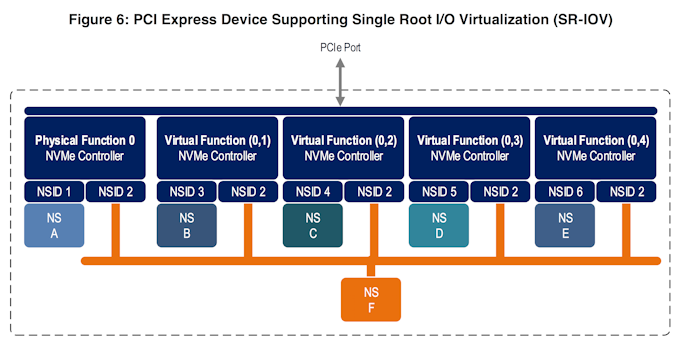
Next up, Samsung has added virtualization technology to the PM1733 and PM1735 SSDs. Samsung has implemented the optional NVMe virtualization features based on Single-Root I/O Virtualization (SR-IOV), allowing a single NVMe SSD controller to provide numerous virtual controllers (up to 64 in the case of Samsung’s drives). Each virtual controller can be assigned to a different VM running on the host system, and provide storage to that VM with no CPU overhead—the same as if the entire drive had been assigned to a single VM with PCIe passthrough. Storage capacity on each SSD can be flexibly allocated to different namespaces that can in turn be attached to the relevant virtual controller.


Machine Learning


The third technology introduced by Samsung is V-NAND machine learning. The company does not disclose precise details about how they are making use of machine learning, but only says that it is used to predict and analyze characteristics of flash cells, including by detecting variations among circuit patterns. With 3D NAND, it is increasingly difficult to get by with one size fits all strategies for cell programming, reading and error correction. Even tracking the P/E cycles each block has been through isn’t enough; there can be significant variation between layers near the top and bottom of the 3D stack, and from one die to another. Samsung is hardly alone in turning to machine learning strategies to tackle these complexities. The new capability will ensure consistent performance and improved reliability of today’s drives powered by TLC V-NAND, but its importance will grow dramatically in the case of QLC V-NAND-based drives.


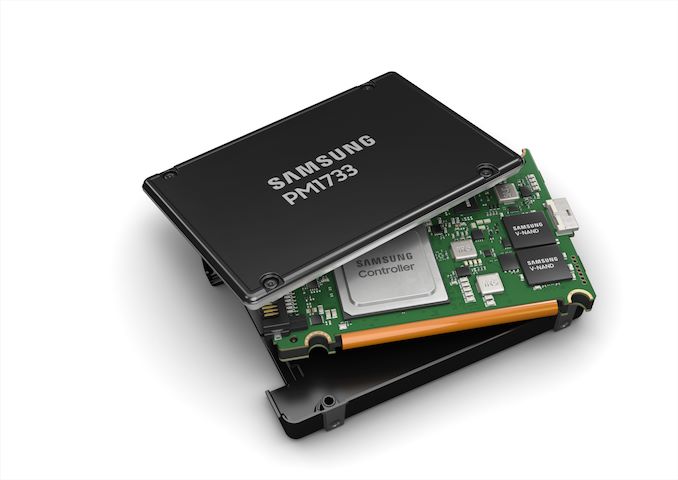
The first drives that can take advantage of the new features are already shipping to interested parties. The PM1733 and PM1735 are based on a common hardware platform. The PM1733 is rated for 1 DWPD and offers capacities up to 30.72 TB, while the PM1735 has more overprovisioning and lower usable capacities to reach 3 DWPD. Both models are available in either U.2 or PCIe add-in card form factors. The U.2 form factor gives a few more capacity options, while the add-in card versions have a PCIe 4.0 x8 interface to enable 25% higher sequential read performance (for other workloads, PCIe 4.0 x4 is fast enough to not be the bottleneck).


Related Reading:


Source: Samsung


Source: AnandTech – Samsung’s PCIe Gen 4 Enterprise SSDs Get Reliability & Performance Boost

GIGABYTE’s Aorus Gen4 AIC SSD 8 TB Launched: Up to 15 GB/s

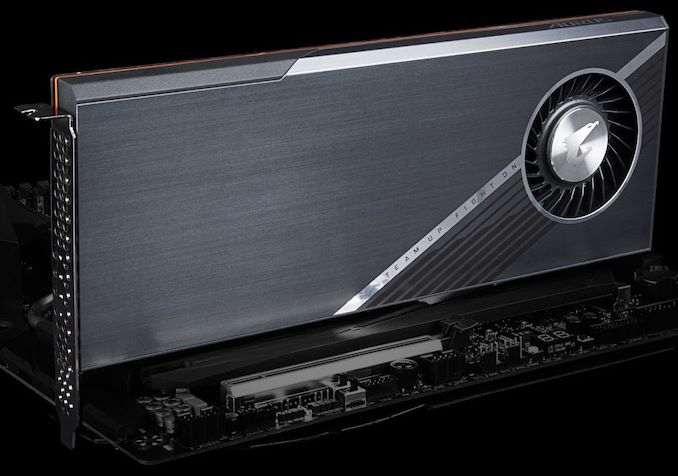
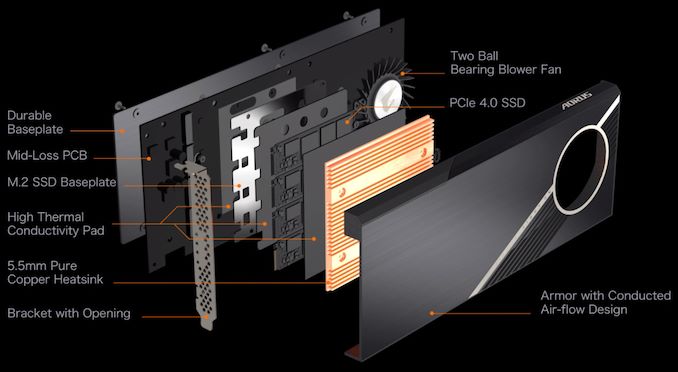
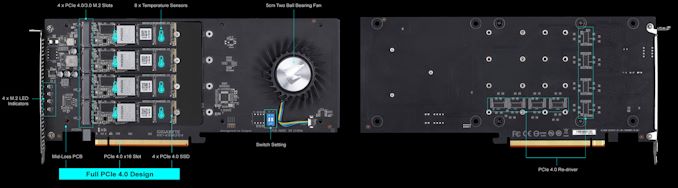
After originally showcasing it at Computex a bit earlier this year, GIGABYTE has officially introduced its quad-SSD PCIe 4.0 adapter card, the AORUS Gen4 AIC. Designed house up to 4 NVMe SSDs, the card is essentially a multi-way M.2 adapter, allowing a PCIe 4.0 x16 slot to be used to drive four x4 SSDs. Fittingly, with so many high-end SSDs on a single board, the card also features an active cooling system to ensure that the drives run at consistent speeds even under high loads. Fully populated with PCIe 4.0 SSDs, the card is rated to provide up to a staggering 15 GB/s of throughput – at least, if you can come up with a workload that can saturate such a setup.


GIGABYTE’s Aorus Gen4 AIC SSD 8 TB is a PCIe 4.0 x16 board with eight PCIe Gen 4 re-drivers. The card in turn carries four 2 TB M.2-2280 SSDs based on Phison’s PS5016-E16 controller, which remains the only client SSD controller with a PCIe 4.0 x4 interface. The card also features a sophisticated cooling system comprising of a large copper heatsink, a 5-cm ball bearing fan, and a baseplate, along with eight thermal sensors to monitor everything. That monitoring, in turn, is provided by the Aorus Storage Manager software, which can also configure the cooling on the card and supports three fan operating modes, including Silent, Balanced, and Performance.


When running in RAID 0 mode, the Aorus Gen4 AIC SSD 8 TB offers up to 15 GB/s sequential read/write speeds, as well as 430K/440K read/write IOPS. It goes without saying that this is a throughput-focused card, as outside of the difficulty in even coming up with that many IOPS in a client workload, RAID modes don’t really improve IOPS.


While the sequential performance of the Aorus Gen4 AIC SSD 8 TB looks extremely attractive, there is a caveat. The only enthusiast-class PCIe Gen 4-supporting platform today is AMD’s Ryzen 3000, and these CPUs only support 24 PCIe 4.0 lanes: x16 for an add-in-card, x4 for an NVMe SSD, and x4 to connect to the chipset. As a result, to make full use of the card you have to give up a board’s sole PCIe 4.0 x16 slot for the SSD, which makes this a niche product for systems that don’t need a powerful dGPU. Otherwise, installing the drive into a PCIe x16 slot controlled by AMD’s X570 chipset would cause it to be bottlenecked by the PCIe 4.0 x4 link between the chipset and the CPU.


That said, the Aorus Gen4 AIC SSD 8 TB can show itself in all the glory either in a workstation based on AMD’s EPYC 7000-series processor with up to 128 PCIe Gen 4 lanes, or, presumably, in a future high-end desktop based on next-generation AMD Threadripper CPU.


Related Reading:


Source: GIGABYTE (via Hermitage Akihabara)


Source: AnandTech – GIGABYTE’s Aorus Gen4 AIC SSD 8 TB Launched: Up to 15 GB/s

Huawei Launches Mate 30 & Mate 30 Pro 4G and 5G Variants: First Step Away From Google

Today at Huawei’s global launch event in Munich, the company has detailed its new Mate 30 and Mate 30 Pro flagship devices. The two new phones continue Huawei’s focus on innovating in the photo capture departments, with the new Mate 30 Pro introducing innovative camera features and hardware. Naturally, as is tradition with the Mate series, it represents Huawei’s pioneer series in which it introduces the newest technologies, such as the new brand-new Kirin 990 as well as Kirin 990 5G. The new Mate 30 also introduce new designs and hardware builds – increasing battery life and minimising weight of the phones.


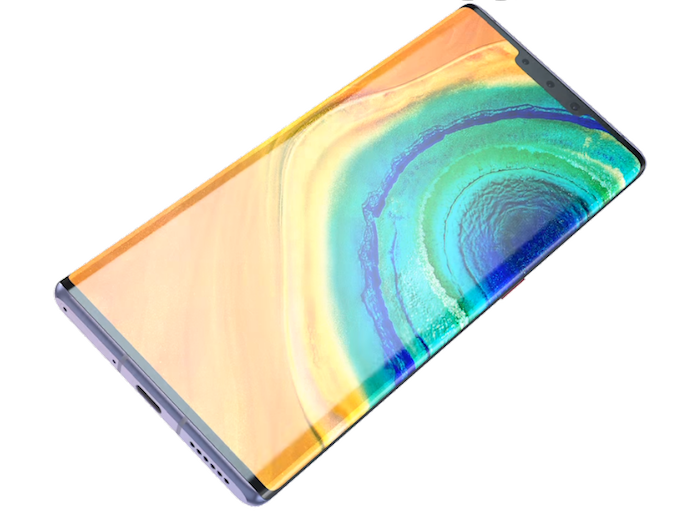
The Mate 30 Pro in particular introduces a new true edge-to-edge display that curves to the sides up to 90° – representing a brand-new form-factor and new ergonomics as Huawei makes away with physical buttons. Beyond all the hardware, the biggest news about Huawei’s newest devices is the fact that they will not come out of the box with Google Play or Google services preinstalled, representing a tectonic shift in the industry that’s bound to have reverberations for the next several years.


Huawei Mate 30 Series
  Mate 30 Mate 30 Pro

(Mate 30 Pro 5G)
SoC HiSilicon Kirin 990


2x Cortex-A76 @ 2.86 GHz

2x Cortex-A76 @ 2.09 GHz

4x Cortex-A55 @ 1.86 GHz

(HiSilicon Kirin 990 5G)


2x Cortex-A76 @ 2.86 GHz

2x Cortex-A76 @ 2.36 GHz

4x Cortex-A55 @ 1.95 GHz

GPU Mali G76MP16 @ 600MHz


(Mali G76MP16 @ 700MHz)

DRAM 8GB LPDDR4X 8GB LPDDR4X
Display 6.62″ OLED

2340 x 1080 (19.5:9)


6.53″ OLED

2400 x 1176 (18.4:9)


edge-to-edge

Size Height 160.8 mm 158.1 mm
Width 76.1 mm 73.1 mm
Depth 8.4 mm

(9.2mm)
8.8 mm

(9.5mm)
Weight 196 grams 198 grams
Battery Capacity 4100mAh (Rated)

4200mAh (Typical)


40W charging

4400mAh (Rated)

4500mAh (Typical)


40W charging

Wireless Charging 27W charging + reverse charging
Rear Cameras
Main 40MP f/1.8 OIS

RYYB sensor


27mm equiv. FL
40MP f/1.6 OIS

RYYB sensor


27mm equivl. FL
Telephoto 8MP f/2.4 OIS

3x Optical zoom

80mm equiv. FL
Wide 16MP f/2.2

Ulta wide angle

17mm equivl. FL


40MP f/1.8

RGGB sensor

Ultra wide angle

18mm equivl. FL

720p7680fps video capture

Extra 3D Depth Camera
Front Camera 24MP f/2.0 32MP f/2.0
Storage 128 / 256GB

+ proprietary “nanoSD” card
I/O USB-C
3.5mm headphone jack
USB-C
Wireless (local) 802.11ac (Wifi 5),

Bluetooth 5.1
Cellular 4G LTE

(4G + 5G NR NSA+SA Sub-6GHz)

Splash, Water, Dust Resistance IP53
(no water resistance)
IP68
(water resistant up to 1m)
Dual-SIM 2x nano-SIM
Launch OS Android 10 w/ EMUI 10

without Google services

Launch Price 8+128 GB: 799€


8+256 GB: 1099€


(5G 8+256GB: 1199€)


Starting off with the heart of the phone, we’re seeing both the Mate 30 and Mate 30 Pro powered by the new Kirin 990 chipsets. As we’ve covered the silicon in more detail a few weeks ago at its launch, this year we’re actually talking about two distinct new chips: The regular Kirin 990, and the Kirin 990 5G. As the name reveals the difference, the 5G variant of the chip includes a new integrated modem with support of Sub-6GHz 5G NR connectivity.


The company this year was conservative in terms of the IP of the new Kirin chipset, as this year again unfortunately the release timing of the silicon wasn’t in sync with the newest generation designs from Arm. Thus the chip again makes use of the existing Cortex-A76 CPU core, but this time around it bumps up the frequency up to 2.86GHz in the two fastest CPU cores. Depending on whether you get the regular or the 5G variant you’ll end up with a further two A76 efficiency cores at either 2.09GHz or 2.36GHz, and the same differences are found in the A55 small cores, coming in a quad-core configuration with 1.86GHz or 1.95GHz. The GPU core configuration is a Mali-G76MP16 at either 600MHz or 700MHz. HiSilicon is able to use the higher frequencies on the 5G model as it’s manufactured on TSMC’s new N7+ manufacturing node which makes use of EUV, whereas the regular variant remains on the existing N7 node.


Huawei was able to increase the battery sizes of the phones to up to 4200mAh for the Mate 30 and 4500mAh for the Mate 30 Pro by increasing the density of the battery cells. This generation, Huawei has also paid more attention to the resulting weight of the phone, managing to remain under 200g at respectively 196g and 198g for the non-pro and Pro models.


Mate 30 Pro


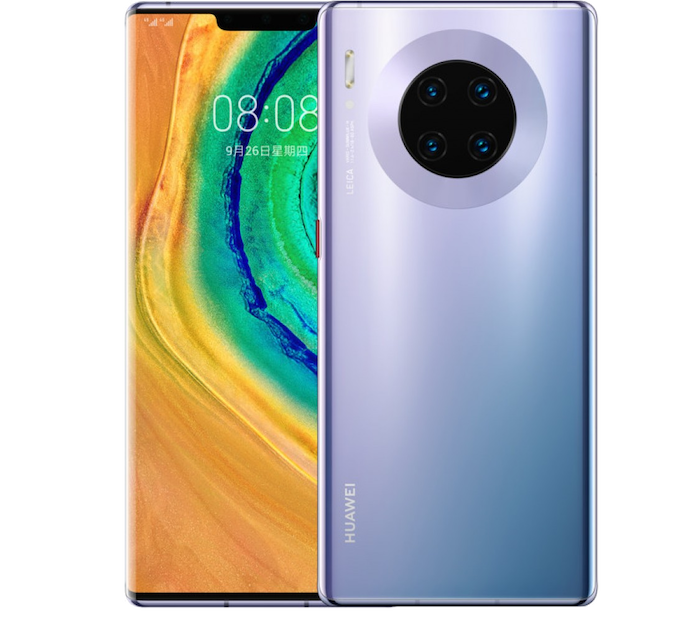
The Mate 30 Pro is certainly the most interesting of the two new devices when it comes to their designs. The Mate 30 Pro employs a new true edge-to-edge OLED screen which curves around to 90° around the edges – essentially making this the first actually bezel-less phone out there as you’ll be seeing pure screen when viewing the phone from the front. Unfortunately, it seems Huawei this year has opted to go back to 1080p-class screens for the Pro Mate model, reducing it from the 1440p that was uniquely shipped last year with the Mate 20 Pro. Either the Mate 30 Pro will have outstanding battery life, or Huawei still hasn’t figured out how to efficiently implement 1440p in their phones.




Mate 30


The 30 Pro comes at a slightly weird resolution of 2400 x 1136 which results in an aspect ratio of 18.4:9. The reason for this is that there’s actually some pixels which are going to be part of the wrap-around part of the screen. The regular Mate 30 has a more traditional 2340 x 1080 19.5:9 resolution and aspect ratio.


Even though the Mate 30 Pro lists a 6.53” diagonal screen size, because of the wrap-around aspect of it, it’s only actually 73.1mm wide which is slightly smaller than the usual “large” form-factor we’re used to, similar to the Mate 20 Pro last year, which was 0.8mm narrower.


Both phones still come with display notches, however Huawei was able to reduce their size notably, and rationalises by having the full plethora of sensors available, including a 3D depth camera, the usual ambient & proximity sensors, the 32MP or 24MP front-facing camera, as well as introducing a new gesture sensor.


The big stars and a big part of the presentation today were the phone’s cameras. The Mate 30 was more conservative in this regard, and essentially, we’re seeing the same camera setup as on the P30, with the exception of the addition of OIS on the main sensor. The main camera sensor for both phones is again the 40MP RYYB sensor employed in the P30 series, however the Mate 30’s pictures will notably improve thanks to a newer generation ISP in the Kirin processors. The aperture on the Pro unit is larger f/1.6 while the regular Mate 30 will make due with f/1.8 optics.
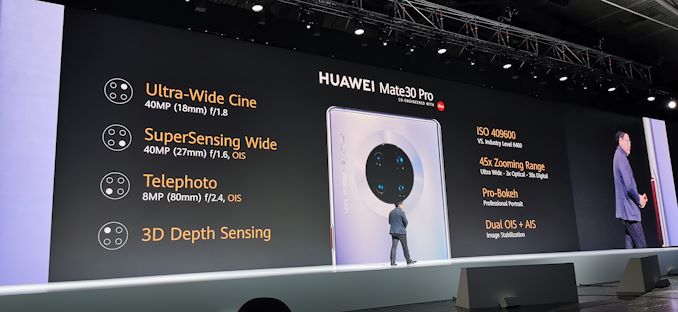


The telephoto module on both phones is the trusted and good 3x telephoto lens and 8MP sensor with an f/2.4 aperture. Personally I wasn’t too convinced of the periscope 5x module of the P30 Pro so I’m glad Huawei stuck around with the more traditional module in the Mate 30’s.


It’s in the wide-angle lens where the two phones drastically differ. While the Mate 30 has seemingly the same 16MP f/2.2 module as on the P30, the new Mate 30 Pro introduces a brand-new and industry first sensor of its type. The Mate 30 Pro’s wide-angle is makes use of a new equally large sized 1/1.54” sensor with a 40MP resolution. The sensor is a regular Bayer RGGB layout, unlike the RYYB 40MP main camera sensor. It employs a wide f/1.8 aperture with a wide-angle view equivalent focal-length of 18mm.
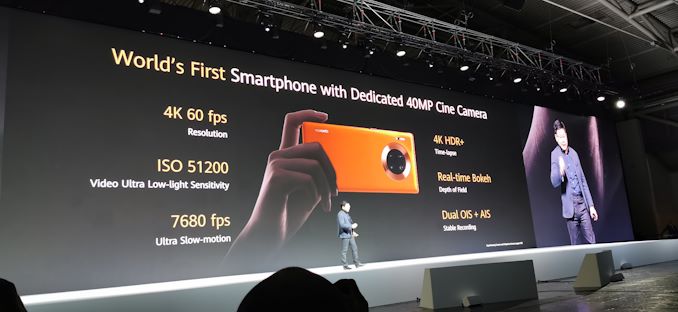


The new sensor however no only serves as the wide-angle eyes for the phone, but also has unique video recording capabilities. Huawei now finally introduced 4K60 recording, and also supports HDR+ video formats. The most eye-brow raising feature of the new module however is its quoted 7680fps slow-motion capture. Huawei demoed 2000fps samples at the presentation, and lists the 7680fps mode as being able to be recorded at 720p.


No Google Play Services or Play Store


Probably the biggest and most important announcement today wasn’t the Mate 30 or Mate 30 Pro as devices, but the fact that the new units will not be released with Google’s services such as the Play Store or Play Services preinstalled on the phone. Unfortunately this is the end result of the ongoing trade-war between the US and China, with Huawei considering themselves as being used as bargaining chips and pawns by the US’s decision to block the company from all commercial interaction with US companies, something the company describes as having nothing to do with security or even 5G infrastructure concerns.
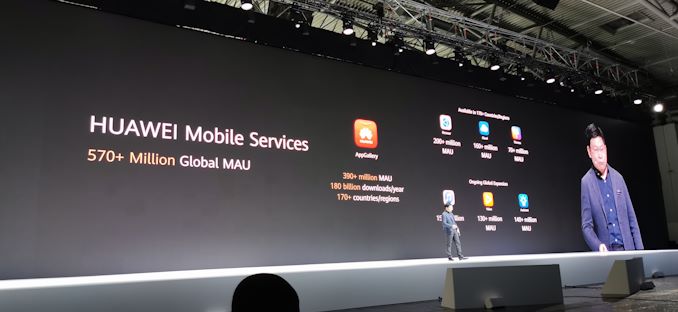


The implications here are huge both for Huawei as for the overall industry, and there will be no clear winners on either side, and on the long-term, it seems Google and the Android ecosystem has more to lose. Huawei is pushing forward with a full replacement of Google’s services, with the alternative being called “Huawei Mobile Services”, or HMS, in order to offer the same functionality that were offered by Google’s GMS.


In a follow-up interview with Richard Yu clarified one important question in regards to how users will have control over the software they’ll be able to install on the Mate 30 and Mate 30 Pro; beyond offering their own app store called the “Huawei App Gallery”, Yu said that it might be possible for users to install the GMS core onto the phones through either third-party app stores or websites. Huawei here is likely to resist as little as possible in terms of limitations as to what users will be able to do with their phones, and he also confirmed that users will be able to unlock the bootloaders for the Mate 30 and 30 Pro.


In case that the trade sanctions imposed by the US were to be lifted, Richard Yu explained that they’d be ready to “immediately” reintegrate the Google services and applications onto their firmware and push out updates to their phones.


In the meanwhile, Huawei is planning long-term and investing into their own HMS ecosystem. In order to attract developers and to gain traction, the company is making a available a $1bn fund for developers, ecosystem and marketing to offer alternatives for their users. Yu described one way to attract developers is that they will adopt a 15/85% share on app purchases, giving developers a larger piece of the pie than the 30/70 share that currently is in place for the Play Store and the iOS App Store. Huawei explains that they don’t want to do this, but given the circumstances, they’re forced to.


Availability & Pricing


The Mate 30 and Mate 30 Pro will be available in October in China and select European markets, with remaining European countries availability coming a bit later. The Mate 30 comes in a 8+128GB configuration for 799€, the Mate 30 Pro coming in a 8+128GB configuration for 1099€, and finally the 5G variant of the Mate 30 Pro coming at 1199€.


Related Reading:


Source: AnandTech – Huawei Launches Mate 30 & Mate 30 Pro 4G and 5G Variants: First Step Away From Google

Sony’s Micro LED-Based Ultra-HD TVs Available to Consumers: 2K to 16K Resolutions, up to 790-Inches

Sony this month started to offer its Micro LED-based displays to well-funded consumers. Officially branded as Crystal LED direct view display systems (aka CLEDIS), these ultra high-end products were previously only available for commercial installations. Designed to offer superior contrasts, brightness levels, and viewing angles, Sony’s Crystal LED TVs are designed to replace projector-enabled home theaters and will be available in 2K, 4K, 8K, and 16K versions with sizes of up to 790 inches.


Sony’s Crystal LED display systems rely on bezel-less Micro LED modules that are built using 0.003-mm² individually-controlled LEDs. The modules offer up to 1000 nits peak brightness, around 1,000,000:1 contrast ratio, up to a 120 Hz refresh rate, as well as nearly 180° viewing angles. According to Sony, such a display can cover 140% of the sRGB color space or around 100% of the DCI-P3 color gamut.


Since the micro LED modules are rather large – even though they’re the fraction of the size of a normal LED, the large number of micro LEDs adds up – the size of a Full-HD Crystal LED display system is around 110 inches in diagonal. Meanwhile the 4K unit doubles that, to 220 inches. Since we are dealing with devices that are designed to replace projection-powered home theaters, such sizes are well justified, but they are naturally too large for an average home.


Sony’s Consumer Crystal LED Display Systems
  Full HD 4K 8K 16K
Number of CLED Modules 18 72 288 576
Diagonal 110-inches 220-inches 440-inches 790-inches
Dimensions (W×H) 8 ft × 4 ft

2.43 m × 1.22 m
16 ft × 9 ft

4.87 × 2.74
32 ft × 18 ft

9.75 × 5.48
63 ft × 18 ft

19.2 × 5.48
Approximate Price of CLEDs at $10,000 per unit $180,000 $720,000 $2,880,000 $5,760,000

Sony’s Crystal LED-based display systems for residential installation will be available through a select group of individually trained and certified Sony dealers. The devices will be supported by Sony’s technicians, who will be able to remotely monitor displays after their installations to provide ongoing service.


Sony is not publicly quoting prices for its consumer Crystal LED products, but there are estimates that each module costs around $10,000 per unit. This would mean that a Full-HD version, which consists of 18 modules, costs over $180,000, whereas a 4K system will be priced at over $720,000.


Related Reading:


Sources: Sony, TechHive


Source: AnandTech – Sony’s Micro LED-Based Ultra-HD TVs Available to Consumers: 2K to 16K Resolutions, up to 790-Inches

The Huawei Mate 30 Launch Event Live Blog (Starts at 8am ET/12:00 UTC)

The busy fall period for smartphone launches continues. Today in Munich, Germany, Huawei is holding their launch event for their Mate 30 family of smartphones, the latest generation of flagship phones from the company. The underlying Kirin 990 SoC was already announced a couple of weeks back at IFA, and now we’ll get to see the rest of what Huawei has in store for their next generation of smarphones.


Source: AnandTech – The Huawei Mate 30 Launch Event Live Blog (Starts at 8am ET/12:00 UTC)