Lenovo: Foldable ThinkPad X1 to Launch in 2020

At Canalys Channels Forum last week, Lenovo finally revealed launch timeframe for its foldable ThinkPad X1 hybrid notebook that was first revealed in May. The company says that the machine is ready from hardware standpoint, but it needs its software partners to polish off their programs for the innovative unit.


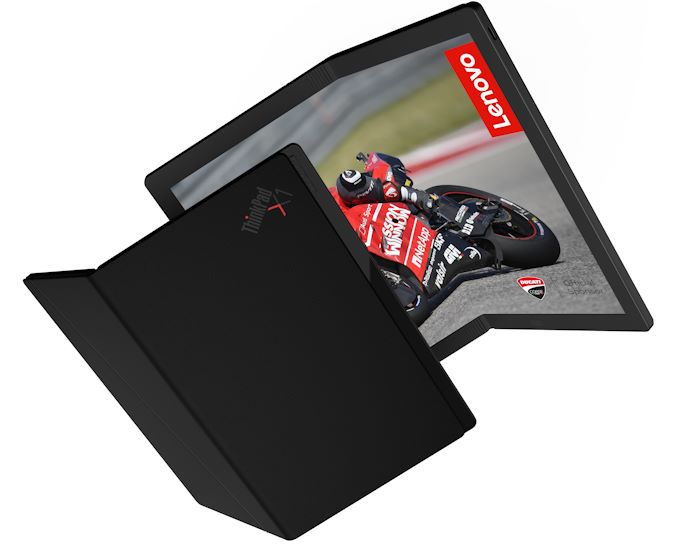
Lenovo’s foldable ThinkPad X1 features a 13.3-inch OLED display featuring a ‘2K’ resolution that can be folded in half to fit it into a small bag. The hybrid notebook can be used in tablet, book, and clamshell modes to serve different purposes. It can also be attached to a stand or a dock for workloads that require a mechanical keyboard and a mouse. The foldable ThinkPad X1 uses an undisclosed Intel processor as well as Microsoft’s Windows operating system and is therefore compatible with a wide variety of software applications.
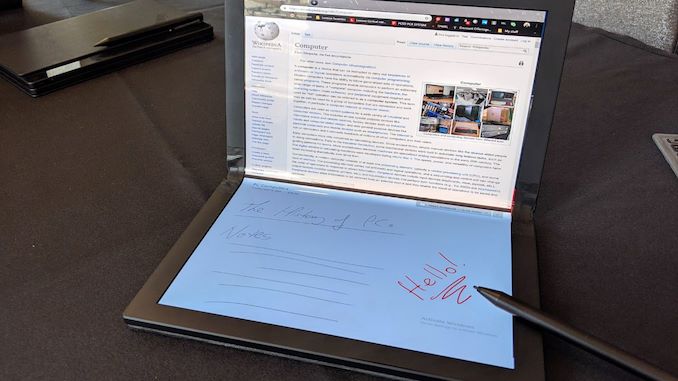

Image by Laptop Mag


Milanka Muecke, director of global commercial communications and brand at Lenovo, described the foldable ThinkPad X1 device as a fully-fledged PC that fits in the palm of a hand:


“I have it right here and you can have it in your purse. It looks like a leather bound notebook that you can carry with you all day long, but it is a full performance PC that fits in the palm of your hand.”


Lenovo now expects to ship its foldable ThinkPad in the second quarter of 2020, though it is unclear when it will be revealed from April to June (Note, June is Computex). From the hardware standpoint, the product is sound, but software still needs certain fixes, according to Gianfrano Lanci, COO of Lenovo:


“It will start shipping probably Q2 next year. […] Hardware is ready, but we need to still fix certain things from a software point of view and that does not depend 100% on us.”


The high-ranking executive of Lenovo does not expect foldable ThinkPad X1 to be an immediate bestseller (probably because of price and other factors), but as a new form-factor it will enable Lenovo to tap into emerging market segments. One of the obvious segments that the foldable ThinkPad X1 will address will be high-performance tablets like Apple’s iPad Pro. Meanwhile, Lenovo will ship its device several months before Microsoft’s launch of dual-screen Surface Neo that targets the same segment.


Related Reading:


Sources: The Register, Laptop Mag, TechRadar


Source: AnandTech – Lenovo: Foldable ThinkPad X1 to Launch in 2020
AMD Ryzen 7 3750X with 105 W TDP: Spotted at AMD

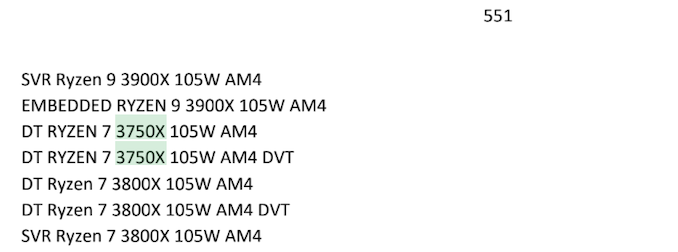
AMD has accidentally published its Product Master list – a list with all of its consumer, enterprise, and OEM parts listed. In the latest publication, it reveals multiple CPUs that could potentially be released in the future. The document, which is dated September 2019, indicates that AMD may be mulling to launch its Ryzen 7 3750X product with a 105 W TDP, though does not disclose its specifications or if it is OEM-only.


From AMD’s Master Product Document


As the product number suggests, AMD’s Ryzen 7 3750X will sit between the eight-core Ryzen 7 3800X and the eight-core Ryzen 7 3700X, which leads to a suggestion that we are dealing with another eight-core CPU with SMT. Meanwhile, the base frequency difference between the Ryzen 7 3700X and 3800X is only 300 MHz, which is pretty narrow, whereas the former features a mainstream TDP of 65 W, while the latter can go all the way to 105W.


AMD ‘Matisse’ Ryzen 3000 Series CPUs
AnandTech Cores

Threads
Base

Freq
Boost

Freq
L2

Cache
L3

Cache
PCIe

4.0
Chiplets

IO+CPU
TDP Price

(SEP)
Ryzen 9 3950X 16C 32T 3.5 4.7 8 MB 64 MB 16+4+4 1+2 105W $749
Ryzen 9 3900X 12C 24T 3.8 4.6 6 MB 64 MB 16+4+4 1+2 105W $499
Ryzen 9 3900 12C 24T 3.1 4.3 6 MB 64 MB 16+4+4 1+2 65W
Ryzen 7 3800X 8C 16T 3.9 4.5 4 MB 32 MB 16+4+4 1+1 105W $399
Ryzen 7 3750X? 8C? 16T? ? ? 4 MB? 32 MB? 16+4+4 1+1 105W ?
Ryzen 7 3700X 8C 16T 3.6 4.4 4 MB 32 MB 16+4+4 1+1 65W $329
Ryzen 5 3600X 6C 12T 3.8 4.4 3 MB 32 MB 16+4+4 1+1 95W $249
Ryzen 5 3600 6C 12T 3.6 4.2 3 MB 32 MB 16+4+4 1+1 65W $199
Ryzen 5 3500X 6C 6T 3.6 4.1 3 MB 32 MB 16+4+4 1+1 65W

Keeping in mind that AMD already has a rather diverse Ryzen 3000 (aka Matisse) family and the fact that the company may have various ideas how to improve its product lineup, it is not particularly easy to make predictions about future products, especially if they may end up as OEM-only products, inside desktops of only one or two partners. The only thing that is certain at this point is that AMD might be considering to strengthen its desktop family if it feels necessary.


AMD’s Product Master document seems to be aimed at the company’s sales teams and contains OPN codes along with US ECCN, HTS, and CCATS codes that are required by the US export regulators. While the list mentions numerous products, at least some of them are potential or partner-specific products.


Related Reading


Sources: AMD, Reddit, Tom’s Hardware, Komachi_Ensaka/Twitter, Planet3DNow.de


Source: AnandTech – AMD Ryzen 7 3750X with 105 W TDP: Spotted at AMD

Biostar Unveils Racing X570GTA Motherboard

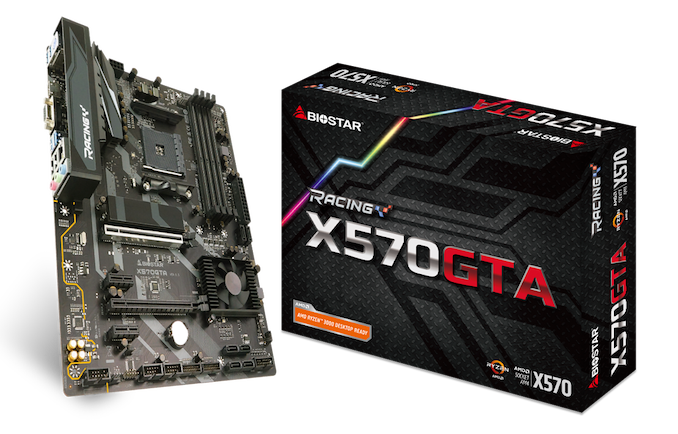
Adding to its small X570 product stack, Biostar has unveiled its latest ATX sized model, the Biostar Racing X570GTA. While nothing to do with ‘Grand Theft Auto’, the X570GTA takes the more budget-focused stance with a Realtek RTL8111H Gigabit Ethernet controller, a Realtek ALC887 HD audio codec, and has support for DDR4-4000 memory.


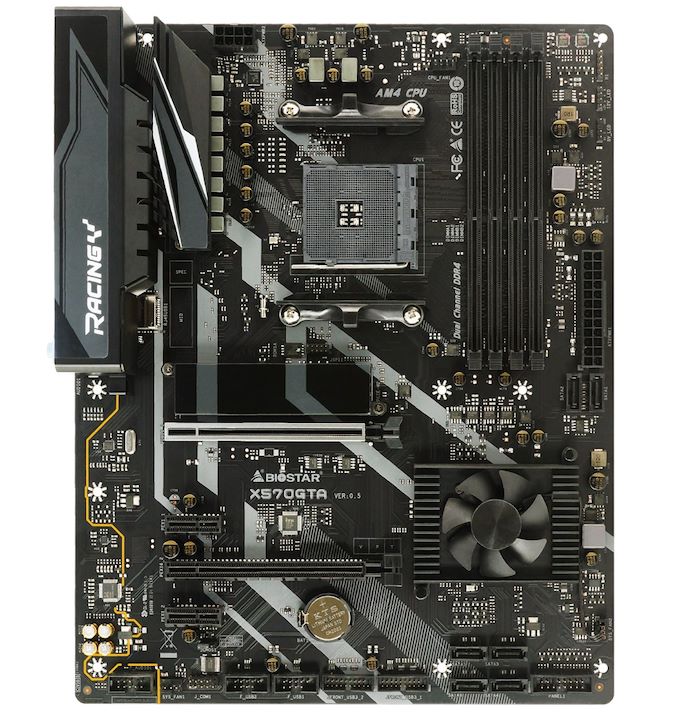
Bordering on one of the most basic feature-sets we’ve come across for any current model on the X570 chipset, the Biostar Racing X570GTA encompasses its typical Racing brand theme with a black and grey accented design. The X570GTA has a full-length PCIe 4.0 x16 slot which has a coating of metal slot reinforcement, a second full-length PCIe 4.0 x4 slot from the chipset as well as two PCIe 3.0 x1 slots.


Storage support consists of a single PCIe 4.0 x4 M.2 slot with support for SATA drives too, as well as six straight-angled SATA ports supporting RAID 0, 1, and 10 arrays. Although not as prolific as some vendors offer on its lower-spec X570 models, the Biostar Racing X570GTA has support for DDR4-4000 memory with support for up to 128 GB; AMD recommends that the sweet spot for Ryzen 3000 processors is DDR4-3600. Delivering power to the CPU is a single 8-pin 12 V ATX input and the power delivery isn’t determined, but we have reached out to Biostar to find out. The CPU section of the power delivery is cooled by a svelte looking aluminium heatsink, while the SoC/IGP area is laid bare. The X570 chipset is actively cooled, and Biostar hasn’t focused too much on aesthetics with its design with no integrated RGB LEDs.


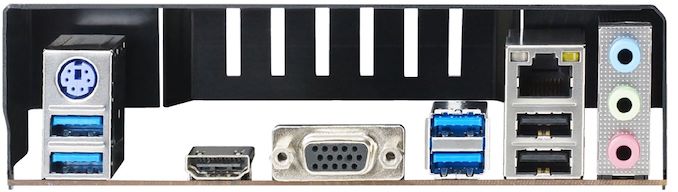
On the rear panel of the Biostar Racing X570GTA is a limited amount of USB connectivity with just four USB 3.1 G1 Type-A, and two USB 2.0 ports. Users looking to use a Ryzen based APU can access integrated graphics with a pair of HDMI and D-Sub video outputs, while a PS/2 keyboard port, three Realtek ALC887 codec powered 3.5 mm audio jacks, and a Realtek RTL8111H Gigabit Ethernet port make up the rest.


The Biostar Racing X570GTA is set to hit retail next month with an MSRP of $160. This puts it same price bracket as the MSI X570-A Pro which benefits from an extra PCIe 4.0 x4 M.2 slot and has a Realtek ALC1220 HD audio codec.


Related Reading


Source: AnandTech – Biostar Unveils Racing X570GTA Motherboard

Details About 3rd Generation Ryzen Threadripper Appear: 24 and 32 Cores, Up to 280 W

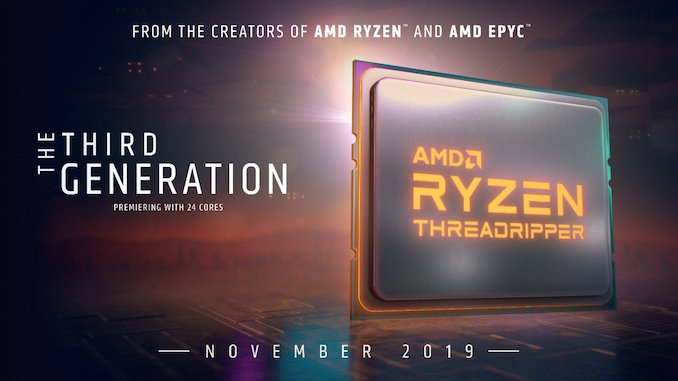
AMD has already officially confirmed plans to launch its 3rd Generation Ryzen Threadripper processors this November, but naturally kept all the details to itself. At the time, it stated that the first products to market will be 24-core products. According to the company’s Product Master document that was published by AMD, it looks like some preliminary information about the CPUs is now in.


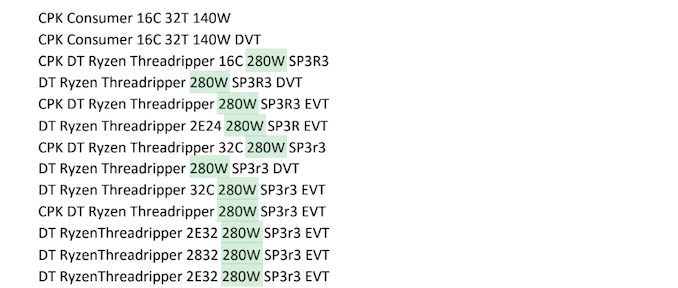
Based on the document (as well as previously released claims by the company), AMD’s Ryzen Threadripper 3000-series family will include 16-core, 24-core, and 32-core CPUs with a TDP up to 280 W for its most extreme parts. This is up from a 250 W TDP featured by AMD’s Ryzen Threadripper 2000 processors with up to 32 cores. The new process technology along with a higher thermal design power will likely enable the new CPUs to run faster and offer a significant performance increase when compared to predecessors (plus, keep in mind performance boost from the Zen 2 microarchitecture).


From AMD’s Master Product Document


The new CPUs are also said to use a new variant of the SP3 socket called SP3r3, which questions if they will be drop-in compatible with previous-gen motherboards. Considering the fact that AMD is preparing new chipsets for its next-generation Ryzen Threadripper processors, but has been stated with providing socket compatibility, it will be interesting when AMD defines the compatibility table. This is likely a differentiator for PCIe 4.0 support.


AMD’s Product Master list is seemingly targeted at the company’s sales teams and contains OPN codes along with US ECCN, HTS, and CCATS codes that are required by the US export regulators. Although the document mentions a variety of products, at least some of them are potential or partner-specific devices not exactly located in the company’s roadmap for mass products. Therefore, the information from the list should be taken with a grain of salt, as some of these parts may not be hitting the market.


Related Reading


Sources: AMD, Reddit, Tom’s Hardware, Komachi_Ensaka/Twitter, Planet3DNow.de


Source: AnandTech – Details About 3rd Generation Ryzen Threadripper Appear: 24 and 32 Cores, Up to 280 W

Royal Memory: G.Skill’s 32 GB DDR4-4000 CL15 Kit for AMD & Intel

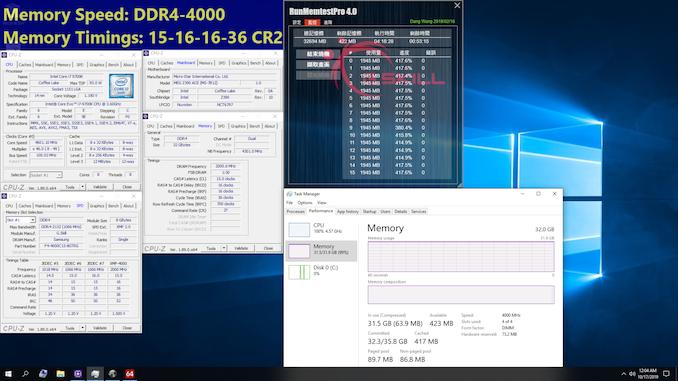
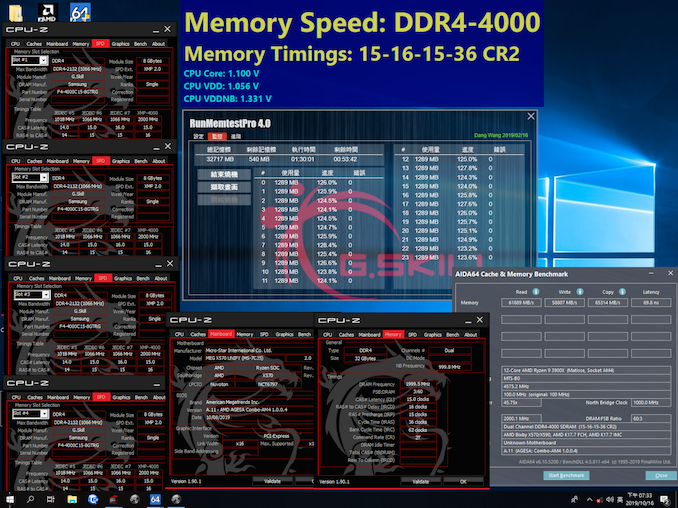
Bucking the trend of ever higher clocked DDR4 memory kits, G.Skill has introduced a new high-end memory kit that is focused on lower memory latencies. Compatible with both Intel and AMD platforms, the premium memory kit offers CL15 latencies at up to DDR4-4000 speeds.


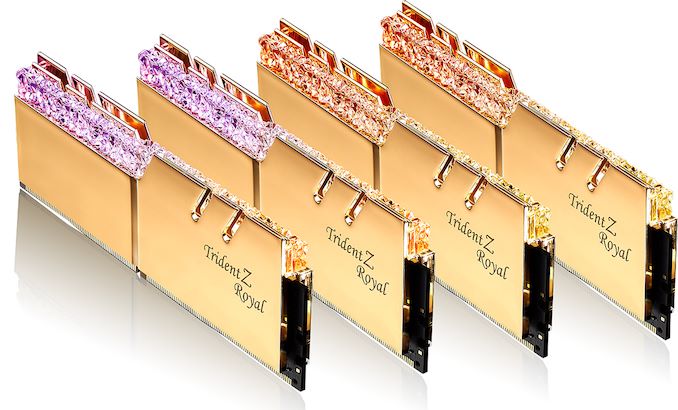
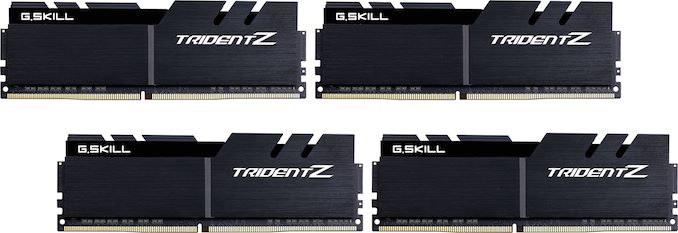
G.Skill’s Extreme Low Latency DDR4-4000 32 GB kit consists of four 8 GB modules based on cherry-picked Samsung’s 8 Gb B-Die chips. The sticks are rated for 4000 MT/s CL15 16-16-36 at 1.5 V. The modules use G.Skill’s custom PCB, feature an XMP 2.0-enabled SPD, and come with G.Skill’s blingy Trident Royal Z heat spreaders with a crystaline RGB lightbar, or regular Trident Z with classic all-black heat spreaders.


The Extreme Low Latency DDR4-4000 32 GB kit has been validated both on AMD’s X570/Ryzen 3000 platform (using MSI’s X570 Unify motherboard) and Intel’s Z390 platform (using MSI’s MEG Z390 Ace motherboard). Keeping in mind that we are dealing with modules that work at clocks and latencies well beyond those recommended by JEDEC at voltages that are a whopping 25% higher than spec for DDR4 DIMMs, one will clearly need a high-end motherboard with a VRM that can deliver clean and quality power to the modules.


G.Skill will start sales of its Trident Z Royal 32 GB DDR4-4000 CL15 kit late in Q4 2019. Pricing has yet to be announced, but considering their high-end specifications, expect them to be expensive.


Related Reading:


Source: G.Skill


Source: AnandTech – Royal Memory: G.Skill’s 32 GB DDR4-4000 CL15 Kit for AMD & Intel

The Microsoft Surface Laptop 3 (15-Inch) Review: AMD Ryzen Surface Edition

This year at Microsoft’s somewhat annual Surface update event, Microsoft surprised everyone by not only announcing a newer and larger Surface Laptop 3, bumping the screen size from 13.5-inches to 15-inches, but also by selecting an AMD processor for the laptop. Though still an incremental shift when looking at the entire Surface lineup, it was a big change for Microsoft, as well as a big win for AMD. Not only is Microsoft now offering a traditional, clamshell laptop in the ever-popular 15-inch form factor, but it’s the highest profile laptop yet to ship with one of AMD’s APUs.


Source: AnandTech – The Microsoft Surface Laptop 3 (15-Inch) Review: AMD Ryzen Surface Edition

Chips&Media Launches Wave510A Hardware AV1 Decoder IP

Chips&Media this month has started to license out its Wave510A hardware decoder IP, the industry’s first AV1 video decoder. The base decoder core supports decoding up to 4Kp60, but it can be scaled out to handle 4Kp120 and 8Kp60 resolutions as well. The IP is designed to be integrated into SoCs for various applications, including televisions, STBs, smartphones, and PCs. Meanwhile, since the Wave510A only decodes AV1 streams, it will likely be licensed by parties who want to add AV1 to their existing SoCs.


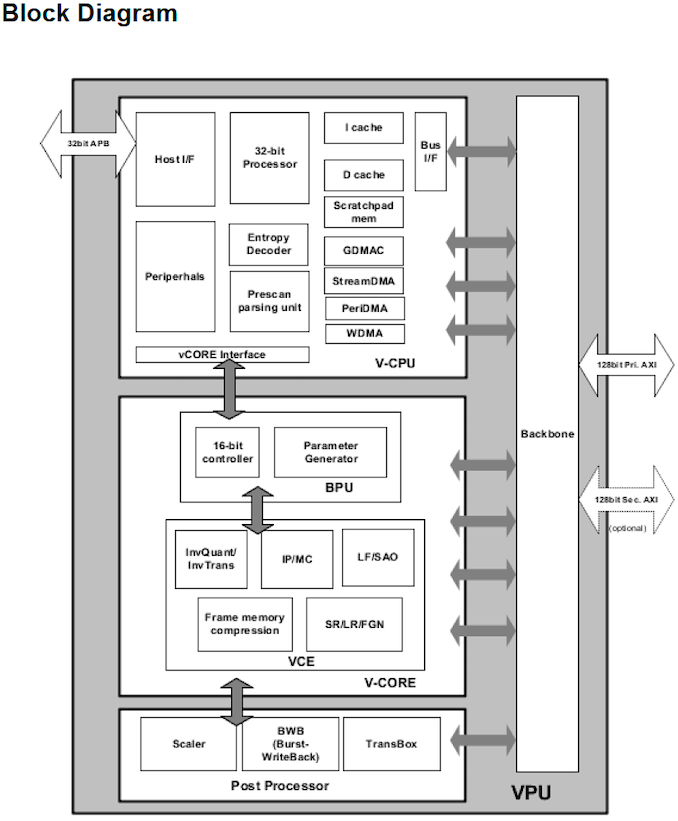
The Wave510A video processing unit (VPU) IP is based on two fundamental units: the V-Core and the V-CPU. The 32-bit V-CPU controls the whole IP block, communicates with host CPU, parses bitstream syntax from sequence to slice header unit, and prescans slice data. The V-Core performs entropy decoding, inverse scan, inverse transform/quantization, motion compensation, and loop filtering. The IP VPU can be connected to host using Arm’s 32-bit AMBA3 APB bus, and also has two 128-bit AMBA3 AXI busses to access external memory and on-chip SRAM.


The Chips&Media Wave510A can decode AV1 Main profile @ L5.1 50 Mbps at 8 or 10-bit color depths, with 4:2:0 chroma subsampling. The VPU can output to various displays at up to 8192×8192 resolution in various formats. When clocked at 500 MHz, it can support up to 4Kp60 realtime decoding in a single-core configuration, whereas in a dual-core configuration it can decode 4Kp120 and 8Kp60 streams.


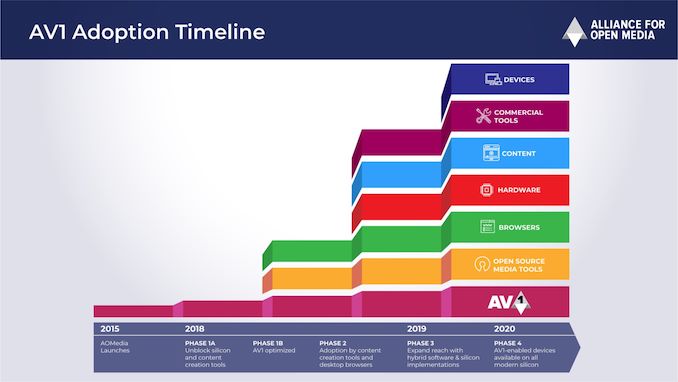
The AV1 royalty-free codec was introduced about 1.5 years ago by the Alliance for Open Media (AOMedia), and it is gaining traction throughout the industry. Over the past few months we have seen multiple technology licensing companies announcing hardware encoder IP blocks as well as several SoCs that already support AV1 decoding using in-house developed IP (or using general-purpose cores).


Amphion Semiconductor was the first company to announce an AV1 decoder with its CS8142 decoder IP, but this part is still in development. By contrast, the Wave510A from Chips&Media is available now and can licensed in the form of a verified synthesized RTL source. Meanwhile, the Wave510A only supports AV1, so to build a complete video decode pipeline supporting codecs like HEVC and AVC, designers will have to license or develop additional IP blocks to support those other codecs. On the other hand, the Wave510A can be easily added to existing designs and improve their feature set.


Related Reading:


Source: Chips&Meida (via Design & Reuse)


Source: AnandTech – Chips&Media Launches Wave510A Hardware AV1 Decoder IP

Xiaomi Reveals 34-Inch Mi Surface Display: 144Hz WQHD w/FreeSync

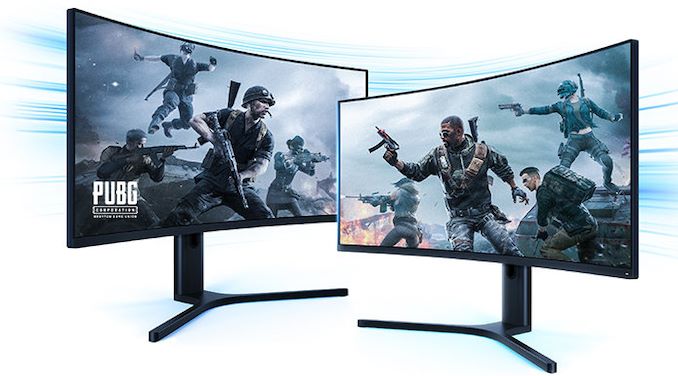
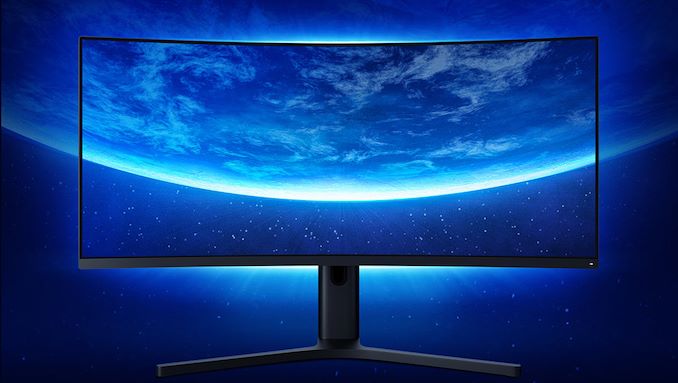
While Xiaomi is best known in the west for its smartphone products, like other electronics conglomorates, the company produces a significant selection of electronics products, and that variety is continuing to grow. To that end, this week the company unveiled its first computer monitors, including the flagship 34-inch curved Mi Surface Display, a 21:9 aspect ratio display with a 3440×1440 resolution.


Xiaomi’s 34-inch curved Mi Surface Display was designed primarily for gamers and multimedia enthusiasts in mind, which is why it has a 4 ms GtG response time as well as a variable refresh rate of up to 144 Hz enabled by AMD’s FreeSync technology. The monitor can display 16.7 million colors and is said to cover 121% of the sRGB color gamut.


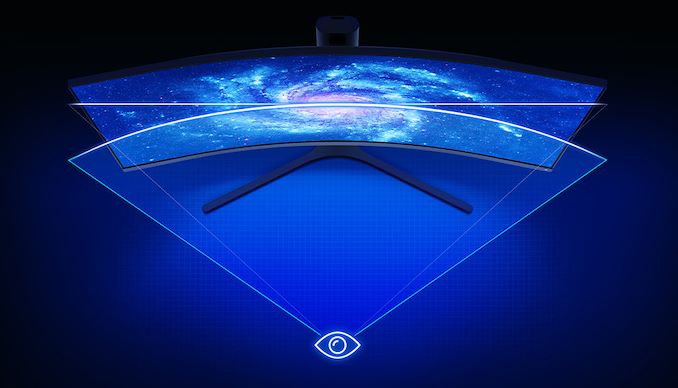
Meanwhile, although Xiaomi has not officially disclosed who makes the panel underlying the monitor, based on unofficial information, the LCD would seem to use a 1500R-curved VA panel from Samsung Display. So expect technical specifications like brightness and contrast ratio to be in line with those offered by other monitors that use the same panel.


Like other devices from Xiaomi, the Mi Surface Display features a minimalistic design and has very narrow (~2 mm) bezels on three of its sides. Meanwhile, it has a stand that can adjust its height and tilt.


The manufacturer does not disclose which connectors does the Mi Surface Display have, but since we are talking about a contemporary monitor for gamers, it is reasonable to expect it to feature DisplayPort and HDMI inputs.


Xiaomi Mi Surface Display
  General Specifications
Panel 34″ VA
Native Resolution 3440 × 1440
Brightness ? cd/m²
Contrast ?:1
Maximum Refresh Rate 144 Hz
Response Time 4 ms GtG
Viewing Angles 178°/178° horizontal/vertical
Curvature 1500R
Pixel Pitch 0.233 mm
Pixel Density 110 ppi
Anti-Glare Coating ?
Inputs ? × DisplayPort

? × HDMI 2.0
USB Hub ?
Stand Height: +/- ? mm

Tilt: -? to +?°
Audio ?
Launch Price ?

Xiaomi’s Mi Surface Display will be available in China starting October 21. Those who pre-order it ahead of the launch will get it for ¥1,999, whereas those buying afterwards will have to pay ¥2,499 (~$312 without VAT). It is unclear when and whether the Mi Surface Display will be available in Europe or the USA as the company may prefer to avoid competing against traditional LCD makers in these regions.


Related Reading:


Sources: Xiaomi/Weibo, GizmoChina, BGR.in, NotebookCheck


Source: AnandTech – Xiaomi Reveals 34-Inch Mi Surface Display: 144Hz WQHD w/FreeSync

Arctic’s Freezer 50 TR Air Cooler w/ RGB for AMD’s Threadripper Launched

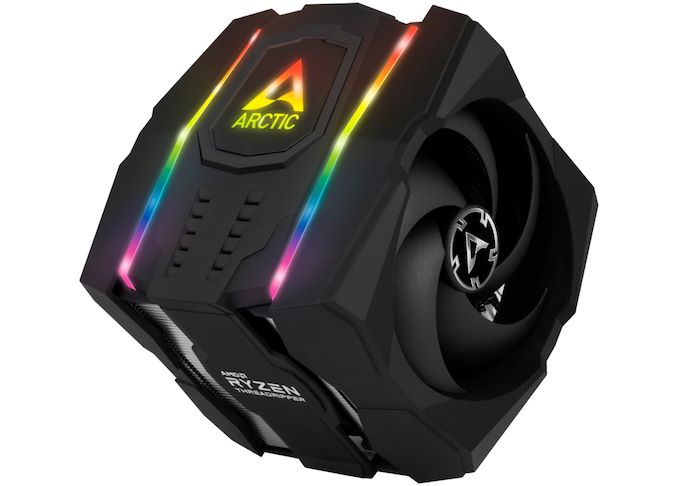
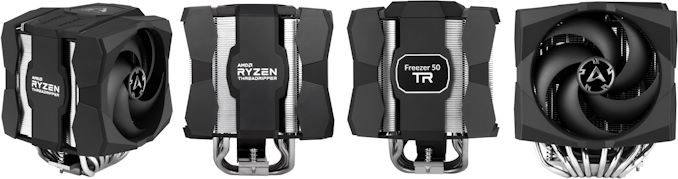
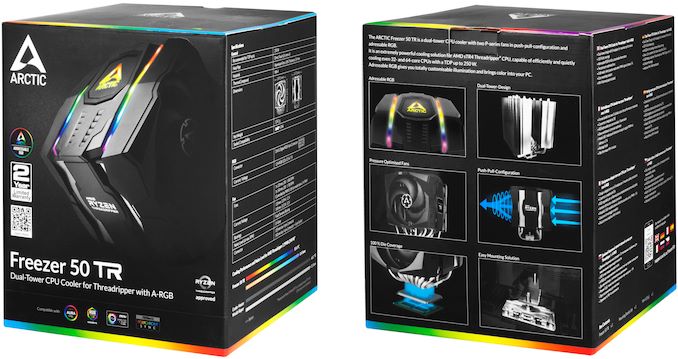
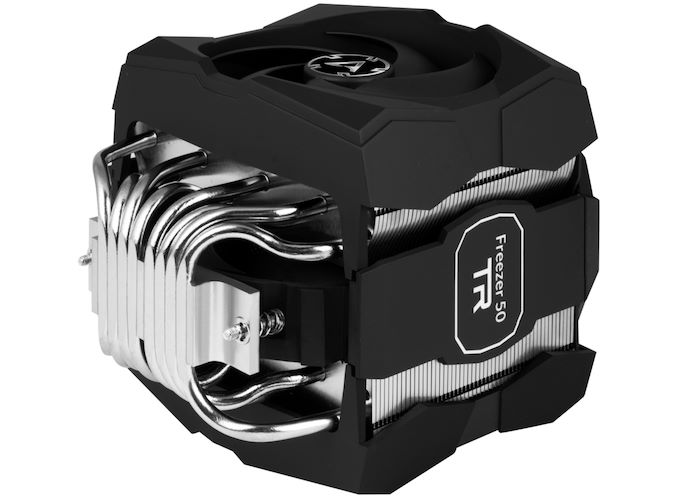
Arctic has formally introduced its Freezer 50 TR cooler for AMD’s Ryzen Threadripper processors, which promises to remain quiet even when the CPU gets hot. The socket TR4-only cooler comes with two fans, has multiple heat pipes, and weighs more than 1.2 kilograms. And, for the multi-colored lighting enthusiasts among us, it’s equipped with 13 addressable RGB LEDs.


The Arctic Freezer 50 TR borrows its design from other so-called ‘mega coolers’: it has a massive dual-tower heatsink featuring 104 aluminum fins, while eight U-shaped 6-mm heat pipes that form the base cover the part of the IHS of the Ryzen Threadripper CPU ‘right where the processor’s die is’. Moving air from the massive heatsink is a 120-mm plus 140-mm fan set, with Arctic’s fans using fluid dynamic bearings. While the mismatched fans are unusual, Arctic says that using two fans of different sizes increases airflow and therefore improves performance. Depending on the load, the fans will rotate at 200 ~ 1800/1700 RPMs, so it should be very quiet under light loads.


It is noteworthy that when the Freezer 50 TR cooler was originally showcased early this year, it actually advertised as being able to go passive under low loads. However this feature is absent from the final version, and while Arcitc hasn’t specifically said why, it’s not hard to imagine thermal stability proving to be a greater concern than expected from such a large (and power hungry) chip like Threadripper.


When it comes to dimensions, the whole construction of Arctic’s Freezer 50 TR measures 147.8×149.5×165 mm and leaves a RAM clearance of 37.5 mm. While the cooler certainly cannot be called compact, it should fit into most enthusiast-grade PC chassis.


The manufacturer does not disclose the cooler’s rated TDP, but says that it can cool down Ryzen Threadripper 2990WX as well as CPUs ‘of 32 cores and beyond’. So as we’ve seen with some other air coolers of this size (which can handle upwards of 340W) it’s a reasonable bet that the 50 TR can dissipate at least 250 W of heat, leaving some additional headroom for overclocking and/or future processors with a higher TDP.


Finally, as is increasingly customary for enthusiast-grade cooling systems these days, the Arctic Freezer 50 TR comes with 13 addressable RGB LEDs. These can be controlled using software from leading motherboard makers as well as a standalone controller (to get it, one will have to buy an appropriate version of the cooler).


The Arctic Freezer TR50
  General Specifications
CPU Socket AMD: sTR4
Heat Sink Material Dual tower heatsink, 2×52 aluminum fins, 8 heatpipes
Dimensions w/ Fan Length: 147.8 mm

Width: 149.5 mm

Height: 165 mm
Fan Speed 120-mm fan: 200 ~ 1,800 RPM

140-mm fan: 200 ~ 1,700 RPM
Fan Air Flow ? CFM
Fan Air Pressure ?
Fan MTTF ?
Fan Connector 3×4-pin
Fan Power Consumption ?
Weight 1,242 grams
MSRP $69.99

The Arctic Freezer 50 TR is available now from Amazon and will shortly hit other channels, where it’s currently selling for $69.99.


Related Reading:


Source: Arctic (via TechPowerUp)


Source: AnandTech – Arctic’s Freezer 50 TR Air Cooler w/ RGB for AMD’s Threadripper Launched

The Toshiba/Kioxia BG4 1TB SSD Review: A Look At Your Next Laptop's SSD

Today we’re taking a look at Toshiba’s tiny, OEM-only BG4 SSD. The BG4 is going to become an increasingly common sight in OEM laptops as manufacturers look to save on space and power consumption. Toshiba’s fourth-generation BGA SSD pushes performance and capacity into mainstream territory while keeping power consumption extremely low, all in a footprint comparable to a postage stamp or SD card.


Source: AnandTech – The Toshiba/Kioxia BG4 1TB SSD Review: A Look At Your Next Laptop’s SSD

TSMC Radically Boosts CapEx to Expand Production Capacities, To Reach $14B For 2019

Forecasting strong demand for its 5 nm and 7 nm class process technologies in the coming years, TSMC has announced that it’s increasing its capital expenditure for 2019 by a whopping 36% – 40% over its earlier plans. The lion’s share of the additional money will be spent on the equipment that will be used to make 5 nm chips.


TSMC expected its 2019 CapEx to be between $10 billion and $11 bullion early this year (in line with $10.5 billion in 2018), but increased demand for chips to be made using one of its 7 nm-class nodes (N7, N7P, N7+, N6) and projected demand for 5 nm semiconductors made the foundry change its mind. At its conference call with analysts and investors this week, TSMC said that it had decided to raise its 2019 CapEx by $4 billion to increase production capacities available to its customers. The company now expects its capital expenditure for the full year to be between $14 billion and $15 billion. Furthermore, TSMC upped its CapEx forecast for 2020 and expects it to be similar to the revised CapEx for this year.

According to TSMC, $1.5 billion of the $4 billion will be spent to increase its 7 nm capacity, whereas $2.5 billion will be used to increase 5 nm capacity. The company did not disclose what kind of equipment it intends to buy, but in the light of the fact that its 5 nm technology will heavily use extreme ultraviolet lithography (EUVL) on up to 14 layers, and the fact that both N7+ and N6 also use EUVL on up to four and five layers respectively, it is safe to say that some of the money will be spent on ASML’s latest Twinscan NXE step-and-scan systems.


From a chip designer’s perspective, TSMC’s N5 looks extremely attractive compared to N7, as it offers an up to 1.84x higher transistor density (i.e., enables to shrink die size of a given chip by up to ~45.6%), a 15% performance increase (at the same complexity and power) or an up to 20% power reduction (at the same frequency and complexity). TSMC’s N7+ also looks quite good (compared to N7) with its 1.15 – 1.20x higher transistor density and around 10% lower power consumption.


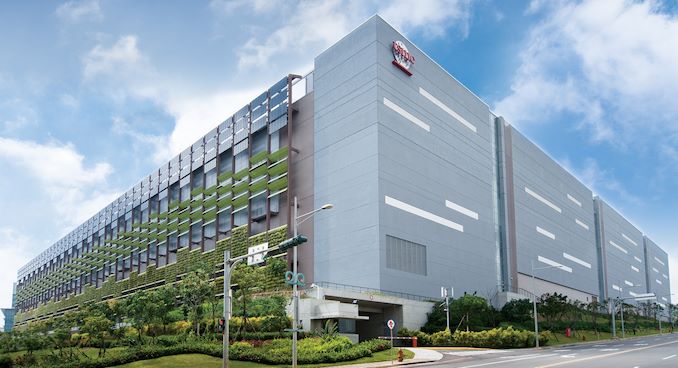
TSMC considers both 5 nm and 7 nm to be ‘long’ nodes, which means they will be used for years to come by tens of its customers, and is why it needs additional capacities to meet demand. Meanwhile, the first fabs to make chips using EUVL on multiple layers are already in place: TSMC’s Fab 15 is producing SoCs using N7+, whereas TSMC’s Fab 18 (the first phase of equipment move-in was completed in March 2019) is ready to start making commercial N5 chips sometimes in Q2 2020. Otherwise, it’s important to note is that lead times of fab investments are on the scale of quarters; so while the money are formally spent in Q4, the actual production capacities will come online only sometimes in 2020.


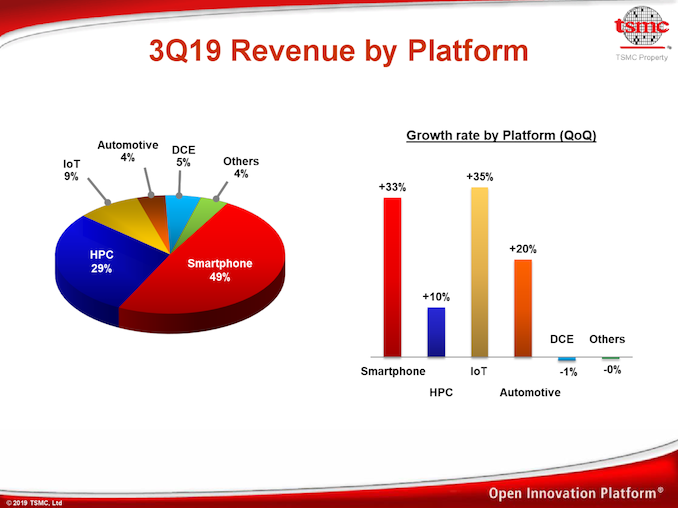
Demand for advanced process technologies (16 nm and below by TSMC’s definition) is very high in general these days. According to TSMC, SoCs for smartphones, HPC, and IoT applications accounted for a whopping 87% of its revenue in the third quarter. All of these SoCs these days demand a high transistor density, decent frequencies, and the lowest power consumption possible, which is why chip designers tend to use technologies with FinFET transistors and various enhancements that maximize performance, improve power savings, and/or increase transistor density (which allows customers to cut costs by making smaller chips or pack more features into a chip of a regular size and increase their value).


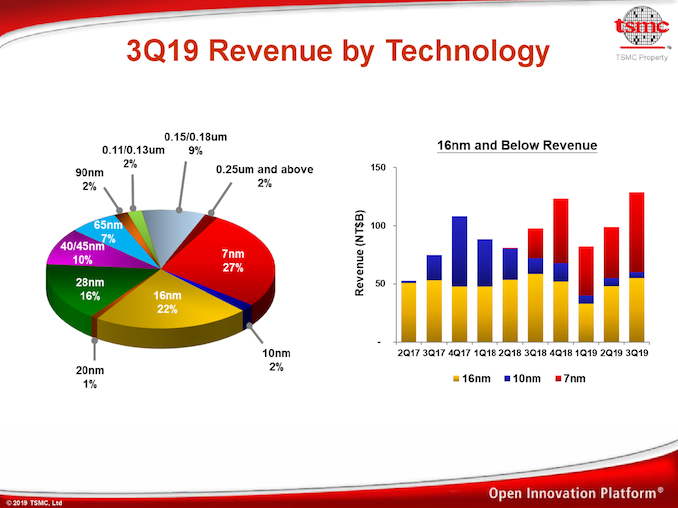
Advanced technologies accounted for a 51% of TSMC’s $9.4 billion wafer revenue in Q3 2019. From wafer revenue perspective, various 7 nm technologies brought TSMC 27% of its revenue last quarter, the highest share of all nodes. That said, it is not surprising that the company is increasing CapEx to meet demand for its leading-edge process technologies.


Here is what Wendell Huang, CFO of TSMC, had to say:


In TSMC, we build capacity according to our customer’s demand. To forecast such demand, we take into consideration not only from each individual customer’s indication, but also our own forecast based on macro as well as market segment outlook. Given the stronger outlook for 5G deployment next year, the demand for our 7-nanometer and 5-nanometer has increased significantly in the last few months.


We have, therefore, decided to raise our full year 2019 CapEx by USD 4 billion to meet this increased demand. We now expect our 2019 CapEx to be between USD 14 billion and USD 15 billion. About USD 1.5 billion of the USD 4 billion Capex increase is for 7-nanometer capacity and $2.5 billion is for 5-nanometer capacity.


Related Reading:


Source: TSMC


Source: AnandTech – TSMC Radically Boosts CapEx to Expand Production Capacities, To Reach B For 2019

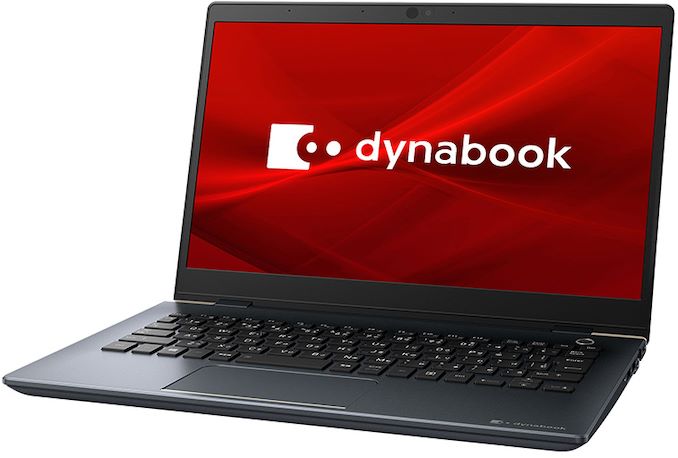
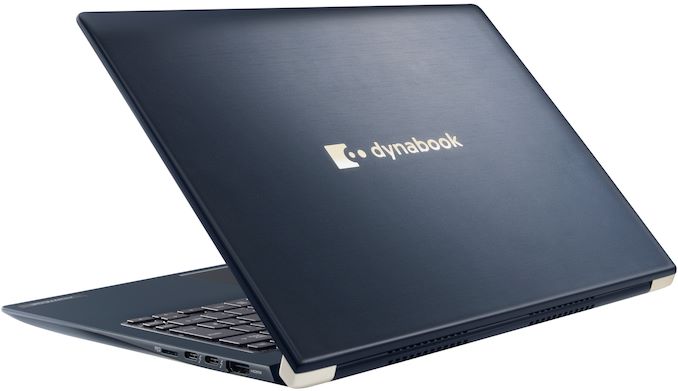
Dynabook Updates Support Policies, Now Offers 3 & 4 Year Warranties For Some Models

Back in the day, virtually all PCs came standard with a three-year warranty with some makers offering to extend it to five years. Due to cut-throat competition on the PC market, manufacturers started to cut down their costs and long warranties were among the first things to go.


While most laptops shipped today come with relatively short one or two year warrantees, there is continuing pressure on notebook makers both to support their devices for longer, as well as to take steps to differentiate themselves in a very crowded market. As a result, we’re finally starting to see longer warrantees become more common – at least on higher-end models. To that end, in a bid to improve their competitive position, this week Dynabook has announced that it will offer standard three and four year warrantees for select notebooks.


From now on, Dynabook Americas (formerly Toshiba America Client Solutions) will offer its three-year +Care Service warranty with select ‘featured configuration’ notebooks, as well as four-year +Care Service warranty with select built-to-order laptops. The new warranties will cover the recently introduced Portégé X30-F, Portégé A30-E, Tecra X40-F, Tecra X50-F, and Tecra A50-EC. If one of the said machines fails, customers will have four repair options: an on-site service for SOHO or corporate clients, an international carry-in service, a depot service center, or a customer replaceable part sent to the owner.


Dynabook Warranties
  Standard Warranty +Care Service Standard Warranty Featured Configuration  +Care Service Standard Warranty BTO Configuration
Warranty Term 1 Year 3 Year 4 Year
Technical Phone Support 1 Year 3 Year 4 Year
Customer Replaceable Parts + + +
Depot Service Center + + +
International Carry-In Service + + +
On-Site Service (Corp. or Home Office) + +

It is important to note that the three- and four-year warranties will only be available with select ‘featured’ and BTO configurations. So while Dynabook is offering longer warrantees on some laptops, their ‘base’ warranty remains at one-year for everything else. Nonetheless, it is good to see that that a PC maker now offers a long warranty with no extra charge in the US.


Related Reading:


Source: Dynabook


Source: AnandTech – Dynabook Updates Support Policies, Now Offers 3 & 4 Year Warranties For Some Models

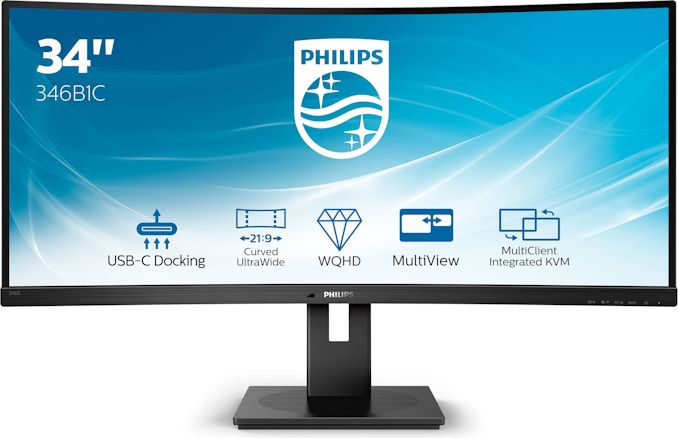
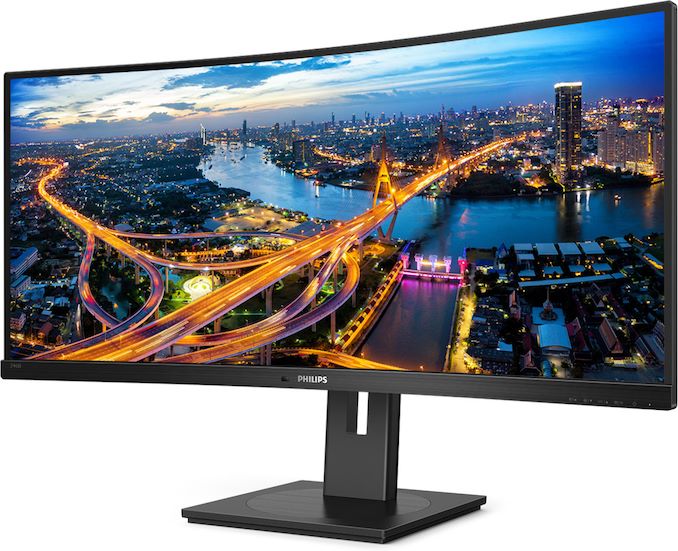
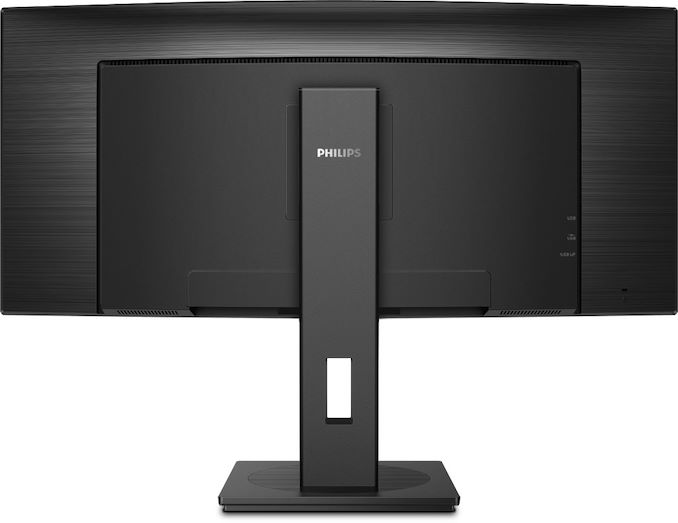
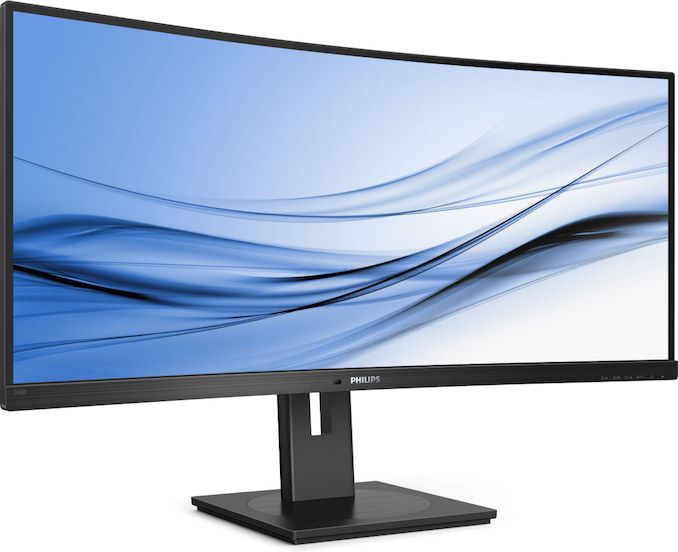
Philips Reveals 346B1C 34-Inch 100 Hz Curved UltraWide Monitor with USB-C Docking

Philips has introduced its new 346B1C ultrawide curved monitor, which is designed for business and professional users looking for a large display offering USB Type-C docking. The Philips 346B1 is one of the industry’s first productivity-focused curved displays that features a 21:9 aspect ratio, as well as a 100 Hz maximum refresh rate, a built-in Gigabit Ethernet, and even VESA Adaptive Sync (i.e. Freesync).


The Philips 346B1C is powered by a 34-inch VA panel with a 3440×1440 resolution, 300 nits brightness, a 3000:1 contrast ratio, a 5 ms GtG response time, a 100 Hz maximum refresh rate, and 178°/178° viewing angles. While the LCD was designed primarily with productivity applications in mind and can display 16.7 million colors, it does cover 119% of the sRGB, 90% of the Adobe RGB, as well as 100% of the NTSC color spaces. Furthermore, the monitor is factory calibrated with a Delta <2 accuracy for the sRGB gamut.


One of the main selling features of the Philips 346B1C is its connectivity. The monitor has one DisplayPort 1.2 input, one HDMI 2.0 port, and one USB 3.2 Type-C input. The latters supports up to 90 W Power Delivery, making it suitable for powering even higher-end 15-inch notebooks. In addition, the monitor offers a built-in Gigabit Ethernet port, a quad-port USB 3.2 hub, and a headphone output. Last but not least, the display has an integrated KVM switch that enables to control two PCs using one display, one mouse, and one keyboard. One thing to note is that when the LCD uses a USB-C connection, it can only support 3440×1440 @ 100 Hz when the upstream USB connection feeding the USB hub is set to 2.0, presumably as the full bandwidth mode requires all 4 high-speed lanes from the USB-C connection.


Traditionally for productivity monitors, the Philips 346B1C comes with a stand that can adjust height, tilt, and swivel. Furthermore, it has VESA mount holes.


Philips’s Curved Display with USB-C Dock & KVM
  346B1C
Panel 34″ VA
Native Resolution 3440 × 1440
Brightness 300 cd/m²
Contrast 3000:1
Maximum Refresh Rate 100 Hz
Response Time 5 ms GtG
Viewing Angles 178°/178° horizontal/vertical
Curvature 1500R
Pixel Pitch 0.233 mm
Pixel Density 110 ppi
Anti-Glare Coating Anti-Glare, 2H, Haze 25%
Inputs 1 × DisplayPort 1.2

1 × HDMI 2.0

1 ×USB Type-C (with up to 90W PD)
USB Hub 4-port USB 3.0 hub
Stand Height: +/- ? mm

Tilt: -? to +?°

Swivel: 180°
Audio headphone output
GbE integrated
KVM integrated
Launch Price UK: £539

The Philips 346B1C will be available next month. In the UK, the product will cost £539, so expect MSRP in the USA at a sub-$600 level.


Related Reading:


Source: Philips


Source: AnandTech – Philips Reveals 346B1C 34-Inch 100 Hz Curved UltraWide Monitor with USB-C Docking

EUV Demand is Up: EUV Device Manufacturer ASML Beats Sales Estimates

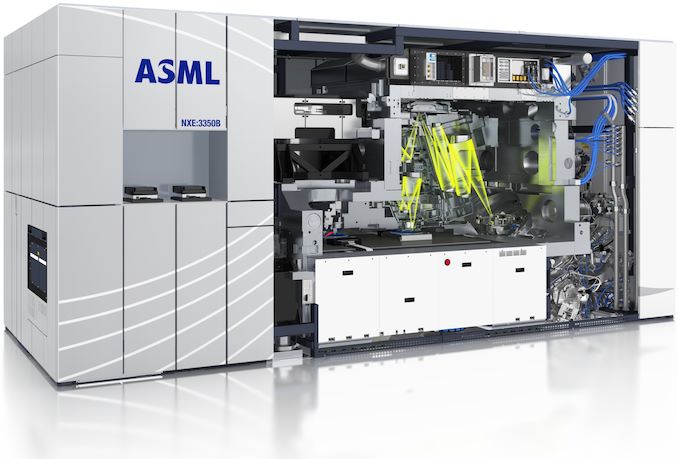
Between the smartphone revolution, cloud computing, and the Internet of Things, the demand for cutting-edge chips has never been higher. And if you have any doubts about that, then one only needs to look at the record-breaking sales of the equipment used to fab those chips. ASML, the leader in the field for photolithography, announced this week its financial results for the third quarter, revealing that its sales, profits, and net bookings all topped expectations, as the company received orders for 23 extreme ultraviolet lithography (EUVL) tools.


ASML’s revenues in Q3 2019 totaled €2.987 billion ($3.3 billion), with a net income of €627 million ($692.7 million). During the quarter, ASML sold 45 DUV and seven EUV lithography systems, as well as five used lithography systems. In total, the company sold 136 step-and-scan tools this year so far, of which 18 were EUV tools. In Q4, the company intends to ship eight EUV step-and-scan systems, bringing the total for 2019 to 30 EUV systems.


ASML’s biggest bump in the third quarter came from a total of 23 orders for Twinscan NXE EUV systems from various customers. Combined with other bookings, ASML’s net bookings totaled €5.111 billion in Q3, the company’s highest ever for a single quarter. It is particularly noteworthy that ASML reaffirmed that it expects its EUV tools to be adopted by both logic makers (i.e., CPUs, GPUs, etc.) and memory manufacturers.


As of July 2018, there were 31 EUV scanners installed at various fabs across the world, including several machines in various semiconductor research organizations. With 10 systems sold in H2 2018 and 18 EUV scanners installed this year, the number of EUV lithography tools used in the world is approaching 60 units. Of course, the number is considerably behind the number of DUV step-and-scan systems used nowadays, but it is clear that extreme ultraviolet lithography is gradually getting more widespread, and that demand is continuing to increase.


Officially, only TSMC and Samsung Foundry use ASML’s Twinscan NXE scanners to make chips using their N7+ and 7LPP manufacturing technologies. Both contract makers of semiconductors will expand their usage of EUV tools as they adopt new fabrication processes. Furthermore, Intel will use EUVL for its 7 nm technology that will be deployed across multiple fabs through 2021. Furthermore, companies like Samsung and SK Hynix are mulling the use of EUVL for DRAM production.


Here is what Peter Wennink, CEO of ASML, had to say:


“For the remainder of the year, we expect Logic to continue to be strong, driven by the leading-edge nodes supporting end-market technology and applications such as 5G and artificial intelligence. The timing of Memory recovery remains uncertain. We continue to make solid progress in EUV. Customers have introduced their first EUV manufactured devices and we have seen EUV mentioned in product announcements. In the third quarter, we shipped seven EUV systems, three of which were NXE:3400C, our higher productivity model. We received 23 EUV orders in the third quarter which contributes to our highest ever value of bookings in one quarter. This strong order flow confirms the adoption of EUV in high volume manufacturing for Logic and Memory. Our overall view for 2019 is essentially unchanged as we continue to see 2019 as a growth year.”


Related Reading:


Source: ASML


Source: AnandTech – EUV Demand is Up: EUV Device Manufacturer ASML Beats Sales Estimates

Razer Unveils Optical Laptop Keyboard

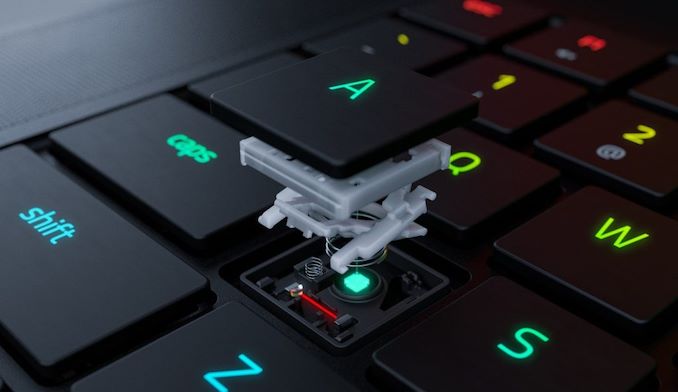
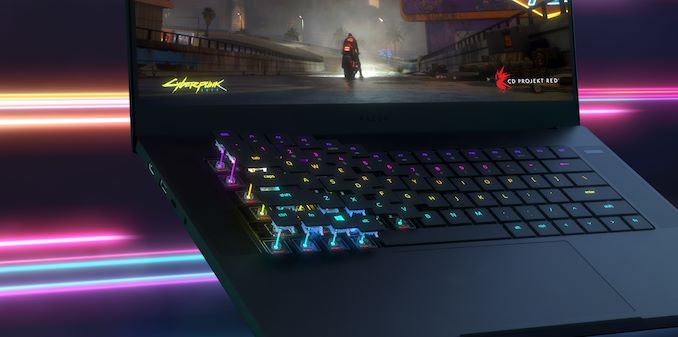
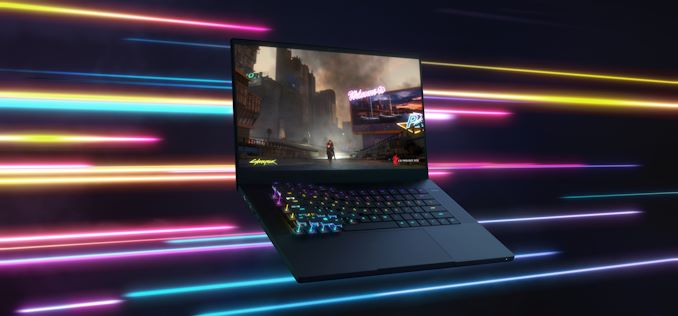
Razer has introduced the industry’s first notebook keyboard based on optical switches. The low-profile keyboard promises tactile feedback of mechanical switches as well as near instant actuation required by gamers. The keyboard will first be used by Razer’s Blade 15 Advanced notebook with more models coming in 2020.


Razer’s new optical laptop switch uses an infrared light beam to detect when a key is pressed. According to the developer, the actuation point of its switch is one millimeter, which allows gamers to input more commands in less time. Meanwhile, the switch features mechanical tactile click to provide a more comfortable typing experience than membrane keyboards.


In addition to the new switches, Razer’s new noebook keyboard supports N-Key Rollover with anti-ghosting as well as Chroma RGB lighting in every keycap.


The first Razer laptop to use the company’s optical keyboard is the Blade 15 Advanced that costs $2,649. As the name suggests, the notebook is equipped with a 15.6-inch display featuring a Full-HD resolution and a 240 Hz refresh rate. The laptop is based on Intel’s six-core Core i7-9750H that is accompanied by NVIDIA’s GeForce RTX 2070 with a Max-Q design, 16 GB of dual-channel DDR4-2667, and a 512 GB PCIe 3.0 x4 SSD.


The mobile PC is equipped with Intel’s Wireless-AX200 Wi-Fi 6 + Bluetooth 5 adapter, one Thunderbolt 3 port, one USB 3.1 Gen 2 connector, two USB 3.1 Gen 2 port, two display outputs (a mini DisplayPort and an HDMI), and a 3.5-mm audio jack. Just like other modern laptops, the Razer Blade 15 also has a webcam, a microphone array, and stereo speakers.


Related Reading


Source: Razer


Source: AnandTech – Razer Unveils Optical Laptop Keyboard

LGA4677 Socket Spotted: Future Server Socket with PCIe 5.0 Support

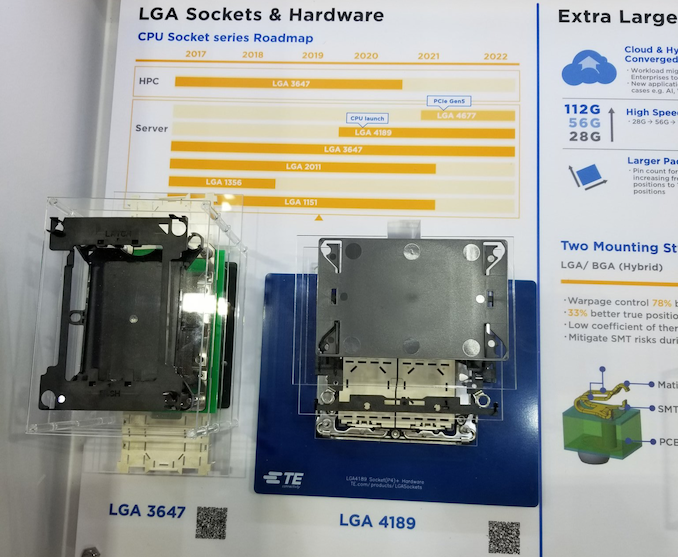
TE Connectivity, a maker of various connectivity solutions in general and CPU sockets in particular, has revealed its roadmap describing future sockets for what looks like a range of future server processors. The roadmap reaffirms that Intel’s upcoming server CPUs will use LGA4189 sockets and indicates that some form of future CPU will use a larger LGA4677.


TE’s LGA4677 socket will be made by the company starting from 2021, and is listed on the diagram as supporting PCIe 5.0. It is noteworthy that according to the manufacturer, LGA4677, LGA4189 and LGA3647 sockets will coexist on the market. This is likely due to long-standing contracts using existing sockets and requiring like-for-like replacements over the lifetime of the hardware.


Image by Kazuki Kasahara from PC Watch


Considering a significant increase in the number of pins featured by LGA4677 (compared to LGA4189 that will be used for Cooper Lake and Ice Lake server CPUs), it is logical to expect it to support processors with a higher TDP. Meanwhile, it is too early to make guesses about exact TDP levels. Alongside improvements in PCIe, we could also consider increases in memory controller counts as a strong indication of more pins.


No large server CPU company has formally confirmed existence of LGA4677 socket in its roadmap.


Related Reading


Sources: Kazuki Kasahara, PC Watch


Source: AnandTech – LGA4677 Socket Spotted: Future Server Socket with PCIe 5.0 Support

The Apple iPhone 11, 11 Pro & 11 Pro Max Review: Performance, Battery, & Camera Elevated

It’s been a little over a year since our review of the iPhone XS and XS Max, and it’s that time of the year to investigate Apple’s latest and greatest: the iPhone 11 family. This time around Apple was able to launch all three phones, the iPhone 11, iPhone 11 Pro, and iPhone 11 Pro Max simultaneously, and we’ve gotten our hands on all of them. We’ll be running them through our extensive testing marathon, again hopefully revealing more about how Apple’s newest hardware improvements change the product experience.

This year we’re not seeing major changes how Apple is slicing up their market segments among the phone models, though we are seeing bit of a name change for the new phones. The iPhone 11 is the direct successor to the iPhone XR: The new phone largely remains similar to its predecessor in terms of externals, although we’re seeing the newest internal hardware as well as adoption of two of the three new cameras in the series.

The iPhone 11 Pro and the iPhone 11 Pro Max succeed the iPhone XS and iPhone XS Max. Here again, we’re not seeing too major of changes in the design, although the backs of the phones differ more significantly to the regular iPhone 11. These are also the first devices that employ Apple’s new full triple-camera system, utilizing a new generation main camera sensor, the well-known telephoto module, and Apple’s first ultra-wide-angle module, matching a significant feature set that’s been prevalent in many 2019 flagship smartphones.

Alongside the usual yearly SoC upgrade and the new generation A13, a big area Apple has improved the hardware design this year is in terms of battery capacities and screen efficiency, with the 11 Pro and 11 Pro Max particularly benefiting from some remarkable changes here.


Source: AnandTech – The Apple iPhone 11, 11 Pro & 11 Pro Max Review: Performance, Battery, & Camera Elevated

Samsung to Invest $11 Billion in QD-OLED Panel Production

Samsung Display has announced plans to invest a further ₩13.1 trillion ($11 billion) in the R&D and production of QD-OLED TV panels. The plan includes building up two QD-OLED production lines in South Korea between now and 2025, with the first starting production in 2021. In addition, the company will invest in R&D of quantum dot-enhanced OLED technology, which promises to provide finer colors than today’s OLED displays and televisions.


The first step of Samsung’s QD-OLED plan will be converting its L8 fab in Tangjong, South Korea, from making LCD substrates to QD-OLED substrates. The plant is expected to produce 30 thousand QD-OLED substrates per month starting in Q1 2021. Longer term, Samsung will be converting all of its 8th Generation LCD production facilities to QD-OLED in a bid to increase the number of substrates produced monthly to 100 thousand.


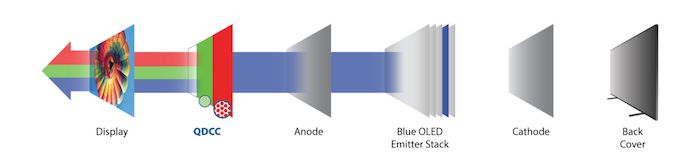
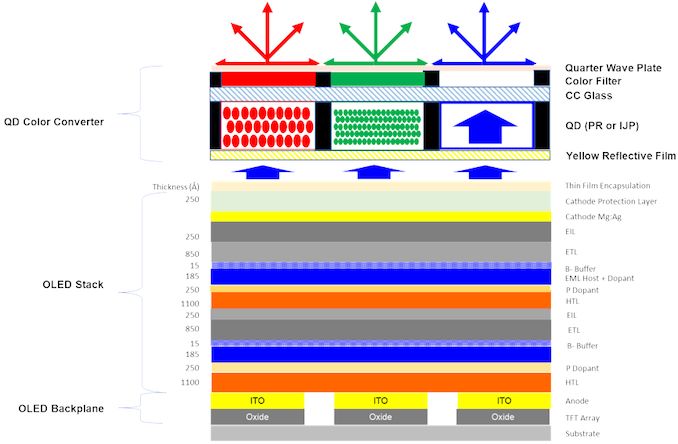
The QD-OLED technology promises to simplify (i.e. lower the cost of) production of OLED-based televisions and monitors, as well as enabling wider color gamuts, which is something expected from next-generation content. Contemporary WOLED panels from LG Display use a blue or white (yellow + blue) OLED emitter stack, and a WRGB color filter system on top with a variety of additional layers behind, between, and ahead of them. By contrast, a QD-OLED panel uses an OLED emitter stack (some believe, with two emitting stacks) with a quantum dot RGB color filter (also called quantum dot color converter, or QDCC) system on top.


Today’s OLED panels feature 22 layers, whereas a QD-OLED panel may cut the number to 13, which means fewer deposition stages, lower material and production costs, and, perhaps, better yield. The QD-OLED technology is still considered to be rather challenging as Samsung has to solve light management issues. Meanwhile, according to Display Supply Chain, one square meter of an QD-OLED panel will cost around $26, whereas one square meter of a contemporary OLED panel costs approximately $95.


Lee Dong-hoon, CEO of Samsung Display, had the following to say:


“Quantum dots are semiconductor particles which luminate close to natural colors. It is the future growth vision of the large display industry. With the investment we will lead the premium display market.”


Related Reading:


Sources: Reuters, Nanosys, The Investor, Nikkei, DSCC, OLED-Info


Source: AnandTech – Samsung to Invest Billion in QD-OLED Panel Production

Google Announces The Pixel 4 and Pixel 4 XL: The 2019 Pixels

Today Google announced the new Pixel 4 and Pixel 4 XL flagship devices, representing Google’s vision for 2019 and 2020. The new phones upgrade the hardware to the latest and greatest, such as introducing a new 90Hz display. The new phones come with a new design language that does differ more significantly from its predecessors, with some risky choices in terms of the new features that the new generation drop as well as adopts.


As always, Google prides itself in the camera of the Pixel phones and this year we kinda saw the new Pixel go against the flow of industry trends, and instead of adopting a much hyped ultra-wide-angle module, Google doubled down on a new telephoto camera. However Google’s forte remains software, and here alongside new camera features, Google also brings new features to the table, such as a new upgraded voice recognition aided by machine learning that’s been used both for the new Assistant, as well as new apps such as the live transcription recorder app


Source: AnandTech – Google Announces The Pixel 4 and Pixel 4 XL: The 2019 Pixels

OWC Mercury Elite Pro Dock / DAS Combo: TB3, up to 28 TB, USB 3.0, DP, GbE, SD

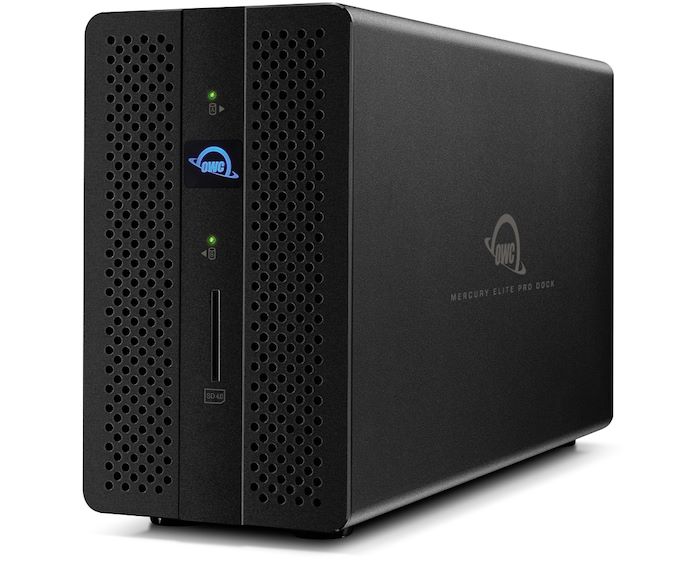
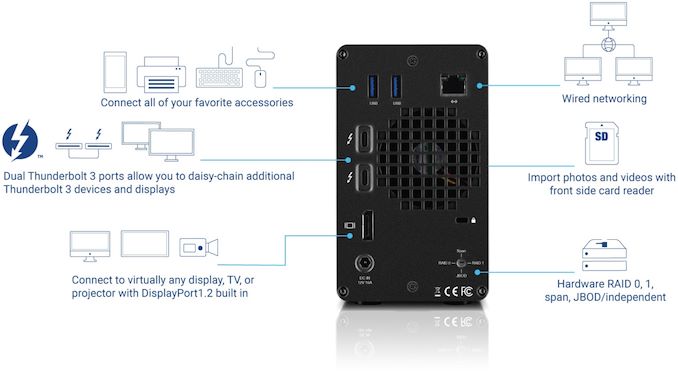
OWC has started sales of its new DAS device that can also serve as a Thunderbolt 3 dock. The Mercury Elite Pro Dock is aimed at creative professionals with the latest Thunderbolt 3-enabled laptops that require a significant amount of storage capacity along with a set of traditional interfaces, including USB 3.0 Type-A, DisplayPort, GbE, and an SD card reader.


OWC is a well-known name in the Mac world as for years the company made accessories and upgrades for Apple’s computers. Since modern MacBooks cannot be upgraded, the company had to refocus to docks and now moves forward with its Mercury Elite Pro Dock that also serves as a DAS.


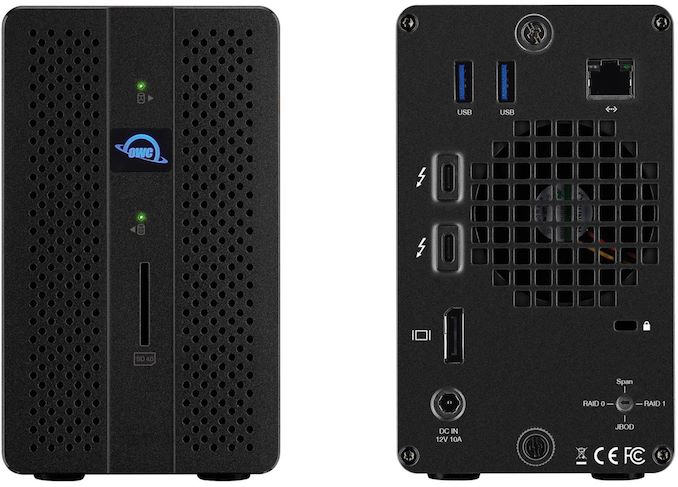
The OWC Mercury Elite Pro Dock is based on Intel’s JHL6540 controller and can be daisy chained with other Thunderbolt 3 devices. On the DAS side of matters, the OWC Elite Pro Dock can pack two 2.5/3.5-inch hard drives and supports RAID0, RAID 1, JBOD, and Span modes to maximize reliability (by mirroring them), double their sequential read/write speeds all the way to ~530 MB/s in case of two 14 TB HDDs (by striping them), or just use them as two separate hard drives or one big drive. RAID is enabled by an ASMedia controller and its mode can be manually switched using a special switch on the back.


OWC plans to offer its Mercury Elite Pro Dock in multiple versions to hit different price and capacity points. All the SKUs will come with two hard drives and offer a 4 TB, 6 TB, 8 TB, 12 TB, 16 TB, 20 TB, 24 TB, and 28 TB capacity.

On the dock side of things, the devices has a GbE port (Intel I210), two USB 3.1 Gen 1 Type-A connectors (Fresco Logic FL1100EX), a DisplayPort 1.2 output, and an SD Card reader (Genesis Logic GL-3227). The OWC Elite Pro Dock can output up to 120 W of power and therefore can power a laptop as well as charge USB devices at the same time.



The OWC Mercury Elite Pro Dock
  General Specifications
Number of Bays 2 bays for 2.5″ or 3.5″ HDDs
HDD Interface SATA 6 Gbps
HDDs Used Seagate or Toshiba HDDs
Capacities Up to 28 TB
RAID 0/1/JBOD/Span
RAID0 Up to ~530 MB/s (depends on HDD)
RAID1 depends on HDD
Thunderbolt 3 Controller Intel JHL6540
RAID Controller ASMedia controller
GbE Controller Intel I210
USB 3.0 Controller Fresco Logic FL1100EX
Media Card Reader Controller Genesis Logic GL-3227
Ports 2 × Thunderbolt 3

2 × USB 3.0 Type-A

1 × DisplayPort 1.2

1 × SD card reader

1 × GbE
Power Input 100-240V, 50-60Hz
Power Output +12V, 10A
Dimensions Height: 5.8 inches | 147 mm

Length: 9.4 inches | 238 mm

Width: 3.3 inches | 85 mm
Cables Included ?
Software OWC Dock Ejector
Price (MSRP) $320 for DIY kit

$520-$1400 for Drives Included

OWC’s Mercury Elite Pro Dock can be acquired as a DIY kit without any hard drives inside for $319.99 or as a ready-to-go product with two HDDs in RAID 0 inside. The cheapest 4 TB version costs $519.99, whereas the highest-end 28 TB model is priced at $1,399.99. Interestingly, but OWC does not commit to a particular hard drive model or even a manufacturer and ships its device with either Seagate or Toshiba HDDs inside.


Related Reading


Source: OWC


Source: AnandTech – OWC Mercury Elite Pro Dock / DAS Combo: TB3, up to 28 TB, USB 3.0, DP, GbE, SD