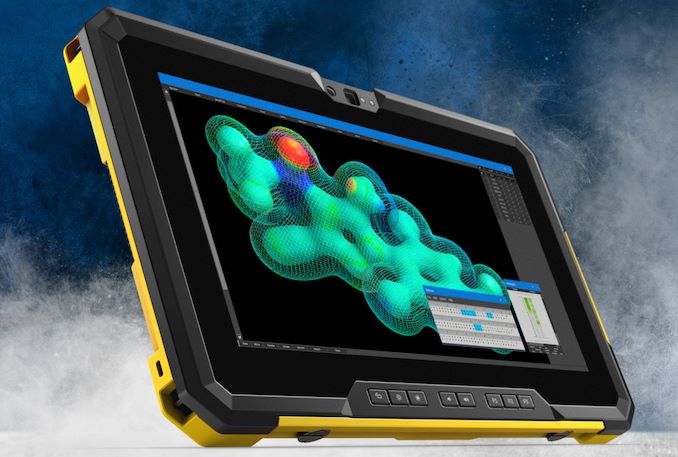
For Explosive Environments: Dell Latitude 7220EX Rugged Extreme Windows Tablet

With industry and research, computers are needed everywhere, including various harsh environments for which companies develop ruggedized PCs, tablets, or smartphones. But there are also hazardous environments that not only pose danger to devices for whatever reasons, but which are potentially explosive because they are filled with gases, vapors, combustible gases, and other flammable components. The use of regular electronics in such environments is dangerous, but Dell has developed its Latitude 7220EX Rugged Extreme Tablet just for this purpose.


The Dell Latitude 7220EX Rugged Extreme Tablet is designed for engineers working in agriculture, chemical, manufacturing, and oil & gas sectors who encounter potentially explosive environments every day. To meet their safety requirements, Dell took its recently introduced Latitude 7220 Rugged Extreme Tablet and redesigned it in order to eliminate any possibility that the device could be the source of an explosion (which may be caused by an overheating or malfunctioning component, a spark caused by an unsealed electric circuit or whatever other reason).


To ensure that the Latitude 7220EX Rugged Extreme Tablet is safe and meets all formal safety requirements in the North America, Europe, and other parts of the world, the machines are Class 1, div 2 certified in NA, ATEX certified in the EU, and IECEx certified for International markets. Meanwhile, in a bid to incorporate



Since the Latitude 7220EX Rugged Extreme Tablet is a version of the non-EX model, their technical specifications are very similar. The tablet is equipped with an 11.6-inch Full-HD display with 1000 nits brightness to make it usable even under direct sunlight. Inside the tablet designed for the most extreme environments is Intel’s Core i7-8365U (Whiskey Lake) processor with four cores and Intel’s UHD Graphics 620. The SoC is accompanied by 8 GB of LPDDR3-2133 memory and a 512 GB Class 40 M.2 SSD with a PCIe 3.0 x4 interface.


When it comes to wireless connectivity, the machine is equipped with Intel’s AX200 Wi-Fi 6 + Bluetooth 5.0 adapter, and Qualcomm’s Snapdragon X20 4G/LTE modem. On the wired side of I/O matters, the Latitude 7220EX Rugged Extreme Tablet includes a USB 3.1 Type-C connector that can be used for charging and external display connectivity, a USB 3.0 Type-A port, a micro RS-232 port, a POGO connector for the keyboard, an SD card reader, and a 3.5-mm audio jack for headsets. Interestingly, the tablet also retains all the imaging and multimedia capabilities of the original one, which includes Windows Hello-compatible front camera, a rear camera with a flash, and stereo speakers. As for security, the machine is equipped with a fingerprint reader, Dell’s ControlVault advanced authentication, Intel vPro remote management, a TPM 2.0 module, optional encryption for SSDs, and NIST SP800-147 secure platform.
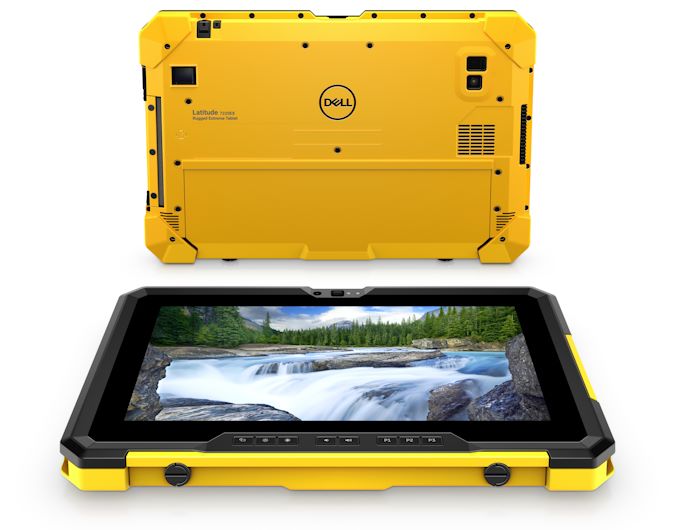


Dell’s Latitude 7220EX Rugged Extreme Tablet is powered by two hot-swappable batteries, each with a 34 Wh capacity, but the manufacturer does not disclose battery life of the device because special-purpose software used by the target audience will have different effects on power draw.


.


Specifications of the Dell Latitude 12 Rugged Extreme Tablets
  Latitude 7220EX

Rugged Extreme
Latitude 7220

Rugged Extreme
LCD Diagonal 11.6″
Resolution 1920×1080
Features Brightness: 1000 cd/m²

Outdoor-readable, anti-glare, anti-smudge,

polarizer, glove-capable touchscreen
CPU Intel Core i7-8665U: 4C/8T vPro Intel Core i7-8665U: 4C/8T vPro

Intel Core i5-8365U: 4C/8T vPro

Intel Core i3-8145U: 2C/4T
Graphics Intel UHD Graphics 620

(24 EUs)
RAM 8 GB LPDDR3-2133 8 GB or 16 GB LPDDR3-2133
Storage Class 40, 512 GB, PCIe 3.0 x4 M.2 PCIe 3.0 x4 SSDs:


Class 35: 128 GB;


Class 40: 256 GB, 512 GB, 1 TB, 2 TB;


Class 40 SED: 256 GB, 512 GB, 1 TB.

Wireless Wi-Fi,

Bluetooth options
Intel Wi-Fi 6 AX200, 2×2, 802.11ax with MU-MIMO, Bluetooth 5.0 Wireless LAN Options:


Intel Wireless-AC 9560, 2×2, 802.11ac with Bluetooth 5.0


Intel Wi-Fi 6 AX200, 2×2, 802.11ax with MU-MIMO, Bluetooth 5.0


Intel Wi-Fi 6 AX200, 2×2, 802.11ax with MU-MIMO, without Bluetooth

Mobile Broadband

(optional)
DW5821E Qualcomm Snapdragon X20 4G/LTE Wireless WAN card for AT&T, Verizon, Sprint optional DW5821E Qualcomm Snapdragon X20 4G/LTE Wireless WAN card for AT&T, Verizon, Sprint
GPS Dedicated u-blox NEO-M8 GPS card
Additional ? ?
USB 3.1 1 × USB 3.0 Type-C w/ DP, PD
3.0 1 × USB 3.0 Type-A
Cameras Front 5 MP RGB + IR FHD webcam with privacy shutter
Back 8 MP rear camera with flash and dual microphone
Security

Steel reinforced cable lock slot


TPM 2.0;

ControlVault advanced authentication;

Dell Security Tools;

Dell data protection encryption

Contactless/Contacted SmartCard reader;

Fingerprint reader;

NIST SP800-147 secure platform;

Dell Backup and Recovery.

Steel reinforced cable lock slot


Optional Security includes:


TPM 2.0;

ControlVault advanced authentication;

Dell Security Tools;

Dell data protection encryption

Contactless/Contacted SmartCard reader;

Fingerprint reader;

NIST SP800-147 secure platform;

Dell Backup and Recovery.

Other I/O TRRS audio jack, micro RS-232, SD Card reader, etc. TRRS audio jack, micro RS-232 (optional), POGO, SD Card reader, etc.
Battery Dual Hot-swappable 34 Whr, 2 Cell, ExpressCharge, Lithium Ion Battery


or


Dual Hot-swappable 34 Whr, 2 Cell, Long Lifecycle

34 Wh Primary

(ExpressCharge)

34 Wh Secondary (optional?)
Dimensions Width 323.4 mm | 12.73 inch 312.2 mm | 12.29 inch
Height 214.2 mm | 8.43 inch 203 mm | 8 inch
Thickness 26.2 mm | 1.03 inch 24.4 mm | 0.96 inch
Weight 1650 grams | 3.65 lbs (tablet) 1330 grams (tablet)
Operating System Microsoft Windows 10 Pro 64 Bit
Regulatory and Environmental Compliance MIL-STD-810G Transit drop (48”/1.22m; single unit; 26 drops), operating drop (36”/0.91m), blowing

rain, blowing dust, blowing sand, vibration, functional shock, humidity, salt fog, altitude, explosive atmosphere,

thermal extremes, thermal shock, freeze/thaw, tactical standby to operational.
Operating thermal range -20°F to 145°F (-29°C to 63°C)
Non-operating thermal range -60°F to 160°F (-51°C to 71°C)
IEC 60529 ingress protection IP-65 (dust-tight, protected against pressurized water)
Hazardous locations ATEX, IECEx certification for Zone 2 and Zone 22; ANSI/ISA.12.12.01 certification (Class I, Division 2, Groups A, B, C,D) ANSI/ISA.12.12.01 certification capable (Class I, Division 2, Groups A, B, C,D)
Electromagnetic interference MIL-STD-461F and MIL-STD-461G
Optional Accessories ? Rugged Tablet Dock

Keyboard with Kickstand

Havis Vehicle Dock

PMT Vehicle Dock

Gamber-Johnson Vehicle Dock

Carrying accessories

Scanner module

Extended I/O module

Dell monitors (with USB-C or over a USB-C-to-DP adapter)

Dell wireless keyboard and mice
Price ? Starting at $1,899

Dell will start sales of the Latitude 7220EX Rugged Extreme Tablet in the near future. Pricing will depend on exact configurations and region.


Related Reading:


Source: Dell


Source: AnandTech – For Explosive Environments: Dell Latitude 7220EX Rugged Extreme Windows Tablet
An Interview with AMD’s CTO Mark Papermaster: ‘There’s More Room At The Top’

On the back of a very busy 2019, AMD is gaining market share and is now a performance leader in a lot of CPU segments. The company has executed well not only with a good product but also at a time when its main competition is having manufacturing and production issues, which means AMD is ripe to push boundaries, gain market share, and make noise with a lot of wins. This year AMD’s Ryzen 3000 CPUs and EPYC Rome CPUs both have the new Zen 2 microarchitecture built on TSMC’s 7nm, something that might not have been possible without deep co-optimization between the two companies for a high performance product. AMD is also making strides with its relationships with enterprise OEMs. We touched on these topics (and more) with AMD’s CTO, Mark Papermaster.


Source: AnandTech – An Interview with AMD’s CTO Mark Papermaster: ‘There’s More Room At The Top’

TureMetal Builds a Fanless 32-Core EPYC PC with an RTX 2070

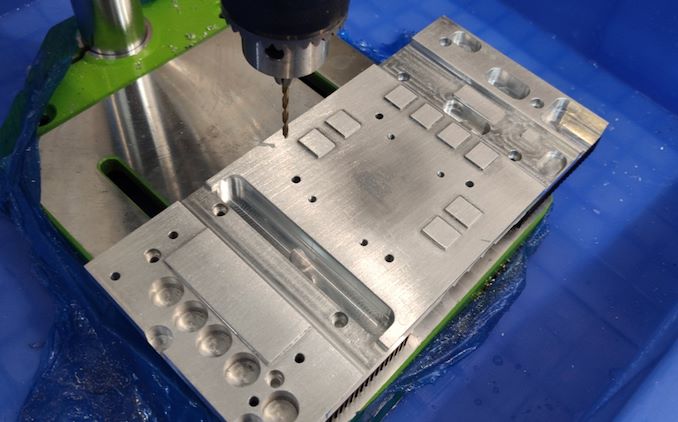
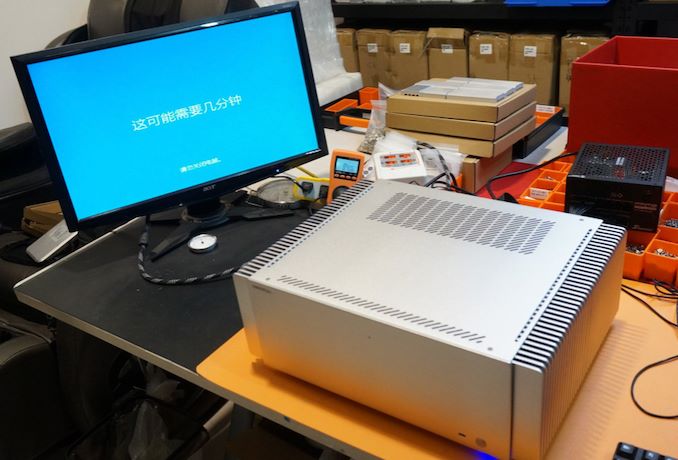
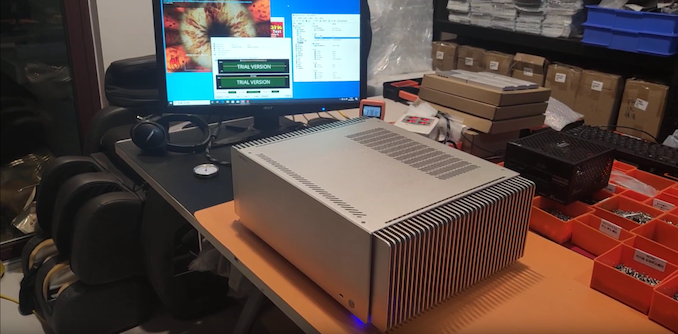
Turemetal, a maker of cases for fanless PCs, has published photos of a passively cooled system featuring an AMD EPYC processor and an NVIDIA GeForce RTX 2070 graphics card. The computer uses numerous custom components, with the founder of TureMetal stating that this is a custom build for a specific customer, although it uses one of their standard fanless PC cases. 


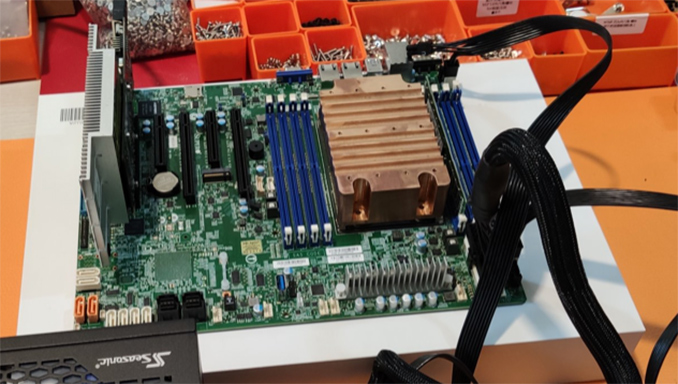
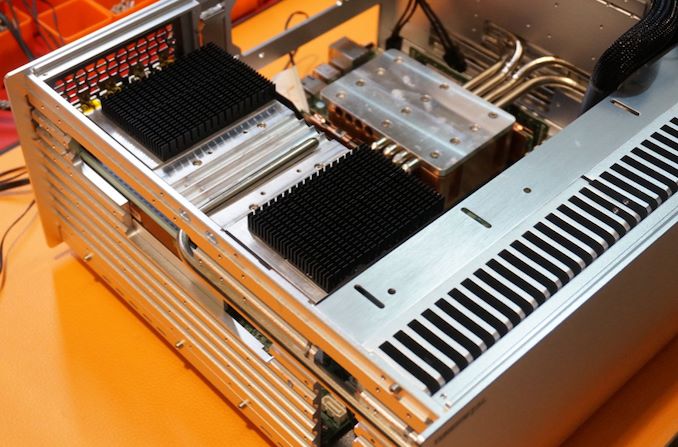
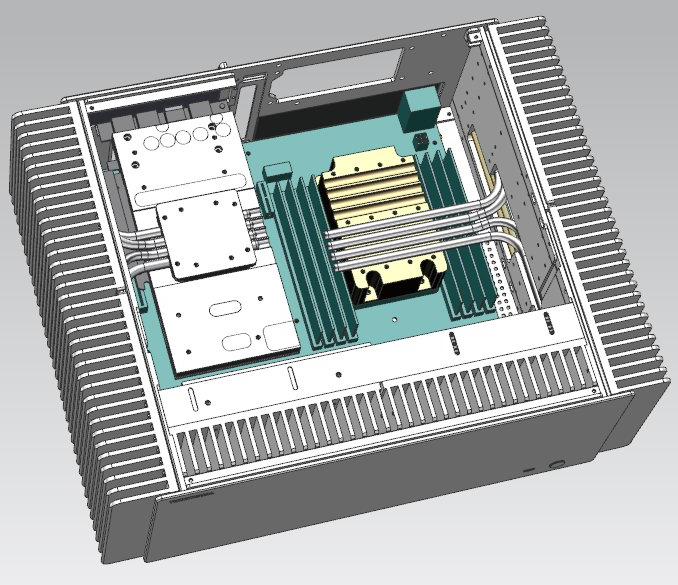
The fanless system built by Turemetal is powered by AMD’s 32-core EPYC 7551 processor, listed as having a 180 W TDP, and GIGABYTE’s NVIDIA GeForce RTX 2070 video card with a 175 W TDP (355W total). These are both equipped into a Supermicro ATX motherboard, and then built inside a commercially available Turemetal UP10 chassis.


The motherboard inside


Officially the chassis supports a 140 W CPU and a 160 W GPU (300W total), but it looks like its actual capabilities are more impressive, and with a bit of tweaking it can house a rather extreme 32-core processor and a high-end graphics board.


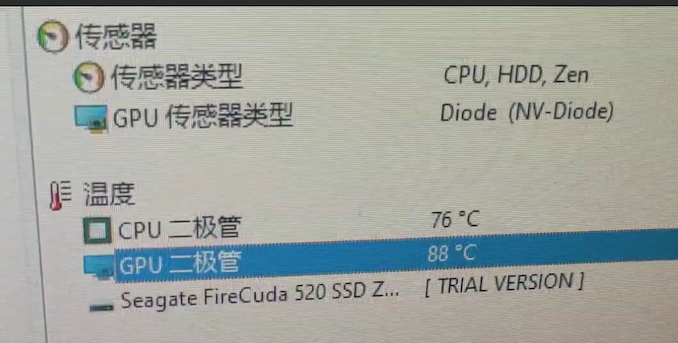
At this time, according to Turemetal’s YouTube channel, the system has passed FurMark’s full-load test for CPU and GPU for 22 continuous hours without a crash or thermally throttling. In the video, we see a GPU temperature of 88C, and a CPU temperature of 76C, in a 24C ambient room.


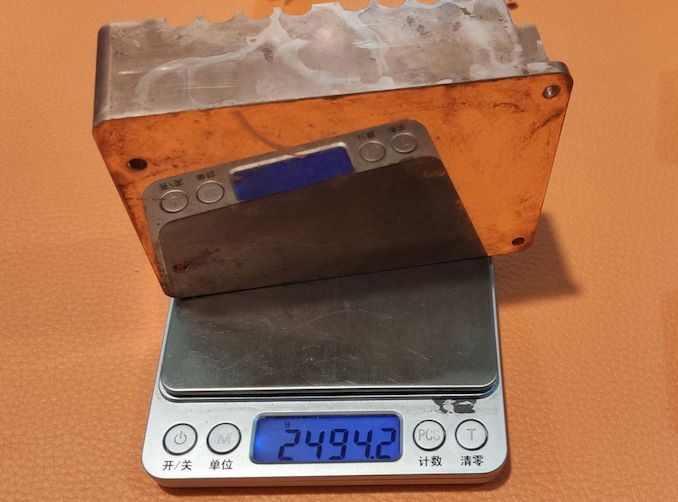
Since the Turemetal UP10 was not designed for AMD’s EPYC processors, in order to meet the demands of the customer Turemetal had to build a custom copper heat spreader for the processor along with an appropriate mounting mechanism. The radiator weighs nearly 2.5 kilograms, so we are literally talking about heavy metal here. The test system currently uses an external PSU, but Turemetal says that eventually power supply will be moved inside the PC.


It remains to be seen when and whether the UP10 chassis with AMD EPYC 7551 support will be available commercially – if the custom block will be an ‘add-on’, or limited to specific customer requests. Meanwhile, good news is that some of Turemetal’s products are now available not only directly from Taobao, but also from Fully Silent PCs in the US and will soon be available in Europe shortly, reports FanlessTech.


Related Reading:


Source: Turemetal/Twitter, FanlessTech


Source: AnandTech – TureMetal Builds a Fanless 32-Core EPYC PC with an RTX 2070

AnandTech Year In Review 2019: Lots of CPUs

Throughout 2019, we’ve had quite the reverse of performance when it comes to the competitiveness of the modern performance-oriented desktop processor. This year we’ve seen AMD introduce its Zen 2 processor designs, offering up to 16 cores for mainstream use cases, and matching if not beating Intel in raw clock-for-clock performance. In a similar vein, AMD’s Rome CPUs offer up to 64 cores per socket on the server side, where Intel can only offer 28 (or 56 in some configurations), while at the same time both consumer and server pushing PCIe 4.0 in preparation for upcoming GPUs and add-in accelerators. Intel has also launched a number of products, such as a couple of 5.0 GHz all-core CPUs, an unlocked 28-core CPU, Xeon 9200, and the next generation of server products.


If you’ve been away from the CPU space this year, here’s the Year in Review.


Source: AnandTech – AnandTech Year In Review 2019: Lots of CPUs

AnandTech Year In Review 2019: Flagship Mobile

2019 is coming to an end, and it’s time again to look back at what the industry has brought us. This year, we saw a lot of hardware improvements from all the various vendors, with a big focus on bringing out new distinctive designs. We’ve seen some exotic devices in the form of foldable phones for the first time ever, and even some more traditional designs dared to implement design cues such as mechanical pop-out cameras. While designs were sometimes the main differentiating factors, most of the time the key selling points of 2019 devices were big upgrades in their camera capabilities. Here we’ve seen huge leaps from almost all the vendors, and the year definitely will be remembered mainly for the innovations in photography.


Source: AnandTech – AnandTech Year In Review 2019: Flagship Mobile

Analyzing Intel’s Discrete Xe-HPC Graphics Disclosure: Ponte Vecchio, Rambo Cache, and Gelato

It has been a couple of weeks since Intel formally provided some high-level detail on its new discrete graphics strategy. The reason for the announcements and disclosures centered around Intel’s contract with the Department of Energy to build Aurora, an exascale supercomputer at the Argonne National Laboratory. The DoE and Argonne want developers clued into the hardware early, so when the supercomputer is deployed it can be used with as little ‘learning time’ as possible. This means Intel had to flesh out some of its strategy, as well as lift the lid on its first announced discrete GPU product. Only time will tell if it’s a bridge too far, or over troubled water, but today we know it as Ponte Vecchio.


Source: AnandTech – Analyzing Intel’s Discrete Xe-HPC Graphics Disclosure: Ponte Vecchio, Rambo Cache, and Gelato

OWC Releases Accelsior 4M2 SSD: Quad-M.2 For Over 6000 MB/s

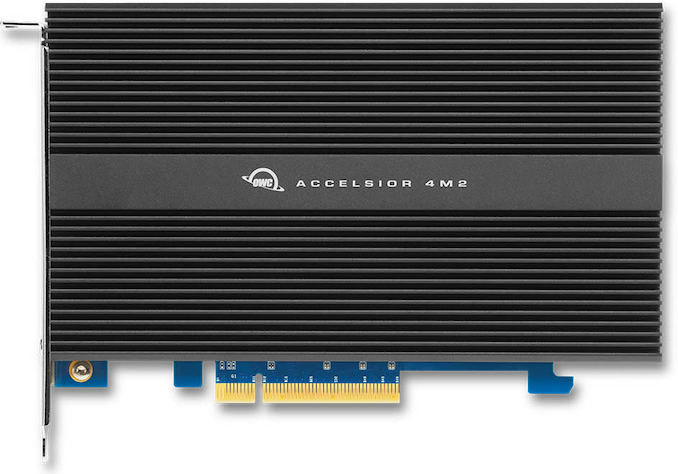
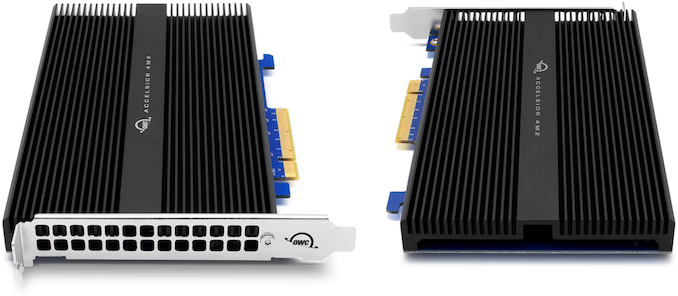
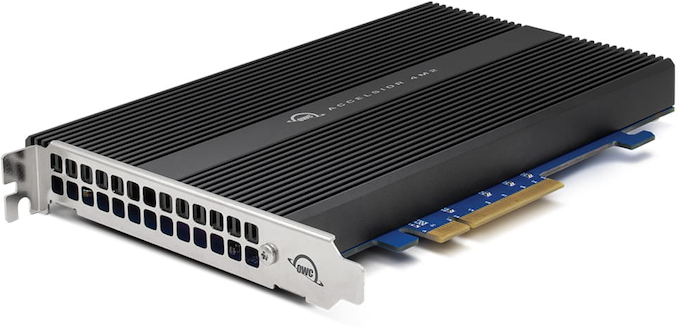
Just in time for the launch of Apple’s newly redesigned Mac Pro tower, OWC has introduced the ‘fastest SSD [they’ve] ever built’, the Accelsior 4M2. The high-end solid state drive combines multiple M.2 drives to offer up to 8 TB of storage, with aggregate read/write well over 6000 MB/s.


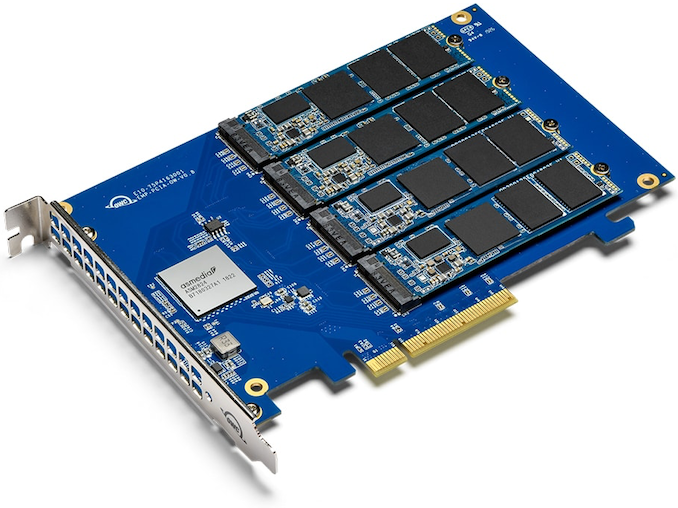
The OWC Accelsior 4M2 SSD is essentially a PCIe x8 backplane based on the ASMedia ASM2824 PCIe 3.0 switch, which in turn is being used to drive a quartet of PCIe 3.0 x4 M.2 slots. The Accelsior then fills out these slots with four of OWC’s Aura P12 M.2-2280 drives (Phison’s PS5012-E12 controller with SLC caching support, DRAM, & Toshiba’s 3D TLC NAND memory). To ensure consistent performance as well as to ensure reliability, the SSD is also equipped with a large heat spreader, as four Aura drives can produce a significant amount of heat.


When it comes to capacity, the Accelsior 4M2 storage solution will be available in 1 TB, 2 TB, 4 TB, and 8 TB raw capacities. OWC in turn rates the SSD for sequential read speeds up to 6318 MB/s, as well as sequential write speeds up to 6775 MB/s.


As is often the case for high-end OWC drives, the Accelsior 4M2 is meant to be used with OWC’s SoftRAID software, which supports various RAID modes (RAID 0, RAID 1, JBOD, etc.). Otherwise the drive can also be used in PCs – despite the Mac-focus, it’s presented as a generic PCIe card – but PC users will need to supply their own RAID software.


The OWC Accelsior 4M2 SSDs
  1 TB

SSDACL4M201T
2 TB

SSDACL4M202T
4 TB

SSDACL4M204T
8 TB

SSDACL4M204T
Formatted Capacity 931 GiB 1863 GiB 3725 GiB 7451 GiB
Drives 4 × OWC Aura P12 M.2-2280 drives

Phison’s PS5012-E12 controller,

SLC caching support,

DRAM cache,

Toshiba’s 3D TLC NAND memory

(7% overprovisioning)
PCIe Switch ASMedia ASM2824
Internal RAID SoftRAID
Peak Read Speed 6318 MB/s
Peak Write Speed 6775 MB/s
Interface PCIe 3.0 x8
Power Bus powered
Form-Factor Full Height Half Length PCIe
Compatibility macOS 10.13 or later

Windows 10 or later
Warranty 5-year warranty
Price (MSRP) $479.99 $629.99 $949.99 $1,599.99

OWC will start shipments of the Accelsior 4M2 SSDs on the week of December 30th. The barebones card is priced at $249.99, the 1 TB version costs $479.99, whereas the top-of-the-range 8 TB model carries a $1,599.99 MSRP.


Related Reading:


Source: OWC


Source: AnandTech – OWC Releases Accelsior 4M2 SSD: Quad-M.2 For Over 6000 MB/s

80-Core N1 Next-Gen Ampere, ‘QuickSilver’: The Anti-Graviton2

The drive to putting Arm into the server space has had its ups and downs. We’ve seen the likes of Applied Micro/Ampere, Broadcom/Cavium/Marvell, Qualcomm, Huawei, Fujitsu, Annapurna/Amazon, and even AMD, deal with Arm-based silicon in the server market. Some of these designs have successful, others not so much, but Arm is pushing its new Neoverse N1 roadmap of cores into this space, aiming for high performance and for scale. We’ve already seen Amazon come into the market with its N1-based Graviton2 for its cloud services, but there’s going to be a counter product for every other cloud provider, with the new N1-based Next-Gen Ampere CPU, codenamed QuickSilver. We have some details ahead of the official release announcement in Q1 2020.


Source: AnandTech – 80-Core N1 Next-Gen Ampere, ‘QuickSilver’: The Anti-Graviton2

In The Lab: ASRock Radeon RX 5700 XT Taichi X 8G OC+ Graphics Card

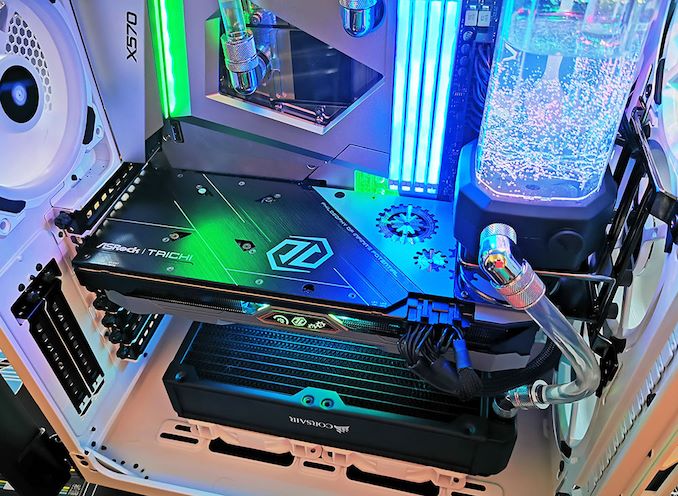
Since AMD unveiled its products on the 7 nm process node, we’ve seen numerous CPU launches and announcements with the Ryzen 3000 series of processors. Not only processors but graphics cards too with AMD’s launch of the RX 5700 and RX 5700 XT graphics cards back in July. Aimed at occupying the mid-range consumer graphics market, both the new Navi 10 graphics cards are based on its RDNA architecture which is completely re-worked from what we’ve seen from the company in previous releases such as the Polaris based 12 nm cards. As part of our ASRock X570 Aqua build, the company also sent us one of its aftermarket cooled RX 5700 XT cards, specifically the ASRock RX 5700 XT Taichi X 8G OC+ graphics card with 8 GB of GDDR6 VRAM, a boost core clock of up to 2025 MHz, and an effective memory clock of 14 Gbps. We’re not doing a full analysis here, but we have takem a look at what’s under the hood and done some testing to see how the card compares with what we have in the motherboard testing lab.


The ASRock Radeon RX 5700 XT Taichi X 8G OC+


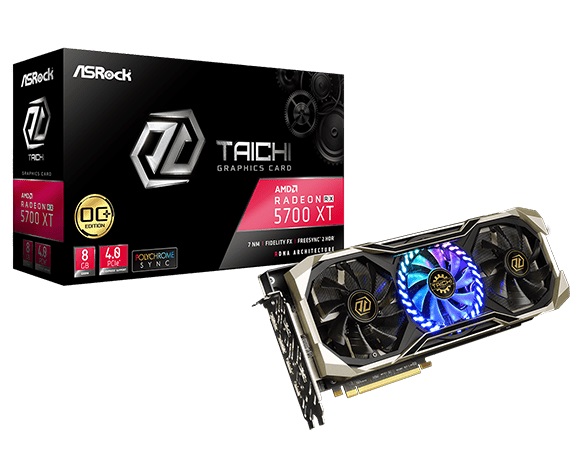
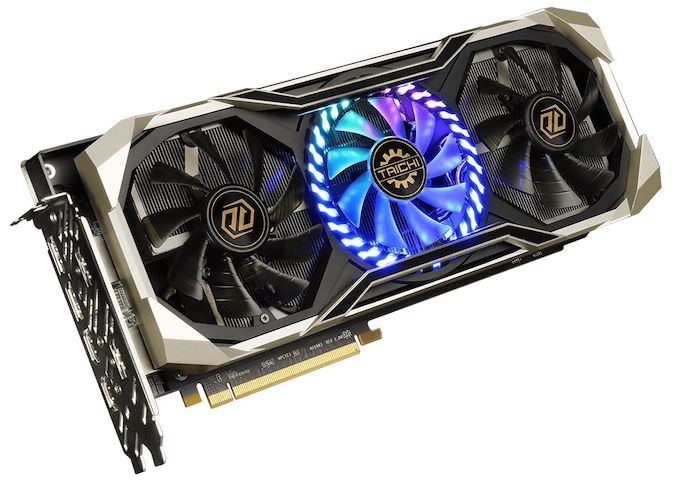
The ASRock Radeon RX 5700 XT Taichi X 8G OC+ is a premium version of AMD’s reference RX 5700 XT with a few key refinements with the aim on pushing mid-range performance to new levels. The reference model is well-known for its unique ‘dent’ along the top of the card’s cooler, but even more unique than this is ASRock’s Taichi X design. The RX 5700 XT Taichi X cooler incorporates a 2.5 slot design which makes it beefy, but more than adequate for ATX motherboards which usually leave 3-slot spacing between the two full-length PCIe slots.


As we highlighted in our launch day AMD Radeon RX 5700 XT and RX 5700 review, this isn’t the first 7 nm graphics card from AMD (Radeon VII), but it’s the first mass-produced consumer 7 nm graphics card in high volumes and one that helps and looks to redefine the mid-range graphics card sector. For comparison, the NVIDIA GeForce RTX 2060 Super is the rival card from the team green at the $399-499 price point.


The ASRock Taichi design is something we have seen implemented successfully on its motherboard range, eg the ASRock Z390 Taichi, the ASRock X399 Taichi, and more recently, the ASRock X570 Taichi. Transitioning the design to its fairly new VGA range, the fabled Taichi cogwheel is found all over the card including the fans, and on the all-metal backplate. The ASRock RX 5700 XT Taichi X also benefits from integrated ARGB LEDs which adds to the design, and the silver fan shroud is designed to fit in with its motherboard designs. It’s now commonplace for vendors that manufacturer both motherboard and graphics to align the designs for brand awareness, and it also gives users the ability to create a uniformed look when building a new system. For connectivity there are two HDMI 2.0b, and four DisplayPort 1.4 video outputs.


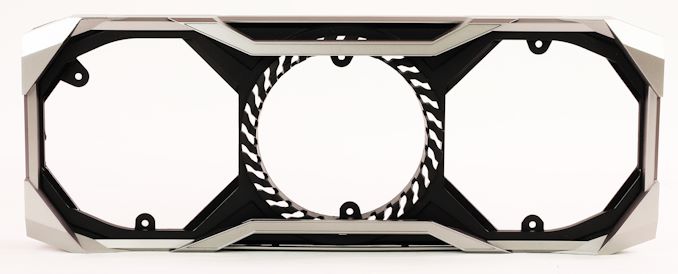
Dissecting the design of the ASRock Taichi X 8G cooler, the fan shroud houses three Taichi cooling fans, two 90 mm fans and a single 80 mm in the middle with each fan consisting of nine blades. The inside of the shroud around the fans is black, while the outer edging of the shrouds structure is silver. Fully assembled the ASRock 5700 XT Taichi X 8G is 12.7 inches in length and occupies 2.5 PCIe slots when installed into a motherboard. 


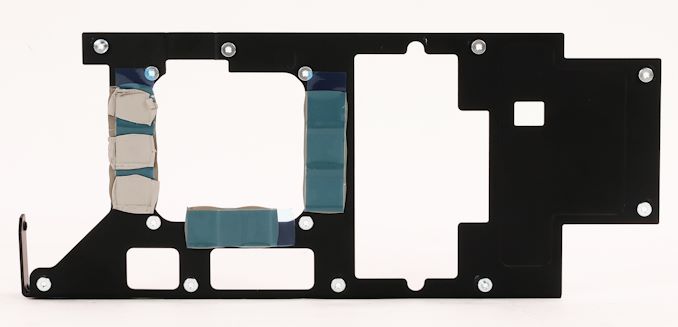
In between the PCB and cooler of the ASRock 5700 XT Taichi X 8G is a metal frame which serves two main purposes. Firstly the brace helps to reinforce the PCB to reduce bending and flex which is commonly associated with GPU sag when installed into a system. Secondly, the metal frame helps to increase the Taichi X coolers thermal properties with a wider base area for heat dissipation. 


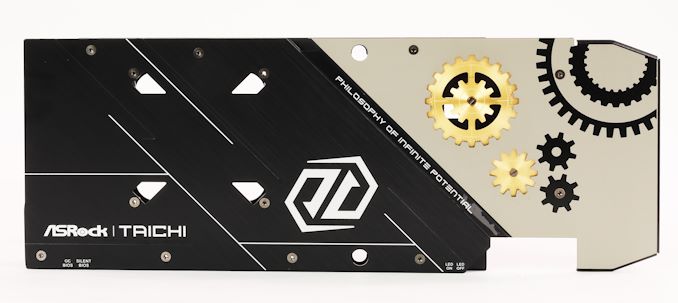
On the rear of the card is a 3D metal backplate which assists the metal frame on the other side of the PCB to reduce PCB flex, and hopefully stop bending altogether. The design of the Taichi X backplate is rather interesting with a black and silver background, with ASRock’s Taichi branding and cogwheel illustrations. The gold cogwheels are 3D moulded into the backplate with a nice finish, while the black cogwheels are printed on. 


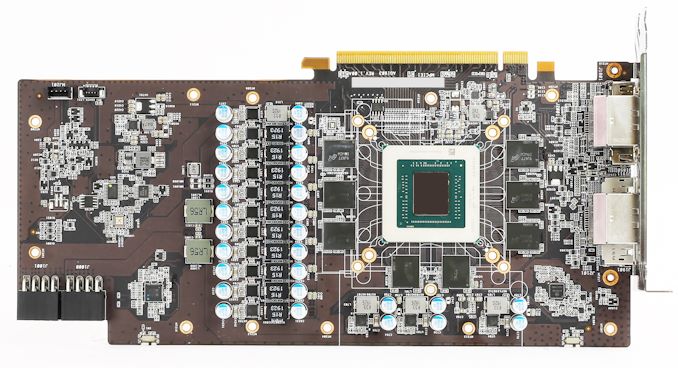
Analyzing the PCB of the ASRock Radeon RX 5700 XT Taichi 8G OC+, we can see that it is using a 12-phase power delivery in an 11+1 configuration. This is an improvement over the reference design AMD RX 5700 XT which has a 7+1 design. Regulating the power delivery is an International Rectifier IR35217 PWM controller, while two 8-pin PCIe power inputs provide power directly from the power supply. Surrounding the 7 nm GPU die is eight Micron D9WCW GDDR6 memory chips which operate at 1750 MHz which is 14 Gbps effective.


AMD Radeon RX Series Specifications Comparison
  ASRock Radeon

RX 5700 XT

Taichi X 8G OC+
AMD Radeon

RX 5700 XT Reference
NVIDIA GeForce

RTX 2060 Super
Stream Processors 2560

(40 CUs)
2560
(40 CUs)
2304

(36 CUs)
Texture Units 160 144 136
ROPs 64 64 64
Base Clock 1810 MHz 1605 MHz 1470 MHz
Game Clock 1935 MHz 1755 MHz N/A
Boost Clock 2025 MHz 1905 MHz 1650 MHz
Memory Clock 14 Gbps GDDR6 14 Gbps GDDR6 14 Gbps GDDR6
Memory Bus Width 256-bit 256-bit 256-bit
VRAM 8 GB 8 GB 8 GB
Board Power (TDP) 225 W 225 W 175 W
Manufacturing TSMC 7 nm TSMC 7 nm TSMC 12 nm
Architecture RDNA (1) RDNA (1) Turing
GPU Navi 10 Navi 10 TU106
Launch Price $480 $399 $399

When compared directly to the reference model, the ASRock RX 5700 XT Taichi X 8G OC+ comes with a hefty out of the box overclock when compared to stock. This is a 12% increase in base clock frequency, with game clock getting a 10% bump, and maximum boost clocks seeing a jump in frequency by just over 6%. The ASRock RX 5700 XT Taichi X 8G OC+ has a current selling price of $480, which is an $80 bump over the reference RX 5700 XT model at $399. NVIDIA’s competing graphics card in this price segment is the NVIDIA GeForce RTX 2060 Super, with aftermarket versions available for roughly the same price as aftermarket RX 5700 XT’s. 


Test Bed and Gaming Performance


Test Setup
Processor AMD Ryzen 3700X, 65W, $329 

8 Cores, 16 Threads, 3.6 GHz (4.4 GHz Turbo)
Motherboard MSI MEG X570 Ace (BIOS 7C35v16 – AGESA 1.0.0.4 B)
Cooling AMD Wraith Prism RGB
Power Supply Thermaltake Toughpower Grand 1200W Gold PSU
Memory 2x8GB G.Skill TridentZ DDR4-3200 16-16-16-36 2T
Video Cards ASRock RX 5700 XT Taichi 8G OC+ (1810/2025 Boost)

AMD Radeon RX 5700 XT (1605/1905 Boost)

NVIDIA GeForce RTX 2060 Super (1470/1650 Boost)

MSI GTX 1080 Gaming 8G (1632/1771 Boost)
Graphics Driver AMD – Adrenaline 19.11.3

NVIDIA – 441.20 WHQL
Hard Drive Crucial MX300 1TB
Case Open Benchtable BC1.1 (Silver)

As mentioned, today we are comparing against what we have in the motherboard lab. Unfortuantely our GPU lab is on the other side of the world, but we were lucky enough to get hold of a few other cards for comparison.


Gaming: Grand Theft Auto V


The highly anticipated iteration of the Grand Theft Auto franchise hit the shelves on April 14th 2015, with both AMD and NVIDIA in tow to help optimize the title. GTA doesn’t provide graphical presets, but opens up the options to users and extends the boundaries by pushing even the hardest systems to the limit using Rockstar’s Advanced Game Engine under DirectX 11. Whether the user is flying high in the mountains with long draw distances or dealing with assorted trash in the city, when cranked up to maximum it creates stunning visuals but hard work for both the CPU and the GPU.


For our test we have scripted a version of the in-game benchmark. The in-game benchmark consists of five scenarios: four short panning shots with varying lighting and weather effects, and a fifth action sequence that lasts around 90 seconds. We use only the final part of the benchmark, which combines a flight scene in a jet followed by an inner city drive-by through several intersections followed by ramming a tanker that explodes, causing other cars to explode as well. This is a mix of distance rendering followed by a detailed near-rendering action sequence, and the title thankfully spits out frame time data.


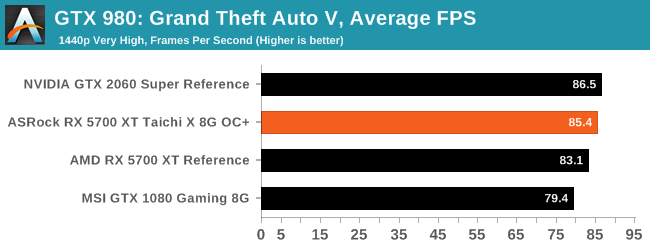
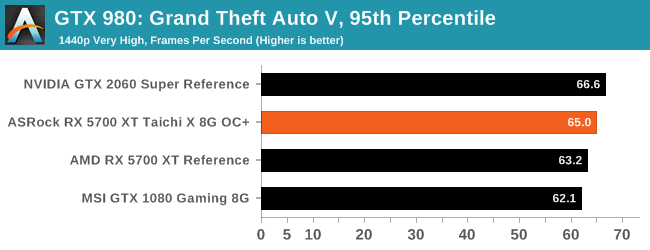
GTX 980: Grand Theft Auto V, Average FPSGTX 980: Grand Theft Auto V, 95th Percentile


It’s no secret that NVIDIA cards perform better in Grand Theft Auto V than AMD’s counterparts, and our results follow this trend. The ASRock RX5700 XT Taichi X 8G performs around 2 frames per better than the reference Radeon RX 5700 XT model in our testing. 


Gaming: Strange Brigade (DX12)


Strange Brigade is based in 1903’s Egypt and follows a story which is very similar to that of the Mummy film franchise. This particular third-person shooter is developed by Rebellion Developments which is more widely known for games such as the Sniper Elite and Alien vs Predator series. The game follows the hunt for Seteki the Witch Queen who has arose once again and the only ‘troop’ who can ultimately stop her. Gameplay is cooperative centric with a wide variety of different levels and many puzzles which need solving by the British colonial Secret Service agents sent to put an end to her reign of barbaric and brutality.


The game supports both the DirectX 12 and Vulkan APIs and houses its own built-in benchmark which offers various options up for customization including textures, anti-aliasing, reflections, draw distance and even allows users to enable or disable motion blur, ambient occlusion and tessellation among others. AMD has boasted previously that Strange Brigade is part of its Vulkan API implementation offering scalability for AMD multi-graphics card configurations.


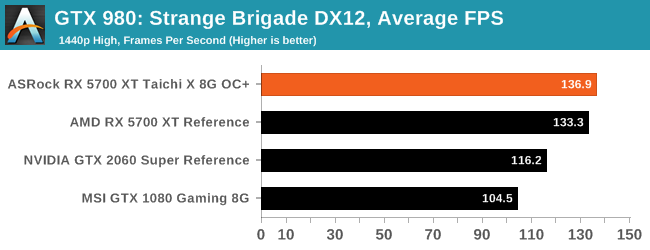
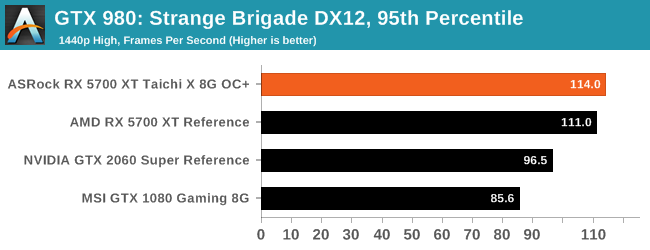
GTX 980: Strange Brigade DX12, Average FPSGTX 980: Strange Brigade DX12, 95th Percentile


In Strange Brigade, the results are different from GTA V, with the ASRock RX 5700 XT Taichi X 8G flexing its muscles with a comfortable lead over NVIDIA’s GTX 2060 Super reference card. Compared with the reference RX 5700 XT, the ASRock RX 5700 XT Taichi X 8G comfortably leads by 3 frames on average and in 95th percentile.


Gaming: F1 2018


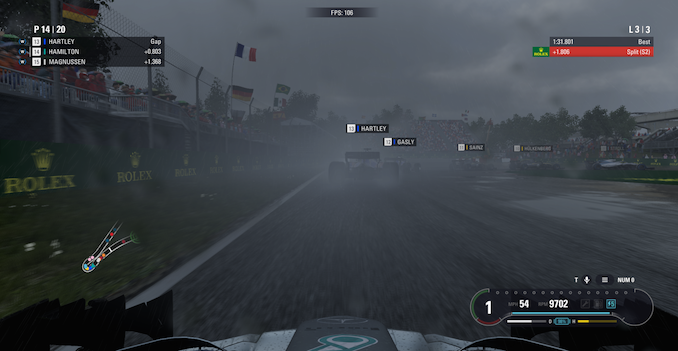
Aside from keeping up-to-date on the Formula One world, F1 2017 added HDR support, which F1 2018 has maintained; otherwise, we should see any newer versions of Codemasters’ EGO engine find its way into F1. Graphically demanding in its own right, F1 2018 keeps a useful racing-type graphics workload in our benchmarks.


Aside from keeping up-to-date on the Formula One world, F1 2017 added HDR support, which F1 2018 has maintained. We use the in-game benchmark, set to run on the Montreal track in the wet, driving as Lewis Hamilton from last place on the grid. Data is taken over a one-lap race.


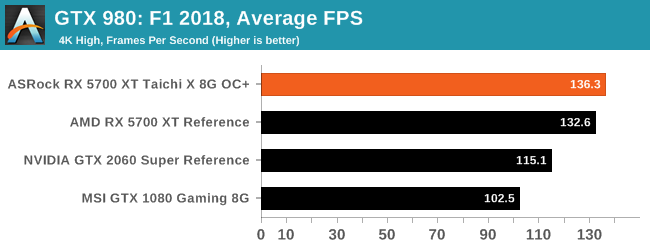
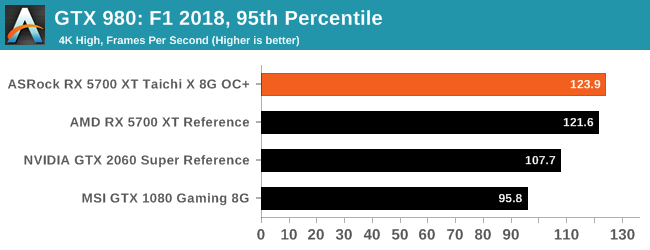
GTX 980: F1 2018, Average FPSGTX 980: F1 2018, 95th Percentile


In F1 2018, the AMD RX 5700 XT models decimate the NVIDIA GeForce RTX 2060 Super. The ASRock RX 5700 XT Taichi X 8G leads the NVIDIA RTX 2060 Super by around 21 frames at average, and by around 16 frames in our 95th percentile testing. 


Final Words


The ASRock RX 5700 XT Taichi X 8G OC+ is one of many custom-designed Radeon RX 5700 series models to hit the market in a large wave. Within our three games, the ASRock RX 5700 XT Taichi X 8G OC+ graphics card comfortably won two of them, with the NVIDIA GeForce RTX 2060 Super comfortably taking the crown in Grand Theft Auto V; this is due to in-game optimizations which favors NVIDIA graphics cards.


One of the most interesting aspects is the design; the ASRock Taichi design is one of its most marketable and well-known brands. Coupled with a Z390 Taichi, or X570 Taichi motherboard, the ASRock RX 5700 XT Taichi X 8G OC+ plus makes a partner with its similar designs, and the RX 5700 XT series is a solid mid-range option. While a reference AMD Radeon RX 5700 XT costs $399, the uprated and better cooled ASRock RX 5700 XT Taichi X 8G OC+ costs $480; a rise of $81 for an aftermarket card over the reference design. 


ASRock X570 Aqua with AMD Ryzen 3950X and ASRock RX 5700 XT Taichi X 8G OC+


It has style, it has a goodcooler, and the hardware itself is more than capable of overclocking and achieving higher clocks than comes default out of the box; it already comes with a noticeably powerful out of the box overclock. For that reason alone, it’s worth it over the reference model. The other alternatives in this price segment are the NVIDIA GeForce RTX 2060 Super reference at $399, and various models via vendors featuring aftermarket coolers.


Source: AnandTech – In The Lab: ASRock Radeon RX 5700 XT Taichi X 8G OC+ Graphics Card

GIGABYTE Unveils MU71-SU0 and MD71-HB0 Xeon Motherboards For Professionals

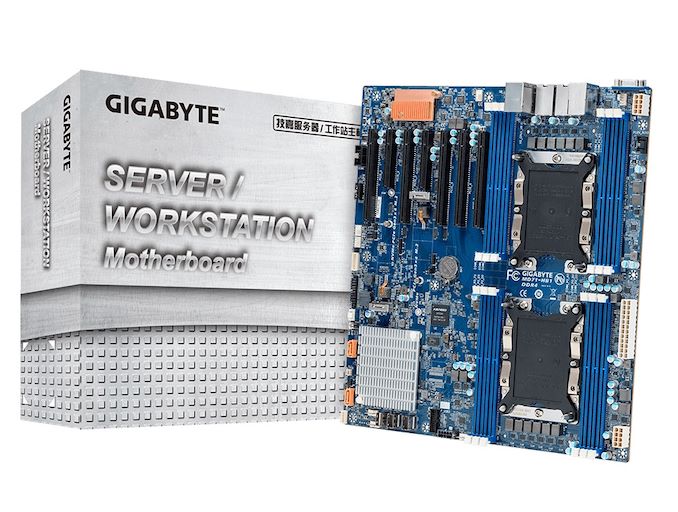
Outside of the plethora of AMD-related announcements of late, GIGABYTE has announced a pair of Intel motherboards for its workstation and server board users. The GIGABYTE MU71-SU0 is designed for Intel’s Xeon W-3200 processor family and is based on the C621 single-socket chipset. The other model is the GIGABYTE MD71-HB0, which is dual-socket on the C622 chipset and supports Intel’s Xeon Scalable processor product stack.


MU71-SU0


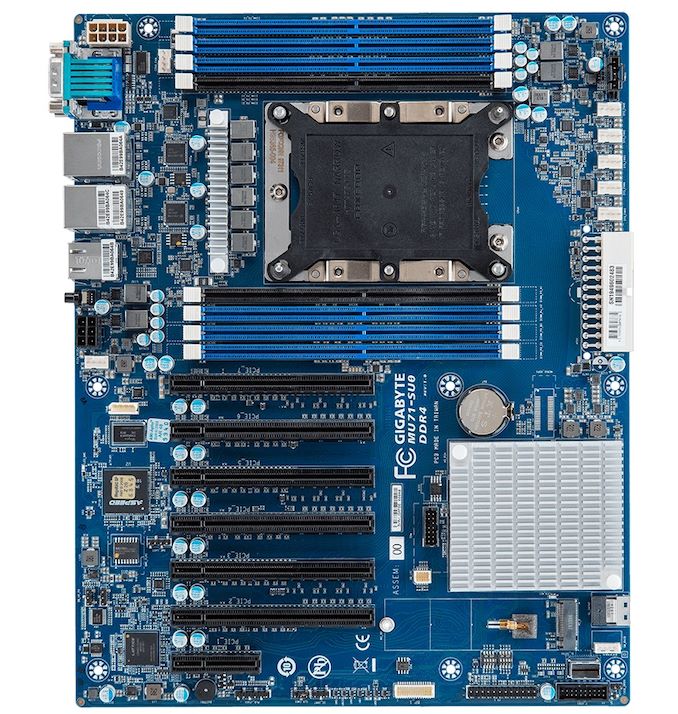
Starting with the GIGABYTE MU71-SU0, the single-socket Intel C621 model has plenty of workstation features designed for use with Intel’s Xeon W-3200 processors, which range from 8-core models all the way up to 28-core options. The flexible Intel C621 chipset benefits from AVX-512 support, Intel’s VROC RAID key utility, and specifically with the MU71-SU0, it has an ASPEED AST2500 remote management controller. 


GIGABYTE MU71-SU0 Single Socket C621 Motherboard


The GIGABYTE MU71-SUO has six full-length PCIe 3.0 x16 slots which operate at x8/x16/x8/x16/x8/x16, with a half PCIe 3.0 slot locked down to x4. This also includes a single PCIe 3.0 x4 M.2 slot, with two Slim SAS connectors providing eight STA ports with support for RAID 0, 1, 5, and 10 arrays. There are eight memory slots which support both 64 GB RDIMMs and 128 GB LRDIMMs, with a maximum speed of DDR4-2933 in hex channel mode and up to 2 TB with Xeon-W ‘M’ high memory model processors. On the website, GIGABYTE states that the board supports Intel’s Optane DCPMM modules, however we were told by Intel that Xeon W-3200 does not support it, so we are looking into this. The rear panel uses two Intel I210-AT Gigabit Ethernet controllers, an additional Ethernet port dedicated for remote management, with four USB 3.1 G1 Type ports, a D-Sub utilized by the IPMI, a serial port. 


MD71-HB0


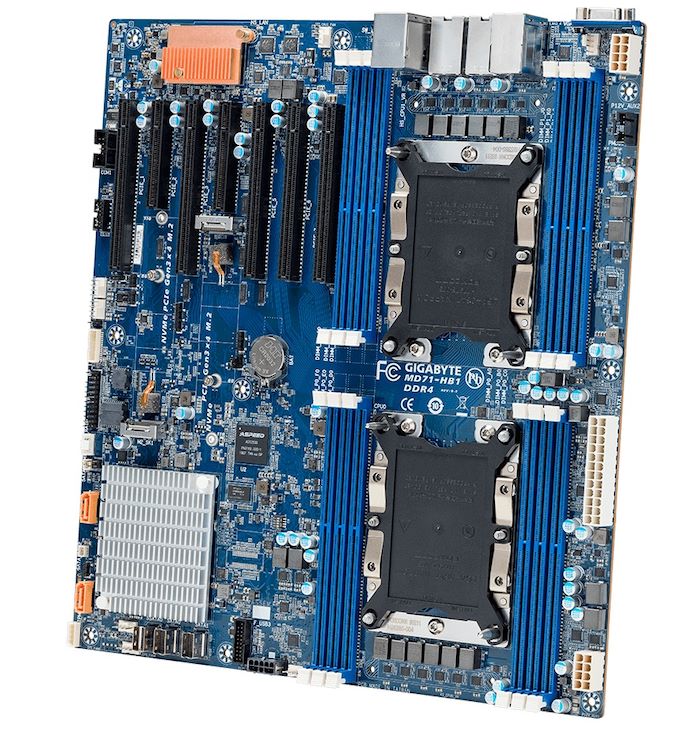
Moving onto the second of GIGABYTE’s new professional mobos, the MD71-HB0, this dual-socket server model is designed for use with Intel’s Xeon Scalable processor family and offers a more high-end feature set than its single-socket counterpart. The GIGABYTE MD71-HB0 shares an albeit similar PCIe slot array which supports x16/x16/x16/x8/x16/x8/x16, with five full-length slots, and two half-length. Storage options include two PCIe 3.0 x4 M.2 slots, with three SlimSAS slots which support up to twelve SATA ports with the usual RAID options.


GIGABYTE MD71-HB0 Dual Socket C622 Motherboard


Its feature set includes twelve memory slots, with support for 64 GB RDIMMs and 128 GB LDRIMMs at speeds up to DDR4-2933. As with other C622 and C621 chipsets, this model uses hex channel memory configurations. On the rear panel is a dual-port Intel X557-AT2 10 GbE controller, with a further two Intel Gigabit Ethernet ports, with two USB 3.1 G1 Type-A ports, and a D-sub video output for the ASPEED AST2500 IPMI interface. 


Both models feature similar designs with a blue PCB, blue memory slots, and standard non-reinforced PCIe slots. GIGABYTE hasn’t shared any pricing or availability as of yet, but it is expected that both the GIGABYTE MD71-HB0 and MU71-SU0 should become part of GIGABYTE’s other server offerings.


Related Reading


Source: AnandTech – GIGABYTE Unveils MU71-SU0 and MD71-HB0 Xeon Motherboards For Professionals

Japan Partly Removes Restrictions on Photoresists Exports to South Korea

Marking a thawing of relations between the Japanese and South Korean governments, the Japanese Ministry of Economy, Trade and Industry (METI) has partially removed export restrictions on photoresists to South Korea. As a result, Japanese companies can now obtain a ‘bulk’ license to supply three years’ worth of photoresists to companies like LG, Samsung, and SK Hynix rather than seek approval for each shipment. However not all restrictions have been removed: exports of fluorinated polyimides and high-purity hydrogen fluoride from Japan to South Korea are still restricted.


Earlier this year the Japanese government imposed restrictions on exports of three industrial chemicals to South Korea as a consequence of a long-lasting political conflict. Starting early July, Japanese manufacturers were required to get approvals for individual exports when shipping fluorinated polyimides (used both for LCDs and OLEDs), photoresists, and high-purity hydrogen fluoride (used to make chips, such as LSI, DRAM and NAND devices). And with Japanese companies providing 70% – 90% of the global supply of these chemicals, South Korean firms such as LG, Samsung, and SK Hynix had no other practical options. So the trade restrictions certainly made lives of both South Korean and Japanese companies a lot harder, though it’s not clear how much the relatively short-lived policy actually hurt South Korea’s high-tech sector.


Ultimately, it would seem that the two countries have since then been able to find some common ground and increase exports/imports. The Japanese government announced the relaxed rules late last week, with all of this coming shortly ahead of a Tuesday meeting between prime minister Shinzo Abe and South Korean president Moon Jae-in.


In the meantime however, this is just the first step in a larger process of resuming more normal trade relations between the two countries. South Korea and its high-tech manufacturers are still on the receiving end of export restrictions on fluorinated polyimides and high-purity hydrogen fluoride, as those rules remain in place. South Korean authorities are still looking to get the rest of the restrictions removed and to build on this “partial progress” as part of a more fundamental resolution fo the issue.


Related Reading:


Sources: Reuters, The Japanese Ministry of Economy, Trade and Industry


Source: AnandTech – Japan Partly Removes Restrictions on Photoresists Exports to South Korea

The ASUS ROG Zenith II Extreme TRX40 Motherboard Review: The Second Coming

Following on from our launch day AMD Ryzen Threadripper 3970X and 3960X CPU reviews, we are taking a look at the accompanying flagship model from ASUS. The ASUS ROG Zenith II Extreme is the predecessor of the previous generation of X399, the original Zenith Extreme, and comes packed with all the benefits of AMD’s TRX40 chipset including PCIe 4.0, strong USB 3.1 G2 implementation, and support for up to DDR4-4733 in quad-channel across eight memory slots. With a 16-phase power delivery for the CPU and a LiveDash 1.77” OLED color screen, the ROG Zenith II Extreme looks to set the standard for enthusiasts on AMD’s high-end desktop platform.


Source: AnandTech – The ASUS ROG Zenith II Extreme TRX40 Motherboard Review: The Second Coming

Western Digital Begins to Sample 18 TB & 20 TB ‘Energy Assisted’ Hard Drives

Western Digital has started partner sampling of its 18 TB and 20 TB energy-assisted magnetic recording (EAMR) drives. The HDDs utilize WD’s up and coming EAMR tech to further improve their storage density, allowing hyperscalers and similar customers to continue improving the desity of their storage clusters. WD is on track to start volume shipments of these products sometimes in the first half of next year.


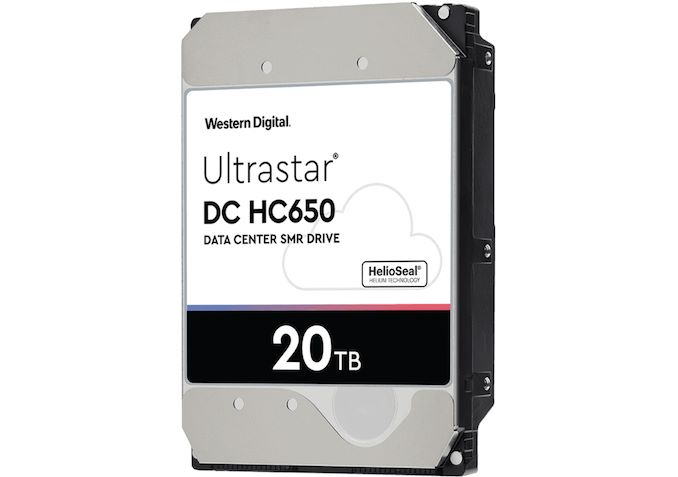
According to an announcement posted by Western Digital, the new 18 TB Ultrastar DC HC550 CMR and 20 TB Ultrastar DC HC650 SMR hard drives have been shipped to a dozen of enterprise OEMs, as well as operators of hyperscale cloud datacenters. This also includes Dropbox, who has been one of the prominent backers of the host-managed SMR technology. Western Digital isn’t disclosing the exact number of 18 TB and 20 TB HDDs it has shipped so far, but given the number of potential customers and the very nature of large datacenters, we are likely looking at thousands of units.


The key difference, of course, between Western Digital’s new 18 TB and 20 TB hard drives and their predecessors is usage of the company’s energy-assisted magnetic recording technology. Western Digital has been relatively tight-lipped for a bit now about its ‘EAMR’ tech and just what they’re doing under the hood; for the moment the company is only disclosing that it is a subset of its microwave assisted magnetic recording (MAMR) technology. However the company has added that it does not use a spin-torque oscillator, which is a key component of normal MAMR.


One thing to note is that the 18 TB Ultrastar DC HC550 is the ‘base’ model that uses conventional magnetic recording (CMR, which is what HDD makers call non-SMR drives these days), which means it behaves more or less like typical 7200 RPM enterprise-grade helium-filled HDDs. Meanwhile, the 20 TB Ultrastar DC HC650 uses shingled magnetic recording (SMR) with all of its peculiarities.


Overall, the sheer size of the drives does mean that WD’s customers will be evaluating factors such as IOPS rates versus the increased size. Since IOPS is essentially constant for a HDD – seek times haven’t really changed – the IOPS-per-TB rate has continued to drop with larger drives, with these drives continuing that trend. That especially goes for the SMR drive, of course, with shingling resulting in an even lower IO operation rate. As a result, only select companies – who happen to run software that considers peculiarities of SMR and a lower per-TB IOPS – are expected to use Western Digital’s 20 TB SMR drives.


MAMR aside, both drives are based on the company’s nine-platter helium-filled enterprise-class platform. WD’s latest generation enterprise tech incorporates triple-stage micro actuators that are optimized for working in multi-drive environments (e.g., racks). The enhancements of such platforms usually include top and bottom attached motor, top and bottom attached disk clamps, RVFF sensors, humidity sensors, and some other methods to improve reliability and guarantee steady performance. To that end, the HDDs are rated for a 550 TB/annual workloads, a 2.5-million MTBF, and are covered by a five-year limited warranty.


If all goes according to plan for Western Digital, expect to see them shipping the new 18 TB CMR and 20 TB SMR HDDs in volume in the first half of 2020. At which point hyperscalers and other enterprise customers will start their own ramp ups for installation.


Related Reading:


Source: Western Digital


Source: AnandTech – Western Digital Begins to Sample 18 TB & 20 TB ‘Energy Assisted’ Hard Drives

LG Reveals 31.5-Inch UltraFine Ergo 4K Monitor with Ergonomic Arm

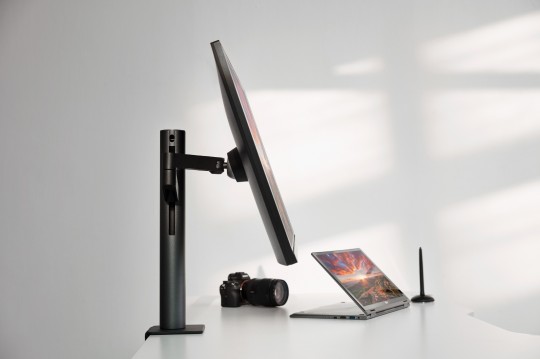
LG has announced its new 31.5-inch UltraFine Ergo 4K display, the largest in the UltraFine family to date. Living up to its name, the Ergo monitor has an innovative ergonomic arm that provides far more flexibility than any other stand that comes with LCDs, affording some new opportunities to free up space on the desktop.


The new LG UltraFine Ergo display model 32UN880 uses a 31.5-inch IPS panel with a 3840×2160 resolution, offering a maximum brightness of 350 nits, a 1000:1 contrast ratio, a 60 Hz refresh rate, a 5 ms response time, and the usual 178°/178° horizontal/vertical viewing angles.


Traditionally for LG’s UltraFine LCDs — which are developed primarily for professional customers seeking for accurate colors — the new monitors can display 1.07 billion of colors and cover 95% of the DCI-P3 color gamut. Unfortunately, we have no idea whether the devices support any other color spaces. Typically, LG’s UltraFine monitors only support DCI-P3, which makes them a great fit for Macs, but a suboptimal choice for Windows-based PCs.


Meanwhile, what is a bit unusual about the LG UltraFine Ergo is that it supports AMD’s FreeSync variable refresh rate technology, a feature that’s mostly used for gaming. HDR10 is also supported here, conferring a basic level of HDR support. Though given the peak luminance of the LCD, it is hard to expect the monitor to provide a meaningful HDR experience.


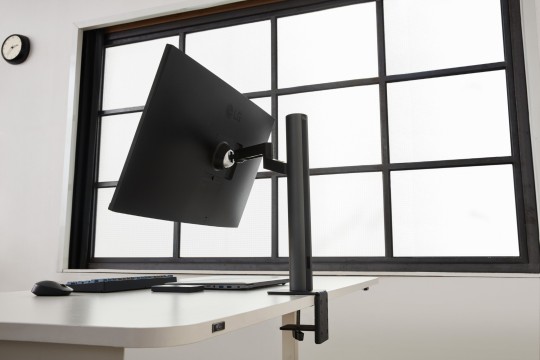
The key selling point of the LG UltraFine Ergo display is of course its full motion arm. The base of the arm uses a C-clamp, which allows it to be attached to almost any working surface. The arm itself can adjust not only the height, tilt, or swivel of the monitor, but also its distance to the viewer. In fact the arm is fairly long overall, which is quite different from what we normally see with standard displays.


With regards to connectivity,, the new LG UltraFine Ergo is different than other monitors in the family. The upcoming unit does not have a Thunderbolt 3 port, but instead sports one DisplayPort input, two HDMI ports, and one USB Type-C input. It also comes with a dual-port USB hub, though not built-in speakers or a headphone jack.


LG’s 2019 UltraFine Displays
  LG UltraFine 4K LG UltraFine 5K LG UltraFine Ergo
Panel 23.7″ IPS 27″ IPS 31.5″ IPS
Native Resolution 3840 x 2160 5120 x 2880 3840 x 2160
Refresh Rate 60 Hz
Variable Refresh Rate AMD FreeSync
Brightness 500 cd/m² 350 cd/m²
Color Gamut Display P3 DCI-P3
Color Depth 8 bit (?) 10 bit (?) ?
HDR HDR10
Response Time ? ? 5 ms
       
Viewing Angles 178°/178° horizontal/vertical
Inputs Thunderbolt 3 or USB-C 1 × DisplayPort

2 × HDMI

1 × USB-3
USB Hub 3 × 5Gbps USB-C 2 × USB
Audio Stereo speakers Stereo speakers

Microphone
Webcam Integrated
Stand Adjustable stand Adjustable arm with C-clamp

Extend/Retract

Tilt

Swivel

Pivot
Power Delivery 85 W 94 W ?
Price $699.95 $1,299.95 ?

LG’s 31.5-inch UltraFine Ergo monitor will be available sometimes in 2020, but its price remains to be seen.


Related Reading:


Source: LG


Source: AnandTech – LG Reveals 31.5-Inch UltraFine Ergo 4K Monitor with Ergonomic Arm

FSP to Demonstrate T-Wings 2-in-1 Chassis at CES: Two Semi-Open PCs in One Box

FSP is a relatively new player in the market for retail PC chassis, so it often goes to great lenghts to attract the attention of enthusiasts and build up its reputation as a maker of leading-edge products. To that end, at the upcoming CES trade show in early January, FSP plans to showcase a rather unique semi open chassis that can house two PCs.


Many streamers nowadays use two computers simultaneously in a bid to ensure the quality of their streams: one to play a game, another to capture the video and broadcast it over the Internet. To meet demands of such customers, a few case makers — most notably Corsair and Phanteks — have released giant full tower chassis that can house an EATX and a Mini-ITX system.


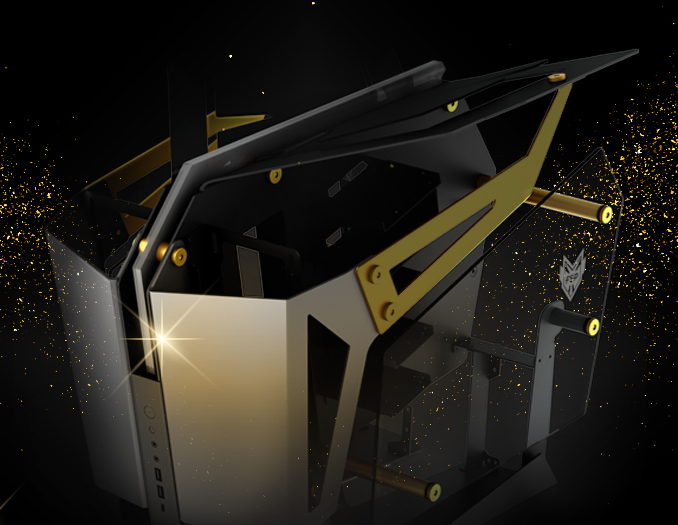
FSP apparently wants to address the same market segment, but with a semi-open chassis. The FSP T-Wings 2-in-1 not only accommodates two high-end PCs, but also catches the eye with its design featuring two ‘wings’, tempered glass, and golden inlays.  The semi-open chassis concept is a relatively new trend case designs and modifications, as these types of PC cases have only been available from a few manufacturers. To that end, FSP’s dual-system semi-open box essentially combines style and ultimate expandability in a never before seen package.


So far, FSP has only released a teaser image of its T-Wings 2-in-1 chassis, so it is impossible to tell anything about its internal structure or efficiency. Also, there is no word about pricing or availability of the box. The only thing that the company has said is that it will demonstrate a liquid-cooled semi-open dual-system PC built by a well-known modder at CES.


Related Reading:


Source: FSP


Source: AnandTech – FSP to Demonstrate T-Wings 2-in-1 Chassis at CES: Two Semi-Open PCs in One Box

Giveaway: Supermicro Z390 Mini-ITX Motherboard & Thermaltake Core P1 TG Case

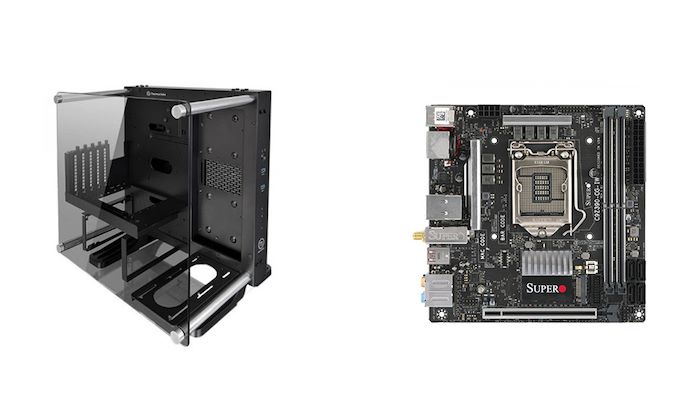
Just in time for a bit of extra holiday cheer, we have a new giveaway courtesy of Supermicro and Thermaltake. The companies have teamed up to give away a barebones Mini-ITX system, consisting of Supermicro’s Z390 Mini-ITX motherboard, the C9Z390-CG-IW, and Thermaltake’s Core P1 TG Mini ITX case. We have one system to give away, so if you’ve been desiring to put together a new Mini-ITX system, then this may be just the kit you need to get started.


The C9Z390-CG-IW is essentially a miniaturized version of Supermicro’s well-regarded ATX sized C9Z390-CG, taking a lot of the important elements from that board and putting it in a mini-ITX sized frame. There is a full-length PCIe 3.0 x16 slot with steel slot reinforcement and the board also includes two PCIe 3.0 x4 M.2 slots; one on the front and one on the rear. Also included are four SATA ports which feature straight-angled connectors.


Supermicro C9Z390-CG-IW Mini-ITX Motherboard
Product Page Link
Price $200
Size Mini-ITX
CPU Interface LGA1151
Chipset Intel Z390
Memory Slots (DDR4) Two DDR4

Supporting 32 GB

Up to DDR4-3866
Video Outputs 1 x HDMI 2.0a

1x DisplayPort 1.2
Network Connectivity Intel I219-V Gigabit

Intel Wireless-AC 9560 WiFi (2×2)
Onboard Audio Realtek ALC1220
PCIe Slots for Graphics (from CPU) 1 x PCIe 3.0 x16
Onboard SATA 4 x
Onboard M.2 2 x PCIe 3.0 x4
USB 3.1 (10 Gbps) 3 x Type-A Rear Panel

1 x Type-C Rear Panel

1 x Type-A Header
USB 3.0 (5 Gbps) 2 x Type-A Rear Panel

2 x Type- A Header
Power Connectors 1 x 24-pin ATX

1 x 8pin CPU

Controller-wise the board is using a Realtek ALC1220 HD audio codec to power the five 3.5 mm audio jacks and S/PDIF optical output on the rear, an Intel I219V Gigabit controller for the single LAN port and a dual-band 802.11ac wireless networking adapter is also included. The rest of the rear panel is comprised of three USB 3.1 Gen2 Type-A, one USB 3.1 Gen2 Type-C, two USB 3.0 Type-A ports, a PS/2 combo port and a pair of display outputs consisting of a DisplayPort 1.2 and HDMI 2.0 ports.


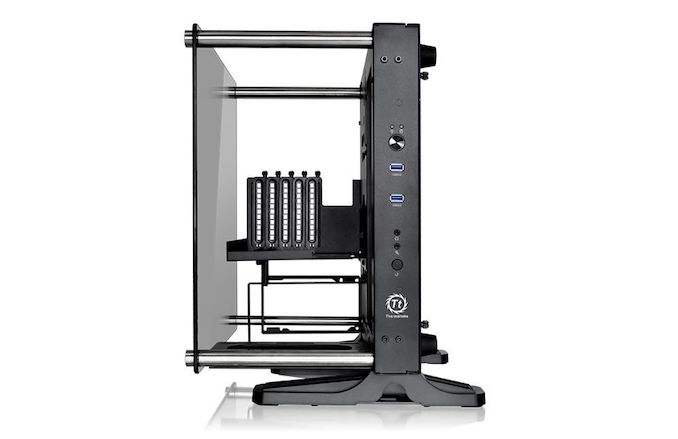
Meanwhile, to show off Supermicro’s board we have Thermaltake’s Core P1 TG Mini ITX case. The open-framed case lives up to the name and is only enclosed on two sides. It features a metal base as well as a tempered glass panel to cover the top of the case while showing off everything underneath. Furthermore, the case can be wall-mounted, in case the default standing configuration isn’t your cup of tea.


The giveaway is running through January 1stnd and is open to all US residents (sorry, ROW!). You can enter below, and you can find more details (and the full discussion) about the giveaway over on the AnandTech Forums.


AnandTech Supermicro + Thermaltake Mini-ITX Giveaway


Source: AnandTech – Giveaway: Supermicro Z390 Mini-ITX Motherboard & Thermaltake Core P1 TG Case

The NVIDIA GeForce GTX 1650 Super Review, Feat. Zotac Gaming: Bringing Balance To 1080p

Bringing 2019 to a close in the GPU space, we have one final video card review for the year: NVIDIA’s GeForce GTX 1650 Super. The last of the company’s mid-generation kicker cards to refresh the lineup in the second-half of 2019, the GTX 1650 Super is designed to shore up NVIDIA’s position in the sub-$200 video card market, offering solid performance for 1080p gaming without breaking the bank. At the same time, it’s also NVIDIA’s response to AMD’s new Radeon RX 5500 XT series of cards, which having landed last week, significantly outperform the original GTX 1650.


Source: AnandTech – The NVIDIA GeForce GTX 1650 Super Review, Feat. Zotac Gaming: Bringing Balance To 1080p

280 Hz Fast: ASUS Releases TUF Gaming VG279QM IPS Monitor w/ 280 Hz

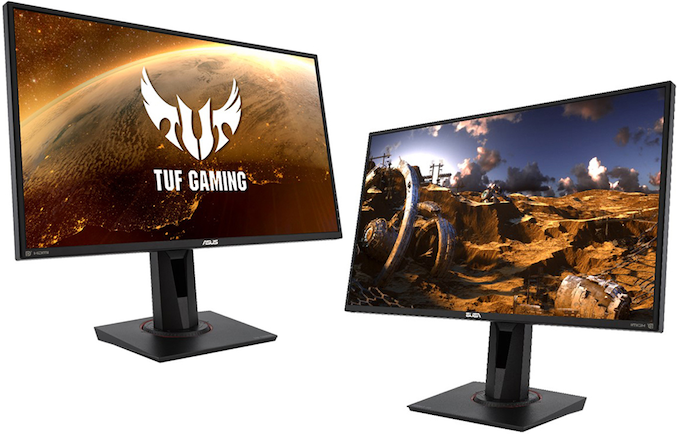
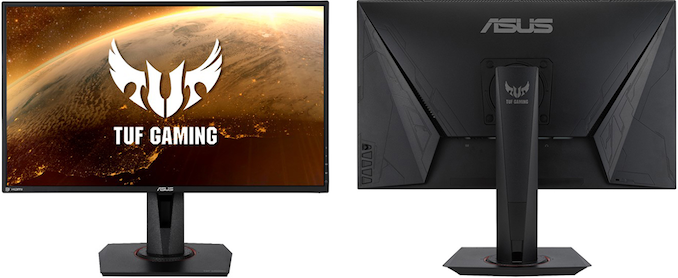
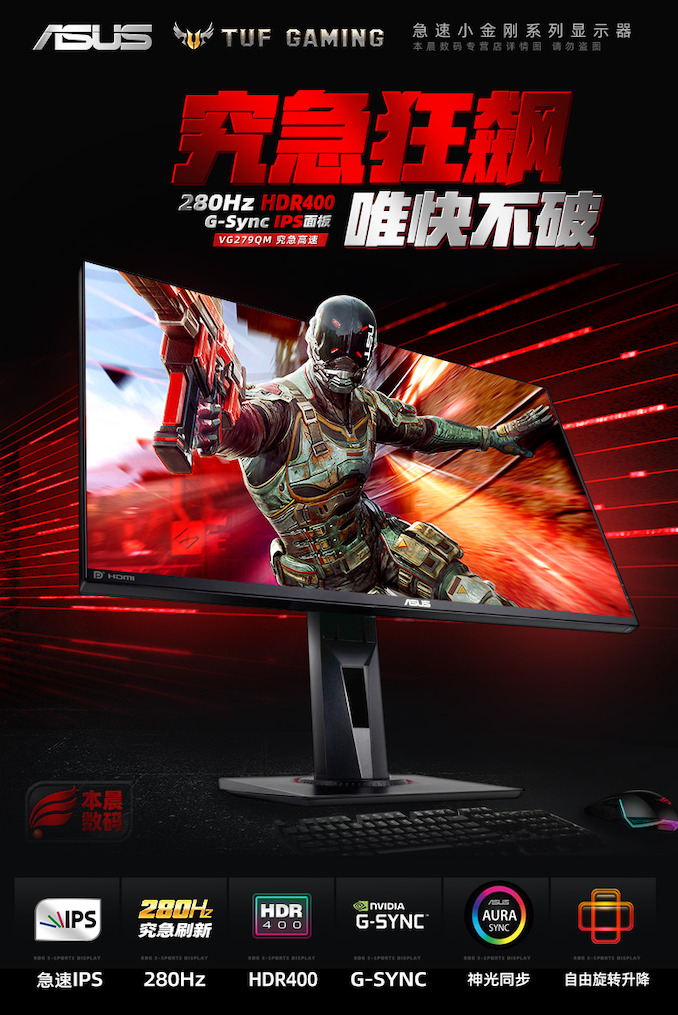
ASUS has started sales of its yet unannounced TUF Gaming VG279QM display in China. The new monitor features a maximum refresh rate of 280 Hz along with a dynamic refresh rate technology and is designed for gamers seeking maximum performance.


The ASUS TUF Gaming VG279QM display uses an 8-bit ‘fast IPS’ 27-inch panel from AU Optronics that features a Full-HD resolution and a native refresh rate of 240 Hz that is overclocked to 280 Hz. Other characteristics of the monitor are in line with specifications of the panel: 400 nits brightness, a 1000:1 contrast ratio, 178°/178° viewing angles, and a 1 ms response time.


Since the monitor is designed for gamers, it does not come as a surprise that it supports NVIDIA’s G-Sync and VESA’s Adaptive-Sync variable refresh rate technologies. (We expect it to support AMD’s FreeSync, but so far it has not been formally qualified.) The monitor also support ASUS’s extreme low motion blur (ELMB) technology. Interestingly, the monitor promises to support something called ELMB Sync, which probably is simultaneous work of ELMB and a VRR technology. The display is also DisplayHDR 400-certified, but do not expect any meaningful HDR experience given the peak luminance of only 400 nits.


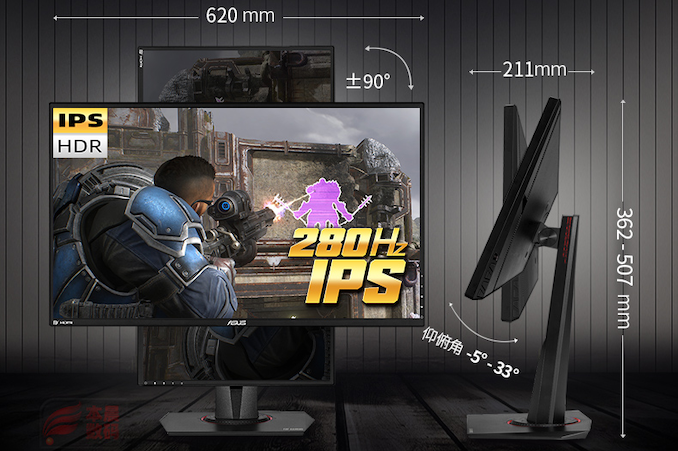
The TUF VG279QM display comes with a stand that can adjust height, tilt, swivel, and can even work in portrait mode. As for connectivity, the monitor has a DisplayPort 1.2 and two HDMI 2.0 connectors. In addition, unlike most TUF-branded hardware from ASUS, the VG279QM supports Aura Sync RGB lighting.


The ASUS TUF Gaming LCD w/280 Hz Refresh Rate
  TUF VG279QM
Panel 27-inch class IPS
Native Resolution 1920 × 1080
Maximum Refresh Rate 240 Hz
Dynamic Refresh Technology NVIDIA G-Sync

VESA Adaptive Sync
Range ?
Brightness 400 cd/m²
Contrast 1000:1
Viewing Angles 178°/178° horizontal/vertical
Response Time 1 ms
Pixel Pitch ~0.27675 mm²
Pixel Density ~82 PPI
Color Gamut Support 99% sRGB
Inputs 1×DP 1.2

2×HDMI 2.0
Audio
Stand Height: +/- 130 mm

Tilt: +33° ~ -5°

Swivel: +/- 90°

Pivot: +/- 90°
Warranty ? years
Launch Price in China ¥3699

At present, the TUF Gaming VG279QM is available in China for ¥3699 and it is unclear when the device is set to hit Europe and the US and how much it is expected to cost. Keeping in mind that at present this display is the only monitor feature a 280 Hz maximum refresh rate on the market, ASUS should be interested in bringing it to markets other than China as soon as possible. On the other hand, it is possible that ASUS will offer the TUF VG279QM under a different brand in other countries given its premium feature set.


Related Reading:


Sources: TFT Central, Taobao


Source: AnandTech – 280 Hz Fast: ASUS Releases TUF Gaming VG279QM IPS Monitor w/ 280 Hz

Micron Obtains License to Sell DRAM & NAND to Huawei

The inclusion of Huawei into the U.S. Department of Commerce’s Entity List and consequent restrictions to work with the Chinese giant clearly made it much harder for the U.S.-based companies to conduct business with Huawei. Yet, it did not make it completely impossible as companies could apply for special licenses. Despite over 160 companies applying for licenses, it has taken a long time for them to be issued. We saw Huawei’s notebooks recently come back to the Microsoft store, and yesterday during an call, Micron announced it is one of the first U.S. companies to recently obtain the required licenses, and they can resume selling various types of products to Huawei.


Because of the Export Administration Regulations and Entity List restrictions imposed on Huawei, companies that develop and make products in the U.S. could no longer sell them to Huawei. As a consequence, companies like Intel, Google, Microsoft, Micron, and many others had to stop working with their Chinese partner, which had a drastic impact on their business as the Chinese telecom giant is clearly a major customer buying a large number of hardware and software products.


Micron was allowed to sell and support some of its products to Huawei, but it was forbidden to supply Huawei with new products or sign new sales agreements. In the recent weeks the company obtained a license from the U.S. administration to qualify and sell new products (e.g., DRAM modules/chips, SSDs, 3D NAND memory, etc.) with Huawei’s mobile and server business units. Meanwhile, since new sales agreements take months to complete, Micron does not expect the licenses to have an impact on its sales in upcoming quarters.


Earlier this year Google and Microsoft were allowed to support existing Huawei devices running Android and Windows. Furthermore, Huawei recently launched new laptops based on CPUs from AMD and Intel as well as running Windows 10. There were reports that Huawei obtained processors from third-party resellers, but it was unclear whether this was the case with software licenses. In any case, it is important that at least some of the U.S.-based companies can now resume their work with Huawei officially.


The statement from Micron reads as follows:


As previously disclosed, we are continuing to ship some products to Huawei that are not subject to Export Administration Regulations and Entity List restrictions. We applied for, and recently received, all requested licenses that enable us to provide support for these products, as well as qualify new products for Huawei’s mobile and server businesses. Additionally, these licenses allow us to ship previously restricted products that we manufacture in the United States, which represent a very small portion of our sales. However, there are still some products outside of the mobile and server markets that we are unable to sell to Huawei.


Receiving the licenses is a positive development, and we are thankful to the U.S. administration for approving these licenses.


Prior to receiving these licenses, Entity List restrictions severely limited our ability to qualify new products at Huawei. Although we are now able to qualify new products with Huawei’s mobile and server businesses, it will take some time before the qualifications are completed and contribute to revenue. Consequently, we do not expect these licenses to have a material impact on our revenue in the next couple of quarters.


Related Reading:


Source: Micron


Source: AnandTech – Micron Obtains License to Sell DRAM & NAND to Huawei

The ASRock X570 Aqua: A $1000 Ryzen Halo Motherboard Reviewed

One of the most important aspects surrounding performance on AMD’s Ryzen 3000 series is temperature. It is no secret that the AMD 7nm chips run somewhat warmer than previous generations, but the unique ASRock X570 Aqua looks to shake things up. The ASRock X570 Aqua features a full-cover aluminium water block cooling the power delivery, CPU socket, and the X570 chipset all at once, and can be integrated into custom water cooling loops. There are plenty of promises made with this super halo product, and so we’ve put it through our testing.


Source: AnandTech – The ASRock X570 Aqua: A 00 Ryzen Halo Motherboard Reviewed