CES 2020: Corsair Reveals Elgato 4K60 S+ Capture Box w/ SD Card & HEVC

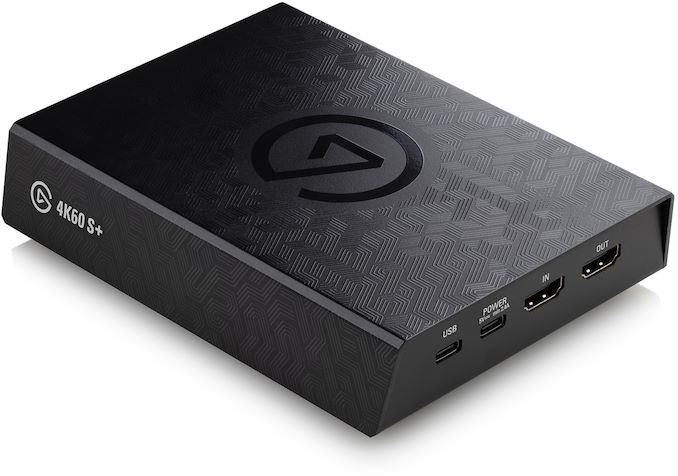
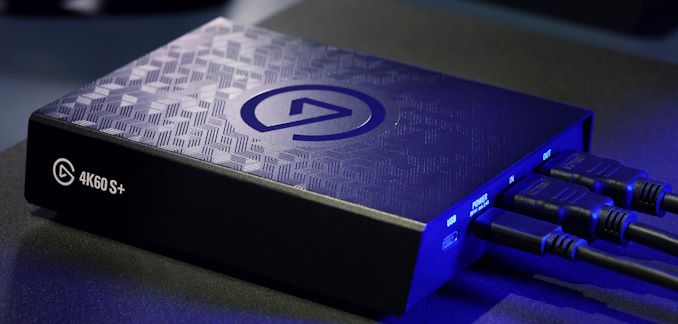
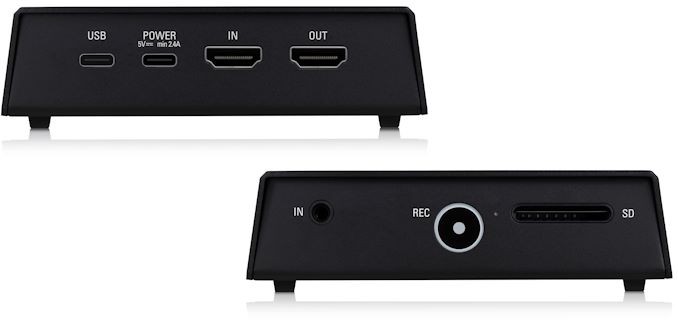
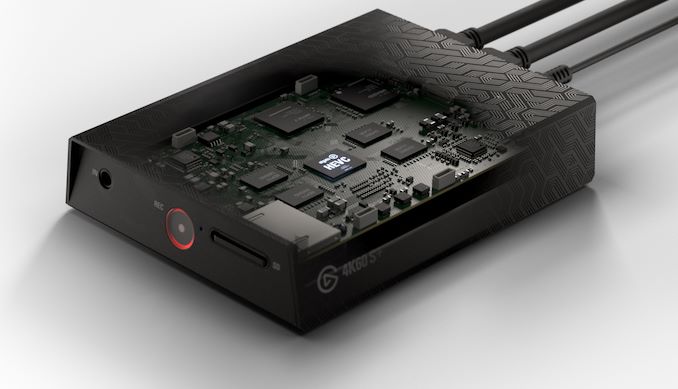
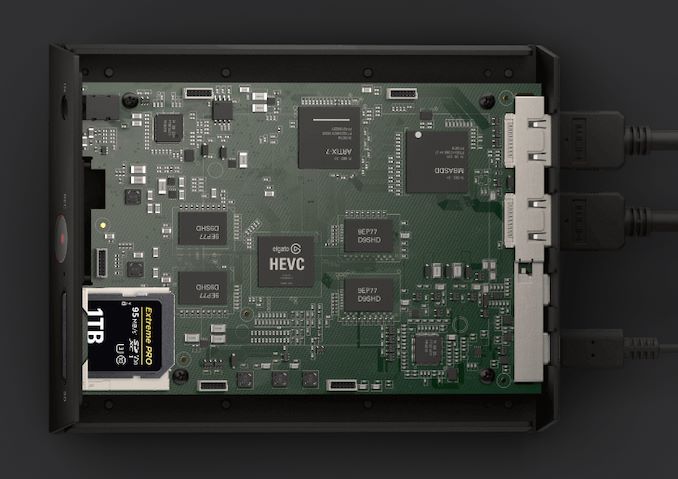
Corsair has introduced its new Elgato 4K60 S+ video capture device for gamers. The new capture box features an SD card reader and a hardware HEVC encoder that enables it to record up to seven hours of 4K HDR gameplay on a single 256 GB SD card.


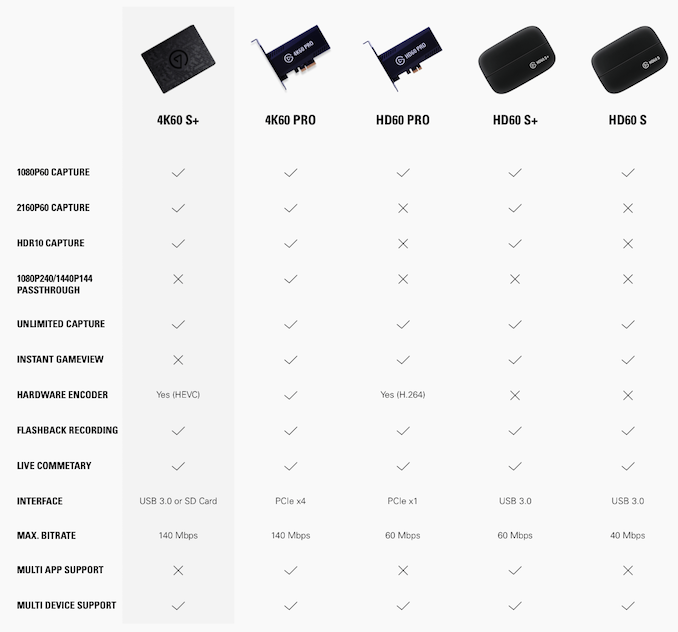
The Elgato 4K60 S+ allows streamers with consoles or PCs to capture and record 4K 60 Hz videos with HDR10 while streaming via USB 3.0 connector, to services like Twitch using various PC broadcasting apps, such as OBS Studio. In case of recording from consoles, it is necessary to record to an SD card, whereas on case of the PC, it is possible to record on host’s SSD or HDD. One thing that the capture device does not support is 1080p240 and 1440p144 passthrough, which introduces some limitations to eSports gamers.


Corsair says that the Elgato 4K60 S+ features a hardware HEVC encoder, which helps to save space on the card. Maximum bitrate supported by the encoder chip is 140 Mbps, which is higher than that of Ultra-HD Blu-ray discs.


Just like the Elgato 4K60 Pro MK.2 card, the Elgato 4K60 S+is the only consumer-oriented external capture device that support 4Kp60 with HDR10 and even has an SD card slot.


The Elgato 4K60 S+ will be available shortly from Corsair and its retail partners.


Related Reading:


Source: Corsair


Source: AnandTech – CES 2020: Corsair Reveals Elgato 4K60 S+ Capture Box w/ SD Card & HEVC

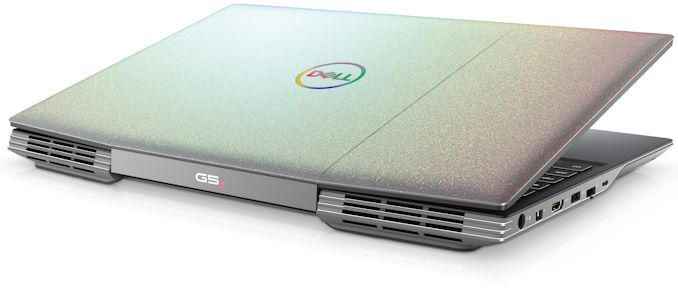
CES 2020: Dell’s G5 15 SE Gaming Laptop Gets 8-Core Ryzen 4000 & Radeon RX 5600M dGPU

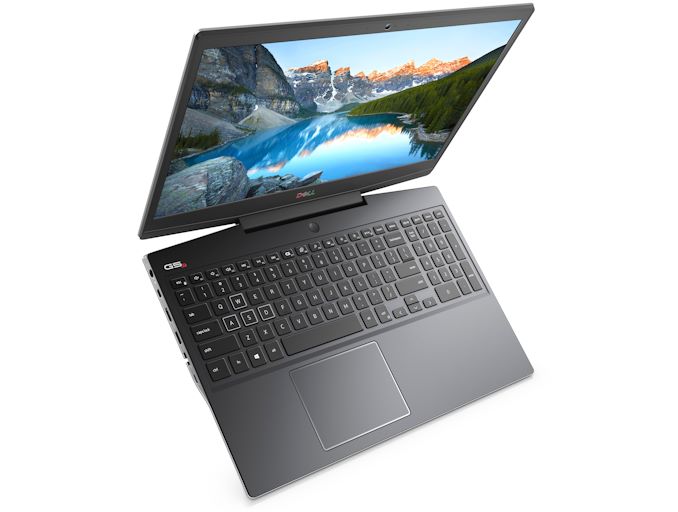
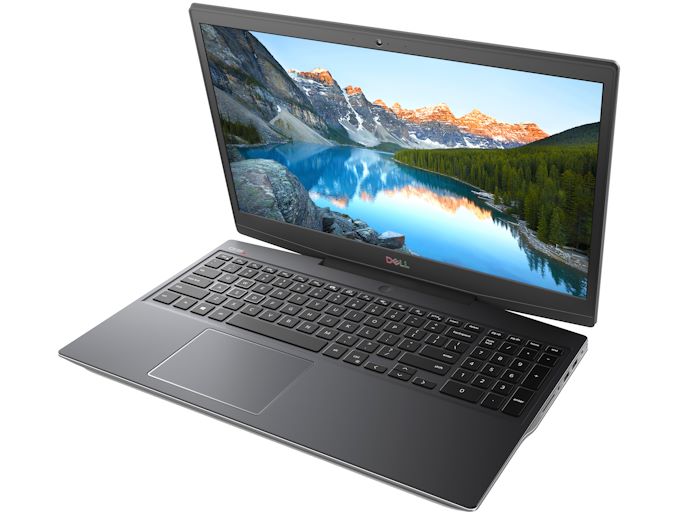
AMD has just introduced its new Ryzen 7 4000H-series mobile APUs as well as the Radeon RX 5600M GPUs and Dell is among the first companies to use both it its new high-performance gaming notebook. Given its ingredients, Dell’s G5 15 Special Edition Ryzen promises to be one of the most powerful gaming laptop in its class this spring.


The flagship configuration of the Dell G5 15 Special Edition Ryzen will incorporate AMD’s Ryzen 7 4800H CPU with eight Zen 2 cores clocked at 2.9 – 4.2 GHz and integrated graphics as well as AMD’s Radeon RX 5600M discrete GPU (Navi architecture), which promise to deliver desktop-class performance in games. Like other AMD Ryzen 7 4000H-based laptops, the Dell G5 15 SE uses AMD’s SmartShift technology to dynamically shift power between the CPU and the GPU for additional performance. Meanwhile, the PC comes with the Alienware Command Center software that allows users to tweak performance and customize gaming profiles. Furthermore, the machine has a serious cooling system with multiple air inlets to help keep low thermals and ensure stable and consistent operation.


To experience all the performance and capabilities that AMD’s latest CPU and GPU have to offer, Dell equipped its G5 15 SE with a 15.6-inch Full-HD panel with a variable refresh rate of up to 144 Hz supported by the FreeSync technology, which should pair up very well with the targetted GPU class. Furthermore, the system comes equipped with an audio subsystem enhanced with Nahimic 3D Audio software. Last but not least, the laptop has a gaming keyboard with highlighted WASD keys as well as a numpad.


In a bid to enable gamers to store as many titles as possible locally, the Dell G5 15 Special Edition Ryzen comes with an up to 1 TB SSD as well as a 2 TB 5400 RPM hard drive. In addition, expect the system to feature loads of DDR4 RAM. As for I/O, the system features Wi-Fi, Bluetooth, GbE, USB-A, USB-C, mDP, HDMI, SD card reader, a 3.5-mm audio jack, and a webcam with IR sensors.


Dell will make its G5 15 Special Edition Ryzen gaming laptop available in early April. Entry-level configurations presumably based on the Ryzen 5 4600H (six Zen 2 cores) with an integrated Radeon GPU (384 SPs) will cost $799, whereas other machines will naturally be more expensive.


Related Reading:


Source: Dell


Source: AnandTech – CES 2020: Dell’s G5 15 SE Gaming Laptop Gets 8-Core Ryzen 4000 & Radeon RX 5600M dGPU

D-Link Adds AI-enabled IP Cameras to mydlink Smart Home Lineup

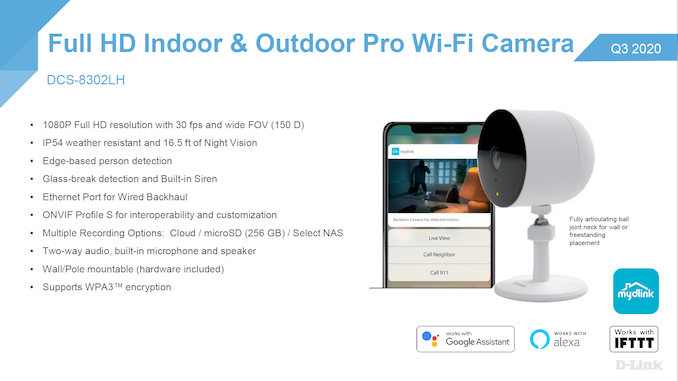
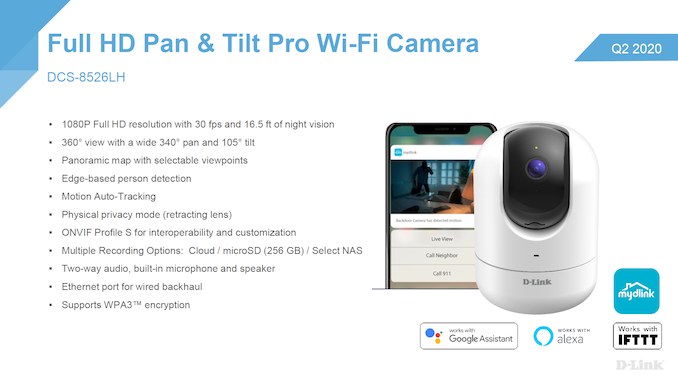
D-Link’s mydlink Smart Home lineup has consistently seen new products being introduced since the branding was launched in 2014. As machine learning and AI become more widespread, many edge devices have started to incorporate those features. D-Link’s new IP cameras are following the script. The interesting aspect is that these features are being implemented at the edge, rather than the cloud (as has been done in many of the IP cameras currently in the market). In addition to the regular face / object detection features used for identification of different persons, the new cameras also come with glass break detection. Doing this at the edge ensures that there is minimal latency in the provision of alerts.


The DCS-8302LH is the indoor model priced at $100, while the DCS-8526LH is the outdoor one priced at $120. The latter sports a spotlight as well as a siren that can be triggered either upon motion detection or through the app. D-Link is also not forcing its customers to use the cloud – the cameras come with ONVIF Profile S support that greatly simplifies the recording of the video streams to NAS devices. The microSD slot on the cameras also support cards of up to 256GB in capacity.


Both cameras come with a wired Ethernet port in addition to Wi-Fi capabilities, and feature two-way audio. Availability is set for Q2 2020. The trend of moving inference to the edge is welcome news for folks who are wary of cloud-reliant devices (be it for security / privacy purposes, or, for just avoiding yet another point of failure in the usage chain). We would like to see other devices in the mydlink smart home lineup get the ability to operate without the need for a cloud connection.


Source: AnandTech – D-Link Adds AI-enabled IP Cameras to mydlink Smart Home Lineup

D-Link Introduces 5G Gateway Solutions

The widespread 5G roll-out by different service providers has made wireless home broadband a very real possibility. The ability of 5G to support a denser subscriber base compared to 4G means that traditional consumer networking equipment vendors are bringing out a variety of 5G gateways to sell into the service-provider market for CPE (consumer premises equipment).


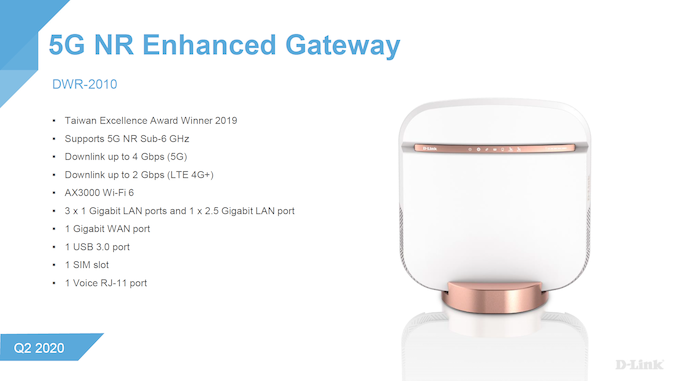
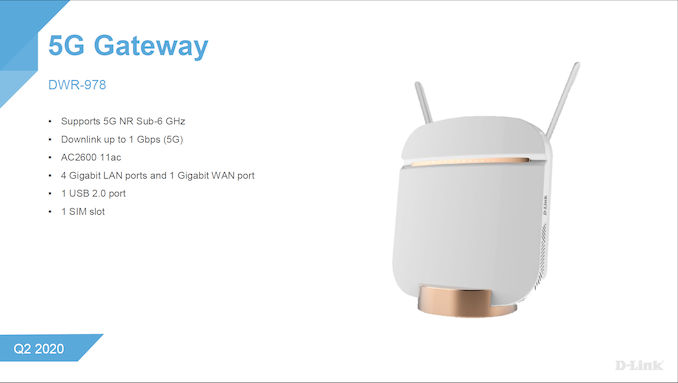
At CES 2020, D-Link announced that the DWR-2010 5G NR Enhanced Gateway (made public last year) now sports support for 5G in the sub-6 GHz band while delivering AX3000-class Wi-Fi connectivity on the other side. Key specifications include downlink speeds of up to 4 Gbps (5G) / 2 Gbps (4G LTE+), 3x1Gb and 1×2.5Gb LAN ports, a 1Gbps WAN port, 1 USB 3.0 port, a single SIM slot and one RJ-11 port for voice services.


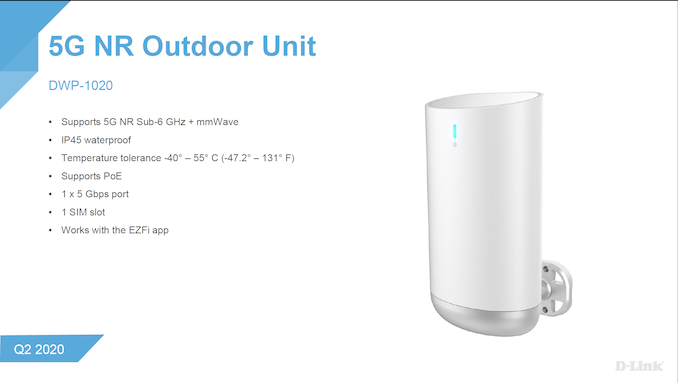
Two additional products were announced – the 5G Gateway (DWR-978) and 5G NR Outdoor Unit (DWP-1020). The former sports bands support similar to the 5G NR Enhanced Gateway, but, the downlink is limited to 1 Gbps with 5G, and the Wi-Fi connectivity is restricted to AC2600. It has 4x 1Gb LAN ports and a 1Gbps WAN port, a single USB 2.0 port and one SIM slot. The 5G NR Outdoor unit also supports mmWave in addition to the sub-6 GHz band. It is also IP45-rated (waterproof), and can tolerate temperatures between -40C and 55C. It can be powered with PoE, comes with a single SIM slot and has a 5 Gbps LAN port.


Overall, D-Link’s 5G offerings provide a variety of choices to service providers, and it bodes well for 5G wireless home broadband. It must be noted that D-Link’s competitors such as Netgear also have a suite of 5G products targeting the same market.


Source: AnandTech – D-Link Introduces 5G Gateway Solutions

Netgear Augments Wireless Broadband Gateway Options with Nighthawk M5 5G Wi-Fi 6 Mobile Router

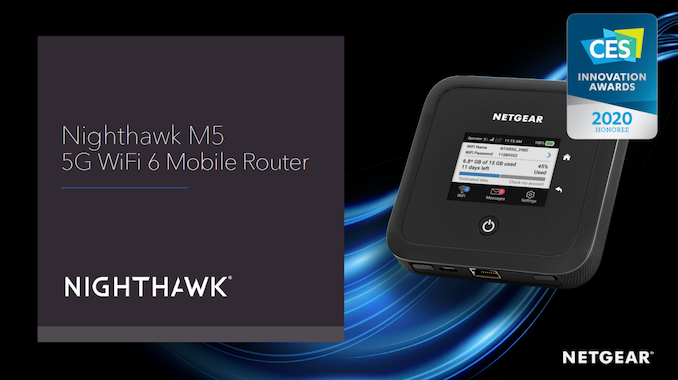
Netgear’s mobile broadband product stack has a variety of different product offerings mostly targeting the personal hotspot market. However, with 5G, wireless home broadband has become a credible proposition. In gearing up for the widespread adoption of 5G across different markets, Netgear is introducing the Nighthawk M5 5G Wi-Fi 6 Mobile Router at CES 2020.


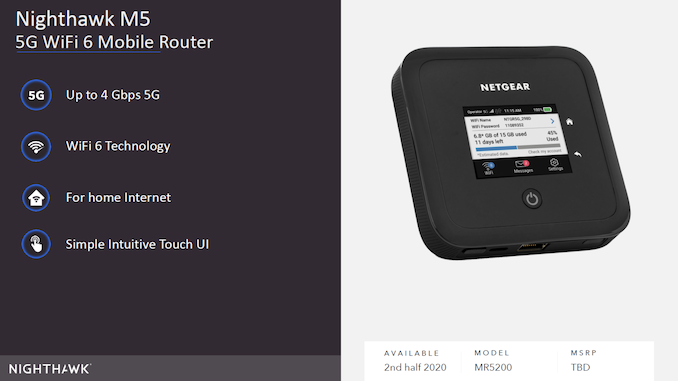
The M5 is designed to make high-speed broadband available in multiple scenarios – such as in-vehicle, or camping, or even just at home. The device is equipped with Wi-Fi 6 technology, and features a touch UI. It supports up to 4 Gbps on the 5G side. Availability is slated for the second half of 2020, and pricing is yet to be decided. The battery is designed to be removable – this helps in cases where the unit is wall-powered (as is the situation when the M5 is used for in-home broadband). The unit also features a single gigabit LAN port.


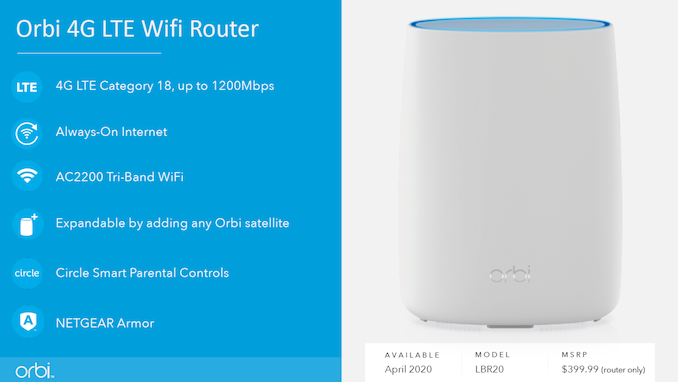
Netgear is also introducing the 4G LTE Wi-Fi Orbi Router at the show. The device is mainly aimed at places where fixed broadband penetration is not high such as in rural areas or sites of vacation homes. The Orbi 4G LTE Wi-Fi router is a AC2200 tri-band Wi-Fi device with a 4G LTE Category 18 connection (up to 1.2 Gbps).


Netgear plans to sell the LBR20 router-only package for $400, starting in Q2 2020. Users can expand Wi-Fi coverage by adding any Orbi satellite to the installation. The LBR20 can also be used as a dual-WAN gateway with failover capabilities, allowing for seamless switchover to 4G LTE when the primary Internet service experiences a failure. The LBR20 carries over all the consumer-friendly Orbi features such as painless app-based setup and management, Disney Circle, and Netgear Armor.


Source: AnandTech – Netgear Augments Wireless Broadband Gateway Options with Nighthawk M5 5G Wi-Fi 6 Mobile Router

Netgear Expands DOCSIS 3.1 Product Stack with Nighthawk CAX80 Wi-Fi 6 Cable Modem Gateway

Cable service providers in the US market have been aggressively deploying DOCSIS 3.1 over the last couple of years. Netgear has been selling DOCSIS 3.1-compatible modems and gateways into the service-provider as well as the retail market. At CES 2020, Netgear is launching a new product to augment their product stack in this segment.


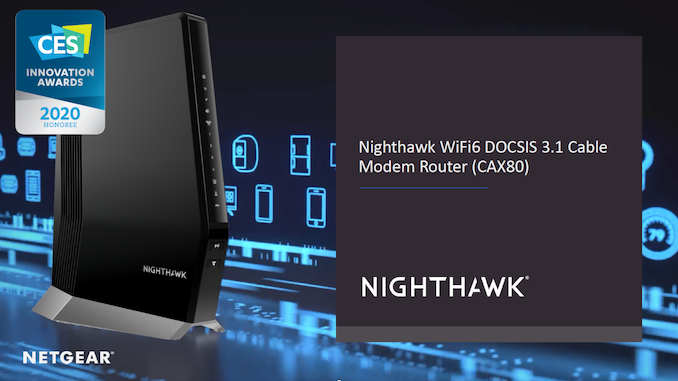
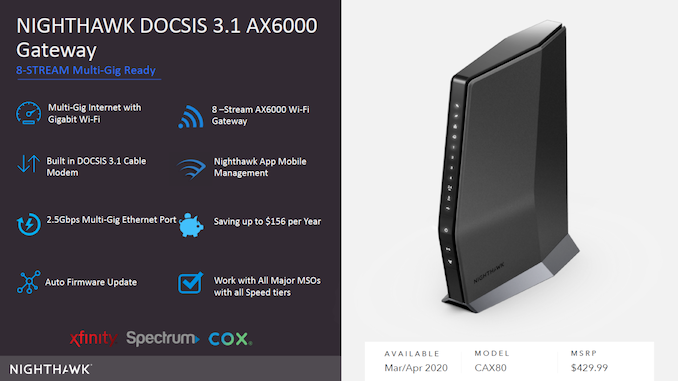
The Nighthawk Wi-Fi 6 DOCSIS 3.1 Cable Modem Router (CAX80) is an integrated device fulfilling modem, router, switch, and wireless access point functions. Priced at $430 and slated for availability in early Q2 20202, this device has a 8-stream Wi-Fi 6 configuration (AX6000-class). It also comes with a 2.5 Gbps LAN port.


The CAX80 has four additional gigabit ports, and two of those are capable of getting link-aggregated too. As Comcast starts to test 2.5 Gbps-capable services, the CAX80 has the ideal specifications to take advantage of it. The Nighthawk app for the gateway is also designed to simplify the onboarding process in a self-install scenario.


Users wanting to avoid a combo-device can currently go in for the CM1100 or CM1200 DOCSIS 3.1 cable modems. They are both multi-gig-ready, but need link aggregation for this purpose. We are looking forward to Netgear updating these models with a 2.5 Gbps port for a simplified installation.


Source: AnandTech – Netgear Expands DOCSIS 3.1 Product Stack with Nighthawk CAX80 Wi-Fi 6 Cable Modem Gateway

Netgear Launches EasyMesh-Compatible Nighthawk Mesh Wi-Fi 6 System

Netgear’s Orbi has enjoyed tremendous success in the Wi-Fi system / mesh networking market. Technically speaking, the Orbi kits can’t interoperate with mesh nodes from other vendors or even with netgear’s own range extenders in a seamless manner. The proprietary nature of each vendor’s mesh networking stack is the key contributor to this problem. In 2018, the Wi-Fi Alliance weighed in with the EasyMesh standard that could allow equipment from different vendors to co-operate for a standards-based mesh networking functionality.


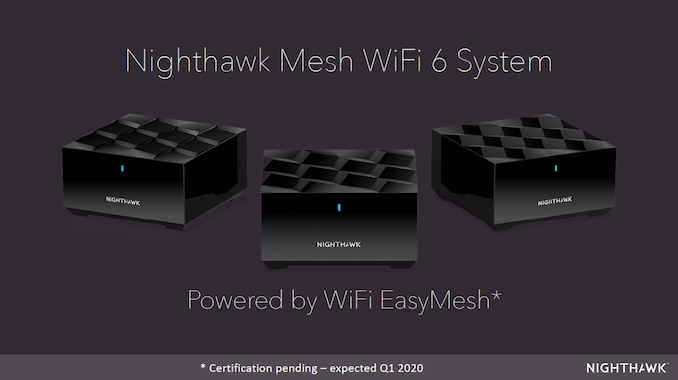
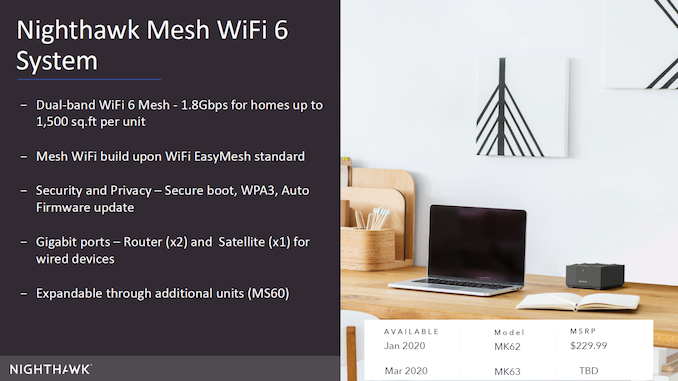
At CES 2020, Netgear is announcing the Nighthawk Mesh Wi-Fi 6 System that implements a standards-based Wi-Fi mesh network capable of interoperating with other Wi-Fi EasyMesh-certified products. Typical of mesh networks, the Nighthawk Mesh also creates a single Wi-Fi network with device steering and intelligent roaming for mobile devices. The members of the kit come pre-paired for easy installation.


Netgear claims that each unit can cover up to 1500 sq. ft., while providing data rates up to 1.8 Gbps (pointing to a 2×2 configuration).


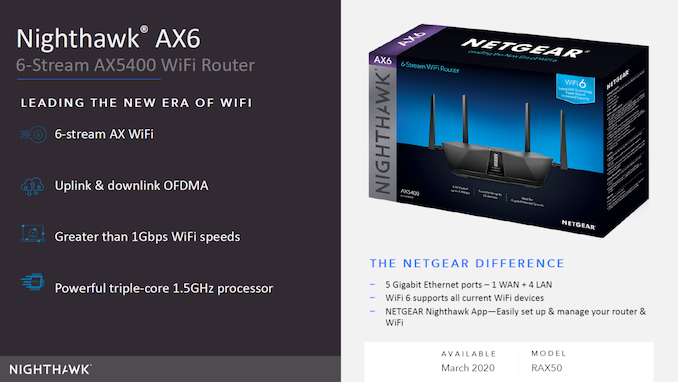
The RAX50 6-stream AX5400 router is also being introduced at CES. It is based on the Broadcom BCM6752 WLAN SoC. The in-built 2×2 WLAN radio in the SoC is used for operation in the 2.4 GHz band, while an external 4×4 radio is used for the 5 GHz operation.


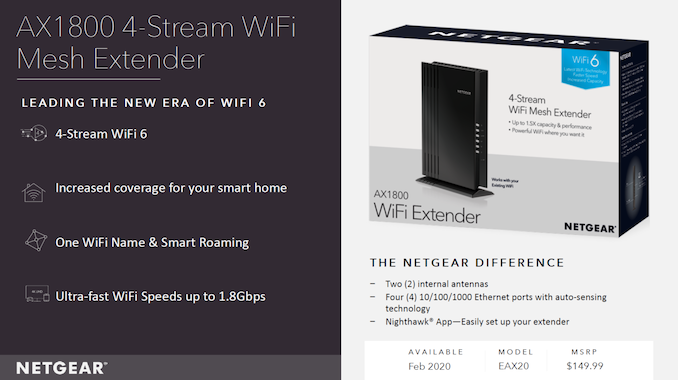
The new EAX20 nesg extender is a 4-stream AX1800-class product that comes with four gigabit LAN ports. The product will be available in retail for $150 next month.


Overall, Netgear is expanding their Wi-Fi 6 offerings to target a wide budget range. While Orbi continues to remain the premium mesh networking product from Netgear, we are glad to see the company put in efforts to also release a standards-compliant EasyMesh-enabled mesh networking kit.


Source: AnandTech – Netgear Launches EasyMesh-Compatible Nighthawk Mesh Wi-Fi 6 System

Western Digital Demonstrates 8TB Portable 20 Gbps SSD, Announces Dual-Connector 1TB Thumb Drive

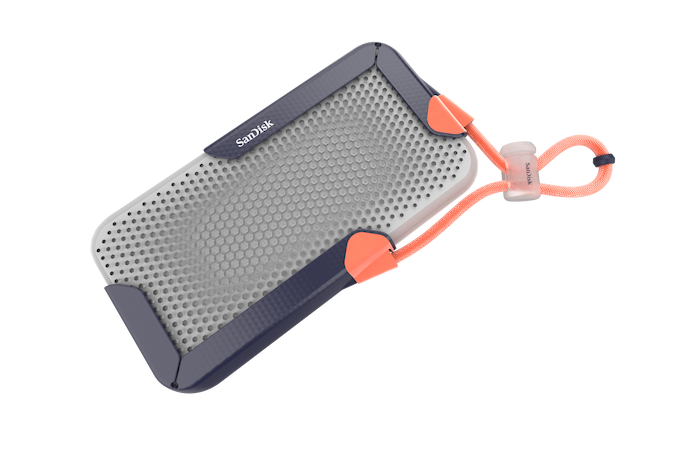
Western Digital has a history of showcasing cutting-edge technological advancements in the consumer electronics space at CES every year. In 2019, a 4TB thumb drive was demonstrated, and this year, we have a 8TB portable SSD with a USB 3.2 Gen 2×2 interface.


As QLC flash becomes more common-place, and the number of layers in 3D NAND keeps increasing, it becomes economically feasible to produce high-capacity compact flash storage devices. In fact, WD presented details of 128L BiCS 5 production wafers at ISSC 2019, though it is not clear if the 8TB prototype being demonstrated at CES 2020 utilizes BiCS 5 flash. In any case, given the size of the prototype (similar to the SanDisk Extreme Pro Portable SSDs already in the market), even BiCS 4 TLC (96L 3D NAND) flash is enough. The choice of TLC or QLC would boil down to economics, and given that this is a techonology demonstration prototype, there is no pricing aspect to consider.


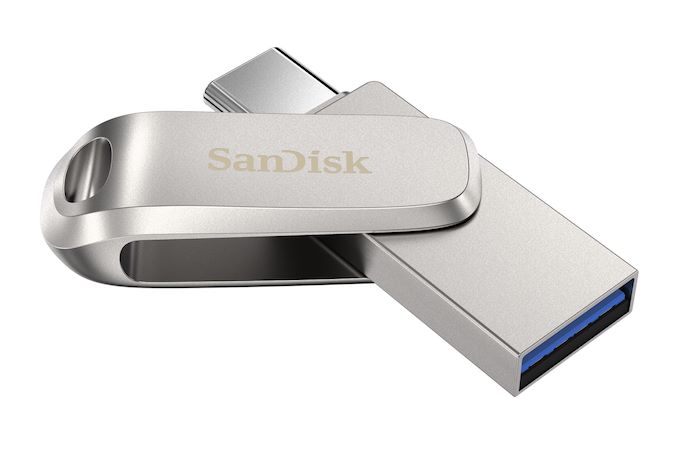
WD also announced some products with retail availability at the show. The SanDisk Ultra Dual Drive Luxe USB Type-C is a 1TB thumb drive that comes with a Type-C male port and a Type-A female port. It is compact enough to fit in a keychain and will be available in late Q1 2020. Pricing has not been announced.


The WD_BLACK line of external storage solutions targeting gamers is also being showcased. The lineup includes the WD_BLACK P50 (one of the first external SSDs to feature a USB 3.2 Gen 2×2 20 Gbps interface), the WD_BLACK P10 (external bus-powered 2.5″ hard drive in 1TB, 3TB, and 5TB capacities), and the WD_BLACK D10 (external 8TB 3.5″ 7200 RPM hard drive with a USB 2.0 hub). The P10 and D10 also come in Xbox-branded variants.


The SanDisk ibi photo management device (a cloud-based service with local storage) is also being demonstrated in WD’s CES suite.


Source: AnandTech – Western Digital Demonstrates 8TB Portable 20 Gbps SSD, Announces Dual-Connector 1TB Thumb Drive

Intel CES 2020 Keynote Live Blog: Ice, Comets, and More To Come

We’re here at the Mandalay Bay Convention Center for Intel’s CES 2020 keynote. Intel always makes their CES presentations exciting affairs, and we’re expecting much the same this year. However there is no escaping the big question that Intel must face: how do you keep products fresh and competitive when the company’s 10nm fab plans have gone well off course?


Source: AnandTech – Intel CES 2020 Keynote Live Blog: Ice, Comets, and More To Come

Acer Swift 3, either with Core i7-1065G7 or Ryzen 7 4700U: The Laptop Market Just Blew Wide Open

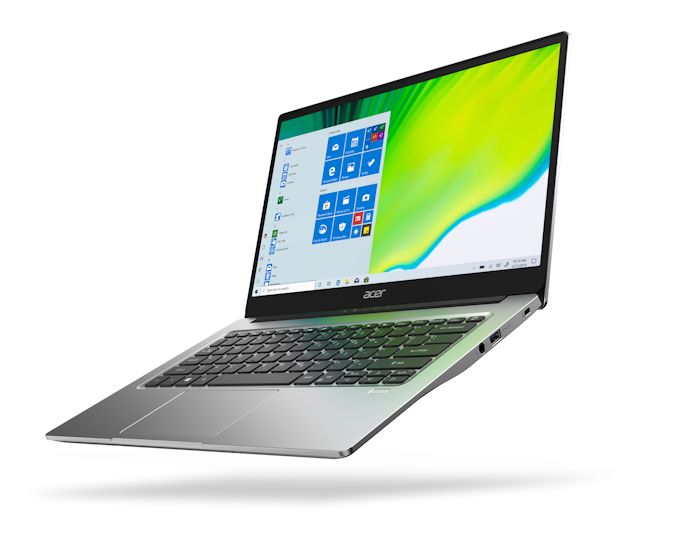
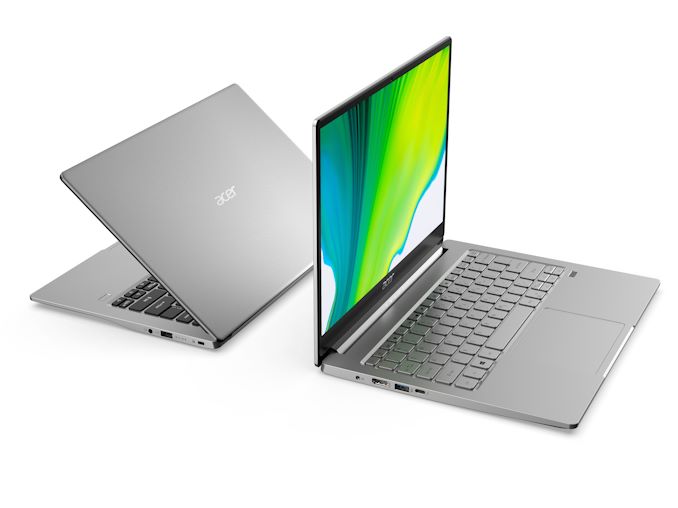
Everyone wants a notebook that fulfills their needs, is super light, lasts forever, and only costs a dime. We’re not in fantasy land just quite yet, but Acer is trying with its new Swift 3 for 2020. There’s one kicker in these units though – there will be AMD and Intel variants, using the latest and greated from both – Intel’s 10nm Ice lake vs. AMD’s new 7nm APUs.


The new Acer Swift 3 ultraportable is a 14-inch unit weighing 1.2 kg (2.6 lbs) that has either up to an octo-core AMD Ryzen 7 4700U inside or up to an Intel Core i7-1065G7, 16 GB of LPDDR4X memory, and up to 512 GB of NVMe storage. Acer is going for a premium design feel here, with the lightweight chassis, narrow bezels (4.37mm), and support for features like Windows Hello and Wake on Voice supported. The full unit is 16.55mm / 0.65-inches thick.


AMD Variant


AMD Prices will start from $599 for the base configuration, and exact specifications will come closer to the launch in May. Intel will start from $699 and be available from March.


Intel Variant


If one thing is going to be clear at this year’s CES, it’s going to be that AMD and Intel are going to be hitting each other with design wins. Normally for design wins we talk about flagships, but I suspect we’ll see AMD in a lot of mid-price notebooks with good all-round specifications, which is going to be where Intel will feel the heat. Not to be outdone, Intel is expected to have a number of Ice Lake designs at CES as well – the Intel Acer Swift 3 has Athena certification for example, which might be where the extra base cost comes from, as it will likely have Thunderbolt 3, Wi-Fi 6, and an ultra-low power display. It would be interesting to square off Intel vs AMD here in a review later this year.


Source: AnandTech – Acer Swift 3, either with Core i7-1065G7 or Ryzen 7 4700U: The Laptop Market Just Blew Wide Open

AMD Ryzen 4000 Mobile APUs: 7nm, 8-core on both 15W and 45W, Coming Q1

At last year’s CES, AMD showcased its then Ryzen 3000 mobile processors as part of the announcements. In what is becoming a trend, at this year’s CES, the company is doing the same in announcing its next generation Ryzen 4000 mobile processors. This year is a little different, with AMD showing off its manufacturing strategy at TSMC 7nm for the first time in the mobile space. There’s a ton of options on the table, both at 15W and 45W, offering some really impressive core counts, frequencies, and most importantly, design wins. Here are all the details.


Source: AnandTech – AMD Ryzen 4000 Mobile APUs: 7nm, 8-core on both 15W and 45W, Coming Q1

AMD Announces Radeon RX 5600 Series: A Lighter Navi To Rule 1080p Gaming

With the launch of the Radeon RX 5700 series and Radeon RX 5500 XT under their collective belt, AMD is now getting ready to fill in the divide between the card families. With the RX 5500 XT carrying a $199 price tag and the next step up being the $349 RX 5700, there’s a significant gap in price and performance between the two cards. All of which has left AMD at a disadvantage in the popular $200-$300 mainstream segment, where NVIDIA’s GeForce GTX 1660 cards dominate. To that end, today AMD is announcing the third sub-series of the Radeon RX 5000 family, the Radeon RX 5600 series. These latest cards will be coming to retail, OEM, and mobile, with the retail Radeon RX 5600 XT leading the charge.


Designed to fill that gap between the RX 5700 series and the RX 5500 series, the $279 RX 5600 XT is employing a further cut-down version of AMD’s class-leading Navi 10 GPU. For their latest card, AMD is dialing back on the amount of enabled hardware in order to offer a card with performance between the existing Radeon RX 5000 series cards, and with a price to match. The net result is a card that, in AMD’s words, is intended to be the ultimate 1080p gaming card, and just as importantly, go head-to-head with NVIIDA’s GeForce GTX 1660 cards.


Source: AnandTech – AMD Announces Radeon RX 5600 Series: A Lighter Navi To Rule 1080p Gaming

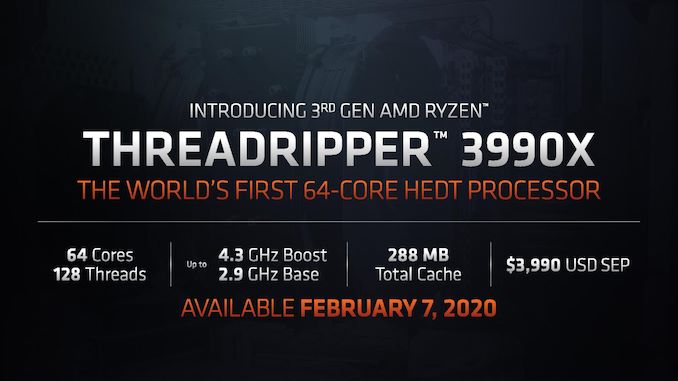
AMD’s 64-Core Threadripper 3990X, only $3990! Coming February 7th

At the tail end of last year, one of the key launches in the creator/workstation processor market was AMD’s latest 3rd Generation Threadripper portfolio, which started with 24-core and 32-core hardware, with a strong teaser that a 64-core version was coming in 2020. Naturally, there was a lot of speculation, particularly regarding sustained frequencies, pricing, availability, and launch date. This week at CES, we can answer a couple of those questions.


The new 64-core AMD Threadripper 3990X is essentially a consumer variant of the 64-core EPYC 7702P currently for sale in the server market, albeit with fewer memory channels, fewer enterprise features, but a higher frequency and higher TDP. That processor has a suggested e-tail price (SEP) of $4450, compared to the new 3990X, which will have a $3990 SEP.


AMD HEDT SKUs
AnandTech Cores/

Threads
Base/

Turbo
L3 DRAM

1DPC
PCIe TDP SRP
Third Generation Threadripper
TR 3990X 64 / 128 2.9 / 4.3 256 MB 4×3200 64 280 W $3990
TR 3970X 32 / 64 3.7 / 4.5 128 MB 4×3200 64 280 W $1999
TR 3960X 24 / 48 3.8 / 4.5 128 MB 4×3200 64 280 W $1399
Second Generation Threadripper
TR 2990WX 32 / 64 3.0 / 4.2 64 MB 4×2933 64 250 W $1799
TR 2970WX 24 / 48 3.0 / 4.2 64 MB 4×2933 64 250 W $1299
TR 2950X 16 / 32 3.5 / 4.4 32 MB 4×2933 64 180 W $899
TR 2920X 12 / 24 3.5 / 4.3 32 MB 4×2933 64 180 W $649
Ryzen 3000
Ryzen 9 3950X 16 / 32 3.5 / 4.7 32 MB 2×3200 24 105 W $749

Frequencies for the new CPU will come in at 2.9 GHz base and 4.3 GHz turbo, which is actually a bit more than I was expecting to see. No word on what the all-core turbo will be, however AMD’s EPYC 7H12, a 64-core 280W CPU for the HFT market, is meant to offer an all-core turbo from 3.0-3.3 GHz, so we might see something similar here, especially with aggressive cooling. Naturally, AMD is recommending water cooling setups, as with its other 280W Threadripper CPUs. Motherboard support is listed as the current generation of TRX40 motherboards.


Although we don’t put much stock in vendor supplied benchmark numbers, AMD did state that they expect to see Cinebench R20 MT numbers around 25000. That’s up from ~17000 on the 3970X. This means not perfect scaling, but for the prosumer market where this chip matters, offering +47% performance for double the cost is often worth it and can be amortized over time.


The other element to the news is the launch date. February 7th is probably earlier than a lot of us in the press expected, however it will be interesting to see how many AMD is able to make, given our recent discussions with CTO Mark Papermaster regarding wafer orders at TSMC. As this chip more closely resembles the price of AMD’s EPYC lineup, we might actually see more of these on the market, as they will attract a good premium. However, the number of users likely do put close to $4k onto a high-end desktop CPU and not go for an enterprise system is a hard one to judge.


AMD recommends that in order to maintain performance scaling with the 3990X that owners should have at least 1 GB of DDR4 per core, if not 2 GB. To be honest anyone looking at this chip should also have enough money in the bank to also get a 128 GB kit of good memory, if not 256 GB. As with other Threadripper chips, AMD lists the support as DDR4-3200, but the memory controller can be overclocked.


We should be talking with AMD soon about sampling, ready for our February 7th review. Please put in some benchmark requests below.


Source: AnandTech – AMD’s 64-Core Threadripper 3990X, only 90! Coming February 7th

D-Link Announces New EasyMesh-Compatible Wi-Fi 6 Gateways and Extenders

The Wi-Fi system / mesh market has turned out to be very attractive for gateway vendors, enabling them to have higher ASPs and more revenue per user. On the technical side, each platform vendor has their own proprietary mesh solution, and these solutions have been rendered non-interoperable further by tweaks from the vendors themselves. In 2018, the Wi-Fi Alliance weighed in with the EasyMesh standard that could allow equipment from different vendors to co-operate for a standards-based mesh networking functionality.


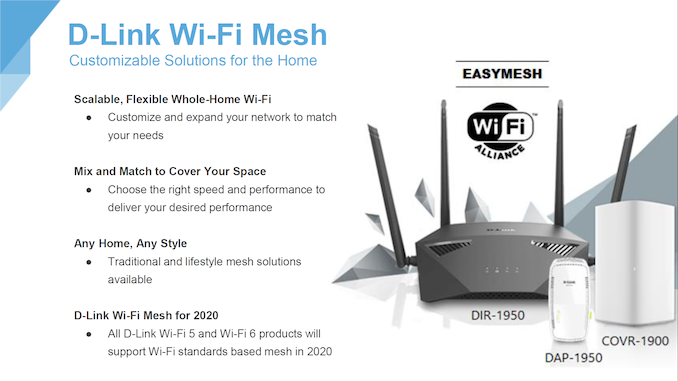
At CES 2020, D-Link is announcing a set of routers and access points with D-Link Wi-Fi Mesh. Even though the Wi-Fi Alliance has not officially released the EasyMesh standard yet, D-Link promises that the new products with D-Link Wi-Fi Mesh will work seamlessly with other products that adopt the EasyMesh standard.


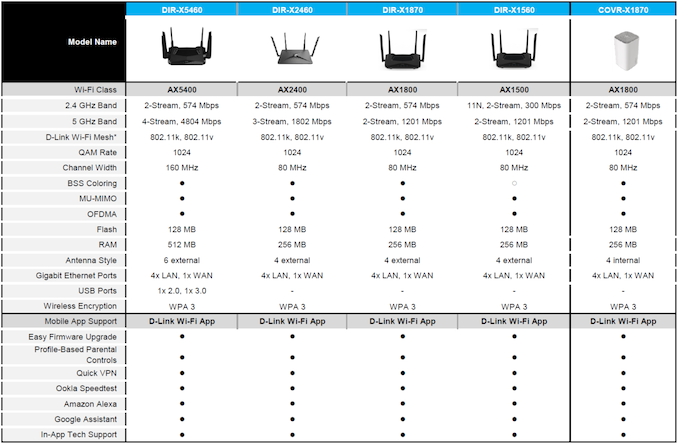
The new products also include some cost-effective Wi-Fi 5 (802.11ac) solutions, though the major ones are all based on the Wi-Fi 6 standard. A comparison of the features of the new products is provided below.


The gallery below presents details of the new products in the stack:


Pricing ranges from $100 for the DIR-1750-US AC1750 mesh router and the DAP-1755-US AC1750 mesh Wi-Fi range extender to $280 for the DIR-X5460-US Smart AX5400 mesh Wi-Fi 6 router.


Source: AnandTech – D-Link Announces New EasyMesh-Compatible Wi-Fi 6 Gateways and Extenders

Wi-Fi Alliance Announces Wi-Fi 6E Moniker for 802.11ax in the 6 GHz Spectrum

   Wi-Fi platform vendors have long been citing the lack of enough spectrum in the 2.4 GHz and 5 GHz bands as true gigabit wireless becomes commonplace. In fact, despite support for 160 MHz channels in the Wi-Fi 6 standard, very few consumers are able to actually utilize it because the dynamic frequence selection (DFS) feature is often disabled by default. DFS is necessary to prevent Wi-Fi devices operating in the 5 GHz band from interfering with radars that are licensed users of the channels in that band. Wi-Fi devices essentially use unlicensed spectrum for communication. As more and more gigabit wireless devices get deployed, the available spectrum capacity in the 5 GHz band may soon get exhausted.


Unlicensed Operation in the 6 GHz Band


The FCC has been considering the opening up of the 6 GHz band (essentially, the 1.2 GHz unlicensed spectrum span just above the currently used 5 GHz band) for unlicensed operation. Wideband unlicensed channels of 160 MHz and more may become essential to achieve expected performance from 802.11ax, 802.11be, 4G LTE, and 5G NR in unlicensed spectrum. Opening up a continuous 1200 MHz chunk will enable substantial amount of new bandwidth over multiple wide bandwidth channels.


Unfortunately, even though there are no currently unlicensed users of the 6 GHz band, certain fixed wireless point-to-point long-range deployments are licensed to utilize it. Wi-Fi platform vendors such as Qualcomm and Broadcom have been confident of working with those users to prevent any interference. Their key message to the licensed incumbents is that any Wi-Fi deployment in the 6 GHz band would use LPI (low-power indoor) operation and can also implement AFC (automated frequency coordination). LPI operation, for example, may impose restrictions on the total EIRP (effective isotropically radiated power) and PSD (power spectral density) for Wi-Fi devices. This will prevent interference due to low power levels and substantial building losses. In addition, most licensed users of the spectrum have their point-to-point endpoints well above the ground (mounted atop towers and buildings), and devices rated for LPI operation are not likely to affect them. AFC involves the maintenance of a database where licensed users are tracked based on their deployment location, and any unlicensed Wi-Fi usage in that spectrum capable of interfering with the licensed users could automatically shift to a different channel.


Wi-Fi 6E


The Wi-Fi Alliance is introducing a new terminology to distinguish upcoming Wi-Fi 6 devices that are capable of 6 GHz operation – Wi-Fi 6E. This is essentially the benefits of Wi-Fi 6 / 802.11ax (higher performance in terms of faster data rates as well as lower latency) in the 6 GHz band. Wi-Fi 6E devices are expected to make it to the market relatively quickly after regulatory approval, as it only requires changing the antenna tuning / RF front end on existing devices.


As explained earlier, 6 GHz addresses Wi-Fi spectrum shortage by providing contiguous spectrum blocks to accommodate up to 14 additional 80 MHz channels and 7 additional 160 MHz channels. Wi-Fi 6E devices can make use of the wider channels and additional capacity to provide better performance and support denser deployments. At CES 2020, the Wi-Fi Alliance is also announcing the development of interoperability testing for Wi-Fi 6E devices.


Source: AnandTech – Wi-Fi Alliance Announces Wi-Fi 6E Moniker for 802.11ax in the 6 GHz Spectrum

CES 2020: The Lenovo Yoga 5G with Qualcomm’s 8cx and Support for mmWave/Sub-6

We’ve been tracking the development of ‘always connected PCs’ since Qualcomm entered the laptop market with promises of enhanced connectivity and all-day battery life. Depending on the market, it’s the latter that resonated most with users: a full 24 hours of real battery is a killer feature. Nonetheless, the desire to enhance the experience with more connectivity options is the primary purpose of this segment, and with the latest 8cx hardware almost ready to go, as one of Qualcomm’s primary partners, Lenovo is almost ready with its newest 5G Yoga device.


So I’ve actually had one of Lenovo’s older Yoga 630 WoS units, equipped with the Snapdragon 855, and the main purpose I use it for is two-fold: as the ultimate backup at events or as the sole device when I’m working and I can’t guarantee a power outlet (say, a 11+ hour flight in economy). The thing it needs is speed, especially as we’re talking about Windows on an Arm-based device. Qualcomm is promising speed with the new 8cx chip, and when paired with a Snapdragon X55 modem, the idea is that for 5G enabled offices and markets, connectivity won’t be an issue.


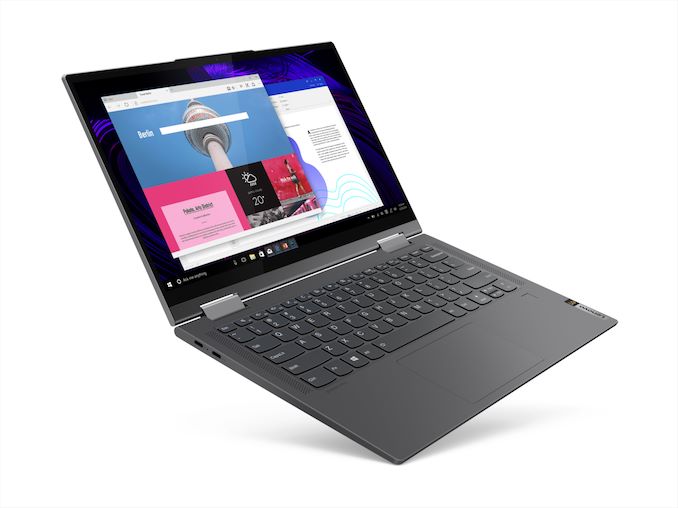
The new Lenovo Yoga 5G builds on the design of the Yoga 630 WoS, by offering a similar 14-inch 1920×1080 IPS display at 400 nits, a 60 Wh battery, dual USB-C ports, and a fingerprint reader. Aside from the bump from the S855 to the 8cx, the minimum specification also gets a memory/specification lift up to 8 GB of LPDDR4 and 256 GB of UFS 3.0, with a second model offering double the storage.


Inside with the Snapdragon 8cx is the X55 modem, which is stated to have antenna to support both full-band mmWave and Sub 6 GHz networks. Given Lenovo’s business for these devices is likely to be both China and North America, I would assume that this unit should support both (or variants for different markets would be provided). The battery inside, 60 Wh, is almost double the size of the Microsoft Surface that also uses a Qualcomm chip, which would solve the battery life concerns which that device has come under fire for.


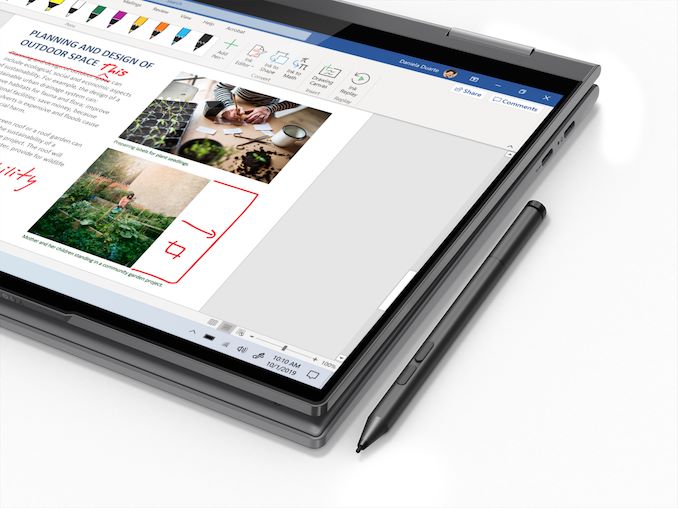
The unit comes in an iron-grey color, like the Yoga C630, and also has a Touch Pen accessory available. Lenovo says the unit will start at $1499, which is a premium over the C630. The release date is listed as ‘Spring 2020’.


Source: AnandTech – CES 2020: The Lenovo Yoga 5G with Qualcomm’s 8cx and Support for mmWave/Sub-6

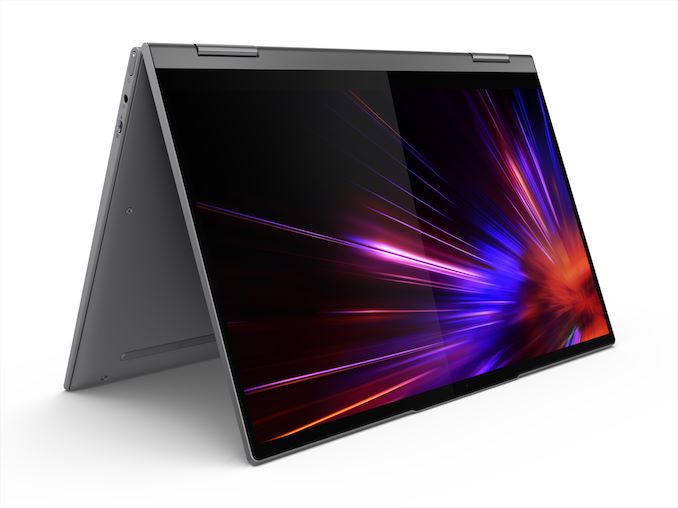
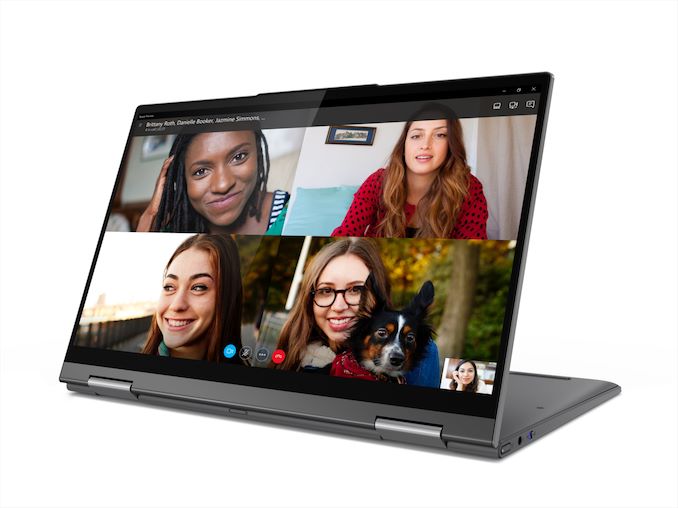
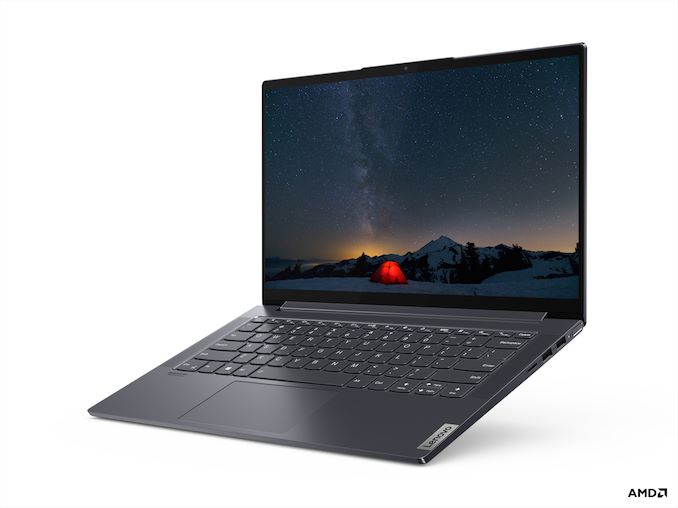
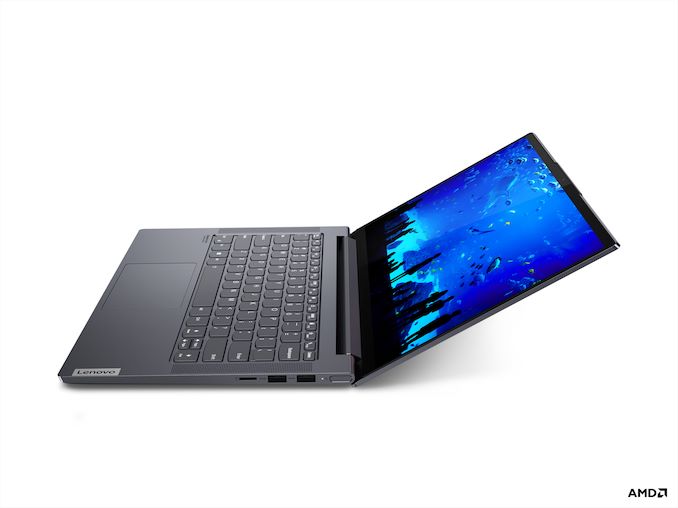
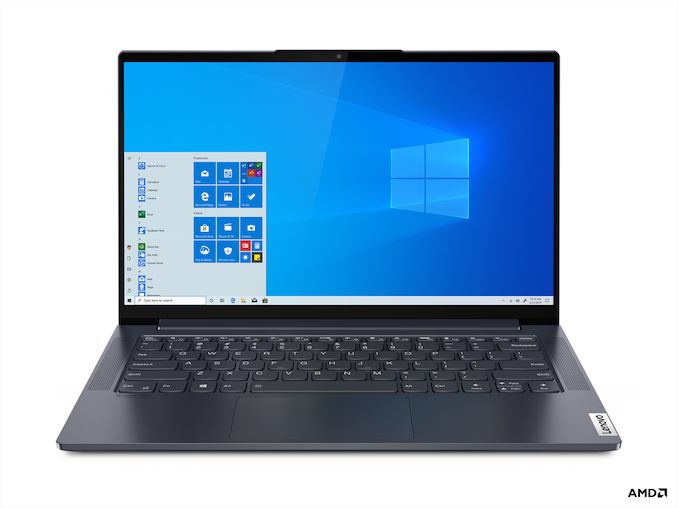
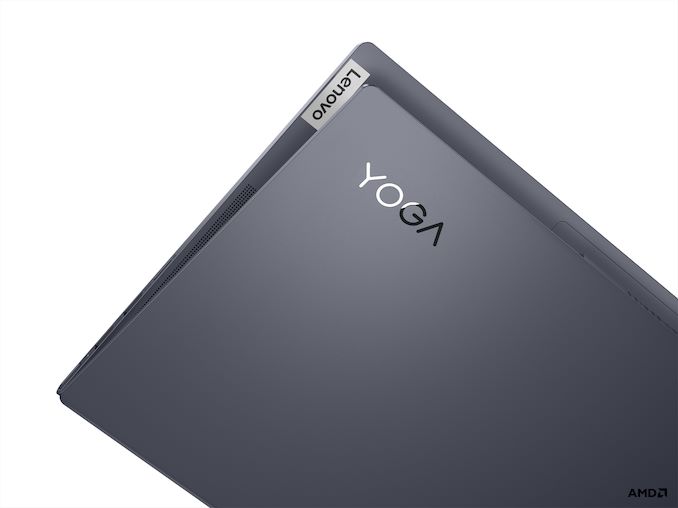
CES 2020: Lenovo Yoga Slim 7, with AMD 4000 APU inside, Coming March

One of the big questions through late 2019 was whether AMD would be releasing its newest Zen 2-based mobile processors by the end of the year. At the time this embargo lifts is AMD’s press conference at the annual CES trade show, and we should know more. But in advance of that announcement, Lenovo provided us a pre-briefing where it gave us details about its new Yoga Slim 7 laptop, featuring one of the new processors. The release date  for this unit is listed as March, which matches the other devices showcased by other OEMs with the same processors.


Lenovo’s Yoga Slim range prides itself on offering full-sized mobile devices in a ‘thinner-than-you-expect’ form factor for the price. The Yoga Slim 7 being discussed today at CES with AMD’s Ryzen 4000 inside is a 14-inch display device featuring a 1920×1080 IPS display, offering up to 16 GB of LPDDR4X memory, up to a 1 TB NVMe SSD, two USB 3.2 ports, one multi-mode Type-C port, 802.11ac WiFi, and an IR camera, all for 14.9 mm thickness (0.58 inches).


Prices will start at $699, although that doesn’t state which processor/memory/storage configuration that would be. The battery comes in at 60.7 Wh, which Lenovo is stating should be good for 14 hours, which would be a sizeable uplift in mobile battery efficiency from AMD.


There will also be an Intel version with similar specifications, with only the Ice Lake Core i7-1065G7 CPU as an option, but otherwise similar specifications (an optional NVIDIA MX GPU) and similar battery life estimates. The difference is that one starts at $1210, and will be in the market from April 2020.


We will hopefully get some hands on with the devices at CES, so stay tuned for more information.


Source: AnandTech – CES 2020: Lenovo Yoga Slim 7, with AMD 4000 APU inside, Coming March

Lenovo’s ThinkPad X1 Fold: Combining Foldable Displays, 5G and Lakefield into a… Laptop?

In 2019 we were exposed to the first foldable display smartphones and wearables, with the Samsung Galaxy Fold, Huawei Mate X, and Xiaomi Mi Mix all demonstrating various themes of a foldable display in a hand-held device. Two of the main concerns with those devices is longevity of a display opened 50+ times a day, and durability if the display is on the outside. Clamshell Notebooks arguably don’t have those restrictions, so it makes sense to bring the technology to something more for business use (especially with the costs). Enter Lenovo’s ThinkPad X1 Fold.


Source: AnandTech – Lenovo’s ThinkPad X1 Fold: Combining Foldable Displays, 5G and Lakefield into a… Laptop?

CES 2020: Qualcomm Press Conference Live Blog 11am PT

Hello all, we’re continuing the day hre at CES 2020 with Qualcomm’s press conference event. We’re likely to hear more about 5G adoption as well as the new Snapdragon chips, but we heard we might also hear about some other topics such as automotive. Stay tuned as we’ll be live blogging the event, starting shortly.


Source: AnandTech – CES 2020: Qualcomm Press Conference Live Blog 11am PT