CES 2020: ASUS Unveils All-White Concept Strix X570 Motherboard

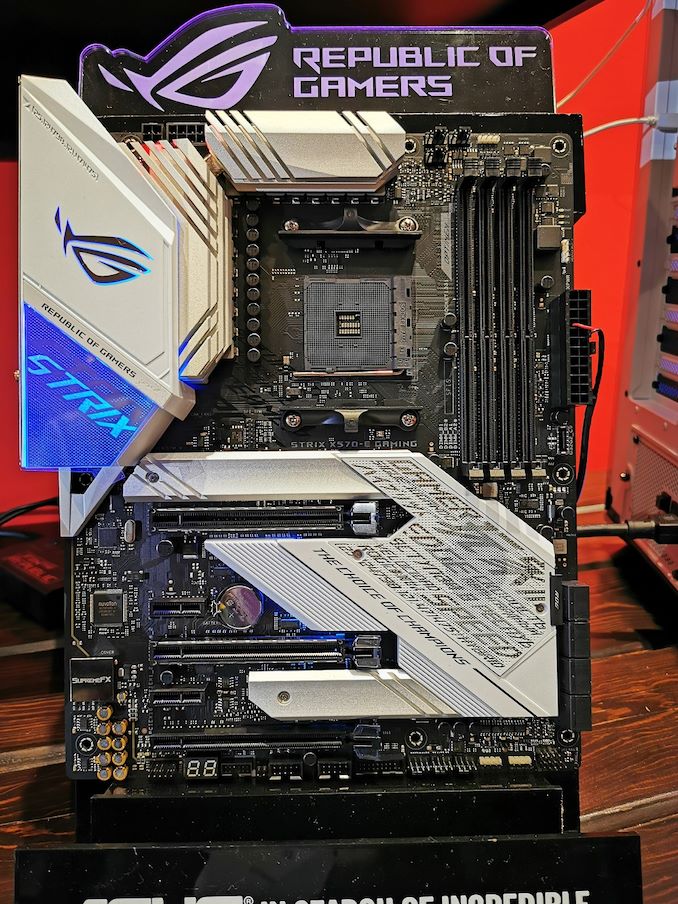
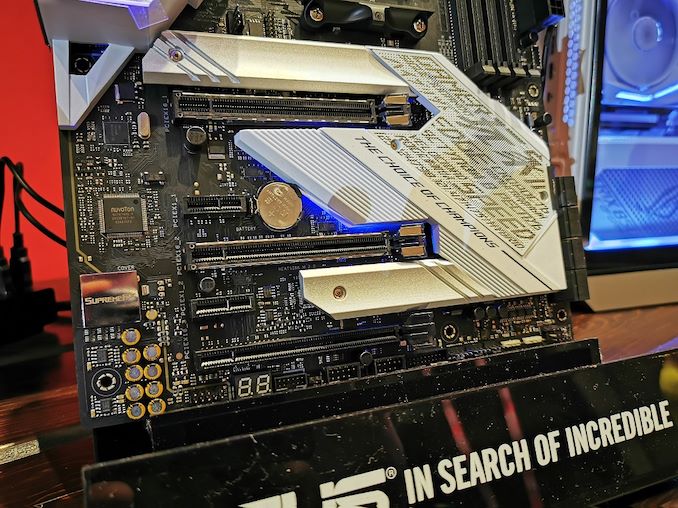
Amid a plethora of ASUS announcements and product showcases at CES 2020, one of the more interesting pieces of hardware on display came on the motherboard side. In what ASUS is currently calling a concept, it had a full system with white components on display, including an X570 Strix motherboard dressed to the nines in white heatsinks and covers.


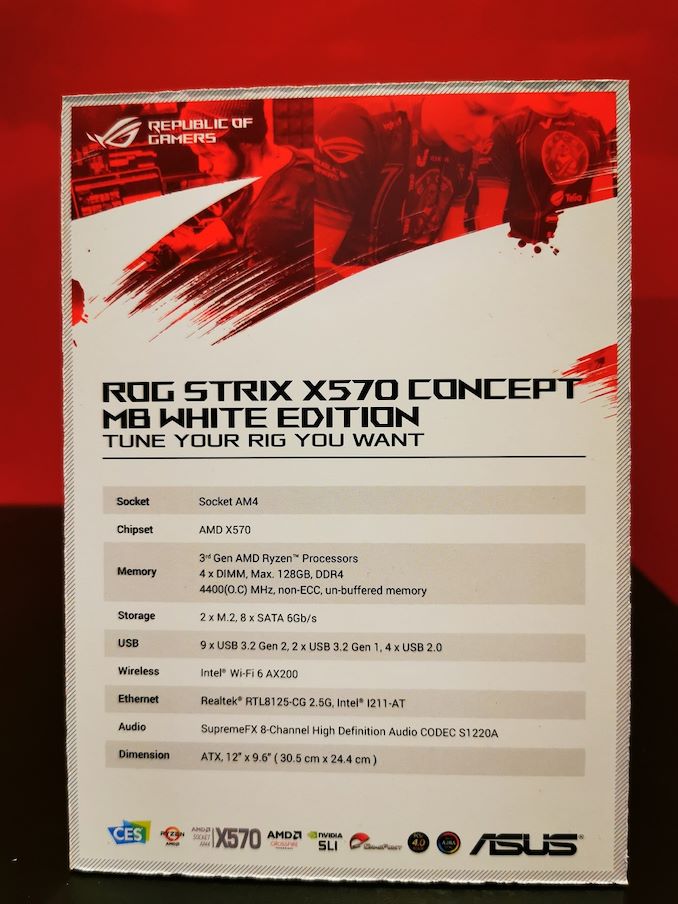
While ASUS hasn’t given much away about which model it’s based on. the specifications list include support for DDR4-4400 memory with a capacity of up to 128 GB, with an Intel AX200 Wi-Fi 6 wireless interface, and a Realtek RTL8125-AG 2.5 G Ethernet controller. A SupremeFX S1220A HD audio codec handles the onboard audio, while the rear panel features plenty of USB 3.2 Gen2 connectivity. The PCB, controller layout and overall PCB layout not only resemble the ASUS ROG Strix X570 E Gaming motherboard, but it has identical specifications match between the two boards.


On the rear panel cover is the typical Strix branding with an illuminated Strix RGB logo, while the M.2 heatsinks and chipset heatsink have the Strix inspired graffiti etching. A two-digit LED debugger is located at the bottom, with plenty of headers and connectors for superior connectivity; again, resemblant of the ASUS ROG Strix X570 E-Gaming. As with all other ASUS X570 models, the X570 is actively cooled. 


At present, the all-white ROG Strix X570 motherboard is just a concept, but we’ve seen ASUS release white themed models before including the Prime series, as well as limited-edition versions of its Sabertooths (now TUF). This could be one ASUS concept that makes it to retail, but it still remains to be seen. 


Related Reading


Source: AnandTech – CES 2020: ASUS Unveils All-White Concept Strix X570 Motherboard

CES 2020: ViewSonic Joins Big Format Game w/ 55-Inch 4K 120 Hz OLED Gaming Display

Demand for larger gaming displays is growing these days, so it is not surprising that more and more manufacturers have introduced 37.5-inch and bigger LCDs. But up until recently, there has still been a pretty big cutoff between PC-centric gaming monitors, and console-centric gaming TVs. Those differences are starting to fade away however, as traditional PC monitor manufacturers are increasingly dipping their toes into ultra-large big format displays, which offer screen sizes above 50 inches. ViewSonic in turn is the latest manufacturer to try their hand at a large format display, announcing its 55-inch 120 Hz OLED display at CES 2020.


ViewSonic’s Elite XG550 features a 3840×2160 resolution, a 0.5 ms GtG response time, and a 120 Hz maximum refresh rate. Since we are dealing with an OLED panel, it may not necessarily have a very high peak brightness, but given its natural ability to offer deep blacks as well as a very high contrast ratio, it should provide a very life-like picture. The monitor can reproduce 99% of the DCI-P3 color gamut, which is well in line with what professional LCDs can do.


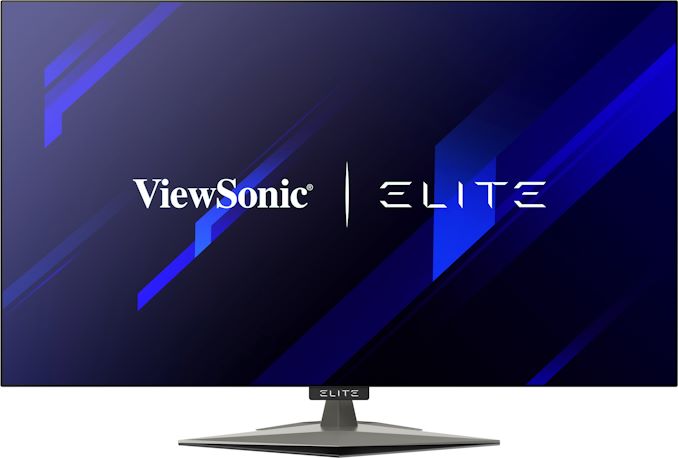
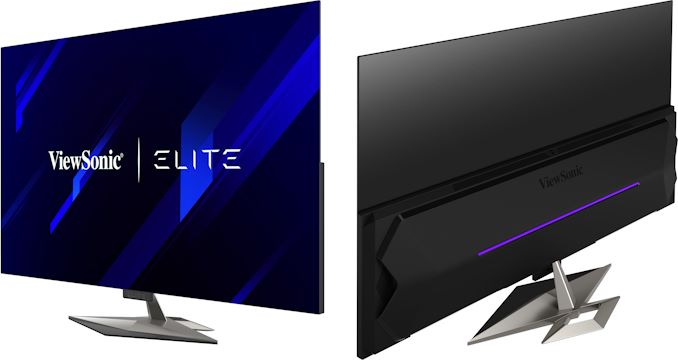
One thing that strikes the eye about the Elite XG550 is its rather narrow bezels. In general, the monitor looks extremely futuristic and an RGB lighting on the back just emphasizes this design


Unfortunately, while the display is being announced this week, ViewSonic is closer to teasing the display than they are to commercially shipping it. So the company hasn’t disclosed what kind of connectors the Elite XG550 has, which variable refresh rate technology it supports, and whether it supports any HDR transport technology (though judging from this week’s other 55-incher, that’s unlikely). Ultimately, as the company isn’t saying anything about its launch timeframe, it looks like the monitor is still work in progress.


ViewSonic Elite XG550 Display Specifications
Panel 55-inch OLED
Resolution 3840 × 2160
Refresh Rate 120 Hz
Response Time 0.5 ms gray-to-gray
Brightness Peak: ? cd/m²
Contrast ?:1
Viewing Angles ?°/?° horizontal/vertical
Color Saturation 99% DCI-P3
Display Colors 1.07 billion
3D-LUT ? bits
Pixel Pitch 0.3108 mm²
Pixel Density 81 PPI
Anti-Glare Coating ?
Inputs ? × DP 1.4

? × HDMI 2.0

? × USB-C
USB Hub ?
Audio ?
Mechanical Design Chassis Colors: black, metallic, w/RGB LEDs
Power Consumption Idle ? W
Active ? W

A thing to note about the ViewSonic Elite XG550 is that it is the third 55-inch OLED gaming monitor introduced in the last 12 months after Dell’s Alienware 55 as well as Acer’s Predator CG55K. Considering that there are not many 55-inch 4K 120 Hz OLED panels around (and it looks like only one large maker produces them), it is very likely that the Elite uses same panel as the other two displays, and will end up with very similar characteristics.


Related Reading:


Source: ViewSonic


Source: AnandTech – CES 2020: ViewSonic Joins Big Format Game w/ 55-Inch 4K 120 Hz OLED Gaming Display

CES 2020: HP’s Envy All-in-One 32 w/ Core i7, GeForce RTX 2080, HDR600, 2.1 Audio

Although all-in-one desktops are rather popular among many casual users, high-performance AIOs remain exotic and yet have to take off. At CES 2020, HP has introduced its new Envy 32 All-in-One desktop with ingredients that will make many fully-fledged desktops jealous. The system has an advanced Intel Core i7 CPU, NVIDIA’s high-end GPU, a sophisticated audio sub-system, and, even more importantly, a very good 4K display.


HP’s Envy 32 All-in-One system is based on Intel’s 9th Generation Core i7 processor with up to eight cores and up to 65 W TDP that is accompanied by up to NVIDIA’s GeForce RTX 2080 discrete GPU. The PC comes with NVIDIA Studio drivers certified by developers of over 40 professional creative and design applications, so it ready for these programs out-of-box. The machine can also be equipped with up to 32 GB of DDR4 memory as well as 1 TB PCIe SSD or even two drives. Considering the desktop components inside, and the socketed nature of the CPUs and memory, user-upgradability may even be possible.


Considering rather powerful hardware inside the Envy 32 All-in-One, it is aimed at people who do some serious work and need more than one monitor and expanded storage. To that end, the AIO has a Thunderbolt 3 port and an HDMI output to connect a DAS and an additional displays. Quite naturally, there are also other ports available for peripherals and other expansions. Furthermore, expect the AIO to feature Wi-Fi and Bluetooth.


One of the key advantages of the Envy 32 All-in-One is its 31.5-inch 4K Ultra-HD monitor that features 600 nits brightness, a 6000:1 contrast ratio, and can display 98% of the DCI-P3 color space. This will make the Envy 32 the first PC display to feature HDR 600 certification. Also, the LCD will come factory-calibrated to a Delta E<2 accuracy. This will be the first  On top of the display is a pop-up webcam that physically turns on and pops up when it is needed by a legitimate Windows 10 application.


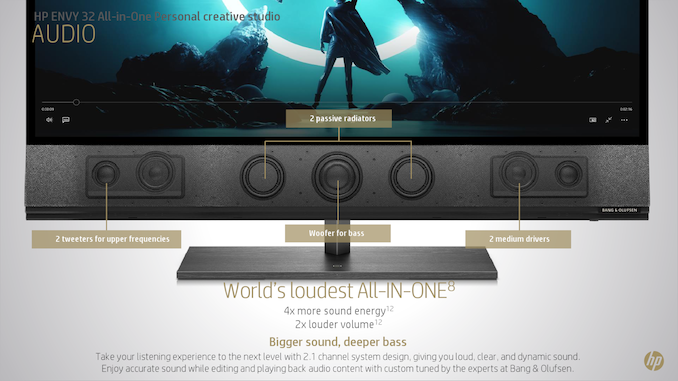
As for audio, the Envy 32 All-in-One comes with a 2.1 audio sub-system co-developed with Bang & Olufsen that features two tweeters, two medium drivers, and a woofer. It is noteworthy that the speakers can be used to stream audio from a Bluetooth-enabled smartphone or a tablet without turning the PC on.


The HP Envy 32 All-in-One comes with a wireless Bluetooth keyboard and mouse. The former has a special slot for a smartphone and a tablet and assuming that these devices support external BT keyboards, Envy’s keyboard can be used to type SMS or emails.


As for design, the Envy 32 All-in-One features a black chassis, ultra-thin display bezels, heathered acoustic cloth on the speakers, and a metal base with dark ash woodgrain finish. Speaking of the metal base, it also integrates a wireless charging pad.


The new HP Envy 32 All-in-One is now available directly from HP as well as from leading retailers like Amazon or Best Buy. Entry-level configurations start at $1599.99, whereas higher-end machines are naturally more expensive.


Related Reading:


Source: HP


Source: AnandTech – CES 2020: HP’s Envy All-in-One 32 w/ Core i7, GeForce RTX 2080, HDR600, 2.1 Audio

Who wants a $14,000 Gaming Seat? Coming to the USA: The Acer Predator Thronos Air

AnandTech’s readers split into a number of categories, and Acer’s Predator Thronos Air certainly falls into the category of ‘whoever buys this has a lot of money’. Acer has already released its first generation Thronos Air, a fully combined PC desk/seat with mounted monitors and combined Predator PC, into several markets, and received a good deal of attention from the fact that no-one knows who exactly would buy a dedicated seat and monitor setup as an all-in-one solution. It turns out that there seem to be enough people willing to put down several thousand Gs in order to get one, because Acer is bringing it to the USA.


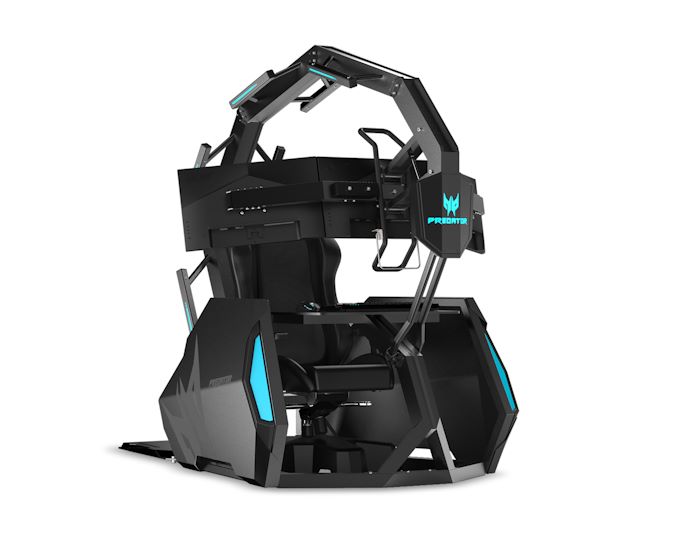
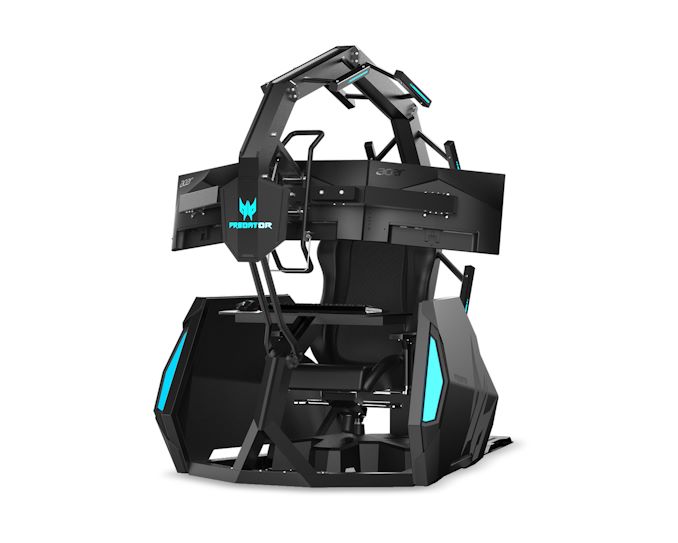
The Thronos Air design is essentially a self-contained gaming throne. The shaped frame has a number of LEDs inside, and is built to house a ‘gaming’ chair, a full Predator PC at the side, and then an arm comes over the users head to hold up three large 27-inch monitors. Obviously this puts limits on weight and height for those that can use it, although it covers most of the population. But the idea is that this is a dedicated gaming machine in the same way that some enthusiasts go all out and spend $10k on a multi-axis racing seat. This doesn’t move like a gaming seat, but it’s just meant to be a dedicated gaming space so that users can feel immersed, especially with the wide displays and the powerful PC behind that can drive term. Or it can look neat in an office I guess?


Acer says that the Thronos Air is modular, adjustable, and customizable. I don’t think there’s a big modding community on this, just because of the price. With a fully laden Predator PC capable of driving three monitors at top settings, Acer has a price tag of $13999 on this thing, and it is expected to be available from March 2020.


(I had to keep editing this news. It’s Thronos, as in ‘throne’. Not Theranos, as in the failed biochem company. And not Thanos, the big mean dude in Marvel. Though I could imagine Acer doing a one-off tie-in.)


Source: AnandTech – Who wants a ,000 Gaming Seat? Coming to the USA: The Acer Predator Thronos Air

Samsung Shows Off Premium Galaxy Chromebook at CES 2020: 13.3-inch Convertible With 4K AMOLED & More

While sales Chrome OS-powered laptops are continuing to grow, the vast majority of these PCs – and arguably the platform itself – have been positioned as entry-level solutions both in terms of price and in terms of hardware. As a result, premium Chromebooks have historically been a commercial footnote; Google and Acer (among others) have developed some models, but nothing has really made a lasting impact on the larger Chromebook market.


Samsung, however, thinks that they finally have a winning formula for a high-end Chromebook. With the new Samsung Galaxy Chromebook, announced this week at CES, Samsung is looking to up the ante on what to expect from a Chromebook both in terms of design and hardware, putting together a Chromebook that can rival premium Windows notebooks in everything from features to pricing.


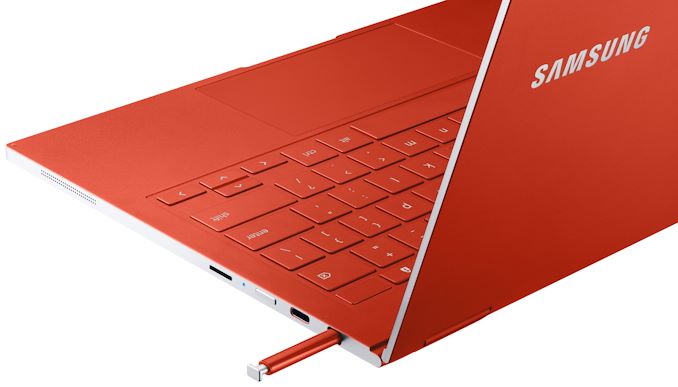
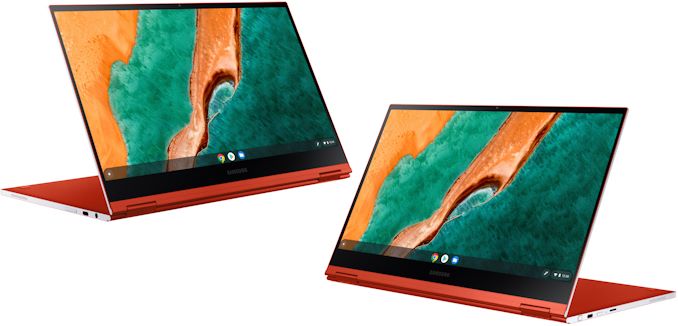
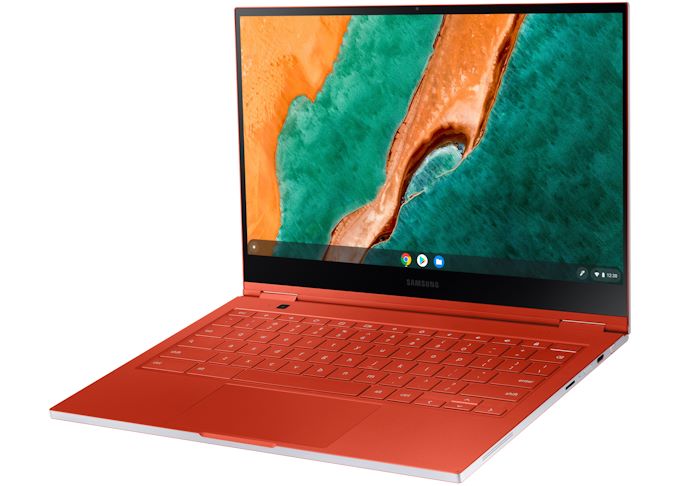
The 13.3-unch Samsung Galaxy Chromebook starts things off with a touch-enabled AMOLED display which offers a 3840×2160 resolution, a peak brightness of 400 nits in HDR mode, and a very high contrast ratio (given peculiarities of the AMOLED technology). The Galaxy Chromebook is a convertible and therefore it can be used as a tablet as well. To that end, Samsung equipped the unit with two cameras as well as a built-in stylus.


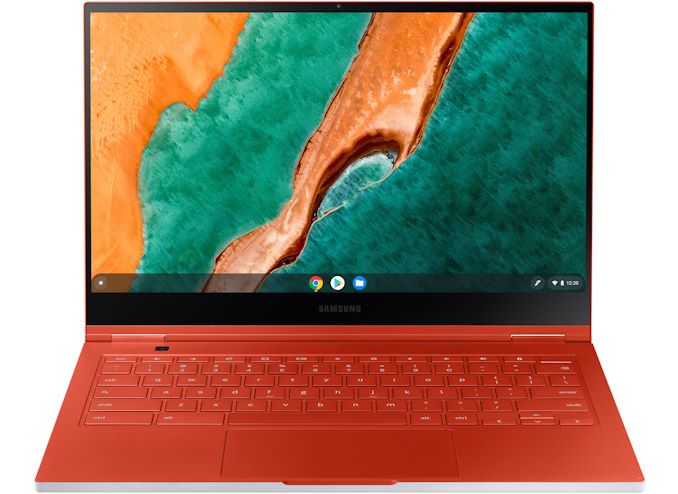
Keeping with the size and weight needs of a convertible, the Galaxy Chromebook is also rather light. The laptop tops out at 1 kilogram thanks to its lightweight aluminum chassis, and is 9.9 mm thick at its largest point. Though you might be hard-pressed to even realize it’s aluminum at first thanks to Samsung’s color choices; the convertible comes in a rather intense Fiesta Red (pictured), or for a lighter touch, Mercury Gray.


Under the hood, the Galaxy Chromebook packs Intel’s 10th Generation Core processor with UHD Graphics, which can be accompanied by up to 16 GB LPDDR3 memory as well as an M.2 SSD with a capacity up to 1TB. While there are numerous Apple MacOS or Microsoft Windows-based PCs to feature a configuration like this, most of Chromebooks come with very limited amounts of DRAM and equally limited storage space. By contrast, Samsung’s Galaxy Chromebook is much closer to a modern, high-end 2-in-1 running Chrome OS.


In fact, Samsung has gone as far as designing the Chromebook to meet Intel’s feature and design standards for Project Athena. So as well as meeting Athena’s performance requirements, the Galaxy Chromebook has also been certified to meet the program’s user experience targets in terms of responsiveness, instant wake, and battery life. Which, with a 49.2 Wh battery, goes a long way in a 13.3-inch laptop.


Meanwhile, the wireless connectivity of the Galaxy Chromebook includes Wi-Fi 6 and Bluetooth, whereas wired connectivity consists of two USB Type-C ports, a UFS/microSD card reader, and a 3.5-mm audio jack for headsets. The system also has two 2W speakers, a microphone array, and a separate mono microphone.


Samsung’s Galaxy Chromebook Convertible
  Galaxy Chromebook
Display Diagonal 13.3″ with touch & pen
Resolution 3840×2160
Brightness 400 cd/m²
CPU 10th Gen Core

(Comet Lake)
Graphics Intel UHD Graphics
RAM up to 16 GB LPDDR3
Storage up to 1 TB SSD
Wi-Fi Wi-Fi 6
Bluetooth Bluetooth
WWAN
GbE
USB 2 × USB 3.1 Gen 1 Type-C
Cameras Front 1 MP
On Keyboard Deck 8 MP
Other I/O UFS/microSD, TRRS connector for audio, speakers, microphones
Battery 49.2 Wh Express Charge
Dimensions Thickness 9.9 mm
Width 302.6 mm
Depth 203.2 mm
Weight 1.04 kilograms
Battery Life ?
Price (starting at) $999

Samsung says that its Galaxy Chromebook will be available this quarter starting at $999.99 for an entry-level configuration, which is comparable to other Athena-class 13.3-inch notebooks, but certainly on the very high side for Chromebooks. And the top-of-the-line SKUs with faster processors and more storage will undoubtedly push that even higher.


Related Reading:


Source: Samsung


Source: AnandTech – Samsung Shows Off Premium Galaxy Chromebook at CES 2020: 13.3-inch Convertible With 4K AMOLED & More

Samsung Launches Portable SSD T7 Touch with Fingerprint Security

Samsung’s mass-market external drive, the Portable SSD T-series, was last updated in August 2017 with the introduction of the T5 with 64-layer V-NAND. The Portable SSD T5 came with a SATA SSD internally and a USB 3.2 Gen 2 (10 Gbps) Type-C port for the host interface. Since then, we have seen a number of technology updates in this market segment including newer flash generations and the introduction of NVMe – USB 3.2 Gen 2 (10 Gbps) bridge chips.


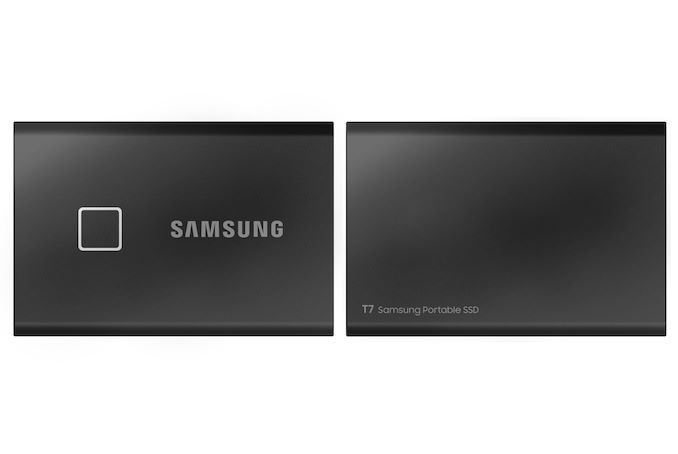
At CES 2020, Samsung is unveiling the Portable SSD T7 Touch and also announcing the Portable SSD T7. Both products place a NVMe SSD behind a USB 3.2 Gen 2 bridge to offer up to read/write speeds of up to 1050/1000 MBps. The performance specifications for the two products are similar, with the only difference being the fingerprint-based security option in the Touch version. Typically, Samsung has used external SSDs as test drivers for new V-NAND generations. For example, the Portable SSD T5 was the retail debut for their 64-layer V-NAND. Based on recent announcements, it looks likely that the Portable SSD T7 Touch and Portable SSD T7 use the sixth-generation 136-layer V-NAND.


The key differentiating aspect of the Portable SSD T7 Touch is the addition of fingerprint-based security to go with the password protection / 256-bit AES-based hardware encryption offered for the data in the internal SSD. External drives adopting biometric security for encryption purposes are rare – the market demanding that level of security is limited. Most of the products adopting this approach (such as the Apricorn Aegis Bio 3, Verbatim Fingerprint Secure HDD, and the Imation Defender H200) carry a significant price premium, with FIPS certification added in certain products to justify it. The Samsung Portable SSD T7 Touch, aimed at casual users, is not FIPS certified. Samsung’s scale and technology advancements have allowed for the pricing of the product at reasonable levels compared to the non-biometrics version. The key specifications of the Portable SSD T7 Touch and Portable SSD T7 are summarized in the table below.


Samsung Portable SSD T7 Touch and T7 Product Specifications
  Samsung Portable SSD T7 Touch Samsung Portable SSD T7
Capacities 2TB, 1TB, 500GB
Interface USB 3.2 (Gen 2, 10Gbps) with backward compatibility
Dimensions (LxWxH) 85 x 57 x 8.0mm (3.3 x 2.2 x 0.3 inches)
Weight 58 grams (2.0 oz)
Transfer Speed Up to 1050 MBps
UASP Mode Supported
Encryption 256-bit AES in Hardware
Security Password Protection S/W

Fingerprint Recognition
Password Protection S/W
Certifications CE, BSMI, KC, VCCI, C-tick, FCC, IC, UL, TUV, CB
RoHS Compliance RoHS2
Colors Black & Silver TBD
Packaged Cables USB type-C-to-C, USB type-C-to-A
Warranty 3 Years Limited
Launch MSRP (USD) $130 (500GB), $230 (1TB), $400 (2TB) TBD

The Portable SSD T7 Touch also features a ‘Motion LED’, allowing the user to determine device status with a single glance. The aluminum casing allows the products to weigh in at just 58 grams.


The product will be available for purchase this month in black and silver, with capacities of 500GB, 1TB and 2TB sizes priced at $130, $230, and $400 respectively. Pricing for the non-biometrics version (retail availability in Q2 2020) was not announced.


Source: AnandTech – Samsung Launches Portable SSD T7 Touch with Fingerprint Security

Fire At Kioxia & Western Digital NAND Fab – Impact on Supply to be Minimal

Kioxia has reportedly informed its customers that a production tool at one of its fabs caught fire early on Tuesday. The fire was promptly extinguished and no casualties were reported, and the impact on the joint venture’s NAND supply is expected to be minimal, according to production partner Western Digital.


The fire occurred in the cleanroom of Fab 6 (pictured), which is a part of the Yokkaichi Operations fab complex owned by Kioxia and Western Digital, according to Wells Fargo senior analyst Aaron Rakers (cited by Blocks & Files). The fire started at approximately 6:10 AM JST on January 7, 2020, and one manufacturing tool was partially damaged, according to a document allegedly sent by Kioxia to one of its customers (and published by TechNews). The precise cause of fire is unknown thus far. Operations were partially interrupted for a brief period, but now are largely back, and the joint venture is working to bring the fab back to normal operational status.


Fab 6 is the latest and most advanced fab in Yokkaichi Operations that kicked off production in September, 2018. At present, the fab produces 64-layer and 96-layer 3D NAND memory. Adjacent Fab 2 and Fab 5 are also used to make 3D NAND flash, so Kioxia and Western Digital continue to make memory at other facilities.


A significant disruption of production at Fab 6 may cause some turmoil on the market, but Western Digital expects impact on supply to be minimal.


Here is what the company had to say:


“On Monday, January 6 (morning, January 7 local time), a small fire occurred at our joint venture facility in Yokkaichi, Japan. Local firefighters quickly extinguished the fire, and we are thankful for their rapid response. No employees were injured, and we are working closely with our JV partner to promptly bring the fab back to normal operational status. We expect any supply impact to be minimal, and will provide updates as appropriate.”


Related Reading:


Sources: Western Digital, TechNews, Blocks & Files


Source: AnandTech – Fire At Kioxia & Western Digital NAND Fab – Impact on Supply to be Minimal

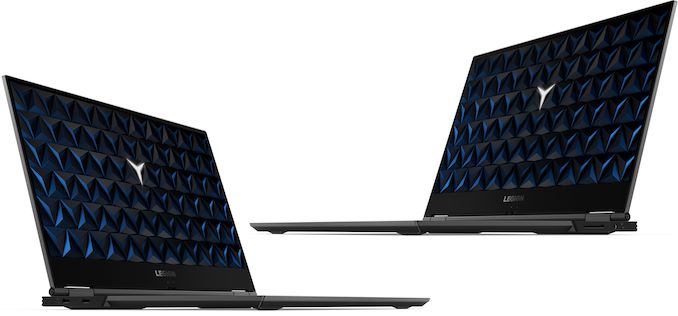
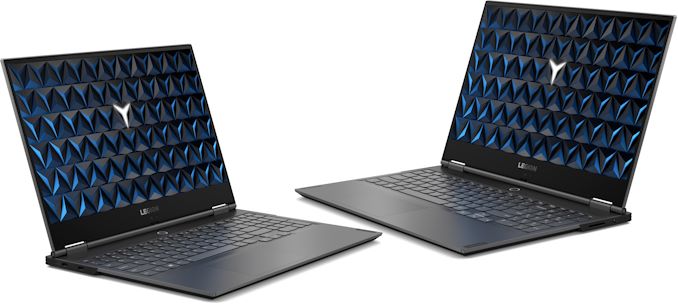
CES 2020: Lenovo Launches Legion Y740S Ultra-Thin 4K 15.6-Inch Gaming Notebook

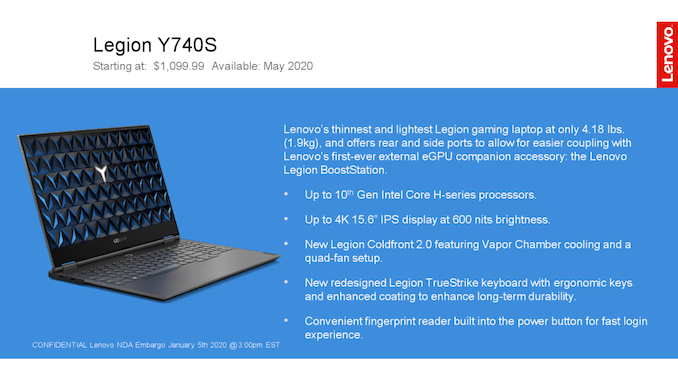
Lenovo has introduced its new ultra-thin 15.6-inch notebook, the Legion Y740S. Formally, the company positions this laptop for gaming and it is meant to be paired with Lenovo’s new Legion BoostStation eGFX solution to get desktop-class graphics performance, yet it can serve as an everyday machine for performance-minded users too.


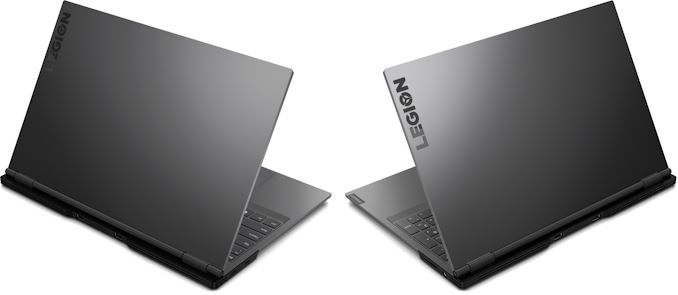
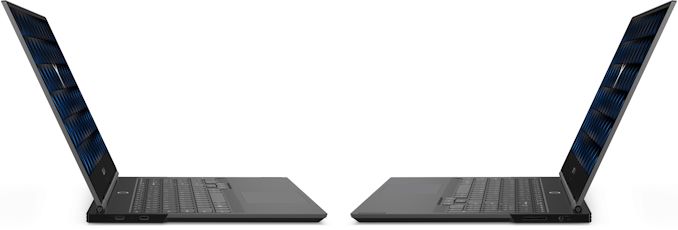
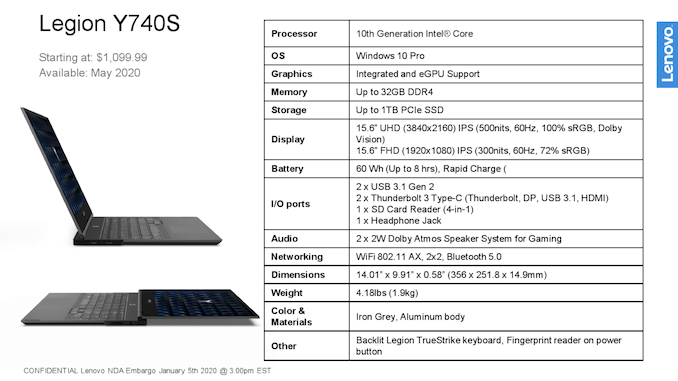
The Legion Y740S weighs just 1.9 kilograms and comes in an Iron Grey aluminum chassis that is just 14.9 mm thick, which is in line with thickness of various 13.3-inch-class machines. Meanwhile, the Y740S comes equipped with a 300-nits Full-HD or a 500-nits Ultra-HD 15.6-inch display panel with a 60 Hz refresh rate.


Inside Lenovo’s Legion Y740S sits Intel’s 10th Generation Core processor H-series with integrated graphics accompanied by up to 32 GB of DDR4 memory as well as an up to 1 TB PCIe SSD. To make sure that the CPU works at full steam at all times, the Legion Y740S uses Lenovo’s new Coldfront 2.0 cooling system comprising of a vapor chamber and four fans.


Connectivity department of the Legion Y740S includes Wi-Fi 6, Bluetooth 5.0, two Thunderbolt 3 ports, two USB 3.1 Gen 2 Type-C connectors, an SD card reader, and a 3.5-mm jack for headsets. Apparently, to make the Legion Y740S laptop as thin as possible, Lenovo decided to get rid of USB Type-A ports as well as of GbE. Still, since the notebook is meant to be paired with the Legion BoostStation that has both USB-A and GbE connectors, the design decision makes sense.


Lenovo says that what sets the Legion Y740S notebook apart from non-gaming ultra-thin 15.6-inch laptops is its TrueStrike keyboard with ergonomic keys and a special coating to ensure long-term durability. In addition, design of its ports, with two on the left side, and two on the back, is arranged in a way to make it easier to connect the Legion BoostStation external GPU box. Finally, the laptop has a dual-speaker Dolby Atmos-supporting audio subsystem.


Lenovo’s Legion Y740S will be available this May starting at $1,099.99.


Related Reading:


Source: Lenovo


Source: AnandTech – CES 2020: Lenovo Launches Legion Y740S Ultra-Thin 4K 15.6-Inch Gaming Notebook

D-Link Announces Nuclias Remote Management Solutions for SMB Networks

Remote management of IT resources on the go has been a pain point for many an IT administrator. Many SMB networking equipment vendors have come out with cloud-based deployment and management options to address this. The options are backed up by both web-based and mobile app-based configuration capabilities. For example, Ubiquiti Networks offers hosted UniFi Cloud Controllers, while Netgear has been slowly expanding the lineup of SMB devices compatible with its Insight Management offering. D-Link is now joining the trend with the launch of Nuclias Connect and Nuclias Cloud remote network management solutions.


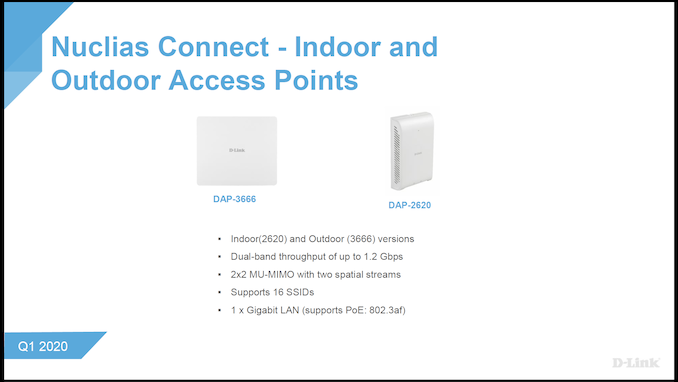
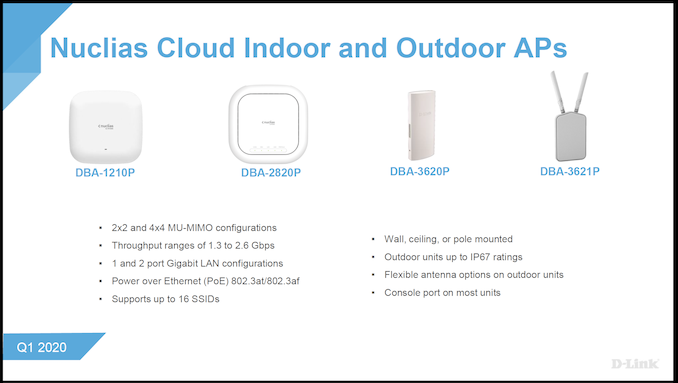
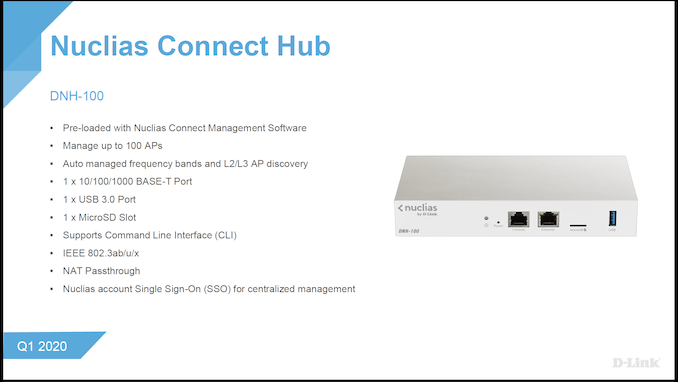
Set to formally launch later this year, Nuclias Connect requires SMB administrators to install the Nuclias Connect Hub (DNH-100) priced at $240 in their network. Compatible access points (indoor-rated DAP-3666, 2×2 MU-MIMO up to 1.2 Gbps, 802.11af PoE, 1x Gb LAN and 1x RJ-11 voice port, or, the outdoor-rated DAP-2620 with similar features, but also carrying IP-68 certification) can then be deployed and administered using the Nuclias Connect desktop software or Android / iOS app.


Nuclias Connect makes administration seamless by allowing management of up to 1000 APs, while featuring L2/L3 access point discovery and NAT passthrough. This ensures that IT administrators can deploy APs from virtually anywhere with an Internet connection.


Nuclias Cloud allows the Connect software to be hosted in the cloud by D-Link, making things easier for certain administrators. D-Link already has a set of switches compatible with Nuclias Cloud.


We believe D-Link will further expand the set of devices compatible with Nuclias Connect in the future. The offering is a bit late in the market compared to already existing solutions from Ubiquiti Networks and Netgear, but, it is always good for consumers to have a wider choice of providers.


Source: AnandTech – D-Link Announces Nuclias Remote Management Solutions for SMB Networks

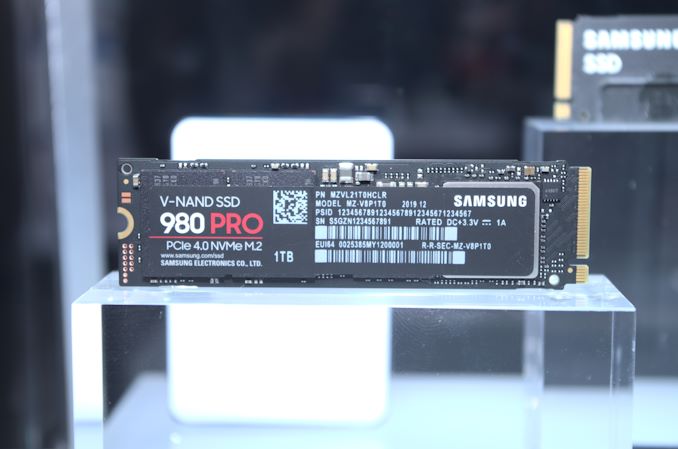
CES 2020: Samsung 980 PRO PCIe 4.0 SSD Makes An Appearance

Samsung’s booth at CES 2020 includes our first look at their next flagship consumer SSD, the 980 PRO M.2 NVMe SSD. This would appear to be Samsung’s first client/consumer SSD to support PCIe 4.0, which has until now only been rolled out to their high-end enterprise drives.


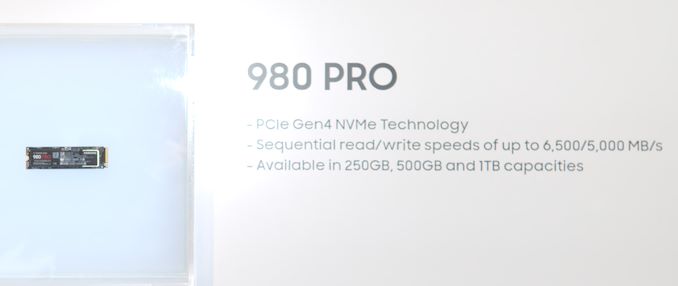
Since this just a low-key preview instead of a formal announcement with a press release, information is limited. The exhibit shows only sequential performance numbers: 6500 MB/s reads, 5000 MB/s writes. That’s a bit better than what we currently see with PCIe 4.0 drives using the Phison E16 controller, but by the end of this year we should start seeing the Phison E18 and other controllers offering sequential speeds around 7GB/s, so the 980 PRO may have little or no time to set throughput records for the consumer SSD market.


The available capacities will range from 250GB to 1TB, which strongly indicates that Samsung us still using 2-bit MLC for the PRO line rather than switching to 3-bit TLC NAND flash as the rest of the industry has done for their flagships. The fate of Samsung’s flagship SSD product line was a bit unclear when Samsung updated the 970 EVO with new NAND as the 970 EVO Plus but did not introduce an accompanying 970 PRO Plus.


Samsung was unable to locate any employees at their sprawling “booth” who could answer our technical questions, so we don’t have confirmation of which generation of V-NAND this uses (probably the 5th gen. 92L), nor do we have any details on the controller. We also don’t have a timeline for retail availability.


Source: AnandTech – CES 2020: Samsung 980 PRO PCIe 4.0 SSD Makes An Appearance

CES 2020: Bluetooth SIG Announces LE Audio Standard: New Baseline For Next Decade

Yesterday the Bluetooth SIG has announced and released the newest Bluetooth standard for audio playback: LE Audio. The new standard is a complete new redesign of the audio stack, building upon the years of learnings that we’ve seen with Bluetooth audio in the past. The new LE Audio standard expends the flexibility and functionality of audio playback over Bluetooth, and is said to represent the new baseline for future developments over the next decade.



Traditional audio playback should be a familiar matter with everybody in the industry as well as consumers. The existing audio stack has now been renamed to “Classic Audio”, and will continue to coexist alongside the new LE Audio standard.


So what does LE Audio bring? The most important aspect of the new standard is self-explanatory and divulged in its very name; it’s based on the new Bluetooth Low Energy radio as opposed to the Bluetooth Classic radio. As a reminder, LE radio is fundamentally different to the classic radio standard and significantly improves upon the power efficiency of transmissions.


LE Audio also brings a lot of new features and helps today’s TWS (True Wireless Stereo) use-cases that we’ve seen over the last few years. TWS audio products nowdays mostly rely on one earpiece receiving the data signal from the transmitter device, and then re-transmits this to its other channel sibling. This is quite inefficient as you might imagine, as you have to transmit from what is usually a very battery limited device. LE Audio now standardises multi-stream transmissions – the source device is the one who handles transmissions of multiple synchronized streams, so for example a smartphone will be able to transmit to both left and right earpieces in TWS products. It is said that the synchronisation here is in the tens of microseconds, allowing for seamless and transparent playback.


There were multiple companies at the launch event showcasing this capability:
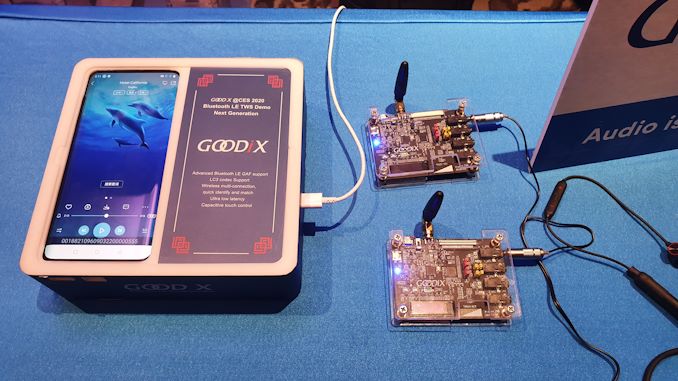


Goodix showcased a production ready development platform with their chipsets, with two of them powering a pair of headphones with flawless synchronisation. Goodix’s demo is Bluetooth 5.1 compliant and supports LE ISOC (isochronous) architecture, which is the official name for this part of the LE Audio standard.
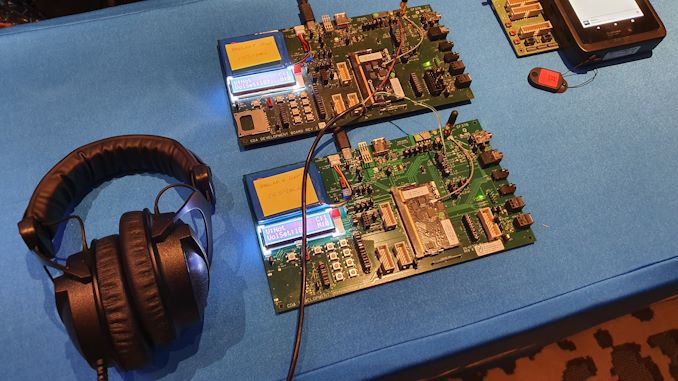


Qualcomm also had a development board showcasing the same feature. Other companies launching LE Audio ISOC solutions were CEVA, Nordic, Dialog and various other vendors.


LE Multi-Stream is envisioned to be able to able to support an unlimited amount of devices when in broadcast mode. Use-cases for this are envisioned to be events and location based broadcasts such as museums or other gatherings, where one would be able to tune into the audio broadcast. It’s to be noted that streams can also be protected as well as public.


Broadcasting also serves as the basis for Audio Sharing, where one can share playback with multiple devices in your immediate surrounding.


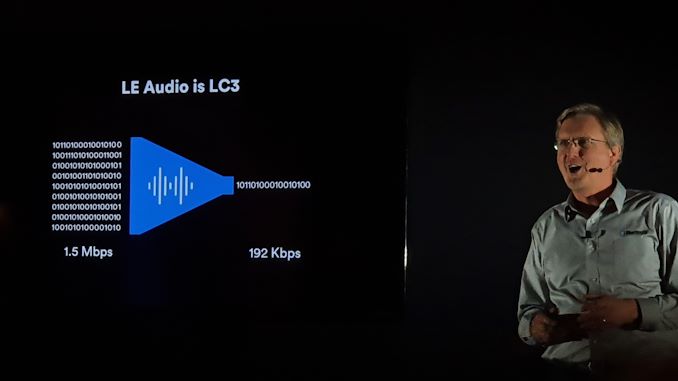
The most important aspect of LE Audio is that it brings with it a brand new base audio codec which massively improves upon the aging and lacklustre SBC standard. LE3 (Low complexity communications codec), is actually a quite complex new codec that promises major upgrades in transmission efficiency as well as audio quality.


The most interesting demonstration at the launch event was that of Tim Reilly of T2 Labs. The showcase here was a software demonstration with the ability to seamlessly switch between codecs during audio playback. Tim demonstrated SBC vs LC3 vs no compression, with users being able to hear the difference with the demo headphones.


There were several comparisons to be made. In an equal bitrate scenario at lower absolute bitrates, LC3 was able to blow SBC out of the water in terms of quality. In general, audio quality would only equal out between the two codecs only when SBC had 3x higher bitrate. In essence, LC3 either allows for three times better quality, or three times less energy used when transmitting audio.
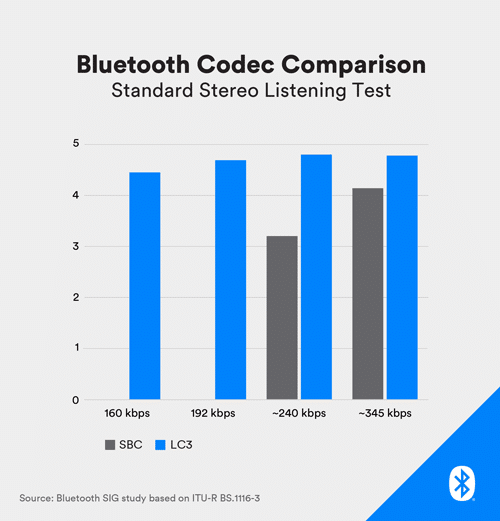


The comparison between LC3 and no compression was also very interesting. Although it was quite a noisy environment, I was unable to discern differences in audio playback quality once the LC3 bitrate reached 192kbps. Let’s say that 256kbps would be damn near transparent in terms of quality. 128kbps the differences started to be audible, but still incomparable to how bad SBC sounds at this bitrate.


The LE Audio standard will be released as several standalone specifications for each feature over the course of 2020. What all the features have in common though is that they rely on a new Bluetooth 5.2 core specification, which was publicly released yesterday.


The Bluetooth SIG expects chip manufacturers to be able to release new designs supporting LE Audio over the course of the next year to 18 months, with consumer products (sources and sinks) to closely follow that timeline, with an expected timeline of 18-24 months.


Overall, LE Audio seems to be addressing some of today’s major shortcomings with Bluetooth audio, and most importantly it standardises a new much more capable codec that will hopefully bring some unison to today’s fragmented BT codec landscape. We’re looking forward to the first devices supporting LE Audio and LC3.


Source: AnandTech – CES 2020: Bluetooth SIG Announces LE Audio Standard: New Baseline For Next Decade

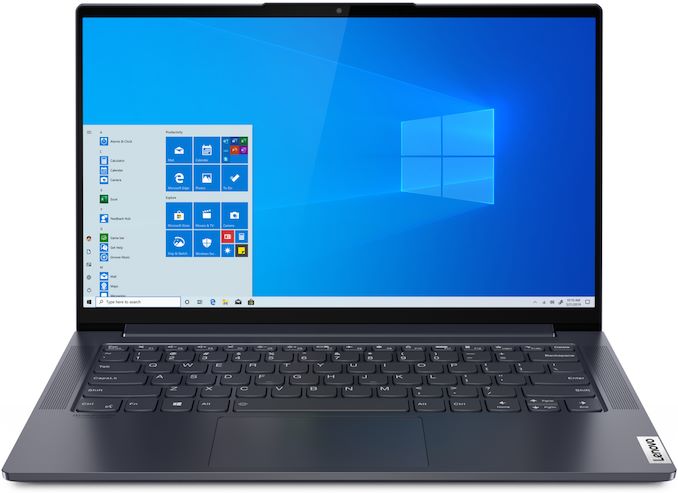
CES 2020: Lenovo Launches Yoga Slim 7 14-Inch w/ Ice Lake & Discrete GPU

One of the key advantages brought by Intel’s Ice Lake processors in addition to higher IPC is its improved integrated Iris Plus Graphics that is meant to offer a much-improved level of graphics performance for ultra-thin laptops. But even so, Lenovo has introduced its new Yoga Slim 7 14-inch notebooks that are powered by Intel’s latest 10nm CPU and offer an optional discrete GPU from NVIDIA.


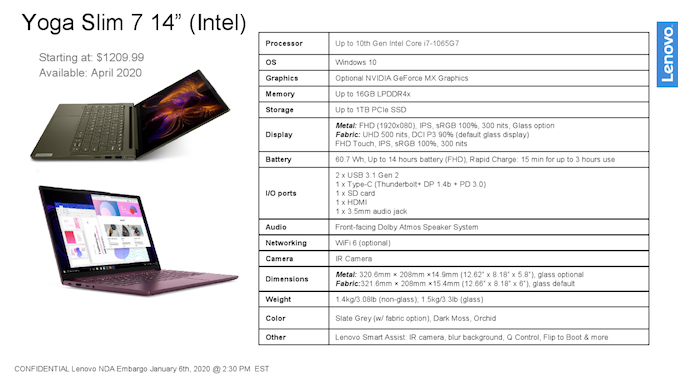
The Lenovo Yoga Slim 7 14-inch is based on Intel’s 10th Generation Core ‘Ice Lake’ processor and may be configured with the company’s top-of-the-line Core i7-1065G7 with four cores clocked at 1.3 – 3.9 GHz as well as well as the Iris Plus Graphics ‘G7’ with 64 EUs and up to 1.1 TFLOPS compute performance. The CPU will share the motherboard with up to 16 GB of LPDDR4X memory as well as an up to 1 TB PCIe SSD.


Meanwhile, for those who want a discrete GPU, Lenovo plans to offer NVIDIA’s GeForce MX option, which in case of the model MX250 features compute performance of around 1.2 TFLOPS, depending on exact clocks. While the standalone GPU in this case is barely better than Intel’s G7, configurations with processors that feature G1 or G4 graphics will clearly be able to take advantage of NVIDIA’s chip.


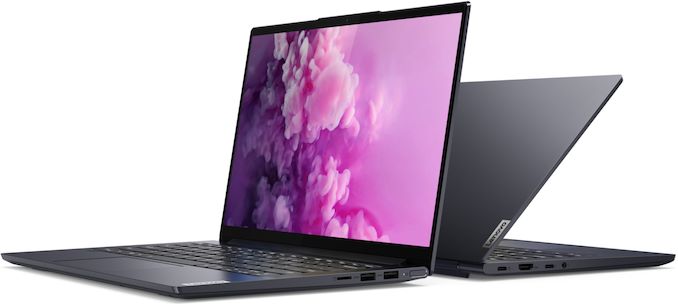
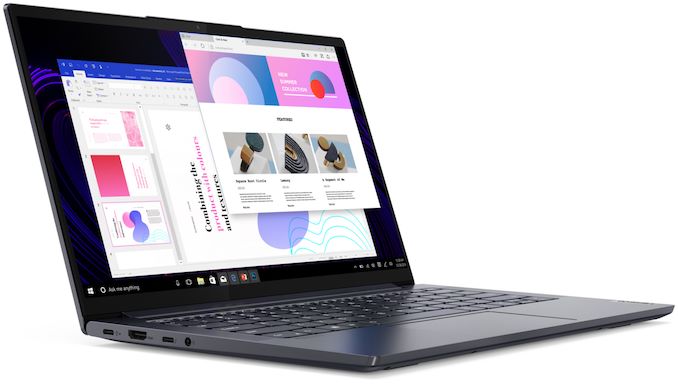
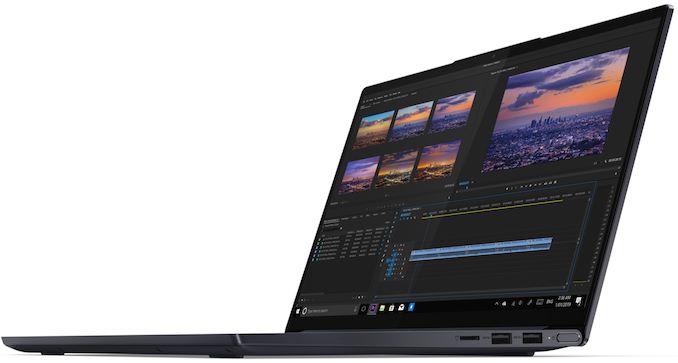
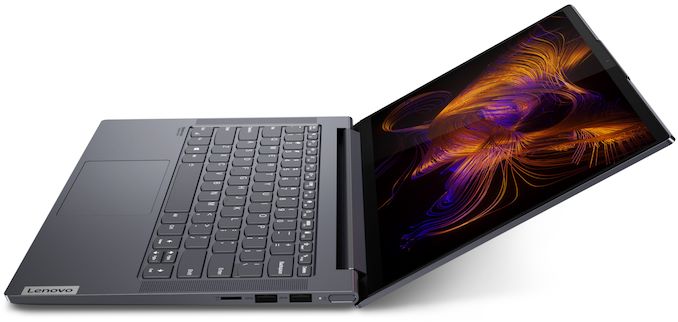
In fact, Lenovo intends to offer two versions of the Yoga Slim 7 14-inch: in a pure aluminum body and in an aluminum body with Slate Grey fabric cover. The SKUs in aluminum body will come with a Full-HD IPS display featuring 300 nits brightness. The Slate Grey fabric models will offer a choice between a Full-HD touch-enabled LCD IPS screen with 300 nits brightness as well as an Ultra-HD IPS display featuring 500 nits brightness along with 90% of the P3 color space coverage. Depending on exact model, the machines are 14.9 mm – 15.4 mm thick and weigh between 1.4 kg and 1.5 kg.


I/O capabilities of all Lenovo Yoga Slim 7 14-inch will be similar and will include a 720p webcam with IR sensors for Windows Hello, Wi-Fi 6, Bluetooth 5, a Thunderbolt 3 connector, USB 3.1 Gen 2 Type-A ports, an HDMI output, an SD card reader, and a 3.5-mm audio jack.



Lenovo says that the Yoga Slim 7 14-inch can last for up to 14 hours on its massive 60.7 Wh battery, though this only concerns a Full-HD version in an entry-level configuration.

The Lenovo Yoga Slim 7 14-inch will cost starting at $1,209.99 when it hits the market this April.


Related Reading:


Source: Lenovo


Source: AnandTech – CES 2020: Lenovo Launches Yoga Slim 7 14-Inch w/ Ice Lake & Discrete GPU

CES 2020: ASUS Showcases Concept 420mm AIO For TRX40

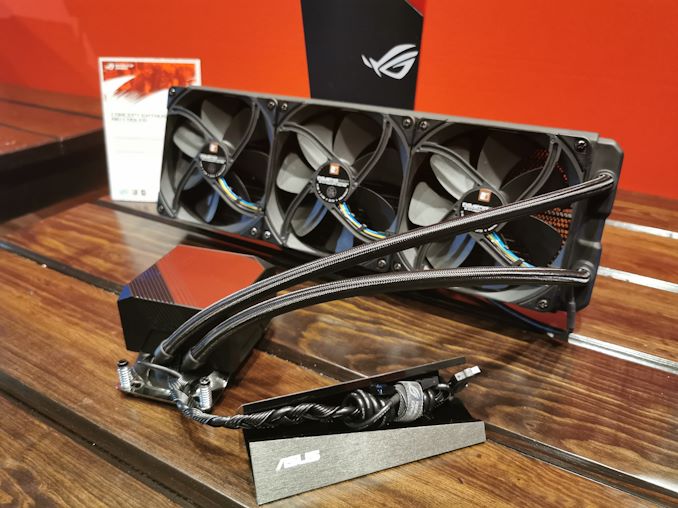
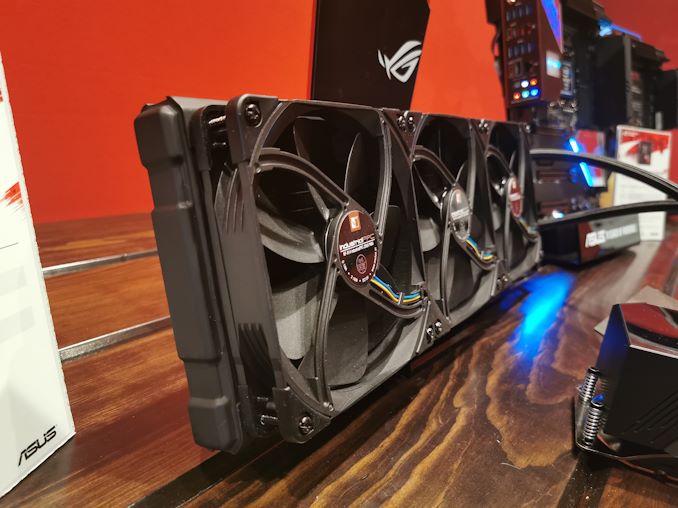
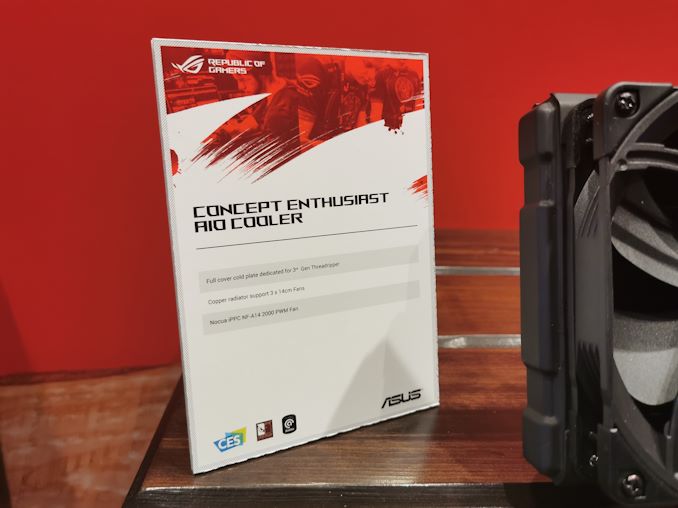
It’s no secret that ASUS has its fingers in multiple areas of computer components including motherboard, VGA, desktop, mobile, and peripherals. Taking into consideration the cooling requirement for AMD’s HEDT Ryzen Threadripper 3000 series of processors, it’s showcased its latest conceptual AIO CPU cooler design which features a large 420 mm radiator, supplied with three premium Noctua black fans. 


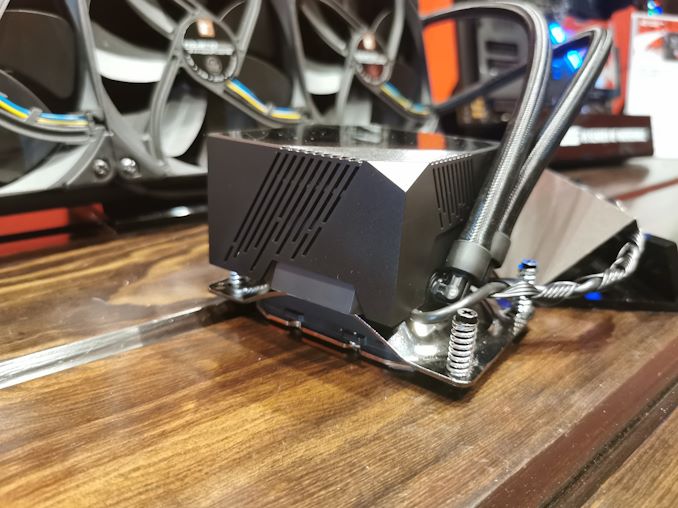
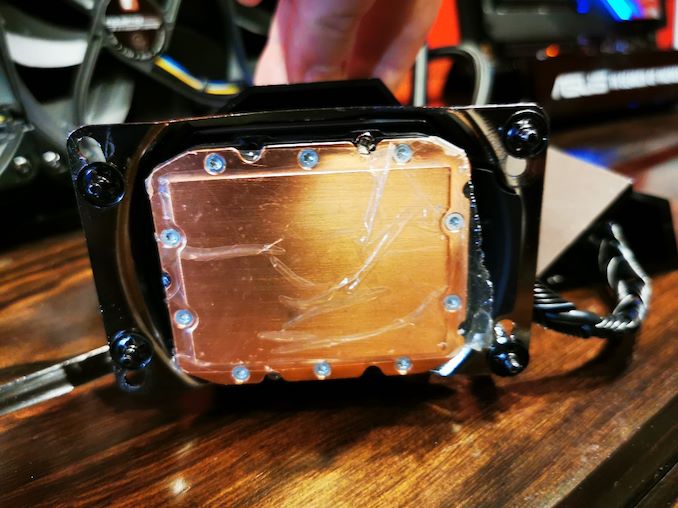
With AMD set to release its 64 core 128 thread Threadripper 3990X in the coming months, ASUS has unveiled a concept design 420 mm AIO CPU with a couple of notable features. The TR4 socket cooler which currently has no name includes an all-black design with no RGB LEDs to speak of, although the CPU block does include ASUS’s 1.77″ LiveDash OLED customizable screen. Other features include a full cover cold plate specially designed to cool the 3rd generation Threadripper processors, with an all-black design that fits well with its ROG Zenith II Extreme TRX40 motherboard.


The unnamed concept cooler as displayed at ASUS’s suite at CES 2020 includes three Noctua NF-A14 2000 PWM fans which spin up to 2000 rpm and omits RGB LEDs for an all-black look which is more subtle. ASUS hasn’t released any more information about when it may hit production, or if it will, but upon speaking to ASUS they were very keen to have it ready for the launch of AMD’s Threadripper 3990X processor which features a TDP of 280 W.


Related Reading


Source: AnandTech – CES 2020: ASUS Showcases Concept 420mm AIO For TRX40

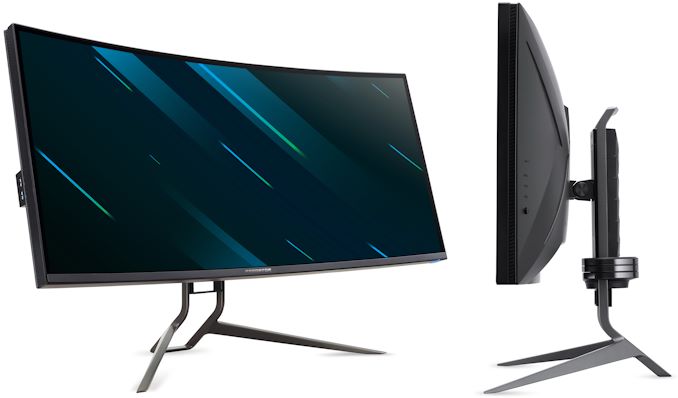
CES 2020: Acer’s Predator X38 Is A 38-Inch Curved Monitor w/ UWQHD+, 175 Hz & G-Sync

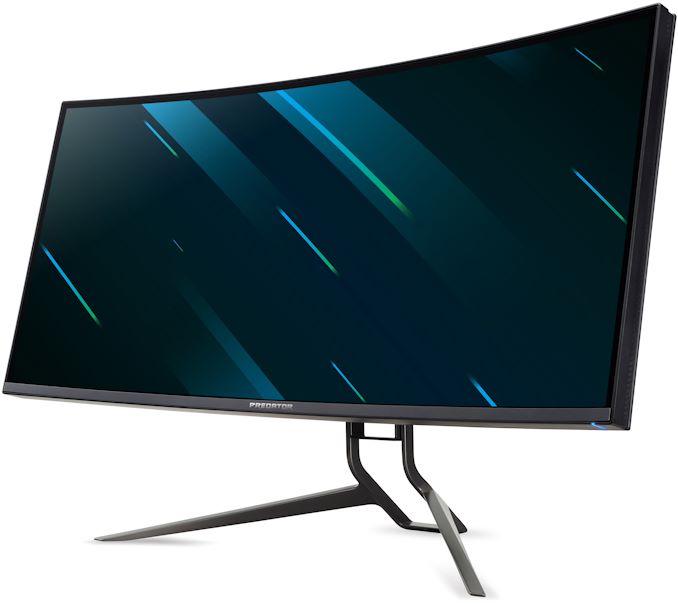
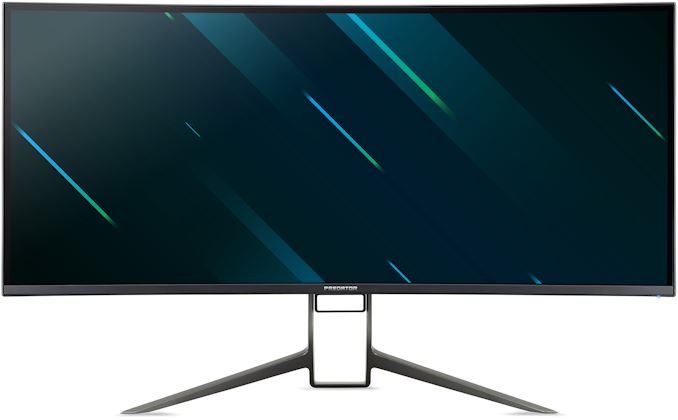
Acer has introduced its new top-of-the-range ultrawide curved gaming display just hours before CES 2020 was set to kick off. The Predator X38 happens to be the industry’s first curved monitor to feature a UWQHD+ resolution and a 175 Hz refresh rate, a combination not yet available from any manufacturer.


The Acer Predator X38 is based on a 37.5-inch IPS panel featuring a 2300R curvature which means that it is ‘less curved’ than displays with a lower radius of curvature, a 3840×1600 resolution, a 1 ms GtG response time, and a 175 Hz refresh rate in overclock mode. The resolution of the display, along with its dimensions is well suited for immersive gaming as well as for watching Ultra-HD videos filmed in an aspect ratio of 2.35:1 or 2.40:1, which is a popular aspect rator for film. Speaking of films, it is necessary to note that the Predator X38 can reproduce 98.5% of the P3 color gamut, which is a common color space used for digital movie projection these days and is a part of the Ultra HD Premium specification.


Being aimed at gamers, the Acer Predator X38 supports NVIDIA’s G-Sync adaptive refresh rate technology and is also DisplayHDR 400 certified. It is noteworthy that Acer does not disclose normal and peak brightness levels supported by the monitor, but the peak one should be at least 400 nits.


The display connects to host PCs and consoles using DisplayPort 1.4 and HDMI 2.0 ports and it also has a dual-port USB 3.0 hub to plug in peripherals. As for audio, the monitor has two 7 W speakers.


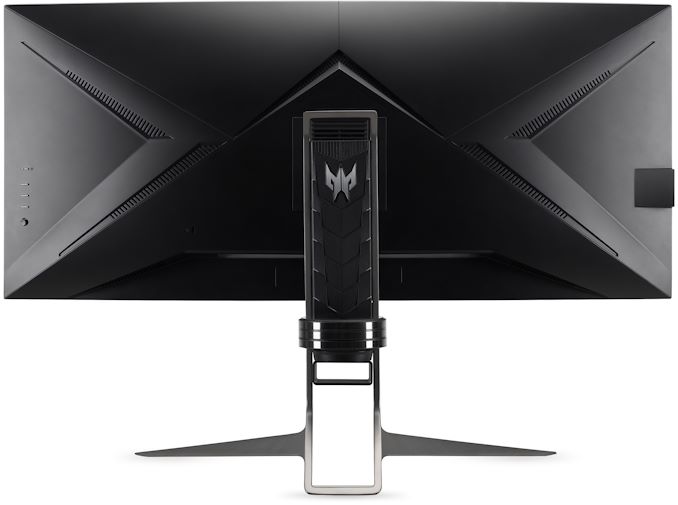
The ergonomic stand featured by the Predator X38 is stylized after battle robots with elements that resemble armor of the Predator character to emphasize the nature of the device. Meanwhile, it can adjust height, tilt, and swivel to optimize viewing position and maximize fragging gaming performance.


Acer’s Predator X38 display will be available in Europe and the US this April for €2,199 and $2,399, respectively.


Related Reading:


Source: Acer


Source: AnandTech – CES 2020: Acer’s Predator X38 Is A 38-Inch Curved Monitor w/ UWQHD+, 175 Hz & G-Sync

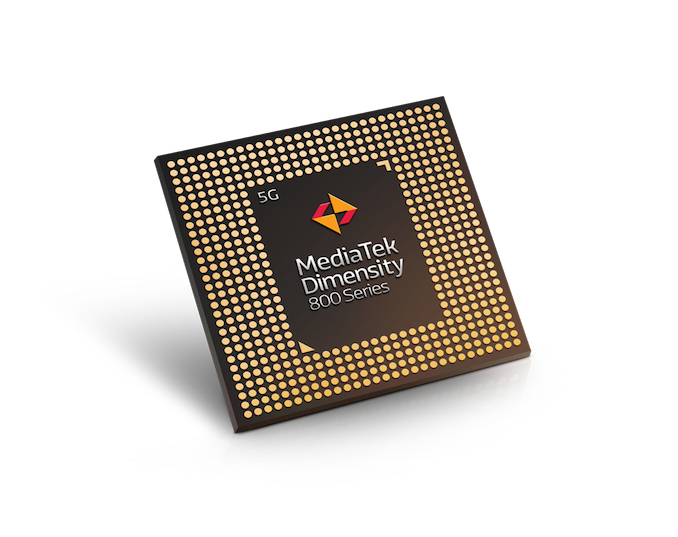
CES 2020: MediaTek Announces New Dimensity 800 Mid-Range 5G SoC

Today MediaTek has announced a new entry into its new “Dimensity” 5G SoC product lineup. The new chip is called the Dimensity 800 and represents a mid-range solution for lower cost devices compared to the larger Dimensity 1000 flagship SoC. The chip’s main feature is the fact that it supports 5G connectivity in the sub-6 spectrum, making this amongst the first 5G designs at this price range.


MediaTek SoCs
SoC Dimensity 1000 Dimensity 800
CPU 4x Cortex A77 @ 2.6GHz

4x Cortex A55 @ 2.0GHz
4x Cortex A76 @ 2.0GHz

4x Cortex A55 @ 2.0GHz
GPU Mali-G77MP9 @ ? MHz Mali-G57MP4 @ ? MHz
APU / NPU / AI Proc. / Neural IP 3rd gen APU

2 “big” + 3 “small” + 1 “tiny”


4.5TOPs total perf

3rd Gen APU

“three cores”


+2.4TOPs total perf

Memory 4x 16b LPDDR4X 2x 16b LPDDR4X @ 2133MHz
ISP/Camera 80MP

or

32MP + 16MP
1x 64MP

or

2x 32+16MP
Encode/

Decode
2160p60

H.264 & HEVC

& AV1 (Decode)
2160p30

H.264 & HEVC
Integrated Modem 5G Sub-6


DL = 4600Mbps

200MHz 2CA, 256-QAM,

4×4 MIMO


UL = 2500Mbps

200MHz 2CA, 256-QAM,

2×2 MIMO


LTE Category 19 DL

5G Sub-6


DL = ?Mbps

2CA


UL = ?


LTE Category ? DL

Connectivity WiFi 6 (802.11ax)

+ Bluetooth 5.1

+ Dual Band GNSS
?
Mfc. Process N7 N7

The SoC is powered by an octa-core CPU setup, including 4x Cortex A76 cores at 2GHz alongside 4x Cortex A55 cores at also 2GHz. It’s interesting to see this segmentation in the IP – the A77 cores aren’t that much larger than the A76 cores, but it’s possible MediaTek has been able to optimise the A76 for higher density implementations, hence also the quite low frequency even though the new chip comes manufactured on TSMC’s 7nm N7 process node.


On the GPU side, we’re seeing a Mali-G57MP4 at an undisclosed frequency. The G57 is a derivative of the Valhall GPU family and covers the lower end spectrum of possible configurations.


The chip features a cut-down DRAM interface with only 2-ch (2x16b) LPDDR4X support at up to 2133MHz, so half the bandwidth of the Dimensity 1000.


The chip still comes with MTK’s newest 3rd generation in-house APU/NPU for AI acceleration, but doesn’t disclose the breakdown in the same way they did with the D1000. They do state there’s up to 2.4TOPs of inferencing throughput which is actually still a very respectable figure for a SoC at this range.


The Dimensity 800 comes with 5G Sub-6 integrated modem; MediaTek discloses 2CC CA on the downlink. MTK at this time didn’t disclose more information on the throughput and how it compares to the D1000, but they do state DSS (Dynamic Spectrum Sharing) as a feature of the D800 which is an important characteristic for the chip’s modem.


We’ll be seeing Dimensity 800 based products being announced and come to market throughout 2020.


Related Reading:


Source: AnandTech – CES 2020: MediaTek Announces New Dimensity 800 Mid-Range 5G SoC

Intel Teases Thunderbolt 4, Light On Details

Intel demonstrated a Tiger Lake system on stage in their CES 2020 keynote yesterday. One of the interesting aspects was the teaser of Thunderbolt 4, with a mention of it offering four times the speed of USB 3. After reaching out to Intel for additional details, it appears that they are not ready yet to share additional details.


Intel did confirm that that they were referencing USB 3.2 Gen 2 – the 10 Gbps version – in the keynote presentation. This means that the peak speeds (40 Gbps) are not changing relative to Thunderbolt 3. Given that the Thunderbolt 3 specifications have been donated to USB-IF for USB 4.0, it appears likely that Thunderbolt 4 may be a push for Intel certification of certain Type-C ports. We look forward to receiving more concrete information from Intel regarding the new features, if any, in Thunderbolt 4.


Source: AnandTech – Intel Teases Thunderbolt 4, Light On Details

AMD at CES 2020: Q&A with Dr. Lisa Su

This week AMD took the wraps off of its latest generation of mobile processors. The company is being aggressive, offering up to eight cores for both the traditional ultra-portable notebook as well as the higher-performance content creator and prosumer notebook. The move to 7nm, as well as design efficiency improvements, have been quite aggressive, with the new hardware claiming double the performance per watt, 20% lower SoC power, and 80% quicker adjustments from low-to-high power inside the chip. This has enabled some key design wins, as seen at CES this week, which are set to come out over the next year.

As part of the CES announcements, AMD invited a small number of press to talk to the CEO Dr. Lisa Su  about the announcements, 7nm, mobile, and for any other lingering questions about AMD’s recent position in technology news. 


Source: AnandTech – AMD at CES 2020: Q&A with Dr. Lisa Su

Plugable Launches TBT3-UDZ: A Comprehensive Thunderbolt 3 / USB-C Docking Station

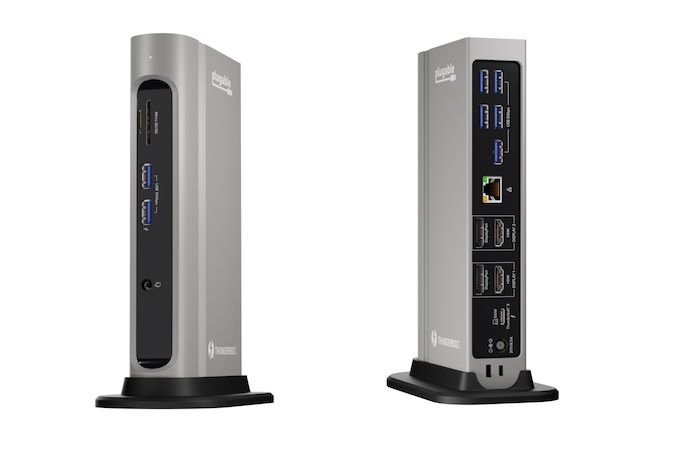
 Plugable is introducing three new products at CES 2020, and the most interesting of the three happens to be the Titan Ridge-based TBT3-UDZ Docking Station with a 100W power delivery budget. Even though the TBT3-UDZ is not the first Titan Ridge-equipped docking station in the market (the StarTech.com TB3CK2DP and the Seagate FireCuda Gaming Dock are already available in retail), the unit brings in some unique features differentiating it from the other docking stations in the market. The use of Titan Ridge allows the docking station to work with both Thunderbolt 3 and USB-C host ports.


The TBT3-UDZ includes DisplayLink chips to provide two 4Kp30 display outputs when used with USB-C hosts. In the case of a Thunderbolt 3 uplink, subject to display routing over the host port, two DisplayPort 1.4 outputs (up to 4Kp60) can be activated. It also features 100W power delivery (the highest we have seen in any Thunderbolt 3 dock from Plugable as yet). Plugable suggests that this would fit well with the 96W charging power requirement for the new Apple MacBook Pro units. The dock comes with a 170W adapter, and includes a wide variety of ports:


  • Two display outputs (HDMI1 or DisplayPort1) and (HDMI2 or DisplayPort2)
  • 1x Thunderbolt 3 uplink port with 100W power delivery
  • 1x RJ-45 1Gbps port
  • 5x USB 3.2 Gen 1 Type-A ports (5 Gbps)
  • 1x USB 3.2 Gen 2 Type-A port (10 Gbps)
  • 1x USB 3.2 Gen 2 Type-A port (10 Gbps) with BC 1.2 (7.5W) charging capability
  • microSDXC slot
  • SDXC slot
  • TRRS audio input/output port for headphones and microphones

The TBT3-UDZ will be available for purchase in Q2 2020 for $299.


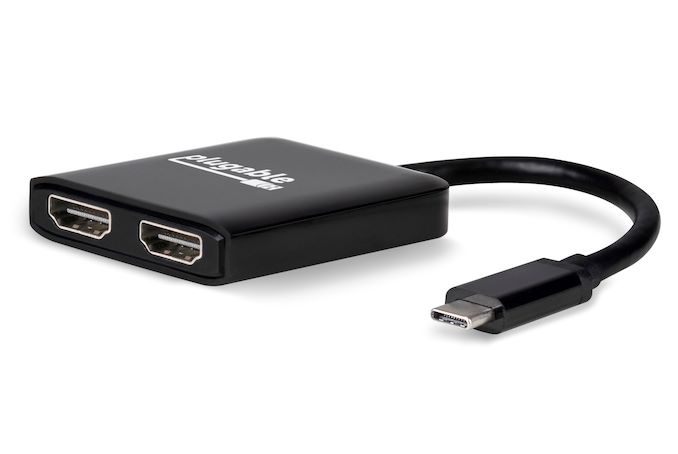
Plugable also announced a USB-C DisplayPort 1.4 MST to Dual HDMI 2.0 adapter. This can enable users of systems like the Surface Laptop 3 and Surface Pro 7 to drive two 4Kp60 displays without using a DisplayLink adapter. The adapter supports up to 25.9 Gbps (more than the 18 Gbps requirement for HDMI 2.0), allowing for higher-resolution dual displays with a single cable. HDR is also supported. The adapter will be available for purchase in Q2 2020 for $40.


The adapter will require MST (multi-stream transport) support on the DisplayPort 1.4 host output port in order to drive two different 4Kp60 HDMI monitors.


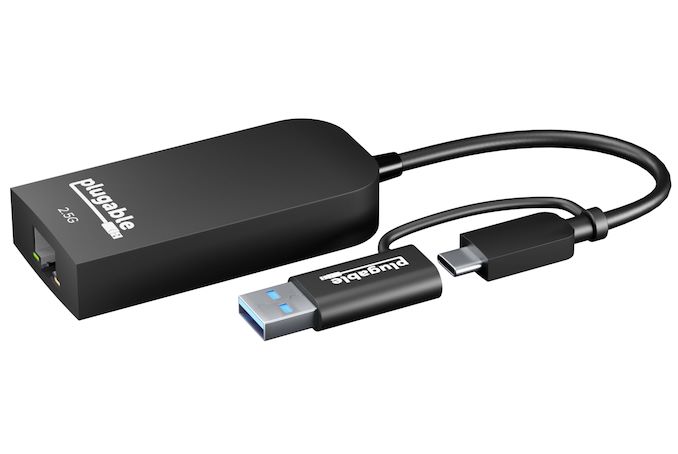
Plugable is also launching a Realtek RTL8156-based 2.5 Gbps USB Ethernet adapter. On the host side, it requires a USB 3.0 port (either Type-C or Type-A), while the Ethernet port can auto-negotiate to 100 Mbps, 1 Gbps, or 2.5 Gbps (802.3bz). Wide compatibility (Windows / macOS / Linux kernel 3.2+) is also being promised.


NBASE-T USB Ethernet adapters are a dime a dozen in the market currently – some of the popular ones include the StarTech.com US2GA30 priced at $110, the TRENDnet TUC-ET2G at $50, the Asustor AS-U2.5G at $46, the Cable Creation adapter at $24, and the QNAP QNA-UC5G1T at $79. The QNAP model is also capable of speeds up to 5 Gbps. The Plugable model differentiates itself with the attached USB-C to USB-A adapter ensuring wider host compatibility. The model will go on sale in Q2 2020 for $50.


Source: AnandTech – Plugable Launches TBT3-UDZ: A Comprehensive Thunderbolt 3 / USB-C Docking Station

CES 2020: Micron Begins to Sample DDR5 RDIMMs with Server Partners

Micron announced at CES that it had started sampling of its DDR5 Registered DIMMs with select partners. The very fact that Micron started sampling of DDR5 modules indicates that its partners already have server CPUs/platforms that support DDR5 memory.


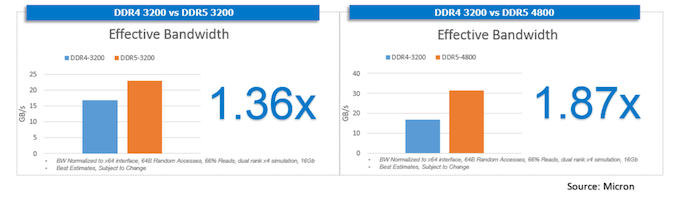
Micron expects its first-generation DDR5 products to offer ‘more than’ 1.85-times performance increase when compared to JEDEC-standard DDR4 memory. There are multiple improvements to DDR5 because in addition to data transfer rates between of up to 6400 MT/s, DDR5 also has improved functionality. Firstly, DDR5 uses two independent 32/40-bit channels per module (without/or with ECC), which improves channel utilization. Also, DDR5 has an improved command bus efficiency because the channels feature their own 7-bit Address (Add)/Command (Cmd) buses, better refresh schemes, and an increased bank group for extra performance.


What is important is that the DDR5 specification allows to design chips with capacities higher than 16 Gb and reduce supply voltage to 1.1 V and an allowable fluctuation range of 3% (i.e., at ±0.033V). So, in addition to performance, DDR5 will enable to reduce power consumption and build servers featuring higher memory capacity.


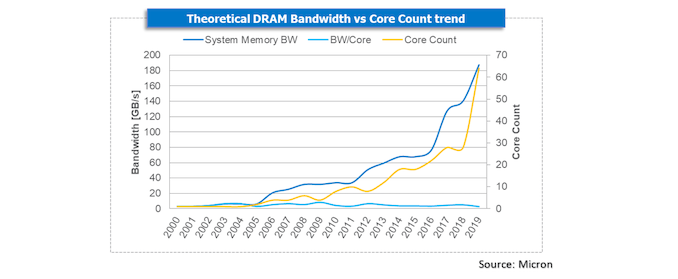
Increasing usable memory bandwidth and capacity is crucially important for next-generation server platforms that use processors with even higher number of cores.


Micron did not reveal specifications of its DDR5 RDIMMs it sent to partners or disclose when it plans to start commercial shipments of DDR5 memory. We can speculate that DDR5-enabled server platforms are several quarters away, but it is up for actual platform developers to set launch dates.


Tom Eby, senior vice president and general manager of the Compute & Networking Business Unit at Micron, said the following:


“Data center workloads will be increasingly challenged to extract value from the explosive growth of data across all aspects of our business and personal lives. The key to enabling these workloads is higher quality memory that is faster and denser. Micron’s sampling of DDR5 RDIMMs represents a milestone for server platforms as it brings the industry one step closer to harnessing the scaling capability of next generation memory.”


Related Reading:


Source: Micron


Source: AnandTech – CES 2020: Micron Begins to Sample DDR5 RDIMMs with Server Partners

CES 2020: Lenovo’s Dual-Screen ThinkBook Plus w/ Comet Lake

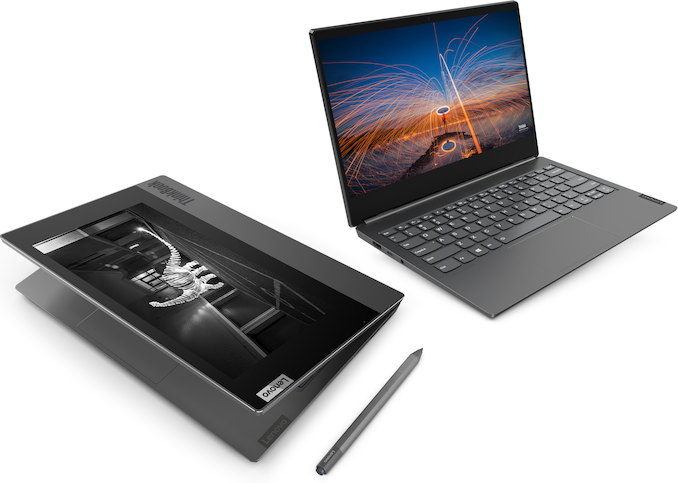
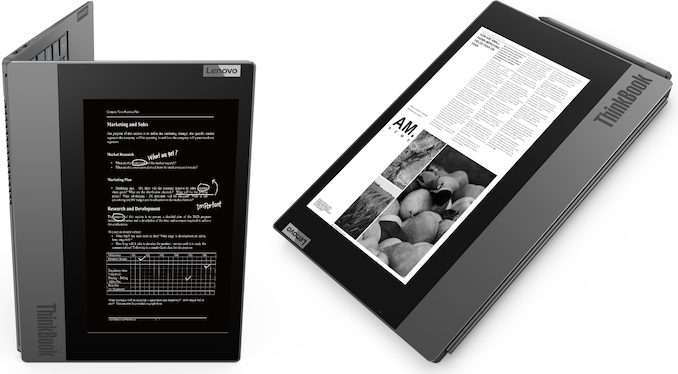
Lenovo is one of the companies that experiments with form-factors and capabilities of its PCs. At CES 2020, the manufacturer introduced its ThinkBook Plus laptop that features two screens: one main 13.3-inch LCD and one auxiliary e-ink display on the top cover. The additional monitor doesn’t add a lot of bulk to the device, thanks to the nature of e-ink.


With the ThinkBook Plus, Lenovo decided to offer SMB something it yet has to offer to other markets: the second e-ink screen on top cover. This display can be used to receive ongoing essential notifications, read documents, take notes, and create illustrations or diagrams using the integrated Lenovo Precision Pen without firing up Windows and the main screen. Lenovo does not reveal much about the auxiliary display, but it looks like it uses a proprietary set of applications with all the peculiarities of such approach, and as such some hands-on time is going to be needed to really get a feel for the benefits.


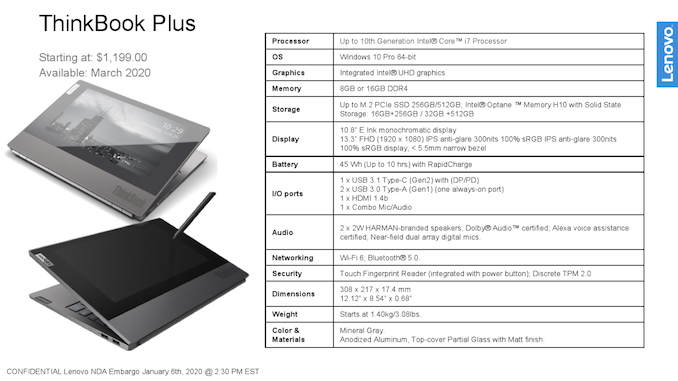
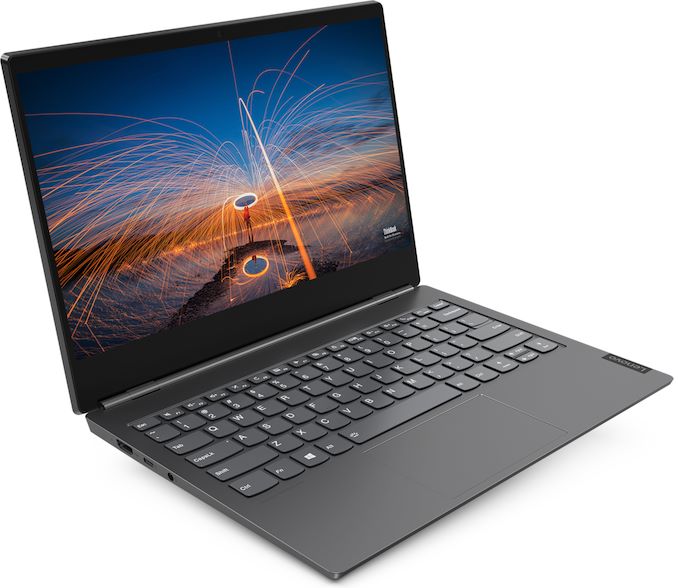
If the second screen is not considered, the ThinkBook Plus is a regular 13.3-inch laptop that comes in an aluminum chassis with 180° lay-flat hinges found on ThinkPads as well as a 13.3-inch Full-HD IPS display. The machine weighs 1.4 kilograms, which is heavier when compared to the ThinkPad X1, and is 17.4 mm thick.


At the heart of Lenovo ThinkBook Plus is Intel’s 10th Generation ‘Comet Lake’ Core i7 processor with built-in Intel UHD Graphics accompanied by 8 GB or 16 GB of DDR4 memory as well as an M.2 SSD featuring up to 512 GB capacity or Intel’s Optane Memory H10 storage solution comprising of 3D XPoint and QLC 3D NAND. Lenovo says that the ThinkBook Plus can last for 10 hours on its 45 Wh battery.


On the connectivity side of matters, the ThinkBook Plus has a pretty standard set of technologies, including Wi-Fi 6, Bluetooth 5, USB 3.1 Gen 2 Type-C, USB 3.0 Type-A, HDMI 1.4b, and a 3.5-mm audio jack. As for security, the laptop has a fingerprint reader, and a dTPM 2.0 chip.


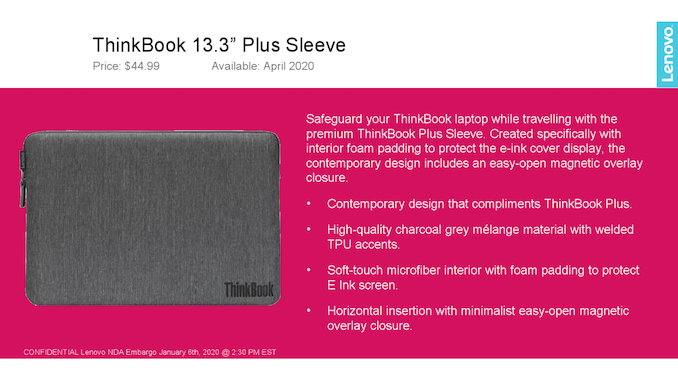
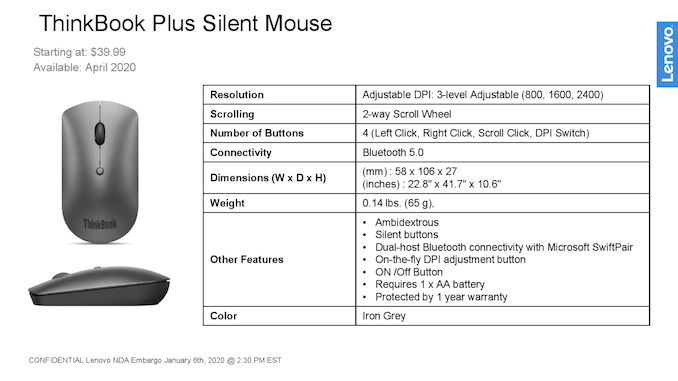
Since the ThinkBook Plus laptop has an auxiliary e-ink display on its top cover, it is natural that this screen needs some extra protection. Because of that, Lenovo will offer a special charcoal grey ThinkBook 13.3-inch Plus Sleeve with soft-touch microfiber interior with foam padding. In addition, Lenovo preps its iron grey ThinkBook Bluetooth Silent Mouse with a 2400 DPI sensor.


Lenovo says that sales of its ThinkBook Plus will begin in March at prices starting at $1,999. The sleeve and the mouse will be available in April for $44.99 and $39.99, respectively.


Related Reading:


Source: Lenovo


Source: AnandTech – CES 2020: Lenovo’s Dual-Screen ThinkBook Plus w/ Comet Lake