
Teaching about AI concepts in schools is a tricky business as there are complicated ideas to be taught.
To teach complex concepts, in computer science, we often use an instructional approach called ‘unplugged’. We use the unplugged approach to teach computing concepts without a computer. Often unplugged activities include using an everyday analogy or a physical fun activity. For example, to teach about algorithms, students might learn how to make a jam sandwich where the recipe and following instructions accurately are similar to an algorithm and the steps within it used to write a program. The jam sandwich activity has now become a popular and key teaching experience for young students across the world, as it teaches a complex but fundamental idea in a simple and fun way.

At the January 2026 Raspberry Pi Foundation Research Seminar, Salomey Afua Addo, a researcher at the University of Cambridge, presented her work about how to teach about AI. She has specifically looked at this in the context of high school students in Ghana, where AI is now part of the mandatory curriculum. In Ghana, most schools do not have access to computers, therefore an unplugged approach to teach about AI is a good idea. Therefore, Salomey developed a set of unplugged activities to teach about a range of AI concepts.
Here, I focus on one of the activities that she presented — one that I think will become another ‘jam sandwich’ experience for students. So if you might teach about AI at some point, then read on.
Neural networks and rope: An unplugged activity
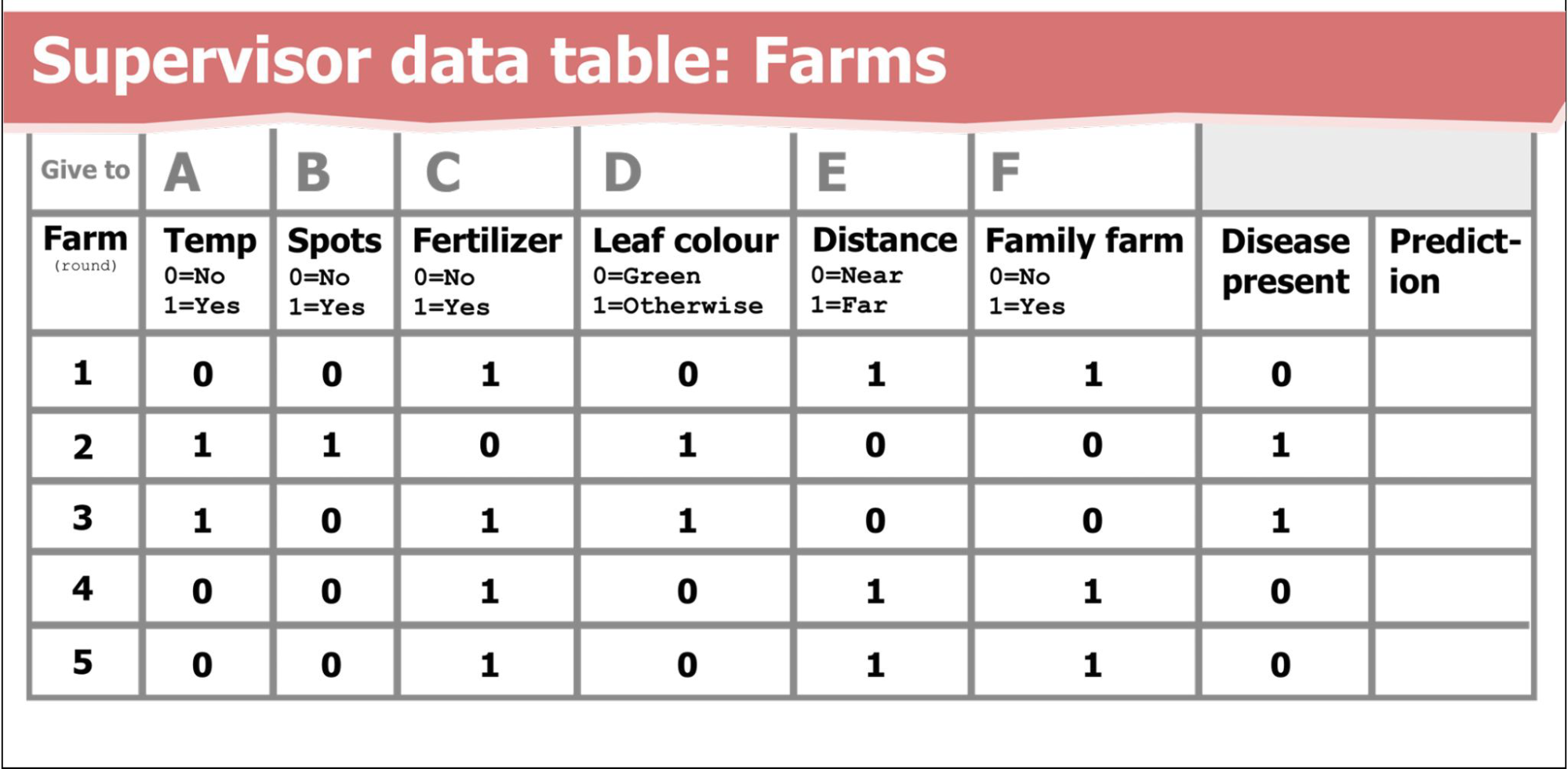
Salomey has designed an unplugged role-play activity to teach about neural networks and how they are trained to solve a problem. She focused on finding a familiar problem context for Ghanaian teachers and their students, and selected farming and crop disease. Students are asked to figure out what features about a farm are relevant for detecting diseases on cocoa trees. To solve the problem, students are given data about the farms (see Table 1). Giving students data, rather than preconceived rules about the context is key to the learning activity. Neural networks are data-driven — they provide a way to model given data so that we can make predictions. Here the features of farms, and importantly whether disease is or is not found in their cocoa trees, is the data that is used to train a model. The model is used to make predictions, which can then be used to improve farming by reducing crop disease.
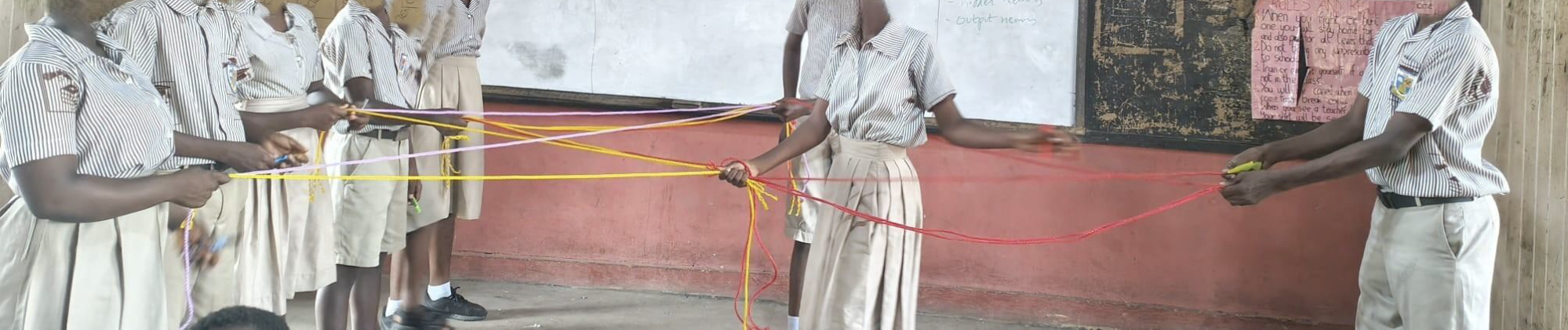
Using farm data, students can learn how neural networks work, and they can do this through an unplugged role play — using ropes!
Here’s how Salomey’s classroom activity works. Sets of students act out the processes of training a neural network, including forward propagation, evaluation, and backpropagation. They take on the “roles’’ of some of the concepts of a neural network. One student acts as the supervisor, six students act as the input layer, two as the hidden layer, and one as the output layer.
Keeping it simple: Concepts and data
Key concepts are simplified for students:
- Forward propagation: The hidden layer players randomly select a set of farms (three of the six sets of input values), which reflects how weights are often set to random values at the start.
- Evaluation: The student acting as the output layer compares the prediction (whether crop disease is present or not) to the actual value for the farm to assess the error, similar to a loss function.
- Backpropagation: Inspired by MIT’s RAISE curriculum, this stage is modelled on establishing trust. Players in the hidden and output layers modify their trust in the previous layers (by adding or removing ropes) based on the accuracy of the prediction (if the farm has disease).
Simple numerical data about the features of the problem are given to the students, such as whether the “Temperature” is suitable (0=No, 1=Yes), if there are “Spots” on the plant (0=No, 1=Yes), if “Fertilizer’’ has been used, whether the “Leaf colour’’ is green or not (see Table 1). Importantly, each of the six features given are represented by the six “input layer” students. So each student can ‘process’ each feature as the data for a given farm is used to train the model. Cards are used to represent the data values passed between layers. And this is where the ropes come into play, as they are used to represent the connections between the nodes in the layers.
Instructions for each role
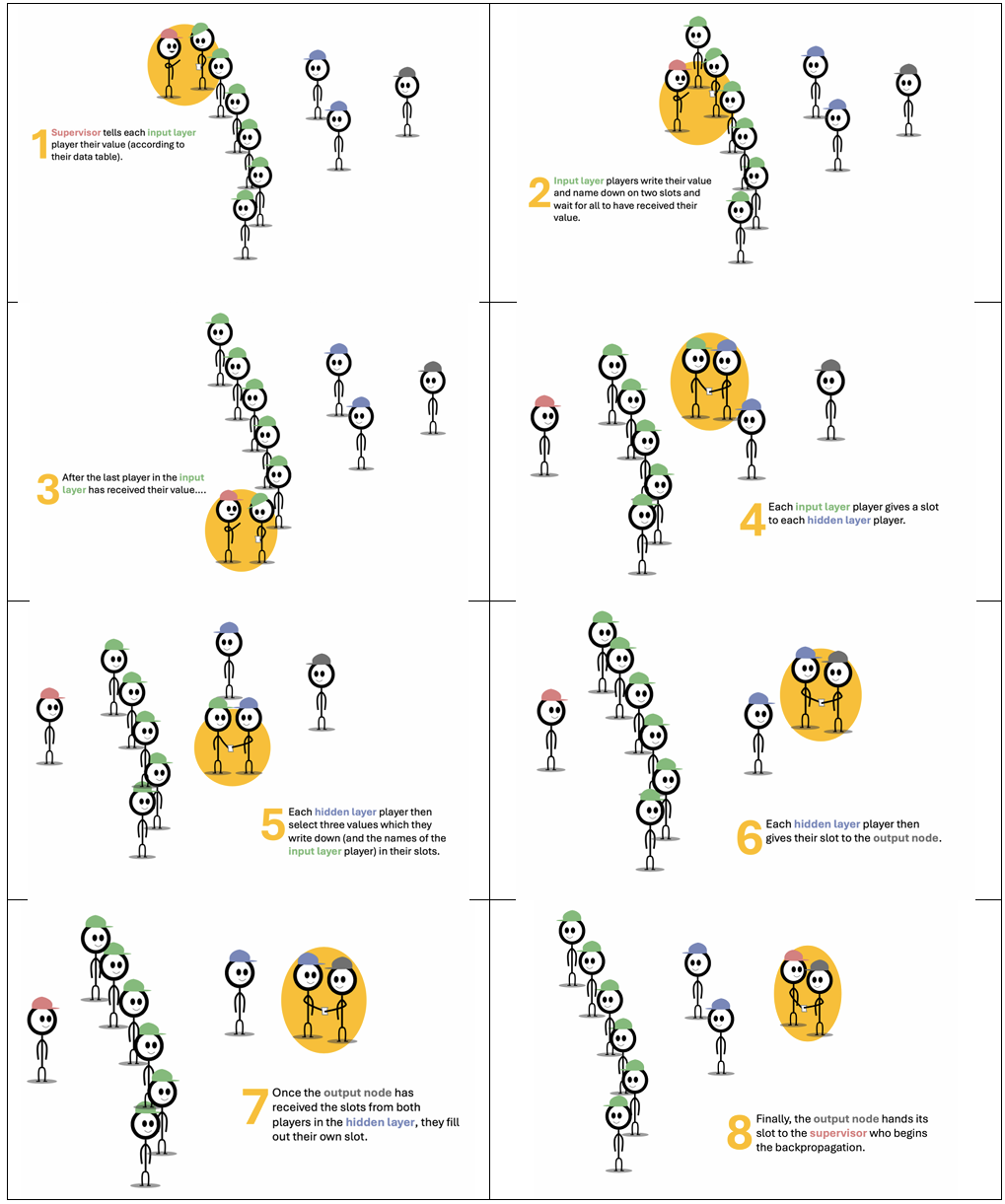
Written role-specific instructions are provided for the students to follow, for example, the Supervisor is given three steps to follow for the forward propagation stage, and the Input Layer students receive a different set of instructions and so on. The detail of the role play is shown in the instruction sheets (see Figure 1).
Why the ropes are important
Using ropes to connect the nodes becomes most important at the reverse propagation stage. The clever part of this is that we can show an increase or decrease in the strength of connection by adding or removing ropes. For me, this is the ‘jam sandwich’ effect. This, I think, is probably the most significant learning point. Here, the number of ropes that connect the nodes in the layers are changed based on the strength of evidence that a particular feature is indicated, by the data, to be relevant to the output. In this case, whether “Temperature”, for example, has an implied effect on cocoa disease or not — based on the data, not on any preconceived rule. Simply put, if a farm did have disease then a rope is added, if a farm did not then a rope is removed. Or at a more abstracted level, if a particular neuron contributes towards the correct prediction, a rope is added, otherwise a rope is removed. In a real neural network, backpropagation involves complex maths, such as calculus that would not be accessible to students of this age. Therefore, the rope is an analogy that replaces something that would be impossible for these students to grasp if it was taught using the real-world implementation.
Problem to be solved in the unplugged activity: Identify features that are relevant for detecting diseases
At the end of the activity, features (temperature, leaf color, family farm, etc.) with many rope connections are considered to be relevant for crop disease detection on the farm, whereas features with fewer rope connections are considered to be irrelevant for crop disease detection. The more ropes attached to a particular feature, e.g., temperature, represent its higher relevance in identifying crop disease on the farm.
Activity design, follow-on and evaluation
As part of the design of this activity, Salomey has simplified technical language so that throughout the role play students use everyday terms and she has chosen a context that is relatable for the students. For example, she uses the language of trust, and the new thickness of a rope connection, rather than using technical terms such as weight, loss function, and the error of the network.
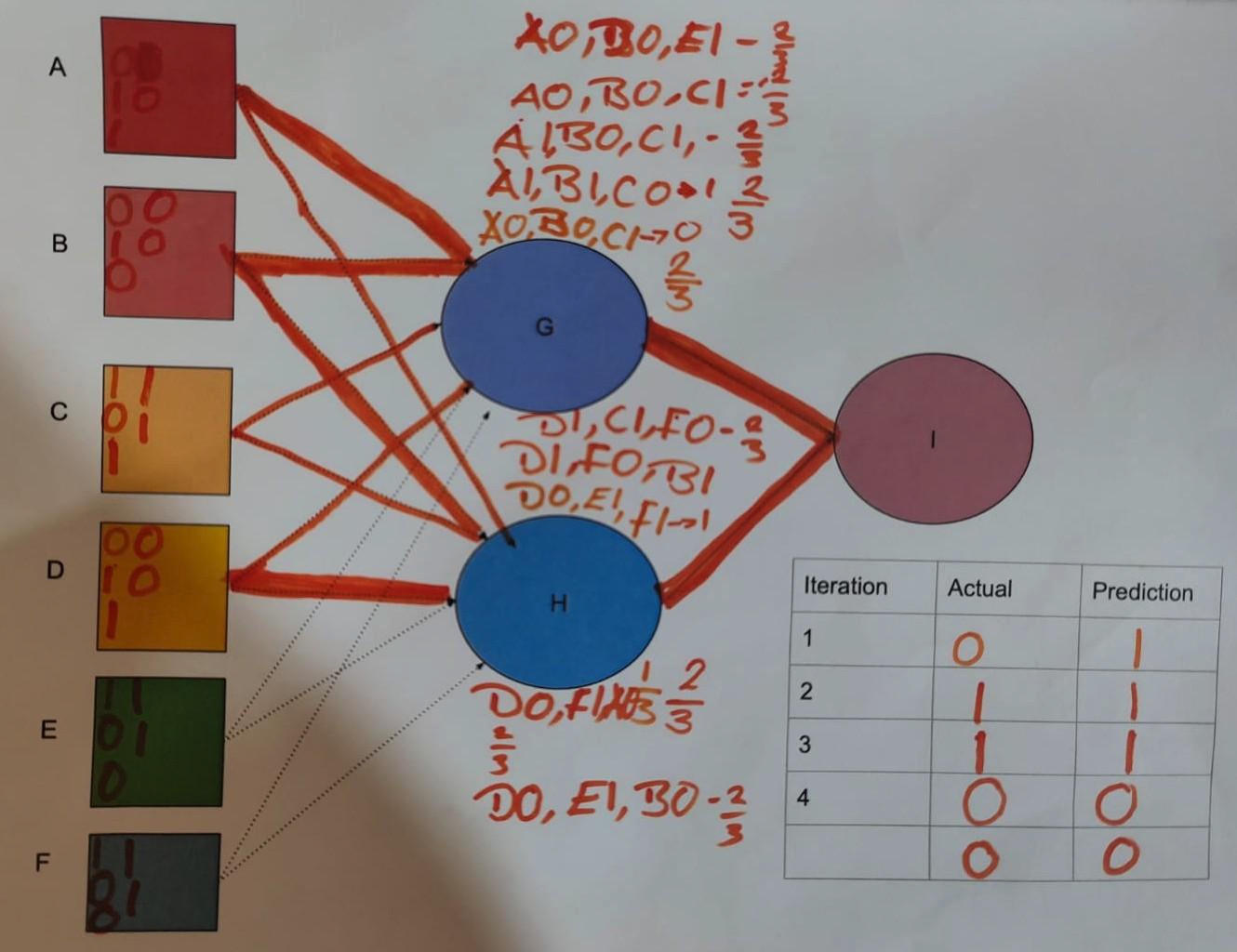
Salomey also designed a follow-on activity that uses pen and paper. In this version of the activity, which she calls a board game, the students draw lines to connect the nodes in the layers. The thickness of the lines connecting the nodes represent the strength of the trust (see Figure 2).
Salomey also shared her evaluation of the resources. She conducted pre‑ and post‑intervention surveys with 39 teachers as part of the professional development on the AI teaching materials, and ten of those teachers implemented the unplugged activities in their classrooms. She reported that the teachers found the role-play activity was effective to demonstrate neural networks, that children worked independently to learn, and that some students who did not take part usually in class were engaged.
As well as sharing about her unplugged neural network activity, Salomey also talked about a set of AI stories that she has developed to teach about other aspects of AI applications. For example, the importance of fact-checking is demonstrated through a story about a young girl who fact-checked information she received from her friends about life in a city.
If you would like to find out more about Salomey’s work, you can find related materials on our seminar website.
Join our next seminar
Join us at our next seminar on Tuesday 17 March from 17:00 to 18:30 GMT to hear Rebecca Fiebrink (University of the Arts London) speak about teaching AI for creative practitioners. This will be the second seminar in our new series on how to teach about AI across disciplines. We hope to see you there!
To sign up and take part in our research seminars, click below:
You can also view the schedule of our upcoming seminars, and catch up on past seminars on our previous seminars page.
The post Do you have some rope? Then let’s teach about AI concepts appeared first on Raspberry Pi Foundation.