
The change comes as Blizzard is rethinking how it handles story in the hero shooter
The post <em>Overwatch 2</em> Drops The <em>2</em>, Is Just <em>Overwatch</em> Again appeared first on Kotaku.

The change comes as Blizzard is rethinking how it handles story in the hero shooter
The post <em>Overwatch 2</em> Drops The <em>2</em>, Is Just <em>Overwatch</em> Again appeared first on Kotaku.

The hero shooter is dropping the 2 from its name, but adding a lot more
The post Everything Blizzard Announced For <em>Overwatch’s</em> Biggest Update Ever appeared first on Kotaku.
On one hand, Catana: Red Flowers is a violent, fast-paced action game in the mold of Joy Way’s STRIDE, complete with rooftop parkour and katana combat. On the other, it’s a low-stakes restaurant management sandbox in which you cook meals and serve drinks to anthropomorphic aquatic weirdos. Each game mode will appeal to a specific audience. For me, neither quite landed.
The VR world caught its first glimpse of Joy Way’s Red Flowers during the 2022 UploadVR Winter Showcase, where it presented as a new take on the studio’s successful parkour action game STRIDE. In the original trailer (and subsequently released demo), Red Flowers allowed players to dash, jump, and scramble their way along the rooftops of an Asia-inspired cityscape, slashing endless Yakuza-like bad guys with a razor-sharp katana. It was dark, violent, and visceral.
As released this past January, Catana: Red Flowers does include some of what we saw in that demo. But it comes with something else, too. In fact, Catana: Red Flowers, as it has eventually arrived, is two games in one.
0:00
The fast-paced, violent, parkour action of the original Red Flowers demo is still here, we simply hold our katana with paws instead of hands. That’s because Catana: Red Flowers’ player character is a cat, complete with retractable claws and a penchant for meowing.
This unexpected tonal shift slightly softens the edges of the original Red Flowers demo (though there’s still an extreme amount of gore unless toggled off in the options menu), but the real departure comes later. When we’ve finished our rooftop scramble, the game reveals its second half. Catana: Red Flowers is also a restaurant management, physics sandbox game.
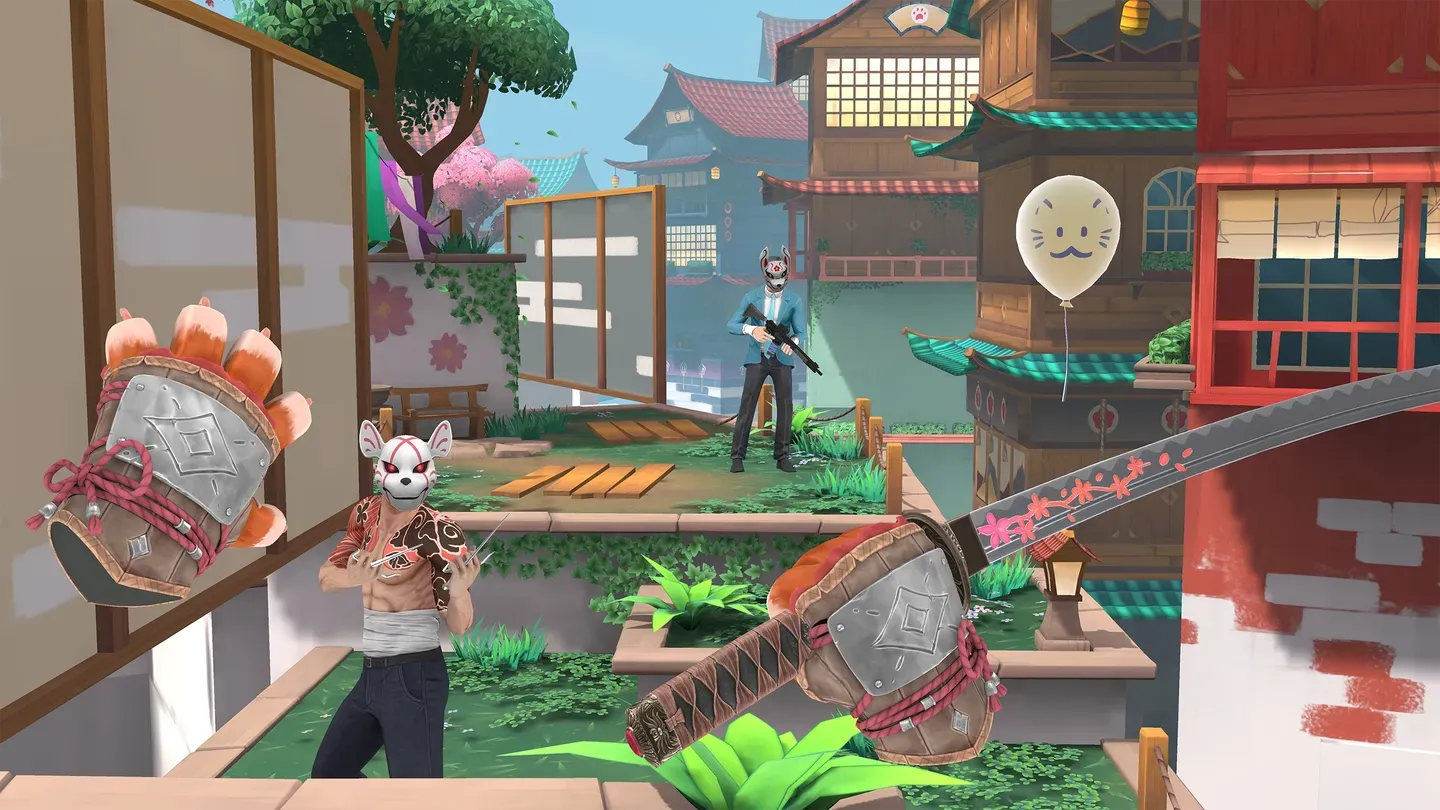
Between combat runs, players will return to a hub world populated by funny-looking anthropomorphic fish and frogs, who also happen to be customers of the player’s grandfather’s restaurant (weird). Grampa’s sick, or drunk, and it’s up to the player to man (or cat?) the shop in his absence. Here you prep food, cook meals, serve drinks, and fulfill orders under extremely light time constraints. Completing orders earns money, which can be spent on upgrading the restaurant or unlocking cosmetic items.
The hub world also offers a number of optional diversions; a fishing hole, secret areas to explore, special drinks which alter the inhabitants therein (think, low gravity, inflating their heads, forcing them to move in slow motion, etc.), and more. These all provide some much-needed levity to the game’s darker action stages.
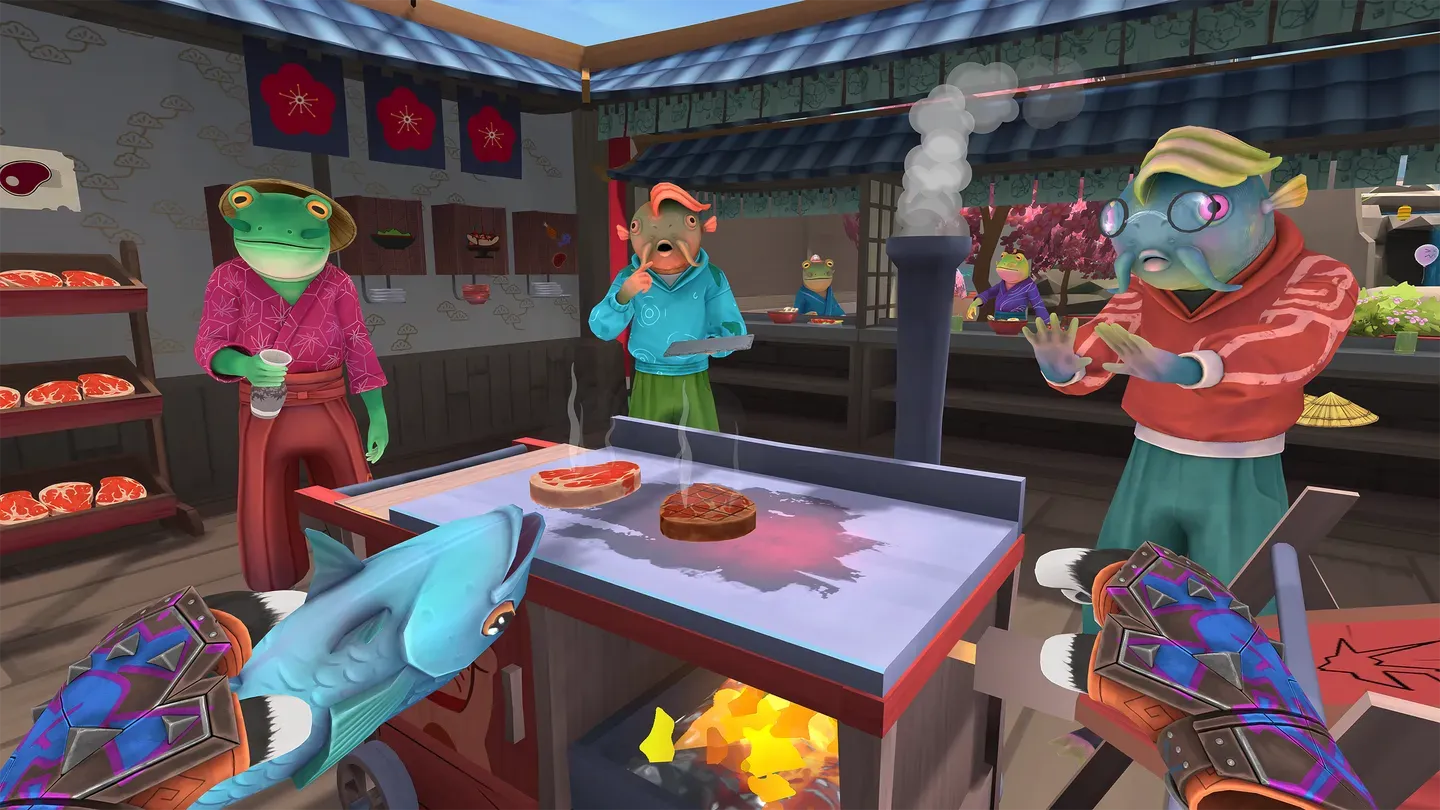
On its own, the restaurant mode is solid. The hub world is gorgeous, the music is great, the physics interactions are silly and fun, and running the restaurant is functionally adequate, too. Orders are easy to understand, mechanics work as expected, and the roadmap of progression is clearly articulated. For players who enjoy “chore games,” Catana: Red Flowers’ hub area will be appealing, as there’s always something demanding your attention, always another order to fill.
But this mode never really lands. There’s nothing particularly challenging about the restaurant management portion of the game, nor am I too motivated to grow the business, since the whole thing boils down to simple, endless repetition. They want a fish, cook a fish, serve a fish, repeat forever.
Developer comments in places where the game has been reviewed have indicated that the low-stakes, low difficulty of the game’s restaurant management hub is intentional. It’s designed to be a place to unwind after a few frantic runs through the game’s violent, high-stakes, reflex-fraying parkour kill-a-thons. And I appreciate that. The problem is that I don’t find the action stages of the game particularly appealing either.
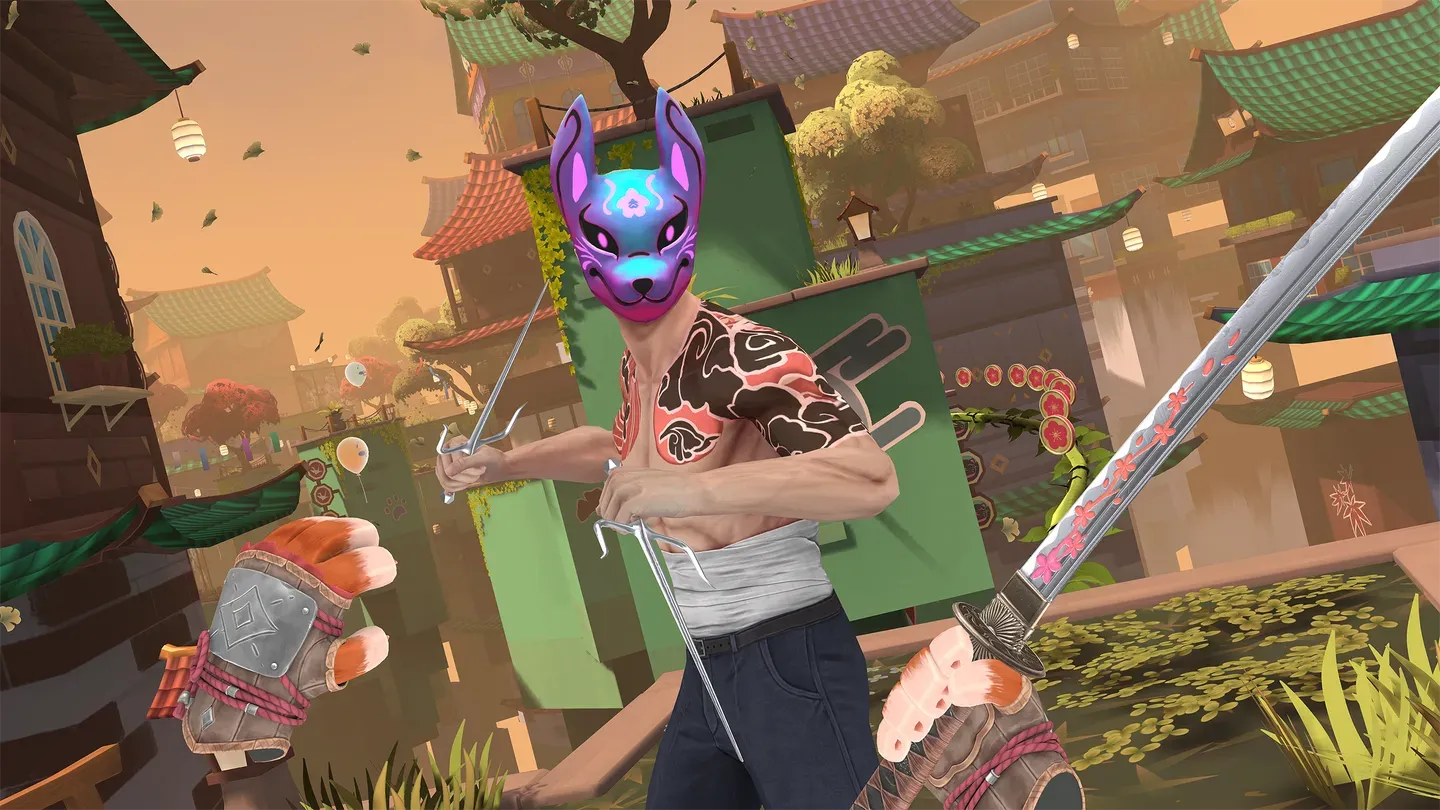
While the frantic runs through the visually interesting cityscapes are fast-paced and initially exciting and slicing up Yakuza on the fly can be fun, the novelty quickly wears thin. The controls, while mechanically sound, are tedious. To run, we must pump our hands up and down, which is imprecise, and tiring. Launching to grapple-able objects requires a combination of button presses and physical movements which, while not difficult, is annoying. Dashing is oddly linked to slashing with our katana, which is fine, but just doesn’t feel particularly fun.
For a game mode which essentially hangs its whole identity on speed-runs and timing, the controls just don’t hold up. Call it a skill issue, but there were too many instances of plummeting to my death or failing to medal due to janky controls. Practice makes perfect, but I’m not really motivated to practice.
My criticisms noted, it’s easy to imagine a different response from players who enjoy the speed, action, and violence of Joy Way’s other parkour action games, like the extremely successful STRIDE. And of course, players who enjoy simply being silly in a sandbox or managing a virtual shop will consider the hub world the heart of Catana’s gameplay. Naturally, for players who enjoy both types of games in VR, Catana: Red Flowers is an obvious grand slam.
Catana: Red Flowers is available now on the Meta Horizon Store for $14.99.

Lore sickos will love Amazon’s newest season of Fallout, but fans of satisfying TV storytelling will be left wanting
The post <i>Fallout</i> Season 2 Review: Give Us More Episodes Or Stop Adding Subplots appeared first on Kotaku.

Jordan Mechner says news like this makes him glad he’s not in game dev anymore
The post <em>Prince Of Persia</em> Creator Reacts To The Canceled <em>Sands Of Time</em> Remake: ‘Having A Project Killed Is A Brutal Experience’ appeared first on Kotaku.

I mean, not enough to actually watch it—I’m not deranged
The post A <i>Pokémon</i> 30th Anniversary Commercial Is Forcing Me To Care About The Super Bowl appeared first on Kotaku.

Add this iPad to your iOS ecosystem and get more done, whether you’re into work or play.
The post Apple iPad (A16 Chip) All-Time Low Deal Quietly Makes a Comeback, No Need to Look for Budget Tablets appeared first on Kotaku.

The Fortnite launcher isn’t going anywhere even if Steam has twice as many players
The post The Epic Games Store Can’t Beat Steam But It Might Become The Next Discord appeared first on Kotaku.

Save $5 per month on Xbox Game Pass Ultimate over at StackSocial.
The post Xbox Game Pass Ultimate Sees a Price Cut, Moving Closer to Its Pre-Surge Pricing After Last Year’s 50% Increase appeared first on Kotaku.

Derpy will lead the movie’s Lego sets this summer
The post <em>KPop Demon Hunters</em> Lego Sets Are Coming, Starting With Everyone’s Favorite Pot-Tipping Demon Cat appeared first on Kotaku.

The screen stays easy on your eyes, even during extended sessions.
The post Samsung 32″ Borderless Monitor Crashes to Budget Portable Display Pricing at Record Low appeared first on Kotaku.

If you want a smart speaker, this is the one to buy, especially at a significant discount.
The post Amazon Goes Big on Smart Speaker Deals as Echo Dot Max Falls to Record Low, Comes With Alexa+ Early Access appeared first on Kotaku.

It’s time to get organized and save some cash while you’re at it.
The post Anker USB-C Docking Station Drops to a Historic Low Price, Packing 13 Ports for a Complete Desktop Upgrade appeared first on Kotaku.

It’s a partner showcase, so don’t expect details on the next Mario or Zelda game
The post There’s A New Nintendo Direct Just In Time For Switch 2’s Momentum To Snowball appeared first on Kotaku.

Enjoy breathtaking details with exceptional color accuracy for all your favorite content.
The post INSIGNIA 55″ Smart Fire TV Hits Nearly 50% Off After Another Price Cut Ahead of Super Bowl, Cheaper Than Smaller Models appeared first on Kotaku.

Yusuke Omura designed the Ultra Beasts based on designs rejected by Ken Sugimori
The post Ultra Beasts Look Like Rejected Pokémon Because That’s Exactly What They Are appeared first on Kotaku.

The Souls-like series returns with a new formula
The post <i>Nioh 3</i>: The <i>Kotaku</i> Review appeared first on Kotaku.

No need to deal with tinny TV sound again.
The post Bose Soundbar Drops Back to Black Friday Price Just in Time for Super Bowl TV Audio Upgrades appeared first on Kotaku.

Save $40 on this tiny but durable large-capacity storage card that works with cameras, consoles, drones, and much more.
The post Amazon Is Clearing Out Samsung’s Nintendo Switch 2–Friendly MicroSD Card at Its Lowest Price appeared first on Kotaku.
Gaijin Entertainment knew exactly what it was doing when it came up with the name Aces of Thunder.
Yes it very obviously references its own ubiquitous military mega-arena, but for flight sim fans of a certain vintage, there is a special reverence for what was later marketed as the Great Warplanes Series. These games, for those too young to have experienced them, were a DOS-era series that started with Red Baron and were quickly followed in the early 1990s by Aces of the Pacific and Aces Over Europe. My nostalgia goggles may be a little foggy, but I believe all three were exceptional. Of course, thirty years on, Aces of Thunder can never claim to be part of that great lineage, but just as Red Baron was arguably the greatest WWI flight sim of its day and its sequels were the twin masters of the WWII skies, I’m happy to report that Aces of Thunder continues in that same ancient tradition of being among the very best at what it sets out to do.
What Aces of Thunder is, very obviously, is a prop-era combat flight sim, designed for – but not exclusive to – VR. Where its sprawling stablemate War Thunder can reliably claim to feature every military fighting vehicle there has ever been (and quite a few that barely escaped the fevered imaginations of their inventors), Aces of Thunder focuses on bona fide World War classics; sadly just four from WWI – including the Fokker Dr.I, naturally – and 20 from the major powers of WWII, including the Mustang, Thunderbolt, Zero, Spitfire and Mosquito, plus equally iconic models from Germany, Japan and USSR that eschewed the enduringly cool naming convention of the western allies. Basically if you, like me, remember life before video games existed, these are all the planes you had dangling from your bedroom ceiling.
If you wanted to be cynical about Aces of Thunder, you could point out with some self-serving justification that the game is merely an abbreviated version of War Thunder, using more or less the same engine and considerably fewer assets. However, there are two very important distinctions between the two games. One is that while Aces of Thunder’s selection of aircraft is limited to a handful compared to War Thunder’s many hundreds, all of them are accessible from the get-go, with the cost of access being a very reasonable old school price of $30 (or $50 for the Deluxe Edition with five extra warbirds). There is no tedious grind to unlock obscure stopgap aircraft or unnecessary fittings, you simply pick a plane and take to the sky. As rudimentary as that sounds, it’s remarkably liberating and intuitive.
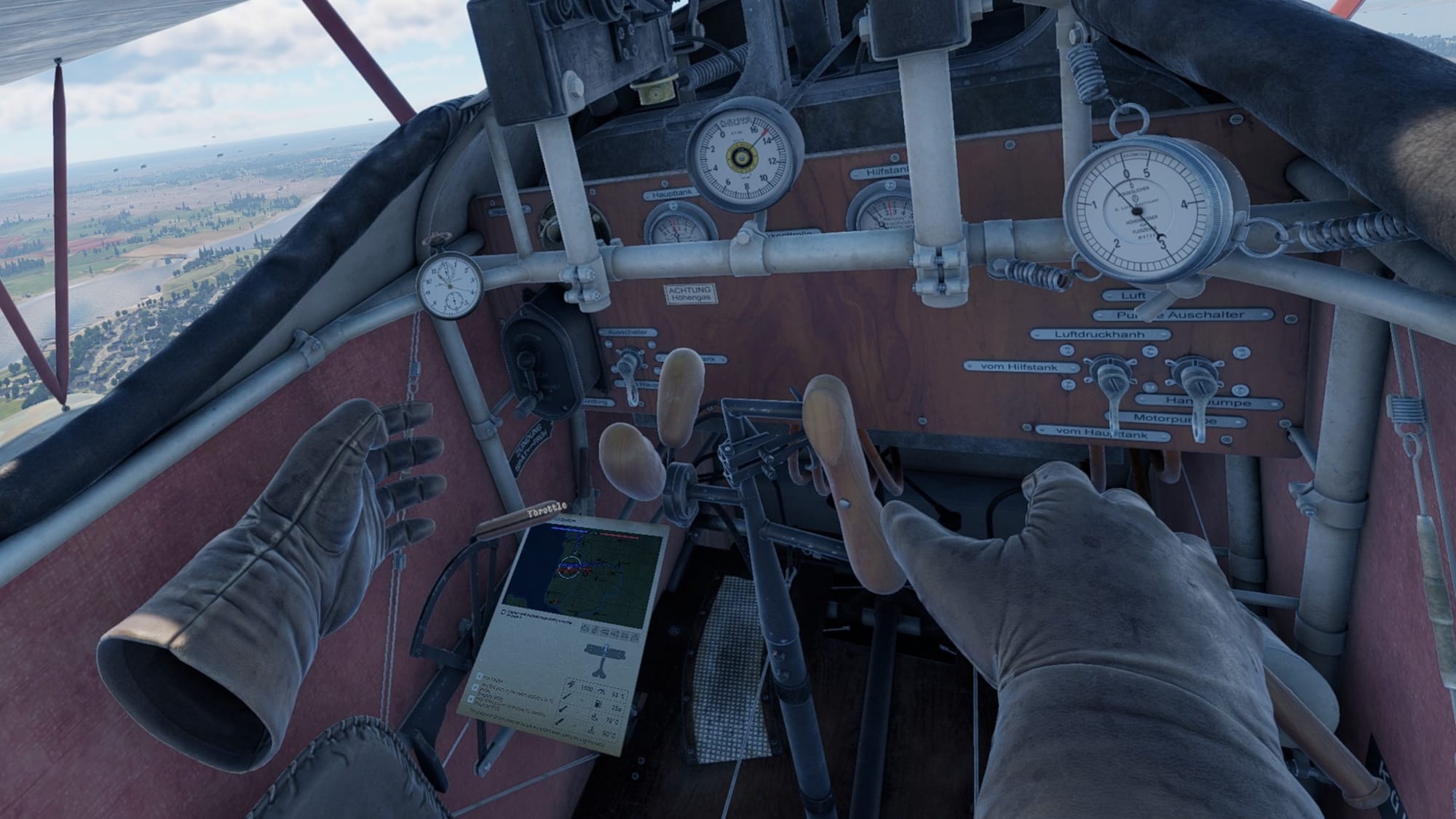
The other difference is just how integral VR is to Aces of Thunder. That may seem an obvious thing to point out, but with a flatscreen version that offers crossplay, Gaijin could so easily have undermined its own efforts by including a superfluous or seemingly harmless HUD element or camera view that favored one group of players over another. Take War Thunder; it has perfectly serviceable VR functionality, sure, but it’s not in the slightest bit necessary or helpful. Here though your only view is from the cockpit. There are no third-person views or chase cameras, no floating icons or voiceover cues to suggest your plane is about to spectacularly break apart, or indeed hardly anything that would constitute any element of a gaming HUD – aside from a map that sits on your lap and I really had to lean into to get anything from. In short, all your feedback about your mission, the state of your aircraft and any potential threats all must come from the timely and judicious use of your Mk 1 eyes and ears. The challenge of the game and why it is so compulsively immersive is because, yes, you have to master the controls, but simultaneous to that is the need to be as aware of what your cockpit instrumentation is telling you as much as the creaking of the airframe or a violently oscillating wing before it snaps off and sends you spinning into the briny below.
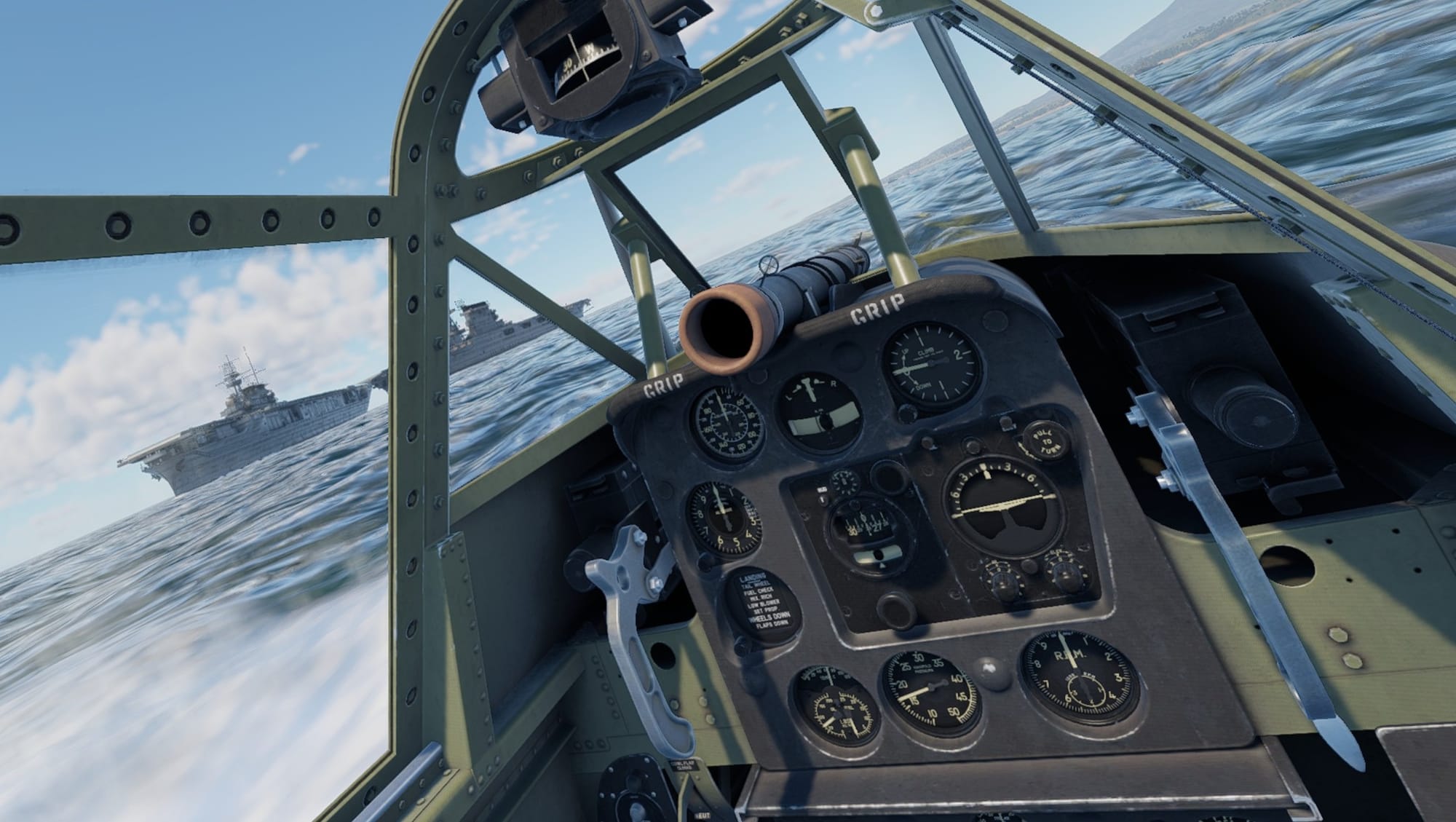
As well as multiplayer battles that are Gaijin’s stock-in-trade – and which we’ll get to shortly – Aces of Thunder offers a generous selection of solo encounters. There are 14 single-player missions and nine so-called War Stories. Functionally there’s no difference between the two, save the fact that the former can be attempted in any order and are not based on any particular historical encounter. War Stories meanwhile run through the truncated highlights of WWII, from patrolling the White Cliffs of Dover and the seas around Pearl Harbor, to supporting efforts over Normandy and Iwo Jima. There’s no real thread between the missions and many can be completed just by turning up and following the waypoints, which, contrary to what you might think, makes them more replayable than they have any right to be.
The Mission Editor is the real star of the single-player show, partly because it’s a proper throwback to the combat flight sims of old. Here you can select a theater relevant to the plane you have selected, a sector of the map where the action is to happen and how the front line is arranged, then pick the type of engagement you want, the weather, time of day and the skill level you wish to fly with. Admittedly there’s not the compulsion of a properly orchestrated narrative campaign, but if you just want a quick sortie over enemy skies, or to brush up on your ground attack skills against a competent and scalable AI, the options are plentiful.
As you might expect, multiplayer battles play out in much the same way as War Thunder, although with a naturally smaller player population your choice of engagement is much more limited. You pick the aircraft you want to fly and the game will seek out an appropriate battle for you to join, with bots filling the skies in the absence of human pilots. If you want a more tailored experience, Custom Battles can be created and joined with much the same parameters as the single-player Mission Builder, with the added benefit that you can go hog wild and have Sopwith Camels battling over the Strait of Saipan. Naturally I got most of my flying time in before the game went live, so I didn’t get to experience how well the matchmaking held up, but given the developer’s 15-year experience with War Thunder and the many thousands that play it every day, it’s hard to imagine the server architecture being anything other than reliable.
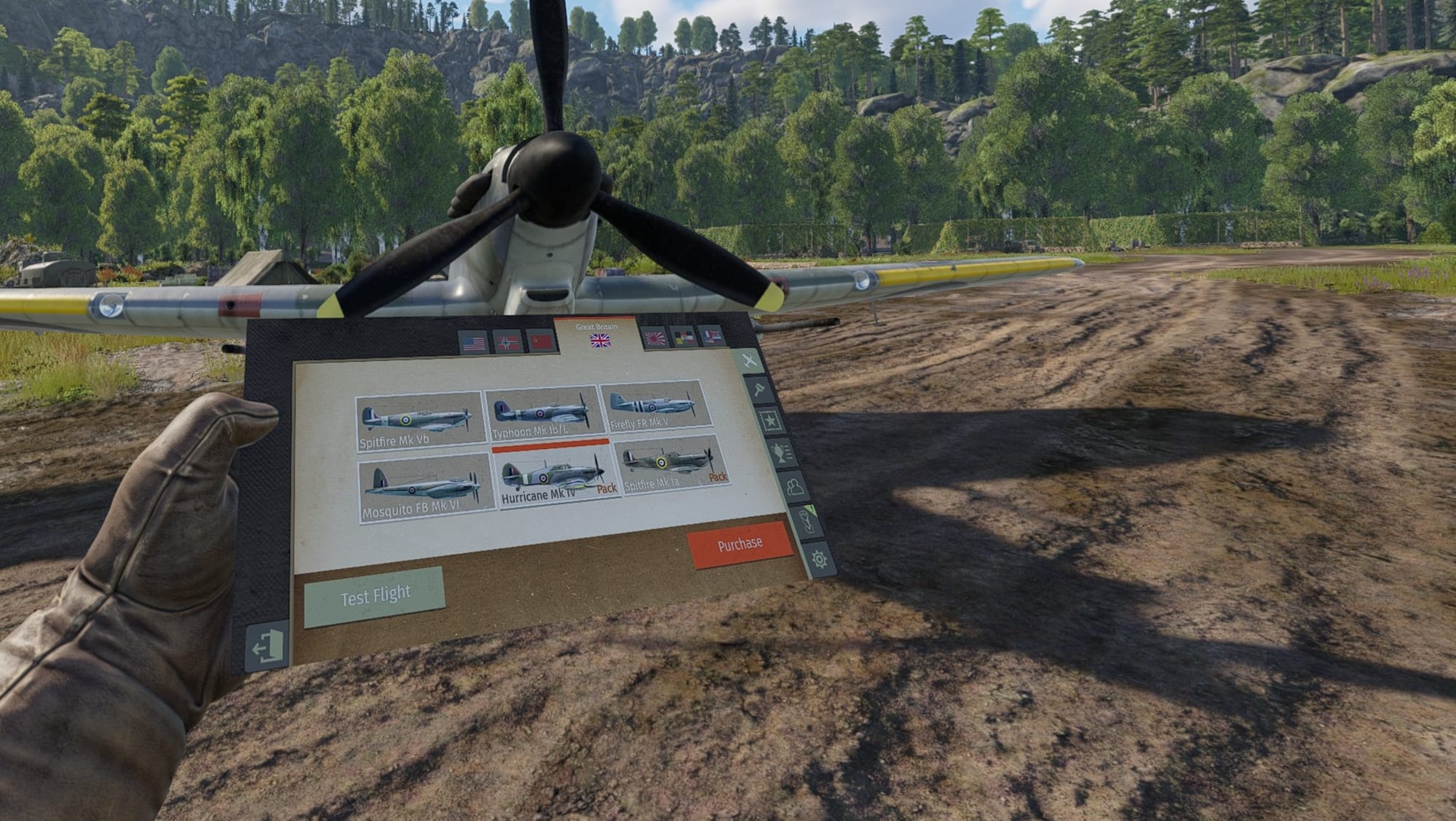
I had only two issues with Aces of Thunder. The first is a natural consequence of enjoying what there is – which is to say I wanted more of everything – WWI planes and maps especially. But my main bugbear was the sparse and often unhelpful presentation away from the meat and potatoes of the main game. There really isn’t much assistance to speak of at all – no tooltips, no tutorial – and the game starts without fanfare and dumps you unceremoniously into the middle of a makeshift airfield, with only distant birdsong and some old gramophone dirge to stir you to action. That action in common with many VR games is to make your selections from an unconvincing clipboard that’s been surgically attached to your flying glove. The problem is that navigating the various menus with said glove is clumsy in the extreme. It’s like trying to operate a phone with a sausage. Sure you get used to it – because you have to – and if you just want to pick a plane and take to the skies you can just about accept the lack of a more precise pointer system, but for anything more than that – such as tweaking the graphical settings, or God forbid, reassigning controls to the various axes of your HOTAS and rudder setup, well, prepare yourself for an exercise in fist-shaking frustration. And don’t think it’s any easier reassigning controls in the flatscreen mode either, because it most definitely isn’t.
I can’t claim to have played the majority of VR games and I’m a little behind on current releases, but I think Aces of Thunder may be the first modern virtual reality video game I’ve played that has zero comfort options. If you have a problem walking around in games that’s not a problem as you’re seated 99.9% of the time, but even I, a seasoned space dogfighter, can sometimes feel my lunch rising up when pulling tight turns to avoid ending up in someone else’s sights – especially when aboard the game’s magnificent WWI flying machines that can turn on a relative dime. Dear reader: you have been warned.
Thankfully, once you have the limited settings just how you like them and your controls have been similarly configured (which, by the way, work well if you avoid virtual stick options and go with your regular VR controllers or gamepad), Aces of Thunder becomes a consistently visceral and thrilling experience, where the term ‘flying by the seat of your pants’ has probably never felt more apt. On my modest PC that just about ticks all the boxes for the recommended spec, I found the visual fidelity and graphical performance to be excellent throughout, with the obvious caveats of pop-up at manageable distances and the odd realignment of foliage as you pass over treetops, but not enough to detract from the game in any meaningful way. I thought the Eastern Front maps to be rather drab, with textures that look like they’ve been extracted from a ’90s Quake mod, and many of the buildings leave a lot to be desired, but that’s as much a feature of them being shipped in from War Thunder. The proper detail is in the aircraft and how they handle and this is where the game shines, especially when tracers are flying and parts of someone’s wing are pinging past your cockpit. It serves to highlight how wonderfully immersive the game is once you’ve acclimatized to the bare bones presentation and the curtailed features necessary to maintain a level VR playing field.
Put simply, despite lacking in approachability and customization features, Aces of Thunder offers one of the most thrilling venues for combat VR gaming has to offer and is a fitting callback to the classic flight sims of yesteryear.

UploadVR uses a 5-Star rating system for our game reviews – you can read a breakdown of each star rating in our review guidelines.