
The just-announced line goes on sale next week in limited quantities

The just-announced line goes on sale next week in limited quantities
Snap spun its Specs AR glasses into its own subsidiary, and reconfirmed that it plans to launch the consumer product this year.
“Establishing Specs Inc. as a wholly-owned subsidiary provides greater operational focus and alignment, enables new partnerships and capital flexibility including the potential for minority investment, allows us to grow a distinct brand, and supports clearer valuation of the business as we work towards the public launch of Specs later this year”, the company behind Snapchat says.
The new Specs Inc subsidiary is currently hiring for nearly 100 open roles globally, it says, in preparation for the launch.
The current Snap Spectacles are $99/month AR glasses for developers ($50/month if they’re students), intended to let them develop apps for the Specs consumer product the company intends to ship this year.
Spectacles have a 46° diagonal field of view, angular resolution comparable to Apple Vision Pro, relatively limited computing power, and a built-in battery life of just 45 minutes. They’re also the bulkiest AR device in “glasses” form factor we’ve seen yet, weighing 226 grams. That’s almost 5 times as heavy as Ray-Ban Meta glasses, for an admittedly entirely unfair comparison.
But Snap CEO Evan Spiegel claims that the consumer Specs will have “a much smaller form factor, at a fraction of the weight, with a ton more capability”, while running all the same apps developed so far.
As such, what’s been more important to keep track of, to date, is Snap OS, not the developer kit hardware.
Snap OS is relatively unique. While on an underlying level it’s Android-based, you can’t install APKs on it, and thus developers can’t run native code or use third-party engines like Unity. Instead, they build sandboxed “Lenses”, the company’s name for apps, using the Lens Studio software for Windows and macOS.
In Lens Studio, developers use JavaScript or TypeScript to interact with high-level APIs, while the operating system itself handles the low-level core tech like rendering and core interactions. This has many of the same advantages as the Shared Space of Apple’s visionOS: near-instant app launches, interaction consistency, and easy implementation of shared multi-user experiences without friction. It even allows the Spectacles mobile app to be used as a spectator view for almost any Lens.
Snap OS doesn’t support multitasking, but this is more likely a limitation of the current hardware than the operating system itself.
 UploadVRDavid Heaney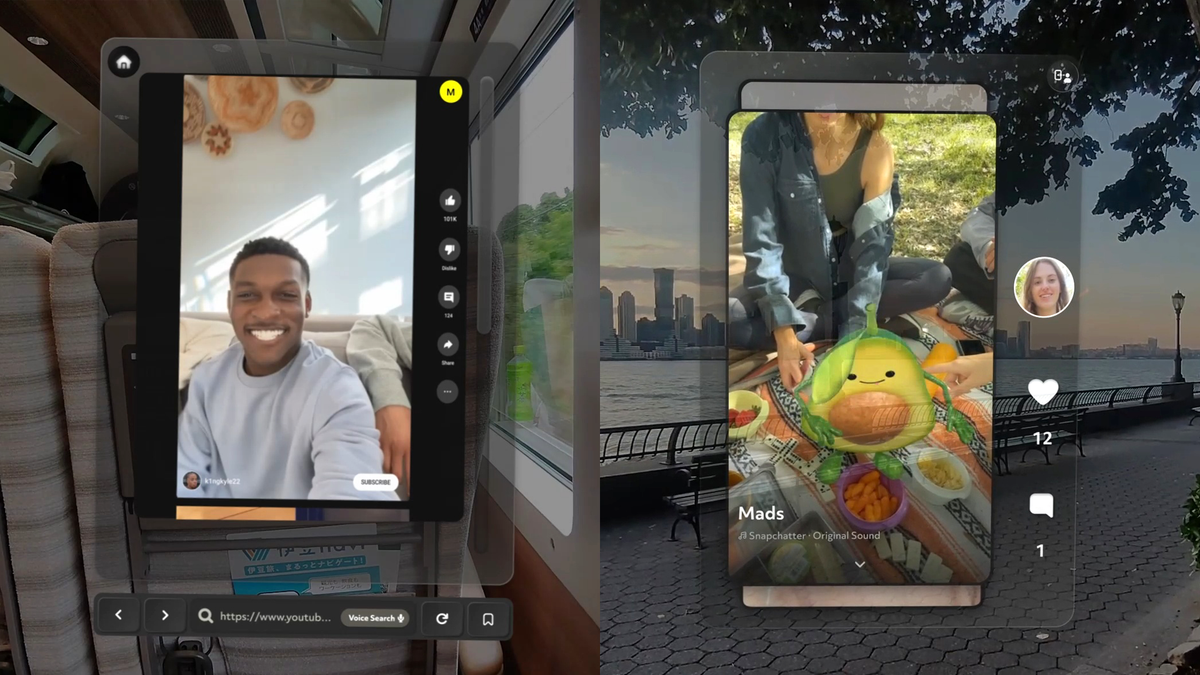
Since releasing Snap OS in the latest Spectacles kit in late 2024, Snap has repeatedly added new capabilities for developers building Lenses, and late last year launched Snap OS 2.0, adding and improving first-party apps like Browser, Gallery, and Spotlight to bring the AR platform closer to being ready for consumers.

Stop relying on streaming and begin investing in physical movies

Build a Rocket Boy seems more interested in investigating leaks than improving the game

Jackal is a new top-down action game that moves fast and feels great to play

Conspiracies spread online thanks to spoofed accounts

‘You’ve got to deceive the company,’ Kazutaka Kodaka says

The Game of Thrones actor can be seen parachuting across a lake in tactical gear

Dragon Quest and Final Fantasy are just the tip of the iceberg

This is a Bluetooth speaker you won’t want to miss out on.

The games are likely to be revealed later this month on the series’ 30th anniversary

Keep all your essentials charged on the go.


The studio behind GOLF+ (2020) is aiming to expand the game this year in a bid to solve some of the most persistent problems in off-course golfing simulators: building real-world muscle memory in a virtual environment.
Golf+ CEO Ryan Engle announced that the studio’s popular golf sim is getting “major product updates” this year, which is set to include a new social lobby, UI improvements, and over a dozen new courses.
In addition, Engle showed off a fresh look at a mixed reality mode which ostensibly tracks real-world golf balls and clubs so players can work on driving, iron play and putting in a Sim Golf environment.
Check it out in action below:
Traditional golf simulators use large 2D impact screens and sensors to measure ball speed and direction. While they’re generally considered effective for practicing full swings and driving, they tend to be less reliable at the slower ball speeds used in putting and short-game shots.
Worse yet, these sorts of simulator screens lack parallax, as courses are projected at a fixed viewpoint. Looping in a mixed reality setup though could allow golfers to not only build muscle memory with a real ball and club, but have the benefit of golfing in a more realistic environment.
It’s unsure whether the studio intends on releasing the mixed reality implementation as an update to the current game, or releasing a separate version for location based golf sims.
Engle says however we should expect Golf+ on more platforms in the near future. Although it’s currently only available on Quest, the studio shared plans to expand the game to PC VR headsets.
Additionally, the studio says it’s exploring flatscreen PC gameplay, as well as offering a “unified experience with shared physics, multiplayer, and cross-play across all platforms.”
The post Studio Behind VR’s Most Popular Golf Game Aims to Solve a Key Challenge with Golf Training Sims appeared first on Road to VR.

This kind of discount is worth waiting for, so grab it while you can.

The company is taking a measured approach to unprecedented economic conditions

The pair offers exceptional sound quality, plus is compatible with both Android and iOS devices.

Showrunner Craig Mazin has reached out to the studio to discuss the series

Upgrade the way you stream without overpaying.

Also: what if instead of game prices going up, game budgets go down?

Over at Amazon, you can save nearly $70 on the Oakley Meta black frame smart glasses with polarized lenses.