
Amazon’s live-action series is bringing back some actors who were part of the games

Amazon’s live-action series is bringing back some actors who were part of the games

Ben Affleck, Scarlett Johansson, Jeff Goldblum, Sofía Vergara, George Clooney, MrBeast, and so many other stars and actors want to sell you AI and food

The generated League of Legends characters look the part, but the video is an incoherent mess

Cyborgs are coming in the next big update

The open-world survival game still doesn’t let PS5 and Xbox players play together

Teen-by-default is coming to all Discord accounts in March

Guerrilla’s coop hunting spin-off is the studio’s main focus right now

Updates on Wolverine and more seem like a safe bet

Right now, you can save 20% on the 128GB, A17 Pro-powered iPad Mini over at Amazon.

Save 13% on the Sony WH-1000XM6 noise-cancelling headphones for a limited time.

Where can you watch Super Bowl for free in the US, and from anywhere in the world?

Stream Super Bowl live in Canada! Get today’s kickoff time, free streaming options, and don’t miss Bad Bunny’s halftime show!
Glassbreakers: Champions of Moss and Clay Hunt VR are this February’s Horizon+ monthly games on Quest.
February 2026 brings a number of new games to the Horizon+ Monthly Games Catalog, including one of the best strategy games in VR, and an engaging target practice shooter. In addition, previously redeemed games will remain in your library while subscribed to the service.
Here’s what you need to know about this February’s offerings.
0:00
The star of February’s Horizon+ Monthly games, Glassbreakers: Champions of Moss is, as our review put it, a “smart, competitive, and […] one of the best strategy experiences available in VR.” The tabletop strategy game, which features characters and lore from the Moss and Moss 2 game universe, blends the strategic depth of RTS games with the character personality and squad mechanics of the best MOBAs.
 UploadVRPete Austin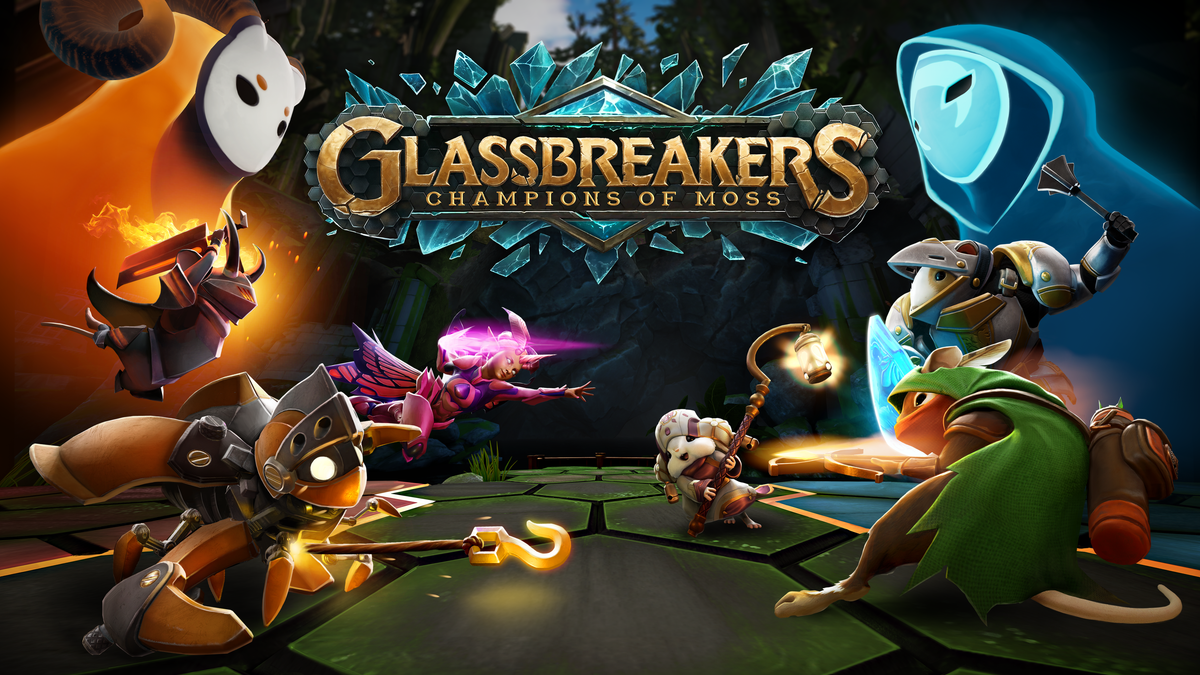
0:00
Clay Hunt VR is a relatively simple shotgun shooting game which challenges you to hone your aim against clay skeets, ducks, and other game animals. A multiplayer mode allows shooting with friends in public or private rooms, and customizable weaponry allows players to tune their favorite guns.
Horizon+ continues offering a Games Catalog of Quest titles that any subscriber can access. Meta can remove and add new games from the catalog at any time. Here is the current Horizon+ Games Catalog in the US:
Meta continues to add new games to the separate Indie Games Catalog, and you can see the entire list here.
Meta Horizon+ is a subscription service that gives players access to a monthly selection of games for $7.99 USD per month, or $59.99 USD a year. New users can give Meta Horizon+ a try for a month.
The Khronos Group is aiming to standardize Gaussian splatting by proposing a release candidate for an integration into the widely adopted glTF 3D format.
Khronos is a non-profit industry consortium that manages OpenGL, Vulkan, and WebGL. In the context of XR specifically, it pioneered OpenXR, an open industry-standard API for XR application development and runtimes. OpenXR provides developers with access to a single standardized API, allowing them to build an app once and then easily port it to other platforms, facilitating cross-platform availability. OpenXR is supported by most major stakeholders in the XR industry, including Meta, Valve, HTC, ByteDance, Epic Games, Unity, Nvidia, and Qualcomm. A notable exception is Apple, which maintains its own proprietary APIs.
In 2015, Khronos introduced glTF (Graphics Language Transmission Format), a standard for the efficient transmission and loading of 3D scenes and models by game engines and applications. Often framed as the “JPEG of 3D,” it provides a streamlined, universal format that allows creators to export high-quality 3D assets from any tool while ensuring consumers can view them instantly and consistently across any device or web browser. Today, glTF is the most widely adopted 3D asset format on the web.
This week, Khronos announced a release candidate for a Gaussian splatting extension to glTF. Gaussian splatting has shown immense potential for XR, as it allows for quick and easy photorealistic 3D capturing of objects and environments using common devices like smartphones, which can later be viewed and explored in VR. The technology already powers the photorealistic captures of Meta Hyperscape, Apple’s recently improved Personas, the volumetric scenes of Gracia and the promptable 3D environments of Marble.
While capturing Gaussian splats has become easier, sharing them remains the primary hurdle, an issue Khronos is now directly addressing. The new glTF extension enables the storage of 3D Gaussian splats directly within glTF files. By doing so, Khronos is standardizing the delivery of Gaussian splats within an already established and widely adopted 3D ecosystem, paving the way for the technology to move into the mainstream.
“Instagram made it easy to share photos; TikTok brought about an explosion in short-form video social sharing. Until now, 3D has lagged behind 2D media formats because 3D models are so much harder than photos or videos to create and share. With Gaussian splatting, you can easily imagine an app that enables a mobile user to move their phone to quickly capture a scene or object to create a splat-based 3D model. As an open standard, glTF makes it possible to share that model. A splat stored in a glTF file could be shared on social media and displayed with full interactivity on any client device,” explains Neil Trevett, president of Khronos, in a written statement to UploadVR.
Khronos’s decision to formally embrace Gaussian splatting sends a clear message that lifelike 3D is here to stay, says Michael Rubloff, Managing Editor of Radiance Fields, a news blog specialized in Gaussian splatting and similar technologies.
“With that level of impact approaching, it becomes critical to build the foundations carefully. A glTF extension, built on the most widely adopted 3D asset format, helps derisk fragmentation as industries shift from 2D to 3D while giving developers confidence that what they build today can ship across ecosystems rather than remain locked to a single platform,” says Rubloff.
Gaussian splats represent a fundamental departure from traditional mesh-based graphics. While standard 3D modeling relies on connected triangles to define an object’s surface, Gaussian splatting treats a scene as a dense cloud of volumetric data points, with each point defined by properties including position, scale, rotation, color, and opacity. The benefits over traditional 3D graphics rendering include the ability to capture complex geometries like hair or smoke and highly realistic lighting effects, such as reflections and refractions, that are notoriously difficult to achieve with polygonal meshes.
The new glTF extension acts like an instruction manual, telling the software to render these points as smooth, overlapping shapes, creating a realistic 3D image rather than the flat, jagged surfaces usually seen in video games.
Still, there is work to be done. The extension is currently in a release candidate phase, with the Khronos 3D Formats Working Group inviting feedback from engine developers, creators, and artists to test the specification ahead of a formal ratification targeted for the second quarter of 2026. So far, companies such as Autodesk, Bentley Systems, Huawei, Niantic Spatial, and Nvidia have contributed to the extension.
The release candidate was developed with the rapid and ongoing evolution of Gaussian splatting in mind. For example, it does not yet define a standard compression approach, which is crucial for making Gaussian splatting performant on mobile devices. To maintain flexibility, the specification is intentionally designed to be extensible, leaving room for future additions as Gaussian splatting techniques evolve and eventually become standardized within the glTF ecosystem.

Watch Super Bowl 2026 for free! Get the February 8 kickoff time & streaming tips !

The underrated and unsung hero of the iPad family is back down to just $300, a great alternative to premium-level tablet prices.

Take a trip with Goro Majima to Hawaii
Valve says it needs to “revisit our exact shipping schedule and pricing” for Steam Frame and Steam Machine amid the global memory and storage shortage.
When announcing the headset and consolized PC back in November, Valve said they would ship in “early 2026”. For pricing, it told UploadVR it was “aiming” to sell Steam Frame for less than the $1000 Index full-kit, and suggested that the Steam Machine would be competitive with building a PC with similar parts.
 UploadVRDavid Heaney
Now, in a blog post on Steam, Valve says that while it had originally planned to share prices and release dates by now, the “limited availability and growing prices” of memory and storage mean it “must revisit” its plan for both.
“When we announced these products in November, we planned on being able to share specific pricing and launch dates by now. But the memory and storage shortages you’ve likely heard about across the industry have rapidly increased since then. The limited availability and growing prices of these critical components mean we must revisit our exact shipping schedule and pricing (especially around Steam Machine and Steam Frame).
Our goal of shipping all three products in the first half of the year has not changed. But we have work to do to land on concrete pricing and launch dates that we can confidently announce, being mindful of how quickly the circumstances around both of those things can change. We will keep you updated as much as we can as we finalize those plans as soon as possible.”
The company says its goal is still to ship in the first half of this year, but has “work to do” to “land on” concrete prices and launch dates.
“We will keep you updated as much as we can as we finalize those plans as soon as possible”, Valve promises.
 UploadVRDavid Heaney
If you missed it at the time, make sure to read our hands-on impressions of Steam Frame from Valve HQ in November.

The just-announced line goes on sale next week in limited quantities
Snap spun its Specs AR glasses into its own subsidiary, and reconfirmed that it plans to launch the consumer product this year.
“Establishing Specs Inc. as a wholly-owned subsidiary provides greater operational focus and alignment, enables new partnerships and capital flexibility including the potential for minority investment, allows us to grow a distinct brand, and supports clearer valuation of the business as we work towards the public launch of Specs later this year”, the company behind Snapchat says.
The new Specs Inc subsidiary is currently hiring for nearly 100 open roles globally, it says, in preparation for the launch.
The current Snap Spectacles are $99/month AR glasses for developers ($50/month if they’re students), intended to let them develop apps for the Specs consumer product the company intends to ship this year.
Spectacles have a 46° diagonal field of view, angular resolution comparable to Apple Vision Pro, relatively limited computing power, and a built-in battery life of just 45 minutes. They’re also the bulkiest AR device in “glasses” form factor we’ve seen yet, weighing 226 grams. That’s almost 5 times as heavy as Ray-Ban Meta glasses, for an admittedly entirely unfair comparison.
But Snap CEO Evan Spiegel claims that the consumer Specs will have “a much smaller form factor, at a fraction of the weight, with a ton more capability”, while running all the same apps developed so far.
As such, what’s been more important to keep track of, to date, is Snap OS, not the developer kit hardware.
Snap OS is relatively unique. While on an underlying level it’s Android-based, you can’t install APKs on it, and thus developers can’t run native code or use third-party engines like Unity. Instead, they build sandboxed “Lenses”, the company’s name for apps, using the Lens Studio software for Windows and macOS.
In Lens Studio, developers use JavaScript or TypeScript to interact with high-level APIs, while the operating system itself handles the low-level core tech like rendering and core interactions. This has many of the same advantages as the Shared Space of Apple’s visionOS: near-instant app launches, interaction consistency, and easy implementation of shared multi-user experiences without friction. It even allows the Spectacles mobile app to be used as a spectator view for almost any Lens.
Snap OS doesn’t support multitasking, but this is more likely a limitation of the current hardware than the operating system itself.
 UploadVRDavid Heaney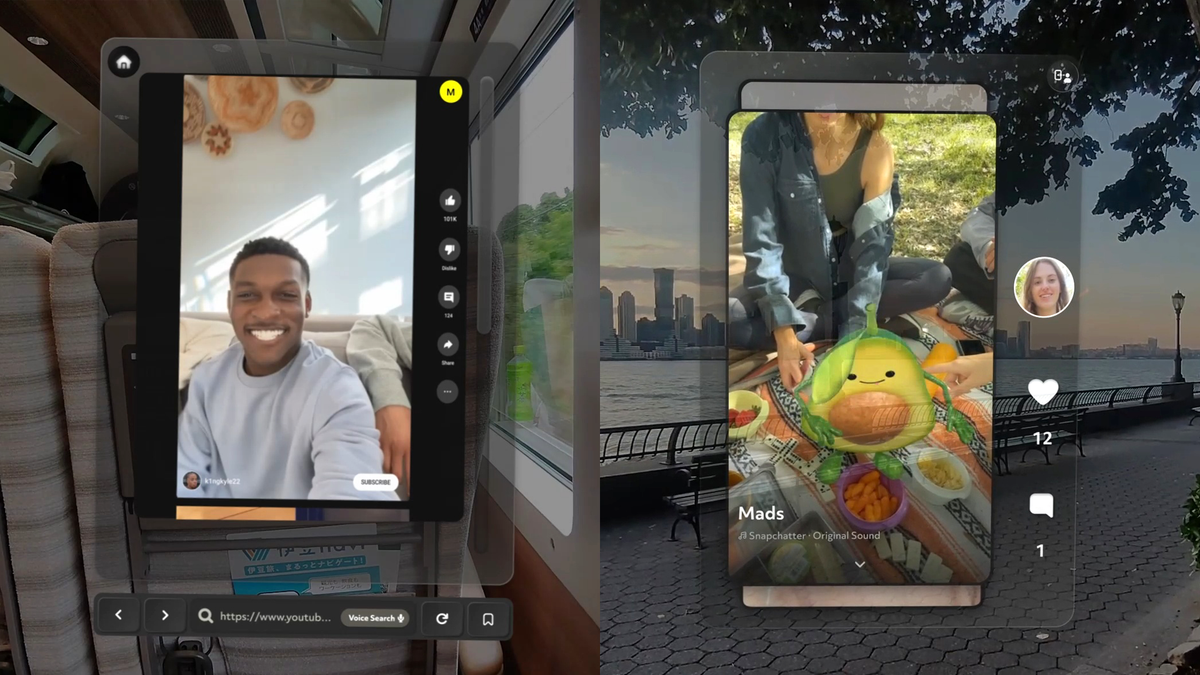
Since releasing Snap OS in the latest Spectacles kit in late 2024, Snap has repeatedly added new capabilities for developers building Lenses, and late last year launched Snap OS 2.0, adding and improving first-party apps like Browser, Gallery, and Spotlight to bring the AR platform closer to being ready for consumers.