
‘Star Citizen’ VR Support Isn’t Prime Time Yet, But It’s Getting There

Cloud Imperium Games (CIG) added experimental PC VR support to Star Citizen late last year, taking a first step in fulfilling a more than decade-old promise. Things are getting increasingly serious though after the release of its second post-VR update.

Update Alpha 4.5 initially brought a VR theater and full VR mode to the game in December, which lets users play the bulk of the game in PC VR headsets for the first time, including walking, flying, EVA, combat, and using menus.

Granted, it’s still a (very) experimental mode, which initially required some users to even add VR config lines to the game’s directory to get it working, done in addition to keeping track of keybinds to cycle through VR modes on the fly.

Now the studio has released Star Citizen 4.6, adding for the first time an official VR option in the settings menu, making managing and enabling VR mode at startup a much easier affair.
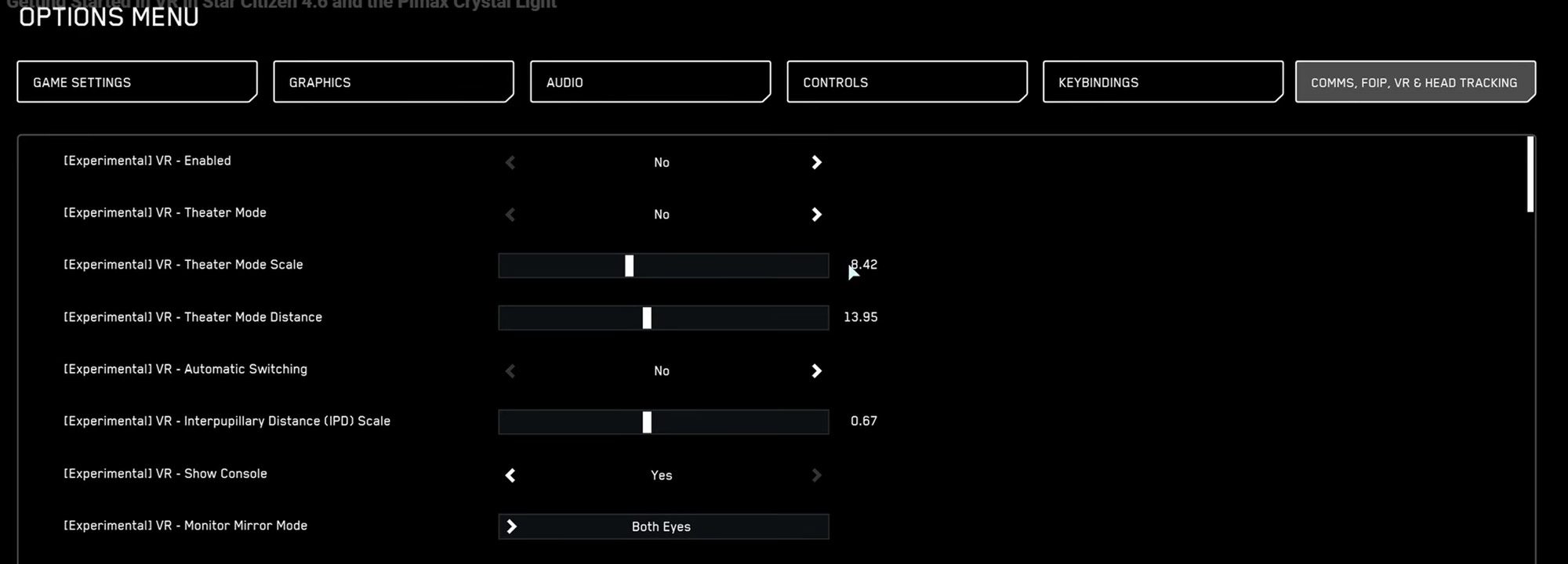
Image courtesy Ray’s Guide

Although 4.6 doesn’t radically expand VR features, it’s certainly a vote of confidence that VR support is not only still on track, but moving closer to the core of the game. Still, it’s polished a number of usability issues, such as better menus and a smoother overall experience.

That said, as mentioned in a recent ‘Ray’s Guide’ video, players still need to carefully tune OpenXR settings, upscaling options, and in-game VR stuff, such as UI scale, distance, and IPD alignment just to get comfortable results. Users also typically need to switch between full VR and theater mode constantly for inventory and kiosk interactions, which is a definite immersion breaker.

That, and it doesn’t include VR motion controller support yet, making control remapping almost mandatory at this point, with many users relying on a mix of controllers, keyboards, HOTAS, and voice command software to manage the game’s enormous number of bindings.

As Silvan-CIG says in the 4.5 update announce in December though, all of its done in the spirit of open development.

“This is not our full VR launch. When that day arrives, we will make plenty of noise about it. What we are rolling out today is an opportunity for some early hands-on time, very much in the spirit of Open Development, so you can jump in, see how things are shaping up, and help guide what comes next.”

That said, creating a VR-native out of a Star Citizen is a tall order. Looking ahead, CIG’s biggest challenges will probably be centered around balancing those ambitions with the rest of the game’s development, which is constantly growing in scope and graphical complexity.

The post ‘Star Citizen’ VR Support Isn’t Prime Time Yet, But It’s Getting There appeared first on Road to VR.


Asymmetric VR Horror Game Inverse Shutting Down In March

The developers of the 4v1 multiplayer horror game Inverse announced that servers will shut down at the end of March.

MassVR, who originally started developing location-based (LBE) VR experiences in 2017, posted an update on Inverse’s Steam page announcing the shutdown. Per the post, the game servers will shut down on March 31, 2026. MassVR clarified “Until that time, all online features/servers will remain active, and you can continue to play and enjoy the game as usual.”

Inverse: Stave Off Demons In 4v1 Multiplayer Horror Action
Inverse brings more 4v1 multiplayer horror action to Quest headsets – here are our hands-on impressions.
UploadVRCharlie Wacholz

Inverse is a 4v1 asymmetric survival horror game drawing inspiration from the popular flatscreen title, Dead by Daylight. Four players play as HAZMAT suit-clad agents against one opponent playing as a monster. The agents have to repair three control panels within a short time limit to unlock gun cases and kill the monster. The monster can either kill all of the agents or simply outlast the time limit to win.

0:00

/0:25

Inverse Release Trailer

Inverse first launched on Quest App Lab in June 2023 as a limited-feature free-to-play title. A PCVR version followed in November of the same year. Its full release was priced $29.99 and was later dropped to $14.99. The game has already been delisted on Steam. At the time of this article, it remains available on Meta Quest 2/Pro/3/3S for $9.99.

Cards & Tankards Season 3 & Major Expansion Coming Next Month

The update brings 25 new cards, a new card type, new legendary cards for each faction, fully revitalized card artwork, and more.

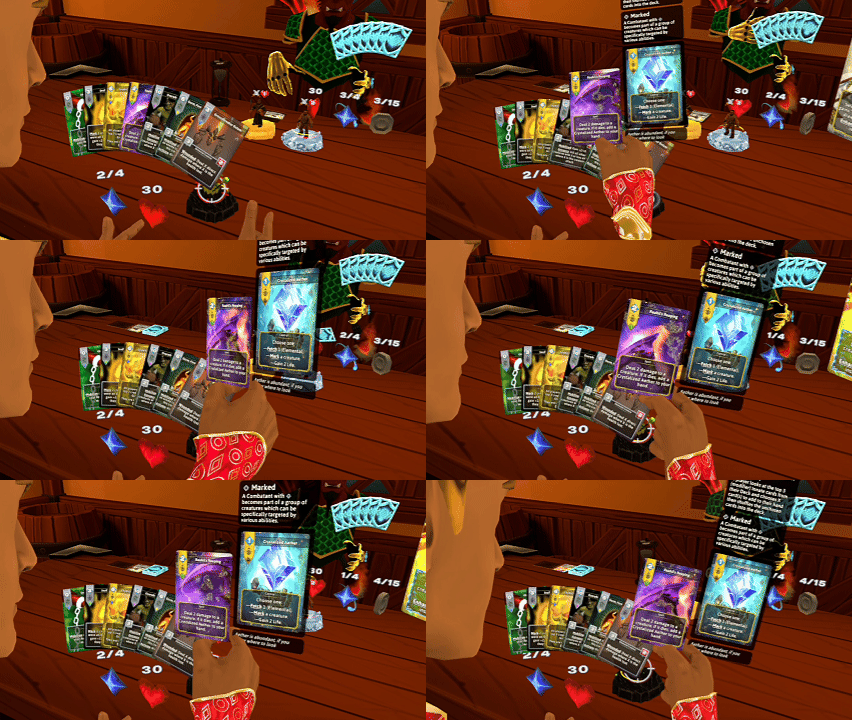
Cards & Tankards, a free-to-play VR social game where players hang out and battle each other in collectible card games and other traditional board games, will receive a massive update in March. The coming update ushers in Season 3, and brings several significant additions to the game as well as new mechanics and features including:

  • 25-card expansion at launch, with an additional 25 cards released gradually throughout Season 3
  • New card type: Relics are available to all factions, summoned into play like “creatures” but do not participate in combat and do not exhaust when played. Each Relic contains a limited number of Sparks of Aether, which are spent to activate its effects. Once those sparks are depleted, the Relic is destroyed. Relics are designed to add long term planning and resource management to gameplay without overwhelming the board state.
  • New Legendary Cards (one per faction)
  • Major mechanical balancing derived through collaboration between the development team and the community-driven Card Design and Balance Team

0:00

/1:28

The forthcoming update follows on from last year’s major update, which added a new social area, chess and checkers boards, new physical shops to peruse, taverns in which to chill, and hidden corners tucked amongst a bustling town center.

The developer team has spent the period between updates rolling out several major quality of life and progression adjustments, including:

  • Achievements System in the Town, rewarding milestones with gold and titles
  • Global Deck Sharing via the Town Schoolhouse
  • Deck Sharing and Copying directly from the deck editor
  • Daily Quests and Streak Rewards
  • Focus Card System to guarantee specific cards over time
  • Expanded Deck Building, allowing over 40 cards for theory crafting
  • Deck Privacy Settings to hide deck information while editing

The team has also recently rebuilt the card visuals, giving all the cards a fresh and modern look.

Cards & Tankards is available on Quest and Steam, and the update is coming in March.

Haymaker Targeting PC VR Port This Spring

One of Meta Quest’s top-selling VR brawlers will make the leap to PC VR headsets in spring.

Haymaker is a physics-first VR combat brawler focused on authentic body mechanics and replayability. You’ll grab, grapple, block, kick, and strike adaptive AI enemies across a variety of environments specifically built for mayhem such as a skyscraper rooftop, a seedy billiard parlor, and more.

Console Studios has just announced both a content update for its physics-based VR brawler Haymaker, and that it intends to bring the title to PC VR via Steam in just a few months’ time. The updated Steam release will also benefit from enhanced graphics and dynamic lighting.

0:00

/1:00

In addition to the Steam port, Haymaker will receive noteworthy updates on Quest, where the game has been available in Early Access since November. Coming updates include an expanded sandbox mode with deeper character customization and fresh designs to diversify the game’s brutal street fights, a new MMA-style Octagon arena, and a tournament mode.

When the Steam port launches, it will do so with content parity with the Quest version.

Haymaker is available in Early Access on Quest headsets, priced at $14.99. It’s currently on Meta’s top-seller list, and has a strong 4.7/5 user rating.

Soul Retreat Offers Photorealistic Nature Meditation On Quest

Soul Retreat is a new Quest 3 & 3S app that uses real-world location captures to take users on a relaxing virtual getaway.

The new VR meditation app from Soul Retreat Labs takes users to photorealistic landscapes inspired by real locations like Scotland’s Glen Coe and Spain’s La Besurta.

These soothing locales have been recreated through a system the developer calls GroundedPresence, an advanced photogrammetry stack. The result is a realistic experience that replicates the feeling of relaxing on a sunny beach or hiking through breezy hills.

0:00

/1:16

A voiceover guides you through their meditation, talking you through breathing exercises or telling short stories to distract you from whatever stress you have in the day, and you can shift the time from day to night with a simple gesture or voice command. This narrator adapts with each session, with the studio promising a personalized experience.

Soul Retreat is currently available to download for free on Meta Quest 3 and 3S, with an optional Soul Retreat Plus subscription service costing either $6.99 a month, $34.99 a year, or a $69.99 lifetime payment.

The free option gives you access to two environments with a third being rotated weekly, while the paid option lets you explore all 10 current retreats. More will be added as Soul Retreat continues its development, the studio promises.

Ray-Ban Smart Glasses Get Massive Utility Boost with Cool (but risky) ClawdBot Hack

If you’re comfortable mucking around with a new open source project, you could be shopping on Amazon just by looking at an object with your Ray-Ban Meta smart glasses.

Ray-Ban Meta smart glasses are pretty useful out of the box, offering photo & video capture, calls, music playback, and your standard assortment of AI chatbot stuff. They don’t have an app store though, which means you’re basically stuck with a handful of curated services.

Now, indie developer Sean Liu released an open-source project called VisionClaw that links Ray-Ban Meta smart glasses with OpenClaw (aka ClawdBot), essentially giving the autonomous AI agent eyes and ears.

Check out VisionClaw in action below, courtesy Liu:

now my clawdbot lives in my ray-ban meta glasses so i can just buy whatever i’m looking at pic.twitter.com/gWrijyTRhE

— xiaoan (@_seanliu) February 6, 2026

OpenClaw isn’t an AI model like ChatGPT or Google Gemini though. It’s an agentic layer—essentially a complex messaging layer built on top of an AI model that interacts with services on your behalf, like sending emails, managing shopping lists, or controlling smart home devices—just three of the 56+ tools OpenClaw can integrate with right now.

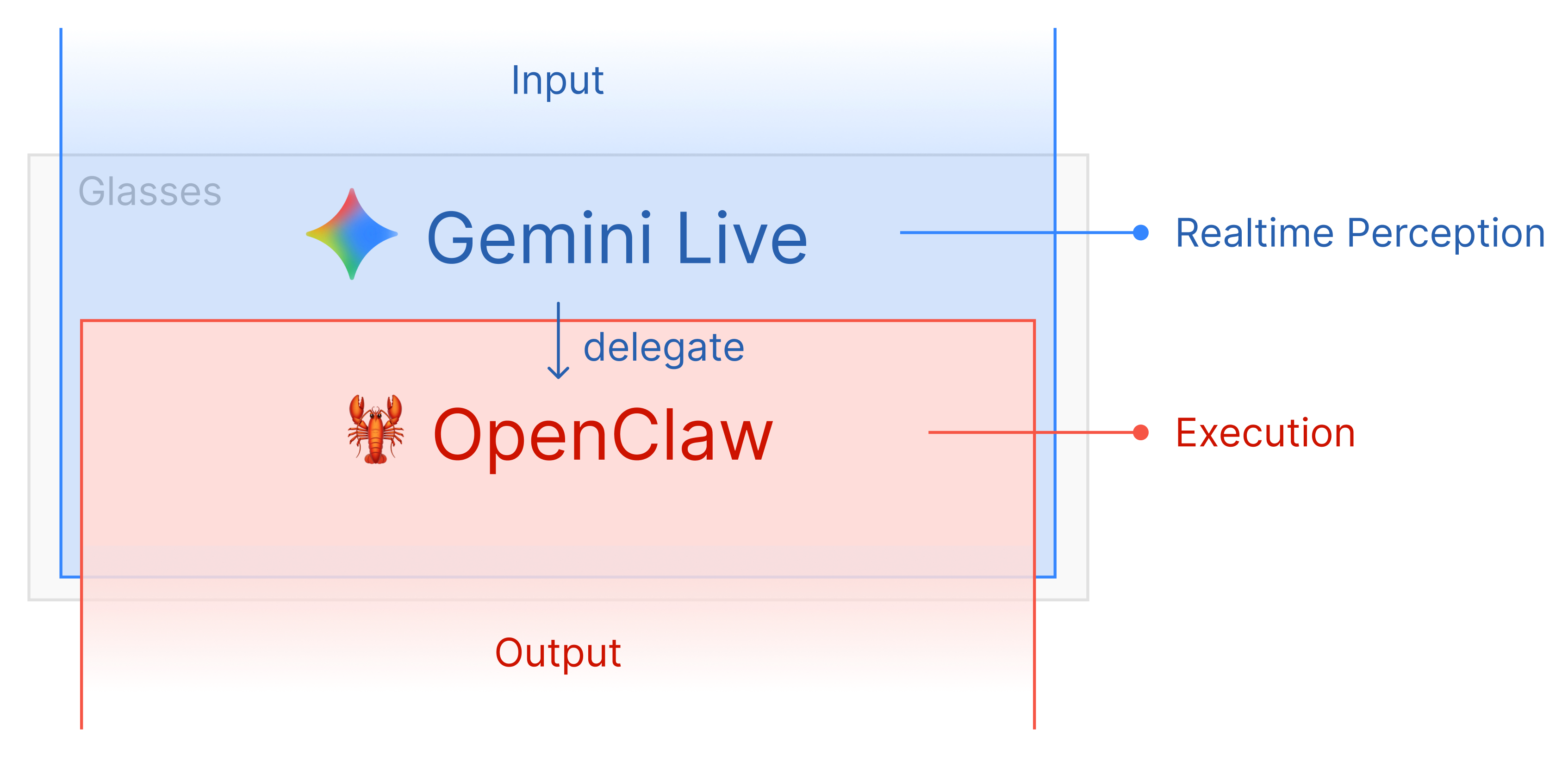
Basically, it works like this: VisionClaw uses Gemini Live for real-time voice and computer vision, which can do things like describe what you’re seeing and answer questions—basically the same sort of tasks you can do with the glasses’ native Meta AI.

Image courtesy Sean Liu

But once you want to actually interact with an app or service—like when you want to send a message over email or your favorite non-Meta messaging app like Signal or Telegram—Gemini Live hands off the request to OpenClaw, which takes action.

Users looking to run VisionClaw will need an iPhone, as Liu’s codebase is written as an Xcode/Swift app that specifically uses Meta’s Wearables Device Access Toolkit (DAT) for iOS to connect the phone to Ray-Ban Meta glasses.

Beyond that, you’ll also need a fair understanding of the risks involved with running OpenClaw on your personal hardware.

While it can do some pretty amazing things, it’s a third-party bit of software that could require you to input passwords, API keys, and personal information, which can open the user up to malicious actors. Notably, OpenClaw’s skill integrations could be written by anyone, so users need to be especially vigilant.

The post Ray-Ban Smart Glasses Get Massive Utility Boost with Cool (but risky) ClawdBot Hack appeared first on Road to VR.