
One user-created piece of content featuring Jeffrey Epstein and Ghislaine Maxwell has been available to download since 2023

One user-created piece of content featuring Jeffrey Epstein and Ghislaine Maxwell has been available to download since 2023

Also: I would delay my game showcase if I was going bankrupt, too

A new Digital Foundry video shows the upcoming action-adventure game looking very impressive indeed
Arizona Sunshine Remake and The Pirate: Republic of Nassau are the Horizon+ monthly games on Quest for March.
March 2026 brings several new games to the Horizon+ Monthly Games Catalog, including the zombie slaughter-fest Arizona Sunshine Remake, and the swashbuckling adventure The Pirate: Republic of Nassau.
Beat Saber, GOLF+, Spatial Ops, and The 7th Guest VR also make their way to the catalog. Previously redeemed games will remain in your library while subscribed to the service.
Here’s what you need to know about this March’s offerings.
0:00
Arizona Sunshine Remake is the definitive updated refresh of 2016’s Arizona Sunshine, an award-winning VR shooter that debuted even before standalone VR. Arizona Sunshine Remake brings updated high-res textures, co-op multiplayer, delightfully gruesome gore, and includes all of the original game’s DLC and updates in one package. Our review said it best. “It’s hard not to recommend grabbing Arizona Sunshine Remake.”
0:00
In The Pirate: Republic of Nassau, you’ll command pirate ships and experience the early 18th century life as a true sea captain. Beginning in Nassau, the heart of pirate culture, you’ll engage in naval battles, recruit legendary pirates, explore and expand Nassau, and build your privateering fleet. Our review called it “a worthwhile golden age of piracy fantasy.”
 UploadVRLuis Aviles
Horizon+ continues offering a Games Catalog of Quest titles that any subscriber can access. Meta can add new games to and remove games from the catalog at any time. Here is the current Horizon+ Games Catalog in the US:
Meta continues to add new games to the separate Indie Games Catalog, and you can see the entire list here.
Meta Horizon+ is a subscription service that gives players access to a monthly selection of games for $7.99 USD per month, or $59.99 USD a year. New users can give Meta Horizon+ a try for a month.
Raceclub is a made-for-VR love letter to formula racing that has you literally chasing ghosts in a promising, addictive work-in-progress.
I sat down with Raceclub, which just released on Meta Quest in Early Access, intending to only play about two hours. This is first impressions, not a full blown review, so I just need to get a feel for the game. Two dead extra batteries and a fully drained Quest 3 later, Raceclub had pulled off the VR trick of making me forget I was sitting in a chair awkwardly holding my controllers in mid air.
What is it?: A formula-style racing game
Platforms: Meta Quest (played on Meta Quest 3)
Release Date: February 26, 2026 (Early Access)
Developer and Publisher: Mixer Lab Games
Price: $ 12.99
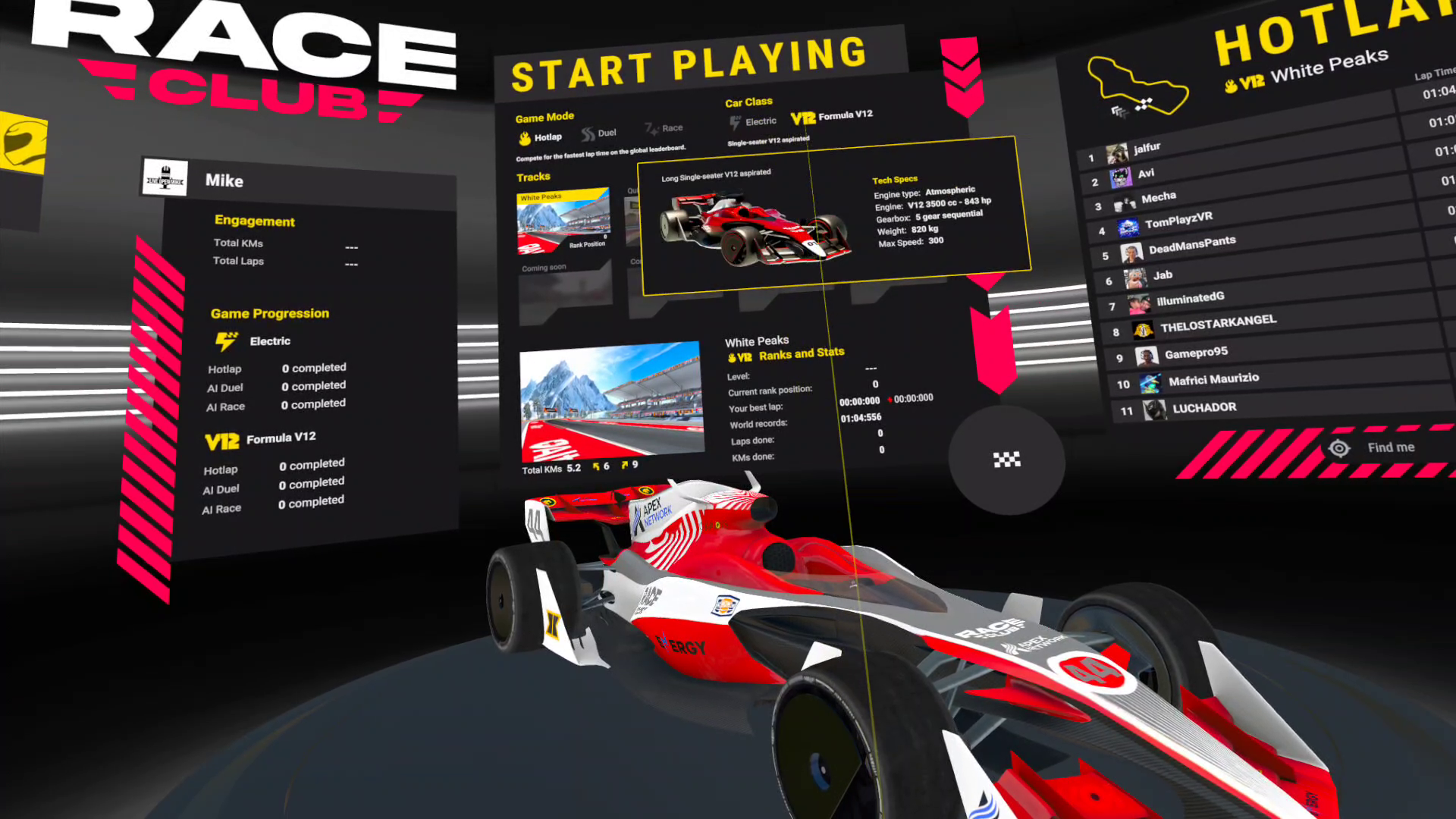
Raceclub offers two types of vehicles: Formula V12 is a more traditional F1 style car and Formula Electric is inspired by Formula E with an electric engine. Past that, cars can be customized with multiple color options and decals and racing has multiple viewing angles. First person views included a traditional cockpit look, the ‘snorkel’ position just behind the driver, the nose of the car, and one seemingly on the track itself under the car. For those prone to motion sickness, there is a third person view behind the car.
There are two modes available to play. In the time attack mode, there are three ghost cars on the track: the car one space ahead on the global leaderboards, a replay of your personal best lap (after you complete one lap), and a replay of the best lap on the top of the leaderboard. I spent over two hours just in this mode, trying to shave milliseconds off my time to improve.
0:00
The other mode is a 1v1 ‘duel’ vs an AI driver. If the AI’s lap time is beaten, a new, faster opponent appears on the next lap, consistently ramping the challenge up as your skills improve. A third, eight-car race mode against AI, is currently unavailable.
One important note is Raceclub does not have vehicle collisions, a (missing) feature that may put some players off. It was odd to phase right through a translucent car instead of crashing, but I quickly stopped caring. I just needed a new personal best.
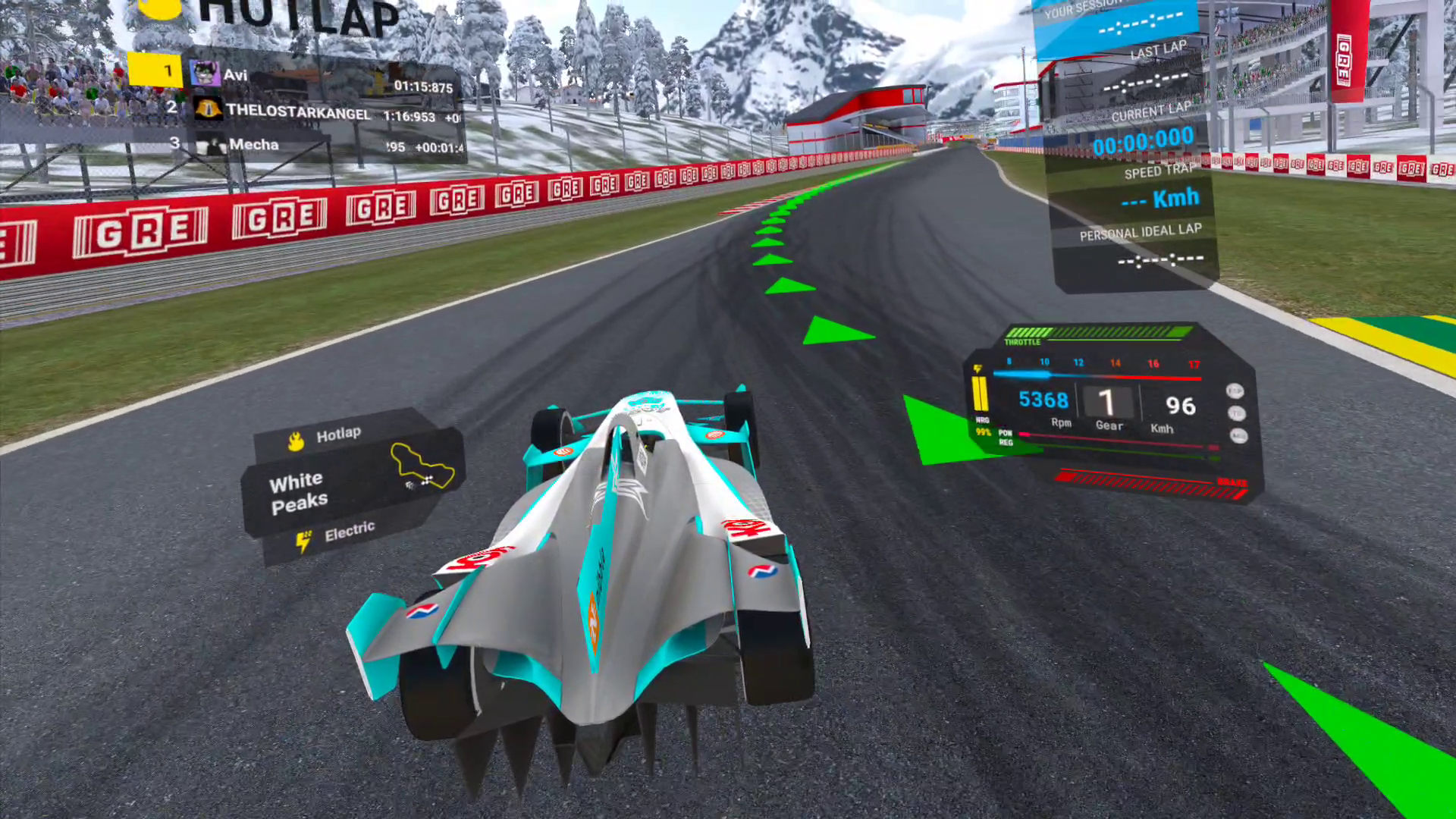
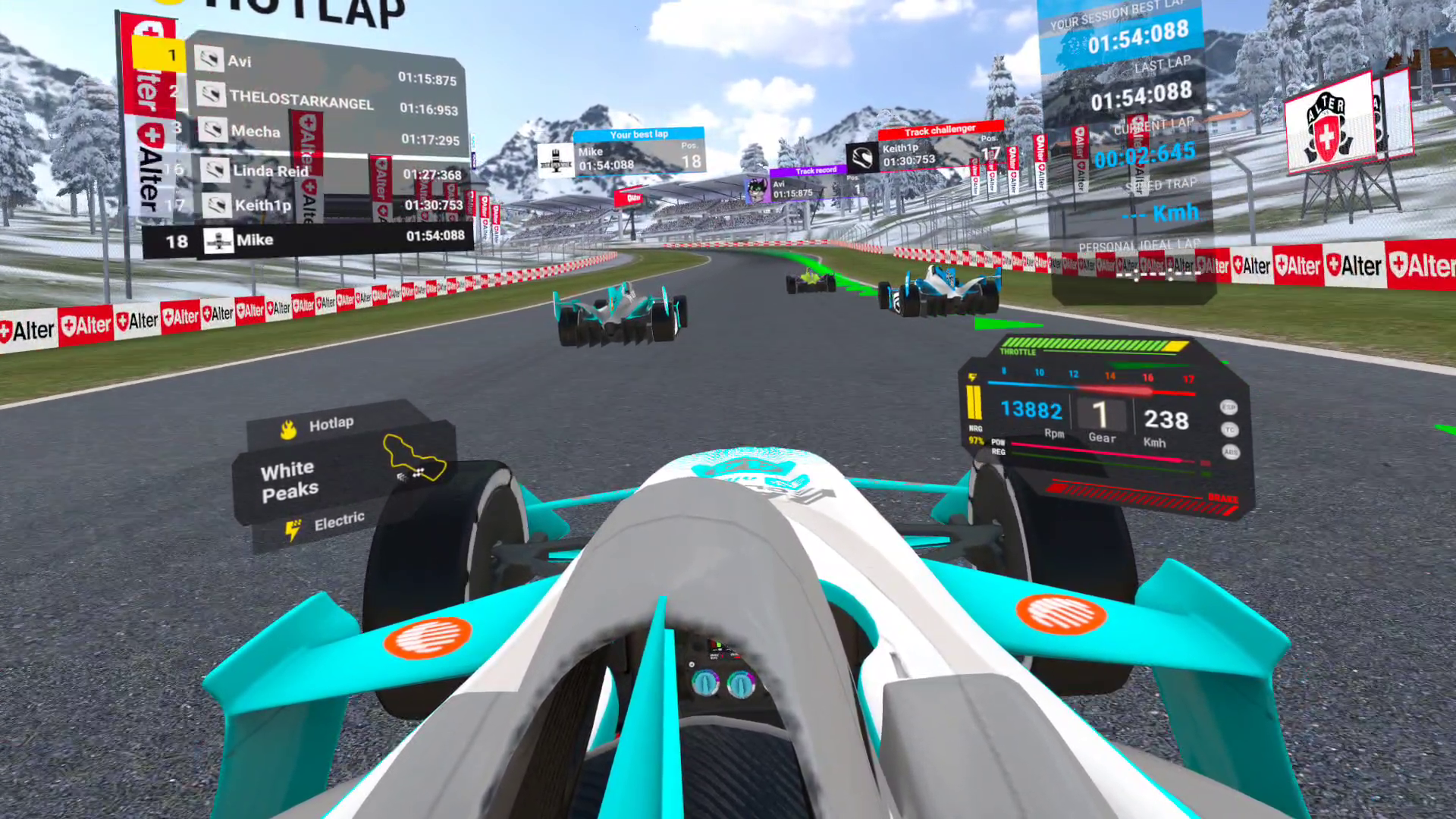
Two views of the electric car in Raceclub captured by UploadVR
One feature I wrote off as immersion breaking when I first saw it, but then realized its purpose is the ‘line’ visualization. It is a visual marker that runs through the entire track of the perfect racing line to take. Trying to keep my car on that line was part of what kept me playing. Every time I messed up and got off that line, I ran another lap to try again. It is a simple, but remarkably effective mechanic.
This is still an Early Access game though, meaning there is room to grow. Half of the tracks are listed as coming soon along with the eight-car race mode. Visually, the game is decent. Admittedly, there is no time to stop and admire the surroundings when chasing ghosts, but while on straightaways I had a second or two to look around and everything looked fine, but nothing stood out. The most glaring feature missing though, is multiplayer.
Raceclub is a high speed racing game with a high sensation of simulated speed. For newer VR users, the third person view, above and behind the car is highly recommended.
There have been a lot of racing games on Quest, from kart racers like Dash Dash World and Galaxy Kart to more serious titles like EXOcars, Downtown Club, and Grid Legends. I’ve played them all, but nothing has quite pulled me in like Raceclub did. Without the horsepower to run the likes of Gran Turismo 7, Assetto Corsa, or EA’s F1 series, this is already a top notch effort on Meta Quest with room to grow.
Raceclub is available now in Early Access on Meta Quest for $12.99.

The President of the United States has a rash or is becoming a zombie, take your pick

Don’t get too excited, the supposed leak just shows what looks like a bridge in Vice City and not much else

Dean ‘Rocket’ Hall’s Icarus is my platonic ideal of a survival sim
ByteDance’s Pico announced the key display and compute specs of its “Project Swan” headset, coming later this year, and detailed the revamped XR operating system it will run.
After years of rumors, ByteDance first officially teased a high-end Pico headset back in November, when its VP of Technology said during a talk in China that it would arrive in 2026 with micro-OLED panels with 4000 pixels per inch (PPI) and a dual-chip architecture with a self-developed coprocessor for computer vision and image processing.
Now, Pico has officially announced these details to the world, and also says that the main processor will have double the CPU and GPU performance of the Snapdragon XR2 Gen 2 in today’s Pico 4 Ultra and Meta Quest 3 headsets.
0:00
Pico’s graphic depicting the “new generation” micro-OLED displays.
Pico says the “new generation” 4000 PPI micro-OLED panels will deliver an average angular resolution of 40 pixels per degree (PPD) and peak of 45 PPD, greater than that of Apple Vision Pro and good enough for text on virtual monitors. That strongly suggests 4K per-eye resolution, though this will depend on the field of view.
Meanwhile, the custom chip that powers computer vision and image processing will deliver “approximately 12 milliseconds of latency”, the company says, the same figure Apple gives for the R1 chip in Vision Pro headsets.
Other than these display and compute specs, and confirming that it will feature hand and eye tracking, Pico isn’t yet revealing specific details about Project Swan, including who is providing the powerful new primary chipset. It’s possible it could be a Snapdragon XR2 Gen 3 from Qualcomm, but there’s no direct indication of this.
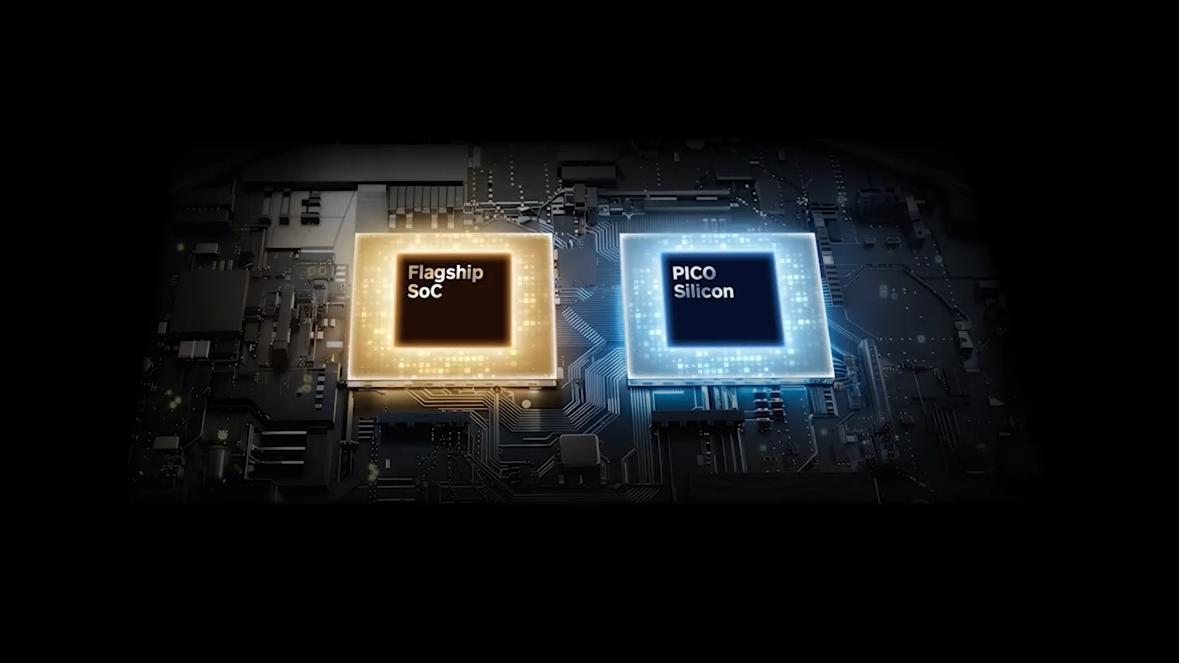
Last year, The Information reported that Pico was working on an ultralight headset a fraction of the weight of typical VR headsets, achieved via the use of a tethered compute puck. But the company isn’t yet confirming the form factor, and a graphic during the announcement depicted the primary and secondary chipsets positioned alongside each other, not one separated into a puck. It’s possible that report referred to a different in-development Pico headset.
While Project Swan is what will draw headlines, Pico’s main focus with today’s announcement is actually Pico OS 6, the revamped version of its XR operating system that the new headset will run.
We first learned of Pico OS 6 and some of its standout features last month via the listing for a talk the company is set to give next week at GDC 2026. The listing referred to Pico OS 6 supporting “a new paradigm for spatial experiences in which games and apps coexist, allowing a primary experience to run alongside companion applications in a shared environment”, and today the company has explained what that means.
0:00
Pico OS 6
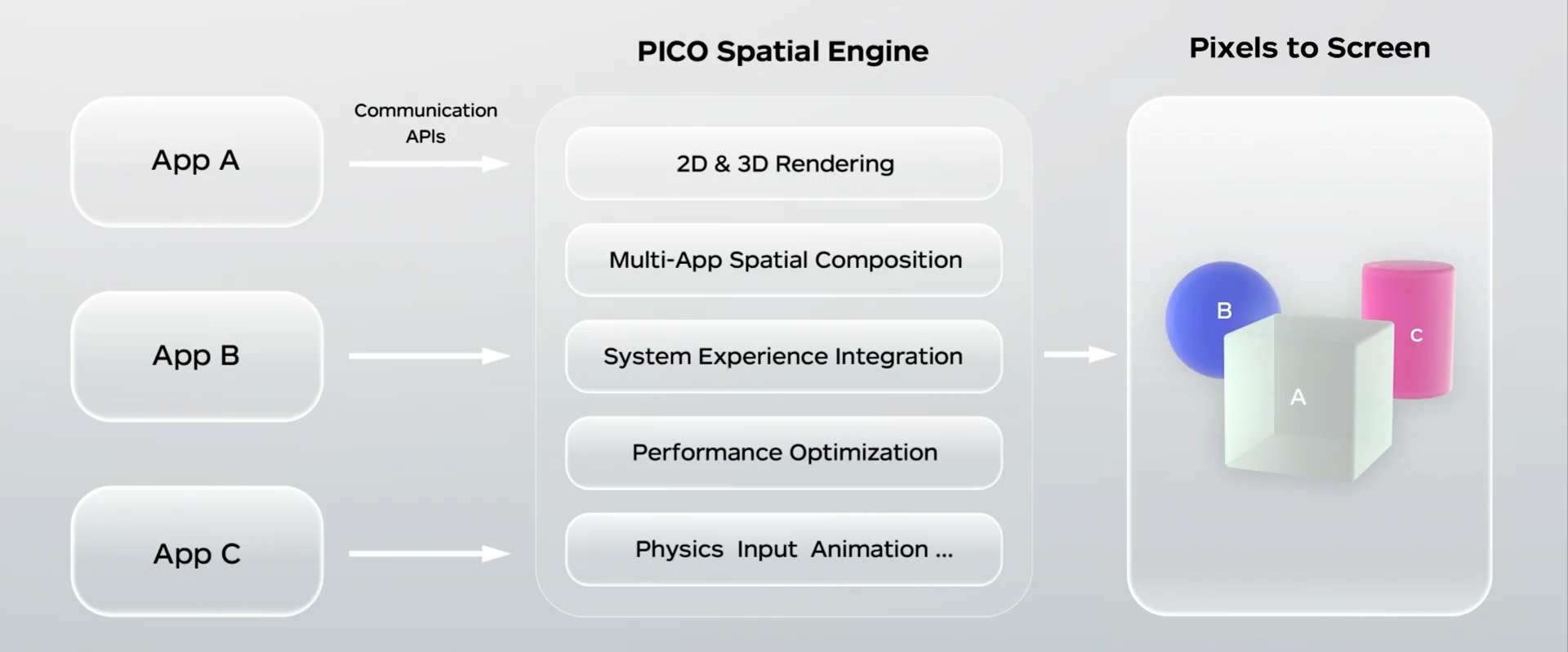
Like Apple’s visionOS, Pico OS 6 features an advanced OS-level compositor with a unified rendering architecture that enables both 2D and 3D apps to run alongside each other, with either a virtual environment or physical reality as the background. The operating system handles rendering and interaction, enabling a cohesive experience where all system-level features are supported and consistent. That includes environmental lighting, dynamic occlusion, spatial audio, physics with real-world surface collisions, and scene understanding.
The company calls this system Pico Spatial Engine, and says it has spent the past two years building it.
This is in stark contrast to Meta’s Horizon OS and Google’s Android XR, which only support running a single 3D app at a time.
Pico OS 6 features a visionOS-like design language that the company calls Cloud Crystal, and developers will be able to use the Pico Spatial UI system to build interfaces that feel consistent with the OS and adapt to real-world lighting, leveraging Pico Spatial Engine.
0:00
A mixed reality game running on Pico OS 6.
Developers can build apps using Pico Spatial SDK, with support for Android Studio and Kotlin, or continue to use Unreal and Unity, with Pico Spatial Support for both engines providing the key features of the Pico Spatial Engine.
Pico says the OS continues to fully support OpenXR, and that all apps that run on Pico 4 Ultra today will be able to run on Project Swan.
The company also introduced an open-source WebXR framework called WebSpatial, which it calls an “open, minimal extension to HTML, CSS, and JS” that lets web developers easily build spatial experiences.
Pico has opened applications for closed beta access to Pico OS 6 and the Project Swan headset.
The company says it will choose “a select few with deep expertise across XR platforms” to join the program, and wants “rigorous feedback” on the hardware and software before a wider release.
Pico’s full announcement video.
Interested developers and XR experts can apply using this ByteDance form.

The Final Puzzle has clues throughout the game, but someone managed to skip to the end

Get Resident Evil 7, Village, and Requiem for just $90

Pokémon Pokopia has surpassed Pokémon Y to become the most highly recommended Pokémon game ever, according to the aggregator

There’s more than a t-Virus infection on his hand in Requiem

March opens with some neat indie games and big console releases

The Switch port makes Shiny hunting easier, but it also puts everyone in danger

Bethesda’s open world sci-fi RPG could be available to pre-order on PS5 in about two weeks

The Windows publisher got a lesson in the Streisand Effect after banning the term


Rebellion announced that Zombie Army VR (2025) is soon losing online co-op, as the studio chalks its up to a change made by the Unity to its underlying game engine.
Publisher and co-developer Rebellion Games says in an announcement that Zombie Army VR will be losing online co-op at the “end of March.”
The studio, which developed the game alongside XR indie Xtended Realities, says its decision to axe co-op comes down to “Unity’s phased exit from the Multiplay Game Server Hosting Service.”
Unity announced in December it was operating its Multiplay Game Server Hosting Service service through March 31st, 2026, noting that the service is deprecated in Unity 6. Instead, the hosting service framework being is being replaced by the unified Multiplayer Services package, which notably requires developer intervention.
Additionally, Rebellion says in the announcement that it’s still investigating how it plans to handle co-op save data, noting that it’s aim is to “protect the integrity of the save data with no loss of progress.”
Released in June 2025, Zombie Army VR faithfully brought the storied franchise to VR for the first time, serving up both single player and two-player co-op on SteamVR, Quest and PSVR 2. Catch our full review here to learn why we gave it a [6.5/10].
The post ‘Zombie Army VR’ to Close Co-op Online Servers Less Than a Year After Launch appeared first on Road to VR.

It sounds like the cozy life sim has the juice

Mina the Hollower and a bunch of other indie games are out soon