AI is getting better at hurricane forecasting

Hurricane Irma as seen by satellite in 2019.

Enlarge / Hurricane Irma as seen by satellite in 2019. (credit: NOAA)

Hurricane Lee wasn’t bothering anyone in early September, churning far out at sea somewhere between Africa and North America. A wall of high pressure stood in its westward path, poised to deflect the storm away from Florida and in a grand arc northeast. Heading where, exactly? It was 10 days out from the earliest possible landfall—eons in weather forecasting—but meteorologists at the European Centre for Medium-Range Weather Forecasts, or ECMWF, were watching closely. The tiniest uncertainties could make the difference between a rainy day in Scotland or serious trouble for the US Northeast.

Typically, weather forecasters would rely on models of atmospheric physics to make that call. This time, they had another tool: a new generation of AI-based weather models developed by chipmaker Nvidia, Chinese tech giant Huawei, and Google’s AI unit DeepMind. For Lee, the three tech-company models predicted a path that would strike somewhere between Rhode Island and Nova Scotia—forecasts that generally agreed with the official physics-based outlook. Land-ho, somewhere. The devil, of course, was in the details.

Weather forecasters describe the arrival of AI models with language that seems out of place in their forward-looking profession: “Sudden.” “Unexpected.” “It seemed to just come out of nowhere,” says Mark DeMaria, an atmospheric scientist at Colorado State University who recently retired from leading a division of the US National Hurricane Center. When he started a project this year with the US National Oceanographic and Atmospheric Administration to validate Nvidia’s FourCastNet model against real-time storm data, he was a “skeptic” of the new models, he says. “I thought there was no chance that it could work.”

Read 13 remaining paragraphs | Comments


Source: Ars Technica – AI is getting better at hurricane forecasting
Our 10-point scale will help you rate the biggest misinformation purveyors

Our new Ladapo scale rates misinformation merchants

Enlarge (credit: Aurich Lawson | Getty Images)

The world has been flooded with misinformation. Falsehoods and conspiracy theories bubble up on everything from the weather to vaccines to the shape of the Earth. Purveyors of this garbage may be motivated by attention, money, or simply the appeal of sticking it to the educated elite. For people who try to keep both feet planted in the real world, it’s enough to make you want to scream. Even if you spend 24 hours a day pushing back against the wrongness on the Internet, it seems impossible to make a dent in it.

I’ve been pondering this, and I’ve decided that we need a way to target the worst sources of misinformation—a way to identify the people who are both the most wrong and the most dangerous. So, as a bit of a thought experiment, I started playing with a simplified scoring system for misinformation merchants.

I’m calling it the 10-point Ladapo scale in honor of the surgeon general of Florida, for reasons I hope are obvious. Any person can be given a score of zero or one (fractions are discouraged) for each of the following questions; scores are then totaled to provide a composite picture of just how bad any source is. To help you understand how to use it, we’ll go through the questions and provide a sense of how each should be scored. We’ll then apply the Ladapo scale to a couple of real-world examples.

Read 24 remaining paragraphs | Comments


Source: Ars Technica – Our 10-point scale will help you rate the biggest misinformation purveyors

The dairy industry is trying to outlaw plant-based “milk” labels—again

The dairy industry is trying to outlaw plant-based “milk” labels—again

Enlarge (credit: Getty | Thomas Trutschel )

In an utterly firm effort to undercut plant-based rivals, big players in the dairy industry are again putting the squeeze on lawmakers to outlaw the use of the term “milk” for non-dairy beverages—or, in Food and Drug Administration lingo, beverages that are not the “lacteal secretion of cows.”

Earlier this year, the dairy industry’s blood curdled when the regulatory agency released a draft guidance stating that plant-based milk alternatives can keep using the term. It was a move that followed years of sour resentment over the labeling.

The FDA did humbly admit that almonds and other sources of plant-based milk don’t, in fact, lactate; therefore, they don’t meet the agency’s own “standard of identity” for products labeled milk. Still, the FDA made a legal argument for keeping the names. It determined that “non-standardized” foods, such as plant-based milks, can legally be marketed with names that are “established common usage,” such as “soy milk” and “almond milk.”

Read 6 remaining paragraphs | Comments


Source: Ars Technica – The dairy industry is trying to outlaw plant-based “milk” labels—again

“Unprecedented” youth climate trial demands action from 32 European governments

Firefighters tackle a wildfire at Vale de Abelha village in Macao, Portugal, on August 16, 2017.

Enlarge / Firefighters tackle a wildfire at Vale de Abelha village in Macao, Portugal, on August 16, 2017. (credit: AFP Contributor / Contributor | AFP)

The largest climate case ever raised before the European Court of Human Rights (ECHR) kicked off Wednesday in Strasbourg, France, Reuters reported. It’s an “unprecedented” effort from six young Portuguese people—ages 11 to 24—who allege that 32 European governments have failed to honor the Paris Agreement and mitigate climate change impacts, causing significant harms and violating their human rights.

Filed in 2020 after a devastating 2017 Portuguese wildfire that killed 120, the complaint alleged that inadequate state measures to reverse climate change have resulted in more frequent heatwaves and wildfires, increasing the risks of heat-related morbidity and fatal illnesses. The plaintiffs also argued that their rights to life, privacy, and family life are being violated, as well as their rights to a life free of discrimination. And because states are unlikely to act fast enough, they’ve alleged that any current risks are “set to increase significantly over the course of their lifetimes and will also affect any children they may have.”

A victory in the ECHR could lead to a ruling forcing European governments to act faster to meet ambitious climate goals—likely by phasing out fossil fuels, reducing emissions, restricting companies from contributing to emissions released overseas, and limiting imports of goods produced by releasing emissions.

Read 12 remaining paragraphs | Comments


Source: Ars Technica – “Unprecedented” youth climate trial demands action from 32 European governments

NASA astronaut Frank Rubio is home after a year in space

Read 29 remaining paragraphs | Comments


Source: Ars Technica – NASA astronaut Frank Rubio is home after a year in space

Musk’s X spreads more disinformation than rival social networks, EU says

Twitter's old bird logo next to the X logo that replaced it.

Enlarge (credit: Getty Images | NurPhoto )

Disinformation is more prevalent on Twitter (aka X) than on Facebook and other social networks, according to a European Union report.

The report released yesterday is a pilot study conducted as part of the voluntary Code of Practice on Disinformation that was created before Elon Musk bought Twitter, which he renamed to X. Musk pulled his social network firm out of the voluntary disinformation pact in May 2023, but it was still included in the pilot study.

“Partway through the study, X withdrew from the Code of Practice on disinformation,” the report said. Twitter also changed its name during the study period; aside from a few X mentions, the 72-page report refers to the social network as Twitter throughout.

Read 17 remaining paragraphs | Comments


Source: Ars Technica – Musk’s X spreads more disinformation than rival social networks, EU says

We finally know for sure what a trilobite ate

Read 10 remaining paragraphs | Comments


Source: Ars Technica – We finally know for sure what a trilobite ate

PlayStation sci-fi epic Horizon Forbidden West makes its way to PC

Read 4 remaining paragraphs | Comments


Source: Ars Technica – PlayStation sci-fi epic Horizon Forbidden West makes its way to PC

Powerful new EV charger starts field tests in Arizona this weekend

A black cube with a white triangle on its corner sits in front of an office building. The cube is the Nxu One charger.

Enlarge / This cube is Nxu’s new charging system, designed to handle up to 4.5 MW of bidirectional power. You can test it out in Mesa, Arizona, between September 28 and October 1, 2023. (credit: Nxu)

Electric vehicles have matured over the past decade to the point where, with few exceptions, they’re now a superior alternative to internal combustion engines. They’re quiet, produce instant torque, and have roughly triple the energy efficiency of a hydrocarbon-burning powertrain. The problem is that recharging an EV battery takes longer than refilling a fuel tank with liquid fuel. A lot longer—even the fastest fast-charging EV still needs 18 minutes to get from 10 to 80 percent state of charge, with 30 to 40 minutes being more common for most EVs on sale today.

Those long charge times are one of the driving forces behind the interest in hydrogen fuel cell EVs, despite the terrible efficiency losses involved in making and using that fuel versus simply storing electricity in a battery. But there are other solutions being pursued. Currently, the most powerful fast chargers an EV driver might encounter in the wild max out at 350 kW—still more than any EV I can think of is capable of accepting. But even more powerful DC chargers are in the works, like the one that Nxu is deploying in Arizona.

“EV users are looking for charging solutions that are reliable, consistent, and convenient. Today, they often only get one of those three, if any at all, when they charge their vehicles,” said Nxu founder, chairman, and CEO Mark Hanchett. “Nxu aims to deliver on all three, starting with our proprietary, powerful Nxu One Charging System. We anticipate a very favorable response from those who experience our charging technology, and we can’t wait to put charging power back in the hands of EV drivers,” Hanchett said.

Read 4 remaining paragraphs | Comments


Source: Ars Technica – Powerful new EV charger starts field tests in Arizona this weekend

Jony Ive and OpenAI’s Altman reportedly collaborating on mysterious AI device

Ex-Apple designer Jony Ive (left) and OpenAI CEO Sam Altman (right).

Enlarge / Ex-Apple designer Jony Ive (left) and OpenAI CEO Sam Altman (right). (credit: Getty Images)

Ex-Apple design star Jony Ive and OpenAI CEO Sam Altman have been discussing the design of an unspecified new AI device, reports The Information, citing two people familiar with the talks. It’s unclear what exactly the device may be, but the report has many people on social media and the press guessing about a re-imagining of a smartphone that relies heavily on generative AI. Others think the device may be something else entirely.

The news, originally broken by The Information and later covered by The Verge and Reuters, is admittedly thin on details. As The Verge points out, it’s unclear if the proposed device would be an OpenAI product, a device produced by a different company, or even whether the device will actually happen at all. (OpenAI did not immediately respond to a request for comment.) But the lack of specifics and the fervor of hype over AI in the tech industry have already created a vacuum that people are filling with speculative ideas.

“Given Ive’s involvement, it’s most likely to be some sort of consumer device, like a reimagined phone,” write Jessica Lessin and Stephanie Palazzolo for The Information. “One possibility is OpenAI is building its own operating system… Imagine an AI-native operating system that could generate apps in real-time based on what it believes its user needs, or one that listens to nearby conversations and automatically pulls up relevant information for its user.”

Read 6 remaining paragraphs | Comments


Source: Ars Technica – Jony Ive and OpenAI’s Altman reportedly collaborating on mysterious AI device

China state hackers are camping out in Cisco routers, US and Japan warn

China state hackers are camping out in Cisco routers, US and Japan warn

Enlarge (credit: Getty Images)

Hackers backed by the Chinese government are planting malware into routers that provides long-lasting and undetectable backdoor access to the networks of multinational companies in the US and Japan, governments in both countries said Wednesday.

The hacking group, tracked under names including BlackTech, Palmerworm, Temp.Overboard, Circuit Panda, and Radio Panda, has been operating since at least 2010, a joint advisory published by government entities in the US and Japan reported. The group has a history of targeting public organizations and private companies in the US and East Asia. The threat actor is somehow gaining administrator credentials to network devices used by subsidiaries and using that control to install malicious firmware that can be triggered with “magic packets” to perform specific tasks.

The hackers then use control of those devices to infiltrate networks of companies that have trusted relationships with the breached subsidiaries.

Read 8 remaining paragraphs | Comments


Source: Ars Technica – China state hackers are camping out in Cisco routers, US and Japan warn

Google deal may have kept Apple from building search engine, exec says

Apple Senior Vice President of Services Eddy Cue.

Enlarge / Apple Senior Vice President of Services Eddy Cue. (credit: Justin Sullivan / Staff | Getty Images North America)

One of the most anticipated witnesses in the Department of Justice’s antitrust trial over Google’s search business was Apple executive Eddy Cue. But Cue, who testified this week for approximately four hours, publicly revealed very few details about the hotly debated deal between the two tech giants that set Google as the default search engine on Apple devices for the past two decades, The New York Times reported. He largely defended the deal as an obvious business choice for Apple.

“I didn’t think at the time, or today, that there was anybody out there who is anywhere near as good as Google at searching,” Cue told the court. “Certainly there wasn’t a valid alternative.”

During Cue’s approximately two hours of open court testimony, however, it was perhaps a passing remark from Cue that raised eyebrows the most.

Read 16 remaining paragraphs | Comments


Source: Ars Technica – Google deal may have kept Apple from building search engine, exec says

Kerbal Space Program 2 has a big pre-launch issue: Windows registry stuffing

Kerbal character next to an overturned aircraft.

Enlarge / It’s what you signed up for. (credit: Intercept Games / Private Division)

When it comes to early access games, the only thing harder than code and quality assurance may be setting expectations.

Kerbal Space Program 2 was initially announced for 2020, then, after a whole bunch of development shifts, arrived in early access in February 2023—a bit too early, as suggested by player feedback. There were complaints about missing features and missing tutorials, but now there’s an issue with having too much of something: Windows registry entries.

As detailed in a bug report, Kerbal Space Program 2 (KSP2) drops lots and lots of “PqsObjectState” entries into the Windows registry. The initial bug report offers a 322MB text file of them, to the point that the game started throwing “PlayerPrefsException” errors and refusing to load. The issue seems to be with how the game is using the Unity engine’s PlayerPrefs game preference storing system.

Read 7 remaining paragraphs | Comments


Source: Ars Technica – Kerbal Space Program 2 has a big pre-launch issue: Windows registry stuffing

Meta’s Quest 3 headset launches October 10, starts at $499

The Quest 3 release date is unveiled at the Meta Connect conference.

Enlarge / The Quest 3 release date is unveiled at the Meta Connect conference.

Following a small tease in July, Meta has announced an October 10 release date for its Quest 3 headset. The follow-up to 2020’s hot-selling Quest 2 and 2022’s overpriced Quest Pro will start at $499 for a 128GB model or $649 for a 512GB model.

The lower-end model comes bundled with a copy of Asgard’s Wrath 2 (available in winter 2023), while the higher-end model also includes a six-month subscription to the Meta Quest+ software subscription service.

The new headset upgrades the Snapdragon XR2 line powering previous Quest headsets to a “Gen 2” chipset, according to specs posted online. That means double the processing power and 30 percent more total resolution than Quest 2 (2064×2208 pixels per eye; 25 pixels per degree). The Quest 3 also sports 8GB of RAM, up from the 6GB of the Quest 2 but down from the 12GB on the Quest Pro.

Read 8 remaining paragraphs | Comments


Source: Ars Technica – Meta’s Quest 3 headset launches October 10, starts at 9

Intel reiterates: Next-gen Meteor Lake CPUs aren’t coming to most desktops

Intel reiterates: Next-gen Meteor Lake CPUs aren’t coming to most desktops

Enlarge (credit: Intel)

Intel’s Meteor Lake processor architecture promises to be its most interesting in recent history, but we’ve known for a while now that Intel isn’t planning to launch a version for socketed desktop motherboards like the ones you’d find in a self-built PC or an off-the-shelf mini tower. For those systems, Intel plans to release a second consecutive refresh of the old Alder Lake architecture, the one that first came to desktops in 12th-generation Core CPUs in 2021.

In an interview with PCWorld (via Tom’s Hardware), Intel Client Computing Group General Manager Michelle Johnston Holthaus said that Meteor Lake chips would be coming to desktops after all. But the company backpedaled a bit a couple of days later, clarifying that these Meteor Lake desktop chips would be of the soldered-to-the-motherboard variety, not intended as high-performance replacements for current desktop Core i7 and Core i9 chips.

This kind of bifurcation isn’t totally unheard of, especially when Intel is in the process of shifting to a new manufacturing technology, as it is with Meteor Lake. Chips for high-performance desktops tend to be physically larger and also need to be able to scale up to higher clock speeds, two things that are harder to do when a manufacturing process is new. And Meteor Lake is nothing if not complex to manufacture, using new Intel Foveros packaging technology to combine four different silicon dies produced on three different manufacturing processes by two different companies.

Read 3 remaining paragraphs | Comments


Source: Ars Technica – Intel reiterates: Next-gen Meteor Lake CPUs aren’t coming to most desktops

Smartphone sales down 22 percent in Q2, the worst performance in a decade

The Pixel 7 Pro camera layout. Between the first two lenses, you can make out sensors for laser autofocus and a color sensor.

Enlarge / The Pixel 7 Pro camera layout. Between the first two lenses, you can make out sensors for laser autofocus and a color sensor.

Canalys has some gruesome new numbers out for the North American smartphone market in Q2 2023, detailing what it’s calling the “worst quarterly performance for over a decade.” Q2 has plummeted 22 percent, year over year, and with these numbers, Canalys is predicting the smartphone market will be down 12 percent overall in 2023.

Apple is down 20 percent for Q2 and still in a dominant position with 54 percent market share. Samsung is down 27 percent, in second place overall with 24 percent market share in Q2 2023. Motorola is next with a 25 percent decline and only 8 percent market share. TCL, a TV company that feels like it only briefly dabbled in smartphones, is the single biggest loser, down 30 percent, with 5 percent market share.

Only a single company survived this quarter unscathed, and it’s actually Google! The company might be at the bottom of the smartphone charts, but Pixel phone sales are up 59 percent, earning Google 4 percent of the market. It was the same story last year, when Google jumped from 1 to 2 percent. In a few quarters, the company might hit fourth place.

Read 2 remaining paragraphs | Comments


Source: Ars Technica – Smartphone sales down 22 percent in Q2, the worst performance in a decade

Einstein right again: Antimatter falls “down” due to gravity like ordinary matter

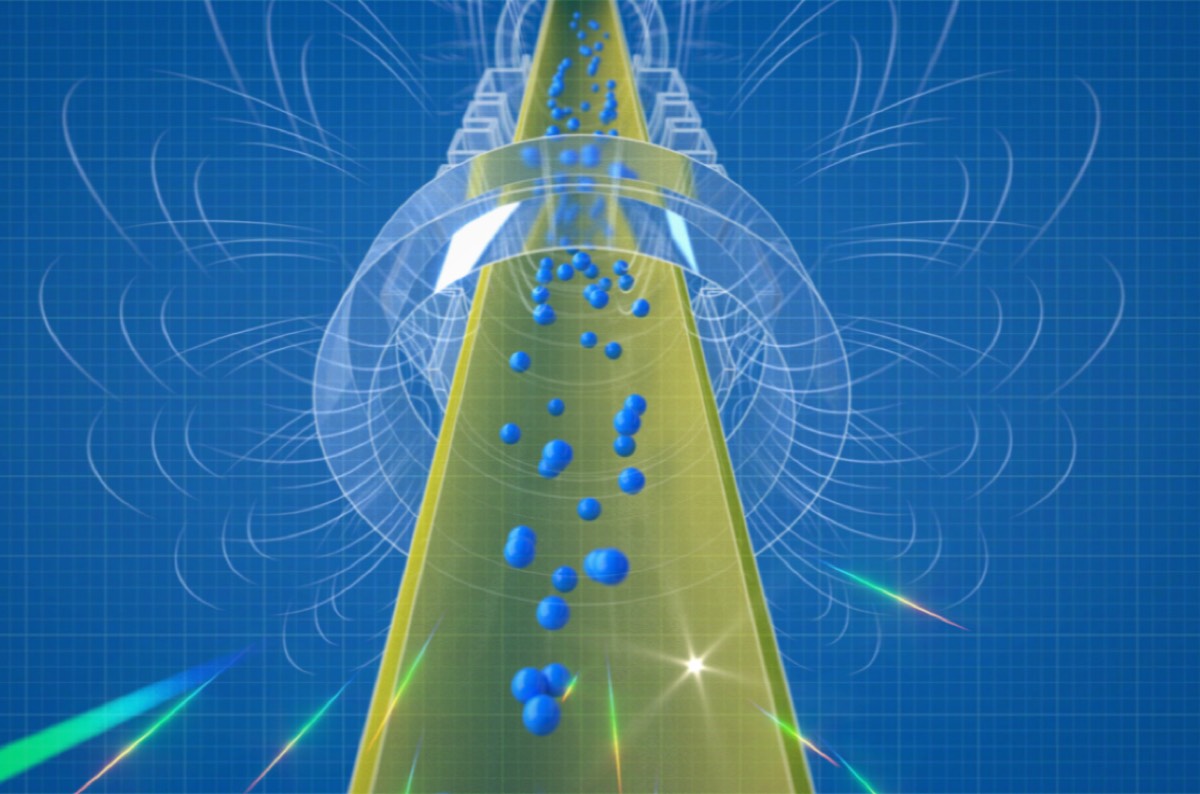
An artist's conceptual rendering of antihydrogen atoms falling out the bottom of the magnetic trap of the ALPHA-g apparatus.

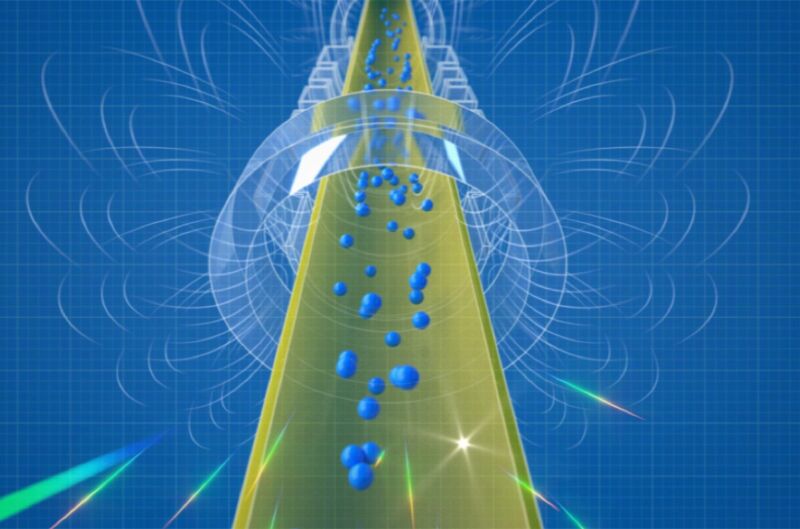
Enlarge / An artist’s conceptual rendering of antihydrogen atoms falling out the bottom of the magnetic trap of the ALPHA-g apparatus. (credit: Keyi )

CERN physicists have shown that antimatter falls downward due to gravity, just like regular matter, according to a new paper published in the journal Nature. It’s not a particularly surprising result—it would have been huge news had antimatter been found to be repulsed by gravity and “fall” upward—but it does tell us a bit but more about antimatter and brings physicists one step closer to resolving one of the most elusive mysteries surrounding the earliest moments of our universe.

As the name implies, antimatter is the exact opposite of ordinary matter, as it is made of antiparticles instead of ordinary particles. These antiparticles are identical in mass to their regular counterparts. But just like looking in a mirror reverses left and right, the electrical charges of antiparticles are reversed. So an anti-electron would have a positive instead of a negative charge while an antiproton would have a negative instead of a positive charge. When antimatter meets matter, both particles are annihilated and their combined masses are converted into pure energy. (It’s what fuels the fictional USS Enterprise, as any Star Trek fan can tell you.)

As far as we know, antimatter doesn’t exist naturally in the known universe, although we can now create small amounts at places like CERN’s Antimatter Factory. But scientists believe that ten billionths of a second after the Big Bang, there was an abundance of antimatter. The nascent universe was incredibly hot and infinitely dense, so much so that energy and mass were virtually interchangeable. New particles and antiparticles were constantly being created and hurling themselves, kamikaze-like, at their nearest polar opposites, thereby annihilating both matter and antimatter back into energy in a great cosmic war of attrition.

Read 7 remaining paragraphs | Comments


Source: Ars Technica – Einstein right again: Antimatter falls “down” due to gravity like ordinary matter

As the EA Sports FC era dawns, FIFA 23 is removed from digital platforms

A new, FIFA-less era begins for EA Sports.

Enlarge / A new, FIFA-less era begins for EA Sports. (credit: EA)

EA has suddenly removed downloadable versions of FIFA 23 from multiple digital storefronts. The delisting comes earlier than expected for the title and coincides with the company’s launch of the newly FIFA-license-free EA Sports FC 24.

While many reports suggest there has been a recent mass purge of all legacy FIFA games from online stores, EA has a history of delisting older sports titles at a pretty regular cadence. FIFA 22, for instance, was delisted from digital storefronts in May, roughly seven months after the launch of the subsequent FIFA 23. And FIFA 21 wasn’t taken down from Steam until June 2022, about eight months after FIFA 22‘s launch.

(Ars Technica may earn compensation for sales from links on this post through affiliate programs.)

FIFA 23, on the other hand, has been delisted less than a year from its October 2022 launch. SteamDB tracking data suggests that the delisting came on September 21, the day before the new EA Sports FC became available for a 10-hour early access trial for EA Play members. The Steam store page for FIFA 23 now notes that the delisting comes “at the request of the publisher” and that the game “will not appear in search.” The game also no longer appears on Steam’s EA publisher page.

Read 4 remaining paragraphs | Comments


Source: Ars Technica – As the EA Sports FC era dawns, FIFA 23 is removed from digital platforms

Spotify tests using AI to automatically clone and translate podcast voices

A toy robot speaks into a tin can and string.

Enlarge (credit: Getty Images)

On Monday, Spotify rolled out a limited pilot program that uses AI to automatically translate podcasts into various languages, using voice synthesis technology from OpenAI to preserve the original speaker’s voice. The feature aims to offer a more authentic listening experience compared to traditional dubbing. It could also introduce language errors that are difficult for non-native speakers to detect, since machine translation is far from a perfect technology.

In its press release announcing the program, Spotify says it is a platform that allows creators to share their work around the world. Then it asks a question: “With recent advancements, we’ve been wondering: Are there more ways we can bridge the language gap so that these voices can be heard worldwide?”

Spotify’s answer is Voice Translation, which can reportedly translate English voices into Spanish, French, and German while retaining the distinctive vocal characteristics of the speaker. The feature is currently being used with only select podcasters, such as Dax Shepard, Monica Padman, Lex Fridman, Bill Simmons, and Steven Bartlett.

Read 8 remaining paragraphs | Comments


Source: Ars Technica – Spotify tests using AI to automatically clone and translate podcast voices

How climate change could make fungal diseases worse

<em>Histoplasma capsulatum</em> is a species of parasitic, yeast-like dimorphic fungus that can, if inhaled, cause a type of lung infection called histoplasmosis.

Enlarge / Histoplasma capsulatum is a species of parasitic, yeast-like dimorphic fungus that can, if inhaled, cause a type of lung infection called histoplasmosis. (credit: Nanoclustering/Science Photo Library)

Back at the turn of the 21st century, Valley fever was an obscure fungal disease in the United States, with fewer than 3,000 reported cases per year, mostly in California and Arizona. Two decades later, cases of Valley fever are exploding, increasing more than sevenfold and expanding to other states.

And Valley fever isn’t alone. Fungal diseases in general are appearing in places they have never been seen before, and previously harmless or mildly harmful fungi are turning deadly for people. One likely reason for this worsening fungal situation, scientists say, is climate change. Shifts in temperature and rainfall patterns are expanding where disease-causing fungi occur; climate-triggered calamities can help fungi disperse and reach more people; and warmer temperatures create opportunities for fungi to evolve into more dangerous agents of disease.

For a long time, fungi have been a neglected group of pathogens. By the early 2000s, researchers were already warning that climate change would make bacterial and viral infectious diseases like cholera and dengue more widespread. “But people were not focused at all on the fungi,” says Arturo Casadevall, a microbiologist and immunologist at the Johns Hopkins Bloomberg School of Public Health. That’s because, until recently, fungi haven’t troubled humans much.

Read 24 remaining paragraphs | Comments


Source: Ars Technica – How climate change could make fungal diseases worse