Qualcomm’s Snapdragon 8 Gen 3 promises 30 percent faster CPU

Qualcomm’s Snapdragon 8 Gen 3 promises 30 percent faster CPU

Enlarge (credit: Qualcomm)

Qualcomm’s Nuvia-designed Arm chip for PCs is easily the company’s most exciting announcement today, but it also announced a phone chip: the Snapdragon 8 Gen 3. This will show up in most flagship Android devices in 2024 and promises around 30 percent performance improvements while picking from Arm’s parts bin.

First up is a new “1:5:2” core arrangement. Instead of the usual one big core, three medium cores, and four small cores (for single-threaded performance, multi-core, and background processing, respectively), the Snapdragon 8 Gen 3 has one big core, five medium cores, and two small cores. Qualcomm says the big core is a 3.3 GHz Arm Cortex X4 but didn’t confirm any of the other CPU core model numbers. Those five medium cores don’t all run at the same frequency, with three running at 3.2 GHz and two at 3.0 GHz. The CPU performance claims are 30 percent faster and 20 percent more efficient. The chip is built on a 4 nm process.

Qualcomm is always light on the GPU details (even though it is one of the strengths of a Qualcomm chip), and this year, the Adreno GPU doesn’t even have a model number in the documentation Qualcomm sent over. It is supposed to be 25 percent faster and 25 percent more efficient, though. Qualcomm talked up the lighting capabilities of the chip for video games, with support for Unreal Engine 5 Lumen and better ray tracing.

Read 3 remaining paragraphs | Comments


Source: Ars Technica – Qualcomm’s Snapdragon 8 Gen 3 promises 30 percent faster CPU

Qualcomm Snapdragon X Elite looks like the Windows world’s answer to Apple Silicon

Qualcomm's Snapdragon X Elite could be the first Arm chip that can do for PCs what Apple Silicon did for Macs.

Enlarge / Qualcomm’s Snapdragon X Elite could be the first Arm chip that can do for PCs what Apple Silicon did for Macs. (credit: Qualcomm)

For years, Qualcomm has been making Snapdragon chips for Windows PCs, and for years, those chips’ performance have failed to dislodge Intel’s or AMD’s chips to any significant degree. Its latest Snapdragon 8cx Gen 3 (and the closely related Microsoft SQ3) appears in just two consumer PCs, the cumbersomely named Microsoft Surface Pro 9 with 5G and Lenovo’s ThinkPad X13s Gen 1.

But that may be changing. Nearly three years ago, Qualcomm bought a company called Nuvia for $1.4 billion. Nuvia was mainly working on server processors, but the company’s founders and many of its employees had also been involved in developing the A- and M-series Apple Silicon processors that have all enabled the iPhone, iPad, and Mac to achieve their enviable blend of performance and battery life. Today, Qualcomm is formally announcing the fruit of the Nuvia acquisition: the Qualcomm Snapdragon X Elite is a 12-core, 4 nm chip that will compete directly with Intel’s Core processors and AMD Ryzen chips in PCs—and, less directly, Apple’s M2 and M3-series processors for Macs.

Qualcomm says the Snapdragon X Elite will begin arriving in PCs starting in mid-2024. The company has also announced a new Snapdragon SoC for smartphones, the Snapdragon 8 Gen 3.

Read 16 remaining paragraphs | Comments


Source: Ars Technica – Qualcomm Snapdragon X Elite looks like the Windows world’s answer to Apple Silicon

How do kingfishers avoid concussions when diving? It might be in their genes

A diving kingfisher

Enlarge / Fish-eating kingfishers execute plunging dives into the water to capture prey, yet never seem to get concussed. (credit: Richard Towell)

There are many different species of kingfisher, and those that eat fish hunt by repeatedly diving head-first into the water when they spot tasty prey without suffering brain injuries like concussions. It turns out that diving kingfishers have several modified genes associated with diet and brain structure, according to a new paper published in the journal Communications Biology—notably mutations in genes related to the tau proteins that help stabilize neuron structure, although they can be harmful if too many build up.

“I learned a lot about tau proteins when I was the concussion manager of my son’s hockey team,” said co-author Shannon Hackett, associate curator of birds at the Field Museum. “I started to wonder, why don’t kingfishers die because their brains turn to mush? There’s gotta be something they’re doing that protects them from the negative influences of repeatedly landing on their heads on the water’s surface.”

It’s not the first time scientists have pondered this question, not just for kingfishers, but for other birds like gannets and woodpeckers. For instance, physicists at Virginia Tech studied diving gannets back in 2014 (publishing their conclusions in 2016), which fold their wings back as they dive, hitting the water with their whole body to snag underwater prey. From a physics standpoint, we’re talking about an elastic body hitting the surface of water as fast as 55 MPH. The stress of moving from the medium of air to the much denser medium of water exerts a huge force on the bird’s body, with an impact akin to tornadoes hitting the water. Yet despite the stress on their bodies, gannets (like the kingfisher) manage the feat again and again without injury, especially concussions.

Read 9 remaining paragraphs | Comments


Source: Ars Technica – How do kingfishers avoid concussions when diving? It might be in their genes

Google falsely flags Samsung apps as “harmful,” tells users to remove them

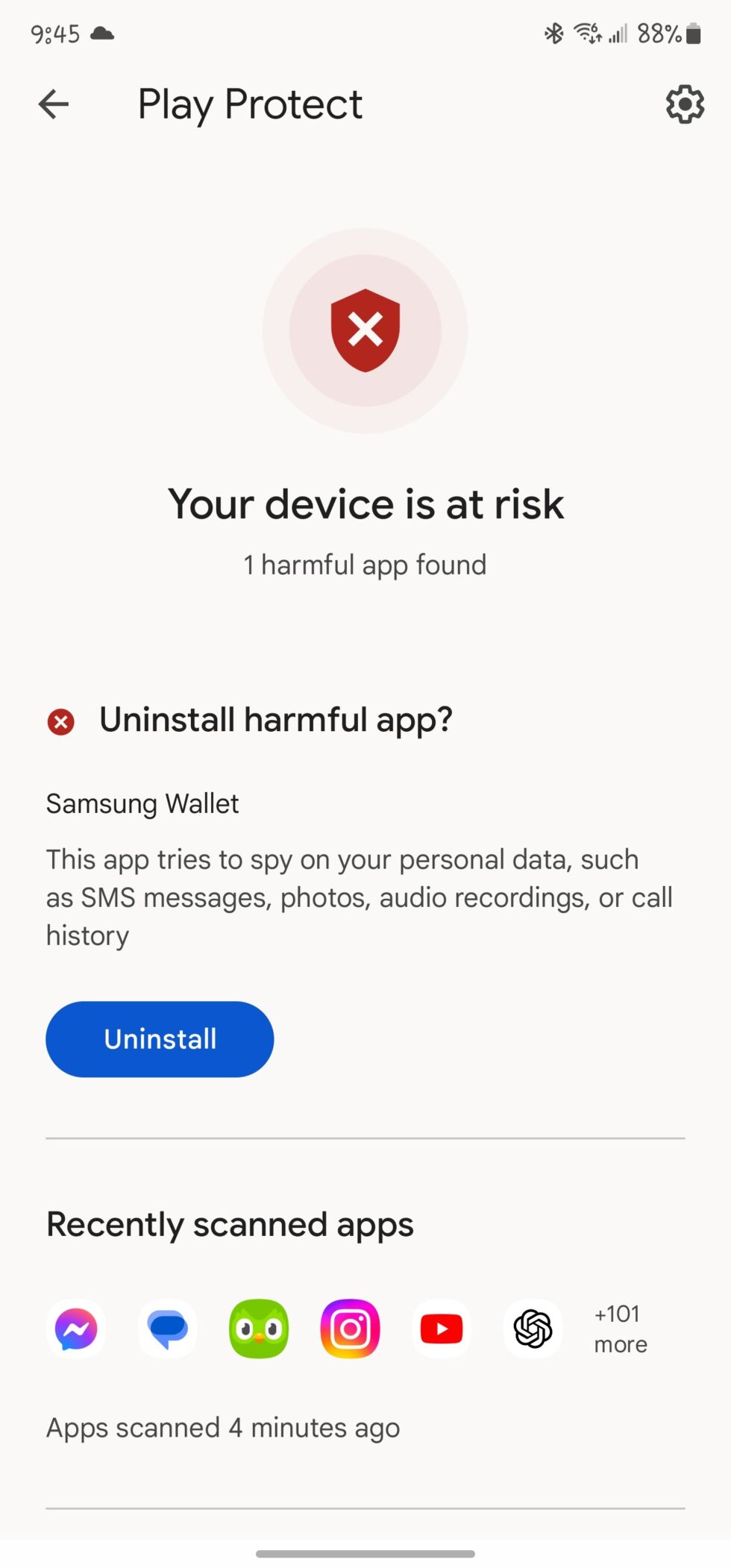
Most Android users have probably never seen Google Play Protect in action. The malware-scanning service is built into every Android device and is supposed to flag malware that users have installed. Recently it flagged some popular apps that are very much not malware: Samsung Wallet and Samsung Messages.

As spotted by 9to5Google, Samsung users have been getting hit with Play Protect warnings since earlier this month. Users on the Google Support forum have posted screenshots of Play Protect flagging the Samsung system apps, and even Samsung responded to the issue, explaining (in Korean) how to fix any damage caused by the bug. Samsung says (through translation) the issue was caused by “a temporary failure of the Google server” and should now be fixed.

Samsung Wallet and Samsung Messages both come bundled with most Samsung phones as system apps, so they have a wide install base. When Play Protect flags an app as harmful, it pops up a message suggesting users remove the app, but since these are both system apps, users can only disable them.

Read 1 remaining paragraphs | Comments


Source: Ars Technica – Google falsely flags Samsung apps as “harmful,” tells users to remove them

Search engine that scans billions of faces tries blocking kids from results

Search engine that scans billions of faces tries blocking kids from results

Enlarge (credit: Wirestock | iStock / Getty Images Plus)

A search engine that uses facial recognition to help people scan billions of images to find their photos strewn across the Internet has officially banned searches of minors, The New York Times reported. The move comes after years of criticism from privacy experts, media outlets, and regulators, warning that tech like PimEyes could be abused to stalk children online.

PimEyes CEO Giorgi Gobronidze told The Times that in addition to setting a “no harm policy,” the company has also implemented new AI age-detection technology to detect and block searches of minors. This update is due to privacy concerns that “images of children might be used by [some] individuals with a twisted moral compass and values, such as pedophiles, child predators,” Gobronidze said. Critics had long warned that PimEyes’ tech made it easy to upload a photo of any child and quickly find other photos or discover their name and address.

By design, PimEyes is supposed to make it easy for people to figure out where their own photos have been posted online, but PimEyes has no way to stop people from searching for photos of other people, The Times reported. The platform’s “data security unit” has monitored suspicious activity in the past by flagging any upload of a child’s photo or detecting when male users repeatedly search for photos of women, the BBC reported. Gobronidze confirmed to The Times that out of 118,000 searches per day of PimEyes’ database of 3 billion images, the company has detected and banned more than 200 accounts conducting “inappropriate searches of children’s faces.”

Read 20 remaining paragraphs | Comments


Source: Ars Technica – Search engine that scans billions of faces tries blocking kids from results

Atom Computing is the first to announce a 1,000+ qubit quantum computer

Read 17 remaining paragraphs | Comments


Source: Ars Technica – Atom Computing is the first to announce a 1,000+ qubit quantum computer

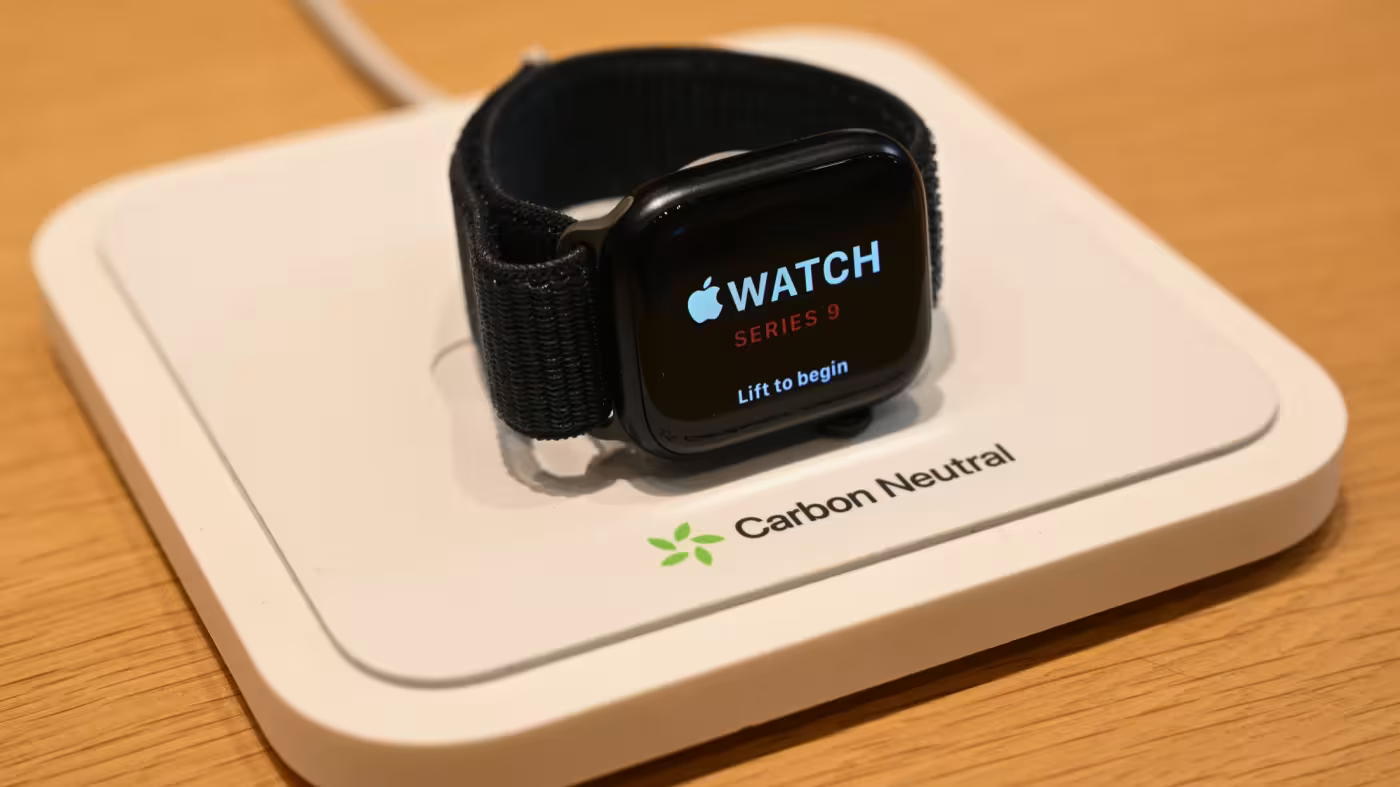
Apple’s “carbon neutral” claims are facing increased scrutiny

Read 24 remaining paragraphs | Comments


Source: Ars Technica – Apple’s “carbon neutral” claims are facing increased scrutiny

The Daily Telescope: A quarter Moon over Sicily reflects light from Earth

The Moon rises over Tindari, Sicily.

Enlarge / The Moon rises over Tindari, Sicily. (credit: Dario Giannobile)

Welcome to the Daily Telescope. There is a little too much darkness in this world and not enough light; a little too much pseudoscience and not enough science. We’ll let other publications offer you a daily horoscope. At Ars Technica, we’re going to take a different route, finding inspiration from very real images of a universe that is filled with stars and wonder.

Good morning. It is October 24, and today’s image features an amazing shot of the Moon over a sanctuary in Sicily. It was captured by Dario Giannobile, a talented Italian astrophotographer.

This is a brilliant shot of the Moon, with the light from Earth shining on about 75 percent of the lunar surface and the remainder brightly lit by the Sun. The Moon is seen above the Santuario della Madonna Nera (Sanctuary of the Black Madonna) in Tindari, a small town on the northern coast of Sicily.

Read 4 remaining paragraphs | Comments


Source: Ars Technica – The Daily Telescope: A quarter Moon over Sicily reflects light from Earth

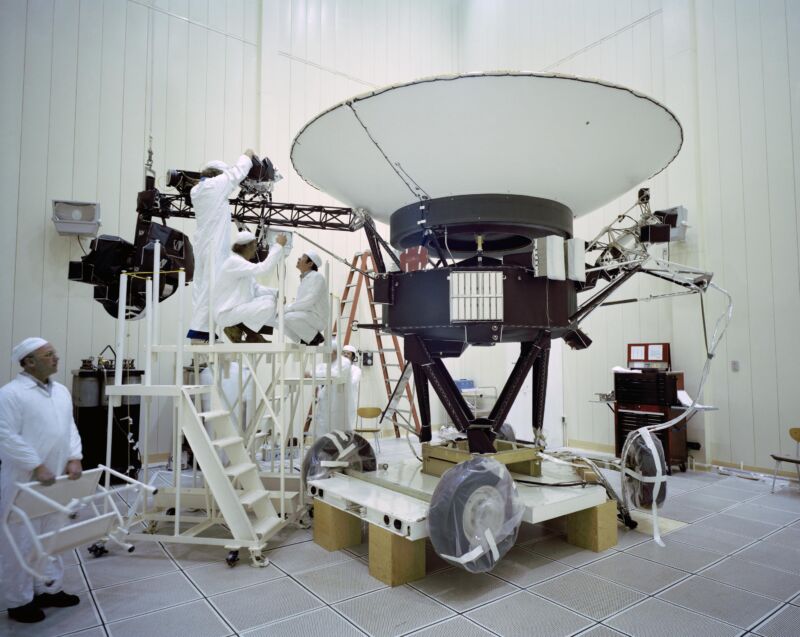
NASA wants the Voyagers to age gracefully, so it’s time for a software patch

Read 24 remaining paragraphs | Comments


Source: Ars Technica – NASA wants the Voyagers to age gracefully, so it’s time for a software patch

Amazon’s Fallout TV series gets a 2024 release date

Vault Bow displays the numbers 4-12-24.

Enlarge / The social media image used to promote Fallout‘s premiere date. (credit: Amazon)

The Amazon-produced TV adaption of the popular, long-running video game series Fallout will premiere on Amazon Prime Video on April 12, 2024, the company announced on Monday.

Amazon also announced that the series will be part of the same canon as the video games. The announcement was made through social media posts that showed an interface resembling the iconic Vault Boy accessory from the games.

The series was announced in July 2020, alongside news that Westworld writers Jonathan Nolan and Lisa Joy would be executive producers. In January 2022, it was revealed that Nolan would direct the first episode but that two other writers—Geneva Robertson-Dworet (Captain Marvel, Tomb Raider) and Graham Wagner (Portlandia, The Office, Silicon Valley) would be the showrunners.

Read 3 remaining paragraphs | Comments


Source: Ars Technica – Amazon’s Fallout TV series gets a 2024 release date

India celebrates “first major milestone” on path to launching astronauts

Read 27 remaining paragraphs | Comments


Source: Ars Technica – India celebrates “first major milestone” on path to launching astronauts

1Password detects “suspicious activity” in its internal Okta account

Read 9 remaining paragraphs | Comments


Source: Ars Technica – 1Password detects “suspicious activity” in its internal Okta account

Tesla’s misleading driving range claims trigger DOJ probe

Tesla’s misleading driving range claims trigger DOJ probe

Enlarge (credit: Thomas Trutschel / Contributor | Photothek)

The United States Department of Justice is investigating Tesla after a Reuters report revealed in July that the EV maker secretly created a team to divert customer complaints because it had grossly exaggerated its vehicles’ driving range. Reuters’ source confirmed that “the directive to present the optimistic range estimates came from Tesla Chief Executive Elon Musk.”

The driving range was so far below company estimates that many customers assumed their cars were defective. Three customers launched a class-action suit, alleging fraud and false advertising. This mounting backlash over Tesla’s overly optimistic driving range estimates came at a tense time for Tesla following an unsuccessful launch of Tesla’s Full Self Driving (FSD) Beta—a feature deemed so dangerous that Tesla had to recall 362,758 cars—and a criminal investigation into its Autopilot claims.

The DOJ appears to now be probing all of Tesla’s recent missteps. According to a US Securities and Exchange Commission (SEC) filing from Tesla on Monday, the DOJ has sent requests for information and subpoenaed Tesla for documents related to Tesla’s Autopilot and FSD features, as well as documents “regarding certain matters associated with personal benefits, related parties, vehicle range, and personnel decisions.”

Read 8 remaining paragraphs | Comments


Source: Ars Technica – Tesla’s misleading driving range claims trigger DOJ probe

Stanford researchers challenge OpenAI, others on AI transparency in new report

A dirty windshield with the letters

Enlarge (credit: Getty Images / Benj Edwards)

On Wednesday, Stanford University researchers issued a report on major AI models and found them greatly lacking in transparency, reports Reuters. The report, called “The Foundation Model Transparency Index,” examined models (such as GPT-4) created by OpenAI, Google, Meta, Anthropic, and others. It aims to shed light on the data and human labor used in training the models, calling for increased disclosure from companies.

Foundation models refer to AI systems trained on large datasets capable of performing tasks, from writing to generating images. They’ve become key to the rise of generative AI technology, particularly since the launch of OpenAI’s ChatGPT in November 2022. As businesses and organizations increasingly incorporate these models into their operations, fine-tuning them for their own needs, the researchers argue that understanding their limitations and biases has become essential.

“Less transparency makes it harder for other businesses to know if they can safely build applications that rely on commercial foundation models; for academics to rely on commercial foundation models for research; for policymakers to design meaningful policies to rein in this powerful technology; and for consumers to understand model limitations or seek redress for harms caused,” writes Stanford in a news release.

Read 7 remaining paragraphs | Comments


Source: Ars Technica – Stanford researchers challenge OpenAI, others on AI transparency in new report

Reddit finally takes its API war where it belongs: to AI companies

Business person searching browsing internet data information networking concept.

Enlarge (credit: Getty)

Reddit ignited a war this year. Dramatic changes in API access pricing (from free to unaffordable) was one of its most polarizing moves ever. It resulted in apps beloved by long-time Reddit users, including moderators and people with accessibility needs, closing shop. Community trust was sacrificed, too. Disgusted with Reddit for how it handled third-party apps, abruptly ushered in pricing changes, and treated moderators who protested, numerous valuable, knowledgeable users quit the platform.

Originally, Reddit framed its API pricing changes as a way to prevent generative AI companies from using Reddit data to train large language models (LLMs) without Reddit getting anything in return. With Reddit no longer dealing with small third-party developers—all of which are now either paying Reddit or getting some sort of exemption—Reddit is reportedly taking the fight to where it should have been focused the entire time: generative AI firms.

Can Reddit survive without search?

On Friday, The Washington Post, as spotted by The Verge, said Reddit “has met with top generative AI companies about being paid for its data,” citing an anonymous source.

Read 21 remaining paragraphs | Comments


Source: Ars Technica – Reddit finally takes its API war where it belongs: to AI companies

Pixel 8 Pro teardown reveals better cooling, interior “Google” branding

The Pixel 8 Pro has been out for a few days now, and iFixit got hold of one for a teardown on its YouTube channel.

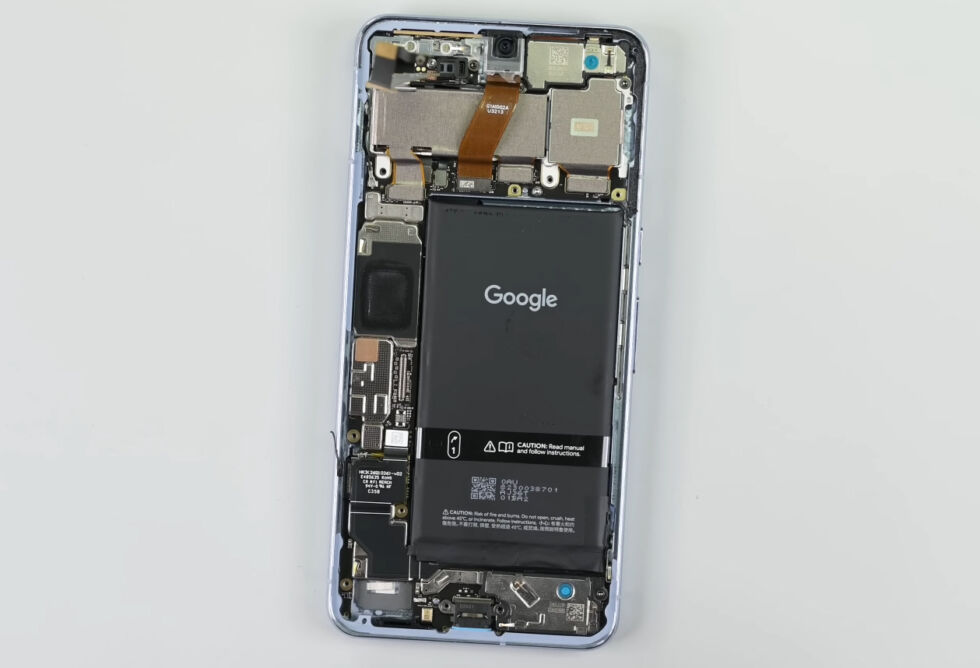
Opening it up doesn’t seem much different from last year. Step one is getting past all the phone glue, which involves heating up the screen, pulling the screen away from the body with a suction cup, and cutting the glue around the edge with a soft pick. iFixit says the adhesive was “easier to get into [than that in the iPhone] 15 Pro Max.” Unlike the iPhone 15 design, though, the Pixel 8 Pro only opens from one side, so you’ll most likely have to remove every single part in the phone to swap out the back.

The guts of the phone look just like the Pixel 7 Pro, but Google has started to pick up on a few of Apple’s tendencies to make the phone’s insides look nice. This year the battery is cleanly branded “Google,” whereas last year it was just covered in manufacturer information and warnings. Of course, you’ll only see this after you peel off the graphite cooling pad, which, for the second year in a row, has seen a big increase in area; it now covers about 60 percent of the battery. The Pixel phone runs a “Tensor” SoC made in partnership with Samsung, so more cooling will definitely help.

Read 2 remaining paragraphs | Comments


Source: Ars Technica – Pixel 8 Pro teardown reveals better cooling, interior “Google” branding

Star Citizen’s Squadron 42 campaign is “feature complete” after 11 years

Gillian Anderson in Star Citizen

Enlarge / Gillian Anderson’s likeness has been promoting Star Citizen since 2015. (credit: Cloud Imperium Games)

Eleven years ago, Wing Commander designer Chris Roberts announced Star Citizen, an online multiplayer game that he said would “change the way people perceive games for the PC.” Roberts told Ars’ Kyle Orland soon after that he didn’t enjoy the four-year development of another hit, Freelancer, because “spending that many years disconnected from your audience, sort of working off by yourself, wasn’t creatively fun for me.” With Star Citizen, Roberts said he could keep development from dragging on by engaging fans and using a pre-built engine, as opposed to what Roberts said would be “two years” building his own.

Roberts has definitely engaged his audience in Star Citizen, to the tune of $616 million raised from more than 4.8 million “Star Citizens.” It has just taken a bit longer than two years to give them a true release.

Roughly 11 years after Star Citizen‘s initial announcement that included it, then nine years after its first potential release date, Squadron 42, the single-player campaign, is now “feature complete” and has “entered its polish phase.” Roberts announced this in a video released Sunday as part of an annual CitizenCon for backers, along with footage from the game and details on its development.

Read 7 remaining paragraphs | Comments


Source: Ars Technica – Star Citizen’s Squadron 42 campaign is “feature complete” after 11 years

Dev sets up “goatse” trap for sites that steal his free web game

Is this "evocative" header image stretching the limits of good taste?

Enlarge / Is this “evocative” header image stretching the limits of good taste? (credit: Aurich Lawson | Getty Images)

Here at Ars, we’ve seen time and again how simple web and/or mobile games can be cloned or outright stolen by unscrupulous developers aiming to cash in on someone else’s game concept. But developer Josh Simmons was in a unique position to inflict a particularly rude punishment on websites that were directly stealing and monetizing his web game Sqword without permission.

Since its launch last year, Simmons says he has attracted a “steady group of daily active users” for Sqword, which involves placing letters sequentially in a 5×5 grid to make as many valid words as possible. But as noted on Simmons’ blog (and noticed by 404 Media), searching for Sqword also brings up several “game aggregator” sites that simply embed the game content from Sqword.com in an iFrame window, only now surrounded by annoying banner ads.

“This made me angrier than it should have—not because Sqword is a cash cow—we don’t run ads on the site and don’t make money from it, it’s just for fun—but because it was a passion project with friends, something pure and intentionally free to play WITHOUT ads,” Simmons writes. “It’s against my ethos as a developer, there are banners and popups everywhere. If I build an app, I believe it should either be free or it should be upfront about what the subscription or purchase price is (and then not upsell you). I couldn’t abide seeing my code monetized in this way.”

Read 4 remaining paragraphs | Comments


Source: Ars Technica – Dev sets up “goatse” trap for sites that steal his free web game

Yes, this beetle runs out of a frog’s anus to survive being swallowed alive

Ursula Vernon, aka T. Kingfisher, won the 2023 Hugo for best novel and found inspiration for her acceptance speech in a 2020 study about a species of water beetle that survives being swallowed alive by a frog by escaping through the frog’s butt. Credit: Shinji Sugiura, 2020.

Inspiration can come from the most unlikely places, as fantasy author Ursula Vernon, aka T. Kingfisher, clearly knows. Vernon won the 2023 Hugo Award for Best Novel this past weekend for her dark fairy tale, Nettle and Bone, and while she was unable to travel to Chengdu Worldcon in China for the event, she posted the text of her acceptance speech (read at the ceremony by a friend) on her Patreon. After the usual preliminary remarks and thanks, Vernon opted to forego “serious and heavy” commentary for the following revelation:

There is a species of water beetle that regularly gets swallowed whole by frogs. And while there’s a lot of things you can do to keep from being eaten, once you’re inside a frog, your options are severely limited. Generally you get digested. But this particular species of beetle said “You know, I bet there’s another way.” And it started walking. In fact, it walked through the frog’s digestive tract and out the back end.

This is 100 percent true, you can look it up.

Naturally, we did look it up and honestly can’t believe we missed covering this fascinating study in 2020. (At least we didn’t miss the 2022 study on how certain species of beetle have evolved unusual “back pockets” to safely house symbiotic bacteria during metamorphosis, shuffling the populations out of those pockets via friction to the genital area as they emerge from their pupae.)

Shinji Sugiura of Kobe University in Japan discovered the unusual survival strategy of the aquatic beetle Regimbartia attenuata while looking into how predation pressures can lead to the evolution of innovative escape behavior in prey animals. He fed a bunch of the beetles to a pond frog (Pelophylax nigromaculatus) under laboratory conditions, expecting the frog to spit the beetle out. That’s what happened with Sugiura’s prior experiments on bombardier beetles (Pheropsophus jessoensis), which spray toxic chemicals (described as an audible “chemical explosion”) when they find themselves inside a toad’s gut, inducing the toad to invert its own stomach and vomit them back out.

Read 6 remaining paragraphs | Comments


Source: Ars Technica – Yes, this beetle runs out of a frog’s anus to survive being swallowed alive

Will ChatGPT’s hallucinations be allowed to ruin your life?

Read 76 remaining paragraphs | Comments


Source: Ars Technica – Will ChatGPT’s hallucinations be allowed to ruin your life?