Boeing says it can’t make money with fixed-price contracts

Starliner touches down in December 2019 for the first time.

Enlarge / Starliner touches down in December 2019 for the first time. (credit: NASA/Aubrey Gemignani)

Boeing released its third-quarter results on Wednesday, and there were promising numbers showing increasing revenues and narrowing losses as the multinational corporation continues its economic recovery.

However, amid these improving results, Boeing’s financials continued to be dragged down by its Defense, Space & Security division. This division, which includes missile production for the military and space activities such as satellites and the Starliner spacecraft, lost $1.7 billion during the first three quarters of this year.

In a conference call with analysts on Wednesday, Boeing’s chief executive, David Calhoun, and chief financial officer, Brian West, expressed disappointment in these results from the defense and space division. They reiterated their goal of returning the company’s defense and space businesses to profitability by the 2025 to 2026 period.

Read 11 remaining paragraphs | Comments


Source: Ars Technica – Boeing says it can’t make money with fixed-price contracts

Even Google CEO Sundar Pichai doesn’t understand Google’s privacy controls

A large Google logo is displayed amidst foliage.

Enlarge (credit: Sean Gallup | Getty Images)

No one in the world seems to know how Google’s privacy controls work, and the company probably likes it that way. The latest example is from Rodriguez v. Google, an ongoing 2021 class-action lawsuit over Google’s infamous “Web & App Activity” privacy check box. The box claims to stop Google from saving a user’s “activity” to Google’s servers, but the lawsuit says that isn’t true. The interesting bit today comes from an expert witness called by the plaintiffs, who testified that even Google CEO Sundar Pichai incorrectly described how this check box works to Congress.

Like a lot of Google court cases, this case has most of the records sealed so that embarrassing comments and testimony about the reality of Google’s business don’t reach the public. The Register noticed that a transcript of the expert’s video deposition is public, though, so we can see just a glimpse of what is going on in this case.

The expert witness, Jonathan Hochman, called Google’s “Web & App Activity” check box “a fake control, because it doesn’t do—technically doesn’t do what it seems it should do.” Hochman later said, “It looks like even Sundar Pichai is confused about how this control works because he testified in front of Congress and told them something that is just wrong from a technical perspective.”

Read 6 remaining paragraphs | Comments


Source: Ars Technica – Even Google CEO Sundar Pichai doesn’t understand Google’s privacy controls

iOS 17.1, macOS 14.1, and other Apple updates arrive with a few new tricks

iPhone in Standby mode

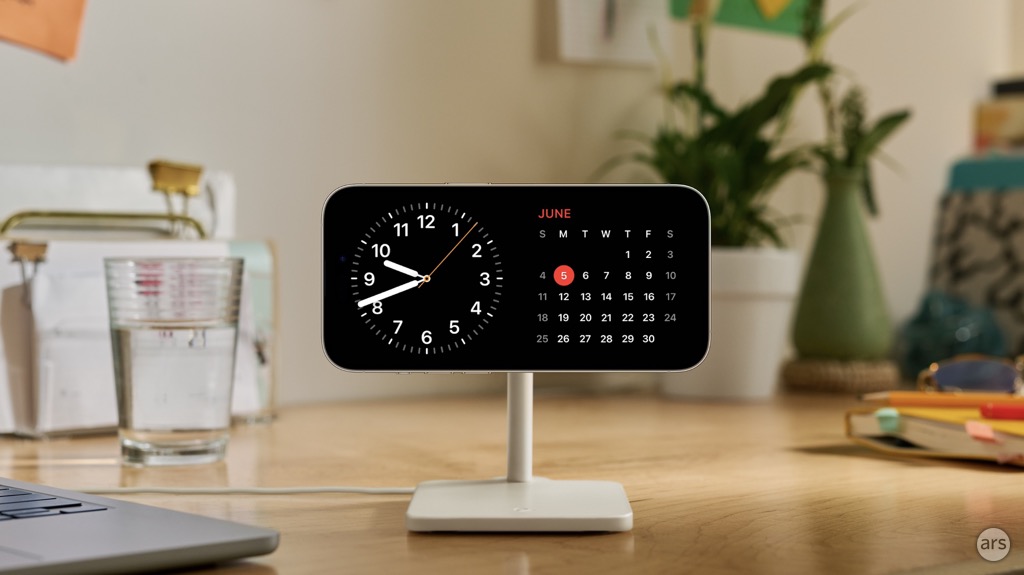
Enlarge / Apple’s iOS 17.1 release includes updates to the Settings for StandBy on the iPhone. (credit: Apple/Ars Technica)

A plethora of point-one updates have arrived for Apple devices, adding a few features and some useful bug fixes to iPhones, iPads, MacBooks, Apple Watches, and Apple TVs and HomePods. It also addresses French regulators’ concerns that the iPhone 12 produced too much electromagnetic radiation in certain conditions.

The biggest new features among the software refreshes are on the Apple Watch and HomePods. If you’re a frequent user of AirDrop, however, and find yourself throwing huge files to people, iOS 17.1 adds a new “Use Cellular Data” option. If both the sender and recipient have iCloud accounts, an AirDrop transfer can continue over a cellular connection if your phone leaves Wi-Fi or Bluetooth range or drops the connection. MacRumors shows the changes and settings involved.

Elsewhere in iOS 17.1, StandBy gets new display options, including display-off timers. No Journal app has arrived yet. One new thing that has arrived is a patch to the iPhone 12’s radio operation to accommodate, as Apple put it, “the protocol used by French regulators.” France’s National Frequency Agency (ANFR) found that the iPhone 12 exceeded a “limbs” limit of radiation, for when the phone is in a pocket or purse or otherwise against the body, and called for Apple to stop selling the device and potentially recall it. Apple, noting that the device was “certified by multiple international bodies,” still agreed to address the issue in iOS 17.1.

Read 4 remaining paragraphs | Comments


Source: Ars Technica – iOS 17.1, macOS 14.1, and other Apple updates arrive with a few new tricks

Mars hides a core of molten iron deep inside

Read 13 remaining paragraphs | Comments


Source: Ars Technica – Mars hides a core of molten iron deep inside

PS5 Slim’s new external disc drive requires online “pairing” before use

Sony wants you to make an online check in before using that external drive with your PS5 Slim.

Enlarge / Sony wants you to make an online check in before using that external drive with your PS5 Slim. (credit: Sony)

The upcoming launch of a redesigned “PS5 Slim” model will mark the first PlayStation to support an optional disc drive add-on for the shrinking number of players who want to stick with physical media. But players who want to use that drive to enjoy their PS5 discs offline must first perform a mandatory online check-in to pair the external disc drive with a specific console.

That’s according to Call of Duty news site CharlieIntel, which posted early pictures of the packaging for a new PS5 Slim bundle that includes a disc drive and a copy of Call of Duty: Modern Warfare 3. That packaging includes some tiny disclaimer text notifying players that an “Internet connection [is] required to pair Disc Drive and PS5 console upon setup.”

The odd-sounding requirement may be part of an anti-piracy effort by Sony to ensure that only authorized, validated drives are connected to their hardware (preventing the connection of modified or generic drives that might aid in decrypting the data on those discs, for instance). In 2020, Wired tried swapping the stock disc drives included in two launch-era PS5 consoles, only to find that the new consoles didn’t recognize the “unpaired” daughterboard on their “new” disc drives. Similar drive-pairing security is built into the drive assemblies for consoles going back to the Xbox 360 era at least.

Read 4 remaining paragraphs | Comments


Source: Ars Technica – PS5 Slim’s new external disc drive requires online “pairing” before use

Hackers can force iOS and macOS browsers to divulge passwords and much more

Hackers can force iOS and macOS browsers to divulge passwords and much more

Enlarge (credit: Kim et al.)

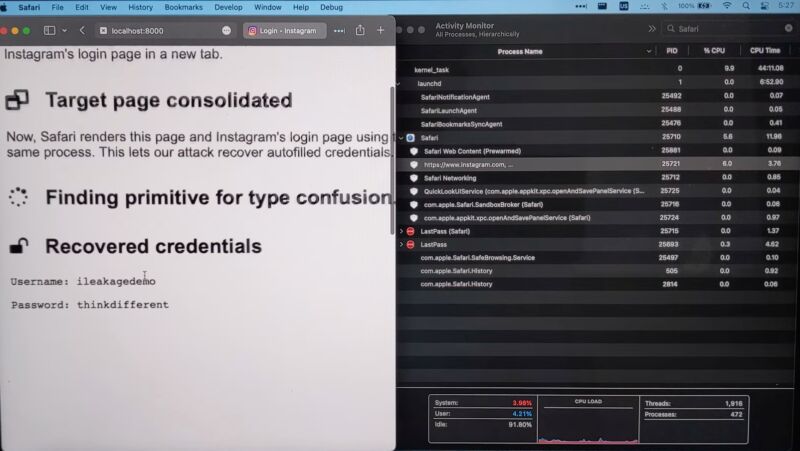
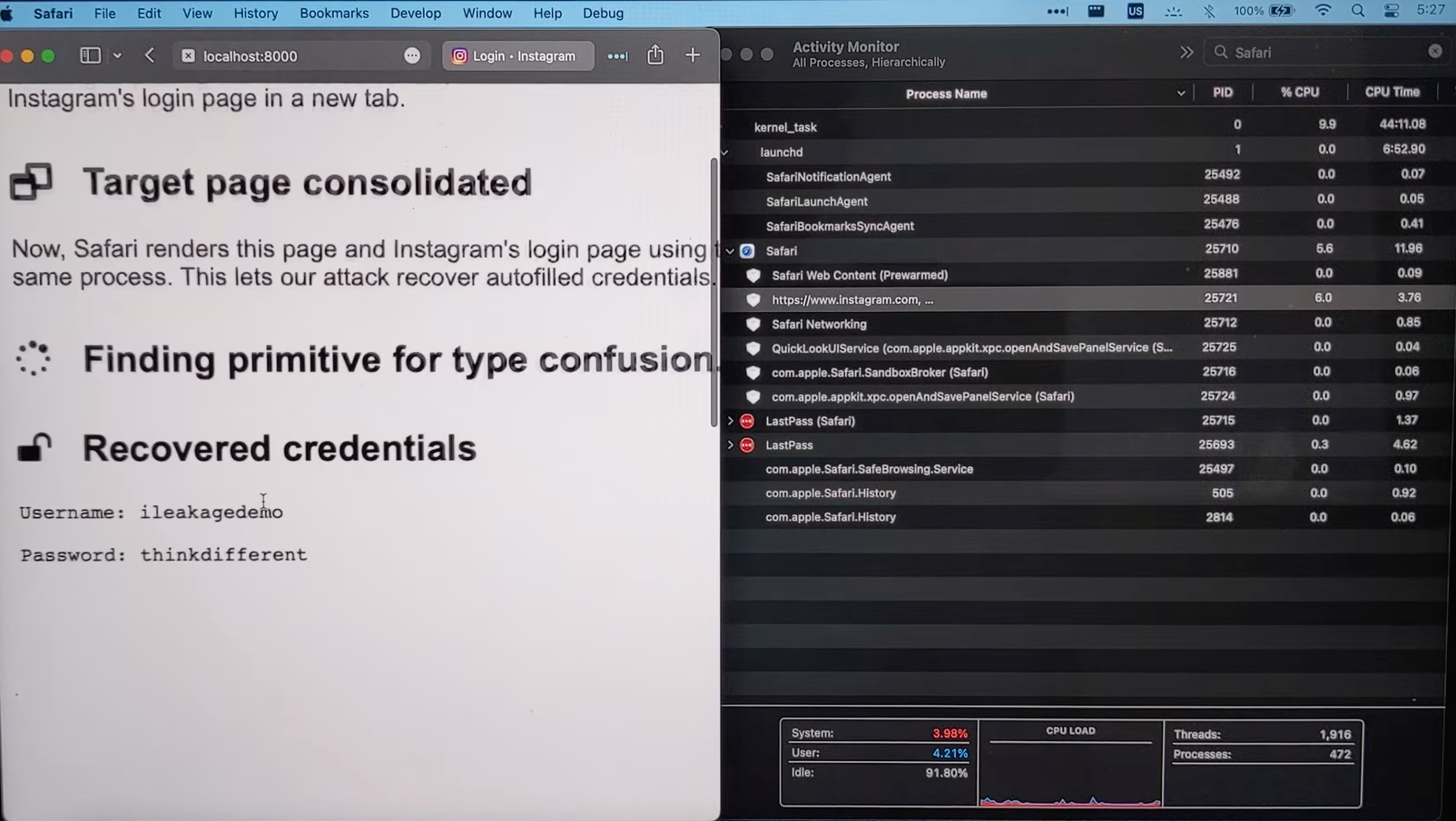
Researchers have devised an attack that forces Apple’s Safari browser to divulge passwords, Gmail message content, and other secrets by exploiting a side channel vulnerability in the A- and M-series CPUs running modern iOS and macOS devices.

iLeakage, as the academic researchers have named the attack, is practical and requires minimal resources to carry out. It does, however, require extensive reverse-engineering of Apple hardware and significant expertise in exploiting a class of vulnerability known as a side channel, which leaks secrets based on clues left in electromagnetic emanations, data caches, or other manifestations of a targeted system. The side channel in this case is speculative execution, a performance enhancement feature found in modern CPUs that has formed the basis of a wide corpus of attacks in recent years. The nearly endless stream of exploit variants has left chip makers—primarily Intel and, to a lesser extent, AMD—scrambling to devise mitigations.

Exploiting WebKit on Apple silicon

The researchers implement iLeakage as a website. When visited by a vulnerable macOS or iOS device, the website uses JavaScript to surreptitiously open a separate website of the attacker’s choice and recover site content rendered in a pop-up window. The researchers have successfully leveraged iLeakage to recover YouTube viewing history, the content of a Gmail inbox—when a target is logged in—and a password as it’s being autofilled by a credential manager. Once visited, the iLeakage site requires about five minutes to profile the target machine and, on average, roughly another 30 seconds to extract a 512-bit secret, such as a 64-character string.

Read 18 remaining paragraphs | Comments


Source: Ars Technica – Hackers can force iOS and macOS browsers to divulge passwords and much more

Honda says making cheap electric vehicles is too hard, ends deal with GM

Ultium batteries and components Monday, December 13, 2021 at the General Motors Brownstown Battery facility in Brownstown Charter Township, Michigan. (Photo by Santa Fabio for General Motors)

Enlarge / A GM Ultium battery pack. (credit: Santa Fabio for General Motors)

Bad news for fans of cheaper electric vehicles: The planned collaboration between Honda and General Motors on a range of cheaper EVs has been canceled. The joint project, which was announced in April 2022, was supposed to develop a new platform for use in lower-cost EVs for North America, South America, and China, with cars appearing in 2027. But on Thursday, the two companies revealed that the plan is no more.

“After extensive studies and analysis, we have come to a mutual decision to discontinue the program. Each company remains committed to affordability in the EV market,” Honda and GM said in a joint statement.

“After studying this for a year, we decided that this would be difficult as a business, so at the moment we are ending development of an affordable EV,” said Honda CEO Toshihiro Mibe in an interview with Bloomberg. “GM and Honda will search for a solution separately. This project itself has been canceled,” Mibe said.

Read 8 remaining paragraphs | Comments


Source: Ars Technica – Honda says making cheap electric vehicles is too hard, ends deal with GM

“Do not open robots,” warns Oregon State amid college food delivery bomb prank

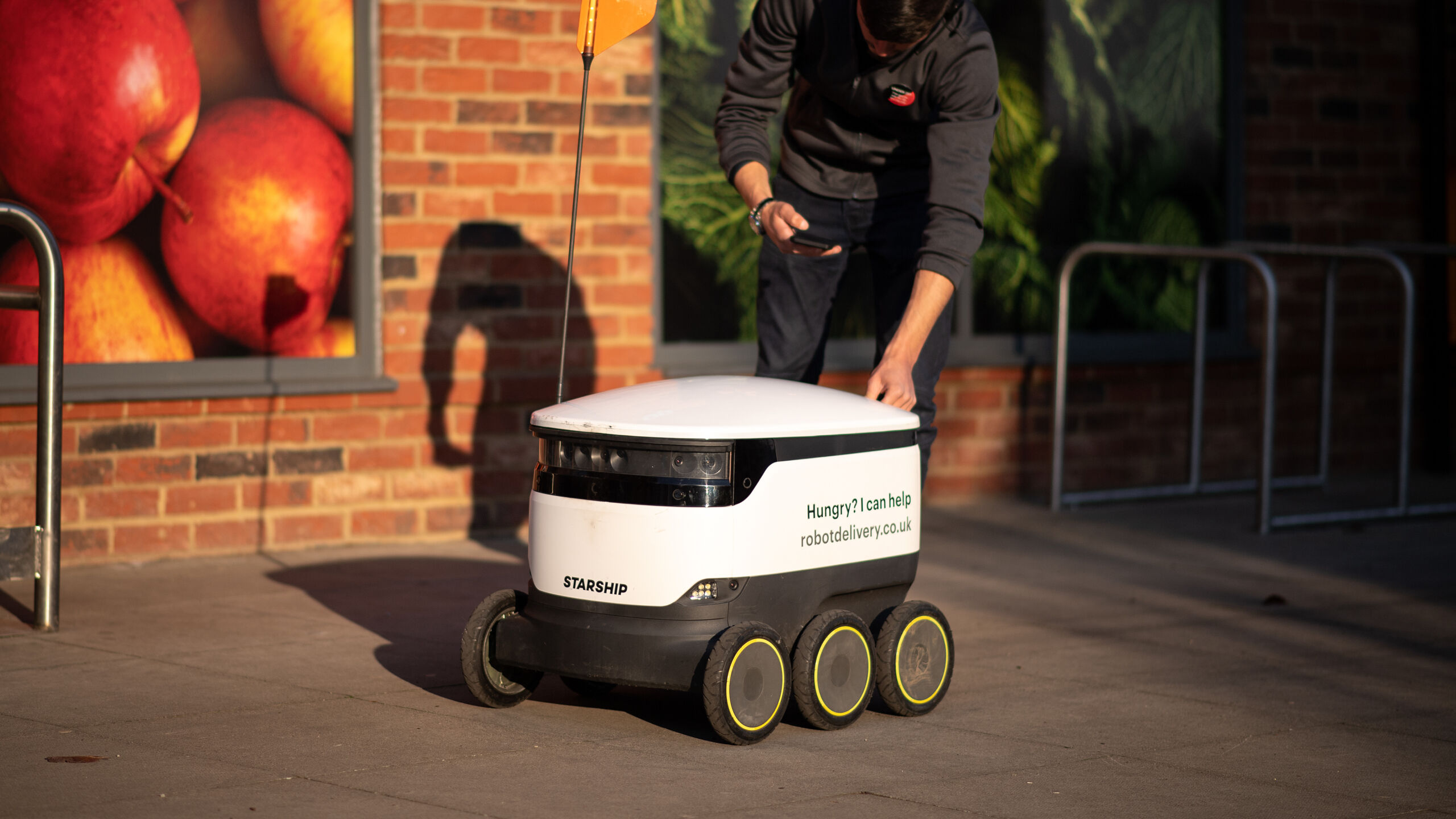
A 2020 file photo of a Starship Technologies food delivery robot.

Enlarge / A 2020 file photo of a Starship Technologies food delivery robot. Food is stored inside the robot’s housing during transportation and opened upon delivery. (credit: Leon Neal/Getty Images)

On Tuesday, officials at Oregon State University issued a warning on social media about a bomb threat concerning Starship Technologies food delivery robots, autonomous wheeled drones that deliver food orders stored within a built-in container. By 7 pm local time, a suspect had been arrested in the prank, and officials declared there had been no bombs hidden within the robots.

“Bomb Threat in Starship food delivery robots,” reads the 12:20 pm initial X post from OSU. “Do not open robots. Avoid all robots until further notice.” In follow-up posts, OSU officials said they were “remotely isolating robots in a safe location” for investigation by a technician. By 3:54 pm local time, experts had cleared the robots and promised they would be “back in service” by 4 pm.

In response, Starship Technologies provided this statement to the press: “A student at Oregon State University sent a bomb threat, via social media, that involved Starship’s robots on the campus. While the student has subsequently stated this is a joke and a prank, Starship suspended the service. Safety is of the utmost importance to Starship and we are cooperating with law enforcement and the university during this investigation.”

Read 2 remaining paragraphs | Comments


Source: Ars Technica – “Do not open robots,” warns Oregon State amid college food delivery bomb prank

California suspends Cruise robotaxis after car dragged pedestrian 20 feet

California suspends Cruise robotaxis after car dragged pedestrian 20 feet

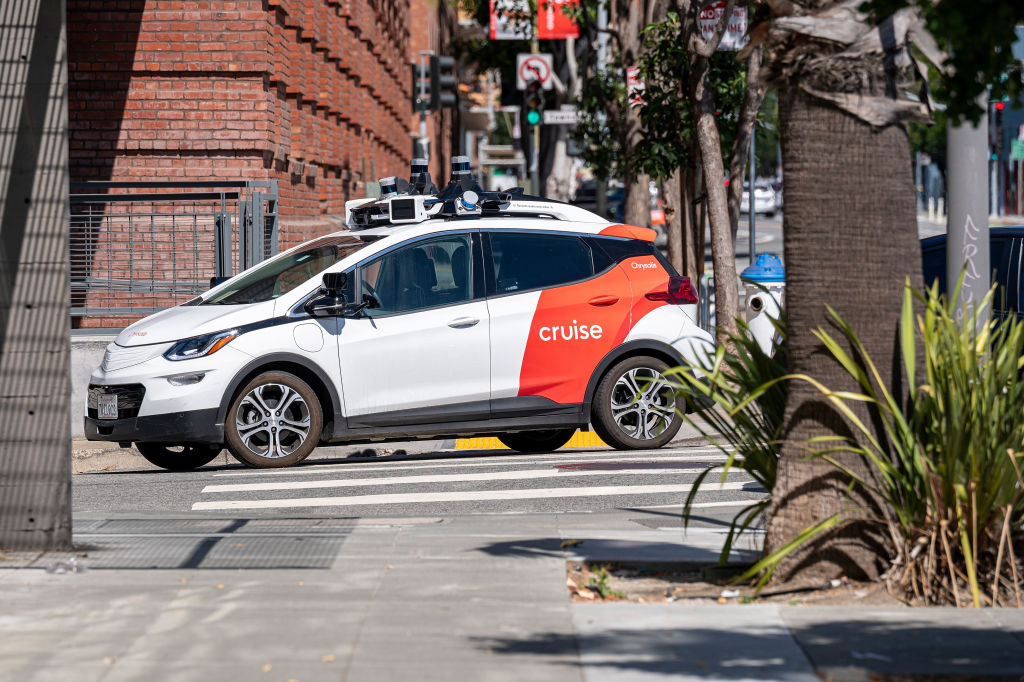
Enlarge (credit: Bloomberg / Contributor | Bloomberg)

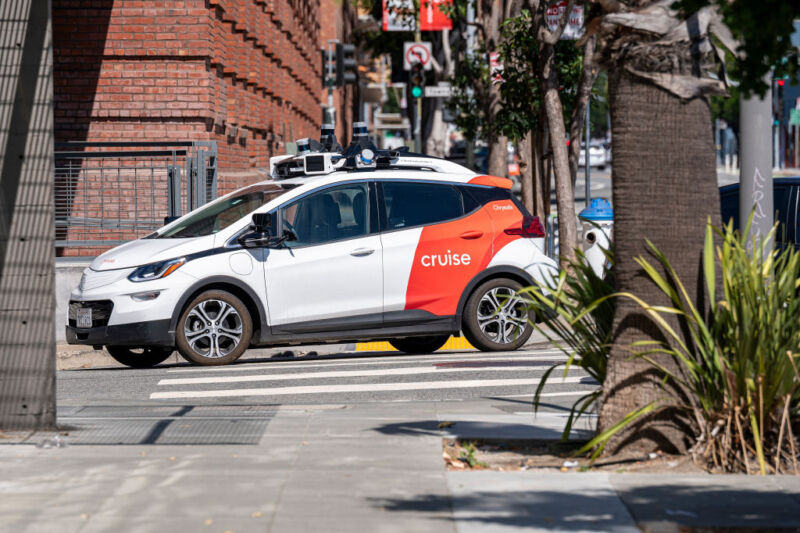
Less than three months after the California Public Utilities Commission approved robotaxi-service Cruise’s plan to provide around-the-clock driverless rides to passengers in San Francisco, the California Department of Motor Vehicles (DMV) has shut down Cruise’s driverless operations in the state.

Yesterday, the California DMV suspended Cruise’s permits for autonomous vehicle deployment and driverless testing “effective immediately” over pedestrian safety concerns.

“Public safety remains the California DMV’s top priority, and the department’s autonomous vehicle regulations provide a framework to facilitate the safe testing and deployment of this technology on California public roads,” the DMV’s announcement said. “When there is an unreasonable risk to public safety, the DMV can immediately suspend or revoke permits.”

Read 11 remaining paragraphs | Comments


Source: Ars Technica – California suspends Cruise robotaxis after car dragged pedestrian 20 feet

Sam Bankman-Fried may testify in hopes of avoiding life in prison

Read 13 remaining paragraphs | Comments


Source: Ars Technica – Sam Bankman-Fried may testify in hopes of avoiding life in prison

Lexus LF-ZC and LF-ZL concepts show extreme aero can look extremely good

A Lexus concept car on display at the Tokyo auto show

Enlarge / The Lexus LF-ZC on display at the Tokyo Auto Show. (credit: Tim Stevens)

It has been a few years since Lexus pledged to go fully electric in the North American market by 2030, globally by 2035. That’s an aggressive timeline for any manufacturer, particularly for one tied so closely with Toyota, a brand that has been slow on the battery-electric uptake.

Today, at the Japan Mobility Show in Tokyo, Lexus finally gave us a comprehensive look at our likely all-electric future. It debuted not one but two new electric vehicles, both based on the same next-generation platform and promising remarkable efficiency and some stellar aerodynamics.

The LF-ZC and new levels of efficiency

The LF-ZC's interior.

The LF-ZC’s interior. (credit: Tim Stevens)

The first car is the LF-ZC, a name that doesn’t exactly roll off the tongue. It’s an acronym, standing for Lexus Future Zero-emission Catalyst, but forget the awkward nomenclature, because the thing looks fantastic. Long and lean and angular, it has a distinctly Lexus feel despite its unique look.

Read 17 remaining paragraphs | Comments


Source: Ars Technica – Lexus LF-ZC and LF-ZL concepts show extreme aero can look extremely good

Daily Telescope: A closer look at the most-distant object visible to the naked eye

The Andromeda Galaxy, as seen from The Milky Way Galaxy.

Enlarge / The Andromeda Galaxy, as seen from The Milky Way Galaxy. (credit: Kevin Chernoff)

Welcome to the Daily Telescope. There is a little too much darkness in this world and not enough light—a little too much pseudoscience and not enough science. We’ll let other publications offer you a daily horoscope. At Ars Technica, we’ll take a different route, finding inspiration from very real images of a universe that is filled with stars and wonder.

Good morning. It is October 25th, and today’s image features one of the most photogenic galaxies from Earth’s vantage point—the Andromeda Galaxy.

This photo was captured by an astrophotographer named Kevin Chernoff using a 6-inch reflector telescope on a tracking mount. According to Chernoff, this was an astrophotography-modified, mirrorless camera without any special filters. “It is about two and a half hours of total exposure time across 300 individual frames, stacked and processed together,” he said. “It was shot from a dark roadside location about an hour away from my home.”

Read 5 remaining paragraphs | Comments


Source: Ars Technica – Daily Telescope: A closer look at the most-distant object visible to the naked eye

How to make almost any computer a modern-day PLATO terminal

How to make almost any computer a modern-day PLATO terminal

Enlarge (credit: Aurich Lawson | Getty Images)

In our previous deep dive into the groundbreaking world of PLATO, we pointed out the technological advances the system heralded in graphical displays, sound, and user interface; the trailblazing software environment it hosted with educational content, networked messaging and communications, and multiplayer games; and the cultural impact it had on subsequent systems—and even on the modern Internet.

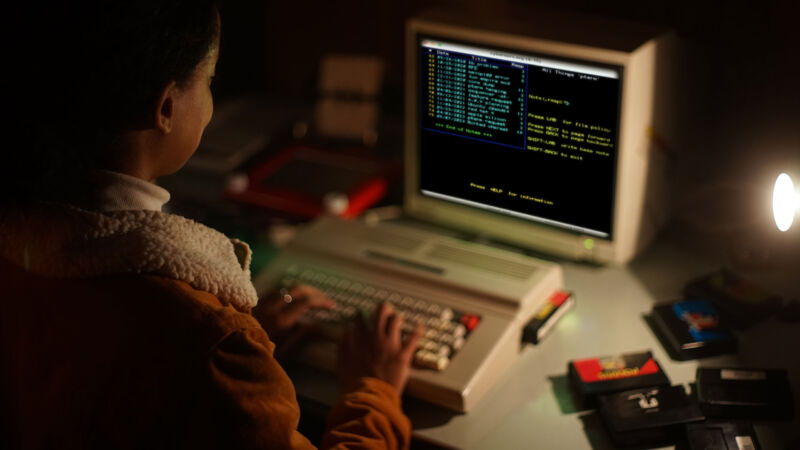
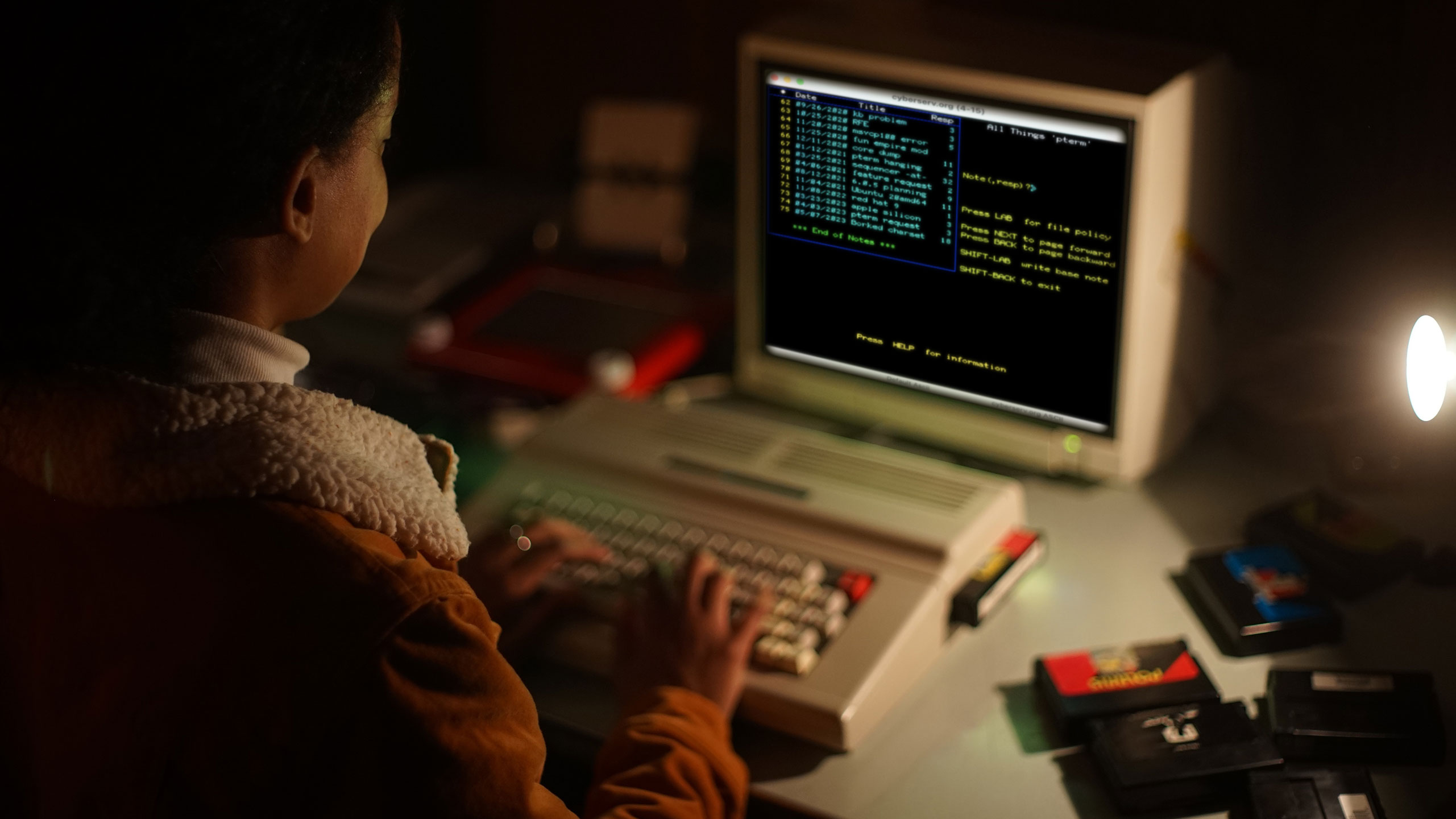
But all’s not lost if you missed out on PLATO the first time around. The spirit, technology, and even software of PLATO live on in modern retrocomputing re-creations. In today’s article, we’ll look at two of these services and demonstrate how almost any computer can be a modern-day PLATO terminal, too.

Sign in and turn on

Although other resurrected PLATO instances are around, today we’ll be looking at two that specifically cater to the curious public, IRATA.ONLINE (yes, Atari spelled backwards, just like in M.U.L.E.) and Cyber1. Both sites operate a server running an emulated PLATO environment with many of the same software components, but the specific mix of lessons (i.e., PLATO applications, more or less) and their front-ends differ somewhat.

Read 44 remaining paragraphs | Comments


Source: Ars Technica – How to make almost any computer a modern-day PLATO terminal

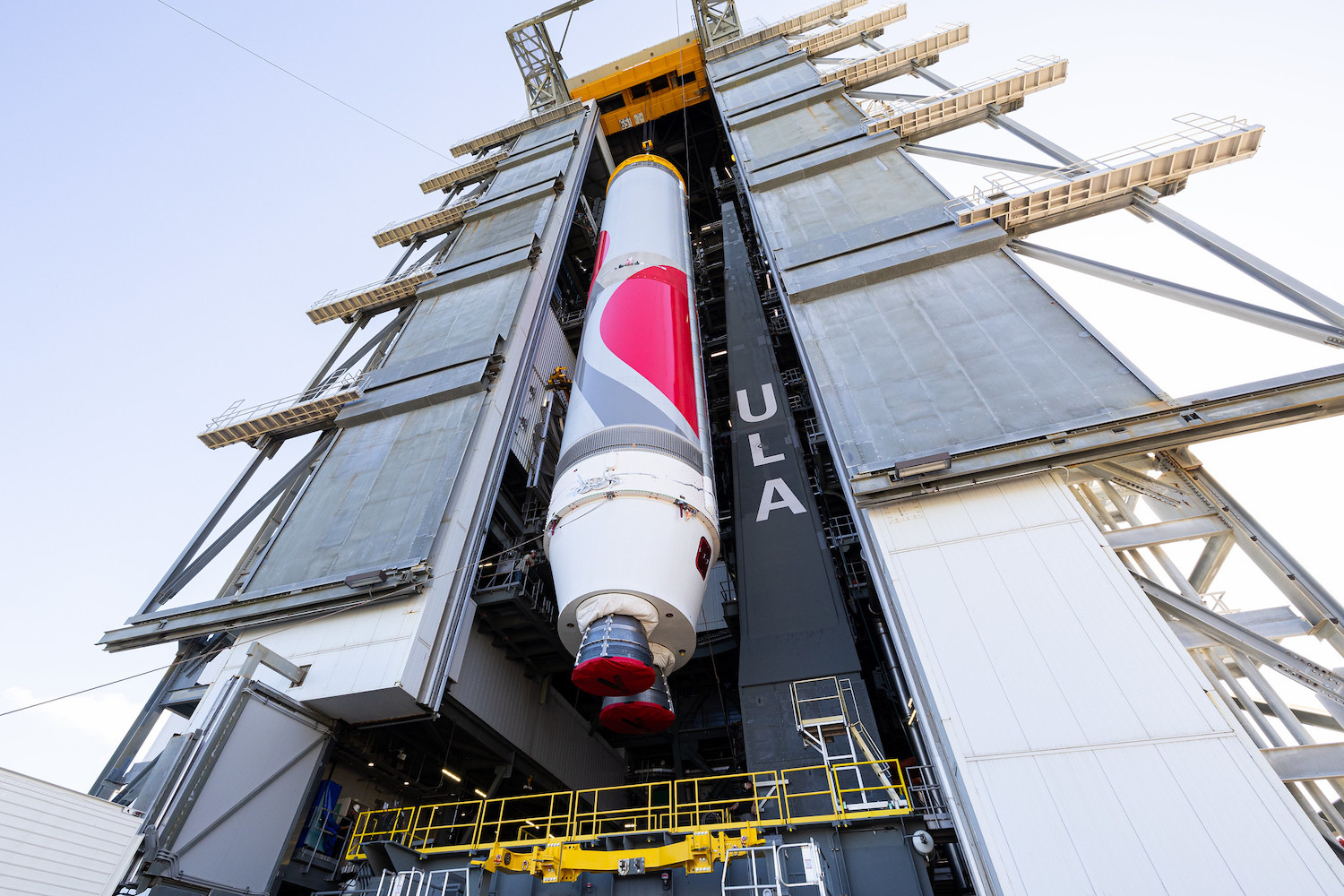
For the first launch of ULA’s Vulcan rocket, it’s Christmas or next year

The first stage for ULA's Vulcan rocket was lifted onto its launch platform at Cape Canaveral in January.

Enlarge / The first stage for ULA’s Vulcan rocket was lifted onto its launch platform at Cape Canaveral in January. (credit: United Launch Alliance)

Three days at Christmastime will be the final chance for United Launch Alliance to get its new Vulcan rocket off the ground this year, the company’s chief executive announced Tuesday.

Still waiting for delivery of an upper stage and a final round of qualification testing following a test mishap earlier this year, Tory Bruno, ULA’s CEO, told CNBC on Tuesday that the Vulcan rocket’s first demonstration flight is scheduled for launch December 24. There are two backup launch dates available December 25 and 26, or else the launch will have to wait until January.

There are threats to this schedule, but ULA officials were confident enough in the timeline to publicly disclose the launch date Tuesday. They have also told Astrobotic, which is flying its first commercial Moon cargo lander on the inaugural Vulcan rocket, to ship its spacecraft from the company’s Pittsburgh headquarters to Florida in anticipation of a December launch.

Read 25 remaining paragraphs | Comments


Source: Ars Technica – For the first launch of ULA’s Vulcan rocket, it’s Christmas or next year

I used a $28 mechanical keyboard for a month—maybe you should, too

Keychron C3 Pro

Enlarge (credit: Scharon Harding)

When I tell people I prefer using mechanical keyboards, I often hear that they’re too expensive. Even people in tech circles have told me they can’t find a quality mechanical keyboard for a decent price. Is $28 decent enough for you?

That’s how much the Keychron C3 Pro is going for on Amazon right now. It’s a sale price that could change, but the keyboard was still only $35 when it released in September. Since September 21, I’ve been using the budget clacker as my primary keyboard, and it has kept up with my busy workload—writing about 17 articles for Ars Technica and more emails than I care to recount. Expensive mechanical keyboards often come with all sorts of perks worth obsessing over, but the C3 Pro proves that sometimes, cheap is good enough. Mechanical keyboards don’t have to be a luxury peripheral.

Meet the C3 Pro

Keychron’s C3 Pro is a tenkeyless (TKL) mechanical keyboard, so there’s no numpad. If you can get past that, you’re left with an affordable keyboard offering a typing experience that’s superior to any membrane or mechanical keyboard in this price range.

Read 19 remaining paragraphs | Comments


Source: Ars Technica – I used a mechanical keyboard for a month—maybe you should, too

US surprises Nvidia by speeding up new AI chip export ban

The Nvidia H100 Tensor Core GPU

Enlarge / A press photo of the Nvidia H100 Tensor Core GPU. (credit: Nvidia)

On Tuesday, chip designer Nvidia announced in an SEC filing that new US export restrictions on its high-end AI GPU chips to China are now in effect sooner than expected, according to a report from Reuters. The curbs were initially scheduled to take effect 30 days after their announcement on October 17 and are designed to prevent China, Iran, and Russia from acquiring advanced AI chips.

The banned chips are advanced graphics processing units (GPUs) that are commonly used for training and running deep learning AI applications similar to ChatGPT and AI image generators, among other uses. GPUs are well-suited for neural networks because their massively parallel architecture performs the necessary matrix multiplications involved in running neural networks faster than conventional processors.

The Biden administration initially announced an advanced AI chip export ban in September 2022, and in reaction, Nvidia designed and released new chips, the A800 and H800, to comply with those export rules for the Chinese market. In November 2022, Nvidia told The Verge that the A800 “meets the US Government’s clear test for reduced export control and cannot be programmed to exceed it.” However, the new curbs enacted Monday specifically halt the exports of these modified Nvidia AI chips. The Nvidia A100, H100, and L40S chips are also included in the export restrictions.

Read 3 remaining paragraphs | Comments


Source: Ars Technica – US surprises Nvidia by speeding up new AI chip export ban

CVS ditches common cold meds after FDA advisers say they’re useless

A box of Sudafed PE sinus pressure and pain medicine containing phenylephrine is displayed for sale in a CVS Pharmacy store in Hawthorne, California, on September 12, 2023.

Enlarge / A box of Sudafed PE sinus pressure and pain medicine containing phenylephrine is displayed for sale in a CVS Pharmacy store in Hawthorne, California, on September 12, 2023. (credit: Getty | PATRICK T. FALLON)

Drug store giant CVS revealed late last week that it is voluntarily pulling some common cold and flu medicines from its shelves because they don’t work—while many other ineffective products remain on the shelves.

The move by CVS comes after an advisory panel for the Food and Drug Administration last month voted unanimously that the common decongestant, phenylephrine, is ineffective at treating a stuffy nose. But it comes ahead of the FDA itself acting on the vote, which will likely lead the agency to revoke phenylephrine’s approval, eventually.

In a statement to Ars, a CVS spokesperson suggested the FDA advisory panel’s vote was the impetus for the change, but that it would “follow direction from the FDA.”

Read 19 remaining paragraphs | Comments


Source: Ars Technica – CVS ditches common cold meds after FDA advisers say they’re useless

41 states sue Meta for allegedly addicting kids to Facebook and Instagram

41 states sue Meta for allegedly addicting kids to Facebook and Instagram

Enlarge (credit: CMB | Moment)

State attorneys general in 41 states and the District of Columbia sued Meta today. The move comes after the conclusion of a multistate probe launched in 2021, where a bipartisan coalition of state enforcers began examining how Facebook and Instagram features are designed to allegedly addict and harm kids.

Back in 2021, the Massachusetts attorney general’s office led the multistate probe investigating “Instagram’s impacts on young people” after Facebook whistleblower Frances Haugen revealed that Facebook knew Instagram was “toxic” to teen girls but downplayed risks to the public. In a press release today, Massachusetts Attorney General Andrea Joy Campbell accused Meta of “deliberately” exploiting “young users’ vulnerabilities for profit.”

Eight states and Washington, DC, filed lawsuits against Meta in state and local courts, while 33 states filed a joint lawsuit in a federal court in California, The Washington Post reported.

Read 12 remaining paragraphs | Comments


Source: Ars Technica – 41 states sue Meta for allegedly addicting kids to Facebook and Instagram

“Scary Fast”: Apple will stream a new product event on October 30

“Scary Fast”: Apple will stream a new product event on October 30

Enlarge (credit: Apple)

Apple is squeezing one more round of product announcements into October after all. The company announced today that it would be streaming a product event at 5 pm Pacific/8 pm Eastern on October 30, unusually late in the day (and in the month) for an Apple event. The “Scary Fast” tagline doesn’t give away anything about what Apple plans to announce, but both history and well-sourced Apple reporters and analysts suggest that the company will focus mostly on the Mac.

As Bloomberg’s Mark Gurman pointed out yesterday, the iMac and all three sizes of MacBook Pro have longer-than-usual shipping times listed on Apple’s website, which often indicates that a refresh is imminent. I’d guess that having an actual livestreamed product event—rather than just announcing the new products via press release, as Apple did with the new Apple Pencil last week—increases the likelihood that any new Macs will come with next-generation M3 chips. Analyst Ming-Chi Kuo believes that Apple will focus on M3 MacBook Pros at the event, although as recently as two weeks ago he didn’t think Apple had anything left to announce this year.

These new MacBook Pros would be coming just 11 months after the M2 refresh for those Macs, which launched back in January. But it’s worth noting that these Macs were probably meant to be released in late 2022, based on the original URL of their announcement video. It’s not that the M3 MacBooks Pro are a little early; it’s probably that the M2 versions were a little late.

Read 2 remaining paragraphs | Comments



Source: Ars Technica – “Scary Fast”: Apple will stream a new product event on October 30

FCC robocall enforcement does little to stop illegal calls, Senate hears

Over the shoulder view of young Asian woman receiving a suspected spam call on her smartphone

Enlarge (credit: Getty Images | d3sign)

The Federal Communications Commission’s attempts to stop robocalls have failed to make a big dent in the problem, according to testimony at a Senate subcommittee hearing today.

The FCC “has been trying to address the problems, but, to date, its methods have not succeeded in achieving a meaningful reduction in these unwanted and illegal calls. Either the FCC does not have sufficient legal tools to stop these unwanted and illegal calls, or it has not yet determined how to deploy those tools effectively,” said Margot Freeman Saunders, senior counsel for the National Consumer Law Center.

The hearing on robocalls was held by the Commerce Committee’s Subcommittee on Communications, Media, and Broadband. Senator Ben Ray Luján (D-N.M.), the subcommittee chair, said that FCC enforcement is ineffective and that Congress should give the agency more power. He mentioned the long-standing problem that the FCC is unable to collect on most of the robocall fines it issues.

Read 19 remaining paragraphs | Comments


Source: Ars Technica – FCC robocall enforcement does little to stop illegal calls, Senate hears