Prime-WoW

My site, my way, no big company can change this

Prime-WoW

Streamer completes hitless run of seven FromSoft Soulslikes without leveling up

If you know just one thing about FromSoft’s recent history of so-called “Soulslike” games, you probably know that they have a well-earned reputation for absolutely brutal difficulty. But these titles apparently just weren’t difficult enough for streamer dinossindgeil (aka Nico) who spent the weekend beating seven of FromSoft’s most punishing titles without taking a single hit or leveling up even once.

Nico’s conquest of what he calls “The God Run 3” dates back to 2022, when he took down all three Dark Souls games as well as Demon’s Souls, Bloodborne, Sekiro: Shadows Die Twice, and Elden Ring live on his Twitch stream without sustaining any damage from enemies. Back then, though, Nico relied at least a little bit on grinding leveled-up characters and high-end gear to make the game’s most difficult bosses a bit more manageable. Even with that advantage, though, a successful God Run 3 completion took Nico 120 days of real-time effort due to frequent restarts whenever he took a single hit.

This time around, Nico cranked up the difficulty even further by deciding not to level his characters even once (though he was able to increase his stats and abilities in some games with level 1-accessible items and weapons). After his first level 1 God Run attempt two months ago, Nico’s efforts culminated in a roughly 11-hour multi-day marathon run over the weekend, which saw Nico break down in tears at the end of the ordeal.

Read full article

Comments

Acer CEO says its PC prices to increase by 10 percent in response to Trump tariffs

PC-manufacturer Acer has said that it plans to raise the prices of its PCs in the US by 10 percent, a direct response to the new 10 percent import tariff on Chinese goods that the Trump administration announced earlier this month.

“We will have to adjust the end user price to reflect the tariff,” said Acer CEO Jason Chen in an interview with The Telegraph. “We think 10 percent probably will be the default price increase because of the import tax. It’s very straightforward.”

These price increases won’t roll out right away, according to Chen—products shipped from China before the tariffs went into effect earlier this month won’t be subject to the increased import taxes—but we can expect them to show up in PC price tags over the next few weeks.

Read full article

Comments

Microsoft warns that the powerful XCSSET macOS malware is back with new tricks

Microsoft said it has detected a new variant of XCSSET, a powerful macOS malware family that has targeted developers and users since at least 2020.

The variant, which Microsoft reported Monday, marked the first publicly known update to the malware since 2022. The malware first came to light in 2020, when security firm Trend Micro said it had targeted app developers after spreading through a publicly available project the attacker wrote for Xcode, a developer tool Apple makes freely available. The malware gained immediate attention because it exploited what, at the time, were two zero-day vulnerabilities, a testament to the resourcefulness of the entity behind the attacks.

In 2021, XCSSET surfaced again, first when it was used to backdoor developers’ devices and a few months later when researchers found it exploiting what at the time was a new zero-day.

Read full article

Comments

3D map of exoplanet atmosphere shows wacky climate

Astronomers have detected over 5,800 confirmed exoplanets. One extreme class is ultra-hot Jupiters, of particular interest because they can provide a unique window into planetary atmospheric dynamics. According to a new paper published in the journal Nature, astronomers have mapped the 3D structure of the layered atmosphere of one such ultra-hot Jupiter-size exoplanet, revealing powerful winds that create intricate weather patterns across that atmosphere. A companion paper published in the journal Astronomy and Astrophysics reported on the unexpected identification of titanium in the exoplanet’s atmosphere as well.

As previously reported, thanks to the massive trove of exoplanets discovered by the Kepler mission, we now have a good idea of what kinds of planets are out there, where they orbit, and how common the different types are. What we lack is a good sense of what that implies in terms of the conditions on the planets themselves. Kepler can tell us how big a planet is, but it doesn’t know what the planet is made of. And planets in the “habitable zone” around stars could be consistent with anything from a blazing hell to a frozen rock.

Like the Transiting Exoplanet Survey Satellite (TESS), Kepler identifies planets using the transit method. This works for systems in which the planets orbit in a plane that takes them between their host star and Earth. As this occurs, the planet blocks a small fraction of the starlight that we see from Earth (or nearby orbits). If these dips in light occur with regularity, they’re diagnostic of something orbiting the star.

Read full article

Comments

OpenAI board considers special voting powers to prevent Elon Musk takeover

OpenAI is considering granting new voting rights to its nonprofit board in a move that could help it fight an unsolicited takeover bid from Elon Musk, the Financial Times reported last night. Citing people familiar with the discussions, the FT wrote that CEO “Sam Altman and other board members are weighing a range of new governance mechanisms after OpenAI converts into a more conventional for-profit company.”

“Giving the nonprofit’s board outsized voting power would ensure it retain[s] control of the restructured company and [is] able to over-rule other investors including existing backers such as Microsoft and SoftBank,” the FT wrote. “While no firm decisions have been made, special voting rights would also ensure OpenAI can fight off hostile bids from outsiders such as Musk.”

We contacted OpenAI about the report and will update this article if it provides any comment.

Read full article

Comments

By the end of today, NASA’s workforce will be about 10 percent smaller

Spread across NASA’s headquarters and 10 field centers, which dot the United States from sea to sea, the space agency has had a workforce of nearly 18,000 civil servants.

However, by the end of today, that number will have shrunk by about 10 percent since the beginning of the second Trump administration four weeks ago. And the world’s preeminent space agency may still face significant additional cuts.

According to sources, about 750 employees at NASA accepted the “fork in the road” offer to take deferred resignation from the space agency later this year. This sounds like a lot of people, but generally about 1,000 people leave the agency every year, so effectively, many of these people might just be getting paid to leave jobs they were already planning to exit from.

Read full article

Comments

Can public trust in science survive a second battering?

Public trust in science has been in the spotlight in recent years: After the US presidential election in November, one Wall Street Journal headline declared that “Science Lost America’s Trust.” Another publication called 2024 “the year of distrust in science.”

Some of that may be due to legitimate concerns: Public health officials have been criticized for their lack of transparency during critical moments, including the COVID-19 pandemic. And experts have noted the influence of political factors. For instance, the first Trump administration repeatedly undermined scientists—a trend repeating in his second term so far.

But what does the research say about where public trust in science, doctors, and health care institutions actually stands? In recent years, researchers have been increasingly looking into quantifying these sentiments. And indeed, multiple surveys and studies have reported the COVID-19 pandemic correlated with a decline in trust in the years following the initial outbreak. This decrease, though, seems to be waning as new research shows a clearer picture of trust across time. One 2024 study suggests Trump’s attacks on science during his first term did not have the significant impact many experts feared—and may have even boosted confidence among certain segments of the population.

Read full article

Comments

Review: Asus’ ROG Flow Z13 tablet takes the asterisk off integrated GPUs

Specs at a glance: Asus ROG Flow Z13 (XS96 model)
OS Windows 11 Pro
CPU AMD Ryzen AI Max+ 395 (16 cores, 3.0 GHz)
RAM 32GB LPDDR5X-8000 (non-upgradeable; XS99 goes up to 128GB)
GPU AMD Radeon 8060S (integrated)
SSD 1TB NVMe M.2 SSD 2230 (upgradeable)
Battery 70 WHr
Display 13.4-inch 2560×1600 180 Hz touchscreen
Connectivity 2x USB-C ports (USB4, DP 2.1, PD 3.0), 1x HDMI 2.1, 1 USB-A, microSD, 3.5 mm audio, 200W barrel charge
Weight 2.65 lb (1.2 kg) without keyboard, 3.51 lb (1.59 kg) with keyboard
Price as tested $2,299 (pre-order at Amazon, get notified at Asus)

I really like Asus’ ROG Flow Z13 for what it is: a convertible tablet with way more gaming power than you would think. Looking at this thing, you might expect to see it propped up at an airport bar, in front of somebody talking into wireless headphones about Tim in Product. But there’s a lot of frame-rendering and multicore processing power inside this glass-fronted slab with a keyboard cover. It’s an impressive showcase for AMD’s leap forward in integrated power.

The Z13 can rip through Hitman and Shadow of the Tomb Raider on their highest settings at its native 2560×1600 resolution. Turn the resolution down to a reasonable-for-this-size 1920×1080 and you can play Cyberpunk 2077 at its Ultra settings at 45–55 frames per second, depending on your power and upscaling preferences. On a device that is essentially a beefy Microsoft Surface, this is no small thing. The AMD Ryzen AI Max+ 395 “Strix Halo” inside the Z13, with the latest Ryzen 8060S GPU built into it, is not just capable—it’s a step up from most of the gaming laptops out there.

As a Windows convertible, it has some interesting tech and notable upgrades from the 2022 product that was also called the ROG Flow Z13. Its webcam works with Windows Hello and logs you in 95 percent of the time. The keyboard has decent travel, the trackpad has a pleasant smoothness, and you can prop the thing up anywhere along the solid kickstand’s 170-degree range. It’s a Copilot+ PC if that matters to you, and when you’re not pushing ray-traced gaming frames, its battery life is no slouch.

Read full article

Comments

Turning the Moon into a fuel depot will take a lot of power

If humanity is ever to spread out into the Solar System, we’re going to need to find a way to put fuel into rockets somewhere other than the cozy confines of a launchpad on Earth. One option for that is in low-Earth orbit, which has the advantage of being located very close to said launch pads. But it has the considerable disadvantage of requiring a lot of energy to escape Earth’s gravity—it takes a lot of fuel to put substantially less fuel into orbit.

One alternative is to produce fuel on the Moon. We know there is hydrogen and oxygen present, and the Moon’s gravity is far easier to overcome, meaning more of what we produce there can be used to send things deeper into the Solar System. But there is a tradeoff: any fuel production infrastructure will likely need to be built on Earth and sent to the Moon.

How much infrastructure is that going to involve? A study released today by PNAS evaluates the energy costs of producing oxygen on the Moon, and finds that they’re substantial: about 24 kWh per kilogram. This doesn’t sound bad until you start considering how many kilograms we’re going to eventually need.

Read full article

Comments

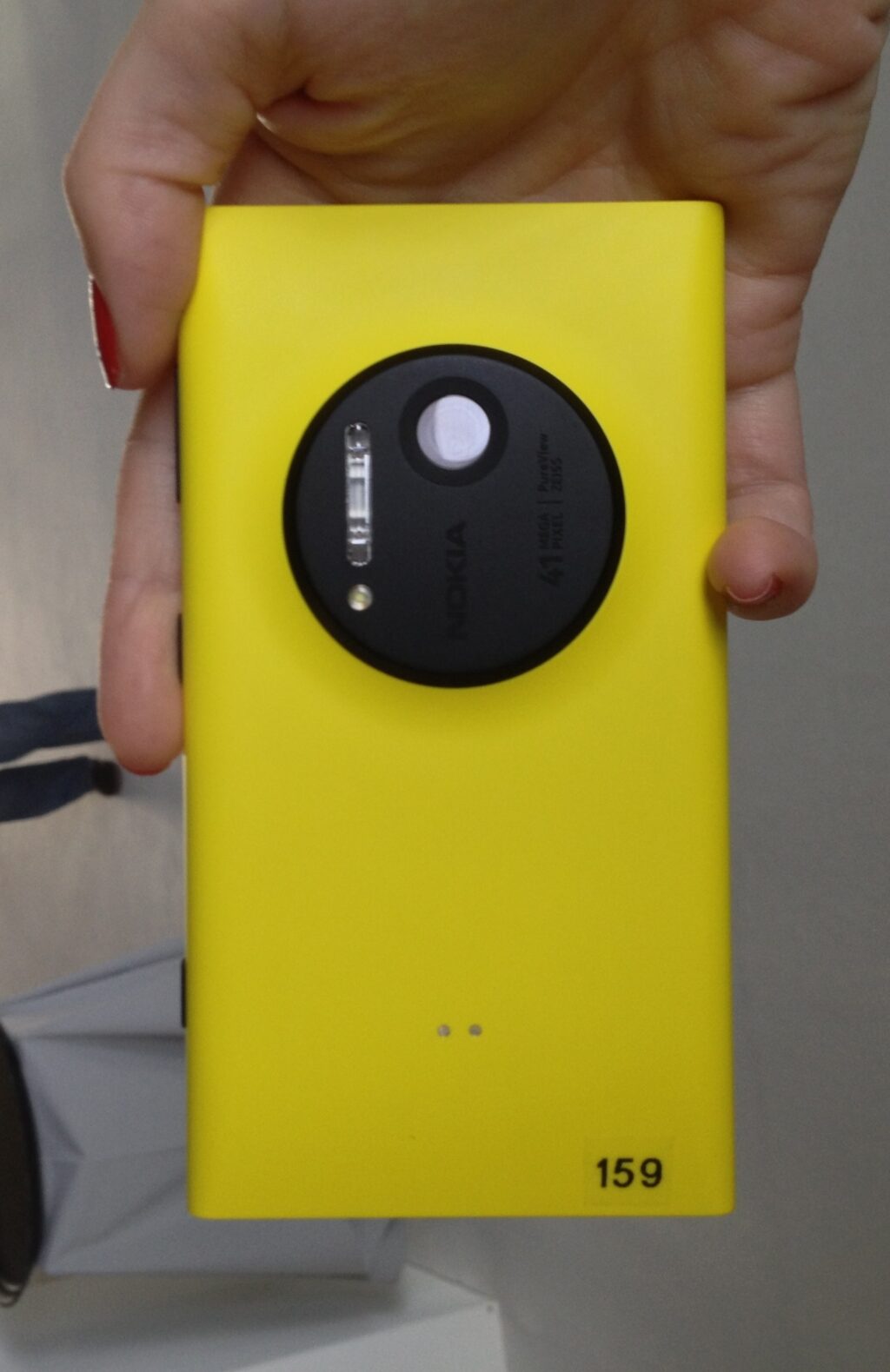
“NokiApple LumiPhone 1020 SE” merges Windows Phone body with budget iPhone guts

Remember the Lumia 1020? It’s back—in iPhone SE form.

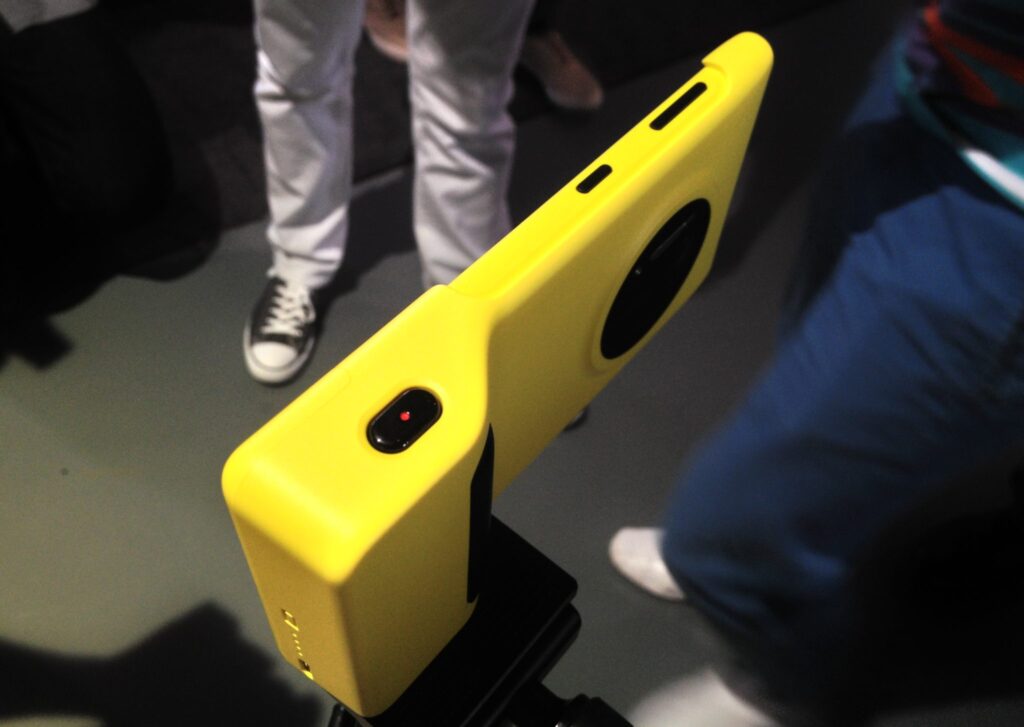
The Lumia 1020 was a lot of smartphone in July 2013. It debuted with a focus “almost entirely on the phone’s massive camera,” Ars wrote at the time. That big 41-megapixel sensor jutted forth from the phone body, and Nokia reps showed off its low-light, rapid-motion camera abilities by shooting pictures of breakdancers in a dark demonstration room. The company also offered an optional camera grip—one that made it feel a lot more like a point-and-shoot camera. In a more robust review, Ars suggested the Lumia 1020 might actually make the point-and-shoot obsolete.

Front of the Lumia 1020, showing a bit of Windows Phone square grid flair.


Credit:

Casey Johnston

Back of the Lumia 1020, with oh-so-much yellow.


Credit:

Casey Johnston

The accessory camera grip for the Lumia 1020, shown at its press reveal.


Credit:

Casey Johnston

The Lumia 1020 contained yet another cutting edge concept of the day: Windows Phone, Microsoft’s color-coded, square-shaped companion to its mobile-forward Windows 8. The mobile OS never got over the users/apps, chicken/egg conundrum, and called it quits in October 2017. The end of that distant-third-place mobile OS would normally signal the end of the Lumia 1020 as a usable phone.

Read full article

Comments

Privacy-problematic DeepSeek pulled from app stores in South Korea

In a media briefing held Monday, the South Korean Personal Information Protection Commission indicated that it had paused new downloads within the country of Chinese AI startup DeepSeek’s mobile app. The restriction took effect on Saturday and doesn’t affect South Korean users who already have the app installed on their devices. The DeepSeek service also remains accessible in South Korea via the web.

Per Reuters, PIPC explained that representatives from DeepSeek acknowledged the company had “partially neglected” some of its obligations under South Korea’s data protection laws, which provide South Koreans some of the strictest privacy protections globally.

PIPC investigation division director Nam Seok is quoted by the Associated Press as saying DeepSeek “lacked transparency about third-party data transfers and potentially collected excessive personal information.” DeepSeek reportedly has dispatched a representative to South Korea to work through any issues and bring the app into compliance.

Read full article

Comments

Despite court orders, climate and energy programs stalled by Trump freeze

President Donald Trump’s freeze on federal funding shows little sign of thawing for climate, energy and environmental justice programs.

Despite two federal court orders directing the administration to resume distributing federal grants and loans, at least $19 billion in Environmental Protection Agency funding to thousands of state and local governments and nonprofits remained on hold as of Feb. 14, said environmental and legal advocates who are tracking the issue.

EPA Administrator Lee Zeldin has vowed to seek return of an additional $20 billion the agency invested last year in the Greenhouse Gas Reduction Fund program, calling for a Department of Justice investigation into what he characterized as a “scheme… purposefully designed to obligate all of the money in a rush job with reduced oversight.”

Read full article

Comments

X is reportedly blocking links to secure Signal contact pages

X, the social platform formerly known as Twitter, is seemingly blocking links to Signal, the encrypted messaging platform, according to journalist Matt Binder and other firsthand accounts.

Binder wrote in his Disruptionist newsletter Sunday that links to Signal.me, a domain that offers a way to connect directly to Signal users, are blocked on public posts, direct messages, and profile pages. Error messages—including “Message not sent,” “Something went wrong,” and profiles tagged as “considered malware” or “potentially harmful”—give no direct suggestion of a block. But posts on X, reporting at The Verge, and other sources suggest that Signal.me links are broadly banned.

Signal.me links that were already posted on X prior to the recent change now show a “Warning: this link may be unsafe” interstitial page rather than opening the link directly. Links to Signal handles and the Signal homepage are still functioning on X.

Read full article

Comments

NASA nominee previews his vision for the agency: Mars, hard work, inspiration

The likely next leader of NASA, private astronaut and pilot Jared Isaacman, has kept a low profile since the announcement last year that he was President Donald Trump’s choice to lead the space agency.

This is understandable, as Isaacman must still be confirmed by the US Senate. No date has yet been put forward for a confirmation hearing before the Senate Commerce, Science, and Transportation Committee, which is chaired by Sen. Ted Cruz (R-Tex.). Typically, during this interim period, nominees meet with Senators behind closed doors before their hearings and limit public comments that could put them in the hot seat during the confirmation process.

This has meant that we’ve heard little from the person who is in line to lead NASA over the next four years as the space agency confronts a number of issues. These include reconfiguring the Artemis Program, a potential pivot toward Mars, an aging International Space Station, Mars Sample Return, a limited pipeline of science missions, and the likelihood of budget cuts. On top of all of this there is the uncertainty and unease federal workers face as the Trump Administration scrutinizes their activities for efficiency and, in some cases, loyalty.

Read full article

Comments

Protesters demonstrate outside Tesla showrooms in US

Protesters gathered outside Tesla showrooms across the US on Saturday to demonstrate against the drastic cuts Elon Musk, the billionaire adviser to President Donald Trump, is imposing on the federal government.

Organisers cited 37 protests across the country as part of an effort co-ordinated through the social media hashtags #TeslaTakedown and #TeslaTakover.

Musk’s car company is emerging as a target for political outrage in the US and Europe in response to the billionaire’s outsized influence in the White House.

Read full article

Comments

Reddit mods are fighting to keep AI slop off subreddits. They could use help.

Like it or not, generative AI is carving out its place in the world. And some Reddit users are definitely in the “don’t like it” category. While some subreddits openly welcome AI-generated images, videos, and text, others have responded to the growing trend by banning most or all posts made with the technology.

To better understand the reasoning and obstacles associated with these bans, Ars Technica spoke with moderators of subreddits that totally or partially ban generative AI. Almost all these volunteers described moderating against generative AI as a time-consuming challenge they expect to get more difficult as time goes on. And most are hoping that Reddit will release a tool to help their efforts.

It’s hard to know how much AI-generated content is actually on Reddit, and getting an estimate would be a large undertaking. Image library Freepik has analyzed the use of AI-generated content on social media but leaves Reddit out of its research because “it would take loads of time to manually comb through thousands of threads within the platform,” spokesperson Bella Valentini told me. For its part, Reddit doesn’t publicly disclose how many Reddit posts involve generative AI use.

Read full article

Comments

Moon rocks reveal hidden lunar history

That mission, and the 2020 Chang’e-5 robotic mission before it, are the first to return lunar rocks to Earth since the 1970s. Together they are building on what scientists learned from Apollo-era missions, helping to unravel mysteries about how the Moon was formed and why it looks the way it does today, and providing clues about our solar system’s history.

But big puzzles remain, such as why the far side of the Moon—the half that always faces away from Earth—is so radically different from the near side. And what is behind the surprising finding that lunar volcanoes may have been active much more recently than previously thought? “The more we look at the Moon, the more we’ve discovered—and the more we realize how little we know,” says Clive R. Neal, a geologist at the University of Notre Dame who specializes in lunar exploration.
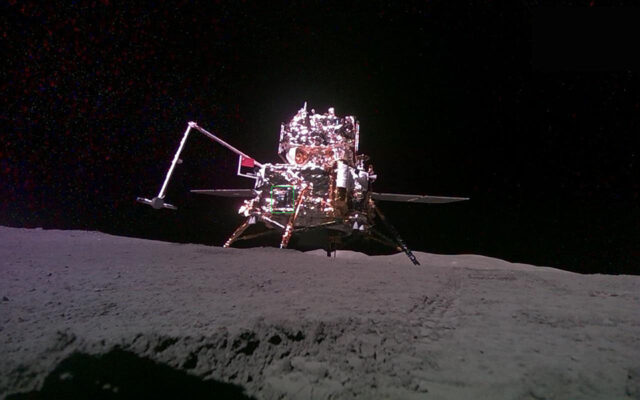

China’s 2024 Chang’e-6 robotic lander mission brought more than four pounds of rocks from the far side of the Moon back to Earth.
Credit:
CNSA / CAS

With NASA planning to send astronauts back to the Moon’s surface in 2027 for the first time since 1972, geologists are excited about what rocks they might find there and the scientific secrets those samples could reveal—along with what resources could be mined for a future Moon base, or for renewable energy back home on Earth.

Origin story

The samples brought home from the Moon in the 1970s by the Apollo missions and the Soviet Union’s Luna missions cleared up quite a lot about the Moon’s history. Because the lunar samples shared strong similarities with Earth rocks, this added weight to the idea that the Moon was formed when a Mars-sized object called Theia collided with the proto-Earth roughly 4.5 billion years ago.

Debris from the impact was thrown into orbit around Earth and eventually coalesced into the Moon. In its early days, the Moon was entirely molten. As the magma ocean cooled over hundreds of millions of years, the Moon formed a crust and a mantle below. Giant pools of lava filled impact craters and settled into the lunar lowlands, or maria (Latin for “seas”), while highlands and volcanic domes loomed above them. Eventually, the volcanism died out.

Without plate tectonics or weather, the only things left to alter the Moon’s cold, dead surface were meteorites. A lot of the Apollo-era samples were found to have formed from the heat and pressure of impacts around 3.9 billion years ago, suggesting that they were the result of a short period of intense pummeling by space rocks called the Late Heavy Bombardment.

But research since the 1970s has refined or changed this picture. Higher-resolution orbital images have revealed plenty of large impact craters that seem far older than 3.9 billion years, for example. And meteorites found on Earth, thought to have been ejected from various areas of the Moon during big impacts, have been found to span a huge range of ages.

All this work together suggests that the asteroid bombardment didn’t happen in one dramatic spike but rather over an extended period lasting from perhaps 4.2 billion to 3.4 billion years ago. In this scenario, the Apollo samples dated to 3.9 billion years likely all came from just one huge impact that spewed rock over a very wide area that happened to include the Apollo-era landing sites.

The Moon: Dead or alive

Greater mysteries surround volcanism on the Moon. “The canonical thing I learned in school was that the Moon had been geologically dead for billions of years,” says Samuel Lawrence, a planetary scientist at NASA’s Johnson Space Center in Houston.

The long-held theory was that a small body like the Moon should have lost its heat to space relatively quickly—and a frigid, extinguished Moon shouldn’t have widespread volcanic activity. Apollo-era samples suggested that most of this volcanism stopped 3 billion years ago or earlier, supporting the theory. But research over the past two decades has overturned that view.
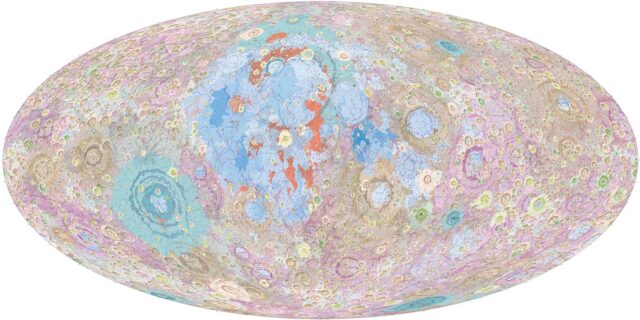

This geologic map of the Moon released in 2022 by China is the most detailed global map yet published and includes information gleaned from the 2020 Chang’e-5 mission.
Credit:
J. JI ET AL / THE 1:2,500,000-SCALE GEOLOGIC MAP OF THE GLOBAL MOON 2022.

In 2014, Lawrence and colleagues posited that some patches of irregular terrain in the middle of the dark plains, or mare, spotted by the NASA Lunar Reconnaissance Orbiter were the result of volcanism that kept going until less than 100 million years ago. “That is totally, totally surprising,” says cosmochemist Qing-Zhu Yin of the University of California, Davis.

The latest sample-return missions added more concrete evidence for recent volcanism. In 2020, the Chang’e-5 robotic mission landed in Oceanus Procellarum (the Ocean of Storms) — a spot picked in part because it looked geologically young given how few craters had accumulated there. Sure enough, the volcanic rocks brought home by that mission were found to be 2 billion years old, the youngest ever retrieved from the Moon. “That was big news,” says planetary geoscientist Jim Head of Brown University, who worked on NASA’s Apollo missions.

On top of this, when researchers trawled through thousands of glass beads found in the Chang’e-5 soil samples, most of which are thought to have been created by impacts, they identified three that were volcanic—and only 120 million years old. This finding was published just last year and still needs to be verified, but if such recent dates hold up, they suggest that the Moon might still be capable of producing deep magma even today, Yin says.

All this indicates that the Moon might not have cooled as fast as everyone thought it did. It’s also possible that some of the younger volcanism could have been powered by radioactive elements underground, which can generate enough heat to form magma and are known to be prevalent in certain patches of the Moon. This could explain the 120-million-year-old volcanic glass beads, for example. But not all the early volcanism can be explained this way: The Chang’e-5 volcanic rocks, along with some 2.8-billion-year-old volcanic rock brought back from the far side by Chang’e-6, came from source rocks not enriched with these elements.

“It throws up more questions than it answers,” Neal says. “It’s job security for people like me — we now have new questions to address.”


Trump has thrown a wrench into a national EV charging program

This article originally appeared on Inside Climate News, a nonprofit, non-partisan news organization that covers climate, energy and the environment. Sign up for their newsletter here.

For now, Priester’s will have to stick to its famous pecans in Fort Payne, Alabama. But maybe not for long.

Priester’s Pecans, an Alabama staple, is one of more than half a dozen sites across the state slated to receive millions of dollars in federal funding to expand access to chargers for electric vehicles.

Read full article

Comments

How Diablo hackers uncovered a speedrun scandal

For years, Maciej “Groobo” Maselewski stood as the undisputed champion of Diablo speedrunning. His 3-minute, 12-second Sorceror run looked all but unbeatable thanks to a combination of powerful (and allowable) glitch exploits along with what seemed like some unbelievable luck in the game’s randomly generated dungeon.

But when a team of other speedrunners started trying and failing to replicate that luck using outside software and analysis tools, the story behind Groobo’s run began to fall apart. As the inconsistencies in the run started to mount, that team would conduct an automated search through billions of legitimate Diablo dungeons to prove beyond a shadow of a doubt that Groobo’s game couldn’t have taken place in any of them.

“We just had a lot of curiosity and resentment that drove us to dig even deeper,” team member Staphen told Ars Technica of their investigation. “Betrayal might be another way to describe it,” team member AJenbo added. “To find out that this had been done illegitimately… and the person had both gotten and taken a lot of praise for their achievement.”

Read full article

Comments

Hyundai’s NACS adapter for EVs will be free to all existing owners

Hyundai Ioniq 5s with NACS (J3400) ports, as opposed to the CCS1 style, are starting to roll out of its factory in Savannah, Georgia. It’s the first manufacturer to sell electric vehicles with native NACS ports—other than Tesla, that is, and you’ll be able to read about our first drive in the model year 2025 Ioniq 5, as well as the new, off-roady Ioniq 5 XRT next week. But we’ve got some good news for owners of any existing Hyundai EVs out there—if your car has a CCS1 port, then next month, you’re eligible for a free CCS1-NACS adapter.

Hyundai wasn’t the first OEM to ink a deal with Tesla to gain access to the Supercharger network, but it is ahead of Ford, General Motors, and Rivian in swapping to the Tesla-style charge ports. Existing owners get access to the large charging network, too, but they’ll need an adapter to make use of the smaller NACS plugs.

And those will be available next month, Hyundai told us. What’s more, they’re going to be gratis, or free as in beer. As long as you have a VIN, the automaker will send you the adapter, which you’ll be able to order once the website goes live in March.

Read full article

Comments