
Raspberry Pi Imager 2.0.5 adds macOS dark mode icon support, fixes the update dialog, and improves UI behavior across platforms.
Category Archives: Linux
New Linux Patch Improved NVMe Performance +15% With CPU Cluster-Aware Handling
Intel Linux engineers have been working on enhancing the NVMe storage performance with today’s high core count processors. Due to situations where multiple CPUs could end up sharing the same NVMe IRQ(s), performance penalties can arise if the IRQ affinity and the CPU’s cluster do not align. There is a pending patch to address this situation. A 15% performance improvement was reported with the pending patch…
Remote authentication bypass in telnetd
One would assume that most LWN readers stopped running network-accessible
telnet services some number of decades ago. For the rest of you, this security advisory from
Simon Josefsson is worthy of note:
The telnetd server invokes /usr/bin/login (normally running as
root) passing the value of the USER environment variable received
from the client as the last parameter.If the client supplies a carefully crafted USER environment value
being the string “-f root”, and passes the telnet(1) -a or –login
parameter to send this USER environment to the server, the client
will be automatically logged in as root bypassing normal
authentication processes.
System76 Continues Driving More Improvements Into The COSMIC Desktop
Following the December launch of Pop!_OS 24.04 LTS and the first major COSMIC desktop release, System76 software engineers have continued making improvements to their Rust-based desktop environment…
AMD Making It Easier To Install vLLM For ROCm
Deploying vLLM for LLM inference and serving on NVIDIA hardware can be as easy as pip3 install vllm. Beautifully simple just as many of the AI/LLM Python libraries can deploy straight-away and typically “just work” on NVIDIA. Running vLLM atop AMD Radeon/Instinct hardware though has traditionally meant either compiling vLLM from source yourself or AMD’s recommended approach of using Docker containers that contain pre-built versions of vLLM. Finally there is now a blessed Python wheel for making it easier to install vLLM without Docker and leveraging ROCm…
Mozilla introduces Firefox Nightly RPM package repository
Mozilla has announced
a repository with Firefox
Nightly channel packages for RPM-based Linux distributions such as CentOS
Stream, Fedora, and openSUSE. Mozilla has provided a Debian repository
since 2023.
Note that this repository only includes the nightly builds of The
firefox-nightly package. Mozilla is not providing stable
builds as RPMs at this time. However, the package will not conflict
with a distribution’s regular firefox package; both packages
can be installed at the same time for those who wish to test the
nightly builds. See the blog post for instructions on setting up the
repository.
LLVM Adopts “Human In The Loop” Policy For AI/Tool-Assisted Contributions
Following recent discussions over AI contributions to the LLVM open-source compiler project, they have come to an agreement on allowing AI/tool-assisted contributions but that there must be a human involved that is first looking over the code before opening any pull request and similar. Strictly AI-driven contributions without any human vetting will not be permitted…
[$] An alternate path for immutable distributions
LWN has had a number of articles on immutable distributions,
such as Bluefin and
Bazzite, in recent years. These distributions have taken a variety of approaches, including
using
rpm-ostree, filesystem snapshots, and
bootable container (bootc) images. But those
approaches, especially the latter, lead to extra complexity for a user
attempting to install new software, instead of just
using the existing package manager.
AshOS (Any Snapshot Hierarchical OS) is an experimental AGPL-3-licensed
“meta-distribution
” that tried a different approach more in line with
traditional package management. Although the project is no longer updated,
it remains usable, and can still shed some light on a potential alternate path for users
worried about adopting bootc-based approaches.
Support For More Bluetooth Guitars & Other HID Changes Ahead Of Linux 6.20~7.0
A lot of HID subsystem updates have been queuing up ahead of the Linux 6.20~7.0 merge window in February. There is a lot of new hardware support on the way along with quirks for some existing hardware support ranging from laptop keyboard issues to enabling support for more PS4/PS5 guitars under Linux…
Patches Ready For Linux 7.0 To Enable Intel GPU Firmware Updates On Non-x86 Systems
Patches are now positioned to go into the upcoming Linux 6.20~7.0 kernel cycle for supporting Intel discrete GPU firmware updating on non-x86 systems…
Just the Browser claims to tame the bloat without forking
Strips the slop and snoopery from Chrome, Edge, and FirefoxThe promise of Just the Browser sounds good. Rather than fork one of the big-name browsers, just run a tiny script that turns off all the bits and functions you don’t want.…
Fedora 44 Feature Approved For Better Windows On ARM Laptop Experience
A change proposal has been cleared by the Fedora Engineering and Steering Committee “FESCo” for providing a nice out-of-the-box experience for Windows on ARM laptops namely the recent Snapdragon X1 laptops and will also be important for the upcoming Snapdragon X2 laptops too…
MX Linux 25.1 ISOs Are Now Available With Dual Init Support
MX Linux 25.1 “Infinity” is out now, restoring dual init support with both systemd and sysvinit available on a single ISO.
How to put data first in K–12 AI education by using data case studies
In Germany, as in many countries, AI topics are rapidly entering formal computer science education. Yet, this haste often risks us focusing on fleeting technological developments rather than fundamental concepts. As computer science educator Viktoriya Olari, from Free University of Berlin, discovered in her research, the fundamental role of data, which powers most modern AI systems, is critically underestimated in many existing frameworks. If students are to become responsible designers of such systems, they can’t afford to treat AI as an opaque box. Rather, they must first master the messy, human process that begins with the data itself.

In our October research seminar, Viktoriya shared the results of her work over the last four years on how schools can shift the focus from the latest technologies to the underlying data. Her research offers a clear structure for what young people should learn about data and how teachers can make it work inside ordinary classrooms.
Why begin with data?
Viktoriya’s analysis of existing AI education frameworks found the data domain is underrepresented, with essentials such as data cleaning often not addressed at all. She argues that, because modern AI systems are data driven, students need both language and routines for working with data: being able to name concepts like training vs test data, data quality, and bias, and to explain practices such as collection, cleaning, and pre-processing. That’s the rationale for teaching data concepts and practices first, and then placing modelling inside an explicit, staged lifecycle.
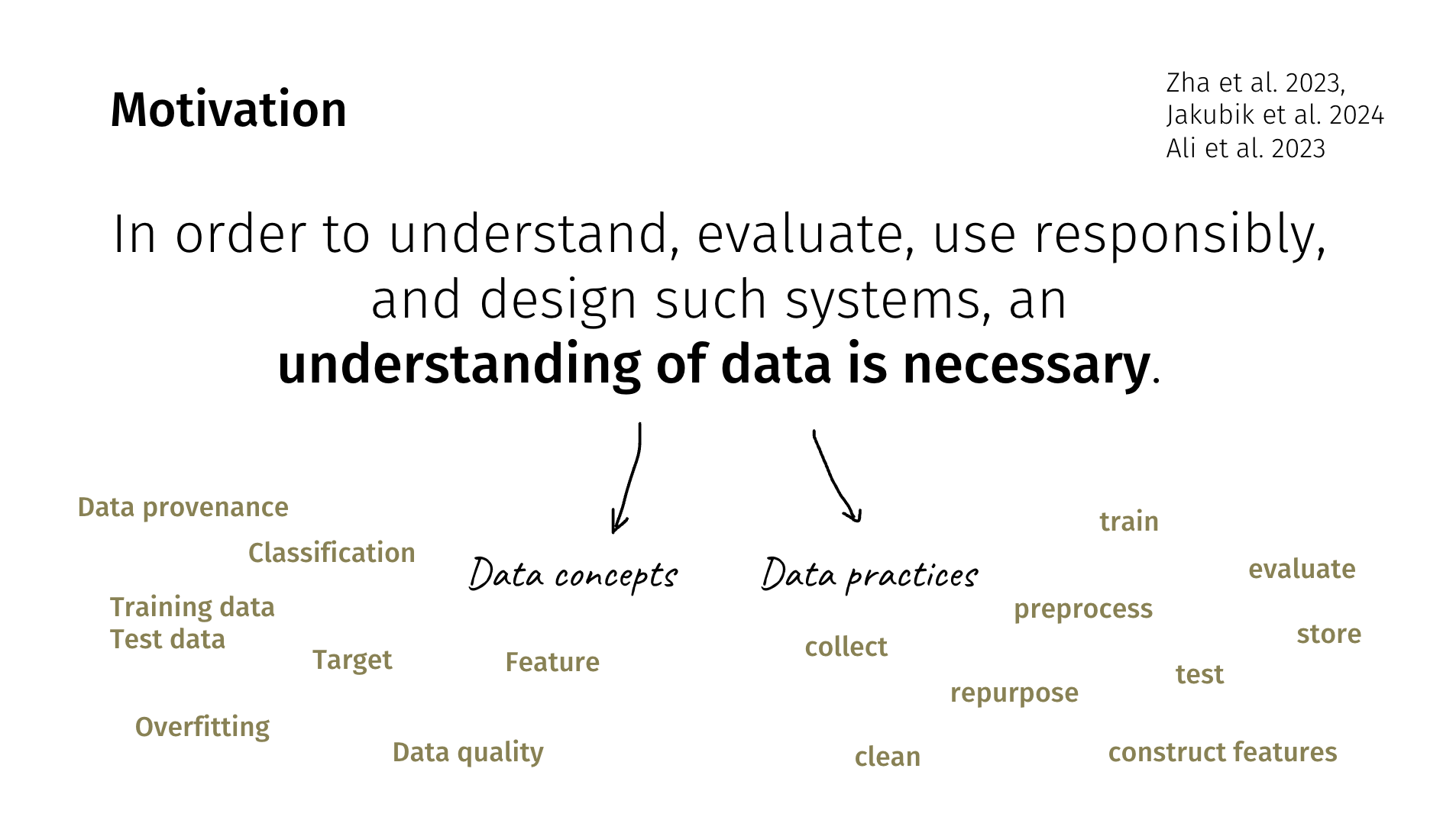
Her talk presented this argument in the German school context, where AI topics are entering state curricula quickly. Her critique targets how existing frameworks fail to address data and how that gap undermines responsible evaluation and design. The proposed model centres data by pairing an eight-stage, data-driven lifecycle with a curated set of key concepts and practices, and by making “data-based judgment skills” a key outcome.
Viktoriya’s work organises this understanding into two foundational components: data concepts (the vocabulary, e.g. training/test data, data quality, overfitting) and data practices (the actions, e.g. collect, clean, train, evaluate).
A lifecycle for learning
Viktoriya’s framework is built around an eight-stage data lifecycle, stretching from defining a task through gathering, preparing, modeling, evaluating, and finally sharing or archiving results. Inside that backbone she has identified two layers of learning targets:
- Data concepts – roughly a hundred ideas that give teachers and students a common language, from “training vs. test data” and “bias” to “features”, “labels”, and “provenance”.
- Data practices – 28 kinds of hands-on work (and 69 subpractices) that materialise those ideas: for instance collecting, cleaning, splitting datasets, checking quality, training and evaluating models, and handling privacy and deletion responsibly.
More details are available in her work on data-related concepts and practice.
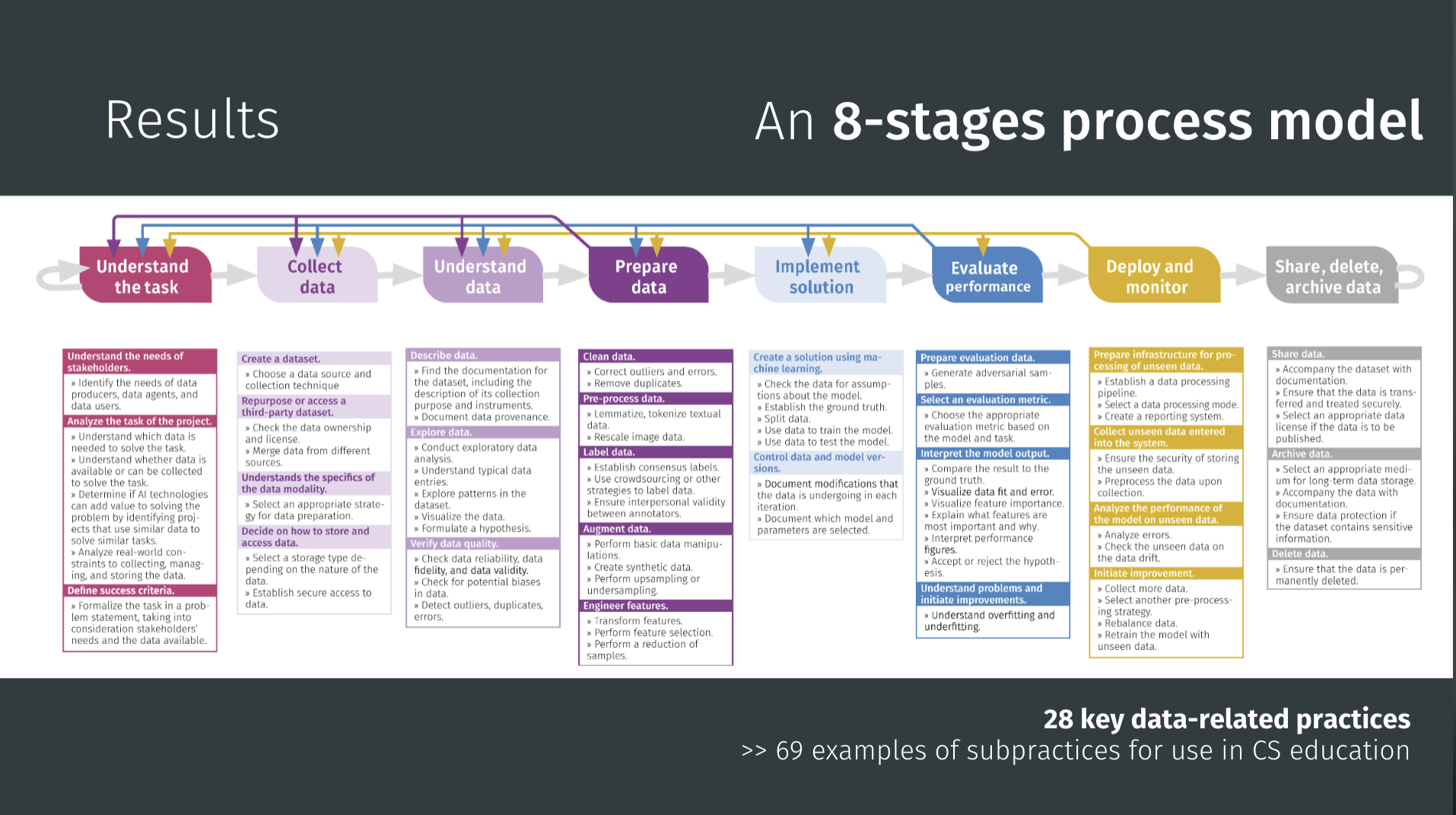
Viktoriya’s 8-stage process model of the data-driven lifecycle. It serves as a guide for curriculum developers and teachers, outlining 28 key data-related practices and providing 69 examples of subpractices for use in K–12 computer science education.
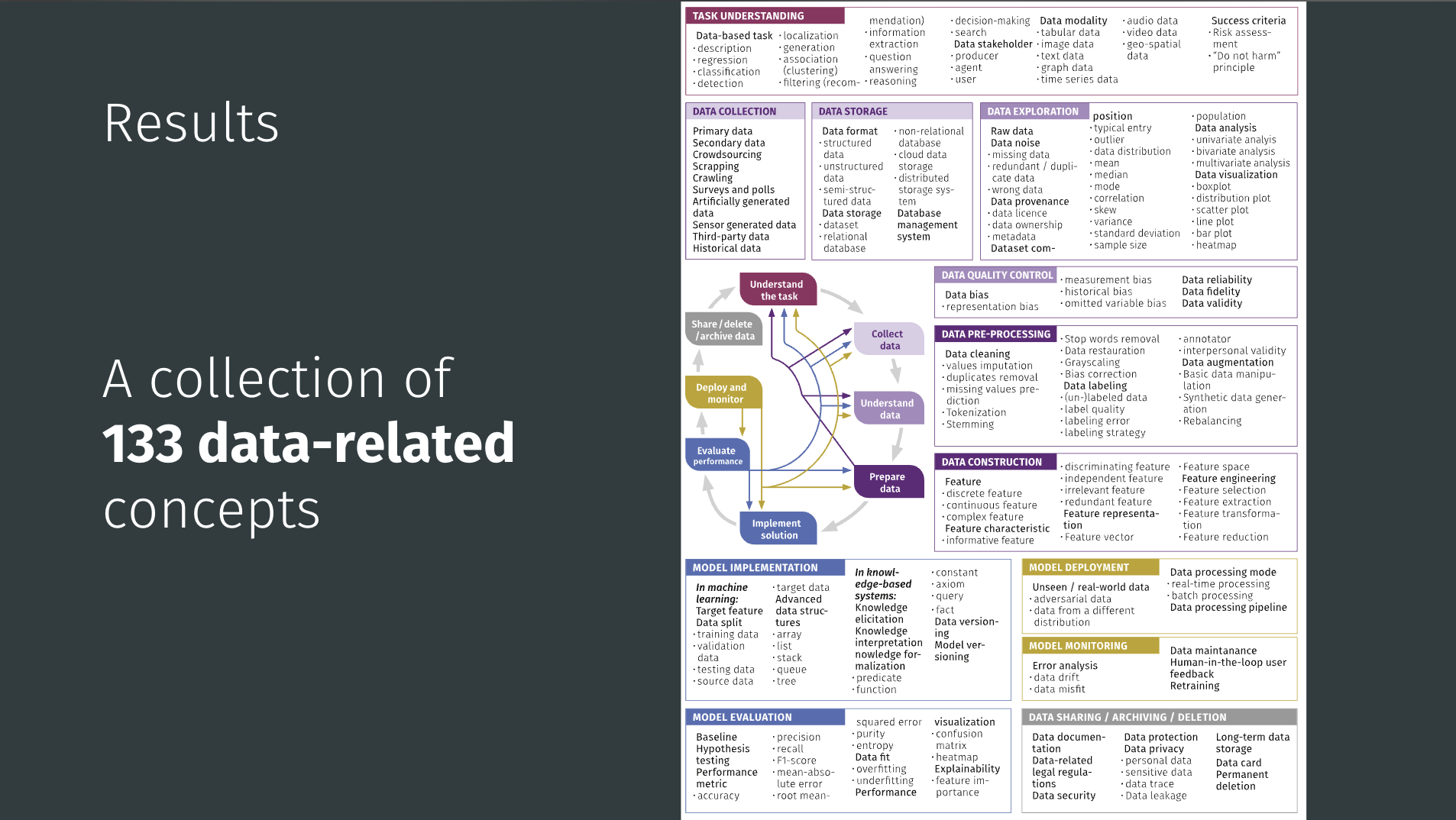
A collection of 133 key data-related concepts. These concepts are organised according to the eight stages of the data-driven lifecycle and provide the foundational vocabulary for teaching AI education.
Making it teachable
Viktoriya’s team set out to redesign the format so that real data work could happen within ordinary lessons. They ended up with three “Data Case Study” architectures, each using authentic datasets and domain questions. The materials are supported by Orange 3, an unplugged machine learning and data visualisations tool familiar to the teachers participating. Variants emerged across three design cycles to address specific challenges, but teachers choose among them based on learning objectives and class context.
- Bottom-up: Students create a workflow step by step (e.g. import, inspect, clean, transform, split, train, evaluate). This approach is excellent for procedural fluency, but teachers reported an over-emphasis on operating Orange and too little reflection on the lifecycle unless explicit reflection is added.
- Top-down: Students start from a prepared workflow, read plots, infer the role of each branch, identify issues in the data/practices, and justify changes. This architecture directly counters the reflection gap seen in bottom-up and leans into reasoning rather than routine.
- Puzzle-like: Using “widgets,” visualisations of data tables, that stand for parts of a data pipeline, students rebuild a valid flow collaboratively. This encourages discussion, works without devices, and makes thinking visible.
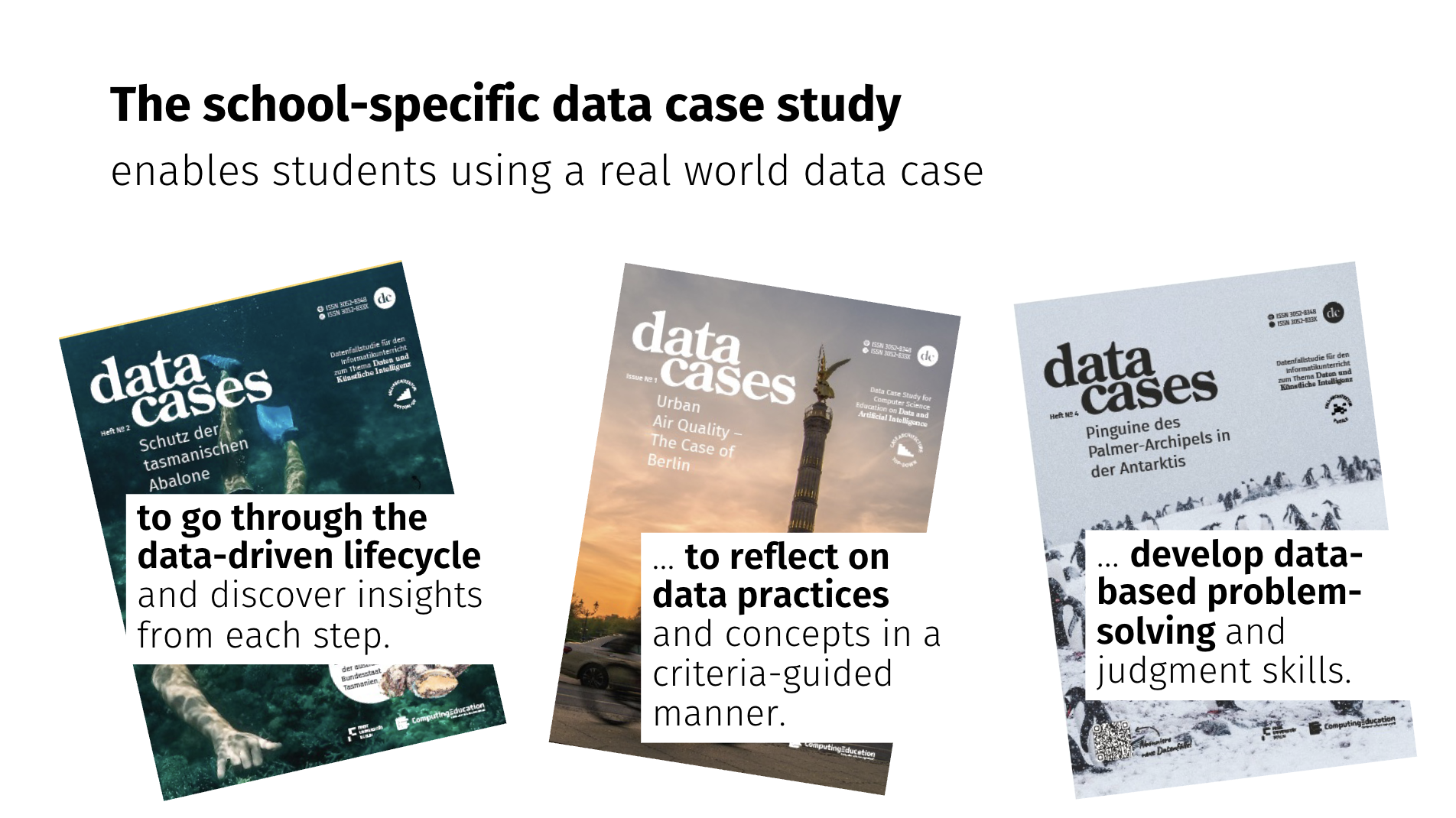
The data case study method uses real-world data and context to help students achieve three key learning outcomes: go through the data-driven lifecycle, reflect on data practices and concepts in a criteria-guided manner, and develop data-based problem-solving and judgment skills.
What happened in the German classrooms
Viktoriya’s team ran three design cycles with small groups in Germany, with students aged 14 to 15. Each cycle lasted around 48 hours of teaching. Because participating teachers already knew Orange 3, the emphasis was on pedagogy rather than software training.
The projects drew on manageable real-world data: spreadsheets, time-series sets, a few geographical samples. Two examples are:
- Forecasting Berlin air quality – Students explored how data quality, feature choice, and evaluation metrics shape predictions, then argued which model best answered the civic question.
- Classifying Tasmanian abalone – A deceptively simple dataset that invites talk about imbalance, feature engineering, and what counts as “good enough” accuracy.
Some groups experimented with collecting their own sensor data, a plan that occasionally failed when the hardware didn’t cooperate. However, even that became part of the lesson: reliability, risk, and missing data are real features of data science, not mistakes to hide.

Student work reflected the three architectures. In the bottom-up groups, guided builds produced complete workflows and concise reflections, while top-down groups submitted annotated screenshots and critiques, and the puzzle-based lessons ended with posters and verbal presentations. Across them all, assessment focused on reasoning: not whether the “right” model appeared, but whether students could explain the stage they were in and justify their choices.
Teaching resources
Everything Viktoriya described is open and classroom-ready (currently in German). The computingeducation.de/proj-datacases hub hosts teacher guides, student tasks, and sample Orange 3 files. The growing library of data cases covers topics from climate data to air quality analytics.
Why it matters now
In the UK, a curriculum review has been recently released and along with the Government’s response. Across Europe and beyond, education systems are racing to add AI content to their curricula. Tools will come and go, and benchmarks will keep moving. What endures is the capacity to reason about data: to know what stage of work you’re in, what evidence supports your decisions, and what trade-offs you’re making. That is why Viktoriya’s contribution is unique — it gives teachers a map, a shared vocabulary, and practical ways to make data visible and the focus of discussion in schools.
You can read this blog to see how we’ve used Viktoriya’s framework in our work designing a data science curriculum for schools.
Join our next seminar
Join us at our seminar on Tuesday 27 January from 17:00 to 18:30 GMT to hear Salomey Afua Addo talk about how to teach about neural networks in Junior High Schools in Ghana.
To sign up and take part, click the button below. We’ll then send you information about joining.
We hope to see you there. This will be the final seminar in our series on teaching about AI and data science — the next series focuses on how to teach about applied AI across subjects and disciplines.
You can view the schedule of our upcoming seminars, and catch up on past seminars on our previous seminars page.
Teachers in England, take part in our new data science study
We’re looking for upper key stage 2 teachers in England who want to join our new collaborative study exploring how to teach learners aged 9 to 11 about data-driven computing. The study will look at:
- How Computing teachers currently approach topics related to data-driven computing
- What key ideas pupils need to understand
- How pupils make sense of data and probability
Our aim for the study is to find practical ways for Computing teachers to build young people’s confidence in working with data in lessons. The study will involve two workshops held throughout 2026.
Register your interest by filling in this form.
The post How to put data first in K–12 AI education by using data case studies appeared first on Raspberry Pi Foundation.
Adreno Gen 8 Vulkan Graphics Merged For Mesa 26.0 To Support The Snapdragon X2
Merged in time for the upcoming Mesa 26.0 release is the merging of Vulkan driver support for the Qualcomm Adreno Gen 8 graphics support that is notably used by the new Snapdragon X2 laptop SoCs as well as the Snapdragon 8 Elite Gen 5…
DragonFlyBSD Now Allows Optional AMD GCN 1.1 Support In AMDGPU Driver
DragonFlyBSD’s AMDGPU kernel graphics driver continues to be a port of the AMDGPU Linux kernel driver. Their latest porting effort for AMD graphics on DragonFlyBSD is now enabling optional support for the GCN 1.1 “Sea Islands (CIK) graphics processors on this modern alternative to the prior Radeon kernel driver…
ESP32-E22 debuts with tri-band Wi-Fi 6E and dual-mode Bluetooth
Espressif Systems has announced the ESP32-E22, its first Wi-Fi 6E connectivity co-processor and the starting point of a new product line targeting higher-performance wireless designs. The company positions the device as a radio co-processor that offloads Wi-Fi and Bluetooth networking functions from a host processor, allowing the host to focus on application-level tasks. ESP32-E22 integrates […]
MX Linux 25.1 Is Out with Dual-Init Support, Debian 13.3 Base, and Linux 6.18 LTS
The MX Linux team announced today the general availability for download of MX Linux 25.1 as the first update in the MX Linux 25 “Infinity” series of this Debian-based distribution featuring Xfce, KDE Plasma, and Fluxbox flavors.
MultiCM Flasher enables parallel programming of Raspberry Pi Compute Modules
Recently featured on Tindie, the MultiCM Flasher is a parallel programming device designed to flash multiple Raspberry Pi Compute Module variants simultaneously. The device supports eMMC-based Compute Modules across several generations, including CM3, CM3+, CM4S, CM4, and CM5. The MultiCM Flasher is designed for programming up to seven Compute Modules in parallel, with support for […]
Banana Pi’s BPI-CM6 compute module runs on SpacemiT K1 RISC-V processor
Banana Pi’s BPI-CM6 is a compute module based on the SpacemiT K1 octa-core RISC-V processor. First revealed in April 2025, the module is now available for purchase from multiple sources and is described as a compact compute platform for edge computing, robotics, industrial control, and network storage applications. The BPI-CM6 adopts a 40 × 55 […]