
KDE Plasma 6.6 desktop is out now, introduces an optional new login manager, improved zoom modes, and faster everyday desktop interactions.
Category Archives: Linux
[$] Do androids dream of accepted pull requests?
Various forms of tools, colloquially known as “AI”, have been
rapidly pervading all aspects of open-source development. Many
developers are embracing LLM tools for code creation and review. Some
project maintainers complain about suffering from a deluge of slop-laden pull
requests, as well as fabricated bug and security
reports. Too many projects are reeling from scraperbot attacks that
effectively DDoS important infrastructure. But an AI bot flaming an
open-source maintainer was not on our bingo card for 2026; that seemed
a bit too far-fetched. However, it appears that is just what happened
recently after a project rejected a bot-driven pull request.
Plasma 6.6.0 released
Version
6.6.0 of KDE’s Plasma desktop environment has been
released. Notable additions in this release include the ability to
create global themes for Plasma, an “extract text” feature in the Spectacle screenshot
utility, accessibility improvements, and a new on-screen keyboard. See
the changelog
for a full list of new features, enhancements, and bug fixes.
The release is dedicated to the memory of Björn Balazs, a KDE
contributor who passed away in September 2025. “Björn’s drive to
“
help people achieve the privacy and control over technology that he
believed they deserved is the stuff FLOSS legends are made of.
Intel Xeon 6 Granite Rapids Memory Scaling Performance From 6 To 12 MRDIMMs
With memory pricing being as wild as it is these days and with MRDIMMs on Xeon 6 Granite Rapids offering much more memory bandwidth than conventional DDR5 RDIMMs, you may be wondering about the performance impact when not populating all twelve memory channels on the Xeon 6900 series processors. In this article are benchmarks to demonstrate the performance difference of MRDIMM-8800 memory across using six, eight, ten, and twelve MRDIMMs with a Xeon 6980P server.
An update on upki
In December 2025, Canonical announced a plan to
develop a universal Public Key Infrastructure called upki. Jon Seager has published
an update about the project with instructions on trying it
out.
In the few weeks since we announced upki, the core revocation engine
has been established and is now functional, the CRLite mirroring tool
is working and a production deployment in Canonical’s datacentres is
ongoing. We’re now preparing for an alpha release and remain on track
for an opt-in preview for Ubuntu 26.04 LTS.
Build CachyOS Kernel 6.19.2 on Debian forky (VENV)
Start with Pre-installation step $ sudo apt install build-essential bpftool and include /usr/sbin in system $PATH variable.On Debian forky installation of libdw-dev and build dependencies for libdw-dev steps are required to succeed with build CachyOS 6.19.2 Kernel on top of Debian Testing ( forky native kernel 6.18.9 )
Microsoft .NET On Linux Patches Use IO_uring For Massive Performance Benefits
A pull request for the Microsoft .NET Runtime build on Linux to use IO_uring for sockets is showing some massive performance benefits…
“AboutCode” is a Microsoft Proxy and Microsoft’s Acquisition of the OSI Advances Via OSI Moles
All we do is document all this as objectively as possible while presenting direct evidence anybody can verify
Levelling up with Python: Create with data
Learning Python often starts with the same building blocks: variables, functions, and loops. However, once young people have learnt these essential foundations, they may be eager to grow their skills and start using Python to explore data and create something meaningful to them.

Our free ‘More Python’ project path helps learners move beyond the basics and use data to create impactful projects of their own.
Python as a tool for exploring the world
Python is the most widely used programming language in the world, not just because it’s accessible, but because it’s powerful. It is used to analyse data, build models, create data visualisations, and explore important questions.

For young learners, this means learning Python can become more than a coding exercise. It can be a way to investigate topics they care about, analyse and understand information, and tell powerful stories about real-world issues.

Working with data helps learners see how coding connects to the world around them — and builds confidence along the way.
Why learning with data matters
In our day-to-day lives, data is everywhere: in sports results, maps, and scientific research, to name only a few examples. Learning how to work with data helps young people develop skills that go far beyond programming, including:
- Thinking logically and solving problems
- Interpreting and questioning information
- Making decisions based on evidence
Data also underpins many of the AI systems people use today. For example, large language models, used to build tools such as ChatGPT, are trained on vast amounts of data. Therefore, understanding how data is collected, organised, and used is an important part of AI literacy.
In Python, structures like lists and dictionaries make it possible to organise, analyse, and explore data in creative ways. Using these tools to build projects can help abstract computing concepts start to feel more concrete and meaningful.
What learners create in the ‘More Python’ project path
The ‘More Python’ project path supports learners through three stages: Explore, Design, and Invent. Each stage builds skills while giving learners more ownership over what they create.
In the Explore stage, young people learn new concepts and build confidence in using data and core Python structures, such as lists and dictionaries. Projects include:
- Making an interactive chart of Olympic medals
- Building a model of the solar system
- Creating a frequency graph that learners can analyse to crack a code
These projects help learners develop new skills, while exploring how Python can be used to analyse and explain real-world information.
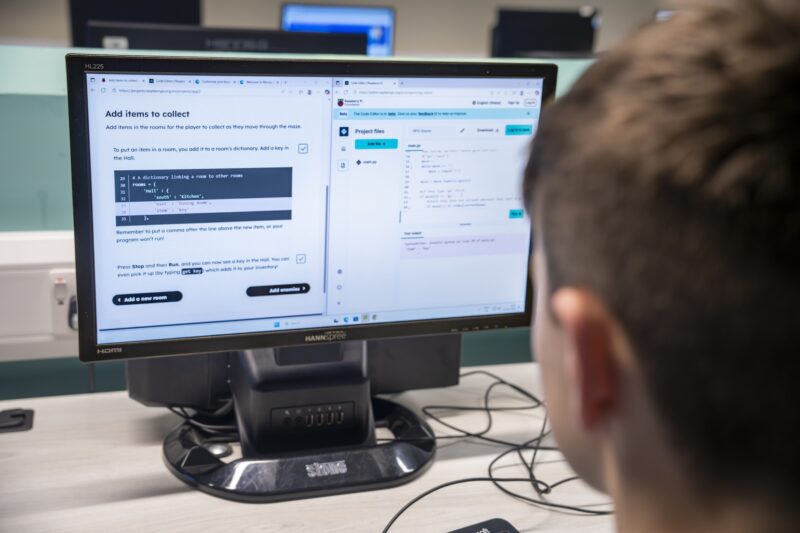
As learners progress to the Design stage, they start making creative choices about how their projects look and behave. In this stage, they:
- Create a project that produces encoded art based on a user’s name
- Build an interactive world map that helps users learn interesting facts
Here, Python becomes a creative medium. As well as putting their new skills into practice, learners think about audience, interaction, and presentation to make their projects their own.
In the Invent stage, learners bring everything together. Using the skills they have built, they design and create a data visualisation on a topic they are passionate about. This final project gives learners the freedom to choose their data, shape their idea, and tell a story that matters to them.

By this point, learners are planning and creating their own projects, growing in confidence and independence.
Take the next step with Python
If the young people you support have already learned the basics of Python, ‘More Python’ offers a clear and creative next step. The projects are designed to be accessible, and young people can work through them at their own pace, whether they are learning independently, at a Code Club, or in the classroom.
By working with data, getting creative, and making their own original projects, learners can build confidence and start to see what they can achieve with Python.
Alongside the ‘More Python’ project path, you can access hundreds of free coding projects on our Code Club Projects site. Find more projects to suit your learners’ interests, and support them to build their digital skills through creativity and making.
The post Levelling up with Python: Create with data appeared first on Raspberry Pi Foundation.
KDE Responds to FUD Over Alleged systemd Mandate
KDE addresses misinformation about systemd requirements, stating Plasma remains usable on non-systemd systems.
Lutris 0.5.20 Game Manager Adds Support for Importing Commodore 64 ROMs
Lutris founder Mathieu Comandon released Lutris 0.5.20 today as the latest stable version of this popular and open-source game management software for GNU/Linux distributions.
Gentoo Linux Begins Codeberg Migration In Moving Away From GitHub, Avoiding Copilot
The Gentoo Linux project last year announced plans to move their code hosting to Codeberg rather than GitHub. Gentoo’s desire to move away from GitHub was motivated by Microsoft’s Copilot training on GitHub repositories. Those plans are turning into action now with the main Gentoo project up on Codeberg and honoring pull requests…
Linux 7.0 CXL Enables AMD Zen 5 Address Translation Feature
A long-in-development feature for AMD EPYC Zen 5 server platforms now merged for the Linux 7.0 kernel is ACPI PRMT-based address translation for the Compute Express Link (CXL) subsystem…
Bottles 62.0 Adds Dynamic Launcher Portal Support
Bottles 62.0, a Wine prefix manager for running Windows apps on Linux, introduces Dynamic Launcher portal support and adds detailed progress reporting for backups and restore operations.
Idea Raised For Nicer DRM Panic Screen Integration On Fedora Linux
DRM Panic is the Linux kernel infrastructure now supported by most of the Direct Rendering Manager (DRM) kernel graphics/display drivers for being able to render a QR code kernel error message or similar when a kernel panic occurs to provide a cleaner interface should your system run into serious problems. An idea has been raised now within the Fedora Linux camp to provide an improved experience around this feature akin to Windows’ “Blue Screen of Death” functionality…
Lutris 0.5.20 Linux Game Manager Brings New Features, Wine Wayland Option
For fans of Lutris as the open-source desktop client for installing and playing many games on Linux, Lutris 0.5.20 is out today with new features that further enhance the integration with different emulators and compatibility layers…
[$] Open source security in spite of AI
The curl project has found AI-powered tools to be a mixed bag when
it comes to security reports. At FOSDEM 2026, curl creator and
lead developer Daniel Stenberg used his keynote session to discuss his
experience receiving a slew of low-quality reports and, at the same
time, realizing that large language model (LLM) tools can sometimes
find flaws that other tools have missed.
RISC-V In Linux 7.0 Brings User-Space CFI & Optimized strlen Assembly
The RISC-V architecture updates have been merged for Linux 7.0 with a few items to note…
How Our Fundraiser Ended Up on GoFundMe
Christine Hall takes the scenic route while explaining the whys and wherefores behind our 2026 Independence Drive.
The post How Our Fundraiser Ended Up on GoFundMe appeared first on FOSS Force.
SparkyLinux 8.2 Released with Support for Linux Kernel 6.19, Updated Packages
The SparkyLinux team announced the release and general availability of SparkyLinux 8.2 as the latest stable version of this Debian-based GNU/Linux distribution.