
Merged on Wednesday were some additional memory management “MM” updates for the Linux 7.0 merge window. Most interesting out of these latest three dozen patches is support for batched unmapping of file-backed large folios…
Category Archives: Linux
Simdjson Shows More Speed-Ups Possible For SIMD In JSON Parsing: Another 30% Boost
Simdjson is the open-source project for high performance JSON parsing by leveraging SIMD instructions for “parsing gigabytes of JSON per second.” Notably it showed years ago the huge performance advantage to using AVX-512 in JSON parsing for surprisingly big benefits. Simdjson has continued advancing since then with various optimizations over the years and today is out with simdjson 4.3 that brings yet more SIMD optimizations…
The challenges of measuring AI literacy
Measuring student understanding in computing education is not an easy task. As AI literacy becomes an important pillar in computing education, defining and accurately measuring students’ understanding of concepts and their skills is an even greater challenge.
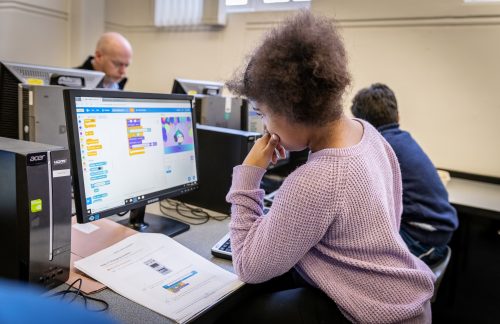
In a recent seminar in our series on teaching about AI and data science, researcher Jesús Moreno-León (Universidad de Sevilla) talked about his work in developing assessment tools for computational thinking (CT) and AI literacy. Jesús is also co-founder of Programamos, a non-profit organisation that promotes the development of computational thinking, supporting teachers through training and sharing resources.

Developing assessment tools in computer science
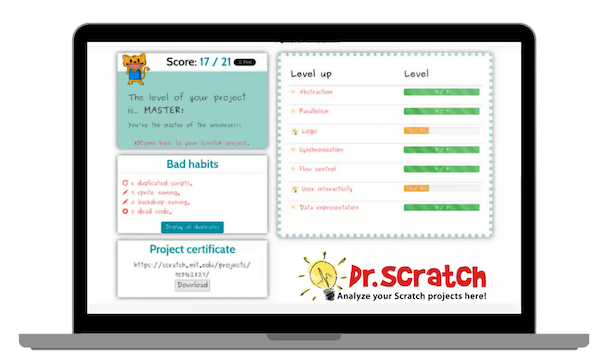
Jesús began by discussing the recent development of computer science assessment tools. Together with Gregorio Robles (Universidad Rey Juan Carlos), they created Dr Scratch, a web-based tool to assess the quality of Scratch projects and detect errors and bad programming habits (e.g. dead code). Projects are scored on the use of computational thinking concepts (e.g. parallelism, conditional logic) and the use of desirable programming practices (e.g. naming sprites, removing duplicate scripts) in order to give feedback to students and teachers to iteratively improve their Scratch projects.
Alongside measuring students’ programming skills, Jesús also shared work by Marcos Román-González (Universidad Nacional de Educación a Distancia) to develop the Computational Thinking test (CTt), a 28-item assessment tool designed to measure the computational thinking skills of students aged 10 to 16 years old. Two collaborators, María Zapata and Estafanía Martín (Universidad Rey Juan Carlos) further adapted these items to create the Beginners Computational Thinking test (or BCTt), an unplugged assessment suitable for younger learners aged 5 to 10 years old.
Teaching about AI in Spain
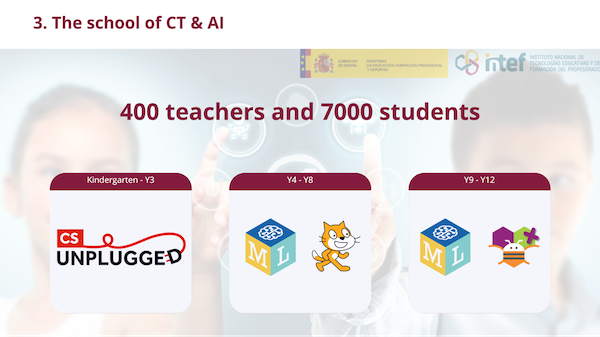
Jesús also described his more recent work at the Ministry of Education and Vocational Training in Spain to promote computer science at all educational levels. One initiative, La Escuela de Pensamiento Computacional e Inteligencia Artificial (or the School of Computational Thinking and Artificial Intelligence), supported Spanish teachers through training and resources to introduce CT and AI into the classroom. Over 400 teachers and 7000 teachers took part across Spain through unplugged activities and tools such as Machine Learning for Kids and LearningML, allowing students to classify text and images using machine learning. Older students created apps using the MIT App Inventor. When evaluating the design of the curriculum, they found they had strong instruments to measure the development of CT — such as the assessment tools described above — yet nothing to measure AI literacy.
A tool for measuring AI literacy
The lack of valid AI literacy assessment tools led the team to develop the AI Knowledge Test (or AIKT), a 14-item survey consisting of multiple-choice questions designed to measure students’ understanding of AI. The instrument was inspired by previous work in the field and relevant research (e.g. the AI4K12 framework).
An example from the AI Knowledge Test
An example of one of these items is presented below. Can you solve it? The answer is at the bottom of this article.
Q1. Which of the following strategies would be most appropriate for teaching a computer to recognise photos of apples?
- Train the computer with photos of dogs
- Train the computer with several photos of different apples, taken in different places and contexts
- Train the computer with several similar photos of the same apple, taken in the same place
- Train the computer with several identical copies of the same photo of an apple
Testing the test
In a study on the impact of programming activities on computational thinking and AI literacy in Spanish schools, the authors tested these knowledge-based items with over 2000 students to assess the reliability (e.g. internal consistency), or a measure of the quality of a survey or test. They found one item (“As a user, the legal regulation that is approved regarding AI systems will affect my life”) did not correlate with the other items. This left a total of 13 items which were found to have sufficient internal consistency — meaning how well each item correlated with one another to measure an underlying construct (i.e. “AI knowledge”). They concluded that the assessment tool needed a higher ceiling and needed to address common misconceptions. The authors also learned that teachers needed free and open-source tools with low barriers for entry, such as not needing registration, and were suitable for classroom use, such as limiting data sent to the cloud.
AI literacy in the generative era
With the rise of generative AI tools like ChatGPT or Google’s Gemini, Jesús and his colleagues felt their AI literacy assessment tool needed to focus on the capabilities of generative AI tools. They also felt they needed to take a broader view of AI and focus on additional dimensions, such as the social and ethical implications of AI tools. They are, therefore, currently revising their assessment items to align with several common frameworks, including the SEAME framework and AI Learning Priorities for All K–12 Students.
An example from the revised AI Knowledge Test
One of the revised items is presented below. Can you solve it? The answer is revealed below.
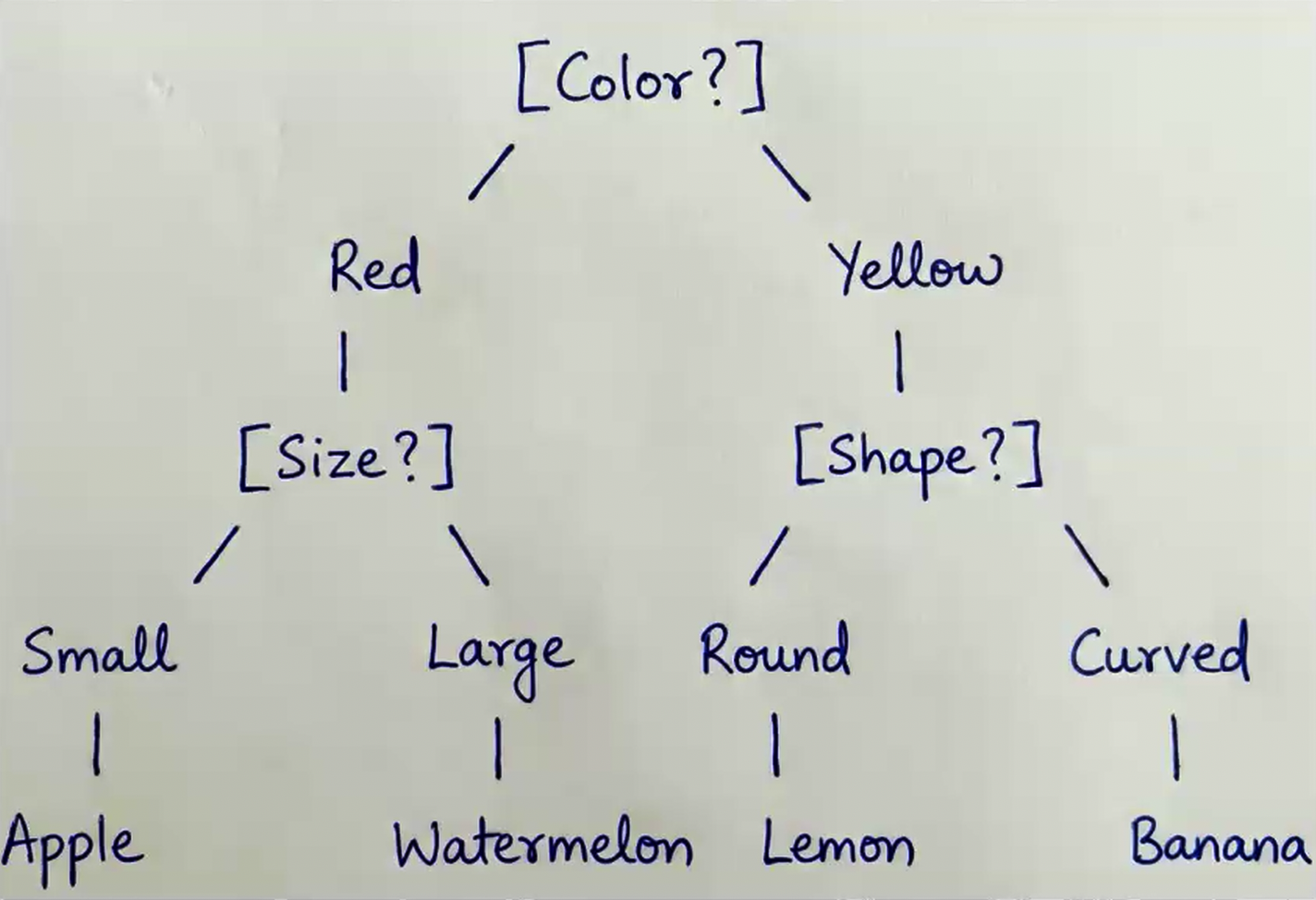
Q2. You have asked your students to design a decision tree to classify different fruits based on three characteristics: color, size, and shape. To check whether the following proposed solution is correct, you are going to test it with a small, round, yellow apple.
- Apple
- Watermelon
- Lemon
- Banana
Learn more about this work
Jesús concluded the seminar by describing his intentions to collaborate with others to test the revised AI literacy instrument with students in early 2026. We look forward to hearing about their results!
You can watch Jesús’s whole seminar here:
If you are interested to learn more about Jesús and his work, you can read about his development of the AI Knowledge Test (or AIKT) here and the Computational Thinking test (CTt) here or look at the original items here. You can also learn about the Beginners Computational Thinking test (BCTt) by watching a Raspberry Pi research seminar about it or reading about it here.
Join our next seminar
In our current seminar series, we’re exploring applied AI and how AI can be taught across the curriculum. In our next seminar in this series on 17 March at 17.00 UK time, we welcome Rebecca Fiebrink (University of the Arts London) who will explore the questions of how and why we might teach AI for creative practitioners, including children, students, and professionals.
To take part in the seminar, click the button below to register. We hope to see you there.
The schedule of our upcoming seminars is available online. You can catch up on past seminars on our blog and on the previous seminars and recordings page.
Answers
- Q1: 2
- Q2: 3
The post The challenges of measuring AI literacy appeared first on Raspberry Pi Foundation.
PipeWire 1.6 Released With Many New Features
PipeWire 1.6 is out today as the newest feature release for this software widely used by the Linux desktop for managing of audio and video streams while nicely integrating with sandboxed Flatpak apps and more…
You can jailbreak an F-35 just like an iPhone, says Dutch defense chief
No worries if the US doesn’t want to be friends with Europe anymoreLockheed Martin’s F-35 fighter aircraft can be jailbroken “just like an iPhone,” the Netherlands’ defense secretary has claimed.…
How to Run Full-screen Games In Linux With Dual Monitors
With a few simple tweaks, you can run your game fullscreen on one display while your other screen remains fully usable. Here is how to do so.
Copilot spills the beans, summarizing emails it’s not supposed to read
Data Loss Prevention? Yeah, about that…The bot couldn’t keep its prying eyes away. Microsoft 365 Copilot Chat has been summarizing emails labeled “confidential” even when data loss prevention policies were configured to prevent it.…
[$] LWN.net Weekly Edition for February 19, 2026
Inside this week’s LWN.net Weekly Edition:
- Front: AI agent goes rogue; debuginfo; iocane; revocable resource-management patches; 7.0 merge window; AccECN; LLMs and security; Humanitarian OpenStreetMap Team.
- Briefs: upki; Asahi Linux progress; DFSG processes; Fedora in Syria; Plasma 6.6.0; Vim 9.2; …
- Announcements: Newsletters, conferences, security updates, patches, and more.
More ISA Differences Come To Light With The New AMD GFX1170 “RDNA 4m”
Earlier this month we spotted the addition of a new GFX1170 GPU target in the AMDGPU LLVM back-end. Making this GFX1170 target interesting is that its marked as an APU/SoC part with “RDNA 4m” while being part of the GFX11 series. The GFX11 series is for RDNA3, GFX115x is for RDNA 3.5, and GFX12 is RDNA4. More ISA changes have now been committed to the AMDGPU LLVM back-end that make a few more instruction differences better aligned with RDNA4…
Mrhbaan Syria! Fedora now available in Syria
As of 10 February 2026, Fedora is now available in Syria. The Fedora Infrastructure Team has lifted IP blocks on Syrian addresses following recent United States policy changes. This restores full access to Fedora Linux ISOs, repositories, and services. We are thrilled to welcome our Syrian contributors and users back to the community!
Linux 7.0 Showing Some Early Performance Regressions On Intel Panther Lake
With the Linux 7.0 merge window beginning to calm down ahead of the 7.0-rc1 release due out on Sunday, one of the areas I was most excited about benchmarking on Linux 7.0 was looking for any performance gains with the new Intel Core Ultra Series 3 “Panther Lake” given ongoing Intel Xe graphics driver improvements and other general kernel optimizations. Unfortunately, at large the Intel Panther Lake performance is moving in the wrong direction with the early Linux 7.0 benchmarking.
KDE Plasma 6.6 Desktop Environment Officially Released, This Is What’s New
The KDE project released today KDE Plasma 6.6 as the latest and greatest version of this modern and popular desktop environment for GNU/Linux operating systems.
Linux 7.0 Retires The IBM Mwave ACP Modem Driver Used By Some 1990s ThinkPads
Long past due for retirement, the Linux 7.0 kernel has removed the obsolete Mwave driver for the 3780i ACP Modem found in some Pentium II era IBM ThinkPads from the 1990s…
Intel’s Discontinued Open-Source OpenPGL Project Finds A New Home
Back in 2022 Intel announced OpenPGL as an open-source library for path guiding to help enhance the quality of path-based renderers. With time Blender began making use of OpenPGL and other industry interest and adoption. Unfortunately, Intel quietly ended work on OpenPGL in 2025 but has now fortunately found a new home…
System76 Preparing To Introduce Redesigned Thelio Hardware
Linux hardware vendor System76 has begun teasing a redesign of their Thelio chassis that is used by their modern desktops and workstations. Helping distinguish System76 from other Linux desktop/PC vendors has been their custom-engineered, built-in-the-USA enclosures and now they are preparing to launch a next-generation design…
Linux 7.0 Brings Several Enhancements For Modern Laptops
The x86 platform driver updates were merged recently for the ongoing Linux 7.0 merge window. As is a common theme for platform-drivers-x86, a lot of the feature work is around Linux laptop drivers for enhancing the support on modern hardware…
[$] More accurate congestion notification for TCP
The “More Accurate Explicit Congestion Notification” (AccECN) mechanism is
defined by this
RFC draft. The Linux kernel has been gaining support for AccECN with
TCP over the last few releases; the 7.0 release will enable it by default
for general use. AccECN is a subtle change to how TCP works, but it has
the potential to improve how traffic flows over both public and private
networks.
Dell UltraSharp U5223KW: An Outstanding 52-Inch 6K Monitor With Extensive Connectivity
Earlier this month Dell sent over a review sample of their new UltraSharp U5223KW monitor. While the model number may not imply much, this monitor is outright incredible. The Dell UltraSharp U5223KW is a 52-inch 6K @ 120Hz monitor with integrated USB hub also working as a KVM switch, 140 Watt power delivery support for USB-C/Thunderbolt laptops, 2.5G Ethernet, and the color reproduction and visuals with this Dell 6K monitor are impeccable.
Fedora now available in Syria
Justin Wheeler writes, on Fedora
Magazine, that Fedora is now available in Syria once again:
Last week, the Fedora Infrastructure Team lifted
the IP range block on IP addresses in Syria. This action restores
download access to Fedora Linux deliverables, such as ISOs. It also
restores access from Syria to Fedora Linux RPM repositories, the
Fedora Account System, and Fedora build systems. Users can now access
the various applications and services that make up the Fedora
Project. This change follows a recent update to the Fedora Export
Control Policy. Today, anyone connecting to the public Internet from
Syria should once again be able to access Fedora.[…] Opening the firewall to Syria took seconds. However, months of
conversations and hidden work occurred behind the scenes to make this
happen.
An Asahi Linux progress report
The Asahi Linux project, which is working to implement support for Linux on
Apple CPUs, has published a detailed 6.19
progress report.
We’ve made incredible progress upstreaming patches over the past 12
months. Our patch set has shrunk from 1232 patches with 6.13.8, to
858 as of 6.18.8. Our total delta in terms of lines of code has
also shrunk, from 95,000 lines to 83,000 lines for the same kernel
versions. Hmm, a 15% reduction in lines of code for a 30% reduction
in patches seems a bit wrong…Not all patches are created equal. Some of the upstreamed patches
have been small fixes, others have been thousands of lines. All of
them, however, pale in comparison to the GPU driver.The GPU driver is 21,000 lines by itself, discounting the
downstream Rust abstractions we are still carrying. It is almost
double the size of the DCP driver and thrice the size of the
ISP/webcam driver, its two closest rivals. And upstreaming work has
now begun.