
SparkyLinux 2025.12 (codename Tiamat) has been released today as another snapshot in the semi-rolling series of this Debian-based GNU/Linux distribution leveraging the Debian Testing repositories.
Category Archives: Linux
Linux 6.19 Features: LUO, PCIe Link Encryption, ASUS Armoury, DRM Color Pipeline API & More
With Linux 6.19-rc1 released, the merge window for Linux 6.19 has now concluded. Here is a summary of the interesting Linux 6.19 new features and changes with this kernel version.
AmpereOne M Finally Appears – In The Oracle Cloud With A4
Back in July 2024, Ampere Computing announced AmpereOne M on their road-map for Q4’2024 to provide AmpereOne with 12 channel DDR5 memory compared to eight memory channels with the original AmpereOne processors. Then this past May the AmpereOne M SKUs were announced while Ampere Computing stated these “M” processors had been shipping since Q4 of last year. Since then we haven’t seen or heard anything more about AmpereOne M nor the AmpereOne MX processors with up to 256 cores. Since then, the acquisition of Ampere Computing by SoftBank also was completed that made us wonder more about impacts to the roadmap and what hardware may or may not make it out to market. Well, today, we are finally seeing AmpereOne M availability in the public cloud with the new Oracle Cloud A4 instances…
Announcing Vojtux: a Fedora-based accessible Linux distribution
Vojtěch Polášek has announced
an unofficial effort to create a Fedora-based distribution designed
for visually impaired users:
My ultimate vision for this project is “NO VOJTUX NEEDED!” because
I believe Fedora should eventually be fully accessible out of the
box. We aren’t there yet, which is where Vojtux comes in to fill the
gap. […]Key Features:
-Speaks out of the box: When the live desktop is ready, Orca starts
automatically. After installation, it is configured so that it starts
on the login screen and also after logging in.
-Batteries included: Comes with LIOS , Ocrdesktop, Tesseract,
Audacity, and command-line tools like Git and Curl. There are also
many preconfigured keyboard shortcuts.
See the repository
for instructions on getting the image.
Fresh Launches as a New Terminal-First Text Editor
Fresh is a newly released open-source terminal text editor combining modern UI elements, mouse support, plugins, and strong performance.
Wayland Protocols 1.47 Released With Updated Color Management Protocol
Following the Color Management protocol introduced in Wayland Protocols 1.41, out today is Wayland Protocols 1.47 with various revisions to that color management and HDR support…
[$] Better development tools for the kernel
Despite depending heavily on tools, the kernel project often seems to
under-invest in the development of those tools. There has been progress in
that area, though. At the 2025 Maintainers Summit, Konstantin Ryabitsev,
who is (among other things) the author of b4, led a session on ways
in which the kernel’s tools could be improved to make the development
process more efficient and accessible.
From learners to leaders: Jayantika and Ruturaj’s journey as Code Club youth mentors
Two remarkable teenagers from Pune in the state of Maharashtra, India — Jayantika (age 16) and Ruturaj (age 14) — have turned curiosity into community impact.
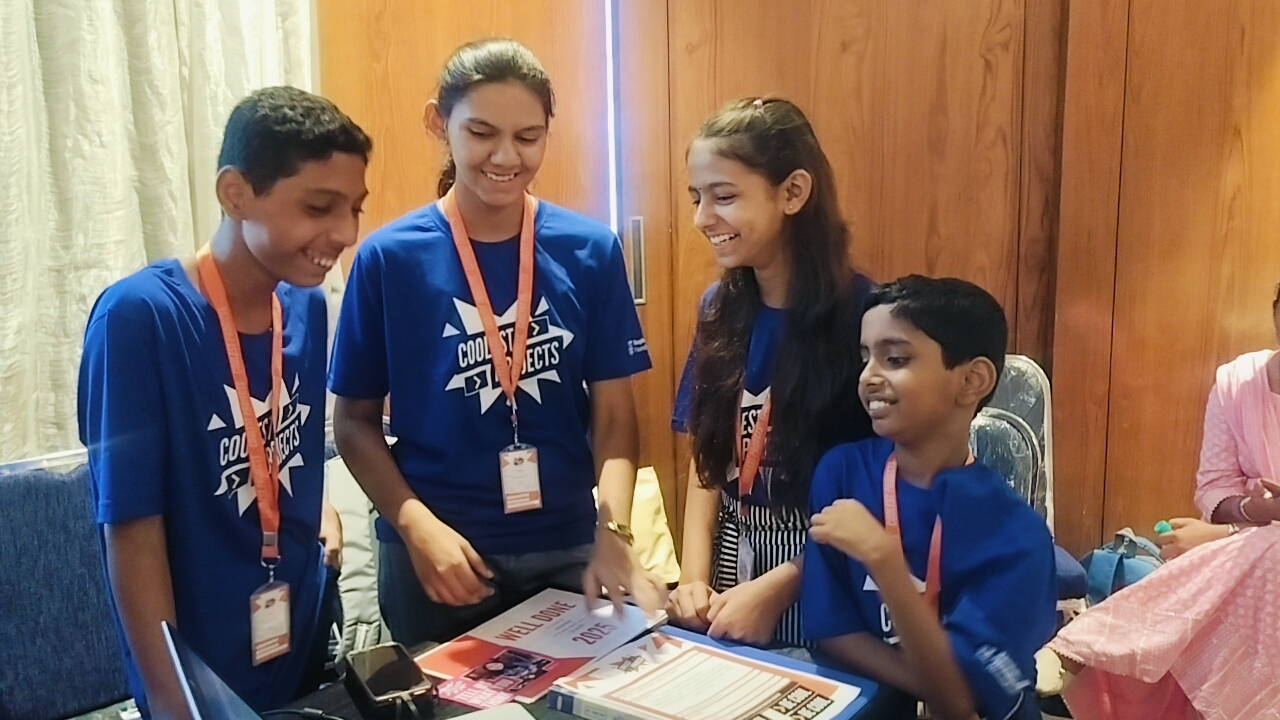
With support from the Bidkar Foundation and the Raspberry Pi Foundation, they now help run five Code Clubs, reaching over 200 young people in rural areas of Pune. Along the way, they have twice received the Coolest Projects Judges’ Favourite Award: first online in 2023, and again at Coolest Projects India in September 2025.
How it all began
For Jayantika and Ruturaj, the spark for coding began at home. During the pandemic, when schools were closed and days felt long, their father encouraged them to try something new.
“When we were at home and there was nothing to do,” recalls Jayantika, “my dad introduced us to coding, and from that time till this date we are participating — and yeah, we love it.”
In 2021, they joined their local Code Club, run by the Bidkar Foundation, which provides coding opportunities for young people in rural areas of Pune. That moment opened a door to creativity neither of them expected. Scratch projects soon filled their weekends with problem-solving, and Ruturaj found himself fascinated by how games worked.
“I was too curious how games were made,” he says. “After a while in Code Club, I learned new things and got the answers to my questions.”
As their confidence grew, so did their sense of purpose. They wanted others to experience the same excitement they had discovered. “We thought these things should be shared with others,” says Jayantika. “So that’s why we started a Code Club and began teaching — to spread awareness and knowledge to everyone.”
Reaching out to rural learners
Each weekend, Jayantika and Ruturaj set out for nearby villages, with laptops, lesson plans, and a sense of possibility. Their aim is simple but powerful: to bring coding opportunities to children who might otherwise never encounter them. “Village students must also learn coding and get opportunities to come in front,” explains Jayantika.
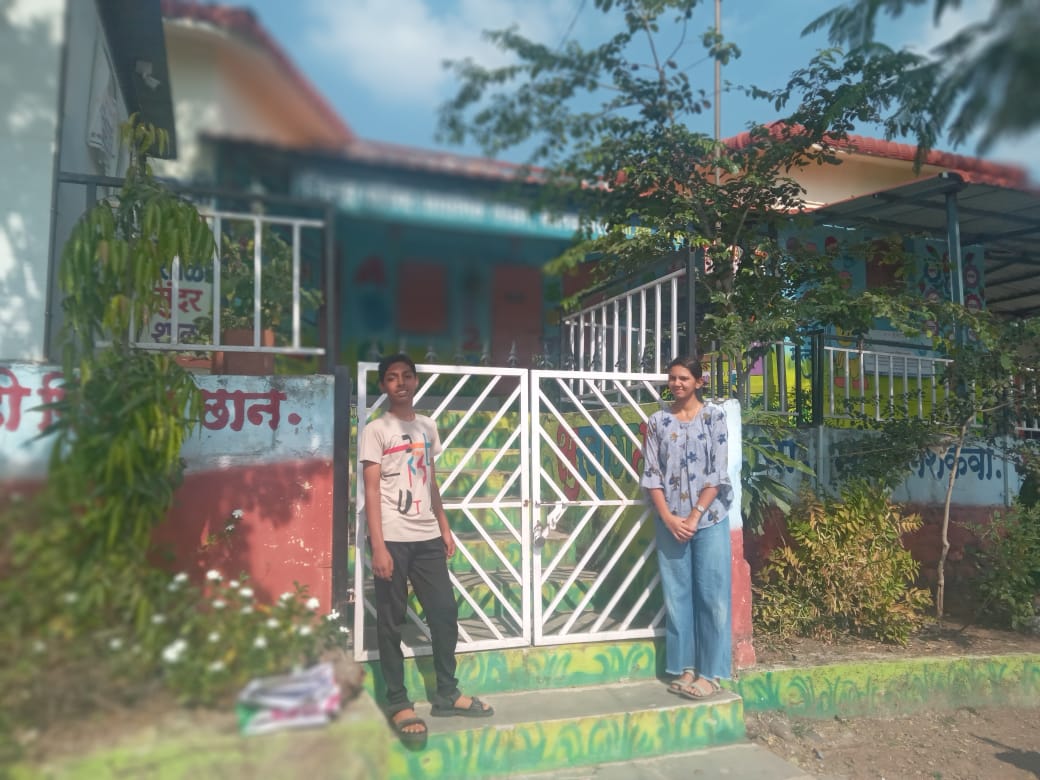
What started modestly — “one computer and seven students” — has become a thriving network of clubs that now reaches hundreds of young learners. Their father, Mr Bidkar, has been by their side throughout, watching as their initiative has grown from a small idea to something that’s changing lives. “Now we are 25 computers, 200-plus children,” he says proudly.
Inside their Code Club sessions
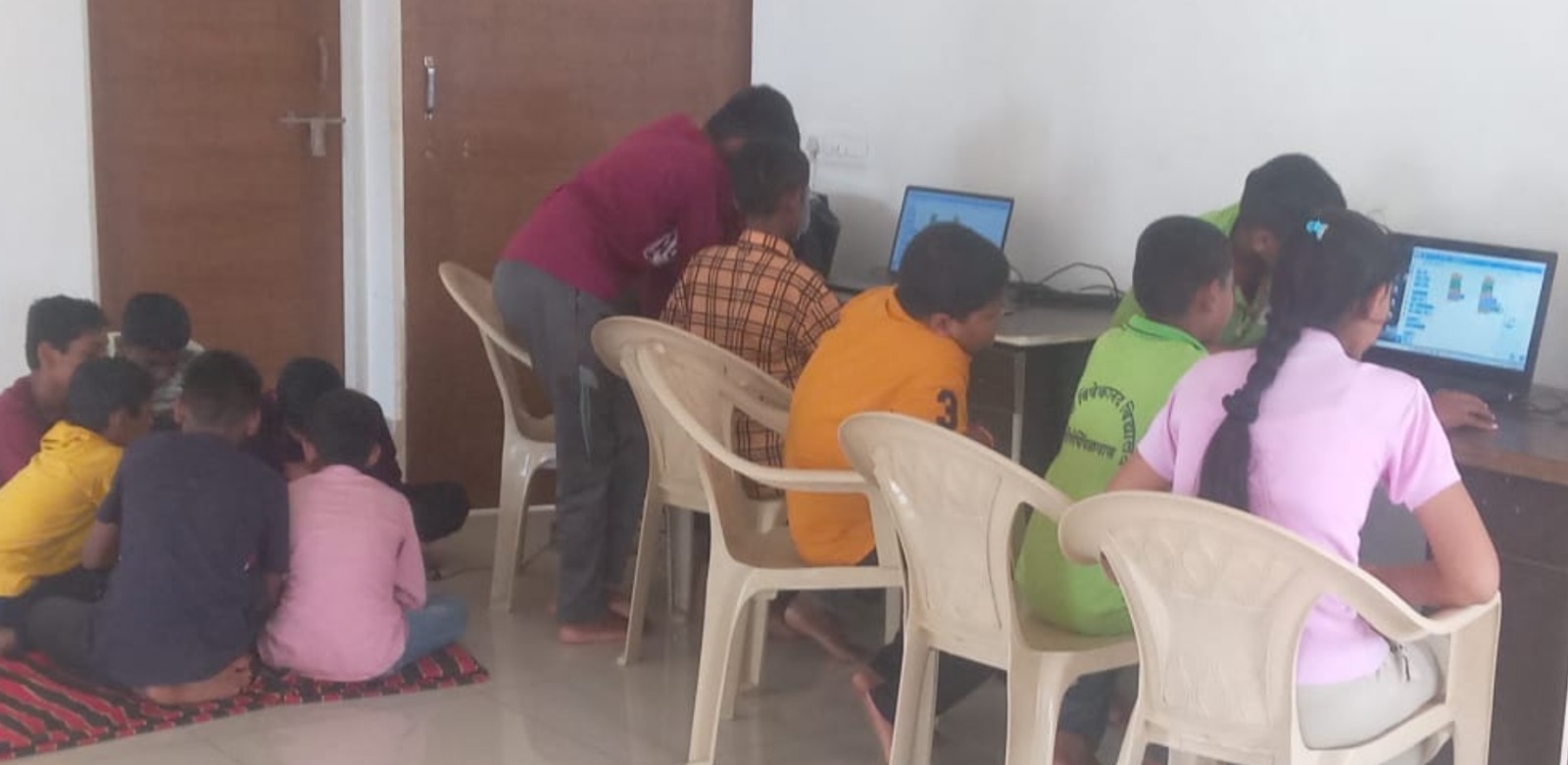
Their Code Club sessions are lively and filled with curiosity. Children crowd around laptops, excited to build their next animation or game. The mentors blend teaching with fun, alternating between theory and practice to keep things engaging.
“At first, we take theory classes — we explain what’s the game,” says Jayantika. “At the end we let them sit on computers.”
Some weeks are spent planning and others creating. “We give them a plan, and then next time they create,” she explains. Younger learners, aged six to ten, start with small projects such as animations or motion-based activities. Older learners tackle bigger challenges in Scratch, building their own games from ideas they’ve brainstormed together.
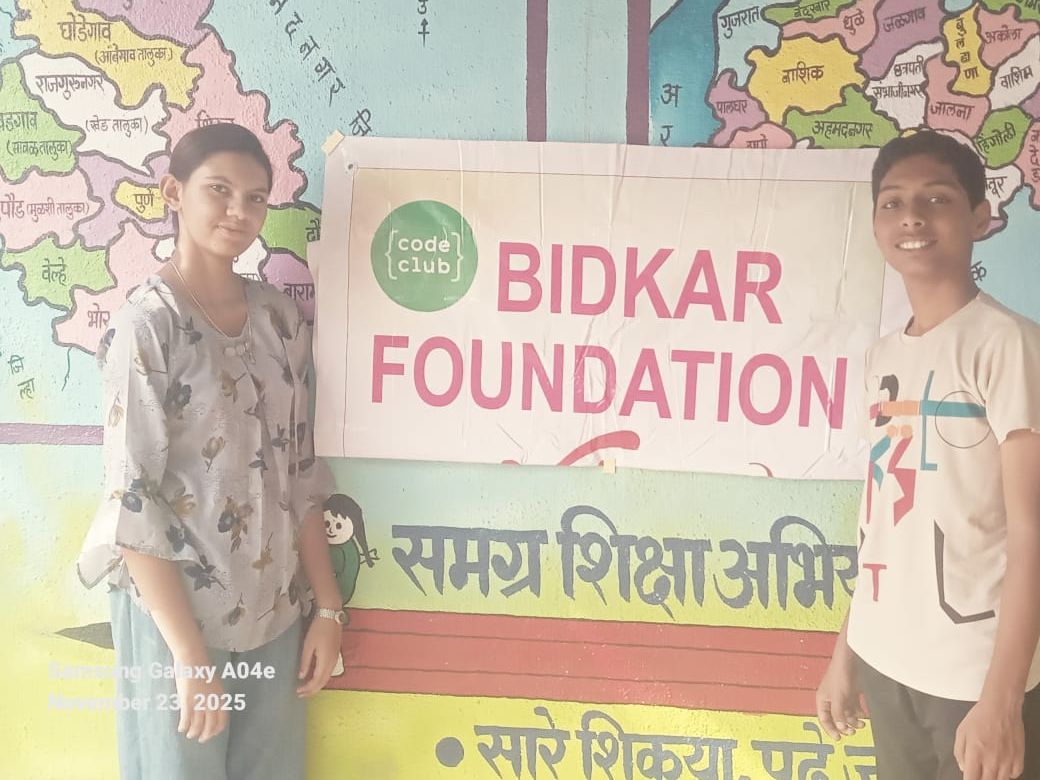
Sessions end with a much-loved tradition: “After the session ends, we give them 15–20 minutes to do whatever they want,” says Ruturaj. “Because they’re very curious.” The pair work in perfect rhythm. “I manage one group and Ruturaj manages another,” says Jayantika. “If any doubt is there, we solve them together.”
Mentoring has given both siblings new confidence and skills. “At first we were only on Scratch, and now we’ve expanded our knowledge,” says Jayantika. “Next, we’re going to start robotics. It is simple and it is creative also and it can connect to Scratch.”
The role of a mentor
Over time, Jayantika and Ruturaj have learned that mentoring is as much about listening as it is about instructing.
“Sometimes their questions are not so obvious,” laughs Jayantika. “Like ‘Why can’t we change the sprite?’ or ‘Why can’t we use another block?’ We can explain to a certain limit, but after that we are speechless!”
These moments, she says, are part of the magic of teaching. They push the mentors to explore new ways of explaining and to see coding from a beginner’s perspective again.
Watching their students succeed brings the biggest reward. “We feel very happy that the students are listening to us and they’re doing what we wanted — and they’re even adding extras,” says Jayantika. “Most of them tell us they want to create another project; they want more time.”
And for those thinking about becoming mentors, they both agree that empathy is key. “If you want to teach them, you must become a student,” says Ruturaj.
“First, think at the students’ level… explain in simple language and give more time to experiment,” adds Jayantika.
Looking ahead
Ruturaj dreams of exploring game development and cybersecurity, while Jayantika hopes to move into web and app design. Together, they balance logic and creativity, each complementing the other’s strengths.
“Even though both are coding, we are on different paths,” she smiles.
For anyone curious about coding, Ruturaj’s advice is simple: “Do it by yourself. Make projects by yourself, share them, and learn from others.” Jayantika adds: “Coding has no limits. You can create anything you imagine — open your mind, open your creativity.”
Their father, rightly, is proud not just of their achievements but of how they have inspired others to learn. From a single laptop to five thriving Code Clubs, Jayantika and Ruturaj’s journey shows what’s possible when young people lead with passion and purpose. With support from their family, the Bidkar Foundation, and the Raspberry Pi Foundation’s India team, they’re proving that talent truly is everywhere — opportunity just needs a spark.
Thank you, Jayantika and Ruturaj, for inspiring young people across India and around the world.
The post From learners to leaders: Jayantika and Ruturaj’s journey as Code Club youth mentors appeared first on Raspberry Pi Foundation.
Intel Quietly Discontinues Supporting Its Open-Source User-Space Gaudi Driver Code
There’s another setback to the open-source driver code around Intel’s Gaudi accelerator support on Linux…
Igalia’s Work Improving The Linux Kernel For Helping Steam Play Gaming On ARM64
Besides Valve funding FEX-Emu for x86_64 binaries to run on AArch64 Linux as part of their Steam Play (Proton) efforts in being able to get Windows x86/x64 games running on AArch64 SteamOS for the Snapdragon-powered Steam Frame, there is also work happening in kernel-space to help this emulated gaming experience on AArch64…
9to5Linux Weekly Roundup: December 14th, 2025
The 270th installment of the 9to5Linux Weekly Roundup is here for the week ending on December 14th, 2025, keeping you updated with the most important things happening in the Linux world.
Kernel Graphics Driver Changes Already Begin Lining Up For Linux 6.20~7.0
Even before the Linux 6.19 merge window wrapped up this weekend with the Linux 6.19-rc1 release, there was already the first pull request to DRM-Next of the first batch of new material to be queued for Linux 6.19’s successor…
GCC Developers Considering Whether To Accept AI/LLM-Generated Patches
The GNU Compiler Collection (GCC) developers now have a need to set a policy whether AI / Large Language Model (LLM) generated patches will be accepted for this open-source compiler stack…
Linus Torvalds Announces First Linux Kernel 6.19 Release Candidate
Linus Torvalds announced today the general availability for public testing of the first Release Candidate (RC) development milestone of the upcoming Linux 6.19 kernel series.
Paris-Based ‘Open Source Experience’ Conference Hands Out ‘Acteurs du Libre’ Awards
At Paris’s Open Source Experience conference, six Acteurs du Libre awards mapped out a snapshot of Europe’s free software ecosystem in 2025, from enterprise strategy to privacy‑first Android and public‑sector platforms.
The post Paris-Based ‘Open Source Experience’ Conference Hands Out ‘Acteurs du Libre’ Awards appeared first on FOSS Force.
Is your Waydroid blurry or pixelated when opening an application? This might be how to fix it
Waydroid looks blurry or pixelated when opening Android apps on Linux?This post explains the possible causes and a simple fix to restore a sharp display
Mixxx 2.5.4 Open-Source DJ App Improves Support for Korg KAOSS DJ, Pioneer DJ CDJ
Mixxx 2.5.4 was released today as the latest stable version of this open-source DJ software, which enables you to create and perform creative live mixes with digital music files.
Pangolin 1.13 Released With Private Resources and User Device Access
Pangolin 1.13, an open-source, zero-trust VPN, introduces Private Resources, user devices, and a new WireGuard-based networking model.
Linuxiac Weekly Wrap-Up: Week 50 (Dec 8 – 14, 2025)
Catch up on the latest Linux news: Pop!_OS 24.04 LTS launches with COSMIC 1.0, Kali Linux 2025.4, Manjaro 25.1 Preview, Cinnamon 6.6, Plasma 6.5.4, Firefox 146, GNOME to reject AI-generated Shell extensions, and more.
The Opt-In Proactive & Crash Time Data Collection On Valve’s Steam Deck
Valve’s Steam Deck with SteamOS features built-in crash data collection as well as for logging other system events worth having knowledge about like the split-lock detection and other events. This is all opt-in by users for data collection by Steam, but for those curious about a bit more insight into this Steam Deck data collection, a presentation at this past week’s Linux Plumbers Conference dove into the matter…