
The final part of the 2025 Maintainers Summit was devoted to the kernel’s
development process itself. There were two sessions, one on continuity and
succession planning, and the traditional discussion, led by Linus Torvalds,
on any pain points that the community is experiencing. There was not a lot
that developers were unhappy about, and there are now more explicit plans in
the works to provide a process should Torvalds abruptly become unable to
fill his role.
Category Archives: Linux
DietPi 9.20 Brings RustDesk Server and Broad SBC Improvements
DietPi 9.20 is out with RustDesk Server support, USB improvements for Orange Pi boards, kernel updates, and multiple stability and bug fixes.
Emmabuntüs Debian Edition 6 Released With Strong Focus on Accessibility
Emmabuntüs DE 6 launches with a Debian 13.2 base with accessibility improvements, new speech tools, and enhanced support for visually impaired users.
ZLUDA For CUDA On Non-NVIDIA GPUs Enables AMD ROCm 7 Support
The ZLUDA open-source project that has been through several incarnations but ultimately about getting CUDA software up and running on non-NVIDIA GPUs now supports the AMD ROCm 7 series…
Servo 0.0.3 Browser Engine Brings Better Performance, Embedding Improvements
Servo 0.0.3 is out today as the newest update to this Rust-based, open-source web layout engine. Servo 0.0.3 incorporates many enhancements made over the past month from better performance to enhancing its embedding API and other improvements like context menus for more web content…
MidnightBSD 4.0 Brings Many Changes To This FreeBSD 13 Derived OS
While FreeBSD 15 stable was officially released earlier this month, MidnightBSD continues plotting its own course atop its FreeBSD 13 base. Out today is MidnightBSD 4.0 as the latest iteration of this desktop-minded BSD operating system…
OpenShot 3.4 Video Editor Released: One Of Their Largest Updates Ever
OpenShot 3.4 is now available as the latest feature update to this open-source video editor app. OpenShot 3.4 happens to be “one of our largest updates we’ve ever done” with a variety of improvements in tow…
2025 highlights from the Raspberry Pi Computing Education Research Centre
It’s been over a year since I last wrote an update on this blog about our research and as we’ve just published our 2025 Annual Report, this is an ideal opportunity to share what we’ve been working on at the Raspberry Pi Computing Education Research Centre.
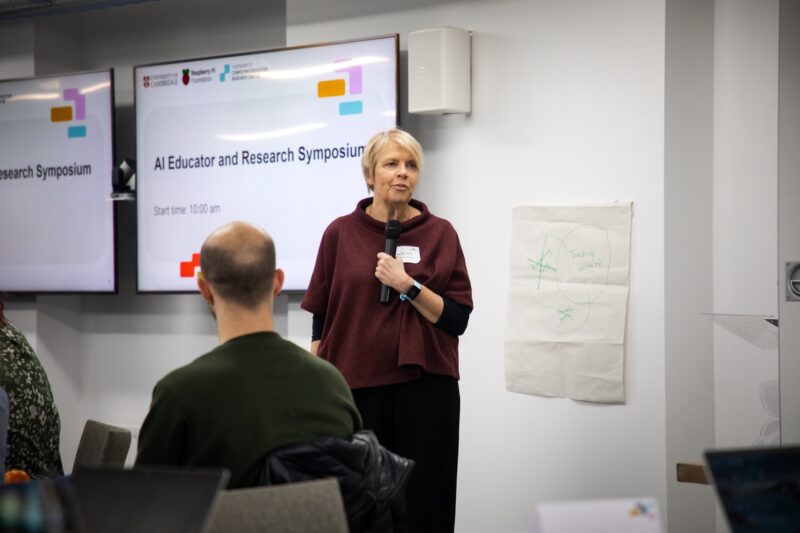
We are a research centre based in the Department of Computer Science and Technology at the University of Cambridge, with a team that spans the university and the Raspberry Pi Foundation. We conduct research into many aspects of the teaching and learning of computing and AI and we work closely with schools, teachers and young people to ensure our research is applicable to practice.
Below I highlight some of the projects we’ve worked on in the academic year 2024-2025:
- Computing Around the World
- AI education
- Programming education
- Physical computing (EPICS project)
- Teacher action research (TICE project)
Computing Around the World
As I’ve written on this blog before, computing education is a global challenge. In one of the Research Centre’s projects, we are looking at how computing education is spreading around the world.
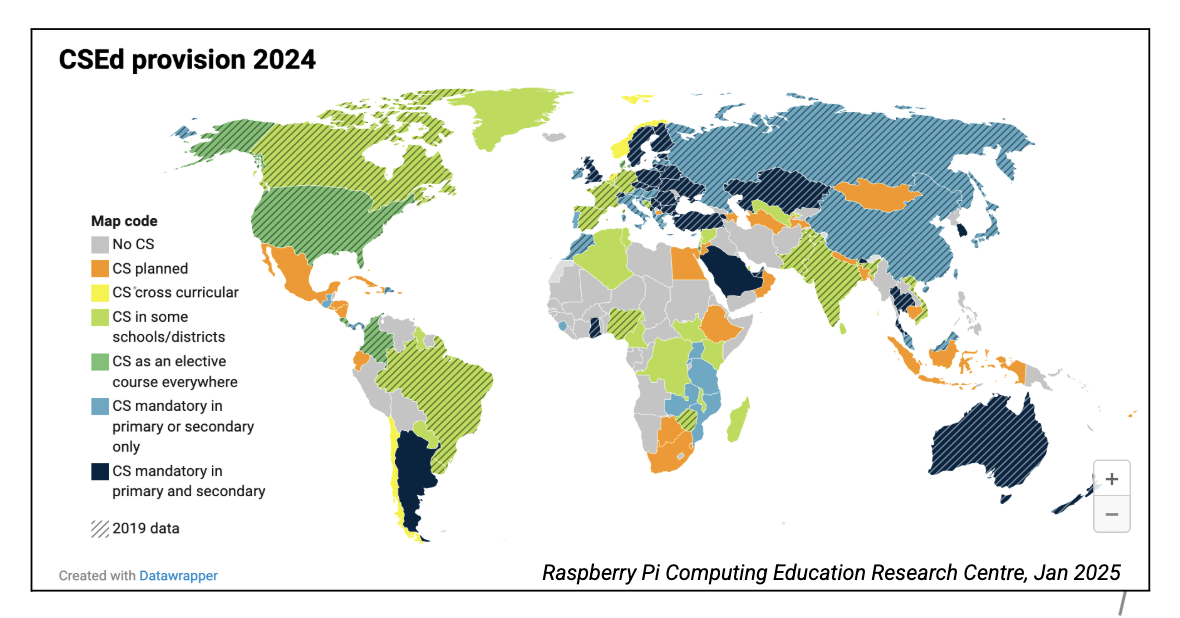
We found that between 2019 and 2024 the number of countries offering computing education had doubled, and that two thirds of all countries now offer, or have concrete plans to offer, computing education. This research has already been highlighted in the Stanford AI Index, and we are considering repeating the analysis in future years in order to have the most accurate and up-to-date information displayed in our map.
AI education
We have a number of projects in the area of AI education.
Teaching about AI
We are very interested in how to teach about AI, and held a workshop with teachers who were interested in the teaching of AI in February. Following on from the workshop results, we are interviewing more stakeholders, including UK-based experts, teachers and students, about their perspectives on concepts and skills that should be taught as part of an AI curriculum.
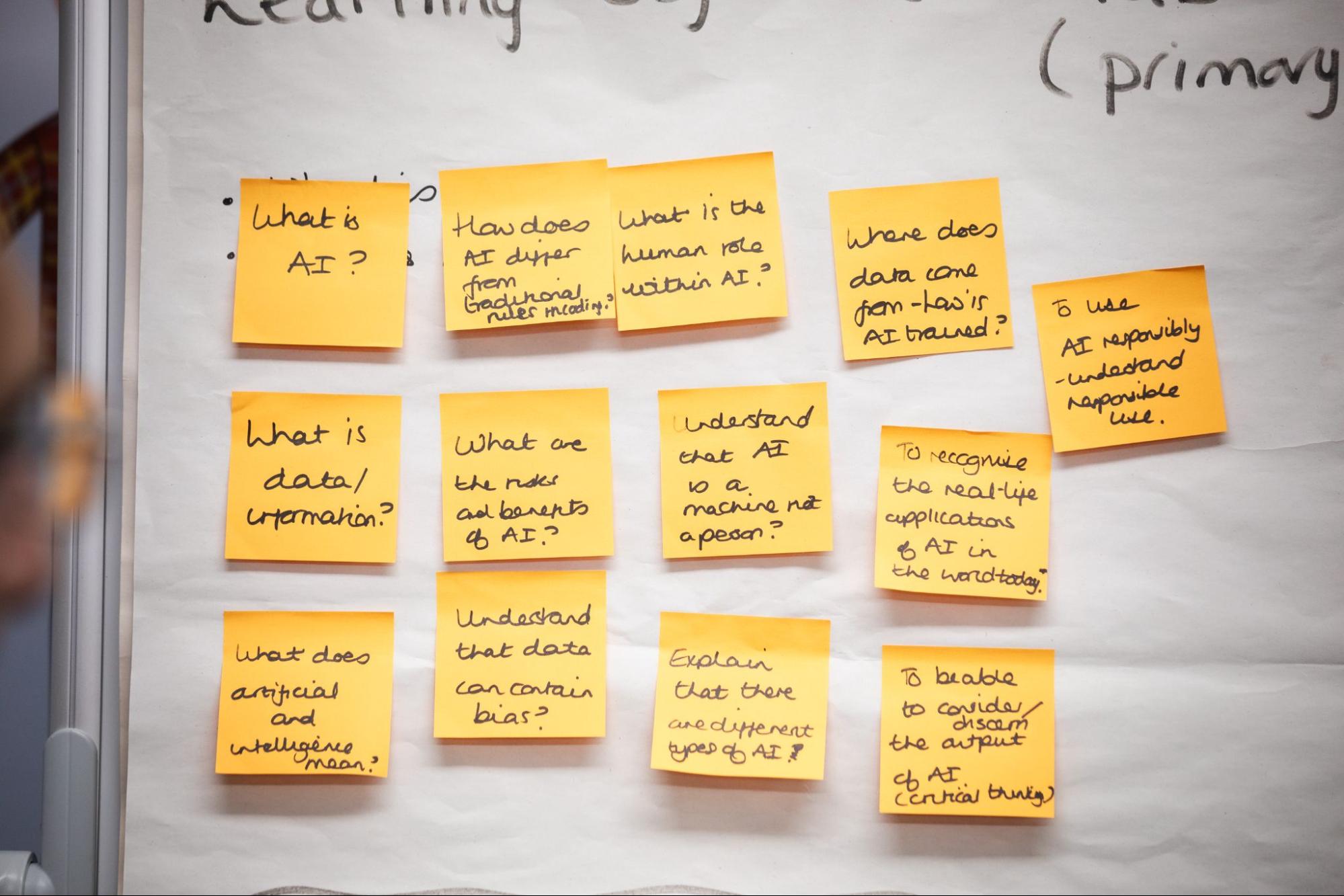
We’re also researching data science and data ethics education, which are foundational aspects of AI literacy. Most of the current AI systems are data-driven, having been trained on vast amounts of data. Therefore students need to understand about data and data science if they are to learn about AI systems. Therefore we’ve conducted two detailed literature reviews on data science and on data ethics this year. The first of these will be published in March at the WiPSCE conference.
Unplugged AI in Ghana
One of our PhD students, Salomey Addo, has been examining how AI is taught in Ghana, where it is part of the curriculum for young people between ages 12 and 15. This year Salomey published a paper reporting that Ghanaian teachers have positive attitudes towards teaching AI but feel unprepared for it. She’s also developed unplugged resources to teach about artificial neural networks (ANNs).
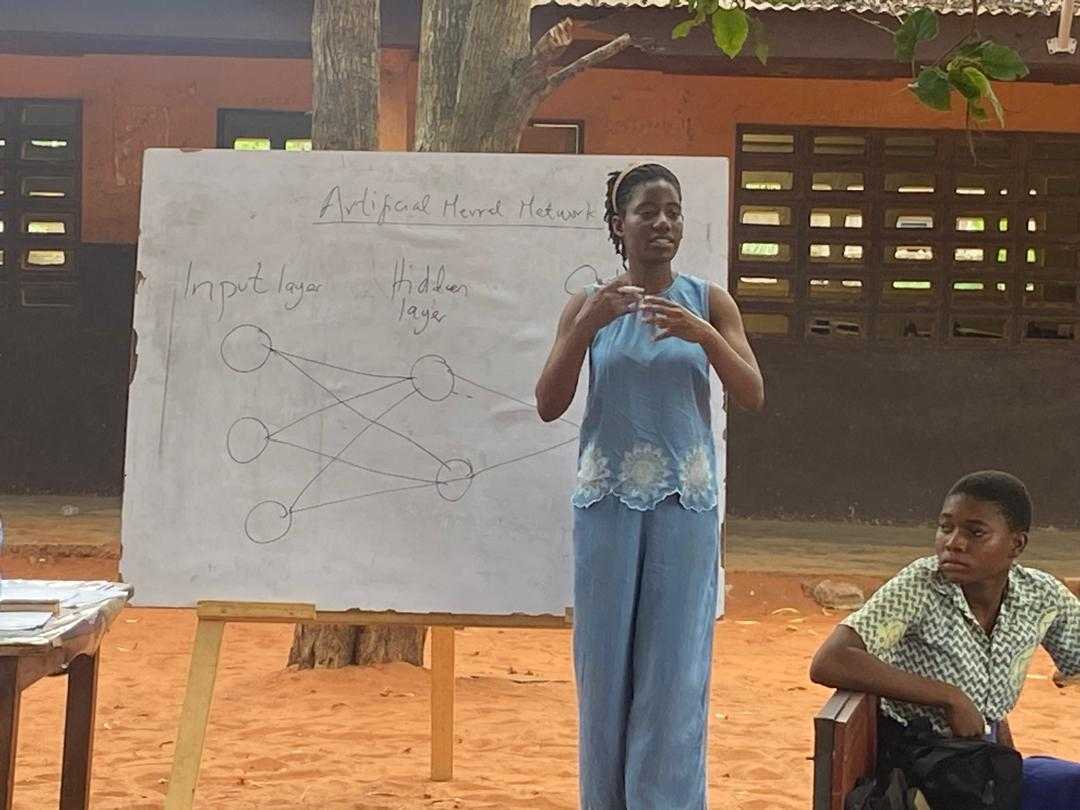
ANNs are a fundamental technology used in a variety of AI systems, including image recognition and language translation systems. While ANNs are included in the Ghanaian AI curriculum, Salomey observed that teachers had difficulty with this particular topic The resources she developed are directly inspired by this, and involved teaching through role play and a board game.
Using AI in learning and teaching computing
This is an area we’ve also done some research in in the past year.
Carrie Anne Philbin published a paper in September showing that — at least in higher education — much of the use of generative AI in computing education is just duplicating the way teachers might already teach, and is primarily passive from a students’ perspective.
Meanwhile Katharine Childs and Veronica Cucuiat have been looking at how large language models (LLMs) can support secondary school programming education by helping students understand programming error messages.
Programming education: Learning to debug
Text-based programming is a topic featured in many computing curricula around the world. Teachers and researchers know that younger learners, for example at the lower secondary school level, can find debugging text-based programs very challenging. Although we’ve seen decades of research around programming and debugging focusing on learners who are in higher education, very little research has been done with school-age students.
In his research, Laurie Gale, a final-year PhD student at the Research Centre, found that learners were impatient to fix programs by trial and error, without figuring out what the real problemwas with their code or the underlying algorithm. He subsequently developed a tool called PRIMM Debug, which supports a more reflective and systematic approach to debugging. This tool enables learners to slow down when they are programming and to be more reflective. You can read more about it on the Research Centre website, and also catch up on the Foundation research seminar where he presented his work.
EPICS: Physical computing in school
As part of a 5-year longitudinal project, running across the whole UK and the first project of its kind, we are looking at how physical computing impacts primary and secondary school learners. We’re investigating the effect of physical computing on learners’ creativity, agency and confidence, over time and at particular points known to be important for their subject choices. We are working with a wonderful set of partner primary schools who we visit each year.
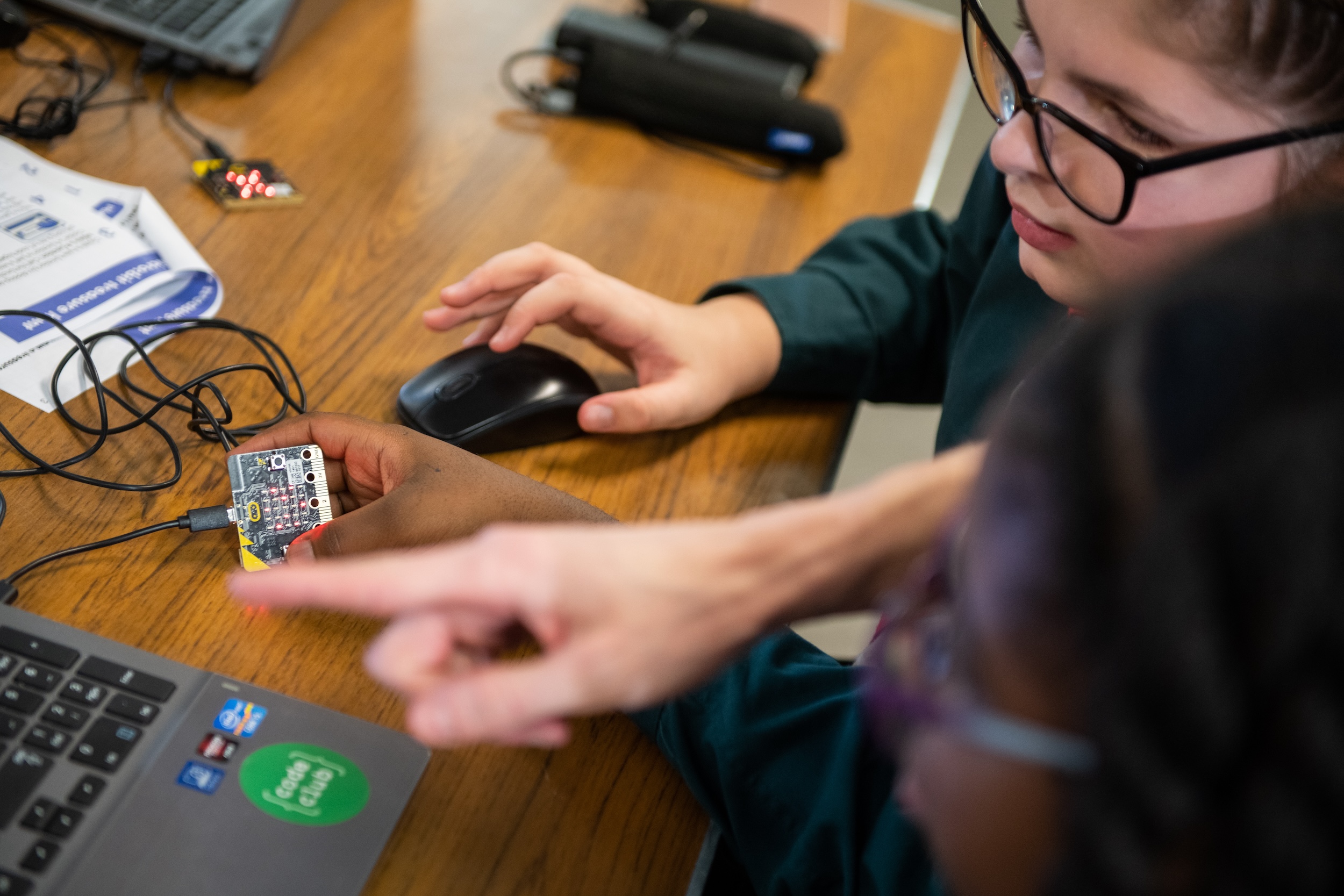
This year we reported some of our first results, which point to teachers’ perceptions of physical computing being engaging and inclusive for primary-aged children. Starting next spring, we will be carrying out our third year of data collection with our pupil cohort, who have reached the age of 10 to 11.
We’ll also be running a survey next summer for upper primary-aged children and their teachers. Please sign up for our Teacher Research Network newsletter to be the first to hear about taking part in this survey.
Teacher Inquiry in Computing Education (TICE)
As part of our TICE project we support teachers to conduct their own action research projects. This is a collaborative project, involving academics across the UK who volunteer to support teachers. The goal is to enable teachers to take a deep dive into a curriculum topic, a pedagogical approach, or a new resource, or to address a wider issue such as gender diversity or accessibility, to inform a change in their practice.
This year 16 teachers published their reports in our Teacher Research Booklet, and many also presented their findings online at CAS events or at the KCL-CAS London conference and the CAS National Conference. We’re very proud of them!
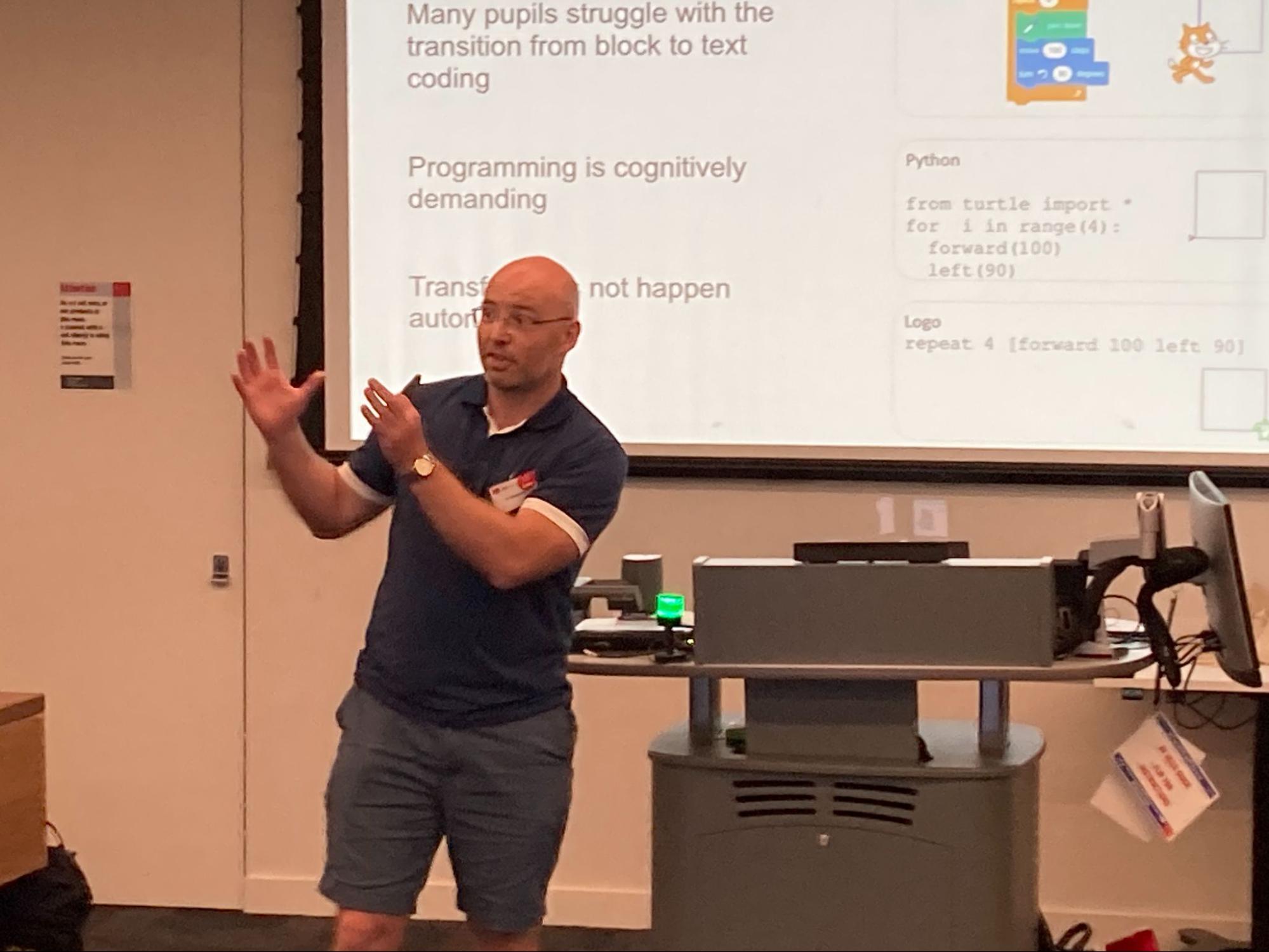
Two of our TICE teachers will be also presenting their research at an academic conference to be held in January. Congratulations to Will Grey and Joanne Hodge!
Get involved
There are many other projects you can find out about on our website and in our annual report, so I hope that you will keep reading. It goes without saying that I’m incredibly proud of the team who’ve worked on all of these projects!
To summarise, here’s how you can stay up to date with our work and maybe even get involved in studies:
- Sign up to the Research Centre newsletter
- Sign up to our Teacher Research Network newsletter if you’re a teacher and interested in participating in projects
Finally, I am pleased to announce that we will be hosting the UKICER 2026 conference for researchers and teachers in Cambridge on 3 and 4 2026 September. More details will follow on the UKICER website and on the Research Centre website in due course.
The post 2025 highlights from the Raspberry Pi Computing Education Research Centre appeared first on Raspberry Pi Foundation.
Microsoft Releases Last Azure Linux 3.0 Update Of 2025
Microsoft on Monday released Azure Linux 3.0.20251206 as the newest monthly update to its in-house Linux distribution used within the Azure cloud and elsewhere at the Windows company…
Scribus 1.6.5 Open-Source Desktop Publishing App Released with Various Changes
The development team behind Scribus, an open-source and cross-platform desktop publishing app, released version 1.6.5 today as yet another minor update to the Scribus 1.6 stable series.
Beginners Guide for Type Command in Linux
In this article, you will learn everything about the type command, including its different options (with practical examples).
Toradex Luna SL1680 SBC Features Synaptics SL1680 SoC with 8 TOPS NPU, Starts at $105
Toradex has announced the Luna SL1680, a SBC that introduces the company’s new “Pro Consumer” product tier. Positioned between consumer development boards and fully industrial hardware, the platform targets applications such as smart kiosks, light industrial systems, and advanced maker projects. The Luna SL1680 is built around the Synaptics SL1680 system-on-chip, which integrates a quad-core […]
Fedora Games Lab Looks To Be Revitalized As Modern Linux Gaming Showcase
One of the lesser known Fedora spins under the “Fedora Labs” initiative is the Fedora Games Lab that showcases some open-source games and can serve as an easy demonstrator for Linux gaming. Looking forward to 2026 with Fedora 44, there is a proposal to revitalize Fedora Games Lab to become a better showcase for the modern potential of Linux gaming…
Creating Data Analysis Pipelines using DuckDB and RStudio
This data project details the shift to an In-Situ ELT workflow showcases a hybrid RStudio/Python environment essential for transforming today’s analysts into “Data Ops.”
GIMP 3.2-RC2 Brings Bug Fixes & Minor Refinements
GIMP 3.2-RC2 is out today as what could be the last release candidate of GIMP 3.2 before its stable release. This leading open-source image editor/creation alternative to the likes of Adobe Photoshop continues becoming much more refined and polished in the GIMP 3 series…
Torvalds On Linux Security Modules: “I Already Think We Have Too Many Of Those Pointless Things”
Stemming from a security researcher and his team proposing a new Linux Security Module (LSM) three years ago and it not being accepted to the mainline kernel, he raised issue over the lack of review/action to Linus Torvalds and the mailing lists. In particular, seeking more guidance for how new LSMs should be introduced and raised the possibility of taking the issue to the Linux Foundation Technical Advisory Board (TAB)…
Fedora 44 Could Work Nicely “Out Of The Box” On Snapdragon-Powered Windows ARM Laptops
Longtime Red Hat engineer Hans de Goede who worked on many Intel/AMD laptop enhancements over the years left Red Hat and ended up joining Qualcomm. Now it turns out one of his projects at Qualcomm is enhancing the Fedora Linux support for running nicely out-of-the-box on Snapdragon-powered Windows on ARM laptops…
What’s New in KDE Gear 25.12 — A Major Update for KDE Software
The KDE community has just published KDE Gear 25.12, the newest quarterly update to its suite of applications. This refresh brings a mix of enhancements, bug fixes, performance refinements, and new features across many popular KDE apps, from Dolphin file manager and Konsole terminal to Krita and Spectacle.
Flatpak Adds Support For Building OCI Bundles Using Zstd Compressed Layers
Back in November Flatpak 1.17 released with support for sideloading from OCI images and other improvements in working toward the Flatpak 1.18 stable release. Out today is Flatpak 1.17.1 and was then followed quickly by Flatpak 1.17.2 to fix a mistake in the release artifacts…
SparkyLinux 2025.12 “Tiamat” Released with Debian Forky Base, Linux Kernel 6.17
SparkyLinux 2025.12 (codename Tiamat) has been released today as another snapshot in the semi-rolling series of this Debian-based GNU/Linux distribution leveraging the Debian Testing repositories.