
Spectre V1 mitigations in the Linux kernel are coming for RISC-V with newer RISC-V core designs being vulnerable to Spectre Variant One style attacks…
Category Archives: Linux
Kdenlive 25.12 Video Editor Brings New Docking System, Menu Restructuring
In addition to the release this week of OpenShot 3.4, released today is a major update to another popular open-source video editing application: Kdenlive. The Kdenlive 25.12 release brings many improvements to help with editing of any year-end / holiday videos…
Linux Kernel 6.17 Reaches End of Life, It’s Time to Upgrade to Linux Kernel 6.18 LTS
This is your friendly reminder that, as of today, the Linux 6.17 kernel series has reached the end of its supported life, which means that it’s time to start upgrading your installations to Linux kernel 6.18 LTS.
Mesa NVK Driver Merges Compression Support For Better Performance
Merged today to the Mesa 26.0-devel code for the open-source NVIDIA “NVK” Vulkan driver is compression support for helping to deliver better performance…
NVIDIA Releases Linux Driver 590.48 With Wayland and Vulkan Fixes
NVIDIA’s Linux driver 590.48 debuts as a New Feature Branch release with Wayland fixes, Vulkan performance improvements, and updated platform requirements.
NVIDIA 590.48.01 Linux Driver Brings R590 Series To Stable
NVIDIA has promoted their R590 driver series to stable with the release today of the NVIDIA 590.48.01 Linux driver as their latest new feature branch version…
A change of maintainership for linux-next
Stephen Rothwell, who has maintained the kernel’s linux-next integration
tree from its inception, has announced his
retirement from that role:
I will be stepping down as Linux-Next maintainer on Jan 16, 2026.
Mark Brown has generously volunteered to take up the challenge. He
has helped in the past filling in when I have been unavailable, so
hopefully knows what he is getting in to. I hope you will all
treat him with the same (or better) level of respect that I have
received.It has been a long but mostly interesting task and I hope it has
been helpful to others. It seems a long time since I read Andrew
Morton’s “I have a dream” email and decided that I could help out
there – little did I know what I was heading for.
Over the last two decades or so, the kernel’s development process has evolved
from an unorganized mess with irregular releases to a smooth machine with a
new release every nine or ten weeks. That would not have happened without
linux-next; thanks are due to Stephen for helping to make the current
process possible.
React2Shell exploitation spreads as Microsoft counts hundreds of hacked machines
Security boffins warn flaw is now being used for ransomware attacks against live networksMicrosoft says attackers have already compromised “several hundred machines across a diverse set of organizations” via the React2Shell flaw, using the access to execute code, deploy malware, and, in some cases, deliver ransomware.…
AMD Radeon RX 9000 Series vs. NVIDIA GeForce RTX 50 Open-Source Linux Performance For 2025
In the past few weeks on Phoronix we have explored a fresh look at the open-source Nouveau/NVK performance compared to the NVIDIA 580 packaged Linux driver as well as a multi-generation Nouveau vs. NVIDIA comparison from the GeForce GTX 980 to RTX 5080 since the forthcoming NVIDIA R590 driver series is ending the GTX 900/1000 series support. Today’s article provides another round of fresh open-source NVIDIA Linuc graphics performance data using the upstream open-source Nouveau and Mesa NVK/Zink drivers compared not only to the current NVIDIA packaged driver but also competitively for how the GeForce RTX 50 line-up compares to the current AMD Radeon RX 9000 series graphics cards.
[$] Episode 29 of the Dirk and Linus show
Linus Torvalds is famously averse to presenting prepared talks, but the
wider community is always interested in what he has to say about the
condition of the Linux kernel. So, for some time now, his appearances have
been in the form of an informal conversation with Dirk Hohndel. At the
2025 Open Source Summit Japan, the pair followed that tradition for the
29th time. Topics covered include the state of the development process,
what Torvalds actually does, and how machine-learning tools might fit into
the kernel project.
LibreOffice 25.8.4 Is Now Available for Download with More Than 70 Bug Fixes
The Document Foundation announced today the general availability of LibreOffice 25.8.4 as the fourth maintenance update to the latest LibreOffice 25.8 office suite series with various bug fixes.
Systemd v259 released
Systemd
v259 has been released. Notable changes include a new
“--empower” option for run0 that provides elevated
privileges to a user without switching to root, ability to propagate a
user’s home directory into a VM with systemd-vmspawn, and
more. Support for System V service scripts has been deprecated, and
will be removed in v260. See the release notes for other changes,
feature removals, and deprecated features.
Thunderbird Expanding Microsoft Exchange & Protocol Support For 2026
Beyond the Firefox browser to see more changes under its new CEO, the Thunderbird mail client is also expected to see some big changes in the new year…
Qt 6.11 Beta Released With New Canvas Painter, OpenAPI & TaskTree Modules
Qt 6.11 Beta 1 is out on-schedule with the code having entered its feature freeze and code branching earlier this month. This toolkit is working toward the stable Qt 6.11 stable debut in March…
Three stable kernels for Thursday
Intel ISPC 1.29 Drops Gen9 GPU Targets, Add New Optimizations & Experimental RISC-V
Intel ISPC 1.29 released on Wednesday as the newest feature update to this Implicit SPMD Program Compiler as a C variant able to target Intel hardware from their CPUs to GPUs for SIMD programming…
Introducing our new ‘Programming with AI’ unit
In the age of AI, we believe kids still need to learn to code. We’re also testing how AI tools can be used to help with teaching and learning programming. This blog dives into our new classroom unit ‘Programming with AI’, which we’ve developed for teachers to introduce students to learning to code using tools built on large language models (LLMs). We share an overview of the unit, and the early excitement of educators and learners with whom we’re exploring this new approach to teaching and learning programming.

Bridging the gap in programming education
As India is accelerating its efforts to modernise digital and computing education, it’s the ideal place for us to test how best to introduce learners to AI-assisted approaches to programming and teach them responsible AI use.
We decided to design a ‘Programming with AI’ unit of eight lessons that support students aged 14–16 to progress from block-based programming to text-based Python programming, Python being one of the most widely employed programming languages in industry and academia. In the new unit, students are guided to use LLM-based tools safely, ethically, and responsibly in order to undertake data analysis projects in Python. Students learn how to use the tools, such as Gemini and ChatGPT, to deepen their understanding, experiment with ideas, and connect classroom concepts with real-world technological applications.

The ‘Programming with AI’ unit is currently being piloted across five residential schools under our partner, the Telangana Social Welfare Residential Educational Institutions Society. In the coming months, we will evaluate the impact of this AI-supported approach to learning programming on student engagement, motivation, and overall learning outcomes.
Key design decisions during unit development
During the design phase of the unit, we identified three main challenges we wanted to address:
- The first was the transition from block-based to text-based coding. The students we were designing for are familiar with block-based programming like Scratch, but Python needs precisely typed code (syntax). This is a huge shift, and we wanted to offer a way to bridge the gap.
- We also had to figure out how to teach prompting LLM tools to students who are learning English as their second language.
- Finally, LLMs are non-deterministic. This means that LLM tools don’t always produce the same output, even when given the same prompt. They also do not generate correct code consistently.
To solve the first problem, we decided that the initial lessons in the unit should start by showing familiar Scratch blocks right next to the equivalent Python syntax. This direct comparison makes the transition from block-based to text-based programmer smoother.
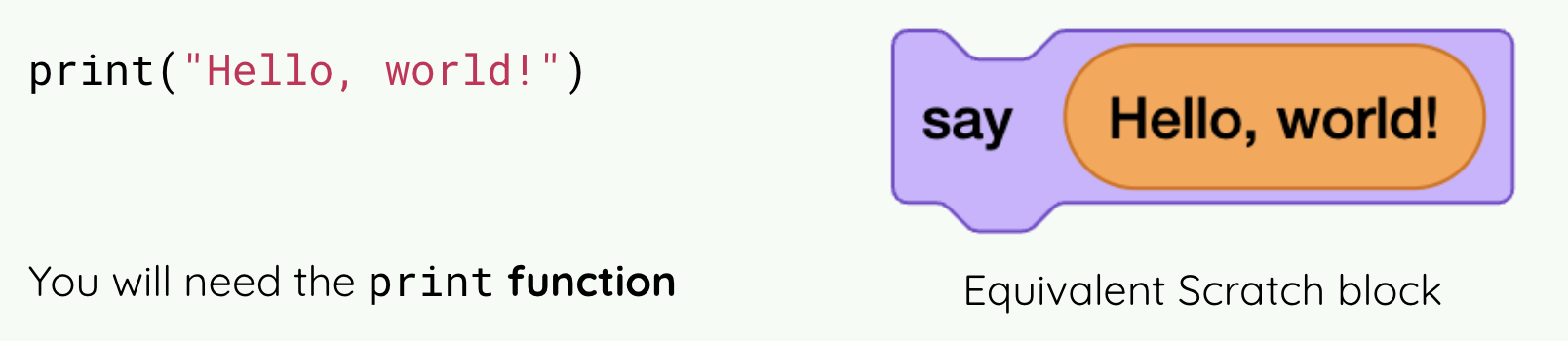
To teach prompting, we built a gradual path. The unit starts with a debugging code activity, where students get code with errors and a prompt to make an LLM tool fix the errors. Later, they learn to break down a prompt into their goal (what output they want) and the context (additional information for the LLM tool). Eventually, they use a structured framework to prompt the tool to generate complete, bug-free code.
Handling the unpredictable outputs of LLM tools we turned into a learning activity. In one lesson, students are given different chatbot-generated code segments and asked to analyse and reflect on the code quality. This crucial exercise helps them build the critical thinking and code evaluation skills they need for programming with AI tools.
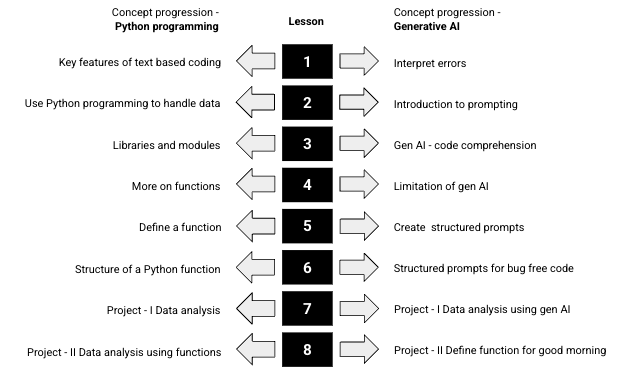
Over the eight lessons, there is a progression of Python concepts and generative AI concepts, as shown in the image above. They lead students to complete two challenging, real-world data analysis projects.
Preparing the educators
To ensure the successful pilot of the ‘Programming with AI’ unit, a comprehensive teacher training program was essential. We understood that teachers needed confidence and competence not only in the subject matter — programming — but also in guiding students to ethically and effectively use LLM tools.
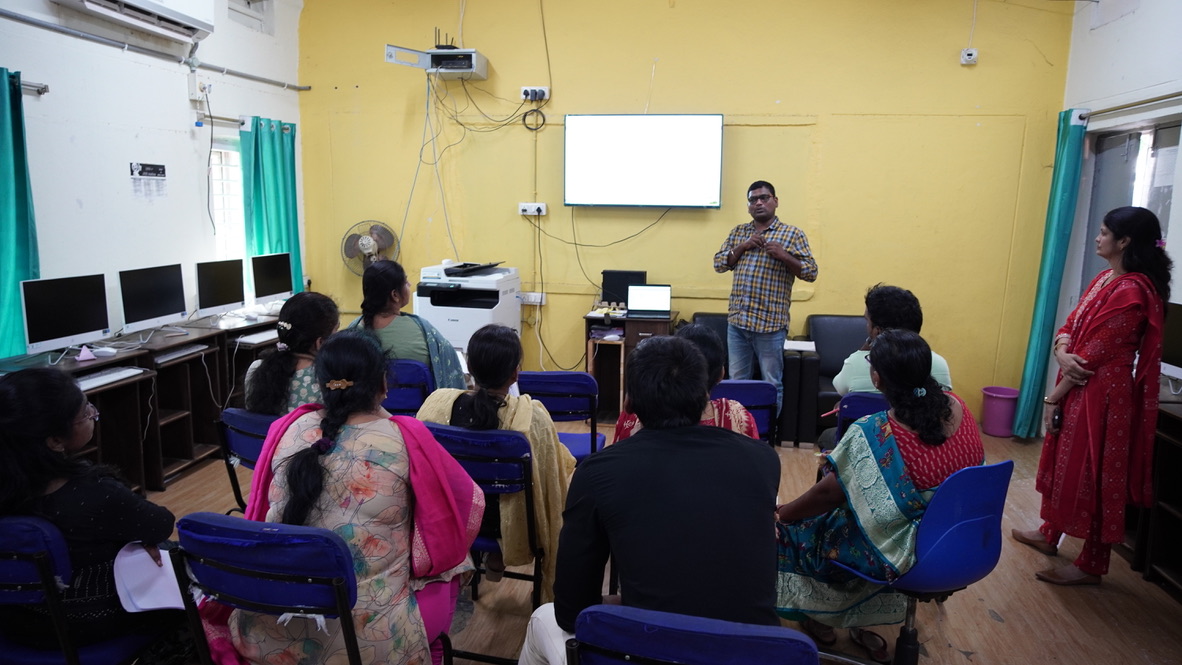
The training was an intensive, three-day programme: two days were held in-person for deep collaboration and one day was virtual for reinforcing key information. We covered five critical areas:
- Hands-on activities to ensure comfort with the Python programming language
- Exploring the capabilities and limitations of LLM tools
- Effective prompt writing, which teachers would in turn model for their students to use for code debugging and idea generation
- Reviewing lesson flow and learning objectives to understand the structure of a lesson
- Adapting specific pedagogies to integrate an LLM tool in teaching the Python programming language
This training ensured our educators were not just teaching a new unit, but felt like confident facilitators ready to lead the shift towards AI-supported learning.
Initial student reactions: Excitement, familiarity with LLM tools, and seamless transition
The pilot of the ‘Programming with AI’ unit began during the second week of December 2025 across five selected schools. It was immediately met with enthusiastic student engagement — they were highly excited to learn Python programming using LLM tools.
When teachers initiated discussions about AI, students demonstrated their familiarity with LLMs, chatbots, and related concepts. They were not only aware of generative AI but could readily name and describe the functions of LLM tools, telling us they were actively using these tools to create projects in various other subjects.

Students could easily connect with the activities in the lessons as they had foundational understanding of programming, which they developed while learning block-based coding in Scratch. This prior knowledge enabled their seamless transition to the new learning. Perhaps most impressive was the students’ rapid adoption of LLM tools to debug their code. This skill can ease what is traditionally a steep learning curve when students first learn text-based programming.
We are now eagerly anticipating their curiosity and progress in the upcoming lessons.
Looking ahead and collecting impact data
With the initial enthusiasm confirmed, the pilot program moves into its next critical phase. Teachers will continue to deliver the unit over the next few months in the five selected schools in Telangana.

During this extended observation period, our primary focus will be on rigorous data collection and impact assessment. We will closely monitor how students interact with the provided learning materials and how they use LLM tools throughout the unit. We will systematically assess whether the new teaching approach successfully helps students achieve the defined learning objectives for Python programming. Crucially, we will capture comprehensive data to understand the impact of this AI-integrated approach on engagement, skill acquisition, and problem-solving compared to traditional methods.
Based on the synthesis and analysis of all the gathered data, we will share our gathered insights early next year. The findings will inform our plans for more widely introducing the AI-integrated unit and for developing similar content for other settings and age groups.
The post Introducing our new ‘Programming with AI’ unit appeared first on Raspberry Pi Foundation.
Pop!_OS 24.04’s New Scratch-Built Cosmic: Hands-On, With Screenshots
System76’s Pop!_OS 24.04 lands with the all-new Cosmic Epoch 1 desktop. We installed it and kicked the tires so you know what to expect.
The post Pop!_OS 24.04’s New Scratch-Built Cosmic: Hands-On, With Screenshots appeared first on FOSS Force.
Meet Armbian Imager, the Official Flashing Utility for Armbian Linux, Beta Out Now
The Armbian Linux project introduced today a new utility called Armbian Imager for flashing the Armbian operating system to your single-board computer.
Opus 1.6 Audio Codec Released With 96 kHz Audio and ML Improvements
Opus 1.6 open-source audio codec introduces 96 kHz Opus HD support, ML-based bandwidth extension, improved redundancy, and more.