
The community behind the Devuan GNU+Linux project has published Raspberry Pi images of the latest release, Devuan 6.1 (codename Excalibur), so I took it for a test drive on my Raspberry Pi 5 to give you guys a first look at what Devuan can do on the tiny single-board computer.
Category Archives: Linux
EU Digital Laws Spark FOSS Liability Fears: The GNOPPIX Case and Wider Impacts
The European Union’s ambitious digital regulatory agenda has positioned the bloc as a global leader in technology governance. From data protection to platform accountability, EU lawmakers have enacted sweeping legislation designed to make the digital ecosystem safer, more transparent, and more accountable. Yet for the free and open-source software (FOSS) community, these well-intentioned regulations have created an unexpected crisis of confidence, with volunteer developers and small projects increasingly questioning whether they can safely operate within EU jurisdiction. At the heart of this tension lies a fundamental mismatch: regulations designed to rein in Big Tech giants are being applied, or could be applied, to volunteer-driven projects with no legal departments, no compliance budgets, and no ability to absorb the risks that come with regulatory uncertainty. The result is a growing chorus of concern from open-source advocates who warn that the EU’s regulatory framework could inadvertently chill the very innovation it seeks to protect.
All Fedora 44 KDE Variants To Use Plasma Login Manager Rather Than SDDM
The Fedora Engineering and Steering Committee (FESCo) has approved a Fedora 44 change for switching all KDE variants away from using the SDDM display manager to instead use the newer Plasma Login Manager…
Ubuntu 25.04 (Plucky Puffin) Officially Nears End of Life
Ubuntu 25.04 (Plucky Puffin) will reach end of life on January 15, 2026, after which security updates and official support will end. Users should upgrade promptly.
[$] Questions for the Technical Advisory Board
The nature and role of the Linux Foundation’s Technical Advisory Board (TAB) is
not well-understood, though
a recent LWN article shed some light on its
role and
history. At the 2025
Linux Plumbers Conference (LPC), the TAB held a question and
answer session to address whatever it was the community wanted to know
(video).
Those questions ended up covering the role of large language models in kernel
development, what it is like to be on the TAB, how the TAB can help grease the
wheels of corporate bureaucracy, and more.
[$] The difficulty of safe path traversal
Aleksa Sarai, as the maintainer of the
runc container runtime, faces a
constant battle against security problems. Recently, runc has seen
another
instance of a security vulnerability that can be traced back to the difficulty
of handling file paths on Linux. Sarai spoke at the 2025
Linux Plumbers Conference
(slides;
video)
about
some of the problems runc has had with path-traversal vulnerabilities, and to
ask people to please use
libpathrs, the library that he has been developing for
safe path traversal.
Redox OS Begins Developing Its Own Intel Graphics Driver
The Rust-written Redox OS operating system had an exciting end to the year as it began developing its own native Intel graphics driver…
Manjaro 26.0 released
Version
26.0 (“Anh-Linh”) of the Arch-based Manjaro Linux distribution has been
released. Manjaro 26.0 includes Linux 6.18, GNOME 49,
KDE Plasma 6.5, Xfce 4.20, and more.
Transparent Hugepage Performance On Linux 6.18 LTS: Madvise vs. Always
With some Linux distributions like Fedora Workstation and Ubuntu defaulting to “madvise” Transparent Hugepages (THP) while others like CachyOS and openSUSE defaulting to “always”, you may be curious about the madvise vs. always THP difference in modern Linux environments. If so this round of benchmarking is for you in looking at the performance impact of madvise vs. always THP.
Pre-Compiled Headers Being Debated For LLVM/Clang To Speed-Up Build By 1.5~2x
LLVM developers and other stakeholders have begun debating the use of pre-compiled headers “PCH” as a means of speeding up the compiulation of the LLVM compiler infrastructure by 1.5x to 2x than with non-PCH builds…
Revised Steam Survey For December 2025 Puts Linux Gaming Marketshare At 3.58%
Back on the 1st Valve published the Steam Survey results for December 2025 and they put the Linux gaming marketshare at 3.19%, a 0.01% dip from November. But now the December results have been revised with a nice bump to the Linux marketshare…
Flatpak Exploring GPU Virtualization To Ease Driver Challenges
Open-source developer Sebastian Wick has written a blog post outlining work to improve the graphics driver situation for Flatpaks. Particularly around situations like the NVIDIA driver stack that may depend upon a specific kernel version or where a Flatpak runtime may be end-of-life, dealing with GPU drivers in Flatpaks can be a burden. A solution being explored is GPU virtualization to deal with those GPU driver handling challenges while still providing robust and secure GPU access…
Intel Core Ultra X7 358H + 32GB RAM Laptop Around ~$1300 USD
Yesterday when Intel formally introduced Panther Lake as the Core Ultra Series 3 with pre-orders set to begin today and available globally later this month, one of the key questions remaining was around pricing… I’ve been scouting various Internet retailers today and so far have found a Ultra X7 358H model with the 12 Xe cores for the Xe3 integrated graphics to be priced around $1299 USD with 32GB of RAM…
AMD Releases GAIA 0.15 – Positioning It As A Framework/SDK For Building AI PC Agents
Last year AMD announced GAIA as short for “Generative AI Is Awesome”. It started off as a Windows-only AI demo but over time added Linux support along with introducing different AI agents. For going along with AMD’s AI announcements at CES 2026, AMD released GAIA 0.15 where they are now positioning this software as a framework/SDK for building AI PC agents…
GStreamer 1.28-RC1 Brings A Rust-Based GIF Decoder, Other New Rust Components
On Monday the first release candidate of the GStreamer 1.28 multimedia framework was released. As is a recurring focus in recent releases, more GStreamer code is written in Rust for memory safety especially around decoding content…
A research-led framework for teaching about models in AI and data science
Research indicates that teaching learners to use and create with data-driven technologies such as AI and machine learning (ML) requires an entirely different approach for solving problems compared to traditional programming activities.

In this blog, we share the new data paradigms framework that we have developed through research and used to help improve our understanding about how to teach and learn about AI and data science. We also invite you to register your interest in participating in our next collaborative study on the topic.
Knowledge-based approaches to systems design
Let’s start by highlighting an important distinction between different approaches to designing systems. In a knowledge-based approach to system design, a set of rules (e.g., if-then statements) are written for the system to execute. Every rule is explicitly defined. This approach is called ‘rule-based’, ‘symbolic’, or ‘logic-based’. For example, a developer could create a program that simulates dialogue by writing specific lines of code to handle a greeting, such as “IF user says “Hello” THEN output “Hi!”. If the user types “Greetings!” instead, the program fails because it has no rule for that specific word.

Knowledge-based models are often said to be explainable by design. This means the logic is accessible and interpretable and developers can trace the exact steps taken to produce an output. For example, if developers manually classify restaurant reviews as positive or negative using a pre-defined set of criteria, the rules their restaurant classifying system follows are entirely explicit, and the path from input to output is clear and explainable.
Data-driven approaches to systems design
By contrast, in a data-driven approach to system design developers do not write specific rules. Instead, they collect lots of data and train a model. In the dialogue simulator example, they would collect hundreds of examples of greetings and train a model to the pattern of a greeting. If the user types “Greetings!”, the system generates a response based on the patterns in its training data.

Data-driven models are often opaque. In other words, the internal workings of these ML models are hidden. While we can see our input and the system’s output, the internal mathematical process is so complex — often involving layers of calculations and abstractions — that we cannot simply “explain” why a specific output was produced. For example, developers can create a classification model by training a neural network using thousands of images. Due to the large quantity of data used to train the model, and complex internal parameters and hidden layers, developers and users of the system cannot understand or explain the logic or features that lead to a specific output. These kinds of models are often referred to as a “black box” (as opposed to a “glass” or “clear” box).
Comparing knowledge-based and data-driven approaches
Researchers have argued that the move from knowledge-based (or rule-based) programming to data-driven system design represents a paradigm shift and creates unique challenges for educators. The challenge is helping students shift from the expectation that a system produces a single ‘right’ answer — characteristic of traditional rule-based programming — toward an understanding that systems trained on large quantities of data produce outcomes that aren’t always fixed or explainable. If the current instruction in the classroom still relies heavily on traditional rule-based programming approaches, we might be setting students up for misconceptions.
Data paradigms: A framework for analysing data science education approaches
In our research work on AI and data science at the Raspberry Pi Computing Education Research Centre, we analysed 84 research studies about the teaching and learning of data science. We categorised learning activities used in the studies to understand whether they were (i) knowledge-based or data-driven, and (ii) the extent to which the underlying models used were transparent or opaque. This led us to define four distinct data paradigms:
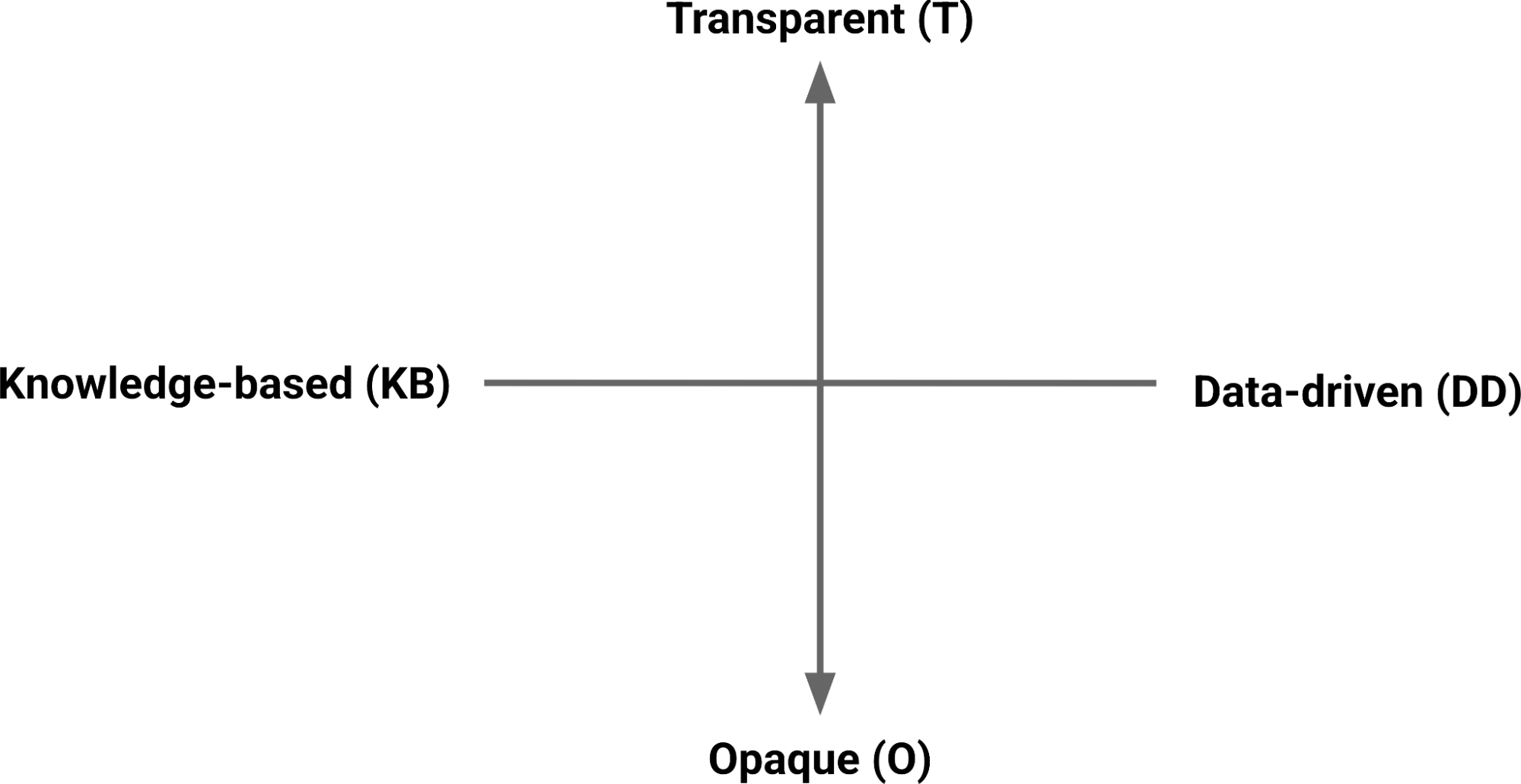
- Knowledge-based and transparent (KB + T): Activities in this paradigm are ones where students write rules for systems, or work with systems that use rules, where the logic is fully explainable by design. For example, if students manually classify data (e.g. creating simple ‘if-then’ statements to predict an outcome), the path from input to output is clear.
- Data-driven + Transparent (DD + T): In this paradigm, activities involve students working with models trained on data, but the trained model’s logic remains explainable and interpretable. For example these could be models using k-nearest neighbors (KNN) algorithm to group data points based on proximity, or using linear regression to predict a trend. Even though the model produces an output, the student can look at the inner workings of the model and see how the decision is made.
- Data-driven + Opaque (DD + O): This paradigm’s activities require students to work with data-driven ML models where the models’ internal logic is hidden, for example an image classification model using a type of neural network (e.g. CNN). The model produces an output (e.g. classifying an image as ‘This is a dog’), but the student cannot inspect the system to find a rule or clear path explaining why that specific output was produced. To understand these systems, it’s necessary to use additional testing and evaluation tools.
- Knowledge-based + Opaque (KB + O): Activities in this paradigm would involve systems with human-written rules that are not explainable. In our review of K–12 activities, we found no examples of activities within this paradigm.
The data paradigms framework helps us to distinguish between different kinds of modeling activities students take part in and how instructional approaches could be classified across one or more paradigms. For instance, we found that most data-driven activities were also opaque (DD + O), usually meaning that students collected and used data to train a model, but how the system worked was opaque. This pattern, where the data is visible but the model is not explainable, risks students forming misconceptions about the capabilities and limitations of data-driven systems. Without understanding how outputs are generated, students may expect data-driven ML systems to operate like fully explainable (or transparent) ones.

We think that lessons are needed in the data-driven opaque (DD + O) quadrant to explicitly teach students about how data-driven systems work and the role they play in everyday contexts. However, when teaching data-driven opaque (DD + O) activities, learners’ attention needs to be directed to concepts such as model confidence, data quality, and model evaluation. Since an ML model is not inherently explainable, we need to teach students to use post-hoc explanation methods, such as testing different inputs to see how a system’s output changes. To prepare students for this learning experience, we think that first introducing activities about rule-based systems (knowledge-based + transparent; KB + T) or simple data exploration, such as linear regression or data visualisation (data-driven + transparent; DD + T) may serve as a ‘bridge’ to understanding data-driven modeling by helping students to distinguish between systems built from specific logical rules and systems trained on data.
We believe the idea of data paradigms can serve as a way of framing teaching activities about data science and help educators and students to consider the transition between different paradigms when engaging with the systems we interact with every day.
Teachers in England, participate in our new study
We’re launching a new study to explore how to teach learners aged 9 to 11 about data-driven computing. The study will take place in collaboration with upper key stage 2 teachers in England and look at:
- What key ideas pupils need to understand
- How teachers currently approach topics related to data-driven computing
- How pupils make sense of data and probability
Our goal is to find practical ways to help teachers build children’s confidence in working with data in computing lessons. The study will be collaborative, with two workshops held throughout 2026, and we’re inviting upper KS2 teachers in England to take part.
You can express your interest in participating by filling in this form:
The post A research-led framework for teaching about models in AI and data science appeared first on Raspberry Pi Foundation.
How to Install COSMIC Desktop on Ubuntu 24.04 LTS
A step-by-step guide to installing the COSMIC desktop environment on Ubuntu 24.04 LTS via a PPA repository.
Gmail preparing to drop POP3 mail fetching
It’s January 2026, and Google is finding innovative new ways to make one of its services worseImportant news for Gmail power users: Google is dropping the feature whereby Gmail can collect mail from other email accounts over POP3.…
AMD Announces Ryzen 7 9850X3D, New Strix Halo SKUs & Ryzen AI 400 Series
Lisa Su’s keynote just wrapped up at CES 2026 and in turn the embargo regarding AMD’s first consumer product announcements for 2026. The AMD Ryzen AI 400 series and new Ryzen 7 9850X3D 3D V-Cache processors are what’s in focus for CES this year.
Phosh 0.52 GNOME-Based Mobile Shell Brings QR Codes for Wi-Fi Hotspots
Phosh 0.52 introduces QR code sharing for Wi-Fi hotspots, lock screen brightness gestures, new debug controls, and more.