
At the 2025 Linux Plumbers
Conference (LPC), held in Tokyo in mid-December, Changwoo Min led a session on what
he has learned while developing the
“latency-criticality
aware virtual deadline” (LAVD) scheduler, which is aimed at gaming
workloads. The session was part of the Gaming
on Linux microconference, which is a new entrant into LPC; organizers
hope to see it return next year in
Prague and, presumably, beyond. LAVD uses the extensible scheduler class (sched_ext) and has
the primary goal of minimizing stuttering
in games;
it is implemented in a combination of BPF and Rust.
Category Archives: Linux
Dell Pro Max GB10 vs. AMD Ryzen AI Max+ Framework Desktop For Llama.cpp, OpenCL & Vulkan Compute
Over the past number of weeks the Dell Pro Max with GB10 has been undergoing a lot of testing at Phoronix. This NVIDIA GB10 powered mini PC with its 20 Arm cores (10 x Cortex-X925, 10 x Cortex-A725) and Blackwell GPU offers a lot of combined compute potential for AI and other workloads. In this article is a look at how the Dell Pro Max with GB10 competes with AMD’s Ryzen AI Max+ 395 “Strix Halo” within the Framework Desktop SFF PC.
TUXEDO InfinityBook Max 16 Gen10 Linux Laptop Unveiled with New OLED Display
Linux hardware vendor TUXEDO Computers unveiled today the 10th generation (Gen10) of their TUXEDO InfinityBook Max 16 Linux-powered laptop with newer NVIDIA GPUs, newer Intel CPU, and a new display.
[$] 2025 Linux and free software timeline
Last year we
revived the tradition of publishing a timeline of
notable events from the previous year. Since that seemed to go over
well, we decided we should continue the practice and look back on some
of the most noteworthy events and releases of 2025.
IPFire 2.29 Core Update 199 released
The IPFire project, an
open-source firewall Linux distribution, has released version
2.29 – Core Update 199. Notable changes in this release include an
update to Linux 6.12.58, support for WiFi 6 and 7 features on
wireless access points, as well as native support for link-local
discovery protocol (LLDP) and Cisco discovery protocol (CDP).
Next-Gen AMD Server SoCs To Enjoy Firmware-Agnostic Platform Configuration Approach
Next-generation AMD server SoCs — presumably the AMD EPYC “Venice” on Zen 6 — is poised to introduce a firmware-agnostic platform configuration platform configuration change method/format. This is This aims to improve server platform interoperability and eliminate redundant configuration efforts for different firmware solutions…
Google will now only release Android source code twice a year (Android Authority)
Android Authority reports
that Google will be reducing the frequency of releases of code to the
Android Open Source Project to only twice per year.
A spokesperson for Google offered some additional context on this
decision, stating that it helps simplify development, eliminates
the complexity of managing multiple code branches, and allows them
to deliver more stable and secure code to Android platform
developers. The spokesperson also reiterated that Google’s
commitment to AOSP is unchanged and that this new release schedule
helps the company build a more robust and secure foundation for the
Android ecosystem.
The release schedule for security patches is unchanged.
Radeon RADV Vulkan Driver Is On The Verge Of Another Big Ray-Tracing Performance Gain
Natalie Vock as one of the open-source developers on Valve’s Linux graphics team has been spearheading another big ray-tracing performance improvement for the AMD Radeon Vulkan driver. RADV ray-tracing performance improved a lot in 2025 but it’s looking like 2026 could be even more exciting…
Compiler-Based Context & Locking Analysis On Deck For Linux 7.0 Paired With Clang 22+
A new feature in the queue for likely introduction with the next version of the Linux kernel (Linux 6.20~7.0) is compiler-based context and locking analysis. This kernel code depends on the yet-to-be-released LLVM Clang 22 compiler but can provide some powerful insights to kernel developers…
Acer Laptop Battery Control Driver Looks Toward The Upstream Linux Kernel
For those with Acer laptops running Linux on GitHub there has been an out-of-tree driver providing an experimental “acer-wmi-battery” kernel module to allow controlling battery-related features. Now a cleaned-up version of that driver is working on getting into the mainline Linux kernel…
DRM Splash Screen Updated To Simply Drawing A Colored Background, Displaying A BMP Image
Back in October was an initial proposal for a DRM splash screen client for the Linux kernel that would be primarily useful for embedded systems for rendering a simple “splash screen” when updating the system firmware/software, early display activation at boot, during system recovery, or similar processes. Sent out today was a second revision to the DRM splash screen code…
What shaped computing education in 2025 — and what comes next
To mark the start of 2026, we’re releasing a special episode of our Hello World podcast, which reflects on the key developments in computing education during 2025 and considers the trends likely to shape the year ahead.
Hosted by James Robinson, the episode brings together a conversation between three Foundation team members — Rehana Al-Soltane, Dr Bobby Whyte, and Laura James — and perspectives from colleagues and partners in Kenya, South Africa, and Greece.
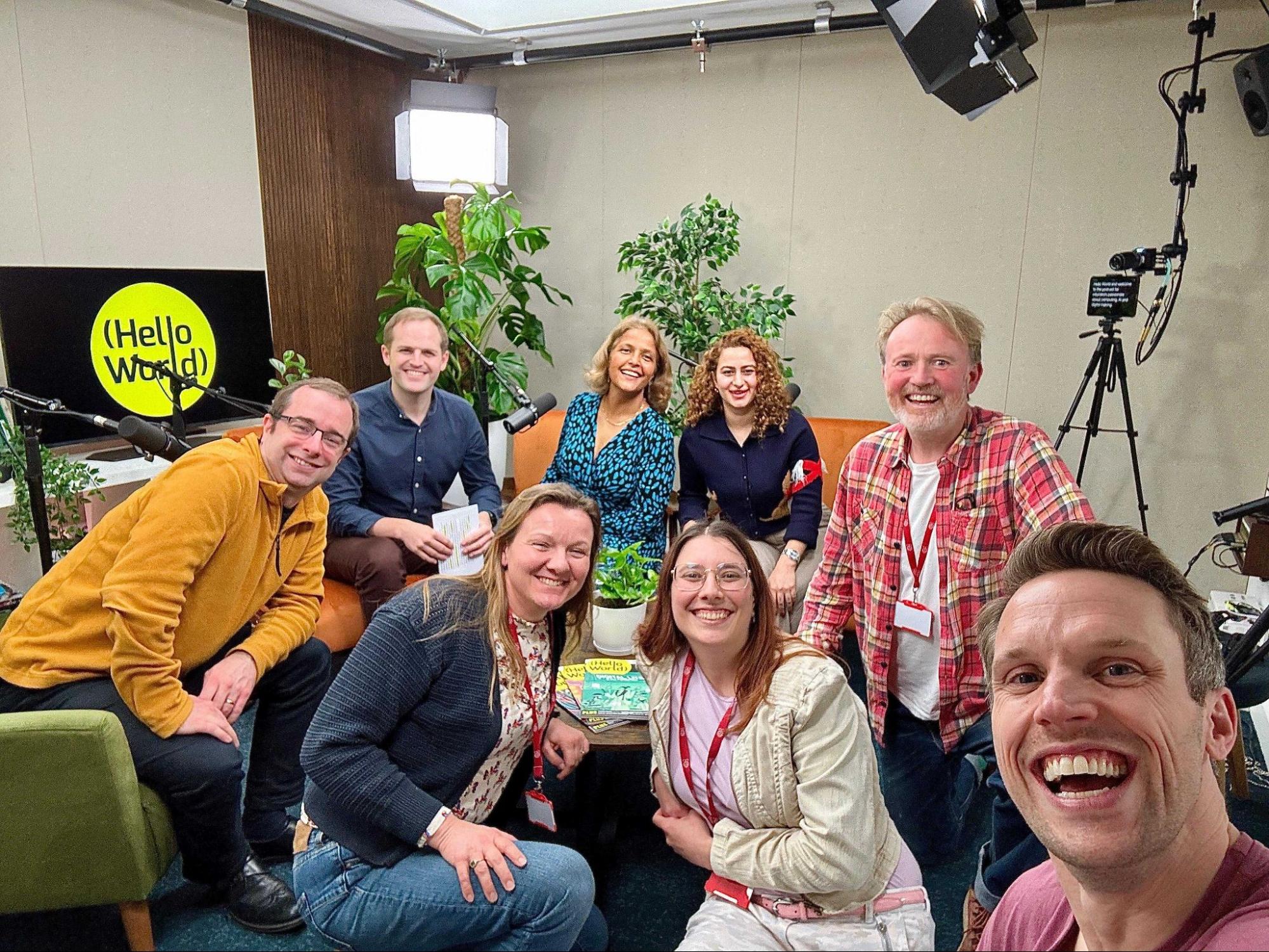
The podcast is framed around three major themes that defined 2025: data science, AI literacy, and digital literacy, all of which continue to play an increasingly important role in education systems worldwide.
Looking back at 2025
In the podcast, Rehana reflects on a year characterised by research, collaboration, and community, highlighting the importance of global partnerships in developing and localising AI literacy resources for diverse educational contexts.
From a research perspective, Bobby explains that 2025 was about pulling together what we already know and making sense of it, to better understand what good data science education should look like, including curriculum design, pedagogy, and appropriate tools.
Laura focuses on resilience and creativity in computing education, as well as the growing presence of more personalised forms of artificial intelligence, which present both significant opportunities and complex ethical challenges.

A key concern raised throughout the episode is the risk of cognitive offloading, whereby learners rely on AI tools to bypass critical thinking processes. The speakers emphasise the need for learning experiences and assessments that value process, reasoning, and reflection rather than solely final outputs.
The episode also examines barriers to the adoption of computing and AI education, including teacher confidence, limited access to devices, restrictive school IT policies, and the need for translated and localised resources.
Contributions from our colleagues around the world highlight stark contrasts in educational contexts, with challenges such as funding constraints, connectivity issues, and teacher training needs, alongside examples of innovation where educators are adequately supported.
What’s ahead
Looking ahead to 2026, Rehana outlines the potential of interdisciplinary approaches to AI literacy, integrating AI concepts into subjects such as geography, history, languages, and the arts to increase relevance and engagement (look out for our upcoming research seminar series on the topic).

Bobby anticipates a gradual shift towards more data-informed approaches to computing education, with greater emphasis on classroom-based trials and research that directly informs practice.
Laura offers a strong call to renew focus on cybersecurity education, arguing that security and safety must remain central as digital systems and AI technologies continue to evolve.
In a series of concise predictions, the speakers point to increased attention on explainable AI, wider integration of AI literacy across the curriculum, and renewed concern for digital safety and security.
More from Hello World
You can subscribe to Hello World and listen to the full podcast episodes from wherever you get your podcasts. Or you can find this and previous Hello World podcasts on our podcast page.
Also check out Hello World magazine, our free digital and print magazine from computing educators for computing educators.
The post What shaped computing education in 2025 — and what comes next appeared first on Raspberry Pi Foundation.
StarBook Horizon Linux Laptop Now on Sale with 32GB RAM, Wi-Fi 6E, and Coreboot
Linux hardware vendor StarLabs announced today that its StarBook Horizon Linux-powered laptop is now on sale as a 13-inch Coreboot notebook designed for privacy and as a daily driver.
ADLINK Express-PTL and COM-HPC-mPTL pair Intel Core Ultra Series 3 processors with Arc Xe3 graphics
ADLINK Technology has introduced the Express-PTL and COM-HPC-mPTL modules, built on Intel Core Ultra Processor Series 3 (Panther Lake-H), targeting edge AI, graphics-intensive, and general embedded systems that require high compute density, standards-based form factors, and long-term availability. Both modules are based on Intel Core Ultra Series 3 processors featuring a hybrid CPU architecture with […]
AAEON Reveals BOXER-8742AI Embedded AI Box PC Based on NVIDIA Jetson T4000
AAEON has outlined plans for the BOXER-8742AI, a fanless embedded AI box PC built around the NVIDIA Jetson T4000 module for edge AI deployments requiring high compute density and multi-sensor connectivity. The BOXER-8742AI is based on the NVIDIA Jetson T4000 module, which combines a 12-core Arm Neoverse-V3AE CPU with a Blackwell-architecture GPU featuring 1,536 CUDA […]
Linux’s Old Mount API Code On The Chopping Block For The 7.0 Kernel
The Linux kernel’s “new mount API” that has been in the kernel since 2019 and recently made rounds for taking 6+ years to land the man page documentation on it will soon be the the only mount API internally within the kernel. Removing the “old” Linux kernel mount API internals is a candidate for the upcoming Linux 7.0 kernel cycle…
Ubuntu Now Officially Supports NVIDIA Rubin AI Systems
NVIDIA Rubin AI platforms are now officially supported on Ubuntu, unifying CPU, GPU, and DPU components for scalable AI workloads.
What if Linux ran Windows and meant it? Meet Loss32
It’s crazy, a million-to-one shot, but it might just workWhat if, rather than make a Linux distro that can run Windows apps, you built the whole distro around Windows binaries instead?…
Gentoo Linux Made Progress On RISC-V, WSL & More In 2025 While Pulling In Just $12k USD
The Gentoo Linux project published their 2025 retrospective this week with their many accomplishments, including the recruitment of four more developers and now being up to 31,663 ebuilds and a total of 89GB worth of x86_64 binary packages on mirrors…
There’ll Be More AI Than Open Source at Spacewalk 2026 — But Not by Much
For the teaser: Spacewalk 2026 will kick off ATO’s year with a slate of AI‑focused talks in Raleigh — and organizers say open source will still be woven through the entire evening.
The post There’ll Be More AI Than Open Source at Spacewalk 2026 — But Not by Much appeared first on FOSS Force.