
See zwiftinsider.com/tiny for current Tiny Race details.
Category Archives: Bikes
No winner on stage 11 of La Vuelta due to pro-Palestine protests
There was no winner on stage 11 of the Vuelta a España in Bilbao today after pro-Palestine protestors disrupted the finish, with the general classification times taken with 3km to go.
Protestors disrupted the race throughout the day, displaying flags and banners, with others encroaching on the race.
The peloton was briefly stopped during the neutral zone at the beginning of the day as protestors entered the course. Later, Mads Pedersen was impeded on the intermediate sprint with 38km, and protesters ran onto the penultimate climb of the day, causing the peloton to change course. Images show riot police at the finish in Bilbao working to hold the crowds back.
Towards the end of the stage, the race organisers announced that there would be no winner.
“Due to some incidents at the finish line, we have decided to take the time at 3 kilometres before the line. We won’t have a stage winner. We will give the points for the mountain classification and the intermediate sprint, but not on the finish line,” the organisers said, according to Cycling Weekly.

The decision didn’t halt the GC battle.
Race leader Jonas Vingegaard (Visma–Lease a Bike) and Tom Pidcock (Q36.5 Pro Cycling) attacked in the closing kilometres of the stage to gain time over João Almeida (UAE Team Emirates–XRG), who is currently second in the general classification, and was in a group behind Vingegaard and Pidcock.
Stage 11’s neutralised finish follows a string of protests over the presence of Israel–Premier Tech at the race.
Last week, protesters disrupted Israel–Premier Tech’s team time trial. And yesterday, demonstrators disrupted stage 10, which led to Wanty–Intermarché’s Simone Petilli crashing.
Although he finished the stage, Petilli later called for calm. The Wanty–Intermarché rider said on X: “I understand that is not a good situation, but yesterday I crashed because of a Protest on the road.”
“Please, we are just Cyclists and we are doing our Job, but if it will continue like this our safety is not guaranteed anymore, and we feel in danger! We just want to race! Please,” he added.
The riders’ union, the Cyclistes Professionels Associés (CPA), also met with the race organisers before stage 11 began to discuss how to deal with the protests, allegedly stating they would ride as long as protests remained peaceful.
“We feel in danger” – tension mounts at La Vuelta amid protests against Israel–Premier Tech’s inclusion
Tension is mounting at the Vuelta a España amid protests over Israel–Premier Tech’s presence in the race. The riders’ union, the Cyclistes Professionels Associés (CPA), has met with race organisers to discuss how to approach the issue, and individual riders have called for calm and greater safety.
Demonstrators have lined the roads waving Palestine flags at the race, and last week saw protestors disrupt Israel–Premier Tech’s individual time trial.
Now the protests against the team, which is co-owned by Canadian–Israeli businessman Sylvan Adams, who is a vocal supporter of Israel, have affected other riders.
Wanty–Intermarché’s Simone Petilli crashed on yesterday’s stage 10 to Belagua after three protesters with Palestinian flags entered the course and the peloton tried to avoid them.
| La Vuelta Euskal Herrian barrena dabil gaur eta bihar, @IsraelPremTech talde sionistaren presentziaren aurkako protesten erdian. Begira zer gertatu den Irunberrin.
GENOZIDAK EZ DIRA ONGI ETORRIAK EUSKAL HERRIAN! #LaVuelta25 #StopGazaGenocideNOW pic.twitter.com/rimAvHPRTo
— Malcolm iXa (@ideiazabaldub) September 2, 2025
Petilli, who fell but finished the stage, wrote on X: “I understand that is not a good situation, but yesterday I crashed because of a Protest on the road.”
“Please, we are just Cyclists and we are doing our Job, but if it will continue like this our safety is not guaranteed anymore, and we feel in danger! We just want to race! Please,” he added.
Adam Hansen, the president of the CPA, said on X: “We remind everyone that cyclists are not involved in political or social disputes — they are simply doing their job: racing. Their safety must never be put at risk.
“While we respect the right to peaceful protest, actions that endanger athletes cannot be accepted. Rider safety must remain the highest priority.
“The CPA stands firmly with the riders: they just want to race in safe conditions.”
Soudal–QuickStep’s Louis Vervaeke also took to X, asking protesters not to endanger riders or themselves. “We fully acknowledge that everyone has the right to protest. However, we kindly ask that this be done in a safe manner. Our focus here is on our sport, not on politics or any particular position in this matter,” said Vervaeke.
Before the start of stage 11 in Bilbao, there were meetings between the CPA and the race organisers, and several teams have registered their interest for Israel–Premier Tech to withdraw from the race, according to journalist Daniel Friebe.
The peloton was stopped in the neutral zone of stage 11 when pro-Palestine protesters blocked the road.
Elia Viviani, a representative of the CPA at the race, told Friebe that: “riders said to commissaires/race organisation they would ride as long as protests are peaceful. If race gets stopped, riders will reassess.”
Friebe added: “Viviani also said CPA wouldn‘t demand Israel-Premier Tech riders pull out. ‘We wouldn’t go against our colleagues’.”
Friebe also said on X that riders want the UCI to intervene. “They feel exposed on an issue that’s beyond their knowledge/expertise/desire to expose private position,” he wrote on X.
Basque political party EH Bildu called for Israel–Premier Tech’s withdrawal from the Vuelta.
“Israel is not welcome in the Basque Country and we urge the withdrawal of the Israel-Premier Tech cycling team from La Vuelta 2025,” the party said in a statement, according to the Domestique. “We do not want a team that represents a genocidal state in our country. It is unacceptable that sport be used to whitewash genocide.”
Spanish political party Izquierda Unida also asked the government to propose to the Vuelta organisers that Israel–Premier Tech be excluded from the race.
The protests at the Vuelta follow demonstrations at the Tour de France and Giro d’Italia. An activist from Extinction Rebellion was arrested at the Tour de France after running onto the final straight on stage 11 wearing a T-shirt that read ‘Israel out of the Tour’ while waving a keffiyeh scarf.
The Boycott, Divestment and Sanctions (BDS) Movement called for peaceful protests in April at this year’s Grand Tours against the participation of Israel–Premier Tech.
The BDS Movement said: “As Israel escalates its ongoing genocide against 2.3 million Palestinians in Gaza and its violent military occupation of the West Bank, international sporting bodies have a moral obligation to take all measures to prevent genocide, or risk being held criminally liable.”
Two former Israel–Premier Tech riders have commented on no longer riding for the team in light of Israel’s war on Gaza. Alessandro de Marchi said he was “relieved” not to be cycling for them anymore and Jakob Fuglsang said that since retirement it has been “nicer to ride without an Israel logo than with it”.
Derek Gee also terminated his Israel–Premier Tech contract last month, stating that “certain issues simply made my continuation at the team untenable”.
Israel–Premier Tech has been contacted for comment.
New Fulcrum Soniq 42 wheels provide ‘maximum comfort’ thanks to special carbon lamination
Fulcrum says its new Soniq 42 wheels “maximise comfort” thanks to their FF80 carbon lamination rims, while the sawtooth rim profile optimises aerodynamics and stability.
These features are a combination of technology that debuted on Fulcrum’s most recent wheels. The carbon lamination appeared on Fulcrum’s Wind wheels in 2023 and the ‘2-Wave’ rim profile is borrowed from its more recent Sharq wheels.
Fulcrum says the Soniq 42 is suitable for road and gravel riding. “It’s the ideal choice for anyone seeking a unique, distinctive, and functional wheel – ready to handle any road with ease and unmistakable style,” the brand says.
Maximum comfort
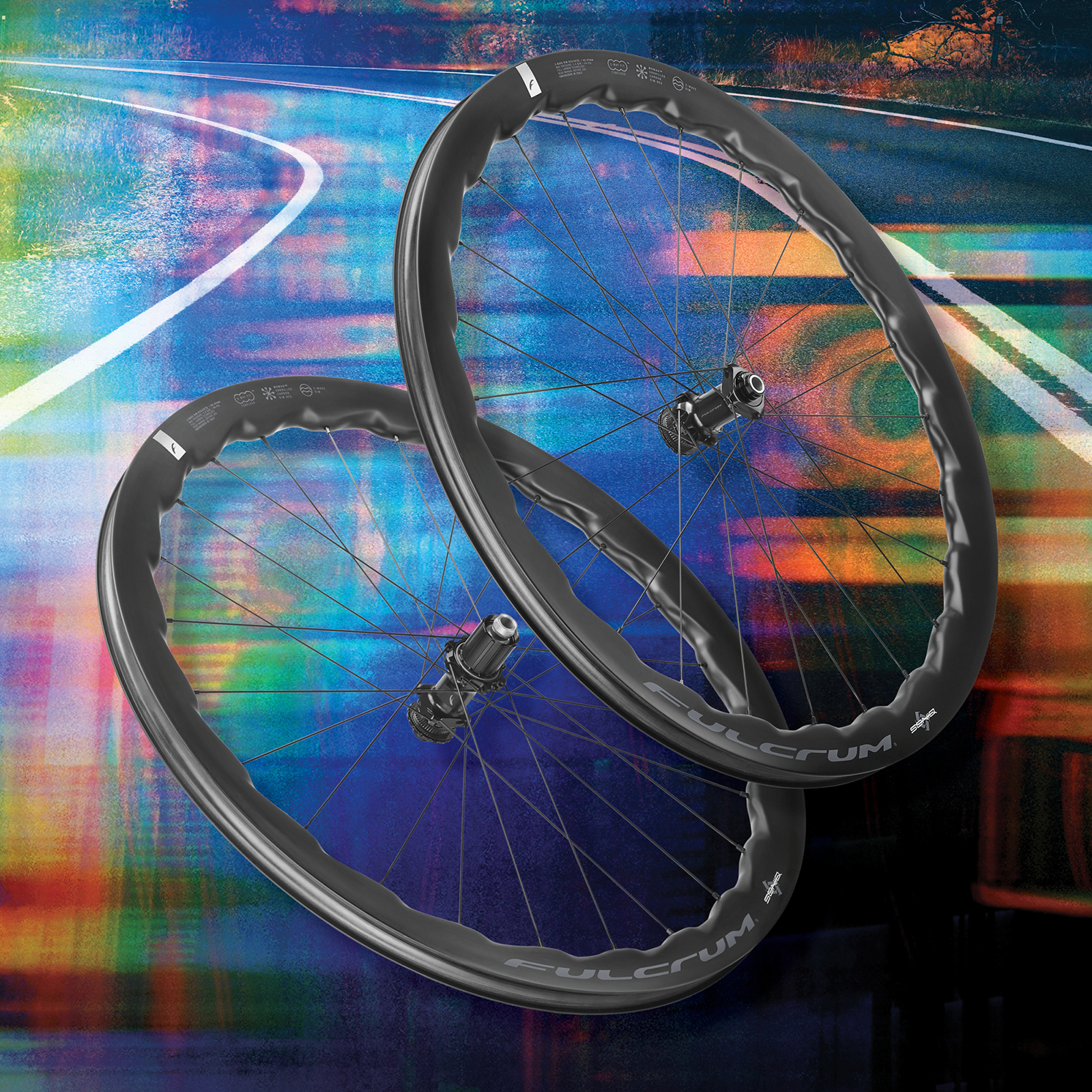
While Fulcrum hasn’t given much away about its FF80 lamination, it says the carbon design provides “maximum comfort, especially on long rides and mixed surfaces”.
When it launched the Wind wheels, Fulcrum also said the FF80 mix helped keep weight down compared to the carbon used in the Fulcrum Speed wheels, which had the same rim shape. So this carbon contributes to the Soniq’s claimed weight of 1,595g, too.
The Soniq 42 has Fulcrum’s 2-Way Fit technology, where an undrilled rim bed means you can fit tubeless tyres without rim tape.
“This makes the wheel not only stronger but also easier to manage and maintain – making Soniq 42 ideal for both seasoned cyclists and those seeking a high-quality, hassle-free product,” says Fulcrum.
2-Wave rim
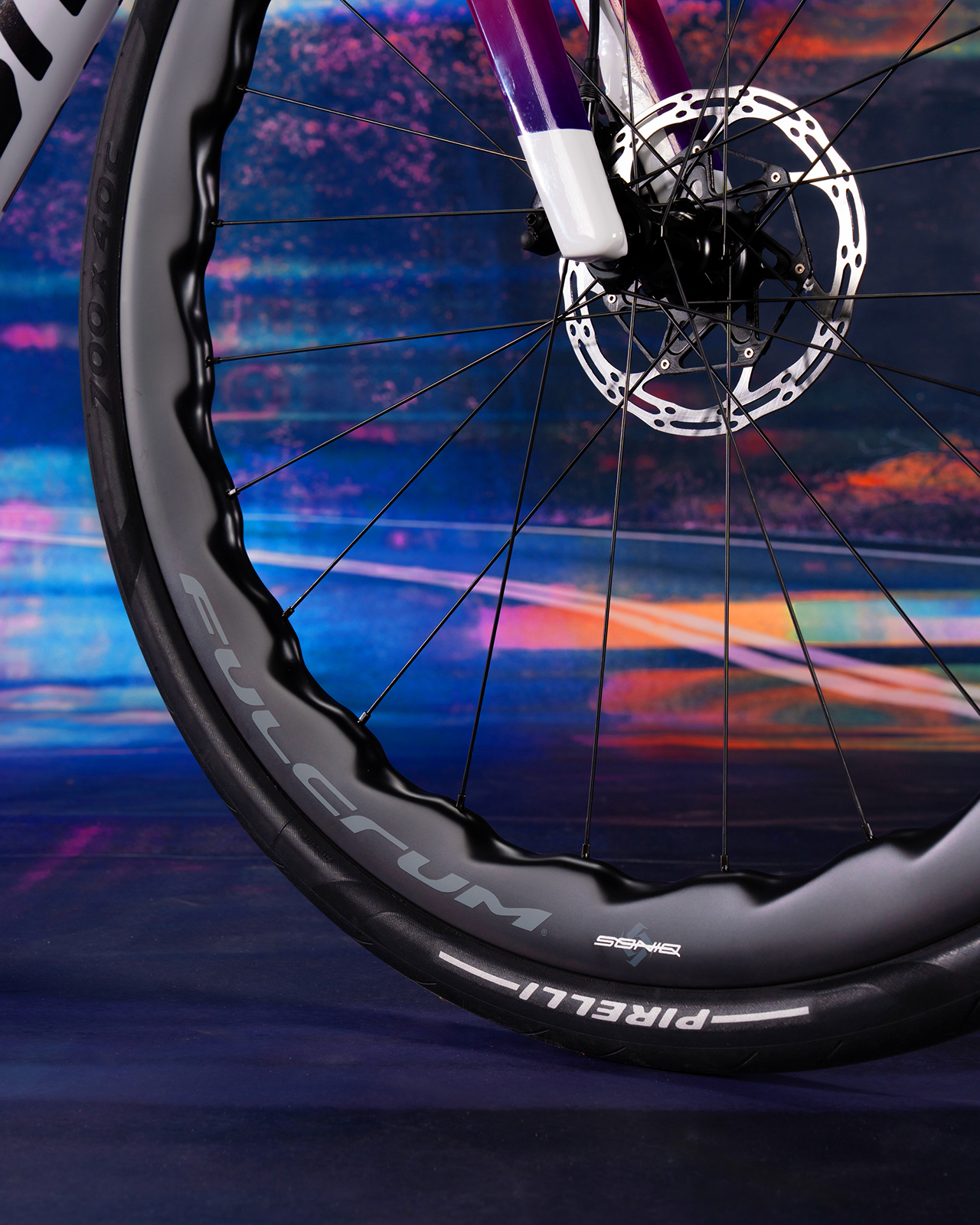
The most distinctive feature of the Soniq 42 is the sawtooth rim, which it borrows from the Sharq wheels.
It’s a design we’ve seen from other brands, such as Zipp and Princeton CarbonWorks, and Fulcrum says it “optimises aerodynamics and stability”.
Fulcrum hasn’t gone into any more detail, but if the rim is identical to that of its Sharq wheels, it should save 21 per cent energy at 0-10 degrees of yaw, and 29 per cent at 10-20 degrees.
Due to the wavy design, the rim depth varies from 42 to 47mm. Fulcrum says this “contributes to the wheel’s dynamic and responsive behavior”.
The rim has an internal width of 25mm.
A hub derived from the Wind series
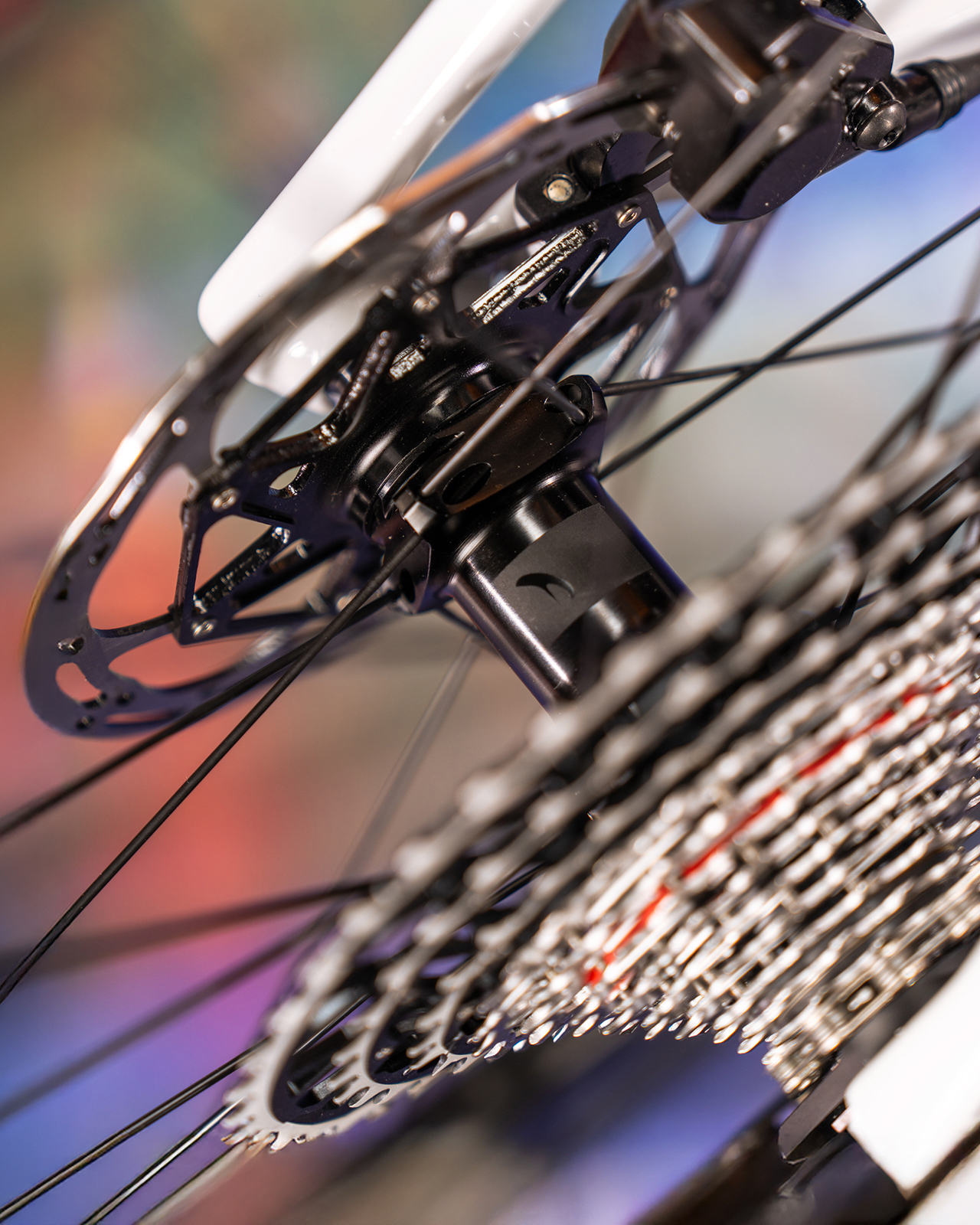
Fulcrum says the hub on the Soniq 42 wheels is “derived” from the hub used on its Wind wheels.
With an aluminium body, the hub has sealed bearings and preload adjustment. Fulcrum says this “ensures long-lasting smooth rolling” for a “solid and precise ride feel”.
The new Soniq 42 wheelset costs £1,599.99 / $2,079 / €1,590.
You may like
This rider’s simple homemade energy gel recipe saves him $300 a month and can be made anywhere
A Canadian endurance rider has turned to homemade energy gels to fuel his training, claiming his simple DIY recipe cut his nutrition costs by more than $70 a week – and it’s easy enough for any rider to create their own at home.
Oliver Dowd says he began experimenting with gels after realising the volume he needed for long rides made shop-bought products unaffordable. “I wanted the convenience of gels in training,” he explains, “but with the amount I was going through, I couldn’t afford to buy them.”
Dowd consumes between 25 and 30 gels each week. At retail prices, that would typically cost him around $80.
By mixing his own using little more than sugar, sodium alginate and water flavouring, he estimates he spends only $5 per week.
Each serving contains around 70g of carbohydrate – “the important metric everyone cares about,” he says in a video posted on his Instagram feed – putting his recipe in line with commercial gels.
- Read more: Are your energy gels lying to you? New study shows many products contain fewer carbs than claimed
Dowd originally developed the recipe while preparing for an attempt at the cross-Canada cycling record, which was derailed after an accident left him injured.
“I needed a way to make gels in a hotel room with no stove,” he says. A friend suggested sodium alginate as a substitute for cooking down the mixture, enabling him to refine the formula. Sodium alginate is used by brands, including Maurten, to create a gel-like consistency.
Before the accident, Dowd tested the gels during two days of back-to-back riding, consuming 15 servings per day without any stomach issues.
He hasn’t ruled out another record attempt in future, but admits it is “a lot to ask [of] my friends to take that much vacation to support me for two years in a row”.
For now, the gels remain his go-to fuelling option for training and long rides. “After tonnes of long rides as my main fuel source, I can confirm they do work,” he says.
Want to make your own?
SQUIRREL_PLAYLIST_10207918
Oliver Dowd’s simple energy gel recipe
- Place 70 g of sugar and a pinch (about 1/8 teaspoon) of sodium alginate into a measuring cup
- Pour in boiling water until the total volume reaches 100ml
- Mix thoroughly until all the dry ingredients dissolve. You may need to add a little more water to maintain 100ml
- Stir in a liquid flavouring, such as Kraft Heinz’s Mio or another water enhancer
- Once the mixture has cooled slightly, pour it into soft, reusable containers or silicone bottles for use on the bike
Dowd packages the gels in refillable silicone travel bottles bought online.
He says these are “no more messy than a regular gel” and reduce the waste of single-use wrappers. While the flavour doesn’t quite match his favourite store-bought options, he describes it as “good enough to eat for the whole day”.
Chris Froome suffered life-threatening heart injury in crash
Chris Froome suffered a life-threatening injury to his heart in a crash, alongside a broken back and ribs.
The four-time Tour de France champion was airlifted to hospital last Wednesday after he collided with a road sign at more than 30mph.
Initially, Israel–Premier Tech, Froome’s team, reported that he had sustained a collapsed lung, five broken ribs and a lumbar vertebrae fracture. However, during surgery, doctors discovered the 40-year-old Briton had sustained a pericardial rupture, which is a tear to the sac that surrounds the heart and is usually the result of a blunt impact.
“It was obviously a lot more serious than some broken bones,” Michelle Froome, his wife, told The Times. “He’s fine but it’s going to be a long recovery process.”
Chris Froome’s surgery took place at the Sainte Anne Toulon military hospital, which is the highest-level trauma centre in the region and specialises in thoracic surgery.
French newspaper L’Equipe reported that Froome remained conscious after the crash and was able to speak to those around him.
Froome, who is out of a contract for the end of the year, previously suggested 2025 could be his final year of competitive racing – and the crash could bring an end to his professional career.
“He won’t be riding a bike for a while. Chris is happy for you to share this because people need to understand what is going on,” said Michelle Froome.
Froome is one of the world’s most decorated professional cyclists. He has won a total of seven Grand Tours. He won his first Tour de France title in 2013, followed by consecutive victories in 2015–2017. He has also won one edition of the Giro d’Italia and two editions of the Vuelta a España.
Froome suffered a heavy crash at the Critérium du Dauphiné in 2019, which saw him taken into intensive care.
Join Team Italy: More Rides, ZRL Teams, Pizza and Fun!
Team Italy is a longstanding Zwift club and racing team that helps riders of all abilities improve their fitness while having fun and competing in a supportive environment.
The Zwift Italy/Team Italy community was founded on January 4, 2017, with the goal of creating an all-Italian community on Zwift. Our numbers keep on growing thanks to inspiring leaders who motivate Zwifters from Italy and around the world to join our rides. Participation is also strong among women, thanks to our legendary “Pink Ladies!”
We proudly take part in the Zwift Racing League with both male and female teams. A big applause goes to our ZRL captains, who are reaching important goals and growing their leadership skills. We also have the Zwift Running Italy group for runners!
Our community is growing across all social channels, and Team Italy is active on Zwift Companion too. The Italian presence is strong and engaged — we want to play a significant role in the global Zwift community!
The club hosts ten group rides every week, including:
- Social rides for beginners
- Competitive training sessions
- A climbing & endurance event
- The famous Burn Calories Ride (perfect for pizza lovers)
We ride to train, but we also ride to enjoy more pizza and pasta — our special combo! Our ride leaders and our amazing red broom wagon make every event welcoming and fun.
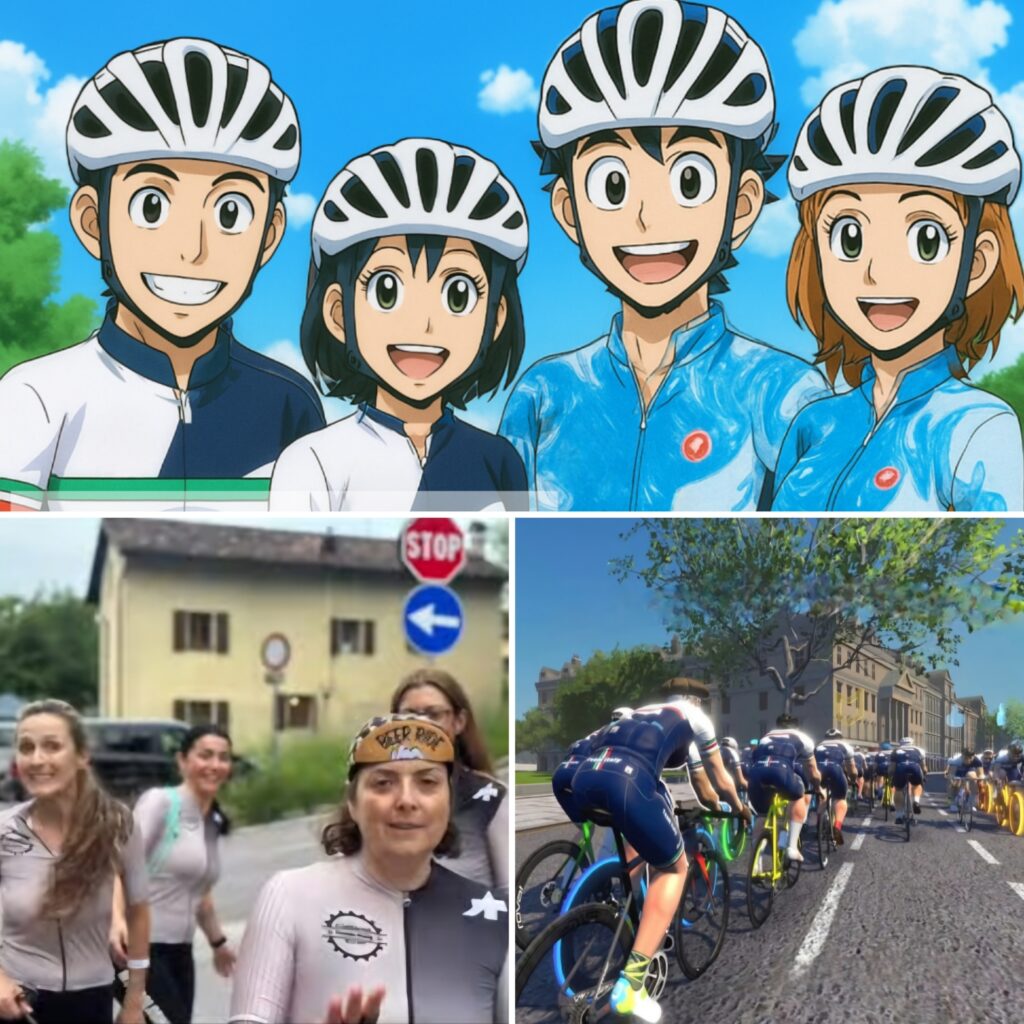
Our weekly Rides include:
- Fat Burn Ride
- Super Early Ride
- Social SUB2 Ride
- Burn Calories Together Ride
- Endurance – Badge Hunting Ride
- Morning Early Ride
- Monday Afternoon Relax w/Rubberband Ride
- Smile! It’s Tuesday Ride
- Coffee Italian Ride
- Hunting Ride
See all Team Italy rides at zwift.com/events/tag/teamitaly >
Standing ovation for our Ride Leaders and Sweepers:
Elvira Wilhelm, Lily Franken, Cris Benato, Angela Di Prisco, Marco Xibilia, Simone Maffi, Niccolo’ Martinoli, Christopher Vigna, Andrea Anastasio, Oleg Smirnov, Nacho Rodriguez, Alberto Roncalli, Paolo Cairoli, Jason Taylor, Steffen Riemer, Mario Serratore, Massimo Asti, Eugenio Milano, Angelo Barra, Jim Brauer “Höf”, Jayde Cardoso, Enrico Oggiano, Fabrizio Germani, Thierry Bøudøuresque, Luca Acco, Milo Rad, Sergio Mercky, Felice De Rosa, Rob Julian, Enrico “Groot”, Fabio Benotti, Stefano Vesprini, Massimiliano Caccia, Silvio Coggiola, Marco Tandu, Diego Zanin, Daniele Pascali, Etienne Constant, Robert Jones, Richard Mattinson, Marcello Ferraro, Fabio Cola.
Join us in our events by signing up for Team Italy on Zwift Companion and following us on our social channels (links below).
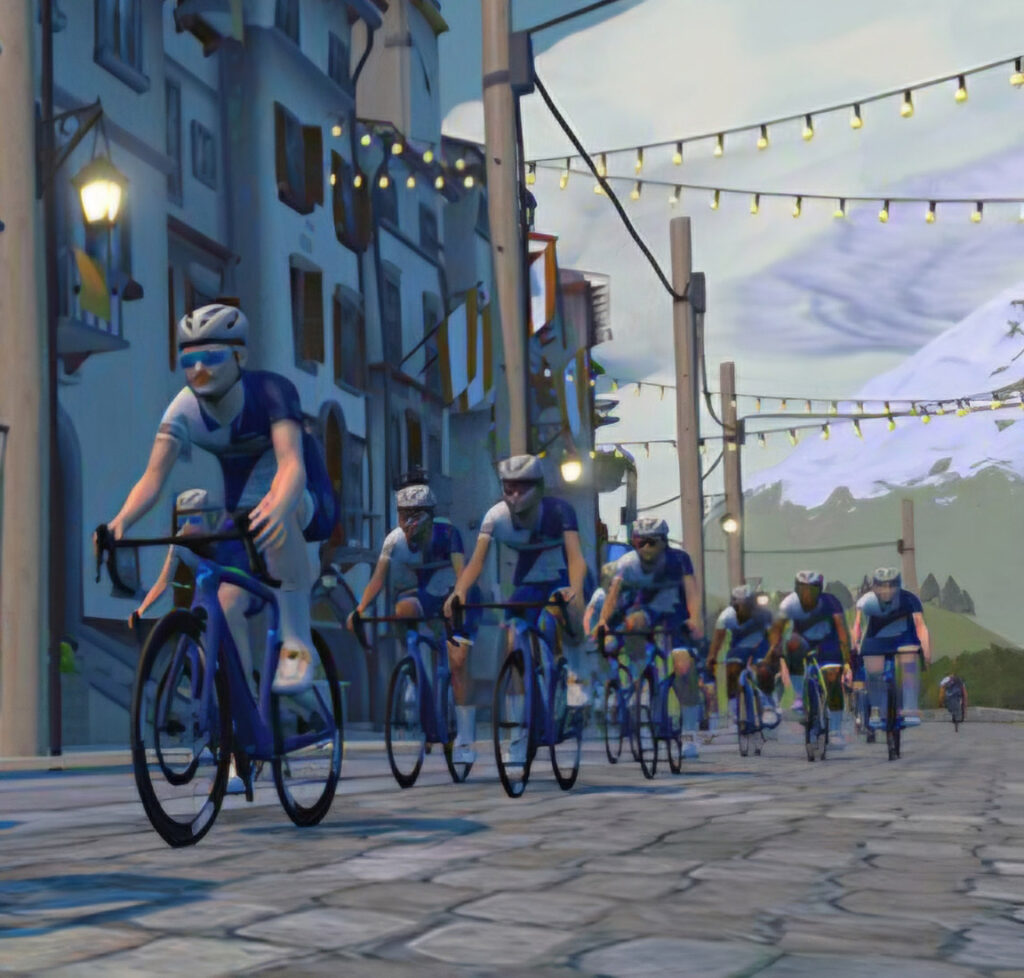
Zwift Italy and Team Italy are waiting for you — for fun rides, great company, and sharing the Zwift spirit with everyone!
Learn more about Zwift Italy/Team Italy:
- Facebook Group: https://www.facebook.com/groups/zwiftitaly
- Discord Channel: https://discord.gg/c7PGKGv
- Live Streaming: https://www.twitch.tv/teamitalylive
- Other Contacts: https://linktr.ee/TeamItalyECT
Ride On! Ciao.
This spec sheet shouldn’t exist at this price – Cube’s latest gravel bike is absurdly good value
Hidden among Cube’s sprawling 2026 line-up is the Nuroad C:62 SLT – a race-focused carbon gravel bike with a spec sheet list that looks outrageous for the money.
For £5,299 (international pricing TBC), you get a full SRAM Red XPLR groupset with power meter, Newmen Advanced SL X.R.36 Vonoa carbon wheels, and a suite of Cube’s own carbon finishing kit.
Although a road bike, the Boardman SLR made waves at £5,500 for a similarly top-end build.
The difference is that Cube follows a more traditional dealer-to-shop model, meaning you can buy the Nuroad C:62 SLT at your local bike shop, with all of the benefits that brings.
- Read more: Best gravel bikes in 2025: top-rated carbon, aluminium, titanium and steel gravel bikes reviewed
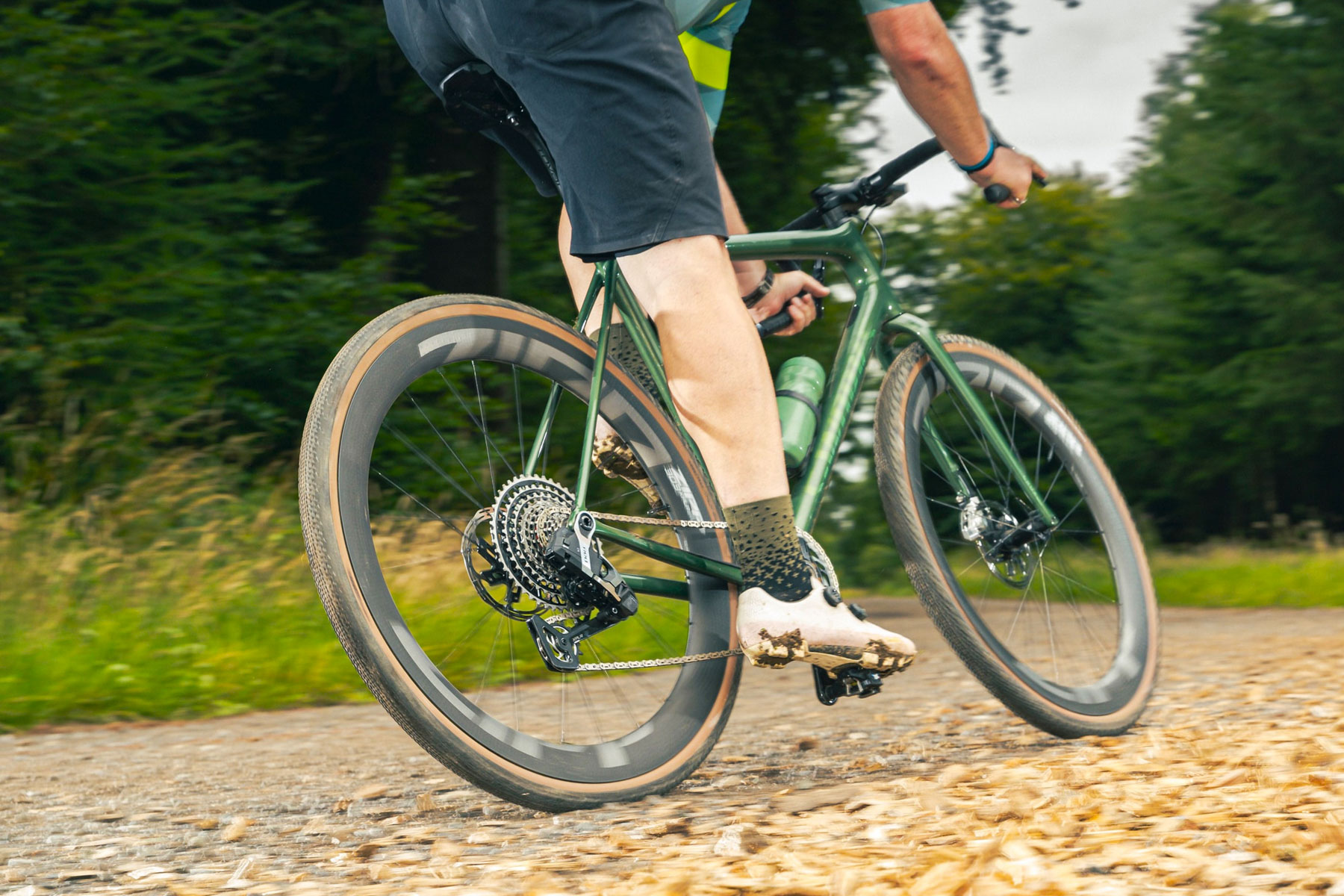
Comparing the build to other rivals, and the value is even more stunning.
Specialized is hardly a brand known for wild value for money, but an S-Works level Crux would set you back £11,500 – leaving you change to buy a whole other Nuroad C:62 SLT, and some.
Trek’s a bit closer at £8,950 for a Red-equipped Checkmate SLR 9 AXS, which features house brand Bontrager wheels, but that’s still significantly more than the Cube.
At least here in the UK, Giant doesn’t appear to offer a Red-equipped version of the Revolt. Regardless, a Force-equipped bike is still more expensive than the Cube, at £5,599 for a build with Giant’s in-house carbon wheels.
Even the usual value leaders like Canyon can’t quite match this spec sheet at the price. The brand’s lowest-priced Red-equipped Grail CFR XPLR is £7,899, although that comes with branded Zipp wheels.
Those aren’t exact like-for-like comparisons – the frameset specs are all very different – but based on build alone, Nuroad C:62 SLT is one of the most remarkably priced high-performance gravel bikes we’ve seen.
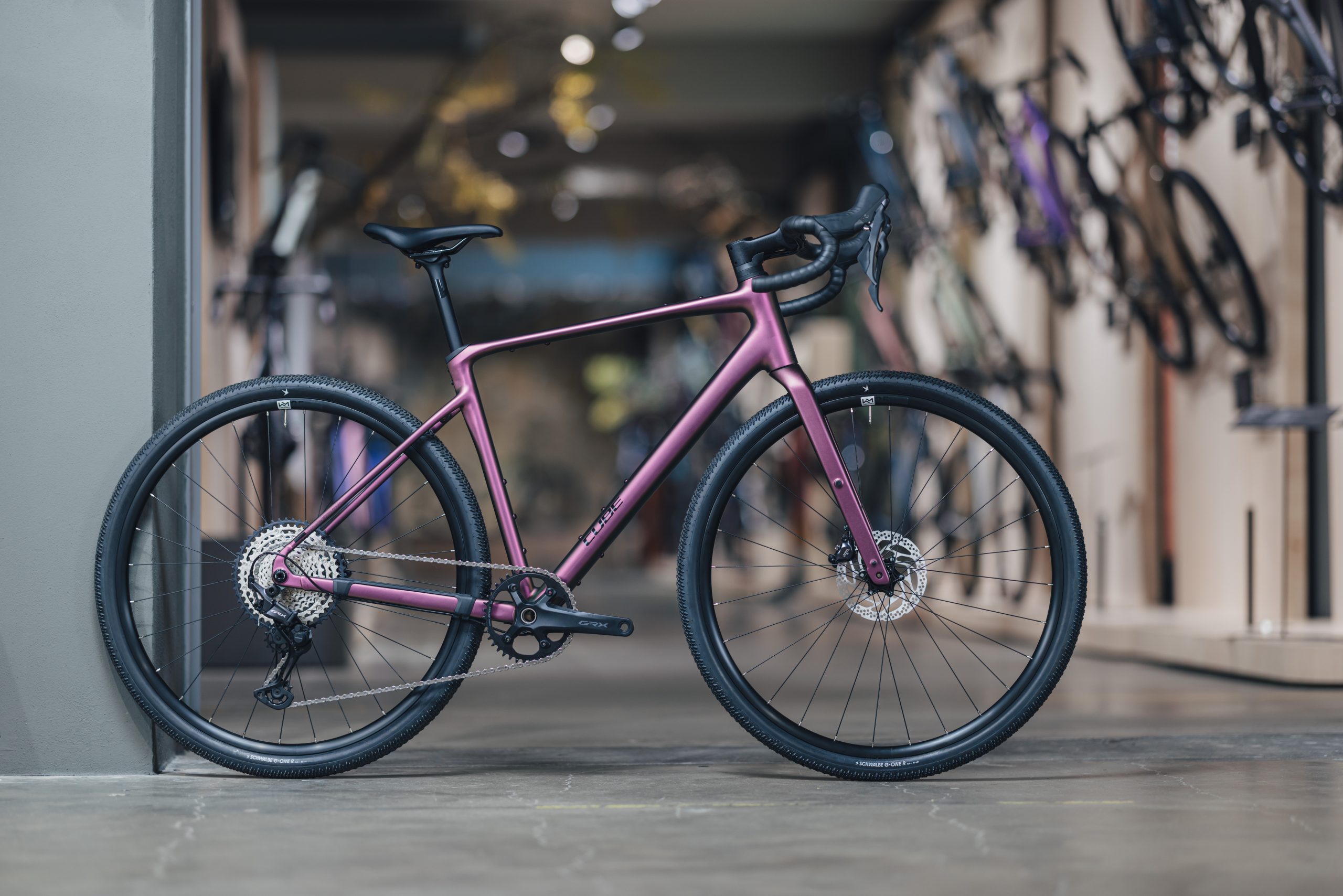
Alongside the SLT, the brand is also offering aluminium Nuroad models, which look very handsome for the modest asking price.
Pictured is the Nuroad SLX. Priced at just £1,799, it features a GRX-equipped build and Newmen alloy wheels.
The bike includes mounts for racks and clearance for 50mm tyres, and could make a great all-rounder likely to satisfy most gravel riders.
Zwift Climb of the Week Schedule
Zwift began featuring a Climb of the Week in August 2025, giving Zwifters the chance to earn an XP bonus by completing a particular portal climb. Here’s the schedule of featured climbs, including the bonus XP you’ll earn for completing each. (Click climb name for details.)
Featured climbs switch at 9am Pacific each Monday (noon Eastern, 4pm UTC).
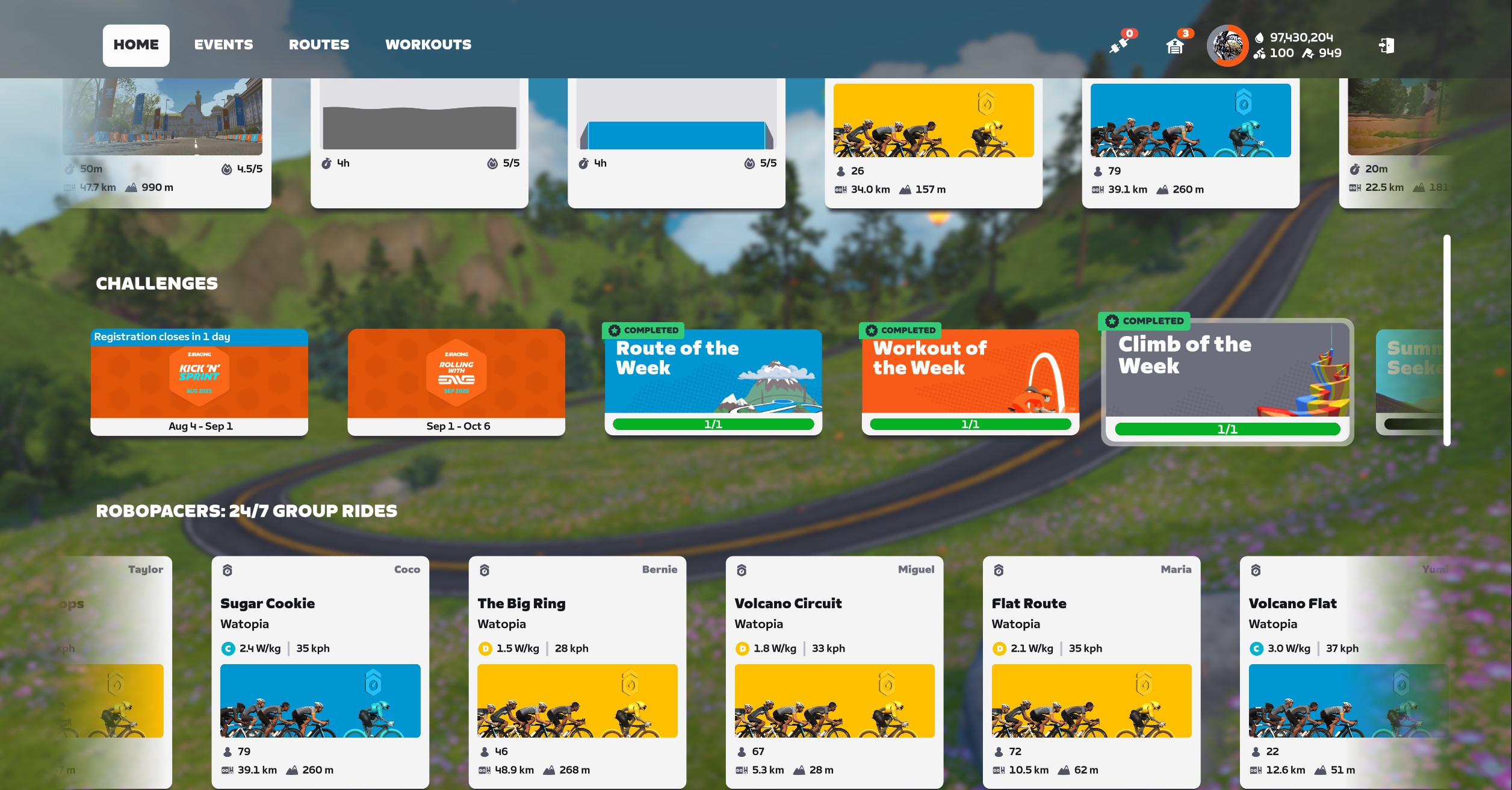
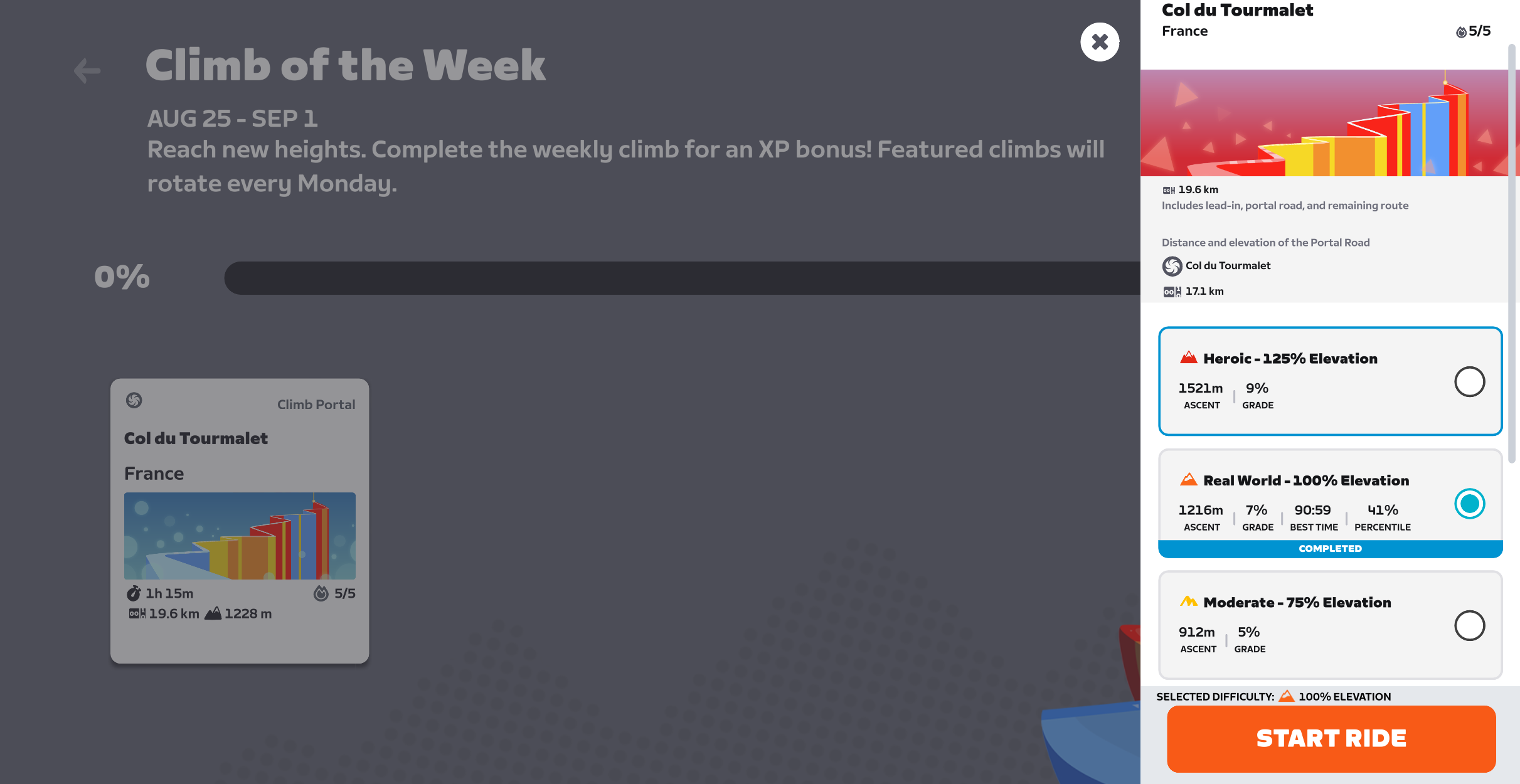
To access the Climb of the Week, begin by clicking the challenge card on the homescreen. Click the climb, confirm your difficulty percentage (you can ride the climb at 50%, 75%, 100%, or 125%), then click Start Ride.
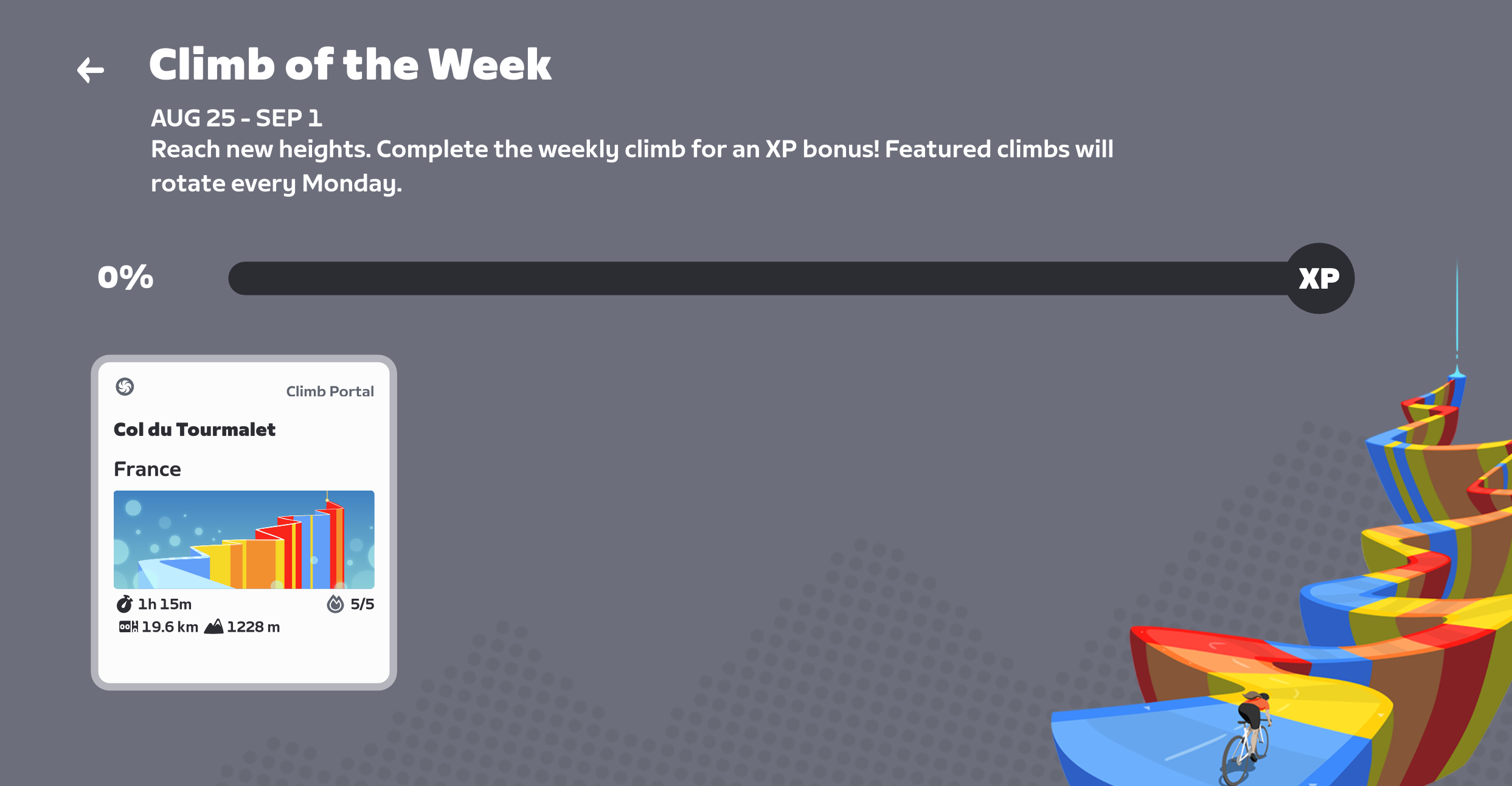
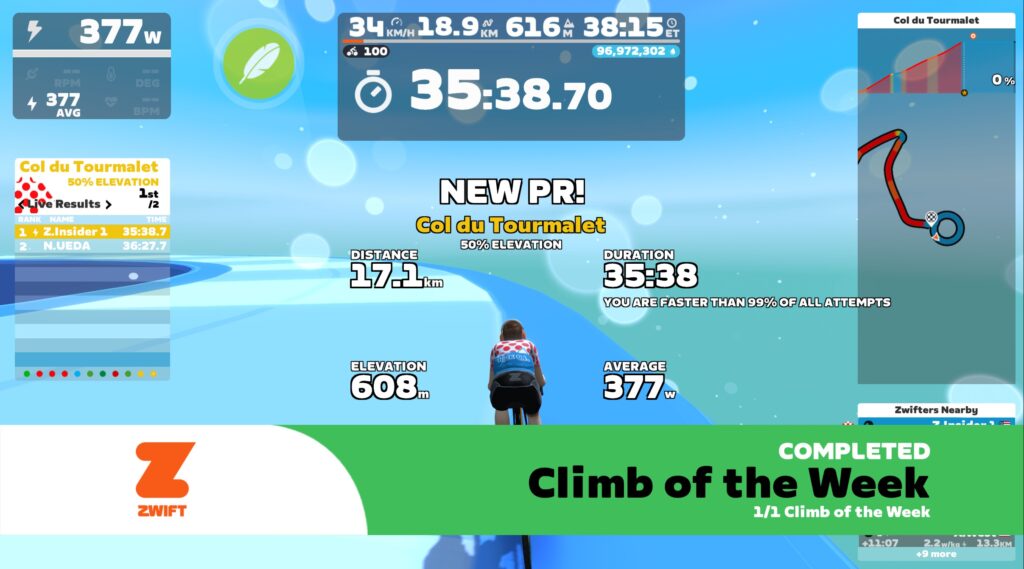
Finish the full climb and you’ll get a completion banner across your screen:
Double Up
The Climb of the Week can be stacked with the Workout of the Week to earn bonus XP extra fast.
To do this, you must first click the Workout of the Week challenge card to be “registered” for the week’s workout challenge.
Next, click the Climb of the Week challenge card, click the featured climb, and enter the game. Once you’re in the game, pull up the list of workouts (use the “E” keyboard shortcut or access it by clicking Menu>Workouts).
Find this week’s featured workout in the workout archive. (If you aren’t sure where to find it, click the workout on the WOTW calendar above to learn where it’s stored.) Load the workout and complete it while completing the Climb of the Week. Double the fun!
Questions or Comments
Questions or comments about the Climb of the Week? Share below!
Beloved British brand releases completely unexpected adventure ‘grountain’ bike
British bicycle company Pashley is known for its classic bike designs, including the Guv‘Nor (a 1930s-style race bike), and the step-through Britannia (complete with a wicker basket).
Yet the historic brand has modernised its approach in recent years. Pashley has been growing its line-up of electric bikes and, in January, released the Roadfinder SL, which blends the company’s steel frame-building expertise with up-to-date tech such as electronic gears and a SRAM UDH dropout.
Now Pashley’s latest bike, the Wildfinder, continues the brand’s change of direction and synthesis of old and new.
The bike is said to be an “all-terrain adventure machine” that is designed to “take a ride on the wild side”. And yes, we are still talking about the company that used to make bikes for the Royal Mail.
A ‘grountain’ bike
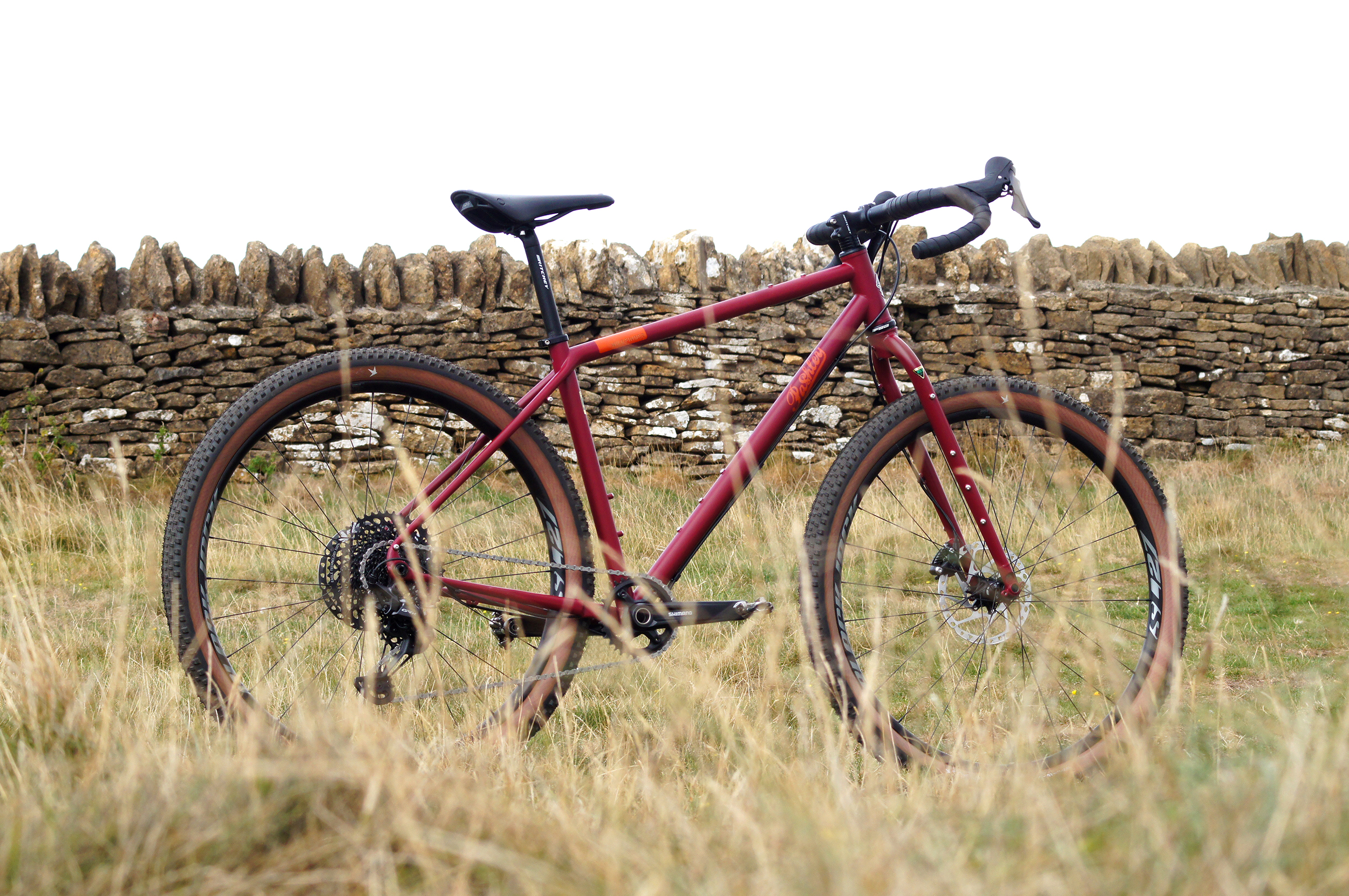
Pashley’s project design lead, Mark Lloyd, says: “We have designed the Wildfinder to be a drop-bar mountain bike, blurring the lines between gravel and mountain genres (I like to call it a ‘grountain’ bike) primarily designed to be a capable machine for long-distance, multi-day, off-road bikepacking expeditions.”
Lloyd adds that, even if you’re not on a bikepacking trip, the ‘grountain’ bike is equally at home exploring more challenging gravel terrain and singletrack.
Pashley has built the Wildfinder with this off-road capability and the more extreme end of gravel riding firmly in mind. It says the Wildfinder’s geometry has been suspension corrected, should you wish to run a gravel fork, and there is the option of a RockShox SID SL fork on all complete bikes and frameset options.
Elsewhere, the bike is UDH compliant, uses a BSA threaded bottom bracket and has external cable routing. Pashley says these features futureproof the bike and make maintenance easier when you’re out “in the wild”.
Cutting-edge manufacturing and craftsmanship
In keeping with the other gravel bikes in its ‘Finder’ collection, Pashley says the bike blends “cutting-edge manufacturing processes and technology with traditional craftsmanship”.
Pashley’s CEO Andy Smallwood says: “It’s the latest example of true British design and craftsmanship, incorporating the best use of Reynolds steel, all created from start to finish by our team of artisans in our Stratford-upon-Avon workshop right here in the UK.”
The frame is made using Reynolds 853 DZB tubing, which is coated for corrosion protection and has an “extra durable” powder finish, according to Pashley.
It features a 3D-printed junction between the seatstays and top tube, alongside a 3D-printed chainstay yoke, which provides clearance for 29×2.4in tyres and chainrings with up to 42 teeth. The 3D-printed dropouts accommodate a 180mm disc brake rotor, which Pashley says is “essential for fully loaded mountain touring.”
Mounting points across the frame mean you can fit the Wildfinder with frame bags, cages and racks.
The Wildfinder is available in five sizes (XS to XL) and in three recommended builds, with a choice of Shimano GRX, SRAM Rival and Shimano SLX groupsets, as well as flat or drop handlebars. Prices range from £2,795 / $4,195 to £3,995 / $5,995.
Zwift Workout of the Week Schedule
Zwift began featuring a Workout of the Week in August 2025, giving Zwifters the chance to earn an XP bonus by completing a particular workout. Here’s the schedule of featured workouts, including the bonus XP you’ll earn for completing each. (Click workout for details.)
|
||||||||||
| Monday | Tuesday | Wednesday | Thursday | Friday | Saturday | Sunday | ||||
| 1Jon’s Mix (500XP)Jon’s Mix (500XP) |
2Jon’s Mix (500XP)Jon’s Mix (500XP) |
3Jon’s Mix (500XP)Jon’s Mix (500XP) |
4Jon’s Mix (500XP)Jon’s Mix (500XP) |
5Jon’s Mix (500XP)Jon’s Mix (500XP) |
6Jon’s Mix (500XP)Jon’s Mix (500XP) |
7Jon’s Mix (500XP)Jon’s Mix (500XP) |
||||
| 8Orange Unicorn (750XP)Orange Unicorn (750XP) |
9Orange Unicorn (750XP)Orange Unicorn (750XP) |
10Orange Unicorn (750XP)Orange Unicorn (750XP) |
11Orange Unicorn (750XP)Orange Unicorn (750XP) |
12Orange Unicorn (750XP)Orange Unicorn (750XP) |
13Orange Unicorn (750XP)Orange Unicorn (750XP) |
14Orange Unicorn (750XP)Orange Unicorn (750XP) |
||||
| 15Expand (250XP)Expand (250XP) |
16Expand (250XP)Expand (250XP) |
17Expand (250XP)Expand (250XP) |
18Expand (250XP)Expand (250XP) |
19Expand (250XP)Expand (250XP) |
20Expand (250XP)Expand (250XP) |
21Expand (250XP)Expand (250XP) |
||||
| 22The Kitchen Sink (500XP)The Kitchen Sink (500XP) |
23The Kitchen Sink (500XP)The Kitchen Sink (500XP) |
24The Kitchen Sink (500XP)The Kitchen Sink (500XP) |
25The Kitchen Sink (500XP)The Kitchen Sink (500XP) |
26The Kitchen Sink (500XP)The Kitchen Sink (500XP) |
27The Kitchen Sink (500XP)The Kitchen Sink (500XP) |
28The Kitchen Sink (500XP)The Kitchen Sink (500XP) |
||||
| 29Melange (750XP)Melange (750XP) |
30Melange (750XP)Melange (750XP) |
|||||||||
|
||||||||||
Featured workouts switch at 9am Pacific each Monday (noon Eastern, 4pm UTC).
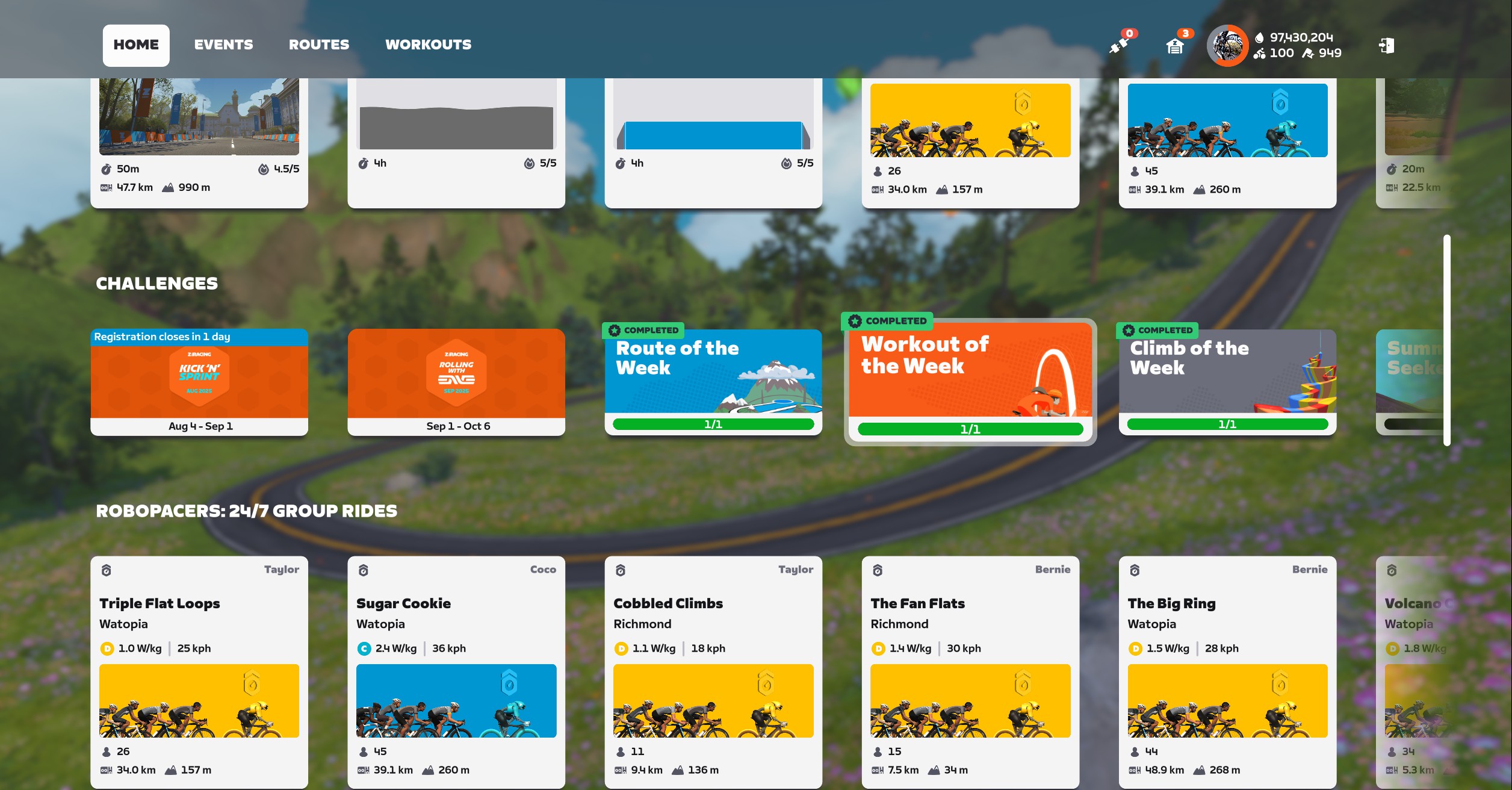
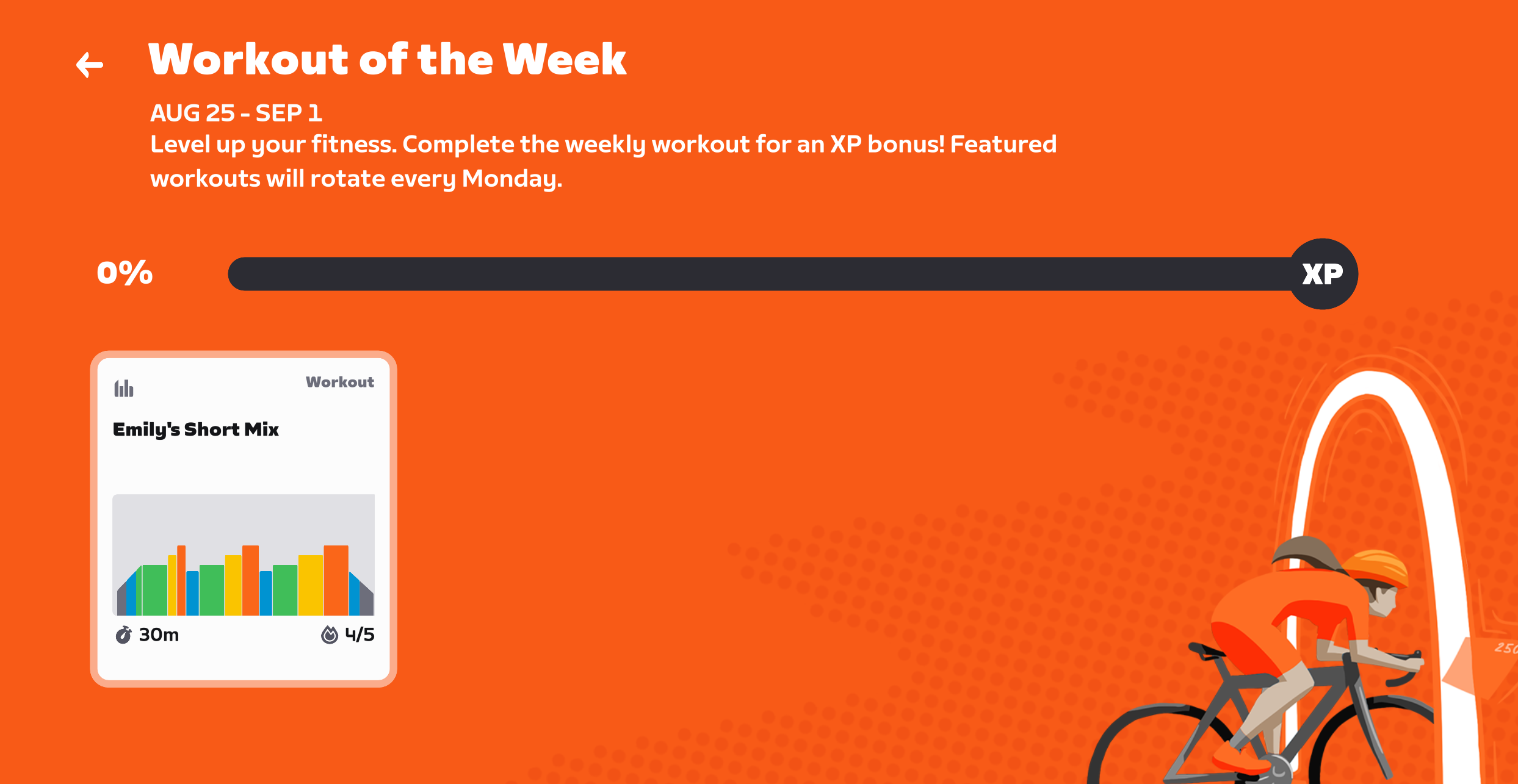
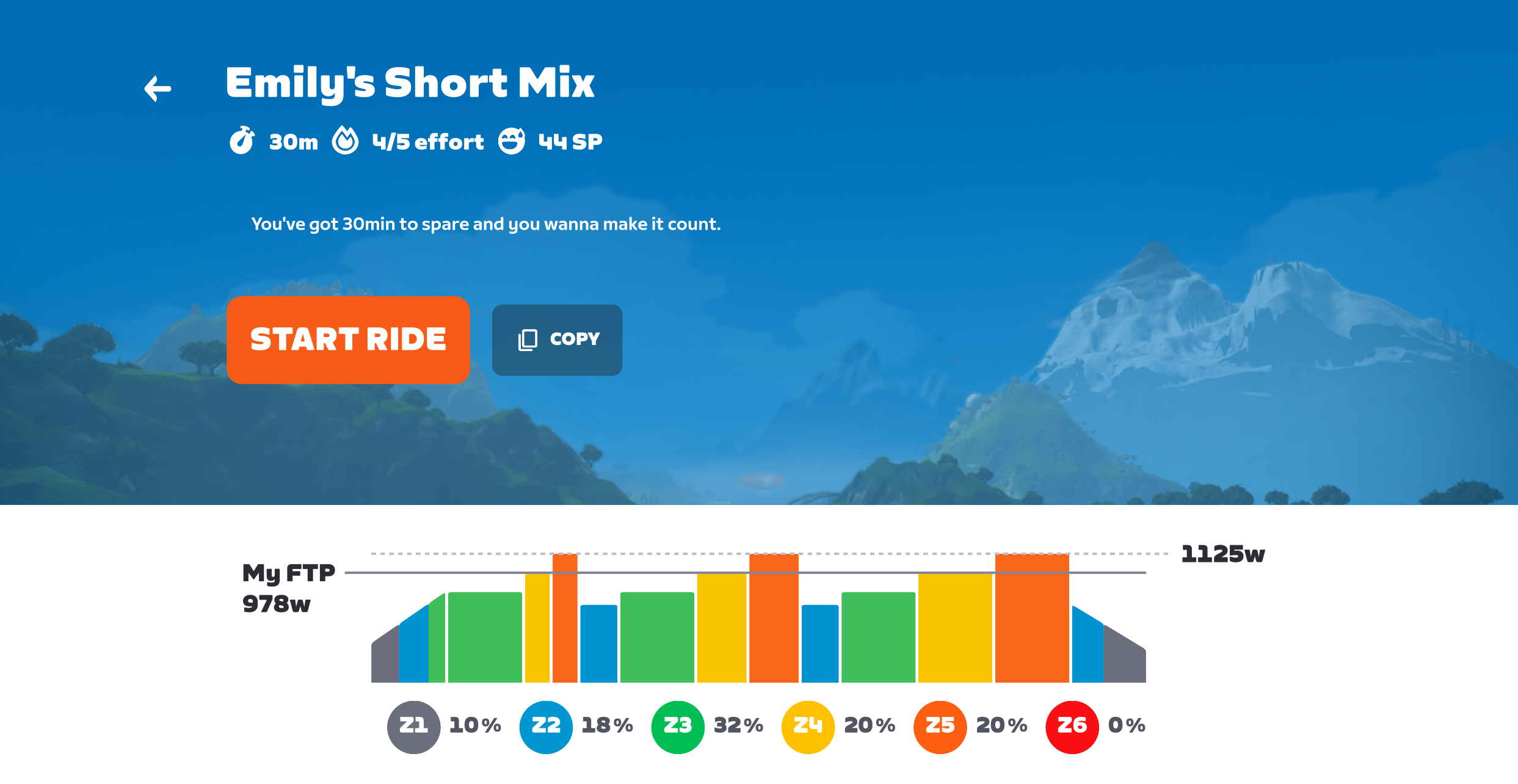
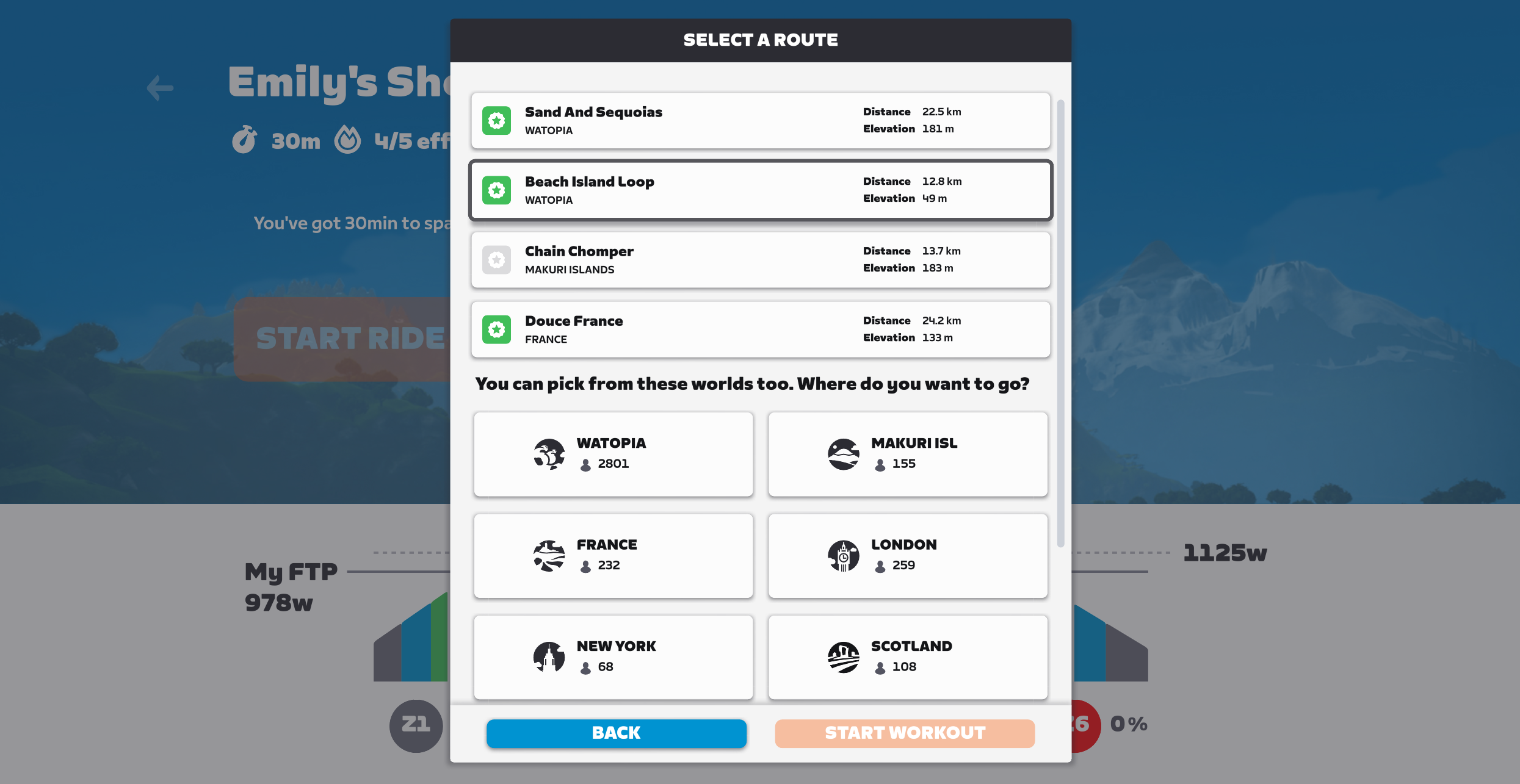
To access the Workout of the Week, begin by clicking the challenge card on the homescreen. Click the workout, click Start Ride, choose your route, and click Start Workout.
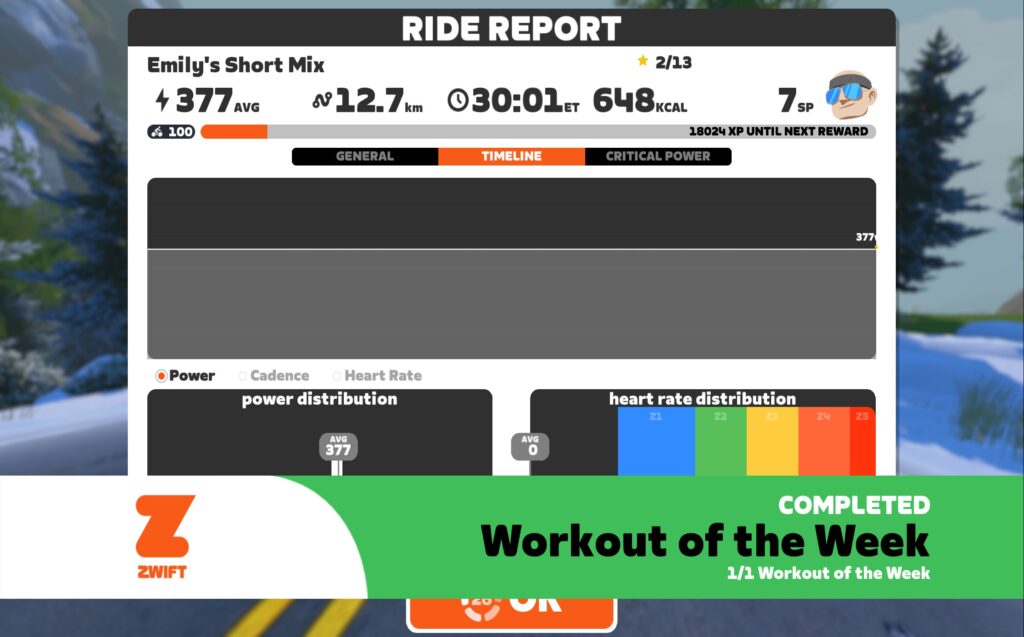
Finish the full workout and you’ll get a completion banner across your screen:
Double Up
Workouts of the Week can be stacked with the Route or Climb of the Week to earn bonus XP extra fast.
To do this, you must first click the Workout of the Week challenge card, which brings you to the orange screen shown above. This “registers” you for the week’s workout challenge.
Next, go through either the Route of the Week or Climb of the Week challenge cards to select a challenge and enter the game. Once you’re in the game, pull up the list of workouts (use the “E” keyboard shortcut or access it by clicking Menu>Workouts).
Find this week’s featured workout in the workout archive. (If you aren’t sure where to find it, click the workout on the calendar above to learn where it’s stored.) Load the workout and complete it while completing the Route or Climb of the Week. Double the fun!
Questions or Comments
Questions or comments about the Workout of the Week? Share below!
New Pinarello F-series frameset weighs just 100g more than the Dogma F, but costs thousands less
Pinarello’s updated range of F-Series road bikes improves aerodynamic efficiency, frame stiffness, and ride quality of the brand’s entry-level road bike, bringing features seen on the Flagship Dogma F to models starting at £4,000 / €4,500 / $5,200.
Alongside the updated frames, Pinarello has also broadened tyre clearance to 32mm.
Carbon layups vary across the F-Series, with T900 used on the top-tier F9 and F7, T700 on the mid-level F5 and F3, and T600 reserved for the entry-level F1. The F1 remains the entry-level model (£3,000 / $3,250 / €3,400) but retains the previous frameset design.
Updates centred on performance
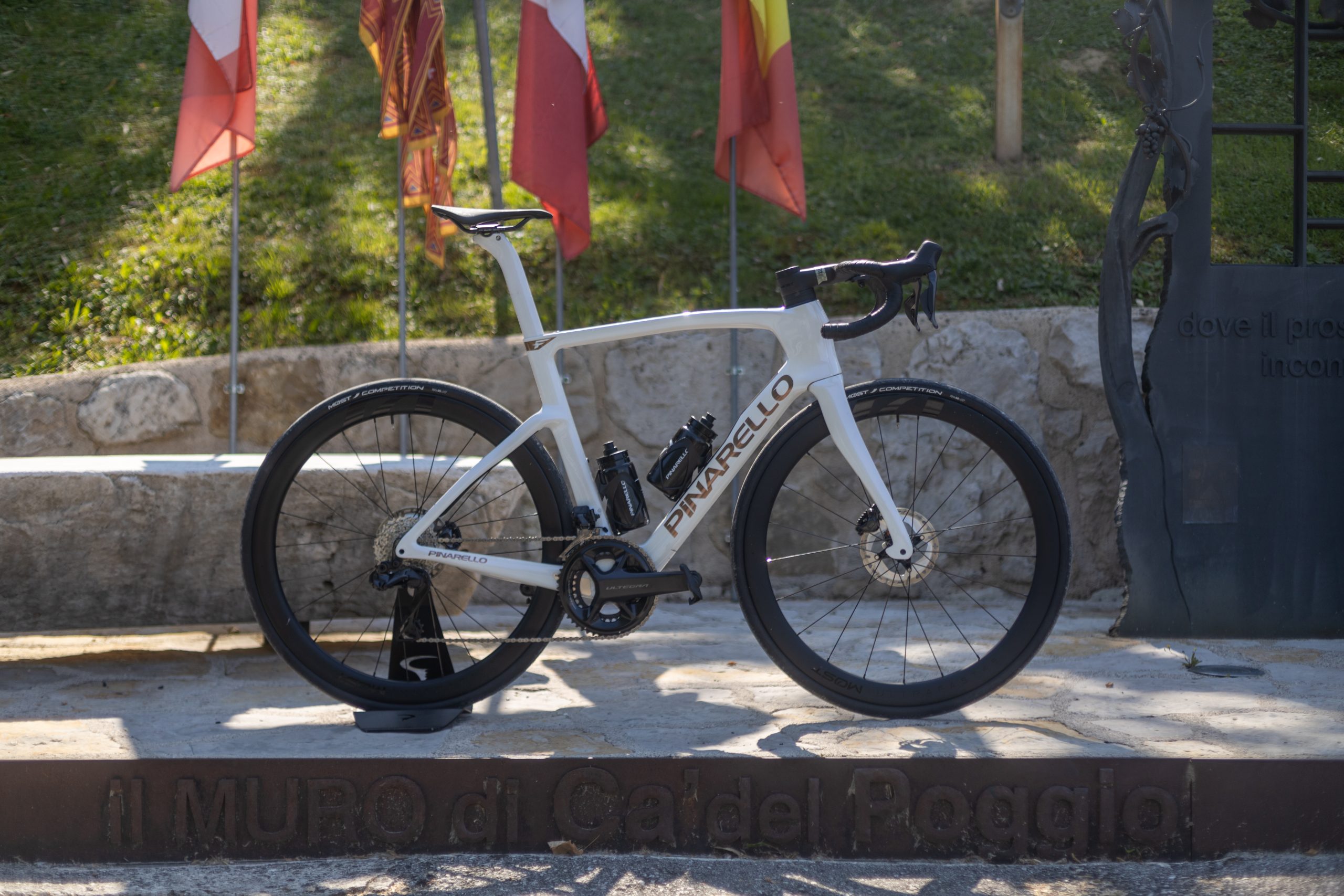
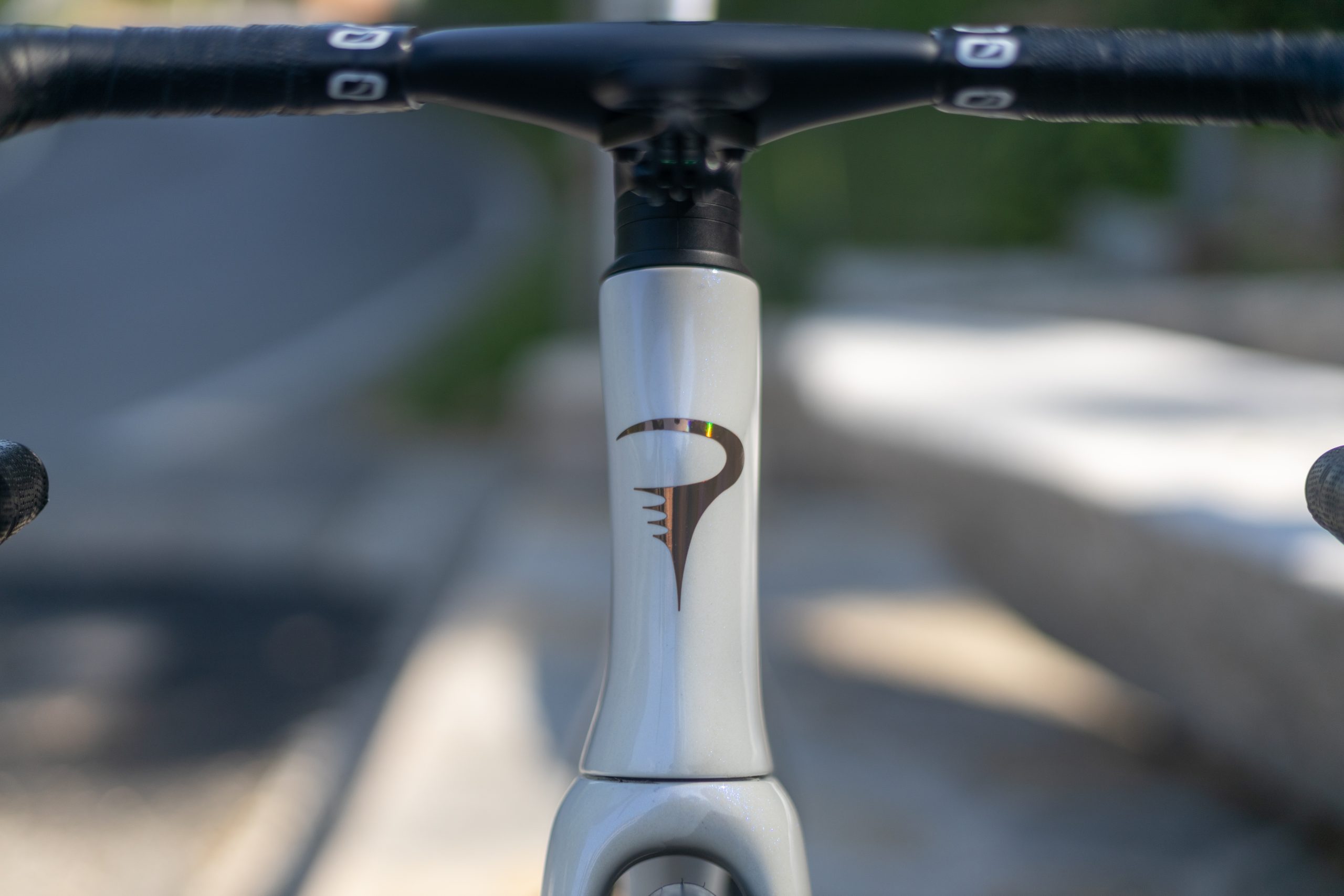
Central to the new F-Series frame is a new head tube and steerer assembly derived from the Dogma F.
The redesigned head tube is narrower than before, which Pinarello says improves the F-Series’ aerodynamics. This houses an elliptical steerer tube that’s similar to Dogma F’s.
This has enabled the brand to adopt the flagship bike’s E-TiCR (Total Internal Cable Routing) system, which it claims offers improved serviceability.
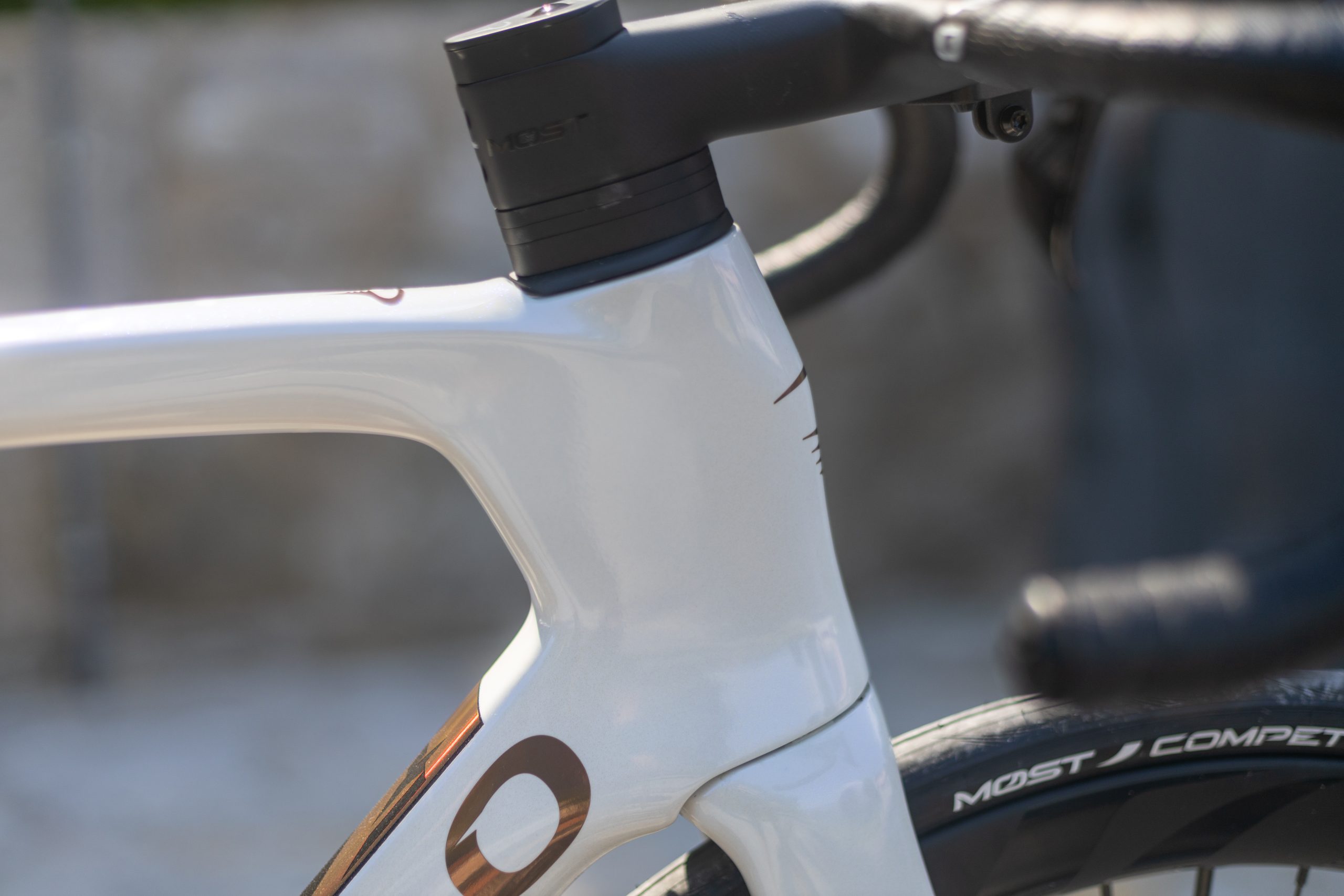
Also notable are modifications to the down tube profile (using aerofoil-inspired profile with a blunt training edge) and slimmer fork legs, which are said to improve aerodynamics, and a beefed-up bottom bracket.
This adopts the Aero Keel layout, which debuted on the Dogma F. Pinarello claims this smoothes airflow around the area disturbed by moving feet and legs, while offering a stiff platform for high-powered efforts.
It’s worth noting that Pinarello hasn’t offered any comparative aerodynamic testing data against the Dogma F, or rival bikes, though.
The rear triangle has also been revised with a marginally bulkier design to reduce torsional (twisting) motion, thereby improving power transfer, according to Pinarello. Tyre clearance has also increased to 32mm (from 30mm).
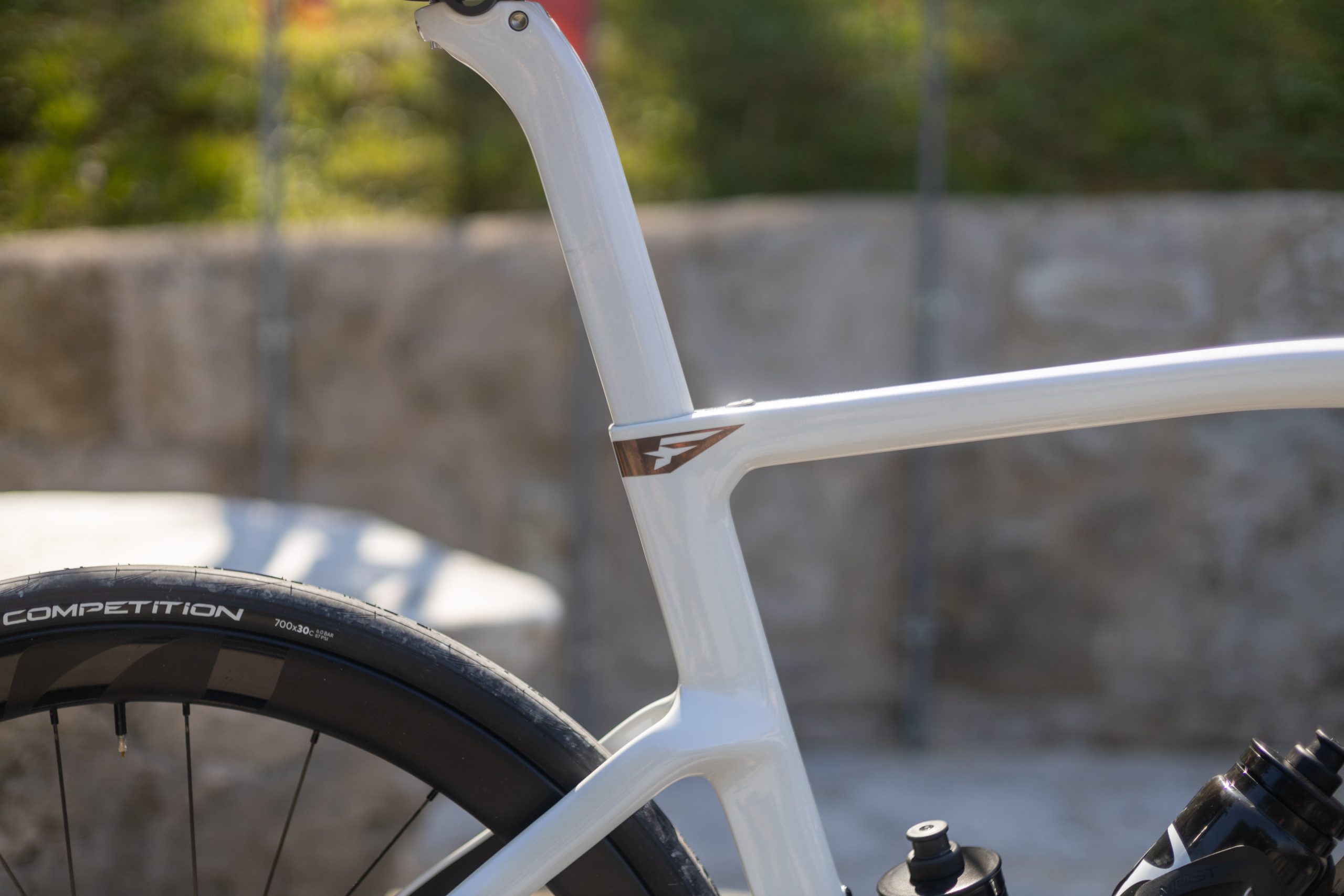
The geometry of the new F-Series remains race-oriented and closely mirrors that of the Dogma F.
Pinarello offers the F-Series in nine frame sizes (two fewer than the Dogma F, but generally up to four more than brands typically offer), ranging from 425 to 595mm seat tube lengths.
Model breakdown and availability
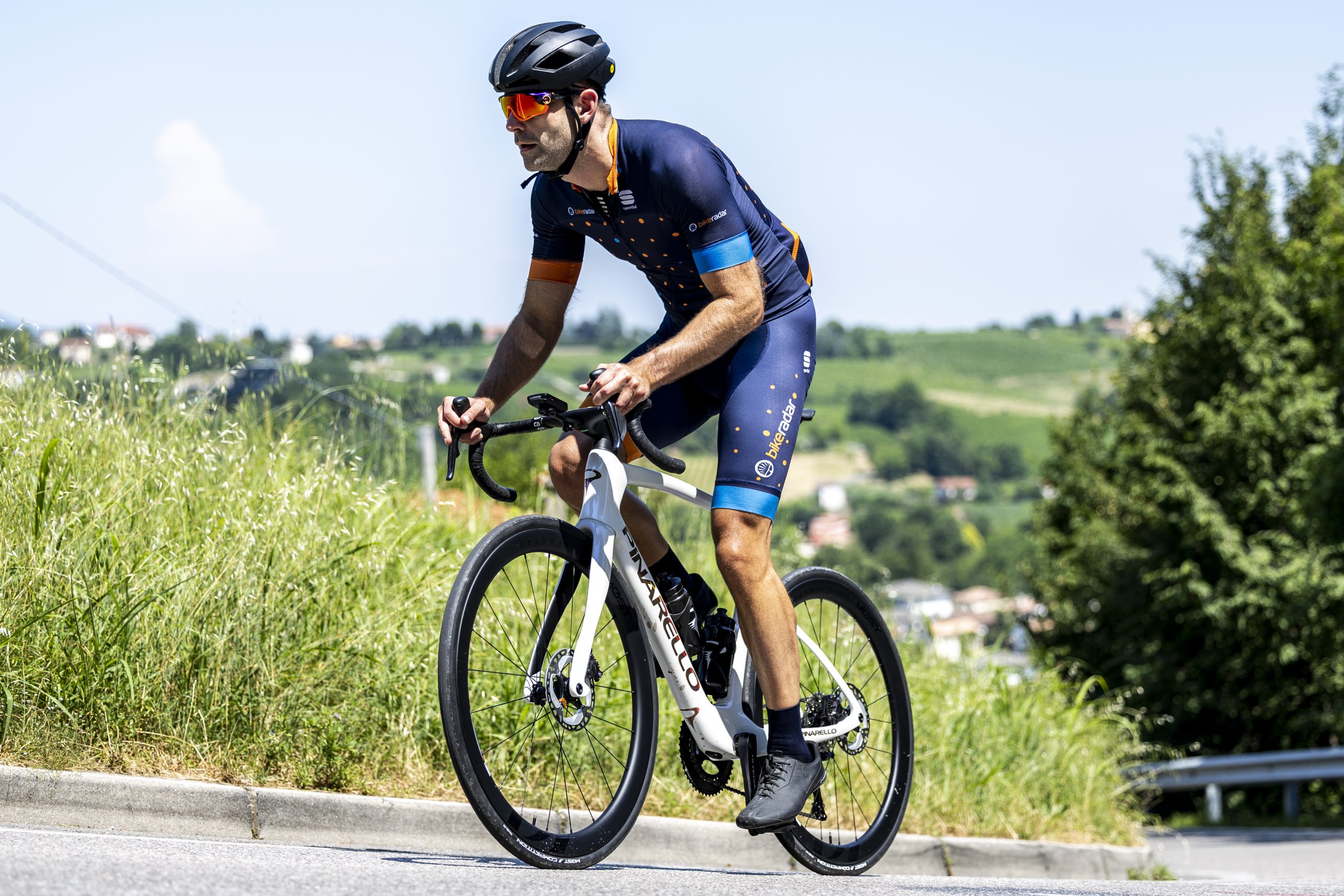
The F-Series is available in five model ‘tiers’.
The F9 comes with a Shimano Dura-Ace Di2 R9200 groupset and MOST Ultrafast 45 DB wheels, while the F7 is available with either Shimano Ultegra Di2 R8100 or SRAM Force AXS drivetrains.
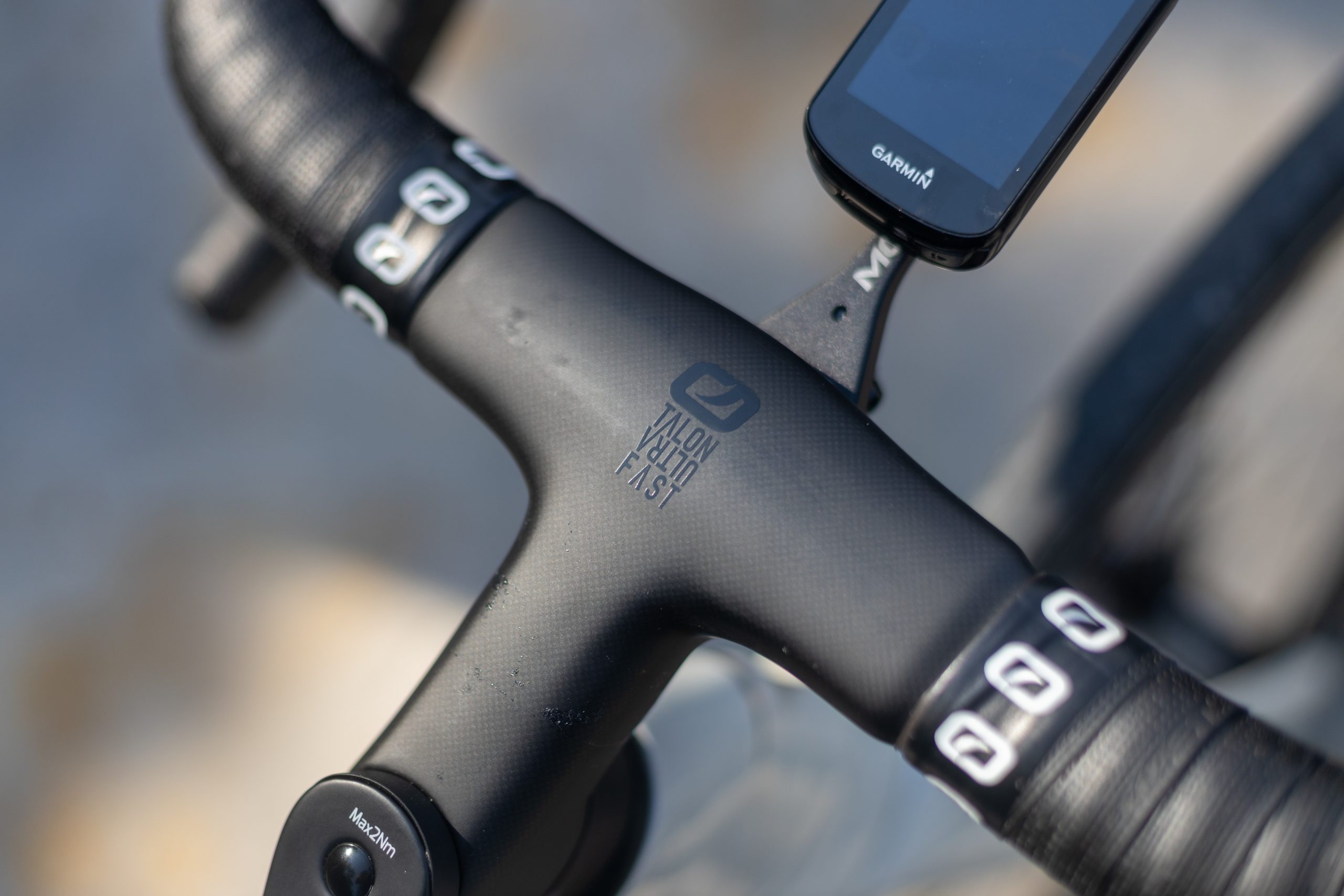
Both feature one-piece Most Talon Ultra Fast cockpits, which were first introduced on the Dogma F.
Pinarello says the F9 weighs 7.4kg, in an unspecified size, while the F7 comes in at around 7.8kg.
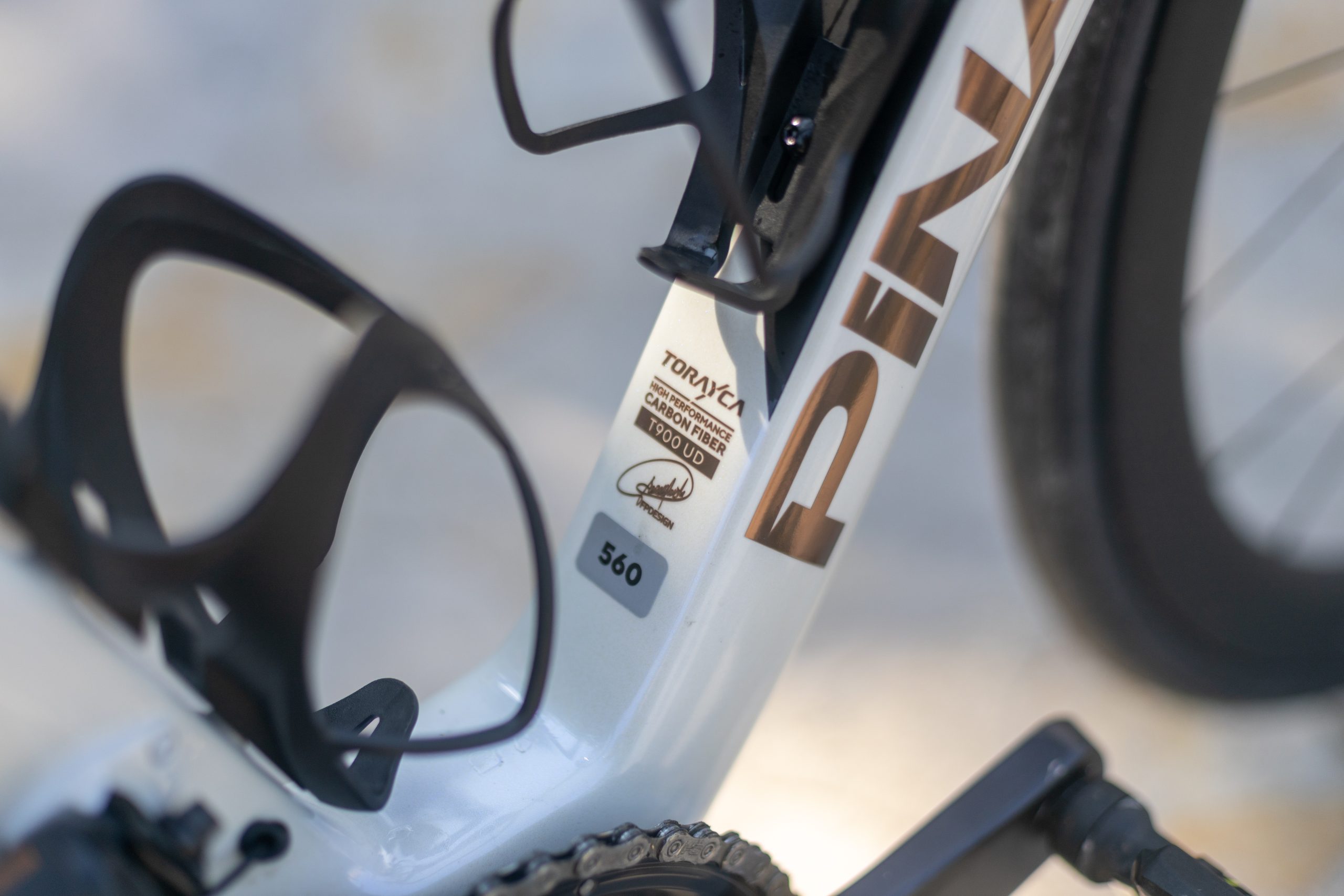
These the top-level framesets use Toray T900 carbon fibre, and are said to weigh around 100g more than the Dogma F, but specific frame weights for either aren’t given.
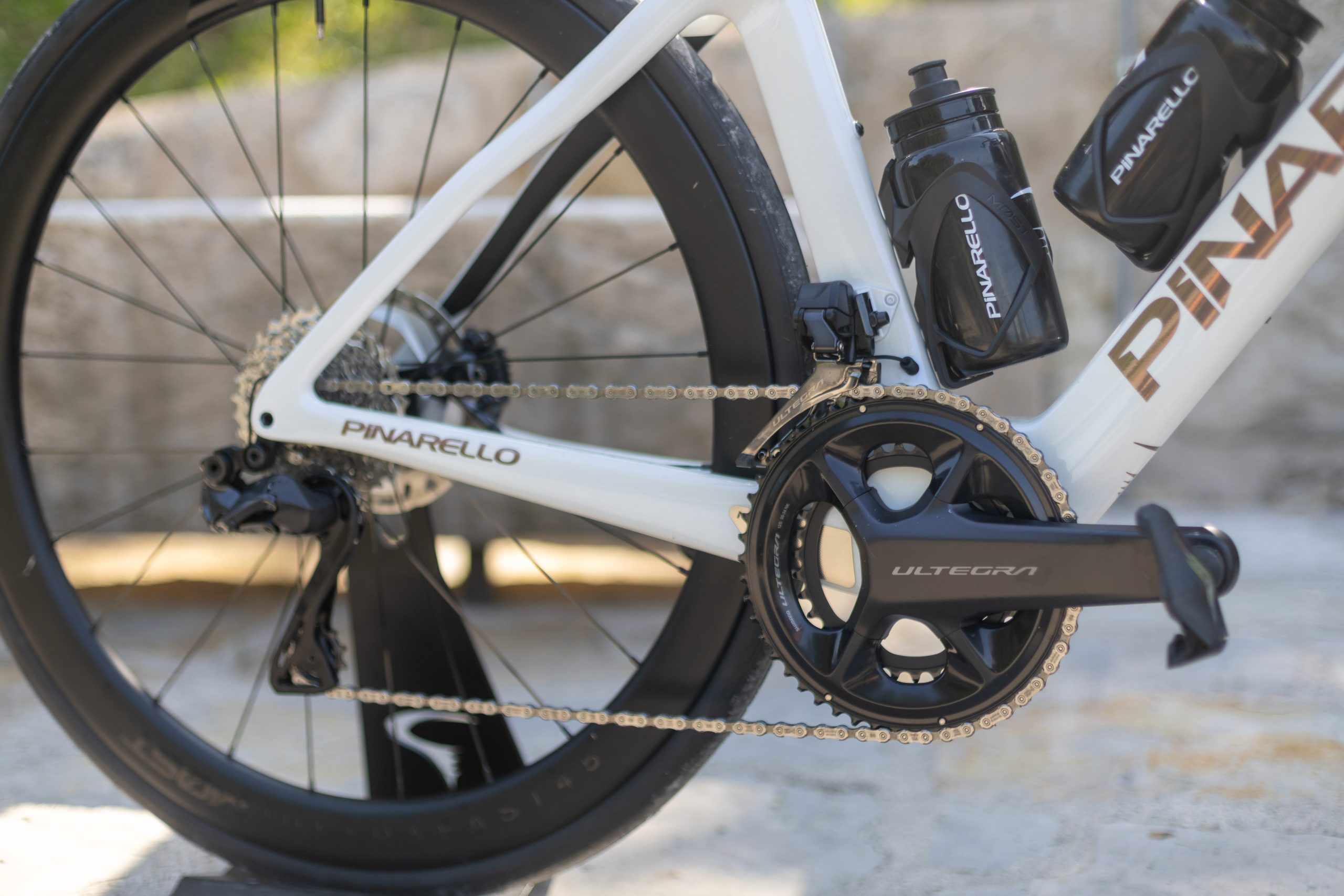
F5 and F3 framesets feature Toray T700 carbon, described as a mid-level layup, offering a blend of light weight, stiffness and compliance.
Both are fitted with Shimano 105 Di2 R7100 groupsets. The F5 is paired with the MOST Ultrafast wheels seen on the higher spec bikes, whereas the F3 is fitted with alloy DT Swiss A1800 wheels.
Here, the bikes are specced with a new two-piece alloy bar-stem setup with internal routing, which Pinarello says enables the rider to change the stem without cutting the hoses.
These models are said to weigh 8.25kg and 8.5kg, respectively.
The F1 features the previous generation frameset design, and is made from Toray T600 carbon, which is claimed to deliver more compliance.
This is equipped with mechanical Shimano 105 and Shimano RS-171 wheels.
It’s worth noting that the F3-spec framesets and higher can only sport electronic groupsets, while the F1’s can be used with both mechanical and electronic setups.
For all bikes, a setback seatpost is specced as standard, but an inline version is available. Pinarello says it’s up to its dealers to arrange specification swaps, but confirms that these are not free-of-charge. Different size cockpits can also be sourced via dealers.
Pinarello claims that the frameset and model specifications were specifically chosen to appeal to varying levels of riders – the F9 and F7 for racers and those engaged in “competition”, while the F5 and F3 are pitched to those looking for a balance of racy performance and comfort. The F1, meanwhile, is aimed towards those looking for value entry point to Pinarello ownership.
Prices are as follows (note that the F9 is not available in the UK at launch):
- F9 – £N/A / $11,000 / €11,000
- F7 (Ultegra Di2) – £6,500 / $8,200 / €7,900
- F7 (Force AXS) – £6,500 / $7,500 / €7,900
- F5 – £5,000 / $6,200 / €5,500
- F3 – £4,000 / $5,200 / €4,500
- F1 – £3,000 / $3,250 / €3,400
Zwift Racing Etiquette: The Unofficial Code of Conduct for Indoor Cycling Racing
Every cyclist knows the Velominati—keepers of the sacred outdoor road cycling commandments. But once you clip in on a smart trainer and enter the pixelated world of Watopia, those rules start to fall apart. Sock height still matters, sure, but what about your fan placement? Your avatar name? Your squirrel?
Enter Zwift Racing Etiquette: the ultimate guide to proper behavior in the virtual peloton. These rules are designed for Zwift racers who want to ride hard, race fair, and keep the vibe fun—even when chasing a breakaway at 180 bpm in a garage that smells faintly of chain lube and long lost ambition.
The Golden Principle of Zwift racing etiquette is simple: Be a Good Sport. Zwift racing is highly competitive, but it’s also a shared experience. Whether you’re chasing a podium or just trying not to get dropped, the goal is to race with integrity, respect your fellow riders, and contribute to the community. That means no sandbagging, no tantrums, and no ghosting. It means giving Ride-Ons, pulling your weight in a break, and finishing even when it hurts.
If everyone follows this one principle, the rules almost take care of themselves.
The Rules
Rule #1: Keep it fun.
Zwift is serious business—until you remember you’re sweating in your attic pretending to climb a volcano. Lighten up.
Rule #2: Wear a jersey.
Indoor riding gets hot. We get it. But Zwift is not OnlyFans. So wear a shirt when filming your ride. Your YouTube viewers will thank you.
Rule #3: Ditch the “pain cave.”
The term is cringey and overused. Whatever you call it, it should feel like a place where legends are made. Hang some Tour swag to make it feel legit.
Rule #4: Don’t forget the essentials.
You can have the perfect warm-up, the perfect playlist, and the perfect race plan—but if you forget your towel, bottle, or to switch on your fan, you’re toast. Prep your setup like it’s a space launch: checklist, power, hydration, airflow. Forget one, and you’ll be sweating into regret.
Rule #5: The fan cools you. The software cools your mic.
Strategic airflow is non-negotiable. But if your teammates can’t hear your tactical brilliance over the roar of your industrial-grade fan, it’s time to let noise suppression do its job. Balance is everything.
Rule #6: Charge your devices.
Nothing says “pro” like a mid-race voice dropout because your AirPods died during your attack. Keep your gear juiced. Better yet, plug it in.
Rule #7: Calibrate your trainer.
Your trainer isn’t magic. It needs calibration. Regularly. If your watts are suspiciously heroic, it’s either your legs or your laziness. Don’t let it be the latter. Calibrate, verify, and race clean.
Rule #8: Drop watts, not connections.
Your setup should be race-ready. That means no Bluetooth dropouts, no sensor drama, no “why did my avatar stop?” moments. Keep interference low, test with Zwiftalizer, and choose your connection method wisely. Companion App bridge can help, but it’s not for everyone. If your signal’s sketchy, your race is too.
Rule #9: Identify yourself.
If your name is “Mr. Fast” and your avatar is a Bugatti, we assume you’re compensating for something. Just be you.
Rule #10: State your true height.
Yes, shaving centimeters makes you faster in Zwift. But unless you’ve actually shrunk, set your real height. Cheating the system is easy—earning respect isn’t.
Rule #11: Weigh-in with integrity.
Morning weigh-ins (sans gear) are fine. Don’t film it—you’re naked, remember. Enter your weight with one decimal and update it every couple of weeks. It’s not just about numbers—it’s about showing you care enough to keep it fair.
Rule #12: Your age doesn’t earn you watts.
Zwift doesn’t care how old you are—and neither should your race name. If you’re 70 and dropping 20-year-olds, that’s genuinely impressive. But don’t fish for compliments by adding your age to your username. Performance speaks louder than birthdays.
Rule #13: Only state your FTP when asked.
Power is silent. Ego is loud. Be the former. Dropping your FTP into casual chat is like flexing your salary at a dinner party—no one asked, and now it’s awkward.
Rule #14: Sock height is sacred.
There is a correct sock height. You don’t know what it is, but you’ll know when someone gets it wrong.
Rule #15: Respect the Tron.
If someone’s riding the Tron bike, they’ve earned it. Don’t ask how. Just admire the glow and get in their draft.
Rule #16: Respect the burrito.
It’s not glamorous. It’s not sexy. It’s not even edible. But the burrito power-up cancels your draft and scrambles your chasers. Laugh at it, and you’ll get dropped. Use it right, and you’ll ride off into the distance before the opponents even know you’re attacking.
Rule #17: Sprint into descents.
The gravity may be virtual, but the glory is real. Always start a downhill with a watt bomb—you’ll carry extra speed and drop your rivals. And yes, in the virtual world, the supertuck is still a thing. Use it wisely. Abuse it, and you’ll be dropped like a bad Wi-Fi connection.
Rule #18: No distractions.
Zwift is not background noise. If you’re watching Netflix during a race, you’re not really here. Save the binge-watching for rest days. When it’s go-time, be present. Your watts deserve your full attention.
Rule #19: Know your racing category.
If ZRS, CE, and vELO just look like alphabet soup to you, you’re not ready to race. These acronyms determine who you race and how fair it all feels. So learn the system, check your numbers, and race where you belong. Confusion is forgivable. Ignorance is not.
Rule #20: E-racing has a capital Z.
Other platforms are just pixel cosplay.
Rule #21: Don’t compare Zwift to IRL.
Zwift isn’t outdoor riding—and that’s the point. There’s no wind, no potholes, and no chance of getting dropped because you missed a turn while reaching for a gel. It’s a different sport. Zwift has volcanoes, power-ups, and glowing bikes. Embrace the weird. Respect the platform.
Rule #22: Non-Zwifters won’t get it.
Your sub-6 hour vCinglés du Ven-Top means nothing to non-Zwifters. They won’t care about your zMAP boost or your Epic KOM reverse PR. Save it for fellow Zwifters.
Rule #23: Keep the bike clean and lubricated.
Just because no one sees your bike doesn’t mean it should look like a biology experiment. Clean your drivetrain, no sweat puddles, and bin those wrappers.
Rule #24: Wear the team kit.
Wear your club jersey (virtually) and display your team name. Otherwise, no one knows if you’re a rival or just vibing.
Rule #25: Take your turn.
In a breakaway or chase group, do your share. It doesn’t have to be heroic, but it has to be something. Riders who merely freeload are to be dropped at the earliest opportunity.
Rule #26: Always race to your max.
Race like your Twitch stream actually has viewers. If you’re looking for a training ride, do a workout instead. See also Rule #28.
Rule #27: Empty your weebles.
Intervals.icu shows how deep you went above FTP. If your w’balance didn’t reach zero, you just didn’t go hard enough. See Rule #27.
Rule #28: No sandbagging.
Don’t limit your power to stay in a lower category. Big fish belong in big ponds. Race like it’s the Tour de France and let the pens sort themselves out.
Rule #29: No tanking.
Purposely racing poorly to lower your ZRS or vELO rating is just sad. Wear your category with pride.
Rule #30: Finish the race.
Got dropped and don’t want your poor result to show on ZwiftPower? Tough luck. Take your defeat on the chin and complete the full distance.
Rule #31: Sauce is allowed (mostly).
Sauce 4 Zwift is fine—if the HUD is on. If the organiser switches it off for a data-free experience, don’t bypass it. That’s just shady.
Rule #32: Keep the chat clean.
“Have fun!” is great. “How long is this race?”—not so much. Race chat isn’t your personal FAQ or therapy session. Don’t complain about the course or ask what’s for dinner, and save the sarcastic coaching for Discord. Say thanks, be nice, and if you’ve got nothing helpful to say—pedal harder.
Rule #33: No public shaming.
Suspicious power, weight, or height? Don’t call it out in chat. Send a private message to the organiser. Keep the vibe positive.
Rule #34: Big watts? Dual record.
If you can do more than 5 w/kg for 5 minutes, invest in some power pedals. They’re not that expensive anymore, and they prove your numbers are legit.
Rule #35: Ride-Ons galore.
That rider who clawed their way back after getting dropped? Ride-On. The one who led the chase to reel in a breakaway? Ride-On. The teammate who gave up their sprint to lead you out? Definitely Ride-On. We’re all suffering in our own way—sometimes, a well-timed Ride-On makes it bearable. Use them generously, but meaningfully.
Rule #36: No moaning about steering.
Yes, Zwift Play isn’t sold everywhere. But if you want it, find a forwarding address. Complaining won’t make your avatar steer better.
Rule #37: Do not ghost the race.
If you signed up, show up. Be the wheel someone else needs.
Your Thoughts
What do you think of the list? Got rules to add or changes to recommend? Share below…
Review: Zwift x H2O Audio “100% Sweatproof” Headphones
Back in July, the Zwifty social blew up when Mathieu van der Poel donned Zwift-branded headphones for his TdF TT warmup. The headphones basically match the in-game headphones originally available via the Big Spin 2024 prize spinner, and Zwift sleuths soon figured out they were a collab between Zwift and H2O Audio, who are headquartered in San Diego, California, just a bit south of Zwift’s Long Beach headquarters.
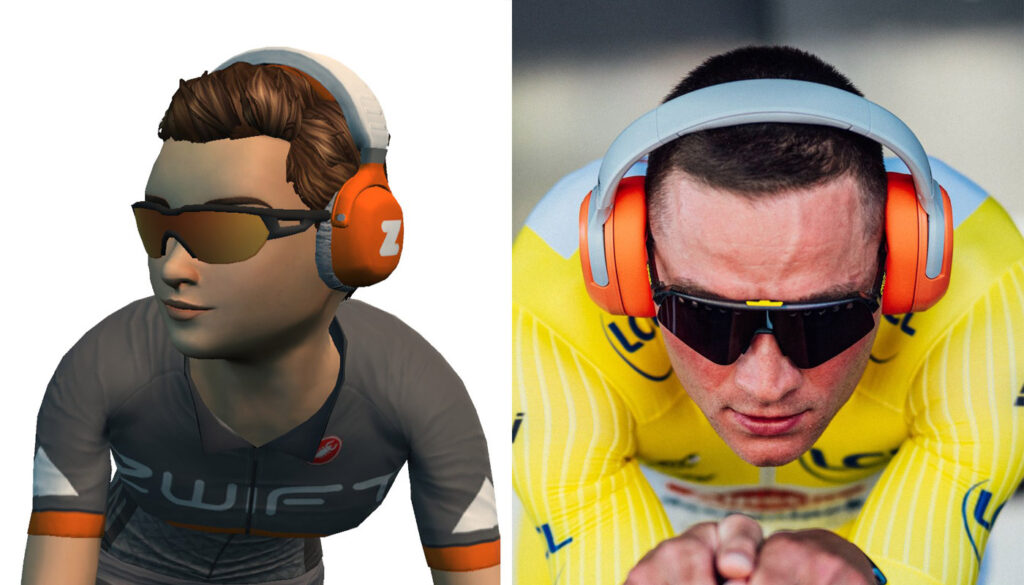
Opinion was immediately split: were these the coolest Zwift accessory yet, or a terribly sweaty idea? Was Zwift wasting time making headphones when they should be laying more virtual tarmac?
In my post announcing the headphones, I promised to thoroughly test their “100% sweatproof design”… for science. And that’s exactly what I’ve done for the past ~7 weeks. Here’s my full review.
First, the Basics
These headphones are a co-branded version of H2O Audio’s flagship “RIPT ULTRA” headphones. So for anyone concerned that Zwift is diverting much-needed resources into headphone development… well, these are more of a small marketing team project than anything else.
A few key specs:
- Wireless
- Bluetooth
- Active noise cancellation of 30dB and transparency mode
- Built-in microphone for seamless calls (and Discord!)
- “100% sweatproof design” with patent-pending removable and washable silicone ear cushions
- Black leather ear cushions also included, and a carrying case
- Charge via USB
- Powered by custom-developed 45mm drivers
- 50-hour battery life
- Price: $249.99 Buy Now > (see below for coupon code)
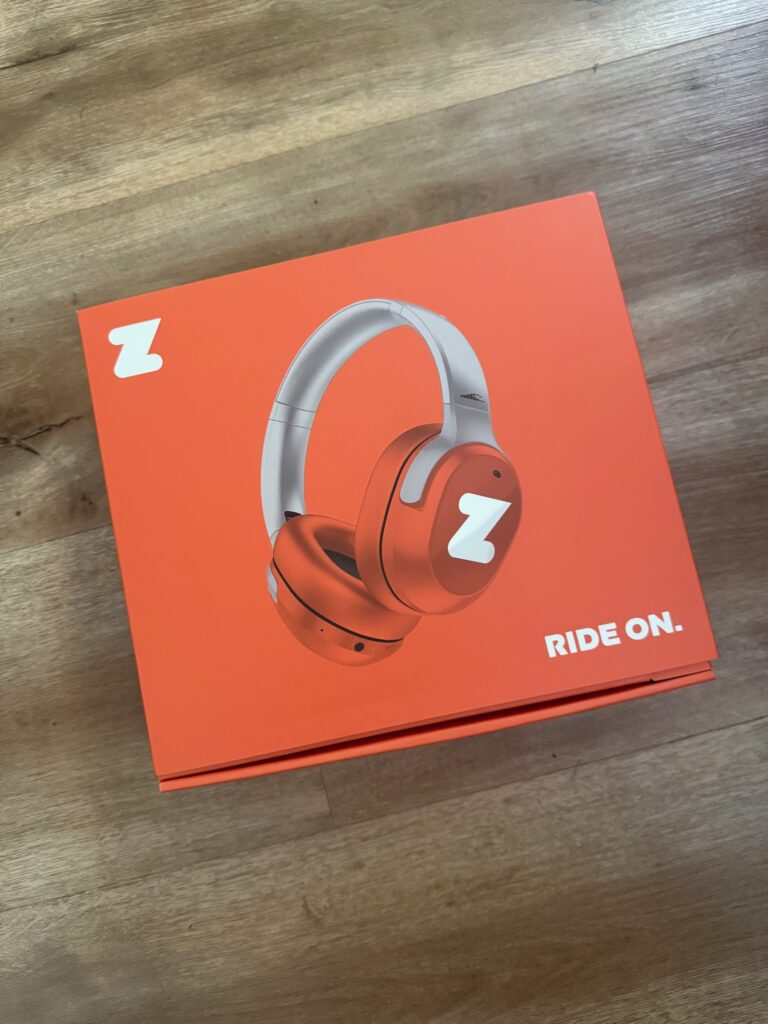
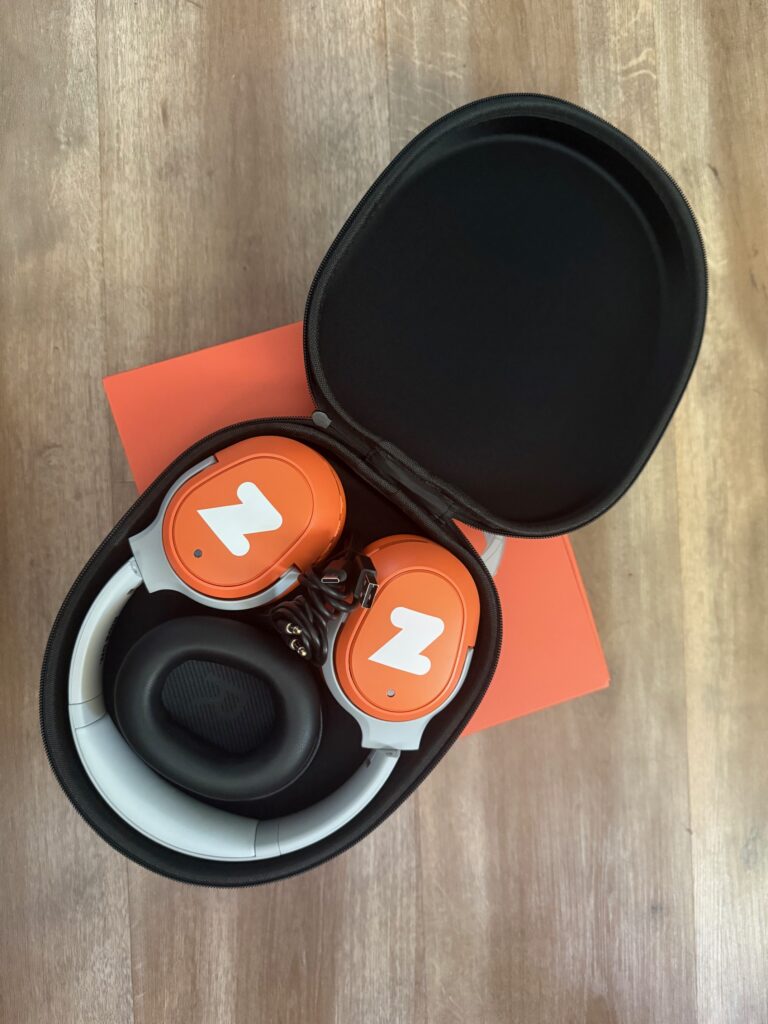
Sound Quality
First, I’m no audiophile. So if you’re expecting that sort of review, you’ll need to look elsewhere.
I am a musician, though. So I care a lot about sound quality, and I notice things others may not. (Then again, I play the banjo, so can I really be trusted with anything?)
After hours of listening, I found these headphones to be on par with others I’ve used in a similar budget range, including Beats Studio3. Sure, they won’t be as pristine as audiophile-level $2000 headphones, but they sound good, with clear articulation and an even frequency response that isn’t too bass-heavy.
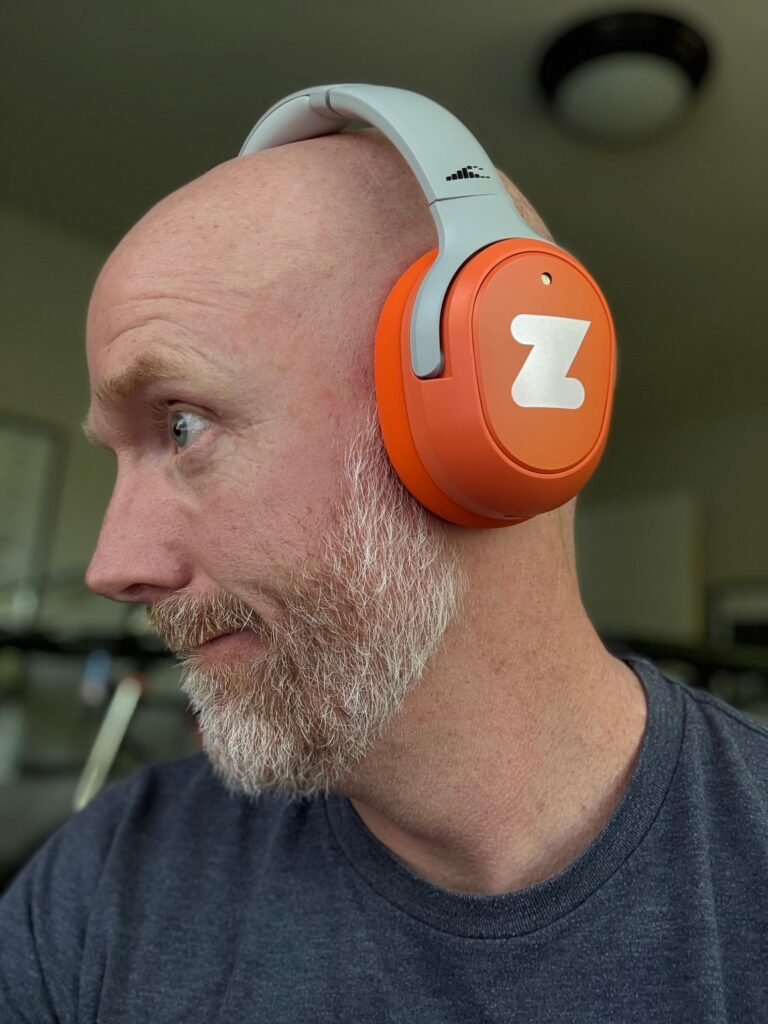
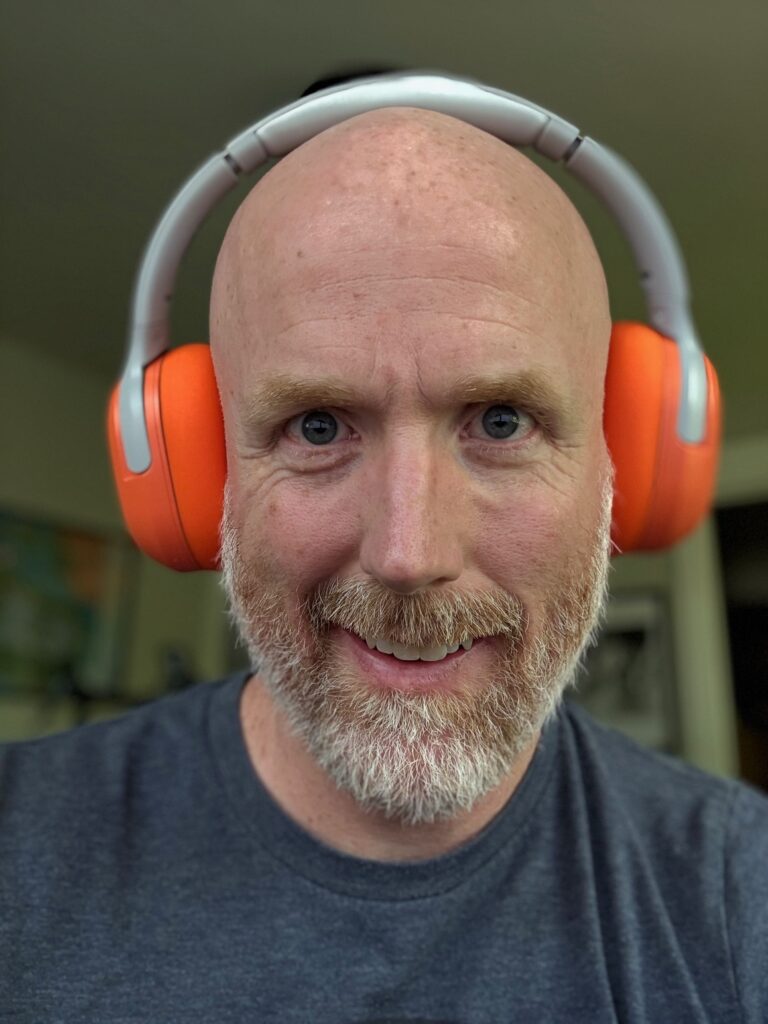
Over-the-ear (OTE) headphones typically deliver a rounder, fuller bass response than earbuds because their larger size can support much larger drivers. Noise cancelling is often better too, since the over-the-ear nature of the headphones keeps out more sound than an earbud. Both of these expectations were met with the H2O headphones. I’d describe the active noise cancelling (ANC) of the H2O headphones as not quite as good as the Beats Studio3, but close, and noticeably better than my Apple Airpods Pro. I kept it engaged for most of my Zwift sessions, and it nicely muted the noise of my fan and drivetrain.
A few more sound-tech details, if you’re interested:
- Audio codec: APTX (Qualcomm aptX Audio, Qualcomm aptX HD)
- Audio Sampling frequency: 48KHz
- Speaker Frequency: 20Hz~15KHz
- Sound pressure level 114±3dB
- Impedance 32Ωohm
- Diameter Φ45 mm
- Bluetooth chipset Qualcomm QCC3034
- Includes AUX audio jack (3.5mm) and wire for external audio source
Let’s Talk About Sweat

Like many of you, I’ve never worn OTE headphones while Zwifting. (The only headphones I owned had nice leather or cloth ear cushions, and I didn’t want to find out what would happen after those got repeatedly sweat-soaked.) But I have spent hundreds of hours wearing earbuds while riding. In recent years it’s been my trusty Apple Airpods Pro, but I’ve spent many Zwifty hours wearing buds from JBL, Sennheiser, and others.
So I was curious how comfortable full OTE headphones would be while riding. Apart from the sound quality differences (discussed above), how would they actually feel? Here’s what I noticed:
- They felt surprisingly non-sweaty, even after very sweaty heat training sessions. I suppose my ears and a small part of the side of my head were a bit more sweaty than usual, being nearly sealed inside the rubber ear cushion. But it wasn’t particularly noticeable or irritating to me.
- They stayed put, even when I moved my head around quickly while racing or doing intense workouts.
- I did notice the headphones when I needed to adjust or swap out my head sweatband. Being bald, a sweatband is a must, and on long rides, I often bring two! Swapping a sweatband while wearing these headphones, though, requires removing the headphones, putting on the new band, then placing the headphones back on. A minor inconvenience, but one nonetheless. (Rotating the headband, which I sometimes do mid-ride, is also a bit of a faff.)
- If you wear glasses while Zwifting (I do not), these could prove problematic. The arms on your glasses will break the seal of the ear cushions, which will probably allow more sweat inside, which may pool. And the cushions will push your glasses’ arms against your head, which will probably be uncomfortable.
I wore these for multiple ~3-hour sessions (Thursday 100km Pizza Burner, anyone?), as well as super sweaty heat training sessions that lasted an hour or more. Here’s what they look like after one such heat training:
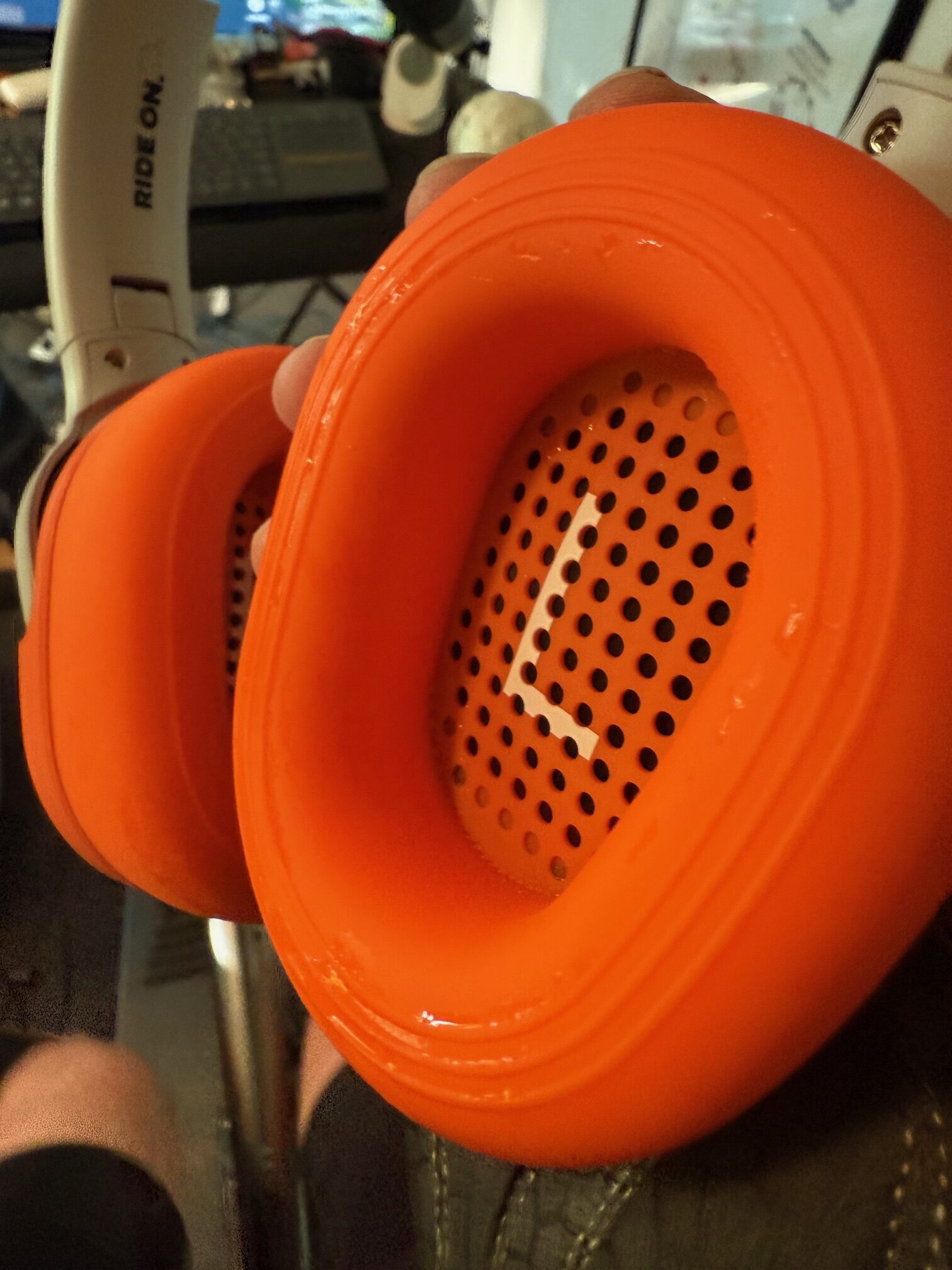
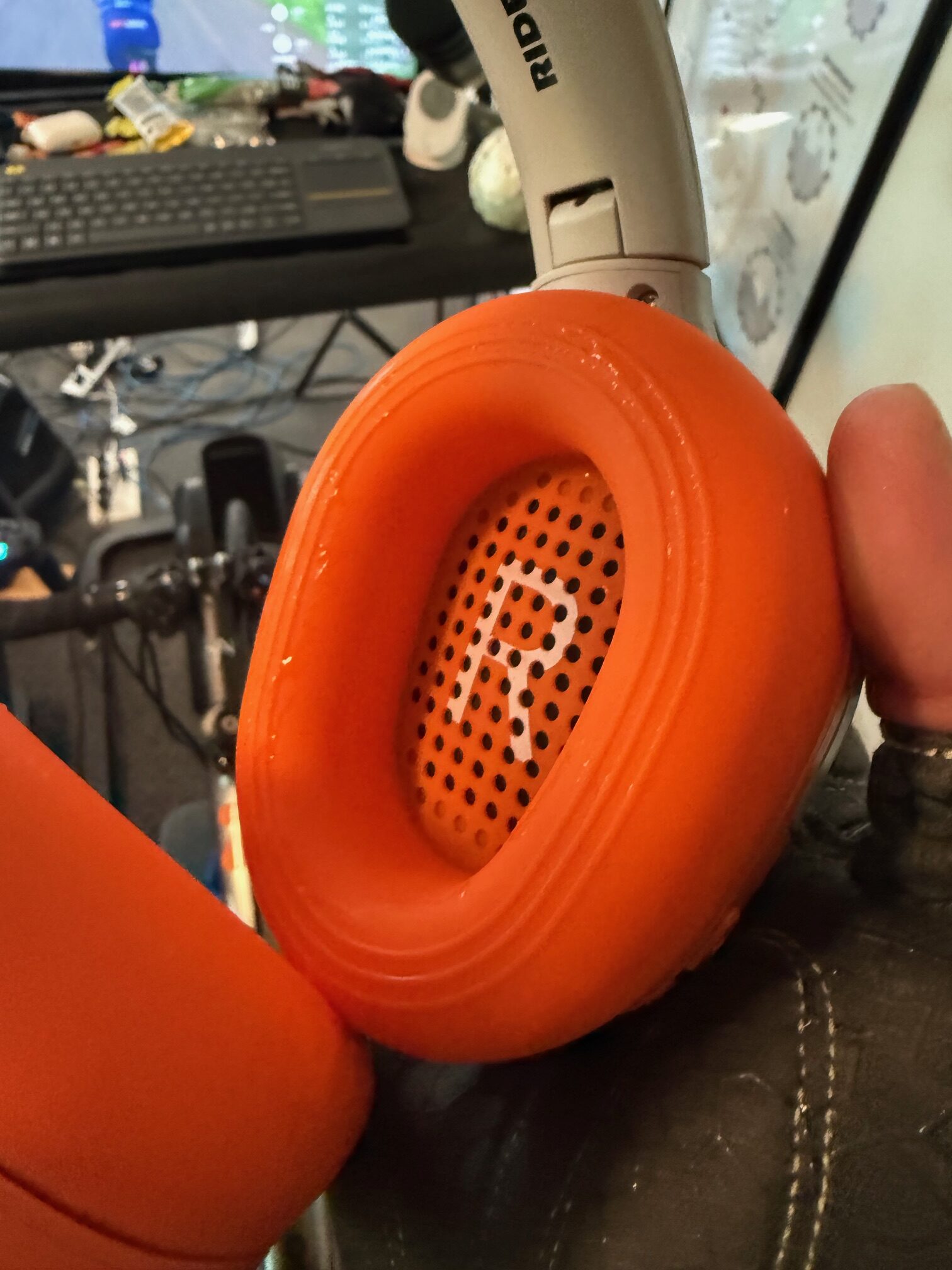
In these pics, a bit of sweat is pooled inside the ear cup, but nothing significant. The cool thing about H2O’s design is that these silicone ear cups can be easily removed from the headset, rinsed, and dried. The headphones also include nice black leather cushions, if you’d rather use those for non-sweaty listening.
Wrapping this section up: for me, a bald guy with a sweaty head doing very sweaty Zwift sessions, I found these headphones surprisingly comfortable. (There was one issue I experienced, which may or may not have been sweat-related, which I explain below.)
What Makes Them Special
Apart from their sweatproof/washable nature (which is no small thing), there are a few nice extras on these headphones that are worth mentioning:
- They’re Zwifty in color, and even have “Ride On” printed inside the headband
- When you power them on and off, Matt Stephen’s cheerful voice is the first thing you’ll hear. What a way to start and end a ride! “Power off. Catch you next time.”
- That battery life! 50 hours of battery life is impressive, and around double what many headphones in this range claim. It’s not just marketing, either – I have yet to charge mine, and they still say “Battery level high” when I power them on after using them for at least 30 hours of Zwifting.
Just One Issue
There’s just one problem I’ve had with these headphones, though. And it’s not a minor thing.
Three different times, when I was 90 minutes or more into a Zwift session, one or both sides of the headphones began to crackle intermittently. It was very noticeable and loud, but it was also unpredictable and far from constant. I soon discovered that tapping the left ear button to swap to “noise cancelling off” mode made the crackling disappear, while setting them to “noise cancelling on” or “transparency mode” would bring the crackling back.
I reported this to H2O Audio, and they said it wasn’t a known issue. They asked me to send the first pair back for investigation, and sent a replacement set. But that replacement set did the same thing the first time I used it for a long ride.
Trying to figure out the root cause, I wore the headphones while working at my desk (not sweating), but could never get them to crackle. It does seem to happen quite regularly when riding over 90 minutes, though, so my hunch is it has to do with moisture getting into the electronics. The headphones feature a special hydrophobic mesh on the inside (not attached to the removable ear cushion) to prevent water from entering the speaker assembly. However, I wonder if the humid air that builds up over long sessions inside the sealed ear cup is somehow affecting the internals.
Most Zwift sessions are an hour or less, and if the crackling begins, it’s really easy to tap the button on the left ear cup to turn off active noise canceling and thus any crackling. So I don’t consider this a deal breaker, but it certainly seems like something H2O will want to get fixed.
Buy Now
Interested in purchasing the Zwift + H2O Audio headphones? Shop through this link and use the coupon code ZWIFTINSIDER for 20% off! Your purchase helps support this site.
Questions or Comments
Did you purchase the Zwift x H2O Audio headphones? Any particular features you like, or issues you’ve had? Post your comments below!
Considering a purchase and have further questions? Share those below too, and I’m happy to answer any I can.
Girona has something for every cyclist – here’s why it’s the perfect autumn cycling destination
Girona is a must-ride cycling destination, whether you’re into road cycling, mountain biking or gravel riding.
Autumn is the ideal time for a trip to this Catalonian cycling hotspot – here are five reasons why.
Tick off more from your cycling bucket list
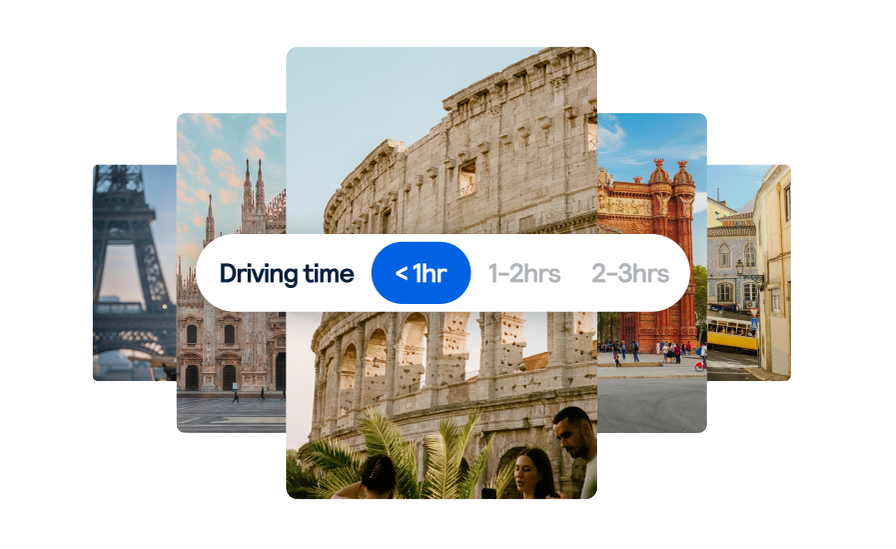
Use the Skyscanner City Break tool to plot your next cycling trip across Europe
1. Get there fast and inexpensively
You can fly direct to Girona itself in around two hours from London, Birmingham, Manchester and other major UK airports. This autumn, budget airlines are offering rock-bottom prices on flights, so you’ll have more Euros to spend once you arrive. Check out Skyscanner for the best deals.
Alternatively, fly to Barcelona with even more flight options and train connections to Girona in just over an hour.
Once you arrive, Skyscanner has deals on car hire from £22 for an SUV, so you can pack your bike and quickly head out to the smooth empty roads in the hills or drive to your hotel.
Plan your next cycling trip to Girona
2. Test yourself: explore its varied terrain
Girona has a bit of everything on its doorstep, which is why it’s a favourite base for pro cyclists. While many road riders will gravitate naturally to the challenging ascents and quiet roads inland or even head into the Pyrenees to take on the classic climbs, there’s less demanding riding to the east and glorious undulating roads along the coast.
Girona isn’t just for roadies – it’s become a major destination to ride gravel, with the Traka a major European gravel race to rival Unbound in the US. You don’t have to ride too far out of town to hit gravel and can choose between flatter, faster routes and taxing climbs.
Plan your coastal and gravel routes through Girona
3. Soak in the warm climate
Hang onto summer for another few weeks. With average daytime temperatures in September 28ºC, October 24ºC and November 18ºC, you can enjoy short-sleeved jersey weather without sweltering, while the gales blow in from the Atlantic in the UK.
Plan your next warm getaway in Girona
4. Spot the pros
All the above are reasons why many pros make Girona their base. You can spot the current generation of riders heading out to train on Rocacorba, Els Àngels or one of the other local climbs or find the door behind which Lance Armstrong used to prepare for races when he was based in Girona.
5. Plenty of off-bike activities
It’s not just about the riding though, with Girona boasting a historic old town with cobbled streets, ramparts, museums and churches, ancient houses on the banks of the river Onyar and a bridge designed by Gustave Eiffel.
You can hang out at a coffee shop, browse the boutiques and eat in some great restaurants. Head out of town for more sightseeing or further afield to see those climbs in the Pyrenees that you didn’t quite find time to cycle.
Plan your cycling trip to Girona
Tick off more from your cycling bucket list
Use the Skyscanner City Break tool to plot your next cycling trip across Europe
Bike sizes for kids | How to find the right size bike for your child
Children grow up fast, and finding a bike that fits them while offering a few years of service can be a difficult affair.
Whether you want to get them riding along with the family or commuting to school, making sure your little ones are comfortable on their bikes will help build their confidence faster.
As with adult bikes, getting the correct size is vital for children’s enjoyment and for improving their confidence when they first start pedalling.
The best children’s bikes will feature size-specific components such as child-size levers, cranks, saddles and handlebars to help your kids get the most out of their bikes.
Most brands will recommend a height range for their bikes, while some suggest an age range, though this can be confusing because little riders grow at different rates.
Wheel size remains an important indicator of children’s bike size, ultimately restricting the frame size.
With all of this in mind, here’s everything you need to know about children’s bike sizes to make sure your kids feel safe and confident on their bikes.
Kids’ bike size chart
This table shows the various bike wheel sizes and the approximate ages they are suitable for, as well as the minimum height and inseam length for each wheel size.
The important thing here is the size of the child, not the age.
| Approx age | Wheel size (in) | Minimum inseam (in) | Minimum inseam (cm) | Minimum height (ft, in) | Minimum height (cm) |
|---|---|---|---|---|---|
| 2+ | 12 (balance bike) | 12 | 30 | 2,8 | 88 |
| 3+ | 14 | 15 | 38 | 3,3 | 98 |
| 4+ | 16 | 16 | 42 | 3,5 | 104 |
| 5+ | 18 | 18 | 46 | 3,8 | 112 |
| 6+ | 20 | 20 | 52 | 3,11 | 120 |
| 8+ | 24 | 23 | 57 | 4,2 | 127 |
| 10+ | 26 | 25 | 64 | 4,7 | 140 |
Measuring your child

The most important thing to consider when finding the right size bike for your child is not their age, but their size.
Some brands will size bikes on overall height, though this doesn’t take proportions into account, so it’s important to also measure your child’s inside leg.
This can be done by having your child stand against a wall with a book placed between their thighs. Once the height is market against the wall, measuring down to the floor with a tape measure will give you their inside leg measurement.
The inside leg measurement will give you a good indication of standover height for younger riders, and where saddle height should be for older children looking for pedalling efficiency.

A smaller standover height will give your child more confidence when learning to ride because they will find it easier to put their feet down should they lose balance.
While measuring your child will give you a good indication of what bike size you should buy, it is always best to sit your child on a bike before buying it to make sure they are comfortable and can reach the handlebars.
What if my child is in between sizes?

It can be tempting to buy a bike that is slightly too big in the hope it will last longer before your child grows out of it, but this can compromise safety and stability.
The more enjoyment they have when riding the bike, the more they’ll be interested in learning.
Some brands have experimented with trade-up schemes, which enable you to return your bike and receive the next size up.
Kids’ bike types and size guides
Balance bike sizes

Balance bikes have become a very popular way of introducing young children to cycling, with the omission of pedals reducing the coordination needed to learn how to balance on two wheels.
Similar to early Victorian bicycles, such as the dandy horse, balance bikes are propelled by kicking backwards and encourage the child to ride along at their own momentum.
Most balance bikes will typically feature 12in wheels, making it easier for small legs to reach the floor, but make sure your child can support the bike and reach the brakes if they are fitted.
If a child becomes confident on a balance bike, they can usually skip training wheels when progressing to a pedal bike because they will already understand how to balance it.
First pedal bike sizes
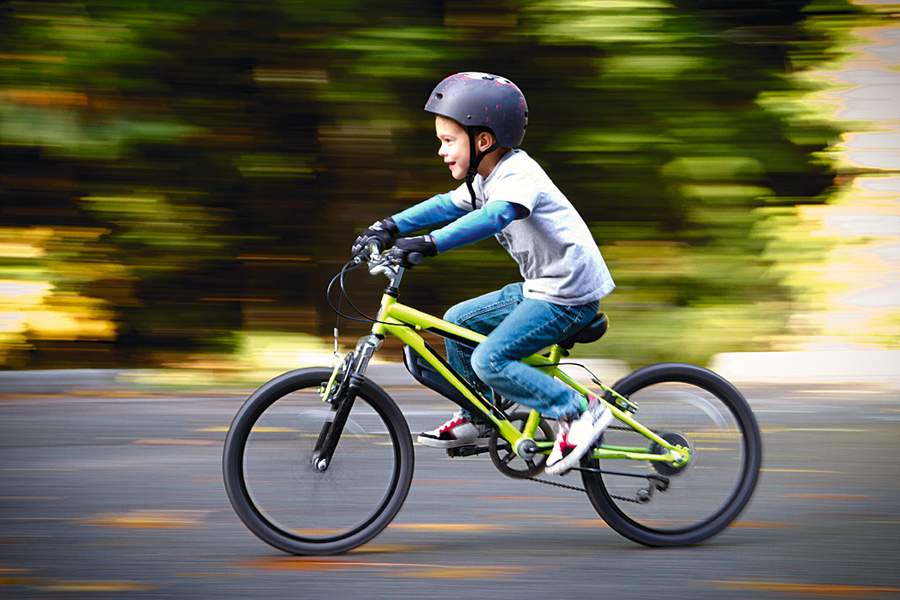
Whether they have mastered the balance bike or are using training wheels, making sure their first pedal bike fits will enable them to enjoy learning to ride a bike and the fun it brings.
These bikes are usually designed for children who are 3 years old or above and typically feature 14in or 16in wheels, a low standover height and brakes – in line with the law for pedal bikes in the UK.
As with balance bikes, it’s important your child’s feet can still touch the floor at this stage because sacrificing pedalling efficiency is well worth it for their security.
First pedal bikes will usually be singlespeed, enabling young riders to focus on pedalling rather than changing gears, and can be heavy for their size.
Kids’ hybrid bike sizes
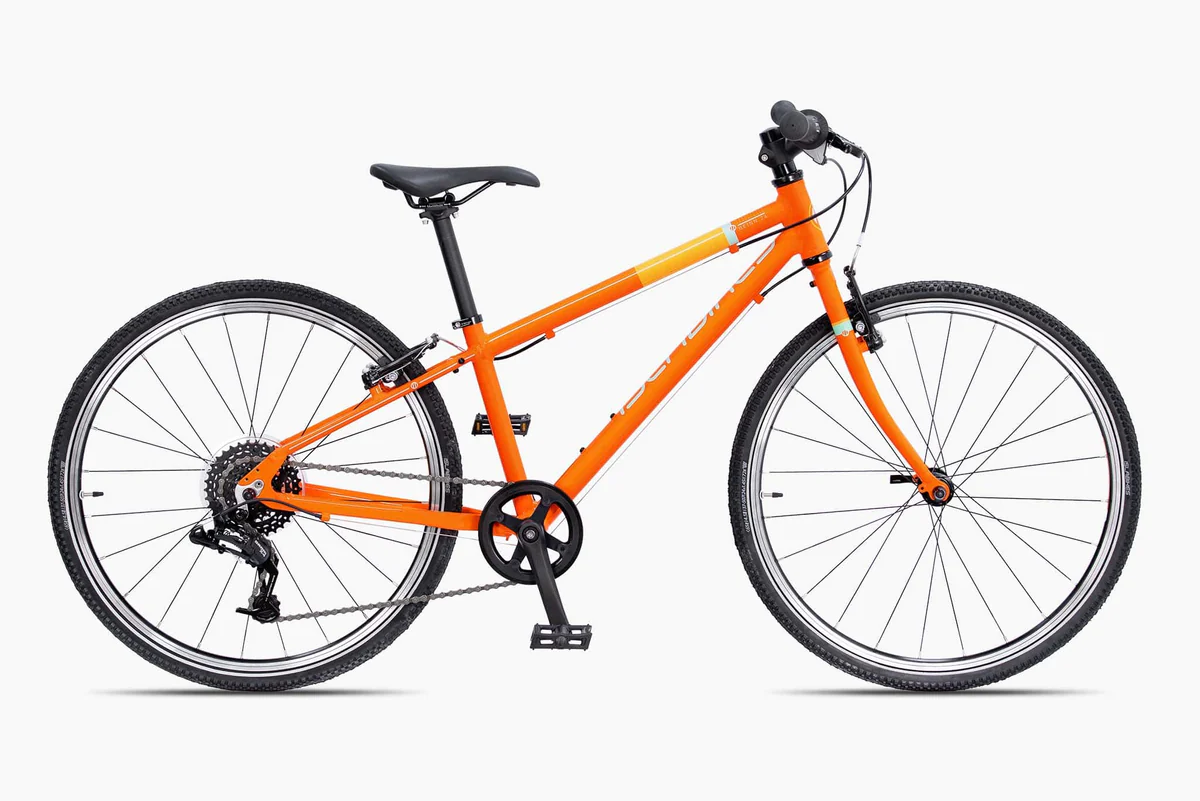
Most children’s bikes will feature a hybrid design that enables young riders to explore trails while remaining efficient on the road.
These multi-purpose bikes are designed for children aged six or older, with many featuring 20in, 24in or 26in wheels. They have low slung top tubes to allow for a lowered standover height.
Kids’ hybrid bikes usually feature grip shifters that enable smaller hands with less dexterity to change gears easier.
Kids’ road bike sizes
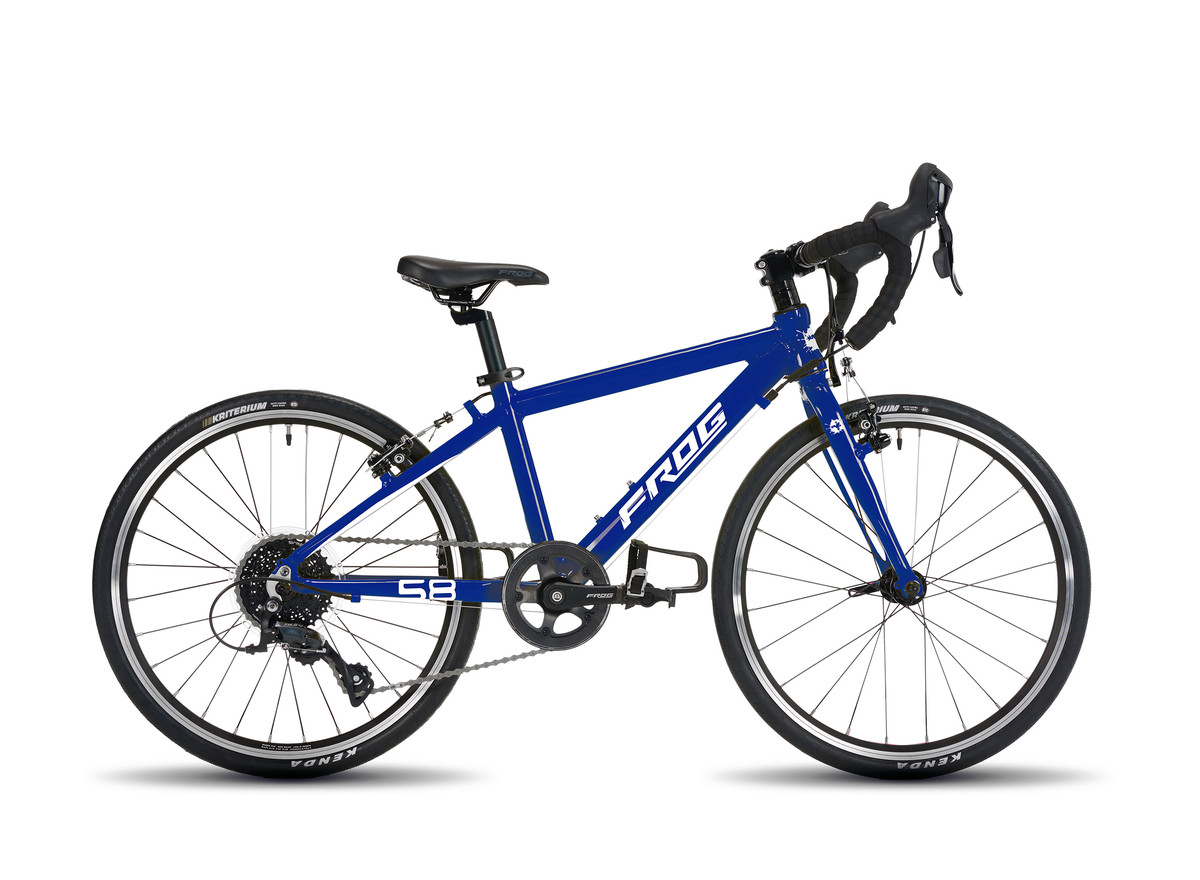
Kids’ road bikes usually feature cantilever brakes and large clearances to allow for knobbly tyres to be fitted for cyclocross.
Road shifters can be hard to use with small hands, so make sure your child is confident with dropped handlebars.
Kids’ road bikes are available in 24in, 26in and 650c wheel sizes, with the latter also being found on some women’s road bikes.
If your child is confident on their road bike, then setting the saddle height as you would for an adult will enable them to be more efficient with their pedal stroke.
Kids’ mountain bikes
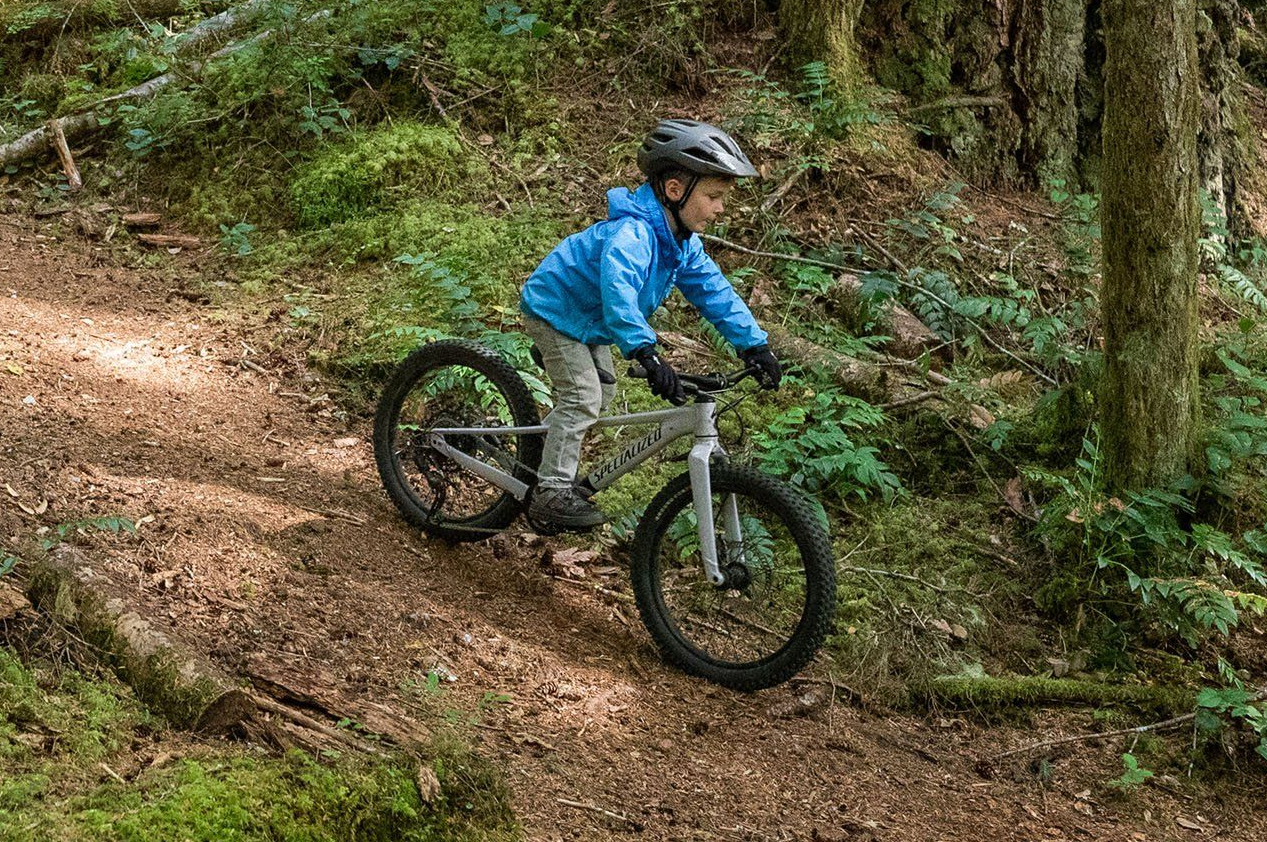
Kids’ mountain bikes come in all shapes and sizes, with the complexity of the bike differing between sizes.
Some kids’ mountain bikes will feature suspension, though this can add weight to the bike, making it harder to pedal and manoeuvre.
Instead of this, many brands offer wide tyres to soak up bumpy trails, while maintaining a light and playful bike.
Kids’ mountain bikes are available in 20in, 24in, 26in and 27.in wheel sizes.
Hydraulic disc brakes can be set up with small reaches and provide the best braking for little hands.
How the Race Lost: Broken By the Brae (Rolling Highlands)
This week, the final race of August’s Kick ‘N’ Sprint series was held on Scotland’s Rolling Highlands route. I was looking forward to it, because it’s a fun race course: hard enough to keep things interesting, but not so hard (read: climby) that I would get dropped.
Read below to see how my race unfolded…
The Warmup
I got on the bike with plenty of time before the 12:10pm PT race, giving me a full half hour to wake up the ol’ ticker and spin up the legs. I was already one dirty chai and a few pieces of Neuro caffeine gum into my warmup by the time I got on the bike, so I was nicely caffeinated. I had also rubbed PR Lotion into my legs to keep the burning at bay.
My Warmup “Stack”



I rode my Cadex Tri bike during the warmup, since I’m working on upgrading it as we head into ZRL. Just upgraded to stage 3, working on stage 4, which requires 480 minutes!
Lead-In + Lap 1
Rolling Highlands has a long lead-in, but it’s an easy one: 5.1km, starting with a nice little descent and ending with a kick up the Breakaway Brae. In a two-lap race like today’s, you’ll hit the Brae three times: once at the end of the lead-in, once at the end of lap 1, and once at the finish.
I was holding onto a feather powerup, which I used at the bottom of the Brae. 412W for 58s got me through that segment. At the finishing arch I grabbed a draft boost powerup, then settled in for a bit of recovery as we looped past Nessie’s pond and headed back toward the lap banner. Lap 1 had begun.
The next challenge is the climb up through “The Cliffs”. It’s 2.2km long, and not steep at all – a very draftable climb. I held onto my van until we neared the top, where the riders always push the hardest. Then I used it, so I could more easily surf the wheels as we headed toward the lap banner and another powerup.
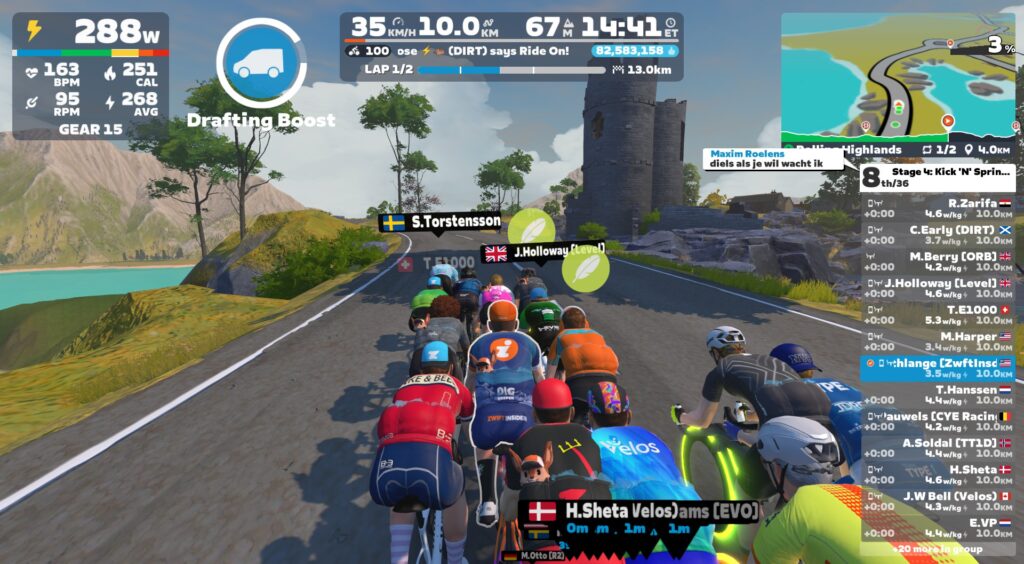
I grabbed another draft boost through the lap banner, then sat in and recovered to prepare for the Corkscrew Castle climb just up the road. This steep little kicker requires close to an all-out sprint for 15 seconds or so in order to stay in touch. The pack always stretches across the top, but tends to come together before hitting the Brae just 90 seconds up the road.
And that’s what happened: 549W for 31s got me up and over the Corkscrew Castle climb, then it was another go at the Brae, using my draft boost over the flat top to ease my effort as I sat in the wheels. Lap 1 done.
Lap 2 + Finish
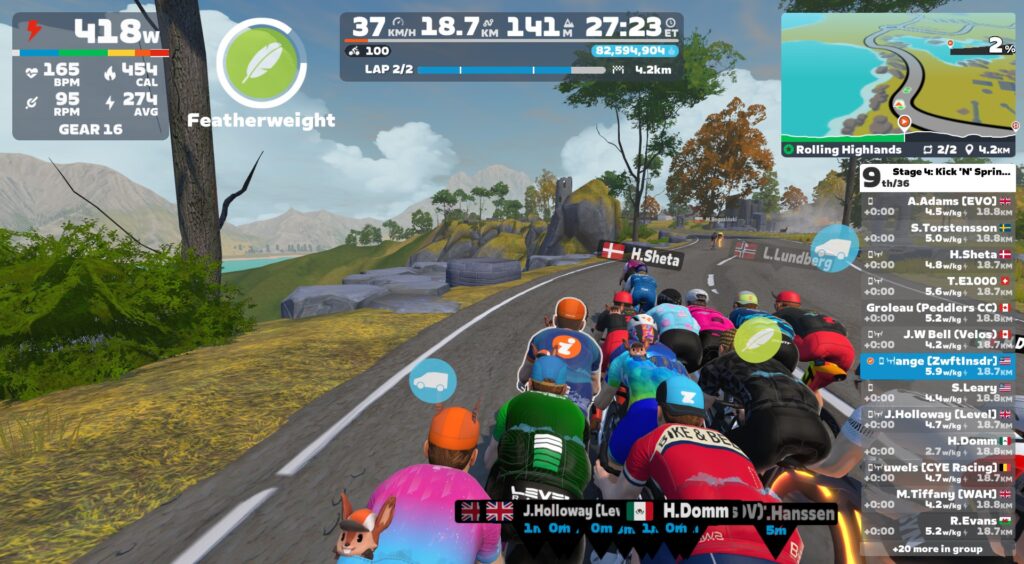
After a bit of recovery, we hit the Cliffs climb again. M. Rogozinski went off the front and was soon joined by E.VP, but I just sat in, using my feather to ease the effort near the top. As we went through the lap arch I got a feather as my final powerup, Rogozinki got reeled in, and E.VP was 5s off the front.
We hit the Corkscrew Castle climb with 2km left in the race, and I knew these final 2000 meters would be hellish. I put out some big watts to stay near the front over this climb, figuring the pack might break up and I didn’t want to get gapped. 618W for 28s put me into a good position… but had I dug too deep? I spun my legs past Nessie’s place as our front pack of 24 proceeded toward the final Breakaway Brae.
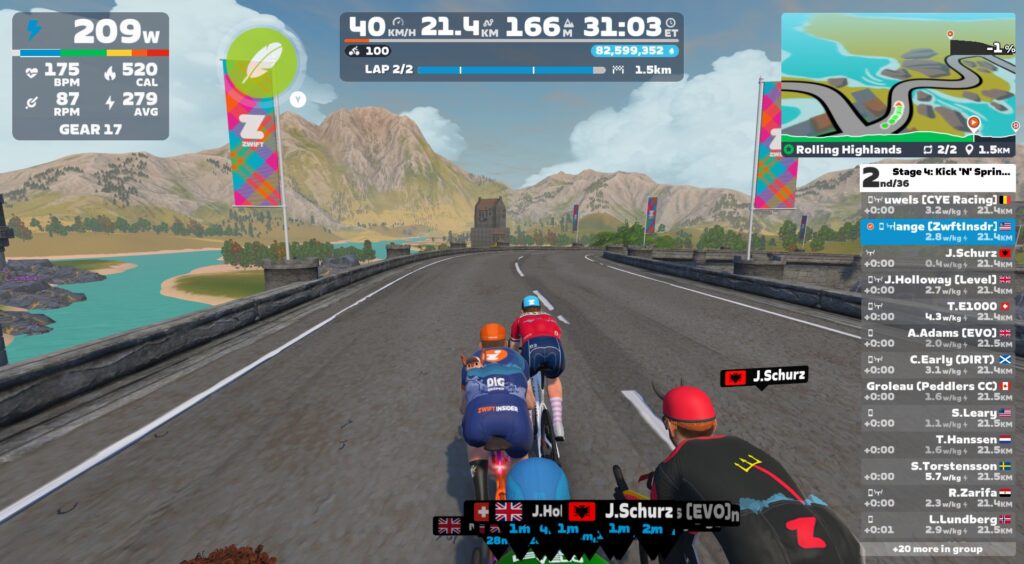
One rider, S. Leary, went long as we crossed the segment start line. Others followed, and I boosted my power to try to hold their wheels. But seconds later, Leary was too far ahead for me to draft, and I was in the wind, so I eased a bit to let riders around me come around as we hit the uphill hairpin with 400 meters to go. Feather engaged. It all comes down to this!
The orange numbers were everywhere! A. Adams passed me, then T. E1000. 300 meters to go and I was hurting in 4th position. I steered left to get more draft, but my legs were done. More riders passed mein the final 100m, and I rolled across in 8th.
T. E1000 took the win with a powerful, perfectly-timed final kick that pipped S. Leary.
See ride on Strava >
See results on ZwiftPower >
Watch the Video:
Takeaways
Rolling Highlands is a fun race course for me. The three climbs – Breakaway Brae, The Cliffs, and Corkscrew Castle – make it interesting without forcing me out the back.
It’s just that the Breakaway Brae finish always seems to eat my lunch. I do well climbing through the left hairpin, but seem to run out of fuel on the long hall to the line that follows. Pre-race I tell myself I should wait longer before going all in, but somehow I never manage to do it. Because there’s always someone just a little off the front, dangling a tantalizing wheel. If I could just grab that wheel…
My “weebles” (W’bal) chart from intervals.icu is pretty telling when it comes to that final effort over the Corkscrew Castle and Breakaway Brae. W’ is the amount of work you can do over critical power – that is, how big of a bucket you have to draw from when it comes to hard efforts (read more about W’ and Critical Power here.) Ride above your critical power (which is close to, but not the same, as FTP) and you’ll be emptying your bucket. Ride below critical power long enough, and the bucket will refill.
You can see in the chart below that my W’bal began at 25 kilojoules, and dipped to -3.9 as I crossed the finish line. That’s truly emptying the bucket! It’s the lowest I’ve seen my weebles in at least a few months…

If I were to do this race again, I would go easier up the final Corkscrew Castle climb, gambling that it would all come back together before the start of the Breakaway Brae. This would have left me more weebles to play with, and hopefully a bit more kick left in those final meters.
I began this race with a score of 569, just barely sneaking into the 450-570 group. My 8th-place result boosted my score by 5 points, which means I’ll have to race against the big boys next week. Wish me luck!
Your Thoughts
Did you race Rolling Highlands this week? How did it go? Share your thoughts below…
Exposure’s new range of lights finally has the one feature I’ve been yearning for
Exposure has launched its new 2026 front light range, consisting of four handlebar-mounted lights and three helmet lights.
All of the lights now charge via USB-C – a feature many riders, me included, have been asking for. Until now, Exposure has stuck with its own proprietary charging port.
The brand claims the USB-C charge port improves charge times by up to 66 per cent and is compatible with power banks – news that will particularly delight bikepackers and ultra-distance racers.
Exposure also says you can charge other devices straight from the USB-C port.
In addition, the handlebar-mounted lights now come with a new colour OLED screen, which is said to be easier to read, as well as ‘Reflex 2.0’ technology, which automatically changes the light’s output according to the speed and terrain.
Let’s take a closer look at the range.
Read more from BikeRadar
- After hundreds of miles of testing, I found the latest bib short trend is really a fad
- I’ve ridden thousands of bikepacking miles – here are 10 mistakes to avoid
Four handlebar-mounted lights
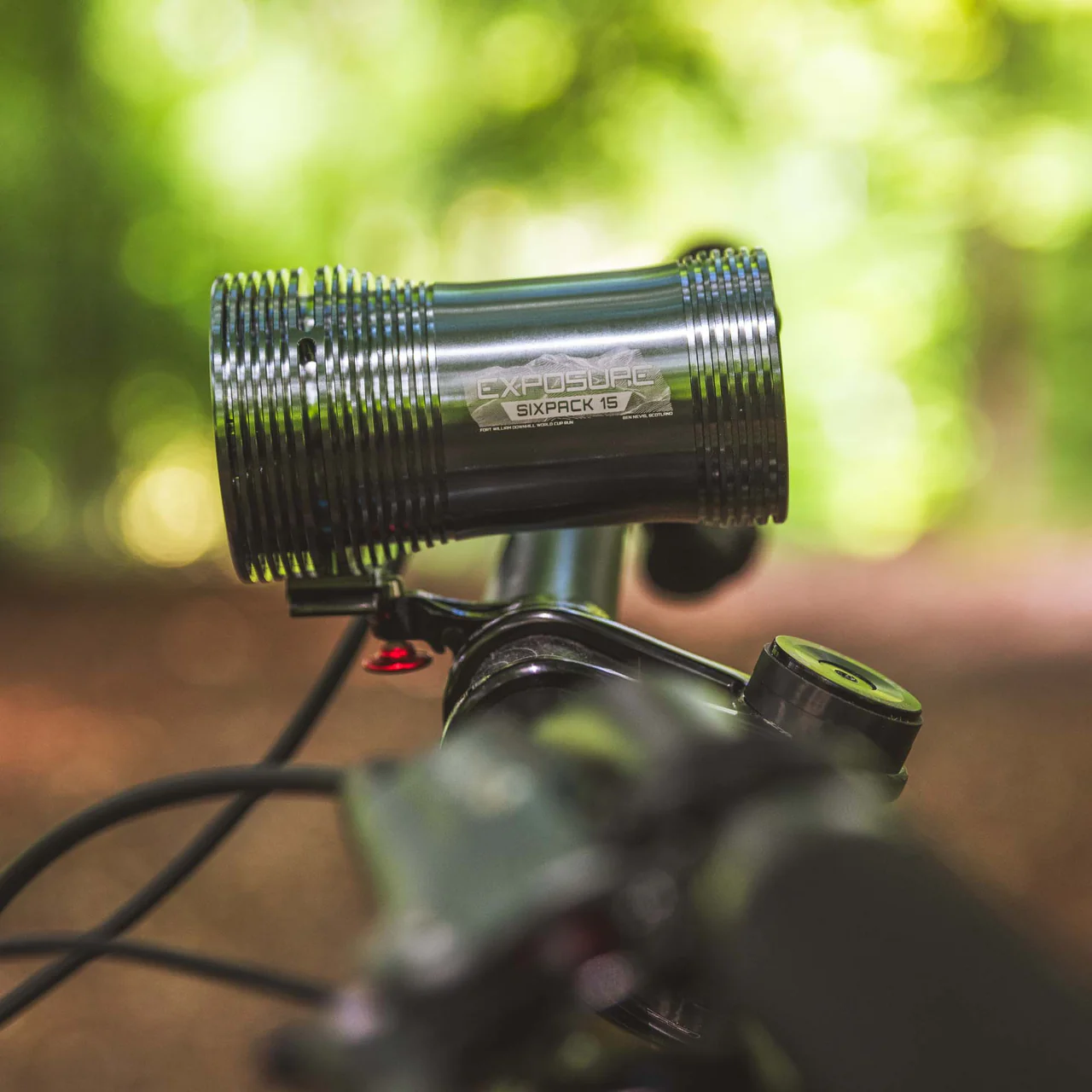
The new handlebar-mounted front light range consists of the:
- Exposure Six Pack Mk15
- Exposure MaXx-D Mk17
- Exposure Toro Mk16
- Exposure Race Mk19
All are made from machined 6063 aluminium.
The Six Pack Mk15 can now kick out up to 6,000 lumens in its brightest setting (up from 5,800), while the MaXx-D Mk17 is 50 lumens brighter than its predecessor at 4,850 lumens.
Meanwhile, the Toro Mk16 can pump out 3,850 lumens (up from 3,800), but the Race Mk19’s maximum output is a little dimmer than the Mk18 at 2,650 lumens (previously 2,800 lumens).
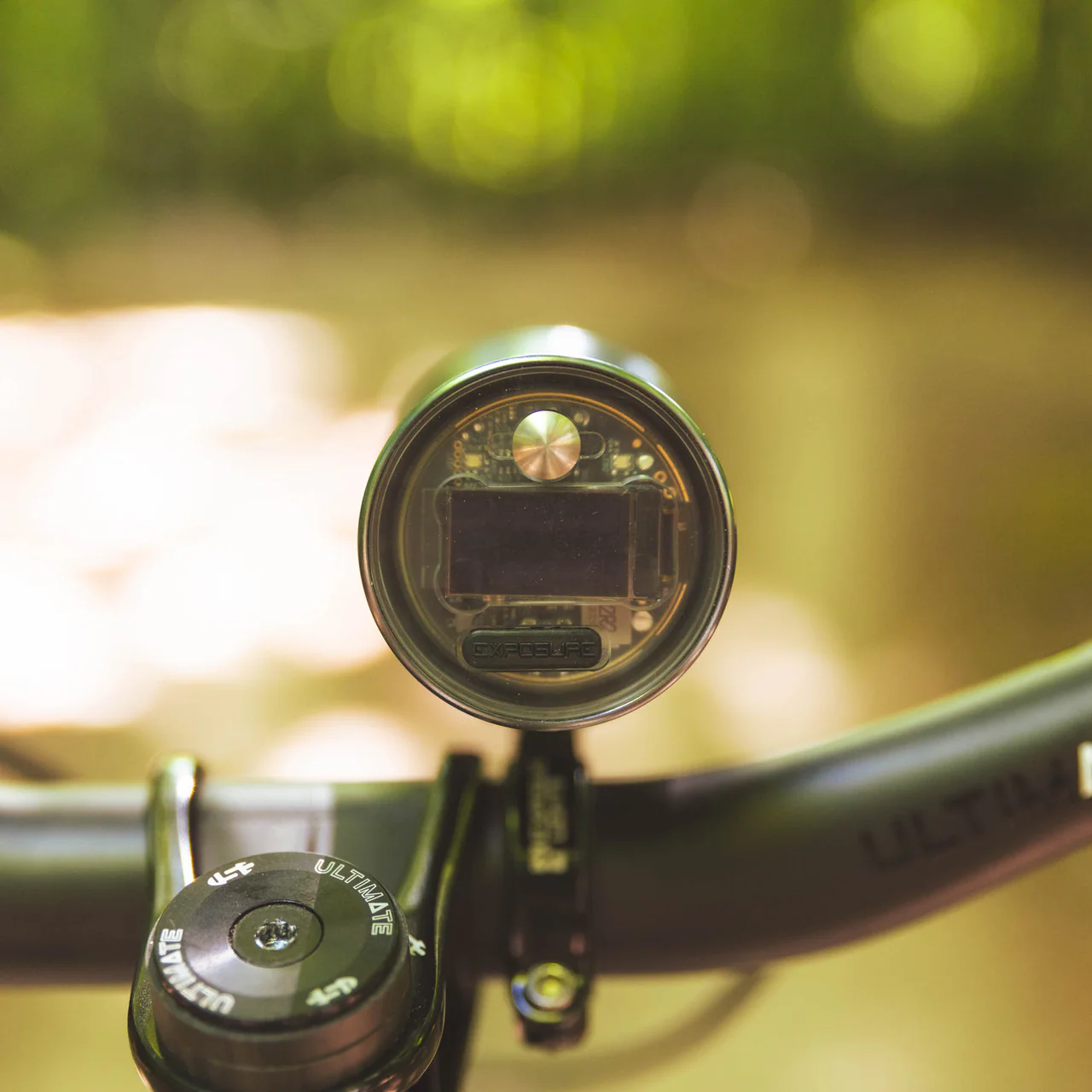
All four lights use what Exposure calls its new ‘OSD+ Screen’. This is said to be easier to read because the display is 70 per cent bigger, and it’s now in colour, displaying what mode you’re in and the remaining run time.
A new ‘Reserve’ mode provides 30 minutes of lower-level light if the light runs out of juice, Exposure says.
The updated Reflex 2.0 Technology automatically changes the light’s output depending on your speed and the terrain you’re riding, via thermistors and 3D-digital accelerometers, including a gyroscope.
According to Exposure, the lights will last for a minimum of 2 hours and up to 36 hours on a single charge.
- Exposure SixPack Mk15 – £495 / $540 / €495
- Exposure MaXx-D Mk17 – £445 / $485 / €445
- Exposure Toro Mk16 – £355 / $385 / €355
- Exposure Race Mk19 – £295 / $320 / €295
Three helmet lights
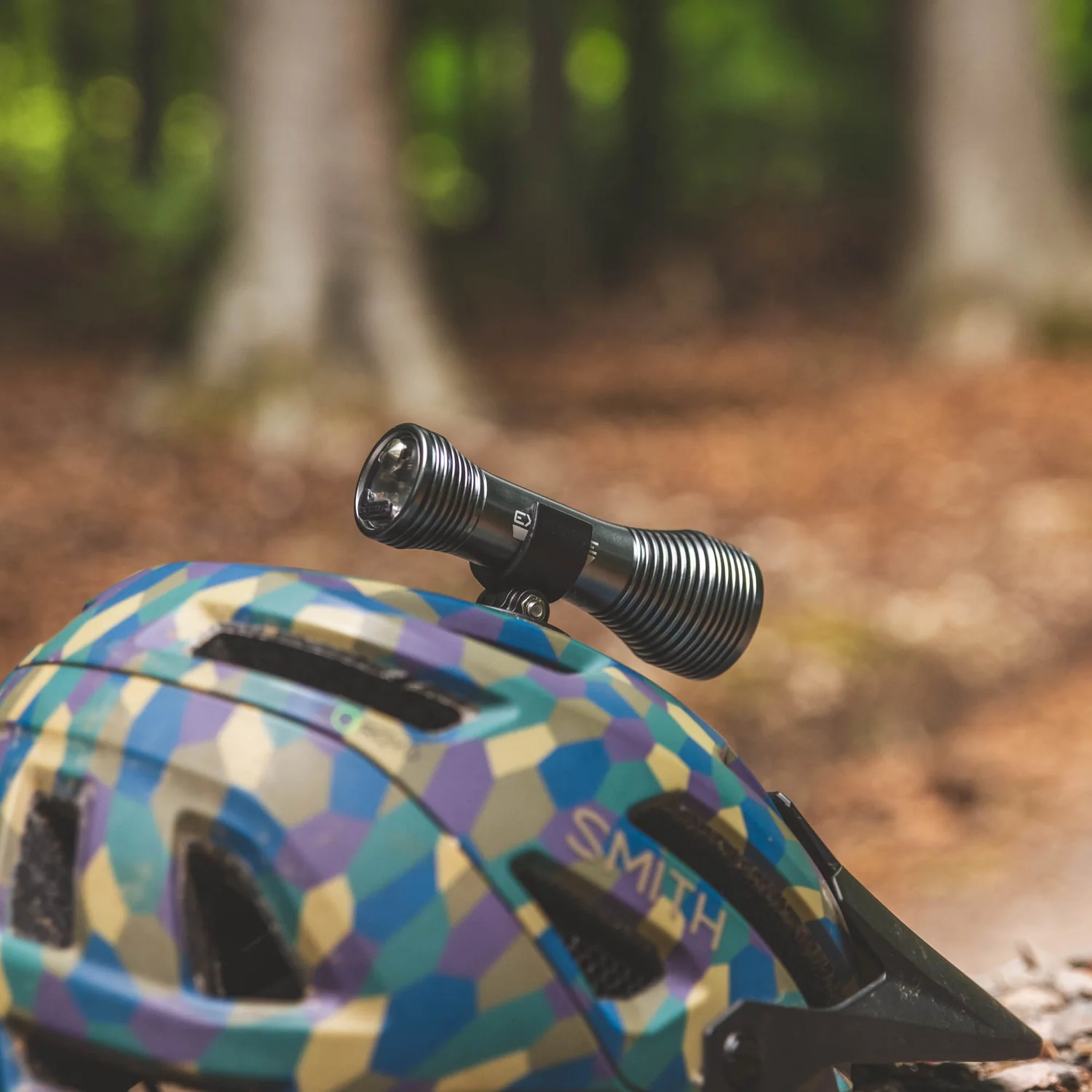
In addition to the four handlebar-mounted lights, Exposure has also updated its three helmet lights.
The new Zenith Mk4 has a maximum output of 2,360 lumens (up from 2,200 on the Mk3), with the Diablo Mk15 the same as the Mk14 at 2,000 lumens. Finally, the new Joystick Mk18 is 50 lumens brighter than its predecessor at 1,200 lumens.
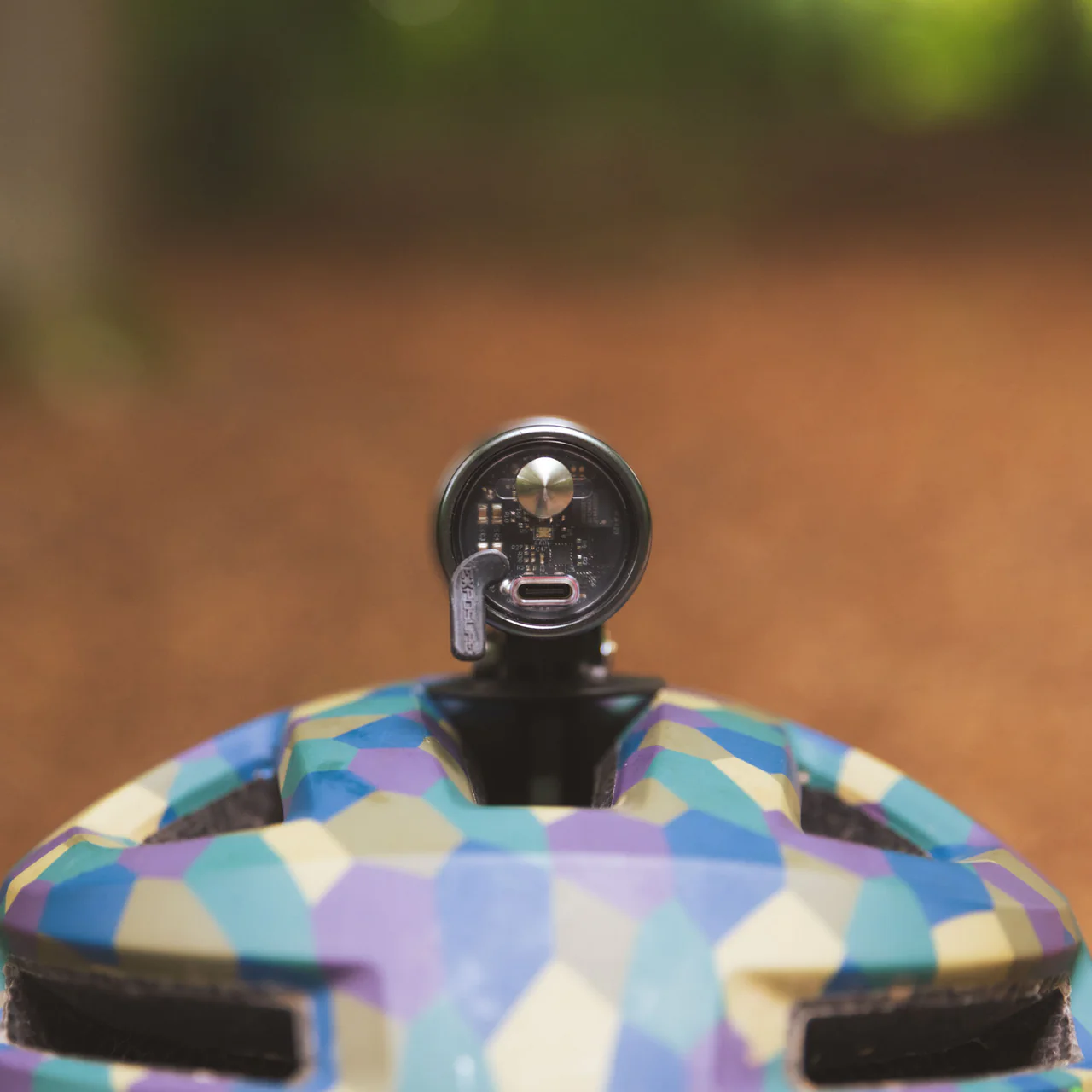
The lights feature Exposure’s ‘Tap Technology’, where you simply tap the light and it’ll switch between modes – much easier than needing to locate the ‘Function’ button the brand used on some of its older helmet lights.
Exposure claims each of these lights can last up to 36 hours on a single charge.
- Exposure Zenith Mk4 – £280 / $305 / €280
- Exposure Diablo Mk15 – £240 / $260 / €240
- Exposure Joystick Mk18 – £195 / $215 / €195
Notable Zwift Events for the Weekend of August 30-31
This week’s picks are all community-organized events, and they rotate between innovative races and challenging longer group rides. So whether you’re looking to go fast or go long, we’ve got you covered!
 Team Evolve’s August Omnium
 Unique Event Neutralized Bikes
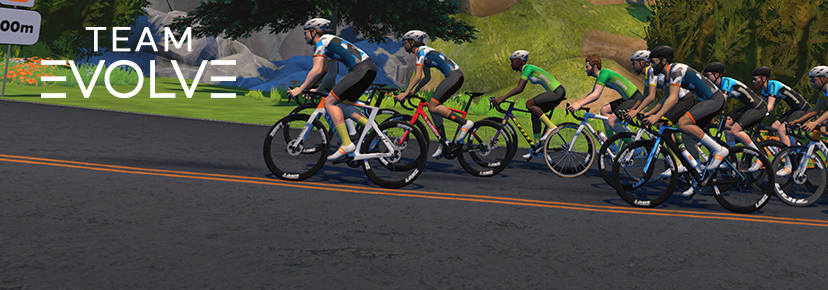
The new Team Evolve is holding a three-race omnium on Sunday consisting of a 16km individual time trial (iTT), a one-lap short route under 10km, and a 4-lap crit race to cap it off.
You earn points based on your finishing position in each race, and the rider with the most points wins.
Along with its unique format, the event includes some unique rules: riders are categorized based on FTP, and bikes are neutralized to level the playing field.
First event is Sunday, August 31 @ 5pm UTC/1pm ET/10am PT
Sign up at zwift.com/events/tag/evolveomnium
 Beth’s Banded Badge Hunt
Banded Ride Beginner-Friendly Endurance Challenge
Beth’s Badge Hunt is a series of monthly rides taking on big Zwift routes. Led by Wobble Cycling Club’s Beth Phillips, these are banded rides, so everyone can ride at whatever effort level they’d like.
This weekend’s ride is on London’s PRL Half route (69.6km, 1014m).
Saturday, August 30 @ 7am UTC/3am ET/12am PT
Sign up at zwift.com/events/view/5077335
La Roja Tour (TNP): Stage 1 and 2
Stage Race Multiple Classifications
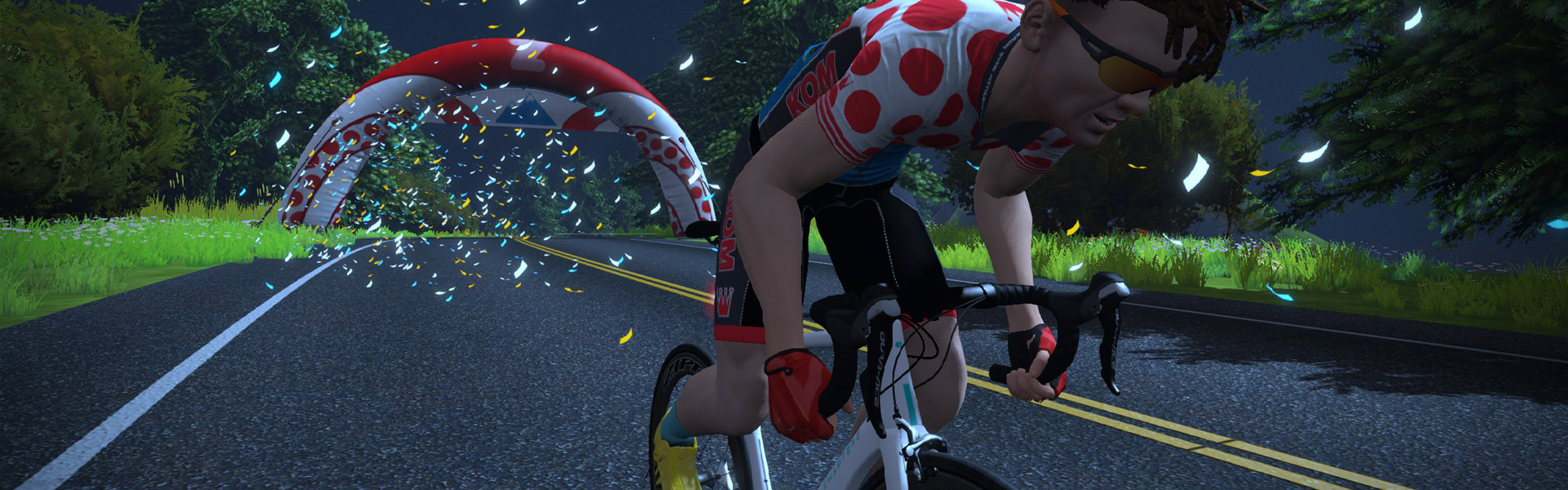
TNP (Team Not Pogi) has organized a 6-stage race series held on Saturdays and Sundays, and this weekend it kicks off with stages 1 and 2. In this series, riders compete across each stage for GC, Sprint, and Climbing overall podiums.
Stage 1 is on Watopia’s Hilly Route with a custom finish line, while stage 2 is on 1 lap of Watopia’s Waistband.
Saturday and Sunday, August 30 and 31 @ 5:15pm UTC/1:15pm ET/10:15am PT
Sign up at zwift.com/events/tag/tnp
Bikealicious Rubberband Joy Ride
Banded Beginner-Friendly Endurance Challenge
Which ride had more signups than any other when we were putting this post together? This one!
The friendly Bikealicious crew is leading a “keep together” group ride on Watopia’s Zwift Games 2024 Epic route (81.7km, 878m). Grab this challenging route badge if you haven’t done so yet, which comes with a whopping 1594 XP!
Saturday, August 30 @ 7am UTC/3am ET/12am PT
Sign up at zwift.com/events/view/5089213
Tour de HISP 2025 Stages 12 and 13
Popular Race
The most popular race this weekend is the Tour de Hisp, which wraps up on Sunday. Racers are nearing the end of this grueling 14-day tour featuring 13 stages, but even if you haven’t been joining in the fun, you can hop into the race!
Saturday’s stage 12 is held on Innsbruck’s Lutscher CCW route (22.6km, 828m), while Sunday’s stage 13 wraps up the series in Paris with 2 laps of Champs-Élysées (16.4km, 91m).
Four timeslots each day
See events on ZwiftHacks
How We Make Our Picks
We choose each weekend’s Notable Events based on a variety of factors including:
- Is the event unique/innovative in some way?
- Are celebrities (pro riders, etc) attending/leading?
- Are signup counts already high, meaning the event is extra-popular?
- Does the ride include desirable unlocks or prizes?
- Does the event appeal to ladies on Zwift? (We like to support this under-represented group!)
- Is it for a good cause?
- Is it just plain crazy (extra long races, world record attempts, etc)?
- Is it a long-running, popular weekly event with a dedicated leader who deserves a shout out?
In the end, we want to call attention to events that are extra-special and therefore extra-appealing to Zwifters. If you think your event qualifies, comment below with a link/details and we may just include it in an upcoming post!
Cannondale’s Synapse Carbon 2 SmartSense is our Road Bike of the Year for 2025 – here’s why
Our annual Bike of the Year awards are now in their 17th year, and 2025 has been as tough a year as any to select our shortlist and arrive at winners for each of our road and gravel categories – as well as an overall victor.
Tough, but not impossible… and Cannondale’s five-star Synapse Carbon 2 SmartSense has been crowned as our overall Road Bike of the Year for 2025, while also topping the endurance bike category.
We all have different needs from our bikes, but our annual Bike of the Year awards offer the opportunity to shine a light on those that stand out from the crowd, be it for their innovation, success on the podium or sheer ingenuity.
Bike of the Year is a long-term project that begins at the end of the previous year’s edition, and this year we’ve focused our attention on the three key categories we know you love to read about – race bikes, endurance bikes and gravel bikes.
Since 2024’s Bike of the Year, we’ve tested dozens of bikes across all categories, with road lead Ashley Quinlan and Bike of the Year stalwart Warren Rossiter taking the best of the bunch, and pitting them against one another to find a winner.
Across the three drop-bar categories – race, endurance and gravel – we whittled the selection down to five bikes worthy of a ‘Highly Commended’ accolade, before pulling out the standout pairs into a finalists’ shootout for each category and an overall winner debated.
The results?
2025 Road Bike of the Year winners
- Overall and Endurance Bike of the Year – Cannondale Synapse Carbon 2 SmartSense
- Race Bike of the Year – Cervélo S5 (Dura-Ace Di2)
- Gravel Bike of the Year – Parlee Taos Force AXS
Over the next week, we’ll be bringing you in-depth coverage of our finalists in each category, and analysis on the current state of play across the endurance, race and gravel bike sectors.
And on Tuesday 9 September, we’ll announce our Mountain Bike of the Year for 2025 – stay tuned for that.
Why the Cannondale Synapse is our Road Bike of the Year
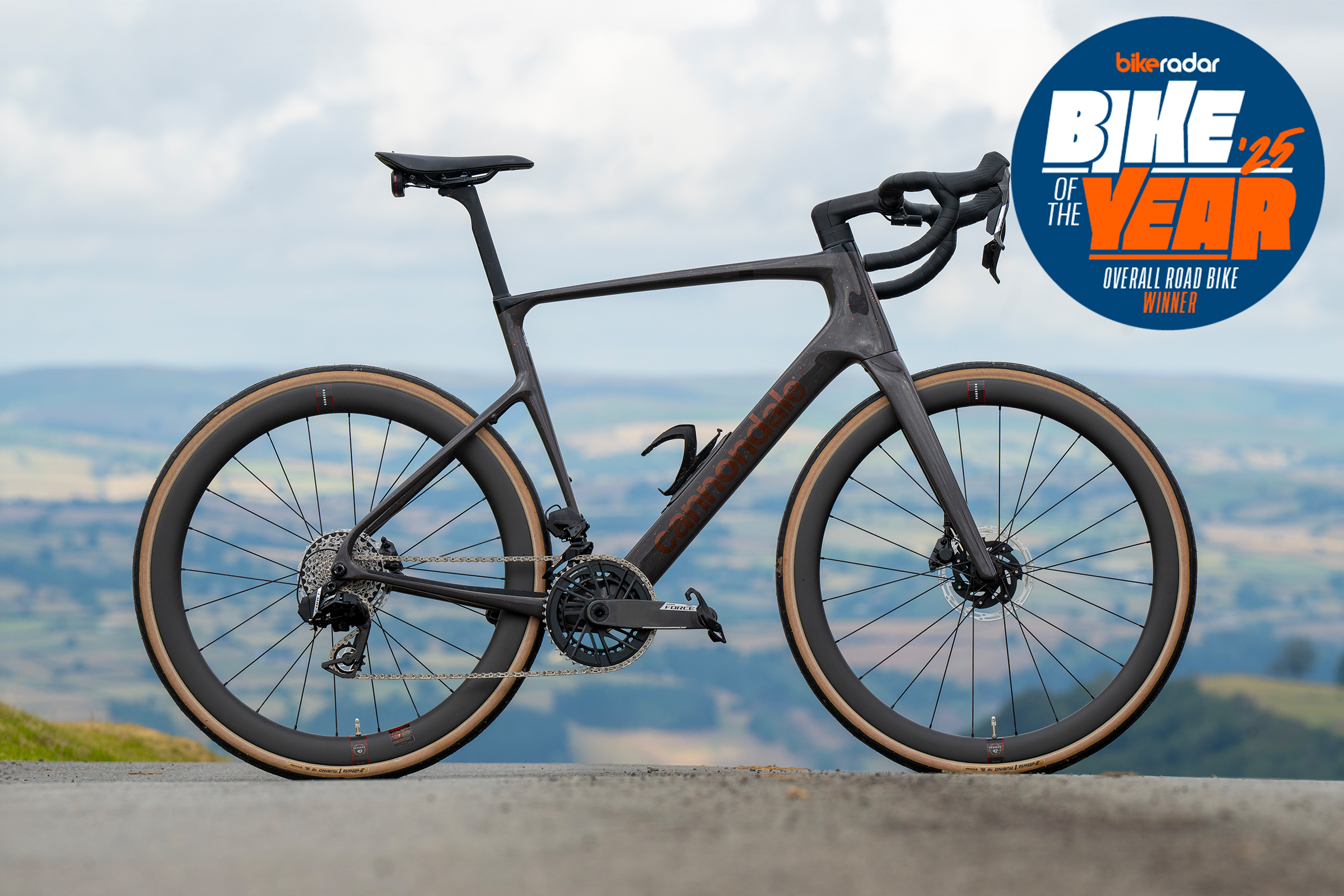
Just as in 2023 (Vitus Venon Evo) and 2024 (Giant Defy Advanced Pro 2), our overall winner is an endurance bike – a category that has seen rapid change in recent years to make these bikes more versatile than ever, without losing any of the joy of a go-fast road machine.
This year’s winner, the Cannondale Synapse Carbon 2 SmartSense, landed at BikeRadar HQ hot on the heels of the sterling performance of the flagship (and eye-wateringly expensive) Synapse Lab71, and had much to live up to.
However, it packed all the same integrated tech as the newly-launched flagship model into a machine that Warren described as setting “a new gold standard” for what we should expect of endurance bikes in 2025 and beyond.
While the Cube Attain, Parlee Ouray and Cervélo Caledonia 5 also earned ‘Highly Commended’ awards in the endurance category, the Cannondale Synapse and Boardman SLR 9.4 Ltd were selected by Warren to go head-to-head in the final.
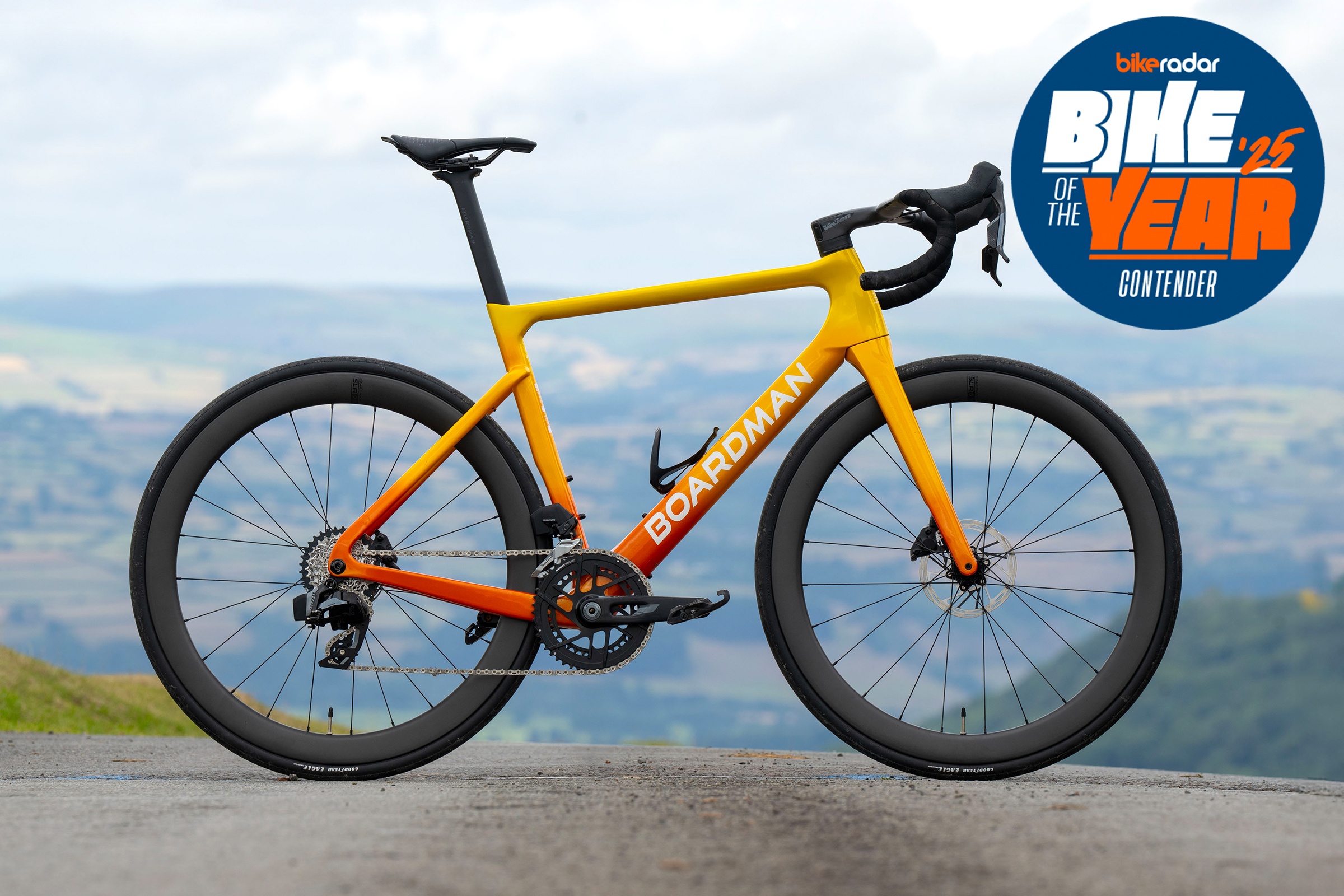
The Boardman SLR 9.4 Ltd offered tough competition – in our eyes, it’s one of (if not the) standout value proposition of 2025, with an enviable spec list including a handlebar that would cost over a fifth of the bike’s total value if you bought it aftermarket, with no notable shortcomings elsewhere.
Both bikes scored a rare five-star rating in testing, owing to their respective strengths and dearth of weaknesses, but for its forward-thinking design, both Warren and Ashley agreed during final deliberations that the Synapse took the tape by a whisker.
Warren’s verdict
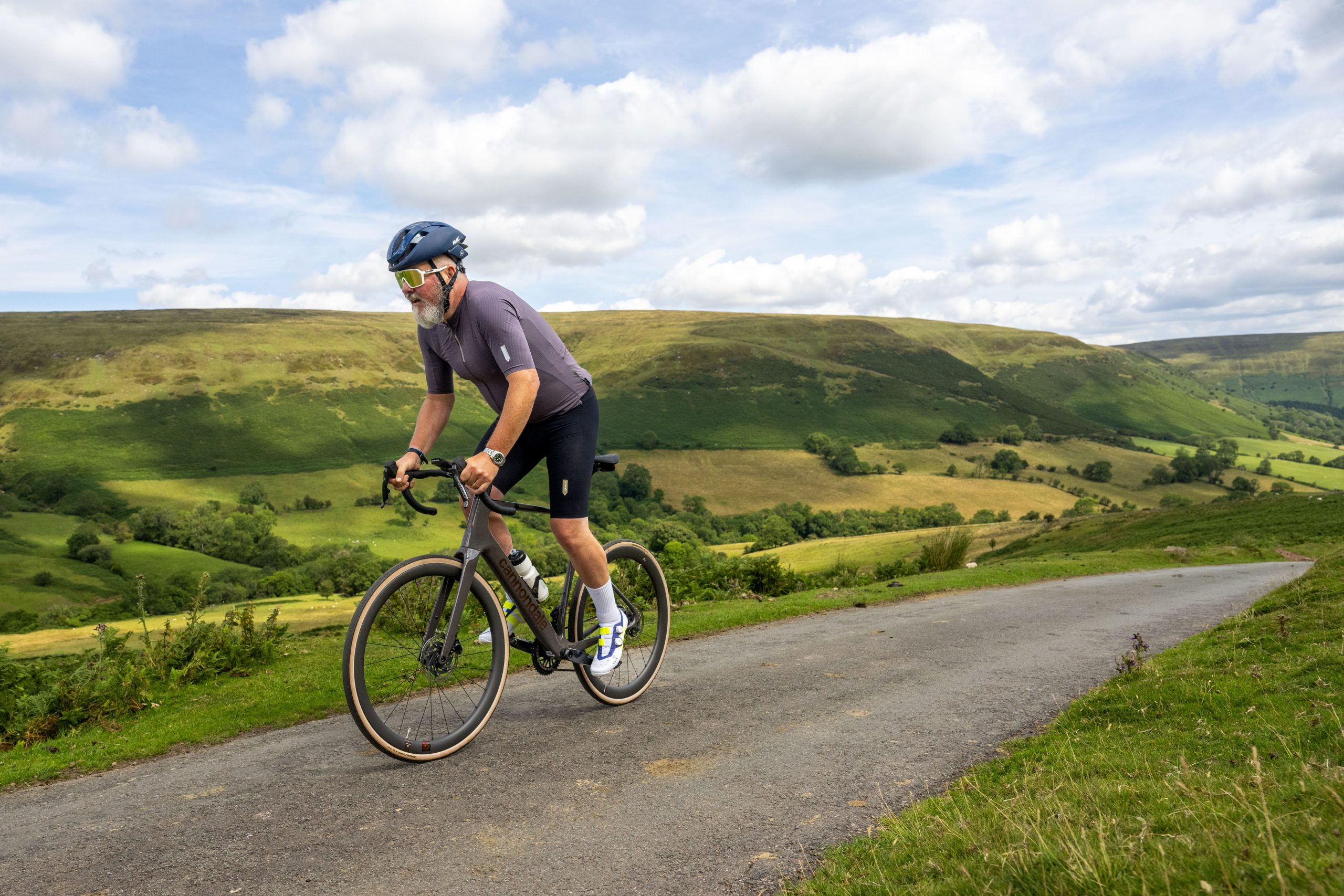
“The Synapse represents the new template for a non-racing road bike,” says Warren. “It has handling that’s swift and stable, and it delivers confidence in spades. It’s compliant but doesn’t lose the excitement that comes from a stiff bike, plus it features the most usable application of the SmartSense system to date.”
He concludes: “The Synapse Carbon 2 SmartSense is an exciting ride and a sensible choice – it’s a rare thing to draw both those conclusions about a single bike.”
- Read Warren’s dedicated head-to-head between our two endurance bike finalists – Cannondale Synapse Carbon 2 SmartSense vs the Boardman 9.4 Ltd
Overall and Endurance Bike of the Year winner
Highly commended
- Boardman SLR 9.4 Ltd review (runner-up)
- Cervélo Caledonia 5 Ultegra Di2 review
- Cube Attain C:62 SLT review
- Parlee Ouray SRAM Red AXS review
Introducing our Race Bike of the Year
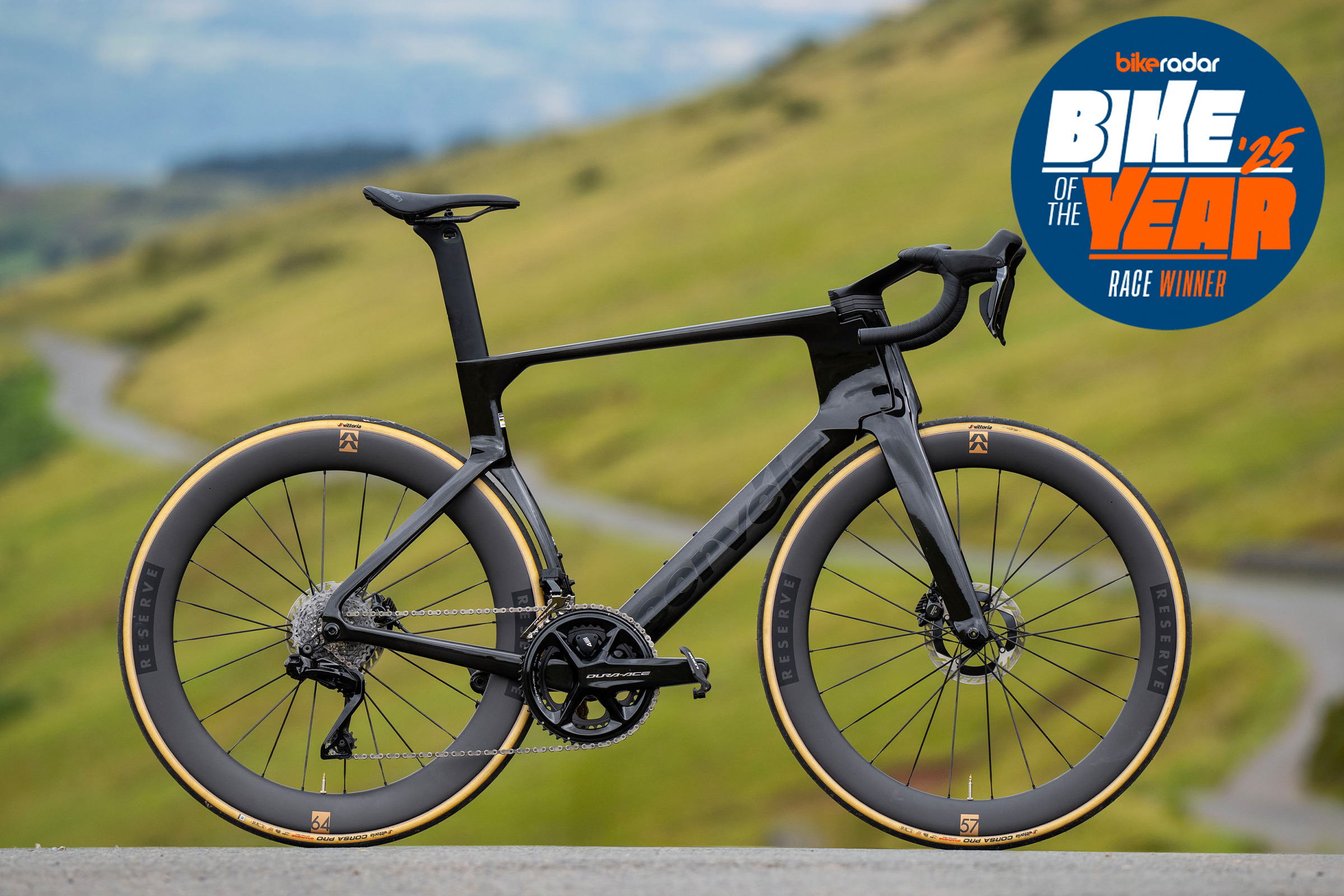
Turning to race bikes, the Cervélo S5 takes the title after going head-to-head with the Colnago Y1Rs in our category final.
Despite fierce competition from some outstanding contenders, with the Van Rysel RCR Pro, Scott Addict RC 20 and Trek Madone 7 SLR earning ‘Highly Commended’ nods, our two finalists here showcase cutting-edge aero designs.
Indeed, both bikes featured at the front of the 2025 Tour de France but while that fight ended up being decidedly one-sided in favour of the Colnago Y1Rs-riding Tadej Pogaçar, BikeRadar’s lead tester, Ashley Quinlan, looked past the Slovenian phenom and instead found that the S5 was the more worthy winner of our Race Bike of the Year category.
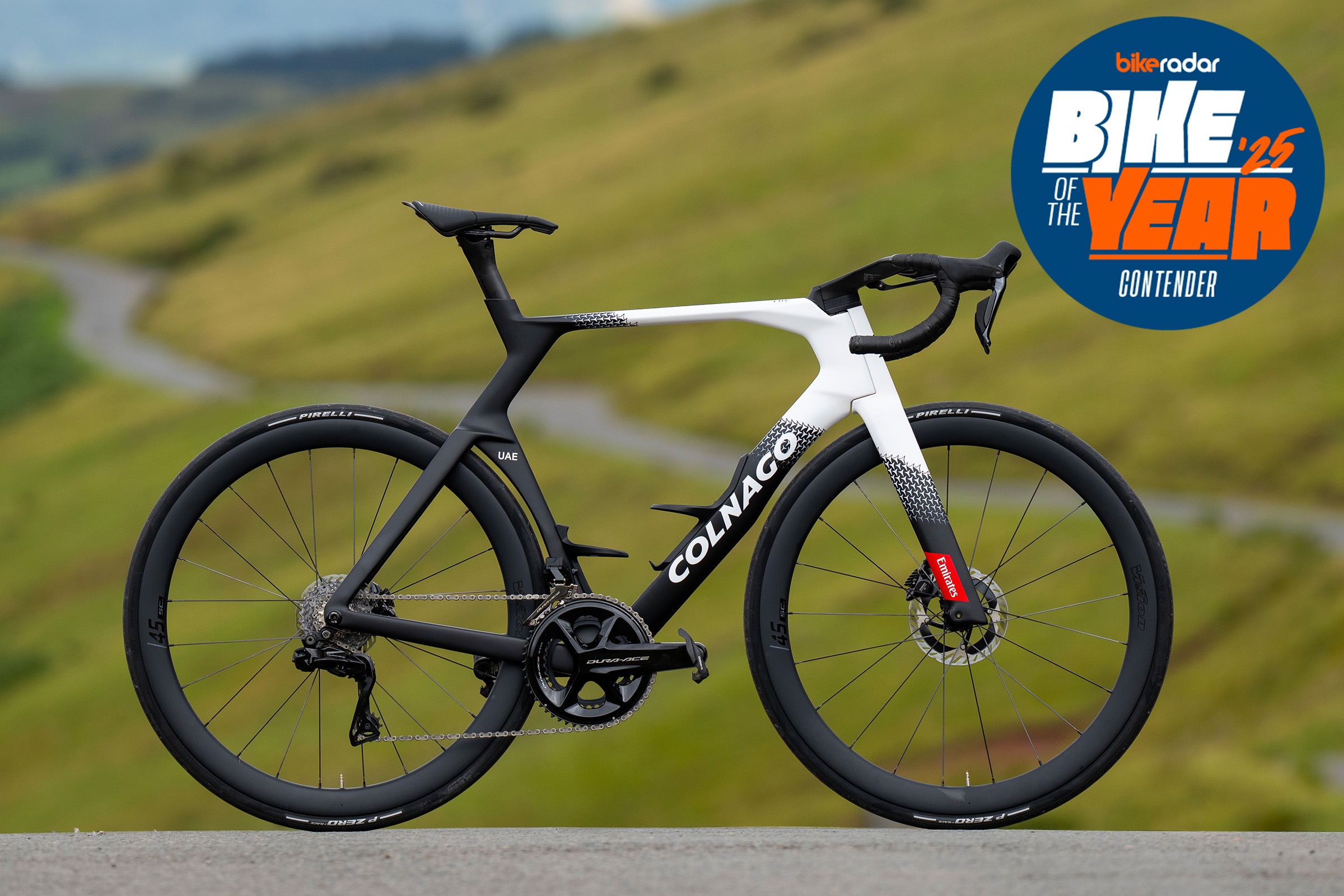
Why? While both bikes are undoubtedly expensive – the cream of the racing crop – the Cervélo S5 simply offered more for a keen racer’s money. The build is practically unimpeachable, and while the Y1Rs offers a little more customisability overall, this can be more than made up for with the money left over once the specs have been equalised.
Ashley also found the S5’s ride quality and handling to be a little more polished than the Y1Rs – a marginal win, but where the details really matter among two outstanding contenders, that’s where the devil lay.
- We will publish our final shootout between the Cervélo S5 and Colnago Y1Rs on Wednesday 3 September
Ash’s verdict
“The Cervélo S5 offers a well-balanced ride quality and excellent handling, underpinned by a devilish turn of speed,” says our road lead, Ashley Quinlan. “It’s also stable in changing wind conditions, though perhaps its biggest asset is how easy it is to ride quickly – it feels as fast as any aero road bike I’ve tested.”
Race Bike of the Year winner
Highly commended
- Colnago Y1Rs review (runner-up)
- Scott Addict RC 20 review
- Trek Madone 7 SLR Gen 8 review
- Van Rysel RCR Pro review
And our Gravel Bike of the Year?
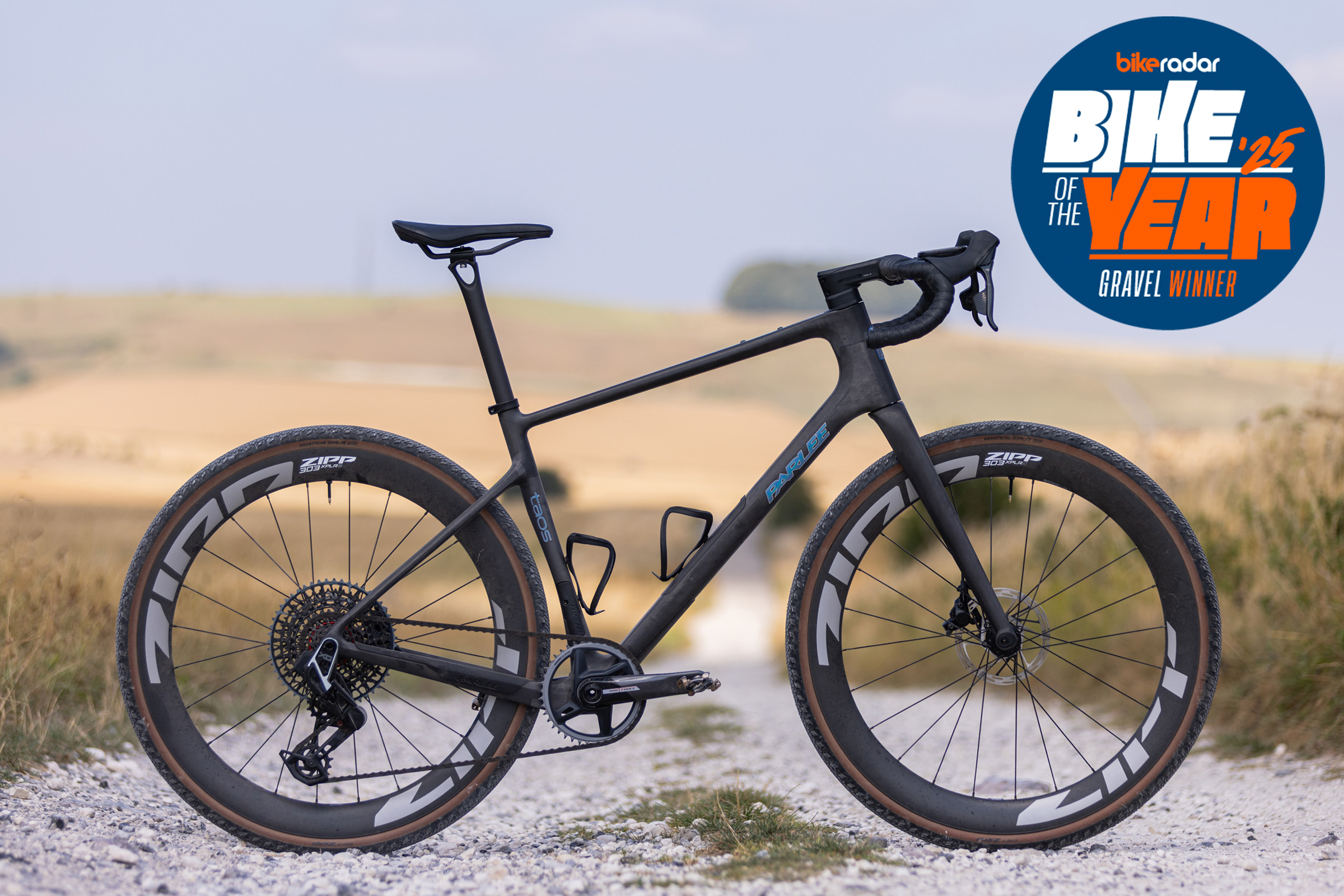
Rounding out our drop-bar awards, the Parlee Taos Force AXS is BikeRadar’s Gravel Bike of the Year for 2025.
Pitched against the mountain bike-inspired Mondraker Arid Carbon RR in our gravel final, Parlee’s Taos took the crown thanks to its mightily impressive versatility and progressive design.
If there was a gravel bike to rule them all, this might be it, leading Warren to believe that it’s the best all-round gravel bike he’s ever tested.
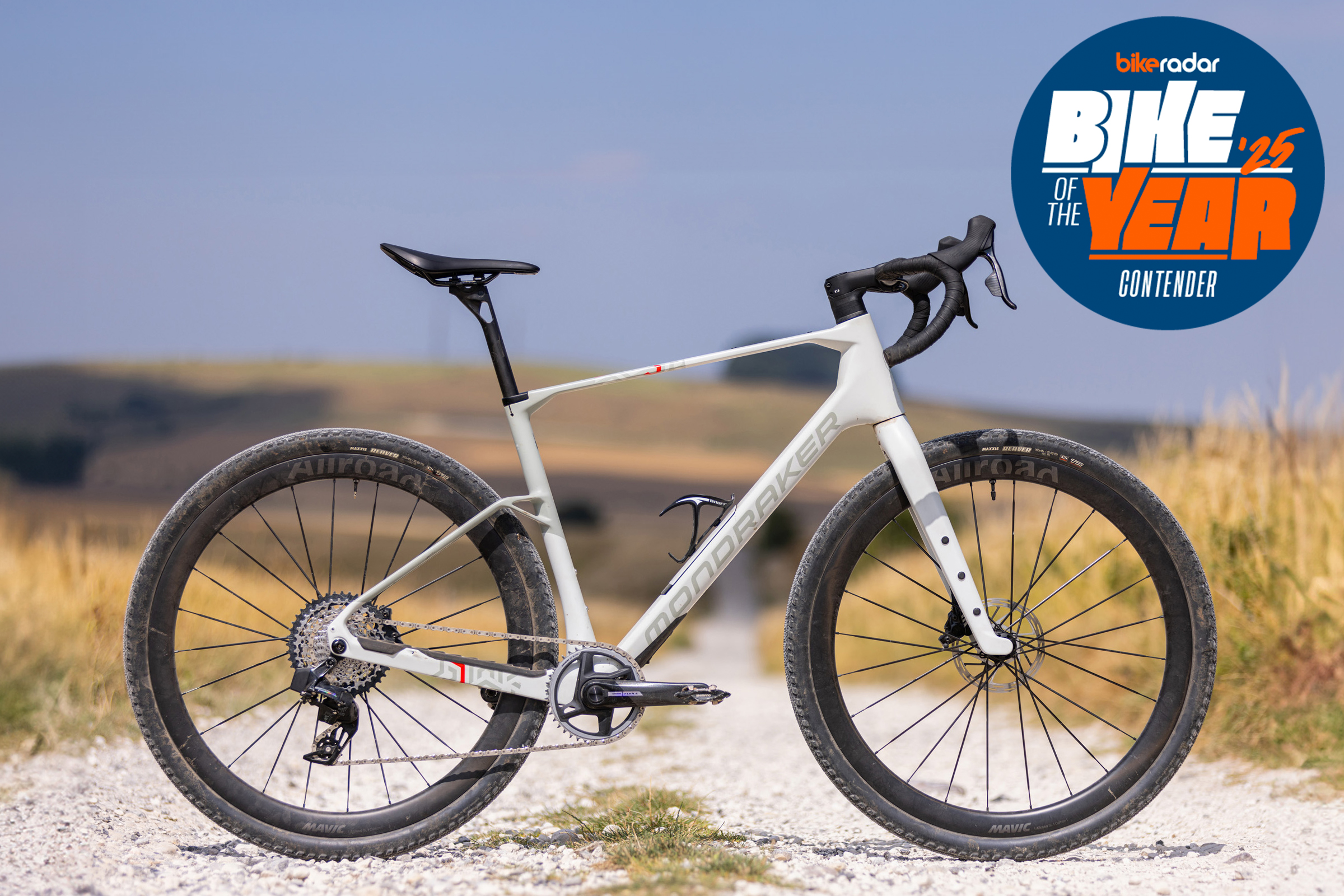
That said, the Arid’s chops when things get gnarly earn it high praise – if off-road fun on a gravel bike is what you’re after, then look no further.
Elsewhere, the Cannondale Topstone, Kinesis Tripster AT+ and Wilier Rave SLR all earn ‘Highly Commended’ awards in a hard-fought category.
- Find out how Parlee Taos and Mondraker Arid stacked up against one another soon, with our head-to-head review due to be published on Monday 1 September
Warren’s verdict
“Parlee has managed to combine the best elements of a gravel race bike – low weight, pedalling efficiency and fast handling – with the traits of more adventurous designs – large tyre capacity, smooth riding over rough ground, and stable handling and control on technical trails,” says Warren.
Highly commended
- Mondraker Arid Carbon RR review (runner-up)
- Cannondale Topstone Carbon 1 Lefty AXS review
- Kinesis Tripster AT+ review
- Wilier Rave SLR ID2 (full review to come)
What we tested
We established three categories in our road and gravel Bike of the Year test this year, distilled from five in recent years to reflect what we know you (our audience) love to read about.
This saw us put every race, endurance and gravel bike that we’ve reviewed in 2025 in the pot for consideration, with the finest five examples for each category examined once more.
The two standout candidates from each group of five were then put forward for a dedicated head-to-head test, with back-to-back testing conducted to find a winner for each category, with Warren and Ashley then coming together to decide on an overall winner.
Everything from established market leaders to emerging newcomers have been represented throughout the past year, and there should be something to suit most budgets by checking out our reviews and buyer’s guides.
- Read our road bike reviews
- Read our gravel bike reviews
Bike of the Year is supported by Auto-Trail

Big thanks to sports campervan specialists Auto-Trail for supporting our Bike of the Year 2025 test. Head to auto-trail.co.uk for more details about their range, including the cycling-specific Auto-Trail Expedition 68, which features a purpose-built bike garage.
Previous Road Bike of the Year winners
Bike of the Year – the industry’s most prestigious annual bike test – has been running since 2009, with previous winners including some of the biggest names of the past two decades, as well as breakthrough brands earning their place at the top table.
2024
Giant Defy Advanced Pro 2
2023
Vitus Venon Evo RS Aero
2022
Giant Revolt Advanced Pro 0
2021
Boardman SLR 9.4 AXS
2020
Cannondale SuperSix EVO
2019
Rondo HVRT CF0
2018
Giant TCR Advanced 2
2017
Specialized Roubaix Comp
2016
Cannondale CAAD12 105
2015
BMC GF01 Disc 105
2014
Cannondale Synapse 5 105
2013
Giant Defy Advanced 2
2012
Focus Izalco Pro 3.0
2011
Storck Scenero
2010
Cannondale Six Carbon 105
2009
Giant TCR Advanced 3
Why you can trust BikeRadar
BikeRadar has been an authority on bikes and cycling tech since its inception in 2007, delivering the world’s best riding advice.
We have experts testing all types of bikes, parts, clothing and accessories, from road, mountain and gravel bikes to commuting, bikepacking and electric bikes.
Our reviews are always editorially independent – with no exceptions. Our reviewers comprehensively test all products in the real world, always reflecting on performance, value and the wider market when delivering their verdicts and review ratings.
We have more than 15,000 product reviews available at your fingertips, as well as expert buying, maintenance, training, skills, health and fitness advice.
Our annual Bike of the Year test is an industry benchmark and the BikeRadar team consists of some of the most experienced riders and testers in the business, with road lead Ashley Quinlan and senior technical editor Warren Rossiter heading up this year’s test.