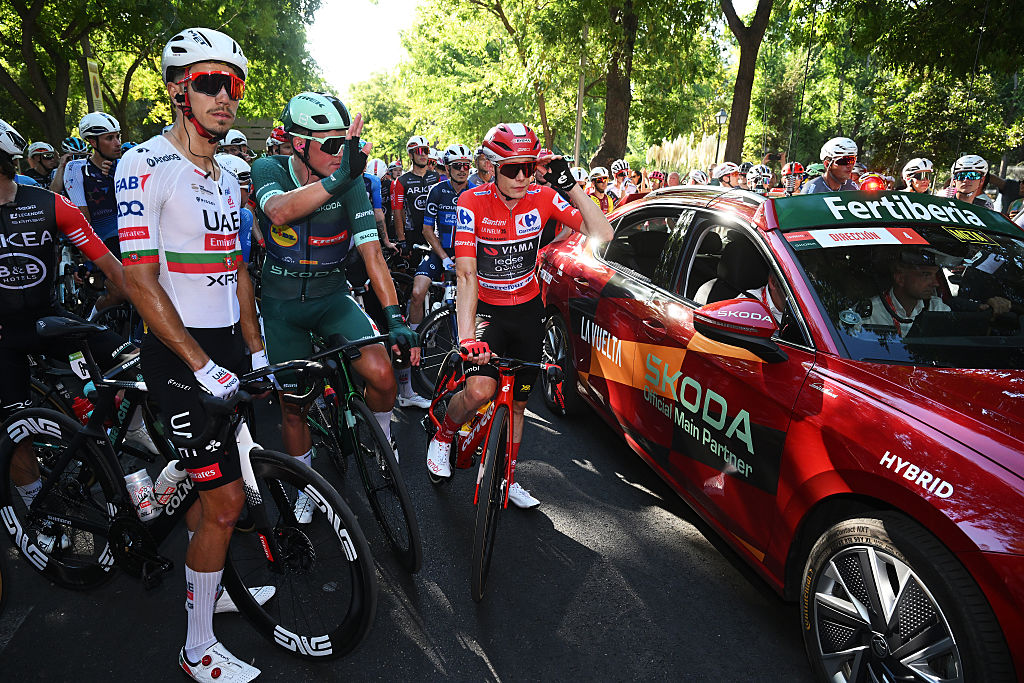
Confirmed: 2027 Tour de France to start in the UK with tri-nation Grand Départ

The Tour de France will return to the UK in 2027, with Scotland, England and Wales to host stages, and Edinburgh confirmed as the start city for the men’s race.

The 2027 Grand Départ will mark the first time both the Tour de France and Tour de France Femmes have started in the same country, outside France.

While Edinburgh has been announced as the host city for the men’s race, with Tour de France stages also confirmed to take place across Scotland, England and Wales, the start venue for the women’s race has not been revealed.

Six stages will take place on UK soil across both races, although whether the women’s race traverses all three of Scotland, England and Wales is also unconfirmed. The full routes will be announced this autumn.

“Britain has always welcomed the Tour with enthusiasm and pride, and this collaboration across England, Scotland and Wales promises to make the event even more special,” said Christian Prudhomme, general director of the Tour de France.

The Tour de France last touched British shores in 2014, when the race started with two stages in Yorkshire, before a third stage from Essex to London. Previously, London hosted the Grand Départ in 2007.

“I will always remember the riders applauding the spectators, crossing London Bridge in 2007,” said Prudhomme, at a press conference confirming Edinburgh as the start city of the 2027 Grand Départ.

“It was impossible for them to hear anything for three days because there were huge crowds everywhere.”

Crowds at the roadside for the three stages of the 2024 Grand Départ were reported to total 4.8 million, generating £131 million in revenue.

2014 Tour de France in Yorkshire
Millions of spectators lined the streets for the 2014 Grand Départ, with two stages in Yorkshire and a third finishing in London.

A British start for the Tour de France Femmes

The Tour de France Femmes first ran in 2022 and the 2027 event will see the race arrive in Britain for the first time. Prudhomme confirmed that the women’s race will continue to run separately from the men’s race, as is the current format, rather than combining with the men’s race into a single, concurrent event.

Prudhomme also suggested the Grand Départ will be broadcast on free-to-air television in the UK, despite 2025 being ITV 4’s final year showing the race, after Warner Bros. Discovery signed an exclusive deal with ASO.

“There will be discussions, of course, but I do hope the stages in the UK will be live and free-to-air,” said Prudhomme. “We are optimistic.”

The tri-nation 2027 Grand Départ has been described as ‘the largest free sporting event in British history’, and is said to represent a ‘strategic win’ between British Cycling, UK Sport, the UK Government, and the Scottish and Welsh Governments, to ‘drive lasting benefits for the sport and everyone who rides a bike’, according to organisers.

“The opportunity to host the Grand Départs of both the men’s and women’s Tour de France will cement Britain’s reputation as a destination for major international sporting events,” added culture secretary Lisa Nandy.

“This will stimulate growth, attract new visitors and leave a lasting legacy for athletes and fans alike.

“Staging the Tour de France Femmes in Britain for the first time will also be a historic occasion and inspire the next generation of female cyclists while supporting our mission of breaking down barriers for women and girls to get more involved in sport.”

2024 Tour de France Femmes
The Tour de France Femmes is coming to the UK for the first time. Getty Images

An international affair

The Grand Départ of the Tour de France has become an increasingly international affair, with six of the past ten editions of the men’s race starting outside of France. Last year, the race started in Florence, Italy, taking the Grand Départ to the home of the Giro d’Italia for the first time, while next year’s edition will start in Barcelona, Spain.

The Tour de France Femmes, however, has started in France for three of its four editions to date, with only the 2024 race starting outside of its home country, kicking off in the Netherlands.

In 2021, the British government attempted to bring the Tour back for the 2026 edition, but that bid was abandoned. Scottish Cycling was then reported to be interested in tabling a bid having got a taste for things by hosting the 2023 UCI World Cycling Championships.

That dream has now become a reality and the 2027 Grand Départ will come alongside a ‘landmark social impact programme’, according to organisers, with the aim of delivering ‘long-lasting benefits for thousands of people across the country by tackling inactivity, improving mental wellbeing, boosting economic growth and supporting communities to thrive’.

Jon Dutton, CEO of British Cycling, said: “The return of the Tour de France Grand Départ to Britain is an exciting moment for cycling in the UK. 

“Hosting both the men’s and women’s races together will be a first, and we believe it has the potential to inspire more people to discover the joy and benefits of cycling. 

“This is not just about the race – it’s about creating a national moment that encourages healthier lifestyles, supports cycle tourism and brings communities together.”

Zwiftcast Episode 213: Women’s History Month Special 2 of 2

This week, co-hosts Rebecca Charlton and Dave Towle are joined by an array of special guests for the second of two Zwiftcast episodes celebrating Women’s History Month.

Pro tip: join a Watch The Femmes ride to listen to the latest episode and earn an exclusive headphone unlock.

First, Eric Schlange takes us through bike upgrades, wind tunnels, and all the latest, biggest events.

Then WorldTour AG Insurance Soudal star Ashleigh Moolman Pasio drops in for a chat about returning from serious injury and why she’s supporting the next generation of women and girls from South Africa. Sindile Mavundla follows up, sharing the story of the Khaltsha Cycling Academy and why it’s transforming the lives of young girls. Here’s how you can support their great work.

And finally, the wonderful creator of the Zwiftcast, Simon Schofield, is back to share his story as he launches a new YouTube channel to document his return to the bike after being diagnosed with Stage 4 cancer.


Zwiftcast is available on Podbean, Apple Podcasts, YouTube, Amazon Music, and Spotify.

Speed Tests: Concept Z1 (Tron) Bike vs Top Performers

Our wheel and frame performance charts are useful tools, but they don’t answer one crucial question for many Zwift racers: how does X frame paired with Y wheelset perform compared to the Zwift Concept Z1 (Tron) bike?

With Zwift tweaking performance parameters and releasing new bikes this week, it was time to update this popular chart with current data. Below, you’ll find a scatter plot chart pitting the Tron bike against top-performing wheels and frames.

Tip: we charted how many seconds each setup saves across an hour of riding, which means you’ll find the top performers higher on the Y-axis and further right on the X-axis.

Frames used:

  • Zwift Concept Z1
  • S-Works Venge
  • S-Works Tarmac SL8
  • Pinarello Dogma F 2024
  • Canyon Aeroad 2024
  • Cannondale SuperSix EVO LAB71
  • S-Works Aethos

Wheels used:

  • Zipp 858/Super9
  • DT Swiss Disc   
  • ENVE 8.9 
  • ENVE 7.8   
  • Zipp 454   
  • Lightweight Meilenstein

Colored based on frame. Mouse over each point for details.
Zwift Concept Z1, S-Works Venge, S-Works Tarmac SL8, Pinarello Dogma F 2024, Canyon Aeroad 2024, Cannondale SuperSix EVO LAB71, Specialized Aethos

Chart updated March 18, 2025

Observations

The most surprising thing you can see immediately is that Zwift’s performance tweaks have turned the Tron bike into a leading aero bike, but a poor climber. It’s no longer an all-arounder.

See the old Tron vs Top Performers chart for comparison >

This change is due in part to Zwift making the Tron bike a bit heavier. But they also made the disc wheels a bit slower on road bikes, and those nerfed disc wheels no longer let us beat the Tron.

The next thing worth noting is how the new S-Works Tarmac SL8 is the best performer in almost every way. (See how its purple dots are higher and further right than all the other bikes.) It’s only edged out in pure aero performance, but even then its most aero setup (paired with the Zipp 858/Super9) only loses 2.4 seconds over an hour of flat roads to the Tron bike, while being 6.5 seconds faster on an hourlong climb.

Speaking of the new Tarmac, you can see that, with its release, there’s really no place for the S-Works Aethos. It used to be the pure climber that beat everyone else up the Alpe, but the Tarmac now edges it out while being much more aero. (It is possible that tests at lower power, perhaps 2 W/kg, would see the lighter Aethos edging the Tarmac whose superior CDA would have less of an effect at lower speeds. Stay tuned for more on this topic…)

Let’s talk about wheels a bit, since their performance was modified this week as well.

One big piece of news is that the DT Swiss Disc is no longer the obvious king. The Zipp 858/Super9 is just a bit more aero, and gains almost 5 seconds on the climb.

Another big piece of disc news is that all the disc wheels were made heavier this week. It used to be sort of an “even trade” going from a good disc wheelset to the best non-disc wheels… you would lose about as much in your flat time as you gained in your climb performance.

But now, going from the Zipp 858/Super9 to the ENVE 7.8 improves your climb hour by ~11s on the climb, while costing you less than 4s on the flats. This makes it hard to justify using a disc wheel on all but the flattest races.

The ENVE 8.9 wheels have received a bit of a polish, making them perhaps the best non-disc wheels available in terms of pure aero performance. If you’re looking for good climbing wheels, though, the Zipp 454s are probably your best bet. In fact, as you can see in the chart, they edged out the Lightweight Meilensteins! (The same disclaimer as above holds true here, though, that riders are lower speeds may see the lighter Lightweights beating the 454s.)

Your Thoughts

What conclusions do you draw from this chart? Share your thoughts below!

Chris King’s latest wheels pair its famous hubs with budget-friendly alloy rims

The new Chris King MTN30 AL wheelset pairs the American brand’s famous hubs with aluminium rims to create a budget-friendly mountain bike wheelset.

This will likely come as welcome news to riders who want quality hubs and professionally built wheels, but can’t justify the cost of carbon rims.

In fact, Chris King claims its new trail and all-mountain wheelset will have a ride quality that’s reminiscent of its carbon mountain bike wheels, despite costing around $1,000 less. 

As a result, Chris King says the MTN30 AL offers reliability and serviceability, alongside responsible manufacturing processes.

Ride quality and durability

Chris King MTN30 AL mountain bike wheel.
Christ King learned ride quality and durability were the most important features for shops and riders. Chris King

When designing the MTN30 AL, Chris King says it consulted bike shops and riders about what they wanted from an aluminium mountain bike wheelset.

Chris King’s wheel product manager, Greg Hudson, says: “We learned that ride quality and durability were the most important features.”

With hubs that are renowned for their quality, and backed by a lifetime warranty, Hudson says Chris King knows “how to make durable bike products”, so achieving durability didn’t feel like a problem. 

“However, it took a lot of comparative ride testing in the field and impact testing in the lab to create a wheel that both meets our durability standards and delivers the premium ride quality we were after,” he says. 

Chris King hub in MTNAL 30 wheelset.
The wheels come with Chris King’s famous hubs. Chris King

Hudson adds that Chris King was happy with its MTN30 carbon wheels, which it launched in 2022, and tried to bring as many design cues as possible to the alloy wheels. 

“They’re highly responsive and give the rider the right amount of trail feedback. We really hit that sweet spot between muted and too harsh. The ride feels very smooth but also connected to the terrain,” Hudson says. 

Chris King MTN30 AL specs and details 

Chris King MTN30 AL mountain bike wheel.
The MTN30 AL wheels are built at Chris King’s Portland, OR factory in a range of configurations. Chris King

The MTN30 AL is built in-house at the Chris King factory in Portland, Oregon, using Sapim Race spokes and Chris King Boost Centerlock, Boost six-bolt, or Super Boost hubs.

The hubs will be available in all the usual Chris King colours.

Chris King says the aluminium rims are made in the USA. They have 32 spoke holes, an internal rim width of 30mm and the tubeless-compatible, hookless rim bead is said to increase sidewall protection. 

The rim and decals have a subtle matt finish, letting the hub colour set the tone for your bike’s aesthetics.

The rims are backed with a two-year warranty on defects. The wheels also come with an affordable lifetime crash replacement programme for the original purchaser. 

The wheels will be available in 29in or 27.5in sizes, or in a mullet configuration – which is a first for Chris King. 

Lower cost, increased weight 

Chris King MTN30 AL mountain bike wheel rim.
The 29in aluminium rim weighs a claimed 595g. Chris King

The MTN30 AL costs from $1,250, which is roughly $1,000 less than Chris King’s MTN30 carbon wheelset. 

Unsurprisingly, the MTN30 AL weighs more than Chris King’s carbon mountain bike wheels. 

Chris King claims the 29in rims weigh 595g, which is 104g more than its 29in carbon mountain rim. 

It says the complete wheel weight starts at 2,080g for a mullet configuration, which is just over 300g more than its 29in MTN30 carbon wheels. 

All About Zwift’s New “Bike Upgrades” Functionality

This week, Zwift’s much-anticipated Bike Upgrades feature goes live, allowing Zwifters to trade Drops and accumulated riding for performance upgrades.

But how does it work? What sort of performance improvements can we expect? And what exactly is a “Halo Bike”? Dive in and find out!

Bike Upgrade: the Basics

Every bike frame in Zwift now has 5 “stages” of upgrades available. As you ride a particular frame, you work your way toward completing the current stage. Completion progress is visible in your garage:

Completing the work required unlocks the ability to purchase that upgrade for your bike:

There are five types of bike upgrades:

  • CDA (aero) improvements
  • Weight reduction
  • Crr (rolling resistance) decreases
  • Drops earning increase (5%)
  • XP earning increase (5%)

Why Upgrades?

It seems that, with every new feature Zwift releases, there are people who comment, “Why did Zwift put the development resources into building this feature? I won’t be using this. Etc, etc…”

Bike Upgrades add another carrot to the game – a fresh incentive to get on your bike and put in the work. Will that carrot be attractive to all Zwifters? Of course not. No feature is. But Zwift is betting it will appeal to many.

Additionally, most experience Zwifters have millions of Drops saved, with nothing to spend them on (I’ve currently got 81 million.) Bike Upgrades give Zwifters a place to spend our Drops.

Lastly, Bike Upgrades add a strategic element for racers who may want to put some thought into which bike(s) to upgrade and when, for maximum in-game performance.

Upgrade Variations

While every bike in Zwift now has 5 stages of upgrades, it’s not the same upgrades for every bike. The upgrades available for a particular frame are based on two factors:

  1. Bike Type: climbing bikes get more weight reductions, TT bikes get more aero upgrades, and all other bikes get a more even mix of upgrades. Example: a maxed out TT frame compared to its un-upgraded version is about 45 seconds faster over an hour on flat roads, and 26 seconds faster on an hour of climbing. By contrast, a maxed out S-Works Aethos is about 21 seconds faster over an hour on flat roads, and 58 seconds faster on an hour of climbing, compared to its un-upgraded version.
  2. Bike Price: entry-level bikes get bigger performance increases in the early upgrade stages, while latter stages unlock Drops or XP bonuses. Higher-level bikes don’t unlock Drops or XP bonuses, but rather spread the performance increase upgrades across all 5 stages so you really have to put in the work to max out a top-level frame.

Additionally, the type of work you must do to unlock upgrades, the amount of work you must do to unlock an upgrade, and the cost of each upgrade vary between bikes based on three factors:

  1. Bike Type: climbing bikes require accumulated elevation, TT bikes require accumulated time, and all other bikes require accumulated distance. Example: to unlock upgrade stage 1, the S-Works Aethos (climbing frame) requires 2000 meters of climbing while the Cadex Tri TT requires 6 hours of use and the Felt AR 200km of distance.
  2. Upgrade Stage: each stage requires more effort to unlock than the stage before. Example, the S-Works Venge requires 200km of riding to unlock stage 1, but 440km for stage 5.
  3. Bike Price: just like outdoors, higher-end bikes cost more to upgrade. Example: in the climbing bike category, the S-Works Aethos requires 4000 meters of climbing and 750,000 Drops for its stage 5 upgrade, while the more entry-level Trek Emonda SL requires just 2000 meters of climbing and 200,000 Drops for its stage 5 upgrade.

Upgrades vary widely in price. A basic bike’s stage 1 upgrade only costs 25,000, while a Halo Bike’s stage 5 upgrade costs an astronomical 5 million Drops!

Performance Improvements

The big question on everyone’s mind is: just how much faster will upgraded bikes be?

While we can’t tell you exactly what each stage’s upgrade will trim off of your time (not yet, anyway), we can share overall time improvements for a “stage 0” (completely un-upgraded) frame vs its maxed out “stage 5” version. Here is the time savings you can expect across an hour of riding at 4 W/kg:

Bike Type Flat Roads (Stage 0 vs Stage 5) Climbs (Stage 0 vs Stage 5)
Climbing -21s -58s
TT -45s -26s
All Others -28s -36s

Note that the 1-hour time savings above is estimated based on test results with our bot (75kg, 183cm tall, at 300W). Flat tests are done on Tempus Fugit, while the climb test is done on Alpe du Zwift.

Halo Bikes

This update from Zwift also adds a new, highly prestigious set of bikes to Zwift: Halo Bikes! These are fast and unique bikes that take a lot of work to unlock, a ton of Drops to purchase, and oodles of work and Drops to fully upgrade.

There are four available today:

  • Pinarello Espada
  • Specialized Project ’74
  • Cannondale R4000 Roller Blade
  • Concept Z1*

* the Concept Z1 (Tron bike) is unique on this list, because many Zwifters already own it after completing the Climb Mt Everest Challenge. This is still the only way to unlock it, but if you want to upgrade your Tron bike, you have to fully upgrade 3 Zwift frames first.

Halo Bikes can be seen as brand loyalty rewards, because unlocking a brand’s Halo Bike requires you to first fully upgrade three frames from that brand. Simply unlocking a Halo Bike doesn’t mean you own it, though. You still have to purchase the bike, at a hefty price of 10 million Drops. Yes, you read that right: 10. Million. Drops.

Once you own it, a Halo Bike can be upgraded in 5 stages, just like every other bike in Zwift. But the work and cost of each upgrade is around 5x more than even the best non-Halo Bikes! So while Halo Bikes will be somewhat rare, fully-upgraded Halo Bikes will be rarer still.

Watch this space! We’ll be publishing a dedicated post all about Halo Bikes in the coming days, sharing performance details and more. Until then, catch the Halo Bikes in action from March 18-April 7 in Watopia with Robopacers Big Mig, Jacques, and Coco.

Upgrading Tips

Zwifters – especially racers and riders who collect unique in-game bikes – will probably be asking two questions:

Question #1: Which bike should I upgrade first?

If you’re a racer, it’s probably smart to upgrade the bike you race the most. Maxing out high-end race bikes like the S-Works Venge or Pinarello Dogma F 2024 requires 1600km of riding and 1.9 million Drops. That’s no small ask, but it is also doable in 3-5 weeks for many experienced riders.

If you just want a particular Halo Bike, and aren’t concerned with race performance, you’ll get there quickest by upgrading three lower-end bikes, because lower-end bikes can be upgraded to stage 5 much quicker than higher-end bikes.

Question #2: Are there ways to speed up the upgrade process?

The simple answer is “yes,” but a full explanation could be an article in itself. As explained above, depending on which type of frame you’re riding, upgrades will be unlocked based on accumulated elevation, distance, or time on the bike.

Shortening your upgrade time, then, means figuring out how to accumulate more elevation, distance, or time on the bike. A few ideas:

  • To gain elevation faster, do your structured workouts on climbs like Alpe du Zwift or Ventoux. The workout won’t feel any different, but you’ll be gaining more altitude than you would riding on a flat route.
  • To gain distance faster, ride in groups. Robopacers are an obvious choice, but group rides or races are also a good option.
  • To get more time on the bike, try adding another long, slow zone 2 endurance ride to your week. These sorts of rides do wonders for your riding, delivering increased mitochondrial density, improved lactate clearance, and new muscle capillaries, among other things.

One last tip for upgrading as quickly as possible: once you’ve done the work to unlock an upgrade, spend the Drops to buy it! Because until you purchase it, your work on the bike won’t go toward unlocking the next step.

Your Thoughts

Got questions or comments about bike upgrades? What bike are you going to upgrade first, and why? Comment below!

Zwift Update Version 1.86 (142579) Released

Zwift version 1.86 begins its phased rollout today. This is a major release – Zwift’s largest so far this year – delivering major changes to the Drop Shop and Garage including new bikes, frame/wheel performance modifications, and the much-anticipated Bike Upgrades system. Read on for details…

Bike Upgrades

Zwift’s release notes say, “the Zwift Garage now features a Bike Upgrade system that lets Zwifters upgrade any bike and hand cycle to five (5) upgrade stages for increased performance.”

It’s the long-awaited “Garage Upgrades” functionality announced back in September 2024, and it adds lots of new carrots for Zwifters to chase. It also gives us a reason to spend Drops and think strategically about which bikes to upgrade and when!

This is a big update, so we’ve put together a detailed post all about it.

Read “All About Zwift’s New ‘Bike Upgrades’ Functionality” >

Performance Changes

To support the Bike Upgrades system and increase in-game realism, this week’s update includes performance tweaks to nearly all bikes and wheelsets in game. Again, there’s way too much detail to share here, but the good news is we published a post last week detailing the new performance characteristics of all the road frames and wheels:

Read “Learn About Upcoming Frame and Wheelset Performance Changes on Zwift” >

There’s much more to talk about in this space, including performance changes to the Tron (Concept Z1) bike as well as TT, MTB, and Gravel frames. Watch Zwift Insider for more info soon.

7 New Bikes

Everyone loves new bike day! Four new “production” road bikes have been added to the Drop Shop: the S-Works Tarmac SL8, Tarmac SL8, Cannondale CAAD13, and Cannondale Super Six EVO LAB71:

We are now running speed tests on these bikes. They are fast. We will publish results as soon as possible.

Additionally, three new “Halo Bikes” are now “available” in the Drop Shop: the Specialized Project 74, Pinarello Espada, and Cannondale R4000 Roller Blade:

We say “available” for the Halo Bikes because Zwifters will have to put in a lot of work and spend a pile of Drops before they even have the opportunity to unlock a Halo Bike. Read our Bike Upgrades post for more info.

Drop Shop Price Changes

The Pinarello Dogma F 2024 has slightly increased in price, from 1,400,000 to 1,750,000. That is the only frame with a new price. Wheels, on the other hand, have (almost) all increased in price:

Wheelset Old Price New Price
Bontrager Aeolus5 67,700 150,000
CADEX 36 223,900 375,000
CADEX 42 119,500 425,000
CADEX 65 216,900 450,000
Campy 35 250,000 350,000
Campy 50 150,000 450,000
DTSwiss 62 400,000 500,000
DTSwiss DISC 655,000 750,000
Enve SES 2.2 174,300 400,000
Enve SES 3.4 200,000 525,000
Enve SES 6.7 150,000 525,000
Enve SES 7.8 278,900 550,000
Enve SES 8.9 250,000 550,000
FFWD RYOT55 136,100 200,000
Giant SLR 0 165,100 450,000
HED Vanquish RC6 Pro 120,000 175,000
Mavic Comete Pro 38,400 200,000
Mavic Cosmic CXR60c 39,800 150,000
Mavic Cosmic Ultimate 38,400 525,000
Novatec R4 37,900 150,000
Roval Alpinist CLX 634,300 550,000
Roval CLX64 150,000 525,000
Roval Rapide CLX 200,000 500,000
Shimano C40 85,300 300,000
Shimano C50 165,000 250,000
Shimano C60 187,000 325,000
Zipp 202 135,200 350,000
Zipp 353 NSW 168,800 600,000
Zipp 404 115,600 425,000
Zipp 454 204,300 600,000
Zipp 808 200,000 425,000
Zipp 808/Super9 450,000 650,000
Zipp 858 300,000 600,000
Zipp 858/Super9 550,000 750,000
Zwift 32mm Carbon 32,000 100,000

Additionally, four wheelsets have had their unlock levels changed:

  • HED Vanquish RC6 Pro: 17 to 10
  • Shimano C60: 10 to 17
  • FFWD RYOT55: 18 to 6
  • Mavic Cosmic Ultimate: 6 to 18

New Routes

Three new routes (and route badges) arrived in this update. Two are now available to free ride, while the third (Hilltop Hustle) is event-only at this time.

Retired Bikes

This wasn’t mentioned in the release notes, but Zwift has “retired” many older bike models in today’s release by removing them from the Drop Shop. (This is the first mass bike retirement in Zwift’s history.)

Here’s the full list of bikes retired in this release:

  • Specialized
    • 2015 Shiv
    • 2019 Tarmac Pro
    • 2015 Tarmac
    • 2015 Roubaix
    • 2015 Amira
    • 2016 S-Works Amira
    • 2019 Ruby
    • 2015 S-Works Ruby
    • Specialized Allez 2015
  • Cannondale
    • CAAD12
  • Pinarello
    • 2019 Dogma F10
    • 2015 Dogma 65.1
  • Canyon
    • 2015 Ultimate
    • 2015 Speedmax
  • Cervelo
    • 2015 S3D
    • 2015 S5
  • Scott
    • Scott Foil 2015

If you already own one of these bikes, it will remain in your garage. But you won’t be able to purchase these bikes once you’ve installed version 1.86.

Release Notes

Zwift provided notes on additional tweaks and bug fixes in this update:

  • Improved the reliability of The Zwift Big Spin reward spinner.
  • Improved the navigation and appearance of the tabs shown on top of the Home screen.
  • Fixed an issue that caused Running progress to incorrectly count towards the Factory Tour challenge.
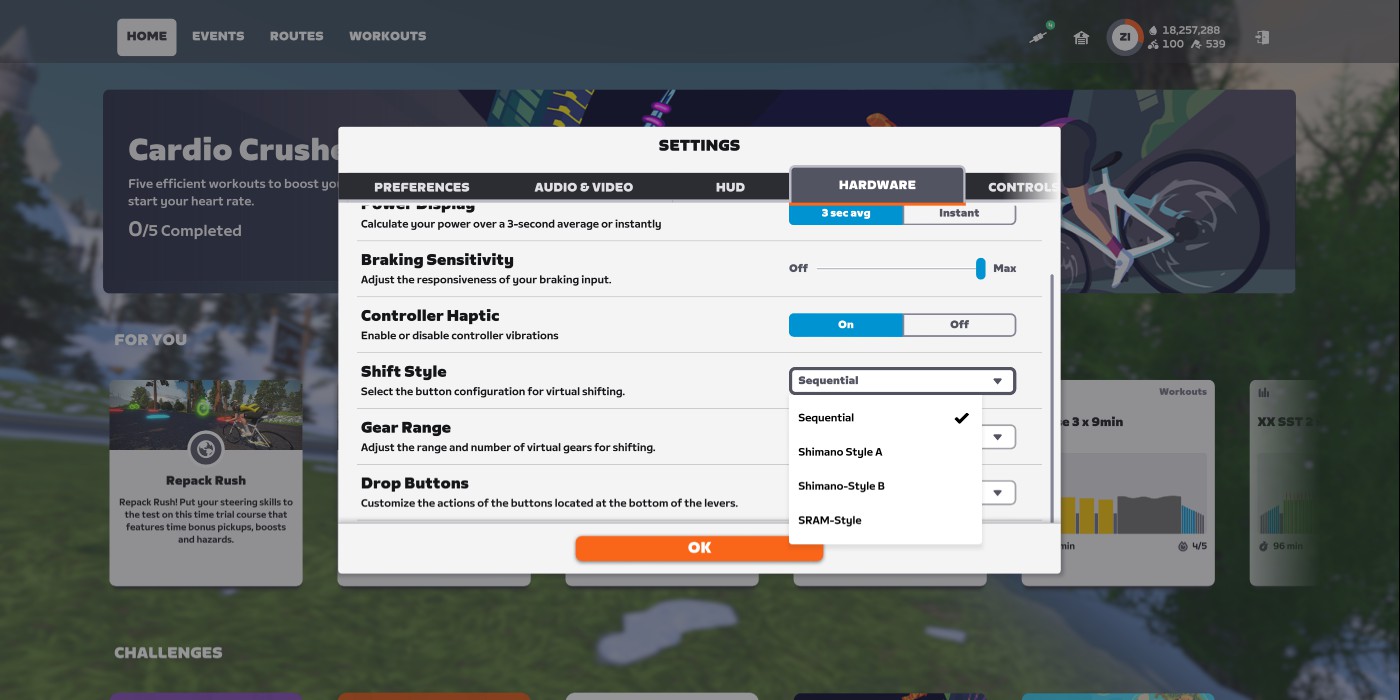
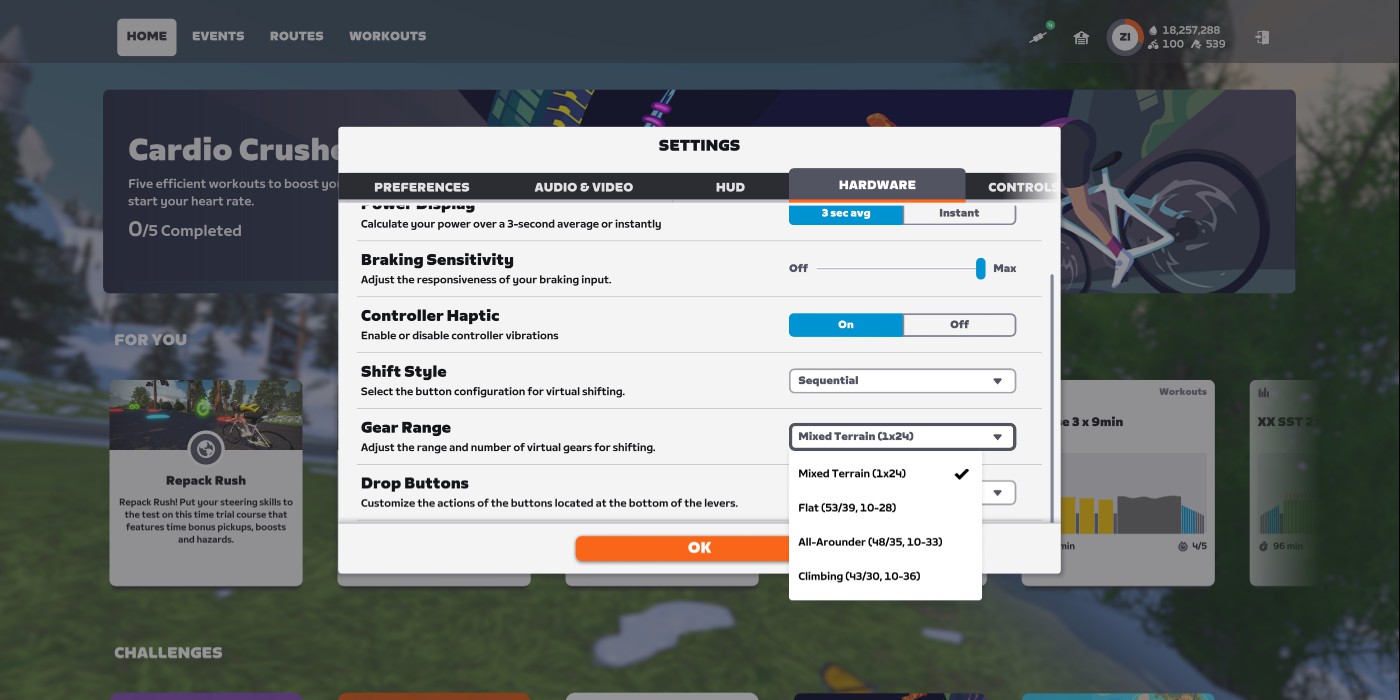
  • Fixed an issue that could cause the Shift Style and Gear Range settings to appear for trainers that do not support virtual shifting.
  • Windows: For Windows devices that are compatible with Video Screenshots, Video Screenshots is now disabled by default for devices that have less than 8 GB of RAM or fewer than 4 CPU cores. Video Screenshots can be re-enabled at any time for these devices under Settings → Video Screenshots.
  • iOS: Fixed an issue that could cause Bluetooth devices to not automatically reconnect if Zwift was open for an extended period of time.
  • Android: Fixed an issue that could prevent Bluetooth devices from automatically reconnecting after a disconnection.

Discuss this update in Zwift’s forum > (link coming soon)

Questions or Comments?

What do you think of this big update? Have you spotted any other changes or bugs in this release? Share below!

Rapha’s new rain jacket is its lightest ever – or is it?

Rapha says its new Pro Team Lightweight Gore-Tex Jacket is its lightest ever rain jacket, but this might not be as light as one older jacket from the cycling clothing brand.

In a size medium, the brand says the waterproof cycling jacket weighs 128g – on our scales, our size large test sample weighs 135g.

The 7g difference could easily account for a size jump, but it’s worth recalling that Jack Luke weighed a size medium Pro Team Lightweight Gore-Tex Shakedry Jacket at 125g (3g lighter than the new garment), putting the brand’s claim into question.

PFAS-free fabric

Rapha Pro Team Lightweight Gore-Tex Jacket
The jacket is certainly light, but might not be as light as Rapha’s old Shakedry jacket. Rapha

Whatever you think about a 3g difference, though, the new jacket features a PFAS-free fabric from Gore, just like the Men’s Rapha Gore-Tex Rain Jacket I reviewed in late 2024.

That said, this comes with a qualifier that Gore’s fabrics are “made without intentionally added per- and poly-fluorinated substances, [but] may contain trace amounts.”

This fabric is claimed to be “new”, and Rapha says it played a key role in the “wear testing process” with Gore.

Rapha Pro Team Lightweight Gore-Tex Jacket
An ergonomic fit is said to be tailored for “aero bike positions”. Rapha

The fabric has a 3-layer woven ripstop construction which, in combination with an ergonomic fit, Rapha claims makes the jacket comfortable for training and racing in aggressive riding positions.

Initial impressions

Rapha Pro Team Lightweight Gore-Tex Jacket
EF Education-EasyPost pro rider Kasper Asgreen is said to have been involved in the jacket’s development. Rapha

Hands-on with the jacket, a square-waffle pattern is visible on the outer fabric. It packs down into a jersey pocket relatively easily as claimed, but the fabric has a crinkly texture. 

This means the thinner-feeling Shakedry fabric (which has two layers) feels slightly easier to compress. 

The Pro Team Lightweight Gore-Tex Jacket also has a two-way zip, which the brand says will boost airflow when opened from the bottom. This is also how a rider will need to access a pocket, given there are no pockets on the jacket itself.

The jacket uses taped seams on the inside, and has a fleece-backed chin guard (as opposed to a wrap-over zip garage).

We’ll be putting the jacket to the test this spring, to see how it performs versus recently-tested PFAS-free rivals

The jacket is available from today and costs £295 / $390 / €335.

How the Race Was Lost: Zwift Games Stages 3 and 4 (Downtown Eruption and London Uprising)

The Zwift Games are upon us, and with them big race packs on fresh routes. Having finished third in stage 1 (read more) and second in stage 2 (read more), I was really enjoying myself in the 450-570 group.

But then the climb stages arrived, and everything changed. Here are my summaries of stages 3 and 4 of Zwift Games.
Stage 3: Warmup

It didn’t take long for me to realize that today wasn’t going to be pretty.

As I spun my legs to gently warm them up prior to the race, I could tell today (Tuesday, March 11) was a bad leg day. You know what I’m talking about. Sometimes these days are expected, other times they come as a surprise. Today was a bit of a surprise since I had ridden the day before and felt fairly good.
What was the cause? Poor sleep? Insufficient nutrition? Getting sick? I wasn’t sure. But I could tell something was off.

Stage 3: Volcano Implosion

Stage 3 took place on the new Downtown Eruption route in Watopia, and I knew exactly where I would have trouble here: the Volcano KOM. This segment has often been my undoing in races, as it’s just a bit too steep and long for me to hang on!

We had a big pack of 144 starters in the race, so I knew the effort was going to be extra tough. That’s just how it works on Zwift: bigger packs mean more strong riders, generally.

The course begins with a quick climb up the bottom half of the Hilly KOM, and it took ~450 watts for 50 seconds to hold onto the group here. Job done, but I knew the big test was up the road.

I made it to the foot of the Volcano KOM without incident, but it wasn’t long (around 600 meters in) before I saw my avatar drifting backward in the group. At 1.1km into the climb, the white flag came out. 75 riders rode away in a long string ahead, and I was quickly passed by several more.

At first, I sat up and spun easily, sinking down to 93rd place. Then I realized there was still a GC competition going on, so I pushed a bit to catch the wheels of the small group just ahead as we hit the flat halfway point of the Volcano KOM.

But then the road tilted up again, and that group rode away from me too! Jimmeny Christmas. This was bad.

Over the top, I found myself with just a couple of riders. We descended together, and I used the supertuck and some well-timed power to bridge us up to a small group just up the road.

The race may be lost, but you can still make it interesting, right?

You can tell it’s a bad leg day when your legs like you’re riding at threshold, but your heart rate doesn’t want to get above tempo zone. That’s what I was feeling on this day – like I couldn’t even push my legs hard enough to make my heart work hard!

Stage 3: Finish

Six of us made our way through Downtown Watopia, then it was time for the final challenge: the Hilly KOM. This climb is around 2 minutes long and, again, has been my nemesis in past races, seeing me dropped by just a few seconds as we crest the top.

Our group strung out and separated up this climb, and I finished somewhere in the middle of my pack of 6, for a final placement of 94th overall.

See my ride on Zwift.com >
See my ride on Strava >

Watch the Video

Stage 4: Warmup

On Saturday, March 15, I raced the second climbing stage on the new London Uprising route. I knew this one would be rough, too, because it features two big climbs: Fox Hill and Box Hill.

My legs felt nicely recovered during the warmup, and I spun my legs for around an hour prior to the race.

I’d been chatting with Nick Kalkounis from ZwiftHQ about the Zwift Games stages prior to this, sharing my results as he shared his. (Nick is a cool dude who’s done a lot of work with Zwift Racing Score. We met on my trip to the Specialized Win Tunnel back in October – read more about that here).

We decided to meet up for this race, and Nick invited Tim Hanson (of zwiftracing.app fame) along. So the three of us were having a sort of informal “race within the race.” Nick is a fit dude without a scrap of fat on his body, so I didn’t think I stood much chance against him on this course. But it’s always fun to race with friends anyway. Let’s go!

Stage 4: Outfoxed

The London Uprising route begins by taking riders straight up Fox Hill. Then you descend, do a lap of the Classique, and head up Box Hill for the finish.

Simple. But not easy.

The start was pretty chill, since everyone knew the work would begin just up the road. 67 riders left the start pens, and soon enough we hit Fox Hill, and things exploded! Despite holding some solid power numbers (for myself, at least), I was dropped from the front group by the time we hit the first flattish spot just ~400 meters into the 2.4km climb. And I kept drifting back. 34th… 36th… 39th.

At 3.4km, I saw a gap to the group behind, so I pushed to hold the wheels just ahead. “Maybe Nick is in that group behind?” I hoped, against hope. Then I tapped his name in the Companion app and hit “Fan View”… and saw that he was sitting in 2nd place, on the 1st place rider’s wheel. Crap!

I finished Fox Hill in 39th, and joined a group of 7 riders. We were caught by a group of 8 from behind, despite my valiant supertucking, and that group headed to the Classique.

Soon enough, a few riders from our group got bored and attacked, leaving me in a pack of 10 riders with 3 up the road. By the time we hit the base of Box Hill, I was in a group of 8 constituting places 34-42.

Stage 4: Finish

On the first section of Box Hill, our group stretched out, and I simply didn’t have the legs to hold on. Most of them went up the road, then as it leveled out I found a bit of energy to push hard to reel in some riders just ahead.

I made it to the flat top of Box Hill with two other riders in 38-41st place, and my only goal was to beat both of them to the line. I deployed my aero powerup and went hard with 250 meters to go, but M. Moore (ART) had a much stronger sprint and blew past me. I finished 39th overall.

Chapeau to Nick Kalkounis, who hit the bottom of Box Hill with the front pack, and ended up finishing in 21st.

See my ride on Zwift.com >
See my ride on Strava >

Watch the Video

Takeaways

Races with climbs over a few minutes are always tough for me, and Zwift Games stages 3 and 4 were no exception. Stage 3 was especially rough because my legs just didn’t show up!

I actually had some decent power numbers in Stage 4, hitting 2025 bests in the 6-11 minute range as I climbed Fox Hill:

But that simply wasn’t good enough. It’s clear that my racing score puts me in a group where I have a shot at the podium in flat races, but will get dropped handily if the race features any significant climbing.

Which, to be honest, is how it should work. I have no complaints. If I want to put in a hard effort and know I won’t have a shot at a win, I can do a climbing race. If I want a shot at a podium, I need to stick to flatter events.

Your Thoughts

Did you race Zwift Games stages 3 and 4? How did they unfold for you? Share below!

New FFWD Ryot carbon wheels are wider and lighter but no more expensive

FFWD has announced a sweeping update to its Ryot carbon wheelset range, but has kept starting prices the same as the previous generation at a flat £1,349 / $1,599 / €1,499 for all rim depths.

This is a relatively rare occurrence in recent years, with bike and component prices generally seen to have risen throughout this period.

The new wheels feature a redesigned rim profile and hub system, as well as an “average weight saving of 100g” across the depth range. 

Value for money

FFWD 2025 wheelset comparison table
FFWD compares its wheelsets to some of its key rivals. While some of its conclusions should be taken with a pinch of salt, there’s no doubt the specifications are competitive for the money. FFWD

While £1,349 / $1,599 / €1,499 remains a large investment for a wheelset, FFWD has modernised the Ryot wheels without asking customers to fork out more than before – something, in isolation at least, to be commended.

The brand already charged the same price across the four depths (33, 44, 55 and 77mm) and this remains the same.

FFWD RYOT33
The Ryot 33 is the shallowest in the range, with 44, 55 and 77mm options also available. FFWD

Throughout, the hooked rims have been updated to 23mm wide internally (up from an already contemporary 21mm), which the brand says will help support wider tyres.

21mm is considered the optimal internal rim width on which to run 700x28c tyres by the ETRTO (European Tyre and Rim Technical Organisation), but with more riders opting to use even wider rubber, the width bump should future-proof these wheels. 

FFWD points specifically to the growing use of 30 and 32mm-wide tyres, and suggests riders using these widths will benefit from an improved shape.

FFWD RYOT 23mm hooked rim
The internal channel is now progressive, rather than contemporary, at 23mm wide. FFWD

Externally, the Ryot 33 and 44 models are 30mm wide, and the deeper Ryot 55 and 77 rims are 31mm wide, as before. 

Despite the remodelling of the internal channel, FFWD says it has shaved an average of 100g from each of the wheelsets. It claims this was achieved mainly by applying the same carbon production techniques as used on the brand’s Raw wheelsets.

That said, it continues to use brass spoke nipples in the Ryot range – these are less prone to corrosion compared to alloy nipples, which are lighter. 

New N/Gage hub design

FFWD N/Gage rear hub
The N/Gage hub design project was focused on saving weight – the internals remain the same as FFWD’s old Two/One hubs. FFWD

No, this isn’t an unexpected revival of Nokia’s erstwhile gaming phone from the mid-2000s, but a new hub shell that replaces the outgoing Two/One design.

The internals remain the same, though, with 36t on a ratchet-based system yielding a 10-degree engagement angle. 

However, the hub shell has been redesigned to cut 50g in total across the front and rear hubs, while FFWD says it has improved the finish for greater durability, and employed a laser-etched logo in place of a standard decal (which can perish). 

FFWD 2025 wheelset comparison table
Even with the more expensive DT Swiss 240 EXP hubs specced, FFWD thinks the Ryot remains better value than other road bike wheels. FFWD

Despite this, FFWD continues to offer a DT Swiss 240 EXP hubset (as tested by Oscar Huckle in 2023) for a £250 / $300 / €300 premium.

It’s worth noting this premium has remained static too, like the standard-spec wheelset prices.

Top 5 Zwift Videos: Behind the Scenes of Zwift Academy, Indoor Cycling News, and The Big Spin

Now that the Zwift Academy 2024 winners have been announced, one Zwifter, namely Katie Kookaburra, can now share her inside look at the series. This week’s top video provides an interesting behind the scenes at the women’s Zwift Academy Finals!

Also included in this week’s top picks are videos about the latest indoor cycling news, The Big Spin, and the Zwift Ride sale.

My secret mission with PROs CANYON SRAM // Behind the scenes Zwift Academy!

Get an exclusive behind the scenes look at Zwift Academy from the one and only Katie Kookaburra.

Zwift and TrainerRoad Hug It Out?!

DCRainmaker and Desfit talk all things indoor cycling, including discussions on the new Zwift and TrainerRoad integration, smart bikes, and budget trainers.

Conquering Zwift’s Latest Challenge!

After hearing about the new BMX Bandit bike added for The Big Spin, Thomas Martinez, aka The Cycling Tattooist, rides The Big Spin and tries to get this coveted unlock.

Zwift Ride Sale has Arrived – 3 Reasons to Act Now + Extra Discount

ViveLeVelo discusses the new sale on the Zwift Ride and shares three reasons why you should purchase one.

Can I win the Zwift BMX Bandit First Try? | Stage 1 – The Zwift Big Spin 2025

After focusing most of her energy on running recently, Jessica Strange decides to switch things up and tackle stage 1 of The Big Spin.

Got a Great Zwift Video?

Share the link below and we may feature it in an upcoming post!

Woman Racer Spotlight: Alison Kerr

Name: Alison Kerr

Hometown: Glasgow, Scotland

How did you get into cycling? I used to run marathons and a friend said they thought I’d also be good on a bike, so when my ancient commuting bike needed replaced I bought a road bike in September 2019. But the traffic on the Glasgow roads I commuted on scared me, so the bike never got much use.

Fast forward to empty lockdown roads in April 2020 and I loved the freedom to escape the daily grind of lockdown/homeschooling/still working full time that the bike brought. I gained confidence on the bike and when traffic reappeared I held my road position and felt safe enough to ride IRL.

How many years have you been racing on Zwift? Since October 2020. I was concerned that lockdown would become a total lockdown/no leaving the house situation. So I bought a smart turbo in September 2020, discovered Zwift, and then the Zwift Riders Scotland team. I got utterly hooked on the social aspect, the ability to meet new people and make friends. Feeling like I was leaving the house mentally if not physically was a huge thing.

I saw a post about ZRL season 2 and took part with Zwift Riders Scotland January 2021 and loved racing as part of a team. It was perfect for childcare whilst my son was younger. I could still ride for several hours but be in the house, even helping him with homework and dictating spelling words at him to write down!

Are you part of a Virtual team? I’m in several and do different things with each. I now mainly ride WTRL TTT with Zwift Riders Scotland, I mainly race ZRL and some TTTs with Wahoo Esports ladies A, and love taking part in ladies team events, ZRL recons and mixed ladder with Level Velo.

What do you love most about racing? Racing in a team event. Especially cross category events where all categories add points. Knowing you are contributing to a team really makes me work harder. Hearing teammates’ voices as we ride makes me smile… although what the DS is telling me to do does not always make me smile! The friendly chat and banter in races is also great. Even in ladies A races, the riders can post jokes and have a laugh during it. Overall the Zwift racing world is an awesome, supportive community to be part of. 

What is your favourite style of race (e.g. points, scratch, iTT, TTT, Chase, duathlon)? I adore TTTs, knowing each pull you do helps, or even when you have given your all and just have to sit in and be part of the momentum. I think it is because I’m calmer, knowing none of my teammates are actively trying to drop me, not like in a standard race where competitors are. I can simply focus on my rotations and pulls. 

What is your favourite Zwift women’s race series? Current active series has to be Tour de Boudicca, Karla and the Warrior Games do so much to encourage all categories of ladies to try their hardest and push themselves to discover just what they can achieve whilst being in a super supportive setting. When Zwift Riders Scotland had no other A cat ladies able to take part, Karla helped find me a team for 2 years in a row. That’s how I first met Mim and some of the Level Velo ladies.

What is your most memorable racing experience, inside or outside or BOTH? In a Herd ladies series from back in 2021 I was dropped on the Legsnapper alongside one other rider I did not know. We gave each other a thumbs up and 2-up TT’d it to the finish line. We commented on each other’s activities in the app and that was the start of a hugely supportive friendship with my wonderful friend Bella (of the inspiring SeekTravelRide podcast) whom I’ve been lucky enough to visit twice in the Pyrenees and ride IRL.

She introduced me to other brilliant female riders Kirsty and Brandi, and for 4 years we’ve been a wonderful virtual and IRL support to each other despite us at times being in Oregon, Australia and UK. All from working with an unknown rider after getting dropped in a race. I don’t have a memorable outside race experience… yet. My 2025 resolution was to try an IRL race and I’ve just signed up to a hilly irl iTT in Scotland in March.

What is your favourite food to eat post race? Tuesday night is burger night in our house, so post ZRL it is usually a burger.

What advice would you give to a woman entering her first Zwift race? Message to say hi/good luck in the pen and I bet others reply to you and just that wee act will make you feel part of a community. Don’t be nervous, it is just 1 race, there are plenty of different styles of them on plenty of different types of routes. I’m sure you’ll find one that you enjoy. 

Any upcoming race you are looking forward to? The Rhino team have a really interesting mixed gender 2-up TT race starting in March. And I really, really hope that Herd do their “no spring chicken” race series March/April again. They held it last year with a ladies category and I adored the fact that my added years gave me some sort of bonus/payback.

Learn About Upcoming Frame and Wheelset Performance Changes on Zwift

Early one morning back in October 2024, I drove down to Morgan Hill, California to join a small team from Zwift at the Specialized Win Tunnel. The goal? To spend two days testing various frames and wheelsets in the tunnel in order to establish a realistic delta between the slowest and fastest frames and wheels in Zwift.

You can read all about our tunnel time if you’d like, but you’ll get to experience the result of those tests soon enough: Zwift is rolling out performance changes to frames and wheels in next week’s big update!

Zwift Insider has published mountains of speed tests over the years, so Zwift was nice enough to send over a pre-release game build that allowed us to run our standard tests and publish the results a few days before the release. That’s the post you’re reading now. Let’s dive in!

Why the Change?

Zwifters might wonder: why tweak the performance of all the frames and wheels now, 10+ years into the Zwift journey? It’s a fair question. There are two key reasons why this is happening now:

  1. Those wind tunnel tests in October showed that the aero performance delta between the slowest and fastest road frames on Zwift was too small, while the delta between the slowest and fastest wheels was too large. This change will make the universe of bikes perform more in line with real-world physics (more on this below).
  2. With the Bike Upgrades feature releasing soon, Zwift’s game team wanted to make sure they avoided the unrealistic situation of an upgraded slow frame like the Zwift Steel outperforming a fast frame like the Specialized Venge S-Works.

With that out of the way, let’s dive into fresh speed test data for all the road bike frames in Zwift. (We’ll publish separate posts about TT, mountain, and gravel frames in the near future.)

Test Methodology Notes

The following results are from tests done using our standard parameters: a 75kg rider, 183cm tall, without drafting, riding at 300 watts (4 W/kg) steady. If you ride at lower power (and most do!), the time gaps you’ll experience between different frames and wheels will typically be larger than what is shown below.

Flat tests were done on Watopia’s Tempus Fugit since it’s Zwift’s flattest route, while Climbing tests were done on Alpe du Zwift since it’s a long-steady climb.

If you’re interested in comparing these new performance numbers to what’s currently in game, check out our Frame and Wheel data chart pages.

Lastly, an important note about the accuracy of these results. While we present time data with tenths-of-a-second precision, it’s important to understand there is a 1-second margin of error in these results, so it’s probably not worth obsessing over fractional seconds.

Frame Performance Data

Time Savings Over 1 Hour

How many seconds does a frame save over an hour of riding compared to the basic Zwift Carbon frame? (Astute observers may notice that this is a different way of presenting data than our old style of simply displaying raw test results. We think showing the 1-hour time gap is more intuitive.)

Charts are sorted from the best-performing frames to the worst, and you can sort based on flat performance or climb performance.

Sort Chart By:

Flat Performance
Climb Performance

The following bikes are not included in this chart, because they performed worse than the baseline Zwift Carbon frame: Zwift Steel, Zwift Safety, Zwift Atomic Cruiser, Zwift Buffalo Fahrrad.

The following bikes are not included in this chart, because they performed significantly worse than the baseline Zwift Carbon frame: Zwift Steel, Zwift Safety, Zwift Atomic Cruiser, Zwift Buffalo Fahrrad.

Stacked Percentile Rank

This format lets you easily see how frames comparatively perform across both flats and climb. This is useful for selecting the best bike frame for a given race course.

Frame Changes Summarized

The difference between basic and fast frames has increased dramatically in our flat tests with this performance update. Previously (see data here) the fastest frames gained around 19 seconds spread out over an hour. Now, they gain around 75 seconds!

This isn’t because the most aero frames have gotten faster. Rather, Zwift kept the fast frames around the same performance level, but slowed down the mid-range and slower frames.

The performance gap between the basic and best climbing frames, on the other hand, has narrowed a bit. The fastest climbers used to gain about 70 seconds over an hour of climbing, but now they gain 54 seconds.

While most frames didn’t move dramatically in terms of percentile ranking, you may notice a few that did. Two of these are especially notable:

  • The Specialized Tarmac SL7 is now a much faster climber, in keeping with the frame’s real-world performance
  • The Uranium Nuclear has dropped out of the “fast four” grouping of top aero frames

Wheel Performance Data

Time Savings Over 1 Hour

How many seconds does a wheelset save over an hour of riding compared to the basic Zwift 32mm Carbon wheels?

Charts are sorted from the best-performing wheels to the worst, and you can sort based on flat performance or climb performance.

Sort Chart By:

Flat Performance
Climb Performance

Stacked Percentile Rank

This format lets you easily see how wheels comparatively perform across both flats and climb. This is useful for selecting the best wheelset for a given race course.

Wheel Changes Summarized

In terms of aero performance, the difference between basic and fast wheels has narrowed a bit, from around 72 seconds over an hour (see previous data) to 52 seconds. One big reason for this is Zwift’s new treatment of disc wheels on road bikes, which leads to an interesting performance change you can’t easily spot in the charts above.

Zwift has decided to make all disc wheelsets perform worse on road bikes than they do on TT bikes. They’re still pretty fast on road bikes, as long as climbing isn’t involved. But they are faster on TT bikes. (We’ll unpack this more in future posts.) It’s Zwift’s way of encouraging roadies to use more traditional wheels, while leaving the discs to the time trialists. As it should be.

When it comes to climbing, the difference between basic and fast climbing wheels has halved, from around 16 seconds over an hour to just 8. Zwift has adjusted wheelset weights based on manufacturer’s specifications, so this time gap should be a better reflection of what you’d see IRL.

While most wheels didn’t move dramatically in terms of percentile ranking, you may notice a few that did. Here are the wheelsets we caught that moved up in rank significantly (winners) and down (losers):

  • Winners:
    • Mavic Cosmic Ultimate UST
    • ROVAL CLX64
    • ENVE SES 6.7
    • Shimano C40
    • Shimano C60
    • Zwift Tri Spoke
  • Losers:
    • DTSwiss ARC 62

Price Changes

Next week’s big update includes a raft of price changes, and most of those are price increases. Frame prices are holding steady for the most part, but many wheelsets are going up in price.

So if you’ve had your eye on a particular wheelset, you may want to purchase it now – especially if its performance looks strong in the updated charts above.

(On the other hand, there are some new, fast frames being released next week. So you may just want to hold onto your Drops!)

Wrapping It Up

Whew… that’s a lot to digest, right?

There are two things I like about these performance changes. First, I like that we have several high-end bikes to choose from, and their performance varies just enough to make it interesting. Zwift clearly doesn’t want “one bike to rule them all,” and these changes show that.

Secondly, I love that the performance of in-game frames and wheels was modified based on the results of the team’s findings at the Win Tunnel. That means Zwift frames and wheels are performing more in line with their IRL counterparts, which I think is generally what Zwifters want to experience.

We’ll be working on additional posts that dig into the performance of top racing frames and wheels (including their comparison to the Tron bike) in the coming days. Stay tuned, because there’s a lot of news just up the road in regards to bike performance and upgrades.

Questions or Comments?

What do you think of all these performance changes? Got questions or comments? Share below!

Notable Zwift Events for the Weekend of March 15-16

Our top two picks this weekend are epic in their own completely different ways. See the details below, along with three additional notable picks…

� Ryan’s Epic Race… Up Alpe Du Zwift Part Deux

✅ Popular  ✅ Special Guests  ✅ Alpe PR Party

The biggest event this weekend isn’t from Zwift, but from YouTuber Ryan Condon who has organized a race up Alpe du Zwift. He’ll be shooting for a new Alpe PR, and so can you! (Or just enjoy a leisurely jaunt and chat). Watch his announcement video >

Five different Robopacers have been set up to pace riders to a particular Alpe finishing time, and they’ll “lead” each pen group out. (See event description for pace details.)

Sunday, March 16 @ 11:05am UTC/7:05am EDT/4:05am PDT
Sign up at zwift.com/events/view/4877365

� Gran Fondo Operation Enfant-Solei

✅ Good Cause  ✅ Epic Distance

We had to feature this Canadian fundraiser fondo, because the race lengths are a bit crazy, and it’s a good cause! Five different lengths to choose from, all starting at separate times: 300km, 225km, 150km, 75km, 35km. Everyone will be on Watopia’s Big Flat 8 route.

Some may just ride this for a challenging effort, but it’s also a fundraiser. See event description for details (scroll down for English version). Get started by signing up to fundraise here.

Saturday, March 15 @ 12:30pm UTC/8:30am EDT/5:30am PDT
Sign up at zwift.com/events/view/4725263

�The Ultimate Women’s Mini Races – Crit Crazy

✅ Punchy Race  ✅ Unique Event

Women’s Mini Races (3 races in an hour) happen each Sunday, but the ULTIMATE Mini Races are a bigger monthly event organized by Vinnette Powell of Team eSRT. If you’re looking for some punchy women-only racing, check out these events.

This Sunday’s races are crit-themed and held on custom-length versions of the The Bell Lap, Glasgow Reverse, and Neokyo Crit Course routes. Two time zones are available.

Sunday, March 16 @ 7pm UTC/3pm ET/12am PT and @ 3pm UTC/11am ET/8am PDT
Sign up at zwift.com/events/tag/esrt

� Zwift Big Spin, Stage 2

✅ Popular  ✅ Fun Unlocks

The Big Spin series is underway, and riders are showing up en masse for fun group rides with a prize spinner at the end! Have you won the BMX bike yet?

Learn all about the Big Spin >

Stage 2 is 80’s themed and held on Watopia’s Jurassic Coast route (19.5km, 212m).

Hourly events this weekend
Sign up at zwift.com/the-zwift-big-spin

� Zwift Games, Stage 4: London Uprising

✅ New Route  ✅ Competitive Fields  ✅ Kit Unlock

The Zwift Games race series is now in stage 4 of 5, and racers everywhere are taking part thanks to various categorization options, free routes, and big competition.

Learn all about the Zwift Games >

This weekend is stage 4 on the new London Uprising route (20.9km, 356m). Are you ready to race up the Fox and Box Hills?

Hourly events this weekend
Sign up at zwift.com/events/tag/zwiftgames2025stage4

How We Make Our Picks

We choose each weekend’s Notable Events based on a variety of factors including:

  • Is the event unique/innovative in some way?
  • Are celebrities (pro riders, etc) attending/leading?
  • Are signup counts already high, meaning the event is extra-popular?
  • Does the ride include desirable unlocks or prizes?
  • Does the event appeal to ladies on Zwift? (We like to support this under-represented group!)
  • Is it for a good cause?
  • Is it just plain crazy (extra long races, world record attempts, etc)?
  • Is it a long-running, popular weekly event with a dedicated leader who deserves a shout out?

In the end, we want to call attention to events that are extra-special and therefore extra-appealing to Zwifters. If you think your event qualifies, comment below with a link/details and we may just include it in an upcoming post!

Fidlock teases its first bike lights plus new range of stainless steel bottles

Clasp and mount specialist Fidlock is set to add to its range of useful commuter accessories with all-new stainless steel bottles and its first bike light set.

The range of accessories use the fast and secure magnetic Pinclip mounting system.

Fidlock’s entry into the world of bike lights is somewhat unexpected, but it looks to have applied the same quick-and-secure mantra to these as-yet-unreleased lights.

Fidlock rear light
Fidlock will also offer a Pinclip-mounting rear light. Warren Rossiter / OurMedia

Presented as 3D-printed mock-ups, the circular 360-degree visibility rear light snaps into a minimal Pinclip mount similar to the brand’s seat packs and on-bike action cam mounts.

The front light uses a band-on Pinclip mount that’s much more minimal than the competition, which suggests you could leave the mount in place when not using the light, without taking up excess bar real estate. Or you could use the Pinclip with the compatible action cam unit.

Fidlock steel bottle
Fidlock’s twist-mount bottle range gains three durable steel bottle options. Warren Rossiter / OurMedia

The new Twist steel bottles are designed to work with Fidlock’s minimal twist-lock bottle mount.

The bottles are available with a capacity of either 400ml with a bite-valve top or 600ml with a screw-cap.

Fidlock bottle detail
The twist-lock system is now incorporated into a range of hardy steel bottles. Warren Rossiter / OurMedia

The model that caught our eye, however, is the 500ml dual-wall insulated bottle.

Fidlock steel bottle cap detail
The insulated steel twist-lock bottle should be commuter gold. Warren Rossiter / OurMedia

The Twist bottles are fully compatible with all Twist bases, which are available to fit standard bottle bosses, while a zip-tie mounting version is also available for frames without bosses.

The bottles and lights are set to be released later this year, with no global pricing yet available.

Teravail is upending the applecart by making a carbon rim for its tyres

Teravail has done something few dedicated tyre brands have done before – designed a rim for its tyres.

While the likes of Mavic, ENVE, Zipp and Giant/Cadex have all developed tyres to work optimally with their wheelsets, the US-based tyre brand has subverted that growing trend.

The Circos carbon gravel rim features a shallow hookless design with a 25mm-wide internal channel, and is available in both 24- and 28-spoke options. 

The profile is designed to match to the brand’s new Updraft gravel race tyre – claimed to be its “fastest gravel tyre ever” – alongside the existing Washburn, Cannonball, Sparwood and Rutland tyres.

Circos rims (front or rear) will cost $495 / CA$720 each, and the Updraft tyre $75-80 / CA$110-115.

Subverting the wheel-tyre system norm

Teravail Circos wheelset and Updraft tyres
The Circos wheelset is designed to work best with Teravail’s tyres, but you’re not locked in. Teravail

While not every wheel brand takes the route of designing tyres to match its rims, it’s far rarer to see a tyre brand develop a rim to match its tyres. 

In recent memory, Vittoria produced the Qurano range of wheels to accompany its road tyre offerings, but this has since been retired.

For many, the upturn in approach might be welcome – tyres are generally considered to be the most important part of customising a gravel bike setup, so being able to choose a rim optimally suited to this choice may well be favourable over buying a relatively expensive rim or wheelset and then fitting a favoured tyre. 

Teravail Circos wheelset and Updraft tyres
The potential benefits of an optimised rolling-stock setup are highly coveted by many riders. Teravail

The potential upsides for a combined wheel-tyre system are easier fitting, safer retention, improved aerodynamics and optimised tyre profiling (which in turn can boost grip).

Teravail says the Circos carbon rim is designed to deliver the “best possible connection to [the rider’s] terrain”, while offering customisability to suit their demands.

Aside from the hookless 25mm-wide internal channel, Teravail says the front and rear rims have specific profiles and benefit from specific spoke-hole drilling techniques to balance pedalling and impact forces. That said, they both have a claimed weight of 370g.

The rims can be laced to a DT Swiss 350 hubset with DT Swiss Competition J-bend spokes via Pro-Lock brass nipples by the brand to create a full wheelset, or supplied as a rim to achieve a custom build. 

DT Swiss 350 road hub on a table
The DT Swiss 350 hubset is a staple of road and gravel wheel builds. DT Swiss

As mentioned, they are available in 24 and 28 spoke-hole options, and can be specified with a Shimano HG11 or SRAM XDR freehub body.

Teravail says both front and rear rims cost $495 / CA$720 apiece, with complete wheelset prices dependent on spec choices. 

The rims are said to be tested to Teravail’s in-house standards (which are claimed to exceed ISO 4210 regulation tests) and are covered by the brand’s lifetime warranty. Complete and custom wheels are hand-built at its Minnesota warehouse.

New Updraft tyre

Teravail Circos wheelset and Updraft tyres
The file-tread design is said to offer superior grip to a smooth tread, but result in low rolling resistance. Teravail

Teravail has also launched the Updraft, which it claims is its “fastest gravel tyre ever”. 

Described as offering responsive acceleration, the brand says the central portion of the tyre has a file tread to promote low rolling resistance, without sacrificing longevity or grip. 

The shoulders have pronounced lugs for grip on loose corners, and it uses the brand’s simply-named ‘Fast’ compound. This is employed on all four of its other gravel tyres.

The casing uses a 120 TPI (threads-per-inch) material, which it claims offers a “compliant ride with minimal weight”. This can be had in two forms – ‘Light & Supple’ and ‘Durable’, whereby the latter is fortified and spreads over the shoulders for greater puncture protection at the cost of a small amount of weight and rolling resistance.

Teravail Circos wheelset and Updraft tyres
The tyres are said to have more strings to their bow than simple hardpack. Teravail

Naturally, the tyre is tubeless-compatible and designed for use with hookless rims (albeit, it can be run with a hooked rim).

Teravail says the tyre is available in 700×35, 40, 45 and 50c widths with either casing, weighing from 395g. It is also available with black or tan sidewalls. 

The Updraft is set to cost $75 / CA$110 in the Light and Supple casing options, while the Durable-casing version is $5 extra in both countries.

UK and European pricing is still to be confirmed for the Circos rim and Updraft tyre.

Orbea’s new e-gravel bike has a custom control system and it’s brilliant

Forget lightweight, low-torque drop-bar bikes, Orbea wants to give you the full-powered experience with the new Shimano EP801-equipped Denna electric gravel bike.

It’s not just the choice of a motor usually found on electric mountain bikes, Orbea has also given us a custom control system that uses Shimano’s left-hand shifter to control the bike’s motor levels.

The Shimano EP8 RS motor has the potential for 85Nm of torque and combines with a custom 420Wh battery. This makes the Denna a power-laden e-gravel bike that’s an alternative to the lightweight all-road 50Nm/350Wh Mahle X20-equipped Orbea Gain.

Shimano's EP8 RS motor
Shimano’s EP8 RS motor is more commonly found on electric mountain bikes. Warren Rossiter / OurMedia

The Orbea Denna M10i we’ve got our hands on for an exclusive test sits one rung below the range-topping SRAM Red XPLR AXS-equipped M11e.

The Denna range starts with the CUES-equipped Denna M30. All models share the same frame and fork, and Shimano powertrain.

The Denna is offered in versions featuring either gravel tyres or road tyres. Gravel incarnations get Vittoria’s 45mm Terreno Dry Gravel G2.0 TLR rubber and the road option comes with Pirelli’s P Zero Race SmartEvo TLR 30c treads.

The new Orbea Denna M10i is priced at £8,999 / $9,999 / €9,999.

Custom power delivery

Orbea Shimano EP8 Gen 2 RC Profiles
Orbea has two custom power profiles on the Denna. Orbea

Orbea hasn’t simply bolted a Shimano EP8 Gen2 RS motor to the Denna. Instead, it has worked extensively on two custom profiles: Gravel and Gravel+. The bike comes set up in Gravel mode and can be switched to Gravel+ using the Shimano E-tube ride app.

Neither mode utilises the full power of the EP8 motor that’s usually reserved for enduro electric mountain bikes. Through the tunability of the Shimano motor via the E-tube app, you can always define your own full-fat performance mode, though.

Shimano e-bike bar mounted controller
The minimal Shimano motor controller on the Denna. Warren Rossiter / OurMedia

Programming power modes is all well and good. However, the genius move is using Shimano’s Ultegra Di2 levers on an off-road build and reassigning the left-hand shifter’s Di2 triggers, which are redundant on a 1x bike, to control the motor modes.

That means you’ve effectively got 12 gears to control with your right hand and three power levels with your left. It’s akin to having a ratio switch on a 4WD, and this combination works brilliantly off-road (based on my few test rides so far).

I’ll report back further once I’ve finished testing the Denna.

Ample range that can be extended

Range-wise, Orbea claims the 420Wh battery can reach up to 3,500m of elevation gain in Eco mode. If that’s not enough, you can equip the Denna with the 210Wh Range Extender, which is smaller than a water bottle and weighs less than 1kg.

On my first ride out on the Denna in standard Gravel mode, I achieved 52.425 miles / 84.37 kilometres with 3,593 feet / 1,095 metres of climbing. This included plenty of mode-switching, and lots of technical singletrack and mud.

The internal battery is Orbea’s own custom design, but it’s built to Shimano’s exacting standards. Shimano has agreed to handle all battery warranties alongside its motors for the Denna range.

Off-road focused geometry

Denna fork tyre clearance
The Denna has generous 50mm tyre clearances. Warren Rossiter / OurMedia

Orbea’s impressive Gain ebike is very gravel-capable, but its geometry is much more from the all-road space. The Denna slots into this gap with its much more off-road-focused shape.

It sports a long top tube and short stem – 90mm on my large test bike – combined with a short seat tube and low standover height. Each size gets a specific fork offset to avoid toe-overlap and set a longer trail figure to help you keep control in the rough.

My size-large bike gets a 67mm trail. The bottom bracket is lower than on a standard non-assisted all-road bike and the wheelbase is extended by 30mm – to aid control and stability on rough surfaces. Add in a rough-stuff-ready 50mm tyre clearance and the new Denna looks good to go really wild.


Premium build

Shimano XT Di2 derailleur
The Denna M10i mixes Shimano’s XT Di2 with Ultegra Di2. Warren Rossiter / OurMedia

The Denna M10i is an expensive bike with a premium build. The drivetrain is intriguing because it mixes Shimano’s Ultegra Di2 and XT Di2. You may ask, why not GRX? The simple answer is that the current GRX Di2 isn’t compatible with XT, which Orbea wanted to use because of the extra gear range available for 1x.

Up-front, Orbea’s own stem clamps Easton’s EC90 AX bar. At the back, it’s Orbea’s own RP10 carbon post, topped with a Selle San Marco Shortfit saddle.

The M10i rolls on Orbea’s own Oquo RP45 Team carbon wheels, wrapped with Vittoria’s Terreno Dry tyres in a 45mm width. It’s not the ideal choice for muddy springtime rides in the UK, but a solid-performing tyre in the dry.

Vitttoria's Terreno Dry tyres
Vittoria’s Terreno Dry tyres are, as the name suggests, best suited to summer conditions. Warren Rossiter / OurMedia

Orbea Denna M10i spec highlights

  • Weight: 13.9kg (large)
  • Powertrain: Shimano RP8 Gen2 RS motor, Orbea custom 420Wh internal battery
  • Drivetrain: Shimano Steps EM600 crankset, Alloy EP8 42t chainring, Shimano Ultegra Di2 shifters, Shimano XT Di2 rear derailleur, Shimano CS-M8100 11-52 cassette, Shimano M6100 12-speed chain
  • Brakes: Shimano R9270 hydraulic
  • Wheels: Oquo Road Performance RP45TEAM carbon wheels
  • Tyres: Vittoria Terreno Dry Gravel G2.0 TLR 45mm
  • Handlebar: Easton EC90 AX
  • Stem: Orbea RP10 alloy 90mm
  • Seatpost: Orbea carbon XP10 Zero offset
  • Saddle:  Selle San Marco Shortfit 2.0 Start Up Off Road Xilite
  • Price: £8,999 / €9,999 / $9,999

This clever conversion kit makes your dropper wireless for half the price of a RockShox Reverb

Wireless dropper posts are one of the most effective upgrades you can make to your mountain bike, with effortless actuation and little required maintenance making them easy to live with.

The only problem is the price, with even the cheapest models costing £400 / $500.

OnlyMotion has set out to fix this with its wireless electronic conversion kit.

The brand says the device enables you to upgrade your existing dropper post, providing instant, effortless control.

OnlyMotion is currently seeking backing on Kickstarter for the wireless actuator, with early-bird buyers able to secure the device for $174.

Wireless upgrade

OnlyMotion actuator
The brand says the actuator is strong enough to lift 200 times its own weight. OnlyMotion

OnlyMotion says the patent-pending actuator integrates directly into the seat tube, shielding it from dirt and water, ensuring long-term reliability in all conditions.

It is also IPX7-rated, meaning it should be able to deal with wet winter trails.

The system works using a brushless motor that actuates the dropper post in the seat tube. This is then connected to a remote on the handlebar.

OnlyMotion remote gif
It appears the production model is fully wireless. OnlyMotion

OnlyMotion says the system is wireless, but in some teaser trailers, the actuator and remote appear to be connected via wire, while in others they look to use a wireless network.

OnlyMotion remote
The remote looks practical, with the paddle not exposed to damage, unlike some other designs. OnlyMotion

The wireless remote itself is ring-shaped and made from 7075 aluminum, featuring a large paddle that should help with easy activation.

An LED indicator on the remote shows battery information, as well as connectivity status.

The brand says the device is currently compatible with the Fox Transfer, Bontrager Line, Race Face Turbine R and OneUp V2 & V3 posts, with more to follow in the near future.

Specialized Turbo Kenevo SL 2 Expert lightweight full suspension mountain electric bike - eMTB
Dropper insertion is already an issue on some frames. Andy Lloyd / Our Media

While the brand says the device is compatible with a host of dropper posts, that’s not to say it will work with your setup, because the extra length added to the post may cause insertion issues depending on your frame.

The device charges via USB-C and is said to last for 150 hours of riding per charge, which OnlyMotion equates to 4,000 actuations.

OnlyMotion says charging is fast, with 10 minutes giving the system enough juice for a day’s riding.

Top 5 Zwift Videos: The 4th Challenge, Climb Portals, and Home Gyms

Zwift’s latest game release launched the long-awaited 4th challenge, so this week’s top video breaks down everything you need to know about the Factory Tour challenge.

We’ve also selected videos about Hardknott Pass on Zwift, building a home gym in a barn, an exciting new Zwift event, and team time trial tips.

ZWIFT Update 1.85: 4th Challenge Arrives // Big Spin ’25 // More…

Shane Miller, GPLama, shares all the latest Zwift news including information on the 4th challenge, Zwift v.1.85, The Big Spin, and more.

Hardknott Pass is on Zwift! How Does It Compare to the Real Thing?

After Zwift recently added Hardknott Pass to the climb portal, Cycle the Nation decided to create a comparison of the real-life climb and Zwift’s climb portal replica.

I Built My Own Gym in a 300-Year-Old Barn

While most cyclists follow the conventional path of setting up their pain caves in their garages, corners of their houses, or living rooms, Mark Lewis is doing things a little bit differently. In this video, watch as Mark sets up his home gym in his barn.

I guarantee you a NEW Alpe Du Zwift PR (but only next Sunday 16th)

Ryan Condon is back with another epic event. Hear from Ryan as he shares the details of his next event: an epic race up the legendary Alpe du Zwift (sign up here).

Zwift: Honing Your Performance for ZRL, WTRL, and Coming World TTT Champs

Looking to do a team time trial on Zwift? The Musette breaks down his top tips for having a successful team time trial on Zwift.

Got a Great Zwift Video?

Share the link below and we may feature it in an upcoming post!

Hope’s new carbon crankset and colourful pedals are built for gravel adventures

Hope has expanded its gravel range, with new brakes that will add a splash of colour to your bike and a handmade carbon crankset designed to produce a smoother ride.

The latest addition to the made-in-Lancashire gravel line-up is the new RX Carbon crankset, which takes its inspiration from the brand’s mountain bike carbon cranks.

Hope has adjusted the chainline to suit gravel groupsets. The new crankset is designed to work with both 45mm and 47.5mm (wide) chainlines.

The new carbon crank arms have a foam core inside to help absorb vibrations as you pedal.

The foam core is an integral part of the crank’s assembly because it’s used in place of a sacrificial material or internal bladder, which requires a chemical process to remove. Because the foam core stays in place, it’s also said to make the Hope cranks better from an environmental perspective.

The cranks are claimed to weigh 426.5g without a chainring or 532.5g, as pictured, with an RX chainring (40T). The spiderless direct-mount rings are available in 28 to 44-tooth sizes.

The arms are initially available in 165mm, 170mm and 175mm lengths, but because they are made in-house by Hope, the brand hasn’t ruled out adding additional options.

The crankset is set to be priced at £575 / $751 / €722 when it’s available in April.

Hope's RX2 and RX4 brakes
Hope’s RX2 and RX4 brakes can bling up your gravel bike. Warren Rossiter / OurMedia

The second addition to Hope’s gravel line-up is the new RX2 and RX4 brake calipers. The RX2 is based on the design of the MTB-specific two-pot X2 brake (Hope’s lightest offering), but with a slimmed-down profile that’s been reshaped to suit road/gravel flat-mounts.

The RX4, as the name suggests, is a larger four-pot design that’s more suited to adventurous bikepacking-style bikes.

The RX2's minimal 2-pot design
The RX2’s minimal two-pot design could be a great upgrade for your gravel bike. Warren Rossiter / OurMedia

In usual Hope fashion, they’re available in myriad colours and can be specced with seals to make them compatible with either Shimano (Mineral oil) or SRAM (Dot fluid) brake systems.

Pricing for the RX2 brakes is TBC.