We at Good Time Riders (GTR) noticed that our Copper and lower Bronze-ranked riders (on ZwiftRacing.app‘s vELO Rating) were getting dropped in ladder races and not having as much fun as we’d like them to have. So we changed the game, creating the GTR Bronze and Copper race series! It’s a monthly series with a new GC starting every month.
Our aim is simple: create a fun, inclusive space for riders to compete with others of similar abilities, to get stronger whilst having fun and hopefully give them a boost to join ladder races in the future.
And the feedback and attendance from across the Zwift platform has been fantastic. So much so that in September, we added a race for Silver-ranked riders.
Races tend to be around 25km in distance and bumps that test the legs are kept to a max 300m incline, so everyone can feel challenged but enjoy the race experience.
vELO Score Groupings
Instead of the ‘old’ categories ABCD or Zwift Racing Score, we use vELO scores from Zwiftracing.app. We find that this is a better way to make sure that riders in a race are of similar strength, which makes things more fun than getting dropped out of the gate by much stronger riders.
Of course, there will still be differences in strength, but that’s part of racing.
Schedule and Route Details
Races are on Fridays at 5:30pm UTC (1:30pm ET/10:30 PT).
To register, you must first become a member of the series Discord server at https://discord.gg/FNR5TXndAH. Racepasses are only available on this Discord server, in the “#racepasses” channel.
Remco Evenepoel romped to a third consecutive victory in the men’s elite time trial at the UCI Road World Championships on Sunday, and here’s his weapon of choice.
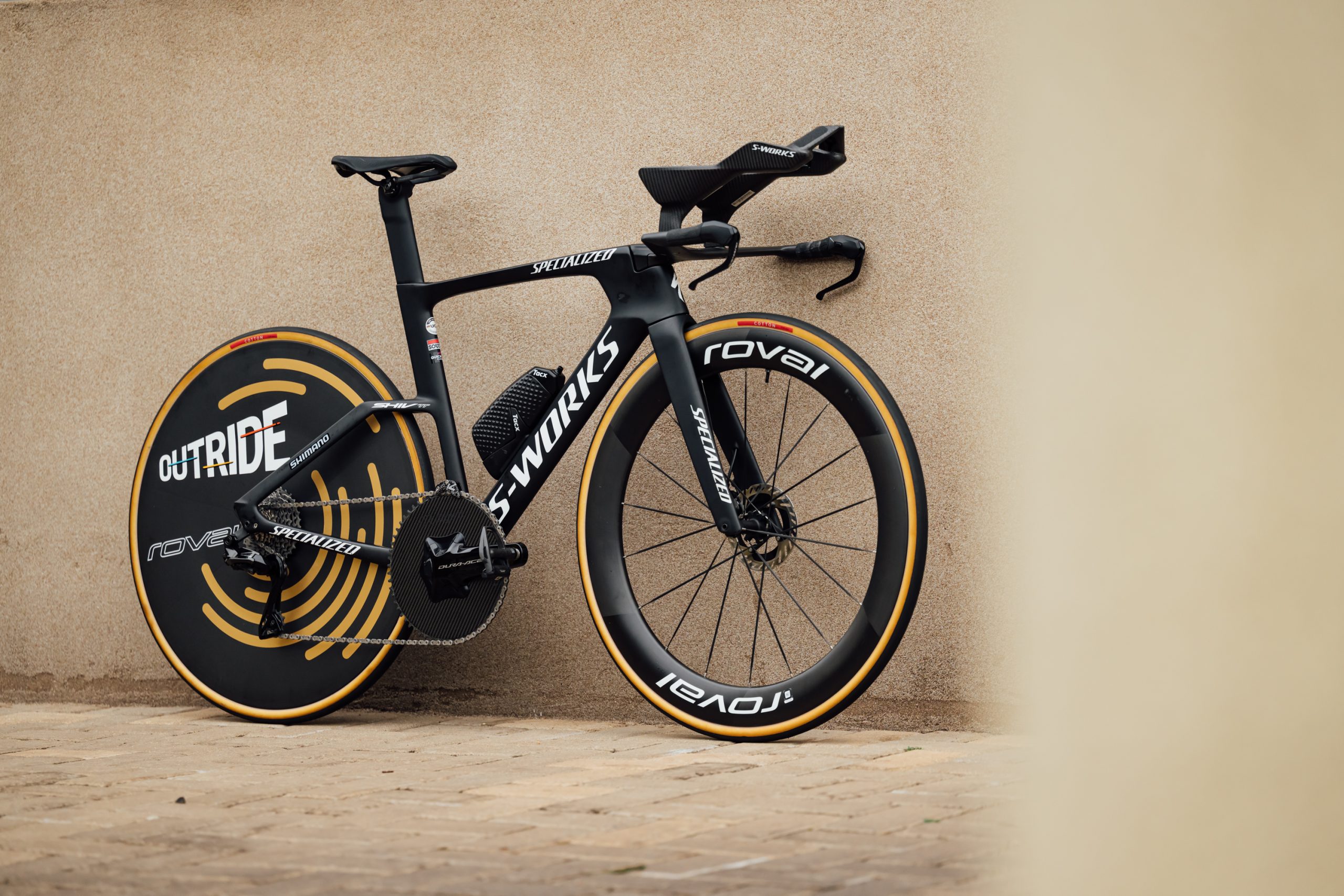
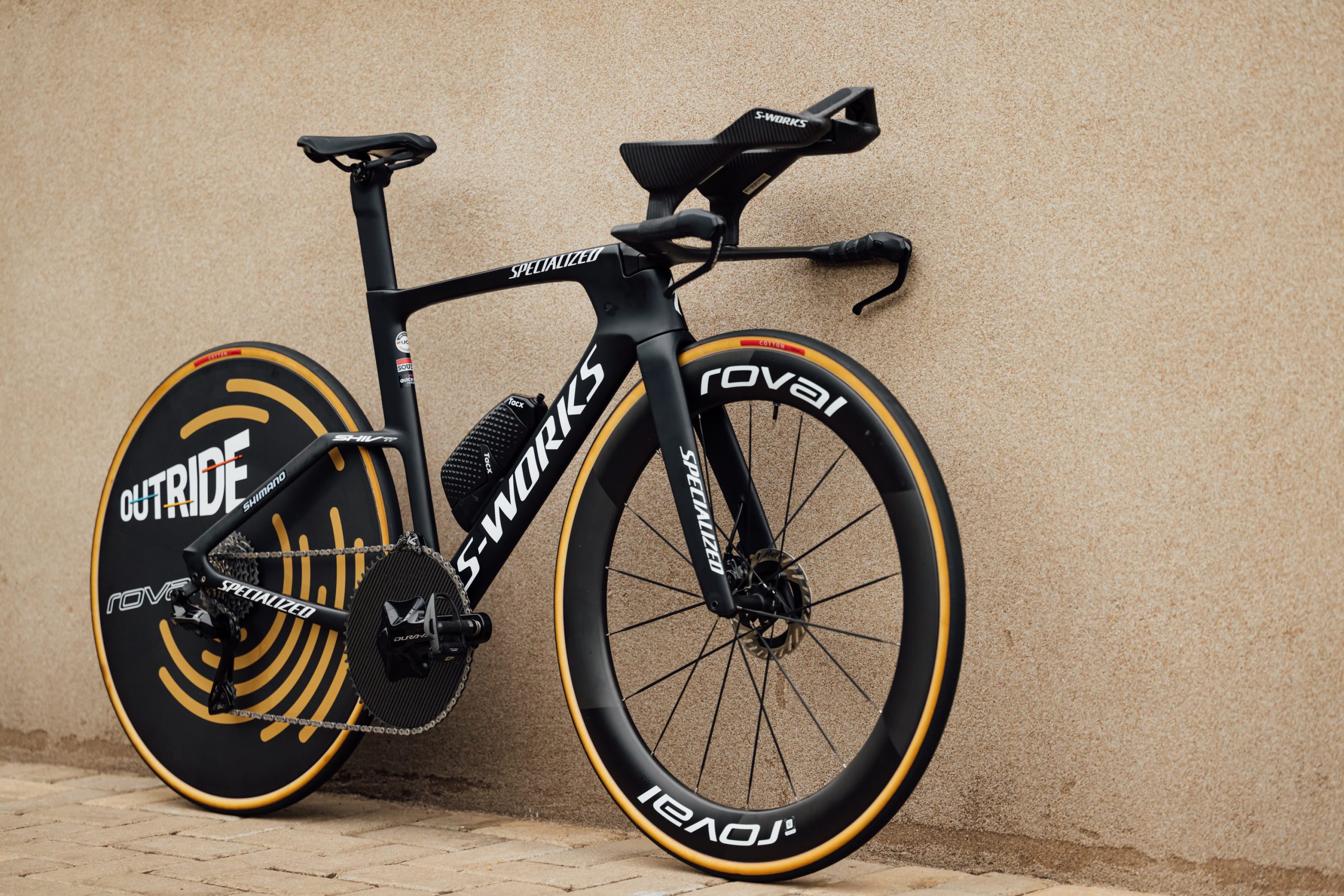
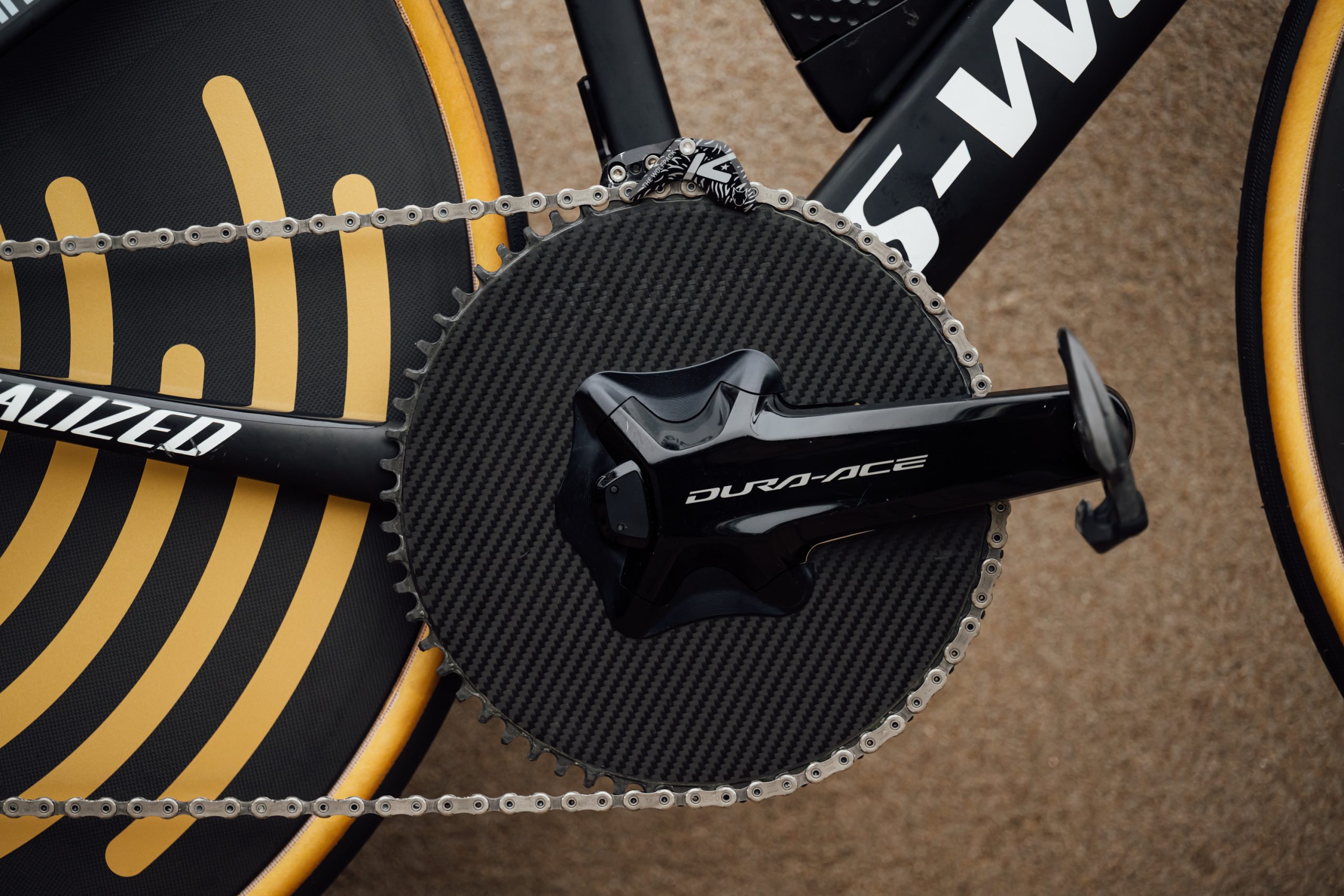
As you’d expect, Evenepoel’s Specialized Shiv TT Disc time trial bike is fully kitted out with all of the latest kit, including a custom carbon fibre cockpit, a monster 1x carbon chainring and Roval’s latest aero wheels.
This year also appears to be the first time Evenepoel has won the event using tubeless tyres, rather than clinchers.
Let’s dig into why that might be and take a closer look at the rest of the Belgian’s tech picks for riding against the clock.
3, 2, 1, go…
Evenepoel’s Specialized Shiv TT Disc looks to have been stripped of paint to shave off a few grams. Chris Auld / Specialized
Evenepoel is one of cycling’s most dominant riders against the clock, and he proved this by catching none other than Tadej Pogačar around 2km from the finish line – despite the Slovenian star starting 02:30 minutes ahead of him.
Launched in 2019, the Specialized S-Works Shiv TT Disc is getting somewhat long in the tooth now, but Evenepoel keeps proving that it remains a competitive frameset.
This year’s hilly parcours in Rwanda saw Evenepoel on an all-black version of the bike, with excess paint presumably stripped away, in order to save weight.
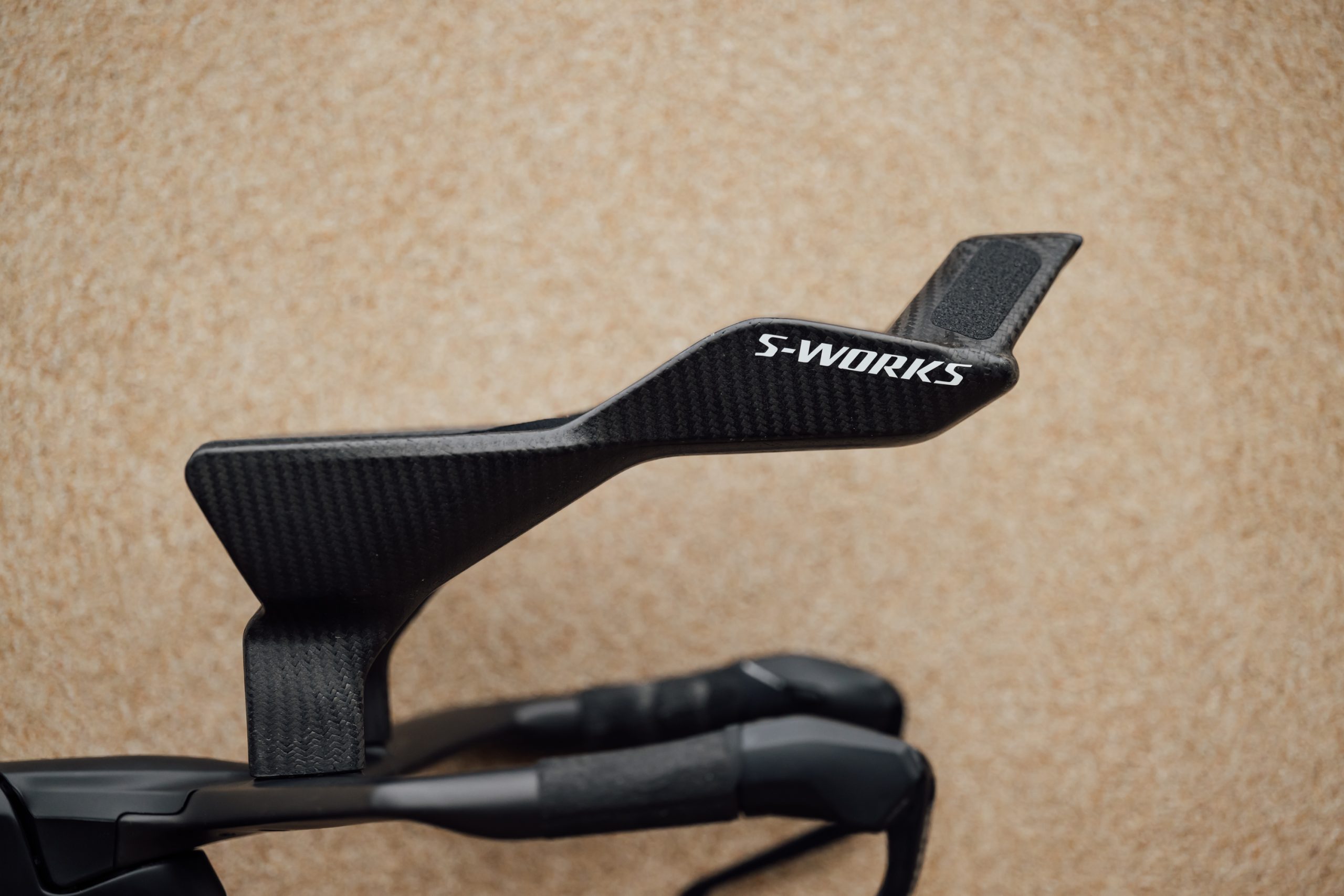
Evenepoel’s custom carbon fibre extensions are angular and aggressive. Chris Auld / Specialized
As is de rigueur for top TT riders, Evenepoel has a set of custom aero extensions, which are moulded to fit his forearms and keep him locked into an aerodynamic position.
A touch of grip tape on the tips of the extensions and bull horns is all he needs – there’s no bulky handlebar tape causing extra drag here.
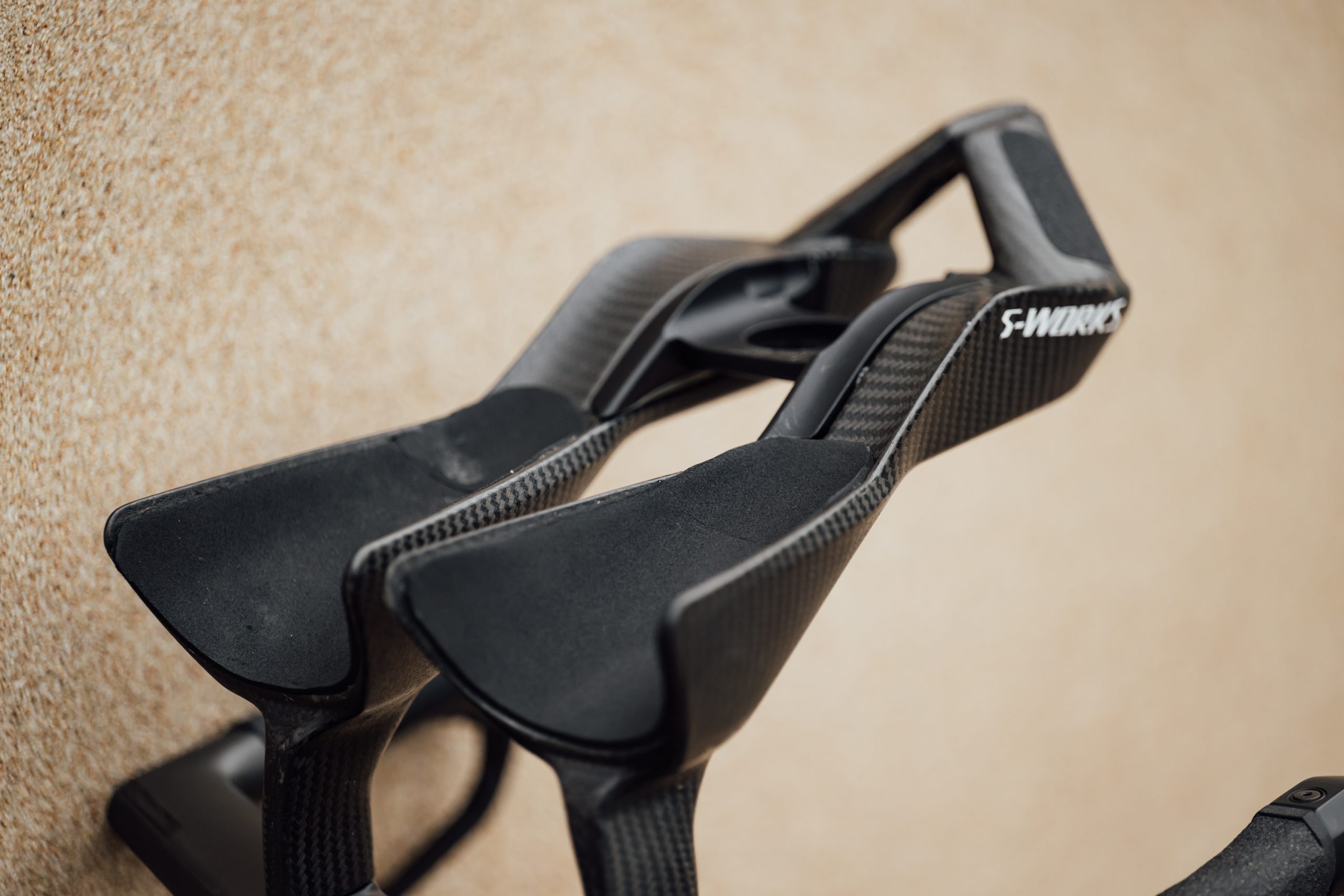
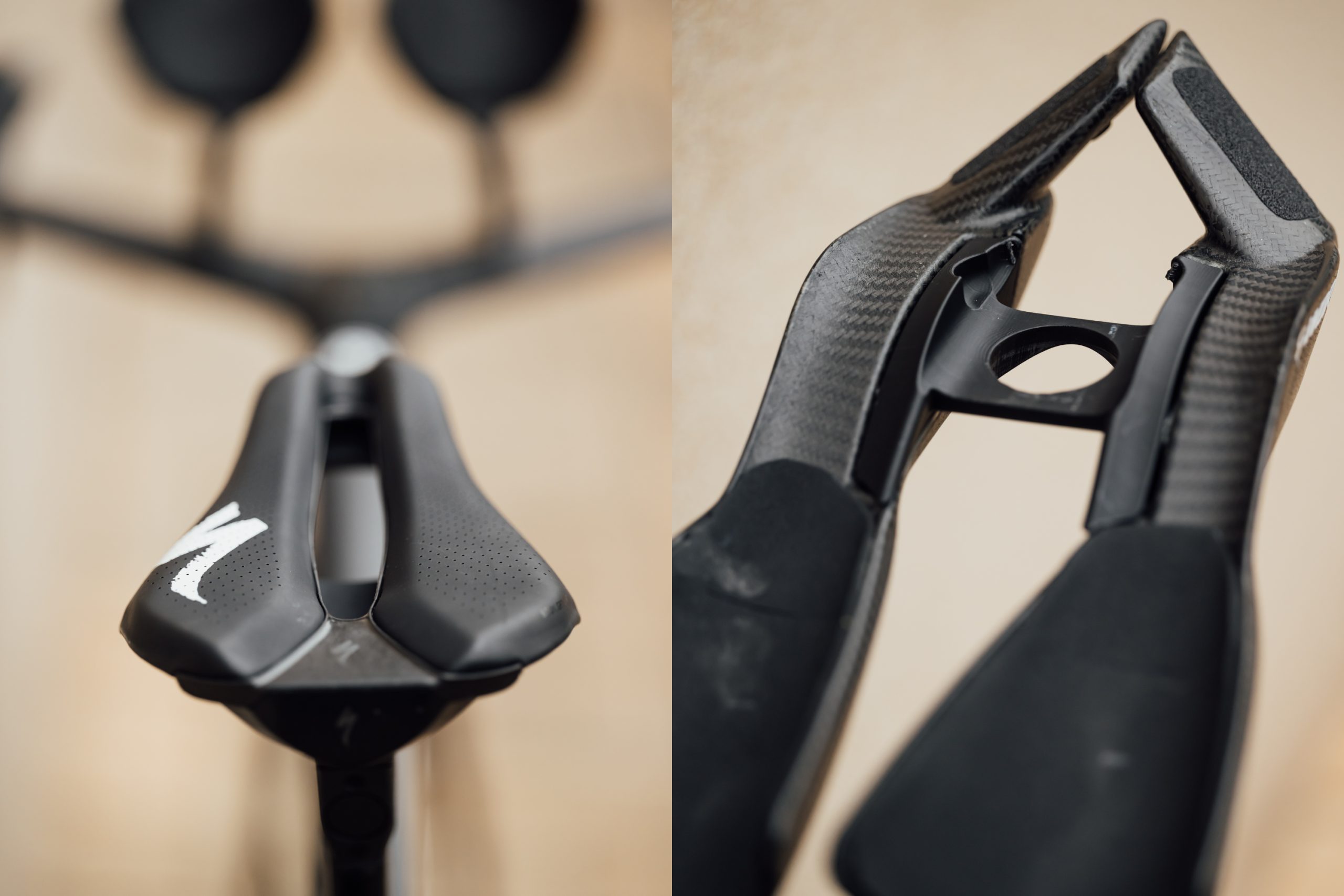
The extensions feature minimalist padding for a close fit, while a bridge between the two extensions acts as a bike computer mount for Evenepoel to monitor and record his efforts.
Evenepoel’s hand grips are tilted in to be almost touching, and there look to be shift buttons underneath so he can change gear while in his compact aero tuck.
The custom extensions feature high-sided armrests to keep Evenepoel locked into his position. Chris Auld / Specialized A bridge between the extensions creates space for his bike computer. Chris Auld / Specialized
In terms of wheels, Evenepoel was rolling on options from Specialized’s in-house brand, Roval – with what looks like a carbon-spoked Rapide Sprint CLX up and a 321 full carbon disc out back.
The Rapide Sprint CLX wheel features a 63mm-deep rim, and is said to be the most aerodynamic front wheel the brand makes.
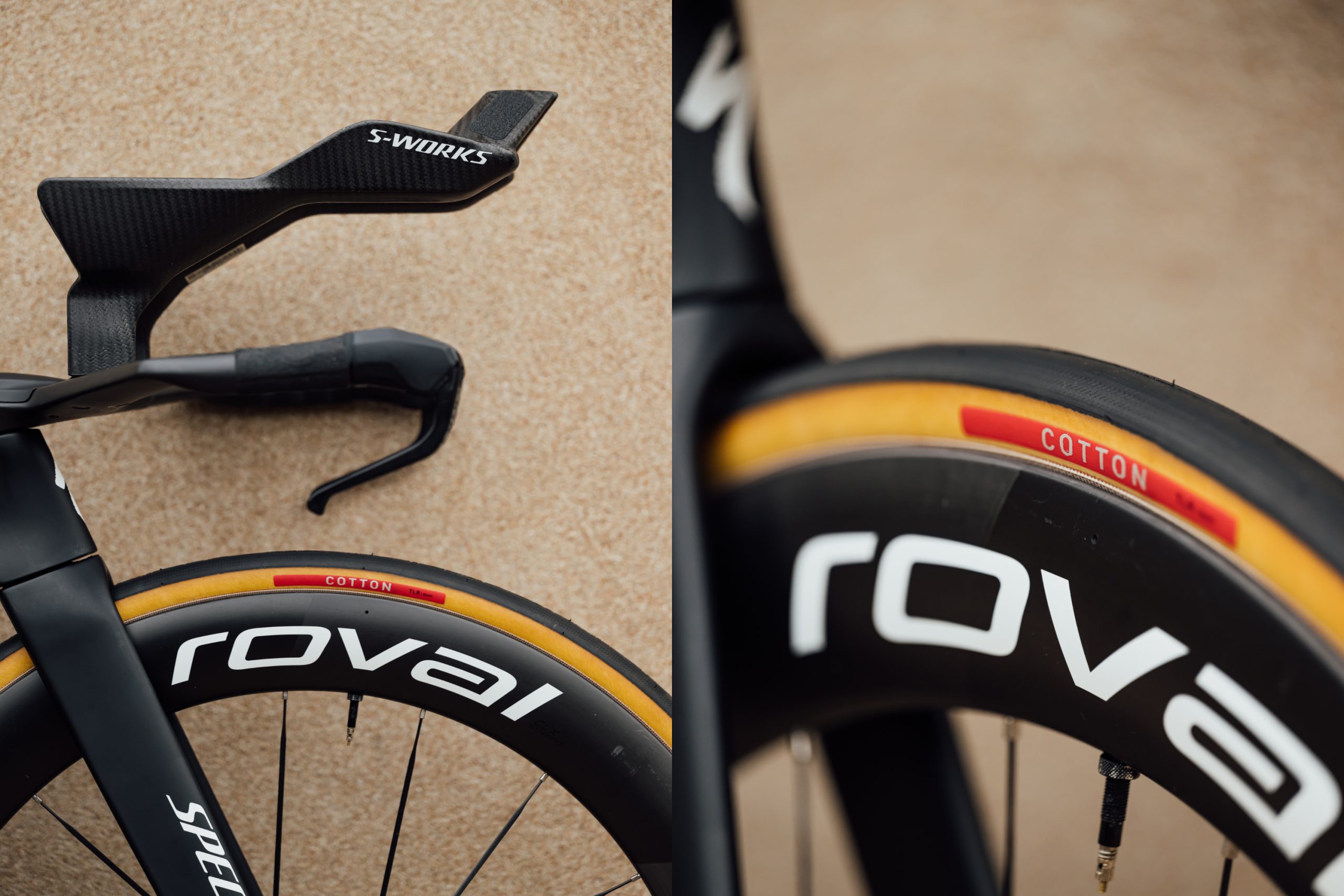
This represents a significant change for Evenepoel, who has used Specialized’s Turbo Cotton clincher tyres for each of his previous TT victories at the UCI Road World Championships.
A full carbon rear disc plus a deep-section front was a very popular combination at this year’s TT world champs. Chris Auld / Specialized Specialized still hasn’t revealed any official details about its new Turbo Cotton TLR tyres. Chris Auld / Specialized
We’re yet to receive detailed information on the new Turbo Cotton TLR tyres, but we can only assume they represent a decent improvement on the clincher model in terms of performance.
Zooming in shows Evenepoel was running an unusually wide 30mm tyre up front, though from our experience at the Tour, these tyres generally measure up slightly narrower than the printed width on Roval rims.
Regardless of how wide they are, given that both the tyres and wheels were developed in-house, it’s likely Specialized will have optimised them to work together in harmony.
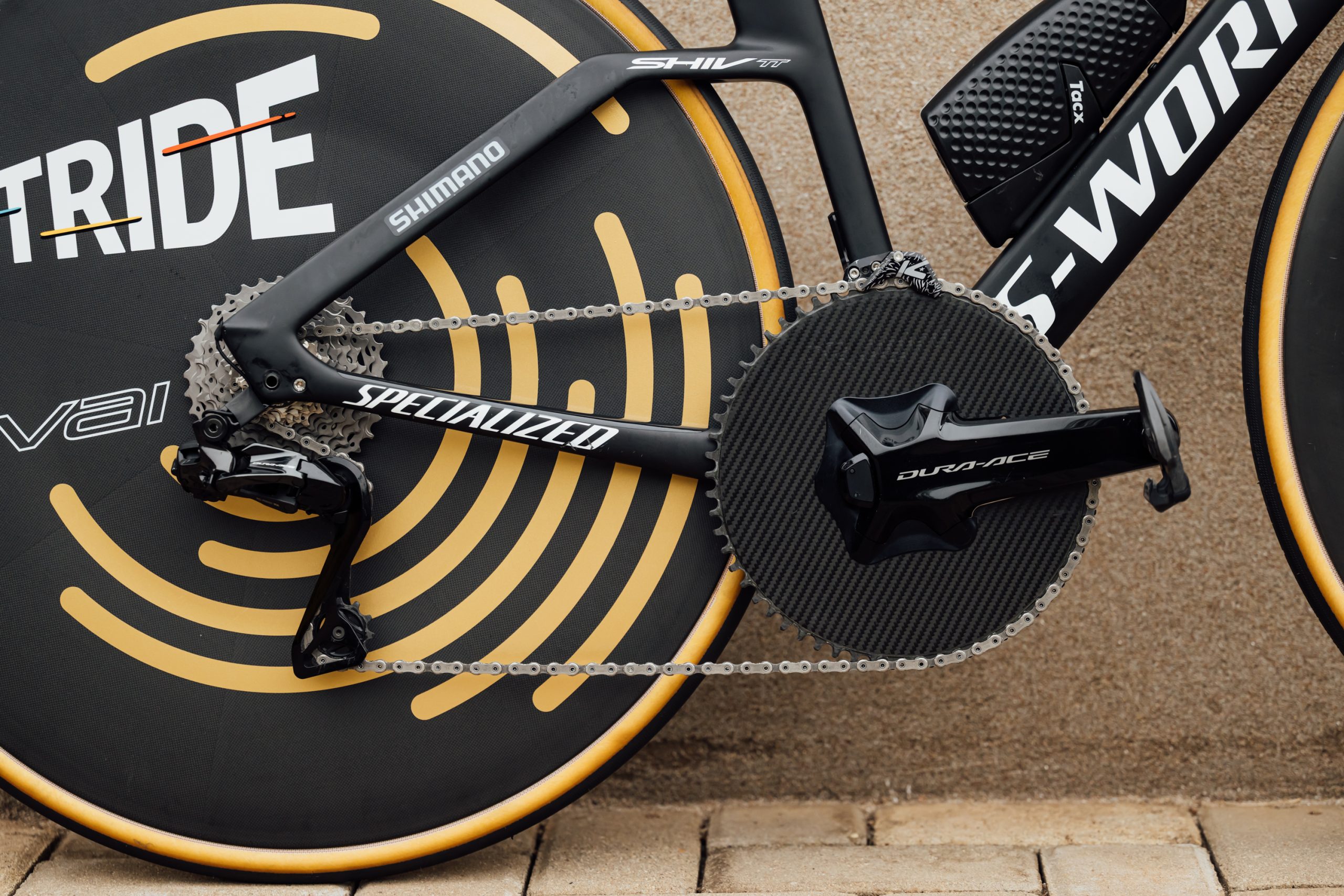
Per his trade team, Evenepoel uses a Shimano Dura-Ace Di2 R9200 groupset. Chris Auld / Specialized
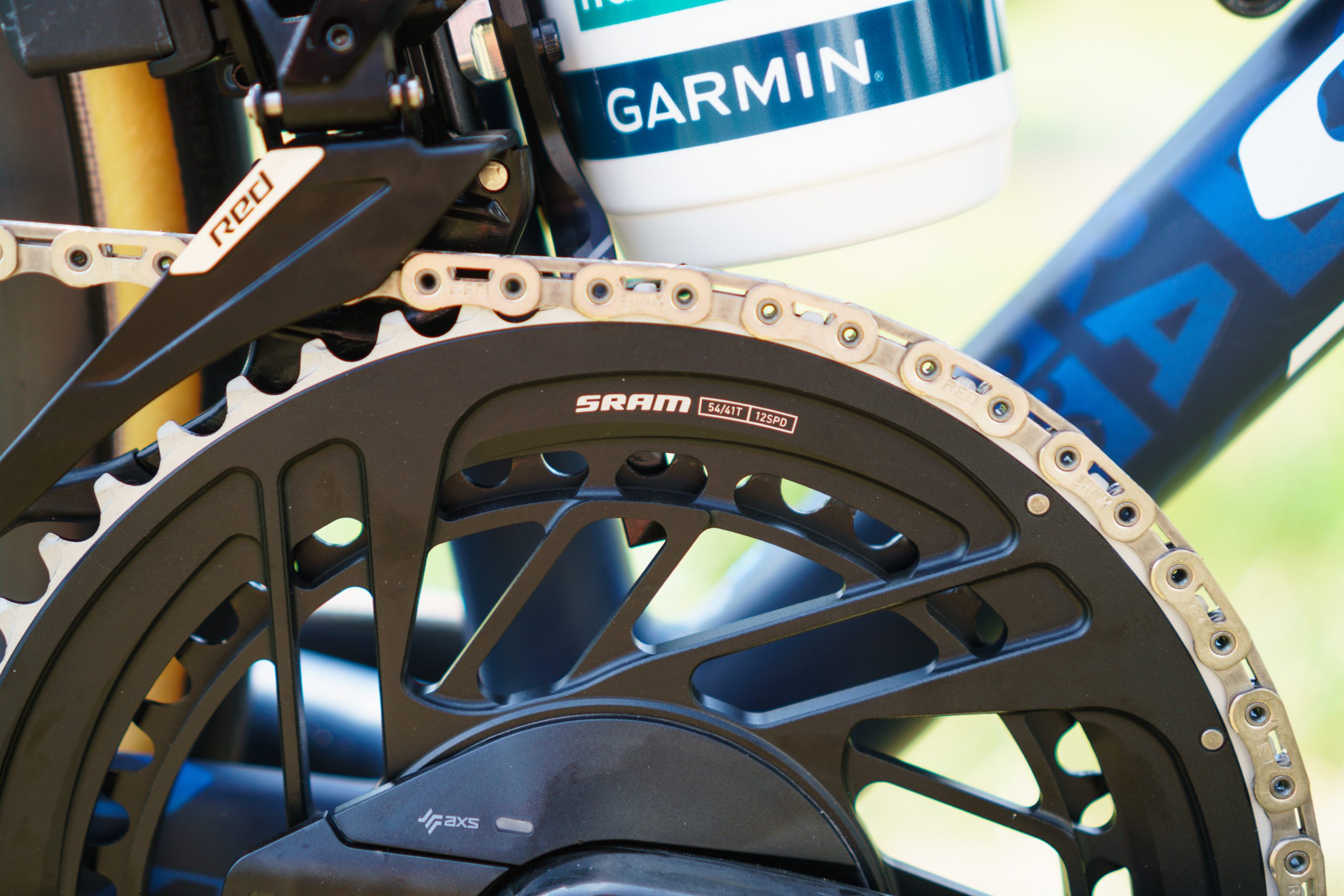
Finishing off the build is a Shimano Dura-Ace Di2 R9200 groupset, with a single Digirit carbon chainring up front and what looks like a wide-ranging 11-34t cassette out back.
Evenepoel also has what looks like an Alugear bolt cover, which smooths the interface between the third-party chainring and his Shimano power meter crankset. As on his road bike, we expect Evenepoel was running relatively short, 165mm cranks.
A K-Edge chain guide replaces the front derailleur to ensure there are no untimely chain drops, and Evenepoel opted for a Tacx aero water bottle, instead of a classic round one, for a final aero gain.
Remco only needed one chainring and he opted for a whopper. The profiled bolt cover is made by Alugear. Chris Auld / Specialized
Remco Evenepoel’s custom Specialized S-Works Shiv TT Disc for the 2025 UCI Road World Championships individual time trial
Frameset: Specialized S-Works Shiv TT Disc
Groupset: Shimano Dura-Ace Di2 R9200 with 1x Digirit carbon chainring
Wheelset: Roval Rapide Sprint CLX front, Roval 321 Disc rear
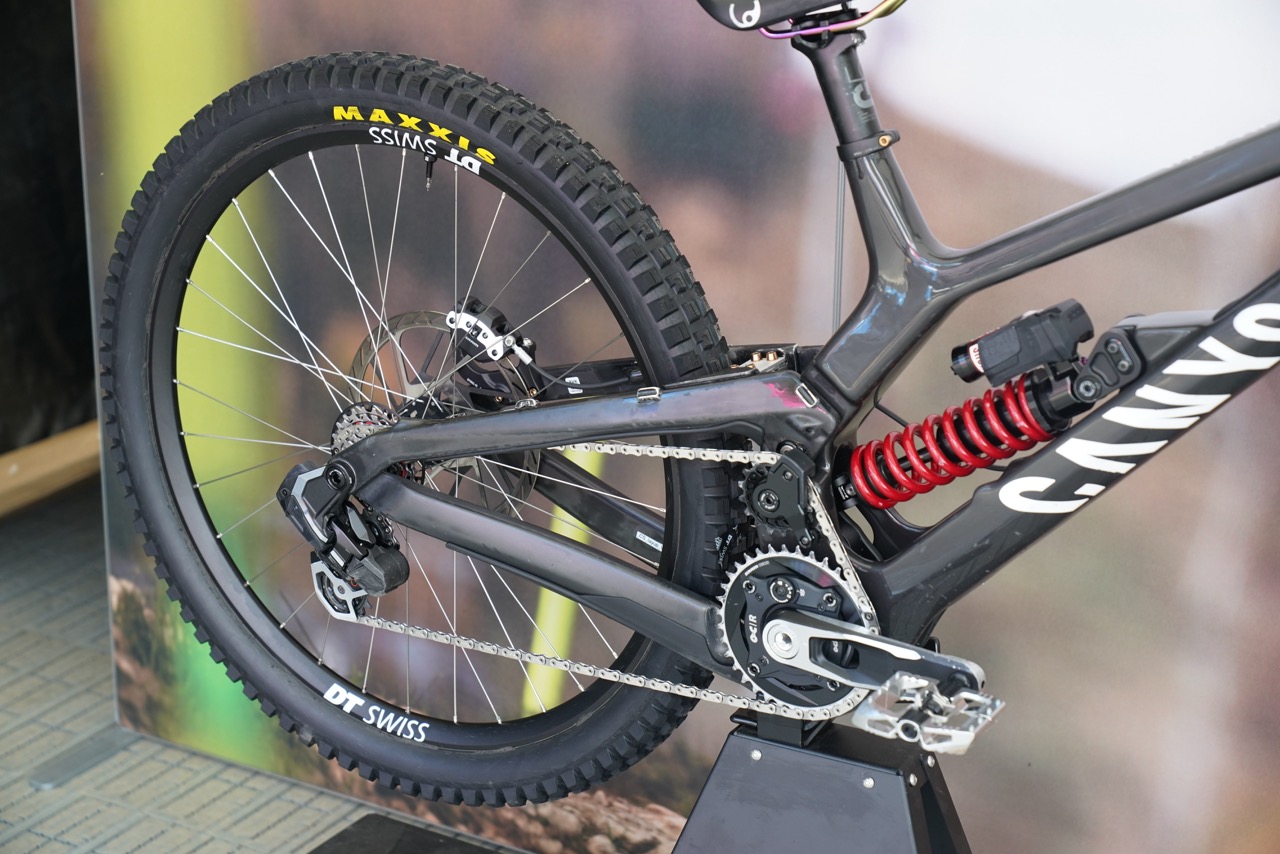
Another SRAM prototype has been spotted, hanging from the rear of Troy Brosnan’s Canyon Sender at the UCI Mountain Bike World Series in Lenzerheide.
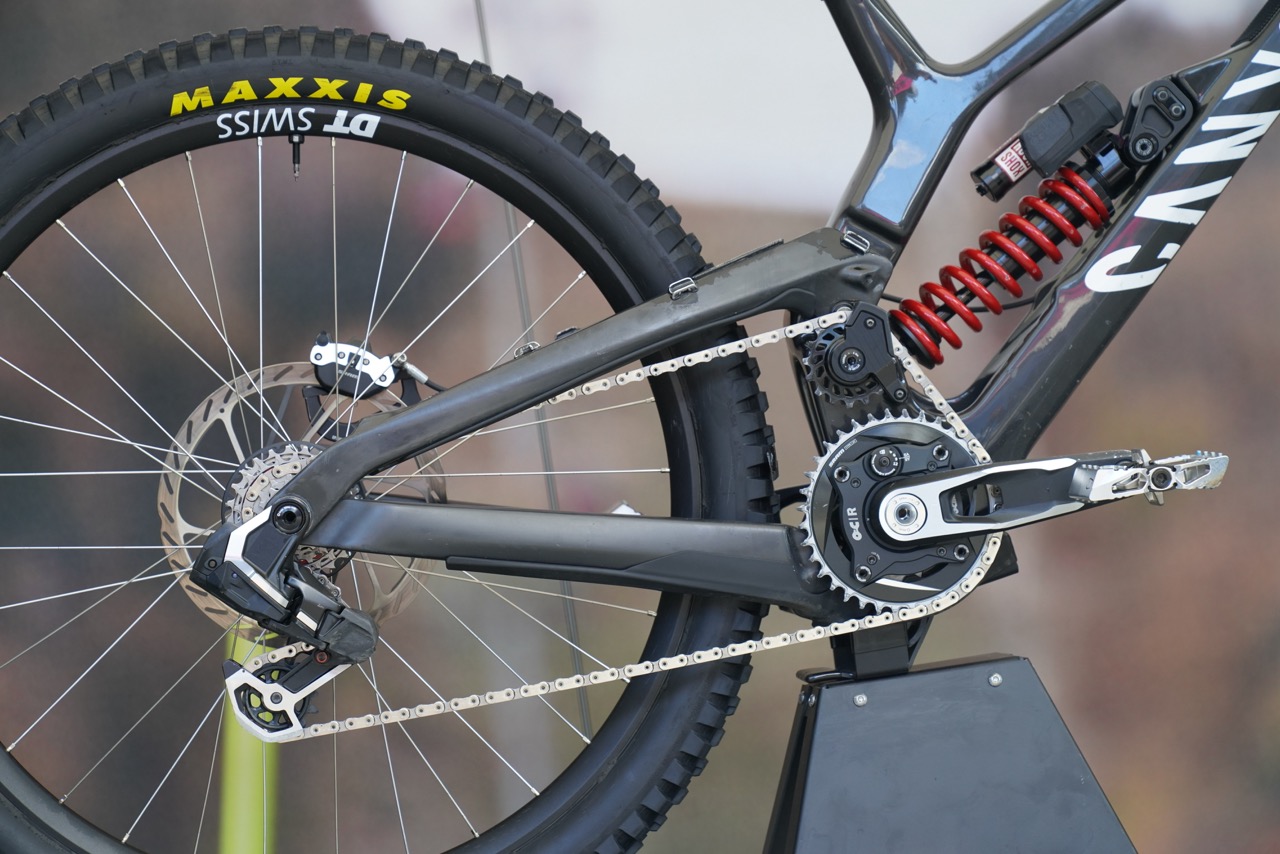
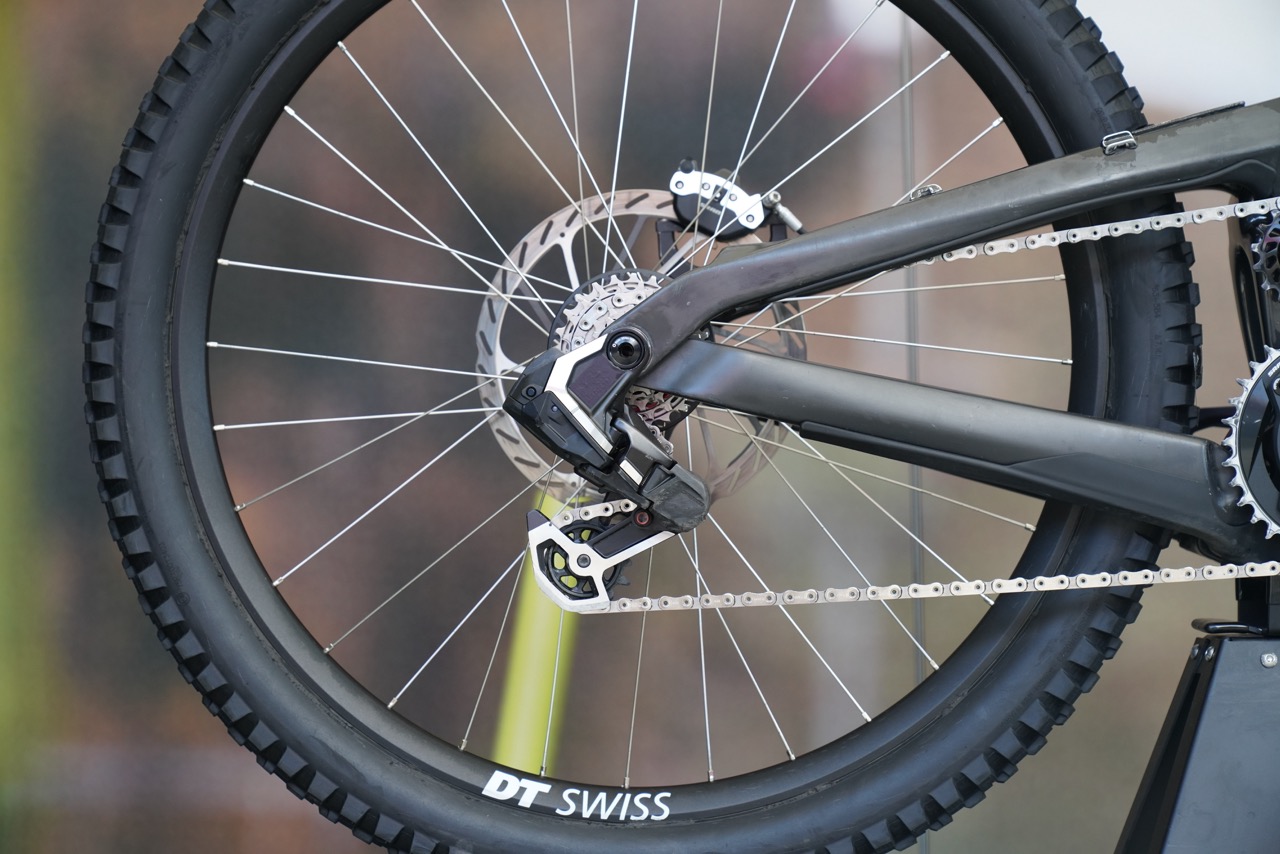
The new derailleur looks to signify an electronic shift for SRAM’s downhill groupset, and appears to be in the final stages of development, with the now-traditional electrical tape covering the name of the upcoming groupset.
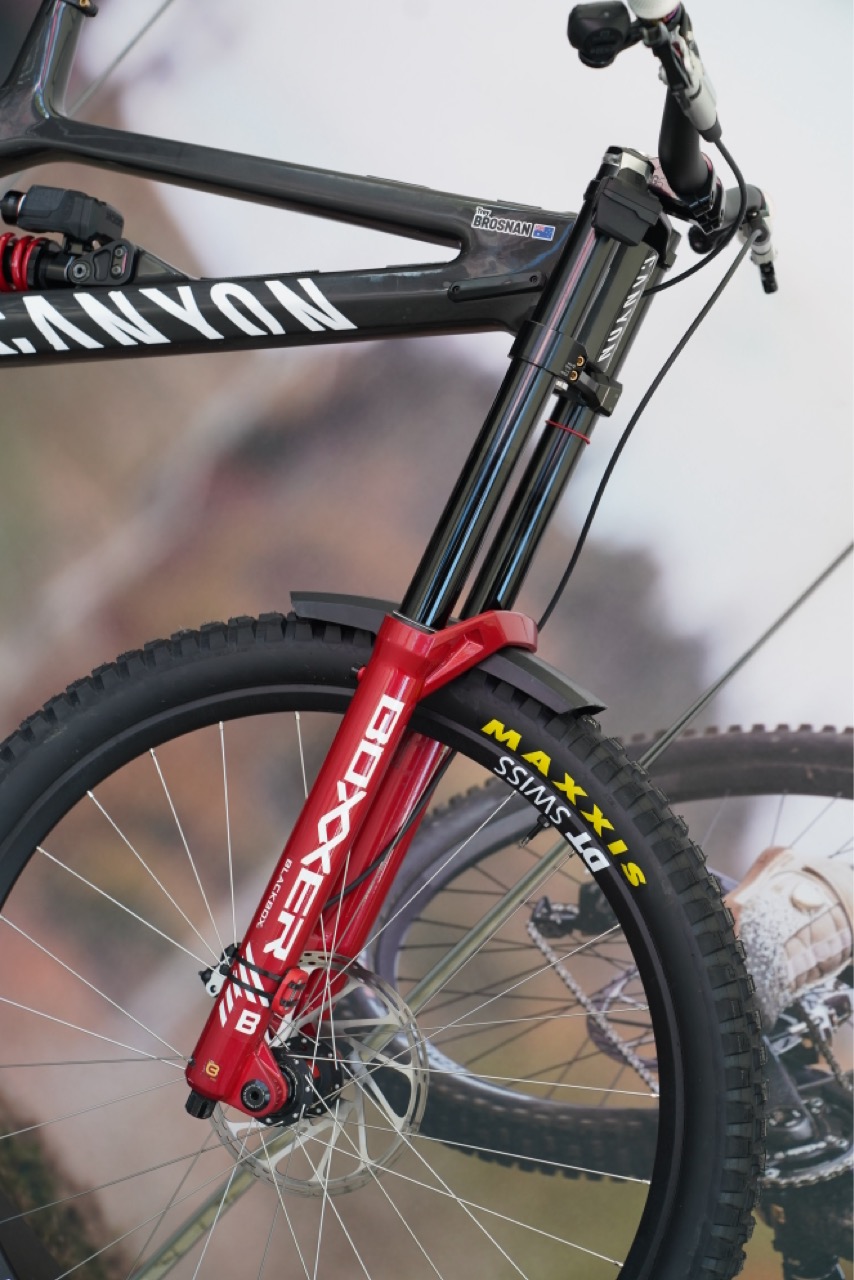
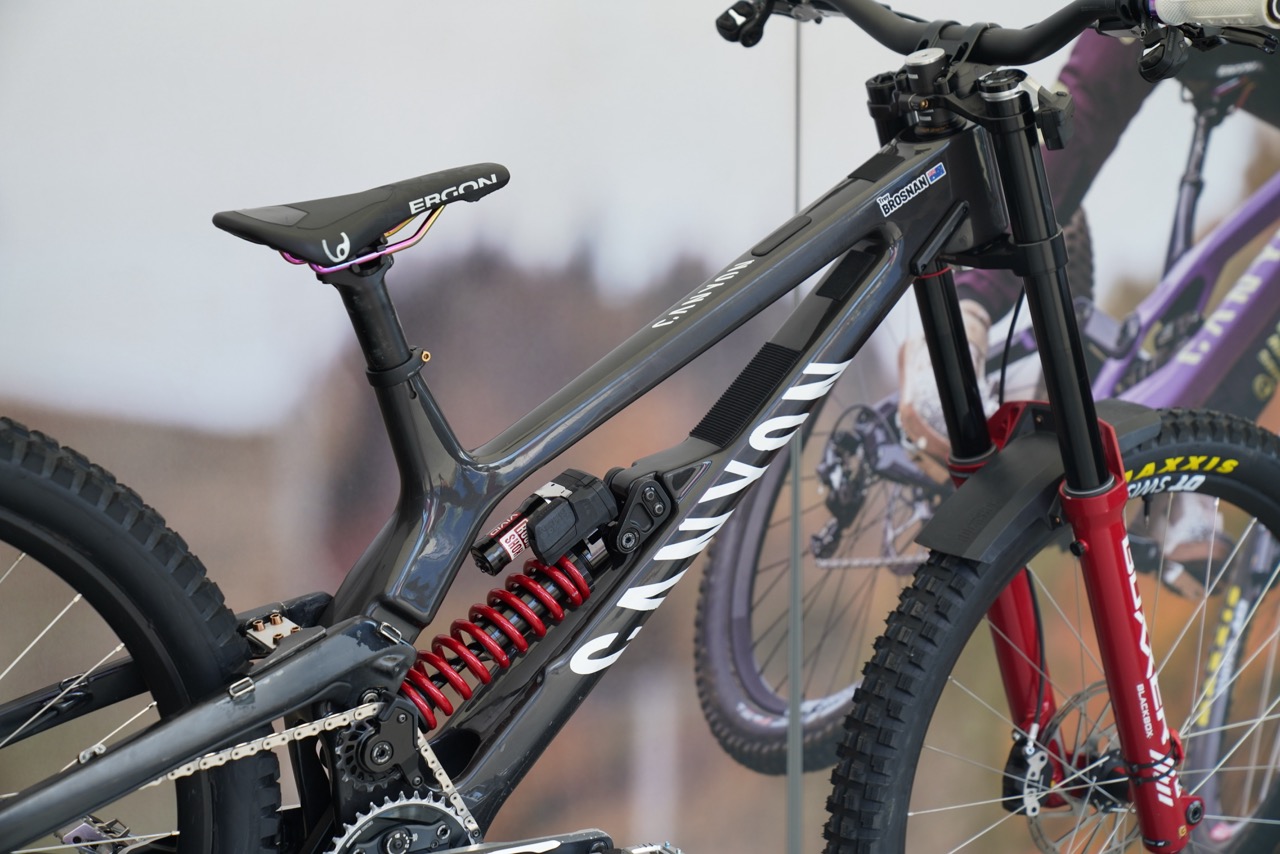
It wasn’t the only prototype technology on Brosnan’s bike, with the Sender featuring a prototype RockShox Boxxer and Vivid with Flight Attendant, as well as a rear end that looks to add stiffness adjustability.
This looks to be very far down the development pipeline. Nick Clark / Our Media
It’s been nearly 10 years since SRAM released a downhill groupset, and within that time electronic shifting has taken over the sport.
We have seen SRAM prototype wireless downhill derailleurs in the past, but never have they appeared so close to production as this.
The new drivetrain looks very neat, with a black and silver colourway. Nick Clark / Our Media
The new drivetrain looks to use the brand’s AXS Transmission technology, bolting directly onto the bike via SRAM’s UDH (Universal Derailleur Hanger).
It appears to adopt the battery placement of GX AXS Transmission, sitting within the clutches of the UDH mount, rather than hanging off the rear as seen on X0 AXS Transmission.
While the architecture on GX AXS Transmission features pins in its top construction, this new DH AXS looks to be fully cast.
The design looks to be up to the rigours of racing, with the lower portion showing some battle scars.
We’re not yet sure on the capabilities of the derailleur, but Brosnan was running a 7-speed cassette, which looked to push the cage length to its limit.
The Ochain device looks to be already part of the family. Nick Clark / Our Media
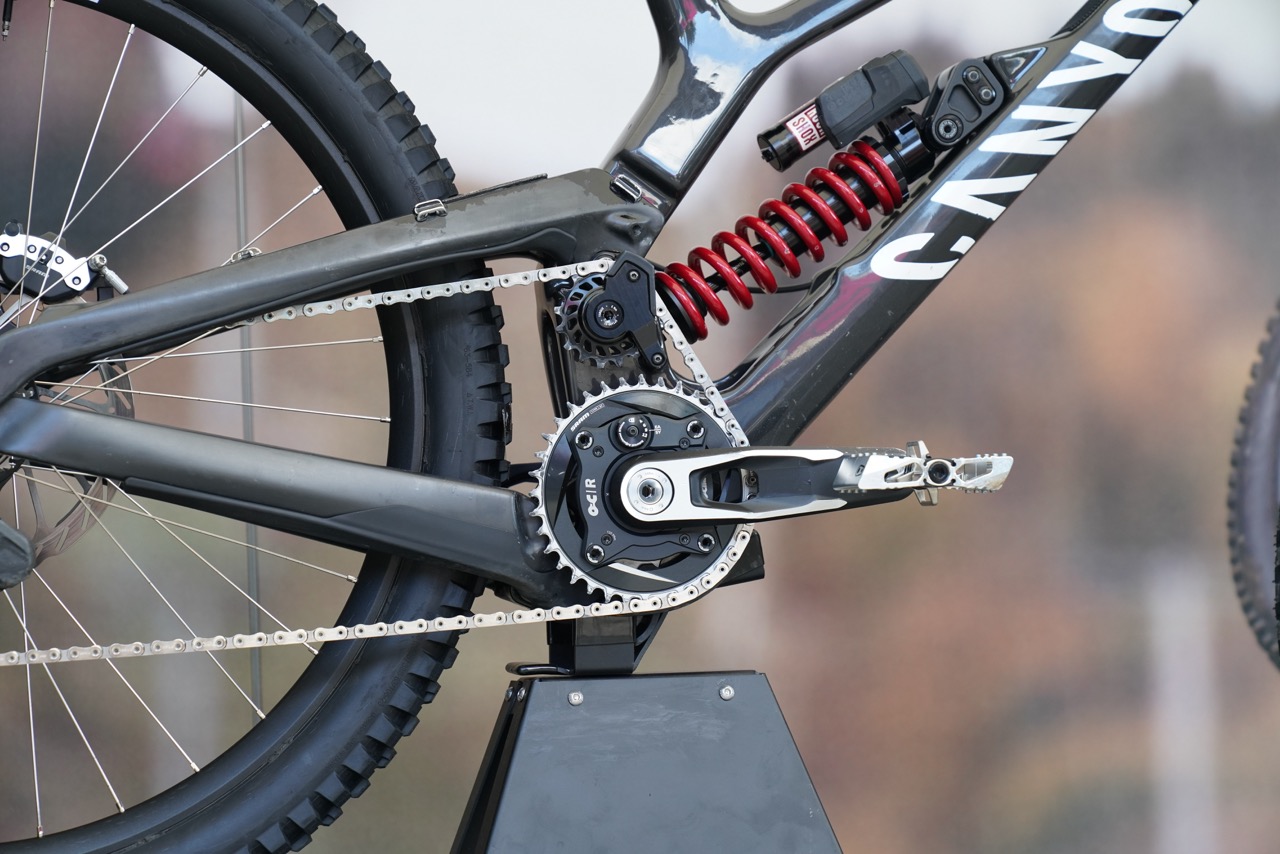
At the centre of the bike are new cranks that look more substantial than those found on X0, and feature a dark and silver colour scheme.
This is connected to an Ochain device, which helps fend off pedal kickback.
Despite being a racing product, Flight Attendant has taken a long time to make it to downhill. Nick Clark / Our Media
The bike also uses a RockShox Blackbox-labelled Boxxer fork and Vivid rear shock that feature the brand’s Flight Attendant technology.
We assume the technology will perform similarly to the trail and XC versions, creating a platform for pedalling and pumping while opening up for gnarly terrain.
Brosnan appears to prefer coil over air shocks. Nick Clark / Our Media
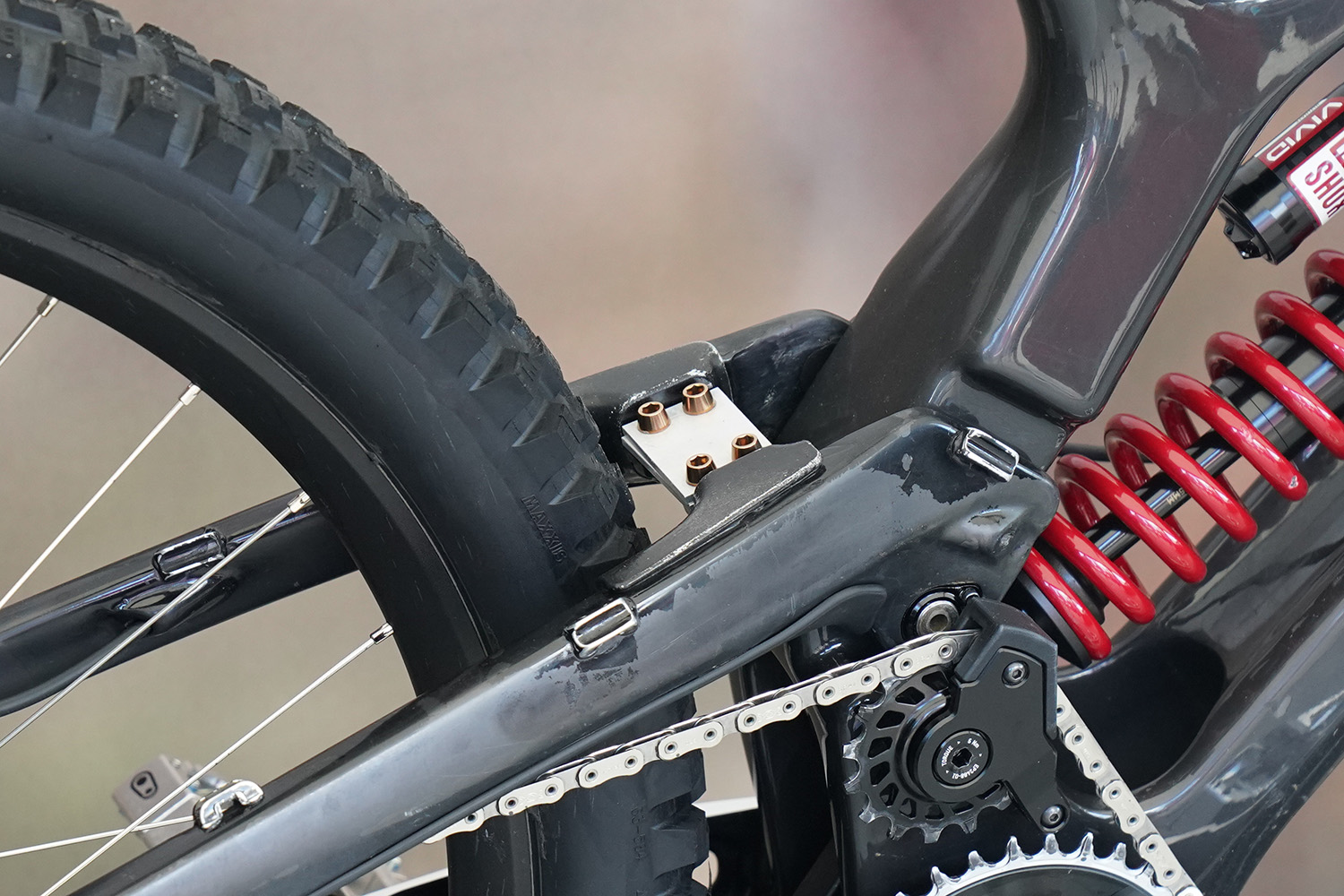
The rear end appears the same as the production model, with the bridge being cut out. Nick Clark / Our Media
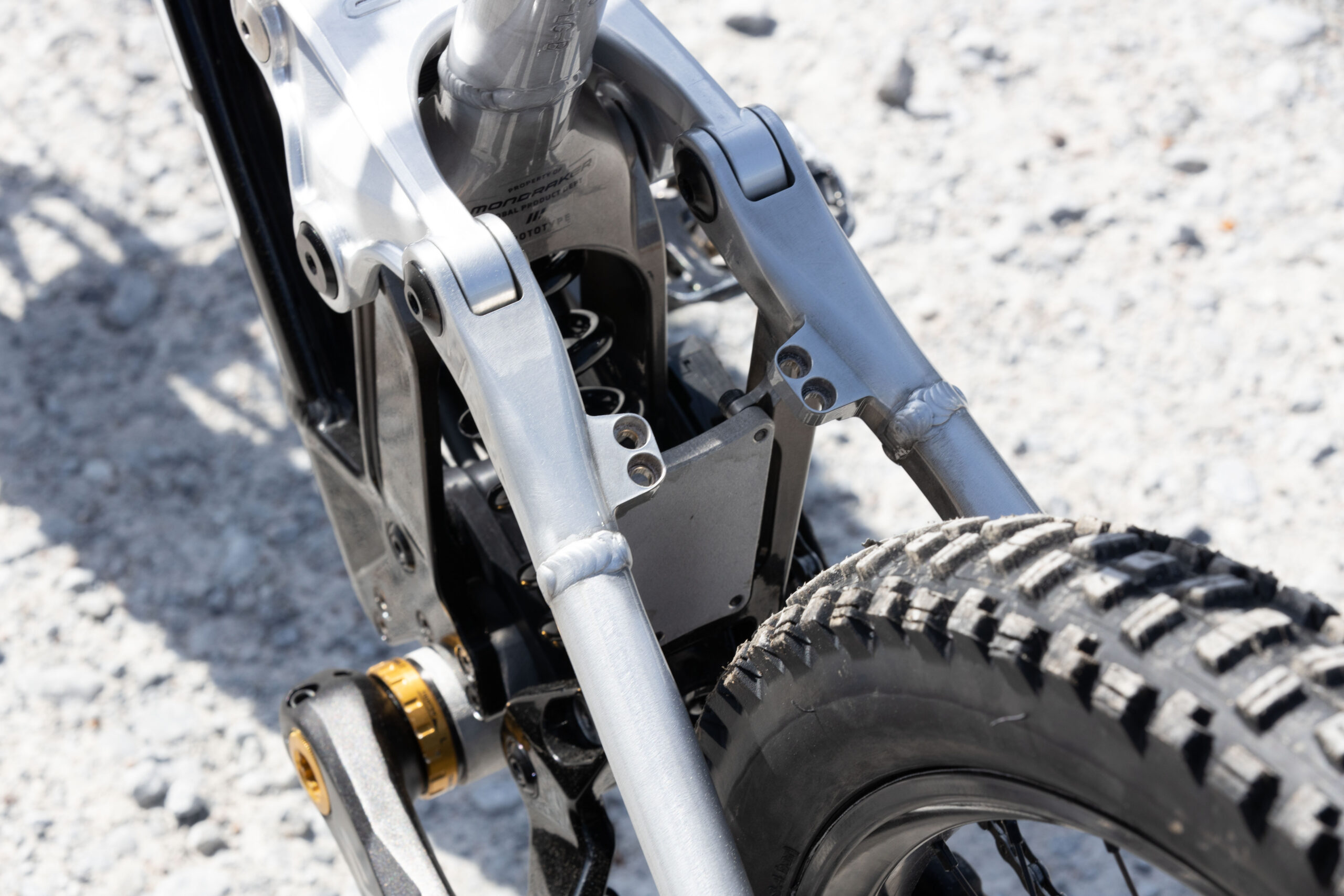
Elsewhere, Brosnan was using a prototype rear end that features a bonded aluminium insert to enable stiffness adjustability.
Mondraker’s prototype Summum has adjustable rear stiffness built into the frame. Nick Clark / Our Media
A number of brands have experimented with stiffness adjustability at the UCI World Cup, but it seems strange to see Brosnan playing with this on the recently launched Sender.
It’s a common thought in cycling that stiffer means better, but that isn’t always the case.
Canyon’s Sender was only released this summer. Nick Clark / Our Media
The new rear end enables metal plates to be added to the seatstay bridge to adjust the stiffness, with Brosnan opting for two plates for Lenzerheide.
There are also some unusual cable mounts running down both seatstays, which we assume is for telemetry equipment.
Founder and CEO of Factor Bikes Rob Giletis has said the brand’s sponsorship of Israel–Premier Tech will no longer be tenable without a name change and a disassociation with the country of Israel, according to reports.
Factor has met with Israel–Premier Tech’s owner Sylvan Adams to discuss the partnership, a change of name and the nationality of the team, reported Cyclingnews.
“I’ve already told the team: Without a name change, without a flag change, we won’t continue,” Gitelis said to Cyclingnews.
“It’s not a matter of right or wrong anymore. It’s become too controversial around our brand, and my responsibility is to my employees and my shareholders, to give them maximum space with which to grow this company and make it profitable. Adding additional level of conflict or complexity, we just can’t accept that any more.
“It’s no longer a personal thing of I support this or I support that. There’s just a certain level of controversy we just can’t have surrounding the brand,” said Gitelis.
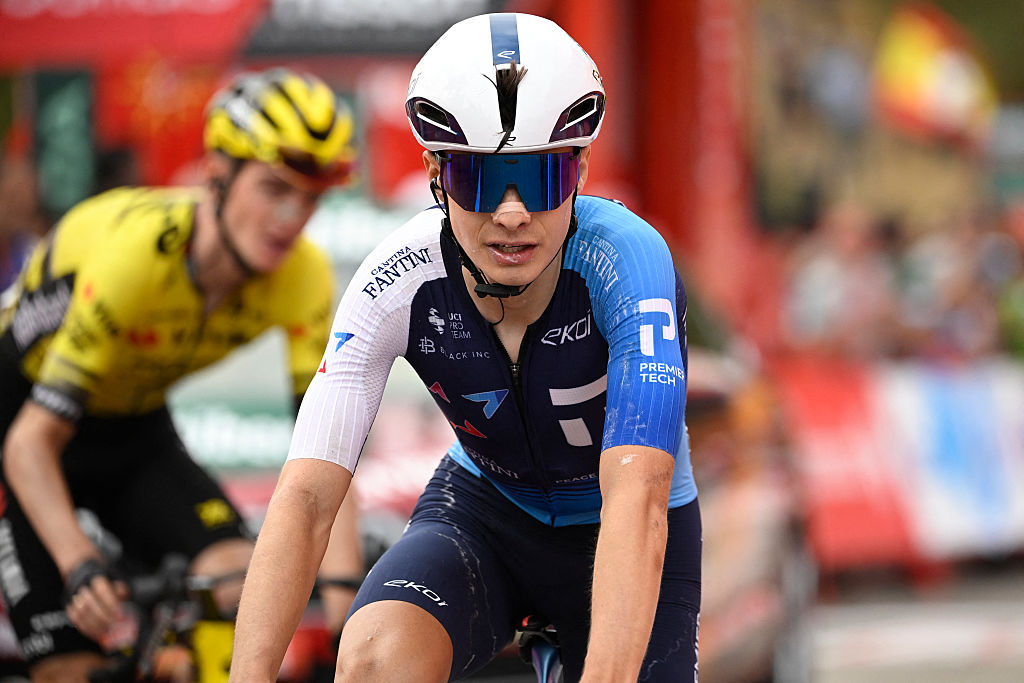
Israel–Premier Tech removed its name from the team jersey at La Vuelta. Miguel Riopa / Getty Images
Cyclingnews said it understands Adams is on board with Israel–Premier Tech changing its name, but that the Israeli-Canadian business and self-proclaimed ‘ambassador’ for Israel assumed the team would retain Israel’s flag.
Israel–Premier Tech told BikeRadar: “The team is currently in the planning phase for 2026 team branding and will communicate any potential changes in due course.”
Teams must register their nationality and the nationality of their paying agent by October 15, according to cycling’s governing body, the UCI.
Rumours of a potential name change follow persistent protests at the Vuelta a España against the participation of Israel–Premier Tech, which led to five stages being shortened and the largest mobilisation of police in Madrid since the city hosted the NATO Summit in 2022.
The team removed ‘Israel’ from its kit during La Vuelta, citing security concerns. It also raced as ‘IPT’ at the GP of Québec and the GP de Montréal earlier in September.
Stephanie Adam, a campaigner for the Palestinian Campaign for the Academic and Cultural Boycott of Israel, which called for the protests at La Vuelta, told BikeRadar that Israel–Premier Tech’s participation in the race was “sportswashing pure and simple”. She said that the team “was explicitly created to whitewash and distract from Israel’s grave crimes against Palestinians”.
Since La Vuelta, a UN commission found that Israel has committed Genocide against Palestinians in Gaza.
Gitelis told Cyclingnews that the conversions around Israel–Premier Tech changing its name are not new.
“This isn’t something that started a week ago, 10 days ago, a month ago. This has been going on now since nearly two years. We’ve found it difficult for the past two years to really use and activate the team to the level that we would like to. We’ve been politically sensitive, as it’s a difficult time,” he said.
Gitelis said Factor does not have a contract with Israel–Premier Tech for 2026 or beyond. “We did have a verbal commitment to continue, but things have escalated since then that we can no longer continue to meet that verbal commitment, ” he said.
Bristol-based Temple Cycles has launched the new Adventure Disc 3 gravel bike, adding a more affordable option to its steel Adventure Disc range for less than £1,500.
The new model’s £1,488 introductory price tag is significantly cheaper than the other two Adventure Disc bikes in the range.
According to Temple Cycles, the AD 3 is “ideal for first-time gravel riders, daily commuters looking to escape the city on weekends or seasoned cyclists after a rugged, no-fuss companion”.
The Adventure Disc 3 has the same powder-coated Reynolds 725 steel frame and fork as the AD1 and AD2, but Temple has achieved a lower price by speccing more budget-friendly components.
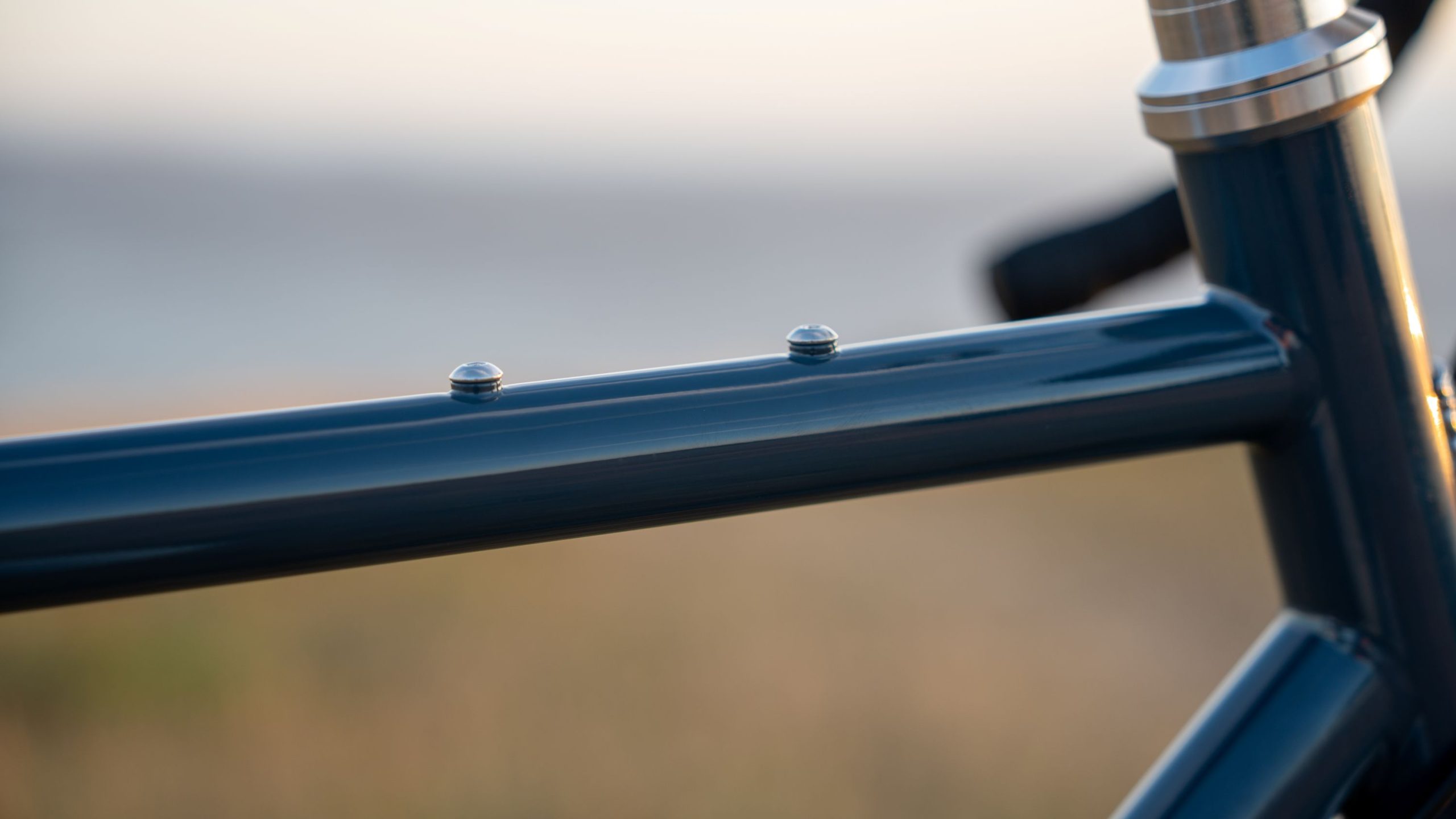
There are plenty of mounting points for luggage and a third set of bottle bosses under the down tube.
“It’s built to the same standards of quality and craftsmanship as the rest of our range, but with smart spec choices that bring the price down. We wanted to offer something for riders who value the Temple aesthetic and feel, but don’t necessarily need all the bells and whistles of our top-tier builds,” says Temple Cycles’ founder Matt Mears.
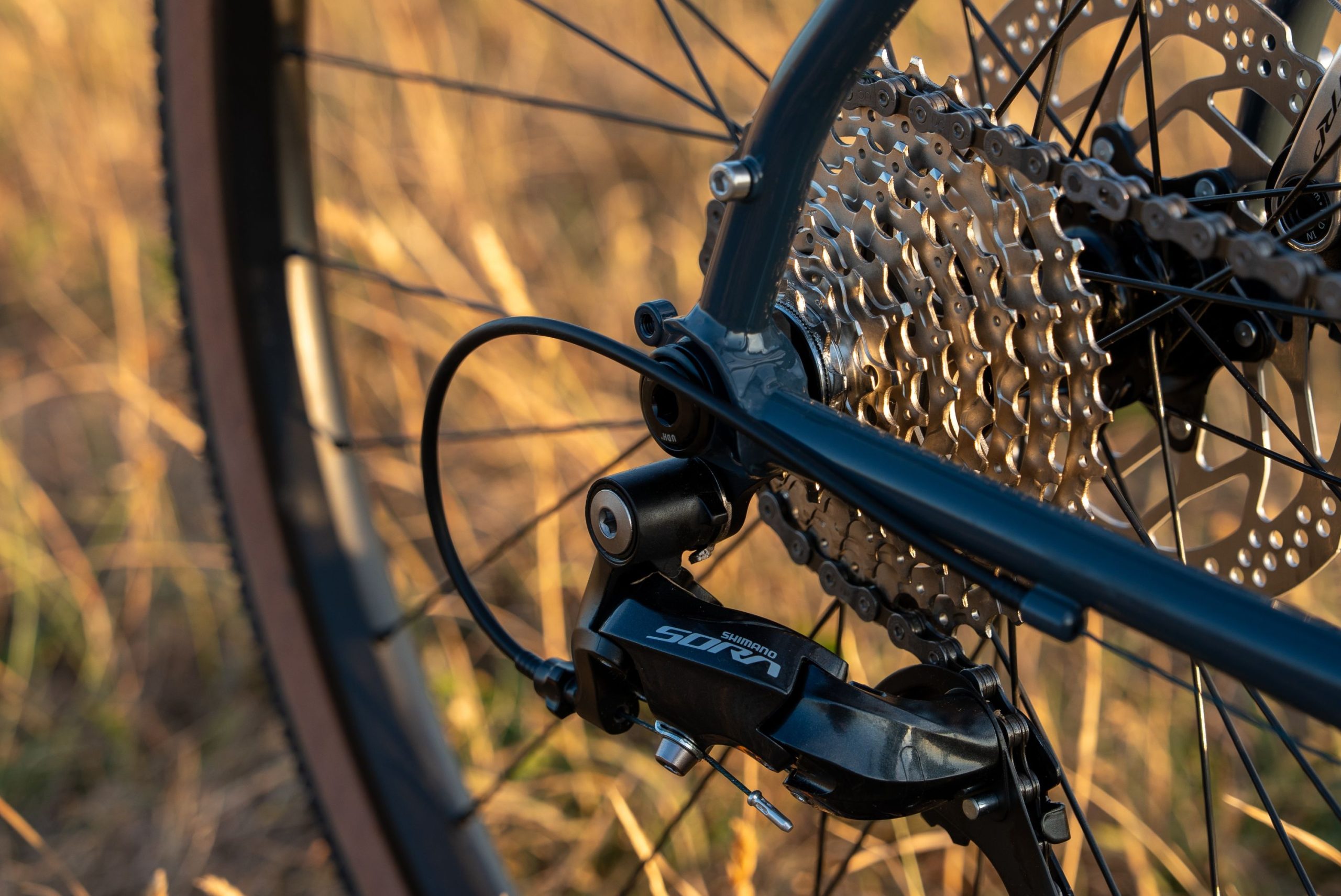
Shimano Sora provides reliable shifting at a lower price.
The AD 3 is equipped with a Shimano Sora 9-speed groupset, rather than the AD 1’s 1×12-speed Shimano GRX and the AD 2’s 2×12-speed Shimano 105, both of which are fitted with Hunt 4 Season Disc wheels.
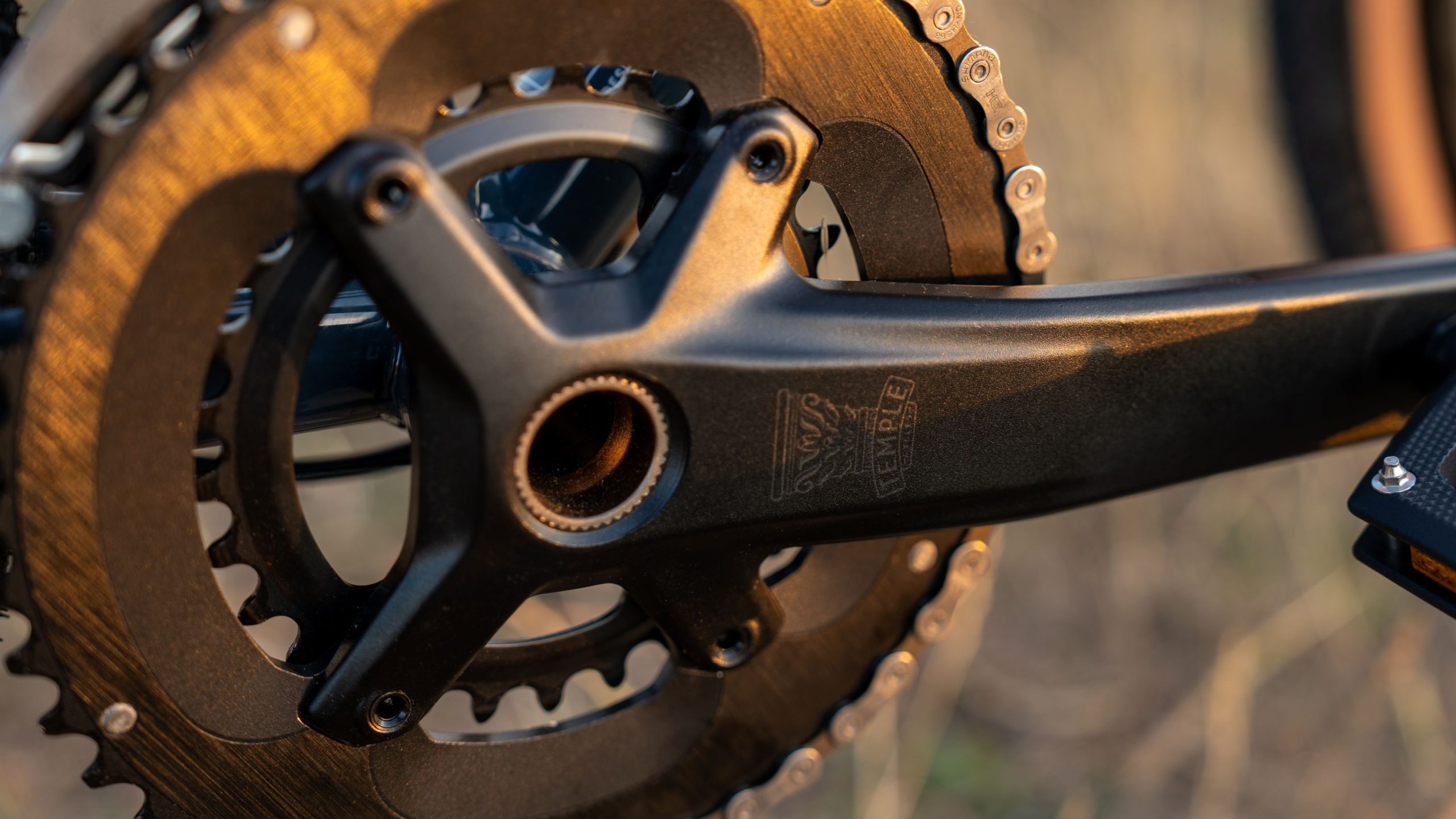
The AD 3 has an 11-34t Shimano HG400 cassette paired to a Temple-branded 46/29t crankset, so despite Sora being designed primarily for road riding, there’s plenty of low gearing for trickier terrain.
Since there’s no in-series disc brake option for Sora, the bike is fitted with TRP Spyre mechanical disc brakes.
A 46/29t Temple crankset ensures there’s plenty of low gearing for off-road use.
Other features of the AD 3 include a sealed headset and bottom bracket, and Shimano RS470 hubs laced to WTB ST i25 tubeless-ready rims with double-butted stainless steel spokes and brass nipples for durability and corrosion resistance.
Temple fits WTB Vulpine 40mm tyres, with tan sidewalls to enhance the AD 3’s urbane looks, and its own finishing kit.
It’s a build kit that prioritises durability, serviceability and real-world adventure-readiness, according to Temple.
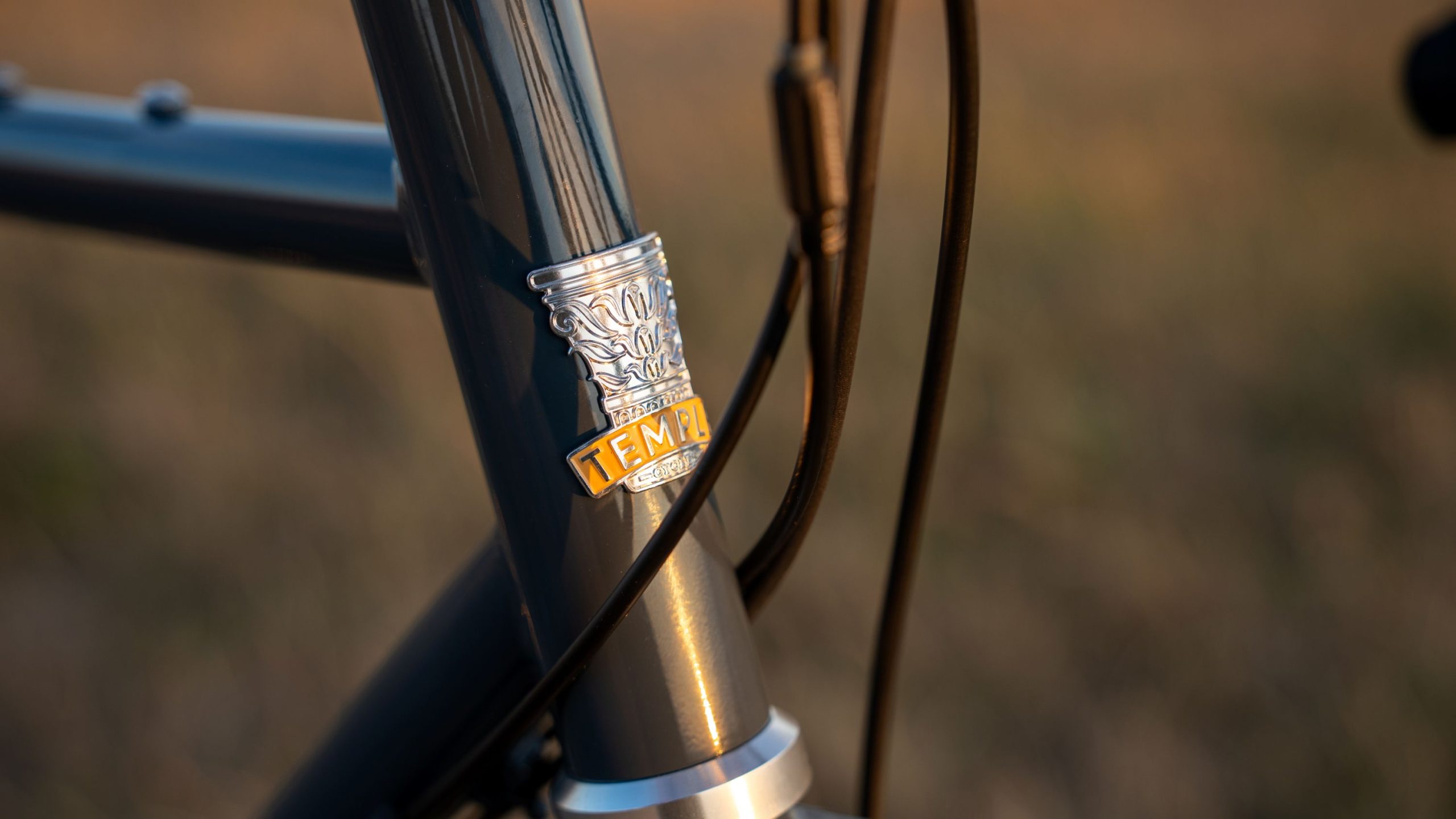
Temple’s TIG-welded Reynolds 725 steel frame has nice finishing details.
There are three muted colours on offer – Granite Grey, Lichen Green and Slate blue, and five frame sizes from 47cm to 60cm.
“The Adventure Disc 3 provides everything you need for adventure riding at a wallet-friendly price,” concludes Temple’s head of product, Tom Bugler.
If you want a higher spec, there’s currently 20% off the list price of both the AD 1 and AD 2.
You can read Gary Walker’s ongoing long-term review of the Temple Adventure Disc 2, to see how it has coped with a range of off-road riding, all-day adventures and the rigours of winter commuting.
Temple Adventure Disc 3 full specs and pricing
Frame: TIG-welded Reynolds 725 steel
Fork: Investment cast steel with lugged fork crown
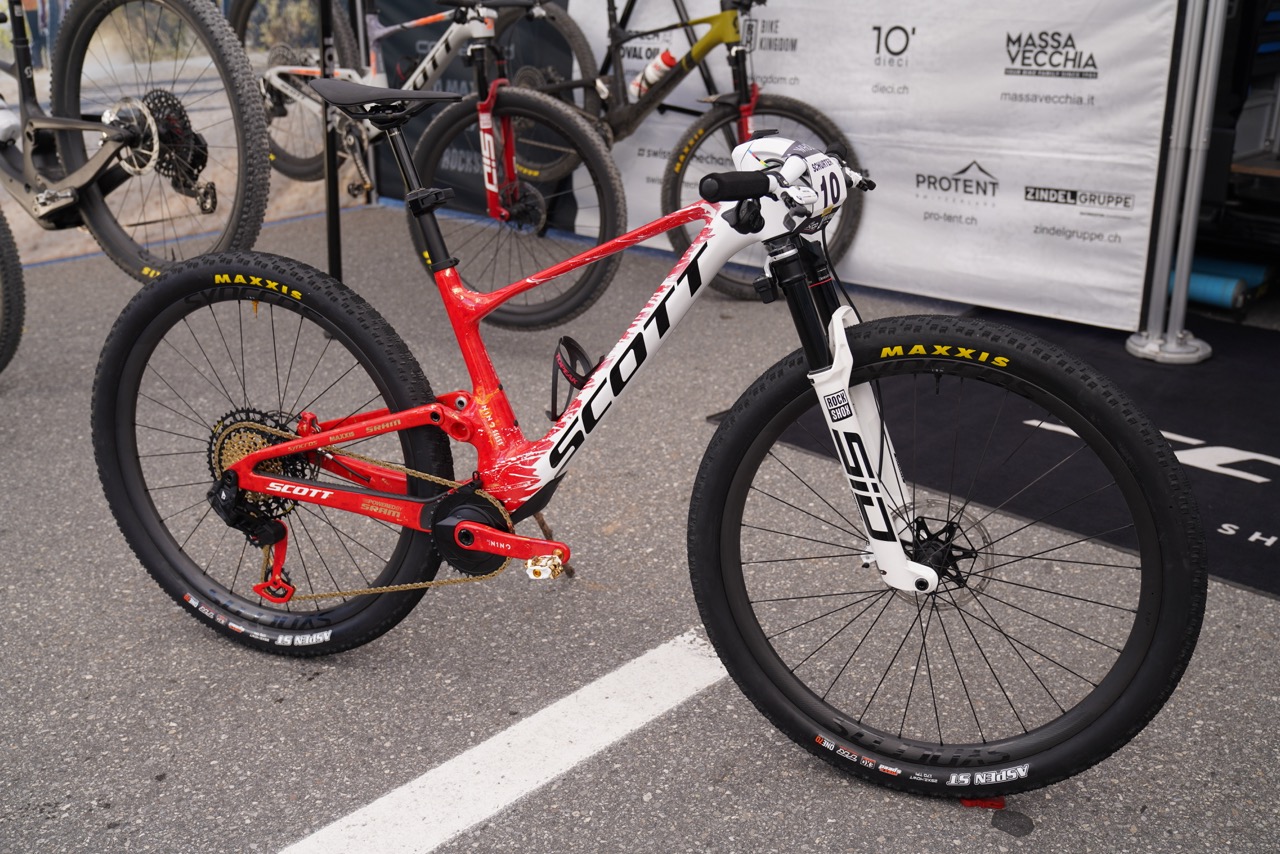
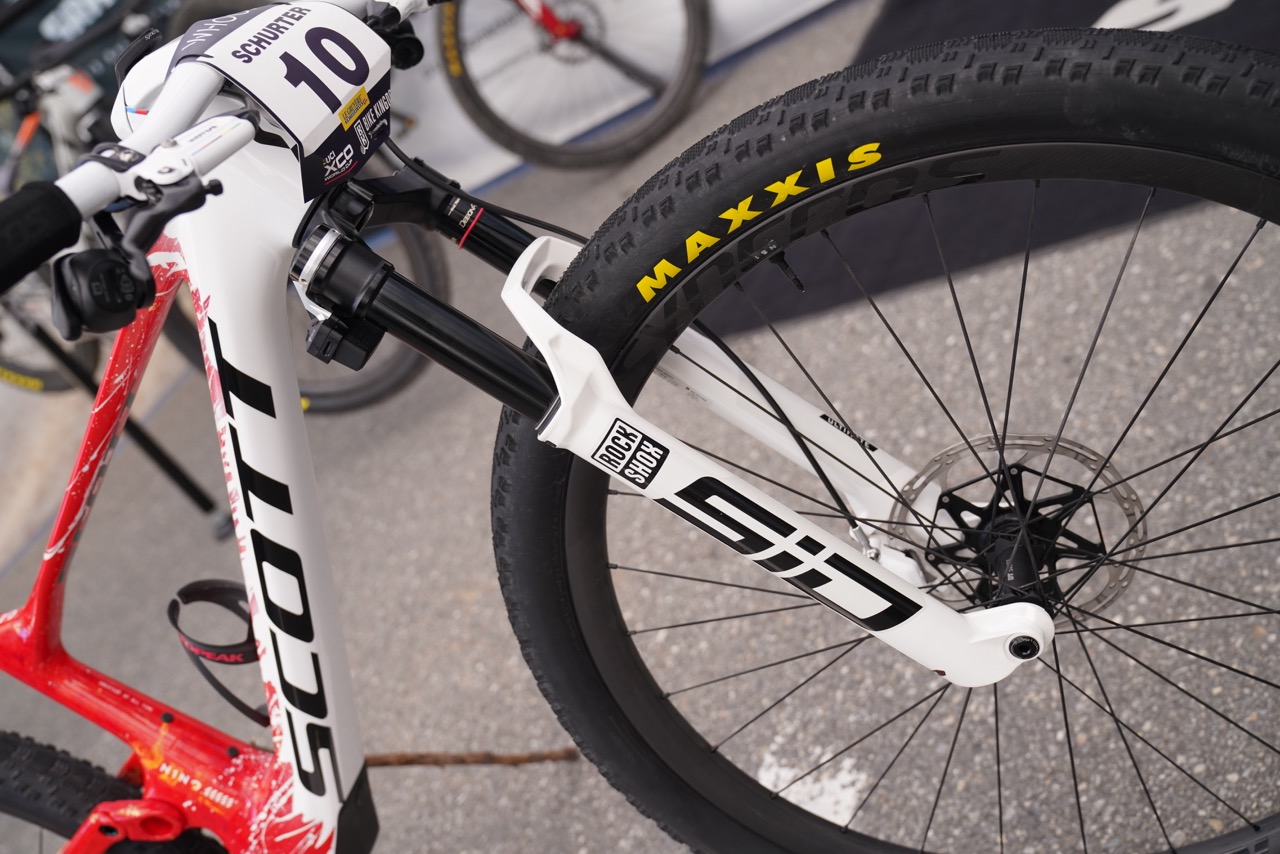
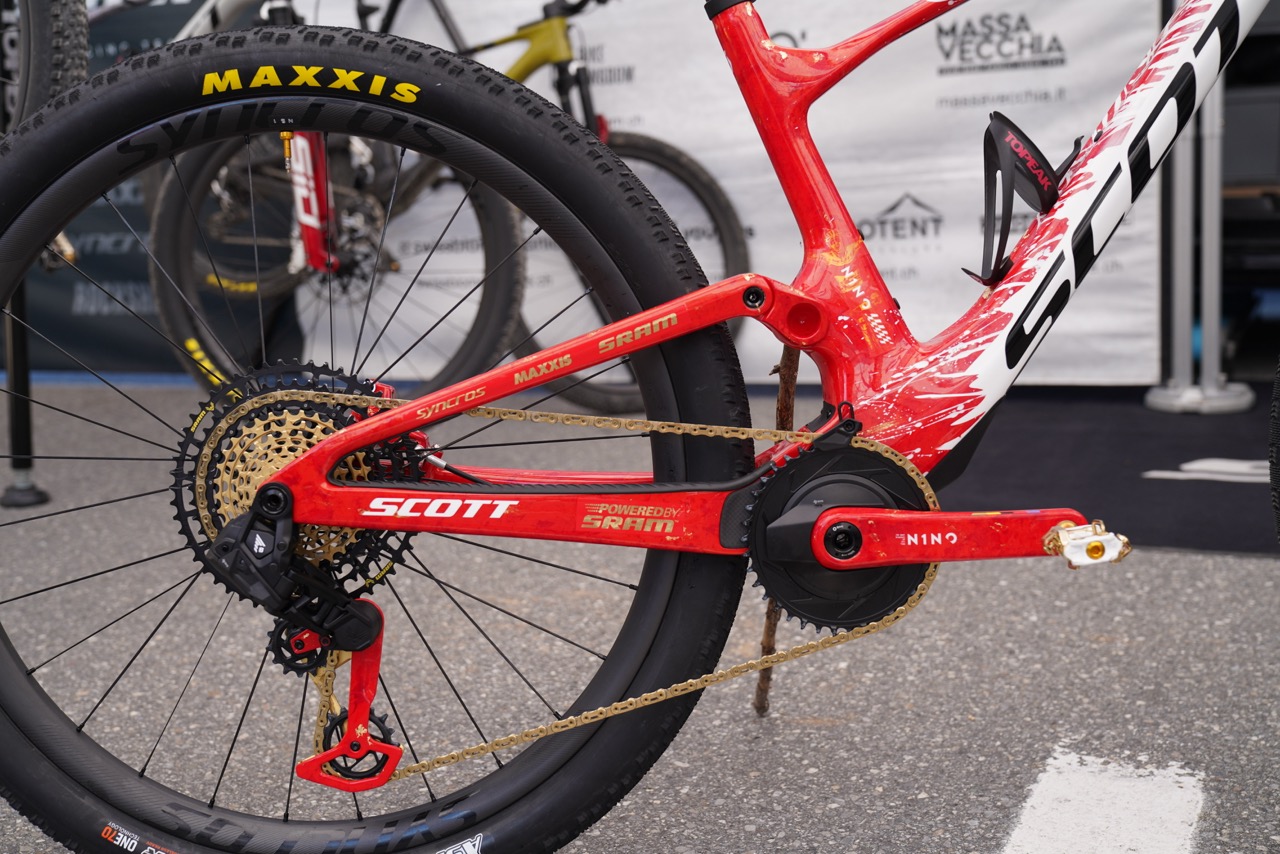
SRAM appears to be working on a new cross-country drivetrain, with Nino Schurter’s custom Scott Spark at the UCI Mountain Bike World Series in Lenzerheide sporting a Blackbox derailleur and blacked-out crankset.
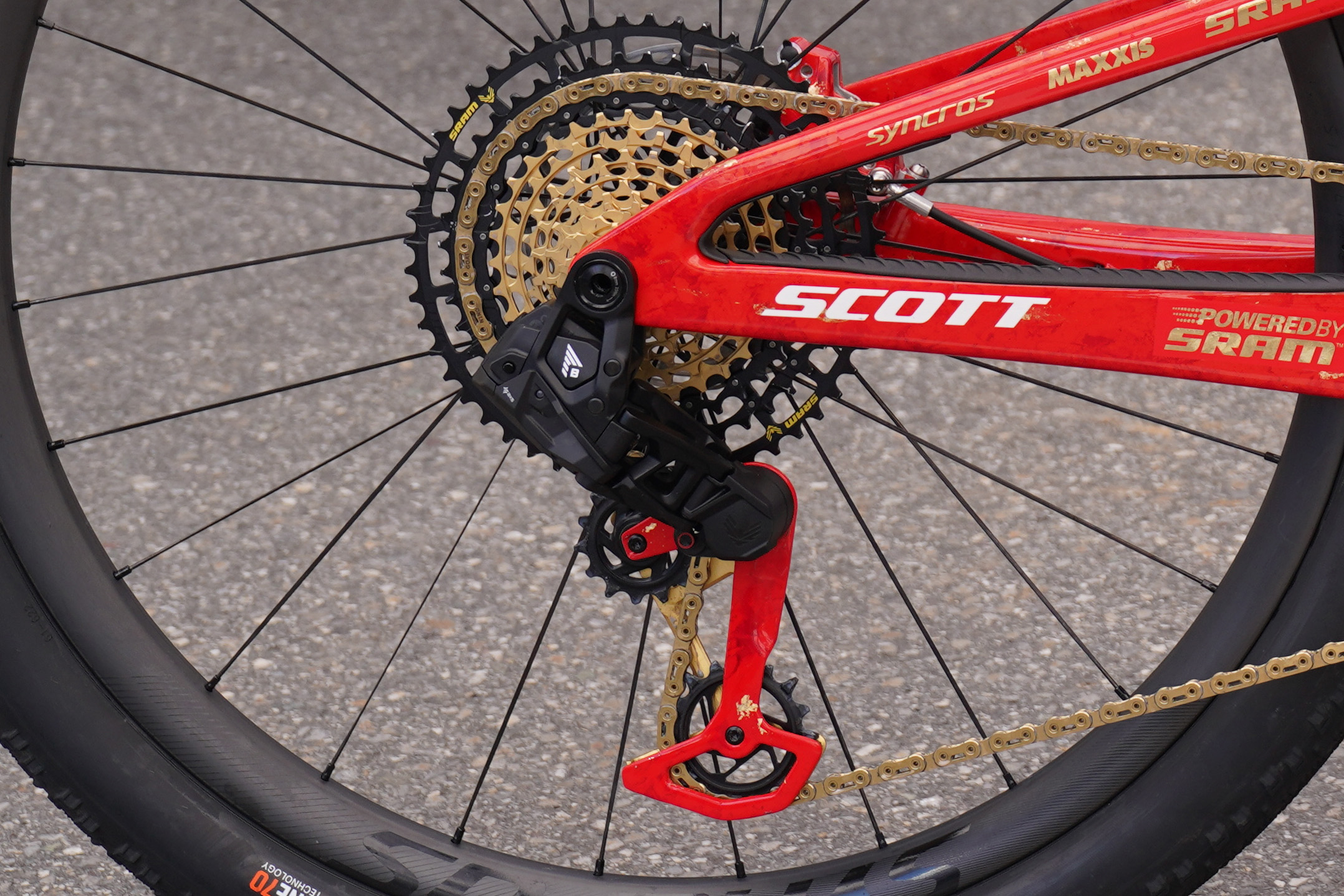
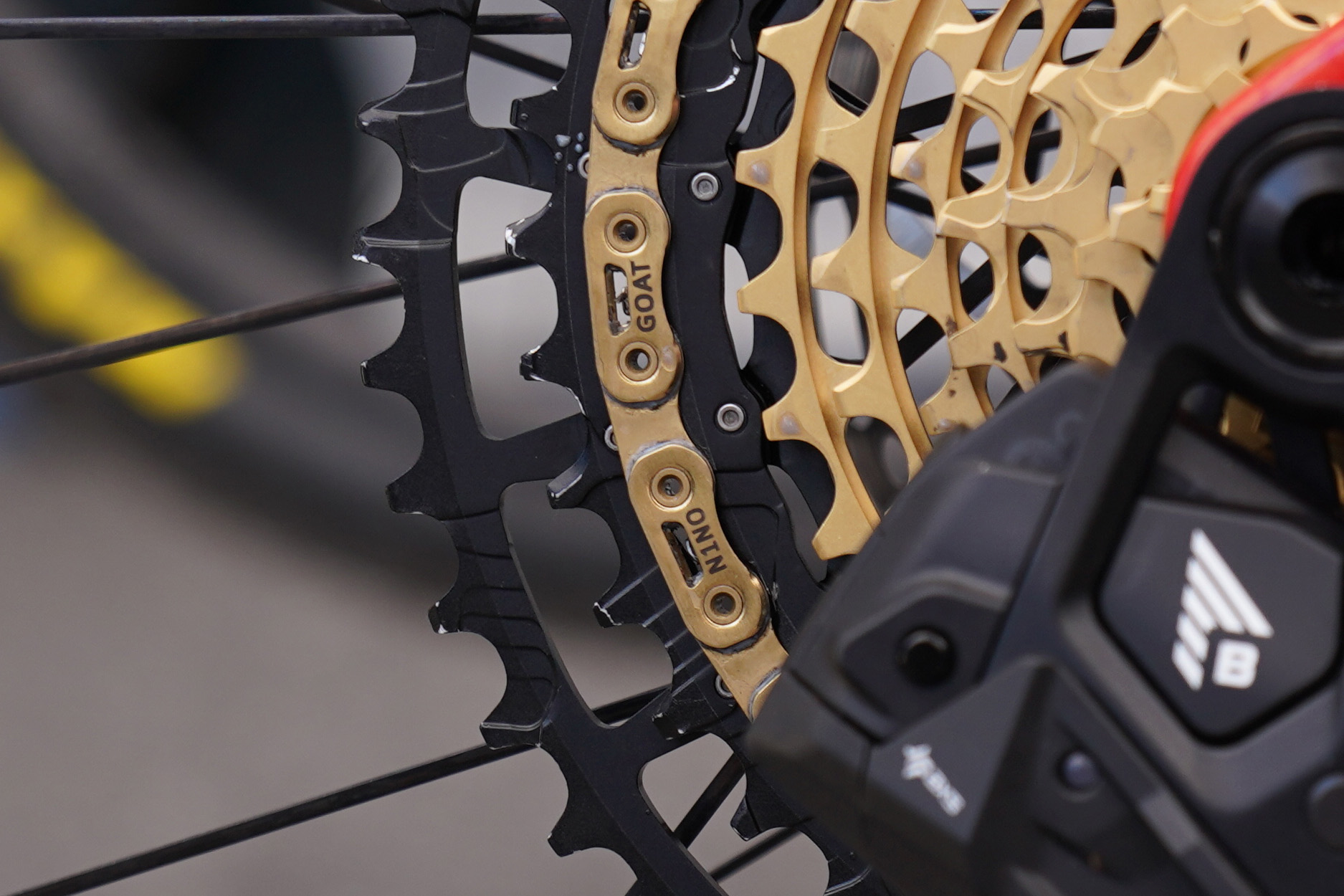
It appears the new derailleur is using SRAM’s GX AXS Transmission architecture, with the battery sitting protected in the UDH mount rather than hanging off the rear on XX SL AXS.
This weekend marked the end of Schurter’s illustrious career, with the Swiss rider choosing to retire at his home venue.
With a career spanning back to 2007, when he turned professional, Schurter has been a dominant force in cross-country mountain biking, winning 36 World Cup races and taking the overall title nine times.
If this were football, it would be like Leonel Messi hanging up his boots, with many regarding Schurter as the GOAT (greatest of all time) in the sport.
In support of one of mountain biking’s greatest athletes, Swiss fans were out in full force to cheer Schurter on one last time.
Unfortunately, he couldn’t quite pull off the fairytale ending, finishing in 24th place, but he still crossed the line to a shower of champagne.
The new tech could be being tested in a GX AXS mule body. Nick Clark / Our Media
Blackbox is SRAM and RockShox’s prototype testing platform, similar to Fox’s RAD development programme.
Under closer inspection, the derailleur appears to share its architecture with the current GX AXS Transmission, with the battery sitting inside the UDH mount rather than hanging out of the rear as seen on the X0, XX and XX SL Transmissions.
The only difference we can see is that the derailleur on Schurter’s bike uses a different cage from that on GX, although it’s hard to tell if this is carbon fibre due to the paintjob.
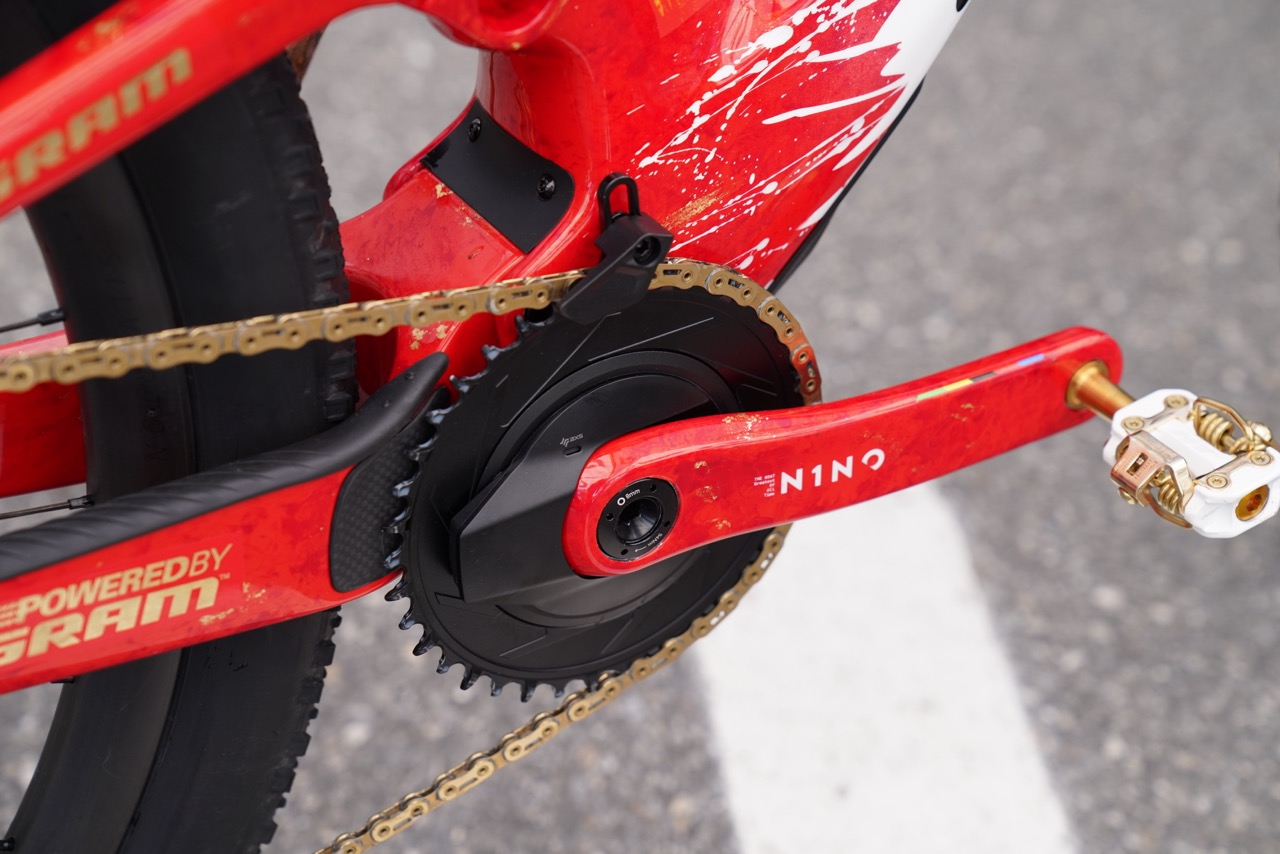
The crankset is understated, but looks to be from SRAM’s RED XPLR AXS drivetrain. Nick Clark / Our Media
Elsewhere, the crankset looks very similar to the power-meter equipped version of SRAM’s gravel-specific RED XPLR AXS drivetrain.
Whether these are final designs is hard to tell, with SRAM possibly using current equipment as testing mules for new technology.
Either way, it looks as though SRAM has something in the oven.
Schurter’s bike blends the white and red of the Swiss flag. Nick Clark / Our Media
For his last race, Scott honoured Schurter with a custom bike that shares some of the Swiss rider’s story.
Schurter last won the world champs in 2022. Nick Clark / Our Media
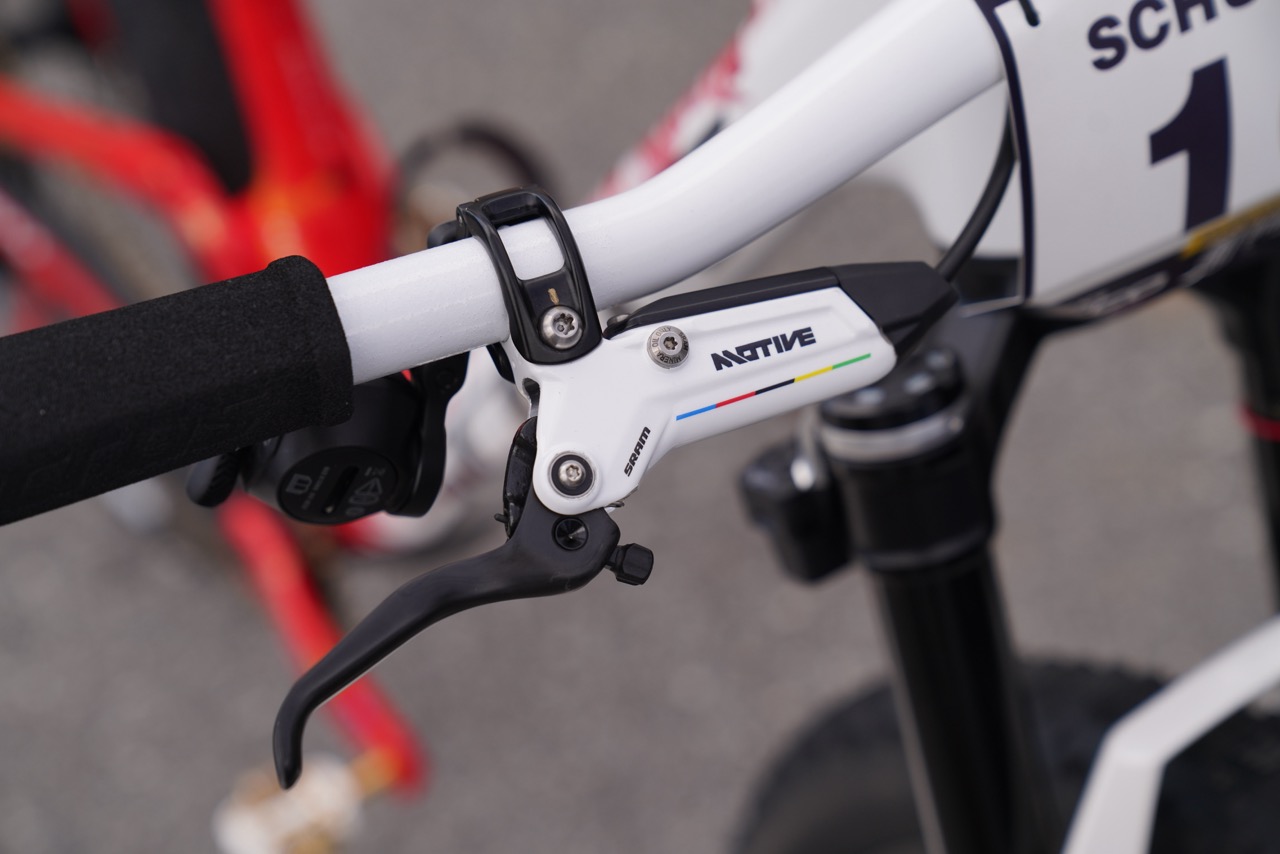
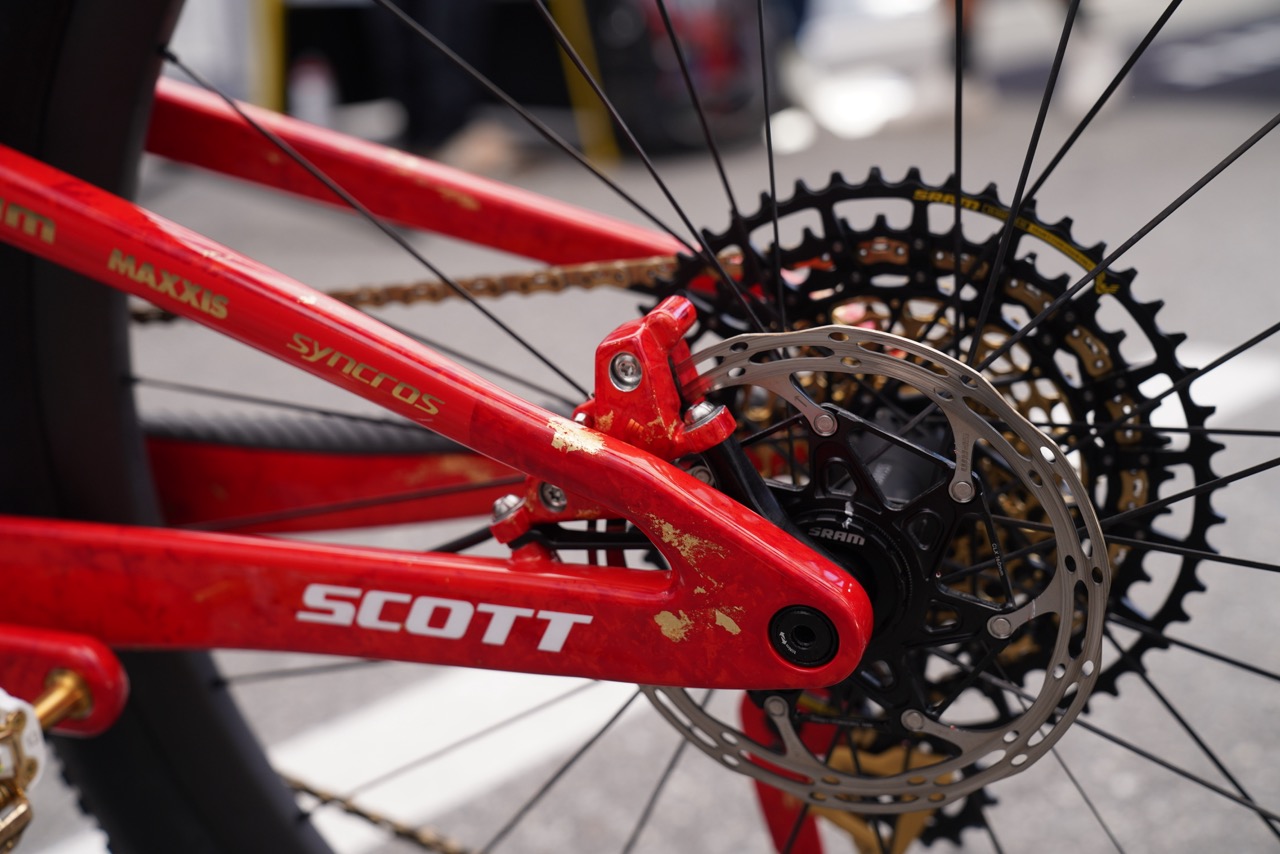
There are nods to Schurter’s career throughout the bike, with rainbow stripes and flakes of gold representing his various world championship successes and 2016 Olympic Gold medal.
His SRAM Motive Ultimate brakes combine both, with the levers painted white with stripes and the caliper featuring the red and gold design.
The rear caliper almost disappears into the rest of the paintjob. Nick Clark / Our Media
SRAM’s Motive brakes were released earlier this year and replaced the Level and Guide line-up, with improved braking power and a shift to mineral oil as braking fluid.
Some have complained that the brakes are heavier than the previous Level options, but this doesn’t seem to be holding riders back.
The gold chain is a nod to Schurter’s gold medal at the 2016 Olympics. Nick Clark / Our Media
Running through the new derailleur is a custom gold chain that has been stamped with the words ‘Nino’ and ‘Goat’.
RockShox SID Ultimate Flight Attendant has 120mm of travel. Nick Clark / Our Media
Elsewhere on the bike, Schurter is using RockShox suspension in the form of the SID Ultimate fork and SID Luxe rear shock.
Both components are Flight Attendant models, meaning the bike should be able to sense automatically when Schurter needs open suspension for descents, firm suspension for better pedalling and locked-out for smooth sections of the track.
Schurter also had custom crank arms on his chainring. Nick Clark / Our Media
The Scott Spark cleverly hides the rear suspension inside the frame, keeping it safely away from water and dust ingress.
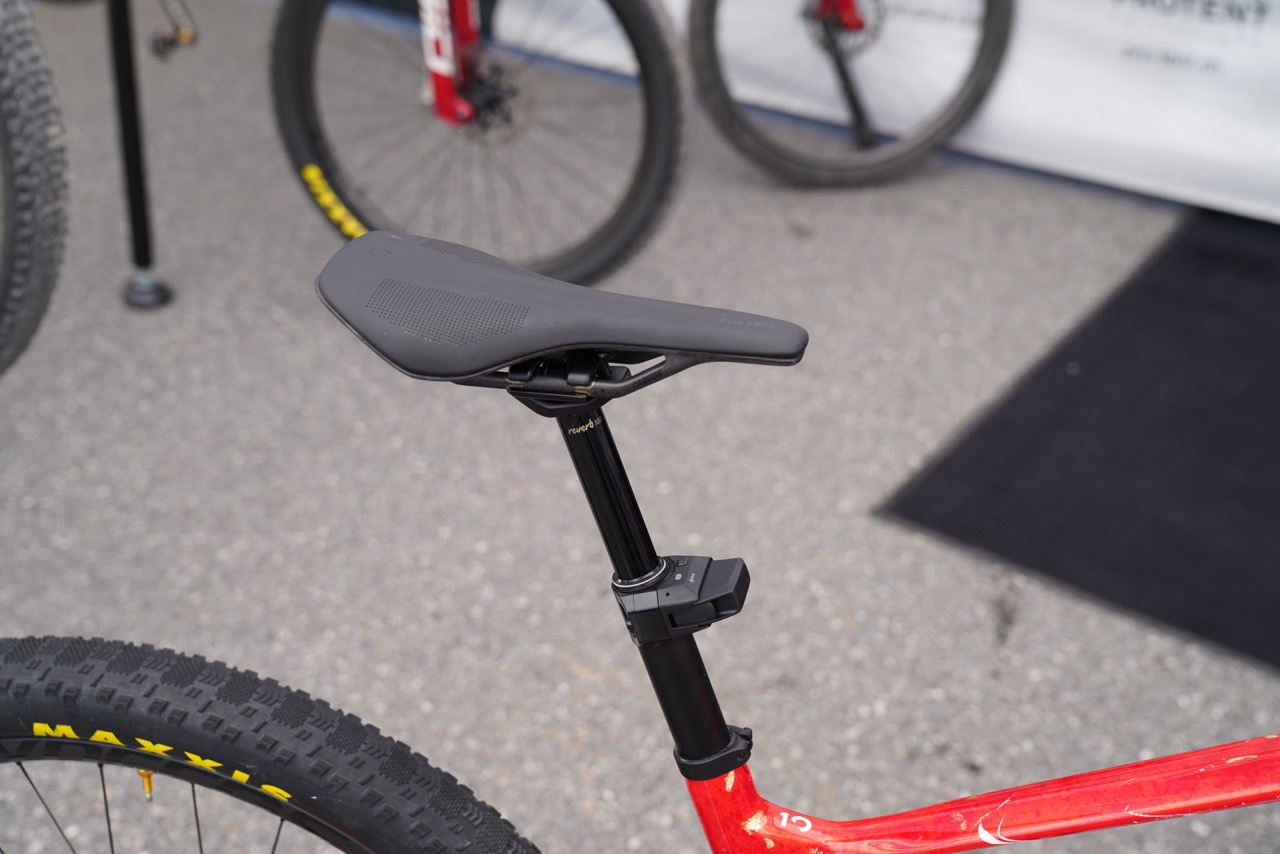
Schurter uses a Syncros Tofino saddle atop his Reverb dropper. Nick Clark / Our Media
Schurter also uses a Reverb AXS B1 dropper post from RockShox, which is lighter than the previous generation.
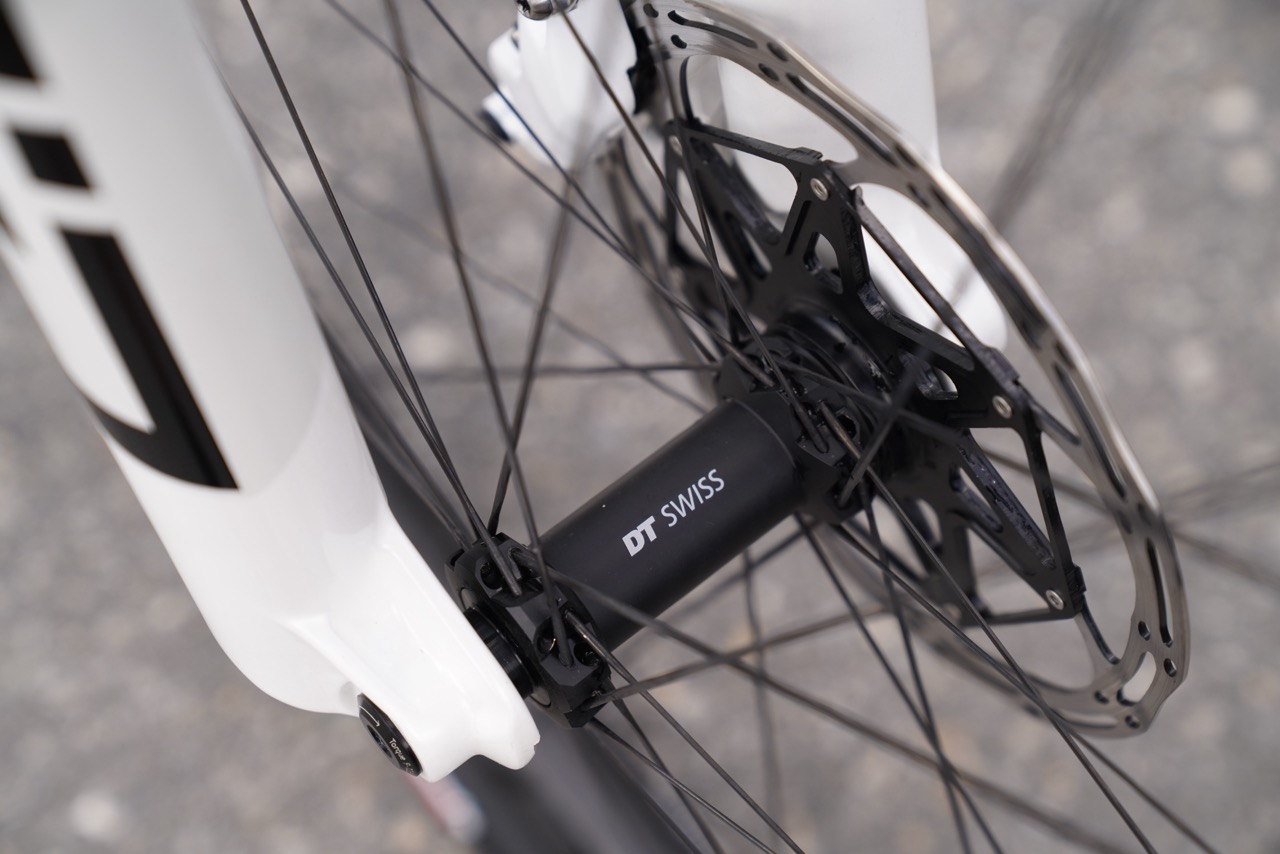
Syncros uses DT Swiss internals or hubs on the majority of its Silverton line-up. Nick Clark / Our Media
The bike rolls on Syncros Silverton carbon rims with DT Swiss 180 hubs booted in Maxxis Aspen ST rubber – well suited to the dry, fast-rolling course.
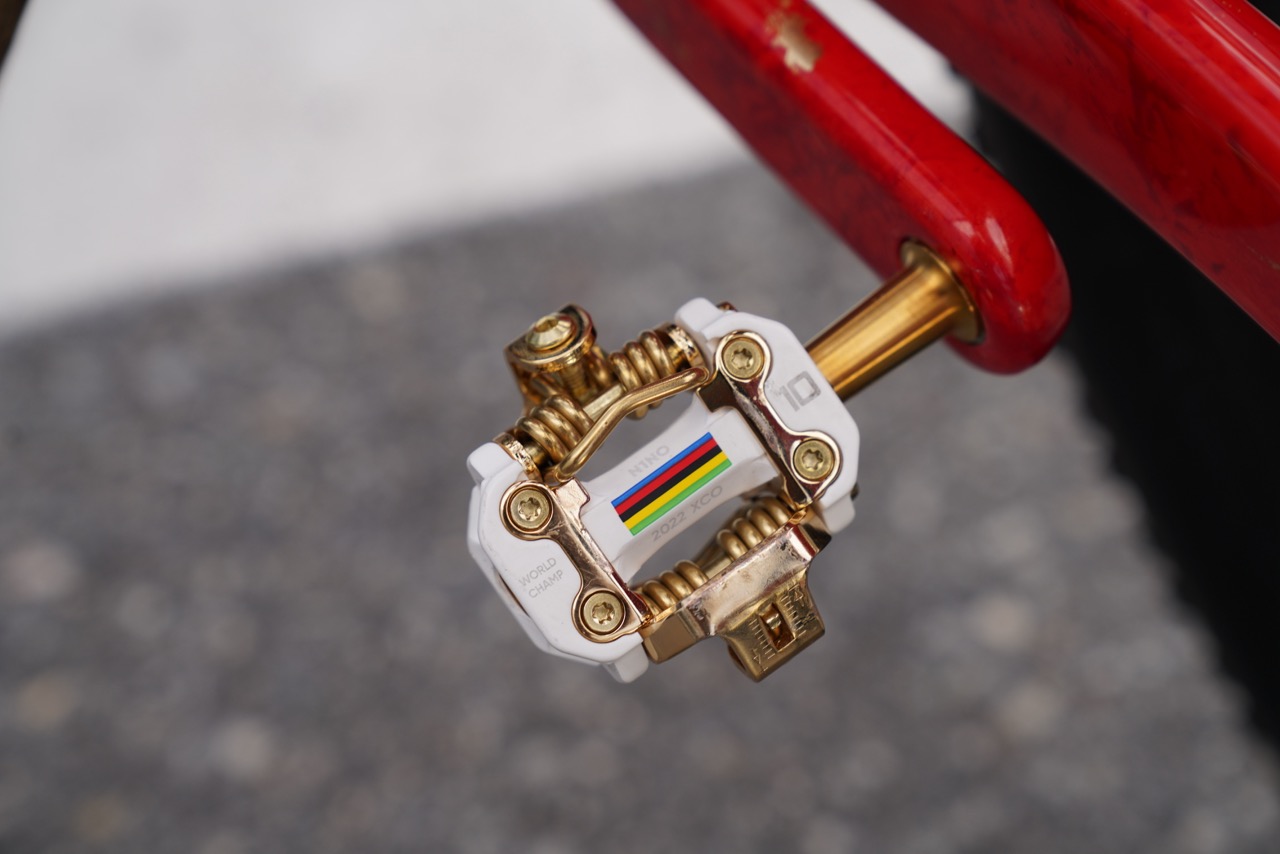
To add even more gold to the bike, HT Components has gilded the mechanism on Schurter’s pedals. Nick Clark / Our Media
Carrying on the celebrations, Schurter’s custom HT Component pedals commemorate his last world championships win in 2022.
Zwift’s big fondo events are a popular tradition where thousands of riders push themselves to finish long weekend rides. And while the ZFondo Series took a year off last year, it’s back for the 2025/26 indoor season, with the first event happening this weekend!
Here are all the details for this year’s ZFondo Series…
Routes and Schedule
The last weekend of each month is designated as a Fondo Weekend, and each month features a different route.
Events are scheduled every three hours on Friday, Saturday, and Sunday on Fondo Weekends.
You must choose a category when you sign up, but the category you choose is entirely up to you, and all categories start together and are visible to each other.
The idea is that you’ll choose a category at the approximate pace you plan to ride, making it easy to see and group up with other riders targeting a similar pace.
Available categories:
A: 4.2 W/kg
B: 3.2 W/kg
C: 2.6 W/kg
D: 1.8 W/kg
E: 1.5 W/kg
1000 XP Bonus + Kit Unlocks
Past fondos have typically featured jersey unlocks, but some of the designs weren’t always a hit. (Does anyone wear the salmon/chocolate 2023 kit?)
So Zwift is switching things up this year by giving a 1000 XP bonus the first time you complete each month’s fondo event.
Of course, a fondo wouldn’t be a fondo without a kit unlock. But instead of releasing another set of fondo kits, Zwift is awarding different legacy Zwift Fondo kits each month:
September (ZFondo Medio 2023)
October (ZFondo February 2022)
November (ZFondo November 2020)
Is this a race?
Officially, no. But hundreds (possibly thousands) of riders will turn out for each of these popular “fun race” events, and the front of each event will certainly be filled with strong riders going all out.
With so many riders participating, everyone should be able to find a group that suits their desired pace. You do you!
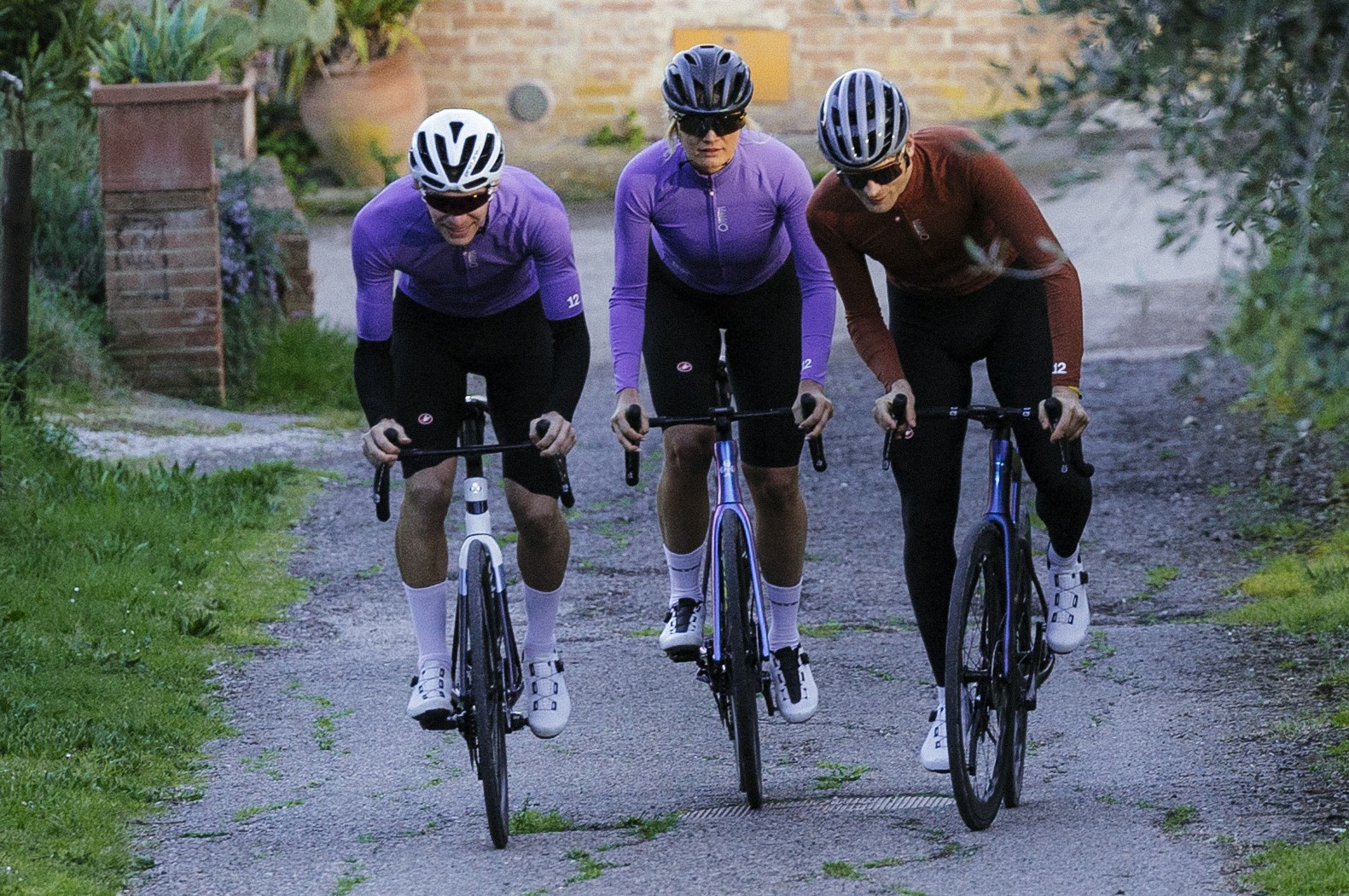
Castelli has added to its jacket collection with the Do.Di.Ci, which it says is the “spiritual heir” to the original Gabba.
The Do.Di.Ci has the high breathability of Castelli’s revolutionary Gabba jacket, but without the water resistance. Castelli says this makes it great for dry weather when the temperature is between 8 and 15°C (46 and 59°F).
According to Steve Smith, Castelli’s global brand manager: “There’s never been a jacket like the Do.Di.Ci. We see it as the spiritual heir to the Gabba for the way many people use the Gabba.
“The original Gabba was created for professional riders racing in the rain, but given its phenomenal success, we see that many cyclists use it in conditions that it wasn’t designed for: cool and dry.”
Castelli says its new jacket is 12 times more effective at evaporating sweat than the original Gabba.
Castelli rather missed the mark when it launched the Gabba R in 2024. That jacket is super-aero and also waterproof, wind-resistant and very packable. But with minimal insulation and a skin-tight fit, not to mention a sky-high price, it’s one for the racers rather than an everyman piece.
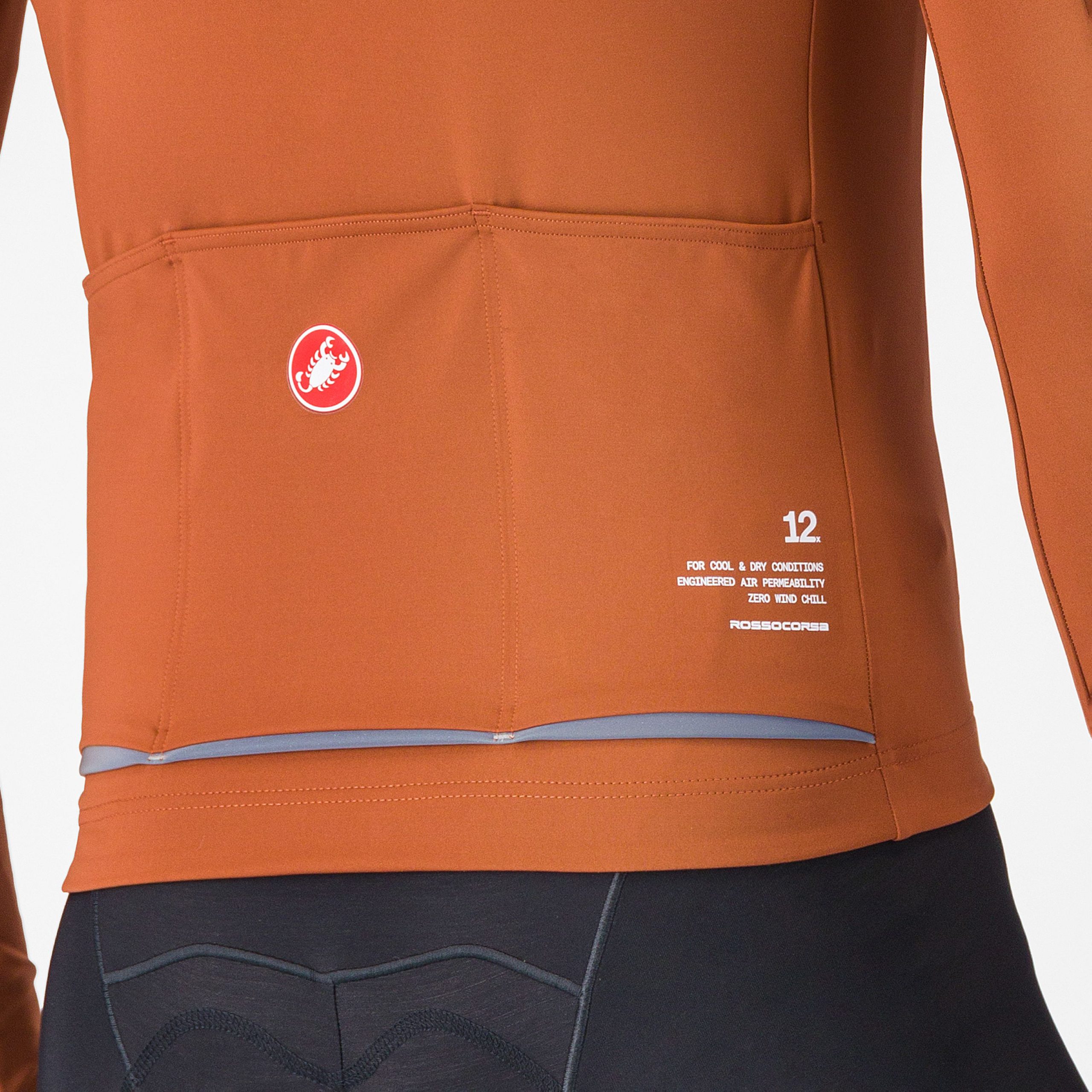
So, the new Do.Di.Ci (minus the dots, the name is Italian for ‘twelve’) skips the waterproofing in favour of good windproofing, paired with plenty of airflow to prevent a boil-in-a-bag feel inside. Castelli says the Do.Di.Ci is 12 times more effective at evaporating sweat than the original Gabba, hence its name.
Castelli advertises the Do.Di.Ci jacket’s credentials on the rear pockets.
According to Smith: “While the Gabba R provides the ultimate protection for racing in the rain while being as aerodynamic as a speedsuit – the Do.Di.Ci excels in high intensity rides in cool dry conditions.
“With water protection taken out of the equation, we’ve designed the Do.Di.Ci. to make performance cyclists more comfortable than they’ve ever been during high-intensity efforts in cooler, dry conditions.”
The Do.Di.Ci uses Castelli’s Ristretto fabric, which has plenty of stretch and incorporates a PFAS-free membrane to restrict the airflow through the fabric. Castelli says the Do.Di.Ci is the most breathable jacket in its winter range, claiming air permeability of 3 cubic feet per minute.
The new Perfetto 3 RoS jacket adds water repellency, but with lower breathability. Castelli
If you want water repellency, too – not a bad idea for UK riders – Castelli points you to the Perfetto RoS 3. Launched earlier this month, it’s made from Polartec AirCore fabric, which is less breathable with a 0.7 cubic feet per minute rating.
The Do.Di.Ci is not a cheap winter jacket, but is still around £100 / $100 less expensive than the Gabba R. You can choose between men’s and women’s versions with long sleeves, as well as a short-sleeve variant available for men only, with four colours and sizes from XS to 3XL for men, and two colours and sizes from XS to XL for women.
The men’s Do.Di.Ci short-sleeve is priced at £220 / $240 / €199.95, and the men’s and women’s long-sleeve at £250 / $280 / €229.95.
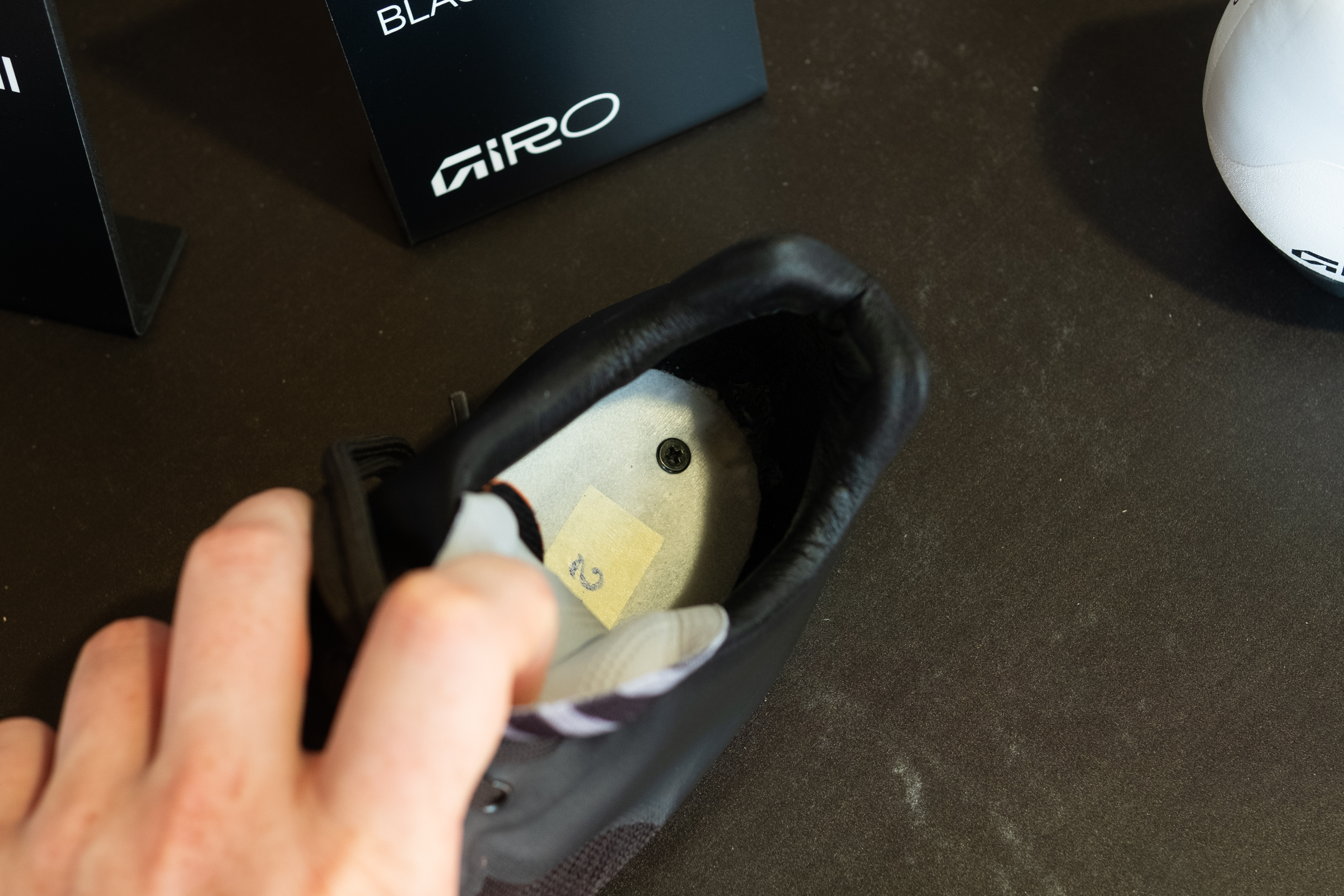
Lace-up fans, rejoice – Giro has finally revived an icon with the long-awaited release of the Empire SLX II, the first update to its flagship lace-up road shoe since 2019.
The previous generation Empire SLX was famously favoured by riders like Bradley Wiggins and Taylor Phinney – clearly firm favourites with riders who, among other things, are as stylish as it gets.
We first spotted what looked like an update to the shoe at this year’s men’s Tour de France on the big Dutch feet of double stage winner, Thymen Arensman. They then appeared on the brand’s site, confirming it was the new Empire, without fanfare, but this is the first time we’ve seen them in the flesh.
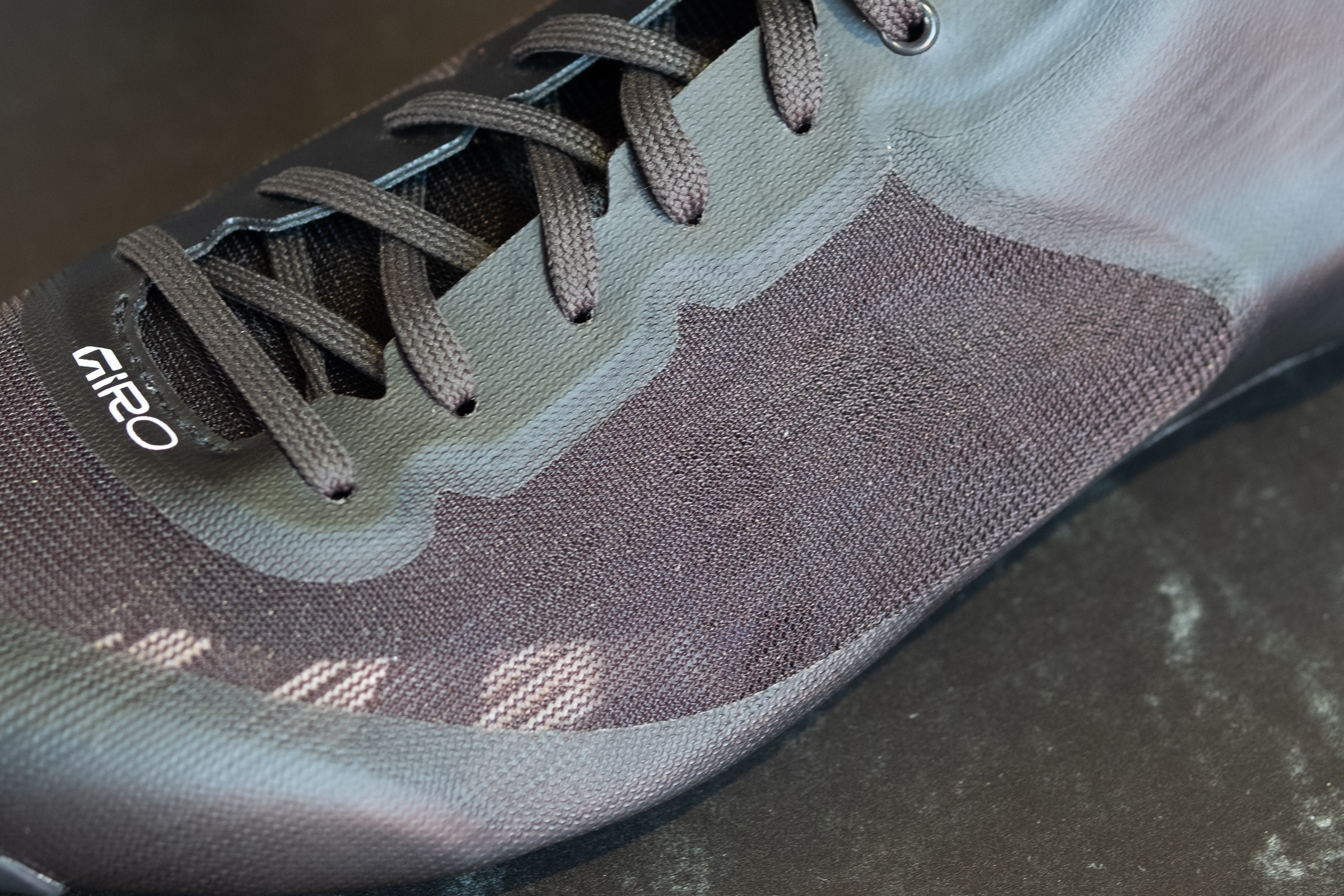
Large portions of the shoe’s upper are mesh. Jack Luke / Our Media
The updated Empire’s upper is made of Synchwire – a seamless material, which Giro says offers “incredible airflow and structural integrity.” This is paired with large mesh panels for lighter weight and more breathability.
Replaceable shoe components are always to be celebrated. Jack Luke / Our Media
The shoes feature a removable heel block, which should enable riders to eek a bit more life out of their shoes if the sole starts to wear. The outsole is forged carbon, completing what Giro tells us is an “ultra-lightweight, supremely efficient update to the icon that reimagined laces.”
The Empire SLX II has a claimed weight of 195g (size 43). For reference, the previous Empire SLX model was slightly lighter at 185g (size EU 42.5).
The S-Works Torch Lace is one of few similarly premium lace-up road shoes. Scott Windsor / Our Media
We’re yet to hear pricing in the UK and Europe, but the Empire SLX II costs $449.95 – a steep price tag, but in-keeping with the broader market for premium road shoes.
Aside from the Specialized Torch Lace, there are few high-end lace-up options available, so no doubt the return of the Empire SLX will please a lot of cyclists looking for the ultra-adjustable fit, low weight, and retro charm of a lace-up shoe.
Ratio Technology appears to be preparing to launch its first complete rear derailleur, which, as far as we’re aware, would be the first non-SRAM model to use the Universal Derailleur Hanger (UDH) standard in the direct-mount format it was originally designed for.
Ratio Technology – a small brand based in the Lake District of England – is best known for producing aftermarket conversion kits for SRAM and Shimano drivetrains.
Its products enable riders to mix and match components across brands and disciplines – for example, SRAM mechanical road shifters with mountain bike derailleurs, or converting 11-speed SRAM shifters to run 12- or even 13-speed cassettes.
The brand also offers replacement pulley cages and jockey wheels, often marketed as like-for-like upgrades over OEM components.
The B-tension screw is a notable addition. Jack Luke / Our Media
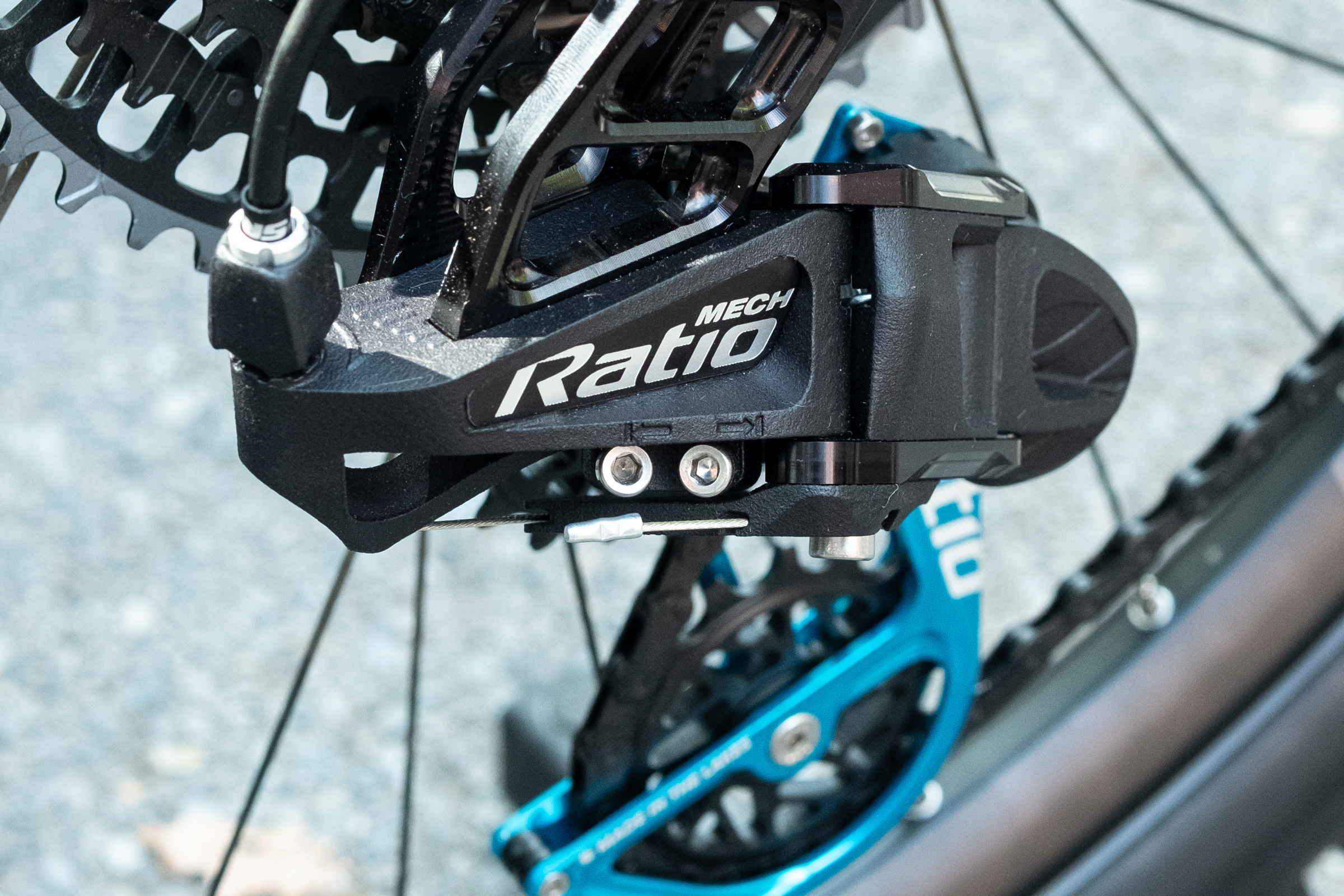
The appearance of a complete derailleur – which appears to be called the Mech – marks a significant step beyond Ratio’s previous focus on small parts and conversion kits.
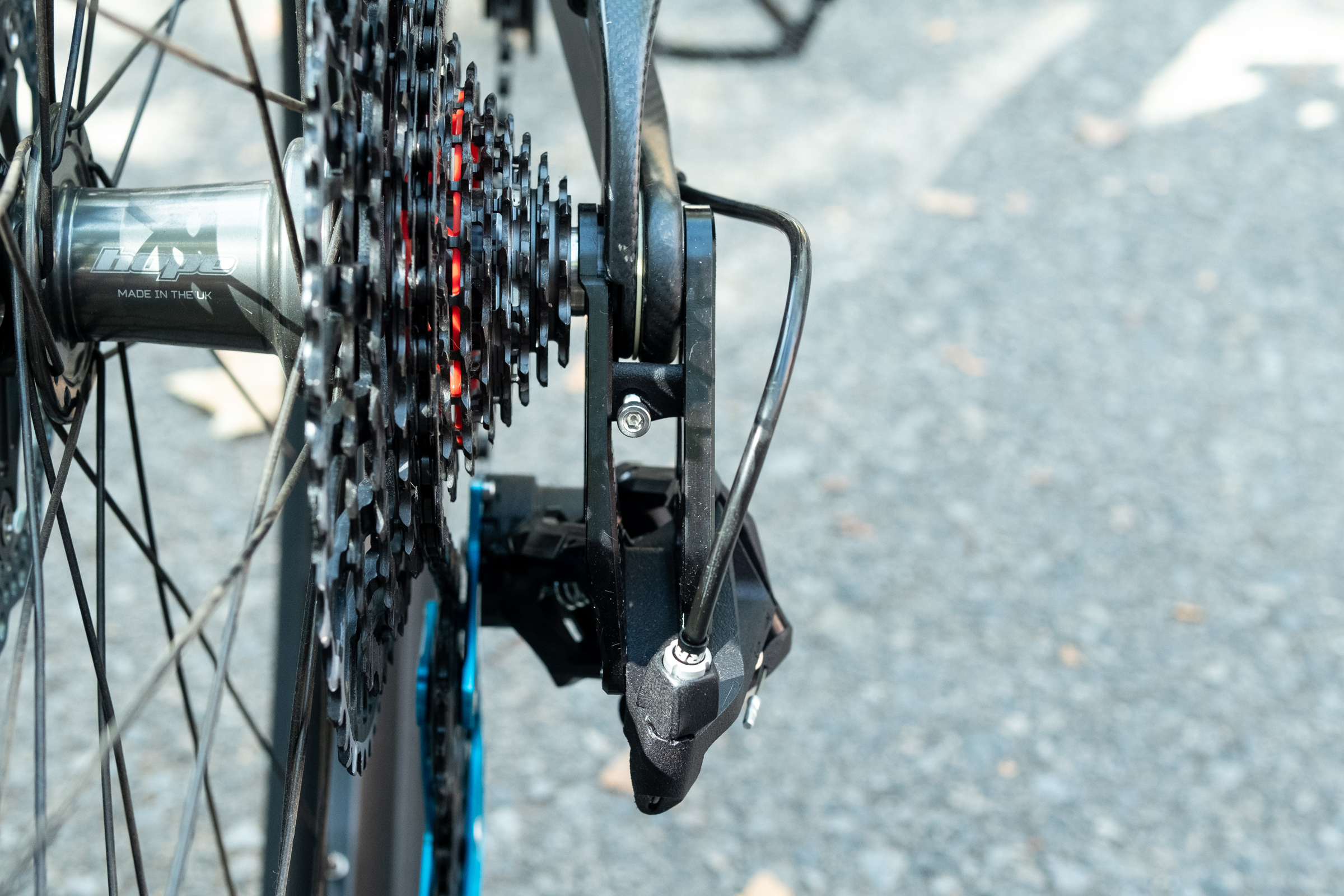
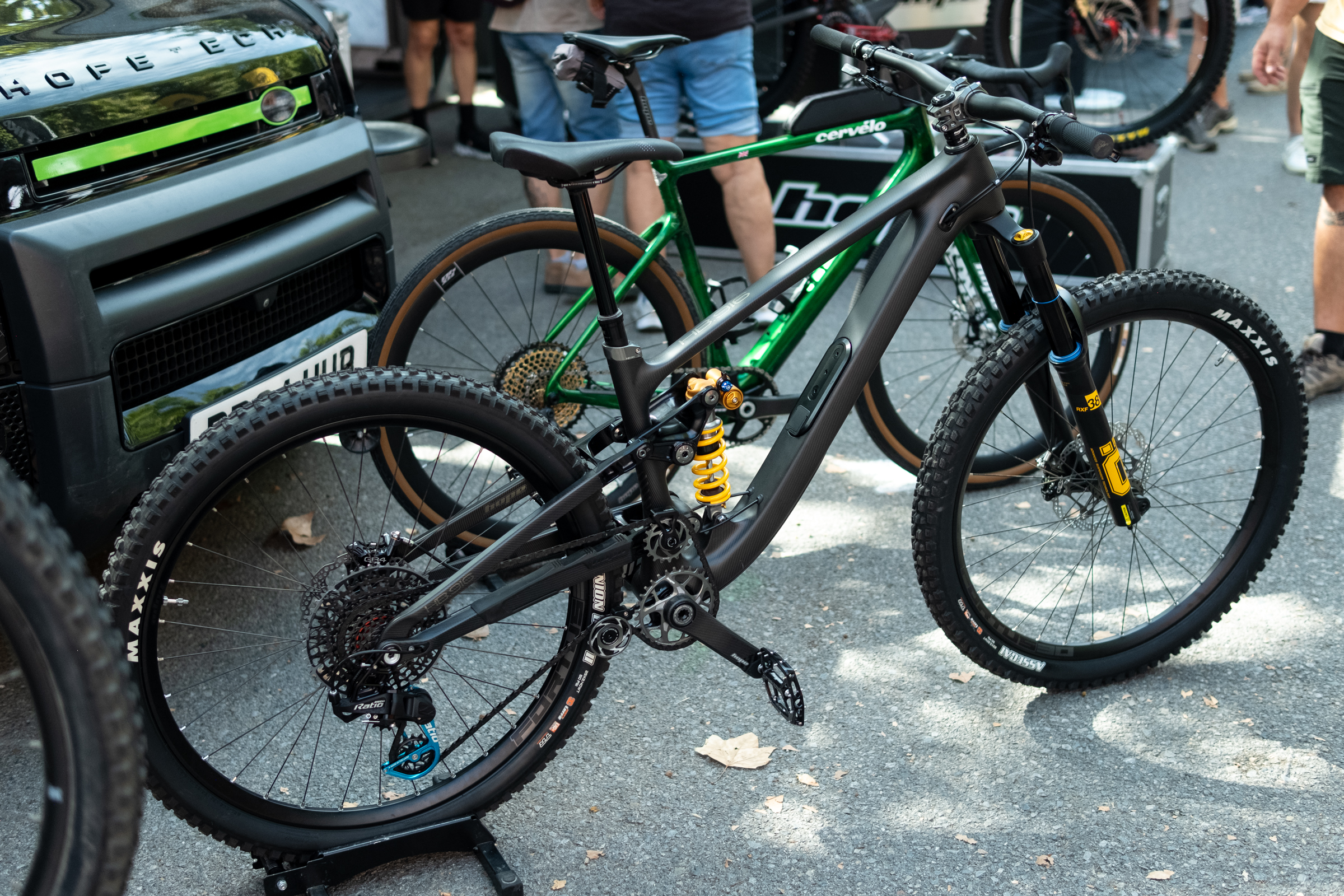
Fitted to a Hope HB.916 enduro bike, the derailleur mounts using a system similar to SRAM’s T-Type, with an extended ‘B-knuckle’ that clamps on either side of the Universal Derailleur Hanger.
Unlike SRAM’s design, however, the Ratio derailleur features a B-adjust screw. This would, in theory, enable users to run different cassette sizes, rather than being restricted to one option, as is the case with SRAM.
Limit screw aren’t present on SRAM’s mechanical or electronic Transmission groupsets. Jack Luke / Our Media
Limit screws for high and low gears are also present. These also point to a wider adaptability of the derailleur compared to SRAM’s existing UDH-mounted designs.
According to Bikepacking.com, which spotted the derailleur at the Made handmade bike show, the derailleur can be adapted to both UDH and conventional hanger mounts.
It can also be adjusted to work with a wide range of cable pulls using interchangeable fins, enabling compatibility with Shimano and SRAM shifters across road and mountain bike platforms.
The site reports that the derailleur is compatible with almost all 1×12 and 1×13 drivetrains and will be offered with cages for 46- and 52-tooth cassettes. Ratio also told Bikepacking.com it is aiming to make the derailleur fully user-serviceable.
The derailleur was teased on a Hope enduro bike. Jack Luke / Our Media
The sample pictured was paired with a standard SRAM cassette, with no visible modifications.
The derailleur features notably clean cable routing. The cable enters near-vertically at the back of the derailleur, running around what appears to be a fin or roller before joining the main knuckle at the bottom, where it clamps.
It is reasonable to assume the derailleur incorporates a clutch mechanism. A small screw cover on the body suggests the clutch may be either serviceable or adjustable.
The UCI has expressed concern over the Belgian Competition Authority’s (BCA) announcement that it has opened an investigation into its proposed gearing restrictions, following a formal complaint filed by SRAM.
The BCA confirmed on 19 September that it had begun looking into “the adoption by the International Cycling Union of a technical standard limiting the maximum gear ratio allowed in professional road cycling events.” The move came after SRAM alleged the UCI’s Maximum Gearing Protocol unfairly disadvantaged its equipment and riders.
In a response published on its website, the UCI said it is “puzzled by the issuance of the Belgian Competition Authority’s press release before the UCI has even been served with the complaint and by the obvious inaccuracies contained in this statement”.
The governing body added that it “understands that the investigation relates to the maximum gearing test which will be carried out at the 2025 Tour of Guangxi taking place from 14 to 19 October 2025”.
According to the UCI, “the test had been communicated by the UCI on 20 June and 3 July and a dedicated ‘test protocol’ adopted by the UCI Management Committee at its meeting of 10-12 June 2025 to enable the implementation of the test”.
The gearing restrictions are set to be trialled at the 2025 Tour of Guangxi. Warren Rossiter / Our Media
The organisation said: “The test was recommended by SafeR, the entity which gathers the representatives of riders, teams, organisers and the UCI, with the purpose of increasing the safety in men’s and women’s professional cycling, in particular for riders”.
The UCI argued that “the statement does not reflect the fact that the UCI has publicly indicated that it will consider the findings of this test before considering if further tests are relevant in 2026. Only then, would the UCI potentially consider any changes to the regulations”.
It continued: “Even more surprisingly, the release does not even deem it necessary to indicate that the test… is aimed at exploring measures aimed at increasing rider safety, which is a fundamental prerogative of all sport governing bodies.”
SRAM disagrees, saying in a statement published on 19 September that: “Although the UCI refers to the Maximum Gearing Protocol as a ‘test’, its implementation has already caused tangible harm.
“SRAM’s gearing has been publicly labelled as non-compliant, creating reputational damage, market confusion, team and athlete anxiety, and potential legal exposure.”
SRAM CEO Ken Lousberg added: “This protocol penalises and discourages innovation and puts our riders and teams at a competitive disadvantage. We rely on the sport’s governing body to foster an environment that encourages innovation for the benefit of riders and racers today, and riders in the future. We also rely on the governing body to make science-based, impactful changes for rider safety.”
The governing body says it is “confident that its proposal to test limitations to gearing is compliant with EU and Belgian competition law”, adding that it feels “it is not the role of competition law to lead to a ‘levelling down’ in regulatory and safety standards”.
The statement concluded: “The UCI will continue to collaborate with the stakeholders of cycling through SafeR for the improvement of safety and shall not make any further comments on these proceedings.”
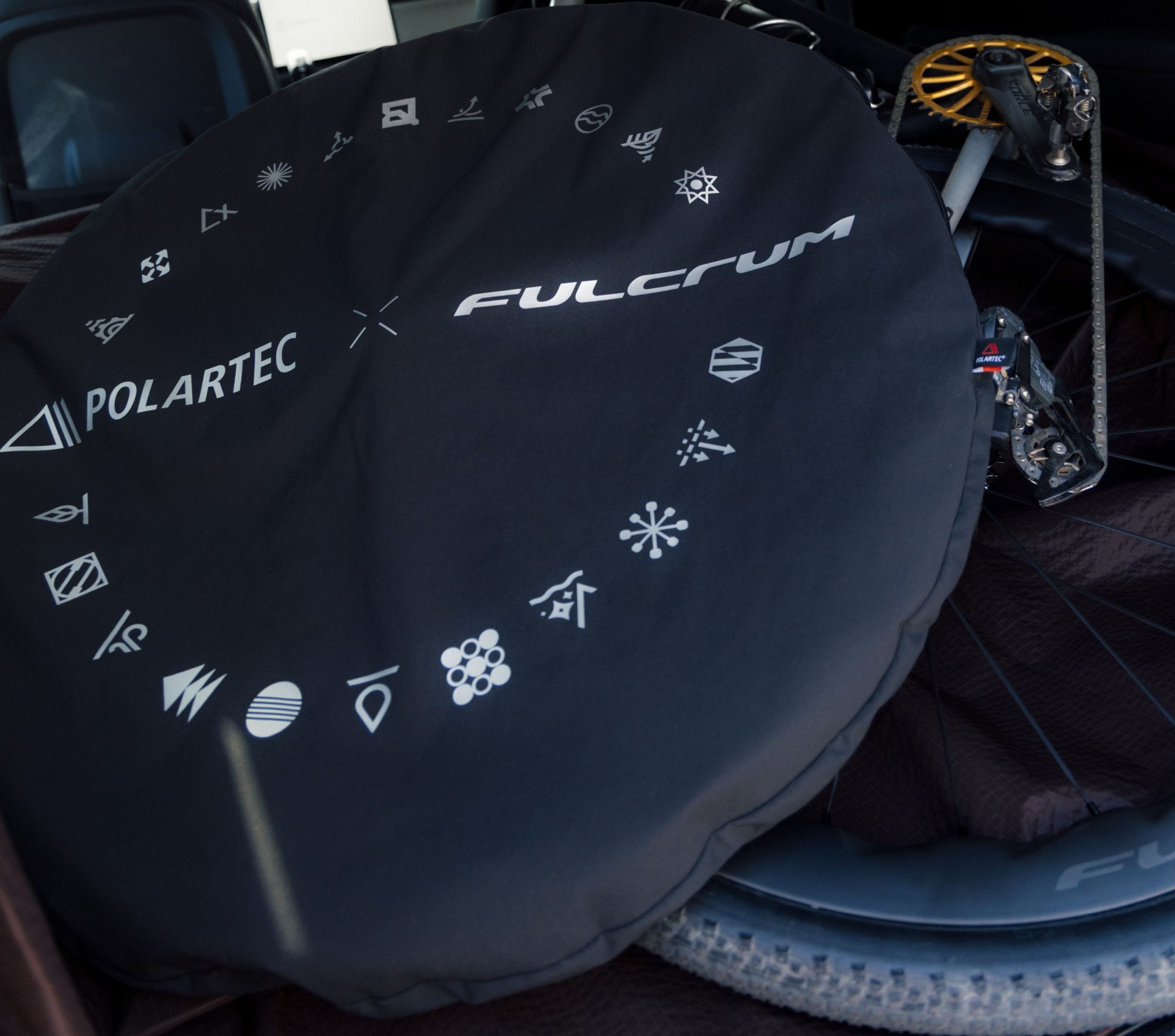
Fulcrum has teamed up with Polartec to launch a waterproof wheel bag for its Sharq aero carbon gravel/all-road wheels, producing a Sharq Polartec Edition with special graphics to mark the collaboration.
The Polartec Power Shield Pro wheel bag, made from fabric usually reserved for high-tech waterproof clothing, is aimed at riders who want to keep their Fulcrum Sharq wheels in pristine condition – at least until they hit the trails.
The wheel bag is made from Biolon nylon with PFAS-free DWR waterproofing and a ‘monolithic membrane’ – no, we don’t know what one of those is either, but according to the dictionary, it’s made from a single large block of stone, which doesn’t sound right. It’s claimed to be breathable and weatherproof, however.
The brands say the new wheel bag is “engineered to protect the wheel rim and spoke while not in use”. They reckon the wheel bag “cleverly becomes a bold fashion accessory” too, while “reflecting the companies’ commitment to sustainability and long-term resilience”.
Spend £2,000-plus on your wheels, get a free cap. Fulcrum
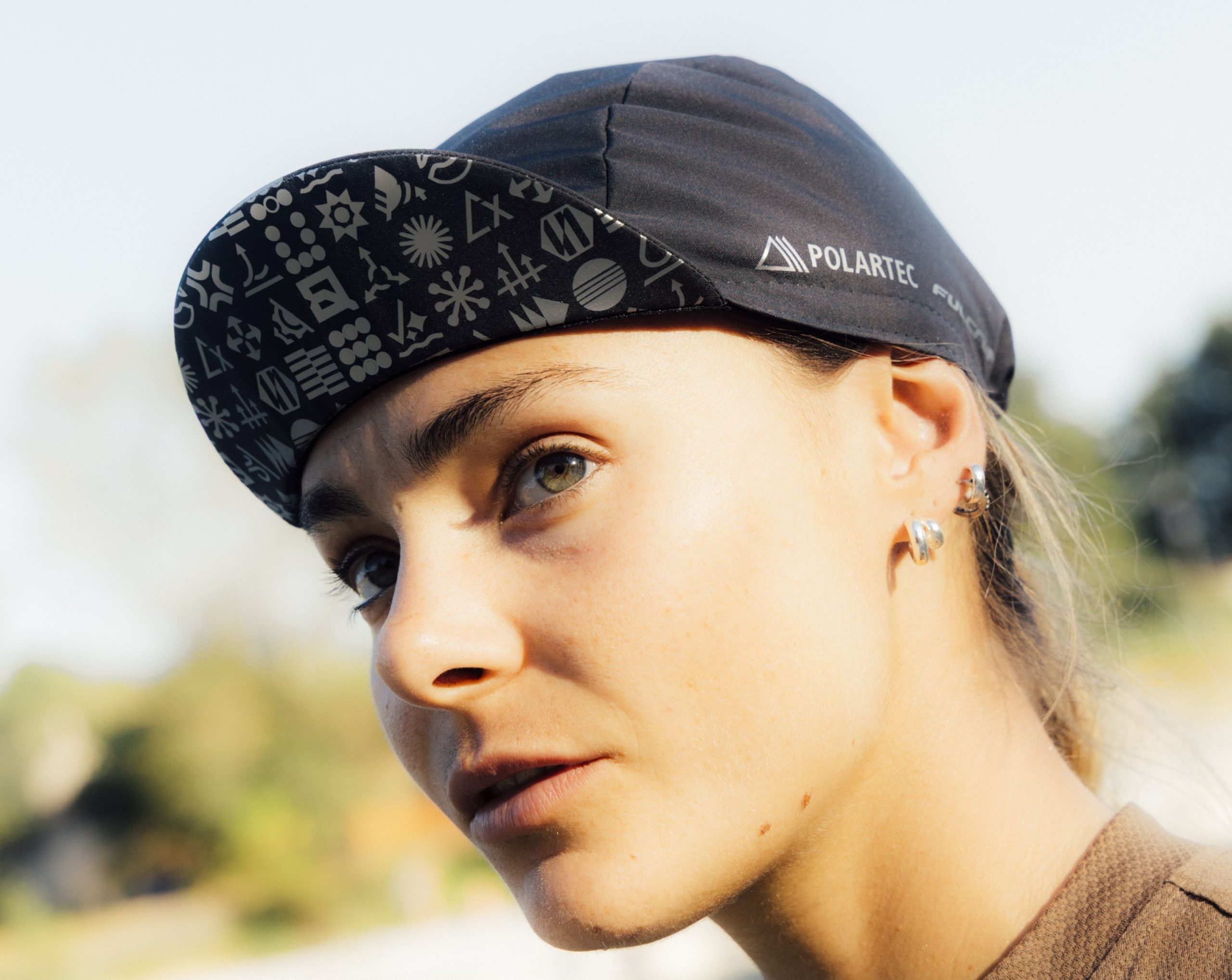
To reinforce the message that your wheels aren’t run-of-the-mill alloy, there’s a matching Polartec cycling cap thrown in with your wheel bag purchase.
Made from the same Power Shield Pro fabric, it’s said to be both breathable and quick-drying, so you’re protected from sun and rain on your gravel rides.
The Fulcrum Sharq wheels get matchy-matchy graphics. Fulcrum
Aside from the über-engineered wheel bag and the special graphics, you’re getting the Sharq wheels’ asymmetric wavy rims with 25mm internal width.
Fulcrum says these are aero optimised for 30mm to 42mm tyres, with the Fulcrum 2-Way Fit non-drilled rim bed and a claimed weight of 1,440g. They’re laced to hubs with Fulcrum’s USB ceramic bearings.
With the Polartec x Fulcrum Sharq wheels carrying a £2,289 / $2,807 / €2,460 list price (the same as the standard Sharq wheels), including the limited-edition Polartec bag and cap, we’d guess there’s some incentive to keep them out of harm’s way.
SRAM’s CEO Ken Lousberg says the company tried to engage the UCI over its new Maximum Gearing Protocol, but its concerns went “unheard”.
The UCI, cycling’s governing body, announced in June that it would trial gearing restrictions in a bid to improve rider safety.
Due to the gear ratios used by SRAM, concerns were raised at the time that the company’s athletes and teams would be most affected by the restrictions.
On Friday, SRAM announced it has filed “a formal complaint” with Belgium’s Competition Authority against the UCI, stating that it’s the only major manufacturer whose current pro team setup would be disadvantaged by the new UCI regulations.
In an open letter, Lousberg said: “The UCI’s new Maximum Gearing Protocol is set to restrict the equipment many of you rely on to ride and race at your best. It limits choice, stifles innovation, and unfairly targets SRAM riders – and SRAM itself.”
“We’ve tried to engage the UCI, cycling’s governing body, in good faith, but our concerns went unheard. That’s why we’ve taken legal action – not just to protect SRAM, but to protect the right to compete on equal footing,” added Lousberg.
“We’re not asking for much. We simply want our racers to compete on a level playing field, and for the industry to be recognized and included as a core stakeholder – working together to make our sport safer for athletes and more inspiring for fans.”
Lousberg added that he knows the rule has “already caused confusion, anxiety and disruption” and said SRAM’s commitment to rider safety and innovation “remains unchanged”.
Tom Pidcock: “Limiting gears will only make everything more dangerous”. Dario Belingheri / Getty Images
SRAM said in an official statement: “Although the UCI refers to the Maximum Gearing Protocol as a ‘test’, its implementation has already caused tangible harm. SRAM’s gearing has been publicly labeled as non- compliant, creating reputational damage, market confusion, team and athlete anxiety, and potential legal exposure.”
Gearing restrictions are a divisive issue in professional cycling. Chris Froome and Wout van Aert called for gear restrictions in January. Froome said: “At some point, I think we’re maybe going to have to even have the discussion about limiting the progression of technology in the sport to accommodate for the safety aspect. That could be something as simple as limiting the gears we’re using.”
But following the UCI’s announcement in June, others objected to the proposal.
Ahead of the Arctic Race of Norway in August, Tom Pidcock said: “Limiting gears will only make everything more dangerous.”
Dan Bigham, head of engineering at Red Bull – Bora – Hansgrohe, also presented his research into the restrictions at the Science and Cycling Conference in Lille. He said the restrictions would have no impact on the speed of the peloton and therefore would not improve safety.
“We have the power to make changes. But restricting gear ratios simply distracts from making meaningful changes to rider safety,” said Bigham.
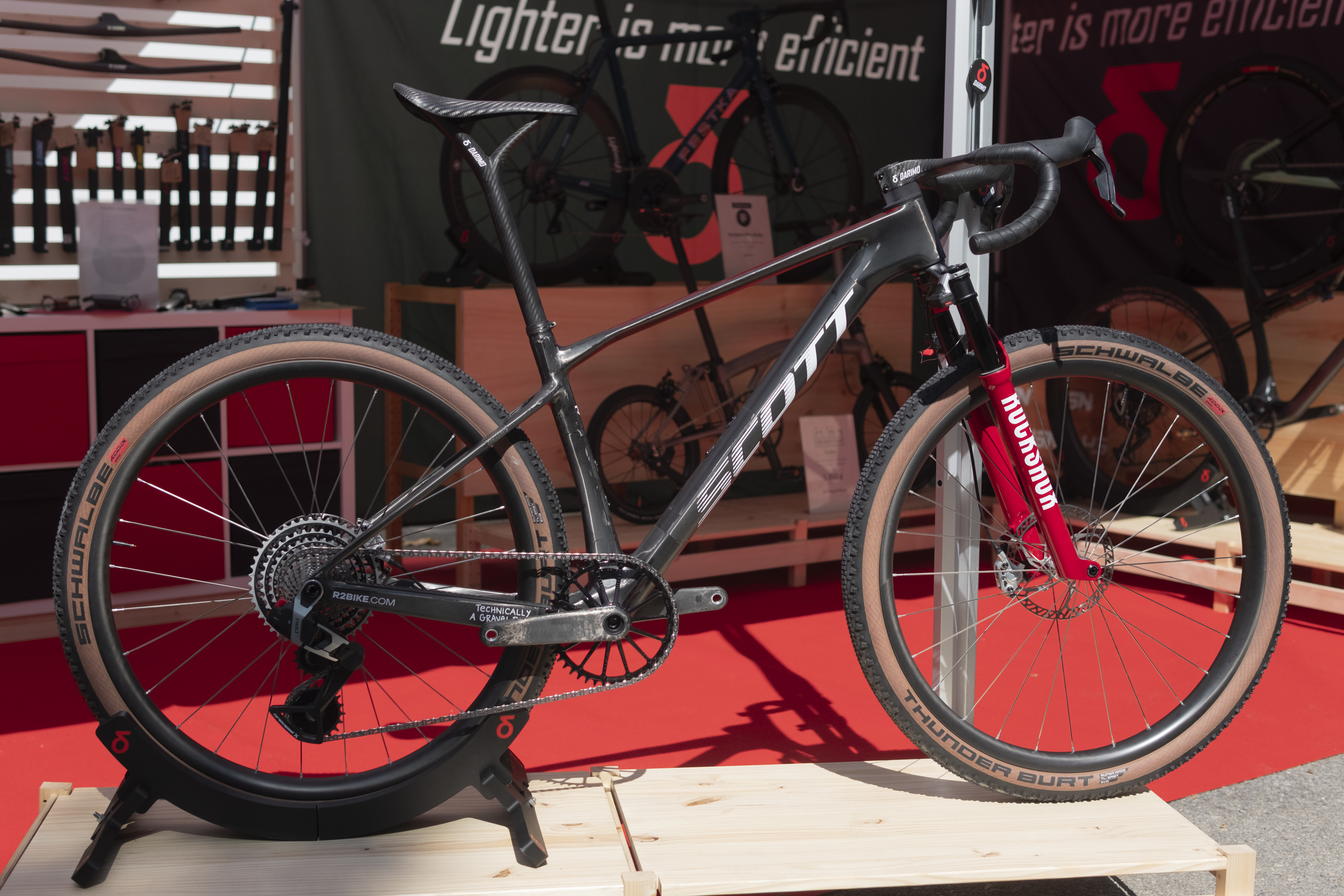
Dangerholm’s latest project is this incredible Scott Scale RC SL, reimagined as a gravel bike.
Weighing only 7.19kg, it blurs the lines between XC race and gravel bikes, and is dripping in carbon exotica, including new components from Spanish weight-weenie specialist, Darimo.
The build uses 40mm-wide (internal) rims paired with 2.1in tyres, which Dangerholm – the nom de plume of Gustav Gullholm – says transforms how the bike rides: “You probably want much, much wider rims on your gravel bike – you just don’t know it yet,” he wrote on Instagram, explaining that the combination enabled him to lower tyre pressure without a squirmy feel.
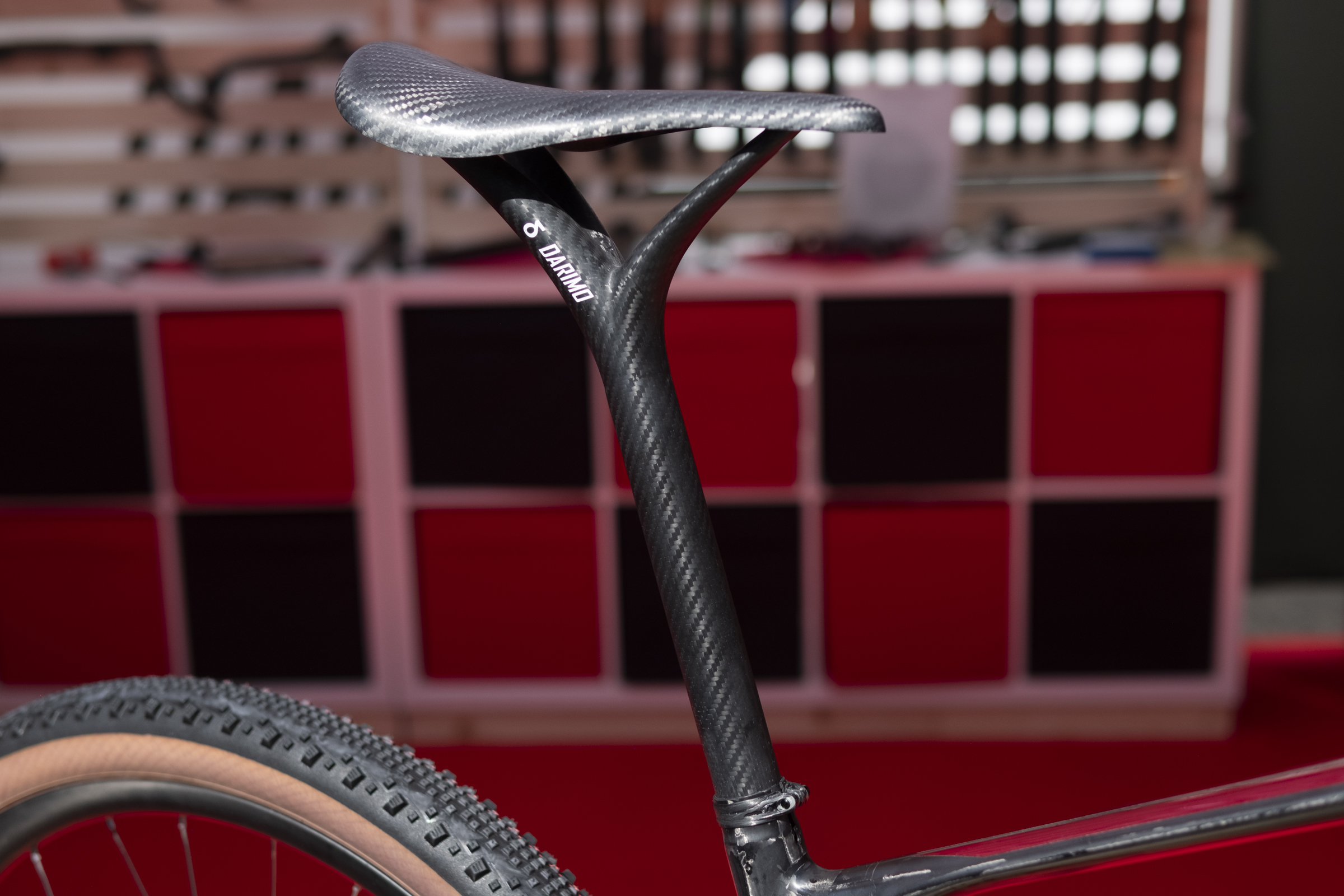
Darimo provided several bespoke components to make the project possible. These included a one-piece saddle and seatpost designed specifically for Dangerholm’s measurements.
100 per cent specific
The seatpost is extraordinary. Jack Luke / Our Media
“The saddle and seatpost are 100 per cent specific for this build because we need to know the exact height of the seatpost over the clamp to reinforce there,” says Darimo spokesperson, Thomas Skubiszewski.
“The angle and the shape of the saddle are completely bespoke for Gustav and for this build.”
The bike is a showcase for new tech from Darimo. Jack Luke / Our Media
Skubiszewski explains the seatpost is not something Darimo intends to bring to market, yet: “We aren’t going to sell it anytime soon because it is so time-consuming to produce. It’s more a proof of knowledge or concept, unless someone offers us 3 million euros or whatever,” he jokes.
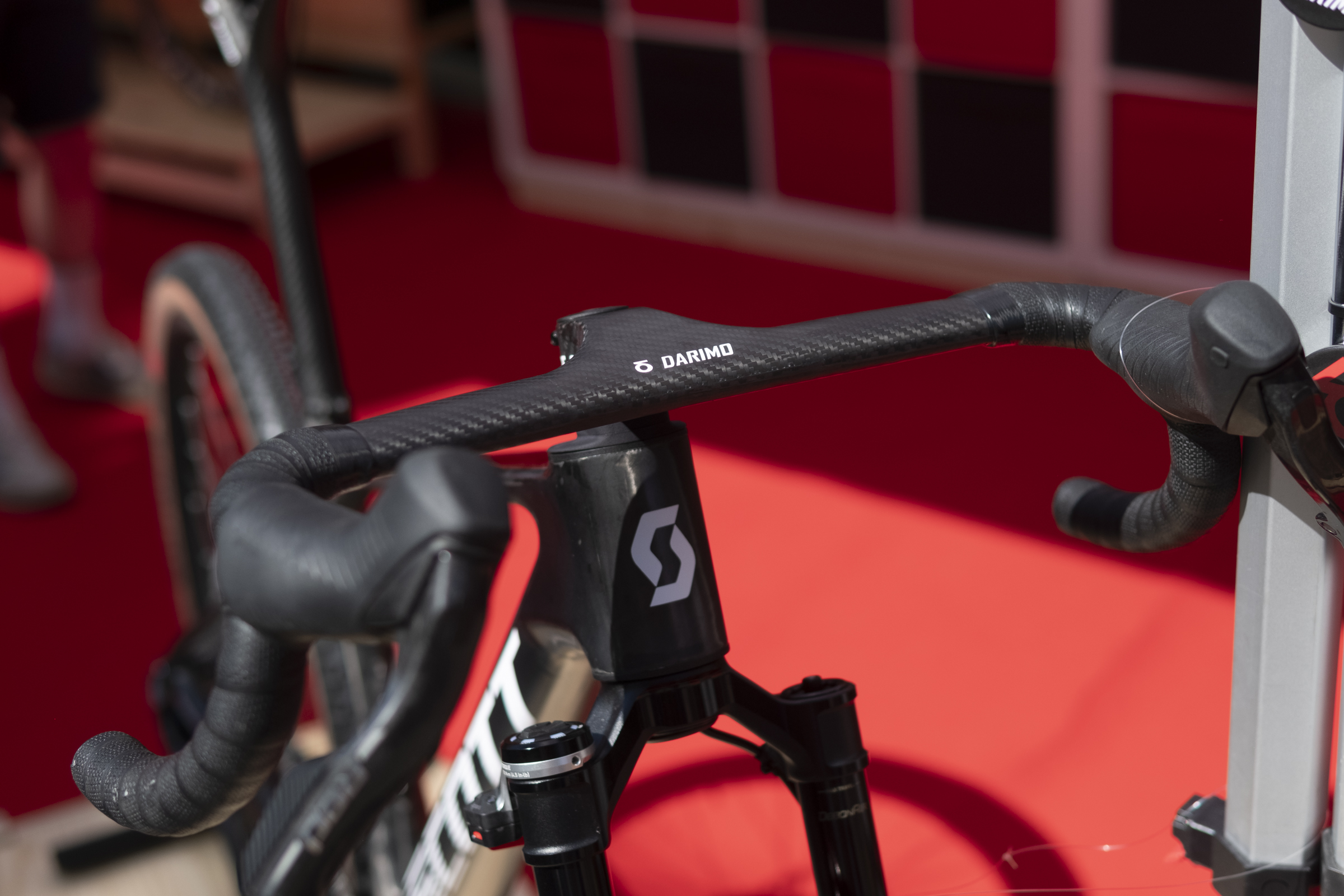
The cockpit can be fully customised. Jack Luke / Our Media
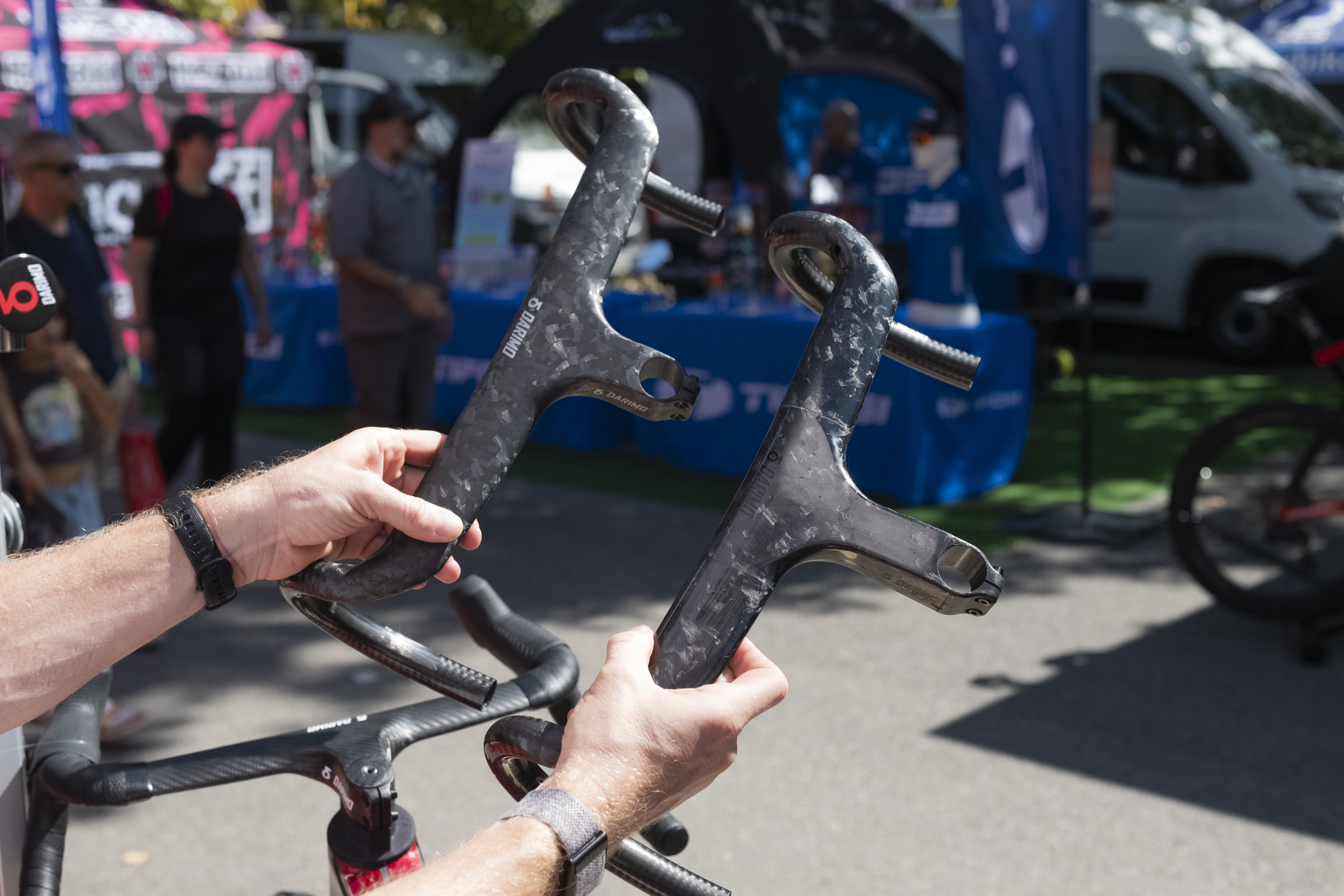
The cockpit is Darimo’s Nexum Drag bar-stem combo, here built with a -12-degree stem.
Like all Darimo bars, it was tailored to Dangerholm’s exact needs.
“First you decide the geometry [of the cockpit] – the dimensions, the width, the length, the angle and everything,” Skubiszewski explains.
“Then you tell us your body weight and riding style, and we adapt the carbon layup.
“Then you choose the aesthetic – 3K, UD or forged carbon, matte or shiny – and it’s your bespoke bar.”
The cockpit has been built specifically for this bike. Jack Luke / Our Media
Darimo stresses that the finish is as much about honesty as it is about weight. “There are some very small imperfections, but we never hide them under a thick layer of paint,” Skubiszewski says. “Whatever product you see with a Darimo sticker is raw carbon with quality fibres that don’t fade under the sun.”
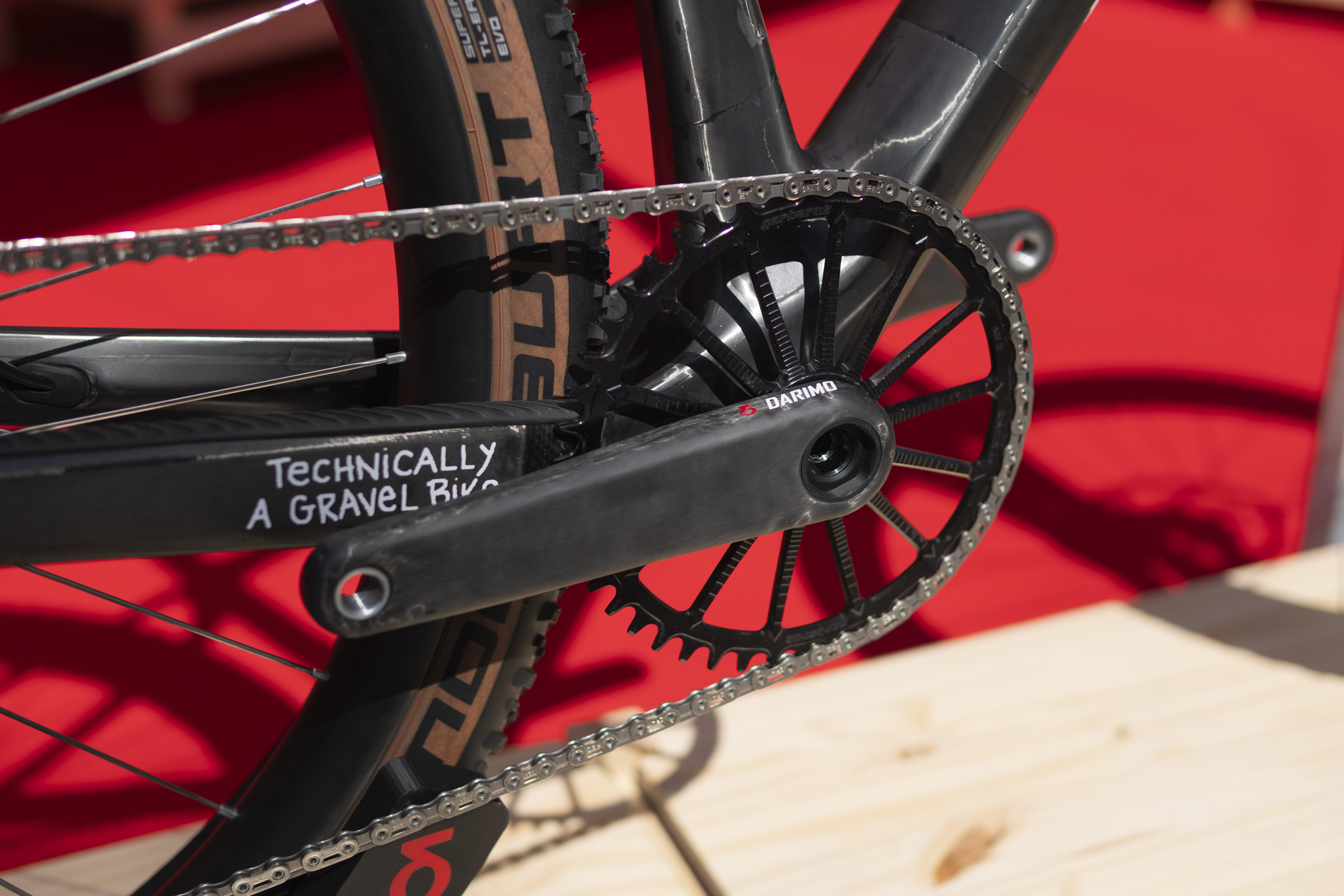
The crankset has been in development for two and a half years. Jack Luke / Our Media
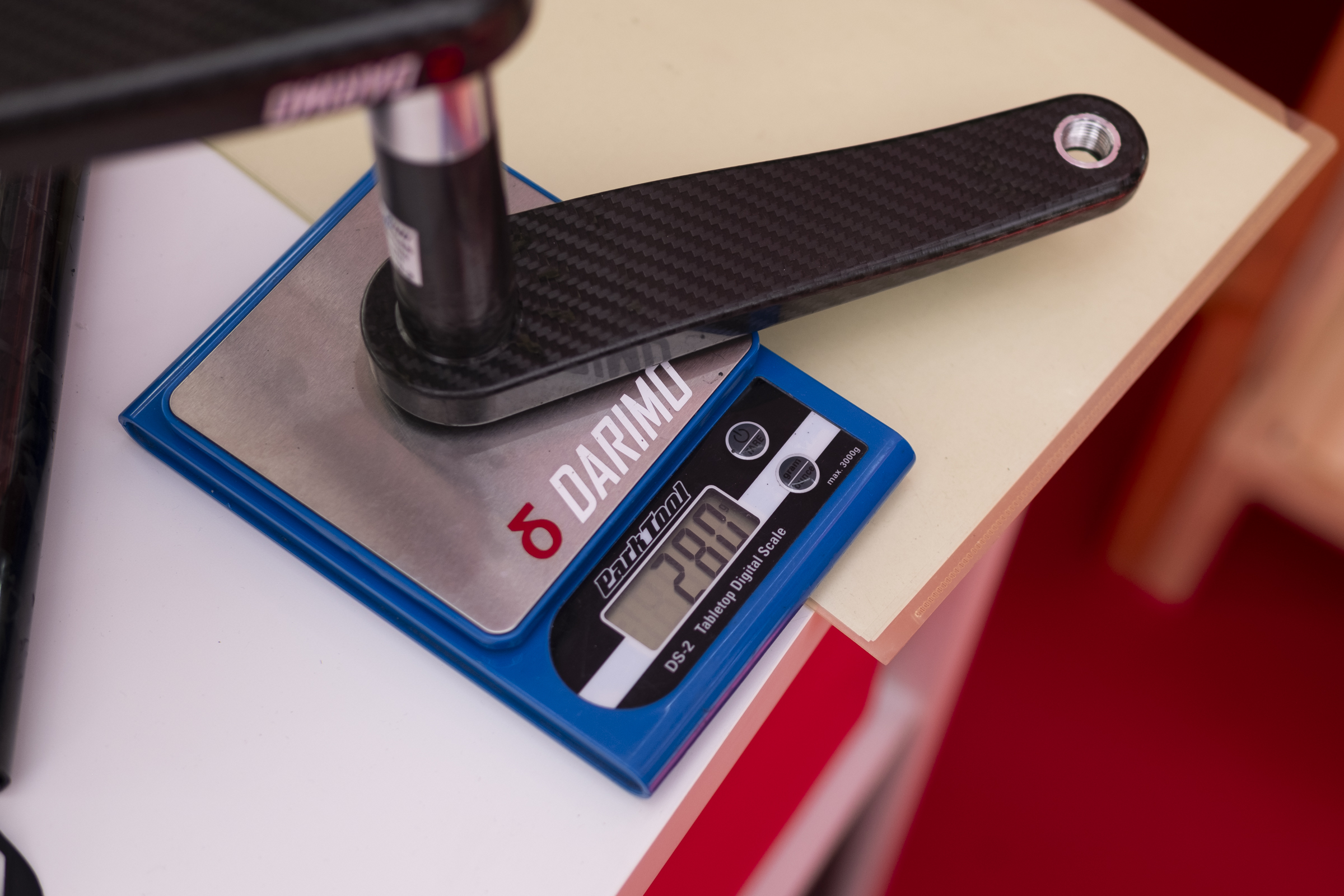
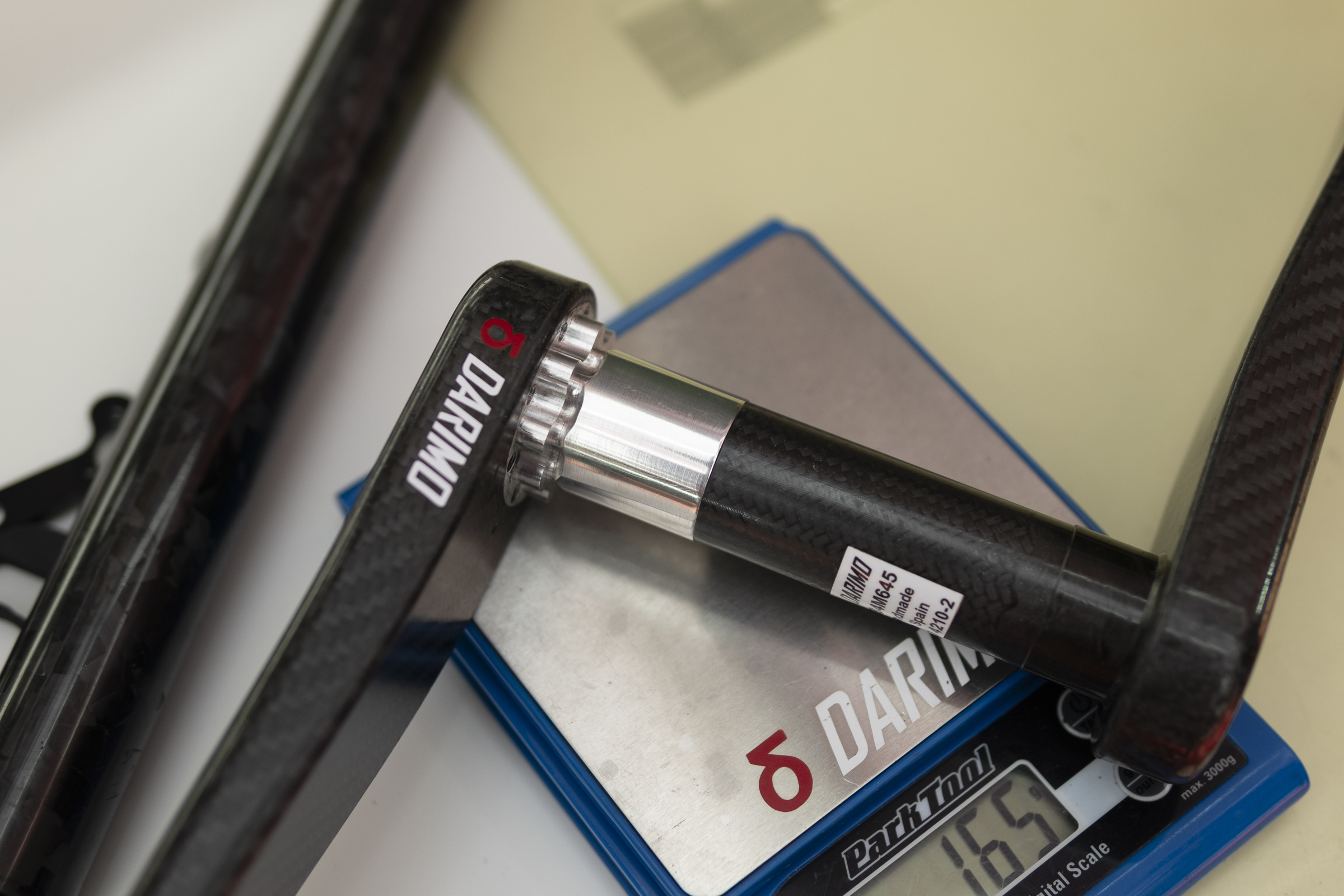
The bike also provided a showcase for Darimo’s new Sigma crankset, shown here in its final form for the first time.
The pictured crankset is 175mm long and weighs 280g without a chainring – impressively light, but not the lightest on the market.
The cranks will be available in MTB, gravel and road axle widths. Jack Luke / Our Media
However, creating the lightest crankset possible was not the aim of the project: “The aim is not to be the lightest because we can go lighter, but it would be fragile in some situations,” Skubiszewski says.
“We want our customers to fall and not feel it is going to break. We don’t want you to feel fragile when you ride your bike.”
The alloy sleeve is not bonded to the axle in the traditional sense. Jack Luke / Our Media
Darmià Rizo Morant, CEO and founder of Darimo, emphasises that it isn’t a conventional, three-part bonded design – the crankset is a two-piece design, with the non-driveside arm and axle formed in one piece. This results in a lighter and more robust design, according to Darimo.
The chainring mounting sleeve is not bonded to the axle in the usual sense, where you make two parts and then glue them together: “In our process, the carbon fibres expand during production and the same resin that forms the carbon also adheres to the aluminium, creating a mechanical bond.”
He adds that the crank is produced in a single shot: “We don’t manufacture separate pieces and then join them later. Everything is made together, so if you try to separate it you’ll just end up breaking it. It’s impossible.”
Morant says the crankset passed ISO testing, withstanding 100,000 cycles at 280kg of force per side without failure. Multiple axle lengths will be available, covering road, gravel and MTB standards, with crank arms offered down to 160mm if demand exists.
The rest of the build is suitably premium, with a top-end SRAM drivetrain and RockShox SID fork.
Dangerholm describes the result as “riding like nothing else I’ve experienced – in a good and very fast way”.
The UCI has confirmed the use of a GPS tracking system to enhance rider safety at the Road World Championships, which begin this Sunday 21 September in Kigali, Rwanda.
The UCI, cycling’s governing body, announced rider trackers would be used at the World Championships back in August – but the introduction of the tech led to disputes with pro riders and their teams.
As part of the UCI’s SafeR initiative, which is intended to enhance rider safety in professional road cycling, the use of GPS trackers was trialled at the Tour de Romandie Féminin in August.
However, several teams raised concerns with the UCI about the “imposition” of GPS tracking devices on one member of each team.
EF Education–Oatley said the team would “not select a rider ourselves, nor install, remove or maintain the device”.
They added that the UCI chose to impose this measure “without clear consent” and that it is unclear why the UCI did not want to nominate riders to trial the GPS trackers.
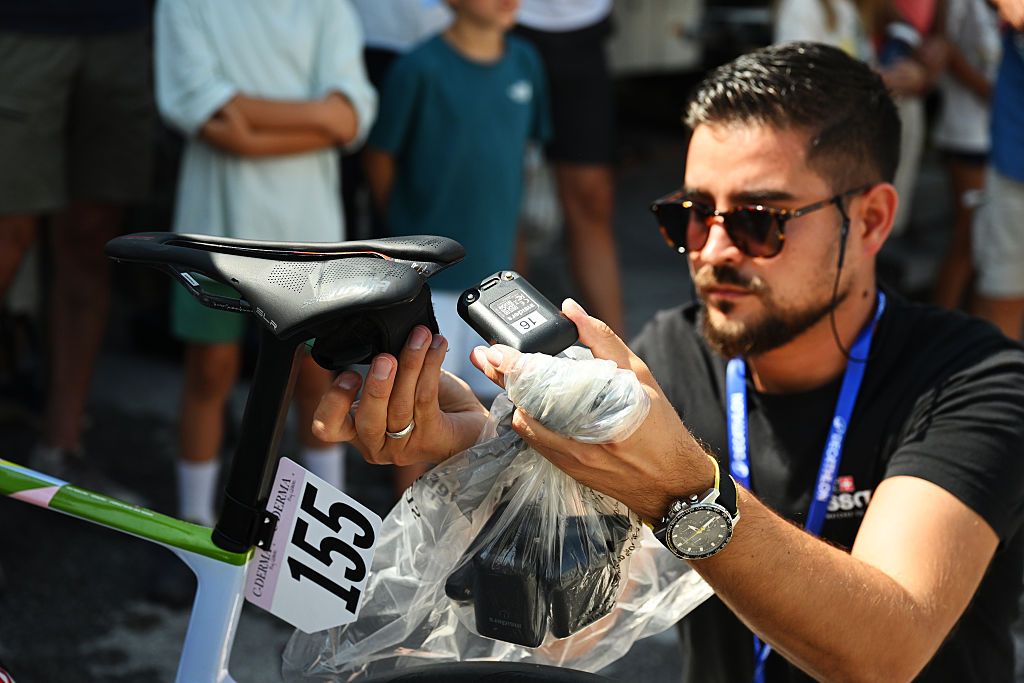
A technician from the UCI checks the GPS security tracker during the 2025 Tour de Romandie Féminin. Dario Belingheri / Getty Images
Five teams refused to nominate a rider, and therefore, the UCI disqualified them, leaving only 63 riders in the race. The UCI said their decision was “deplorable” and undermined “the cycling family’s efforts to ensure the safety of all riders”.
But despite the objections at the Tour de Romandie Féminin, the UCI now says all riders in all categories (the elite men and women, plus under-23s and juniors) will be equipped with a GPS safety tracker attached under their saddles. This will be across the road races, and individual and team time trials.
The system will be operated from the UCI’s control centre and will enable real-time monitoring of rider position. This will allow for the identification of any unusual situations, such as a rider suddenly stopping on the course.
“In such a case, the rider’s exact position will be transmitted to the relevant parties in the convoy – organisers, UCI Commissaires, medical and security services – so that appropriate measures can be taken without delay,” the UCI said in a press release.
The decision to use GPS trackers comes after 18-year-old Muriel Furrer died following a crash in the junior World Championship race last year in Zurich, Switzerland. Furrer reportedly lay alone for almost an hour and a half with a serious head injury.
Race radios are not allowed during the World Championships.
The 2025 Road World Championships will take place between 21–28 September.
SRAM has announced it has filed “a formal complaint” with Belgium’s Competition Authority against cycling’s governing body, the Union Cycliste Internationale (UCI), in dispute of its upcoming ‘Maximum Gearing Protocol’ trial.
Following this, SRAM says the BCA has “initiated formal anti-trust proceedings under EU and Belgian competition laws”.
In a bombshell statement, the American brand says it is challenging the UCI’s upcoming gearing restrictions trial because it will “unfairly disadvantage SRAM riders and SRAM”.
This is because, SRAM says, it is “the only major manufacturer whose current pro team setup will be blocked” by the proposed regulations.
SRAM says its formal complaint comes after multiple failed attempts “to engage the UCI and raise concerns about the impact of the Maximum Gearing Protocol”.
Although SRAM notes it will continue to support its pro teams to comply with the proposed trial event at the Tour of Guangxi in October, a “lack of transparency and collaboration left legal action as the only remaining path forward”, according to SRAM’s statement.
SRAM alleges the UCI’s Maximum Gearing Protocol:
Was adopted without consultation or transparency and lacks supporting empirical evidence, and any safety justification.
Disadvantages SRAM-equipped riders in professional cycling events.
Distorts competition in the road drivetrain market by limiting choice for professional teams and ultimately consumers, because SRAM relies on top-level teams to use and market its products.
Violates EU and Belgian competition law (Articles 101 and 102 TFEU).
SRAM says a “lack of transparency and collaboration left legal action as the only remaining path forward”. Simon von Bromley / Our Media
Speaking on behalf of the brand, SRAM CEO Ken Lousberg, said: “This protocol penalizes and discourages innovation and puts our riders and teams at a competitive disadvantage.”
“We rely on the sport’s governing body to foster an environment that encourages innovation for the benefit of riders and racers today, and riders in the future. We also rely on the governing body to make science-based, impactful changes for rider safety.”
The statement also notes that while the UCI says the 2025 Tour of Guangxi will be a “test” event for the proposed gearing restrictions, SRAM feels “its implementation has already caused tangible harm” to its brand.
“SRAM’s gearing has been publicly labeled as non-compliant, creating reputational damage, market confusion, team and athlete anxiety, and potential legal exposure.”
Lousberg says: “SRAM-equipped teams will have to race at a disadvantage on compromised equipment with a reduced number of gearing options compared to their competitors. It’s also not clear what is being tested.”
As first reported by Daniel Benson, the UCI has said that “relevant data will be monitored and feedback from all stakeholders will be gathered to study the effects” of the restrictions – but exactly what the “relevant data” is remains unclear.
SRAM says it will be forced to race at a disadvantage because of the restrictions. Simon von Bromley / Our Media
As we noted back in June, the UCI’s proposed restrictions will affect SRAM-sponsored teams most heavily, due to SRAM’s extensive use of cassettes that start with 10t sprockets.
Under the UCI’s proposed rollout limit of 10.46m, SRAM-sponsored athletes would face using chainrings no longer than 49t – and taking a hit to drivetrain efficiency compared to rivals using bigger chainrings – or artificially limiting their derailleurs to 11 out of the 12 available rear sprockets, so that the 10t isn’t accessible.
Alternatively, SRAM could row back on its use of 10t sprockets, and provide teams and riders with cassettes starting with 11t sprockets, but SRAM notes that “complying with the protocol would require a full redesign and technical step back – a process that would take years”.
SRAM is also critical of the UCI’s framing of the trial as “a safety initiative”, noting that “no evidence has been presented to support such claims”.
It claims its own analysis of “crash data” from the 2025 Tour de France “found no correlation between higher rollout configurations and crash risk”.
SRAM says it has requested “the immediate suspension of the gearing restrictions”, as well as “representation” for manufacturers on the board responsible for the UCI’s technical regulations.
Citing recently announced changes to the UCI’s regulations surrounding handlebar width, rim depth and so on, Lousberg says: “Today, the UCI’s actions unjustly penalize SRAM riders and SRAM. But given the way the governing body makes its decisions… It’s impossible to know who may be impacted in the future.
“We hope to create a more transparent and collaborative climate for teams and component suppliers that ultimately leads to a better and safer sport for all.”
This week’s event picks are primarily based on sign-up numbers. See below to learn which events are the most popular group rids and races for the weekend!
Bikealicious Rubberband Joy Ride
Banded Beginner-Friendly Endurance Challenge
Which group ride had the most sign-ups when we were compiling this post? This one!
The friendly Bikealicious crew is leading a “keep together” group ride on Watopia’s challenging Four Horsemen route (89.9km, 2,111m). Grab this route badge if you haven’t done so yet, which comes with a whopping 1780 XP!
Women’s Mini Races (3 races in an hour) happen each Sunday, but the ULTIMATE Mini Races are a bigger monthly event. In fact, this race has more signups than any other this weekend!
If you’re looking for punchy women-only racing, these races are the place to be.
This Sunday’s races are rolling courses, with each race longer than the previous. Races are on the Fine and Sandy (3.4km), Jungle Circuit (9.5km), and Handful of Gravel (1 lap, 10.3km) routes.
Here’s a popular, spicy long 100km ride with two pace options: B group at 3-3.3 W/kg, or C at 2.5-2.9 W/kg. The B group will be on Three Musketeers while the C group will be on Petite Douleu. Both groups have optional efforts on some of the intermediate segments if you’d like.
Choose your desired pace, listen to the ride leader, and get that endurance work done! Both categories have a leader (yellow beacon) and sweepers.
Looking for a group ride at an easy pace? This popular event is held on the Makuri Islands Castle to Castle route and is 60 minutes long. While the stated pace is only 1.2-1.7 W/kg, it’s a banded ride, so you can go as hard (or easy) as you’d like, and you’ll stay with the group.
We choose each weekend’s Notable Events based on a variety of factors including:
Is the event unique/innovative in some way?
Are celebrities (pro riders, etc) attending/leading?
Are signup counts already high, meaning the event is extra-popular?
Does the ride include desirable unlocks or prizes?
Does the event appeal to ladies on Zwift? (We like to support this under-represented group!)
Is it for a good cause?
Is it just plain crazy (extra long races, world record attempts, etc)?
Is it a long-running, popular weekly event with a dedicated leader who deserves a shout out?
In the end, we want to call attention to events that are extra-special and therefore extra-appealing to Zwifters. If you think your event qualifies, comment below with a link/details and we may just include it in an upcoming post!
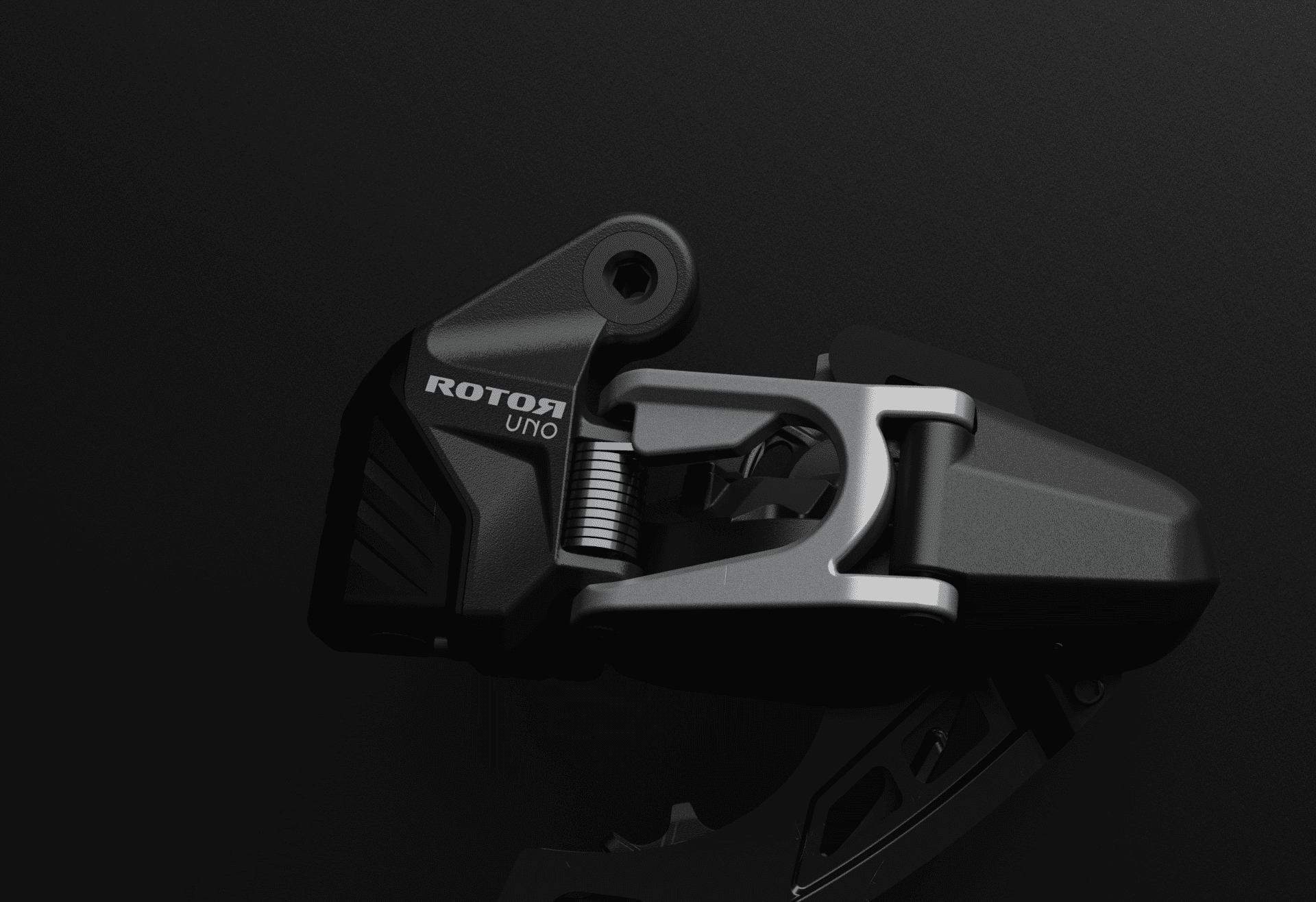
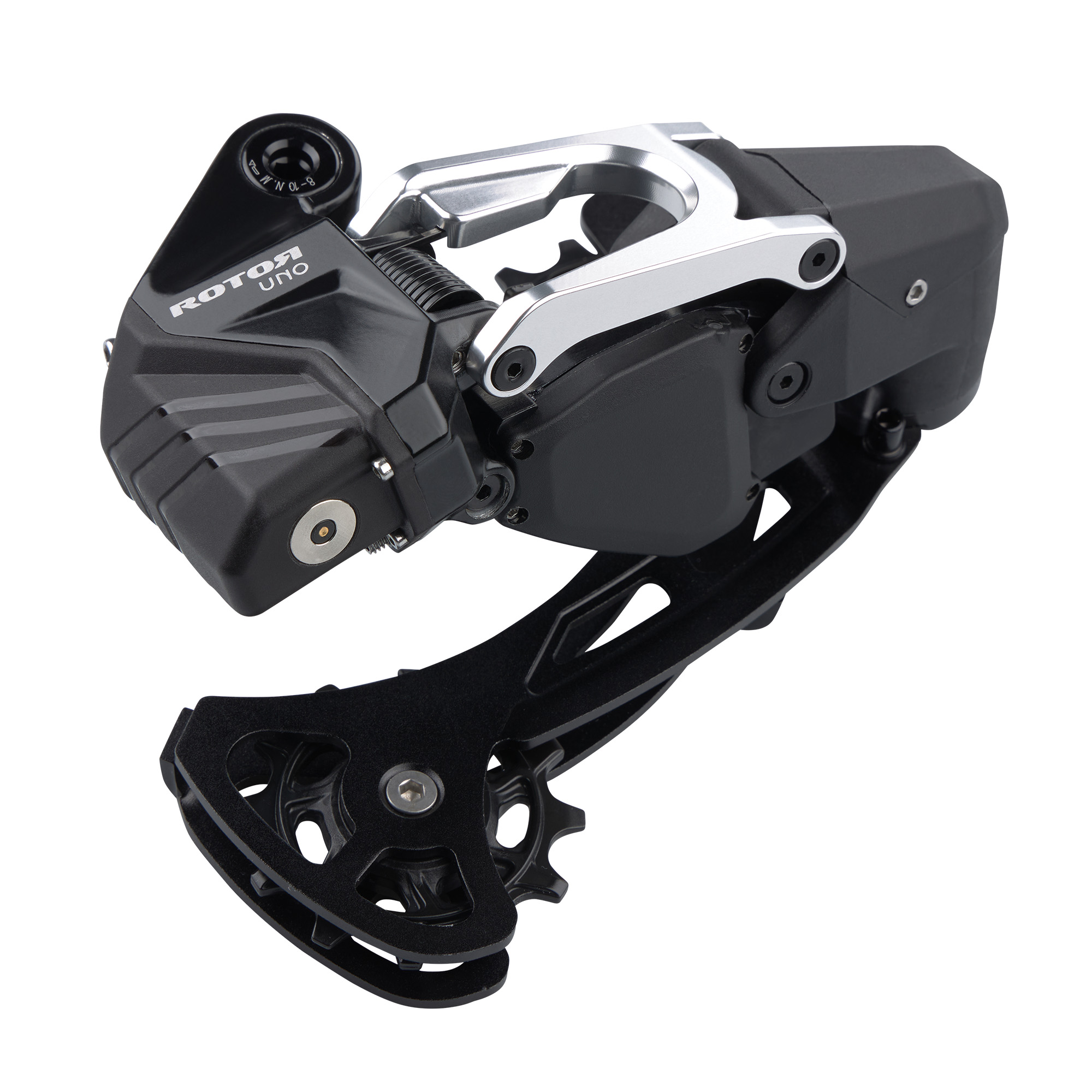
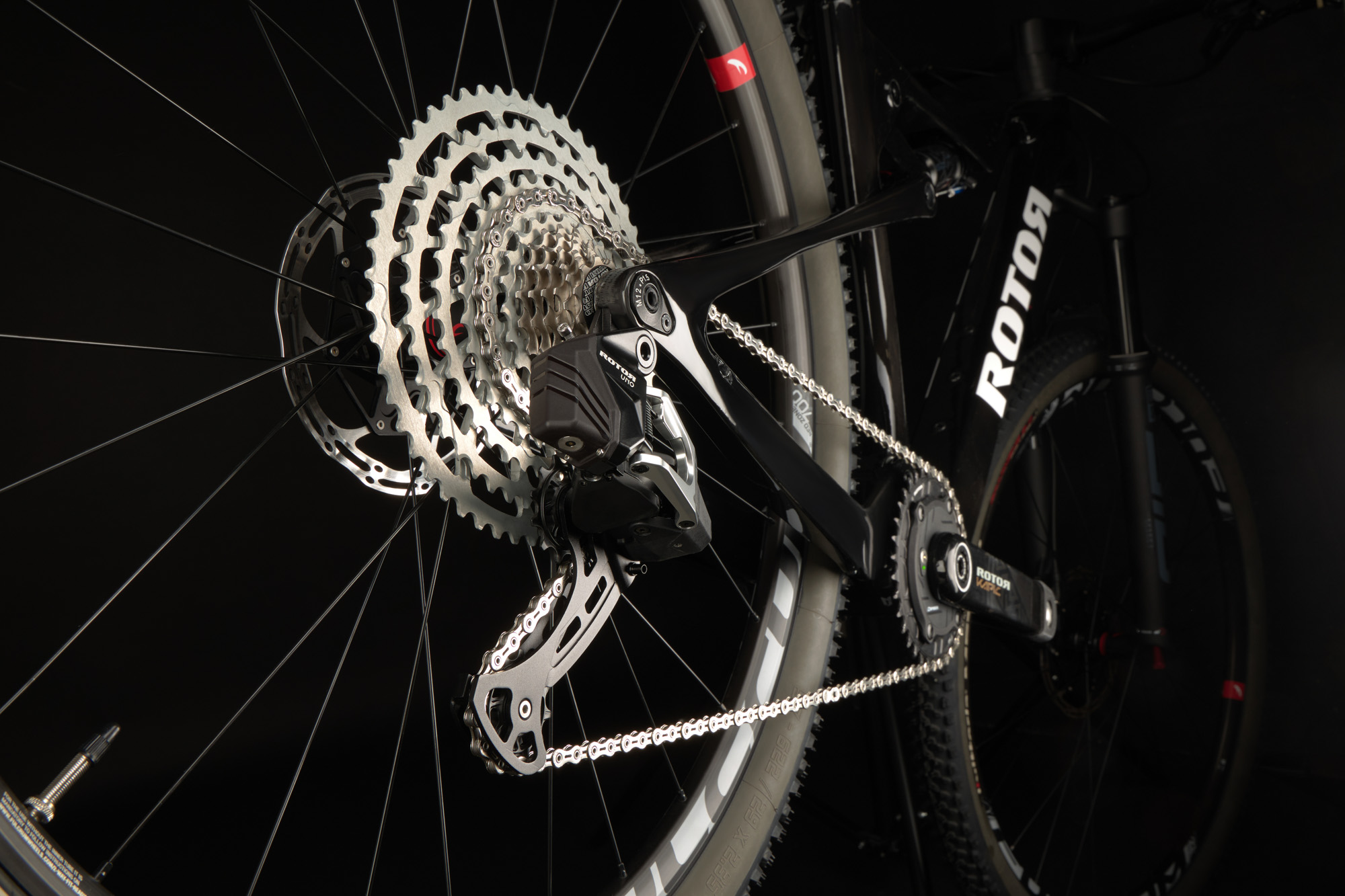
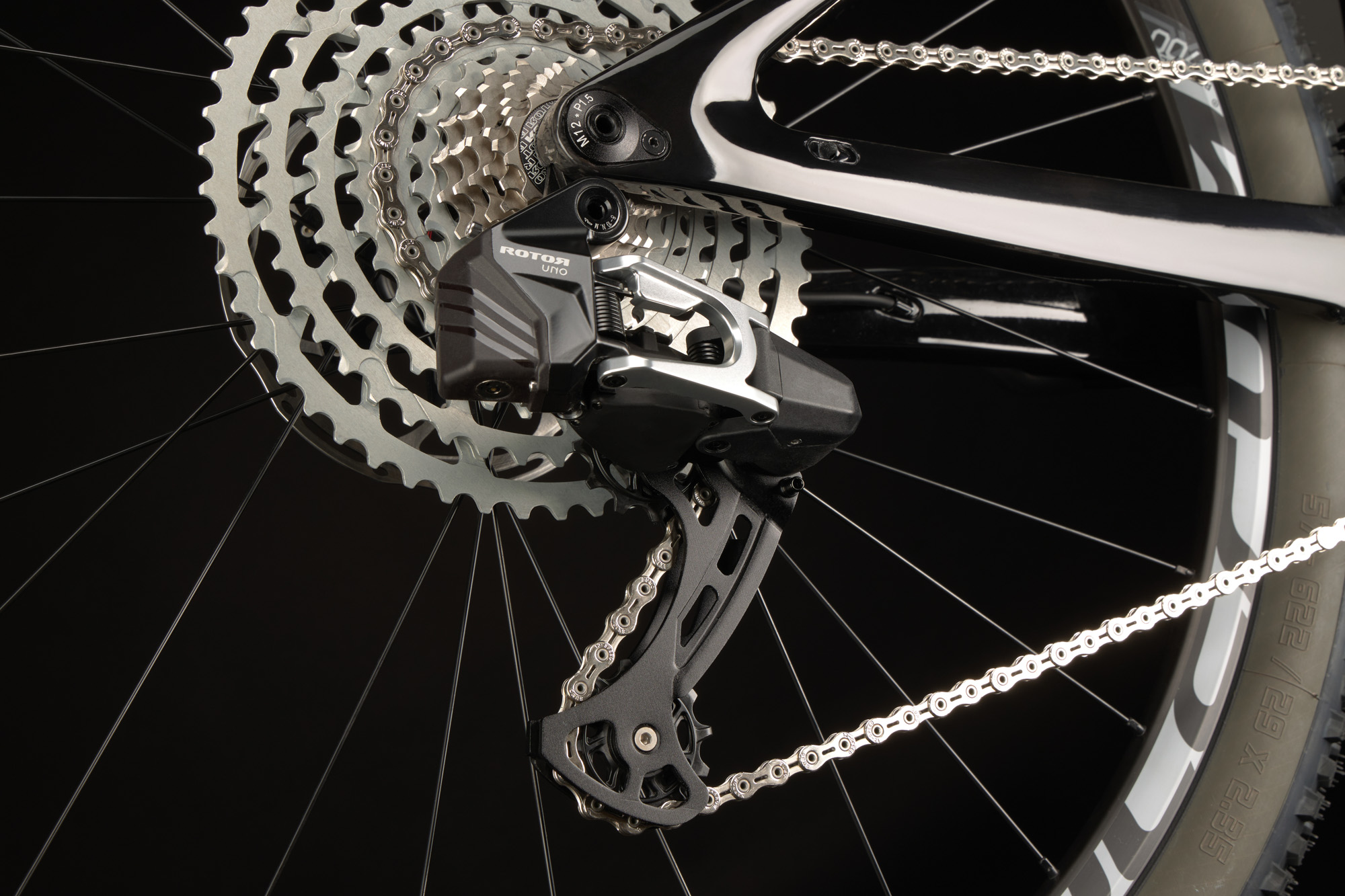
Rotor has revealed the Uno, a new wireless electronic groupset for mountain and gravel bikes that promises fast shifting speeds, low weights and “maximum modularity”.
But while the previous Uno groupset was an outlier in a field of cable-actuated and electronic drivetrains, the new Uno groupset could signal where drivetrain tech is headed.
The groupset is offered with different components for mountain biking and gravel riding, with hydraulic disc brakes also being part of the package for the latter.
In terms of pricing, the MTB upgrade kit (derailleur and shifter) will be under €700, according to Rotor. The gravel kit (derailleur, levers and brake calipers) is expected to be around €800.
In a growing and increasingly crowded market of challenger brands, Rotor believes the new Uno components “will be among the most competitive on the market” and “a reliable alternative” to Shimano and SRAM.
Last year, Chinese manufacturer Lanxi Wheeltop Cycle Industries LTD acquired a majority stake in Rotor.
Now, the new Uno groupset combines Rotor’s expertise in power meters and brakes with the electronic shifting technology from Wheeltop’s EDS groupsets.
Rotor says the main advantage of the Uno groupset is its “versatility and modularity”.
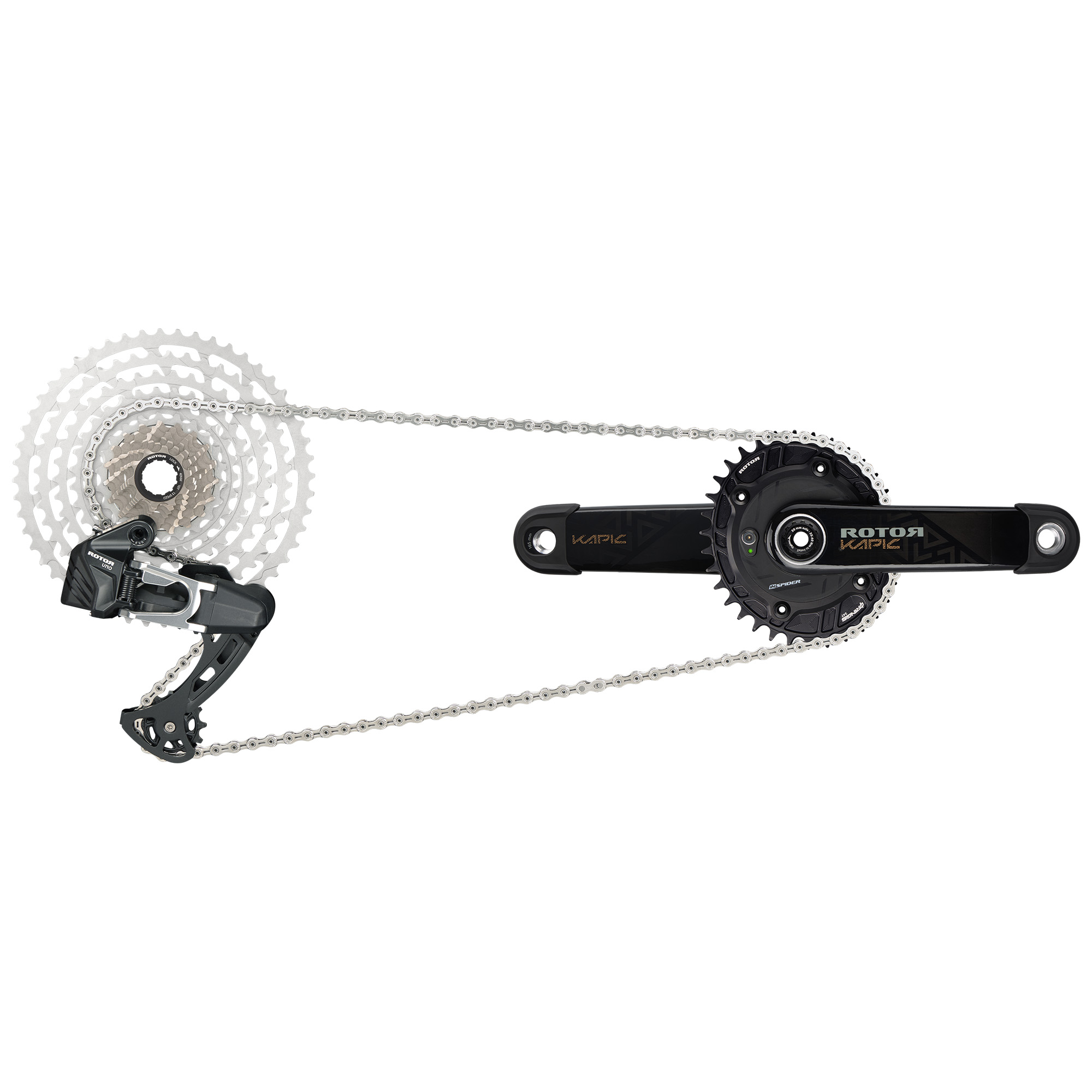
The Spanish brand says that the groupset’s components are interchangeable, allowing riders to build the drivetrain they require to meet their needs and budget.
The shifter and derailleur can also be programmed to work with any 10, 11, 12, or 13-speed cassettes.
15,000 shifts per charge
Uno derailleurs will actuate a shift in 150 milliseconds, according to Rotor Rotor
The Uno groupset’s electronic system is controlled by a microprocessor powered by an internal 600mAh battery. Rotor says this guarantees 15,000 shifts before needing recharging.
The shifting speed is claimed to be 150 milliseconds, and the shifter and mech are connected by Bluetooth and ANT+.
MTB derailleur and shifter
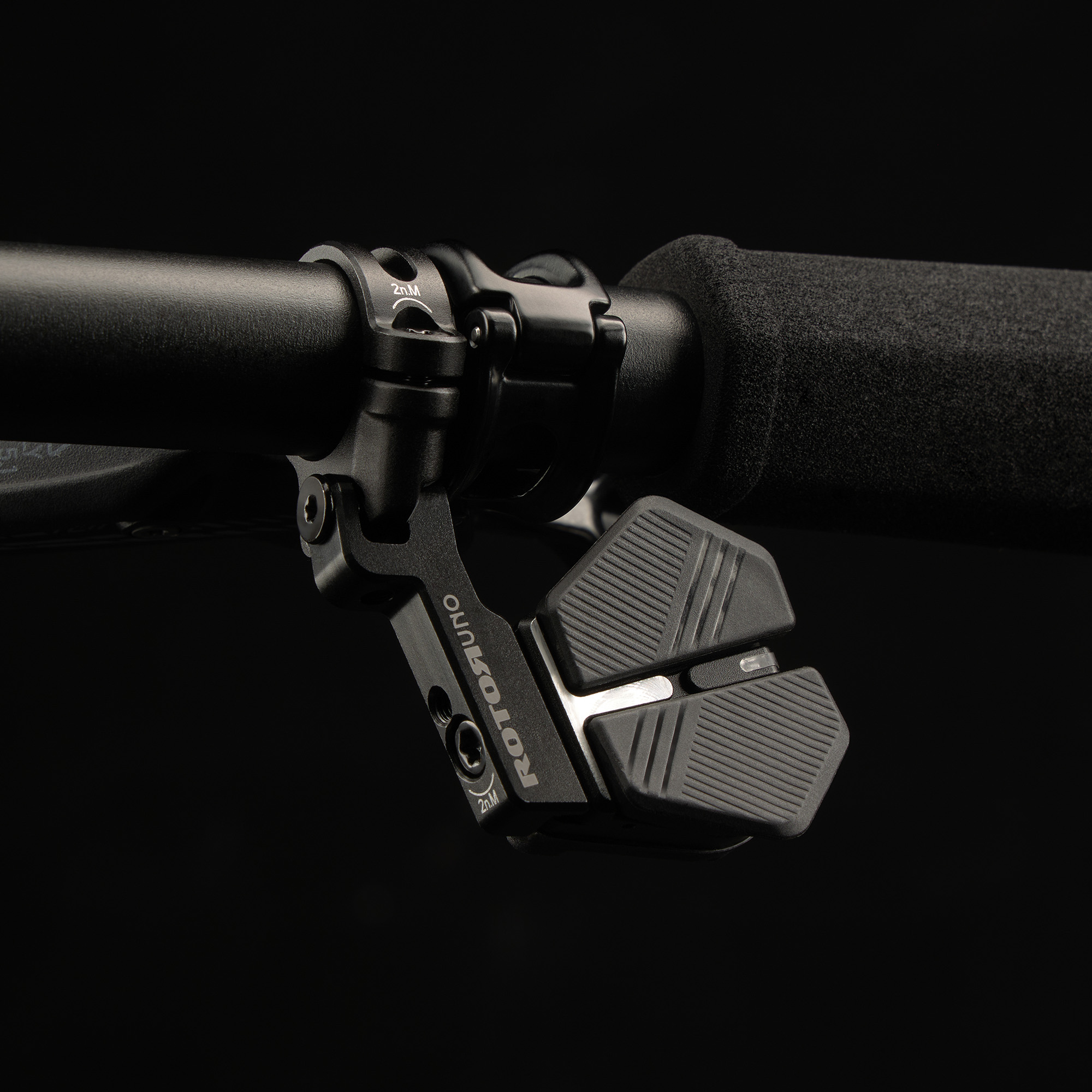
The Rotor Uno MTB shifter is IP67 waterproof-rated. Rotor
Rotor claims the MTB rear derailleur and MTB shifter will weigh in at under 453g, with the batteries.
As the rear derailleur is configurable for compatibility with 10 to 13-speed cassettes, this offers myriad opportunities for using different manufacturers’ cassettes and chains.
Using a 12t pulley and 93mm-long aluminium cage, the mech can accommodate cassettes with up to 52 teeth, like the largest SRAM cassettes.
The mech is constructed from aluminium and fibreglass-reinforced nylon, featuring a parallelogram designed to optimise, Rotor says, the stiffness-to-weight ratio.
The shifter is powered by a CR2032 battery, is IP67 waterproof-rated and has what Rotor describes as a ‘non-slip’ finish, with an indicator light to note activity.
Rotor intriguingly hints that the CPU (central processing unit) is in the mech, so the system will be “expandable to new and future additions of components and peripherals”.
Anyone buying the mountain bike groupset will have to add brakes from elsewhere. Rotor says it’s “leaving this choice up to the user” because of the wide range of mountain bike brakes available. This also means you can choose your brakes depending on your riding discipline.
Hydraulic brakes, but only with the gravel groupset
The gravel setup will use Shimano hoses and mineral-oil-filled Rotor Uno calipers Rotor
The gravel-specific Uno will come with hydraulic disc brakes included.
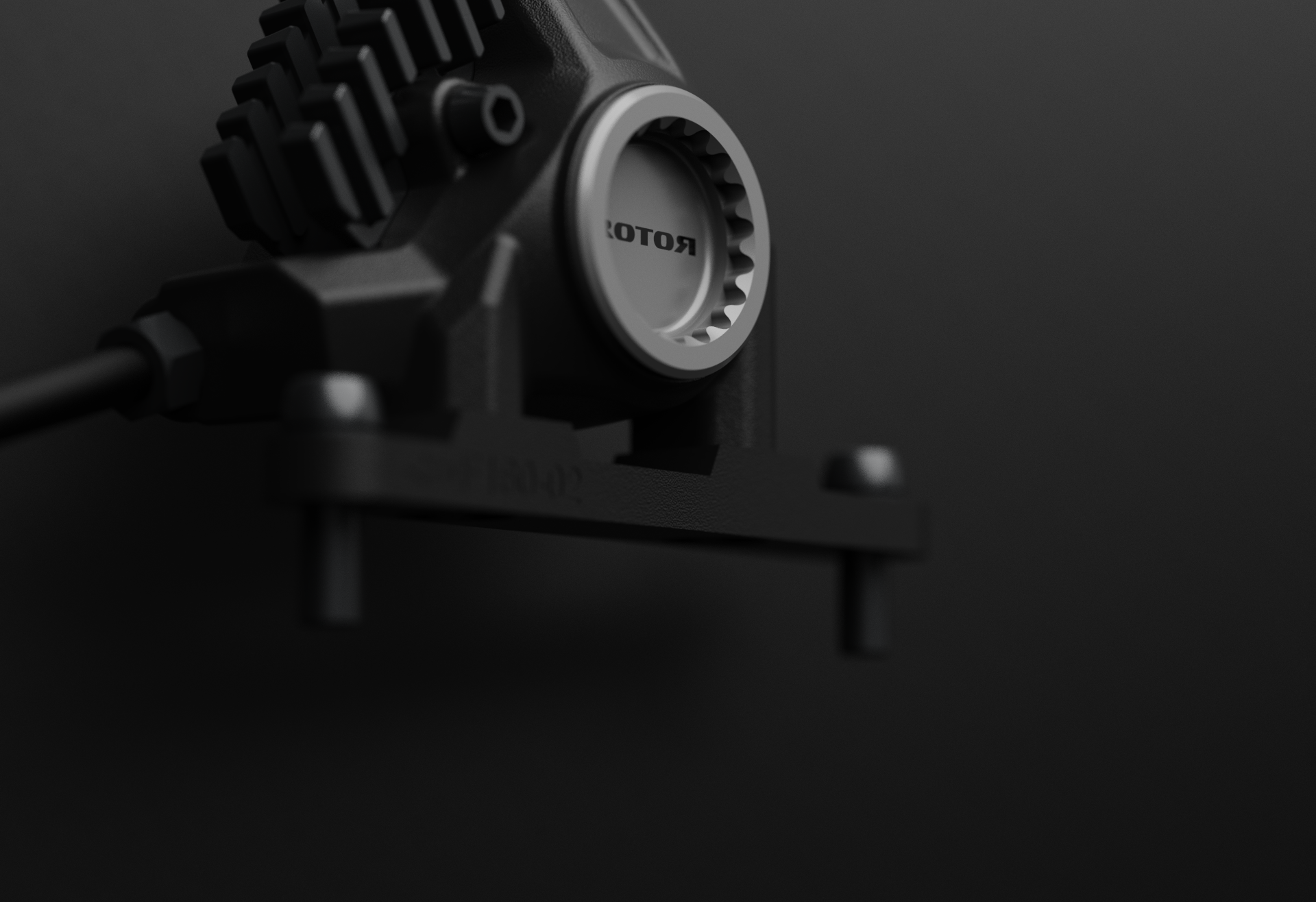
The brakes use carbon lever blades and titanium clamps. They use mineral oil and are actuated by a horizontal brake master cylinder. Lever travel can be adjusted up to 26mm.
The 160mm brake rotors are available in either centrelock or 6-bolt configuration. The flat-mount calipers have ceramic pistons for improved heat dissipation, according to Rotor. They use Shimano BH90 hoses and Shimano-compatible brake pads, allowing you to choose a brake compound that suits your needs.
The gravel groupset uses the same electronic rear derailleur body as the MTB version, but with a shorter cage, and it can accommodate cassettes with up to 46 teeth.
Rotor claims that the system, comprising rear derailleur, levers, brakes and cables, is similar in weight to competitor offerings. However, Rotor says if you add its own 12-speed, 11-46t cassette (with a claimed weight of 294g), that could make the whole package one of the lightest available.
The gravel version of the Uno system is also designed to be used with Rotor’s Aldhu carbon crankset, (which Rotor claims is the lightest on the market), along with the brand’s INspider chainrings and power meter.
Rotor Uno app
The groupset can be programmed using the Rotor Uno app Rotor
Rotor’s Uno groupset will be programmable with an app – for example, to establish whether it’s running as a 10, 11, 12 or 13-speed drivetrain. The Rotor Uno app will be available for both iOS and Android devices.
Users will be able to view the battery level of each component in the app. Metrics and graphs from Rotor’s Power app (used for the brand’s power meters) will not be integrated into the initial version of the app but will be included in future updates.
Any software updates to components will be managed through the app using OTA (Over The Air) updates.
Electronic challengers
Rotor will become part of a select group of manufacturers offering electronic shifting equipment. Rotor
The groupset market is dominated by Shimano and SRAM, but there are now several manufacturers setting out their stall as challengers, with Rotor back in the mix.
Rotor is positive that there is a place for its new Uno groupset in this growing market.
“In terms of weight, reliability and price, [this groupset] will be among the most competitive on the market, so we are confident that we will be a reliable alternative in the field of groupsets,” Rotor told BikeRadar.
Pricing
Pricing looks set to be competitive. Rotor
Rotor says the retail price for the MTB upgrade kit (derailleur and shifter) will be under €700, while the gravel kit (derailleur, levers, and brake calipers) is expected to be around €800.
Strava is prepping for a US initial public offering (IPO), with the fitness platform said to have invited banks including Goldman Sachs, JPMorgan and Morgan Stanley to pitch for roles, according to reports.
Reuters reported that the listing could happen as soon as early 2026, depending on market conditions, and that Strava has yet to finalise how much it plans to raise or the valuation it will target.
The potential IPO follows the San Francisco-based company closing a fundraising round valuing it at $2.2 billion back in May 2025.
The valuation followed a series of acquisitions made by Strava. In April, it acquired Runna, a UK-based run training app. Then, in May, it bought The Breakaway, a cycling training app.
The rumours follow two leadership appointments. In August, Strava announced Matt Anderson as its new chief financial officer and Louisa Wee as chief marketing officer.
Anderson joined Strava from Nextdoor, a social network for neighbourhood communities, where he served as chief financial officer and guided the company through its public listing.
Strava says the platform saw more than 50 per cent growth in new users last year, with Gen Z turning to the platform. The fitness training app now has more than 150 million users in over 185 countries.
Strava has not responded to a request for comment.
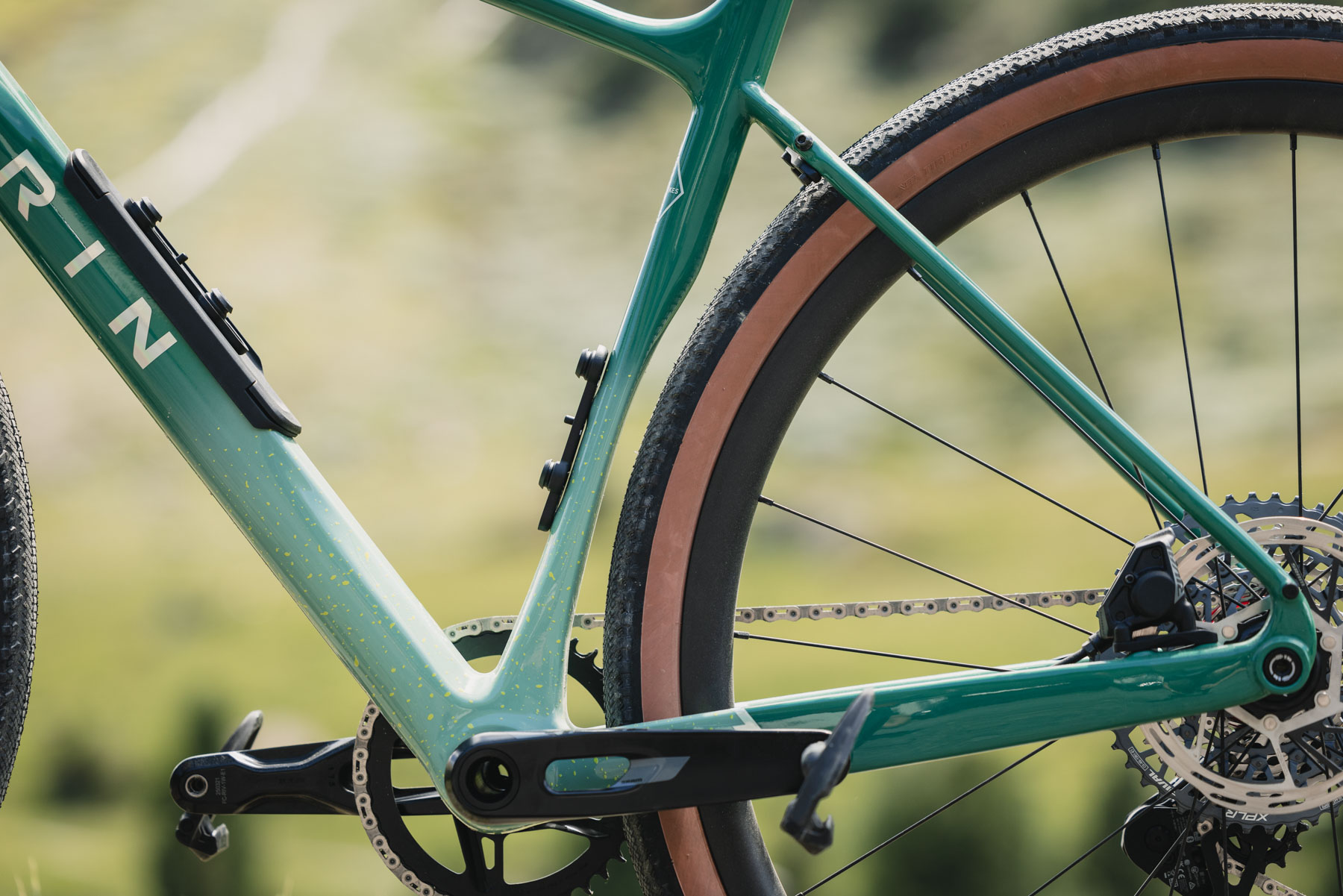
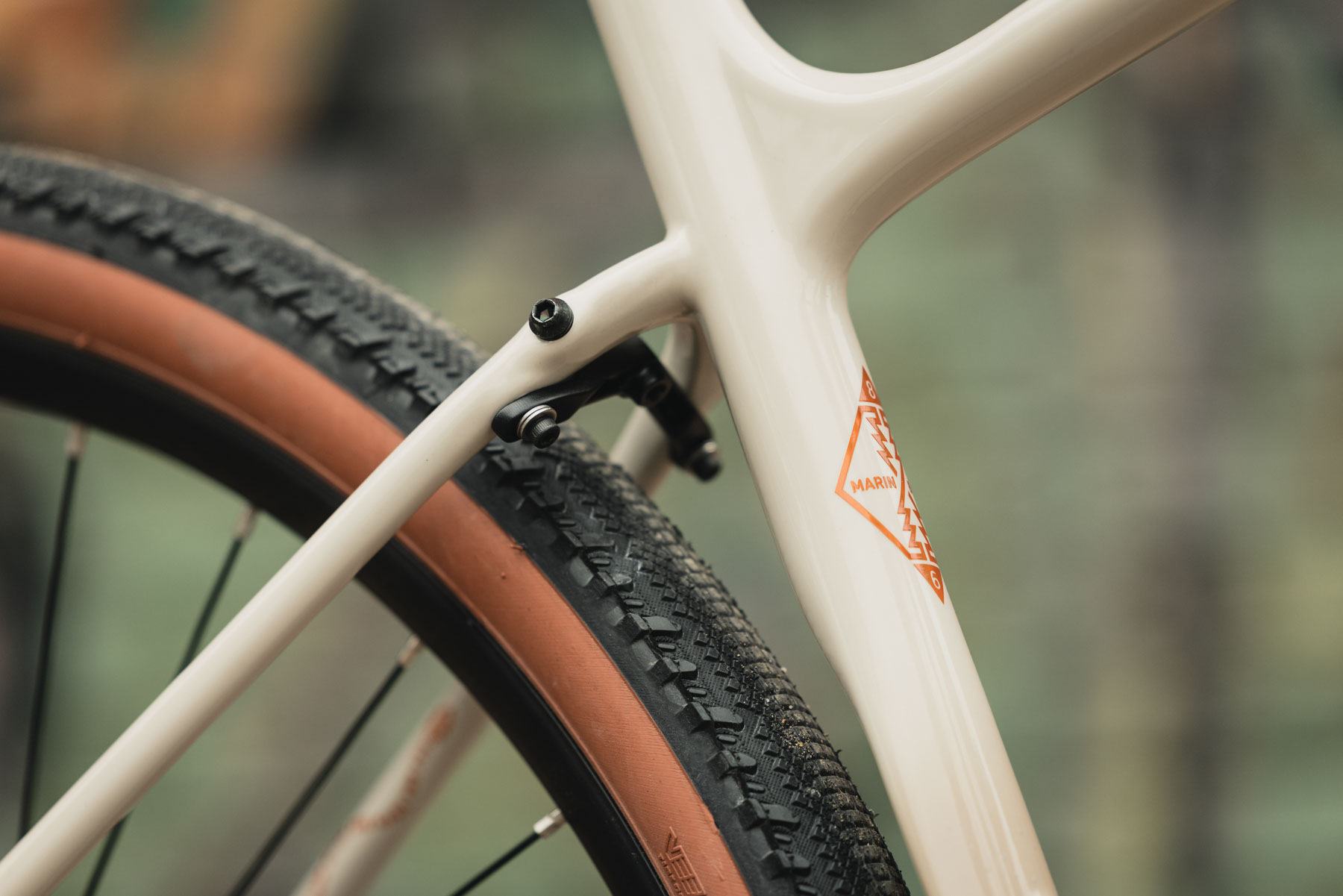
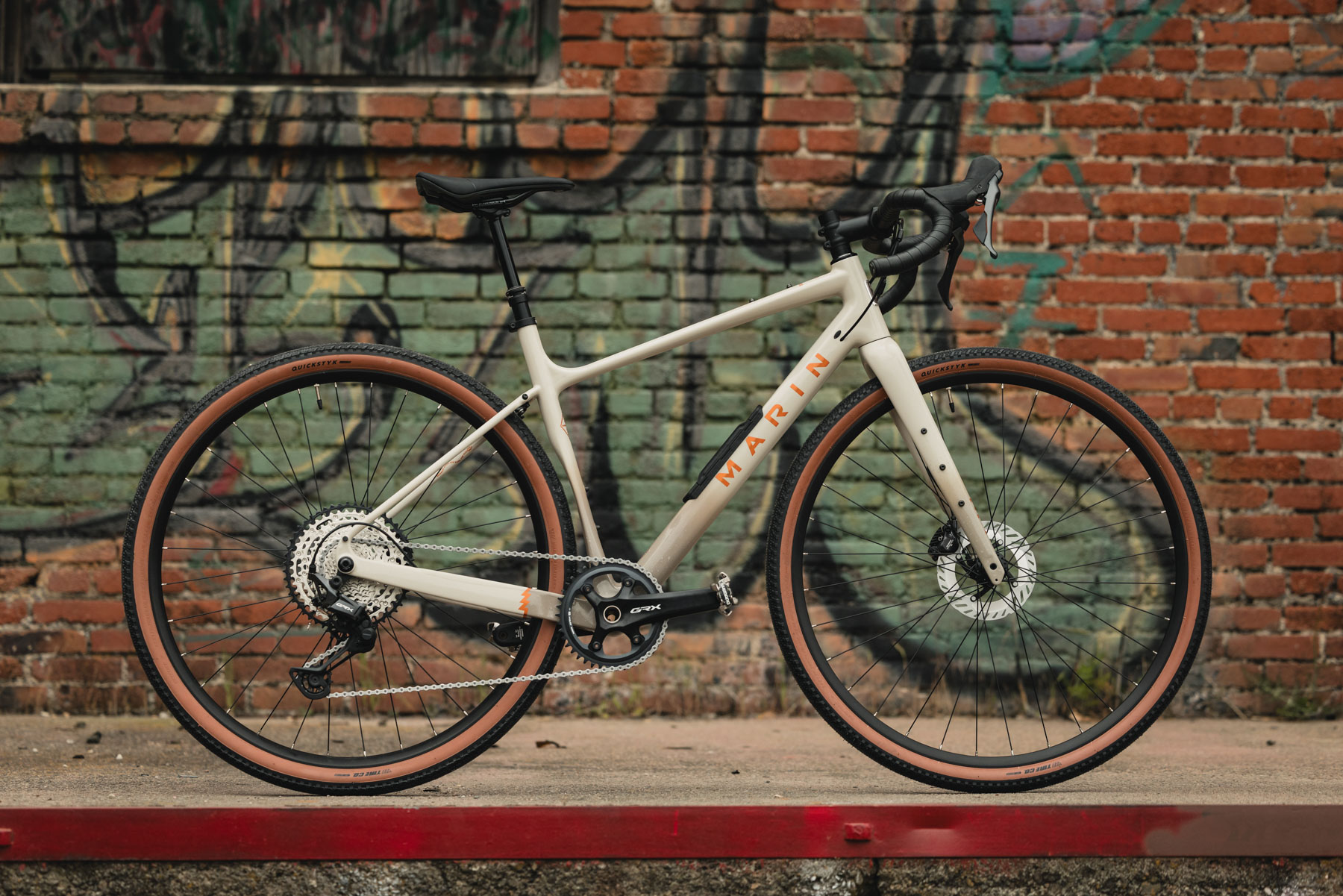
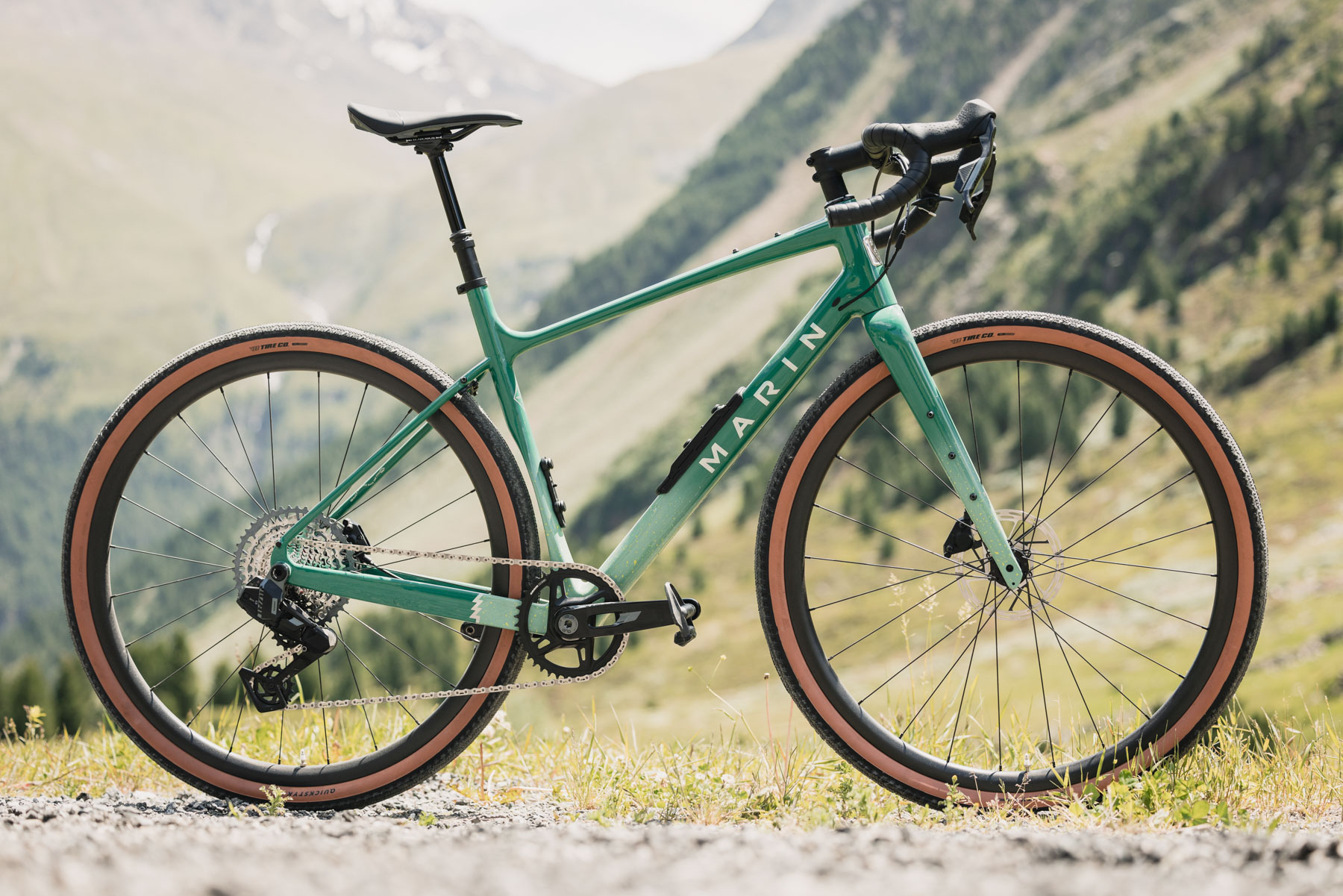
With a raft of mounts, more tyre clearance and geometry inspired by mountain bikes, the new Marin Headlands V2 looks set to be one of 2026’s most exciting and affordable new gravel bikes.
The original Headlands combined a lightweight carbon construction with heavily MTB-influenced geometry.
The Headlands’ combination of impressive handling and great value made it a very popular option for trail-seeking gravel riders, and the inclusion of rack and mudguard fittings made it popular with bikepackers, too.
The new Headlands V2 will certainly keep both parties happy; the raft of updates and design changes seem set to enhance the experience, making the V2 look like one of this year’s most capable and versatile gravel designs.
The Marin Headlands is intended as a trail-capable gravel bike that can handle epic bikepacking adventures, too. Marin
The new frame keeps the same 1x drivetrain-specific design. It means that, while increasing the tyre clearance to 50mm, Marin has been able to retain short 420mm chainstays.
The new Headlands frame features short chainstays and a cut-out seat tube. Marin
The front end retains the slackened 70.5-degree head angle, which is combined with a long front centre, deeply sloping top tube and steep (73.5-degree) seat angle.
The Headlands is designed to be run with a very short stem (60mm on the first four sizes, 70mm on the two largest). From these numbers, it’s apparent the Headlands still wears its mountain bike inspiration boldly.
The mudguard bridge is removable. Marin
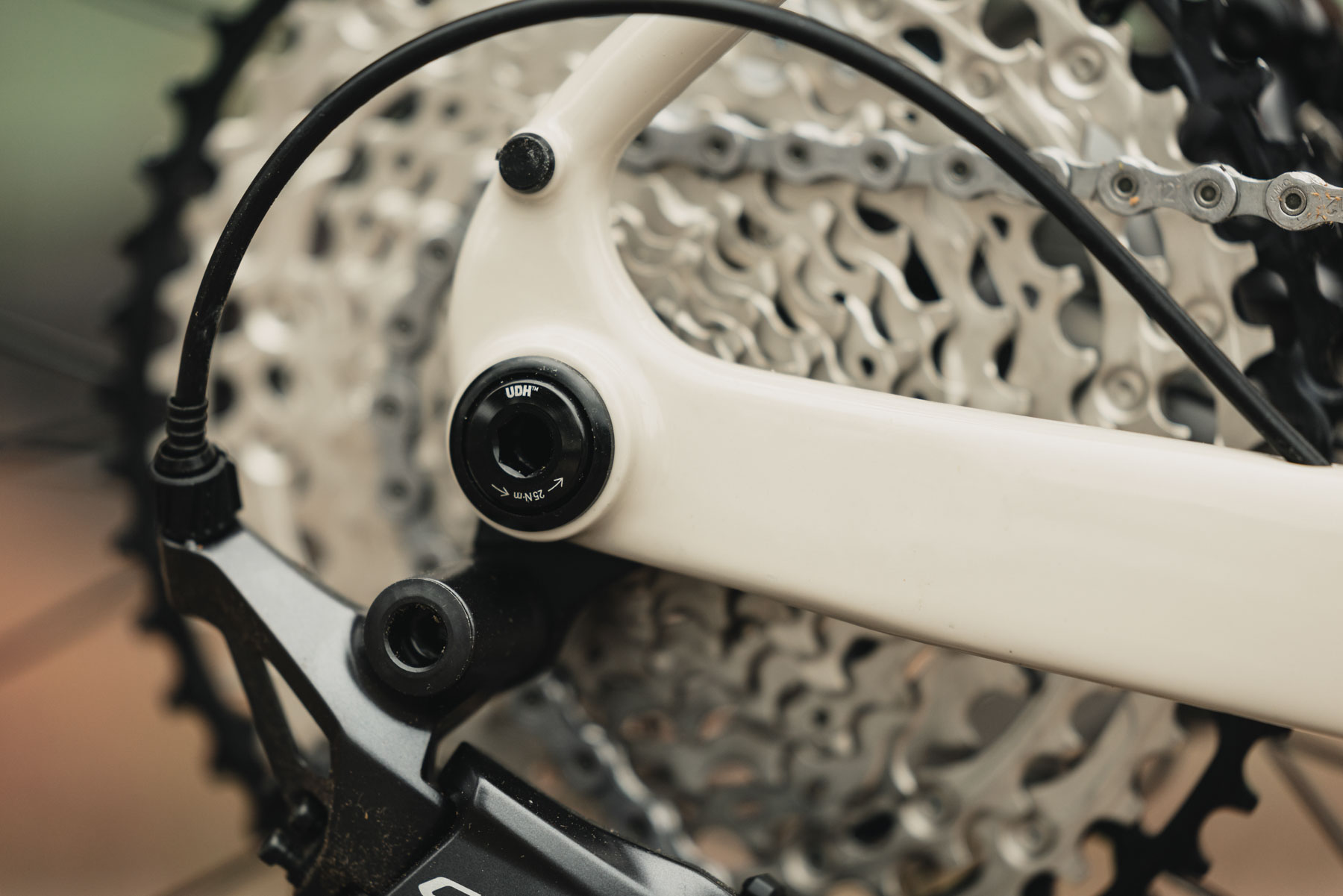
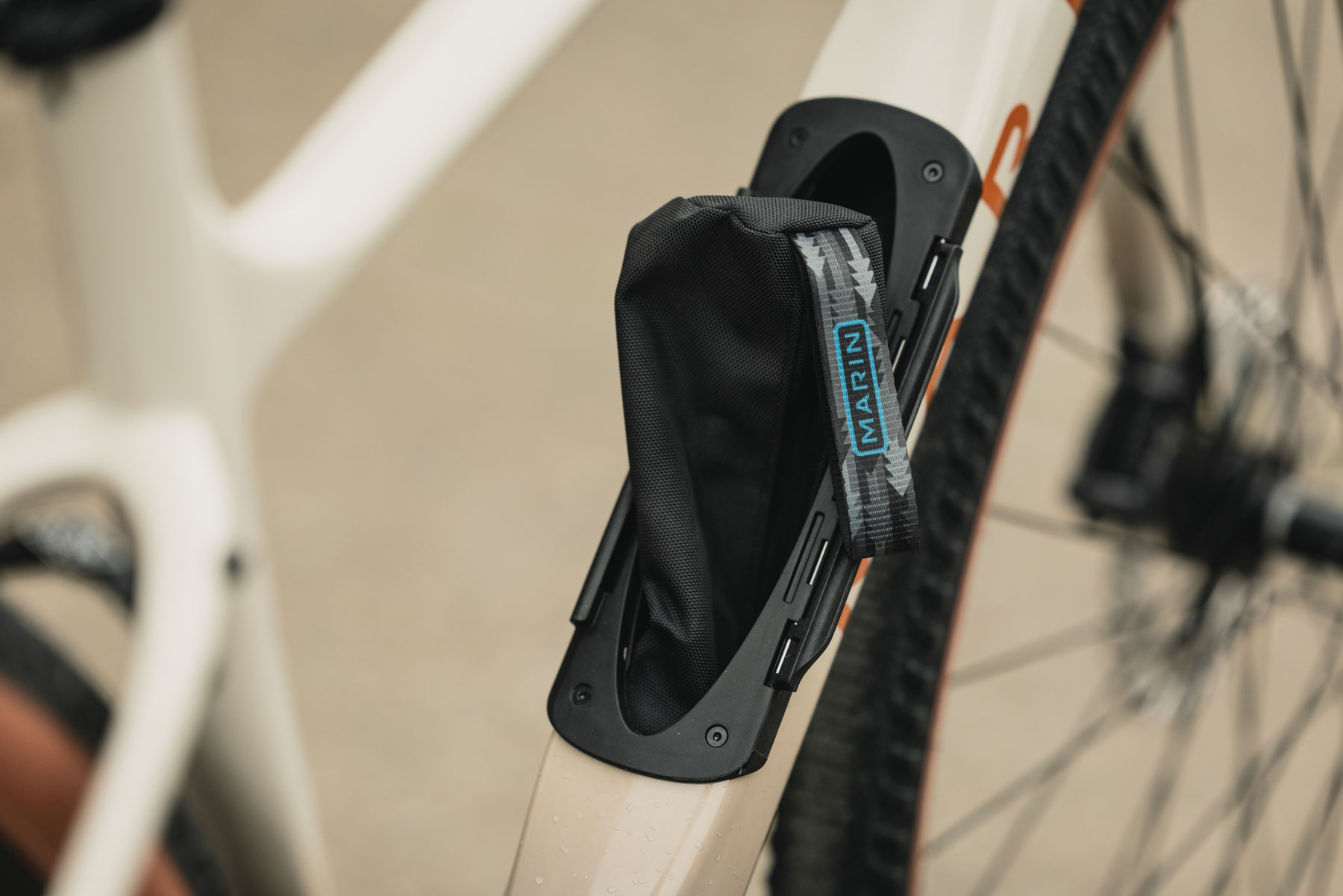
The rear dropout is now UDH-compatible, bringing the frame bang up to date. There are further practical additions, such as the ‘Bear Box’ down tube storage, as seen on the Alpine Trail XR mountain bike, and internal cable routing that enters at the fork crown and down tube rather than being fully internally routed.
The rear dropout is UDH-compatible. Marin
A full raft of mounts on the frame complete the details, with triple fork mounts, top tube mounts and bottle bosses, along with traditional rack mounts and mounts for full mudguards (fenders).
The ‘Bear Box’ storage design is borrowed from Marin’s mountain bikes. Marin
Marin Headlands V2 range details
There are three models in the V2 range. Marin
The Headlands V2 range consists of three models, starting with the Headlands 1, which combines the unidirectional carbon frame with a Shimano GRX610 1×12 drivetrain and GRX610 hydraulic brakes.
The Headlands 1 is priced at £2,499 / CAD$3,499 / €2,849.
Next is the Headlands 2 with Shimano’s GRX RX820 1×12 drivetrain, an integrated dropper lever, GRX RX820 hydraulic brakes and a long-travel dropper post.
The Headlands 2 is priced at £2,899 / CAD$3,999 / €3,295.
The Headlands 3 is the top-of-the-range model, with carbon wheels, SRAM Rival XPLR AXS and a dropper post. Marin
The range is topped by the Headlands 3, which comes with SRAM’s latest Rival XPLR AXS 1×13 drivetrain, SRAM Rival XPLR hydraulic brakes, Novatec G24 carbon gravel wheels and a long-travel dropper post.
The Headlands 3 is priced at £3,799 / CAD$5,399 / €4,499.
If you’d rather build your own, the Headlands V2 is available as a frameset-only option for £1,699 / CAD$2,499 / €1,999.


 Bikealicious Rubberband Joy Ride
 Banded
  The Ultimate Women’s Mini Races – Eat My Dust