Less than a week after Strava’s lawsuit against Garmin was revealed, it has come to light that Suunto is also suing the company.
Filed in a Texas court on 22 September, Suunto’s case accuses Garmin of infringing five patents related to measuring a user’s respiratory rate, antenna design, watch casing and tracking golf shots.
The complaint alleges that many Garmin smartwatches incorporate the patented technologies without permission, including the Marq, Fenix, Epix, Instinct, Venu and Forerunner models.
Suunto is seeking damages and potentially a permanent injunction to block sales of the Garmin devices that use the features.
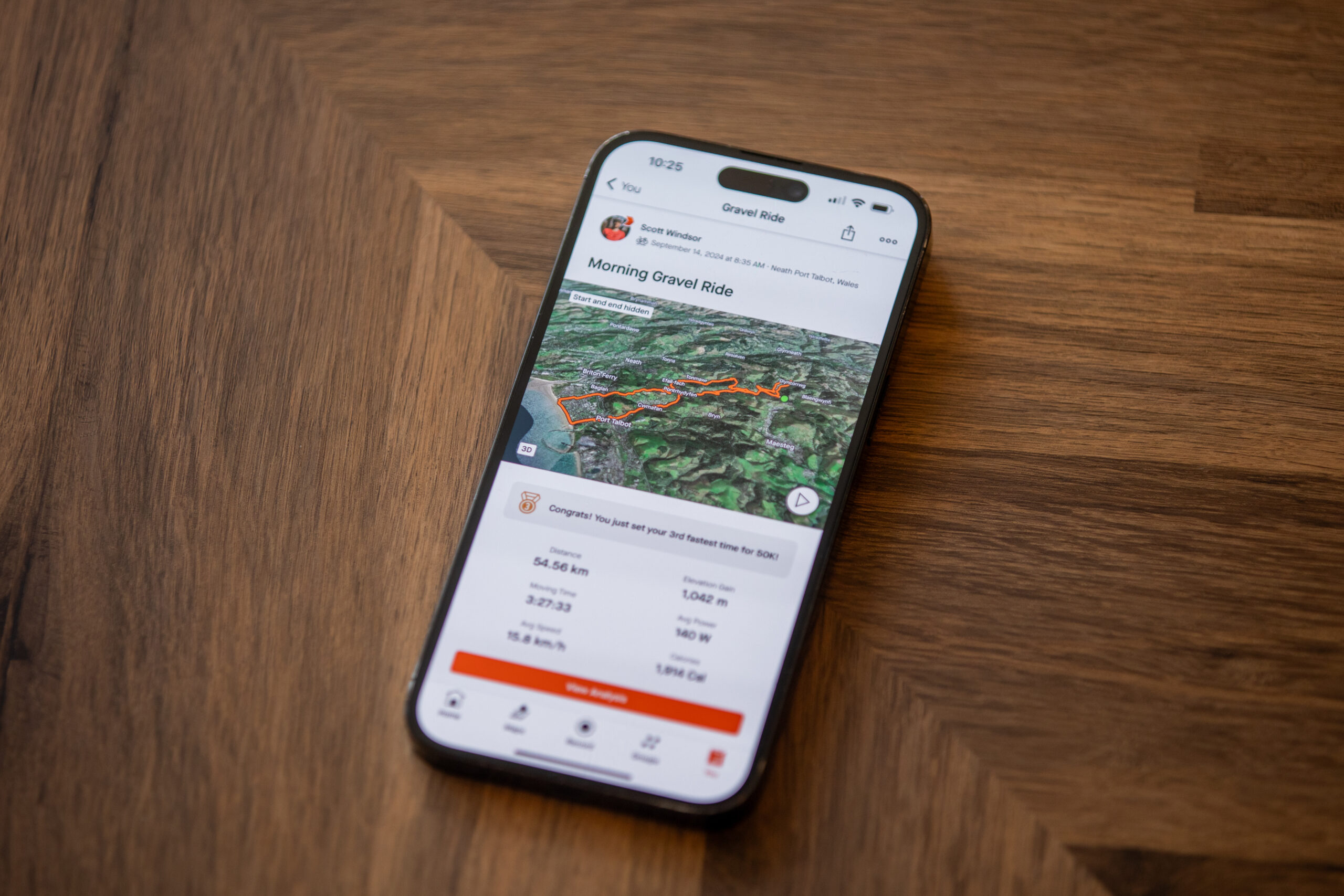
Strava’s lawsuit against Garmin also covers patent infringements. Scott Windsor / Our Media
Suunto, a Finnish smartwatch and tech company, is not alone in suing Garmin, with its filing appearing soon after Strava’s complaint against the GPS giant.
Like Suunto, Strava is also pursuing legal action against Garmin over patent infringements.
Filed in a Colorado court on 30 September, Strava’s case alleges that Garmin violated the terms of a 2015 agreement between the two companies by offering Garmin-branded segments and leaderboards.
However, Strava’s chief product officer, Matt Salazar, offered a different explanation for the legal action in a Reddit post. He said the primary reason behind Strava’s litigation was a set of “new developer guidelines for all of its API partners”.
Salazar wrote that the dispute arose from Garmin’s new API guidelines announced in July that require “the Garmin logo to be present on every single activity post, screen, graph, image, sharing card etc”.
“We have until November 1st to comply, and if not, Garmin has threatened to cut off access to their API, stopping all Garmin activities from being uploaded to Strava,” Salazar said.
The British Transport Police’s decision not to investigate certain bike thefts at train stations “will hit the lowest income groups the hardest”, according to Sophie Gordon, campaigns manager at Cycling UK.
Last week, the British Transport Police (BTP) said it will not investigate bike thefts at train stations where the bicycle has been left for more than two hours, and CCTV footage will not be reviewed outside of this time frame. The BTP also said the theft of any bike worth less than £200 will not be investigated and that robberies on trains should only be reported if the passenger knows which carriage they were in.
“The decision not to investigate bike theft when cycles have been left for longer than two hours will hit the lowest income groups the hardest,” Cycling UK’s Sophie Gordon said.
“These are often working people who might not be able to afford a car and are relying on bikes and public transport to get to work. If you’re on shift or at work, you will inevitably be away longer than a couple of hours,” she added.
Cycling UK found that cycling for commuting made up 29 per cent of all cycle journeys in 2023.
Last year, it was revealed that 49 per cent of Brits couldn’t afford a new bike, with a quarter saying it would take them six months to save for one. The Walk Wheel Trust, formerly Sustrans, also found that almost 2 million people want to cycle but are priced out due to the initial cost of a bicycle and accessories.
More than 14,000 bikes were stolen from outside train stations between 2021 and 2023. A freedom of information request revealed bicycle thefts from outside stations increased by 39 per cent from 2022 to 2023.
An estimated 1.33 million cycle journeys were recorded by Transport for London in 2024, but critics have said bike thefts will discourage people from cycling in the capital.
“We know that people who have their bike stolen quite often don’t go back to cycling,” the London Cycling Campaign’s Simon Munk told the BBC.
“Everyone understands that more cycling, more walking, fewer people in cars is a good thing for London [and] for the planet – for everyone,” he added.
Gordon said: “Bike theft is not a petty crime but has serious social consequences and the police need to take it seriously – to have your means of getting around stolen can be devastating.
“By partnering with cycle trade, planners and other groups, the police could find ways to prevent cycle theft, seeing as that’s more effective than enforcement, but it’s not acceptable for the police to say they will be doing less to investigate theft, when they should be doing more.”
BTP said that these crimes are unlikely ever to be solved. “The more time our officers spend reviewing CCTV footage for these offences, the less time they have available for patrolling railway stations and trains, investigating crimes which cause the most harm and providing a visible presence across the network,” a BTP spokesperson told the BBC.
“We will continue to apply a test of proportionality when determining investigation – looking at factors such as timeframes, witnesses, the availability of CCTV, the impact on the victim or whether there is a realistic prospect of a successful outcome.
“Any offence which is not investigated will still provide us with valuable intelligence, used to direct our patrols and operations.”
Merida is implementing various measures to improve its labour practices, following the blockade on Giant Bicycles by the US due to allegations of forced labour.
In a statement released today, Merida says it complies with Taiwan’s labour laws, but it has emphasised its commitment to “internationally recognised labour standards”.
Merida says it will implement a zero-fee recruitment policy for migrant workers effective from 1 October. In Taiwan, labour laws allow brokers to charge fees to migrant workers, but this can lead to debt bondage, which is an indicator of forced labour. Now, Merida will not allow brokers to charge fees to new migrant workers.
Furthermore, Merida says no migrant workers will have to pay monthly service fees to brokers, and any such costs will be covered by Merida.
“In addition, we are in the process of creating a reimbursement plan to compensate migrant workers for their earlier recruitment costs. Our goal is to complete the reimbursement by October 25, 2025,” Merida says.
“We will work with our recruitment partners to make sure these standards are upheld and will continue to monitor them to ensure this is the case. Employee welfare is further supported through routine check-ups and ongoing feedback mechanisms, including anonymous mailboxes and satisfaction surveys, to drive continuous improvement,” Merida told BikeRadar.
The ban is the first of its kind on a Taiwanese manufacturer and Giant is now taking steps to resolve the embargo. It has formally engaged with CBP through its US legal counsel and will arrange an official meeting in the near future.
Giant said it is “firmly committed to upholding human rights and labour protections. Since January 2025, we have fully implemented a Zero Recruitment Fee Policy, under which all recruitment, agency, and government-related fees for newly hired migrant workers are fully covered by the company. By the end of 2024, we completed upgrades to employee housing, providing a safer and more comfortable living environment.”
The investigative journalist Peter Bengtsen uncovered the labour conditions in Taiwan’s bicycle industry after he and his team conducted more than 200 interviews with migrant workers between 2022 and 2025.
“The risk of debt bondage is the rule, not the exception, for migrants employed in Taiwan’s bicycle and other industries,” Bengtsen told BikeRadar.
“For decades, workers hired from abroad have paid exorbitant fees to home-country recruiters and Taiwanese labour brokers for jobs and services. As a result, workers borrow significantly from banks and money lenders, often at excessive interest rates, and thereby risk debt bondage while working in Taiwan to pay off loans,” he added.
US legislation allows authorities to stop imports at the border if forced labour is suspected.
Last year, the EU passed legislation that, from 2027, will allow authorities to prohibit the sale, import and export of goods made using forced labour.
This weekend’s big events are… well… Zwift’s Big Weekend events. But we’re also featuring two long group rides, a community-organized fondo race series, and a ride for a cause. Check them all out below!
Zwift’s Big Weekend
Celebrity Leaders Popular Banded
It’s Zwift’s birthday celebration this weekend, since the platform turns 11 years old this fall – and Zwift is holding a series of events with celebrity leaders to celebrate! Each ride is on a different route with different leaders, but they’re all 45-minute banded rides.
Here’s a fun and unique event concept – a weekly series of “medio fondos” featuring age-based groupings. Team Foudre is organizing this series, and it appears that the first four events, held on four consecutive weekends in October, serve as a sort of “pre-series,” where your best two results count towards the overall. (See event description for details.)
The series kicks off this weekend with a race on Big Foot Hills in Watopia (69.9km, 714m).
Join Team Vegan in a ride on World Animal Day, a day that “unites the animal welfare movement, mobilizing it into a global force to make the world a better place for all animals.”
This is a 60-minute banded ride on Wandering Flats, so as long as you pedal, you’ll stay with the group.
The USMeS Team holds a 100km ride every Saturday, but on the first Saturday of the month it’s a 100 mile event. This month they’re riding on London’s PRL Full (173.8km, 2628m).
If you’ve been wanting to knock this route out, this is a great way to do it… because long rides are always better with friends!
Rider leader will pace at 2.2 w/kg average, but all paces are welcome.
We’ve featured this event many times in the past, as it’s always well-attended and well-led at paces that helps everyone stay together. Experienced leaders and sweepers do their best to keep the groups together so everyone can work together to knock out a long ride!
This week’s ride has two pace category options: a D pace of 1.7-2.2 W/kg, or a C pace of 2.5-2.8 W/kg. Both groups will ride 3 laps of Watopia’s Triple Flat Loops for a total length of 104.2km and 476 meters of climbing.
We choose each weekend’s Notable Events based on a variety of factors including:
Is the event unique/innovative in some way?
Are celebrities (pro riders, etc) attending/leading?
Are signup counts already high, meaning the event is extra-popular?
Does the ride include desirable unlocks or prizes?
Does the event appeal to ladies on Zwift? (We like to support this under-represented group!)
Is it for a good cause?
Is it just plain crazy (extra long races, world record attempts, etc)?
Is it a long-running, popular weekly event with a dedicated leader who deserves a shout out?
In the end, we want to call attention to events that are extra-special and therefore extra-appealing to Zwifters. If you think your event qualifies, comment below with a link/details and we may just include it in an upcoming post!
British Transport Police says it will not investigate bike thefts at train stations where the bicycle has been left for more than two hours.
This means most bike thefts will not be investigated, and CCTV footage will not be reviewed after the two-hour timeframe, according to the BBC.
“The more time our officers spend reviewing CCTV… the less time they have available for patrolling railway stations and trains, investigating crimes which cause the most harm,” the BTP said.
In a list of crimes the BTP won’t investigate, it said any bike worth less than £200 will not be investigated. The BTP also said thefts on trains should only be reported if the passenger knows the carriage the bike was in.
A BTP spokesperson told the BBC that it knows bike thefts are upsetting, inconvenient and potentially costly, but “there can often be limited opportunity for investigation”.
The spokesperson said: “Our experience tells us at an early stage that there are some crimes that are unlikely to ever be solved – such as those without a clear estimate of time or location for the incident or if there is a lack of CCTV or witnesses.
“The more time our officers spend reviewing CCTV footage for these offences, the less time they have available for patrolling railway stations and trains, investigating crimes which cause the most harm and providing a visible presence across the network.
“We will continue to apply a test of proportionality when determining investigation – looking at factors such as timeframes, witnesses, the availability of CCTV, the impact on the victim or whether there is a realistic prospect of a successful outcome.
“Any offence which is not investigated will still provide us with valuable intelligence, used to direct our patrols and operations.”
More than 14,000 bicycles were stolen from outside train stations between 2021 and 2023. The number of bikes reported stolen from outside stations was up 39 per cent from 2022 to 2023.
The London Cycling Campaign’s Tom Fyans told the BBC: “A lack of secure cycle parking at stations and next to no action against thieves leaves London way behind the Netherlands where nearly half of trips to stations are by bike.
“Many victims of theft in the capital just stop cycling – if we want to reduce car trips in London and encourage cycling we have to redouble enforcement against cycle theft.”
Following yesterday’s news that it had filed a lawsuit against Garmin, Strava has sought to explain the reasons behind the action.
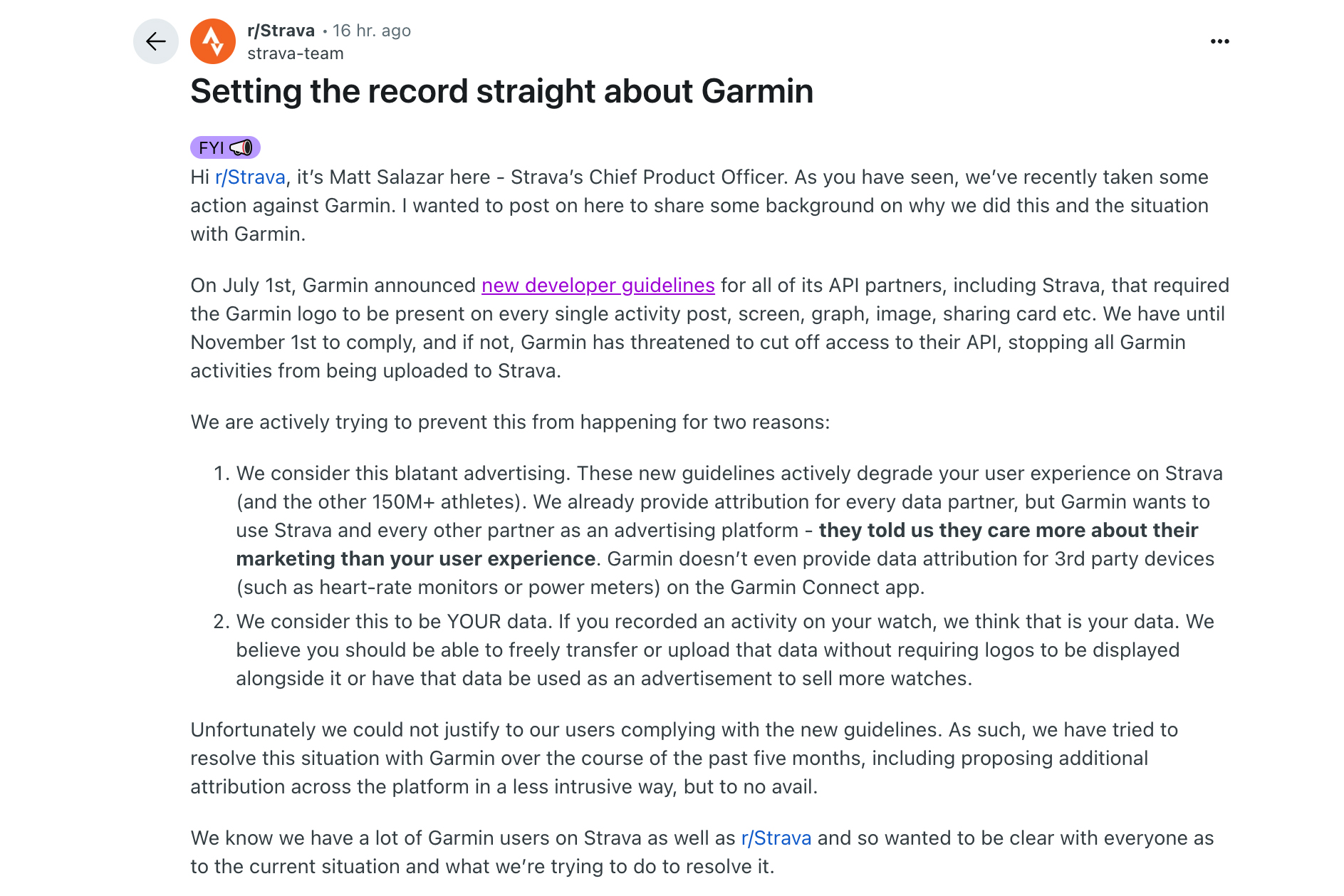
In a post on Reddit, Strava’s chief product officer, Matt Salazar, said the primary reason behind its litigation was a set of “new developer guidelines for all of its API partners”, which Strava took issue with.
Curiously, this appears to be unrelated to the claims in Strava’s lawsuit that Garmin has infringed on two of its patents.
According to Salazar, Garmin’s new guidelines were announced on 1 July 2025 and would require Strava, and other platforms using Garmin’s API, to integrate a Garmin logo “on every single activity post, screen, graph, image, sharing card, etc”.
Strava’s chief product officer, Matt Salazar, took to Reddit yesterday to explain the brand’s actions. Reddit
For context, an API or ‘Application Programming Interface’ is a tool that enables different pieces of software to connect with one another and share features, data or functions. In the case of Garmin and Strava, Garmin’s API is what enables activity data to be automatically shared to Strava after it’s uploaded to Garmin’s Connect app.
Entities using Garmin’s API have, Salazar claims, until 1 November 2025 to comply with the updated guidelines, or else “Garmin has threatened to cut off access to their API, stopping all Garmin activities from being uploaded to Strava”.
Salazar says Strava does not wish to comply with the new guidelines because it feels that including Garmin’s logo would amount to “blatant advertising” that would “actively degrade your user experience on Strava (and the other 150M+ athletes)”.
Strava, Salazar says, “already provides attribution for every data partner”, but sees the inclusion of logos as a step too far: “they told us they care more about their marketing than your user experience”.
Salazar also suggests this is unfair because “Garmin doesn’t even provide data attribution for third-party devices (such as heart-rate monitors or power meters) on the Garmin Connect app”.
Continuing on this theme, Salazar says: “If you recorded an activity on your watch, we think that is your data.
“We believe you should be able to freely transfer or upload that data without requiring logos to be displayed alongside it or have that data be used as an advertisement to sell more watches.”
As a result, Salazar says Strava “could not justify to our users complying with the new [Garmin API] guidelines”.
He claims Strava has “tried to resolve this situation with Garmin over the course of the past five months, including proposing additional attribution across the platform in a less intrusive way, but to no avail”.
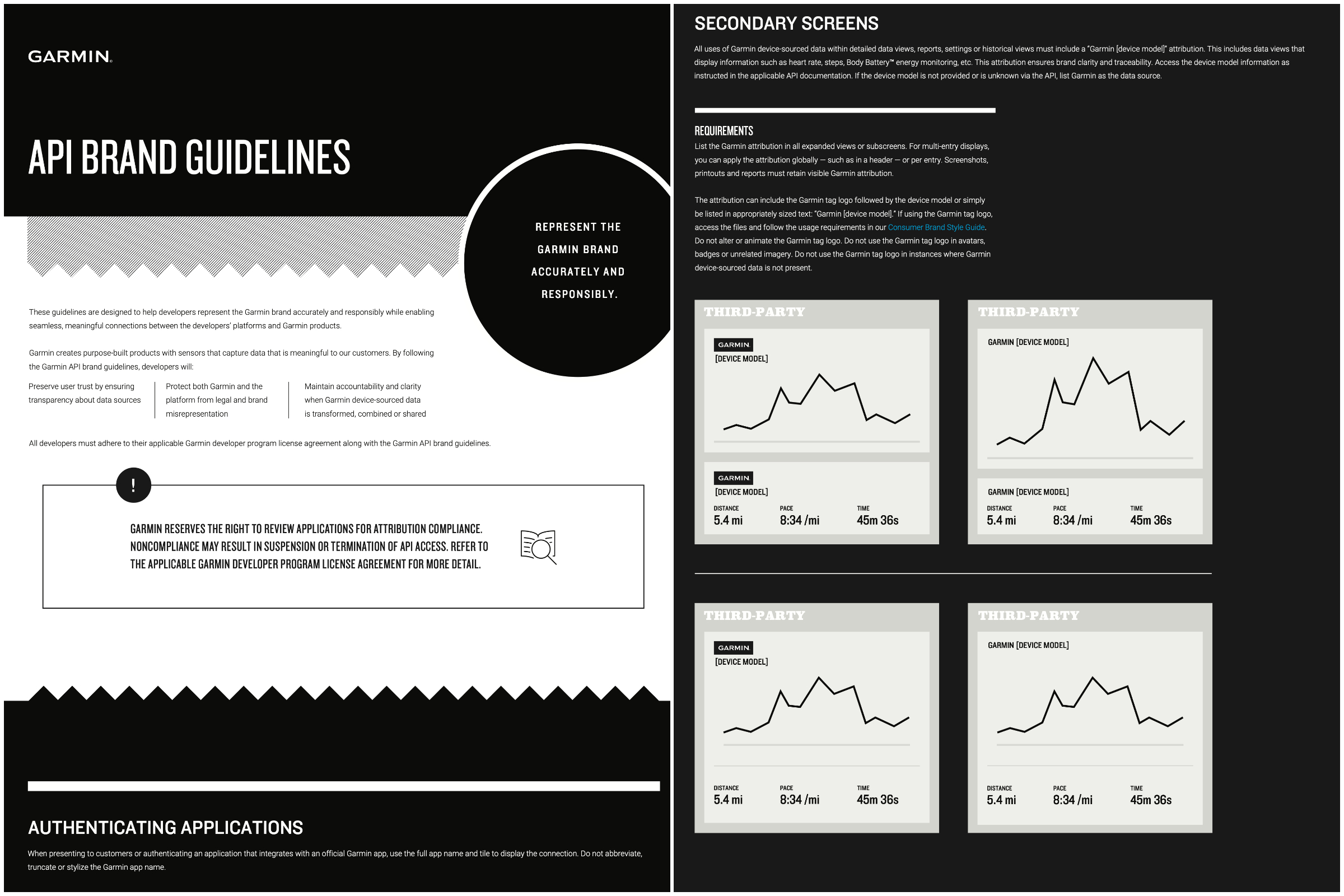
Garmin’s current API guidelines suggest using its logo is optional. Garmin
It’s notable, though, that Garmin’s current API guidelines suggest that although “a Garmin [device model] attribution” is mandatory, the inclusion of its logo is not.
Platforms should “list the Garmin attribution in all expanded views or subscreens. For multi-entry displays, you can apply the attribution globally – such as in a header – or per entry. Screenshots, printouts and reports must retain visible Garmin attribution”.
It continues: “The attribution can include the Garmin tag logo followed by the device model or simply be listed in appropriately sized text: ‘Garmin [device model].’.”
The guidelines then provide a number of illustrative examples with and without the Garmin logo included.
When contacted, Garmin told BikeRadar that it “doesn’t comment on pending litigation.”.
BikeRadar has contacted Strava for comment and will update this article if we receive a response.
Power meter specialist SRM has launched a pair of crank arms for its Origin modular power meter system with swappable crank tips, enabling you to experiment with different crank lengths without needing to buy a whole new crankset or power meter.
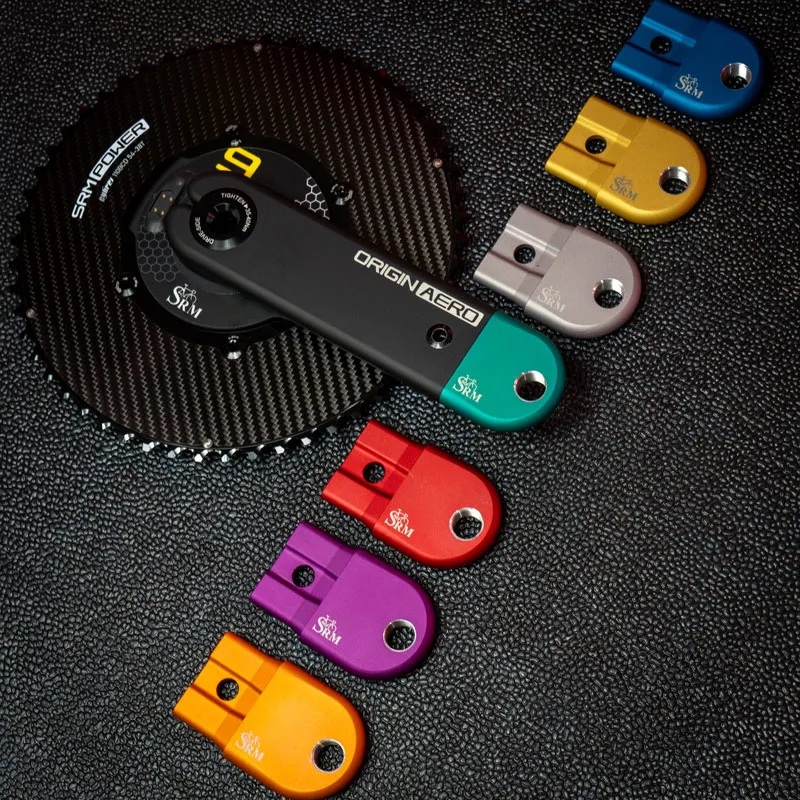
The new SRM Origin Aero Aluminium cranks include seven crank tips, each anodised in a different colour. The crank tips bolt to the crank arms and enable you to alter the crank length in 2.5mm increments from 160mm up to 175mm.
SRM says the Original Aero Aluminium is its narrowest crankset to date, with the wide, flat crank designed to offer low drag and high pedalling efficiency.
The Origin Aero cranks come with a range of crank tips to vary their length.
The SRM Origin Aero cranks’ Q-Factor of 144mm for road bike use is also notable because it’s significantly narrower than that of standard cranksets. Shimano road cranks have a Q-Factor of 148mm, for example, which rises to 151mm for GRX gravel cranksets and as much as 176mm for its MTB cranksets. The 140mm crank Q-Factor is more typical for track bikes.
Pros have been steadily decreasing their crank length over the past few years. Jonas Vingegaard, for example, was riding with 160mm cranks on his Cervélo S5, when we checked his bike out at the start of the 2025 Tour de France. We’d spotted him experimenting with 150mm cranks earlier in the season.
Tadej Pogačar, meanwhile, typically rides 165mm cranks.
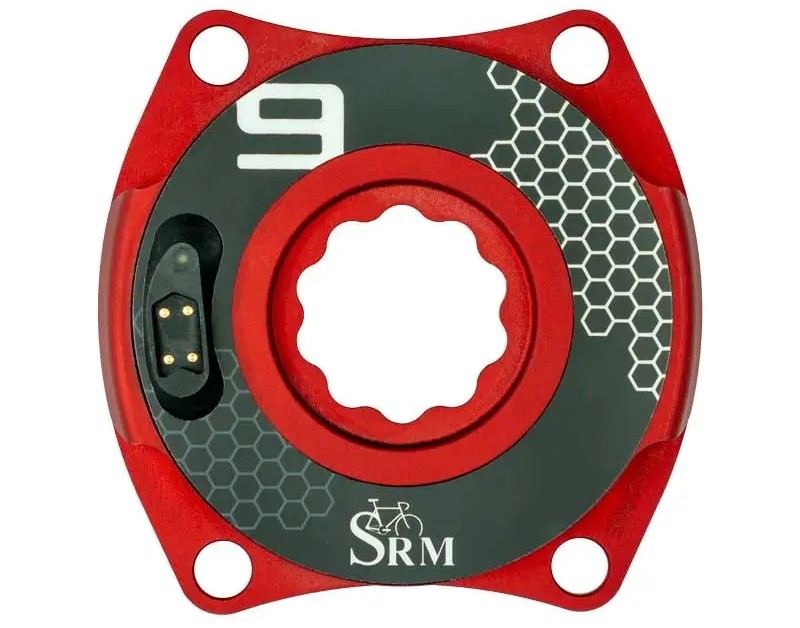
The crank arms fix to SRM’s power meter spider. You also need to factor in the price of the chainrings and bottom bracket.
The SRM Origin Aero Aluminium crank arms work with SRM’s Origin modular power meter, which can be used with a range of SRM crank designs. The Aero Aluminium is the newest option – and, at €2,015, the most expensive.
Factor in the €1,210 price of the power meter spider (available in five colours to match at least some of your crank tips), plus up to €336 for the Carbon-Ti chainring option, and you’re looking at around €3,561 for the complete setup, without a bottom bracket spindle.
After that, experimenting with your crank length is free, though.
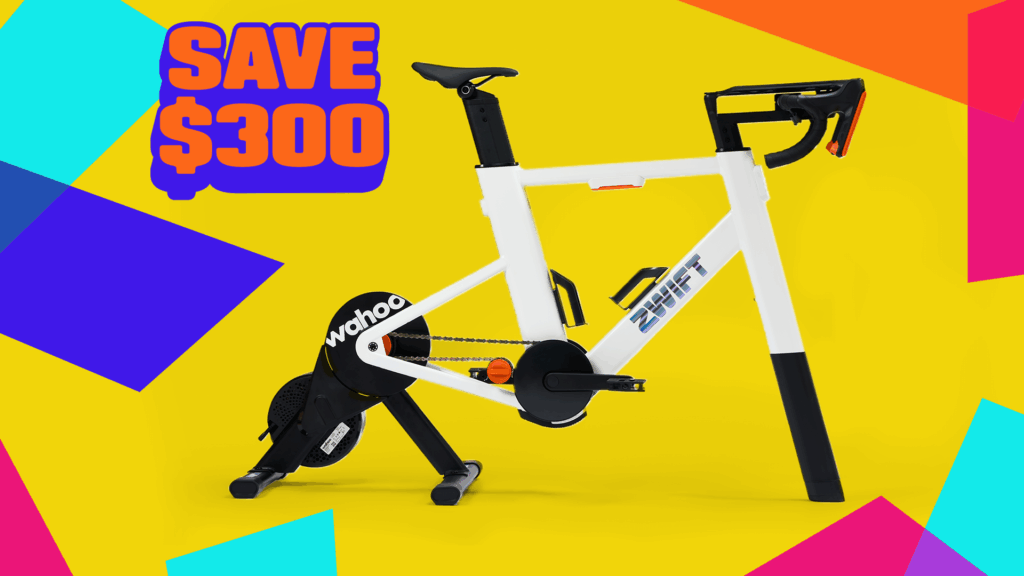
Zwift just launched the second piece of their Zwift’s Big Weekend event: an unprecedented hardware sale! This is the biggest discount we’ve ever seen on the full Zwift Ride setup, which now includes Wahoo’s latest trainer, the feature-packed KICKR CORE 2.
With a price well below other smart bikes, the Zwift Ride is already the best deal around for anyone looking for a turnkey Zwift setup. But this weekend, riders can pick up the Zwift Ride + Wahoo KICKR CORE 2 package for just $999.99/€999.99/£999.99. That’s a huge discount off the regular price, especially for Zwifters in the US:
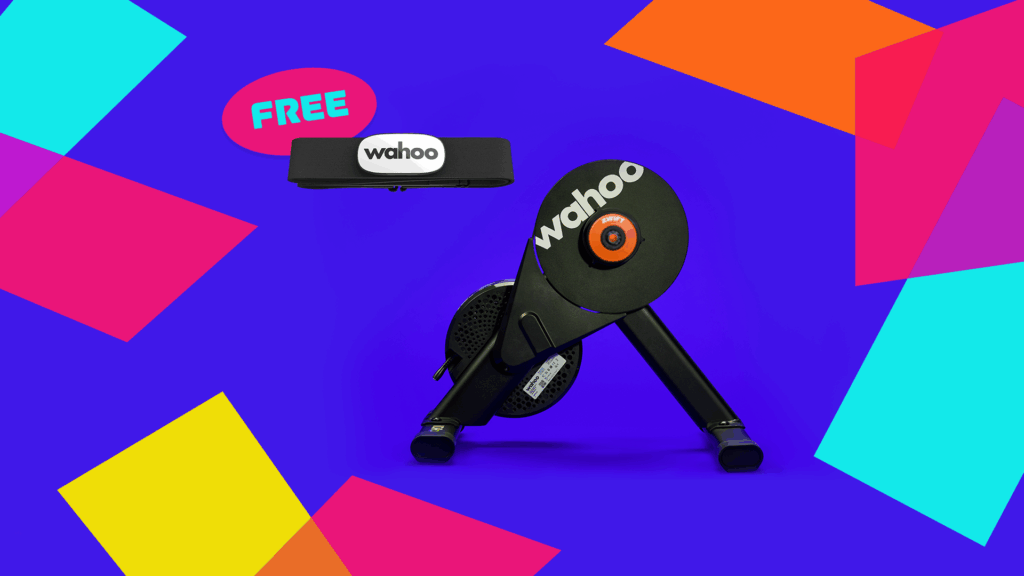
If you aren’t looking for a full Zwift Ride setup, but would love a trainer upgrade, Zwift is running a second promo on the new Wahoo KICKR CORE 2. This trainer, released less than a month ago, improves on the highly popular KICKR CORE by adding Wi-Fi connectivity, race mode, Bluetooth bridging, and more.
Purchase the CORE 2 from Zwift and you’ll get a free Wahoo TRACKR Heart Rate Monitor ($99.99/€89.99/£79.99 retail) thrown in!
Note: Zwift says, “During checkout the TRACKR will appear as a free add-on option,” so be sure to add it to your cart during the checkout process.
A final note: Zwift links in this post (and throughout this site) are affiliate links, so when you shop through these links, Zwift Insider is paid a small affiliate commission from Zwift. Thanks in advance for your support!
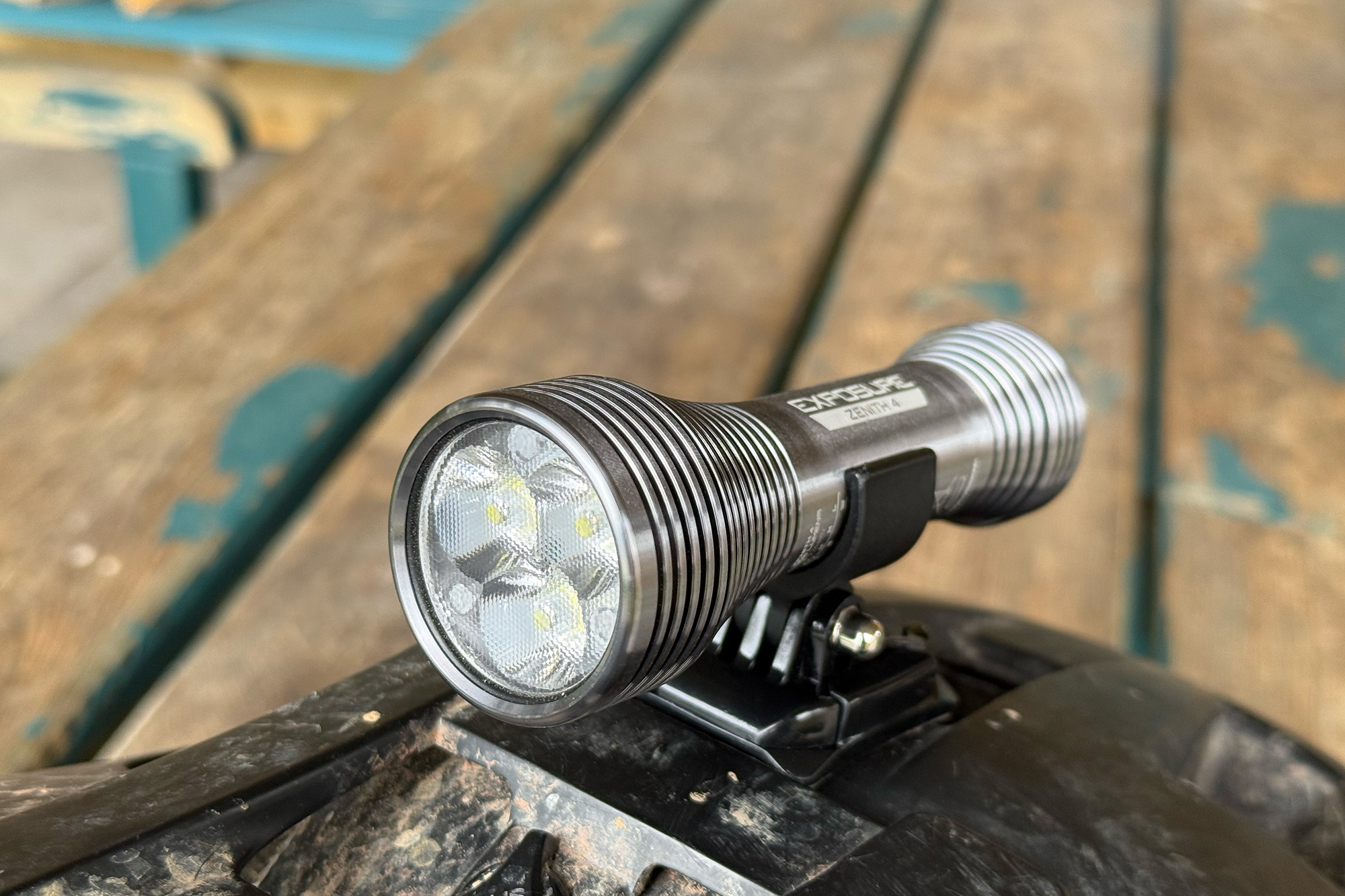
Exposure’s Zenith is the brand’s most powerful helmet-mounted light, and this new MK4 version incorporates many features fans have been demanding for years.
Exposure says this has reduced charging time by 66 per cent, meaning you can charge the light to full in a claimed 2 hours and 45 minutes.
The mountain bike light is also brighter than ever before, with the brand bumping the maximum lumen output to 2,360.
In a world of ever-more-expensive kit, Exposure has managed to add all of these features while reducing the retail price of the light from the previous generation to £280 / $305 from £295 / $345.
While that’s not cheap, Exposure products have a good reputation for quality and often score well in our group tests.
I’ve had the opportunity to use the light a little since receiving it, so I’ll include some impressions throughout this first look.
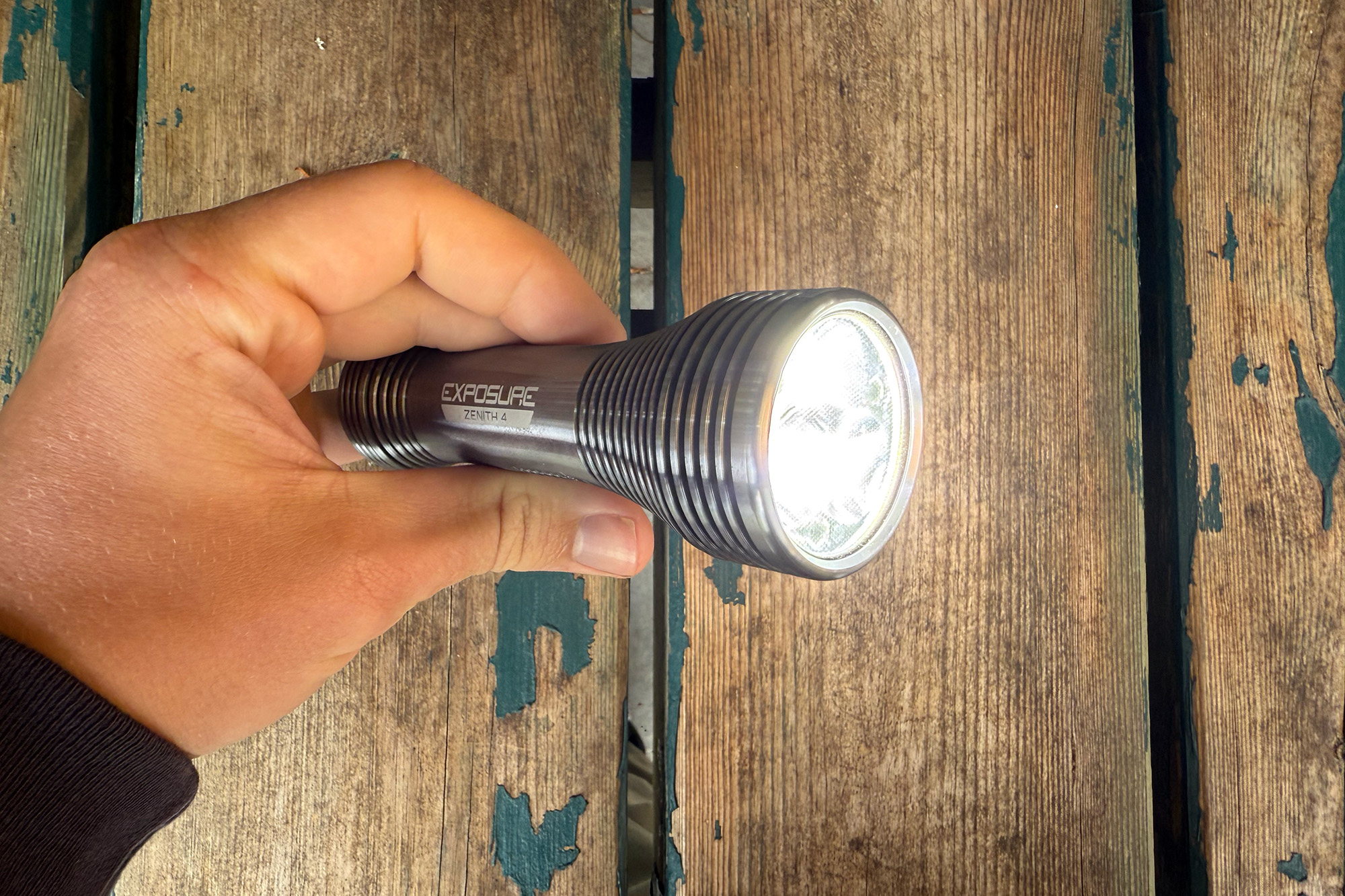
The light measures 120mm in length. Nick Clark / Our Media
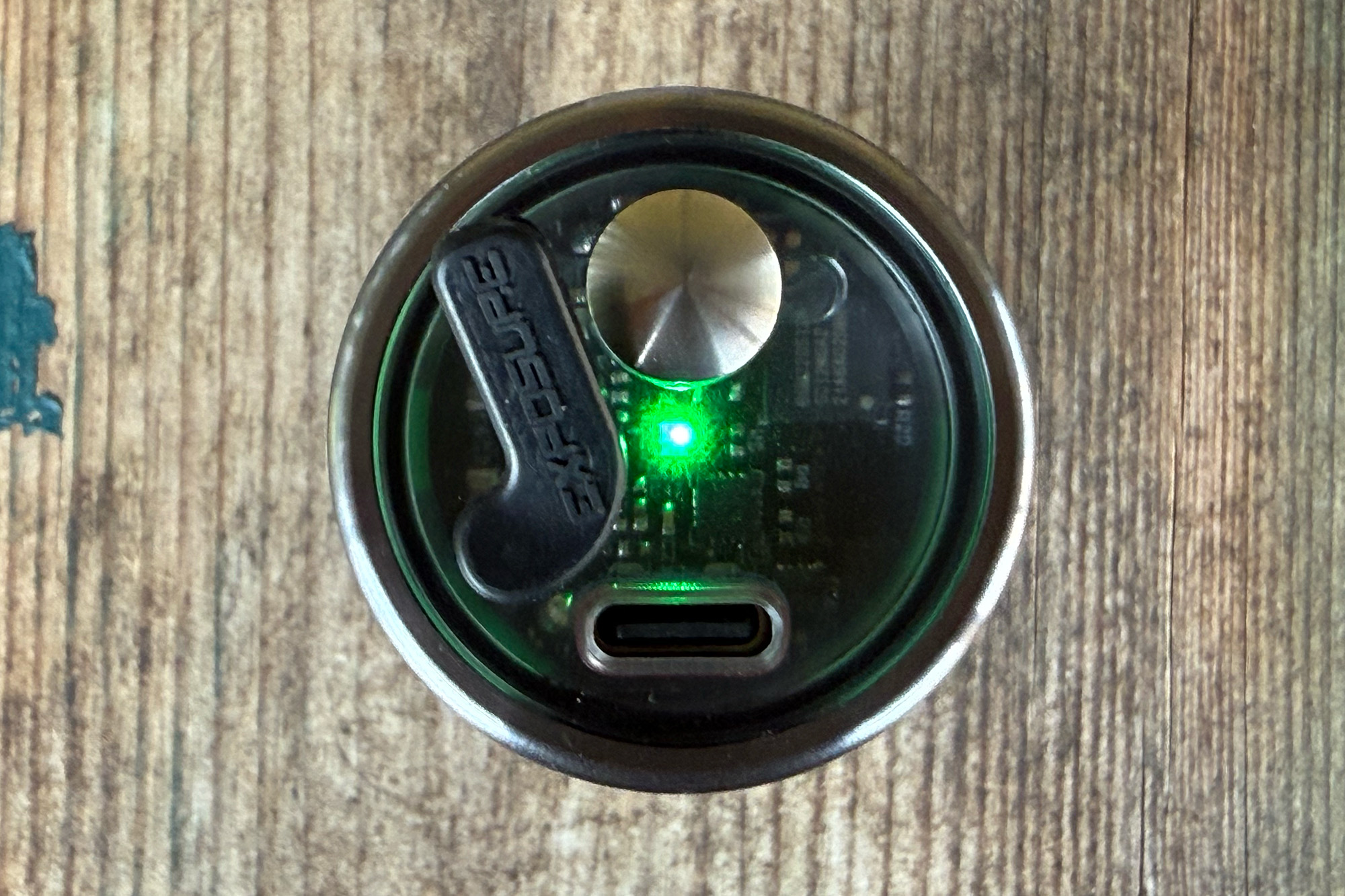
The British brand has finally updated the charge port for its lights, with the DC port being substituted for a USB-C.
Not only does this improve charging speed, but it also means scrambling around for a charging cable should be easier when an impromptu after-work ride is mentioned in the group chat.
While the plastic port feels flimsy, it does do its job. Nick Clark / Our Media
The port is covered by a small plastic tab, which, while it works to keep dust out, doesn’t feel like the most robust solution.
Despite this, Exposure says the Zenith MK4 is IP67-rated, meaning those nighttime showers shouldn’t have you riding home in the dark.
Exposure has given the Zenith MK4 a 6,000mAh Li-Ion battery, which it says will last up to 36 hours.
The Zenith MK4 also gets Exposure’s Tap technology, which enables you to switch between power levels by tapping the entire device rather than searching for a button on the rear.
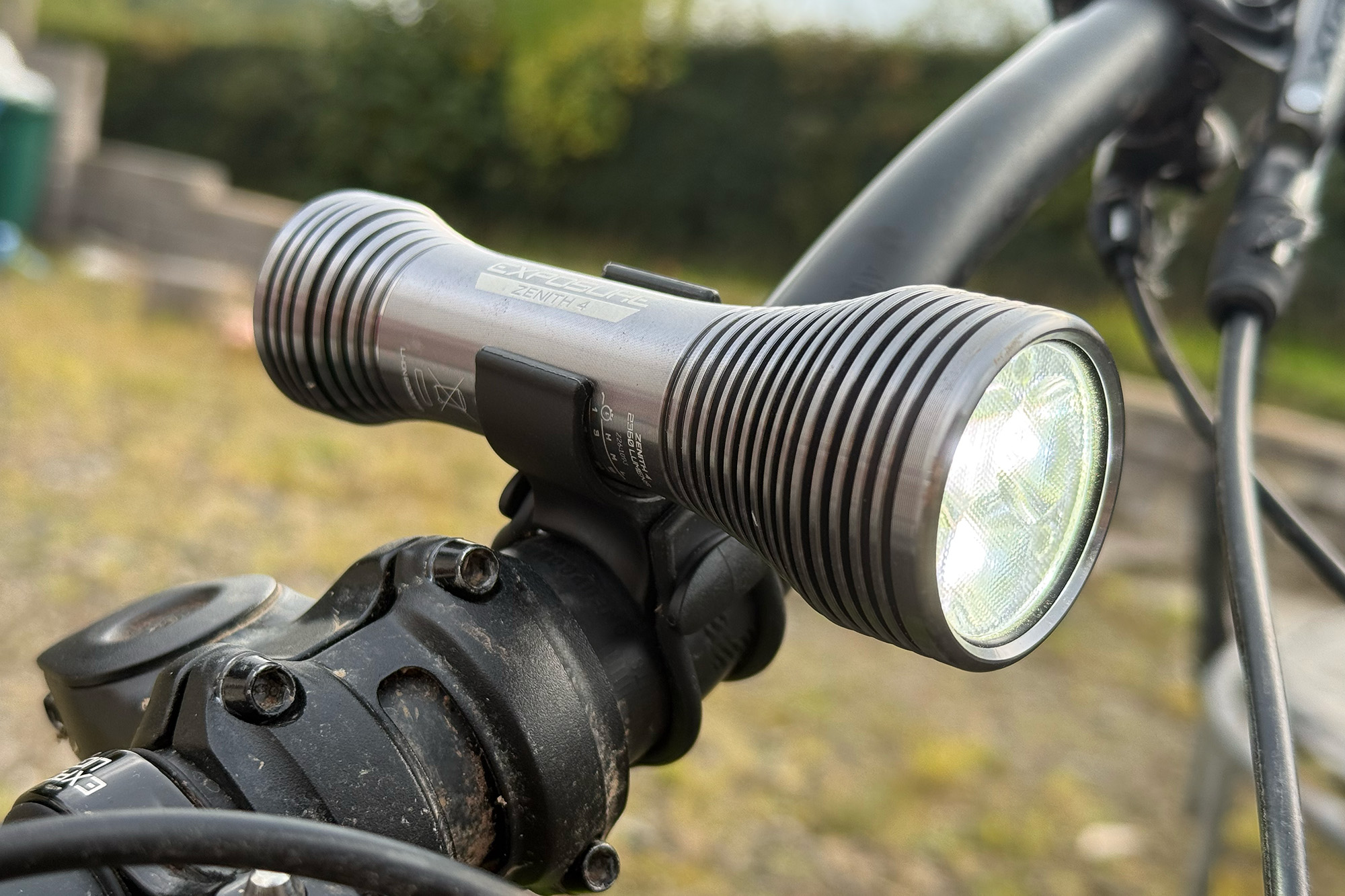
The light attaches to the helmet and bar mount via a clip. Nick Clark / Our Media
While this makes it easier to switch the light between modes and makes you more conservative with your power, I’m not sure it’s much more intuitive than clicking the button on the back of the light. If you thud your head on an overhanging tree, you can quickly be riding in less light than you expected.
There are three sensitivity modes to limit this, but I’m yet to be convinced of this feature.
The light has three White XPL2 LEDs in the front, which shine up to 2,360 lumens down the trail.
I’ve mostly been using the Zenith MK4 in this setting, and it provides a good spread of light, with decent contrast for obstacles.
With 2,360 lumens, the Zenith MK4 should be bright enough to navigate by. Nick Clark / Our Media
Having used lights with a more focused beam in the past, this feels better for spotlighting features such as the lips of jumps and drops.
The Zenith’s white light feels less taxing on the eyes than others and helps with depth perception.
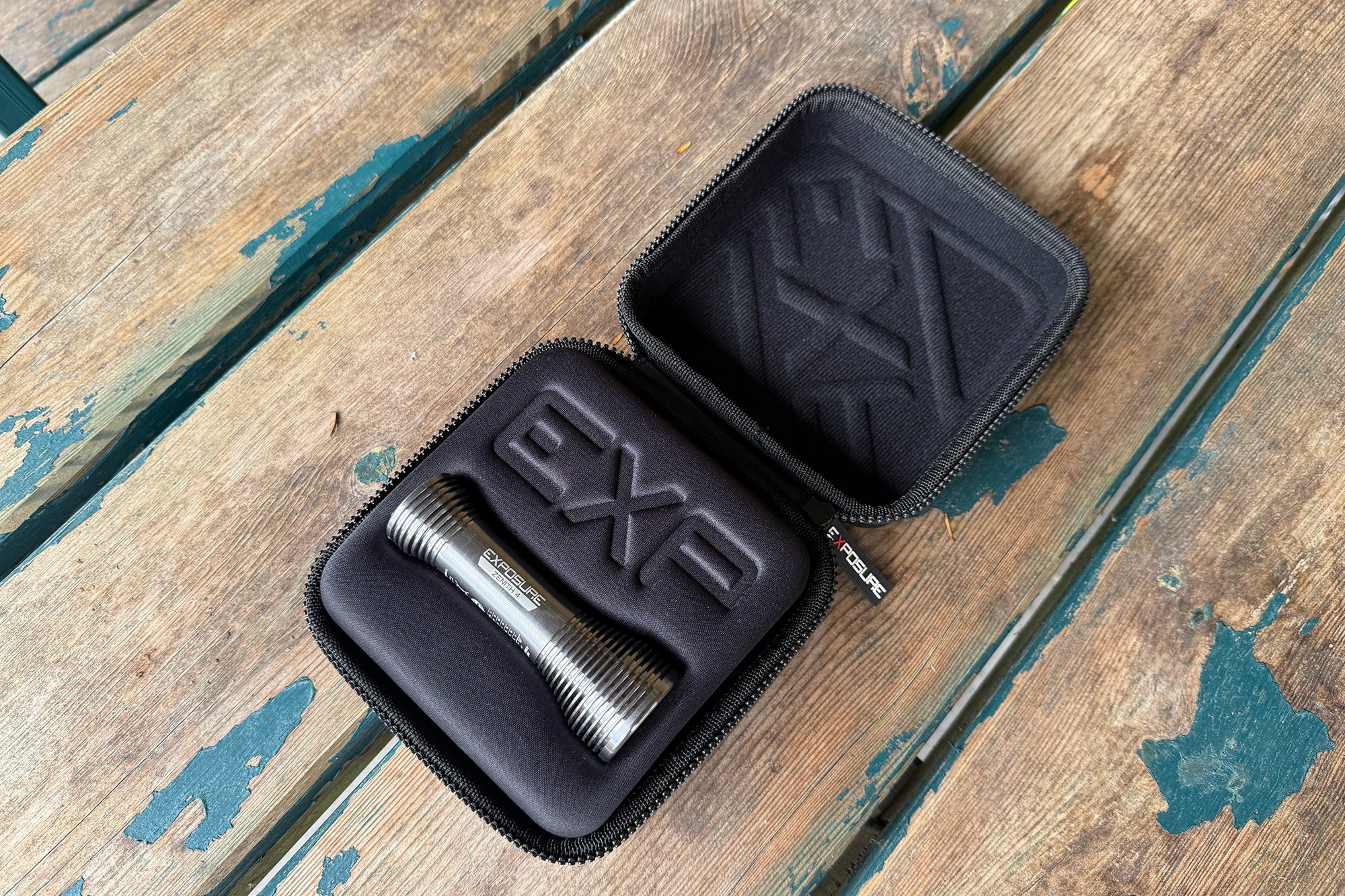
The plush case keeps the light safe and easy to store. Nick Clark / Our Media
In the box, Exposure supplies a helmet mount and bar mount for the light, meaning it could have a dual purpose in your life. I’d consider using it for road riding in a lower-brightness mode.
Having smashed my face up too many times on a mountain bike, I’ve opted for the GoPro-style adhesive sticker mount on my helmet, which has performed really well for my nighttime enduro rides.
Exposure also provides a lanyard for the light, which keeps it attached to your helmet should you knock it out of the mount.
Looking to put together the ultimate Zwift setup for the long winter months ahead? One way many Zwifters have upgraded the feel and aesthetics of their pain cave is through vibrant LED lighting setups. In this week’s top video, watch as one Zwifter walks through his installation of hexagon LED lighting in his pain cave.
We’re also featuring videos about home gym upgrades, climbing Alpe du Zwift in under 50 minutes, beginner indoor cycling setups, and Zwift racing for IRONMAN training.
Zwift Shed Upgrades | Hexagon Light Install
In an attempt to improve the lighting and aesthetics of his cycling shed, Max from The Watt Life shares how he installed hexagon lighting in his shed.
Planning My New Home Gym
Watch as Ryan Condon shares his plans to fully convert his garage into a home gym.
If You Want to Climb Alpe du Zwift in Under 50 Minutes, Do This!
After lots of hard and consistent training, Adam from Road to A recently completed Alpe du Zwift in under 50 minutes. In this video, he shares tips and tricks that helped him achieve this goal.
Is Indoor Cycling Beginner Friendly? We Gave A Smart Trainer To A Beginner To Find Out
If you’re interested in getting started with indoor cycling, but don’t want to worry about all the technical bits, fear not! In this video, watch as Cycling Weekly sets up the Elite Rivo with an indoor cycling beginner.
Using A Zwift Race as Part of My IRONMAN Training | Live Stats + Zwift Bike
Watch as Parker Kerth tackles a Zwift race as part of his prep for an upcoming IRONMAN. Can he take the win?
Got a Great Zwift Video?
Share the link below and we may feature it in an upcoming post!
Strava has filed a lawsuit against Garmin over two key features, Segments and heatmaps, and demanded that Garmin stops selling many of its devices.
The lawsuit was filed on 30 September in the US District Court for the District of Colorado and Strava claims Garmin is infringing patents, as first reported by DC Rainmaker.
Strava’s Segment patent was filed in 2011 and granted in 2015. The patent effectively covers GPS segments with time-based performance comparisons. Garmin introduced its own Segments in 2014 on its Edge 1000 bike computer, and expanded the feature to its other devices over the remainder of the year.
Garmin then collaborated with Strava to bring Strava Live Segments to Garmin devices under a Master Cooperation Agreement (MCA).
As part of the MCA, Garmin agreed not to show Garmin and Strava Segments at the same time. Now, Strava claims in its lawsuit that Garmin expanded beyond the MCA agreement’s scope, studying the Strava implementation and using it as a blueprint to build a competing system.
The second part of the lawsuit relates to heatmap display. Strava cites two patents, which cover generating a map that shows where other users work out based on activity data. These patents were filed in 2014 and 2016.
But, as DC Rainmaker explains, Garmin had heatmap functionality in 2013. “Garmin’s lawyers will easily argue this patent shouldn’t have been granted and get it invalidated,” claims DC Rainmaker.
As a result of these patent infringements, Strava claims it “has suffered damages, including lost revenue and business opportunities, erosion of competitive differentiation and network effects, harm to goodwill, and unjust gains to Garmin.”
Strava’s lawsuit says it provided Garmin with written notice of infringement in June and July of this year, which followed disagreements between the two companies.
Last year, Strava introduced API changes that disrupted third-party apps, such as Garmin. Garmin was critical of how Strava handled data attribution and used Garmin data (from Garmin users who upload activities to Strava) for AI training.
Strava’s lawsuit asks for a permanent injunction to stop Garmin selling devices that include Segments or heatmap functionality, which would cover most of Garmin’s smartwatches and Edge bike computers.
Strava told DC Rainmaker that it does not intend to disrupt the ability of Garmin users to sync data with Strava and it hopes “Garmin values our shared users in the same way”.
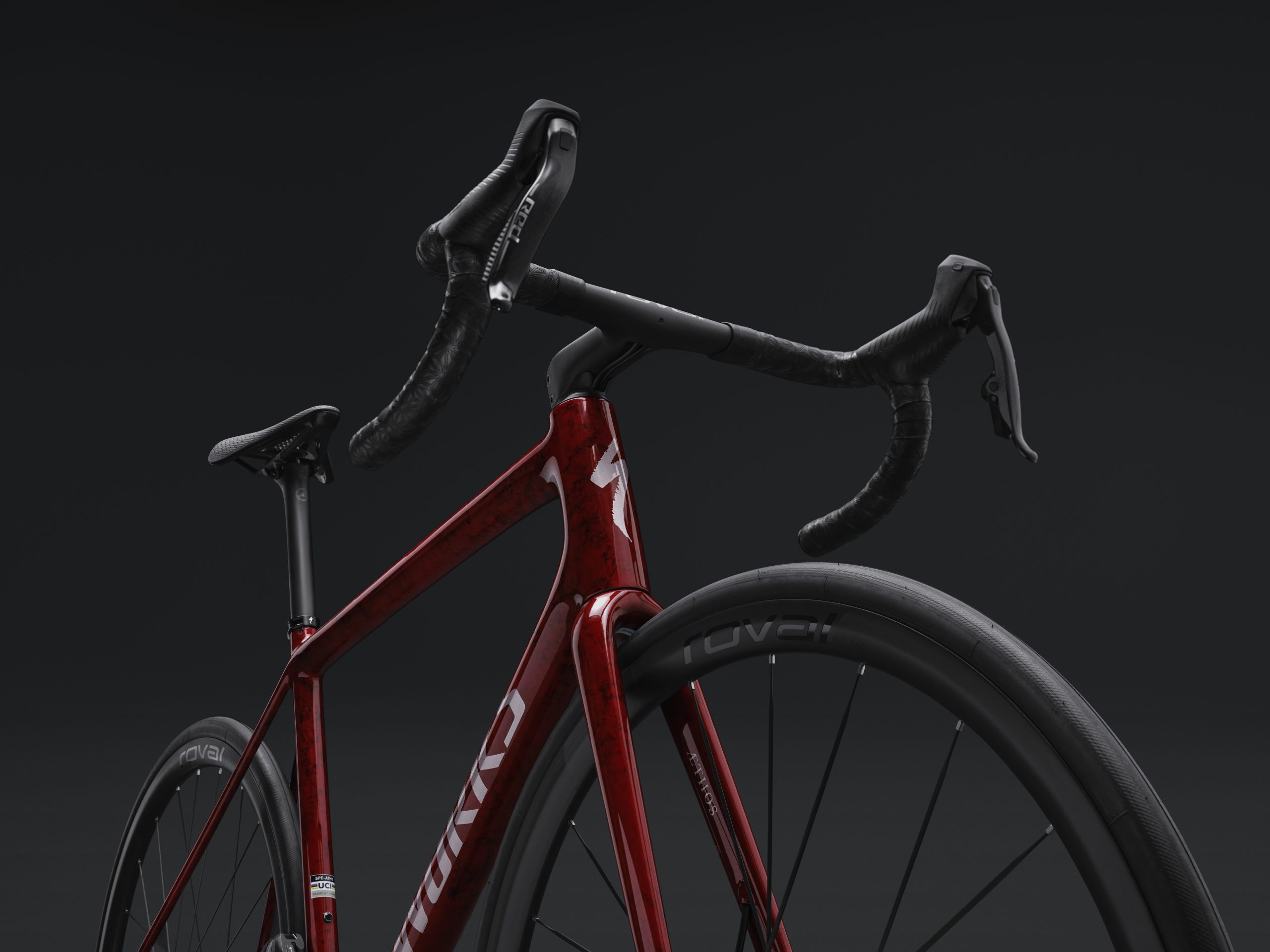
Once you get over the fact that part of what made it stand out from the crowd has gone, the Specialized Aethos 2 is about as unsurprisingly good as road bikes come.
It’s extremely impressive if you value all but aerodynamics, and immediately likeable in the same way Pudsey Bear is (it represents ‘good, wholesome’ things and the purity of cycling spirit, for the benefit of our non-UK readership).
It remains expensive, especially in its S-Works guise, although it’s worth noting there are markedly more bikes costing in excess of £12,000 now than there were when the first Aethos launched.
The tweaks to geometry and tyre clearance have also made the Aethos a better bike for more riders, while the integrated front end certainly modernises it.
However, part of the sell here is the ‘synergy’ between the best of Specialized and sibling brand Roval.
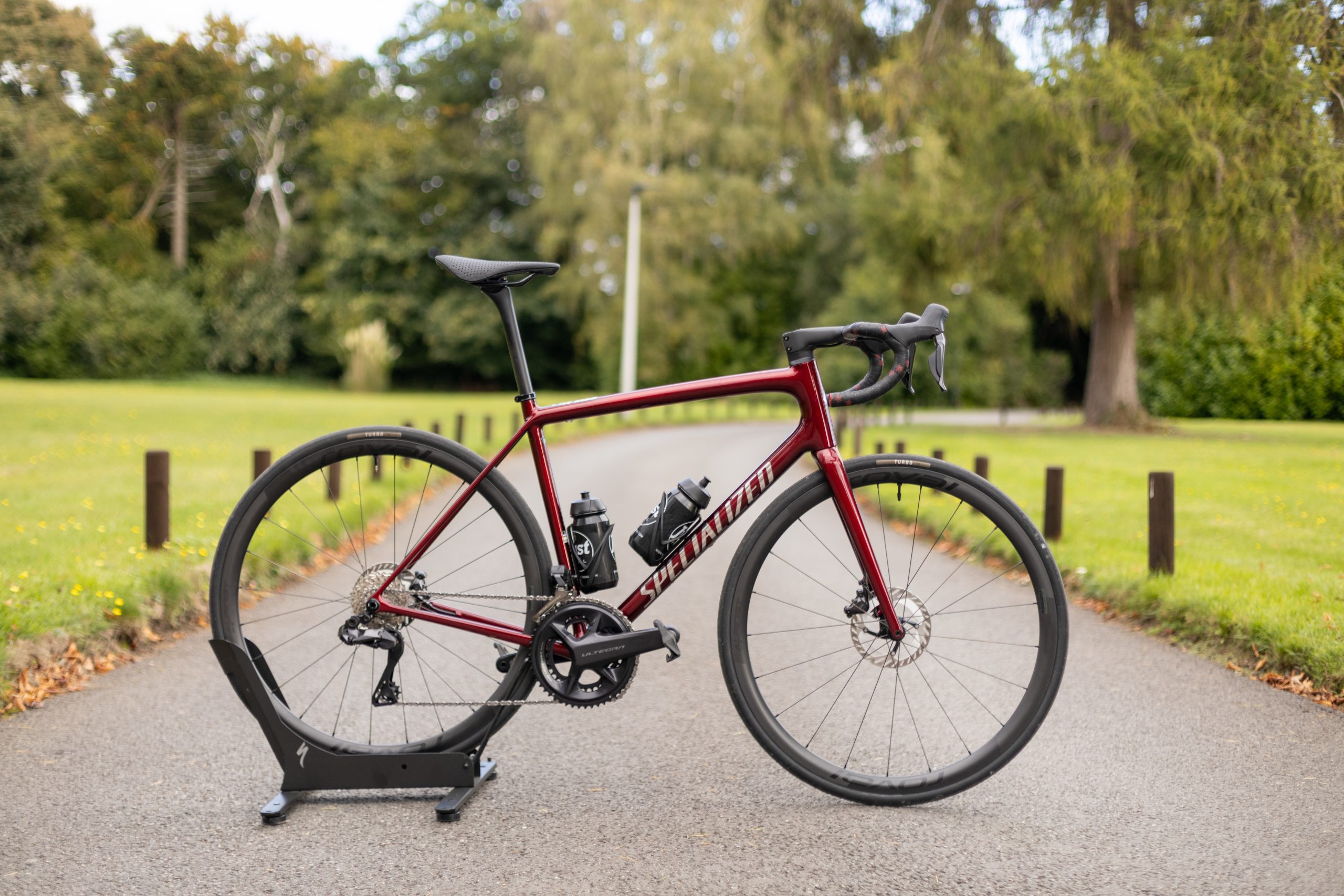
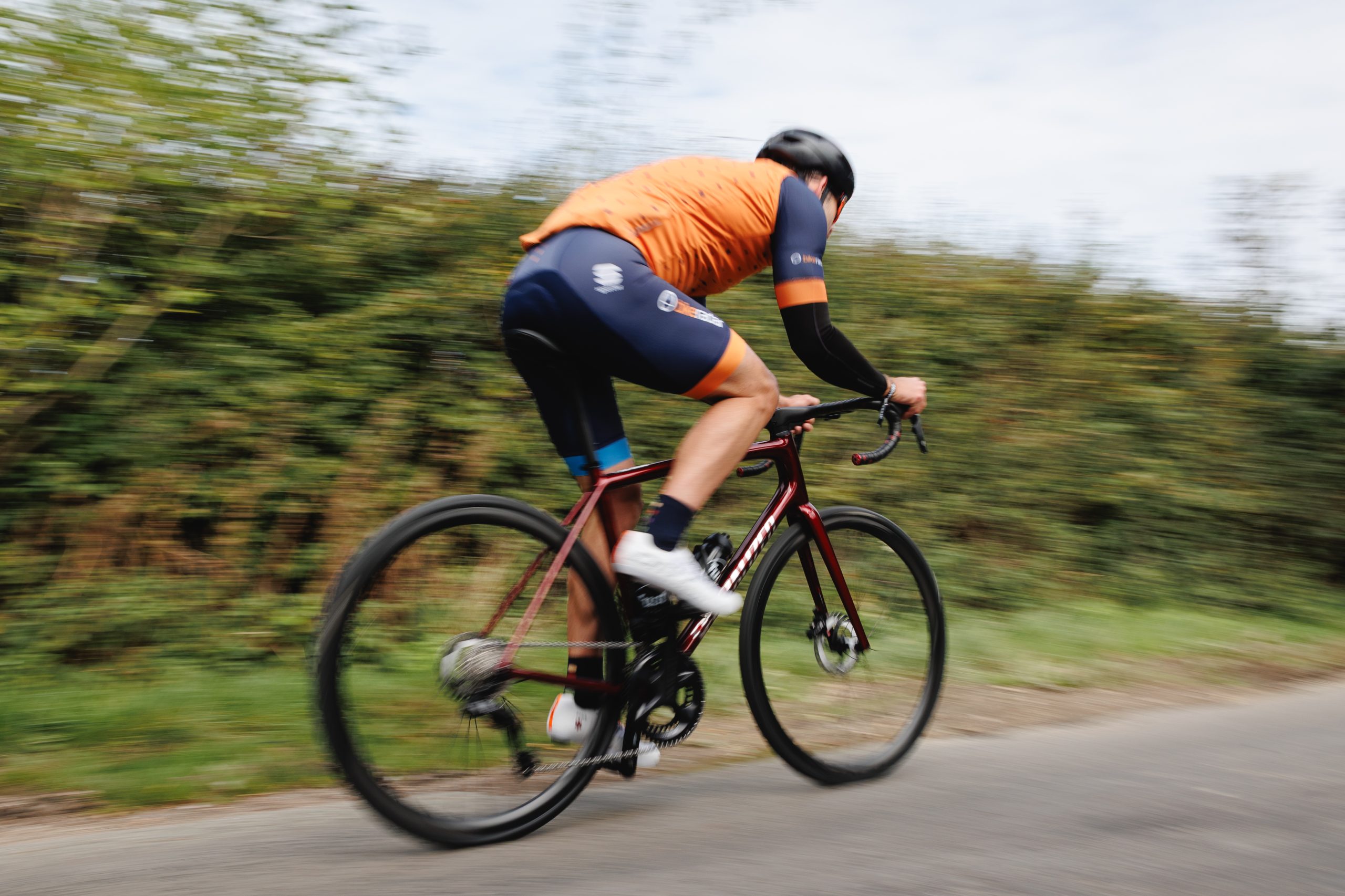
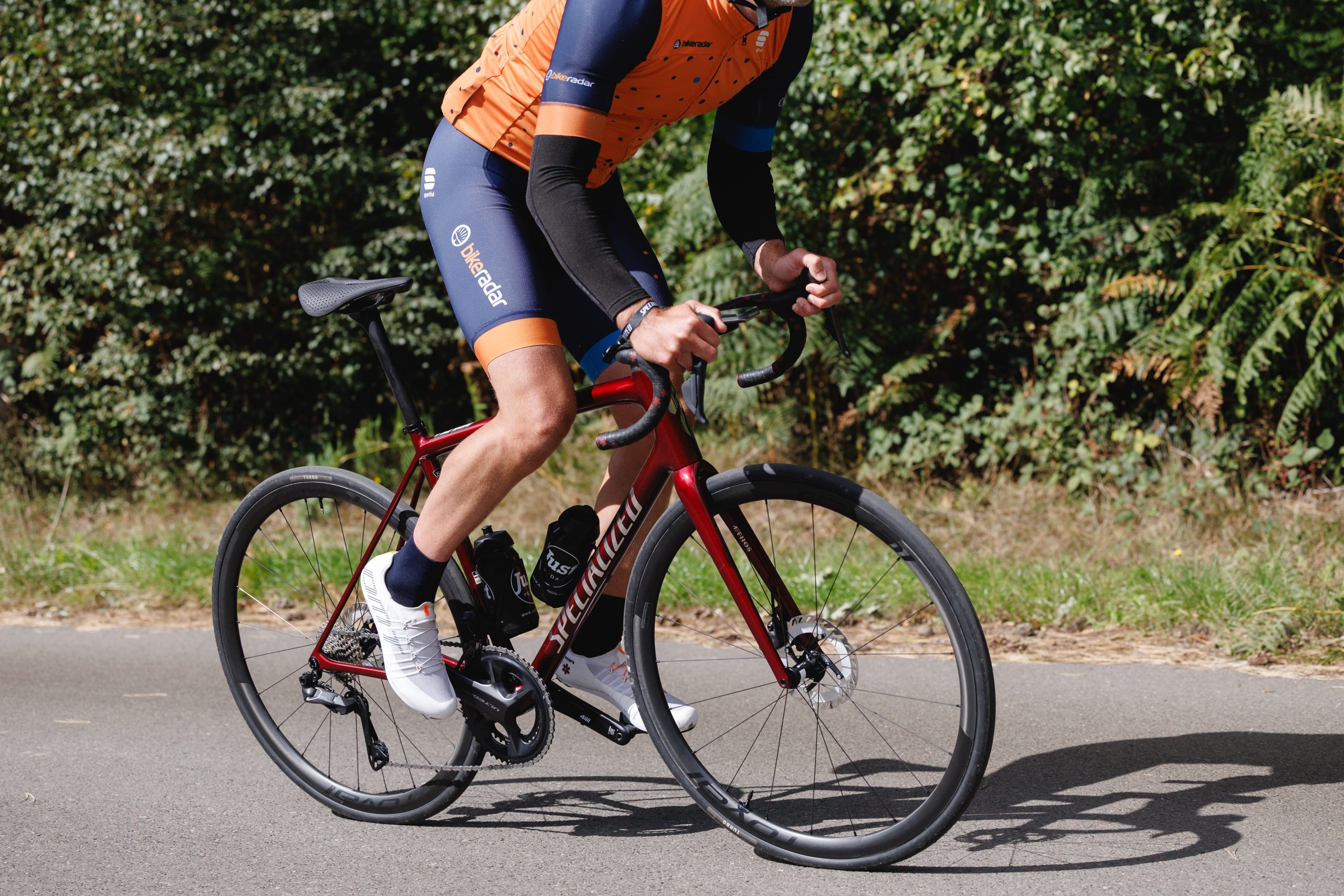
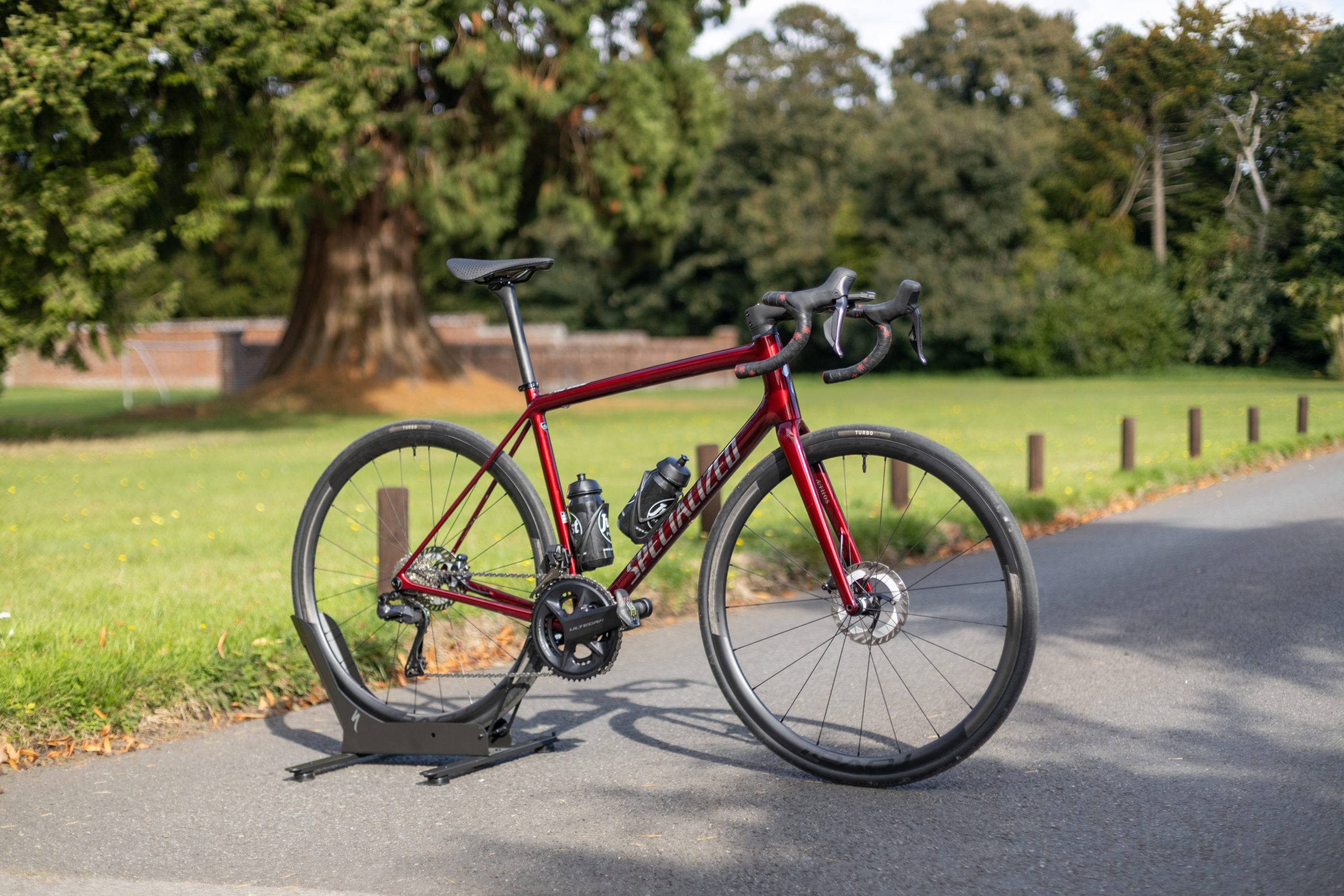
Given you don’t get the latest and greatest wheelset unless you plump for the top models – I tested the £7,249 / $8,499 / €8,499 Aethos 2 Pro Di2 – the latest bike looks to be only a marginal improvement on its predecessor.
Specialized and Roval work in unison, but you’ll need an S-Works bike (which this isn’t) to fully realise the potential. Ashley Quinlan / Our Media
You join me in a small conference room at Specialized’s headquarters in Surrey, UK, where I’m being presented with all the details about the Aethos 2.
S-Works models, check. Second-tier-but-still-great models (at least, the ones more of us will have budget for), check. Synergy between Specialized and sibling components brand Roval, check.
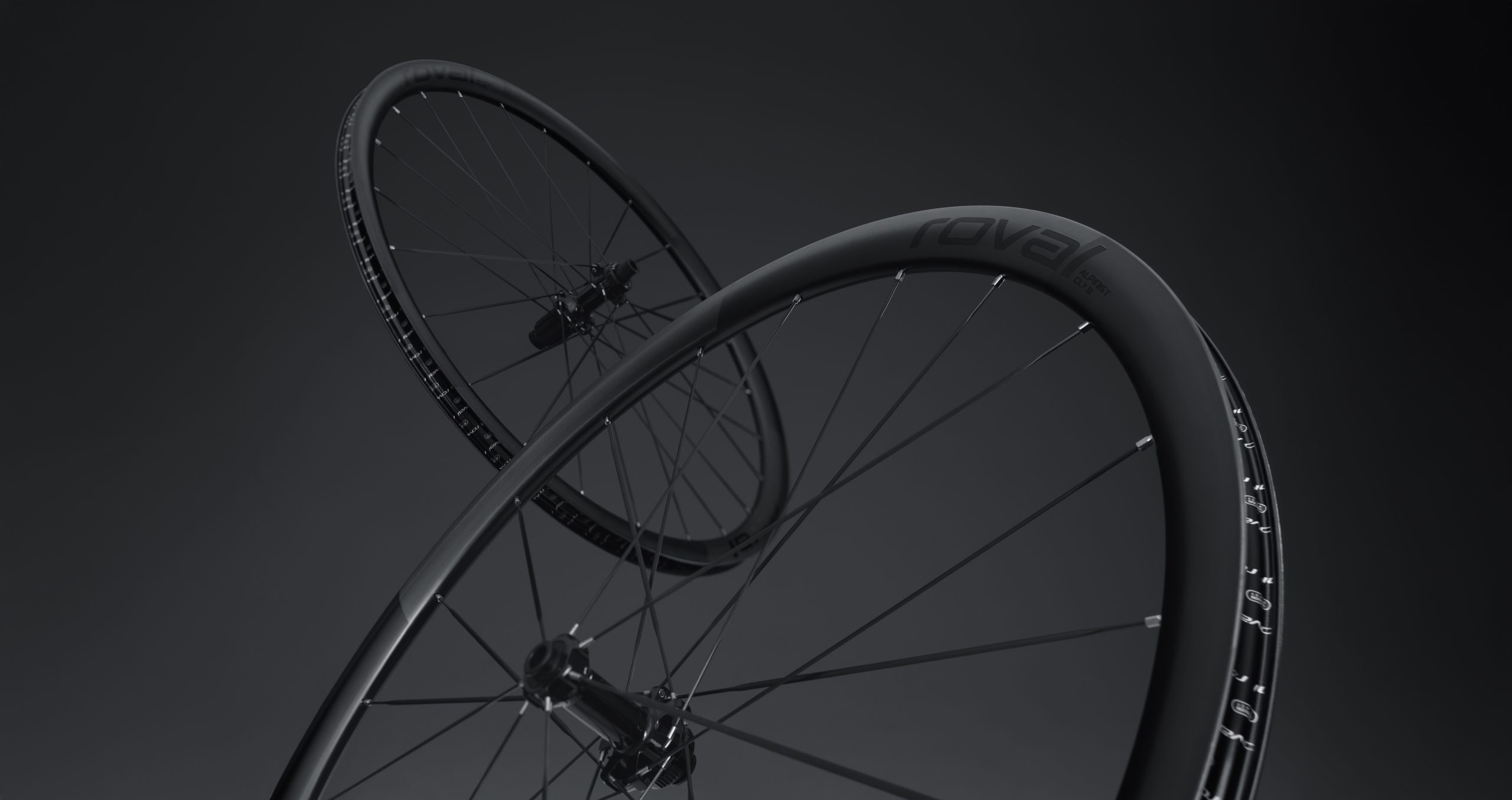
Alongside the Aethos 2 reveal, I’m also told about the new Alpinist CLX III wheelset – it’s 134g lighter than before (according to Specialized) and designed to complement the new Aethos. The catch is, if you want said wheelset, you’ll need an S-Works model.
Everyone else needs to settle for the existing Alpinist CL II, or C38, carbon wheelsets. Specialized says it has performed a rolling update to the rim beds so they’re “fully ETRTO compliant”, like the CLX III, but these fundamentally remain the same as before, and less impressive on the scales or spec sheet.
This Pro-level bike features Roval Alpinist CL II wheels, which are a marked step down from the latest CLX IIIs launched this week. Ashley Quinlan / Our Media
So, while you get a frameset with the modifications Specialized has made in the interests of improving the Aethos, you don’t get the thing that’s supposed to complete the package.
Of course, it’s nothing new to see cheaper components as you move down the range. However, unlike the previous-generation Aethos where such a disparity in wheels arguably didn’t exist, a non-S-Works Aethos 2 is now a less appealing proposition (or, at least, the S-Works version is rendered even more appealing – you decide).
I’m assigned an Aethos 2 Pro Di2 to try – the frame is new and made of Fact 10r carbon to weigh within 6g of its predecessor (705 vs 699g in a size 56cm), as is the new Alpinist integrated cockpit it comes with.
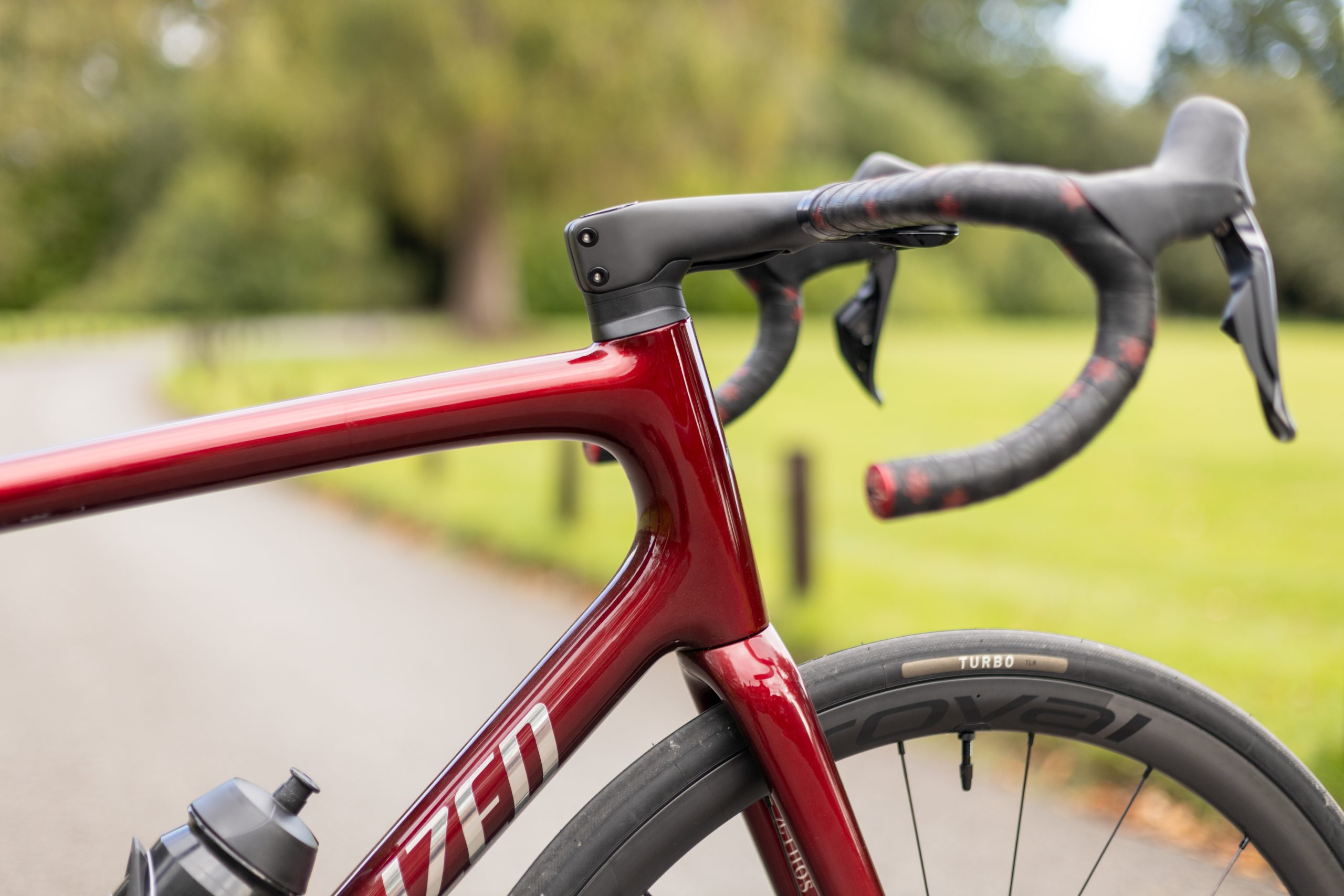
The integrated cockpit means the Aethos has an even cleaner look. Ashley Quinlan / Our Media
I’m trying – and probably failing – to not come across as bougie in my privileged bike-hack position, though. In isolation, the Aethos 2 Pro Di2 offers a great spec, even if there are plenty of others that can match or best it for value.
But, of course, it’s a hefty £4,250 cheaper than the all-singing S-Works bikes with those flashy wheels. If not top value, then, it’s certainly better.
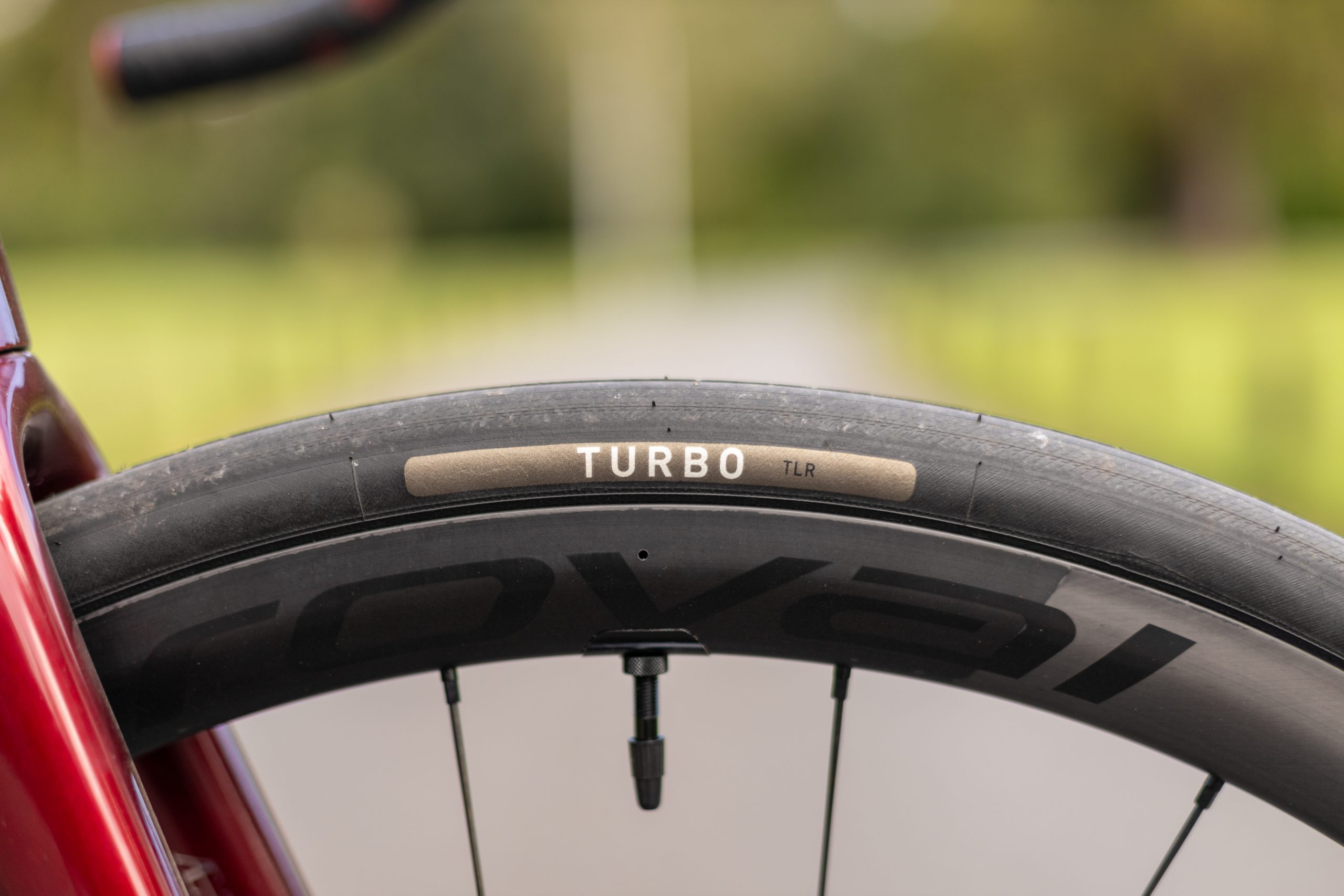
Tyre clearance is 35mm, albeit all the wheels are designed to sport 28mm rubber optimally. Ashley Quinlan / Our Media
Specialized Aethos 2 Pro Di2 headline specs
Price: £7,249 / $8,499 / €8,499
Groupset: Shimano Ultegra Di2 R8100
Power meter: 4iiii Precision Pro
Wheelset: Roval Alpinist CL II
Tyres: S-Works Turbo TLR, 700x28c
Claimed weight: 6.73kg
As smooth as… a smooth thing
Despite the tyre volume, the Aethos 2 feels very smooth to ride. Honor Elliott / Specialized
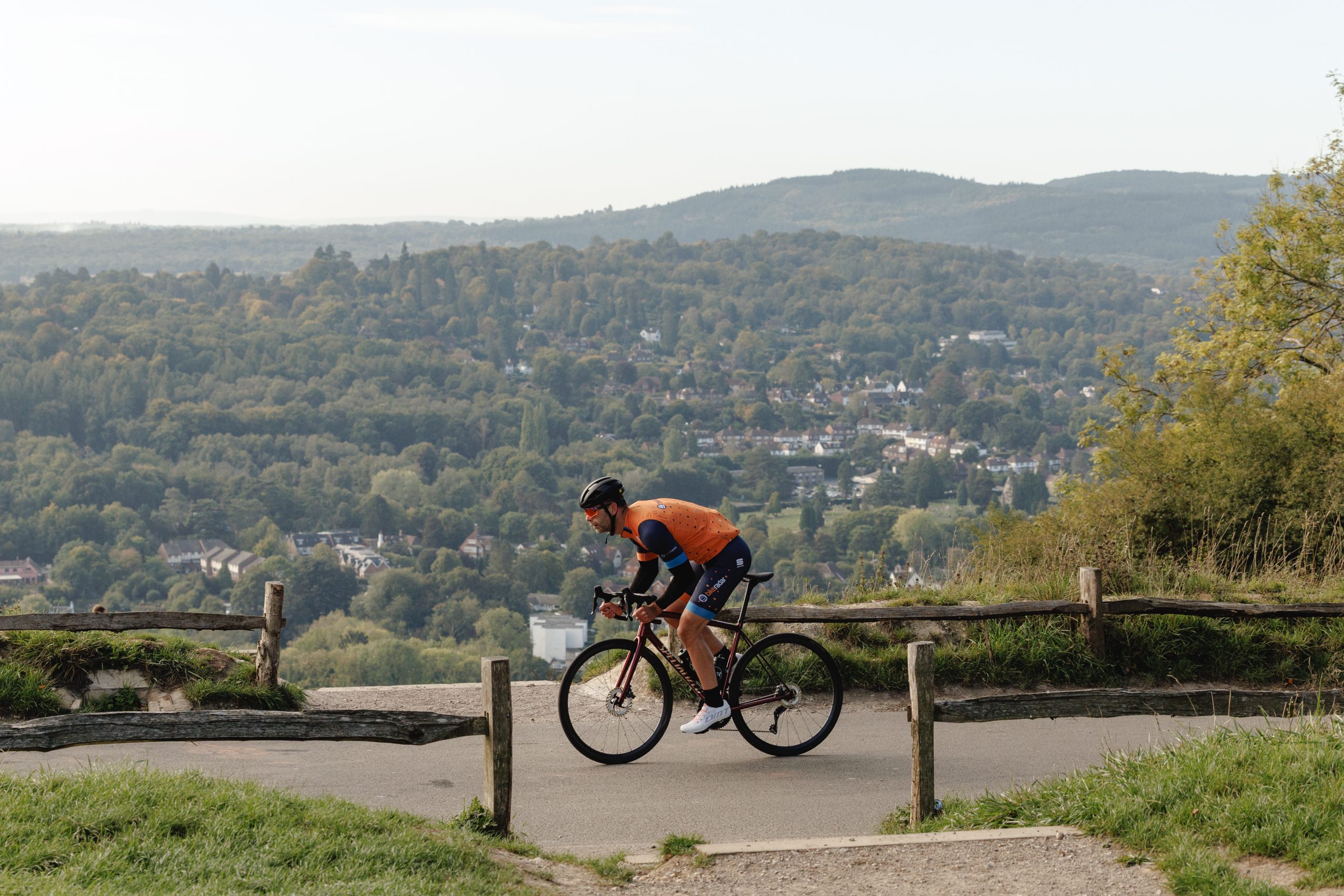
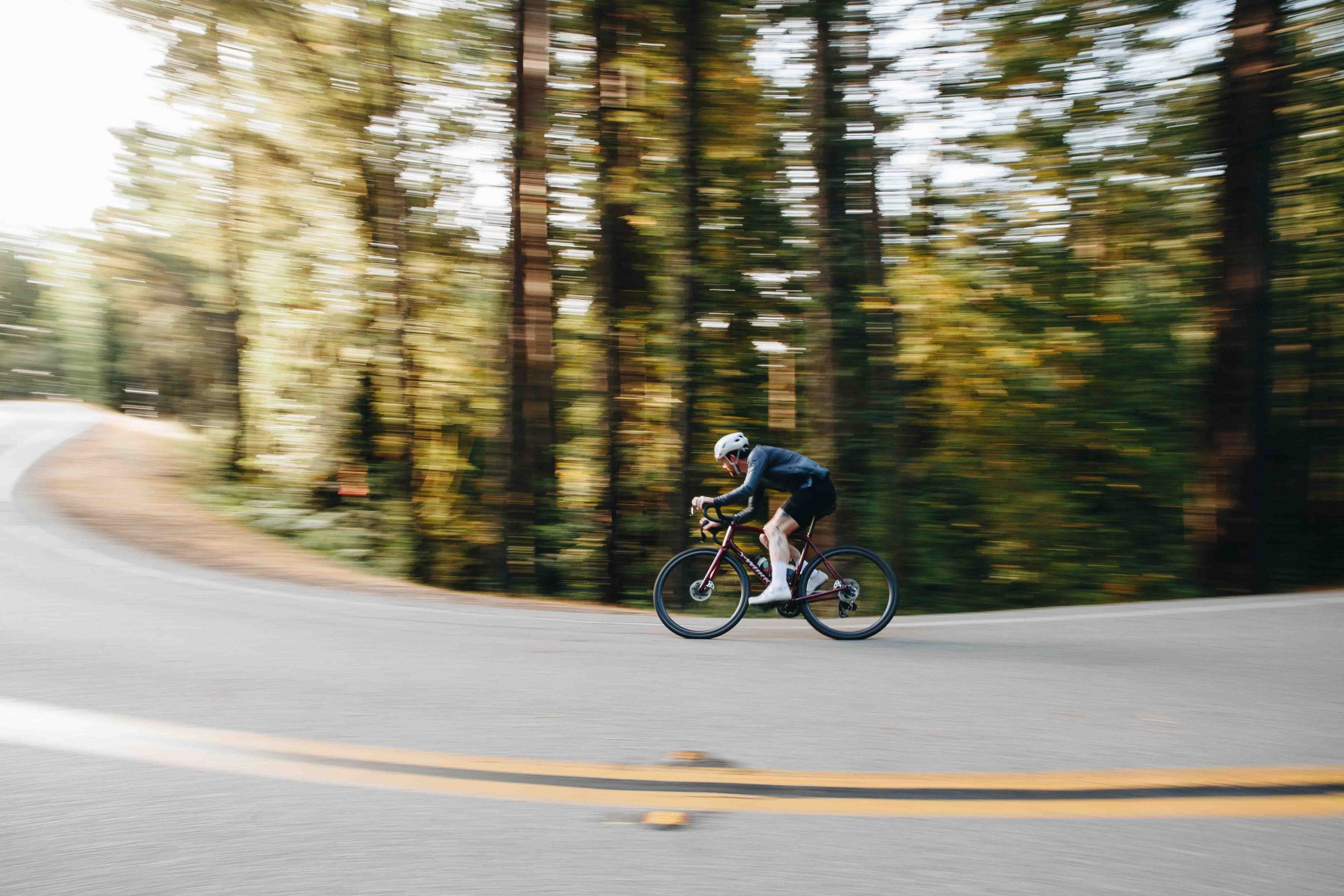
Despite not featuring either the top-spec frame or wheelset, which Specialized insists aren’t as stiff as they could be by design, the Aethos offered an impressively easy-going ride quality on a 78km loop through the Surrey hills.
Heavy textures, and lumps and bumps are dealt with remarkably well considering the tyres are ‘only’ 28mm wide to match the 21mm-wide internal channel.
It’s accepted that bigger tyre sizes run at correspondingly low pressures will soften a ride, all things being equal, but I’d argue the Aethos proves other parts of a bike still have a key role to play. Still, making more of the widened tyre clearance to fit, for example, 32mm tyres is a tantalising prospect.
The handling is excellent – much like the Addict RC, it impresses by being so easy to ride from the get-go, yet it’s still agile and responsive.
You’re propped up more on the Aethos. That means, all things being equal, you should need to run fewer spacers than you otherwise would have. Honor Elliott / Specialized
I haven’t ridden the old Aethos, but the geometry was practically identical to the Tarmac SL8 that followed it. I found that geometry layout hard to fault, but it begged the question, why would anyone opt for the Aethos over the Tarmac on fit or handling grounds?
The new Aethos’ slightly slackened head tube and lengthened rear-centre might have done the trick to separate the two, though.
The 15mm-taller head tube also means more people will be able to ride one more comfortably. While I’ll look to dial my fit beyond supplying a few basic details and noodling around a car park when we receive a test bike for a full review, the benefits are plain on paper.
A teary goodbye to external routing?
Brake hoses make a brief appearance still. Ashley Quinlan / Our Media
Specialized’s decision to follow convention and update the Aethos with full internal cable routing will divide opinion.
It’s part of what made the old Aethos stand out from the crowd, as well as being more customisable and easier to service than its competitors. For that, I lament its passing.
That said, phrases such as ‘brought up to date’ and ‘modernised’ are easily recalled from my time spent with Specialized’s product leads, while I’m told the move reflects what would-be customers are asking for.
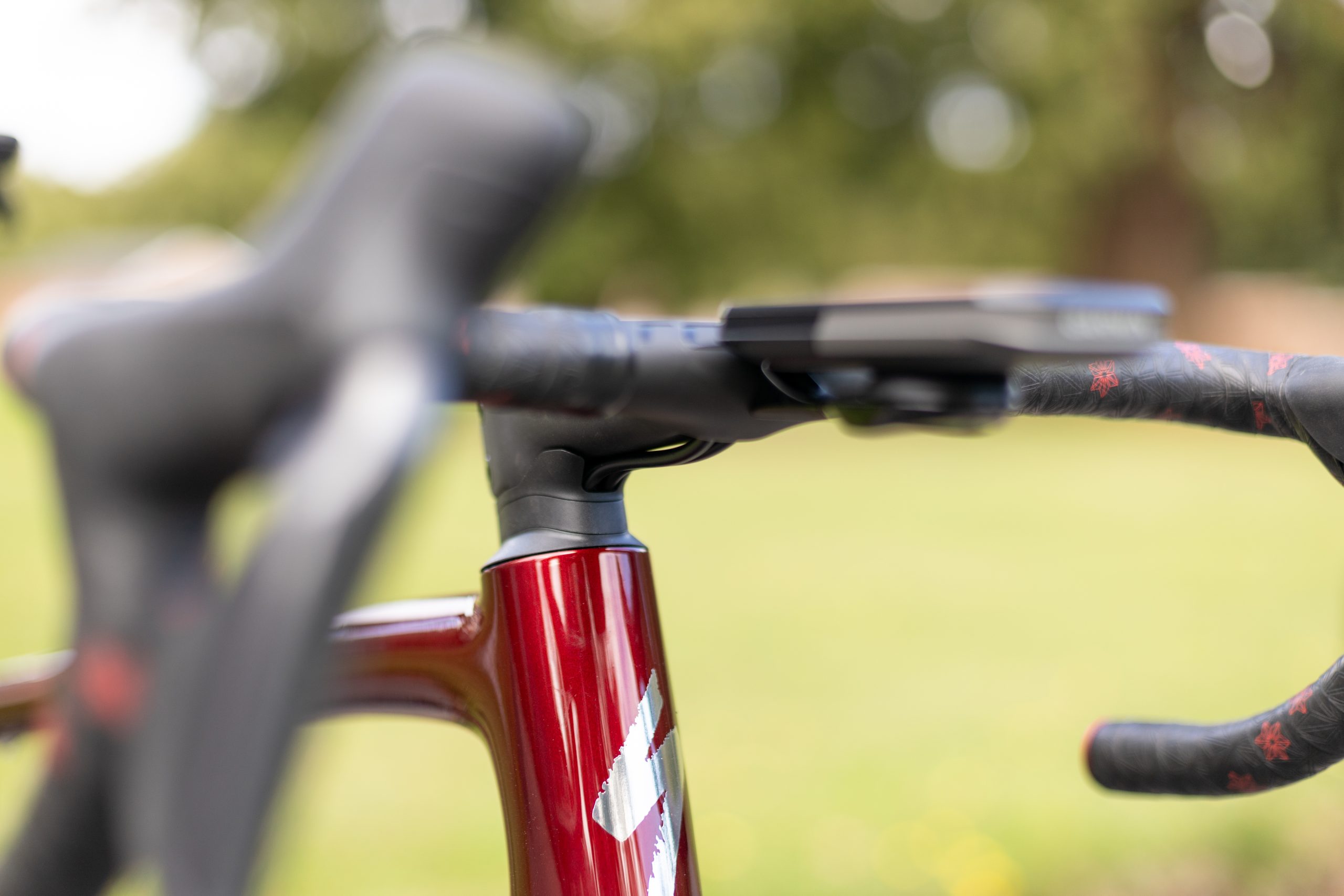
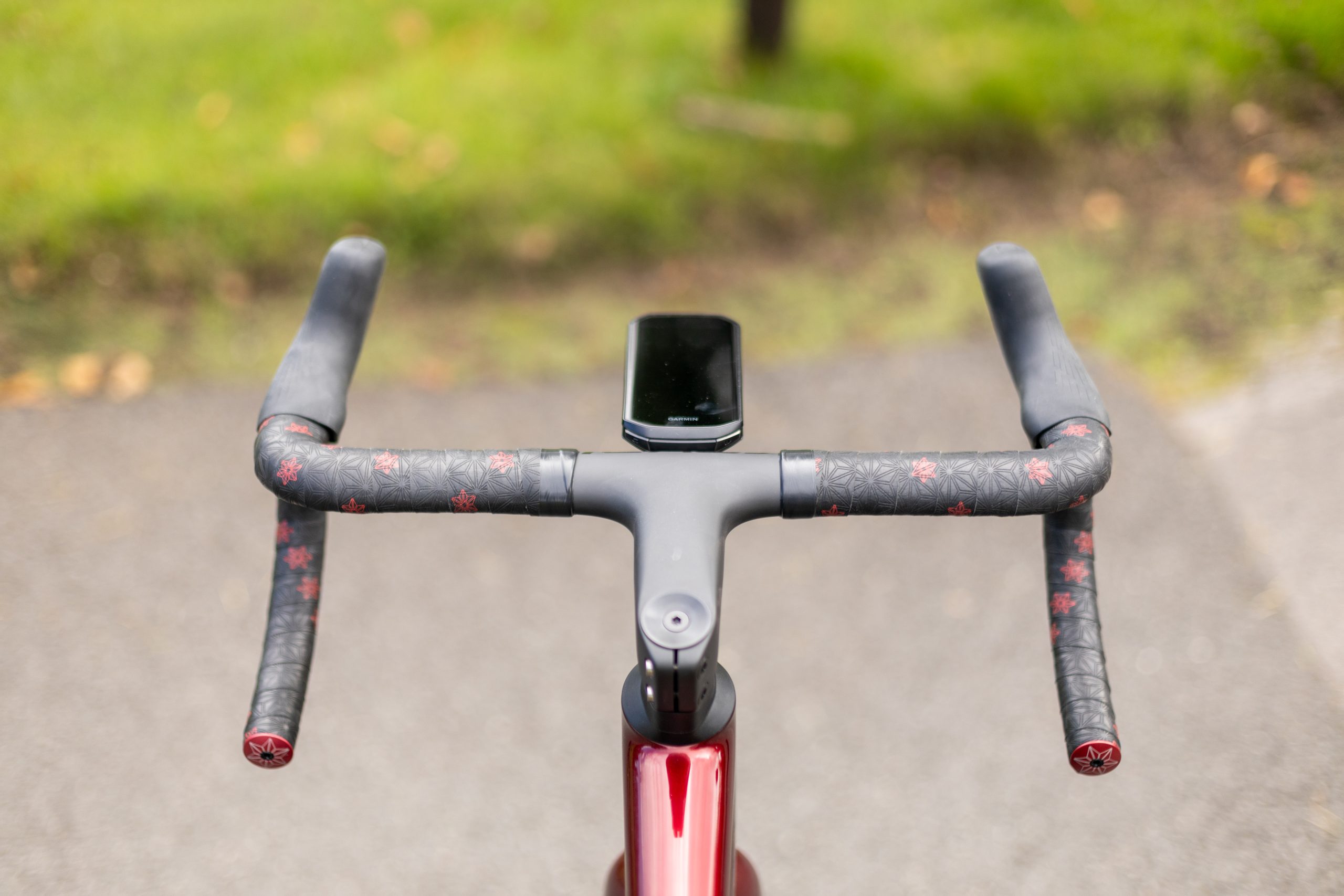
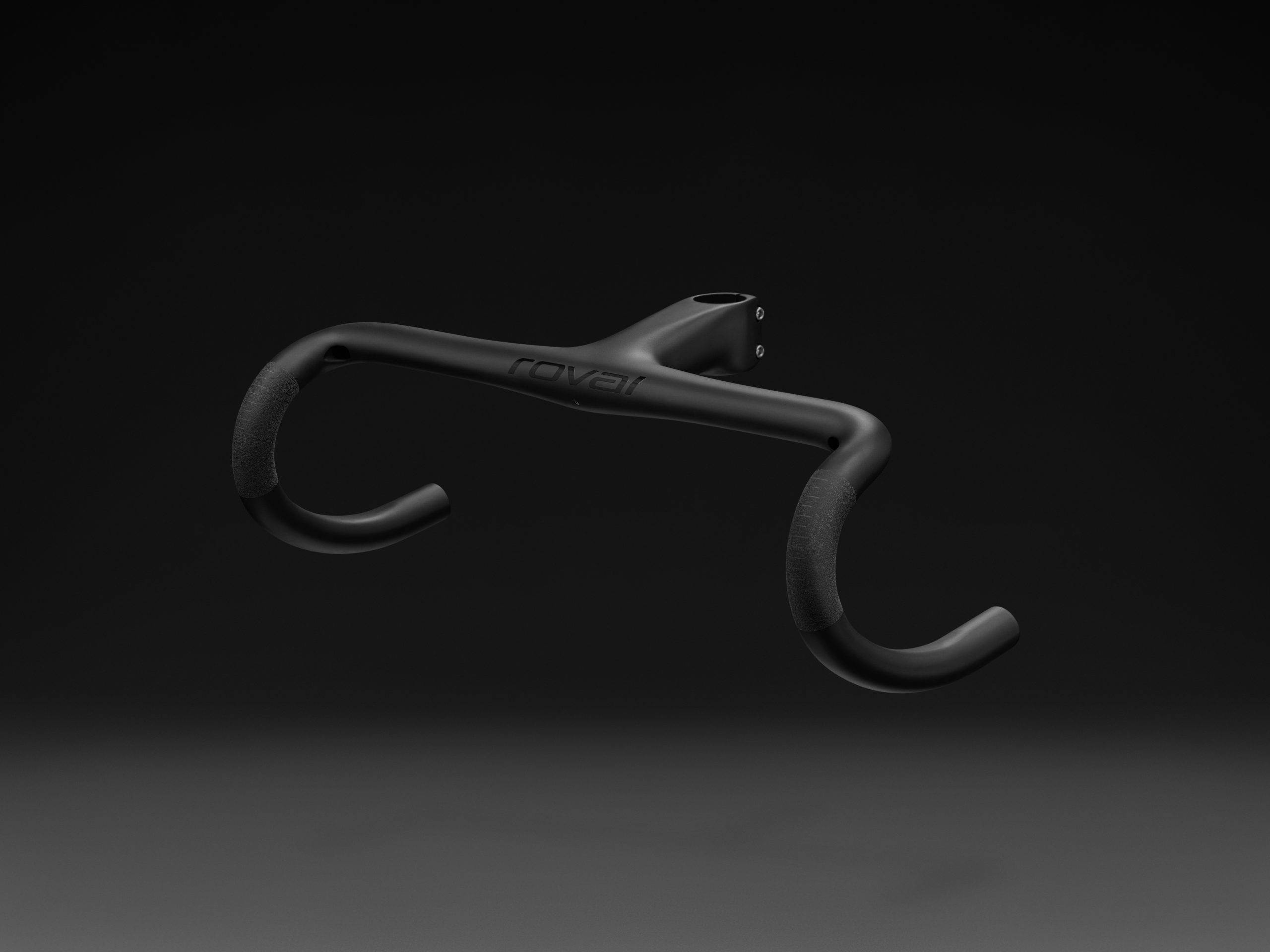
The Alpinist II cockpit is easy to get on with, but the tops could be just a touch deeper. Ashley Quinlan / Our Media
As it is, the Alpinist II cockpit is well thought-out – it’s easy to move around it from the hoods to the drops and up to the tops, and the 4-degree flare keeps things compact but feeling planted. The profile of the tops is good too, although I’ve fairly large hands, and found myself wishing for a couple more millimetres of breadth than delivered.
While many will lament the loss of a two-piece, externally routed layout, you can at least fit your own favoured cockpit from a wide choice, given the standard steerer shape.
Specialized Aethos 2 Pro Di2 initial verdict
The Aethos 2 is an improvement on the old bike, but you might need to buy an S-Works version to feel it. Honor Elliott / Specialized
After my initial test ride, it’s clear the Specialized Aethos 2 is an incredibly good bike. It might not stand out in quite the same way as the old one, but that doesn’t necessarily matter.
More important is that the tweaks to the frame appear to have improved the recipe for most riders – both in terms of handling and fit.
However, it’s a shame that the S-Works bikes are now set a little further apart from the more affordable models on paper, and perhaps in the real world too.
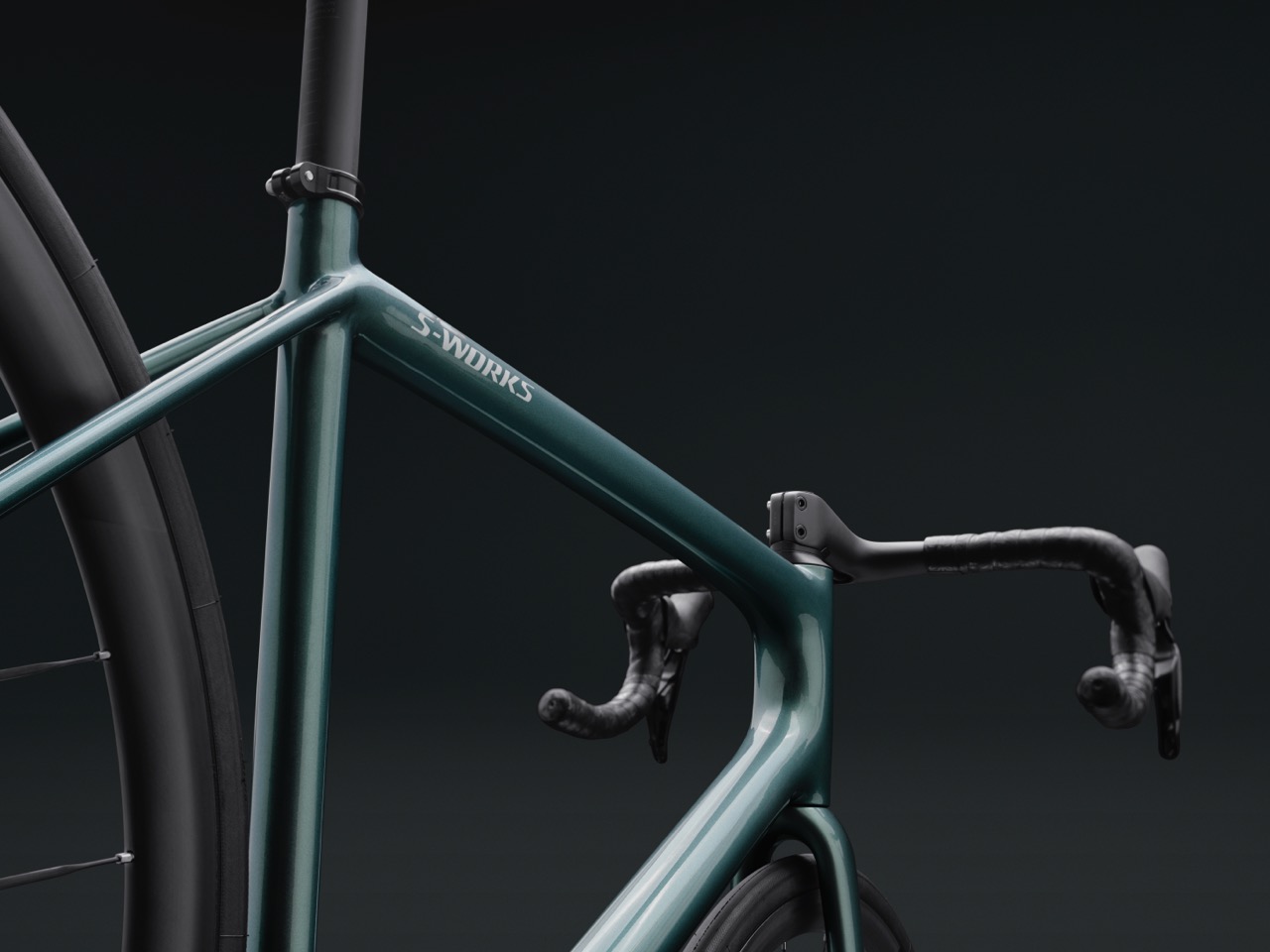
Specialized has unveiled the new Aethos 2 – the lightest road bike it has ever produced, and sporting several new modern features that bring it up to date with 2025 road bike design trends.
This has meant a move to full internal routing via Roval’s latest Alpinist II cockpit and the same headset layout as seen on the Tarmac SL8.
While this might be to the chagrin of fans of the original bike, Specialized says this main change was made to meet the evolving demands of its customers.
Alongside this, the frame has seen an update to its geometry to make it more comfortable to ride, a move to SRAM’s UDH (Universal Derailleur Hanger) standard, and a rise to 35mm tyre clearance.
An S-Works Aethos frame is said to weigh 595g, yielding a 5.98kg total build weight for the range-topping SRAM Red AXS spec, which costs £11,499 / $13,999 / €13,499.
The Aethos 2 sees internal routing throughout. Specialized
The old Aethos featured a two-piece cockpit with cables routed externally. These entered at the top of the down tube and fork shoulder, but the Aethos 2 sees cables fully integrated via sibling brand Roval’s new Alpinist II one-piece cockpit launched 48 hours prior.
Specialized says the move reflects the growing demand for “aesthetically pleasing” integrated front ends (compared to externally routed bars and stems). The Alpinist II cockpit is available in 15 sizes for customers at point of purchase.
That said, those hoping to build up an Aethos 2 from scratch with an alternative handlebar and stem are still able to adopt a two-piece design via a special headset adaptor – they’ll just need to bear in mind that the brake hoses must enter through front-facing ports in the bearing, like a Tarmac SL8.
The move to internal routing has also seen the removal of the down tube port that would house gear cables for mechanical shifting – accordingly, the Aethos 2 frameset can now only sport electronic drivetrains.
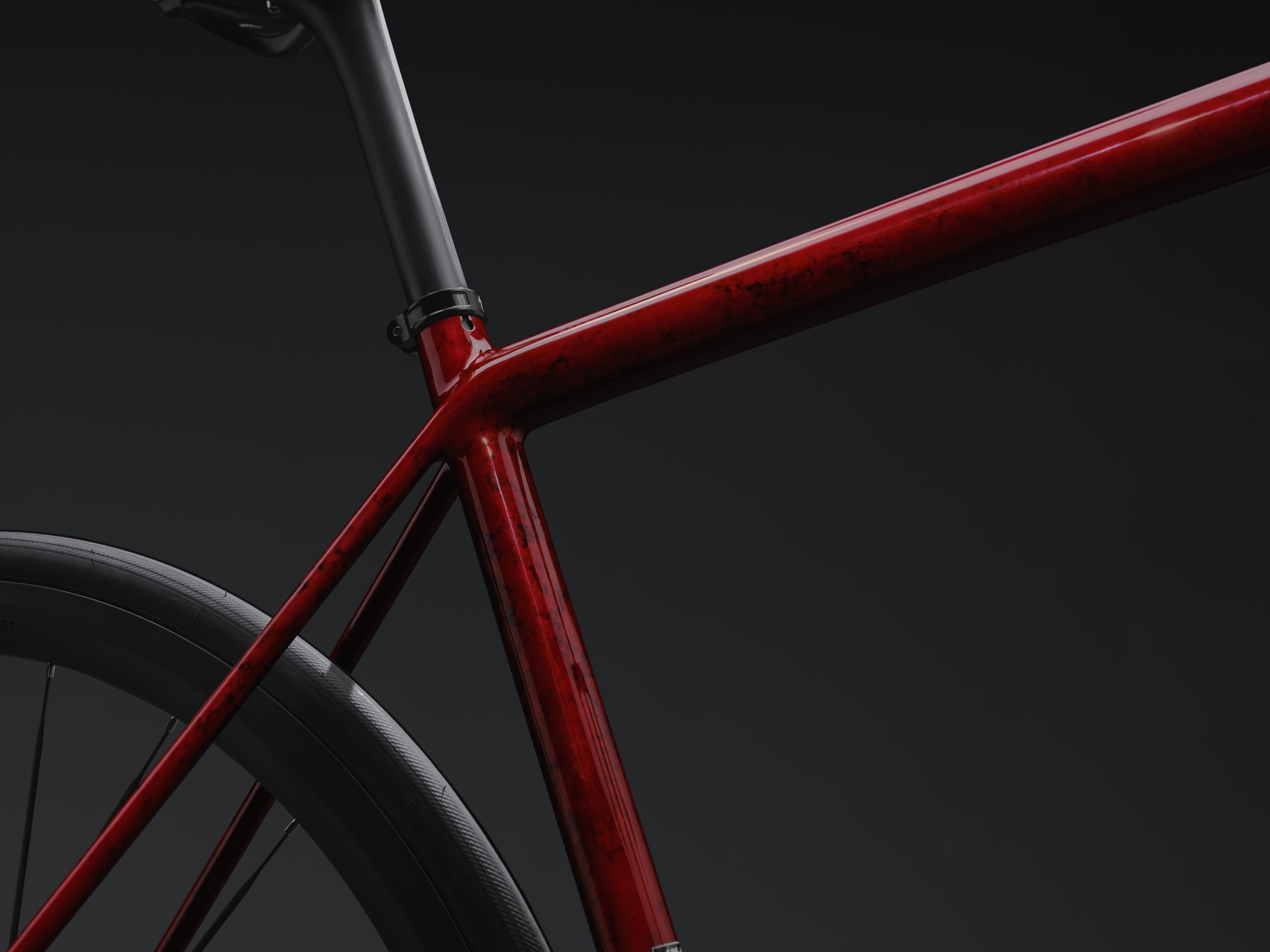
The clean frame lines remain, but Specialized says the triangle joins have been strengthened compared to the old bike. Specialized
Specialized says it has given the carbon layup an overhaul, strengthening the triangle joins, while aiming to improve compliance and ride smoothness.
The brand’s marketing machine calls the process ‘Flow State Design’, whereby it prioritises developing rounded tube shapes (which are claimed to bear stresses more efficiently) versus adding layers of carbon to improve stiffness.
At the rear, the dropouts now meet SRAM’s UDH standard. The move saw the dropout gain “significant” extra material, according to Specialized’s road and gravel category lead, Alex Jerome.
Tyre clearance has increased – up from 32mm to 35mm. Specialized
The head tube has also been made 15mm taller as part of a geometry rethink, adding further material to the frame.
To combat the weight gain, marginal savings are seen at the seat clamp (-9g), brake mounts (-2g) and bottom bracket cups (-6g), plus a custom derailleur hanger (-2g).
All in, the S-Works frame, formed using Specialized’s Fact 12r carbon, is said to weigh 595g in a size 56cm – only 10g more than the previous-generation bike. That’s 62g less than the claimed weight of Cervélo’s latest R5 and 0.7g less than the claim attached to the Black Series Corsa frame in a size medium (broadly equivalent to 54cm in Specialized’s parlance).
The ‘standard’ Fact 10r carbon frame, used for all bikes specced below the S-Works level, is claimed to weigh 705g.
Is the Aethos an endurance bike?
The Aethos 2 is designed to bridge the geometry gap between the Tarmac race bike and Roubaix endurance bike. Specialized
The new Aethos is not quite an endurance bike, although Specialized concedes it landed on the taller head tube to contribute to a more comfortable ride position for more riders.
The head tube has also been slackened by 0.5 degrees (on average through the size range), and the chainstays lengthened by 7mm. Specialized says this makes handling smoother and more stable overall.
Meanwhile, the bottom bracket drop has lowered by 3mm. In isolation, Specialized claims this makes cornering feel more “planted”, while compensating for the use of wider tyres relative to the previous Aethos.
Tweaks to the bottom bracket area, plus the extension of the chainstays, see tyre clearance climb to 35mm (measured, up from 32mm), with the ISO-mandated 4mm space around a tyre measuring that wide.
The new Alpinist 2 cockpit will come supplied on S-Works and Pro-spec bikes. Expert models will get the old Alpinist cockpit. Specialized
Specialized says the second-generation Aethos frame is designed to dovetail with its latest Roval Alpinist components.
The Alpinist II cockpit is the main change, of course, which Specialized says has been optimised to damp ride vibrations by 28.3% compared to the Rapide cockpit used for the Tarmac SL8.
The two are interchangeable, however, with the cockpits and frames using the same standards and internal-routing layout.
Specialized says customers of S-Works and Pro-level bikes have free choice of 15 Alpinist II cockpit sizes at point of purchase, which can be arranged via its dealers. Expert-spec buyers will have a size choice of the old cockpit. The same applies to the Alpinist seatpost, which can be had in a setback or inline format.
You’ll only get the Alpinist CLX III wheels with the S-Works bike. Specialized
The seatpost has remained the same as previously, retaining the standard 27.2mm round shape, save for the modified seat clamp. Specialized says this new clamp will be available as an aftermarket upgrade.
Roval supplies its Alpinist CLX III wheelset with the two S-Works-spec bikes, which is also claimed to have been optimised to work with the Aethos 2 frameset.
Alpinist CL II wheelsets will be supplied with Pro-spec bikes, and the C38 with the Expert bikes, but it’s worth noting the rim beds have seen a “rolling change” to make them “fully compliant” with ETRTO/ISO standards, according to Roval product lead, Chris Whelan.
Specialized Aethos 2 pricing, specs and claimed weights
I had a chance to sample the latest Aethos with a Pro Di2 build. Ashley Quinlan / Our Media
The Specialized Aethos 2 range includes two S-Works level bikes, weighing 5.98kg (in a size 56cm) with a SRAM Red AXS groupset, and 6.05kg for a Shimano Dura-Ace Di2 R9200 version. These cost £11,499 / $13,999 / €13,499.
There are four ‘standard’ bikes, with prices starting from £5,499 / $6,999 / €6,299. Unlike the previous Aethos, there is no 105 Di2 R7100 or Rival AXS built bike, or (of course) mechanical builds.
Specialized S-Works Aethos 2 AXS
Price: £11,499 / $13,999 / €13,499
Groupset: SRAM Red AXS
Power meter: Yes, Red AXS (dual-sided)
Wheelset: Roval Alpinist CLX III
Tyres: S-Works Turbo TLR, 700x28c
Claimed weight: 5.98kg
Specialized S-Works Aethos 2 Di2
Price: £11,499 / $13,999 / €13,499
Groupset: Shimano Dura-Ace Di2 R9200
Power meter: Yes, 4iiii Precision Pro (dual-sided)
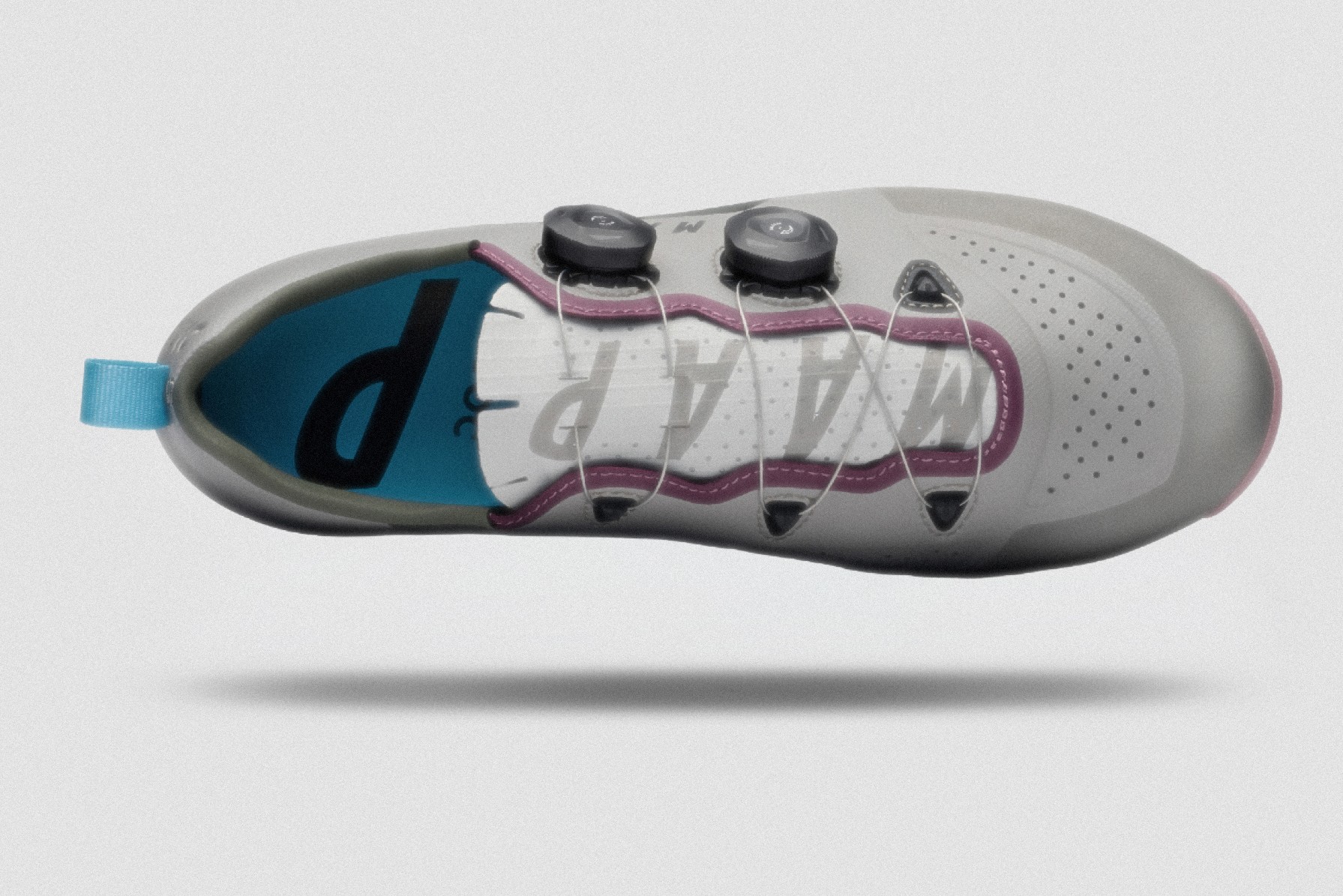
Cycle clothing brand MAAP and shoe maker Quoc have teamed up for another limited-edition gravel cycling shoe.
The latest MAAP x Quoc Gran Tourer XC shoes come in a new Graphite colourway. As you’d expect from the name, the predominant colour is grey, although the tone looks a little light for pure graphite.
That’s probably a good thing, while the pink sole lugs and blue Alt_Road rear pull tab add a flash of colour to liven things up further.
There’s more deviation from the non-MAAP Quoc Gran Tourer shoe with larger perforations for ventilation and a ribbed TPU tongue with the MAAP wordmark.
There’s a special ribbed tongue for the MAAP x Quoc collaboration.
It’s the third collaboration between the two brands, which have previously offered the Gran Tourer XC shoes in a special Fog colourway and the Quoc M3 Pro is a range of colours.
Quoc has form for novel shoe colours, having launched shoes in a shade inspired by the colour of mushrooms growing in the mountains of Taiwan.
Aggressive lugs can be complemented by screw-in toe studs.
The MAAP x Quoc Gran Tourer XC shoes include a carbon sole under the TPU tread, with replaceable toe studs. The uppers are made of abrasion-resistant microfibre with a reinforced toe guard and are closed with two of Quoc’s proprietary dials. The shoes’ claimed weight is 654g a pair (size not specified).
We’ve previously reviewed the Quoc Gran Tourer II, another Quoc gravel bike shoe design but with just a single dial on each shoe, and were impressed by the quality and weather protection, as well as the ultra-grippy sole.
If you want to get your hands on the new MAAP x Quoc Gran Tourer XC shoes, they’re available on the two brands’ websites and from some Quoc or MAAP retailers in full sizes from 38 to 47. They’re priced at £250 / $330 / €295 / AU$480.
Canyon has expanded from manufacturing bikes to introduce its own carbon wheels. Its first wheelset is the GR30 CF, which it will sell standalone as well as fitting it to two specs of the 2025 Grizl gravel bike. It promises additions to its wheel line-up in 2026.
According to Canyon’s senior product manager, Maxime Brunand: “This is a new chapter in the Canyon story. We’re entering the wheel market with decades of cycling know-how and expertise distilled into a trusted performance product that works in perfect harmony with Canyon bikes.”
Canyon has built its own testing facilities in its production centres, aiming to ensure top quality in its new wheels, which are not yet available to US buyers.
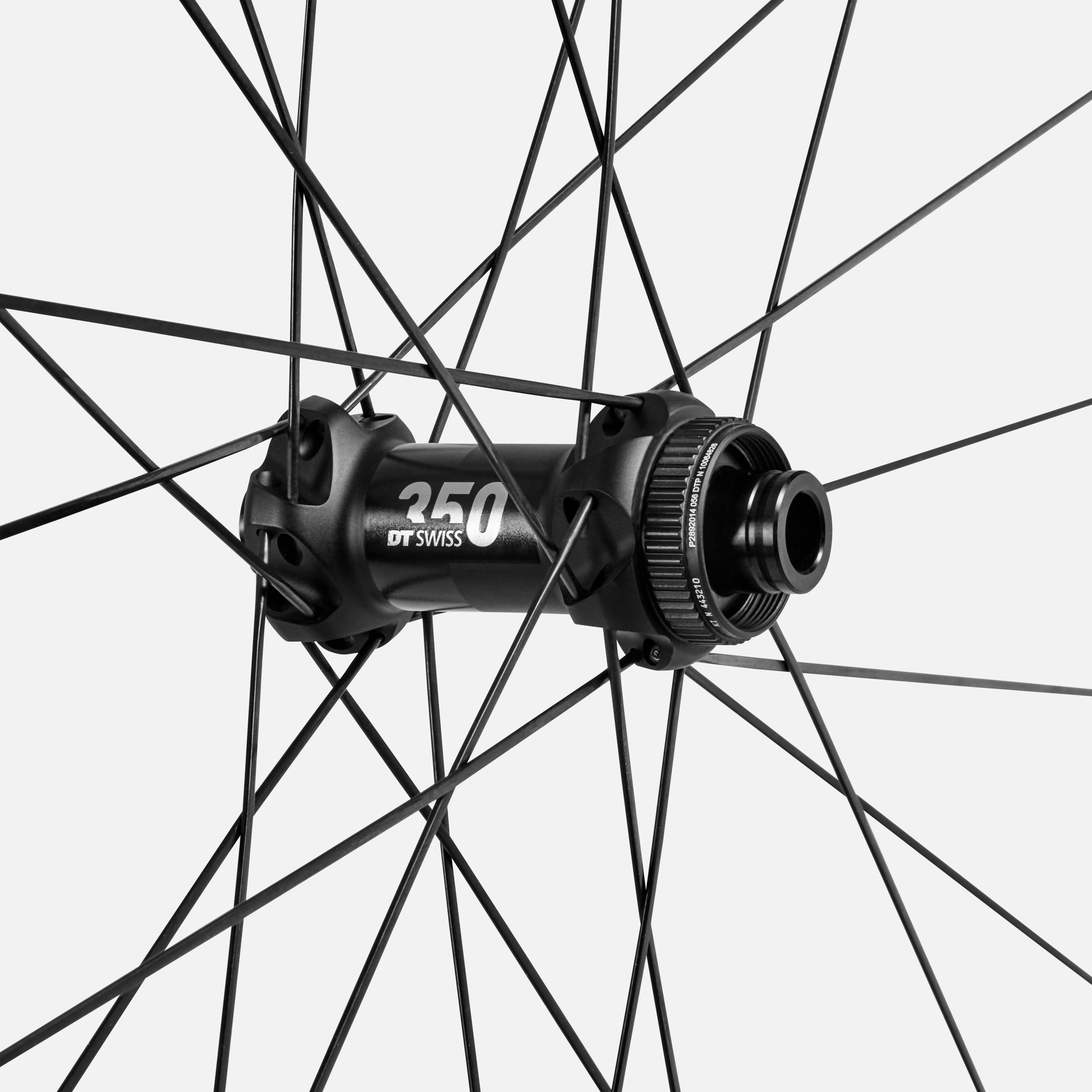
Canyon has specced DT Swiss 350 hubs and DT spokes on its new wheels.
The new wheels, as their name denotes, are 30mm deep and have a wide 27mm internal/33mm external-width hookless rim. Canyon claims a 1,525g weight for the GR30 CF wheelset – 715g for the front and 810g for the rear wheel, including rim tape.
Canyon’s new wheels are laced to DT Swiss 350 Spline hubs, which Canyon says have an unbeatable reputation for reliability and performance. Canyon also looks to DT Swiss for its Aerocomp straight-pull spokes.
Tyres up to 54mm wide
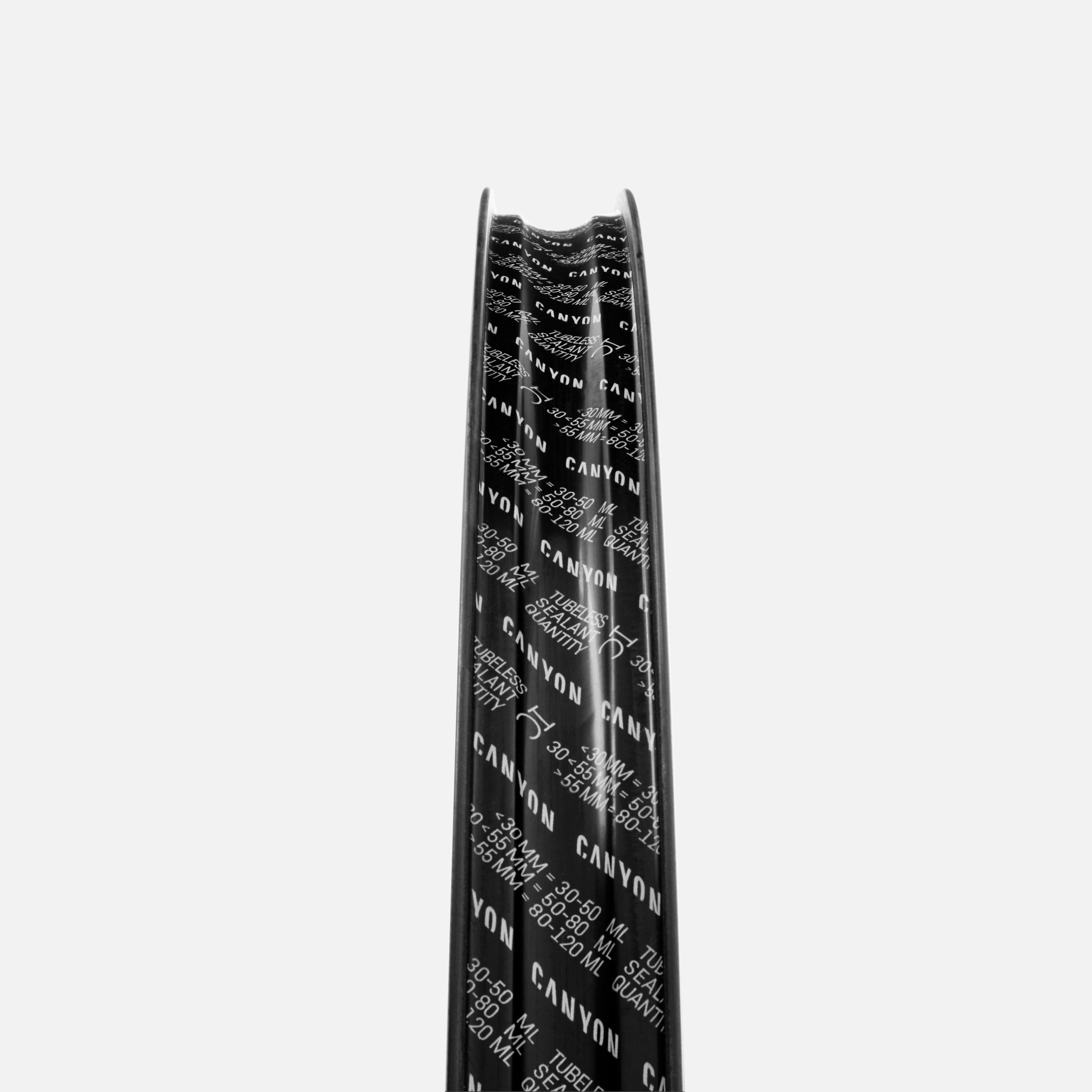
The 27mm internal-width hookless rim is printed with tyre width and pressure guidelines, and the rim tape recommends how much sealant to add.
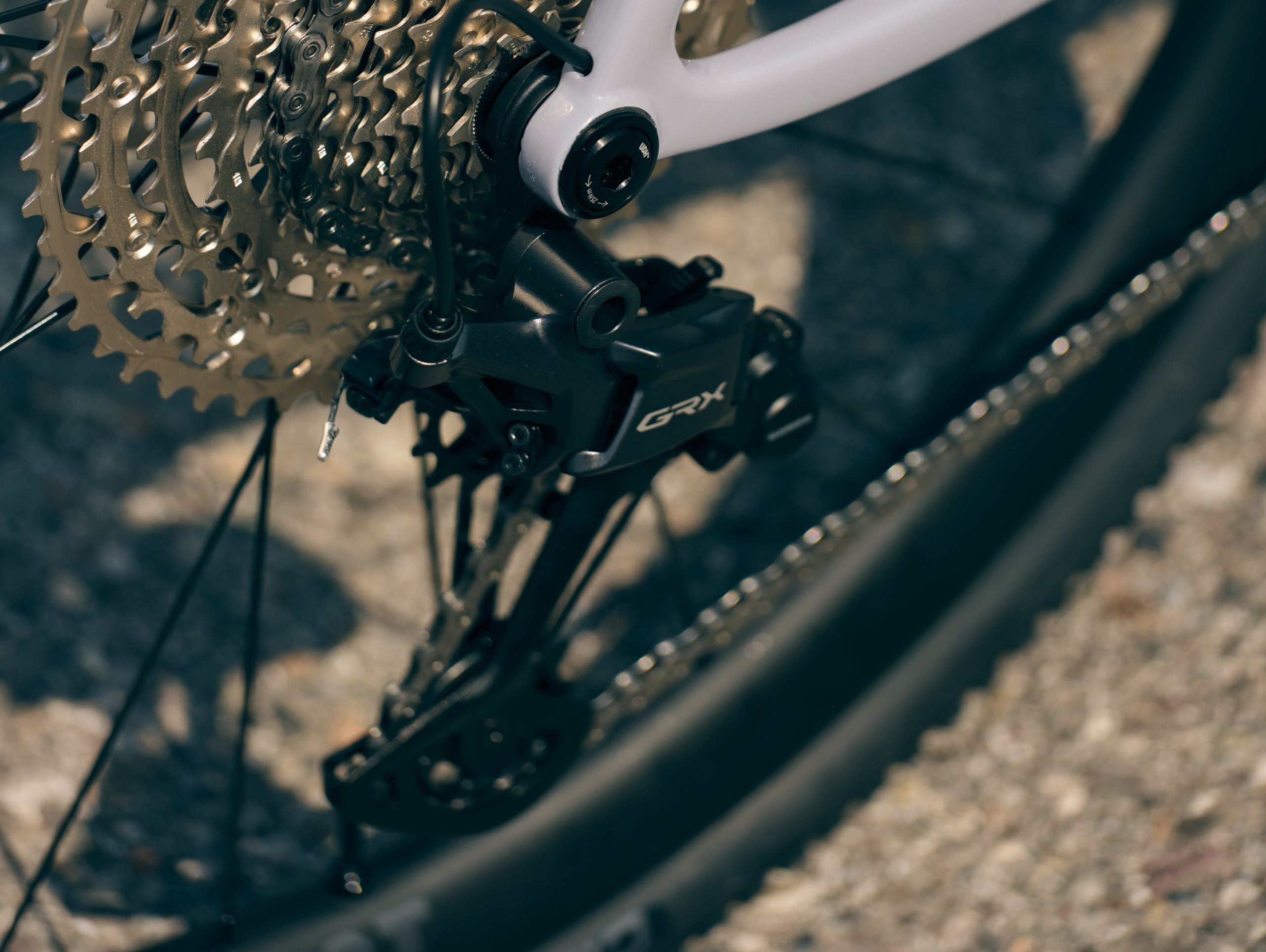
The wheels come ready-fitted with a Shimano Micro Spline freehub for compatibility with Shimano GRX 1×12-speed groupsets. They’re supplied with a SRAM XDR freehub body too, so you can convert tool-free to run SRAM cassettes. Canyon also supplies tubeless valves.
To make it easy to ensure tyre compatibility, the GR30 CF wheel rims are printed with tyre-width compatibility details and recommended pressure ranges. Canyon says you can use the wheels with gravel bike tyres up to 54mm wide. Its rim tape is printed with recommended sealant volumes.
The Canyon GR30 CF wheels are priced at £859.95 / €899 a set, significantly lower than many competitor gravel bike wheels. They’ll also be specced on the Canyon Grizl OG CF 8 Di2 and Canyon Grizl CF 9 Escape gravel bikes.
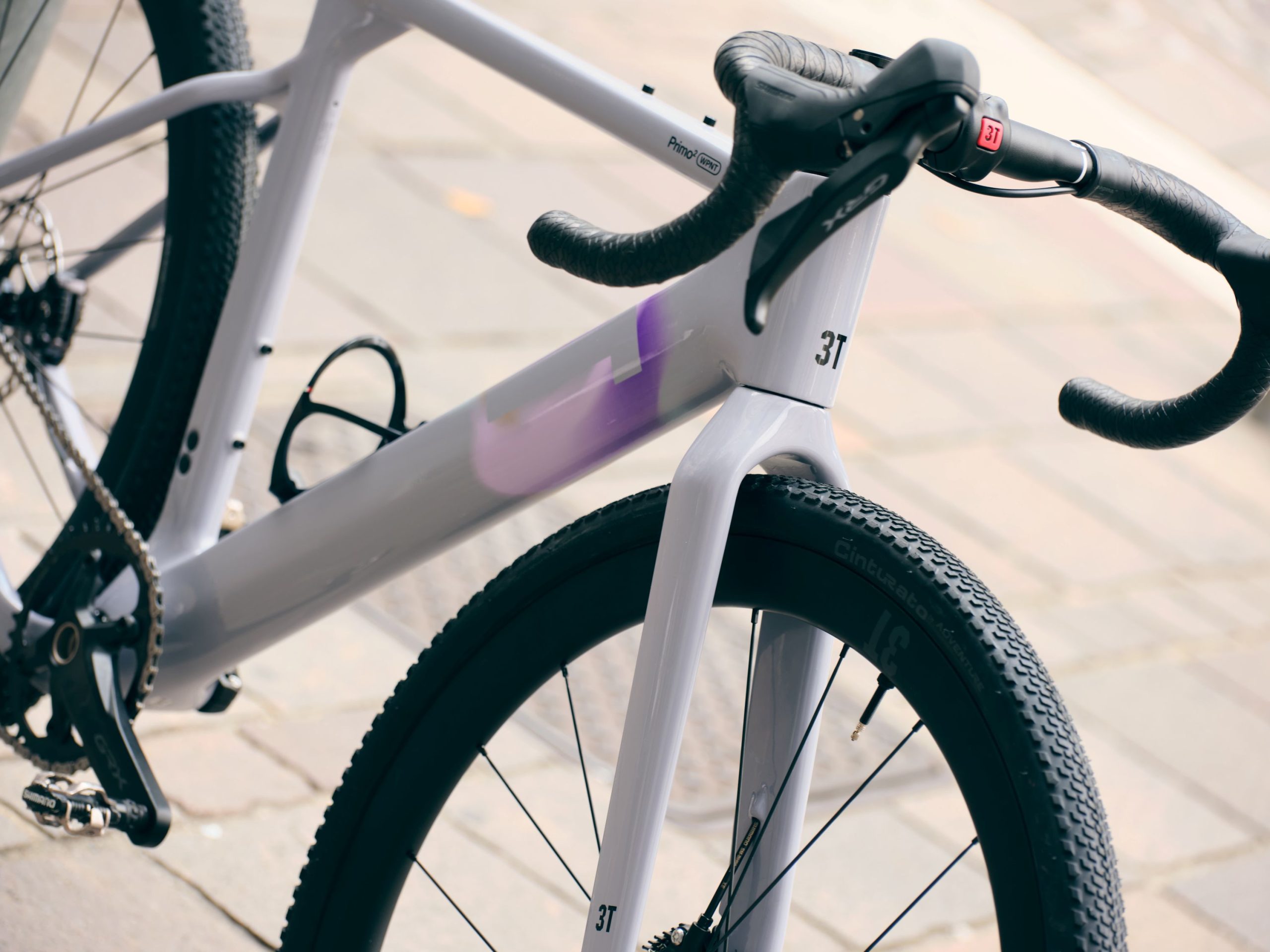
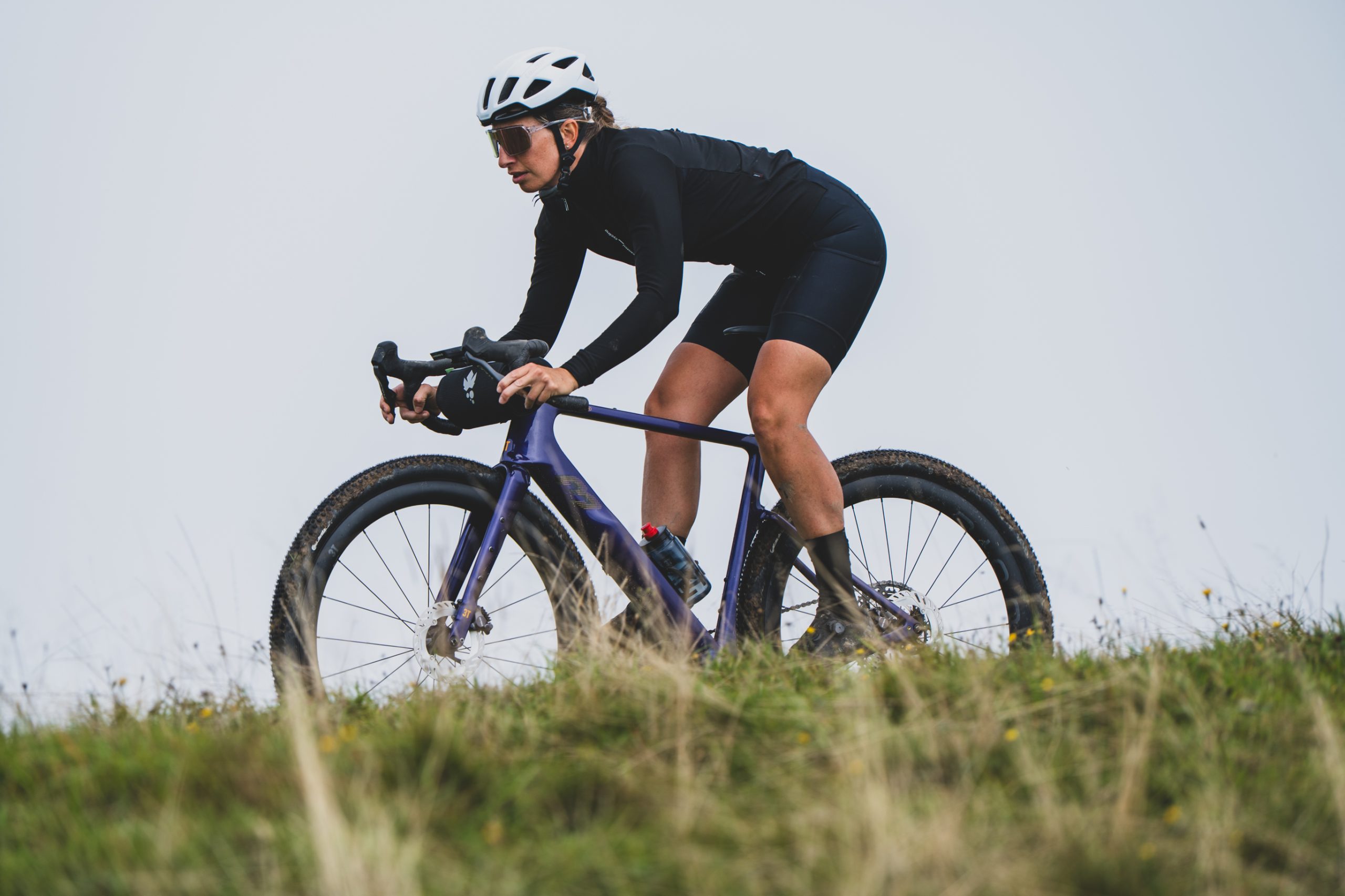
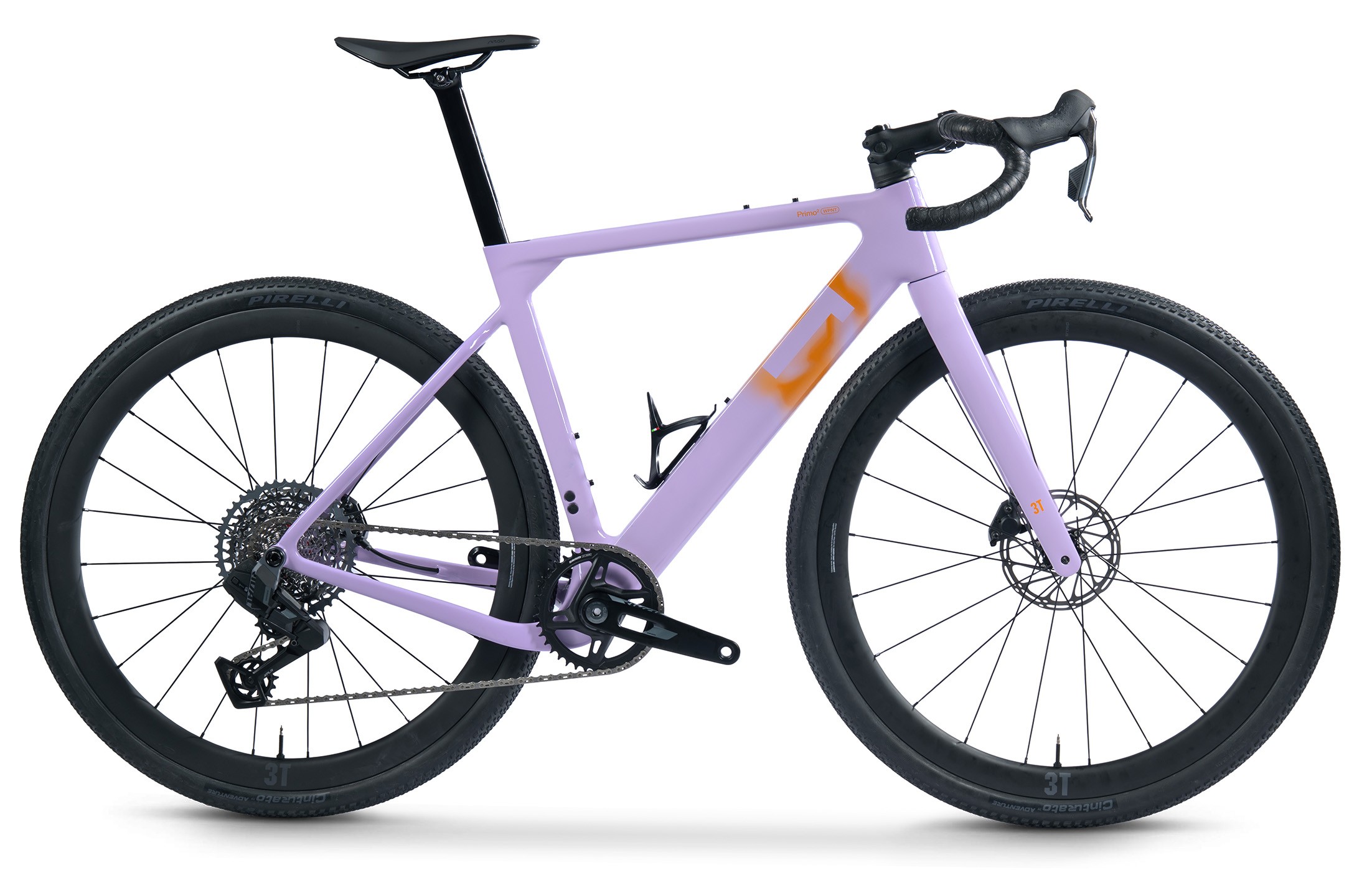
3T has launched the Primo2 WPNT, updating the Exploro to incorporate features typical of modern gravel bikes.
The WPNT suffix denotes ‘we paint’, with the new frame painted in-house at 3T’s headquarters near Bergamo, Italy.
The original 3T Exploro was groundbreaking when it was launched in 2016, offering wide tyre clearance and aerodynamics in a gravel bike. It’s spawned a whole family of 3T gravel bikes with ever-increasing clearance and more extreme geometries.
The Primo2 WPNT updates the design of the original Exploro with more modern features, which weren’t typical in gravel bikes – or drop-bar bikes in general – back in 2016.
SRAM UDH increases the range of compatible groupsets.
So the Primo2 WPNT has internal cable routing rather than external cabling from the bar. There’s also a swap to a Universal Derailleur Hanger, another item that’s increasingly specced on modern bike frames and which opens up compatibility with SRAM’s Full Mount 13-speed XPLR groupsets.
The frame is compatible with both 1x and 2x groupsets, and either mechanical or electronic shifting.
There’s a 15mm increase in bar height to accommodate the integrated cable routing.
What 3T hasn’t changed, though, is the geometry. It says that the Primo2 WPNT has exactly the same handling and ride feel as the Exploro and Primo, although it has raised the bar by 15mm to accommodate the cable integration and provide a more relaxed ride position.
The frame is aero optimised for tyres between 35mm and 45mm wide. 3T’s line-up caters for the wider tyres that are increasingly popular on gravel bikes with the Extrema Italia, which enables you to fit tyres up to 57mm wide.
3T’s new paint colours extend to the rest of its range, including the burly 3T Extrema Italia.
Along with the frameset modifications, 3T has a range of four new colours, with the Italian names Gesso, Fumo, Salvia and Orchidea.
There are paint colour updates, too, for the Extrema Italia, Racemax WPNT, Strada Italia and Strada WPNT. There’s an update to the 3T logo across the range too, reflecting 3T’s overall rebranding.
3T Primo2 WPNT outline specs and prices
You can buy a complete 3T Primo2 WPNT bike in three specs:
1×12-speed Shimano GRX plus Fulcrum Rapid Red wheels: £2,800 / $3,699 / €2,705
1×13-speed SRAM Rival XPLR AXS plus Fulcrum Rapid Red wheels: £3,478 / $4,599 / €3,360
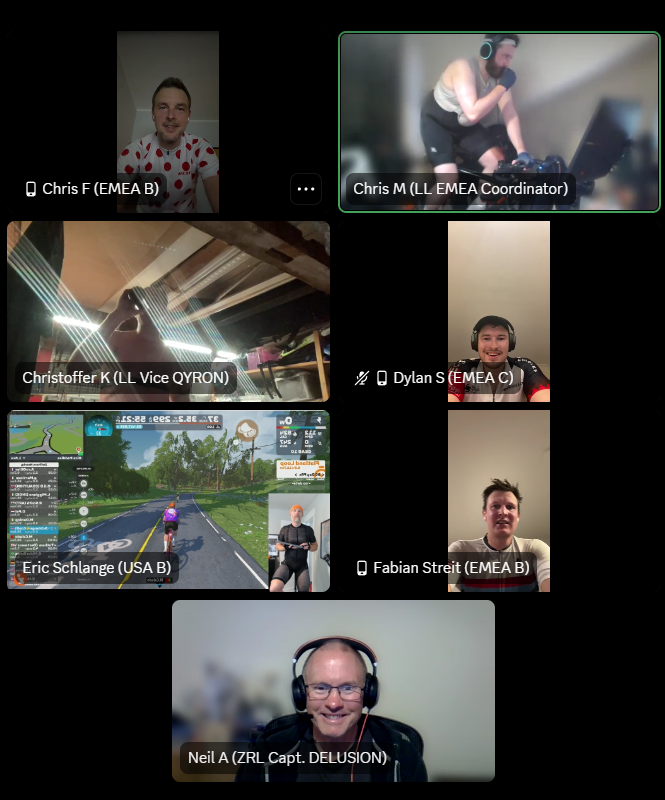
This week my team (Coalition Delusion, racing in the ZRL B1 Development Lime division), took on 8 others in the only scratch race of Round 1. Having raced the course before, I knew it would push me to the limit with its three climbs.
Could I hang on to the front group so I could contest the finish? Only one way to find out…
Planning, Warmup, and Man Flu
As usual, my team was on Discord chatting about the race in the days leading up to the big throwdown. This one was pretty straightforward: a scratch race with three climby bits and a short uphill finish. Each rider’s goal was simply to survive the climbs in the front group, and regardless of whether that happened or not, to finish as high as possible from whatever group we were in at the end.
I got on the bike with plenty of time before the 10am PT race, giving me a full half hour to wake up the ol’ ticker and spin up the legs so I could be ready for what was sure to be a hard start. I was already one dirty chai and a few pieces of Neuro caffeine gum into my warmup by the time I got on the bike, so I was nicely caffeinated. I had also rubbed PR Lotion into my legs to keep the burning at bay.
My Warmup “Stack”
There was just one hitch in my raceday plans: I was getting sick. The night before, I’d noticed a sore throat, then the morning of the race I woke up with that flu feeling. You know the one, where your arm hair is sore to the touch? I felt a bit feverish and generally sore, but I could tell it hadn’t hit me fully, and I didn’t want to make my team scramble for a sub at the last minute. So I soldiered on, hoping t wouldn’t affect me too much.
A Sketchy Start
I almost lost the race before it even began.
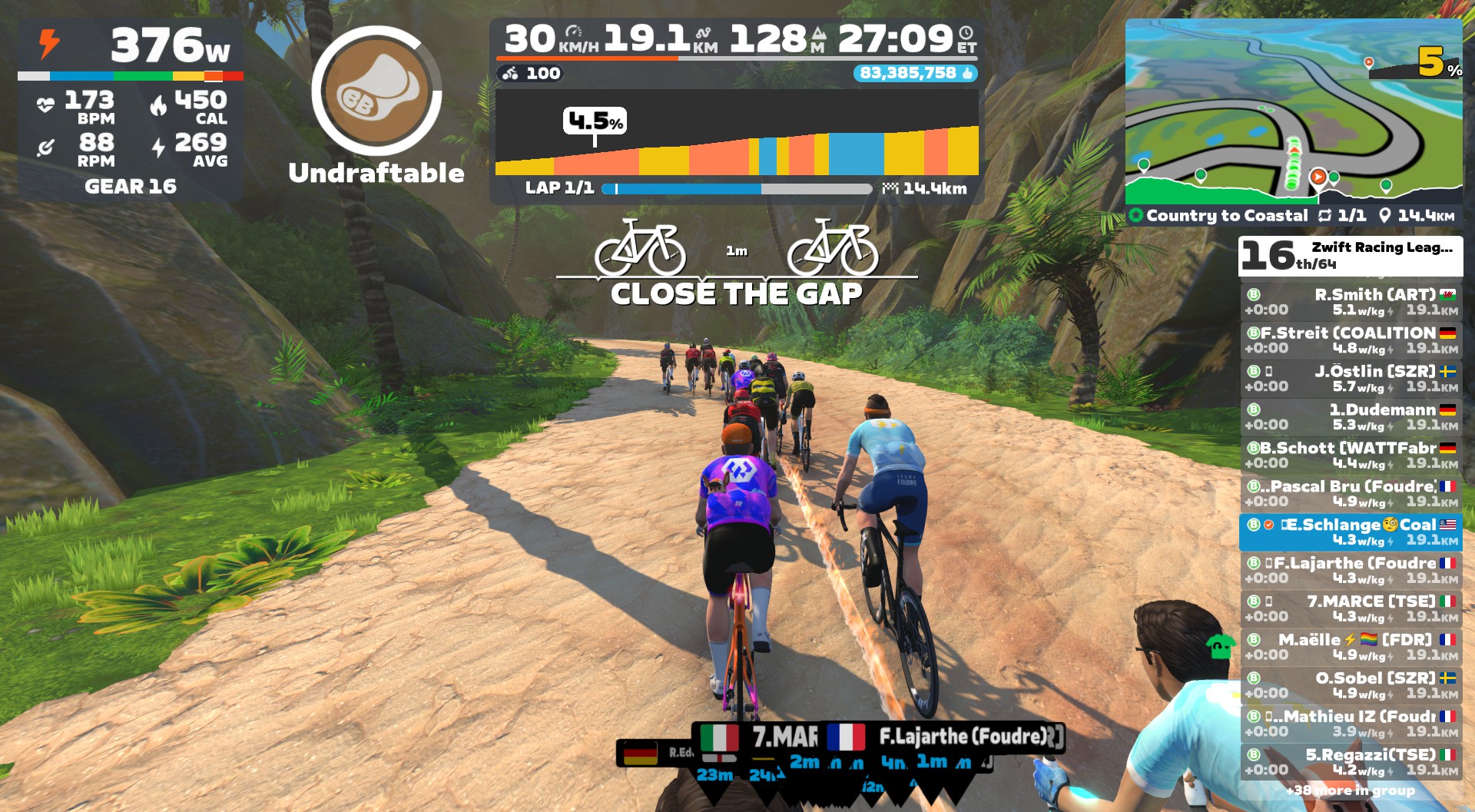
I was running an odd trainer/power meter setup, because I’m still testing the Wahoo KICKR Core 2. I had noticed it was reading extra low recently (3% or so below my Assioma pedals), so I decided I would pair the Assiomas as my power source, but also pair the Core 2 as resistance and cadence so I could use virtual shifting.
That would have worked fine – except I decided to dual record it by booting up a Zwift session on another PC and connecting my test account to it, pairing the Core 2 as power source so I could record the Core 2’s data.
I could have sworn this had worked fine the week before. And it seemed to work fine during my warmup (although looking at my video below, it actually wasn’t working there either. I just hadn’t noticed.)
I didn’t notice the problem until 2 minutes before the race started. Here’s the full play-by-play, pieced together by watching my race video.
-2:00: Re-pair trainer as Resistance and Cadence. Virtual gearing shows again on HUD.
-1:28: Virtual gearing disappears. But I don’t even notice, because I’m faffing around changing my virtual socks. Seriously.
-0:16: I finally notice virtual gearing is gone, and bring up the pairing screen again to re-pair. (I also grab my other keyboard and close the Zwift session I have going with my test account, assuming this is causing the issue. No dual recording today!)
0:00: The race begins, and I’m thinking I’ve fixed things just in time.
0:05: I quickly realize the game has me in gear 15, but I can’t change gears using either my Zwift Play or Click v2 controllers, both of which show up as paired.
0:25: As the pack hits the opening climb hard, I’m pedaling about as fast as I can (although RPM shows 67-68 on the HUD, oddly, while showing 0 rpm from the Core 2 on the pairing screen). I pull up the pairing screen again to confirm everything looks right. It does.
0:33: Everyone gets a surprise burrito powerup… the first of several on the day (more on that below). The burritos begin flying within seconds. This is an unwelcome addition to my race.
0:45: My virtual gear disappears from the HUD. I trigger my burrito from my Play controller, (which apparently can trigger powerups but not gear changes).
0:50: Pull up the pairing screen again. Core 2 is not paired. Pair it again. Back to gear 15.
1:07: I pull up the pairing screen again and unpair all the Play and Click controllers, re-pairing them. That’ll fix it, right?
1:20: It didn’t fix it. In fact, my virtual gearing has disappeared again. I hit “A” on my keyboard once more to enter the pairing screen, which shows the Core 2 not paired once again. I pair it again.
1:27: No dice. Still no virtual shifting showing. I’m in 39th place, sitting in the back of the front pack. Pedaling like mad. Keeping silent on Discord, though, because there’s nothing my teammates can do to help. Gotta get this sorted.
1:39: Bring up the pairing screen again to double-check what I have connected. It’s all correct. But I disconnect and re-pair the Core 2 as resistance yet again, for good measure.
2:04: I decide to use my bike’s mechanical shifting to drop a couple of gears (I’m currently using a cassette, not the Zwift Cog). This should work until I’m on an easier section where I can maybe get virtual shifting working again.
2:49: In a stroke of genius, I decide to power cycle the Core 2. Then quickly realize I may have made a terrible mistake, as all trainer resistance goes away, and I’m forced to pedal at max cadence. I also get a warning popup on my screen: “Heads up! You currently don’t have a smart trainer paired. Pair a Zwift Ready trainer to enable virtual shifting.” Thanks, Zwift.
3:05: I mechanically shift to my hardest gear, to give myself a bit more resistance to push against until the trainer comes back online. I naively hope that the trainer will automatically re-pair, and virtual shifting will be restored. (This doesn’t happen.)
3:12: Bring up the pairing screen once more. Pair the trainer as resistance.
3:21: My virtual gearing pops up: and I’m in gear 24. The hardest. Possible. Gear. It’s like an instant spiral of death, and I stand up and hammer as I quickly shift down using my Play controllers.
3:35: I get down to gear 14 and a comfortable cadence. So far I’ve averaged 383 watts in the race.
3:55: The Core 2/Zwift recalibrates my gear ratio and resistance drops noticeably. My cadence jumps up to compensate, and I shift to a harder gear. I’m still in the front group. We’re ready to race!
Once my trainer/gearing were straightened out, we were essentially on the long descent/flat to Urukazi. So I sat in and conserved as much as possible, knowing there was hard work up the road.
Surprise Burritos
I’m 100% sure the burrito is the most hated powerup on Zwift. And I’m also sure the only thing worse than getting burritoed when you expect it is getting burritoed by surprise.
Due to some sort of configuration error, our race (and I assume many others’) awarded everyone burritos at unexpected locations. We got one just before riding through the virtual start/finish arch for the first time. Then again just before passing the Mech Isle start pens (near the location of virtual start/finish arches for other routes, I believe). One of our riders said they got a second one not long after (I can’t confirm since I hadn’t used the one I had). And watching my video replay, I discovered there was another awarded 80 meters from the finish line, just after the planned one at the lap arch!
All of these extra burritos had the effect of making the race harder. And in fact, they may have been what ultimately dropped me from the front pack.
After our long descent and flat, we hit the next key climb on the route: the corkscrew climb up to the Shisa Sprint.
I fought back to a decent position near the back of the front group with just a few hundred meters left, despite a dangling burrito taking away the group draft that would have otherwise sucked me into the front group.
But just as I got in touch with that group, two more burritos were activated. That front group began to pull away, and a gap opened up.
In the heat of the race, close to my limit at the top of the climb, I didn’t notice this was happening. I saw the pack stretching, but figured it would come back together on the flat and descent that would follow. So as we finished the climb and picked up speed heading into the Shisa Sprint, I sat in my pack of ~8 riders that was dangling off the end of a messy line.
Sauce was still showing all of us together as a front group of 21. But the situation on screen was very different. As we went through the Shisa Sprint, the riders ahead coalesced into two groups. I was in the third with teammate Fabian, and we were 5 seconds behind the middle group which was pushing to rejoin the front.
This is where we should have pushed to rejoin. But we didn’t. I didn’t. And that middle group soon joined the front group, which quickly rode away from us along with any hope of a top finish.
The Finish
We had only Chris F in the front group of 15, which didn’t bode well for us. Fabian and I were in the chase group, and the rest of the team was behind. Based purely on these numbers, I knew that a team win wasn’t probable today. But all we could do was finish as high as possible.
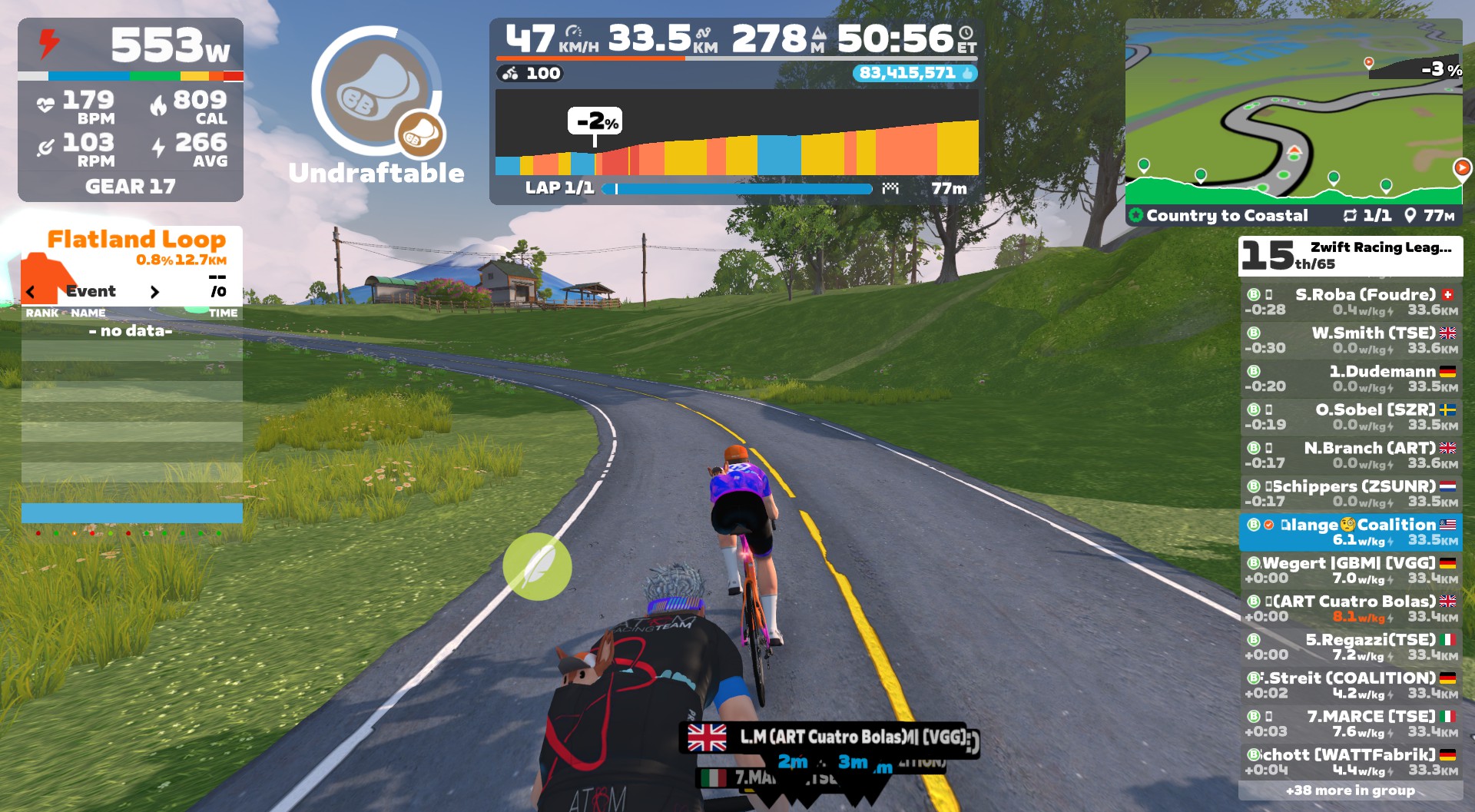
The rest of the race was rather unremarkable from my vantage point, apart from the final sprint. Fabian and I came into the finish in a group of 7, with feather powerups. I decided I would use the feather as I went through the lap banner, then use the burrito if it seemed like it might help.
I ramped up the power and activated the feather as we went through the arch with ~450 meters to go, and quickly found myself on the front of the group with Wegert (a strong rider from VGG) chasing. I thought I had timed it perfectly, activating my burrito as soon as the feather ran out so Wegert would lose any drafting advantage. I even eased a bit, figuring I wanted to keep Wegert under the power of my burrito.
But I didn’t see LM from the ART team flying up behind me in a perfectly-timed feather-powered effort. And with 50 meters to go, he flew past. I finished 16th on the day.
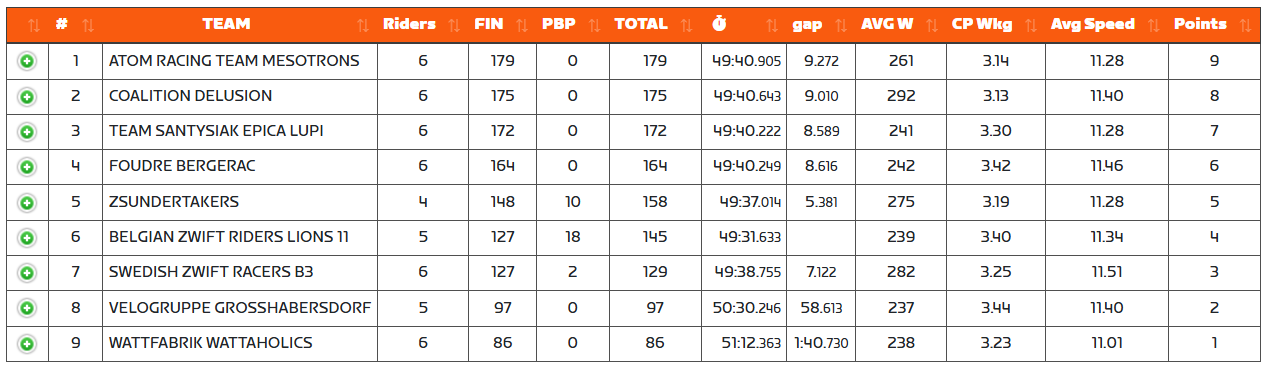
When the dust settled, my team came in 2nd on the day behind Atom Racing Team (ART). Well done, ART!
Teammate Chris Fockenberg was our top finisher, coming in 8th. Our team’s newest member, Fabian Streit, finished in 20th (3rd best on the team) – nicely done.
We lost to ART by only 4 points. Such a narrow margin! If two of our riders had just finished 2-3 places higher, we could have taken the win. But hindsight is 20/20.
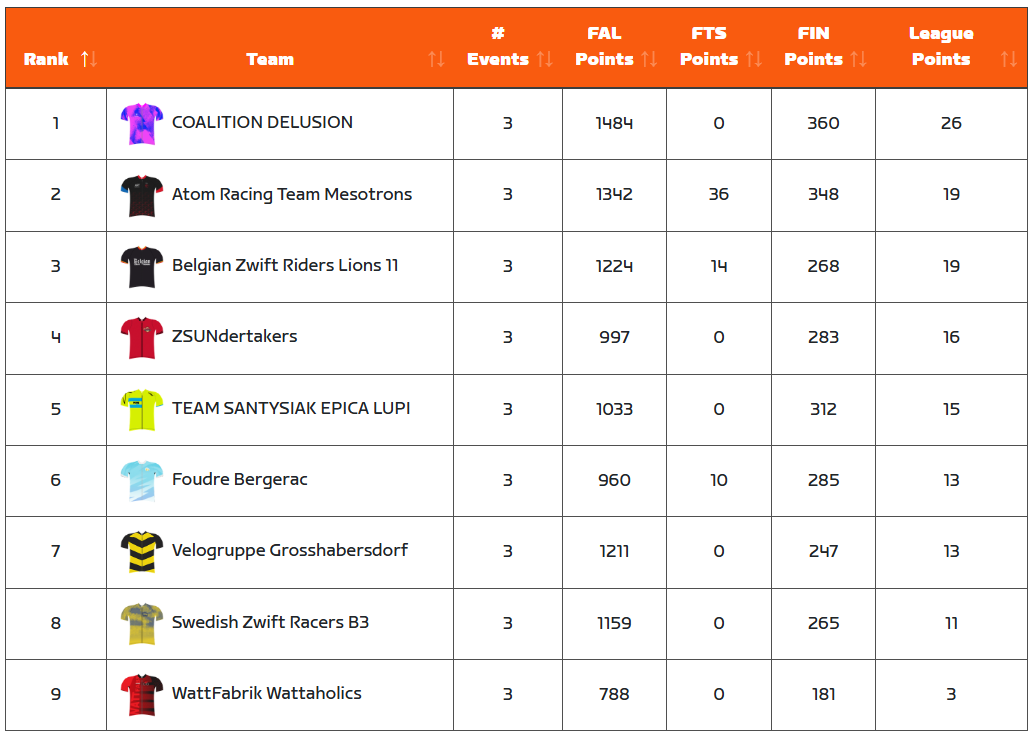
The good news is, we still sit squarely in 1st for Round 1, with just one race left:
Watching my video and thinking through the race, there were definitely mistakes made on my part. With the benefit of hindsight, here’s what I would do differently:
Avoid all the trainer malfunction silliness by paying attention during my warmup. This would have taken some early stress out of the race.
Push harder to be near the front on the climb to the Shisa Sprint, to avoid some of those draft-stealing burritos.
Push to close the gap to the next group on the descent that followed. (I think I could have managed it, although it would have been tough.)
That said, there was a tiny silver lining to the trainer issues I had at the start. Teammate Chris, our strongest rider on the day, told me this after he learned how the first few minutes of my race went:
“What a first few minutes you had! Those trainer issues and the massive gear 24 resistance you faced . In a way you helped me out, because I was hurting like hell going up there and noticed that you were behind me towards the top of the climb and over the climb. As you’re one of our stronger riders, in my head I thought, “Ah well if Eric is ok to sit near the back of the pack then maybe I shouldn’t worry too much,” and thus stopped panicking and didn’t destroy myself to get near the front. So, thanks I guess to your trainer? Great job working through all that though whilst trying to re-pair everything!”
To be clear, I wouldn’t call what happened a malfunction of the Core 2, or even Zwift. I’m sure it was caused by my having the Core 2 paired to two simultaneous Zwift sessions, which is not exactly an approved use case.
Coalition Delusion finished our race with the traditional Discord team pic:
Your Thoughts
How did race #3 go for you? Did you receive some surprise burritos, and did they impact your race? Share below!
Giant has taken several steps to try to resolve the embargo preventing its products made in Taiwan from entering the USA, according to a statement released today.
On 24 September, US Customs and Border Protection (CBP) announced a Withhold Release Order (WRO) on any bicycles, bicycle parts and accessories manufactured by Giant in Taiwan after an investigation that found alleged forced labour.
“Giant Group has been committed to openness and transparency, and has taken multiple actions,” the statement says.
Giant says that on 29 September it formally engaged with CBP through its US legal counsel and will arrange an official meeting in the near future.
“On September 30, Giant submitted formal letters to Taiwan’s Ministry of Foreign Affairs, Ministry of Labor, and Ministry of Economic Affairs, reporting the progress up to date and respectfully requesting assistance,” adds Giant.
Giant also says it is “actively communicating” with key international partners to safeguard its supply chains and market confidence.
Giant has already taken “concrete actions” in the last year to address potential labour rights violations. Sterling Lorence
The source of CBP’s allegations of forced labour is unclear. “CBP has never conducted any on-site investigation at Giant Group’s Taiwan manufacturing factory, nor have any of our departments or personnel been contacted by CBP for interviews or inquiries,” Belinda Yeh, a Giant PR specialist, told trade publication Bicycle Retailer.
The only public report on labour conditions at Giant’s facilities in Taiwan is by investigative journalist Peter Bengtsen, who told BikeRadar that debt bondage “is the rule, not the exception, for migrants employed in Taiwan’s bicycle and other industries”.
But after the suspension on imports was revealed, Giant says it has taken “concrete actions” in the last year to address potential labour rights violations, which includes implementing a zero recruitment fee policy and upgrading its employee housing.
Taiwanese Labor Front, an activist group, released a statement on 25 September, which said this is the first time CBP has accused a Taiwanese company of forced labour.
“Taiwanese companies generally lack awareness of human rights risks, particularly regarding the internationally recognized issue of forced labor. This not only fails to meet the expectations of European and American legislative trends, but also risks being gradually excluded from the international market,” the group explained.
Giant says it appreciates the concern and support from the public regarding the import ban.
“Upholding our principles of openness, transparency, and accountability, we will proactively report progress to regulators, partners, and the public, and ensure that all related issues are properly addressed in accordance with international standards,” it said.
This course presents particular challenges as a points race, which we’ll unpack below. As always, there’s much to discuss, so let’s dive in!
Looking at the Route
Each lap of Watopia’s Jarvis Seaside Sprint route is 12.5km long with 95m of elevation gain, and we begin with a 2.8km lead-in with 36m of climbing. So for this, the final race of Round 1, the A and B categories will race 40.3km (3 laps), while the C and D categories will race 27.8km (2 laps).
Here are the key sections of the route from a points race perspective:
Aero Boost (helmet) at Downtown Watopia Start/Finish arch: makes you more aerodynamic (reduces your CdA by 25%) for 15 seconds. Use at higher speeds (flats and descents), especially when no draft is available (although it is still useful when drafting.) Use your first aero to nab sprint points on the JWB Sprint Reverse.
Lead-In (0-2.6km): the start will always be a bit spicy, but this lead-in, in particular, will tax the legs with its short climb up from downtown Watopia, then the undulating road of The Esses, and finally the kicker climb taking you into the descent that launches the JWB Sprint Reverse.
JWB Sprint Reverse @2.6km (200 meters, 0%) (FAL+FTS): our first points segment of the day may also prove to be the fastest, since the pack will be at its largest and aero powerups will be burning holes in our jersey pockets. The JWB Sprint is fast and rather technical. If you need pointers on maximizing your performance on this segment, read this post.
(The JWB Sprint Reverse arch is the start/finish banner for the Jarvis Seaside Sprint course, so A and B riders will contest this segment a total of four times: once at the end of your lead-in, then three more times at the end of each lap.)
Draft Boost (van) at JWB Sprint arch: increases the draft effect you are experiencing for 40 seconds. Use at higher speeds (flats and descents) when you are already drafting off another rider (since this powerup only helps when you are drafting.) Use this to boost your speed when contesting the Jarvis Sprint Reverse.
Jarvis Sprint Reverse @5.7km (200 meters, 0.2%) (FAL+FTS): our next points segment of the day is the same length as the JWB Sprint, but it will feel much longer since we aren’t entering it off of a descent! On top of that, the pack may be cagey, since every has to decide just how hard they’re willing to go, given that the Jarvis KOM Reverse starts just a few hundred meters up the road. (Is it worth grabbing big sprint points if you get dropped from the front group?)
Lightweight (feather) at Jarvis Sprint arch: reduces your weight by 10% for 30 seconds. Use on climbs, when weight matters the most. Ideally you’d use it on the second, steeper section of the KOM so you’re as light as possible when weight matters most.
Jarvis KOM Reverse @7.5km (1.3km, 3.1%) (FAL+FTS): the only true climb of the race, the Jarvis KOM Reverse is really two steep, short punches, separated by flat bits at the start and in the middle. This will be the key inflection point of the race, as strong puncheurs will be pushing hard because 1) intermediate points and 2) this is their best chance of dropping other riders. Save your feather for this section!
Burrito at the Jarvis KOM arch: turns off the draft effect for riders in a cone-shaped window behind you for 20 seconds. Use when attacking off the front so opponents have to work harder to follow you, or in the peloton to make others work harder. Use this wherever you’d like, but try not to burrito your teammates.
Aero Boost (helmet) at Jarvis Lap arch: makes you more aerodynamic (reduces your CdA by 25%) for 15 seconds. Use at higher speeds (flats and descents), especially when no draft is available (although it is still useful when drafting.) Save this for use on the JWB Sprint up the road. You simply won’t be able to finish near the front without it, unless you manage to stick a breakaway off the front!
Climb into the Volcano @11.1km: riders always push hard up this short climb (200-300 meters long), so don’t get caught out. The aero boost you just picked up can be helpful for chasing back onto the wheels here as you near the Volcano Lap arch, but you’ll really want to save it for the sprint up the road.
Cloaking (ghost) at Volcano Lap arch: makes you invisible to other riders for 15 seconds. Use when you want to get away from one or more riders. Deploy then hammer, in hopes that you will create enough of a gap that your opponents can’t grab your wheel. Important: the ghost is disabled within 400m of the finish line, so don’t plan to hold this until the final sprint! Many riders will just throw this powerup away or not even get it because they’re still holding an aero powerup. But you can use it to help you get away off the front if you’re going for a long breakaway.
Finish: after completing the lead-in plus 3 full laps (2 laps for C & D categories), it will be time for the final sprint to the line. Again, the JWB Sprint is fast and rather technical. If you need pointers on maximizing your performance on this segment, read this post.
This route features two flat sprint segments (including the finish), and one short KOM segment that is more like two short uphill sprints.
So do you optimize for climbing (lightweight) or speed (aero)? With so many points up for grabs on the sprints, you’ll want to be careful about sacrificing aero for weight. But with the KOM being the key selection point in the race, you don’t want your heavier aero setup to send you out the back of the pack when the going gets steep.
We ran tests up the Jarvis KOM Reverse at 5 w/kg using the S-Works Tarmac SL8 and a variety of top-performing wheels: the DT Swiss 85 Disc, the DT Swiss 65, ENVE 4.5 Pro, and ENVE 8.9. We ran the same test using the Tron bike. In the end, the DT Swiss 65s turned in the best time (2:25.17), but every setup was within a half-second of that time.
So if you’re confident in your ability to hang onto the pack over the KOM with disc wheels, use ’em. Because they’ll give you an advantage in the sprints. If you want to hedge your bets a bit, go with the lighter DT Swiss 65s, which will be just a bit slower on the sprints but may be the difference between hanging with the front and getting dropped.
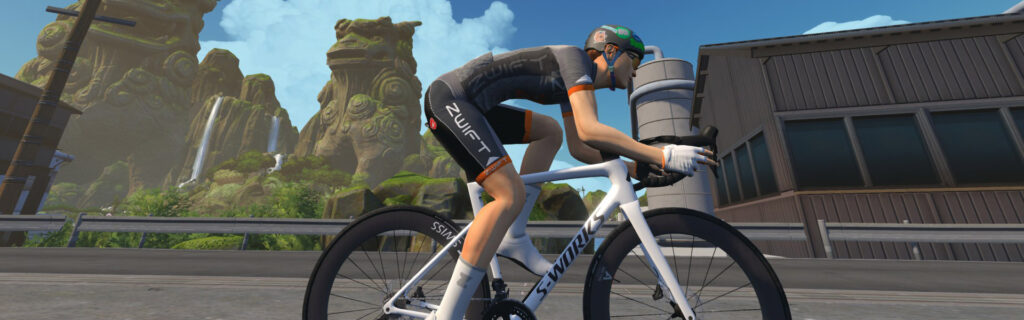
Specialized S-Works Tarmac SL8 with DT Swiss 65 wheels
Lots of recon events are scheduled on upcoming ZRL routes, led by various teams. See upcoming ZRL recons for this race at zwift.com/events/tag/zrlrecon.
John Rice
(more recons coming soon)
Strategic Options
Points Distributions, Jarvis Seaside Sprint
3 Laps (A/B)
2 Laps (C/D)
These charts show the maximum points a team of 6 could earn in a race with 60 participants. In the charts above, we’ve added the FAL points for the final JWB Sprint Reverse to the FIN points, since that’s effectively how they will operate. To learn how ZRL points races work, see this post.
Here are some predictions of strategies we’ll see on Tuesday:
Sprint, Rest, Sprint, Survive, Rest, Repeat: this will be the most common strategy. With ~75% of points tied up in sprints and the finish, strong sprinters will try to contest as many sprints as possible and survive the KOM in the front pack with as little effort as possible, so they can fight hard on the finishing sprint.
Burrito KOM Breakaway: clearly, the powerups in this race are structured to encourage riders to break away over the top of the KOM. Watch for strong climbers to go hard up the KOM, then push on the descent with a burrito powerup.
Ghost Breakaway: we get a ghost powerup at the Volcano Circuit lap arch, and this will prove tantalizing to riders who want to go long on the final lap (there’s always someone). The 200IQ play may be using your aero powerup to attack as you ride through the Volcano lap arch, then using the ghost to disappear for a bit longer. The question for everyone else is, do you chase those wheels, or gamble and hope the pack drags them back?
Your Thoughts
Any insights or further thoughts on this race? Share below!

 Zwift’s Big Weekend
 Celebrity Leaders
  La Cyclo MedioFondo Foudre



 . In a way you helped me out, because I was hurting like hell going up there and noticed that you were behind me towards the top of the climb and over the climb. As you’re one of our stronger riders, in my head I thought, “Ah well if Eric is ok to sit near the back of the pack then maybe I shouldn’t worry too much,” and thus stopped panicking and didn’t destroy myself to get near the front. So, thanks I guess to your trainer?
  Great job working through all that though whilst trying to re-pair everything!”