It’s been over 25 years since the UK Cycle to Work scheme was introduced, enabling employees to use salary sacrifice to purchase bicycles and latterly ebikes, as well as cycling equipment for their commute.
Now the Cycle to Work Alliance, a consortium that includes Halfords, Evans Cycles, Vivup, Cycle Solutions and Cyclescheme, has commissioned independent research to quantify the benefits of the scheme.
The total annual financial benefit is assessed at £573m, in addition to the reductions in congestion and transport emissions it enables, which were not quantified.
The numbers break down into cost savings for commuters, increased workforce productivity, retail income from new bike purchases and the accompanying tax revenue.
Commenting on the research, local transport minister Lilian Greenwood said: “The Cycle to Work Scheme has been a real success story, helping millions of people choose a healthier, greener way to travel while boosting local economies and supporting jobs.”
Commuting by bike is estimated to save £1,262 versus using a car. Scott Windsor / Our Media
The research evaluated the saving to employees who switched from commuting by car to using a bike at £1,262. Separately, the Cycle to Work Alliance says it’s found around 80% of participants claim to cycle every week, up from 40% before joining the scheme.
Productivity increases
There’s an estimated economic benefit of £37m across the UK economy. This comes from reduced absence through sickness, evaluated at £63 per person per year, and improved attendance, estimated at £115 per person per year.
Retail income
Bikes, accessories and cycle clothing worth £219m were purchased via the Cycle to Work Scheme in 2023/24, which is credited with helping the cycling retail sector during its post-Covid downturn.
HM Treasury also benefits, with £43.8m of VAT collected on those purchases.
200,000 participants per year
The Cycle to Work Scheme is used by around 200,000 employees a year. urbancow
In 2023/24, the Cycle to Work Alliance says 199,000 employees made use of the scheme, a number that rose by 10,000 in 2024/25. Over the period since its launch, it says the scheme has been used by more than 2 million riders. It points out that of those, 38% are new cycle commuters.
While for many years limited to a £1,000 total spend, the Cycle to Work Scheme is now available for larger purchases, putting performance bikes and electric commuter bikes within scope. The Cycle to Work Alliance is campaigning to increase eligibility to self-employed and lower-paid workers to widen its benefit.
In what’s becoming quite the trend, Kona has joined the number of brands making aluminium gravel bikes with high-performance gravel geometry and features at more affordable prices.
The new Libre G2 follows in the wake of great bikes such as Specialized’s Crux DSW, Trek’s impressive new Checkpoint ALR, the Boardman ADV and Kinesis’ very capable Tripster AT+.
The new Libre shares the same race-proven geometry as the second-generation carbon CR model.
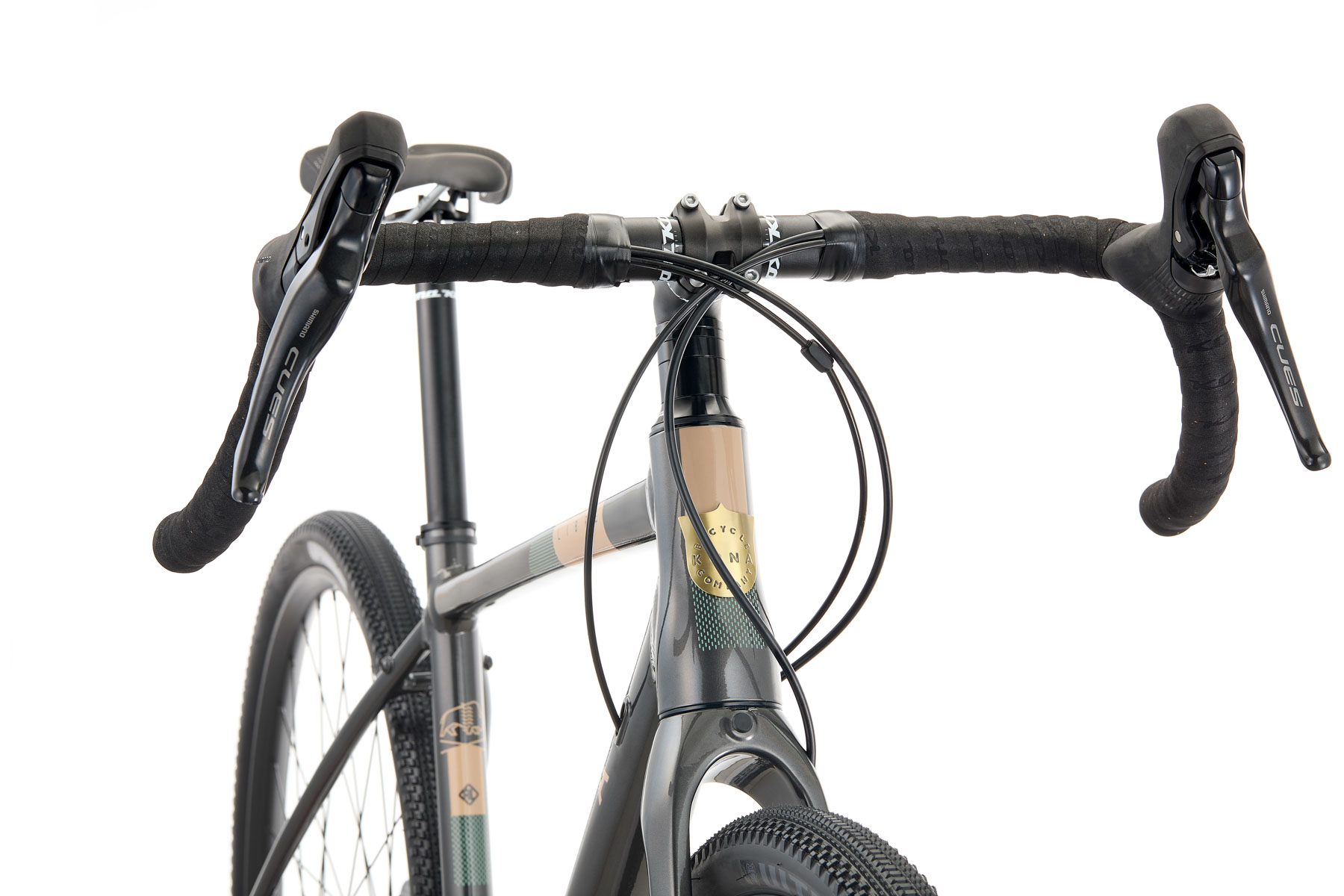
Kona’s new aluminium version of the Libre gravel race bike has the same geometry as the pricier carbon incarnation. Kona
That means a more performance-oriented geometry than ever before. Kona describes the G2 Libre as being fast, but with relaxed geometry that’s composed enough to “eat all that gravel without a twitch”. It also claims the bike is sharp enough to carve fast turns on the road.
The stack and head tube height are both reduced. The Libre now has shorter chainstays to make the handling nimbler, with a steeper seat tube angle for power transfer and a longer reach for a more aggressive ride position.
The Libre G2 has plenty of mount points for racks, guards, bags and bottles. Kona
Up front is a new lightweight all-carbon G2 fork. The aluminium frame features plenty of mounts for fenders (mudguards), a rear rack and a multitude of bottle mounts.
Tyre clearance is 50mm, and the frame also gains a UDH rear dropout. The seat-tube diameter has been slimmed on the alloy bike for a more compliant 27.2mm post.
Kona has also decided on using large 180mm rotors front and rear. With its tongue, I hope, firmly in cheek, Kona says the Libre is too fast for anything smaller.
The aluminium Libre G2 comes in a single version built around 2x 9-speed Shimano CUES. Kona
The Libre G2 alloy comes in a single build, based around Shimano CUES 2x 10-speed. We haven’t seen as much of CUES as we would have expected until now. However, it seems to be gaining traction as an affordable 2x option for gravel.
Wheels are supplied by Easton and paired with WTB Lupine tyres in a 45mm width (the Libre has clearance for 50mm).
With bikes like the Libre G2 Alloy becoming more common, it’s further proof that you don’t need to spend a fortune to have fun on gravel.
No pricing has been announced as yet, but it’s expected to be in line with the outgoing previous-generation aluminium Libre, so expect prices around $1,800.
Kona Libre G2 spec highlights
Kona supplies its own 16-degree flare Gravel bar. Kona
Zwift’s big fondo events are a popular tradition where thousands of riders push themselves to finish long weekend rides. This season’s second set of fondo events happens this weekend, and finishers unlock the vintage February 2022 Fondo kit. Read on for details!
This month’s fondo is on Watopia’s Medio Fondo route, which takes riders up the Hilly KOM Reverse and Volcano KOM and finishes on the Epic KOM. In between, you’ll ride the Jungle Circuit Reverse and various roads around Watopia proper.
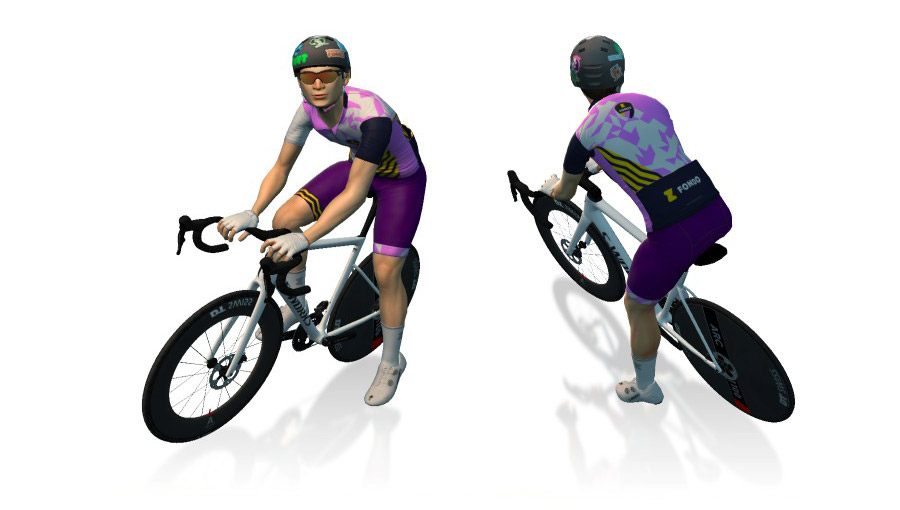
Instead of releasing another set of fondo kits this season, Zwift is awarding different legacy Zwift Fondo kits each month. October’s legacy kit was originally used for the ZFondo series in February 2022:
Is this a race?
Officially, no. But hundreds (possibly thousands) of riders will turn out for each of these popular “fun race” events, and the front of each event will certainly be filled with strong riders going all out.
With so many riders participating, everyone should be able to find a group that suits their desired pace. You do you!
Categorization and RoboPacers
You must choose a category when you sign up, but the category you choose is entirely up to you, and all categories start together and are visible to each other.
The idea is that you’ll choose a category at the approximate pace you plan to ride, making it easy to see and group up with other riders targeting a similar pace. Each category will include a RoboPacer with a beacon, and you can choose to ride with that RoboPacer group or not.
Researchers have concluded that the Tour de France may be an effective tool in stemming the rise of the far right in France.
France has had a problem with rural depopulation for decades, with the term diagonale du vide coined for the 42% of mainland France’s land area that houses only 6.5% of its population, and which stretches the length of the country from the north east to the south west. There are 13 départements out of 96 where more cows live than people.
Previous research pointed to the influence of factors such as economic stagnation, population decline and migration of younger people to urban areas, which result in ‘left-behind places’, where there’s a feeling of neglect and marginalisation. Automation, the decline of low-skilled jobs and immigration are also cited as factors.
This has been shown to result in voters turning away from mainstream political parties and a drift to the far right.
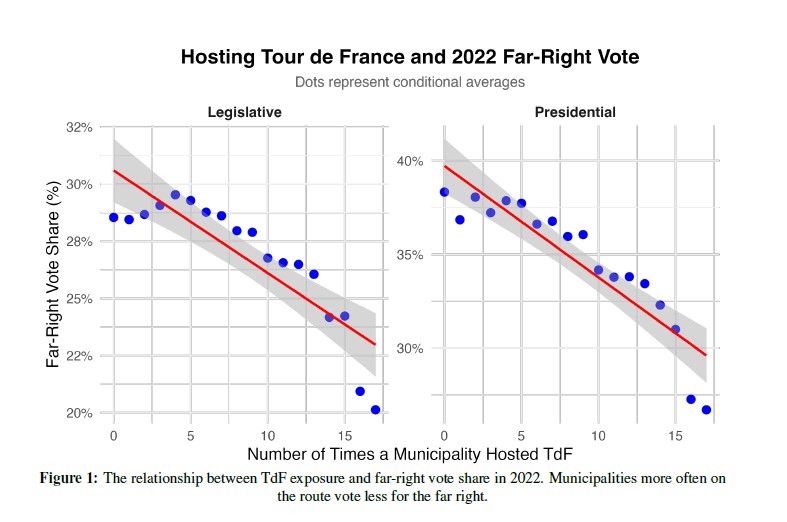
An increased number of Tour de France visits to a municipality correlated with a lower far-right share of the votes.
The researchers found a strong negative correlation between the number of times a municipality had hosted the Tour de France and the far-right share of the vote across both French legislative and presidential elections.
Hosting a grand départ is expensive; the 2021 grand départ from Brest in Brittany cost around €1.5m, but the region estimated the direct local gain from tourist income and increased economic activity at around €4.35m.
“When the Tour comes to town the whole place goes crazy. For the five days or so during which the race is arriving, setting up, conducting medical checks, presenting the riders and of course holding the opening prologue TT and the start of stage one, the town belongs to the Tour…” commented one of the organisers of the 1990 Futuroscope grand départ.
According to the newspaper Le Figaro, towns pay ASO, which organises the Tour de France, between €60,000 and €80,000 for a stage start and €100,000 to €120,000 for a stage finish.
But the researchers point out that the economic benefits spread through the wider area, with hotels booked for teams and spectators, and increased spending in local stores, restaurants and more, lifting local GDP per capita.
The far-right share of the vote is greater outside urban areas of France.
There’s also the effect of the 10,000-plus towns and villages on the route having their brief moment of televised fame, with the TV motorbikes and helicopters overhead showing off the locality. The researchers found this increases pride in the locality, although places through which a stage passes don’t pay ASO.
“Seeing the town highlighted on a national and international scale strengthens the sense of belonging, with decorated streets, media presence, and a festive atmosphere,” said one respondent to a survey carried out to support the research, while another commented that: “It looked like our town was actually important.”
The researchers’ analysis showed that even having the Tour pass through a municipality reduced the far right vote share marginally: by 0.33% in presidential and 0.44% in legislative elections. The effect was larger when a French cyclist won a stage.
They say their findings suggest that the ‘left-behind’ explanation of the increase in far-right voting fits better than the alternative theory that it’s driven by nationalism, ethnic prejudice and the perceived threat from immigration.
They conclude that even a brief spell in the Tour de France limelight can decrease the feeling of neglect and the tendency to vote for the far right, an effect that the study suggests lasts for several years at least.
Strava has dropped its lawsuit against Garmin exactly three weeks after filing the patent-infringement case.
This appears to bring an end to the brief dispute, although what it means for the ongoing relationship between the two tech companies and their apps remains to be seen.
A single-line filing from Strava yesterday (Tuesday 21 October) stated: “Pursuant to Fed. R. Civ. P. 41(a)(1)(A)(i), Plaintiff Strava, Inc., by and through its undersigned counsel, voluntarily dismisses the above-captioned action, without prejudice.“
The lawsuit centred on Strava’s segment functionality. Strava
Strava’s case, filed on 30 September in the US District Court for the District of Colorado, related to two of its key features – Segments and heatmaps – and saw it demand that Garmin stop selling many of its devices.
Strava claimed Garmin had infringed on its patents. Its Segments patent was filed in 2011 and granted in 2015, while the heatmaps patent was filed in 2014 and granted in 2016.
As a result of the alleged patent infringements, Strava claimed it had “suffered damages, including lost revenue and business opportunities, erosion of competitive differentiation and network effects, harm to goodwill, and unjust gains to Garmin”.
Strava’s lawsuit sought a permanent injunction to stop Garmin selling devices that include Segments or heatmap functionality, which would have covered most of Garmin’s smartwatches and Edge bike computers.
In a subsequent Reddit post, Strava’s chief product officer, Matt Salazar, claimed the reason behind its litigation was a set of “new developer guidelines for all of its API partners” from Garmin, which appeared to contradict its court filing.
Salazar said Strava had “tried to resolve this situation with Garmin over the course of the past five months, including proposing additional attribution across the platform in a less intrusive way, but to no avail”.
Garmin did not respond publicly to the filing or Salazar’s post.
Suunto has also filed a suit against Garmin, accusing it of infringing five patents related to measuring a user’s respiratory rate, antenna design, watch casing and tracking golf shots.
For some, Zwift is just a tool for training during the long winter months. But for others, it’s a lot more than that! Watch one rider share how Zwift has propelled his wellness and fitness journey.
We’re also featuring videos about first Zwift races, getting started on Zwift, setups of pro triathletes, and racing in Zwift Unlocked.
How Zwift Changed My Life: 236 to 180 lbs Transformation
In this video by John at Casual Creations, he discusses how Zwift has changed the course of his life.
My First Zwift Race Was Pure Pain
Liam Shaw is on a mission to move up the racing score categories on Zwift. Hear from him as he talks through his experience as a category E Zwift racer.
How to Prepare for Your First Zwift Ride!
New to Zwift? Chad Rides shares a step-by-step guide to getting you going.
Home Training Setup Tour – What It Takes to Train Like a Pro Triathlete
Looking to upgrade your home training setup? Professional triathlete Megan Mcdonald shares tips and tricks for enhancing your indoor setup.
Fastest Pen in Zwift Unlocked – Can I Hang On? | Stage 2 | Electric Break (Makuri Islands)
Watch as Manuel Essl tackles one of the fastest heats of Stage 2 of Zwift Unlocked. Can he hold on until the finish?
Got a Great Zwift Video?
Share the link below and we may feature it in an upcoming post!
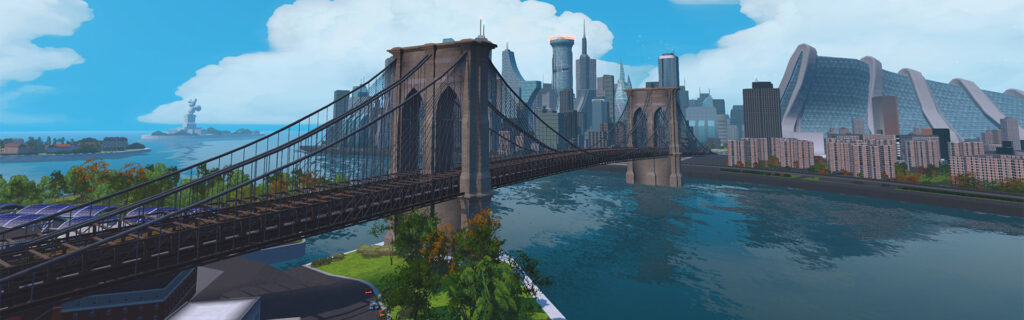
Zwift version 1.100 begins its phased rollout today. Some Zwifters were wondering if v100 was going to include something big and cool, and it does. Well, sort of. There are new NYC roads (which you can’t ride quite yet) but also a serendipitous Streak count and 13 event-only routes that are now free rideable! Read on for details…
New New York Roads Incoming
This latest Zwift update includes what should be the final version of Zwift’s New York map expansion, which we wrote about in TSOZ Closer Look: New York Expansion and Power Segments. This includes 31km of new pavement, which is a big expansion by Zwift standards!
We’ve seen an early release of the new roads, and while we can’t share details of all the new routes just yet (that comes on Monday, October 27) we can share the basics (length and elevation) of the new routes which will be used for Zwift Unlocked:
Stage 4, October 27-November 3
Long Ride – The Greenway (1 lap: 36.8km, 292m)
Short Ride and Race – Spinfinity (1 lap: 19.5km, 155m)
Run – Prospect Park Loop Run (1 lap: 5.5km, 37m)
Stage 5, November 3-10
Long Ride – Stay Puft Pursuit (1 lap: 31.4km, 409m)
Short Ride and Race – The Double Borough (1 lap: 17.9km, 144m)
Run – Times Square Circuit Run (2 laps: 7.2km, 40m)
Watch this space for route details next week!
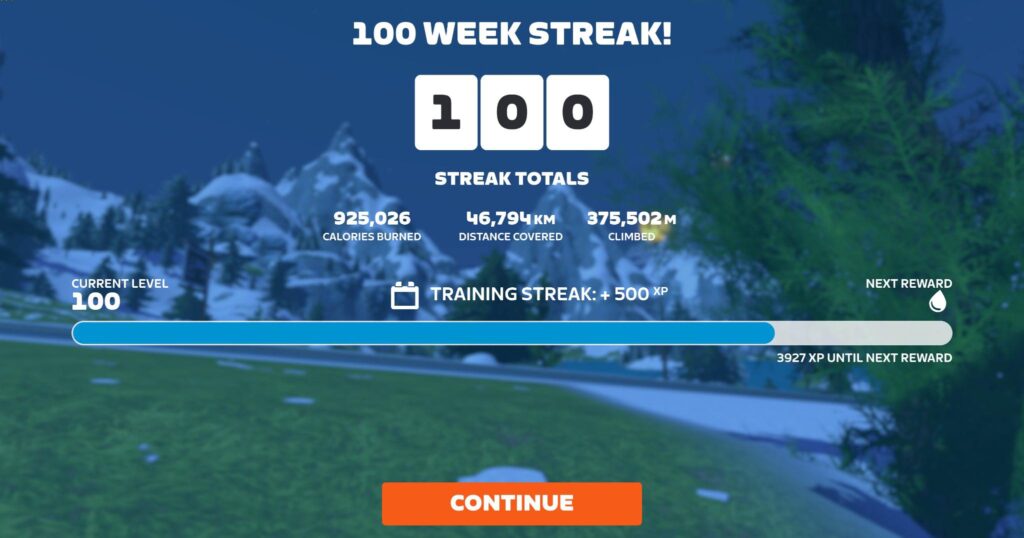
Week Streak #100
In a bit of serendipity, some Zwifters will be extending their Week Streak to 100 this week, as Zwift hits version 1.100. (Most riders who have kept their streak going since Week Streaks were released will hit 100 next week.)
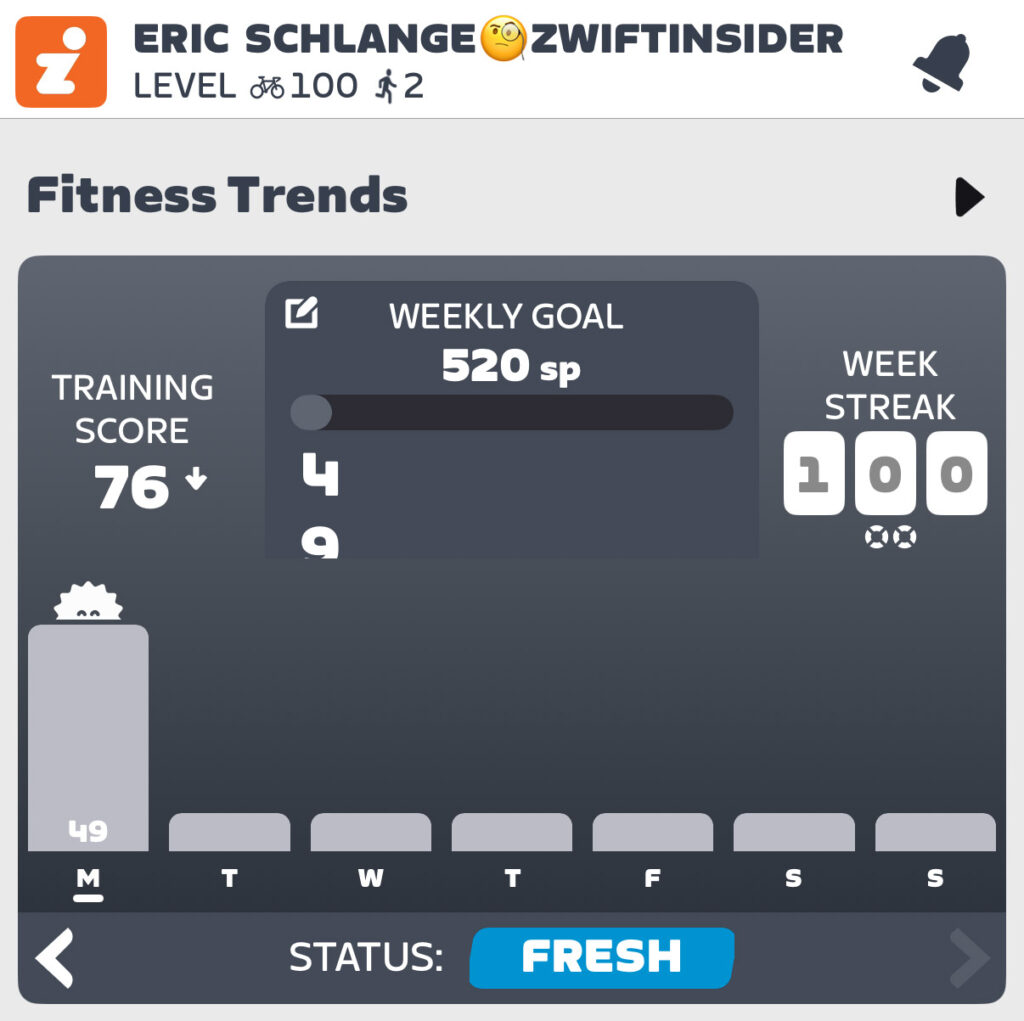
Companion has a bit of a display bug in the weekly goal section due to the Week Streak shifting over to three digits, but we expect this to be fixed soon:
Routes Available for Free Riding
The following 10 routes, originally released as event-only, are now available for free riding/running:
If you haven’t earned these route badges yet, the unearned badges are now visible on your Achievements page.
Release Notes
Zwift provided notes on additional tweaks and bug fixes in this update:
We’ve improved the route preview shown below the mini-map when Zwifters ride off-route: The route preview now shows the next 3 km / 1.86 mi of roadway so you have a better idea of what’s ahead of you, and if you turn at an intersection, the route preview will update accordingly. The name of the next intersection is also now displayed, along with the distance to it.
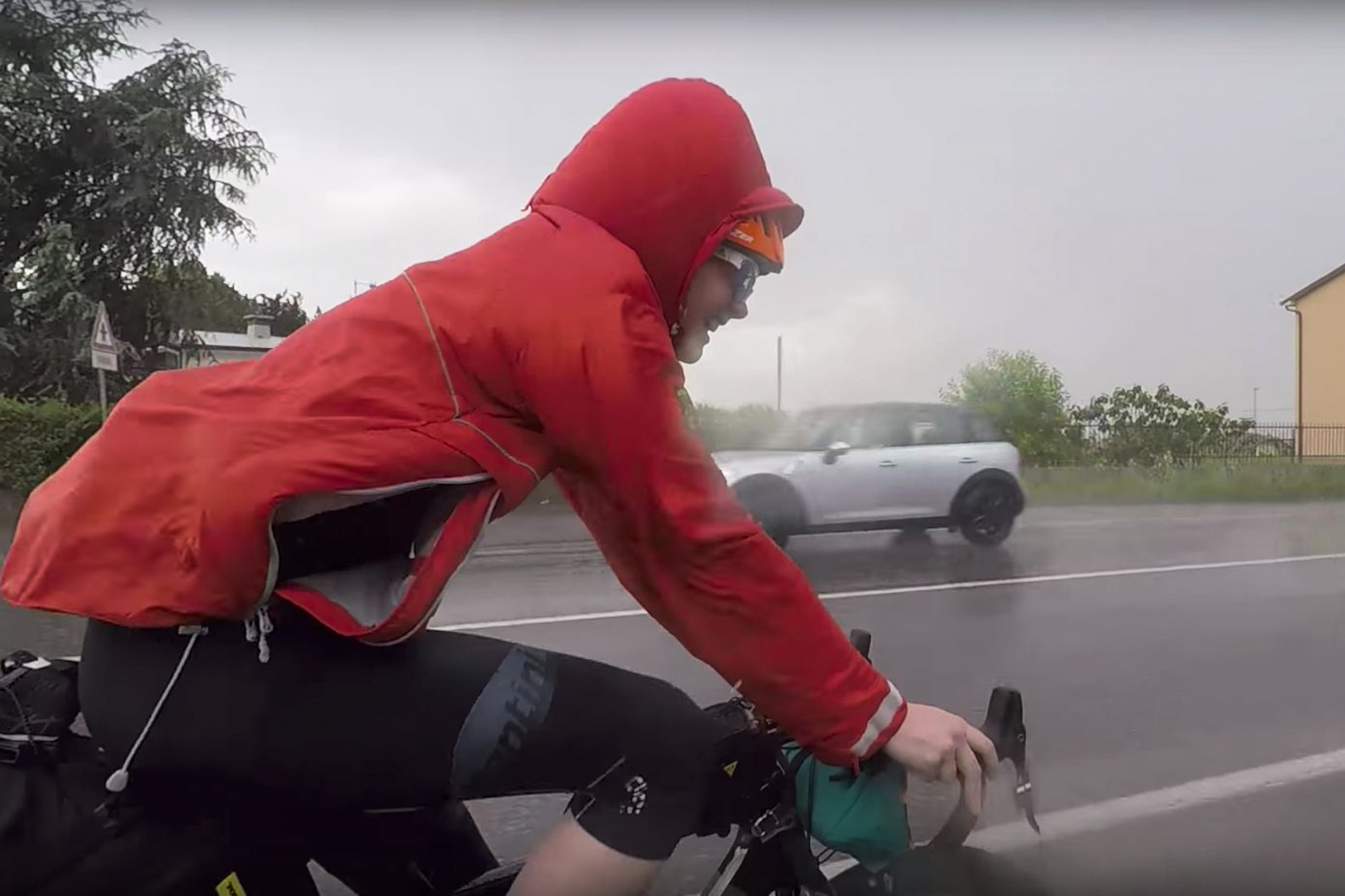
Once the weather turns wet, cycling in the rain can quickly become cold and uncomfortable if you’re not well-prepared.
But there’s a lot you can do to get yourself and your bike ready for wet-weather riding, and to make it more pleasant and safe once you do strike out in the rain.
From choosing the right clothing to fitting mudguards and avoiding riding through puddles, here are 15 tips to make wet-weather cycling more comfortable – and maybe even enjoyable.
1. Invest in the right clothing
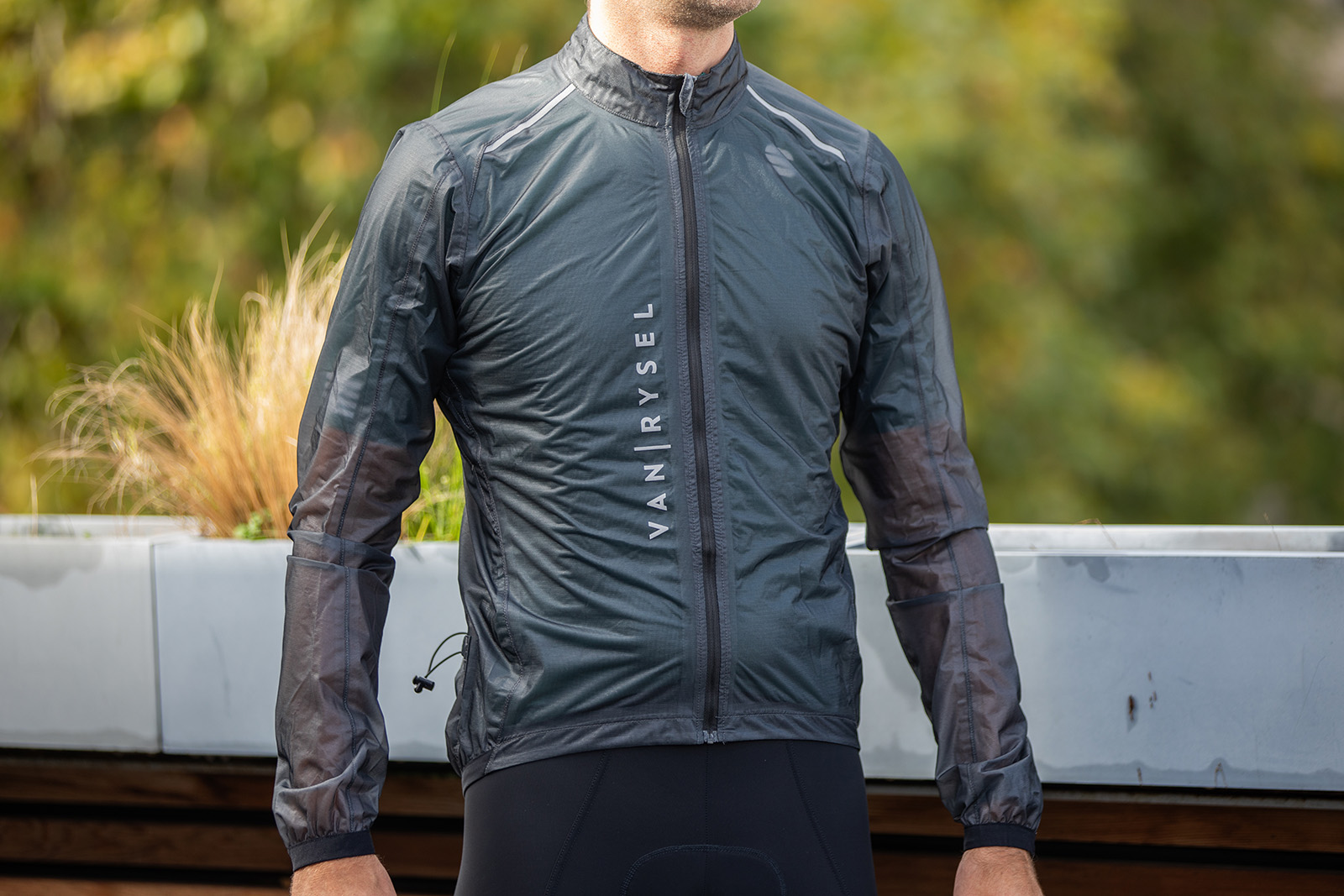
A quality rain jacket is your first line of defence on wet rides. Reuben Bakker-Dyos / Our Media
It’s made tricky by your work rate as you ride, which can result in uncomfortable ‘boil in the bag’ riding in some options, as you build up a sweat, which condenses on the inside of your kit.
It’s particularly a problem for top-half clothing, so it’s worth investing in a cycling rain jacket.
Although the best waterproof jackets made from fabrics such as Gore-Tex and eVent are expensive, they use the most advanced fabrics and have the highest breathability ratings. Less advanced, less expensive options exist that can work almost as well though.
To ensure that water stays out, look for garments that have taped seams.
A jacket that will keep off the rain doesn’t have to cost a fortune – this one is only £40. Scott Windsor / Our Media
A technical baselayer will stay warm even if you get wet. Avoid cotton, which gets cold when wet.
If it’s warm and wet, layering is less of an issue. You may be more comfortable just wearing a jersey and getting wet, rather than getting sweaty in a rain jacket.
Wet-weather jerseys, of which the Castelli Gabba was the archetype, provide less water resistance than rain jackets but are more comfortable if you’re riding hard.
Bottom-half clothing may include waterproof overtrousers, although many cyclists prefer water-resistant bib tights. Although they’ll keep the rain off less well, bib tights are more comfortable to ride in.
For really foul weather, a waterproof onesie may be the business, particularly if you’re mountain biking.
2. Get some overshoes
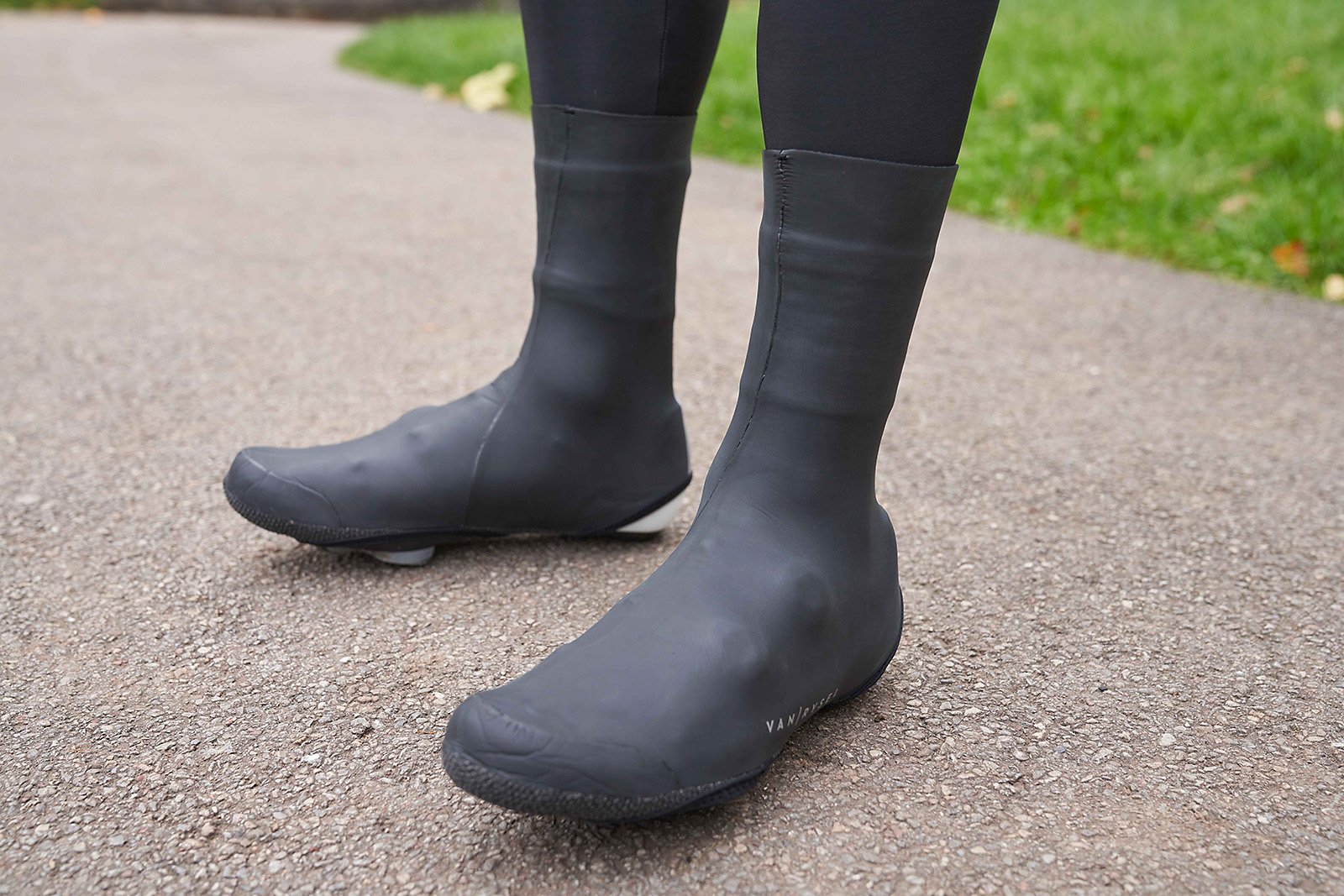
Overshoes will keep your feet dry for longer. Kaden Gardener / Our Media
Waterproof overshoes will help keep your feet dry for longer when cycling in the rain.
Even when wet does get in, overshoes should help keep your feet warmer. They’ll hold the warm water next to your feet and provide a windproof outlet layer. Plastic bags over your socks will help keep your feet drier for longer as a last resort.
Overshoes tend to wear out quite quickly, so if you want a more robust footwear solution, consider investing in a pair of winter cycling shoes or boots. These will have a fully enclosed sole unit and a waterproof upper, so the only way for your feet to get wet is for water to trickle down through the ankle cuff.
3. Wear gloves
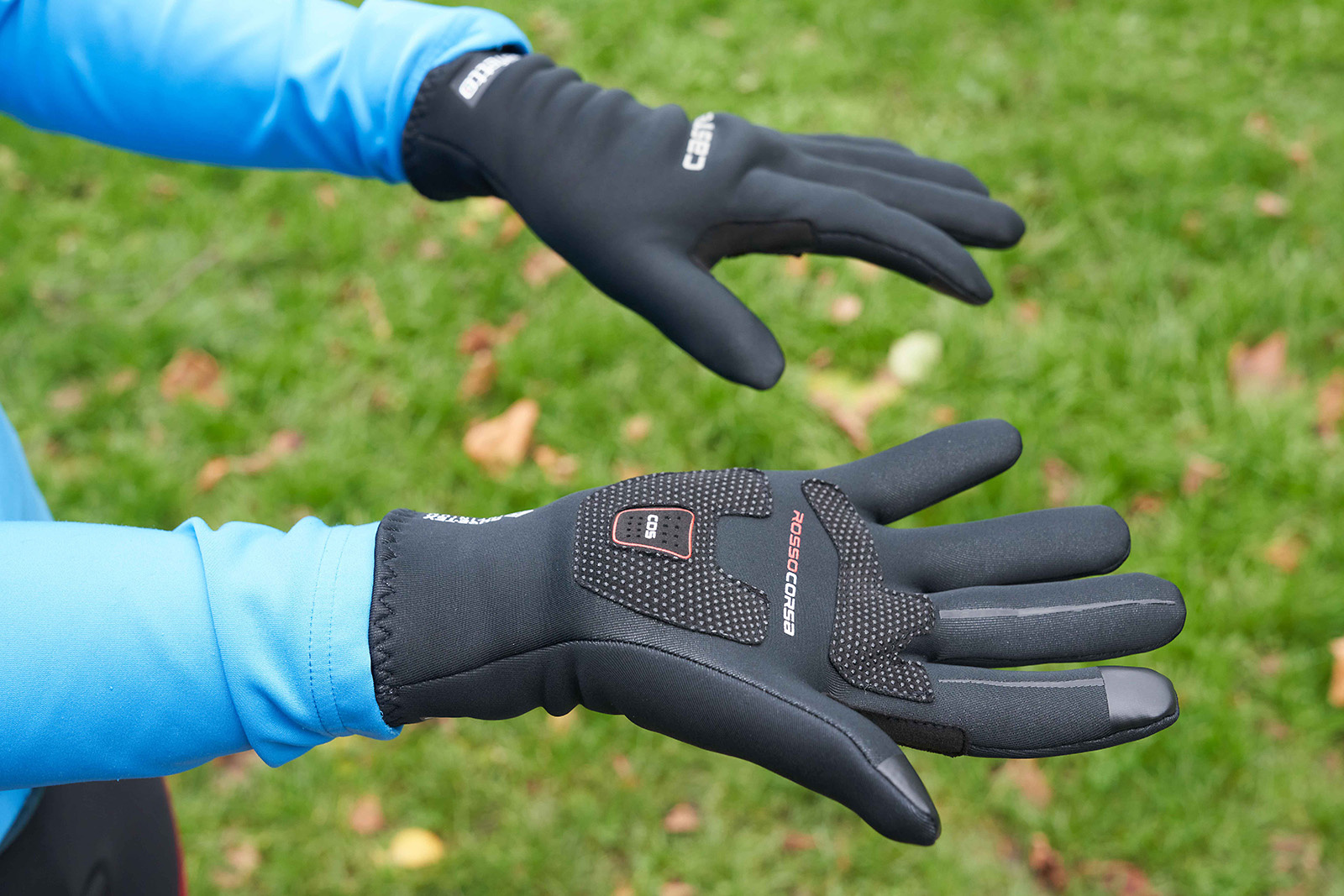
Gloves will help you grip the handlebar and prevent your hands from going numb if it’s cold. Kaden Gardener / Our Media
It’s a good idea to wear full-finger gloves in the rain.
Gloves will help you grip a wet handlebar and stop your hands from getting numb if it’s cold and wet.
As with other clothing, modern winter cycling gloves employ a range of technical fabrics.
They usually have a palm with silicone grippers for a sturdier grip on the handlebars, a breathable waterproof upper surface and well-placed insulation to keep your hands warm without impacting your grip.
4. Put on your glasses
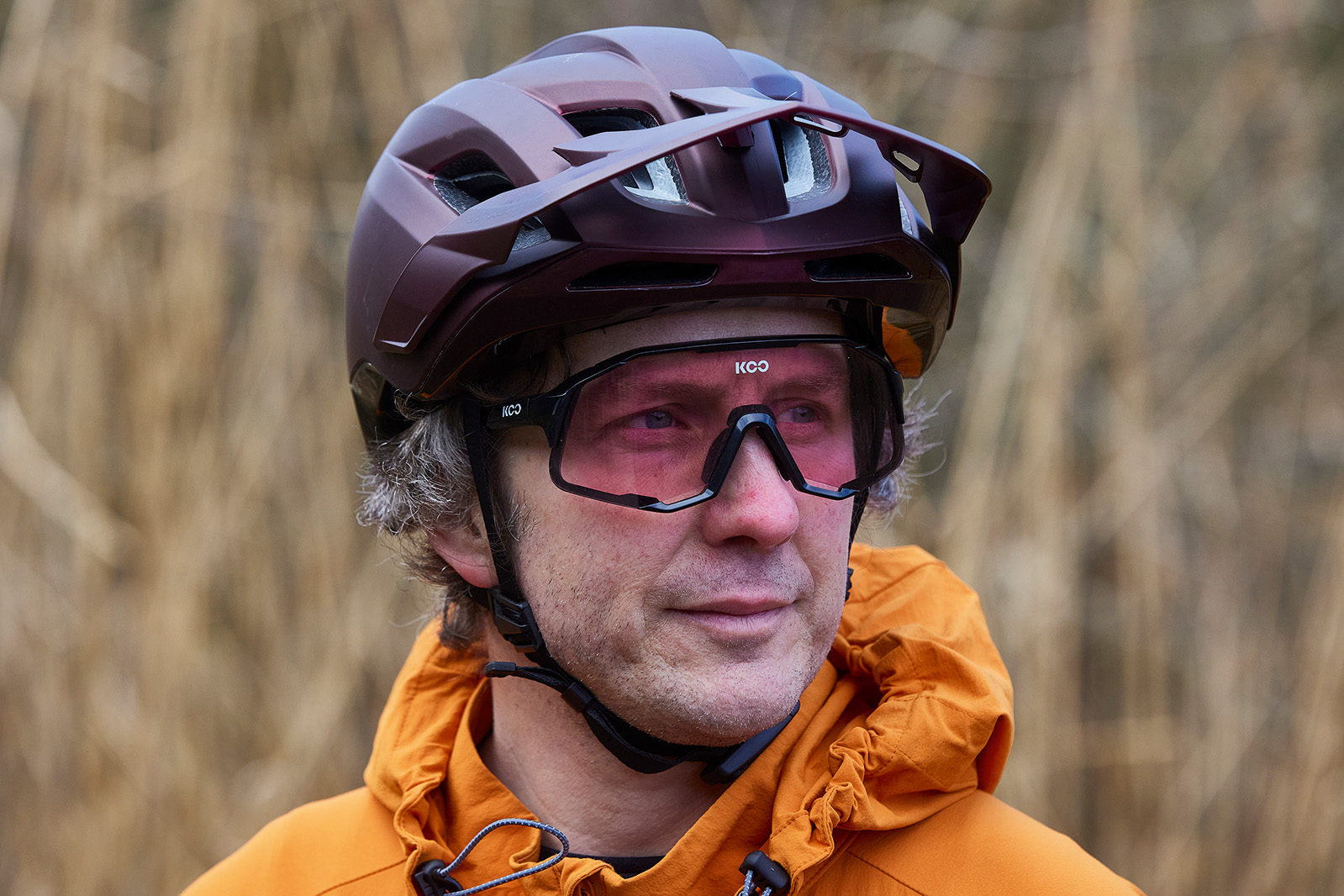
Glasses will protect your eyes from spray. Steve Behr / Our Media
Rain spraying on your face is uncomfortable and may reduce your vision. Spray from the road can wash grit into your eyes as well. So, wearing a pair of cycling glasses can help protect your eyes.
Many of the best cycling glasses enable you to select a clear lens, either as an optional extra or as part of a multi-lens set. Photochromic glasses are also handy when riding in wet conditions because they will adapt to the light level.
Most cycling glasses have a hydrophobic coating on the outside of the lens to help repel water and keep them clear.
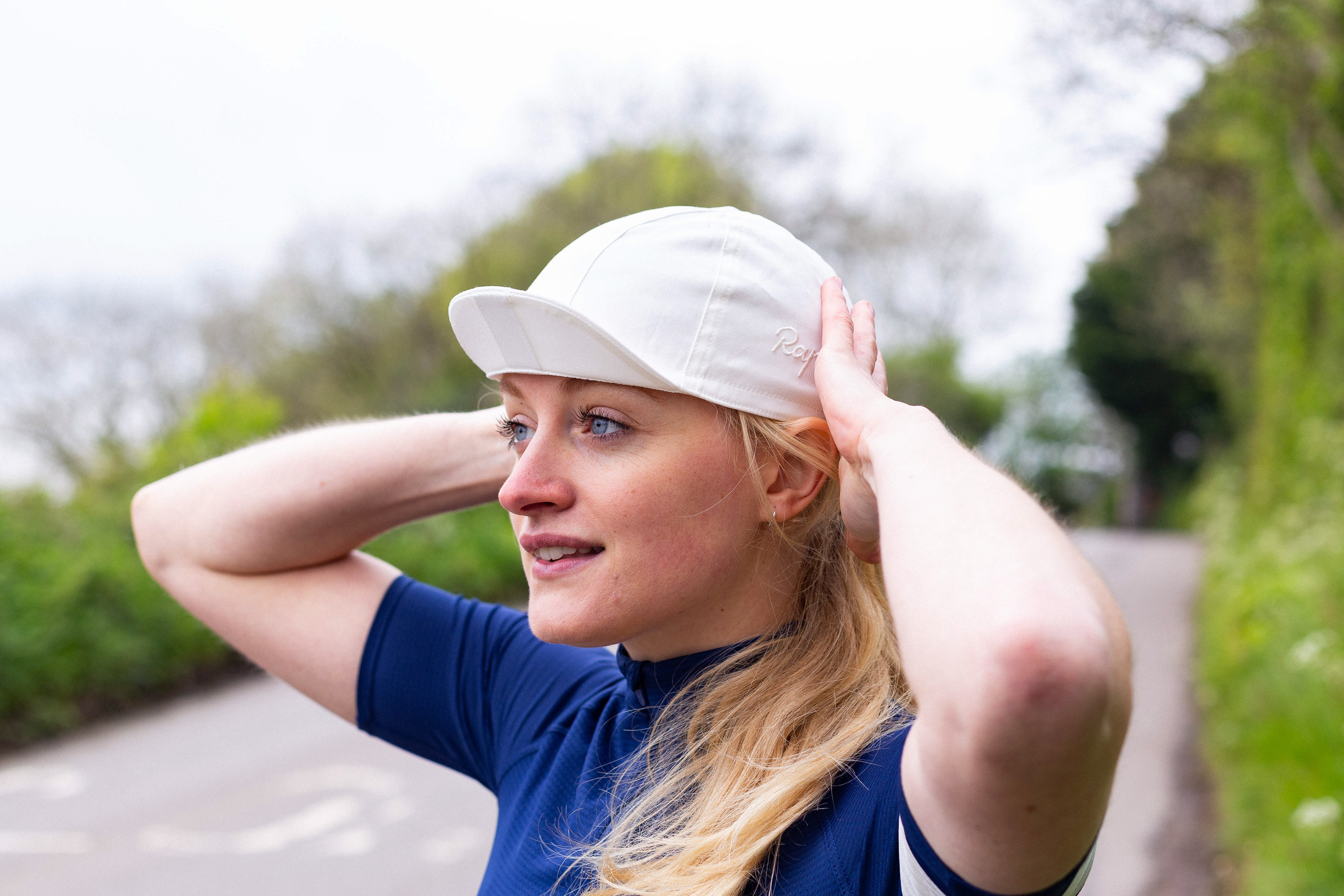
5. Wear a cap
Cycling caps will help keep rain off your face. Felix Smith / Our Media
You’ll stay more comfortable in the rain if you wear a cycling cap. Most have a peak, which will help keep water out of your eyes.
A standard cotton cap will do the job, although it will soak up water, get wet and may feel cold and clammy. There are more sophisticated options that will be more comfortable though, made either from thin fleece-type material or a breathable waterproof fabric.
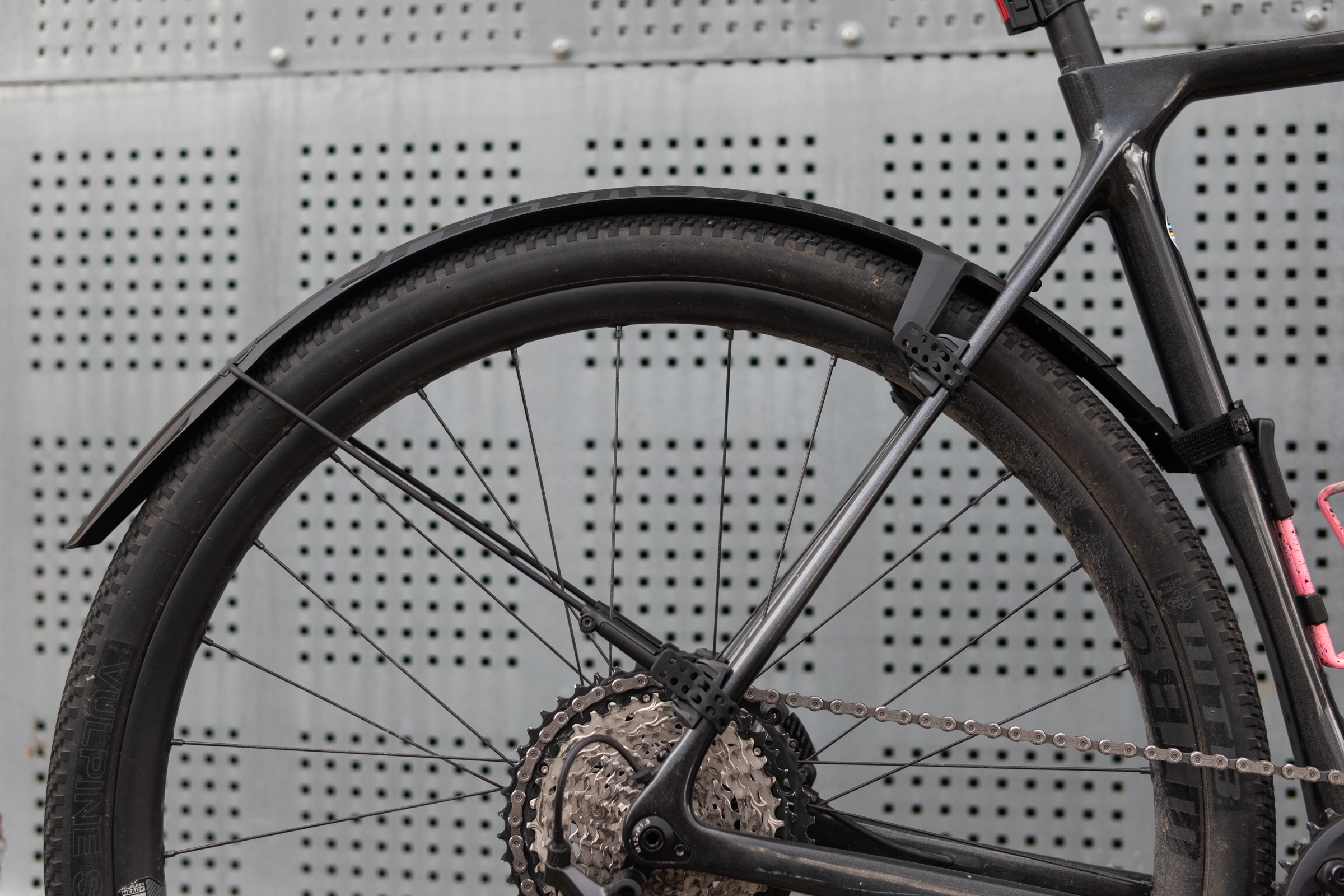
6. Fit mudguards to your bike
There’s a mudguard solution to fit almost all bikes. Jack Luke / Our Media
The number one item that will make riding in the rain more comfortable is a set of mudguards.
Full-cover mudguards are the ideal solution, keeping road spray off most of you and your bike.
Many modern road bikes and gravel bikes have the bolt bosses necessary to fit mudguards, but clip-on mudguards are a reasonable alternative.
There are specific mountain bike mudguards and gravel bike mudguards, which tend to provide less coverage than full-length fenders but will still do a good job of protecting you from rain and mud.
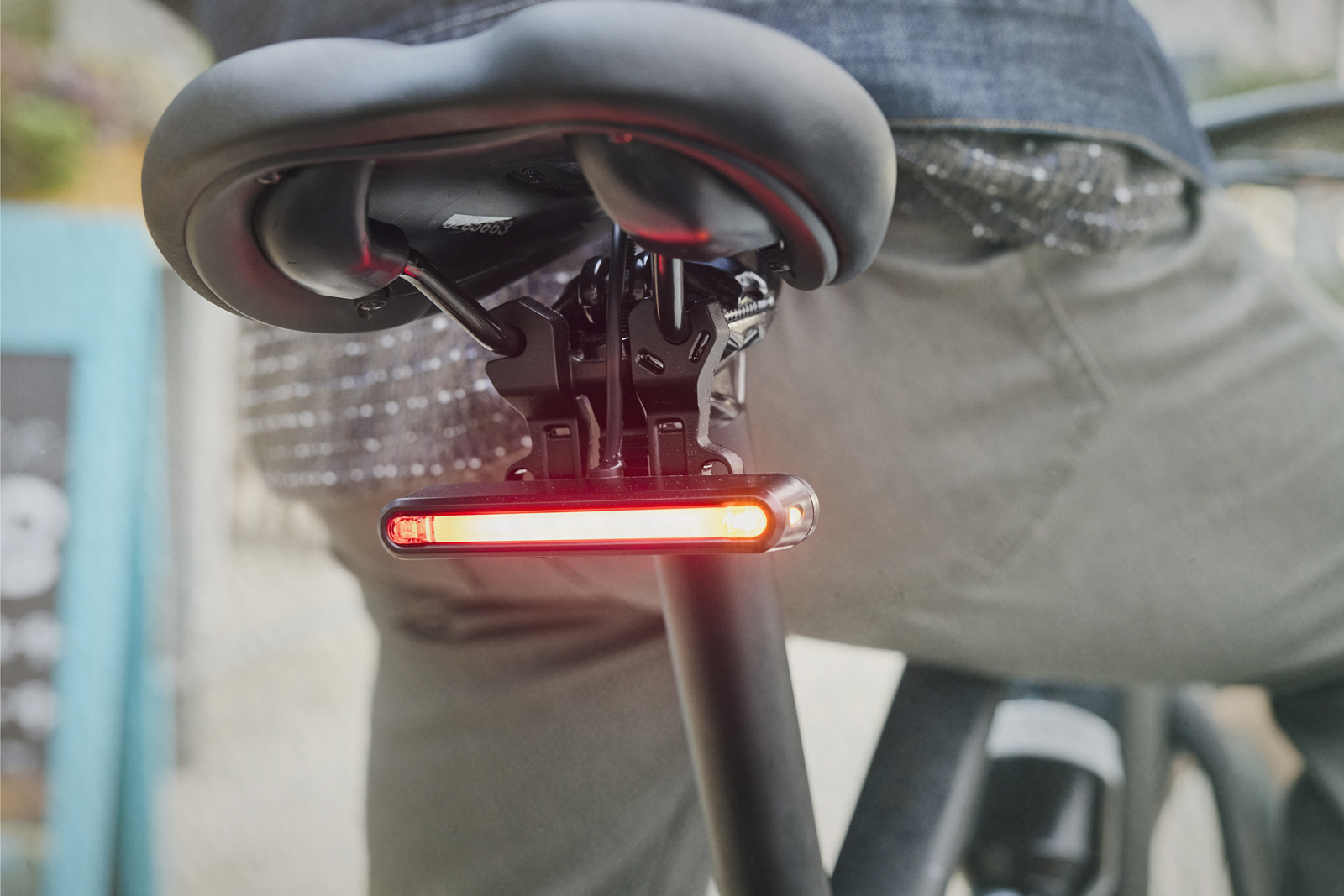
7. Use lights
If it’s raining, you should use lights, even in the daytime. Trek
Wet weather can reduce your visibility to other road users, not just because of cloud cover and lower ambient light, but also because visibility out of vehicle windows may be impaired by the rain.
It’s important to use bike lights, even during the day, to increase your road presence. Use a flashing mode at the front and rear if you don’t need your front light to see by, because this should increase other road users’ awareness.
Rearview radar lights can be particularly good during wet weather because they will notify you of traffic approaching from behind.
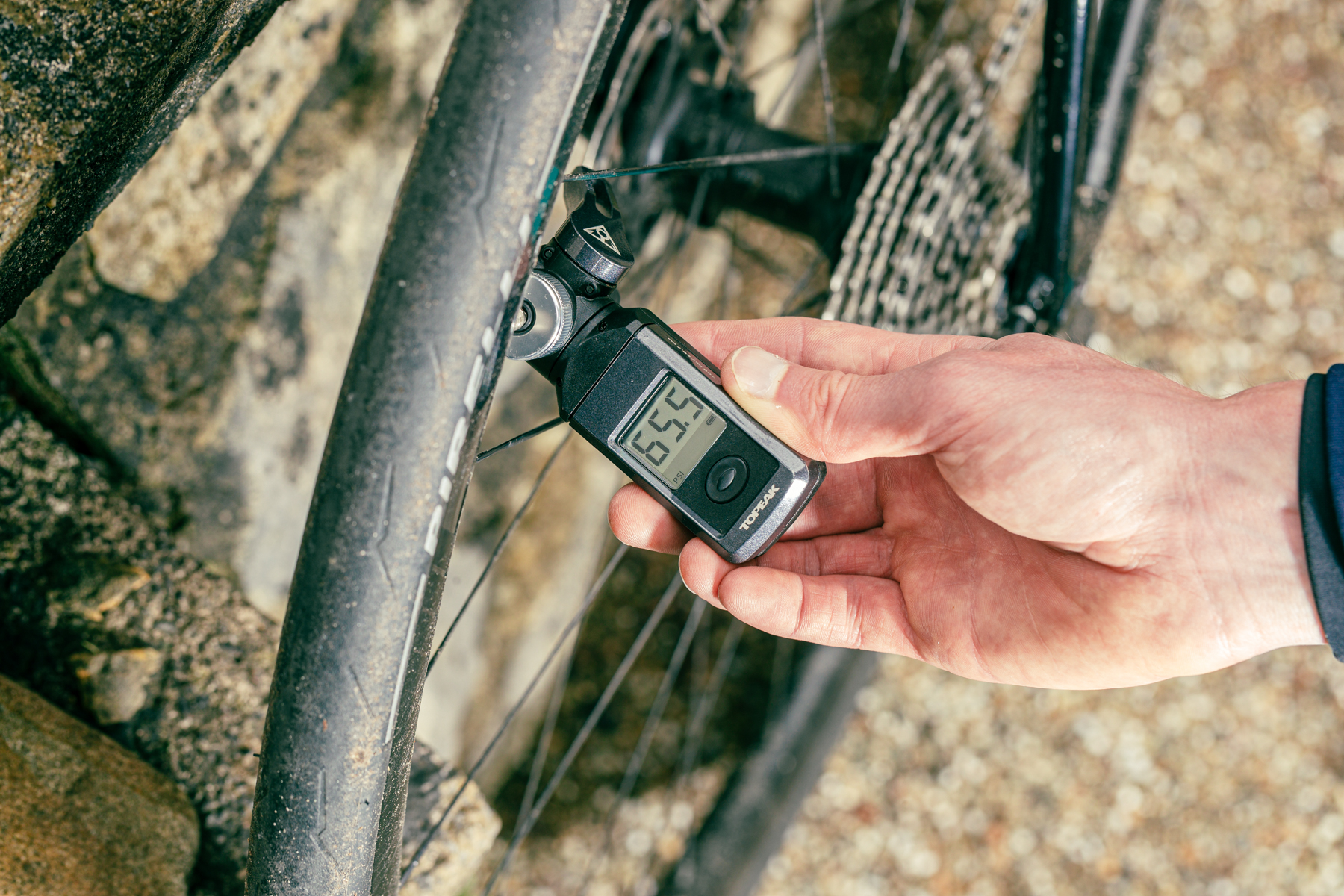
8. Check your tyres and tyre pressures
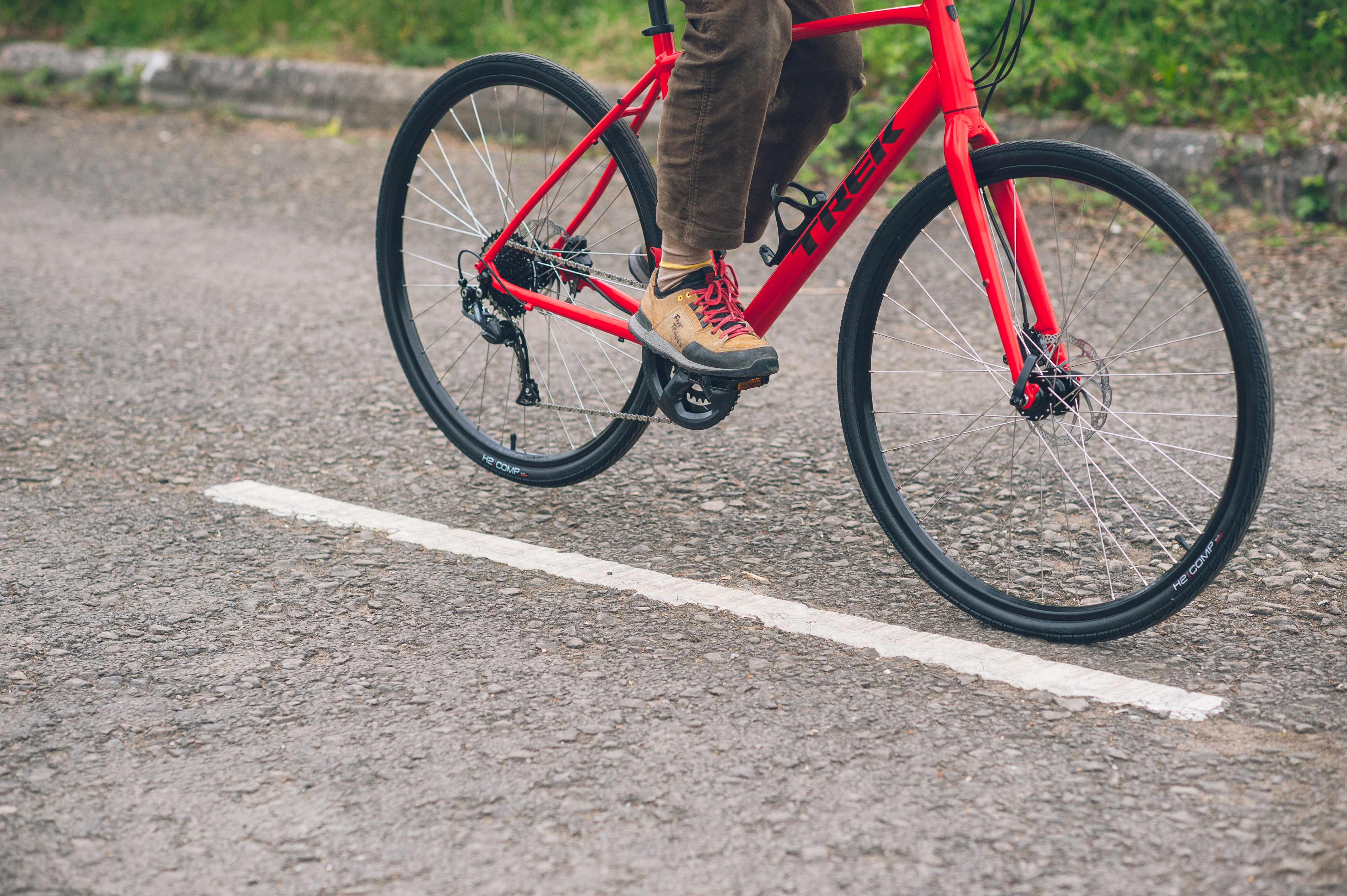
Reduced tyre pressure will create a bigger contact patch with the road for more grip. Russell Burton / Immediate Media
Unlike car tyres, cycle tyres are not prone to aquaplaning because of their narrower widths, so it’s not necessary to have a tread on your tyre when riding on tarmac.
You will need a tread for grip if you’re riding on loose, muddy surfaces in the wet though.
It’s a good idea to reduce your tyre pressure a little when riding wet roads because this will increase the size of the contact patch and the grip on offer.
Make sure your tyres aren’t worn down, because the extra debris on the road when it rains means you’re more likely to get a puncture.
9. Use the right chain lube
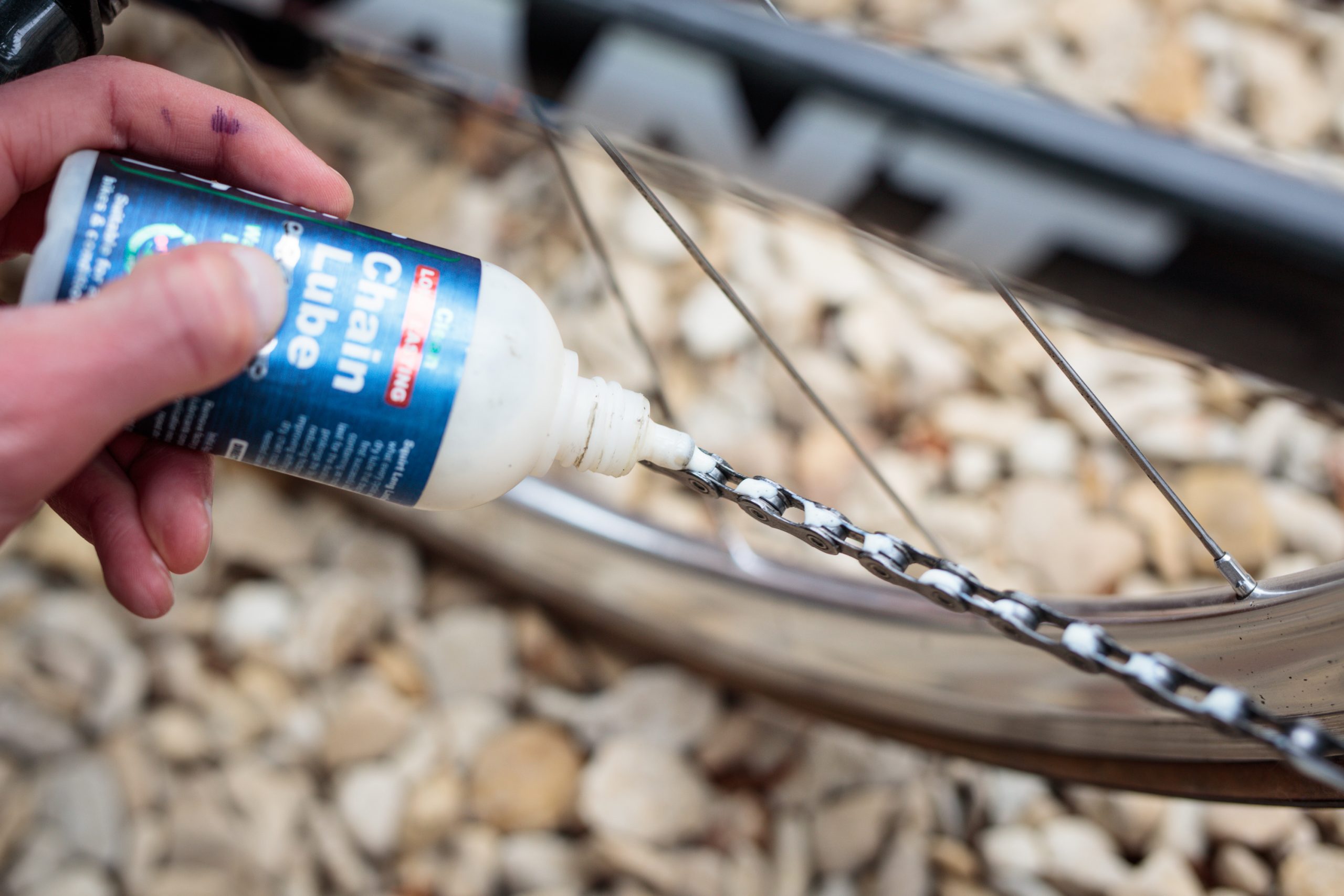
In the rain, wet lube will stay on your chain longer than dry lube. Simon von Bromley / Immediate Media
Use the right chain lube to avoid your drivetrain becoming exposed.
Your chain will be jet-washed by wheel spray as you ride in wet conditions. This can rapidly remove a dry lube.
A suitable wet lube will stay on your chain and protect it better if you are riding in the rain.
The downside is wet lubes tend to attract dirt, so you may need to clean your chain more often than if using a dry lube.
10. Keep your bike clean
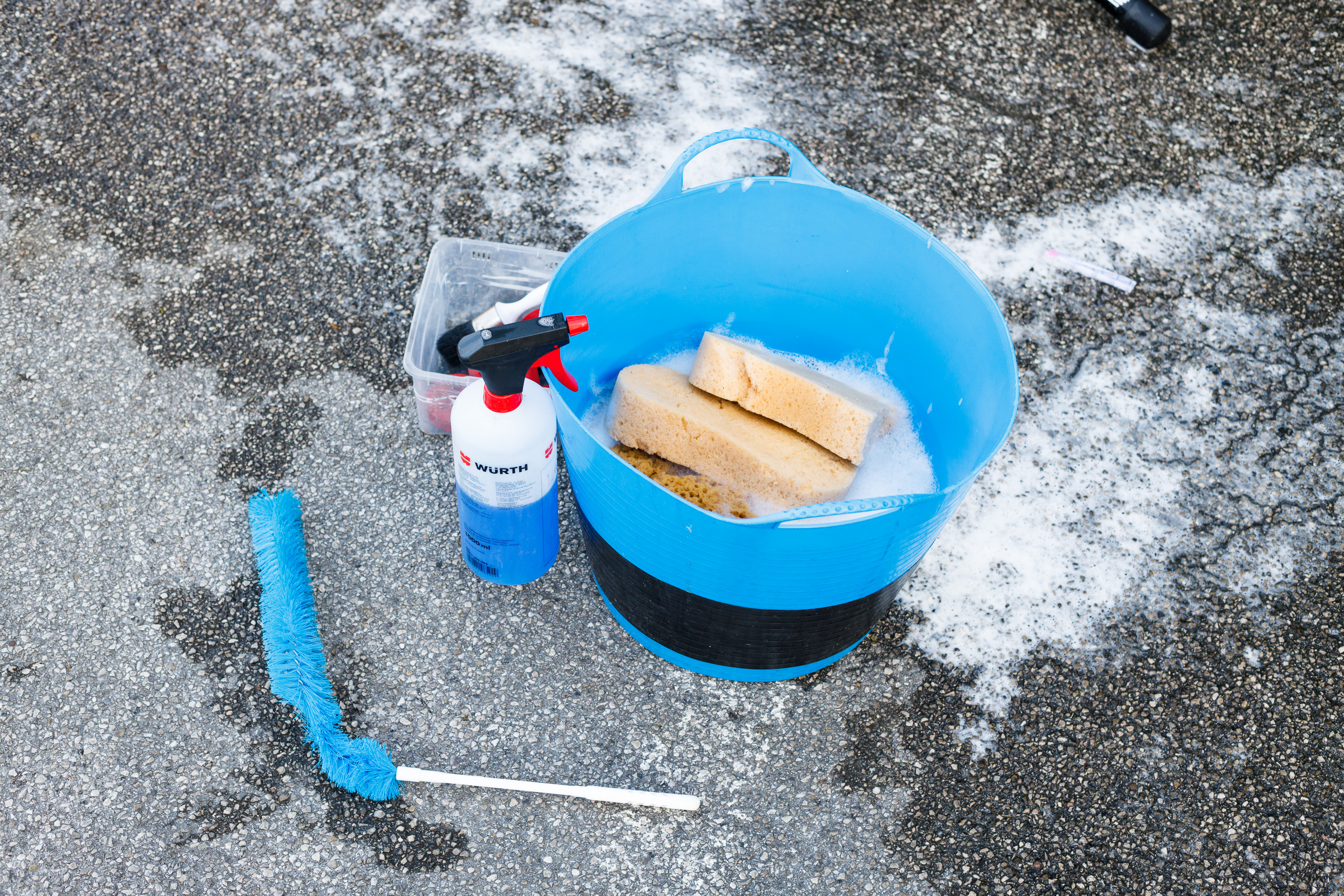
Cleaning your bike will keep it running better and for longer. Simon von Bromley / Our Media
Just like your chain, your whole bike will work more effectively if it’s kept clean, so give it a good wash when you’re back from a wet or muddy ride.
Bearings don’t like wet weather, so dry them and spray them with a water-displacing product such as WD40. The main areas to pay attention to are hubs, headsets and bottom brackets.
Any steel or chromed parts on your bike are also prone to rusting, so dry them off.
11. Keep your clothing clean as well
Durable water-repellent coatings should mean rain beads off your jacket. Paige O’Sullivan / Immediate Media
As well as your bike, it’s important to keep your clothing clean for it to be effective in the rain.
The breathable membrane in fabrics such as Gore-Tex needs to be kept free of oils, which you produce as you sweat, as well as picking up from the road, for it to be effective.
The surface of rainwear is typically treated with a durable water-repellent (DWR) product to repel water.
You should wash rain gear using specialist products to preserve the DWR coating and periodically reproof your waterproof cycling gear to keep it feeling as good as new.
12. Avoid riding through puddles
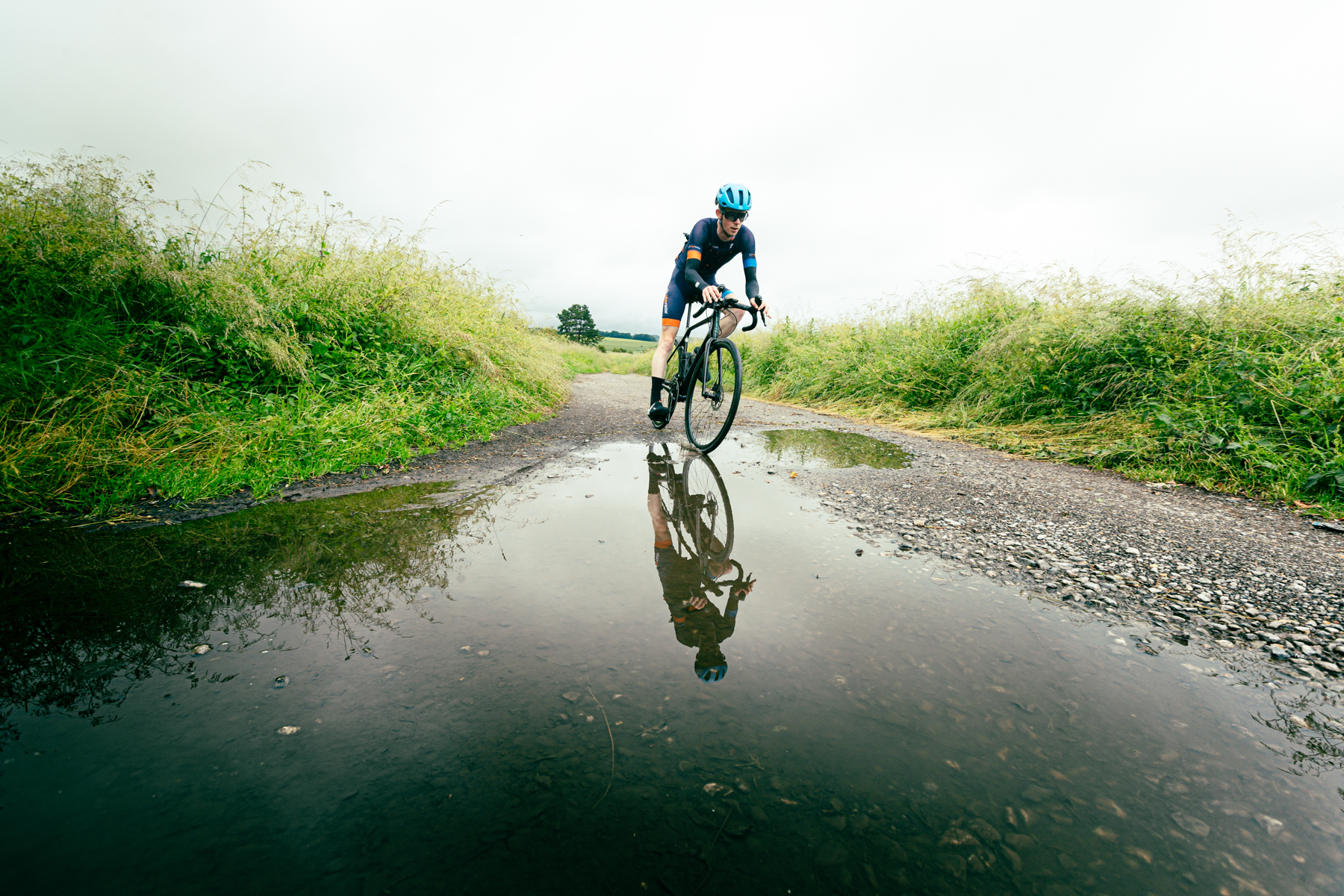
Avoid puddles, small and large. Russell Burton / Immediate Media
It goes without saying that you’ll stay drier if you try to avoid riding through standing water. Don’t be intimidated into riding right at the side of the road.
As a cyclist, under the Highway Code you have the right to use the whole of your lane, so if there’s a large puddle ahead, signal and move towards the centre of the lane to avoid it as much as possible.
It’s not just water in puddles that’s a danger. Often, they’ll accumulate mud and grit, so you risk skidding or a puncture.
A puddle may hide a pothole with an abrupt edge. Hit this and you may get a pinch flat, damage your wheels or even be thrown from your bike.
13. Steer clear of ironware
Manhole covers are a mean obstacle in the wet. iStock / Getty Images
It’s important to avoid ironware on the road.
Tyre grip on metal surfaces is significantly lower than on tarmac. Manhole covers are the main obstacle, but drains too can be slippery. Cattle grids are another obstacle to be taken carefully when wet.
If you do have to ride over a metal road feature, control your speed beforehand and don’t try to brake or turn as you pass over it to lower your risk of skidding.
14. Brake carefully
Braking distances will be longer in the wet than the dry. Wayne Reid / Our Media
Use your brakes judiciously in the rain. Stopping distances increase in wet conditions, so anticipate when you’ll need to brake and start braking earlier than you would in the dry.
This is particularly true of rim brake bikes, but it applies to bikes with disc brakes too.
In the wet, rim brakes have to cut through the film of water on your wheel rim before they start to bite, which can lead to a worrying delay before any braking happens. Disc brakes are better in this respect, but not immune to the problem.
Once your brakes start to work, they can lock up your wheel. Since adhesion between your tyre and the road surface is less in the wet, this can cause a skid.
Be particularly careful when cornering. Try to get all your braking done before you begin to turn, enabling your bike to freewheel through the corner.
When you get home, check your brakes for wear, because riding in the rain can increase the rate at which brake pads wear down. Also check wheel rims on rim brake bikes, because they can wear quickly in wet conditions.
15. Protect items you’re carrying
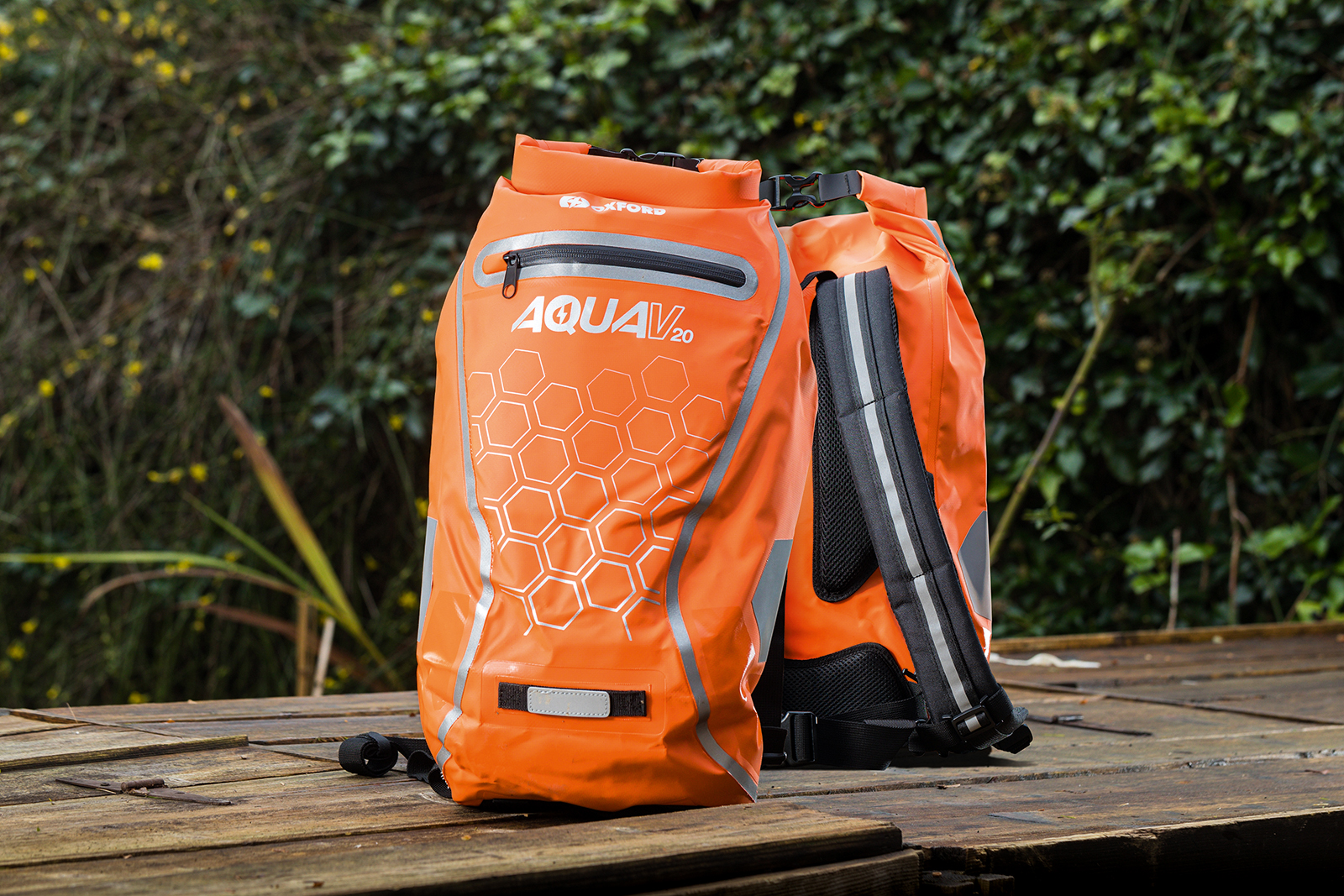
Choose a waterproof cycling bag to keep your belongings safe. Russell Burton / Immediate Media
If you’re carrying any items with you, whether on a commute or a leisure ride, they need to be kept dry too.
Many bike bags and cycling backpacks are made with waterproof materials, and include taped seams and a roll top to keep out water. Nevertheless, you may want to pack anything sensitive in a dry bag or sleeve inside.
Some saddle packs are not as well protected though and their contents may get wet. Multi-tools can rust, so if they’ve been on a wet ride, take them out of a saddle bag and dry them out.
Finally, don’t sit around in wet clothing. Get changed into something dry as soon as you can and sit back, pleased at having conquered the rain.
The 2017 Giro d’Italia winner Tom Dumoulin has just completed his first marathon with a time that will be the envy of many seasoned runners.
Two years ago, the 34-year-old ran Amsterdam’s Mizuno Half Marathon with an impressive time of 1:10:04. This Sunday, he completed the Amsterdam Marathon in 2:29:21.
“I wanted to run under two and a half hours, and I succeeded. But it was painful and difficult,” Dumoulin told Het Laaste Nieuws.
“Of course, I started way too fast. I was running so well that I thought, ‘I’ll see’. I don’t do that on the bike. I know what I can do and how to pace myself. With running, I secretly know that too, but I just enjoy it,” he added.
Dumoulin’s time meant he was the 116th fastest runner at the marathon out of 23,000 participants.
He ran in a group with Ethiopian Aynalem Desta, who won the women’s race in a time of 2:17:38, but halfway through, he said he felt everything “tense up”, fearing he might have to pull out. He stopped twice with cramps.
“After stopping three times because of cramps and thinking I could not finish anymore, I managed to hold on to a pace just fast enough to still finish in a sub-2.30 time,” Dumoulin wrote in an Instagram post.
In terms of training, the former professional cyclist said he did what he could and balanced training enough with avoiding injury.
After completing the 26.2-mile course, he told Het Laaste Nieuws: “I trained up to 34 kilometers at an easy pace. Then I really came crashing down. Today I finished the first half in 1 hour and 9 minutes and the second half in 1 hour and 20 minutes. My decline is enormous. You can tell I’m not getting the kilometres in.”
Dumoulin isn’t the only cyclist to take up running. Lance Armstrong has completed many marathons. He ran the 2006 New York Marathon in 2:59:36 and bettered his time by 13 minutes the following year.
Whyte Bikes has announced it has been bought from Cairngorm Capital by Causeway Capital, an Irish private equity firm.
The deal sees 100 per cent ownership of Whyte Bikes transferred to Causeway Capital, with the brand saying the “move is a major step forwards for the future and international growth of Whyte”.
Whyte’s existing management team will remain in place, with Nikki Hawyes continuing to lead the company as CEO.
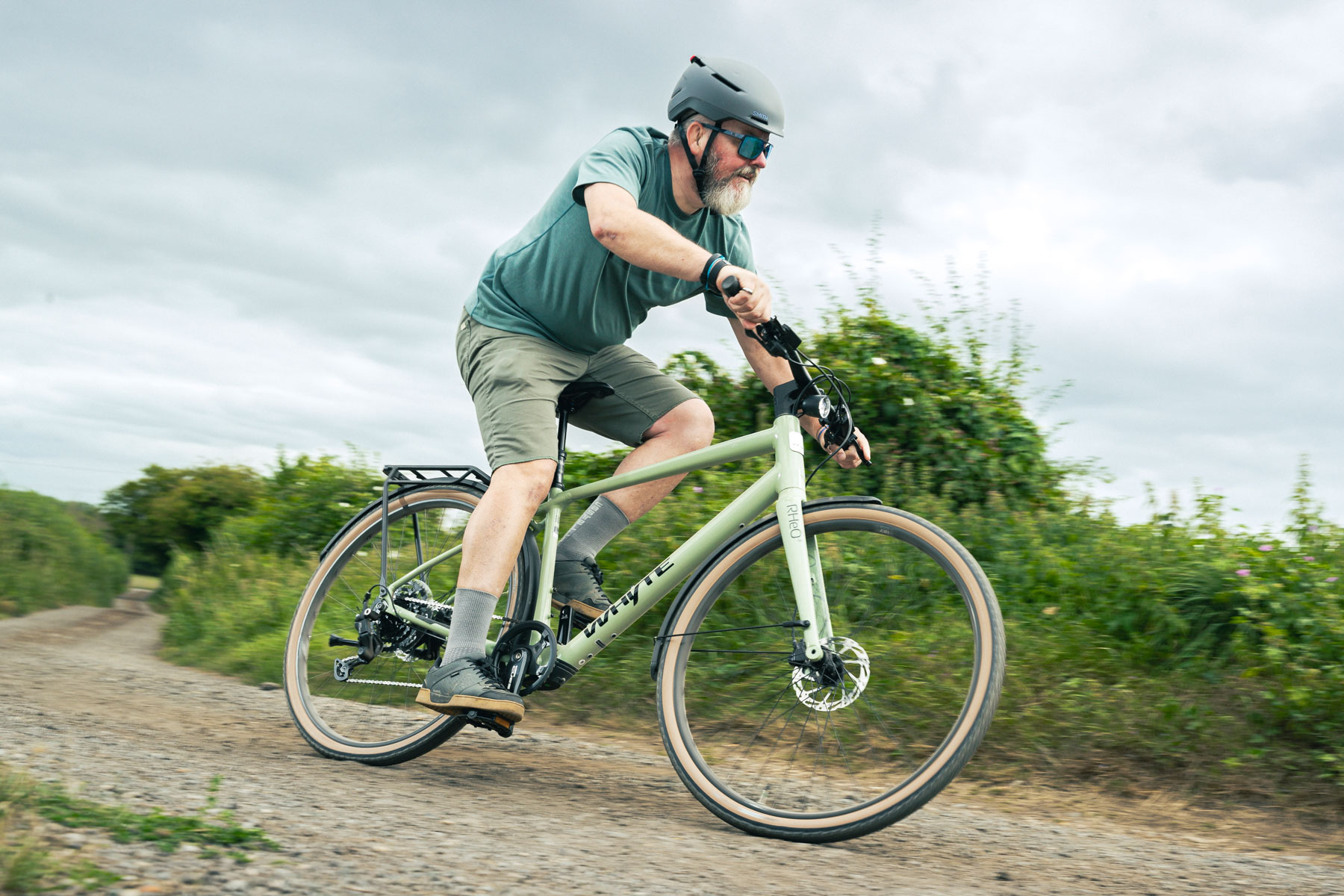
Whyte makes a wide variety of bikes, including an electric line-up. Russell Burton / Our Media
Whyte and Causeway Capital believe the partnership will strengthen the company’s ability to drive ongoing innovation, service Whyte’s dealer base and help it collaborate with key suppliers and partners. Further, with Causeway’s support, Whyte plans to ramp up efforts to extend its reach beyond the brand’s current strong foothold in the UK, with plans to expand further in continental Europe and worldwide.
Hawyes said: “This new partnership is an exciting step forward, building on our 25-year history of producing high-quality bikes. We will enhance our product offerings, expand our global footprint, and invest in our brand. This will allow us to create even better experiences for our partners and riders worldwide. I want to thank the team at Cairngorm Capital – their partnership and support have been invaluable in driving our transformation and bringing us to where we are today.”
Matt Scaife, partner at Causeway Capital, said: “Whyte is a category-leading British brand built on design, engineering and innovation. Wellness and outdoor recreation show strong long-term growth. The performance mountain bike market is accelerating, driven by technology innovation and increasing participation amongst younger riders. We are delighted to use the first investment from Causeway Capital Partners II LP to back Nikki and the Whyte team.”
The UCI has published the list of women’s and men’s professional road teams that have submitted the essential registration documents for the 2026 season.
Candidates had until 15 October to submit their registration files, and the UCI is now assessing the applications.
While many team names remain the same as the 2025 season, the UCI’s list reveals Tom Pidcock’s team will start using Pinarello bicycles.
Now called Pinarello-Q36.5 Pro Cycling Team, it was rumoured that Pidcock’s squad would be switching to Pinarello from Scott.
Since joining the team, Pidcock has ridden Scott bikes on the road but stuck to Pinarello for off-road racing, most recently riding a Pinarello Dogma GR at the Gravel World Championships.
However, Pinarello’s owner is Ivan Glasenberg, a mining billionaire who also has a controlling interest in the squad’s other sponsor Q36.5, the Italian cycling clothing company. So, Pinarello now sponsoring the team can be seen as Glasenberg aligning his interests.
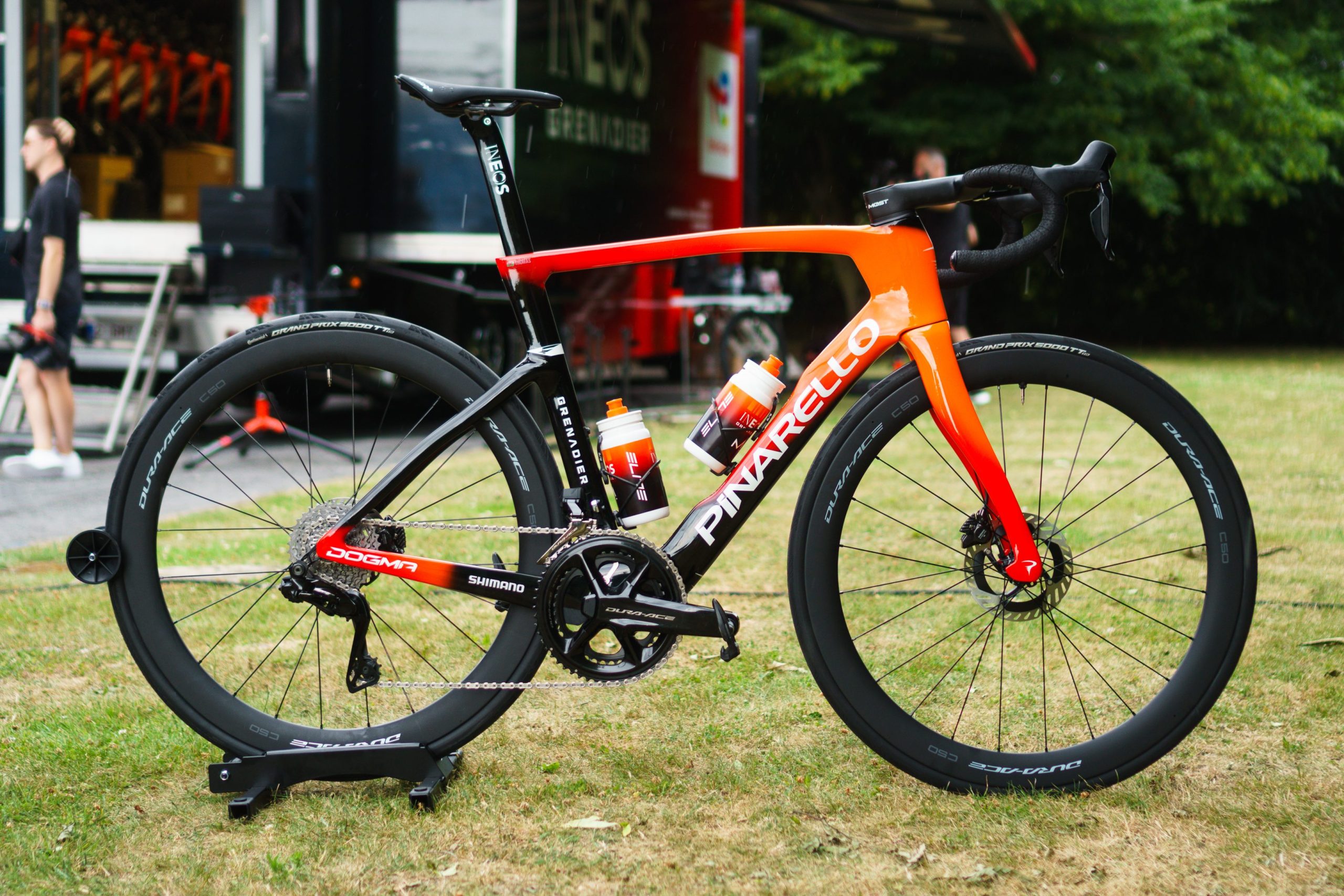
Pinarello will now equip two teams with its bikes. Simon von Bromley / Our Media
Ineos Grenadiers confirmed last week that it will continue its partnership with Pinarello for another three years, following speculation earlier in the season that it may be forced to find a new supplier.
This also raises the question of whether Scott will provide another team with bikes. Scott hasn’t yet responded to our request for comment.
The list of team names will also attract attention, after Israel–Premier Tech revealed it would change the team’s name. Factor and Premier Tech threatened to withdraw their sponsorship of the squad, following continued protests at the Vuelta a España.
The UCI’s list reveals that Israel–Premier Tech is listed as Cycling Academy, but a spokesperson for the team told BikeRadar this won’t be the name. Instead, it is a placeholder for the UCI registration prior to announcing a new name.
The UCI, cycling’s international governing body, says the applications are broken down into:
16 women’s teams for registration as UCI Women’s WorldTeams
20 men’s teams for registration as UCI WorldTeams
6 women’s teams for registration as UCI Women’s ProTeams
14 men’s teams for registration as UCI ProTeams
Not all teams submitted the essential documents by the deadline last week, but the UCI has included them in the above count. “However, they still have the possibility to rectify their situation before the end of the registration process, which would enable them to be registered for the 2026 season,” the UCI said.
The final list of teams registered for the upcoming season will be published on 10 December.
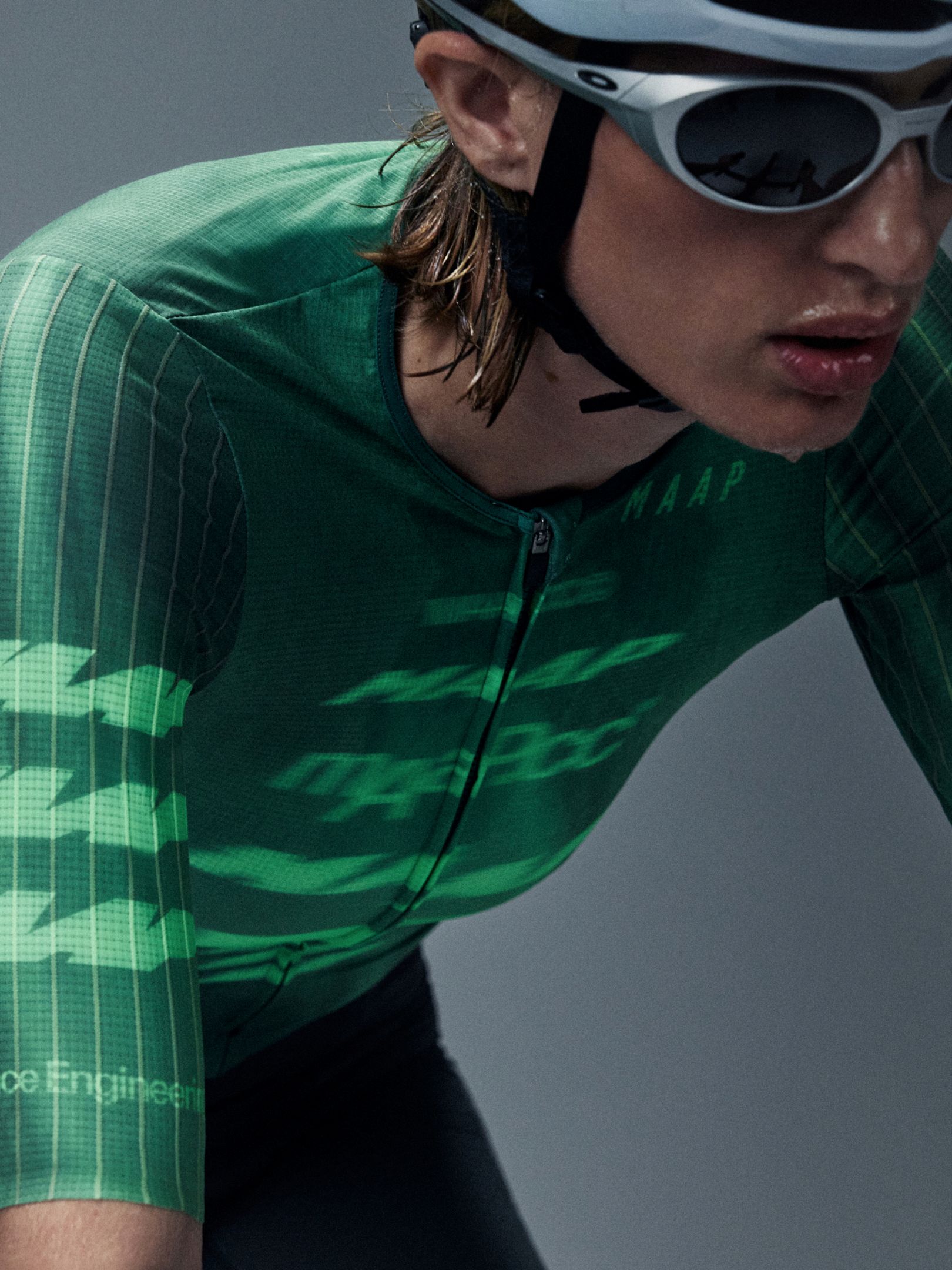
MAAP has launched its latest jersey, the Pro Aero, which it claims will save you between 6 and 8 watts, equivalent to as much as 60 seconds over 100km, thanks to its aero features.
The new jersey has been developed alongside the Jayco AlUla men’s and Liv AlUla Jayco women’s WorldTour pro teams, which are kitted out by MAAP.
Between them, the two teams have scored four victories during the 2025 season, including Ben O’Connor’s summit win on the Col de la Loze on Stage 18 of the Tour de France.
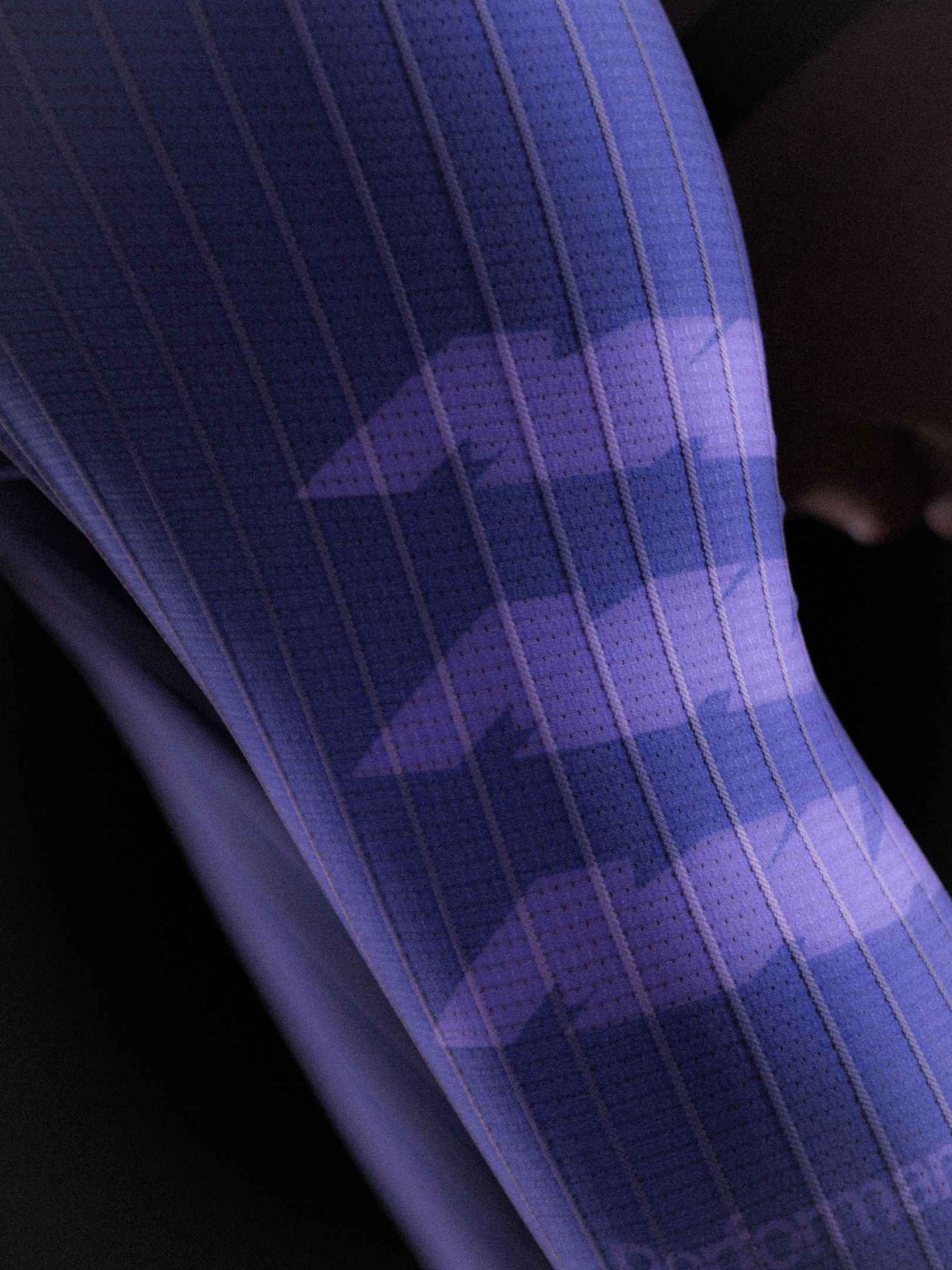
The aero ribs are woven into the sleeves, so MAAP says they won’t degrade over time.
MAAP uses a proprietary thin aero fabric, which it calls Aatero Flyte, which includes woven ribs in the sleeves that it claims reduce airflow turbulence.
MAAP says its new fabric was the culmination of testing of 16 prototypes and is only 20 microns thick, with a weight of 100g/m2.
The bad news is MAAP says the aero gains are only achieved at riding speeds of over 40km/h. The good news is it states the aero features are woven into the fabric, and so are permanent and won’t wear out or degrade over time.
The low-cut collar is designed for comfort.
Other features designed to make you faster include raw hems to the sleeves with internal silicone grippers, hydrophobic fibres to increase evaporative cooling, an ergonomic collar and bonded rear pockets.
MAAP says the new jersey, made in Italy, has a lower environmental impact too, thanks to an elastomer made without solvents that reduces chemical use during production, and is more durable and more easily recycled.
You can purchase the MAAP Pro Aero jersey from MAAP’s site, its Lab stores and retailers of its clothing, priced at £210 / $265 / €220 / AU$345. It’s available in MAAP’s usual men’s S to XXL and women’s XXS to XL sizing, and in the purple and green colours shown.
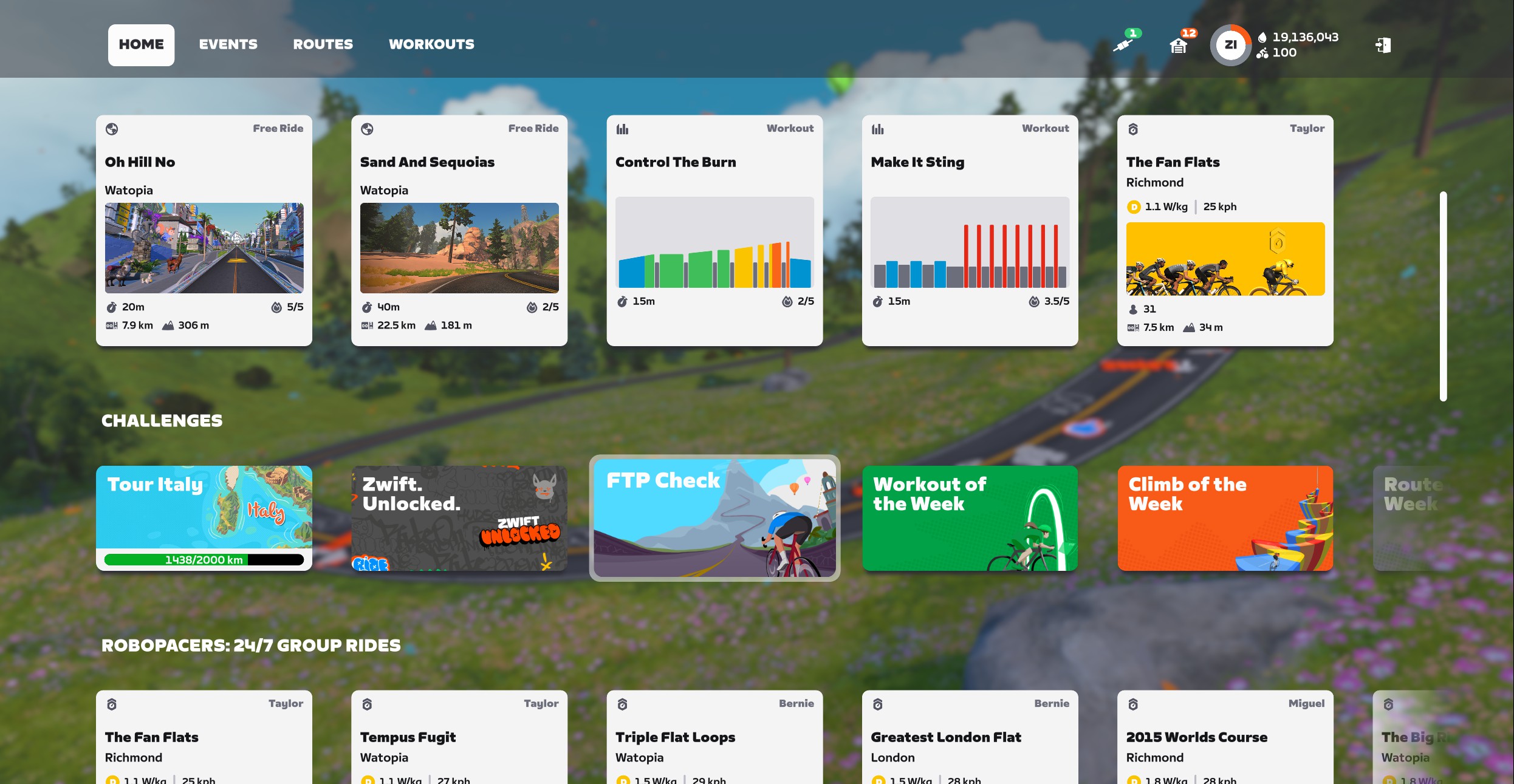
Today, Zwift launched a new “FTP Check” mini-challenge, with the goal of encouraging Zwifters to test their FTP in a uniquely Zwifty way so training metrics are accurate as we head into indoor season.
Challenge Requirements
The Challenge has two parts, which are meant to be completed in the same session:
While Zwift now looks at all activities and will alert you to an FTP increase if it detects on, The Grade KOM is particularly designed as an FTP test. When you finish the KOM segment, the game looks at your average power on the segment, as well as your segment time, then computes an FTP estimate, displaying it on the sign as you ride through the KOM arch:
If you’ve never ridden The Grade before, it’s helpful to have an estimate of how long it will take so you can pace yourself accordingly. Here are segment times from our bot tests with a 75kg, 183cm rider on the Tron bike at various power levels:
150W (2 W/kg): 27:46
225W (3 W/kg): 18:47
300W (4 W/kg): 14:22
375W (5 W/kg): 11:44
450W (6 W/kg): 10:04
Challenge Rewards
Your reward for completing both parts of the challenge is 500 bonus XP, so you can level up faster.
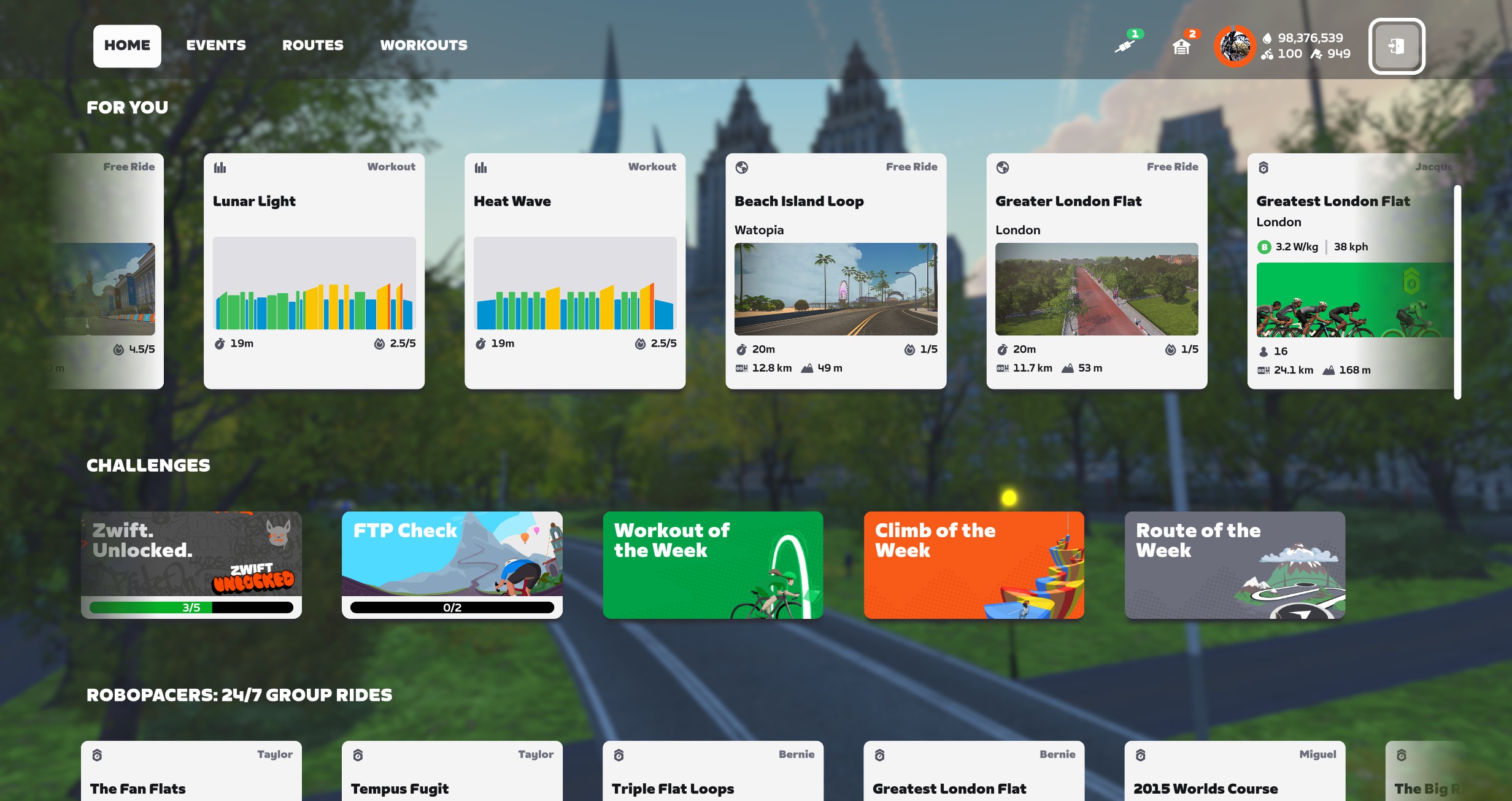
To join the Challenge, just click its card on the home screen. If you return to the home screen after doing this, you’ll see the card now shows your progress. If it’s showing your progress (0/2, 1/2, 2/2) you know you’re signed up!
Not signed upSigned up!
Deadline
This challenge is live from October 20-December 31. (We recommend finishing before the final day, though, as the Challenges sometimes end at an unexpected time on the last day.)
Rapha has announced a new partnership with USA Cycling as its latest financial results reveal a net loss for the eighth consecutive year.
Last month, Rapha revealed it was ending its seven-year partnership with EF Pro Cycling, and Rapha’s CEO Fran Millar said the relationship had “gotten tired”.
The new partnership is part of a renewed vision for the lauded cycling brand and will see Rapha working with USA Cycling for the 2028 LA Olympic Games.
Rapha will manufacture kit for a range of new disciplines, including BMX racing. Emily Maye / Rapha
“We wanted to build a broader portfolio that spoke to a new and different demographic of the sport in a way that we haven’t done before. This will be sort of one of the pinnacle things that we do,” Millar said at a press event in October.
Millar, who joined Rapha last year, says the LA Games could have the same impact on cycling in the US that the London 2012 Games had in the UK, encouraging more people to ride bikes.
Rapha will dress USA Cycling’s athletes from 2026 through to the end of 2029, which will take the company into new cycling disciplines, including BMX, and notably track cycling.
Working with the USA track team will push Rapha in ways Millar feels its relationship with EF Pro Cycling did not.
Millar says the skinsuit for EF Pro Cycling was last tested in 2022. “That’s an anathema to me in terms of having a high-performance suit – that you wouldn’t test every year and get it in the wind tunnel to understand what you could be doing to go faster.”
She says there isn’t the luxury of waiting that long in track cycling “where every millisecond counts”, and that the performance gains developed for the USA track team will eventually filter into Rapha’s other products.
Financial results and kicking the “discounting drug”
Rapha CEO Fran Millar says the 2028 LA Olympic Games could have the same impact on cycling in the US as the London 2012 Games had on cycling in the UK. Emily Maye / Rapha
Millar says there is a “real confidence” in Rapha for the first time in a long time. Its financial backers are supportive of the company pursuing opportunities that could be seen as risky but with high-reward potential, including partnering with USA Cycling.
This may come as a surprise to those who have followed Rapha’s financial results in recent years. Rapha’s latest financial results reveal an annual revenue of £96.2m in the year ending January 2025 and a net loss – its eighth in a row – of £15.6m.
However, Rapha’s chief financial officer, Michelle Woolaghan, says this is not a number the company is focused on internally. Instead, Rapha is concerned by its Earnings Before Interest, Taxes, Depreciation, and Amortisation (EBITDA).
In 2023, Rapha achieved a positive EBITDA of £900,000. For the latest results, ending in January 2025, the EBITDA has moved back to -£2.6m. Woolaghan says this is due to a conscious decision to reduce the level of discounting and promotional sales.
“Within the 2024 numbers, the full price sales held level and what dropped back was promotional or discounted sales. So our gross margin improved across all the channels. But nevertheless, because of that volume drop in the short term, that impacts profitability,” says Woolaghan.
“We’re kind of coming off the discounting drug, I suppose,” she says.
£10 million payback
Woolaghan and Millar are also keen to explain why Rapha’s results look the way they do, and a large contributing factor is amortisation, or the depreciation of goodwill and tangible assets, after it was bought by the grandsons of the Walmart founder Sam Walton, Steuart and Tom Walton, in 2017.
Woolaghan says the amortisation is roughly £10 million a year: “So we just have that hit to the profits and losses every single year until we’ve paid off the kind of purchase price.” She expects this will continue for the next eight to 10 years.
Rapha has also decided to reduce the carrying value of the company – the measure of a company’s value based on its balance sheet – by £102m.
“What that means in practice is when we assess the outlook of what it will take to get back to strong EBITDA and revenue growth,” says Woolaghan.
Millar says this will have no impact on customers.
Women’s cycling is enjoying unprecedented attention and appreciation from a growing global audience, with more eyes than ever on its professional races and athletes. Women’s racing is dynamic, tactical, and CLOSE in a way men’s racing isn’t at the moment. However, beneath this visible success lies a critical vulnerability: the foundational support and development structures may not be robust enough to sustain this boom and ensure the sport’s long-term health.
Natascha Knaven-den Ouden, a Dutch development team lead with daughters in the pro peloton, posted the following on Instagram in spring 2025, highlighting what may be a growing problem with the evolution of women’s professional cycling.
“On the surface, women’s cycling is booming. We see more live broadcasts, increasing prize money, and iconic races like the Tour de France Femmes and Paris-Roubaix are now part of the women’s calendar. Major WorldTour teams are fielding women’s squads, and fans are finally starting to recognize the talent and excitement in the women’s peloton.
It all looks like progress, and to a degree, it is.
However, behind that spotlight is a problem we don’t talk about enough: the base of the sport is far too weak to support the weight of the top.
While the elite side is expanding, the broader structure, especially development and grassroots racing, is actually shrinking. Smaller races disappear. Continental and amateur teams struggle to survive. And most critically: young riders are left with fewer opportunities to grow gradually within the sport.
Today, it’s possible, even common, for a beginner to obtain a license, sign with a small continental team, and be thrown directly into the same races as world-class athletes like Lotte Kopecky. That would be unthinkable in football, tennis, or athletics. But in women’s cycling, it’s a reality.
This isn’t a criticism of individual riders or teams, it’s a systemic issue. A sign that we’ve focused too much on building the top, without strengthening the ladder that leads there. Without regional races, strong national calendars, and structured development programs, we’re setting up a system where only the most exceptional talent breaks through, and where many others drop out before they’ve had a chance to develop.”
Increasing the number of women racing bikes, inside or outside, has to become a priority for those interested in the future of the sport. The FemmeCycle Collab, a group of passionate cyclists and indoor cycling enthusiasts, has a few ideas to get more women onto the roads, whether they be virtual or IRL. We are dedicated to increasing the number of women racing bikes at all levels and ages.
What is something that could increase the number of women racing bikes?
Somewhat recent innovations such as indoor riding platforms (eg Zwift, MyWhoosh, Rouvy, and TrainingPeaks) are beginning to change the thin support for developing riders described above. These virtual environments serve as accessible training grounds, allowing women—whether casual riders or aspiring racers—to develop their skills and understanding of racing culture from home. These platforms enable riders to participate in structured workouts, group rides, and competitive events, with full transparency of their performance stats. Women can track their progress, analyze their strengths and weaknesses, and gain a deeper appreciation of racing strategies—all in a highly engaging, community-oriented environment.
Why are indoor platforms a good tool for accomplishing grassroots growth for women specifically?
While indoor platforms may not fully replicate training outdoor bike handling and pack riding skills crucial for professional racers, they offer a vital stepping stone. For racers in thinly populated areas, especially, these platforms provide an opportunity to compete against strong female competitors, helping them identify their unique talents, such as a “puncheur” superpower, which might otherwise go unrecognized when training with mixed-gender groups. Identifying an athlete’s strength is a starting point for building their personal race profile or strategies (think, Pidcock as a descender, or Cavendish as a sprinter, informing their training).
By engaging with these digital spaces, women can transition from casual cyclists to athletes, developing an understanding of their own racing tactics and the physical demands of competition. This accessibility democratizes participation by overcoming barriers like cost, geography, and time constraints often faced at the grassroots level. As more women utilize these platforms, they gain the skills, motivation, and confidence necessary to excel in outdoor racing.
Expanding participation through these virtual environments is not a substitute for traditional racing, but rather a complement that broadens the base of future cyclists. When women can immerse themselves in the sport digitally—competing, setting goals, and learning about race dynamics—they are more likely to stay engaged and aspire to compete in real-world events. Over time, these virtual experiences can feed into physical competitions, creating a seamless pathway from online training to outdoor racing. The next step in this pathway would naturally be to take this larger pool of riders and build their skill level in outdoor settings in more local settings before they feed into the greater elite pool of riders.
Furthermore, increasing the number of women actively involved at every level—with the aid of such platforms—builds a strong, diverse talent pool. When participation is higher, talent is naturally identified earlier, and more riders receive the support they need to progress. A larger, more inclusive community nurtures the next generation of elite racers, ensuring that talent is not lost due to a lack of exposure or development opportunities. In addition, indoor racing can help bridge the gap for riders who don’t have access to larger fields of racers in their hometowns. Additionally, indoor racing offers a solution for riders in areas with limited access to larger competitive fields.
What’s one thing you’re doing right now to show you value racing?
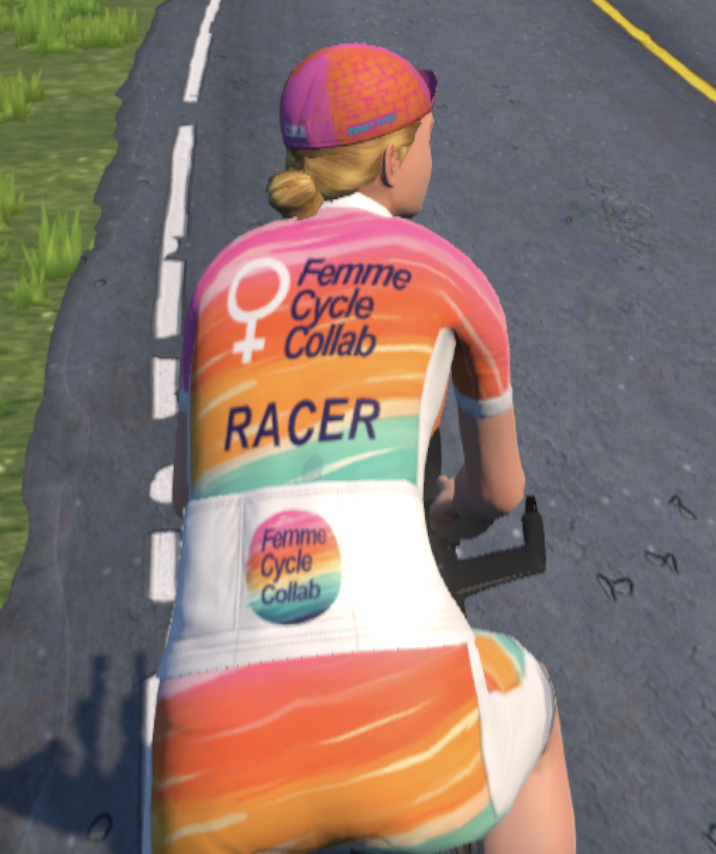
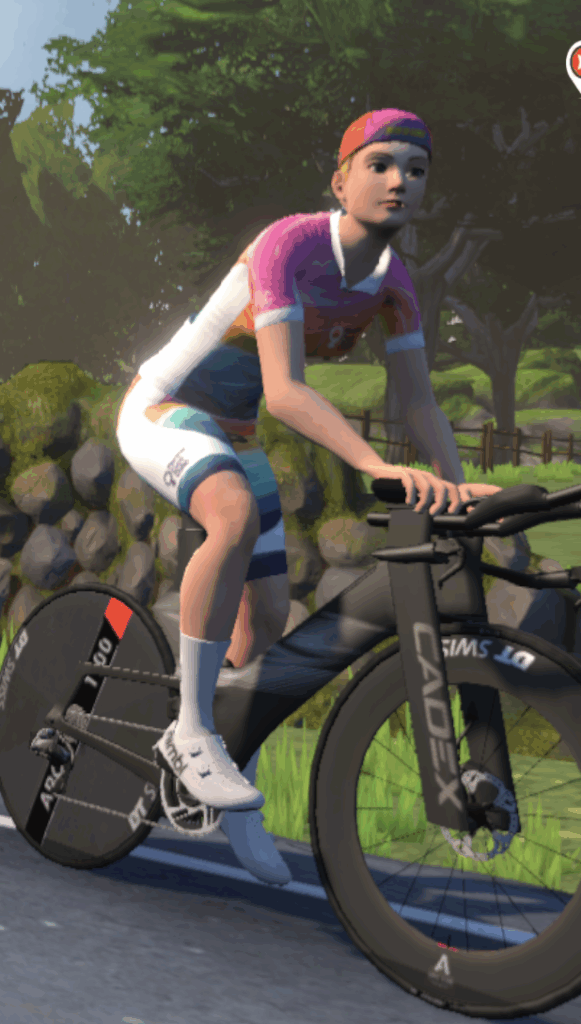
The FemmeCycle Collab created an in-game kit for Zwift that reflects our hopes for the future of the sport. That jersey is a statement of our belief that women’s racing should be more approachable and more visible. Identifying a rider as a female racer shows other women on the platform that there ARE women racing, not just the elites, but moms, grandmothers, retirees, and everyone else that doesn’t have the bandwidth or desire to train 12+ hours a week. Because the more women who race means the more women’s fields will be needed, inside and outside. We hope that increasing the number of women who race will, in turn, drive the demand for more women’s fields, both virtually and in real-world events.
Elevating women’s cycling will require a multifaceted approach. Building a robust base of participation through grassroots races, structured development programs, and innovative platforms like Zwift is crucial. These efforts create a sustainable pipeline where women can progress from casual riders to seasoned racers, understanding and appreciating the sport’s culture and intricacies along the way. A strong top must be supported by an equally resilient foundation—only then can women’s cycling reach its full potential.
And what do you think is next?
With a growing number of women participating in cycling, it’s crucial for those competing at higher community levels to grasp performance verification in indoor training. This encompasses everything from accurately inputting height and weight online to a thorough understanding of their equipment. Initiatives like the Fair e-racing alliance (https://www.f-e-r-a.org/) are already assisting teams with this vital aspect of legitimizing online racing.
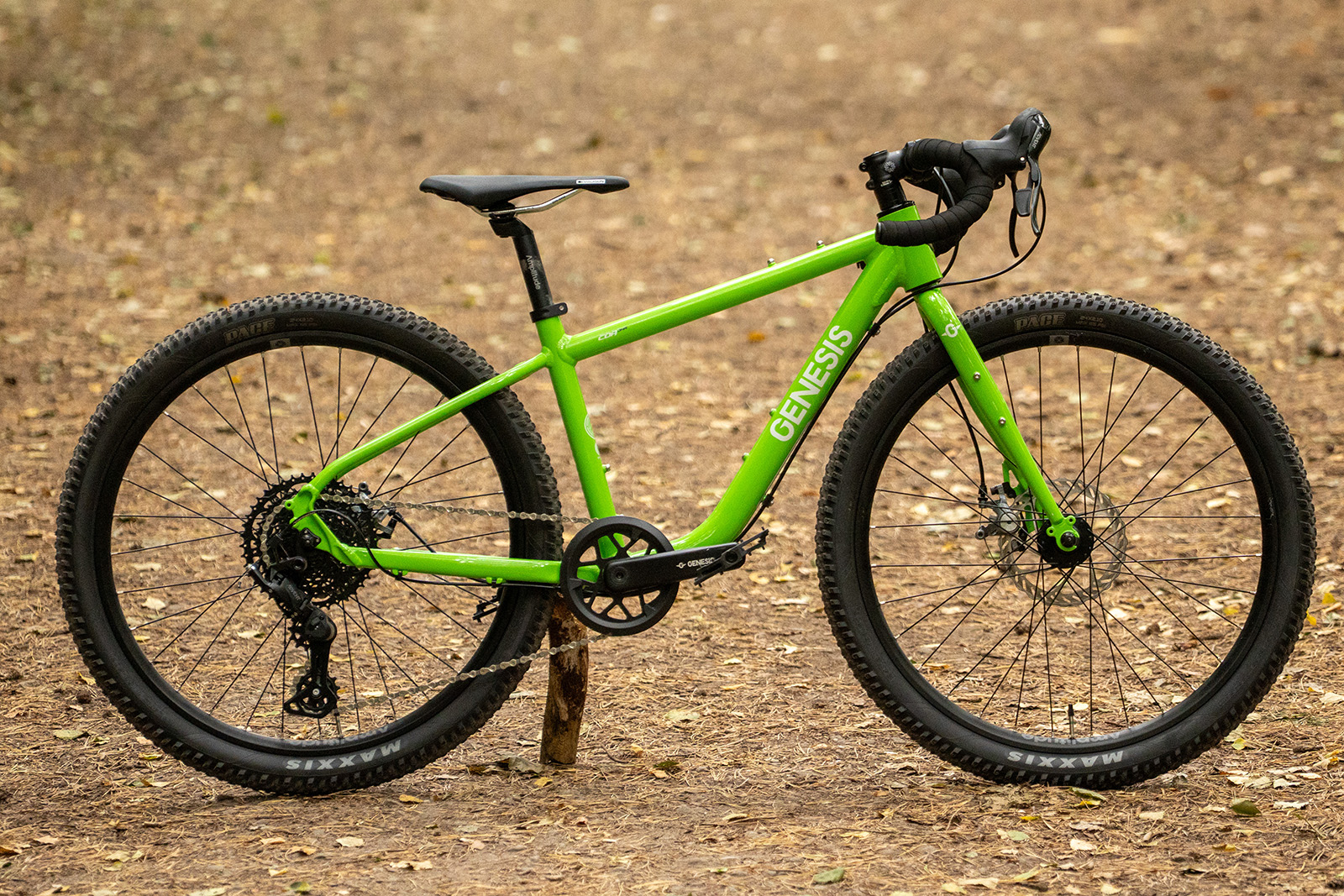
British bike brand Genesis has released the CDA Junior, a new addition to its gravel adventure bike range tailored specifically for smaller riders.
Genesis says its CDA range is designed for riders “seeking a versatile and affordable bike” that’s equally at home on your commute or light gravel trails. The CDA Junior now brings the brand’s “spirit of adventure to riders of all ages.”
Genesis has also revealed two new adult bikes, the CDA 10 and CDA 20, both costing less than £1,000.
Genesis says its CDA Junior kids’ bike is a “scaled down model” that’s light, tough and easy to maintain.
Instead of offering an age range, Genesis says the CDA Junior is suitable for riders between 140 and 157cm tall.
The bike has a lightweight aluminum frame and fork engineered specifically for young cyclists.
Genesis product manager, Sam Lawson, says: “The introduction of the CDA Jnr marks a new chapter for Genesis in children’s bikes. We understand how important the family side of cycling is, and that’s why we’ve created a purpose-built 24in gravel bike that delivers the same performance, versatility, and adventure-ready features as our adult platforms.”
The bike even has top tube and fork mounts. Genesis
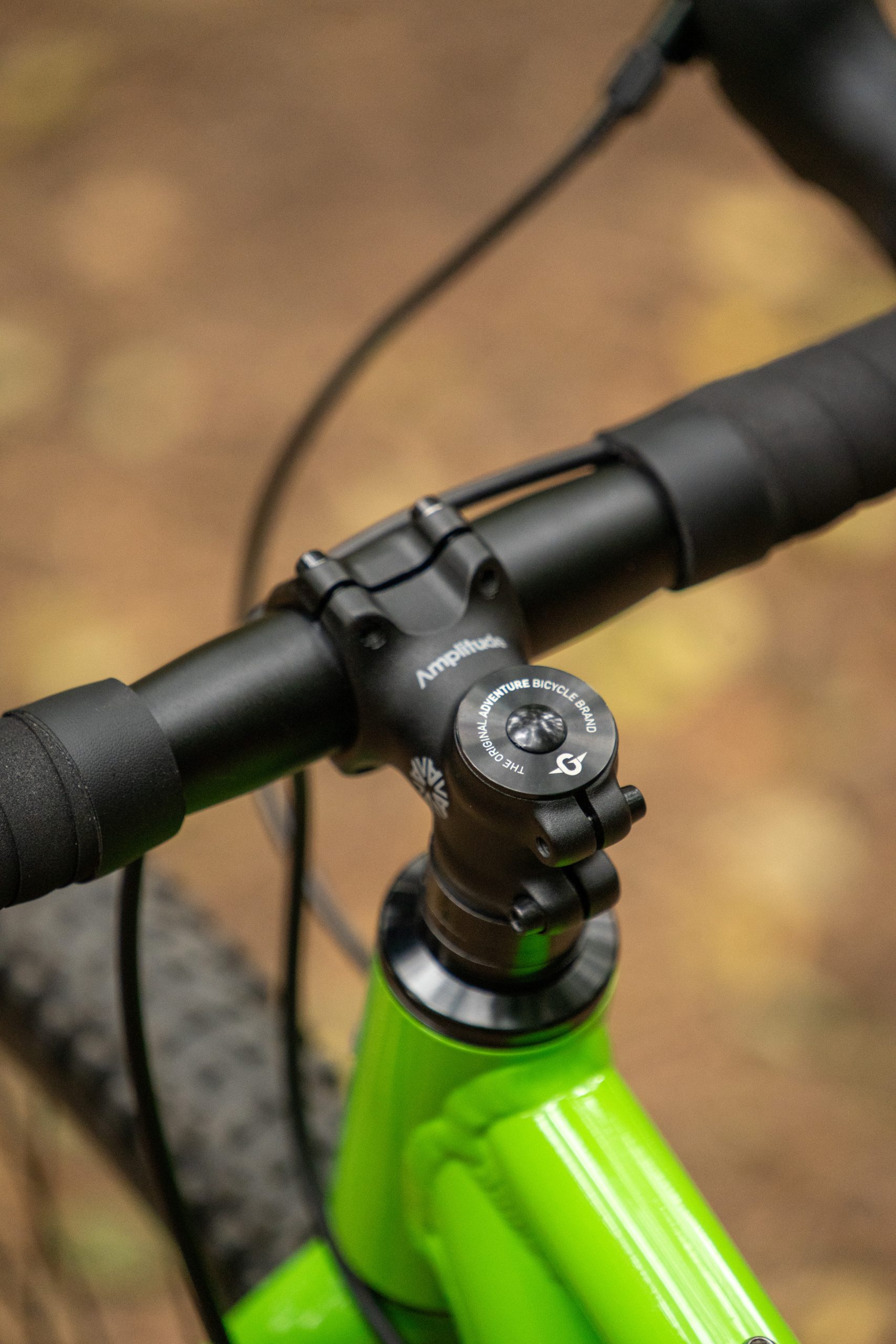
The finishing kit comes courtesy of Amplitude. Genesis
The bike’s geometry is optimised for the 24in wheels. A 468mm effective top tube and 340mm seat tube are said to provide a comfortable and confidence-boosting fit.
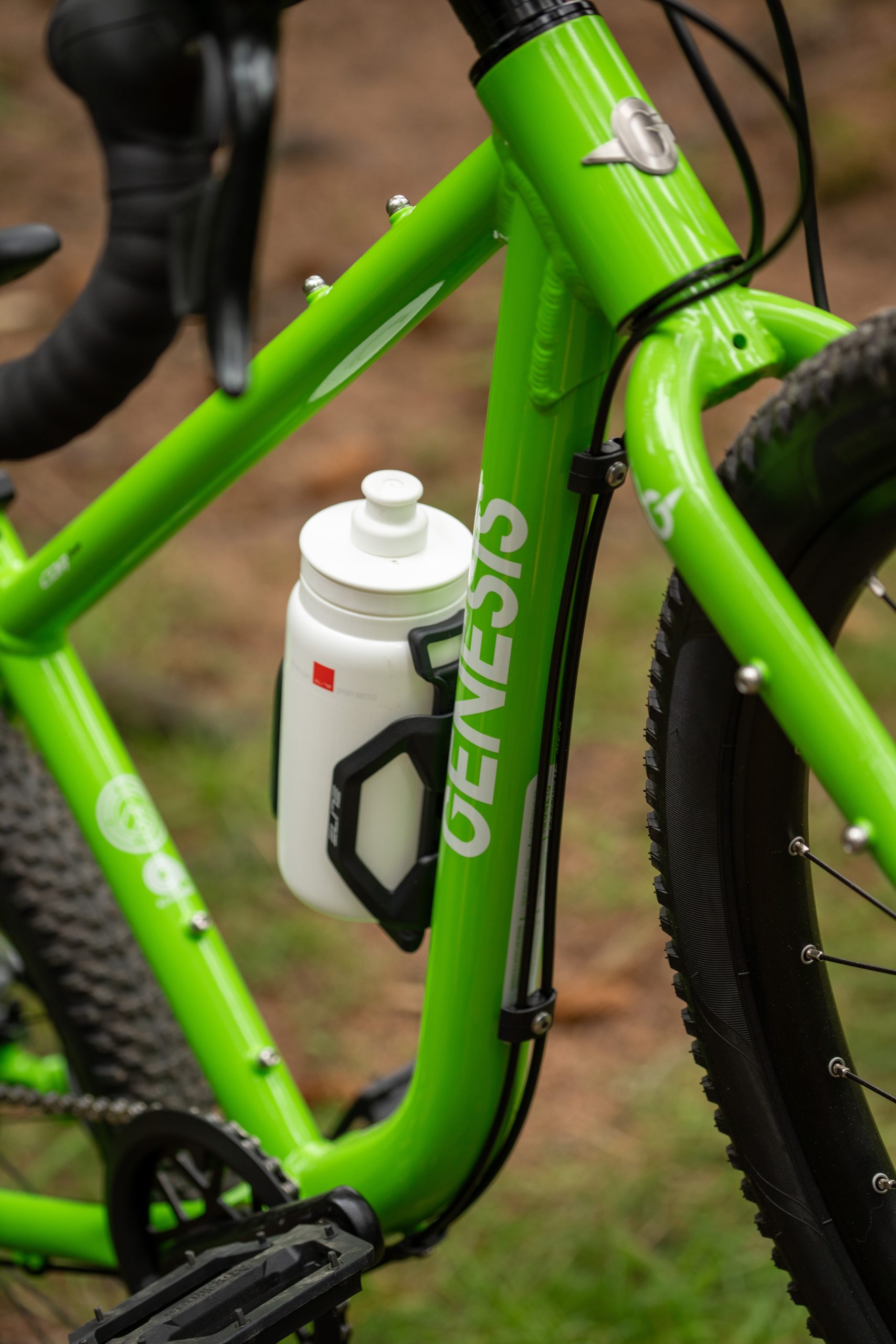
Elsewhere, it has a Microshift Advent 1×9-speed drivetrain for easy maintenance and to provide riders with a wide range of gears. There are even bottle cage mounts, top tube mounts and fork mounts for accessories or bikepacking bags.
The bike will retail for £749.99 / €899.
Genesis CDA 10 and 20 adult bikes
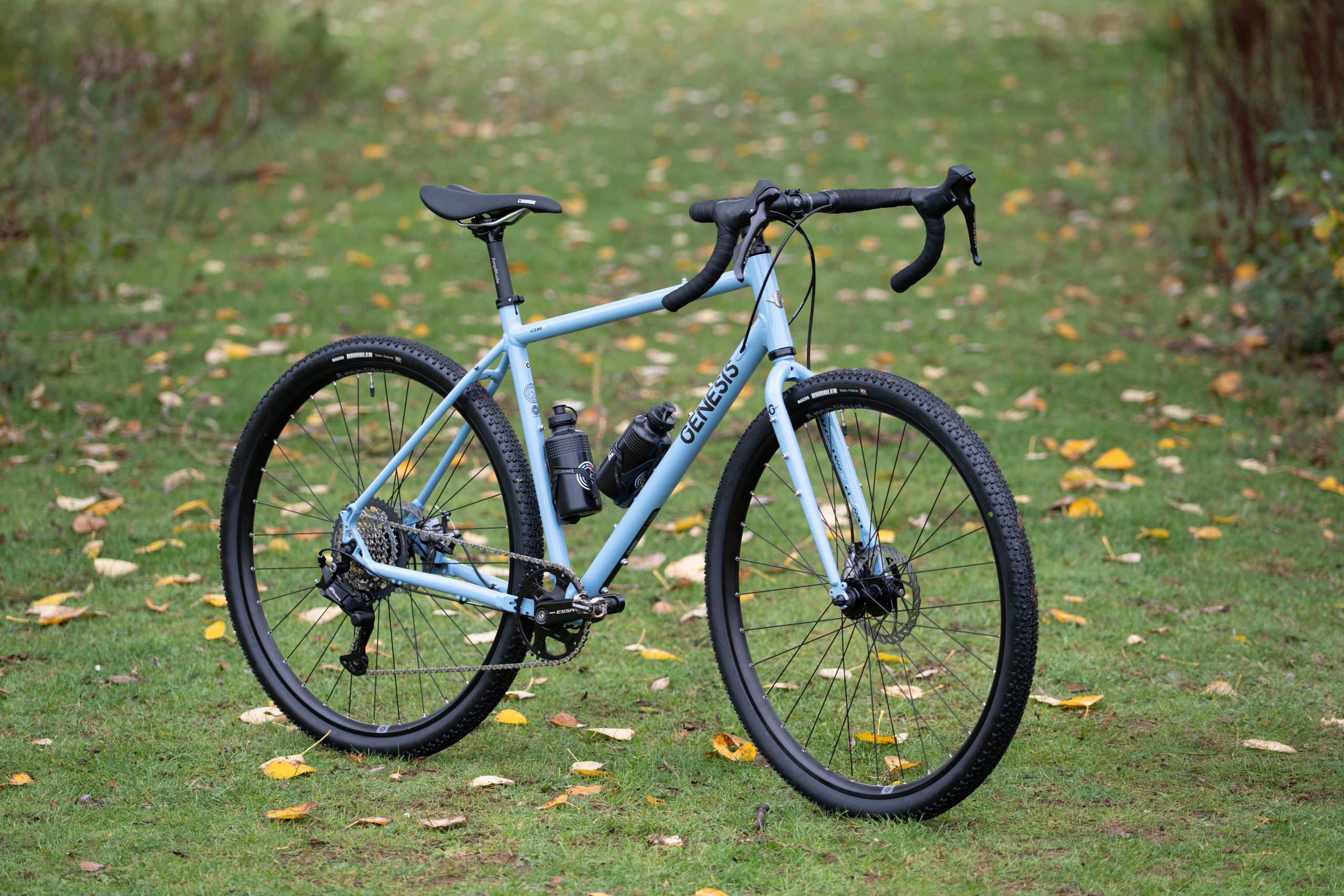
The new Genesis CDA 10 gravel bike. Genesis
Alongside the CDA Junior, Genesis has released two budget gravel bikes for adults, the CDA 10 and CDA 20.
Genesis says the CDA 10 is the “ideal entry point into the world of gravel” and combines practical features with “off-road capability”.
The £799.99 / €979 bike has an aluminium frame and chromoly fork, with Genesis promising a “smooth, confident ride on any surface”.
The CDA 10 features the new Shimano Essa 1x drivetrain to ease maintenance and ensure there’s a ready supply of spare parts available, alongside 45mm Maxxis Rambler gravel tyres.
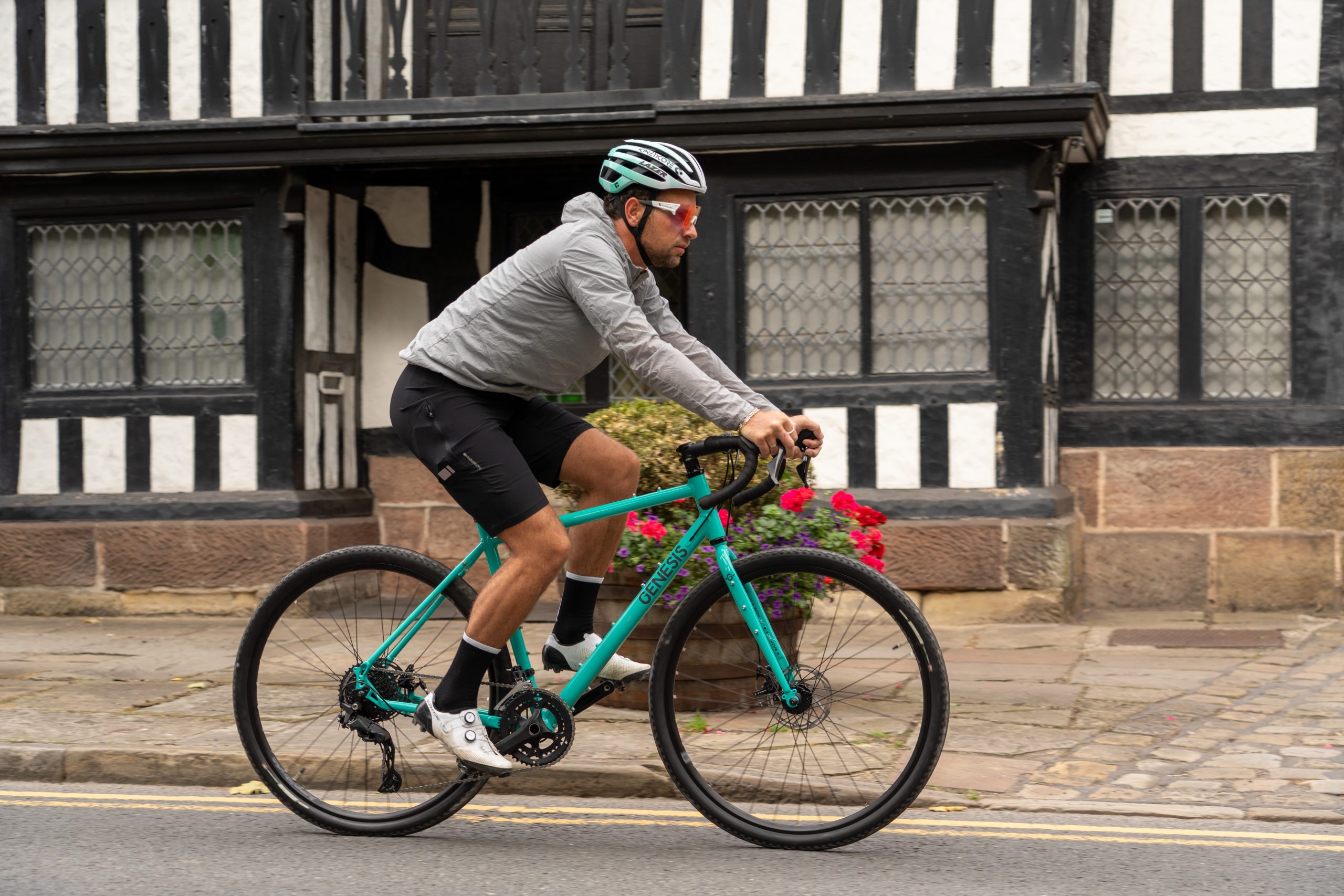
The Genesis CDA 20 has the same frame as the CDA 10, but is built for riders who want more performance. Genesis
While it has the same frame and fork as the CDA 10, the CDA 20 is “built for riders who want more range, control, and performance from their all-terrain bike.”
Instead of a Shimano Essa drivetrain, the CDA 20 has a Shimano Cues 2×10-speed drivetrain and TRP Spyre brakes with dual pistons for “reliable stopping power and a responsive lever feel”.
The bike is complete with the same Maxxis Rambler tyres and Amplitude finishing kit.
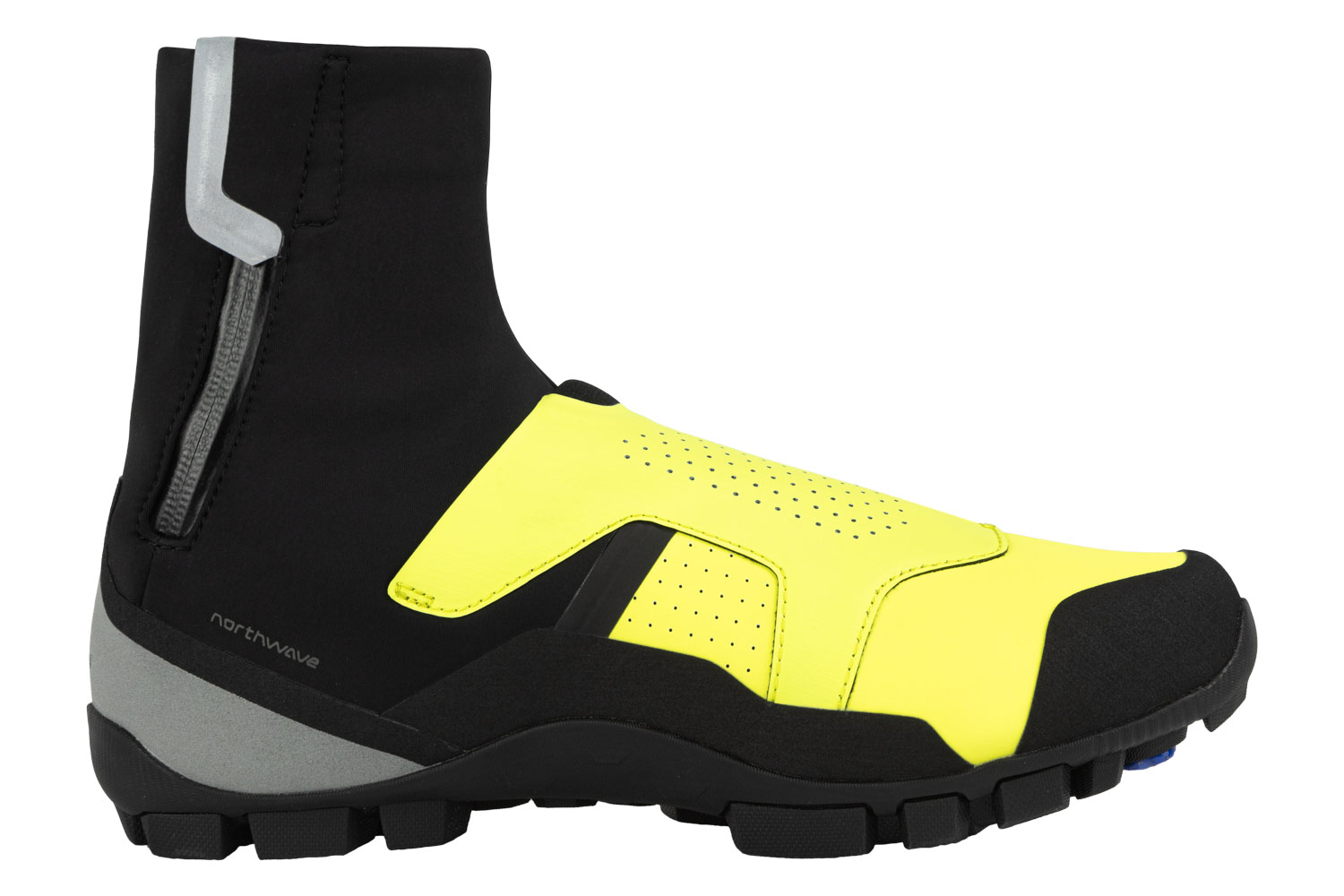
The new Northwave Celsius XT Arctic GTX is a dedicated high-performance winter cycling shoe built for riders who don’t retreat indoors when the days shorten and the weather closes in.
With no compromise on style – because why shouldn’t winter kit look great? – the Celsius XT Arctic GTX features windproof and waterproof construction, and is aimed at gravel riders and mountain bikers who ride year-round in the harshest conditions.
Based in Montebelluna, Italy, a stone’s throw from the Dolomites, Northwave has a rich history in shoe manufacturing dating back to 1971.
The brand was a pioneer in the early days of snowboarding boots in the 90s and soon after expanded into cycling shoes, building a reputation for quality and innovation with products – such as proper winter shoes – that diverge from the mainstream.
Here are five reasons the Celsius XT Arctic GTX deserves a place in your winter-cycling wardrobe.
1. No more overshoes
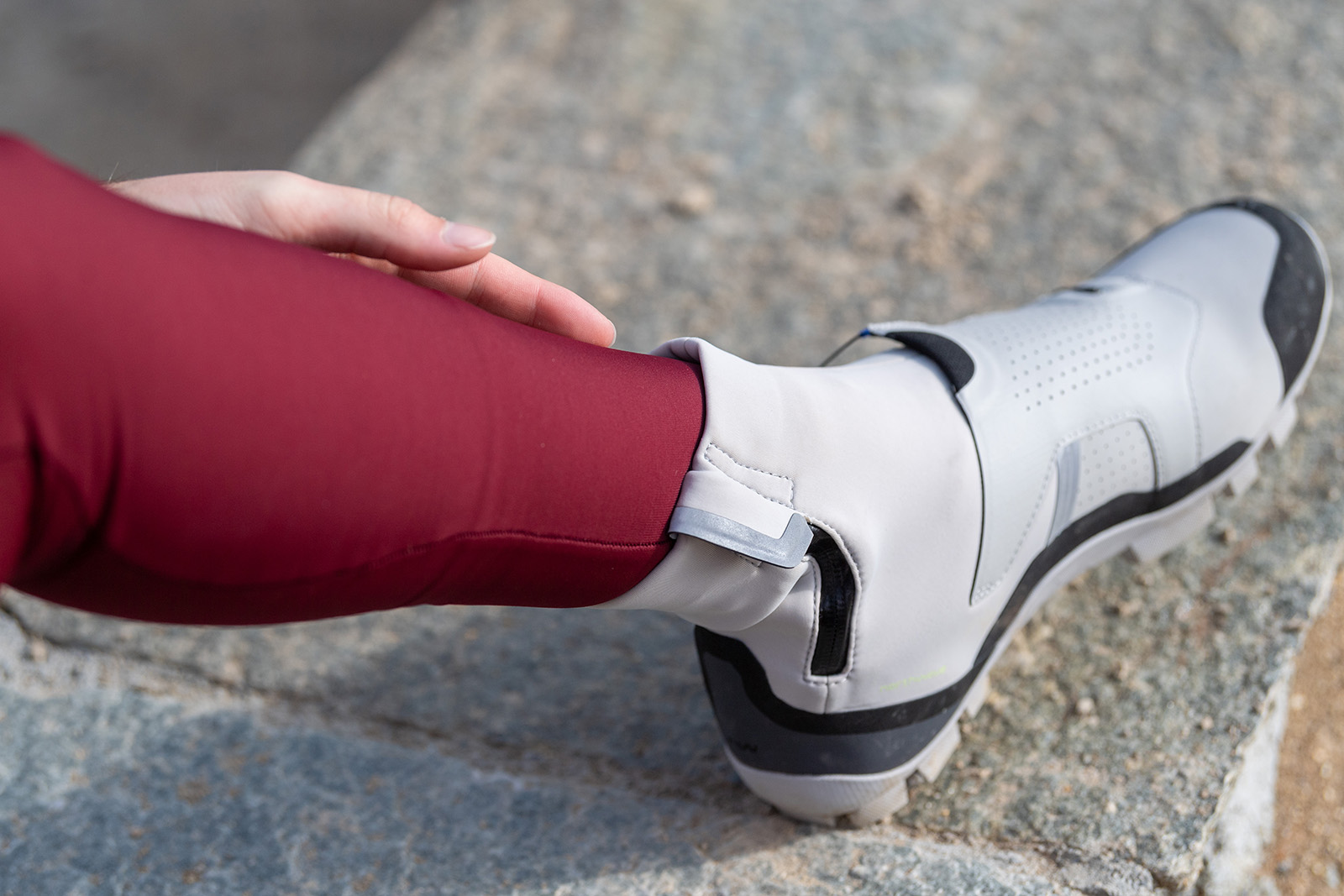
The Celsius XT Arctic GTX could do away with your overshoes. Northwave
The Celsius XT Arctic GTX does away with the need for everybody’s least favourite cycling accessory: the overshoe.
It features a neoprene gaiter that wraps around the ankle and lower leg to form a snug, weather-proof seal.
Overshoes are notoriously fragile off-road, but there’s no issue with a proper pair of winter shoes, because you’re not walking on the protective fabric or scuffing it against your cranks.
Despite the all-enveloping design, the low-cut shape of the shoe part of Celsius XT Arctic GTX enables maximum freedom of movement, while a water-resistant zip makes getting the shoes on and off painless.
2. Clever materials keep you warm and dry
The extended cuff will keep out the elements. Northwave
Two decades ago, Northwave was the first brand in the world to incorporate Gore-Tex into a cycling shoe.
Fast forward to 2025 and the Celsius XT Arctic GTX combines the latest PFAS-free Cirrus XT 4L insulated membrane with Primaloft Gold 200g eco insulation for a cosy, breathable construction that’s suitable for the coldest, wettest weather.
The Arctic 4Layer insole sandwiches EVA foam with aluminium and pile insulation to further cosset your feet.
3. Comfy on and off the bike
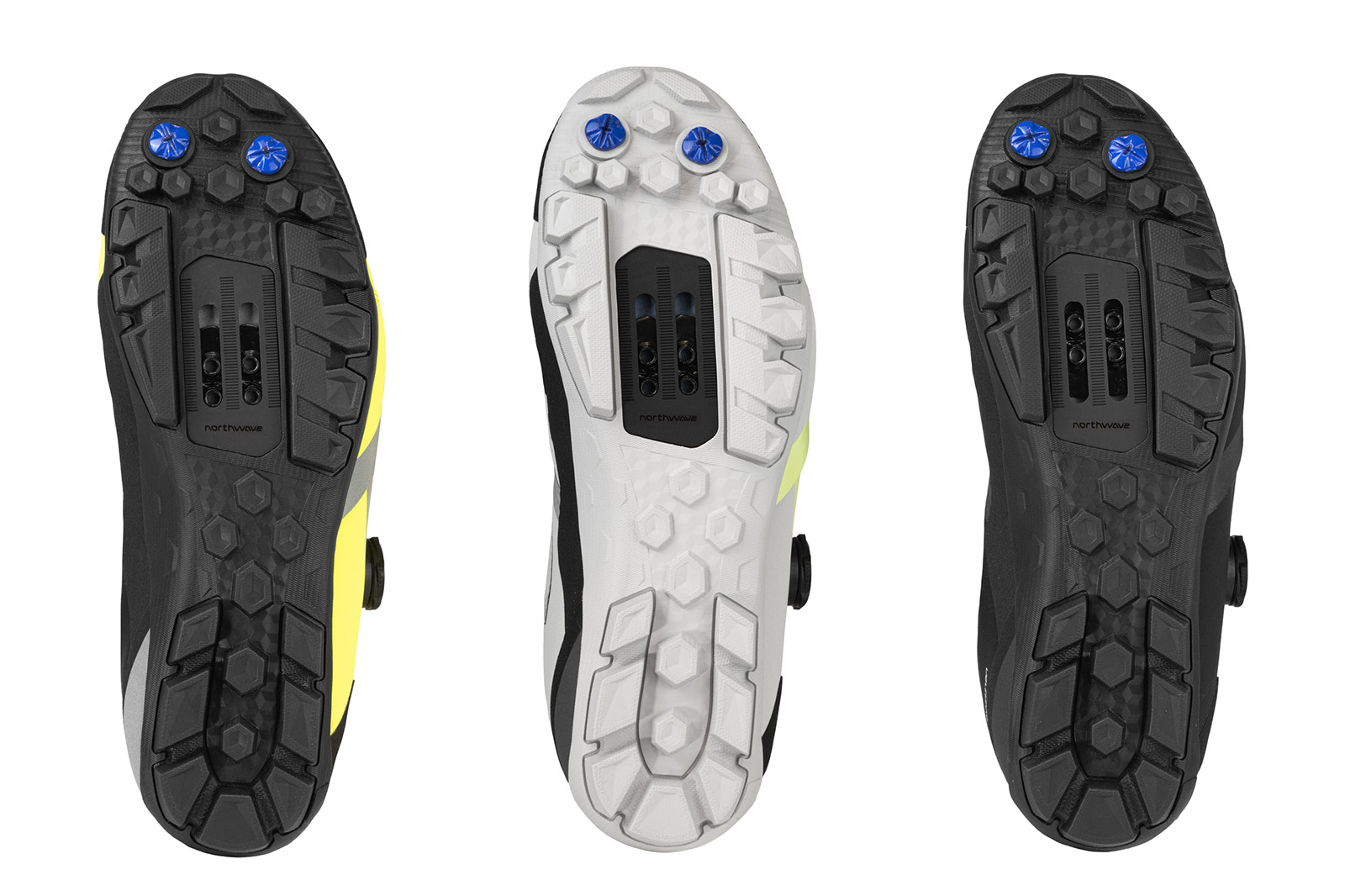
The sole is designed to be walkable. Northwave
Northwave’s Jaws Evo sole strikes a perfect balance between pedalling efficiency and walkability.
It offers comfortable arch support, while a toe-flex system creates a more natural feel off the bike, aiding grip on uneven ground. This is enhanced further by chunky lugs on the outsole.
The X-Dial SLW3 closure is micro-adjustable to fine-tune comfort, and it releases quickly when needed with a single lifting action.
4. Built for all roads and none
XT stands for ‘Cross Terrain’ and the Celsius XT Arctic GTX shoe will keep you warm and dry on every terrain, whether you’re on trails or tarmac, and whether you’re riding road, gravel or MTB.
The two-bolt cleat attachment offers 37mm of fore-aft adjustment, and there’s the option to mount toe spikes if jumping barriers and running through mud is your thing.
5. Sizes and colours for all
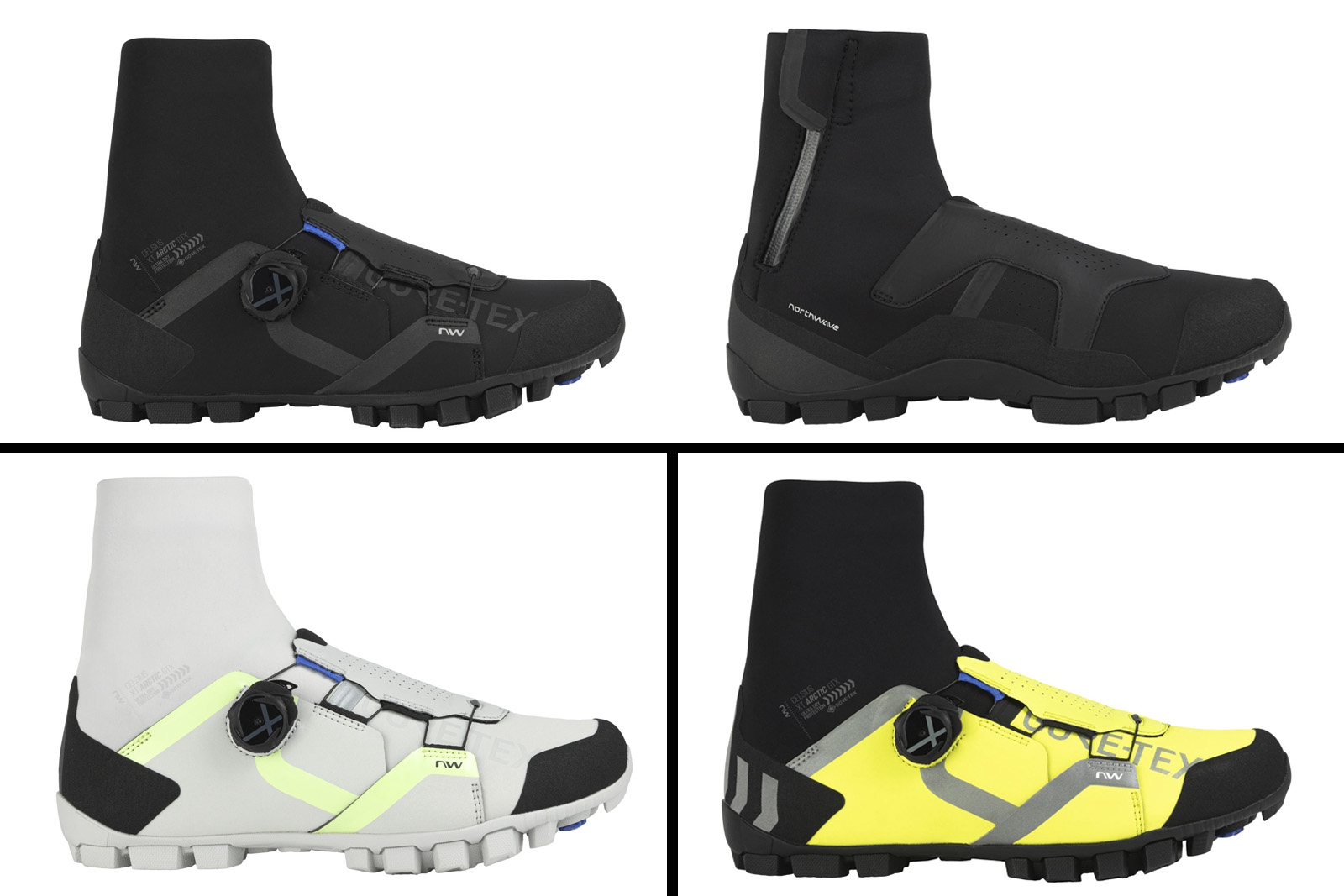
The shoe is available in different colour options and a wide range of sizes. Northwave
The Celsius XT Arctic GTX comes in a vast range of sizes, from EU 36 to 48, with half sizes from 39.5 to 45.5.
There are three colour options to coordinate with pretty much any outfit: light grey, black and yellow fluoro. The Celsius XT Arctic GTX retails at £239.99 / $309.99 / €269.99.
With the nights drawing in and the weather becoming increasingly inclement, many of us are starting to dust off our trusty indoor trainers.
Riding indoors has increased in popularity over recent years, and has helped many people improve their fitness. It has also made cycling more accessible to time-crunched riders and those who lack confidence on the roads.
Indoor cycling isn’t without its drawbacks, though. In particular, there’s a high risk of getting ‘burnt out’ when spending many of your riding hours inside.
So, let’s explore why indoor training can cause burnout, and cover tips you can put in place to avoid becoming worn down by indoor riding.
The nature of indoor training makes it easy to overdo it. Getty
Initially, your enthusiasm for indoor training will likely be high – the appeal of shorter, structured sessions and even some group riding or racing can be just what’s needed after lots of longer outdoor miles.
It is also satisfying to complete some uninterrupted, time-efficient training sessions, rather than the often stop-start, and sometimes hazardous, nature of riding outside.
Many would argue you don’t get the same satisfaction from completing a certain distance or reaching the top of a tough climb as in the ‘real’ world.
In a bid to keep indoor training interesting, riders tend to over-intensify training too, which can quickly lead to physical burnout. Ultimately, these factors can easily derail your training.
To help you reap the benefits indoor training offers and avoid the common pitfalls, here are some tips to help you keep training indoors on a consistent basis…
1. Use power variation (but keep this within the spirit of the session)
Varied workouts will keep things interesting. Scott Windsor / Our Media
Choose sessions that are structured and varied, such as alternating between five minutes at one wattage, five minutes at another and so on.
This enables you to focus on smaller, more manageable chunks, rather than being overwhelmed by the total ride duration (and how much of it you still have left to go).
What’s important, though, is that any power variation should be within the spirit of the session.
For example, if you’re looking to do a training zone 2 endurance ride (~55 to 75 per cent of FTP), aim for a session where the power stays largely within this zone 2 range.
Plenty of indoor training apps will add bursts of intensity within an endurance ride to keep things interesting.
However, these often have no real physiological benefit and can undermine your training by creating unnecessary fatigue, potentially hindering some of the adaptations you’re looking to get from the rides.
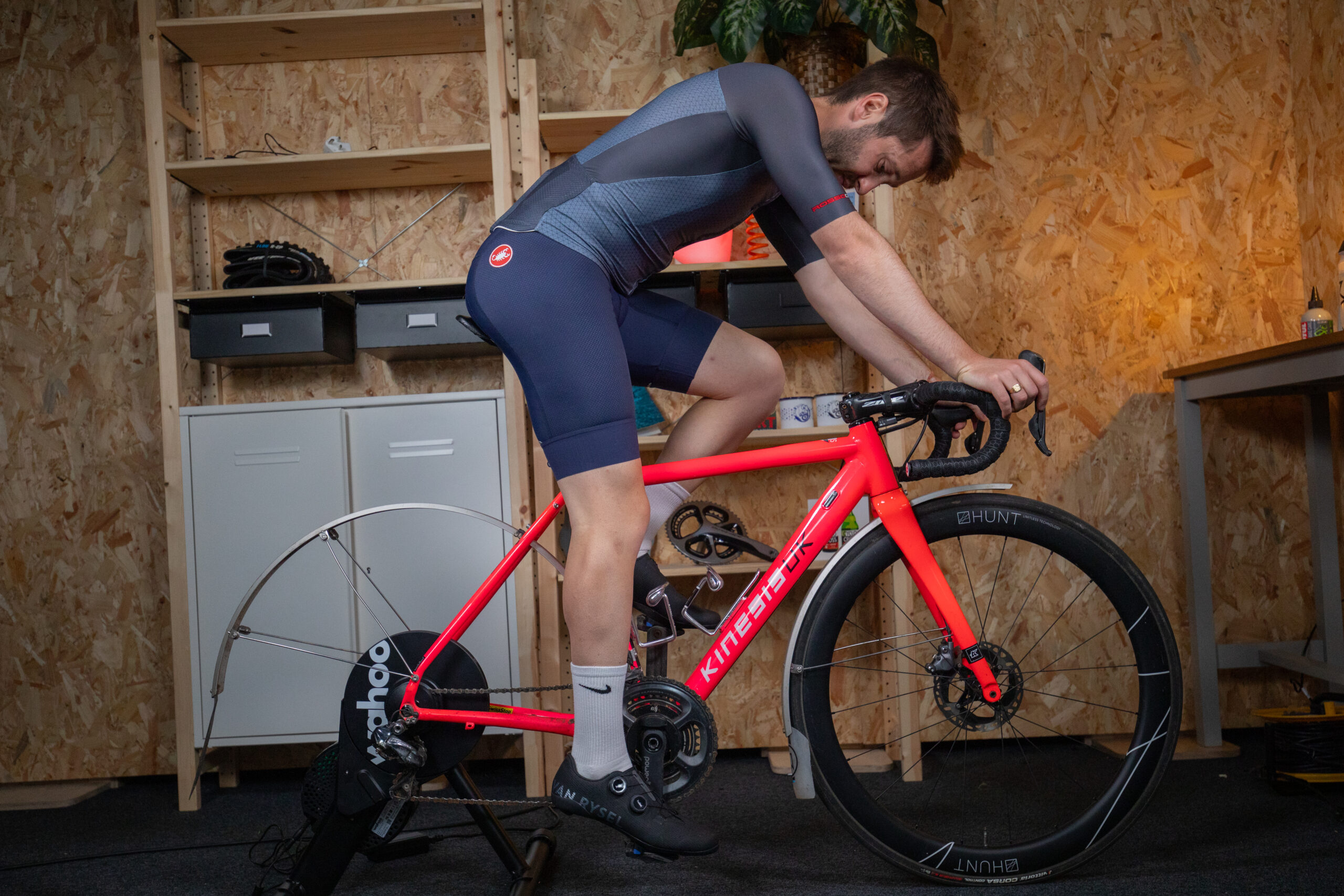
2. Turn ERG mode off for some structured sessions
ERG mode can be useful in some circumstances. Simon von Bromley / Our Media
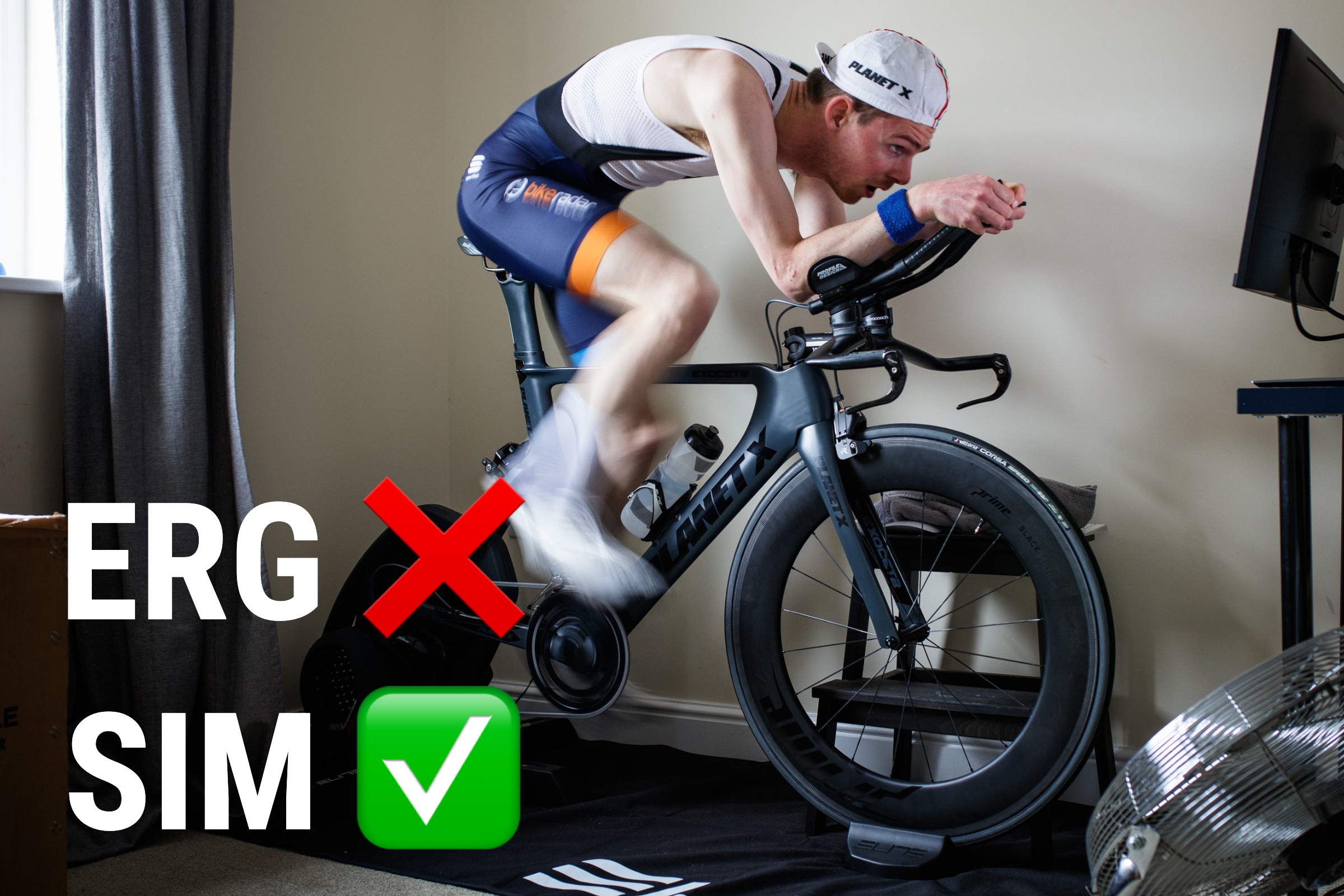
If you have a smart trainer, ERG mode is a fantastic feature that holds power at a target wattage, adjusting resistance according to cadence.
It’s great, because it enables you to follow a structured session while focusing on something else – such as watching TV.
However, our advice would be to do at least some of your structured sessions with ERG mode off.
This can provide mental stimulation and an element of challenge because you have to focus on holding your wattage at a target output.
If you’re ultimately training to improve your power outdoors when the weather improves, switching ERG mode off will also make your indoor riding much more like the outdoors.
When performing high-intensity interval sessions, switching ERG mode off can also allow for higher-quality efforts in some cases.
This is because you can more easily fine-tune your wattage based on how you’re feeling – e.g. pushing a little harder if you’re having a good day, or backing off slightly if things are feeling harder than normal.
This can help avoid physical burnout or failed sessions.
3. Get Social
Apps such as Zwift can prevent burnout. Our Media
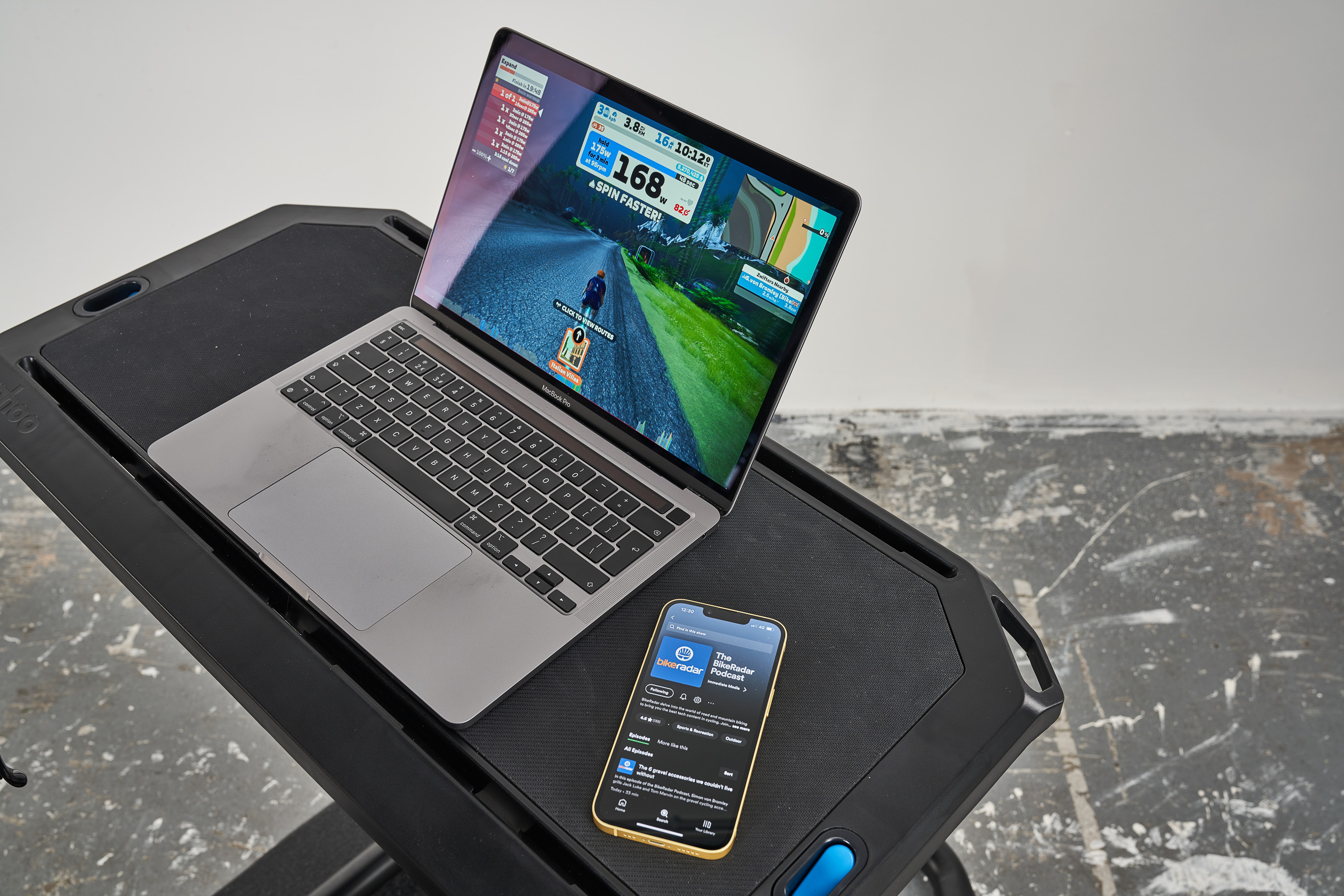
It’s perhaps an obvious tip, but using a social platform such as Zwift for some of your indoor riding can pay great dividends.
Joining an organised group ride or race can provide extra motivation and accountability, as well as help the time pass a lot more quickly. To enhance the experience, you can even join a Discord group to chat away with fellow riders via a headset.
4. Set yourself some process goals
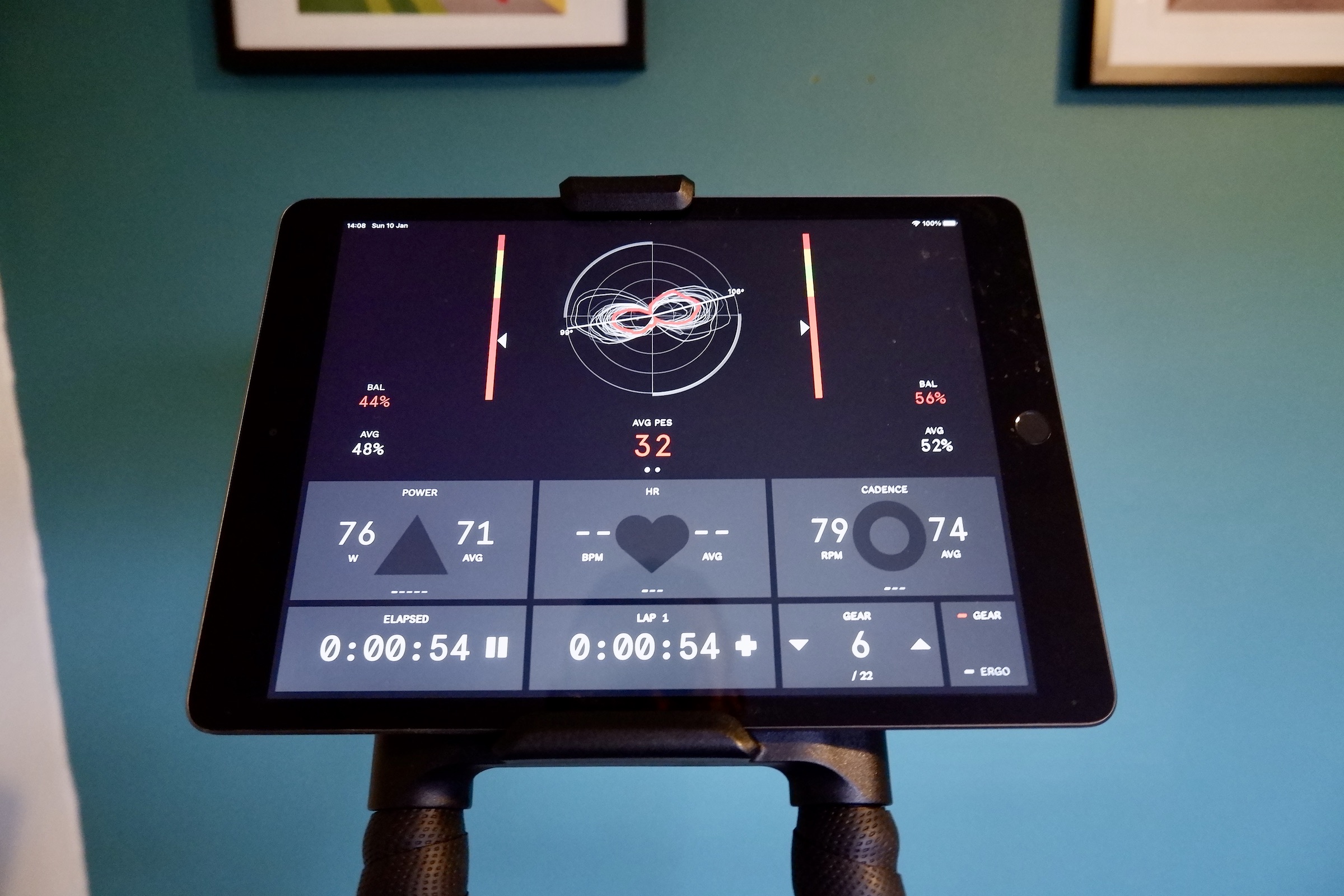
Some devices, such as those from Wattbike, can provide information on, for example, how ‘good’ your pedalling technique is. Tom Marvin / Immediate Media
Riding indoors isn’t all about sheer power output.
You can also work on abilities such as the smoothness of your pedal stroke, the left-right balance of your legs, or how well you’re engaging your glute muscles.
Having process goals like this for some of your indoor rides can help bring purpose to your training sessions, as well as providing something to keep your mind focused.
Certain equipment, such as a Wattbike or dual-sided power meter pedals will give you feedback on data including your pedalling smoothness and torque generation, so you can even set some objective goals to work towards and track your progress.
5. Test progress (but not too regularly)
FTP testing requires a gruelling maximal 20-minute effort, so don’t overdo it. Chris Teagles / Our Media
Seeing clear improvements in your cycling fitness is an excellent way to keep motivation high.
You can measure your progress indoors in various ways, such as by performing one or more all-out efforts and looking for improvements in your power, or looking for a reduction in your heart rate and perceived effort when riding at a given wattage.
Ensure any testing you do is relevant to the type of training you are undertaking. So, if you’re looking to improve FTP, an FTP test is appropriate.
However, if you’re trying to improve your explosive power, then it would be more relevant to test your power over 30 to 120 seconds, for example.
As a word of warning, it’s best not to do maximal testing too often, because it can be a key cause of both mental and physical burnout. Generally, every eight weeks is the most oten we’d recommend.
6. Avoid over-intensifying training (and consider this when choosing a plan)
Some indoor training plans could leave you overcooked. Zwift
In a bid to keep training interesting, there’s a tendency for indoor riding to be over-intensified.
This means most of your training sessions have at least some time spent at a high ‘zone 3’ intensity, or above (e.g. 85 per cent of FTP, or higher).
This can be a fast track to becoming overtrained because you’re not allowing sufficient recovery between training sessions in order for your body to adapt.
It can also mean you’re never quite sufficiently fresh to go really hard in any of your sessions.
This can result in most of your training sessions being neither very hard nor very easy.
Over time, your training will lack the variety and acute adaptive stimuli needed to continue to see fitness improvements, and you’ll reach a fitness plateau.
Our recommendation would be to aim for no more than two high-intensity sessions per week (i.e. efforts above FTP, or a Zwift race).
Depending on your fitness and capacity to recover, you may find you can comfortably include one ‘middle intensity’ session each week (e.g. efforts between ~75 and 95 per cent FTP, or a hard group ride). The remaining training sessions each week would then be at a lower intensity level (less than 75 per cent FTP).
If you opt to follow a pre-built training plan (which can be a great motivator in itself), be careful about the amount of high-intensity work the plan includes.
Some commercial plans are built to achieve short-term fitness wins and to keep training ‘fun’ through lots of high-intensity sessions.
However, these plans can be a wrong choice over the longer term if they cause fitness stagnation and burnout.
7. Get your training environment right
Making sure your indoor setup is comfortable will make it easier to get on your bike and train. Scott Windsor / Our Media
Finally, we all know riding indoors can be a sweaty affair, which can place additional strain on the body, both in terms of temperature regulation and maintaining hydration.
To minimise this stress, we’d recommend investing in a good fan setup for your pain cave, and pre-chilling your drinks, which can make a big difference to your core body temperature as well as hydration levels.
If you’re still overheating, consider using a wet towel on the back of your neck and wrists, and if you’re a salty sweater (you’ll know this if you see salt on your kit, and often find sweat stings your eyes) try adding some electrolytes to your drinks.
Example training weeks to avoid indoor training burnout
Example 1
Mon: Day off
Tues: High-intensity interval session
Weds: Zone 2 endurance ride, including 15 mins focused glute activation and 15 mins focused on smooth pedal stroke.
Thurs: Day off
Fri: Zwift race
Sat: Zone 2 endurance ride with ERG mode off, alternating power every 10 mins between low, medium and high zone 2.
Sun: Zwift group ride at a zone 2/ low zone 3 pace
Example 2
Mon: Day off
Tues: FTP Test
Weds: Day off
Thurs: Zwift race
Fri: Day off
Sat: Zone 2 endurance ride working on left/right power balance and some high-cadence drills.
Sun: Shorter zone 2 endurance ride with ERG mode off, targeting 5 mins at 5W increments from the bottom to the top end of zone 2; followed by a short Zwift group ride.
In recent weeks, thanks to procuring a new (used) gravel bike while also testing a new smart trainer, I’ve spent more time with power meters, smart trainers, and dual recordings than usual. This includes swapping my Favero Assioma Duo power meter pedals (read my review here) between bikes with two different crank lengths, while also testing the accuracy of the smart trainer (a Wahoo KICKR CORE 2) in various Zwift activities.
In doing this, I realized I’ve never written a post about how crank length setting affects power readings on popular pedals like the Garmin Vector 3 or Favero’s various offerings. And while this may not be a topic many care about – most will just set the crank length to whatever matches their setup – I believe the info below will help explain why high-end Zwift races require riders to use certain smart trainers as their primary power source, vs a power meter.
Let’s dive in.
Test Setup
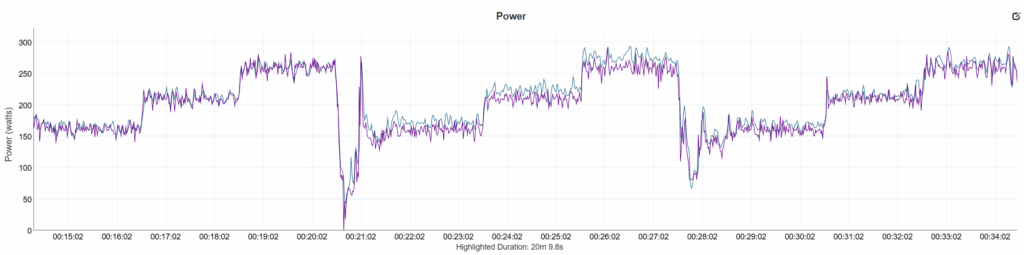
While simple math could deliver theoretical results, I wanted to prove the math using real equipment. So I created a simple Zwift workout which included three sets of the same three ascending 2-minute intervals.
The idea was to use a different crank length setting for each of the three sets and record the pedal power data to my head unit. Zwift would be recording my smart trainer’s power data, which should remain consistent across the 3 sets. Then I could compare the smart trainer’s data to the power pedal data to learn how much the crank length setting actually modified the power readings on the pedals.
Simple enough, right? Let’s look at the test results…
Test Results
You can see the full dataset on DC Rainmaker’s Analyzer tool, but I’ve summarized it below. I rode the first set of intervals with the crank length set too short, the second set with it too long, and the third set with it just right.
(Note that for each 2-minute interval, I took a 60-second sample of the data from the middle of the interval to arrive at my average power values below. This reduces data funkiness at the start of the interval as ERG targets change and trainer resistance adjusts.)
Set 1 (Crank Length: 167.5mm)
ERG Target W
Trainer
Assioma
% Variation
W Variation
160
161.52
164.67
1.95%
3.15
210
210.14
211.95
0.86%
1.81
260
259.47
260.18
0.27%
0.71
Set 2 (Crank Length: 177.5mm)
ERG Target W
Trainer
Assioma
% Variation
W Variation
160
159.76
172.25
7.82%
12.49
210
210.56
224.42
6.58%
13.86
260
259.85
276.05
6.23%
16.2
Set 3 (Crank Length Set Accurately to 172.5mm)
ERG Target W
Trainer
Assioma
% Variation
W Variation
160
159.95
167.73
4.86%
7.78
210
211.51
216.92
2.56%
5.41
260
259.12
266.85
2.98%
7.73
Takeaways
In simple terms, power is calculated by pedals like the Favero Assioma Duo as torque * angular speed (cadence). Torque is force * crank length.
Based on the math, changing crank length from 167.5 to 177.5 should increase power readings by 177.5/167.5, or +5.97%. And in fact, that’s what my test actually showed. The differences in power readings between the 167.5mm and 177.5mm crank length settings were:
@160W Target: 5.87%
@210W Target: 5.72%
@260W Target: 5.96%
(These particular test numbers line up with the math quite nicely, although comparing other data like 172.5 to 177.5 doesn’t yield quite as clean a result. That’s sort of the nature of power testing, though. Between variations in power meter accuracy, pedalling style, drivetrain efficiency, and which data is actually being read and recorded by each recording device, you’ll easily see a variation of 1% from what the math says your results should be. And that’s OK.)
You may be wondering: in set 3, if the crank length is set accurately, why are the readings still higher on the pedals? I’d chalk this up to drivetrain loss, which most experts in the cycling world say runs between 2-3%. Every step of the way between your pedals and your hub, a bit of power is lost. Cranks, spiders, chainrings, chain, cassette… they can flex a bit, get worn, or be poorly lubricated. All those losses typically add up to a 2-3% reduction in power from what you’re putting into the pedals to what is actually delivered to your rear hub.
Power Meters and Zwift Racing
If power at the smart trainer is typically 2-3% lower than at your pedals, wouldn’t you want to use your pedals as your power source in Zwift? Well, yes, if no other factors were taken into account. Because we all want to put out more power, right? (Even if it’s unrealistic on some level, since outdoors, it’s the power at your rear hub that is driving your bike forward.)
There are other factors, though. Sticky watts is one factor that makes using a power meter on Zwift less desirable, unless you’re trying to cheat.
But I would submit that the biggest factor is that it’s very easy to change your power meter’s settings so it overreads power. While most modern mid and high-budget trainers are auto-calibrating, you can easily manipulate power data from a power meter.
Because of this, it’s become pretty standard for high-end indoor bike races to require riders to pair their smart trainer as the primary power source, even though they also require dual recording with a power meter.
Interestingly, I recently learned that Zwift Racing League leans this way as well, while stopping short of a hard requirement. From their rulebook:
6.1.3. Where a Smart Trainer is used, both its Power Meter and Resistance MUST be connected directly to the game as primary source. Participants using other forms of power meters when they have a smart trainer available may be penalised.
While Zwift allows event organizers to enable “hardware enforcement” that requires a power meter or smart trainer to be paired as the power source (no classic trainers/ZPower allowed), perhaps it’s time for Zwift to enable an even stricter setting, where only auto-calibrating smart trainers are allowed as a power source?
Your Thoughts
I hope you found this post interesting. Got questions? Thoughts on power meters or accuracy as they relate to Zwift racing? Share below!