Tomorrow, Cycling Time Trials (CTT) – the national governing body for time trials in England, Scotland, and Wales – launches their Winter Time Trial Series on Zwift. And they’ve clearly done a great job marketing the series, with over 600 riders already signed up for race 1!
Hayley Simmonds, a TT medal winner at both the European and Commonwealth Games and a former National Road TT Champion, is heading up the team running the winter series. She says, “I envisage the Winter Series on Zwift as being a great way for experienced testers to maintain and even improve their race readiness over the winter period. For anyone who is new to Time Trialing, then what better way to give it a go?”
Learn all about the series below…
Routes and Schedule
The series is 14 weeks long and begins this week, with races on Wednesdays at 7pm UTC (2pm EST/11am PST) repeating on Saturdays at 9am UTC (4pm EST/1pm PST).
Overall series rankings are points-based, with lower points being better. Points are earned in two different ways:
Finishing Points: 1st place gets 1 point, 2nd place gets 2 points, etc
Segment Points: fastest 5 through each course’s designated segment will get -5 points for 1st, -4 points for 2nd, -3 points for 3rd, -2 points for 4th, and -1 point for 5th
Course PB Points: each course (except mountain stages) is repeated twice in the schedule, plus there are two race events each week (one on Wednesday, one on Saturday). Riders who set a new series PB on a course will receive a -1 point deduction.
Championship Criteria
At the conclusion of the 14-week series, riders will be crowned as champions in their respective categories based on their best results in 7 races*. There will be both an open championship and a women-only championship.
* The 7 races must include at least 4 flat races, 2 rolling races, and 1 mountain race, as classified in the table above.
Key Rules
Entry Requirements
You must have a heart rate monitor paired to join these events, along with either a smart trainer or power meter connected as your power source.
If you want your results to count toward the Championships, you must be registered at ZwiftPower.
Riders are categorized based on FTP in watts per kilo:
A: 4-6 W/kg
B: 3.2-3.99 W/kg
C: 2.5-3.19 W/kg
D: below 2.5 W/kg
These are mixed races, but CTT says, “We’ll be producing an open leaderboard and female leaderboard for each category.”
Neutralized Equipment
Bike frames and wheels are neutralized for these events, so you can ride any setup from your Zwift garage that you’d like. Maybe it’s time to race that new Brompton P Line?
Questions or Comments?
It’s always fun to see an organization step into Zwift and use the platform effectively, hosting events that reinforce the organization’s mission and connect riders from around the globe. It’s also good to see a thoughtfully designed series structure. Nice work, CTT!
Got questions or comments about the series? Share below!
While tubeless tech has taken over on mountain and gravel bikes, and is the typical choice of pro road cyclists, it still gets mixed reviews from everyday riders. This is despite tubeless’ capability to lower rolling resistance, increase ride comfort and, thanks to the sealant, heal many punctures without you even noticing.
But what if you have a non-tubeless ready wheelset or are using tube-type tyres, or just aren’t willing to jump into the tubeless world? If your tyre setup forces you to run inner tubes, you’re a hostage to flats and roadside repairs.
Bicycle frame builder and tech journalist Richard Hallett has a solution that provides tubeless levels of anti-flat performance, which he calls faux tubeless.
“I’ve converted all my tyres to faux tubeless,” he says. “It’s the uncertainty of tubeless [that’s the problem], you don’t need to worry if you don’t get a seal, and there’s no mess.
“It solves all the problems with tubeless,” he claims.
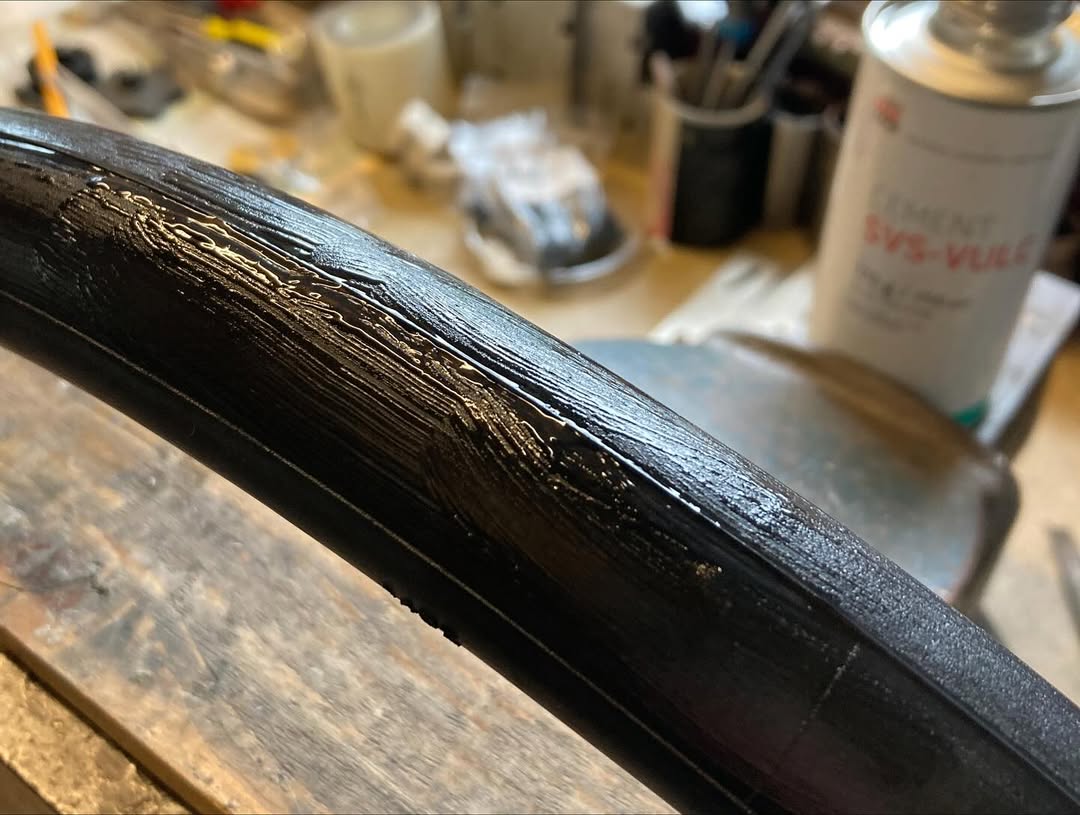
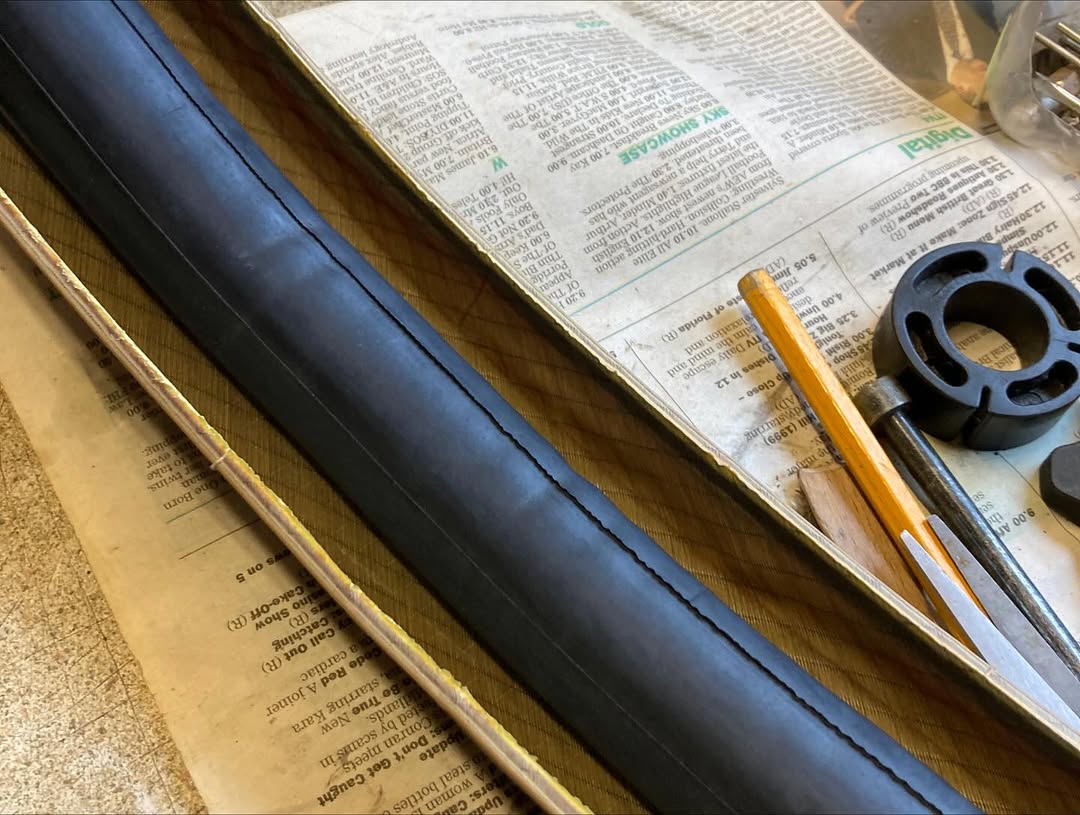
By glueing the inner tube to the crown of the tyre, faux tubeless prevents sealant from leaking into the space between the two. Richard Hallet
Inner tubes with sealant have been around for a long time. But the thin casing and flexibility mean that, if you get a puncture, the tube doesn’t tend to seal properly, and will leak air and sealant into the space between the tube and the tyre casing.
Tubeless tyres also run the risk of rolling off a rim in the event of sudden air loss. Seeing a crash at Paris-Roubaix, where this had occurred, gave Hallett the idea for faux tubeless.
Hallett’s solution is to glue the inner tube to the inside of the tyre. This provides rigidity and thickness to enable the sealant to plug the hole, and no space between the inner tube and tyre for the sealant to leak into.
Hallet published a full guide on how to carry out the conversion on the Cycling UK blog, though he now recommends SVS-Vulc glue over tubular cement.
Hallett says he’s been running faux tubeless for more than 1,000 miles with several pairs of tyres.
One tyre with a thorn embedded held pressure for more than four weeks.
He cites one customer using faux tubeless who found nine thorns embedded in his tyre when it eventually stopped holding air.
He also claims that performance and ride quality are similar to a conventional clincher setup with tubes.
Other benefits include inflation using only a hand pump or electric inflator, the option to run tyre pressures over 5 BAR / 72psi, avoidance of burping and a volume of sealant that’s around half that needed for a full tubeless setup.
The inner tube can be removed from the tyre because it’s not permanently bonded in place.
It’s also possible to remove the tyre from the rim, without bathing yourself in sealant and without the usual struggle of mounting and dismounting tubeless tyres on tubeless-ready rims.
The minuses are that faux tubeless is still prone to pinch flats, as with a standard tubed setup, and you can still get punctures that the sealant or a tyre plug won’t seal.
Hallett reckons a full tubeless setup still works better if you have a tubeless-ready wheel and tyre. It also weighs less and is more pliable, increasing ride comfort and performance.
But, as a halfway house for those running non-tubeless wheels, or if you’re preferred tyres aren’t available in a tubeless option, this could be a worthwhile option.
This round saw 9.5k racers compete across 216 separate divisions from every corner of the globe – in and of itself a massive coordination effort. Big thanks to the WTRL team for pulling this off season after season.
Given that this was a TTT where the times can be compared across zones, and now that all the results are in, I thought it would be worth taking a step back and looking at the ZRL landscape as a whole. Where are the teams concentrated? Which zones are more competitive? Who are the best of the best?
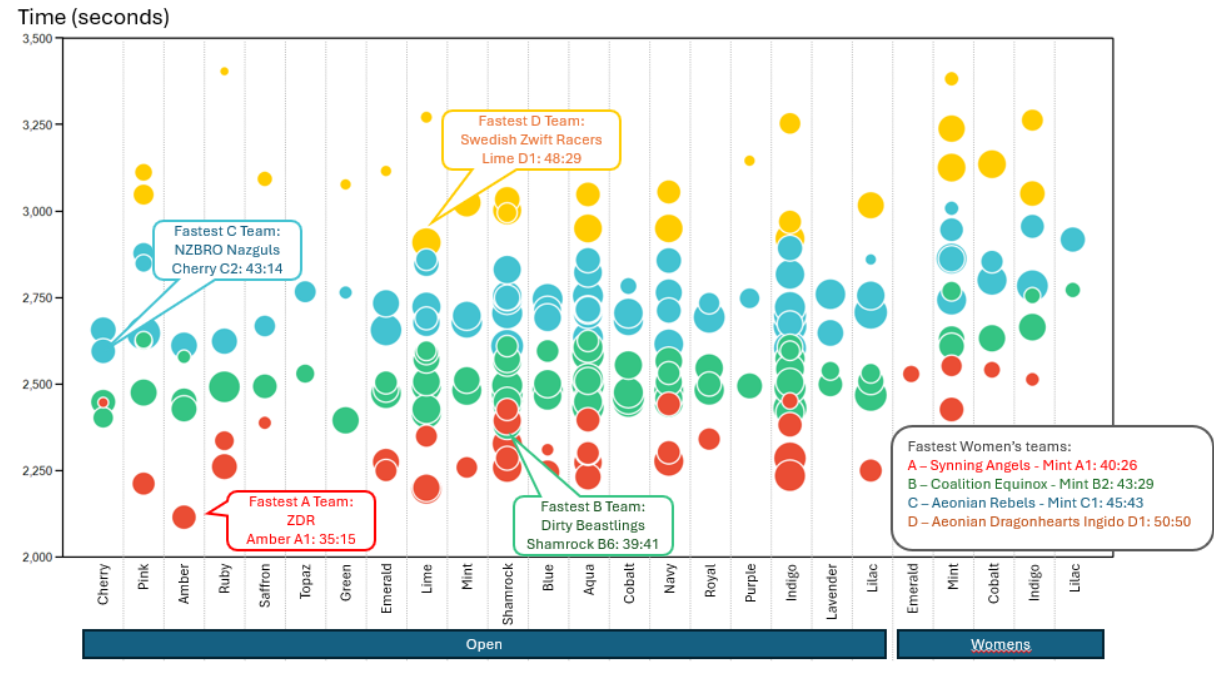
To answer this, I looked at the top team finishing time in each division across all 88 ZRL round 2 events that occurred last Tuesday. In the chart below, each bubble represents a division, plotted by the time of the fastest team in that division (lower on the chart is faster), with the size of the bubble corresponding to the total number of riders competing in that division:
Source: ZwiftPower, time based on 4th rider to finish event
Interestingly:
Clearly some zones are significantly more populated than others, with the Shamrock Open B Regular category having 6 distinct divisions while other zones have just a single division
While the overall riders are relatively concentrated in the Shamrock through Indigo zones, the fastest open times largely came from less-populated zones
This was not the case for the women’s field, where the Mint zone is both the most populated and also fielded the fastest times
There should be some re-shuffling of teams within divisions, with 3 out of the 8 fastest times coming from a team outside of division 1 in their zone. (Editor’s note: WTRL did some reshuffling after the race.)
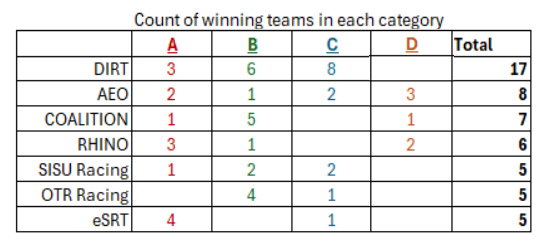
The last topic to look at was teams that performed particularly well across zones and categories. While the underlying data is approximate at best, there are clearly a few organizations fielding top teams across multiple zones and categories:
Source: Team of the 4th-place rider in each event as defined by their ZwiftPower profile
DIRT continues to be by far the largest racing organization within Zwift, though the actual teams are organized by the many sub-teams within DIRT
Aeonian Racing Team appears to have fielded an impressive number of winning teams in the women’s leagues
Followed by some of the more popular event organizers on Zwift fielding 5 or more winning ZRL teams (Coalition, Rhino, SISU, OTR, and eSRT)
Overall, ZRL continues to be an impressive collection of racing teams coming together season after season, round after round. I would highly encourage anyone who has not given it a try to give it a go (many teams are always recruiting and quite welcoming).
For the ~10,000 of you racing this round all around the world, best of luck out there!
Lezyne has issued a voluntary recall notice for its Pressure Over Drive and Digital Pressure Over Drive reservoir pumps.
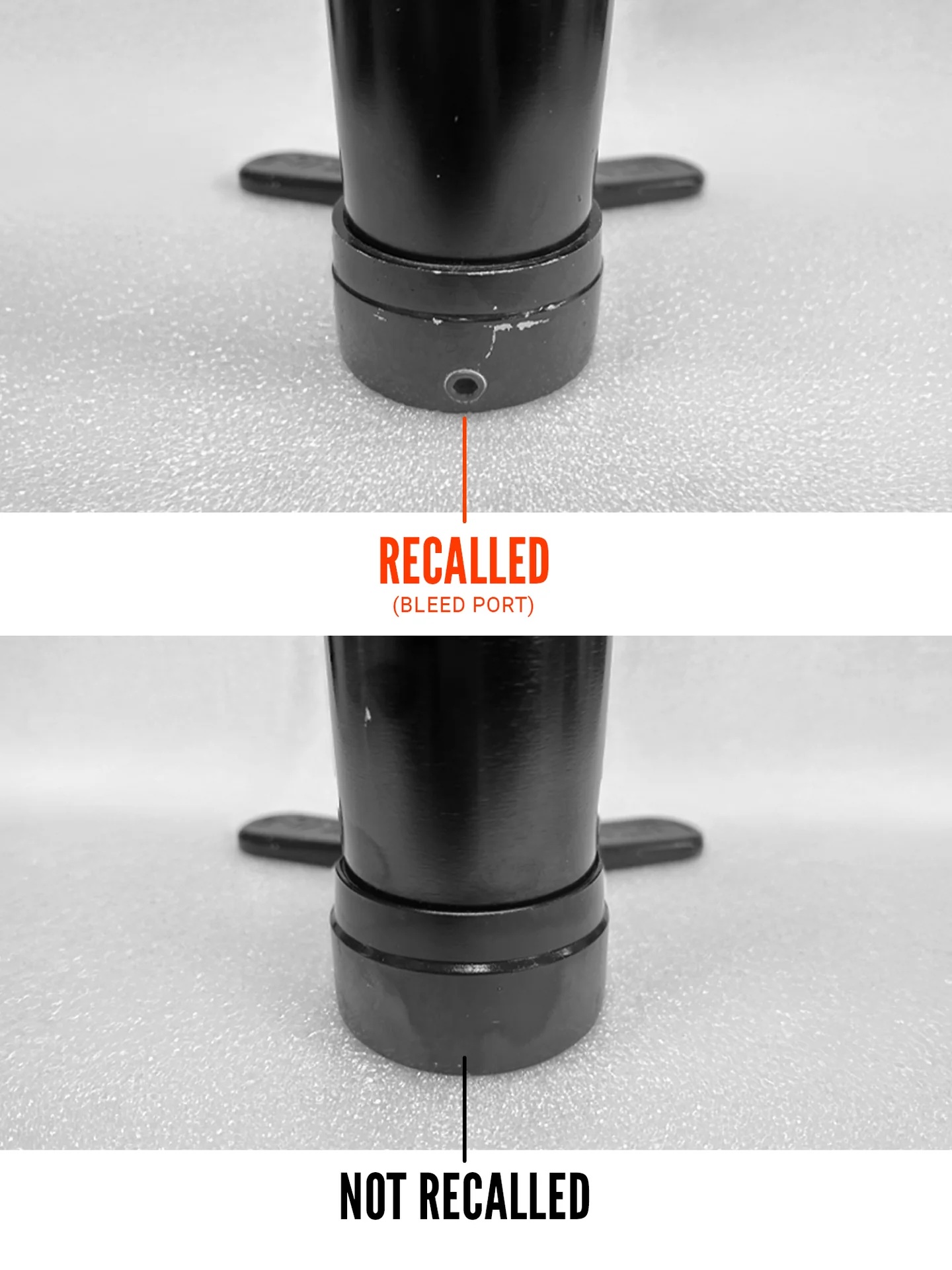
The recall notice is for older-model pumps that were manufactured between February 2016 and December 2021, and which have a bleed port located on the front of the pump’s base.
Lezyne says the recall is the result of a single incident where the pump’s reservoir, when pumped up to pressure, ejected from the pump’s base. Lezyne says there’s a risk of serious injury from impact and has instructed owners to stop using the pump immediately.
It’s only pumps with a front bleed port in the base that are affected.
Lezyne is asking owners to log a claim on its site and register for a free replacement (this link only worked for me on Chrome and not Firefox). If you can’t complete the online recall form, Lezyne says you should email recall@lezyne.com.
If you have an affected pump, Lezyne says that, as well as ceasing use, you should cut, drill or grind a hole in the (depressurised) reservoir and send it a photo of the disabled pump as proof that it cannot now be used. The photo also needs to show the Lezyne logo and the front bleed port.
If you don’t have the wherewithal to inactivate the pump, Lezyne suggests asking your local bike shop for assistance.
Once you’ve done that, Lezyne says you should dispose of the pump as mandated for steel and aluminium products. If you have a digital version, you’ll need to dispose of the coin cell battery separately, as per local hazardous waste/recycling regulations.
Lezyne says Pressure Over Drive and Digital Pressure Over Drive pumps made in 2022 or later are safe to continue using.
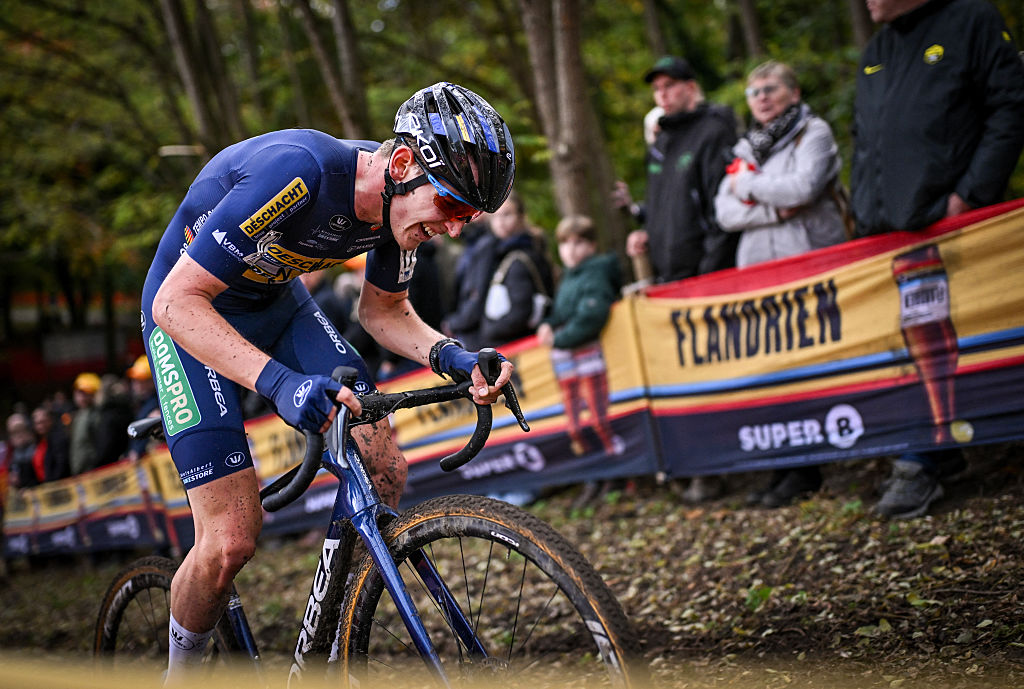
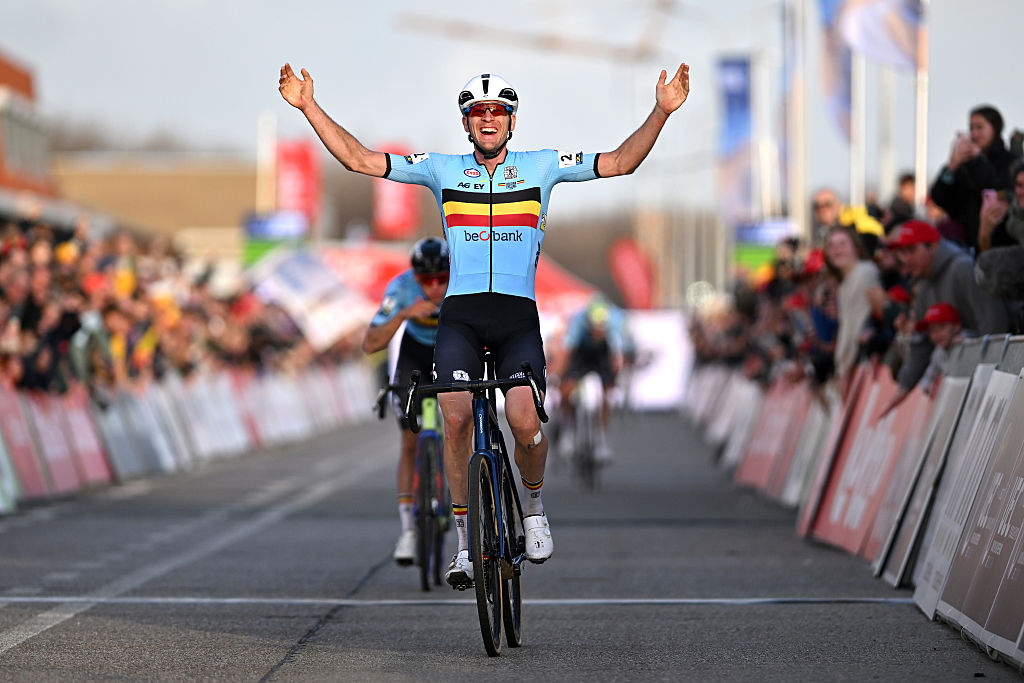
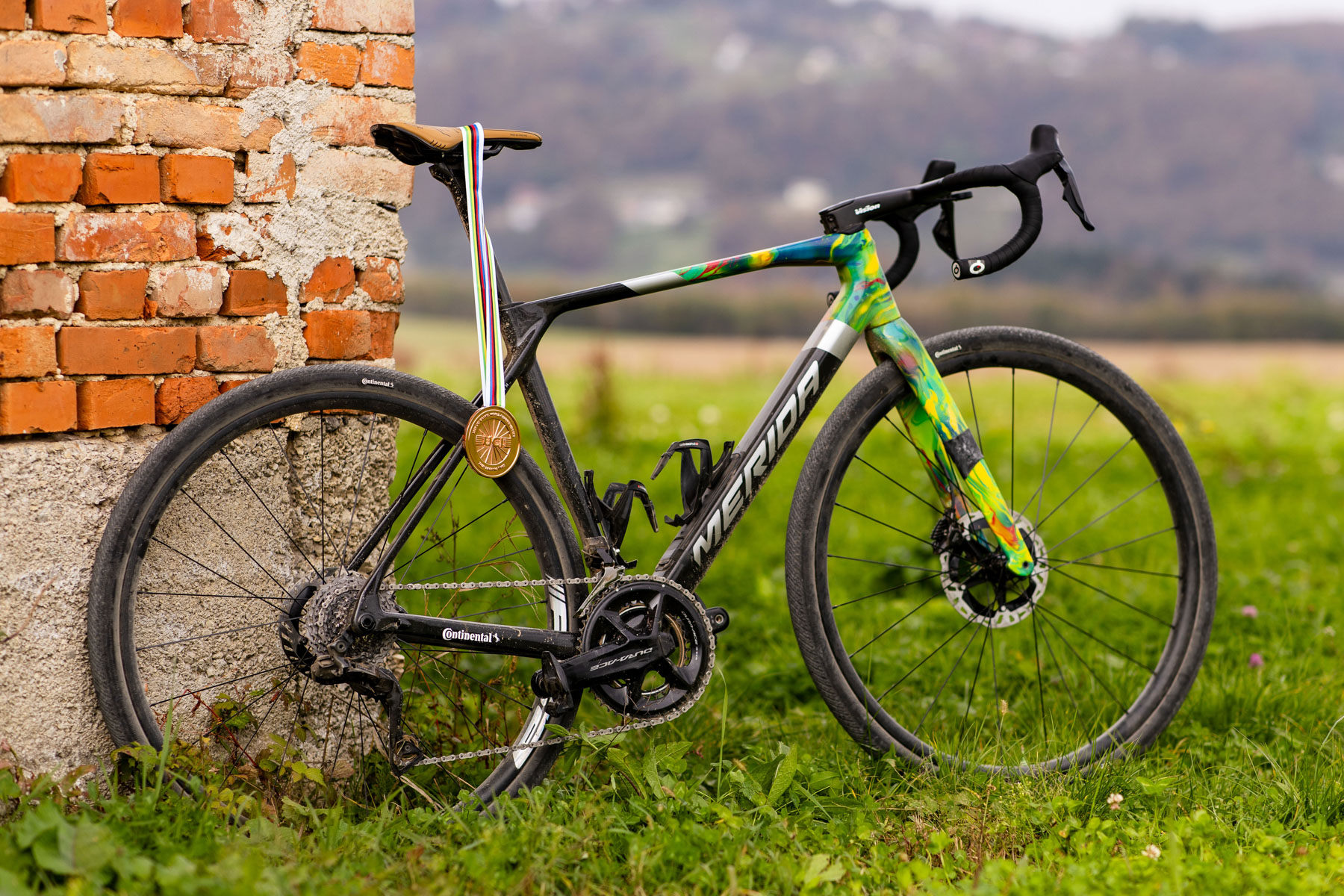
Toon Aerts of Belgium won the elite men’s European Cyclocross Championships over the weekend, not on a specialist cyclocross bike – something of a rarity nowadays – nor on the now more common gravel/cyclocross race hybrid, but on an Orbea Orca OMX road bike.
Like many brands, Orbea has a gravel race bike in its line-up, the Terra Race, which is available for the riders from its sponsored Deschacht-Hens-Maes cyclocross team to use. But Aerts instead opted to adapt the Orca road bike for his ride.
In its more usual road-going form, the Orca has a claimed weight of only 6.7kg, so it’s a bike that’s easy to carry over the obstacles on a cyclocross course. Orbea says it has kept the frame stiff, too, with a robust down tube, chainstays and head tube to resist torsion – advantages for the low-cadence, high-torque riding typically needed for cyclocross.
Orbea quotes a frame weight of 750g for the top-spec Orca OMX, while the Terra Race frame weighs a claimed 910g, so there’s a useful 160g weight saving there.
Aerts has been riding the Orca throughout this season, including here at the Rapencross Lokeren, where he finished sixth. David Pintens/Belga/AFP via Getty Images
Other components were more typically cyclocross, with Aerts running A Dugast (now owned by Vittoria) Pipistrello 33mm tubular tyres on Icon T3.5 Disc carbon tubular wheels.
You can buy the Pipistrello as a tubeless tyre too, but tubulars are still preferred for elite cyclocross racing because they can be run at ultra-low pressures without the risk of burping air, and can be ridden to the pits flat if the rider suffers a puncture.
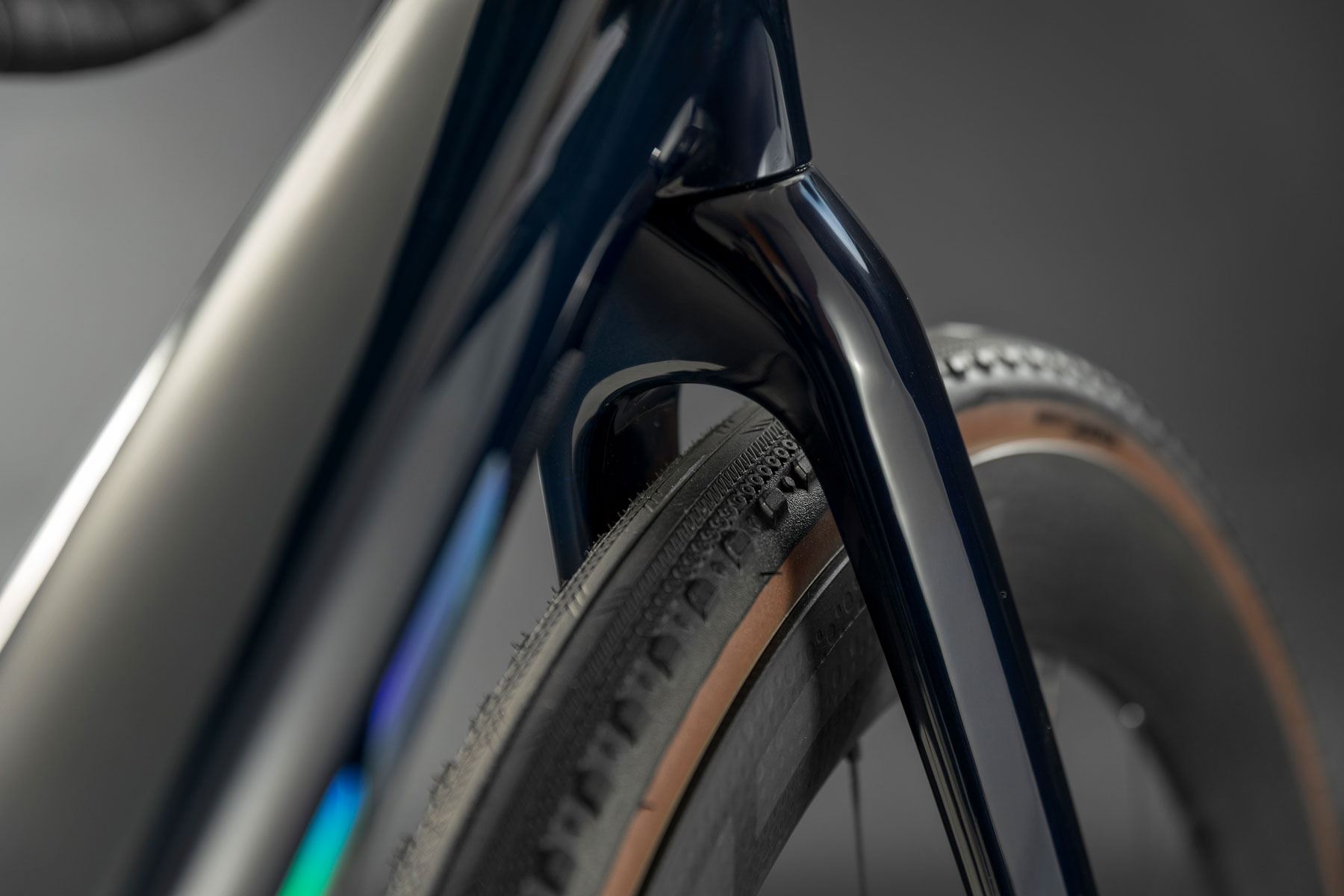
Tyre width in UCI-sanctioned cyclocross races is limited to 33mm, while the Orca has a nominal 32mm clearance, so Aerts is pushing the frame’s capabilities. He swapped out the fork for the Terra Race’s gravel fork with 45mm clearance and a longer 55mm rake rather than the road fork’s 43mm, though.
Aerts outsprinted fellow Belgian rider Thibau Nys to win the European Championships nine years after his previous victory. Luc Claessen/Getty Images
Other spec details carried over from the road included a Shimano Dura-Ace groupset, although with the cyclocross favourite 46/36t chainrings, and a 40mm handlebar width – apparently the better leverage claimed for wide gravel bars isn’t needed to win in cyclocross.
Aerts was emotional at the finish. It’s a race he’s won once before, a full nine years ago.
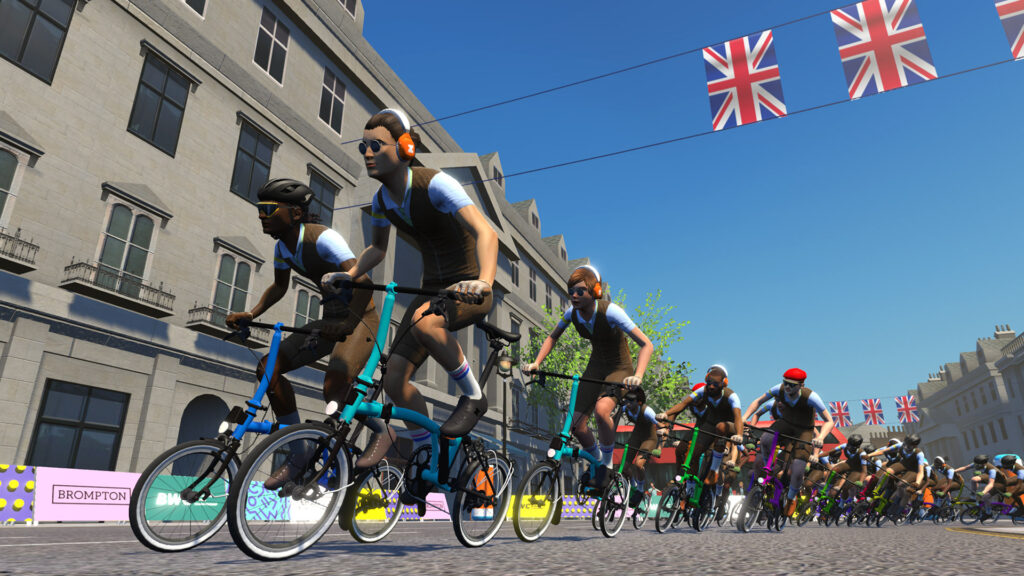
Today, Brompton + Zwift rolled out a slate of race events for the week of November 17-23, dubbed the Virtual Brompton World Championship (VBWC). This is the virtual version of the real-world BWC, which has been held in various venues and formats since 2008. And while the press release calls the VBWC the “world’s most stylish race” (debatable), we can all agree this will at least be a sight to behold!
Everyone will be on the new Brompton P Line bike (added to Zwift this week) for a race of “small wheels and big fun.” Show up, speed through London’s streets, and you’ll unlock the exclusive Brompton kit.
This series, like Zwift Unlocked, which ends the week before, replaces the regular ZRacing events as Zwift’s key races.
VBWC events are scheduled hourly for riders with a racing score of 700 and below, and a bit more intermittently for advanced racers at 650+ in order to assure large enough race fields. This is the same alternating category schedule Zwift uses for ZRacing events, and you can read more about it at zwiftinsider.com/zracing.
Everyone will be racing on Greater London Flat, for a total race length of 17.3km with 97m of elevation. Powerups will be given at each arch, with an equal chance of receiving a Draft Boost or an Aero Boost.
A dedicated workshop is the dream of many riders; a space to tinker to your heart’s content and save money on expensive bike shop bills.
While the real luxury is the space to have such an area, many things go into making a useful workshop, including layout, outfitting and storage.
With BiGDUG offering huge savings on a range of workshop equipment, we’ve highlighted some of the accessories that will level up your workshop and have your local bike mechanic wondering where you’ve gone.
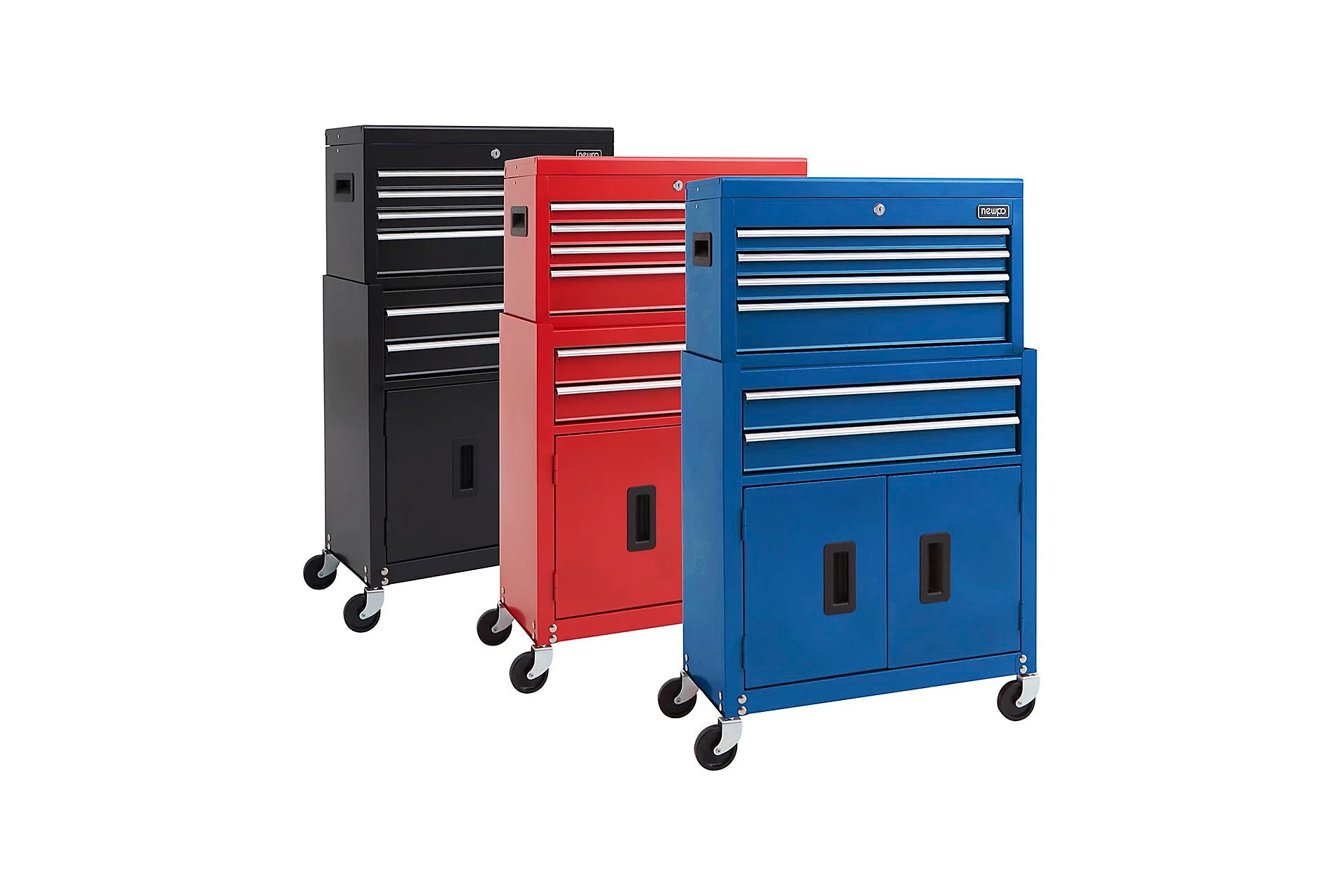
BiGDUG Garage 24″ 6 Drawer Tool Chest & Rollcab Set
Measuring 1,037x616x295mm, BiGDUG says it encompasses all the features of the larger tool chests, but in a slightly more compact design.
The top chest features central locking, so you can punish those who don’t put tools away properly, and has drawers that run on 25mm ball bearing runners for smooth operation.
There’s also an option to have the chest in blue, should you wish to match your workshop to your tools, or you can pick from red and black.
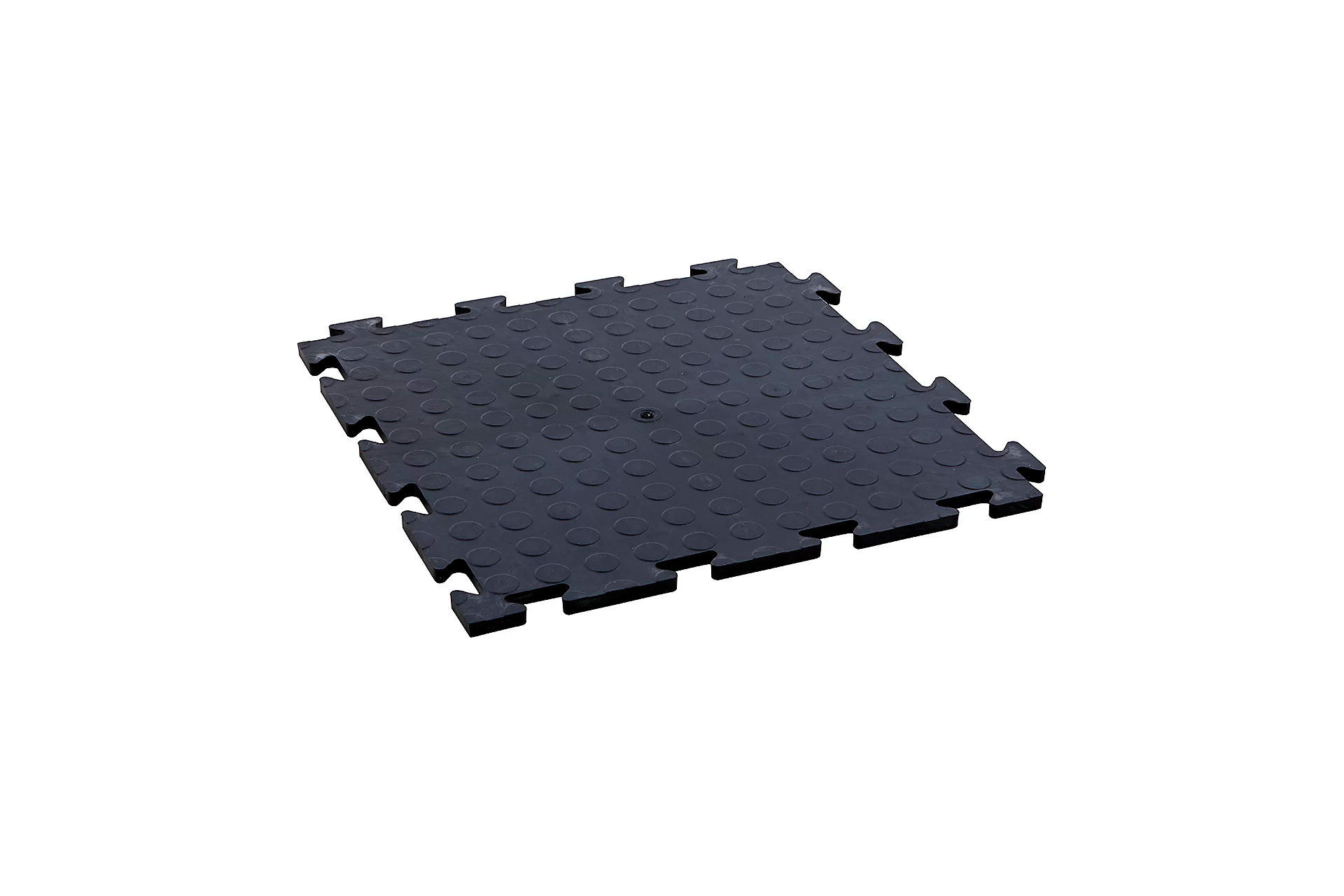
It’s not uncommon to drop things when working on your bike, with contact with the floor often resulting in damaged surfaces, or worse, scuffed components.
These Interlocking Vinyl Floor Tiles from BiGDUG offer protection against both eventualities and are resistant to oils, moisture, solvents and chemicals.
Many bike shops I’ve worked in have used similar flooring to reduce noise from dropped tools and components, while also fighting fatigue from standing when you’re working on your bike.
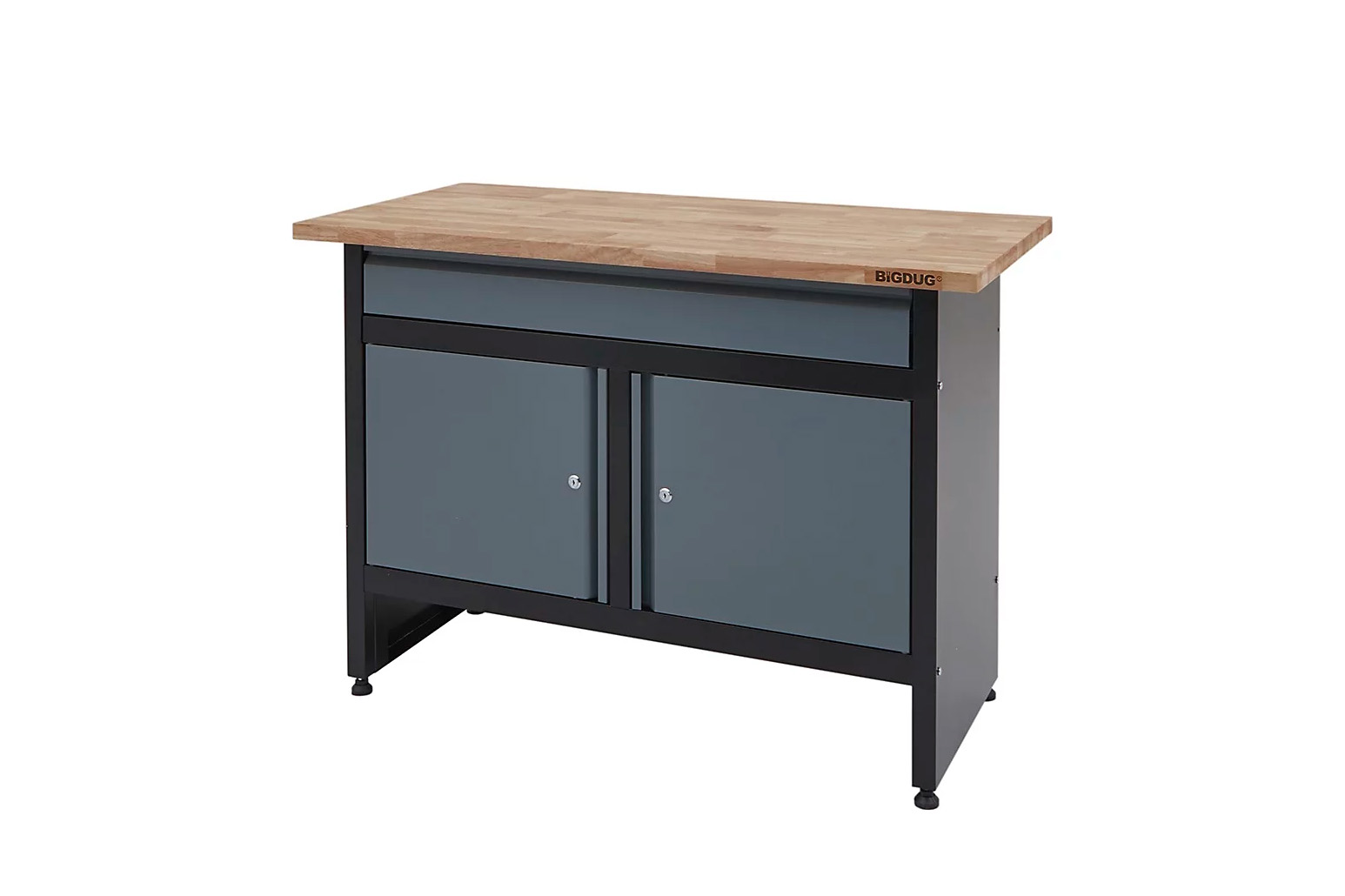
A quality workbench is the beating heart of any workshop, providing the perfect place for fine fettling and component reconstruction.
This Garage Drawer Cabinet Workbench from BiGDUG features a 30mm-thick, FSC-approved solid hevea worktop that should withstand some flak, and three drawer and cupboard combinations to suit your needs.
The drawers are made from hard-wearing powder-coated metal that should remain sturdy for years to come.
It comes in 1,200mm and 1,700mm-wide variations, depending on how much space you need, and features ball-bearing runners on the drawers for smooth operation.
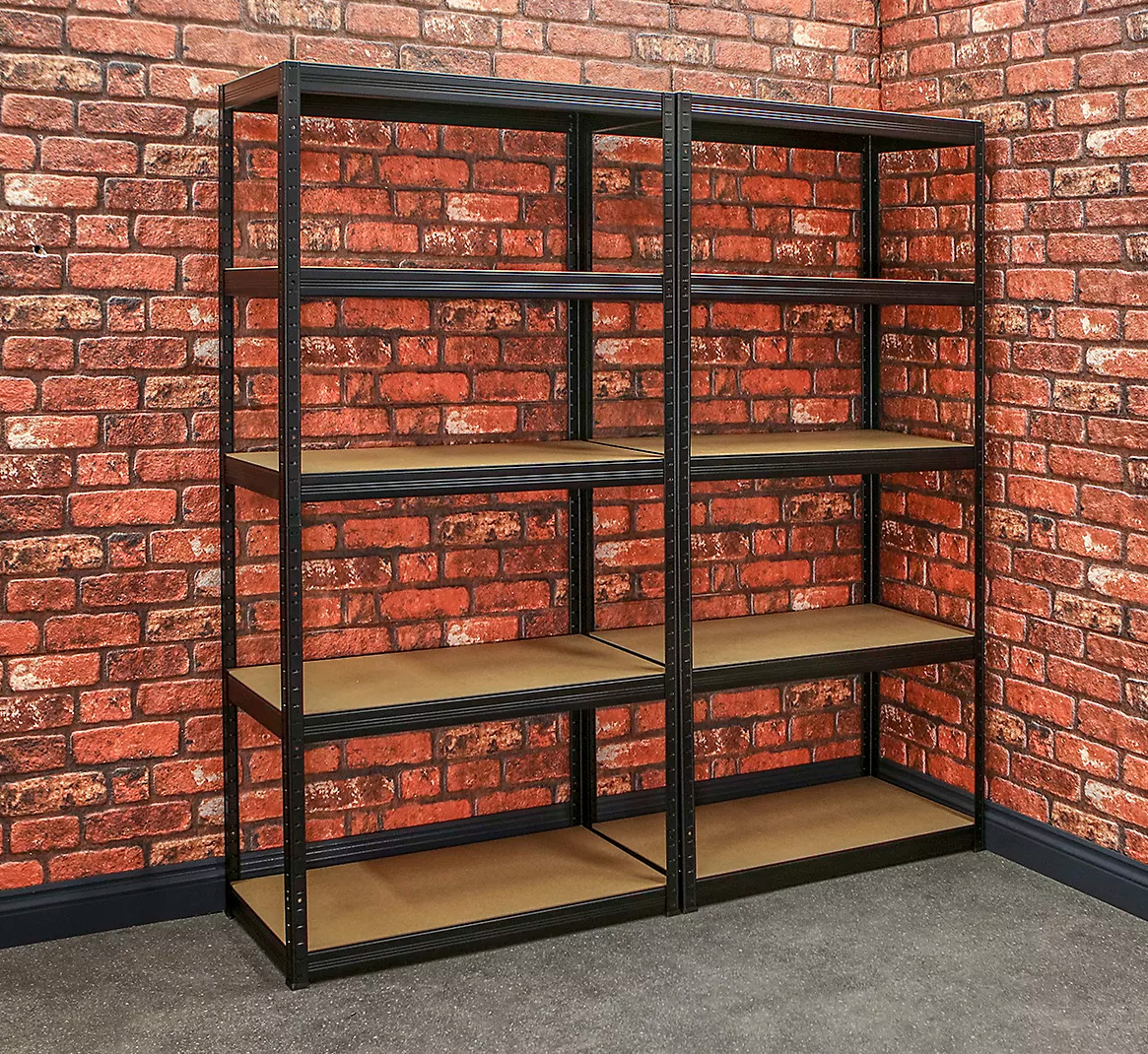
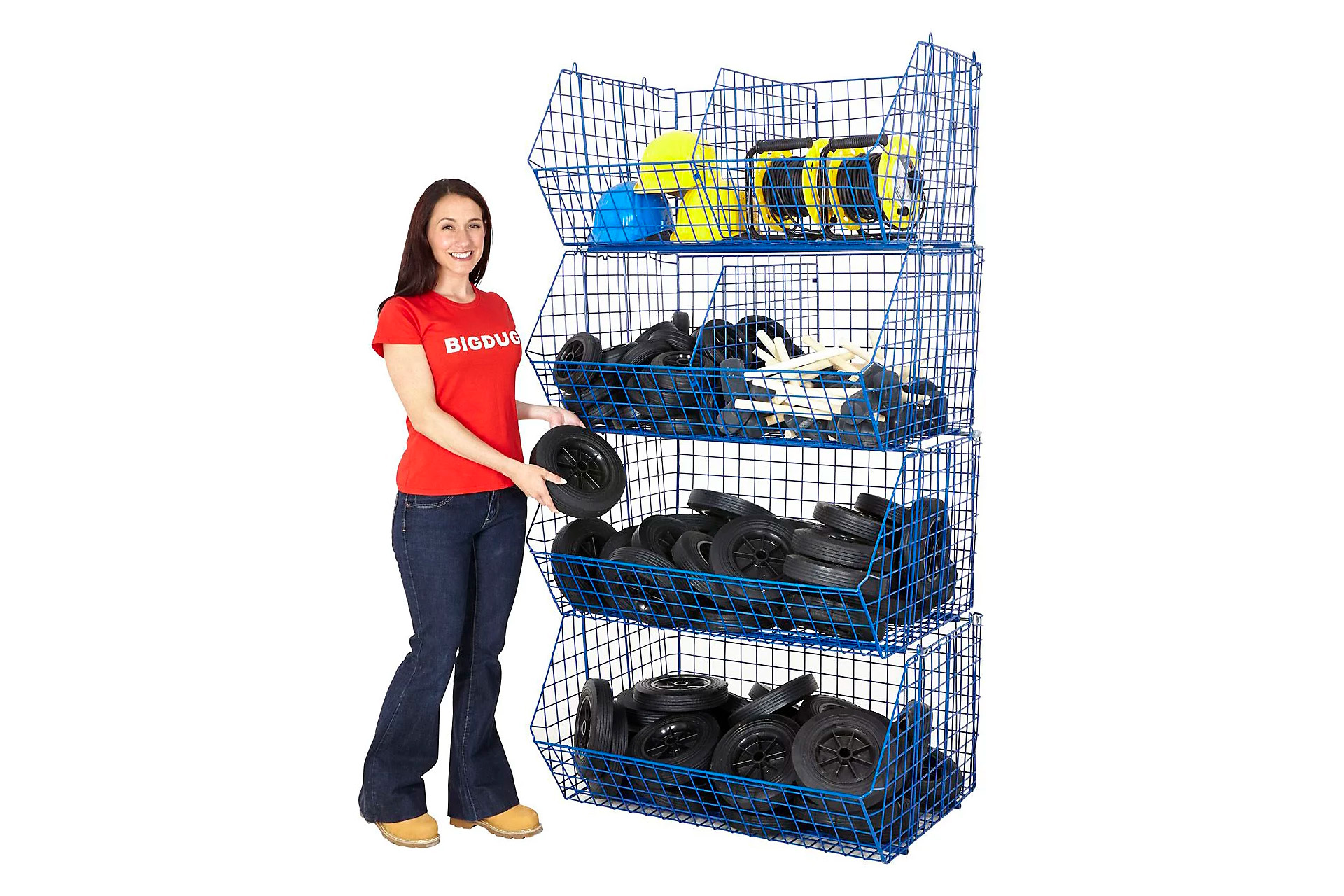
In any workshop, you’re going to need space to store heavy items – whether that’s tools or components.
This Essentials Shelving from BiGDUG comes in a variety of widths and depths to suit every workshop and features a Blue powder-coated European steel frame.
Keeping large bike components organised can be problematic, but this wire shelving looks like a great way to keep track of what you’ve got without taking up too much space.
Zwift Camp: Build begins this Monday, November 10. This is a 5-stage route-based workout series, with each stage lasting one week and focusing on developing power over a specific time interval.
My plan is to do each of the five workouts before their weeks begin, so I can write a post unpacking the workout and delivering some tips along the way. This post covers Stage 1’s workout on Glasgow Crit Six, but before we get there, let’s talk a bit about what Zwift Camp: Build is… and isn’t.
Setting Expectations
Zwift Camp: Build is the second in a series of three Camps planned for the 2025/26 season. We began with Zwift Camp: Baseline, which featured four workouts that pushed us to set maximal power numbers for 5 seconds, 1 minute, 5 minutes, and 20 minutes.
Now we have Zwift Camp: Build, which features workouts where we repeatedly go hard across approximately the same intervals as Baseline used, to build fitness in those systems. (Important note: “approximately” is the keyword here, because the workouts aren’t precisely targeting 5-second, 1-minute, 5-minute, and 20-minute power intervals. Route-based workouts use distance instead of time-based efforts, so Zwift has chosen segments that come close to the target intervals.)
Lastly, in the spring of 2026, we’ll have Zwift Camp: Breakthrough. This Camp will feature some competition and analysis of our power performances.
Who Is It For?
These Zwift Camps are designed as an accessible entry into structured training and analysis. The workouts are fairly short, so the vast majority of riders will be able to complete them. And you only need to do one workout per week to complete the program, meaning most riders can fit Zwift Camp into their current training load.
If you’re a newer cyclist who hasn’t done much structured training, or if you’re a more experienced rider looking to bring a bit of focus and specificity to your training, Zwift Camps may be helpful.
But this isn’t a full-blown periodized training program like you get from a coach, TrainerRoad, or even Zwift’s own training program library. If you’re an intermediate to experienced rider who already trains with even a medium level of structure and specificity, you’ll probably find Zwift Camps don’t offer what you need. Yes, you can do the same Zwift Camp workout more than once to further train a particular system. But experienced riders will probably need to focus much more than one week and a couple of sessions on a particular energy system to see results.
With that said, let’s get into Stage 1’s workout!
Stage 1 Walkthrough: Neuromuscular (~5 Seconds)
The first stage of Zwift Camp: Build focuses on short-term sprint power. To do so, it puts you on the new Glasgow Crit Six route, which takes you on six laps of the Glasgow Crit Circuit for a total distance of 18.3km and 199m of elevation gain.
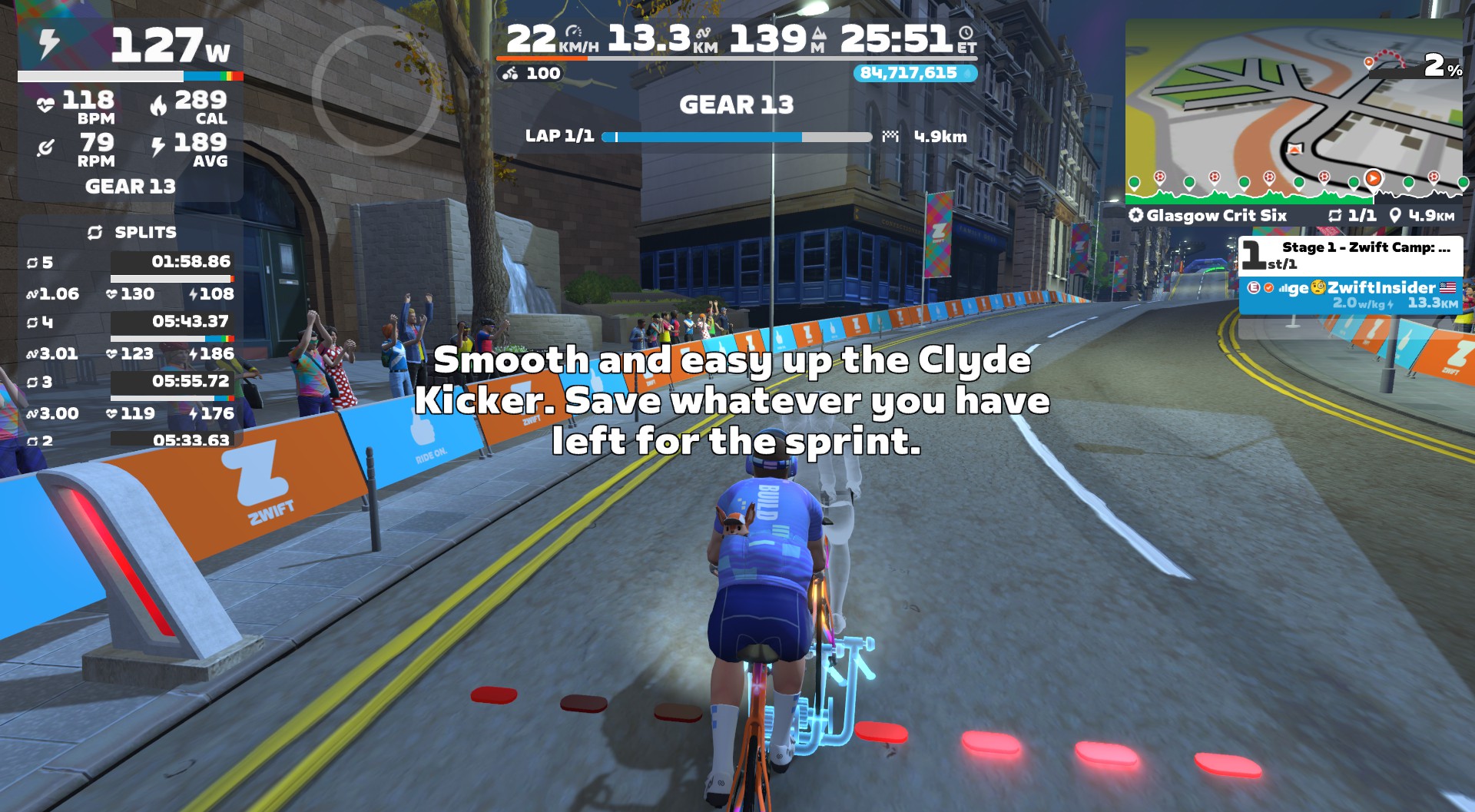
The key part of this route-based workout is the five maximal sprints on the Champion’s Sprint segment, which comes up at the end of each lap and takes most riders 12-15 seconds to complete. The route actually takes you through the Champion’s Sprint seven times, but if you follow the simple instructions on screen, you won’t sprint the first or last time through the segment.
I went into the workout with semi-tired legs, so I planned to just push hard for the final ~5 seconds of each sprint. (The on-screen instructions have you pushing hard throughout the sprint, but this is your workout, and you can do with it what you will.) I did do a longer sprint on the final effort, just to say I’d followed the rules somewhat!
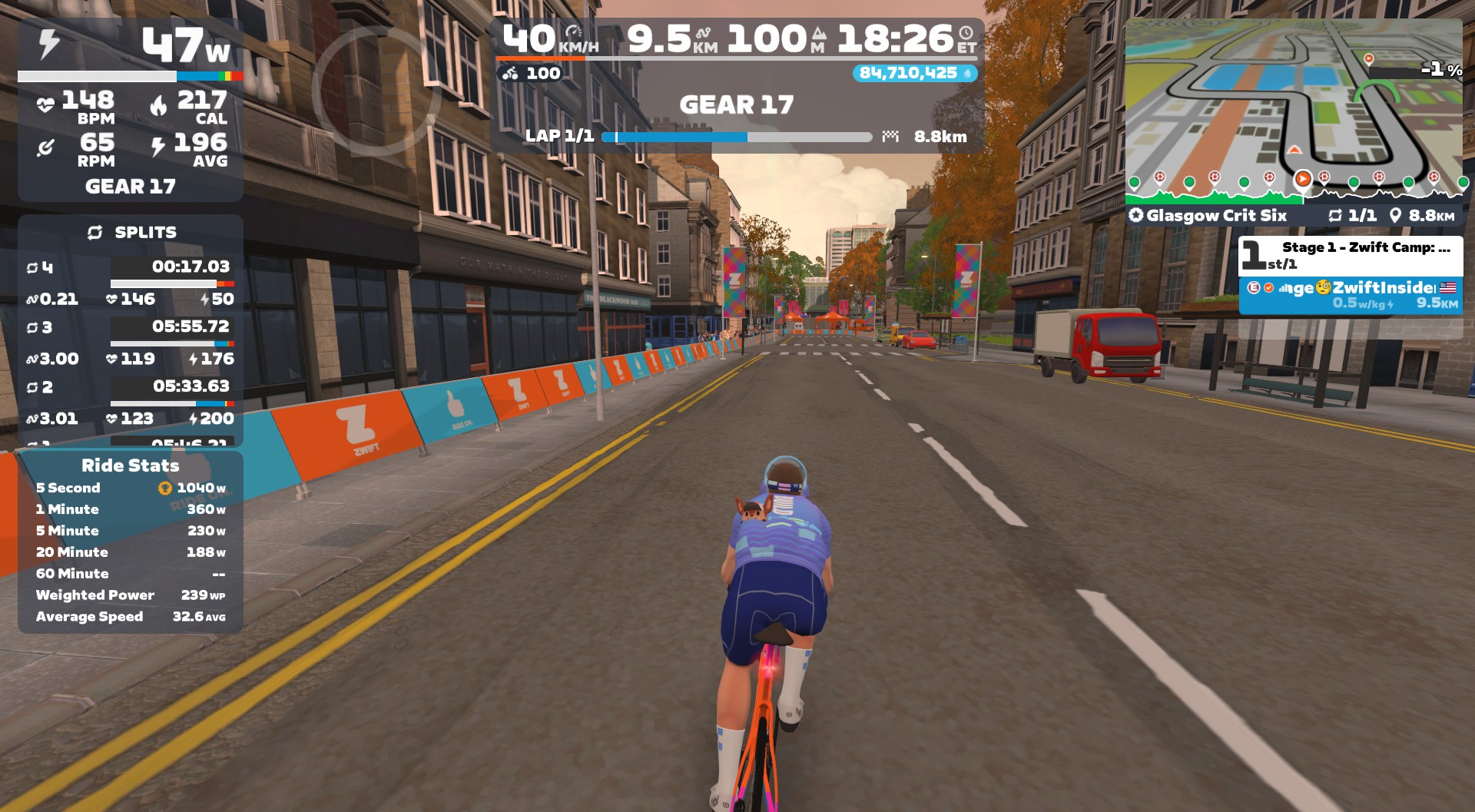
You’ll notice some HUD changes in these route-based workouts. First, if you’re using virtual shifting, your current gear is shown top-center at all times.
Additionally, after your first sprint, the Splits and Ride Stats HUD elements automatically pop up. Ride Stats goes away after a few seconds, but Splits remains throughout the ride, automatically creating a new lap split at the start of each lap. (This auto-lapping is a handy feature some ride organizers might like to use!)
I actually found the Ride Stats HUD more useful for this particular workout, as I wasn’t chasing lap times. (The Splits HUD will be handy, though, in other workouts, including Stage 3, where we ride Volcano Circuit laps as a VO2 workout.) I liked the Ride Stats block because it showed my 5-second power best for the ride, giving me a target to beat.
The on-screen prompts make it clear that you are supposed to rest in between sprints. Even up the Clyde Kicker, your goal is to spin easy so the legs can recharge for another full-gas sprint effort.
I was riding this as a solo test event, so there was nobody else on screen for me to chase. That made it easy to go easy. Fair warning: if you execute this workout in a group event, it may be harder to dial it down and spin between sprints. (Because, as they say, if two cyclists show up, it’s a race…)
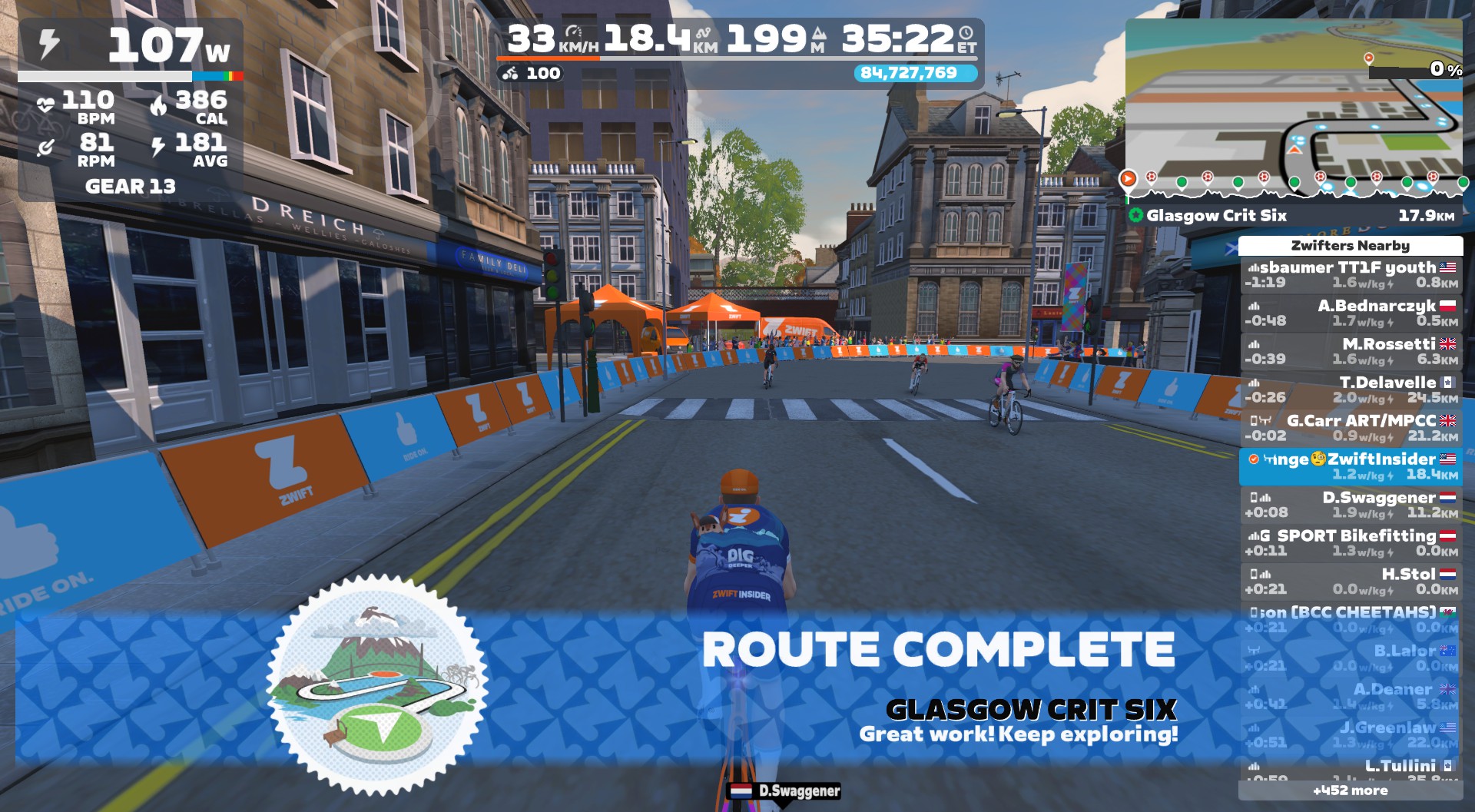
At the end of the workout, you’ll earn the Glasgow Crit Six achievement badge, along with a 360 XP bonus.
HoloReplay Tips
Zwift’s HoloReplay may be a very helpful feature in these route-based workouts, giving you a target to beat on each segment effort. Admittedly, I spent more time confused and slightly annoyed at HoloReplay during my workout than I did chasing the ghosts, but for future workouts I’ll try to be more intentional about chasing my previous self!
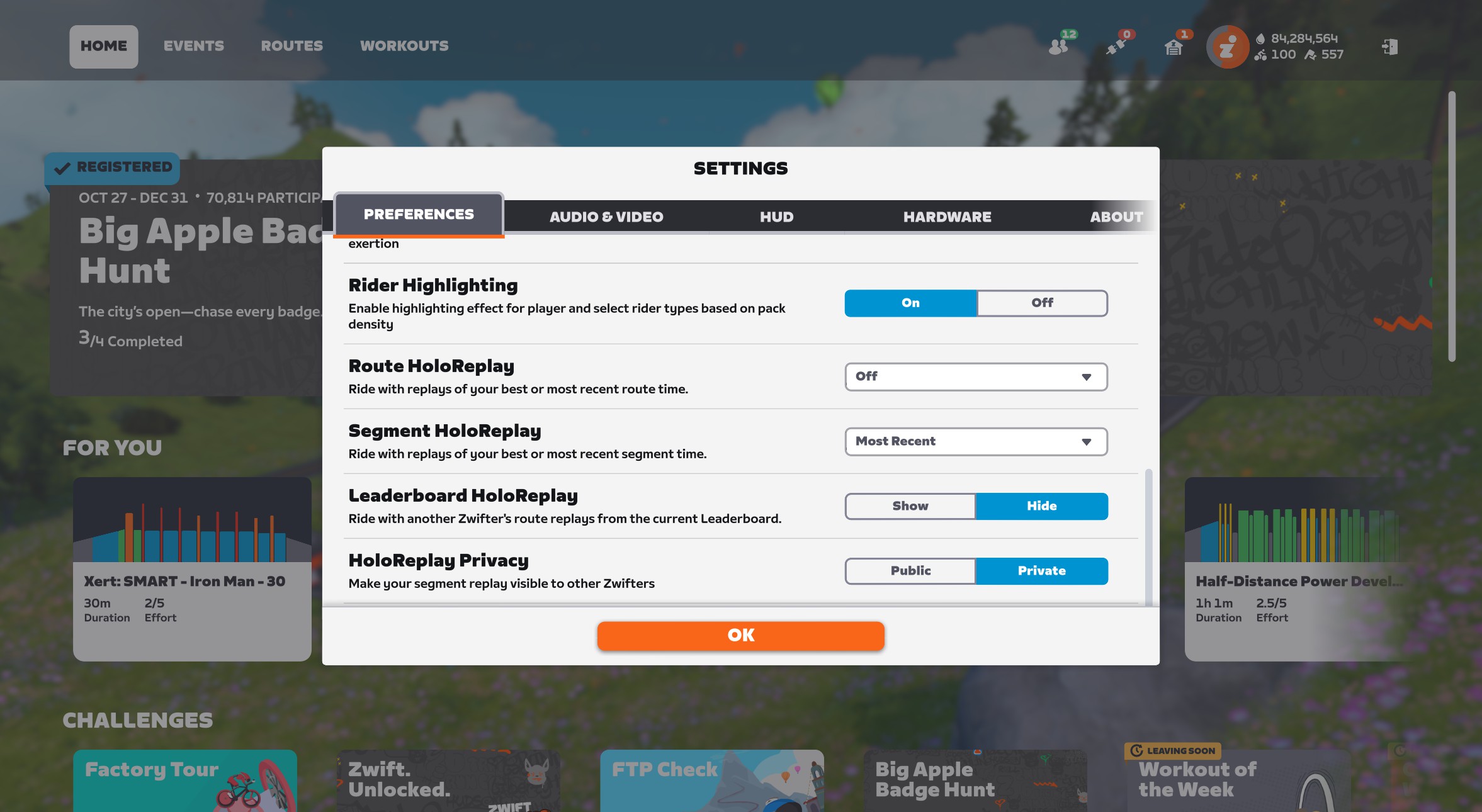
You’ll want to set up HoloReplay in a specific way so it enhances your experience without detracting from it. Here are the settings to use:
Note: if you set “HoloReplay Privacy” to “Public” instead of “Private”, you’ll get a second HoloReplay of yourself at each segment, which corresponds to your best effort currently listed on that segment’s leaderboard. This is the mistake I made when doing the Stage 1 workout, but really, it seems more like a bug, based on the description of what the setting does, and the fact I had “Leaderboard HoloReplay” set to “Hide”…
It powers maximal efforts lasting up to ~15 seconds
It’s like a high-powered battery in that it produces a lot of power quickly, depletes quickly, but can also recharge if you rest for a few minutes
It’s the least adaptable of your three energy systems
Sprint Training Tips
While this workout won’t lead to significant neuromuscular energy system adaptations – it is the least adaptable energy system, after all – it can help you improve your sprinting form and efficiency. And you can make big sprint gains by improving form and efficiency!
Whoever put together the script for this route-based workout seemed to know this, as there are several prompts which focus on form and efficiency, such as, “Think about your gear choice. Maybe try a quicker wind-up this time. Keep your body relaxed and ride efficiently.”
I would have liked to see more prompts like this, though, because many riders could use a bit of coaching to maximize their sprints! I hosted a ride called Sprintapalooza for years, where we rode short circuit routes with sprint segments, going all-in to set segment PRs and compete for the green jersey while working on our sprint form. Through that, I learned a lot about sprinting.
Here are a few tips to maximize your sprint power:
Proper gearing is very important. Too easy a gear and you’ll spin out without enough resistance to push against. Too hard and you’ll be mashing and unable to maximize your power either. Experiment with different gearing in your maximal sprints, and you’ll come to learn which one or two gears work for you in most situations.
Check your form: I’m a big fan of rocker plates, partly because they let me rock the bike back and forth naturally when sprinting on Zwift. If you have one, make sure you aren’t riding it backwards, and be sure to take advantage of its movement. (If you don’t have a rocker plate, your form will differ greatly from good outdoor form.)
Work on cadence: power on the bike is computed using two values: torque (how hard you’re pushing the pedals) and cadence (how fast the pedals are moving). Increase either of these, and your power goes up. Work on high-cadence drills and you may just find you’ve unlocked more sprint power!
Suggestion Box
Overall, I’d say this first workout of Zwift Camp: Build went well. The script was on point, and the course was a good one for sprint repeats. That said, here are a few ways Zwift could improve the experience:
Average segment power history: As mentioned above, I would love to see a HUD element that shows my power average across the target segment every lap, so I can see how those numbers are changing as the workout unfolds.
Improve the event description: Zwift likes to set up these massive event series with a pile of identical text dumped into each and every event’s description. It appears that’s what they’re doing with Zwift Camp: Baseline, too. Why not customize the text for each stage, and make it more useful? Share specifics about what we’re trying to accomplish in that session, and why it matters. And get rid of every word that isn’t needed.
More technique tips: especially when it comes to maximal sprints, form and efficiency are huge factors. Talk about that more during the session. Zwift could even link to further resources in the event description.
Questions or Comments?
Have you done this workout yet? Share your thoughts below, or any questions you may have heading into the workout.
Premier Tech has stepped down as co-title sponsor of the Israel–Premier Tech cycling team following a season marred by protest, the company announced today.
Premier Tech previously demanded the team drop ‘Israel’ from its name and that it adopt a new identity and brand image in order for its sponsorship to continue.
“We are sensitive and attentive to the situation on the international scene, which has evolved considerably since our arrival on the World Tour in 2017,” Premier Tech said at the time.
But despite Israel–Premier Tech stating it would change its name and drop its affiliation with Israel in October, Premier Tech is ending its sponsorship with the team with immediate effect.
“Although we took notice of the team’s decision to change its name for the 2026 season, the core reason for Premier Tech to sponsor the team has been overshadowed to a point where it has become untenable for us to continue as a sponsor,” the Canadian multinational company said in a statement released today.
“First and foremost, we want to thank the team – riders and staff – for the four unforgettable seasons by their side, and to acknowledge their incredible accomplishments and professionalism, both on and off the road.”
Premier Tech added: “We have been involved in cycling for 30 years, but above all, we are passionate about our industries, our markets, our clients, and our team members since 1923. They are at the very heart of our purpose and why Premier Tech exists. We want each of these stakeholders to feel enthusiastic and proud to be associated with Premier Tech, its brands, its products, and its services.
“Premier Tech’s ambition in cycling has always been to build bridges across all levels of the sport, paving the way for athletes and staff to achieve their full potential. Supporting the growth of the sport, alongside the development of Québec and Canadian cyclists, is at the heart of this commitment – and will remain so in the future.”
Israel–Premier Tech was the target of protests throughout the 2025 cycling season. The Boycott, Divestment and Sanctions movement called for peaceful protests against the team’s participation at this year’s Grand Tours back in April.
Protests at the Vuelta a Espana against Israel–Premier Tech’s participation disrupted much of the race. Demonstrators labelled the team’s presence at the final Grand Tour of the year “sportswashing plain and simple”.
Alongside Premier Tech, Israel–Premier Tech’s bike supplier, Factor Bikes, also said it would end its partnership with the team if it did not change its name and affiliation with Israel.
While teams had to register officially with the UCI for the 2026 season by mid-October, the governing body’s list of teams for the upcoming season only included a placeholder for Israel–Premier Tech, and we are yet to find out the squad’s new name or branding.
Signup numbers are looking strong this weekend, so we picked some of the most popular rides and crazier events (6-hour group rides or banded PRL Full events, anyone?) See our five favorites below!
DBR x Canyon x Cykelnerven Ultra Charity Ride
Good Cause Endurance Challenge Popular
Are you ready for a mega endurance challenge? This event is 6 hours long and open-paced. DBR organized it on Watopia’s Flat Route Reverse (10.2km, 61m) so you’ll always have riders nearby and can even take a break if needed.
This is a charity ride, held to support Cykelnerve, raising awareness and funds for a world free of multiple sclerosis. Every donation helps in the fight against multiple sclerosis.
VirtuSlo’s popular 4Endurance League starts this weekend with a 49km, 502m race on France’s Gentil 8. With over 200 riders signed up when we put this post together, this is the most popular ride on our list!
The 4Endurance League is a 6-race series held over a 6-week period. This is race 1. You can find out about the other races and more league info in the event description.
Always a popular ride, this week’s Rubberband Joy Ride is a special one, since it’s on Zwift’s longest route: London’s PRL Full (173.5km, 2625m)!
The Bikealicious crew is always friendly, and this is a “keep together” ride, so as long as you keep pedaling you’ll stay with the group. It’s a good chance to grab this route badge if you haven’t done so yet, which comes with a whopping 3460 XP!
RiZZRL Veterans / Remembrance Day: Salute to Soldiers
Unique Event Newish Route
The RiZZRL races are always epic showdowns, and this week race organizer Ben has fired up a Veterans/Remembrance Day Salute event on Watopia’s Southern Coast Cruise (26.3km, 147m).
Riders are grouped by Racing Score, but these are mass start events.
The Rocacorba Triple Dash combines three mini races into one fierce competition. There are two timeslots: 15:30 UTC/10:30 EST/7:30 PST for women’s only races, and 17:30 UTC/12:30 EST/9:30 PST for mixed. And there are prizes!
We choose each weekend’s Notable Events based on a variety of factors including:
Is the event unique/innovative in some way?
Are celebrities (pro riders, etc) attending/leading?
Are signup counts already high, meaning the event is extra-popular?
Does the ride include desirable unlocks or prizes?
Does the event appeal to ladies on Zwift? (We like to support this under-represented group!)
Is it for a good cause?
Is it just plain crazy (extra long races, world record attempts, etc)?
Is it a long-running, popular weekly event with a dedicated leader who deserves a shout out?
In the end, we want to call attention to events that are extra-special and therefore extra-appealing to Zwifters. If you think your event qualifies, comment below with a link/details and we may just include it in an upcoming post!
The tier will depend on several factors, including whether a bike is in an “over-supplied” parking bay and if it has been idle for an extended period of time.
As a result, Forest says this scheme will help balance supply across the capital.
“Unlike pricing models that increase prices during peak demand, Forest’s approach works by rewarding riders for choosing bikes in high density areas to reduce overcrowding at parking bays, and aid fleet rebalancing,” Forest says.
The new tiering follows a recent pilot by the dockless ebike provider, where bikes that had been idle for more than five days were offered with 30 minutes of travel for £1.
“The trial saw discounted bikes being ridden on average 20% sooner, helping keep Forest’s fleet in motion across London,” Forest says.
“To build on this success, Forest will use real-time fleet data to determine when and where bikes should be relocated, while working closely with local authorities, residents, and riders to deliver a system that benefits the whole city.”
“In addition to improving fleet distribution, the new pricing structure will also help Forest reduce its operational energy consumption. By incentivising riders to move bikes rather than relying solely on support vehicles, Forest expects to improve the energy efficiency of the fleet’s support vehicles by 50%,” Forest adds.
To mark the launch, all Forest bikes in London will offer 30 minutes of riding for £1 on Wednesday 12 November.
Peloton has recalled 830,000 of its Original Series Bike+ Model PL02 because the indoor bike’s seatpost assembly can break, posing a fall and injury hazard to users.
The recall, issued on 6 November in the USA, says consumers should stop using the indoor bike immediately and contact Peloton for a free repair. “Peloton is offering consumers a free seat post that can be self-installed,” it says.
The exercise equipment company, which also makes treadmills and rowing machines, says it has received three reports of the seatpost breaking and detaching from the bike during use, including two reports of injuries due to falls.
The recall states: “This recall involves Peloton Original Series Bike+ units, with model number PL02 and serial numbers beginning with the letter “T”.
“The bike measures 4 ft. long by 2 ft. wide and has an adjustable seat and handlebar. The bike’s serial number is located inside the front fork, behind the front fork, or behind the flywheel.”
Additional information to help locate a Bike+ serial number is on Peloton’s website.
Peloton says the Bike+ was sold at its own stores and Dick’s Sporting Goods across the USA. It was also sold at onepeloton.com, ebay.com, Amazon.com and Dickssportinggoods.com from January 2020 until April 2025.
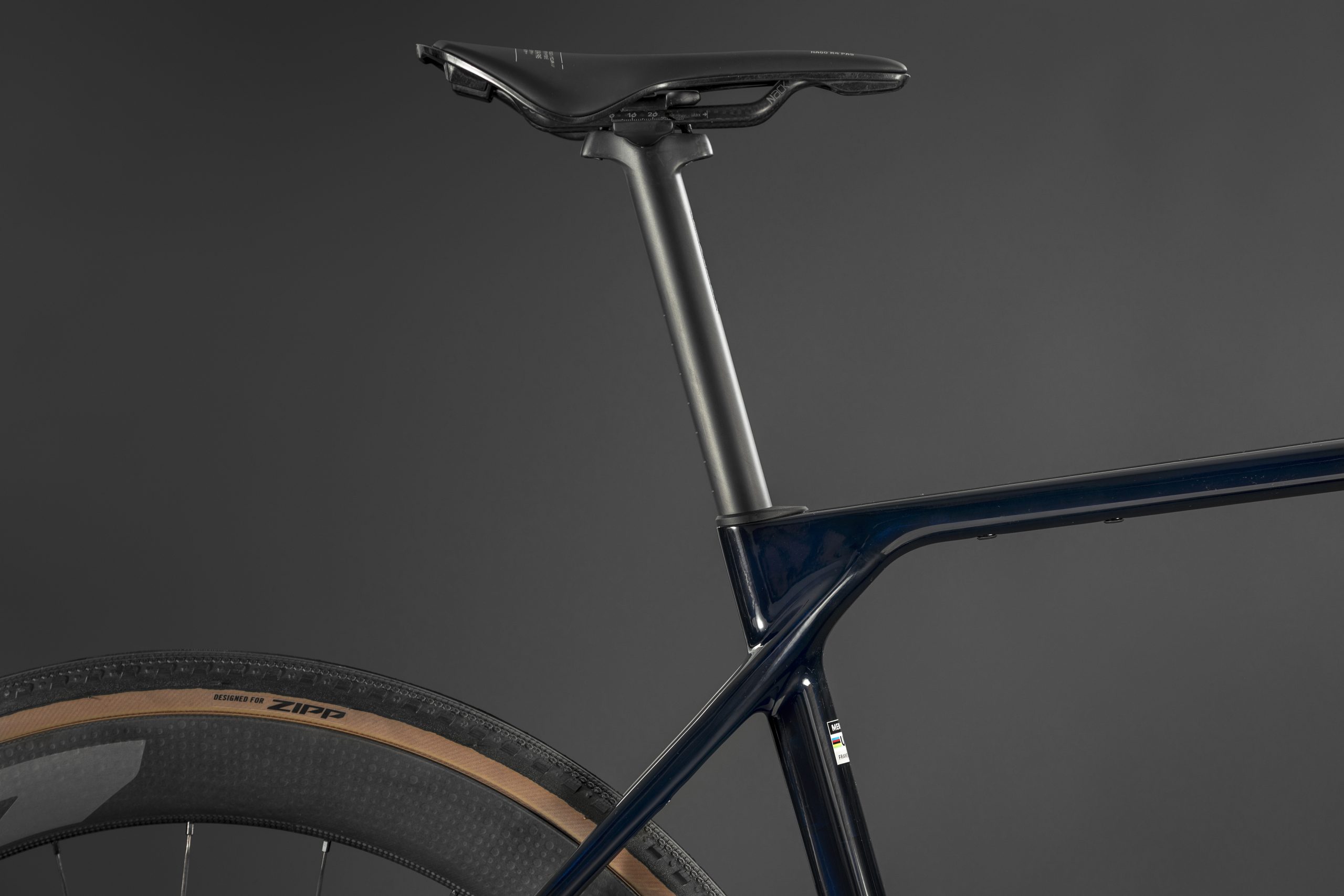
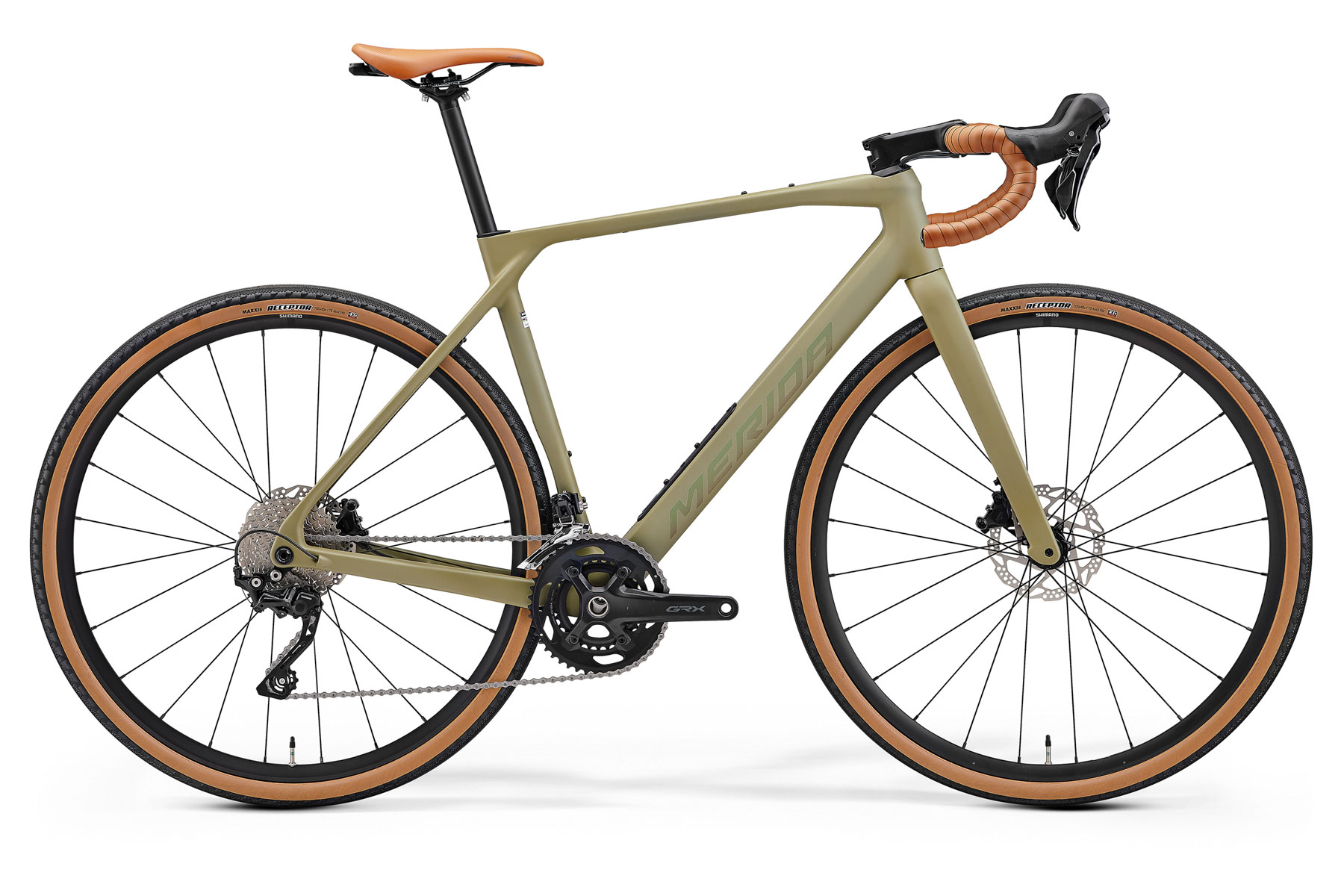
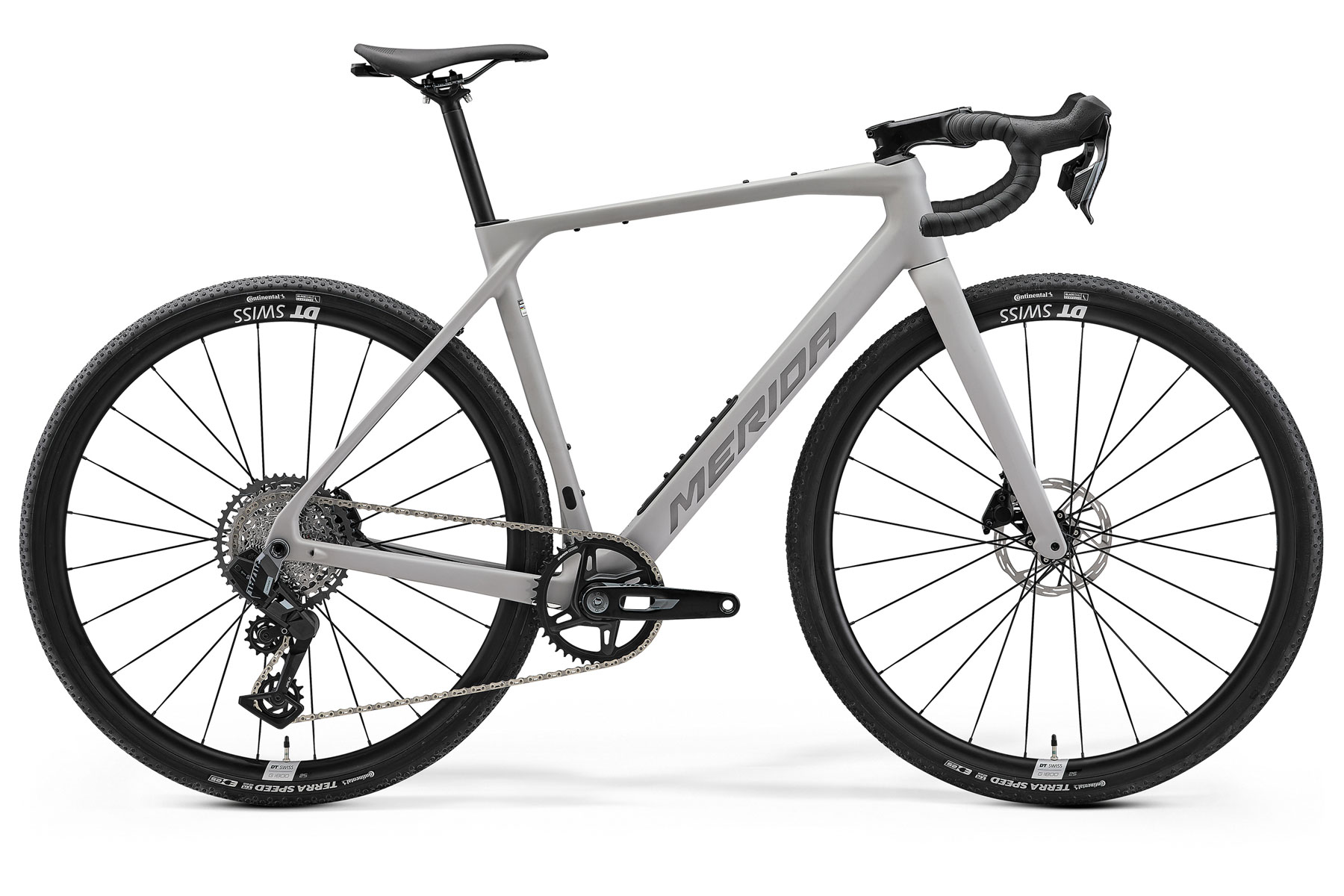
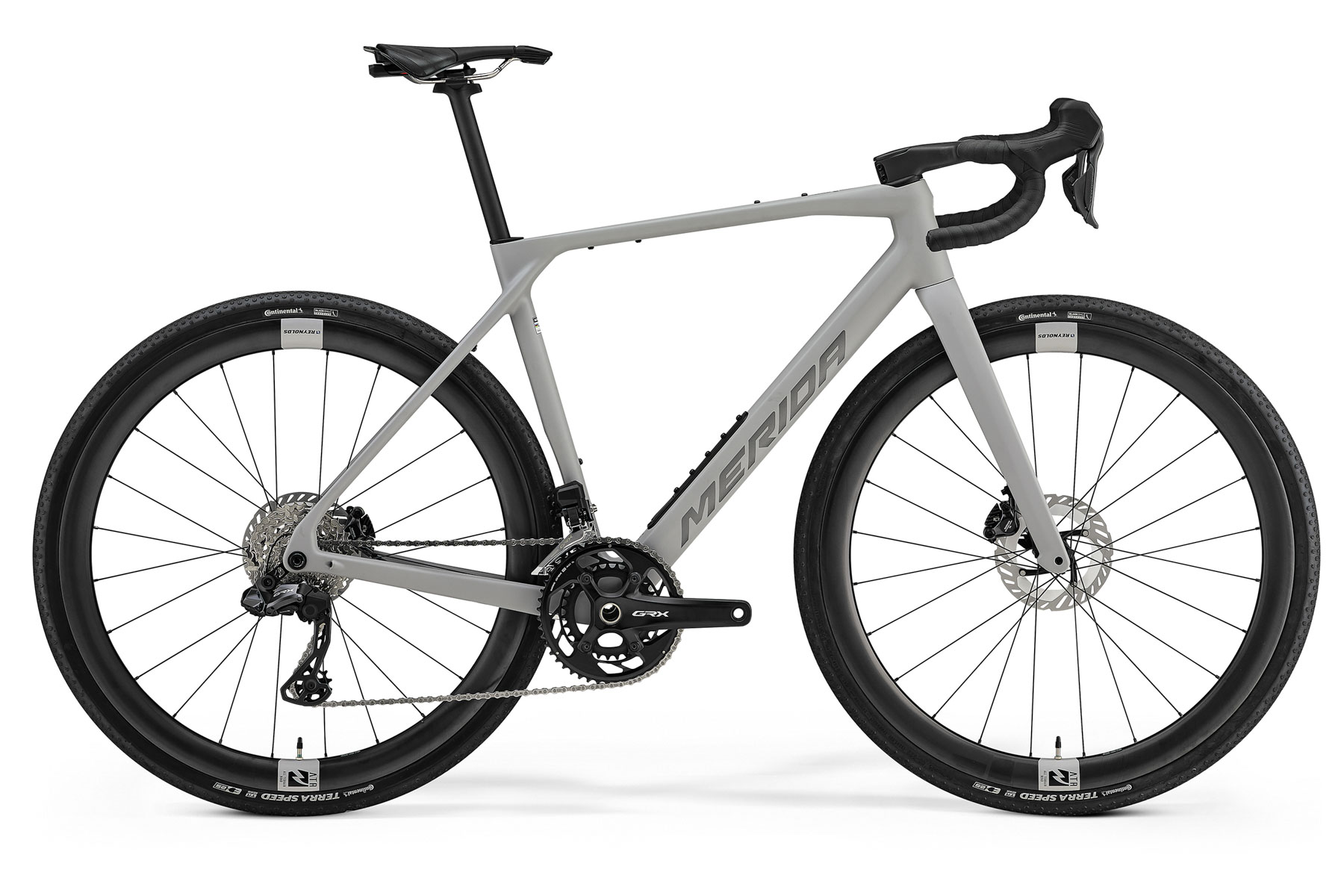
The new Merida Mission has been created to bridge the gap between the Silex, an adventurous gravel design with progressive MTB-derived geometry, and the Scultura Endurance GR, an adaptation of the brand’s highly regarded endurance bike.
The original Mission CX was a similar crossover bike to the new Mission – a cyclocross racer with all-rounder potential. Merida has set out its new Mission as a crossover design that blends the qualities of an aerodynamic gravel race bike with all-surface ability.
That could make the Mission a smart buy for those who only have space for one bike in their riding life.
Matej Mohorič’s Mission that he rode to bronze at the UCI Gravel World Championships in October. Merida
Merida already has solid contenders at each end of the gravel spectrum. The trail-capable Silex is intended for off-road riding and the Scultura Endurance GR is designed for mixed-surface use, with more emphasis on tarmac than dirt.
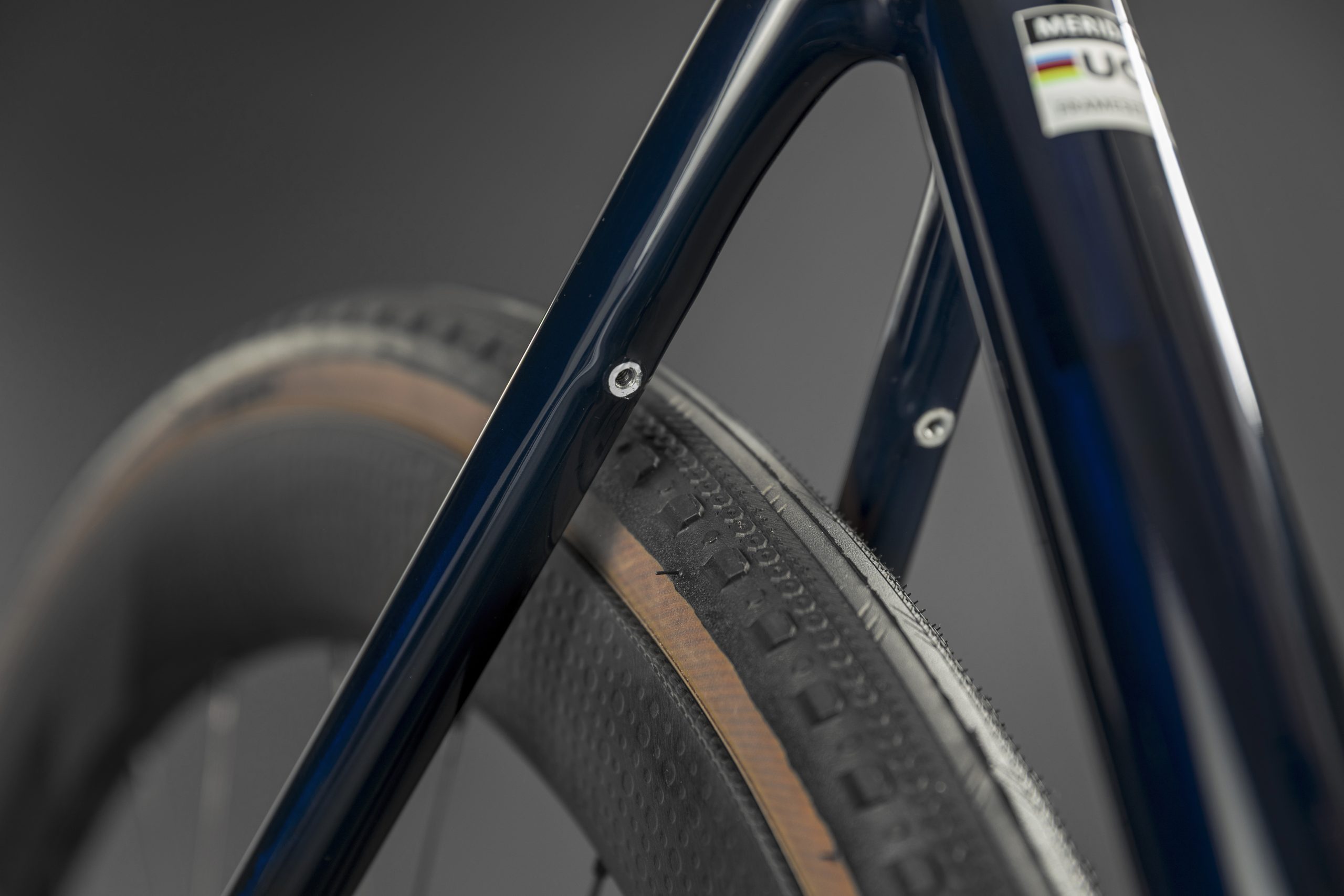
Merida has given the new Mission 40mm tyre clearances, compared to the 35mm of the Scultura Endurance and the 45mm of the current Silex.
The Merida Mission’s tyre clearance is 40mm. Merida
That looks somewhat conservative compared to the trend for USA gravel racers to seek ever larger tyres, going so far as to adopt mountain bike tyres far beyond 40mm, with 50mm becoming the norm.
Merida has kept the clearances modest to maintain the feel of a road bike. That means, compared to the Silex, the new Mission has short 419mm chainstays and a head angle 2.5 degrees steeper at 72 degrees.
FRAME SIZE
XXS
XS
S
M
L
XL
Seat tube [mm]
445
470
490
510
530
560
Top tube [mm]
522
532
543
560
571
586
Chainstay length [mm]
419
419
419
419
419
419
Head tube angle [°]
70
70
71
72
72
72.5
Seat tube angle [°]
74
74
74
73.5
73.5
73.5
Bottom bracket drop [mm]
72
72
72
72
72
72
Head tube [mm]
103
117
126
137
153
178
Fork length [mm]
400
400
400
400
400
400
Reach [mm]
370
377
384
391
398
405
Stack [mm]
529
542
555
569
584
610
Wheelbase [mm]
997
1009
1011
1013
1024
1035
Standover height [mm]
741
764
781
798
816
844
The geometry of the Mission shows its race-ready intentions.
Across the sizes, it has a 20mm+ shorter reach than the Silex (which is designed for short mountain-bike style stems).
The stack height is 15mm lower than the Scultura Endurance and around 40mm lower than the Silex.
The Mission retains mounts for mudguards. Merida
That should make for a very racy position and backs up claims that the new Mission will be the bike of choice for Bahrain Victorious riders competing on gravel next year, after Matej Mohorič took bronze at the UCI Gravel World Championships in October.
The combination of aerodynamics and off-road comfort is aimed at bridging the gap between the Silex and Scultura Endurance. Merida
The Mission has a lower bottom bracket than the Silex and Scultura, which Merida claims enhances stability and control away from tarmac, giving the rider the feeling that they are sitting ‘in’ the bike rather than above it.
Aero advantage
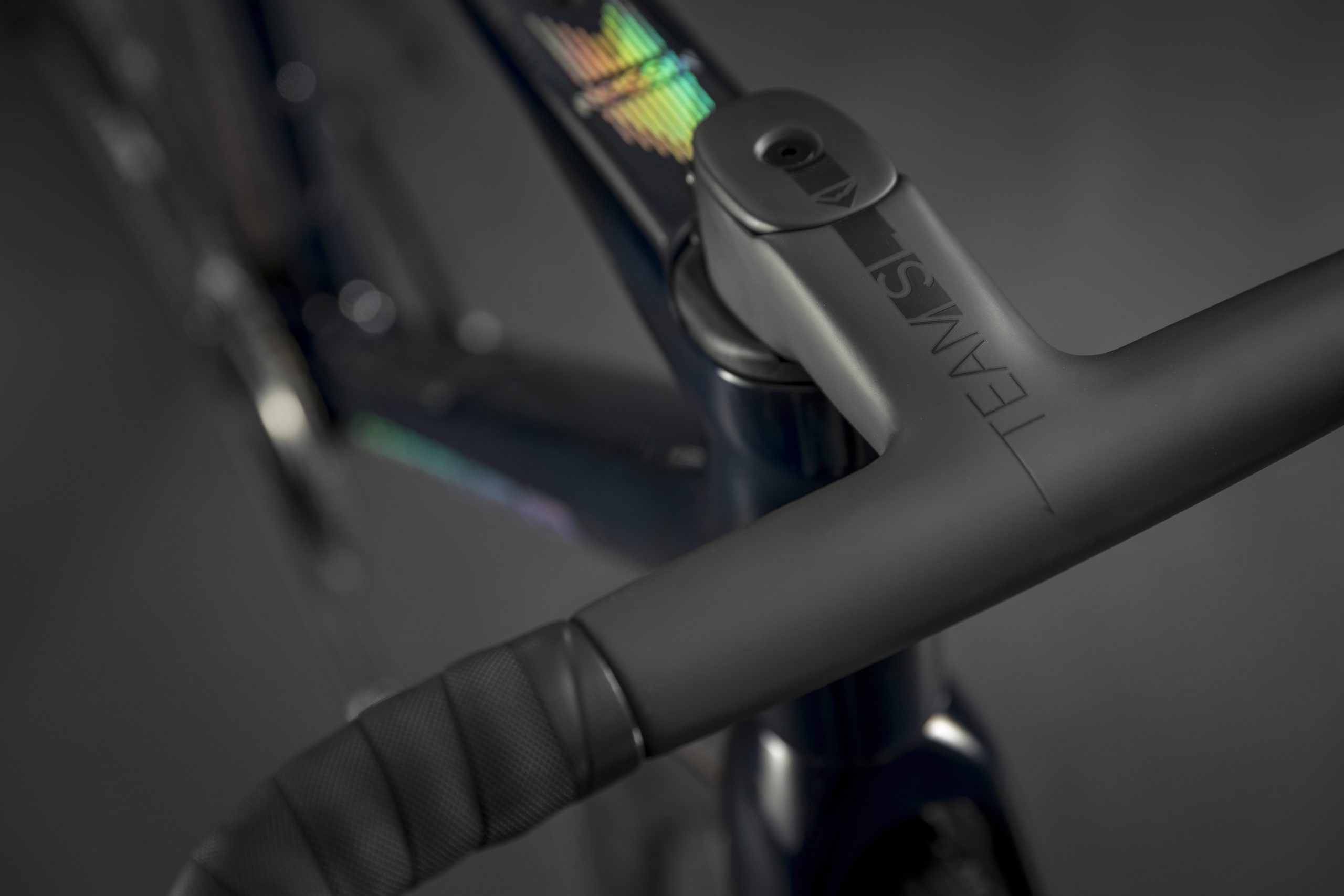
The new one-piece Team SL carbon bar. Merida
The Mission takes lots of its design cues from the Scultura.
Merida claims the tube profiles give an aerodynamic advantage, and when combined with the new one-piece Team SL GR1P carbon cockpit and low ride position, make for a significantly more aerodynamic ride than either the Scultura Endurance GR or the Silex.
Merida Mission range and pricing details
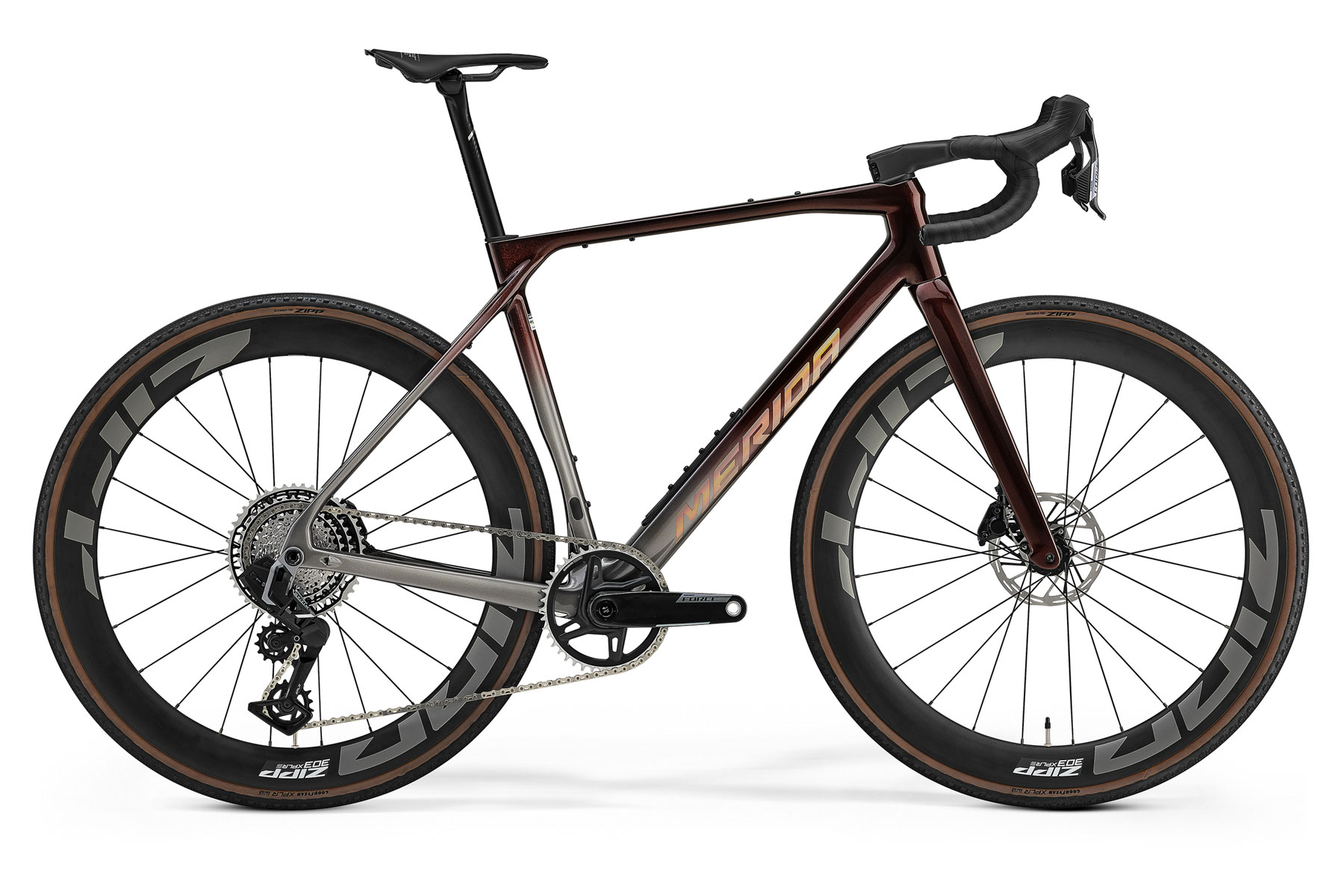
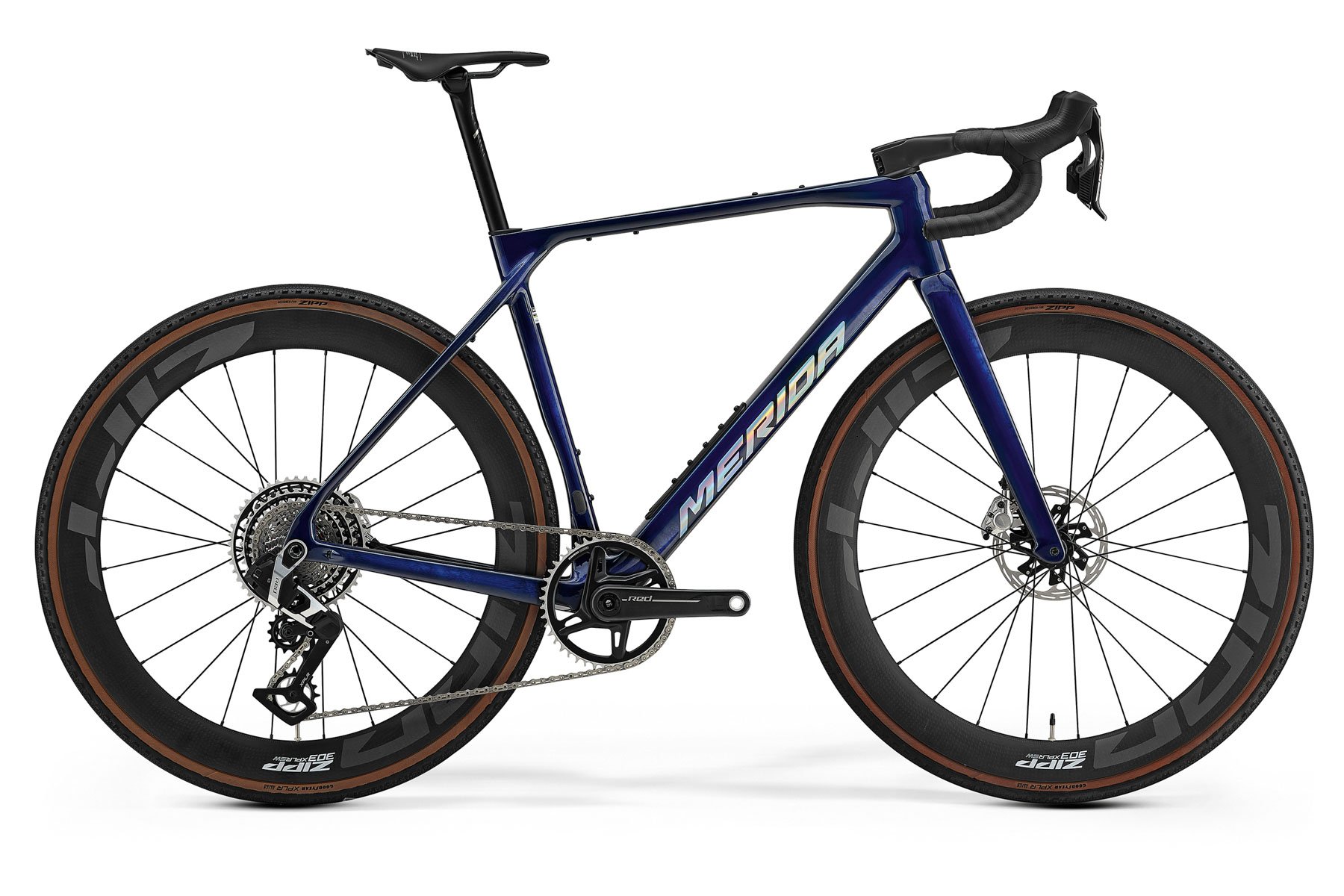
All the Mission models feature the same CF4 carbon frame and fork; prices range from £2,250 for the 4000 to £7,000 for the 10k.
Merida has assembled some value-packed options across all price points.
At the top end of the range, the Mission 10k, at £7,000, has a mighty specification including full SRAM RED XPLR AXS complete with power meter and Zipp 303 XPLR SW wheels.
Specialized’s equivalent S-Works Crux in RED AXS trim with a power meter and Roval Terra CLX II wheels is nearly £4,000 more at £10,999. Trek’s similarly racy Checkmate SLR9 AXS with RED AXS XPLR, power meter and Bontrager Aeolus RSL 37V wheels is £8,950.
Only Canyon can match Merida on value at the high end. The Grail CFR AXS, with the same groupset and wheel package, is £6,999.
At the entry point to the range, the 4000, which shares the same frameset as the premium 10k, matches Canyon’s Grail CF7 at £2,250. However, the Grail has a carbon frame, two tiers below the CFR.
Whether the impressive pricing and Merida’s design choices are enough to sway buyers away from the current trend towards larger tyre clearances and off-road ability remains to be seen.
However, for most riders, the Mission may well be all the gravel bike they need. Combine that with a racier feel on tarmac, and it might be 2026’s smartest gravel racing choice.
Merida Mission 4000
The Mission range starts with the £2,250 4000. Merida
Shimano GRX 400 2x
Shimano WH-RX-180 aluminium wheels
£2,250 / €2,700
Merida Mission 6000
The Mission 6000 comes with SRAM Rival AXS XPLR and DT Swiss wheels for £3,400. Merida
SRAM Rival AXS XPLR 13-speed
DT Swiss 1800 aluminium wheels
£3,400 / €4,080
Merida Mission 7000
The 7000 has Shimano’s 2x GRX Di2. Merida
Shimano GRX 2×12-speed Di2
Merida Team SL GR1P carbon cockpit
Carbon Reynolds ATR wheels
£4,600 / €5,520
Merida Mission 9000
The £5,000 Mission 9000 comes with SRAM Force AXS XPLR and Zipp’s gravel-specific 303 XPLR S wheels. Merida
SRAM Force AXS XPLR 13-speed with power meter
Merida Team SL GR1P carbon cockpit
Carbon Zipp 303 XPLR S wheels
£5,000 / €6,000
Merida Mission 10k
The Merida Mission 10k tops the range at £7,000 with SRAM RED AXS XPLR and Zipp 303 XPLR wheels. Merida
SRAM RED AXS XPLR 13-speed groupset with power meter
This Saturday, The Warrior Games and The Femme Cycle Collab present the Rocacorba Triple Dash powered by ROCACORBA Collective. Get ready for a fierce, empowering single-day battle on Zwift, designed to keep your weekend energy high and your competitive spirit alive.
Join the tribe. Ride with purpose. Rebel with power.
Race Basics
The Rocacorba Triple Dash combines three mini races into one fierce competition. Get ready to push your limits, show your strength, and race like the warrior you are!
Races happen this Saturday, November 8th, in two time slots:
This race uses Zwift pace categories, so riders will choose a category (A/B/C/D) when signing up. These are mass start events, though, so all riders will be visible at the start line!
Riders earn points based on their finishing position in each of the three races, and the rider with the most points after three races is the winner for their category. Full series results can be found in the ZwiftPower League section:
Start things off on the Castle Crit route! A fast and furious city circuit that packs plenty of punch into a short lap. Expect tight turns, punchy ramps, and non-stop action around the streets and castle grounds. It’s pure criterium chaos—perfect for firing up the legs and getting that heart rate sky-high. Quick, intense, and type 2 fun. The perfect opener for the series!
Powerups: Feather (You’ll receive one powerup at the start — use it wisely)
Next up, we’re heading to the Glasgow Crit Reverse route! This one’s a proper leg burner short laps packed with cobbles, climbs, and corners that keep you fighting for position from start to finish. Expect relentless surges and nowhere to hide as the course winds through Glasgow’s gritty city streets. It’s punchy, chaotic, and full of opportunities to attack. A true crit classic to keep the intensity high in race two!
Powerups: Aero (You’ll receive one powerup at the start — use it wisely)
And for the finale… well, we’ve got something special up our sleeves . We’re heading somewhere in Mighty Metropolitan, but don’t get too comfortable—the course is getting a twist! Expect a surprise route change to keep everyone guessing right up until the start. Think city vibes, rolling efforts, and maybe a little chaos to close out the series in style. It’s fast, unpredictable, and the perfect wildcard finish!
Powerups: Draft (You’ll receive one powerup at the start — use it wisely)
Founded by pro cyclist Ashleigh Moolman Pasio in 2021, the Rocacorba Collective is an inclusive indoor cycling community with a mission to empower and uplift women through cycling.
Though rooted in female empowerment, the Collective welcomes men who support its values and vision. Members gain access to expert training, mentorship, and a dynamic global community — supporting riders from grassroots to pro.
This is more than a cycling club. It’s a movement.
Prizes
Here’s what’s up for grabs:
Overall Winners (Categories A–D): ROCACORBA clothing is supplying Rocacorba jerseys to the category winners of both the women-only races and mixed races.
Grand Prize Draw: Riders who complete all three mini race events and are members of the Rocacorba Collective Zwift Club will be entered into a Grand Prize draw for a two-night stay at Rocacorba Cycling!
Race Rules and Other Info
Entry Requirements
All riders must have a registered ZwiftPower account with an assigned race category.
HRMs are mandatory for all categories. If your HRM fails during the race and it clearly appears unintentional (e.g., visible HR data drop), you may keep your result (contact organisers within 2 hours post-race to report this).
zPower users (classic trainers + speed sensor) are not eligible for results.
Categories & Upgrades
If you are on the verge of an upgrade, we encourage you to move up to the next category.
Riders in Pen A are strongly advised to submit dual recordings on ZwiftPower (if equipped)
In-Game Kit Assignment
To differentiate categories, each has been assigned a specific in-game kit as follows:
Cat A: Rocacorba Collective
Cat B: Femme Cycle Collab
Cat C: WatchTheFemmes
Cat D: Zwift 10-year anniversary
Performance & Equipment
Riders exceeding 5 w/kg will be reviewed by organisers.
Powerups are enabled.
Riders must ensure power meters/smart trainers are properly calibrated or zeroed before racing.
Transparency & Fairness
The Warrior Games, Femme Cycle Collab, and RocaCorba Collective reserve the right to review any results or race data.
We may request further information if performance data appears questionable.
All complaints must be submitted within 2 hours after the race concludes.
Gore is reportedly set to shut its Gorewear cycling clothing brand after more than 40 years.
In a letter sent to retailers, and obtained by the German bicycle industry publication velobiz.de, Gore cited economic reasons for the decision. Signed by the WL Gore & Associates GmbH managing director Michael Hullik, among others, the letter says the closure follows “careful consideration and in-depth analysis of long-term prospects”.
According to velobiz.de, the letter says: “For more than 40 years, we have strived with great dedication and considerable investment to successfully position the Gorewear brand in an extremely competitive environment. However, despite all these efforts, we see no realistic possibility of sustainably achieving our business and financial goals.”
Gore will reportedly accept and fulfil orders until 31 March 2026, with the Gorewear website remaining online to sell its inventory.
Gore Bike Wear was founded in 1985, when it produced its first Gore-Tex waterproof and windproof cycling jacket, the Giro. Since then, it has become one of the biggest brands in cycling clothing.
In 2018, Gore Bike Wear was combined with Gore Running Wear to become Gorewear.
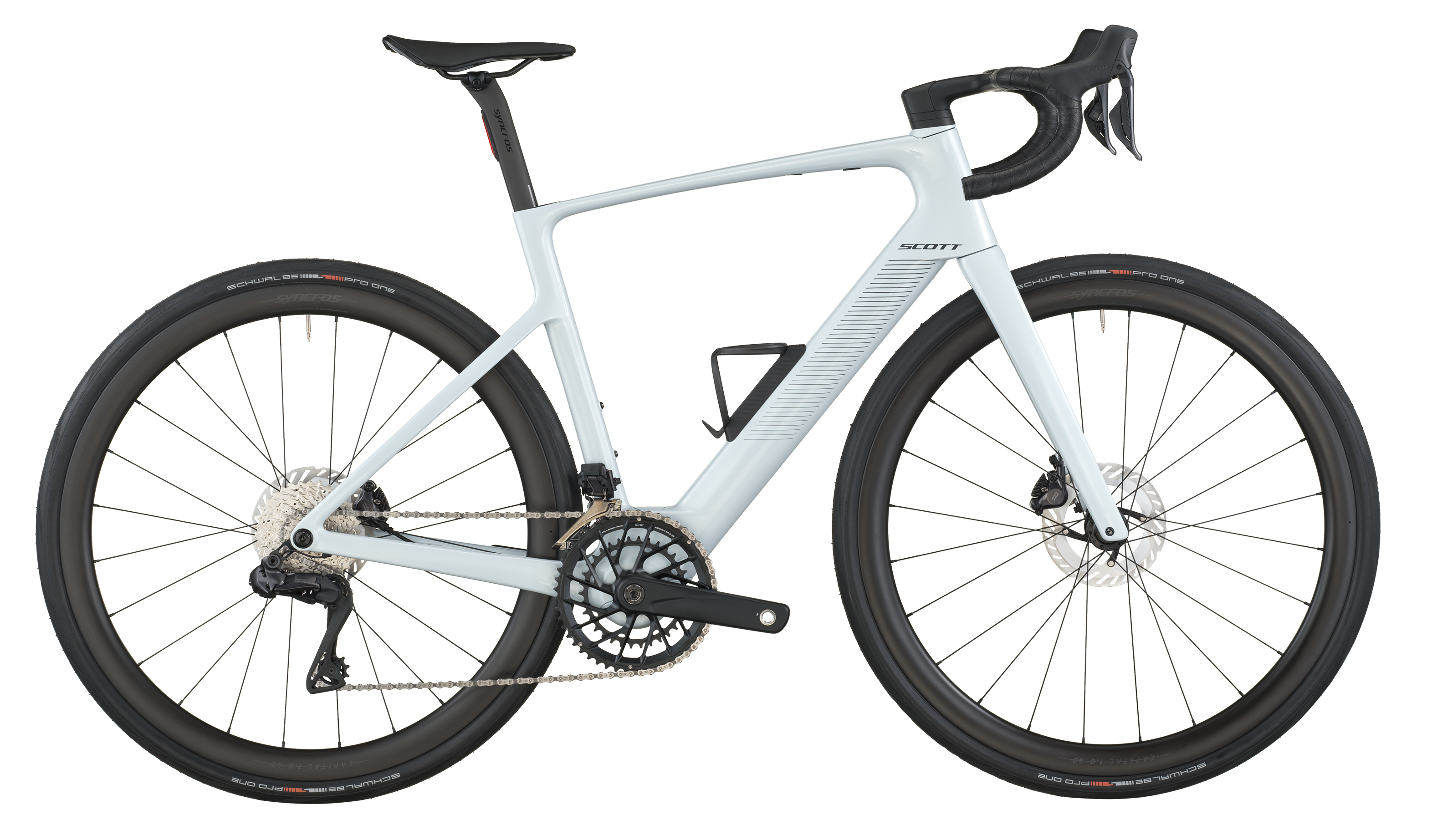
Scott has launched the new Fastlane electric road bike, with the Premium spec dropping the claimed weight under 10kg.
The new bike shares its geometry and some components with the non-assisted Scott Addict endurance bike (the non-RC version) and is made of the same HMX carbon fibre as top specs of that bike. There are three Fastlane specs at launch, with prices of £6,399, £7,299 and £11,099.
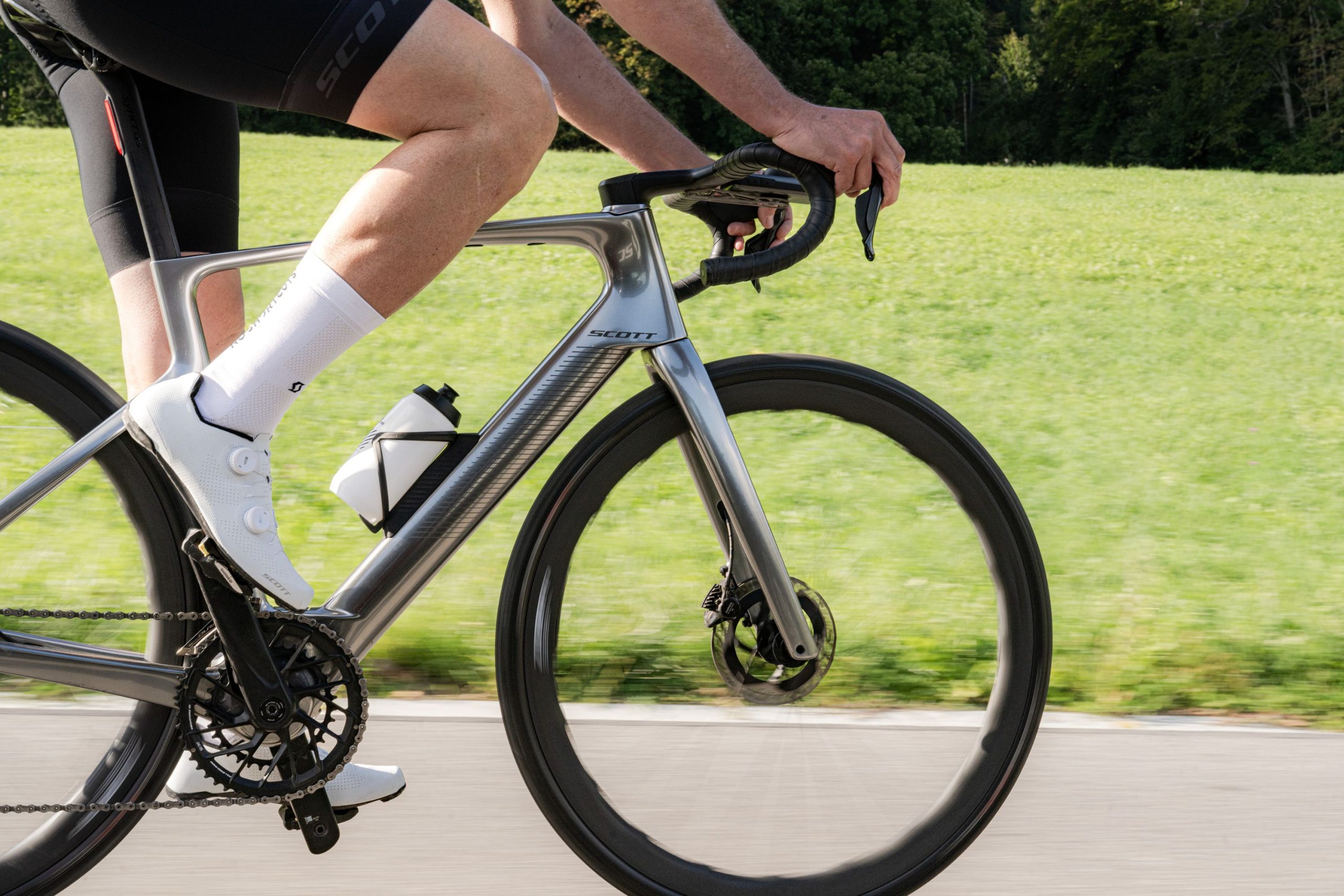
The Fastlane is built around the TQ HPR40 ebike motor system, which has enabled Scott to produce a stealth ebike with a slimline profile that’s not that different from a pedal-powered bike.
Scott claims an 865g frame weight for the HMX carbon frame, with the fork adding 353g, both comparable weights to a non-assisted performance race bike. Scott says the aero tube profiles help to extend the battery range.
Wide tyres are now pretty much standard on new road bikes and the Fastlane is equipped with 34mm tyres, which Scott says enable you to take on a range of surfaces. There’s clearance to go as wide as 38mm, the same as the Addict.
The Fastlane has an integrated rear light, powered by the main battery, and the option to connect a front light to the battery, too. As with the Addict, bolts under the front of the top tube enable you to add a Syncros frame bag.
The TQ HPR40 motor is claimed to provide assistance comparable to a gentle push on the back.
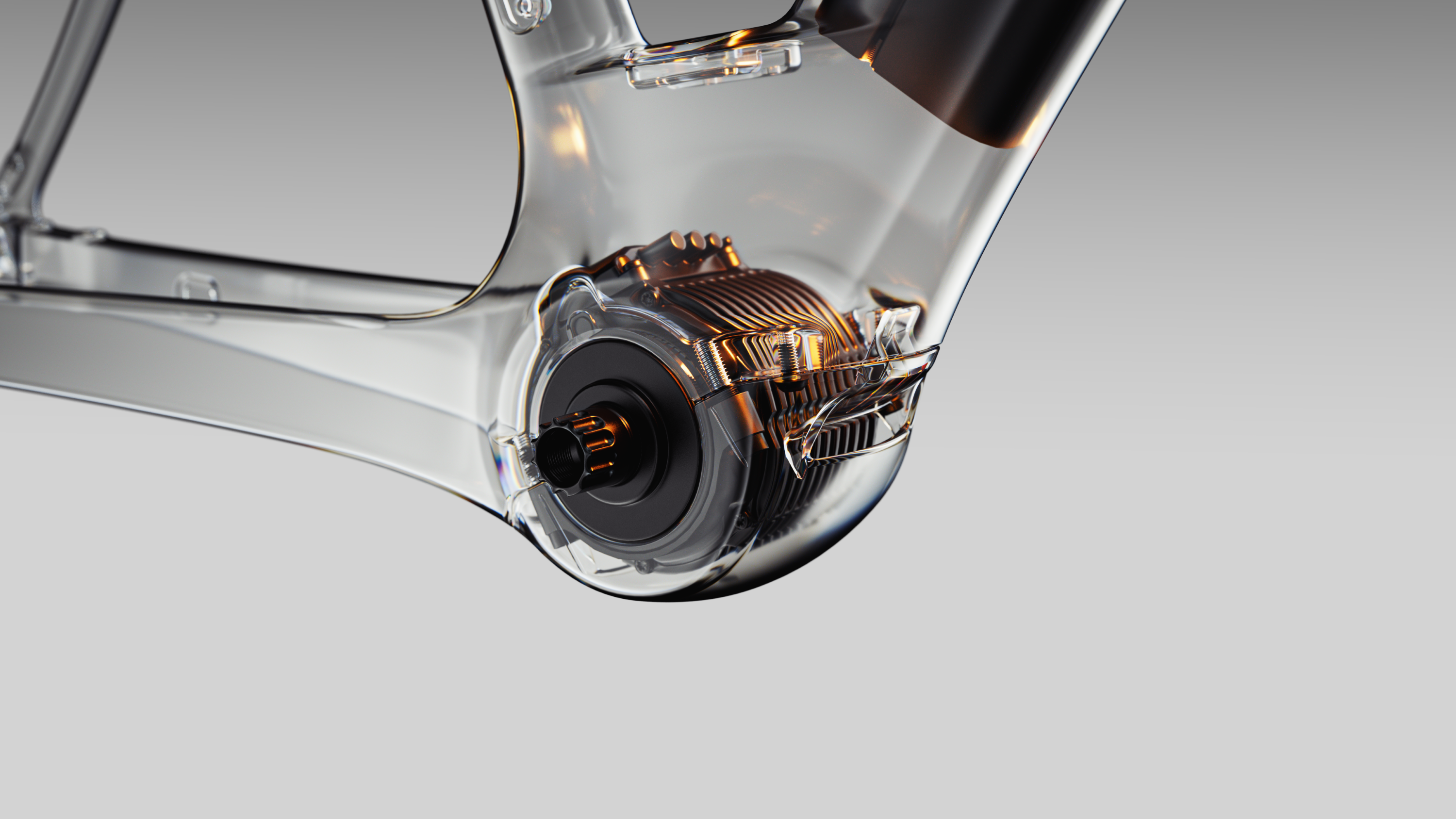
TQ offers three motors: the HPR40, HPR50 and HPR60, with their suffixes denoting their torque output. Scott has chosen to use the lowest-torque HPR40 motor for the Fastlane, which is also the most compact and has a 200W power output, rather than the larger motors’ 300W and 350W respectively.
The TQ HPR40 motor’s claimed weight is 1.17kg and Scott compares its assistance to a gentle push on the back. It’s also claimed to be quieter and to incorporate software that enables it to learn from the rider’s style and adapt to their assistance needs.
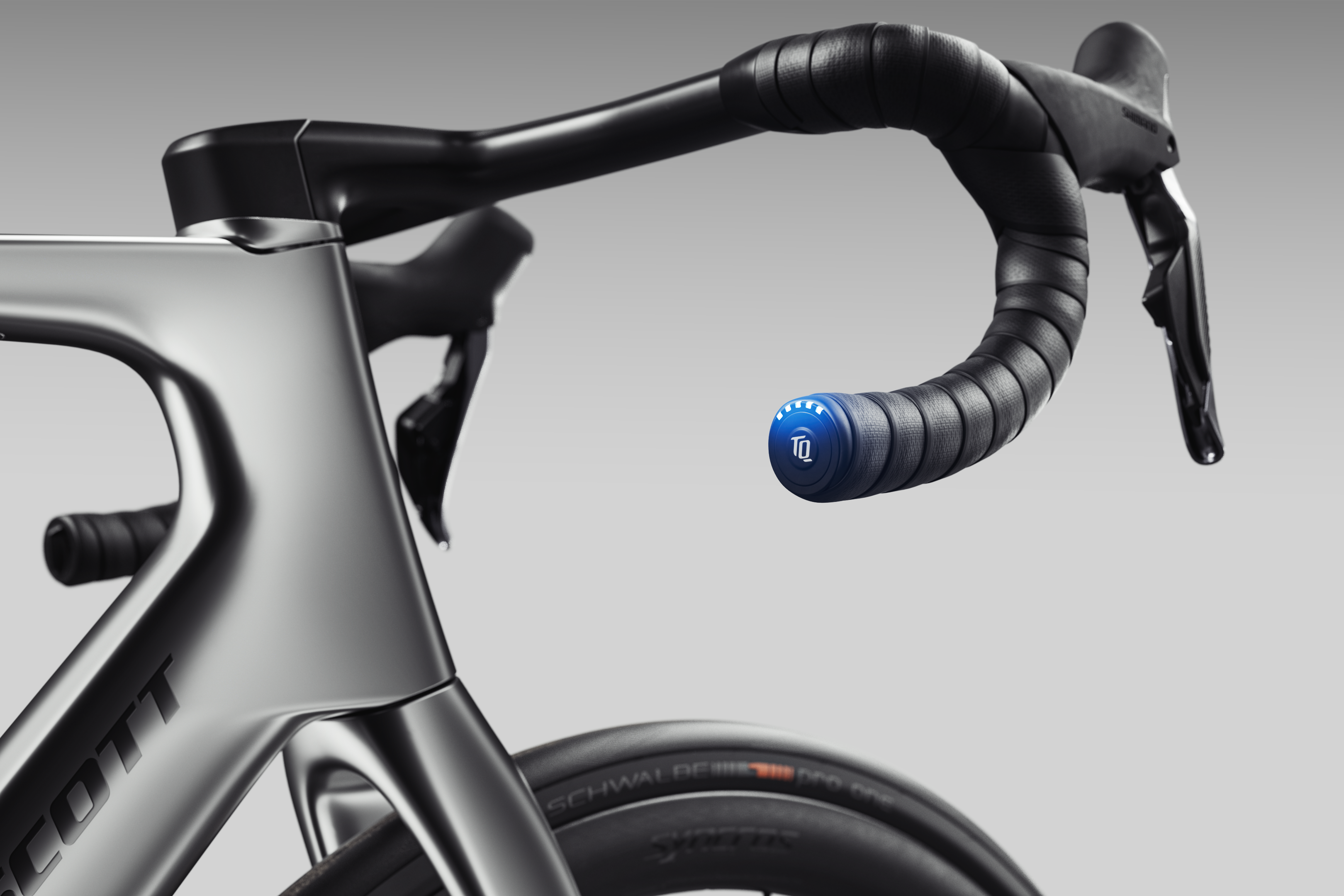
The display unit integrates into a bar end.
The controls are also slimline, with the three assist levels selected via the third button on the Shimano Di2 shifters and a display unit that replaces a bar-end plug, and shows the battery charge and the assistance mode.
Scott has chosen TQ’s mid-capacity 290Wh down-tube integrated battery with a 1.46kg claimed weight, so the motor plus battery contribute only 2.63kg of the Fastlane’s total weight.
There’s an integrated rear light and the battery can also power a front light and other electronics. Nils Laengner/Scott Sports
Despite the stealth implementation, the HPR40’s battery can still power lights and other peripheral electronics. The TQ system can also be paired with a cycling computer via ANT+ to provide a wider display of motor stats.
The HPR40 is the same TQ motor unit as used by Canyon in its Endurace:ONfly electric bike, which also boasts a sub-10kg weight in its top spec and which we rode at its launch event in Girona.
Scott Fastlane spec details
There are three versions of the Fastlane, with prices starting at £6,399.
Scott is offering the Fastlane in three specs: Premium, 10 and 20.
It equips the Fastlane Premium and 10 specs with a one-piece Syncros carbon bar/stem, with an integrated Torq tool, which enables you to fettle all the bolts on the bike.
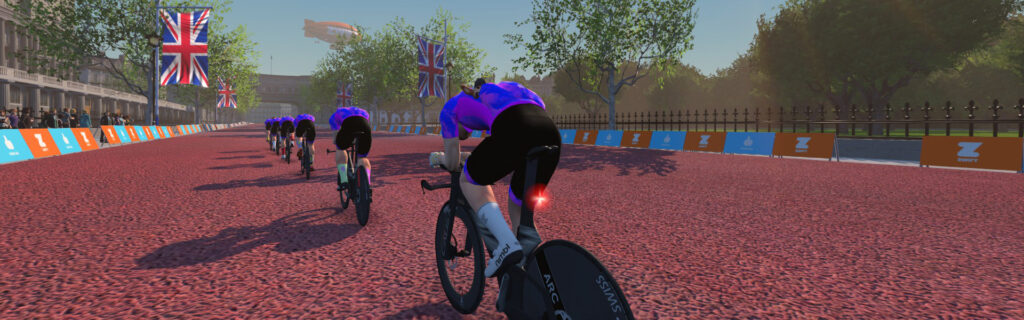
This week, the second round of Zwift Racing League 2025/26 kicked off with a team time trial on Greatest London Flat. I knew it wouldn’t be easy, but I didn’t make it any easier by getting the start time wrong…
Once again, I’m racing with team Coalition Delusion in the Lime B1 Development division. Read on to learn how our race unfolded!
Shortest Warmup Ever
It was Tuesday at 9:55am here in Northern California when I glanced at my phone, opening the Companion app on a whim. I’m still not sure why I did it.
But it’s a good thing I did. Because Companion told me my ZRL race started in 12 minutes. I thought it was still over an hour away!
I’ve given up trying to understand how daylight savings changes work in ZRL, or in Zwift events as a whole. I had assumed my races were still at 11am like they were in Round 1, and I hadn’t even looked at my start time after signing up for this first race.
Panic immediately set in. Could I be ready to ride in 12 minutes? Would my lack of a warmup ruin my performance?
Mentally tossing those thoughts aside, I dashed downstairs as I yelled to the wife, “Gah! My race starts in 12 minutes and I thought it was an hour away!”
I rushed into my bedroom and started grabbing what I needed. I’ve done this, slowly, hundreds of times before. But it sure feels like a lot of stuff when you’re in a hurry!
Bibshorts
Jersey
Sweatband
Gloves
Socks
HRM
I put all that on and hustled upstairs, turning on my Zwift computer while my sainted wife filled a couple of bidons and grabbed me a sweat towel. Seven minutes to go. Pull on the shoes.Climb on the bike.
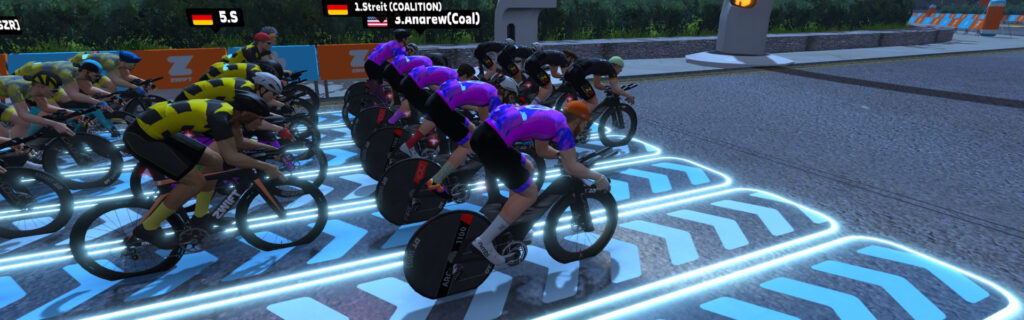
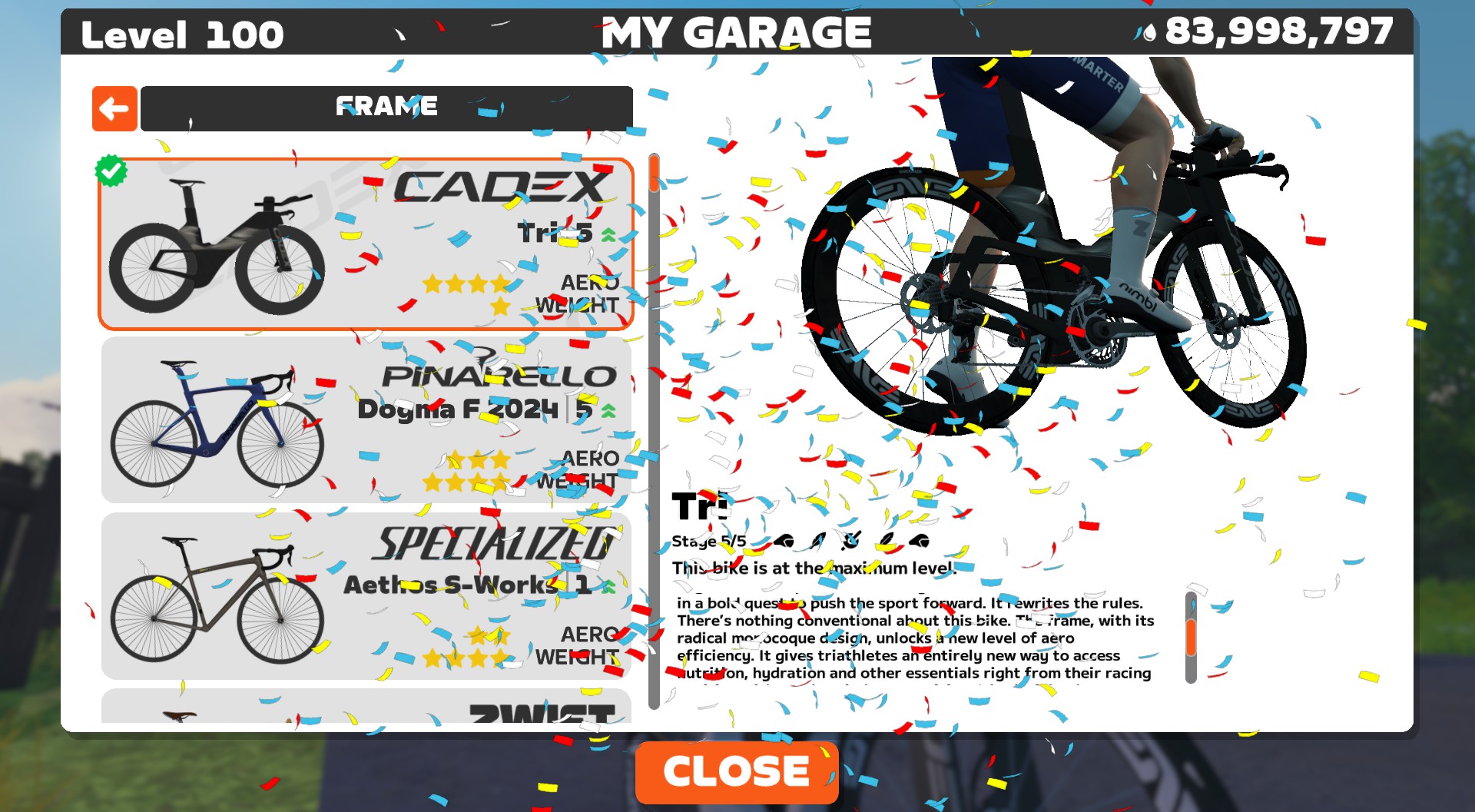
Happily, my computer already had the latest Zwift update installed, plus it boots up fast. I changed my in-game kit to Coalition’s, changed my name so it included my pull number (I was rider #6) and team name, switched to the Cadex Tri bike with DT Swiss 85/Disc wheels, and joined the pens with around 4 minutes to go. It was a good thing we were the 7th team to start (at 10:07) instead of the first (at 10)!
Our sixth man joined the pens with just a minute to go (cutting it closer than me, Fabian), and I even had a spare minute to fire up OBS and get my race video recording for posterity (see it at the bottom of this post). Whew. Let’s race!
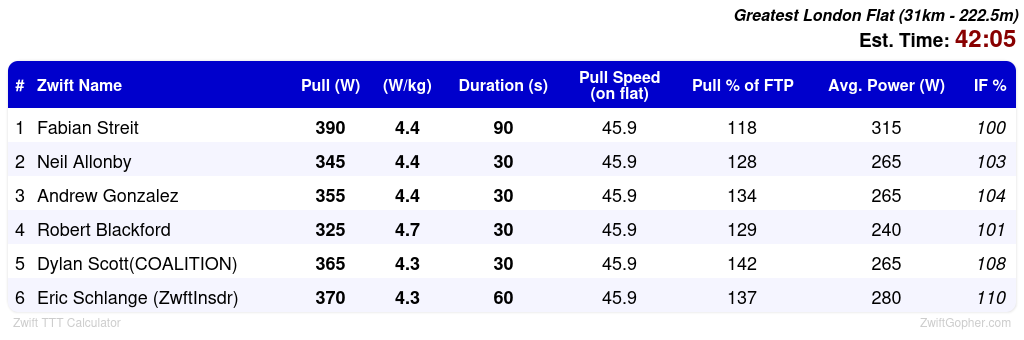
This being the first race of a new round, and only my fourth race with Coalition Delusion, I’m still getting to know my team and their strengths. Captain Neil had our pull order worked out, with a bit of help from the Zwift TTT Calculator:
When the clock hit zero, it was go time. I’d been spinning my legs for a few minutes, but I was far from warmed up. Happily, I was the last guy on the list to pull, which means I’d have a few easier minutes before needing to ramp it up to 370 for 60 seconds!
Settling Into a Strong Pace
We rolled out like pros, getting into a single file quickly despite the rollers at the start that can make it difficult to hold formation. Teammate Chris M was on Discord as our DS, not racing but playing a vital role in calling out what’s going on and making decisions so we didn’t have to.
We settled into a rhythm, calling out what time on the ride clock we’d be pulling to each time we took to the front and when we were about to pull off. I’d forgotten to fire up Sauce for Zwift, so I clicked to do that, giving us extra visibility into time gaps for teams ahead and behind.
As we turned right onto Northumberland Ave, I could see we were doing well, having put time into all the teams I could see in Sauce: to up the road and two behind. A good start, but could we hold the pace?
We ramped up the effort a bit on Northumberland, the first proper uphill of the course. While you have a pull order with power targets in a TTT, that’s your target on flat ground. For a team to maximize their overall speed, they need to push over those targets on climbs. And if you need to, you can ease and drop below the target on descents. The same rules apply in outdoor time trials, because… that’s how physics works.
Bless this Mess
Things got a bit messy formation-wise as we continued our race, so I reminded everyone on Discord that riding 2-3 meters behind the next guy is helpful in TTT races. You still get a full draft, but you aren’t constantly overlapping wheels and pushing each other out of the draft. It gives you breathing room. So we tried to stretch our line out a bit, with varying degrees of success.
I might have pushed on Discord for a cleaner formation, but what I was seeing in Sauce showed that we were still putting time into all the teams we could see. At the 16.6km mark we passed the team ahead, the BZR Lions. These poor guys had their work cut out of them, because they started with only four riders! I gave them a ride on as we passed…
Suffering In the Hills
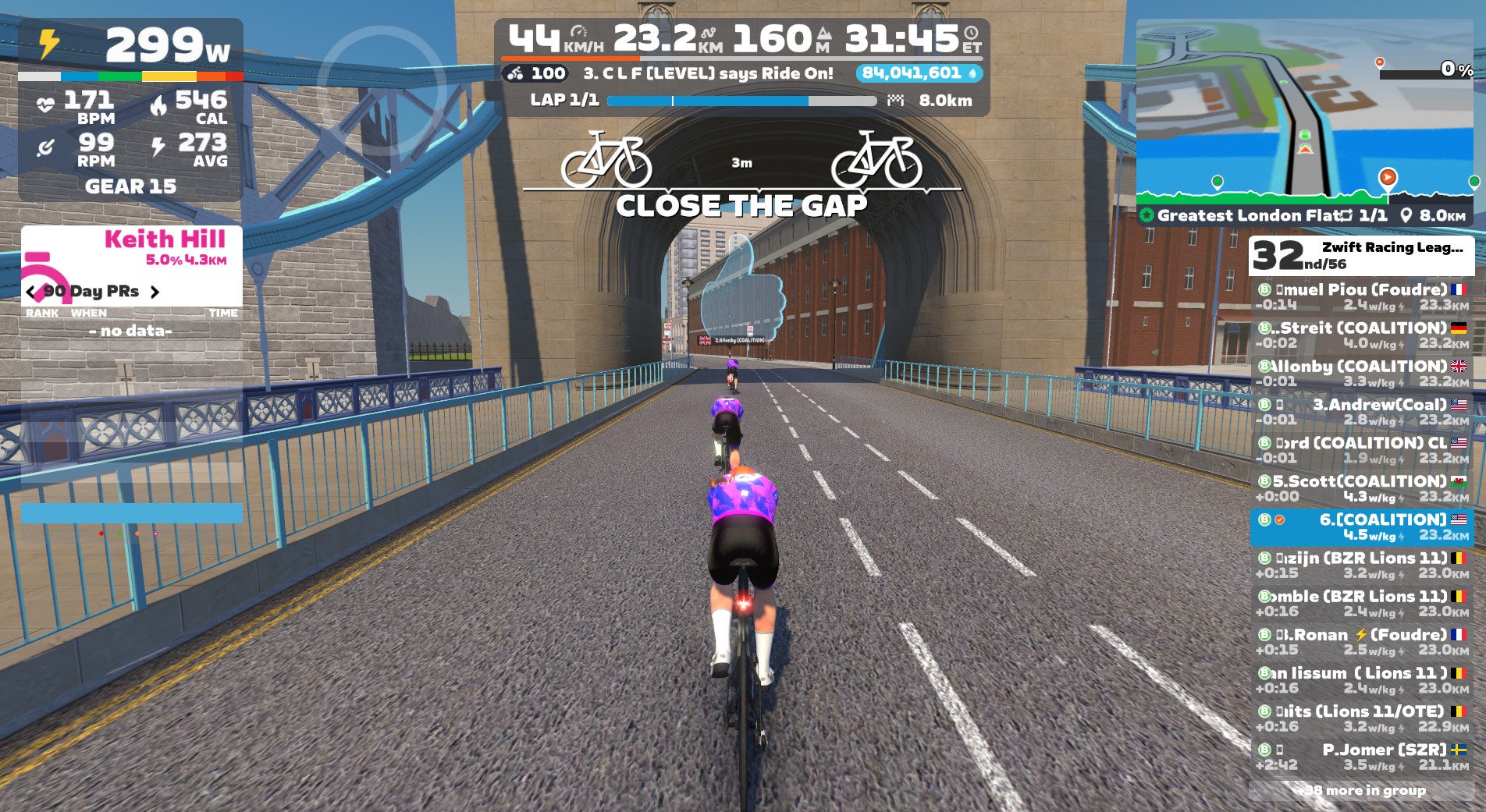
Through the subway, then out into the countryside. This is where the work begins on this course! You’ve got a small climb up to the base of Box Hill, then a series of shallow, draftable climbs through the park area. We ramped up our power on the climbs, but also reminded each other to hold formation since the climb were quite draftable. Sauce said I was saving 40W drafting on the climb, and by the end of this tough section we were less than 30 seconds from catching the next team up the road.
Chris was on Discord, dishing out the positivity: “You’re flying, guys. Keep doing what you’re doing, this is awesome.”
Down the other side, into the Underground, then the next challenge reared up: the escalator ramp! Chris reminded us of the best approach to this tricky section: ramp up before you get to the bottom so you carry momentum up the climb, then keep pushing over the top.
I was first over the top, which gave me a welcome chance to ease up and let the team pass, with Fabian starting another long pull and me catching the tail end so I could sit in for a bit.
One Rider Down
We still had all six riders at this point, but I could tell Dylan, the rider ahead of me, was struggling. I was on his wheel, and he let a big gap open to the four riders ahead. Uh oh! He didn’t call for help, and was able to push hard and close the gap. A noble and strong move, but I think it pushed him past the redline. Seconds after closing the gap he sat up. Parachute pulled. Well done, sir.
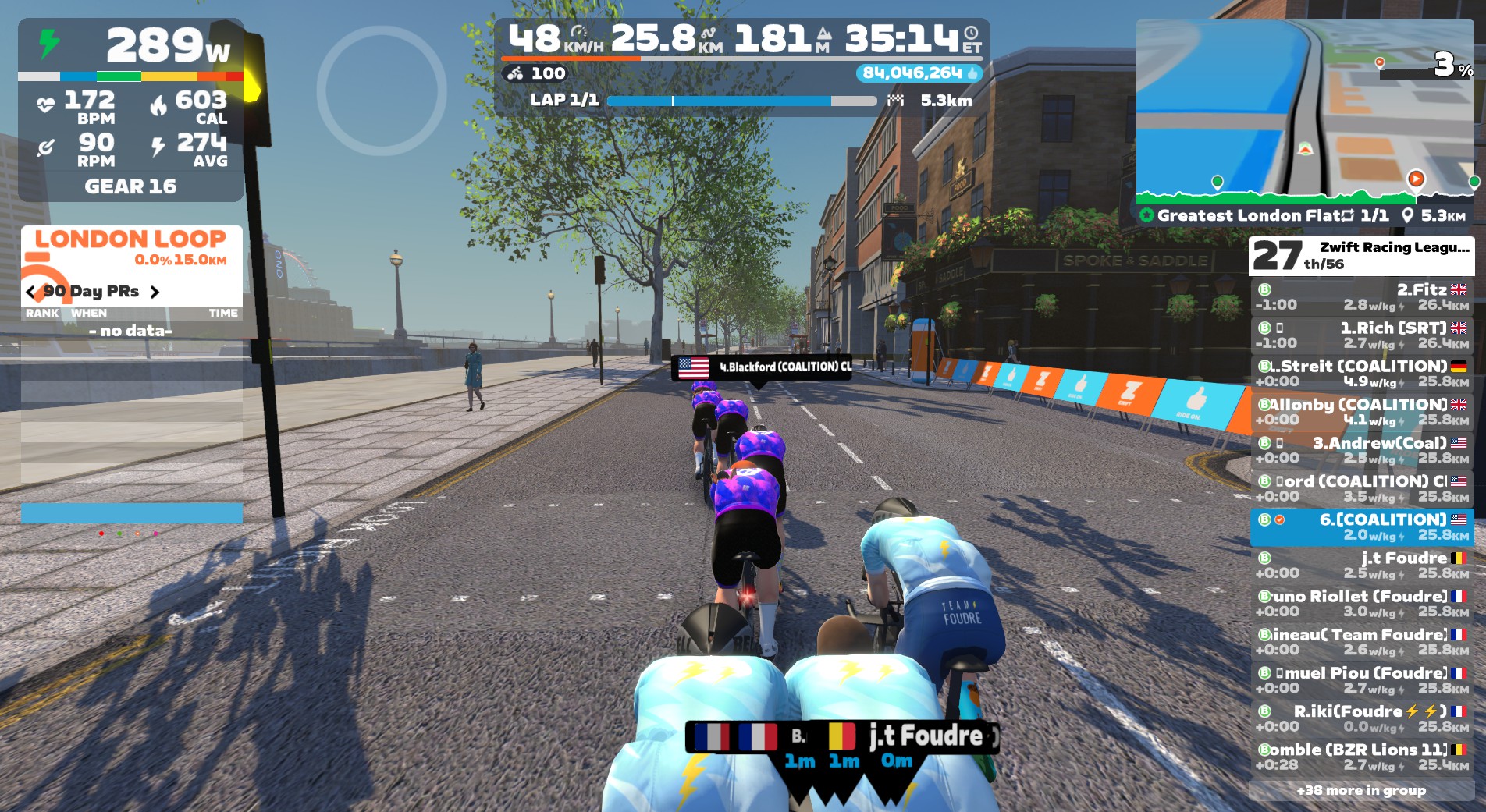
We caught the next team (Foudre) at the 24.8km mark, then kept pushing. Fabian and I had been taking longer pulls, and we were both feeling it. We called out our pull lengths, shortening them so we could hold on to the finish.
The Foudre team sort of sat in our draft for a bit, making things a bit messy and not dropping off until around 26.1km:
(This happens often in TTT races, and I think it’s generally not intentional. It’s hard for the passing team to increase their power even more in order to gap the passed team quickly, and the team getting passed doesn’t want to ease up to let the gap form. So instead, the passed team gets sucked into the draft of the passing team until the elastic snaps!)
Andrew’s Disappearing Act
At the 26.4 mark, our team of five suddenly became four when Andrew disappeared. He was the middle rider in our formation when it happened, too, which really confused things. Fabian was dropping back after taking his pull, Neil had just started his, then Andrew disappeared, leaving Neil 20 meters off the front and the rest of us wondering how that gap opened up!
Andrew appeared again as Fabian started pushing to close the gap. I was feeling the effort, but I knew Fabian was too, having just taken a pull, so I upped the power and came around him to try to pull Fabian and Robert up to Andrew and Neil. Andrew disappeared again, and we climbed up Northumberland, catching Neil halfway up.
That’s when DS Chris noticed Andrew had disappeared. (It’s only in watching my video that I’m seeing what happened earlier.)
Up Northumberland, we were clearly all on the rivet. “Is anyone able to go?” Chris asked, looking for someone to take a pull. *crickets*
Eventually, team captain Neil got on the front (chapeau!) then suddenly, Andrew appeared again, 3 seconds up the road. What a stud! (Anyone who’s ever had an Internet dropout on Zwift knows how hard it is to stay with the other riders when they disappear from the screen and you lose their draft and position. He must have pushed hard to keep his speed higher than ours.)
With 3km to go, the five of us turned right onto the Classique course for our finish. Chris put together an ad-hoc order and we kept rotating through, complete with Andrew disappearing again mid-pull. But we kept our speed up, then went all-in with 400 meters to go. Empty the tank!
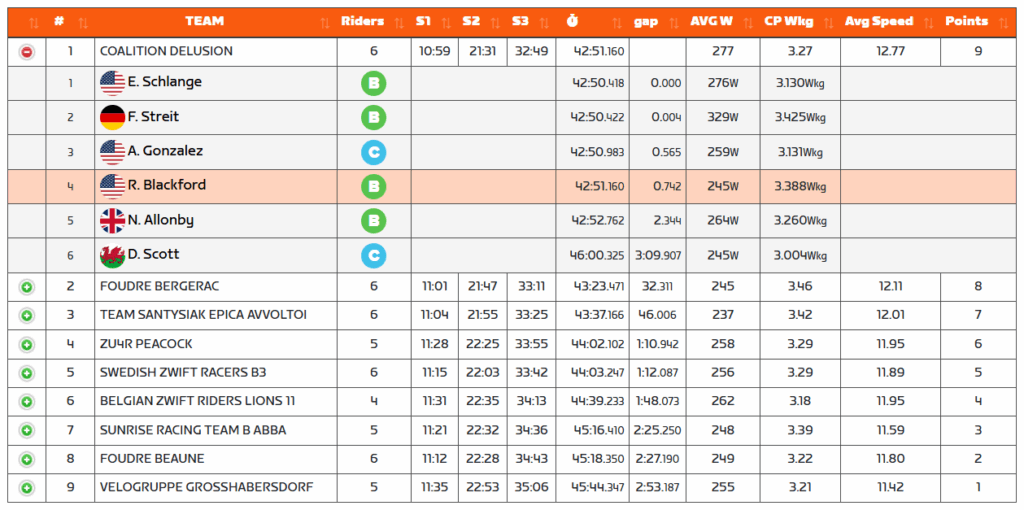
I averaged 493W for the final 30 seconds, pushing hard on tired legs. Our final time, taken off our fourth rider, would be 42:51.16.
We knew we had beaten the teams we could see on screen. And the results screen that popped up showed us in 1st place, but I wasn’t sure if that results screen works the way it should for a TTT. (In hindsight, I think it does.)
After cooling down, I headed over to the WTRL website to see if our results were up yet. And they were… and we’d won!
Overall, I was happy with my performance on the day, as I was able to take 60-second pulls, help close gaps, and generally be an asset and not a liability for the team. That’s the beauty of racing in the B Development division… I’m not constantly struggling just to hold on!
Traditional team Discord snapshot
The team did well as a whole, too, of course. While we could certainly tighten up our formation and get even faster, a win in the first race bodes well for this round. Next week is gonna be a tough one, but that’s part of racing ZRL. See you then!
Your Thoughts
How did your first race of round 2 go? Share below…
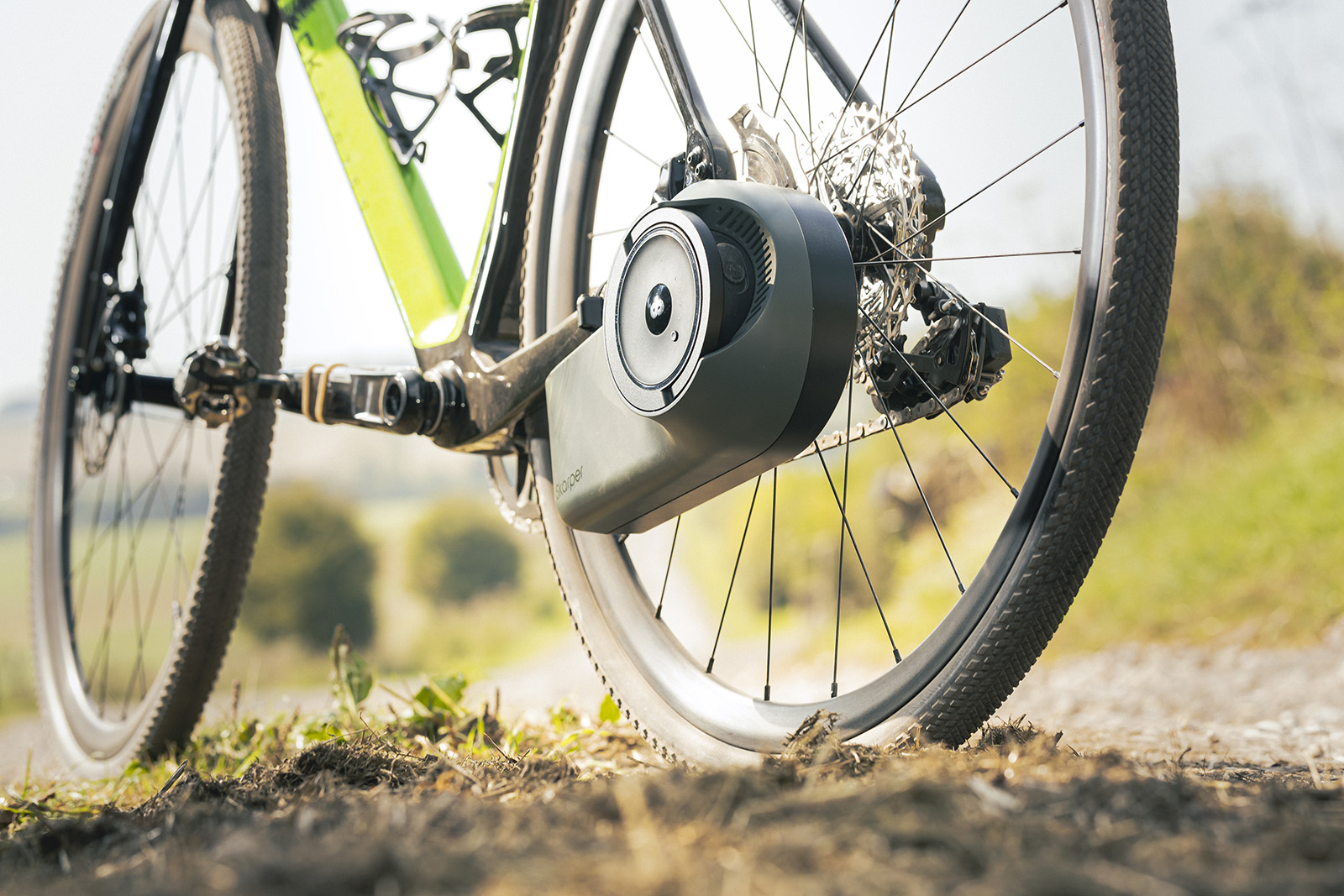
The new Skarper companion app brings full control to what I believe is the smartest ebike conversion kit you can buy.
Skarper’s revolutionary DiskDrive Ebike Drive System impressed me massively when I tested it last year.
It combines great power delivery, low weight and being an ebike converter that, uniquely, can be fitted in seconds and removed just as quickly.
I’ve been impressed by ebike converters from the likes of Boost, Swytch and Cytronex. However, the downside is that once you’ve fitted any of those conversion kits, your bike can’t be restored to its former non-assisted state.
The Skarper unit simply clicks into place and can be removed in seconds. Russell Burton / Our Media
The beauty of Skarper’s groundbreaking solution, which clicks on and off, is that your bike remains a bike. It only becomes an electric bike when you want it to be.
The Skarper system can be shared across multiple bikes, making it a great-value option.
The only niggle I had with the system was the lack of information; with no on-bar display or controller, you have to look at the lights on the unit to check on battery level and current mode. That’s not easy when riding, and not being able to change modes while pedalling seemed like an oversight.
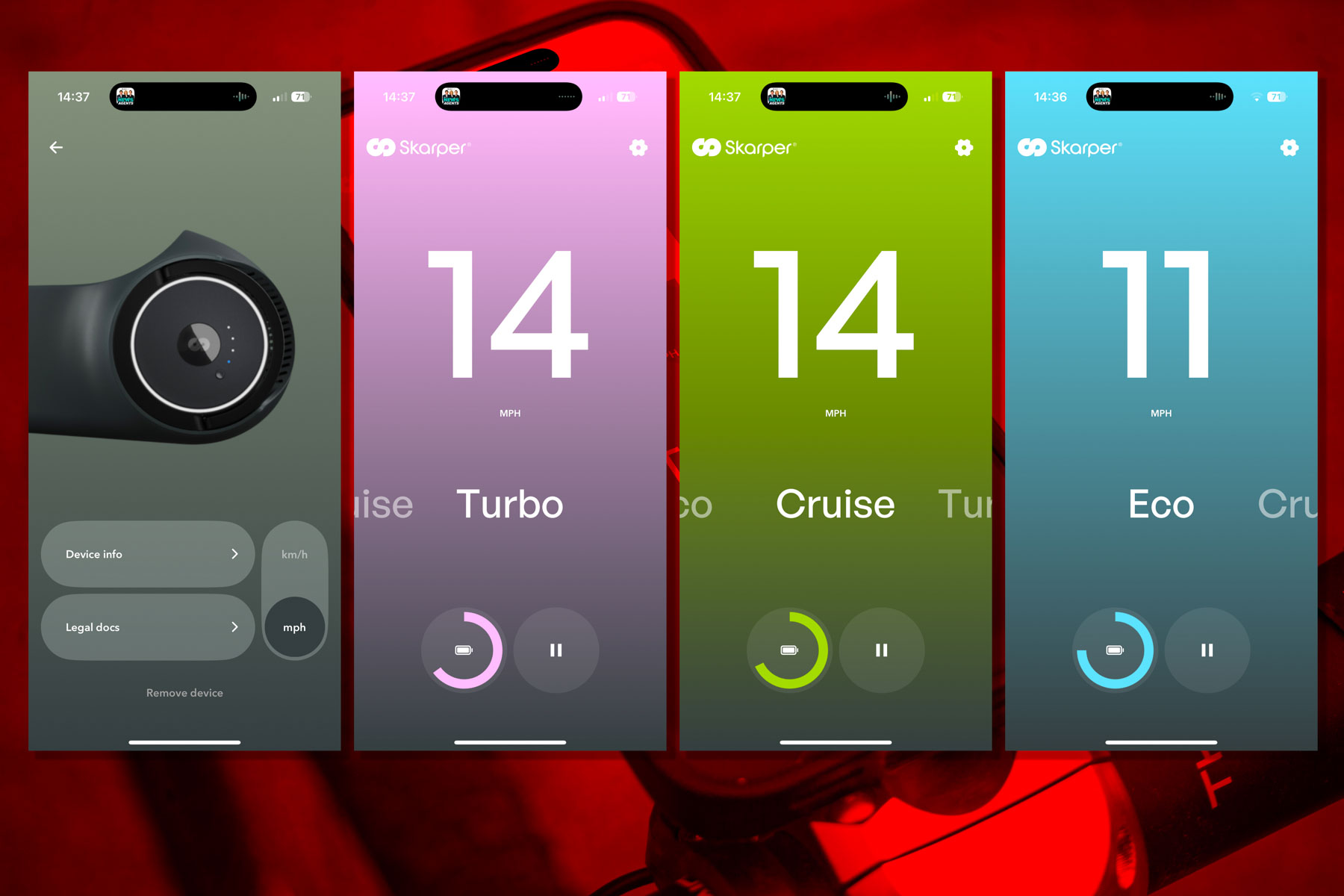
The new Skarper companion app enables you to check firmware, and changes colour as you swipe through the modes. Warren Rossiter / OurMedia
I called out for an app to make the system complete and Skarper has answered my prayers. I’ve had the Beta version of the new Skarper app on test for a couple of months now, and it’s just what I wanted.
The app converts your smartphone into a speed display; it also shows the battery level, and you can switch between Eco, Cruise and Turbo modes by swiping the display left or right.
It will also show warnings if something is amiss with the system, and you can check the firmware is up to date within the system settings. There’s an odometer for the unit, too.
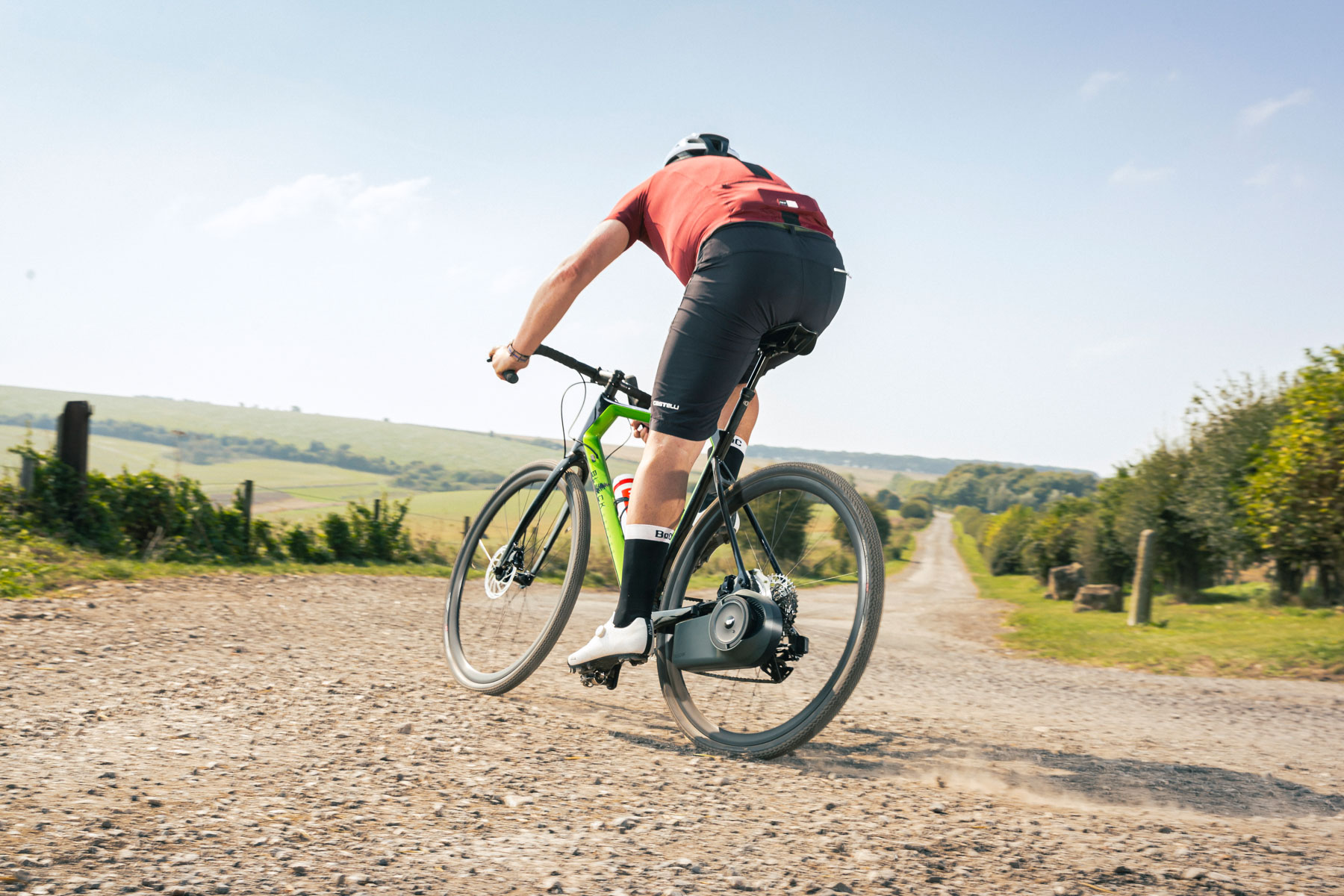
The Skarper kit delivers smooth power thanks to clever programming. Russell Burton / Our Media
The Beta version has these simple functions, but Skarper tells me it will continue development and is looking into expanding the features of the free companion app soon.
The official roll-out of the Skarper companion app is set for early December.



 DBR x Canyon x Cykelnerven Ultra Charity Ride
 Good Cause
  VirtuSlo 4Endurance League 2025
 . We’re heading somewhere in Mighty Metropolitan, but don’t get too comfortable—the course is getting a twist! Expect a surprise route change to keep everyone guessing right up until the start. Think city vibes, rolling efforts, and maybe a little chaos to close out the series in style. It’s fast, unpredictable, and the perfect wildcard finish!