Factor Bikes has terminated its contract with Israel–Premier Tech and Scott Bikes is stepping in to provide the troubled team with bikes, reports suggest.
Scott has reportedly arrived at the team’s service course in Girona, although it’s unclear whether the bike brand will be a lead sponsor, according to Daniel Benson’s Cycling Substack.
The departure of Factor Bikes follows Premier Tech revealing it would leave the team earlier this month. Premier Tech announced this week that it will sponsor St Michel – Preference Home – Auber93 for the next two seasons.
Israel–Premier Tech is currently undergoing a rebrand, after Factor Bikes and Premier Tech said they would only stay on as sponsors if the team ended its affiliation with Israel.
But it now appears Factor Bikes is joining Premier Tech in leaving the team despite its rebranding.
This follows a season marred by protests against the team’s participation in races in light of Israel’s war on Gaza. Protestors at Vuelta a Espana labelled the team’s participation as “sportswashing”.
The timing is also notable for Scott Bikes, after Q36.5 Pro Cycling announced a partnership with Pinarello, which will now provide Tom Pidcock with bikes for riding on and off the road. This left Scott Bikes without a team in the WorldTour.
Today, Zwift launched a new series of experimental Wednesday races dubbed “Crit Cade.” Similar events were held back in November 2023, but two years later, with many more Zwifters owning steering devices, the events may just have the numbers to make them interesting. Read on to learn all about Crit Cade…
These events are just like any other Crit City race you may have enjoyed in the past… except they’re totally different, for three reasons!
Steering Required: These events are designed to maximize the fun and engagement of Zwift Steering, so you must have a steering device connected to join the start pens.
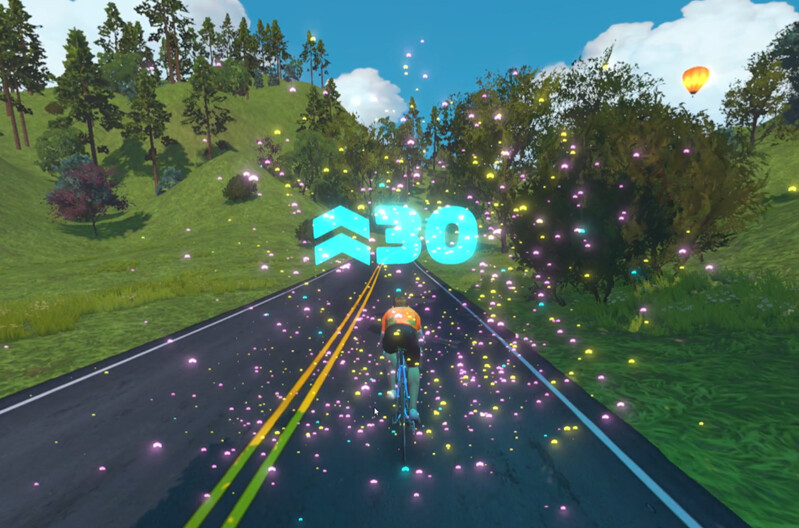
Power Up Pandemonium: This race features the experimental Boost Powerups, which are given at the lap banner and must be used during the lap before picking more up at the next banner.
Speed Boosts and Hazard Pads: Blue Speed Boosts are scattered across the course to give you an extra injection of pace. But red Hazard Pads are also on course, and they slow you down! Watch out, because both types can move around and even swap.
You’ll need to stay fully engaged throughout the race if you want to come home with a win. It’s not just about putting out the power, it’s also about steering effectively, timing your powerups, and drafting whenever possible.
Watch the First Race
I signed up for the first race of the series, just to see how it unfolded from the comfort of my own desk. Watch the A category here:
Route and Schedule
Races are planned for each Wednesday, November 19 through December 31, at five time slots (0830, 1730, 1830, 1930, 2330, 0230 UTC) to cover peak time in all major time zones. See upcoming events at zwift.com/events/tag/critcade.
These events are held within the Zwift Labs club (sign up here). This feature is still in development, so you can share feedback within the club’s chat in the Companion app, or via the comments below (Zwift says they’re watching this post).
Share Your Thoughts
Have you tried a Crit Card Steering Race yet? Share your thoughts below!
Nearly 200 signatories have signed LEVA-EU’s open letter demanding the German Bicycle Industry Association, ZIV, drops its proposed changes to electric bike regulations.
The recent debate over ebike regulations has been fuelled by the European Union giving the industry until 2027 to redefine electric bike standards, which could have big implications for the future of the industry.
In the open letter written by LEVA-EU, a European trade association for electric vehicles, the signatories object to how ZIV’s proposed changes could punish elderly and disabled people, undermine the EU’s climate commitments and penalise certain types of electrically assisted pedal cycles (EAPCs).
The signatories include individuals from companies such as DJI, Avinox, Skarper and VanMoof.
They say ZIV’s proposals would impose “arbitrary restrictions” on EAPCs. These include limits on assistance ratios, peak power and vehicle weight.
Addressed to ZIV, the Confederation of the European Bicycle Industry (CONEBI), which supports the proposals, and the European Commission, the letter also asks these bodies to “not let Europe become the desert of light electric mobility innovations”.
It says ZIV’s proposal would “obstruct European innovation and competitiveness, protecting incumbents while sidelining new entrants and technologies”.
A critical aspect of the ZIV position paper is the proposal to ensure ebikes have the same legal status as non-assisted cycles.
The open letter objects to this legal equivalence, because it would mean certain EAPCs would be subject to type-approval, where a product must meet a minimum set of regulatory, technical and safety requirements.
This could limit heavier and more powerful EAPCs, which would be beneficial for logistics or even families commuting on e-cargo bikes, from getting to the market.
The letter outlines how this also points to a “deeper structural problem” around the regulation of EAPCs in Europe.
LEVA-EU says an EAPC with a motor that provides 250W of continuous power – the legal limit in the EU for an ebike – is regulated under the Machinery Directive. It is therefore excluded from type approval and can be placed on the market after a brand’s own certification process. But an EAPC with a motor power of 300W “must undergo costly and unsuitable type-approval under Regulation 168/2013”.
The issue here is that some argue motor power does not affect the risk an EAPC poses. If an EAPC has an identical weight and top speed, they say, it poses the same risk in an impact, regardless of motor power.
“This regulatory split is neither proportionate nor neutral, and it undermines competitiveness and innovation across the LEV [light electric vehicle] sector,” the open letter says.
The letter adds that instead of a ‘regulatory split’, there should be a dedicated light electric vehicle regulation. It says it would mean these vehicles could be regulated according to their “real safety and use characteristics, not outdated or arbitrary distinctions” and would “enable a fair, innovation-friendly, and future-proof market for light electric mobility in Europe”.
ZIV has yet to respond to our request for comment.
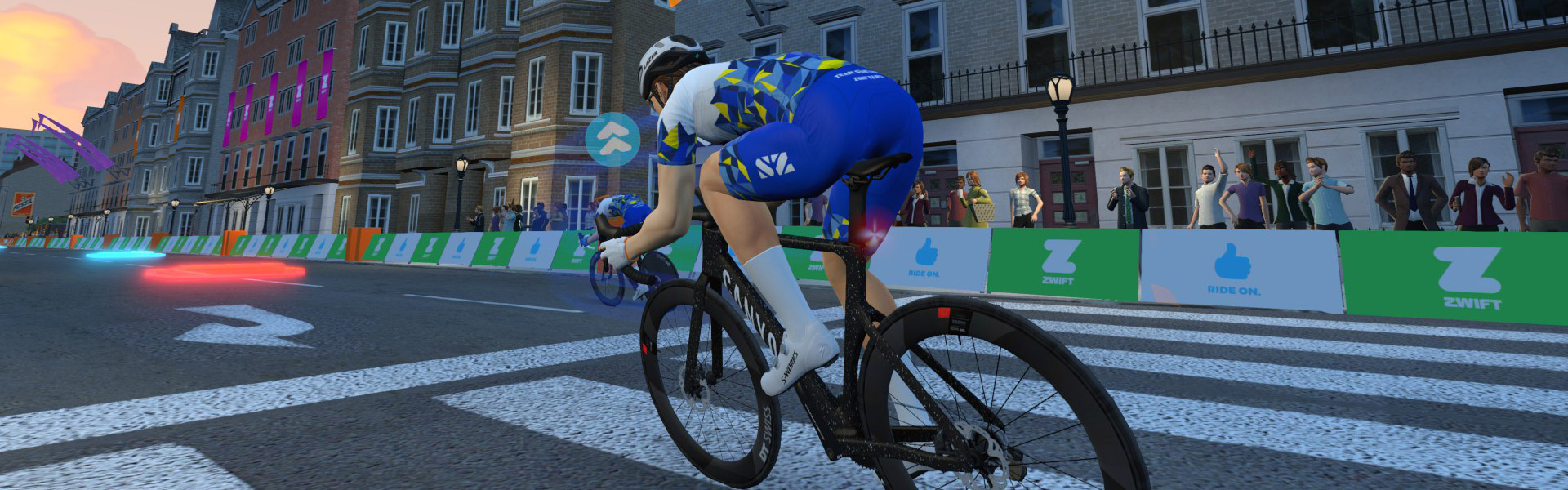
The fourth race of Zwift Racing League 2025/26 Round 2 happens Tuesday, November 25, and it’s a team time trial on the new Watts the Limit route in NYC. This is an interesting TTT route, with plenty of pitch changes to keep us on our toes and unique characteristics that make it a much faster course than you might think.
Let’s dig into crucial segments, escalators, bike choice tips, and more!
Looking at the Route
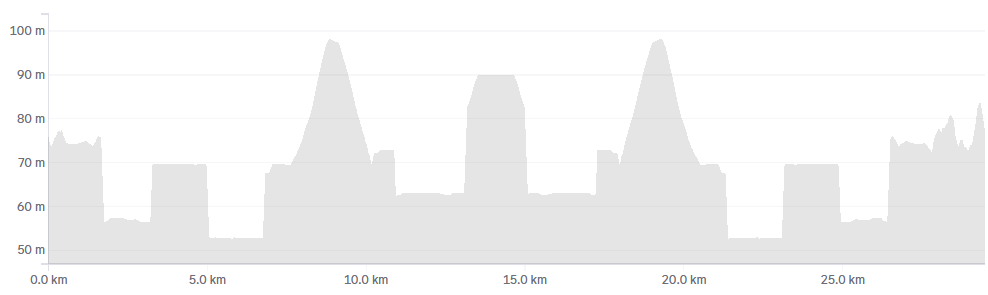
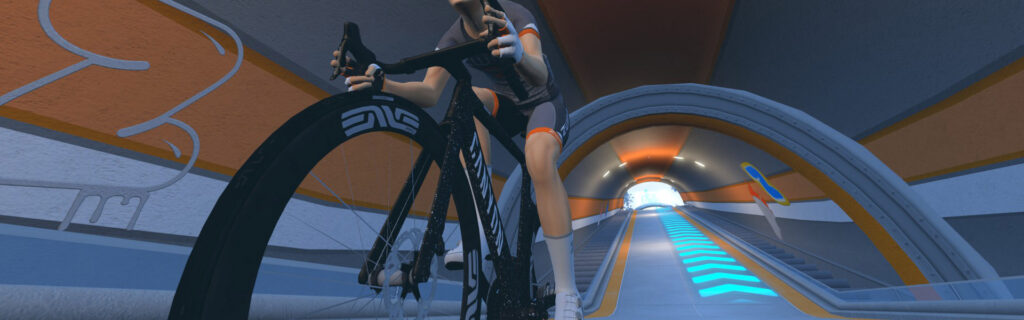
Watts the Limit is a fresh route from the recent New York map expansion. And while the Strava segment profile (above) may look lumpy – like a city skyline, in fact – it’s actually a fairly flat and fast route, thanks to escalators helping us out of the subway tunnels!
All categories will race a full lap of this out-and-back route, for a total of 31km with 219m of elevation. (Although it’s not really 219m, since ~95 of those meters are on escalators.)
Most of this course is close to pan-flat, with major elevation changes taking place quickly in between as you enter or exit subways. Here are the key points you’ll keep in mind as your team attacks this course:
Lead-In Kicker @1km (300 meters at 3.7%): this little bump near the end of the lead-in is short enough that it’s best to just hammer hard if you’re on the front, and stay in the draft if you’re behind. Keep the watts high so your speed stays up, then grab recovery on the flats and descents that follow.
Escalator @4.7km: the first of six escalators you’ll encounter today, these are going to play havoc with teams who have riders with widely varying weights. See “More On Escalators” below for details.
Escalator @8.2km
Manhattan Bridge @9.1km (1.2km at 1.6%): the bridge isn’t as steep from this side, so speeds will stay high and drafting will remain very important. Increase your power, but stay in formation. Recovery awaits on the back half of the bridge.
Escalator @14.5km
Hill to Grand Army Plaza @14.6km (400 meters at 2%): this little climb comes directly after the escalator, so keep the power up in order to maintain speed all the way up to the flat Grand Army Plaza turnaround at the top.
Escalator @18.7km
Manhattan Bridge @19.5km (1.1km at 2.4%): a bit steeper on this side, but still not a proper “climb,” so you’ll definitely want to lift the power while staying in formation up and over.
Escalator @24.5km
Escalator @27.8km
Final Kicker @30.5km (300 meters at 3.7%): almost there! Hammer this kicker just like you did at the start of the race, then go all-in across the top to empty the tank and finish fast.
Warning: the new escalators in NYC may prove tricky if there’s a big difference between the highest and lowest rider weights on your team!
Community feedback is saying, and our tests are confirming, that heavier riders slow much more on the escalators than lighter riders. (Heavier riders, take heart: Zwift knows about this issue, and internal sources tell me a change is planned soon to make escalators perform much more uniformly across various riders. Light riders: enjoy the escalators while you still can! )
I ran bots of various weights up one of the longer escalators on the route (the final escalator you’ll hit, in fact). Each bot’s power was set so they would all have approximately the same escalator entry speed (~46 kph), and that power remained steady as they went up and over the top of the escalator. Here’s how much each bot slowed down between entering and exiting the escalator:
50kg bot @261W: slowed 3.2 kph
75kg bot @339W: slowed 11 kph
100kg bot @390W: slowed 16.1 kph
Of course, most teams won’t have a 50kg (or even 25kg) weight difference between riders. But the heavier you are, the more you should plan to push on escalators to keep your speed high. And lighter riders will probably want to keep their power fairly steady, to avoid shooting off the front!
Two more escalator tips:
Lower Your TD: These are steep, with gradients around 20%. If you have trainer difficulty set to 100%, it will feel like pedaling into a wall. I recommend setting TD to 50% or less for this course.
Follow the Wheels Down: The downhill ramps will also wreak some havoc due to varying rider weights and power outputs. Pay close attention and try to maintain your single-file position before, during, and after descending the ramps to maximize your draft benefit and keep speeds high. If you’re a lighter rider on the front during one of these descents, hammer out some of the watts you’ve saved on the escalators, as the heavier riders will fly past otherwise!
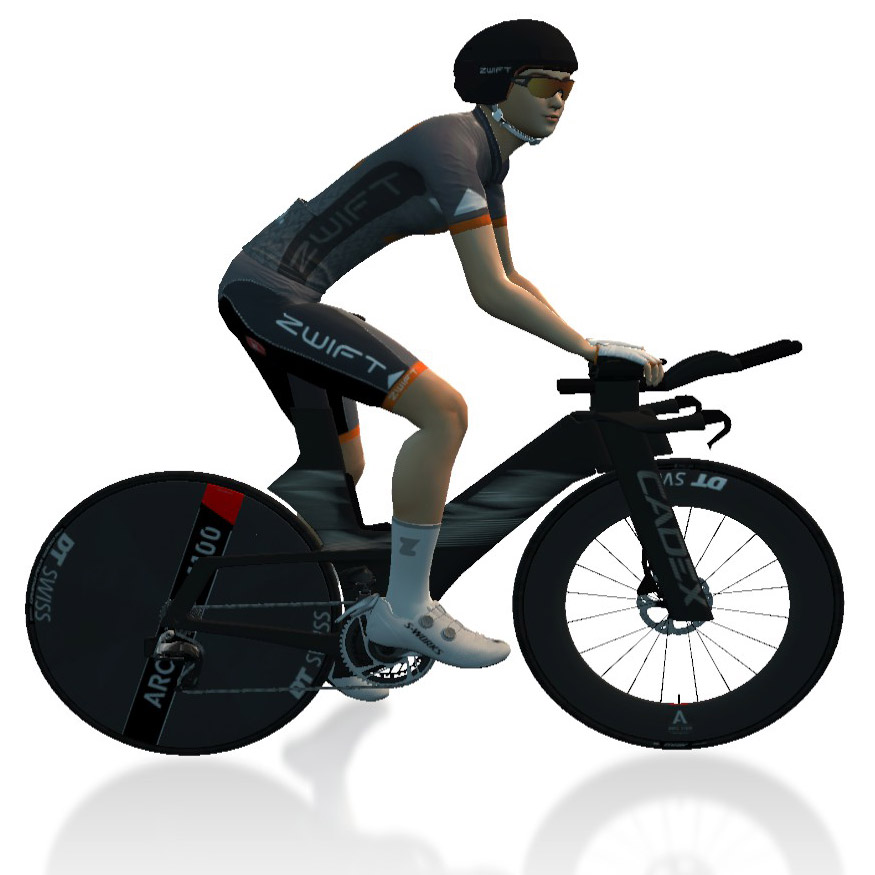
Bike choice here is simple: go aero. On a flattish route like this, weight doesn’t matter much, and aero is everything! The best setup by far is the CADEX Tri frame paired with the DT Swiss Disc wheels, but you’ll need to be at level 40+ to access this sweet rig:
Many recon rides are planned each week on the upcoming ZRL route. If you’re unfamiliar with this course, jump into an event and familiarize yourself with the route! Find a list of upcoming ZRL recon rides at zwift.com/events/tag/zrlrecon.
Additionally, riders in the Zwift community do a great job every week creating recon videos that preview the courses and offer tips to help you perform your best on the day. Here are the recons I’ve found (comment if you find another!):
Flatter courses like this week give valuable seconds to teams with big pure-power riders who can keep their power high on the front while staying in single-file formation to conserve in the draft behind. Extra seconds can also be gained by pacing smartly, ramping up the effort on short climbs and recovering a bit once you’re up to speed on the short descents.
On a course like this week’s, I highly recommend all team members set their Trainer Difficulty to the same value so you’re all feeling the gradient changes similarly. (When one rider has it set to 100% and another 25%, the first rider may ramp up power much more than the second when a climb hits, which can make a mess of your team formation.)
Your goal in a ZRL TTT is to get four riders across the line in the shortest time possible. That means every team’s pace plan will differ based on each rider’s abilities. I highly recommend having an experienced DS on Discord directing your team, especially if your team contains some inexperienced TTT riders.
Lastly, if you want to go further down the TTT rabbit hole, I highly recommend Dave Edmond’s Zwift TTT Calculator tool.
Premier Tech will sponsor the St Michel – Preference Home – Auber93 men’s and women’s cycling teams for the next two seasons.
The Canadian multi-national company revealed its new sponsorship deal yesterday, only 10 days after it announced the end of its partnership with Israel–Premier Tech.
As part of the sponsorship deal, Premier Tech says it will “notably support” the women’s ProTeam programme.
Three Canadian cyclists will join the women’s team for the 2026 season: Alison Jackson and Clara Émond will move from EF Education-Oatly, while Simone Boilard makes the switch from Uno-X Mobility.
“Partnering with Premier Tech marks a milestone for our team. We share a common vision: an inclusive, integrated cycling ecosystem driven by talent diversity. We are pleased to welcome Premier Tech and pursue this shared ambition,” says Charlie Nerzic, deputy general manager of the team.
Jean Bélanger, president and chief executive of Premier Tech, says: “This opportunity fully aligns with the reason why Premier Tech has been committed to cycling for over 30 years – building bridges across all levels of the sport and supporting the development of Québec and Canadian cyclists.”
Premier Tech sponsored Israel–Premier Tech from 2022, but it said in September that the team must change its name and state affiliation in order for its support to continue. Although Israel–Premier Tech said it would change its name, Premier Tech stepped down from sponsoring the team earlier this month.
“Although we took notice of the team’s decision to change its name for the 2026 season, the core reason for Premier Tech to sponsor the team has been overshadowed to a point where it has become untenable for us to continue as a sponsor,” Premier Tech said at the time.
Israel–Premier Tech was the target of protests throughout the 2025 cycling season, with demonstrators at the Vuelta a España labelling the team’s participation as “sportswashing”.
Several former riders also expressed relief this year at no longer riding for Israel Premier–Tech, in light of Israel’s war on Gaza. Derek Gee terminated his contract, citing “serious concerns related to racing for the team”.
The founder of Factor Bikes, Rob Gitelis, said Factor would end its sponsorship of Israel–Premier Tech if the team did not change its name.
Israel–Premier Tech applied for a WorldTour licence for the 2026 season with a placeholder name, and its new identity is expected to be announced shortly.
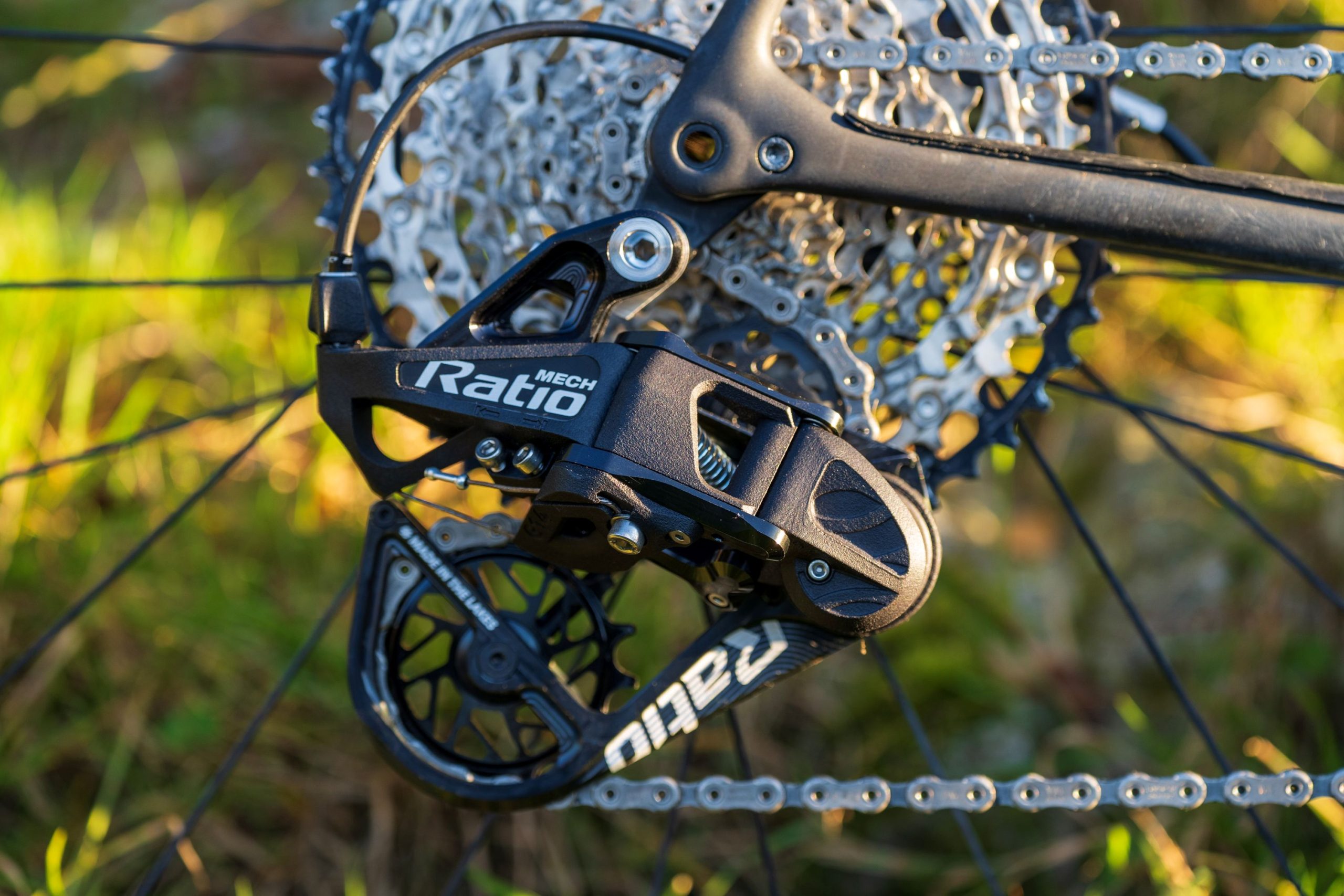
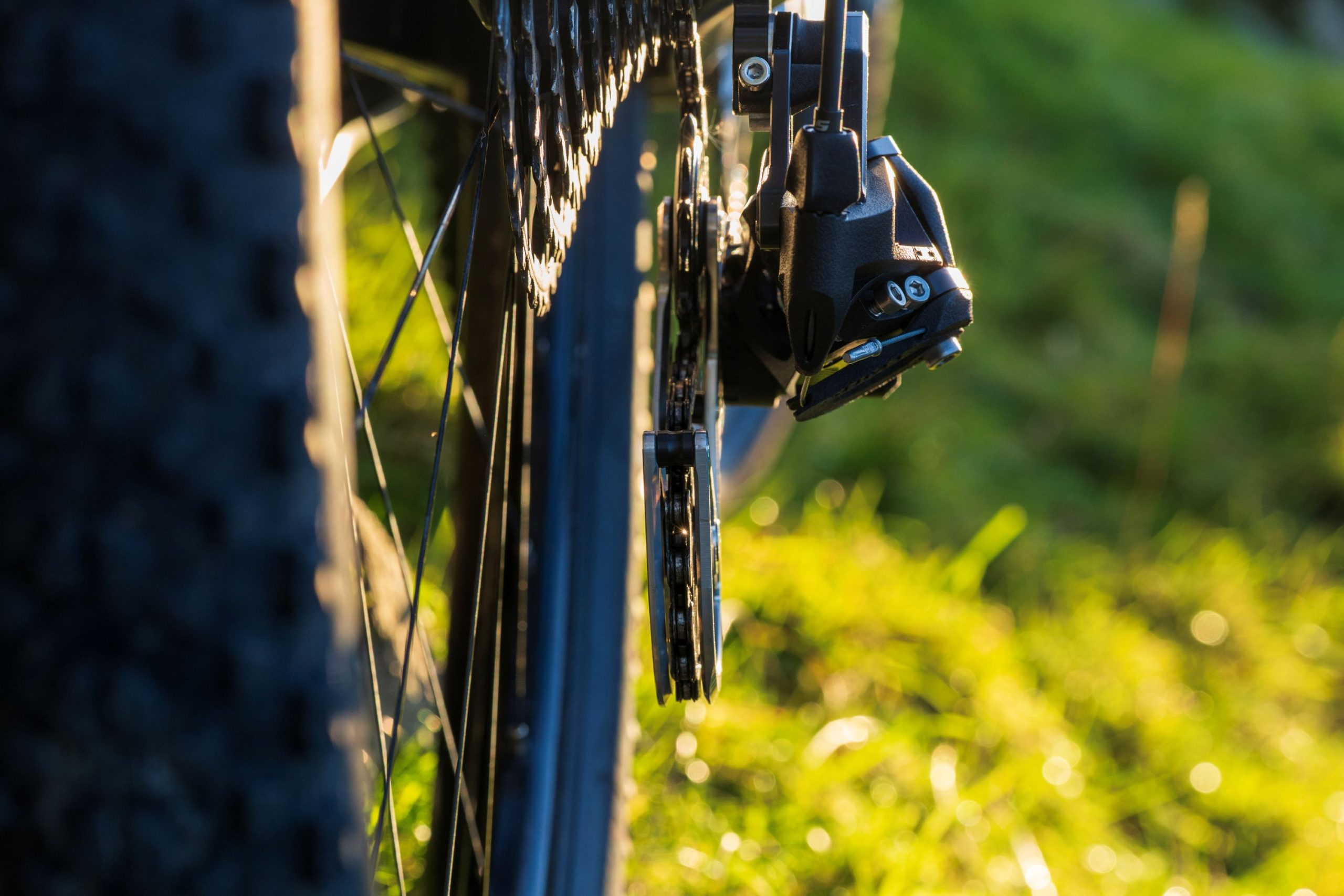
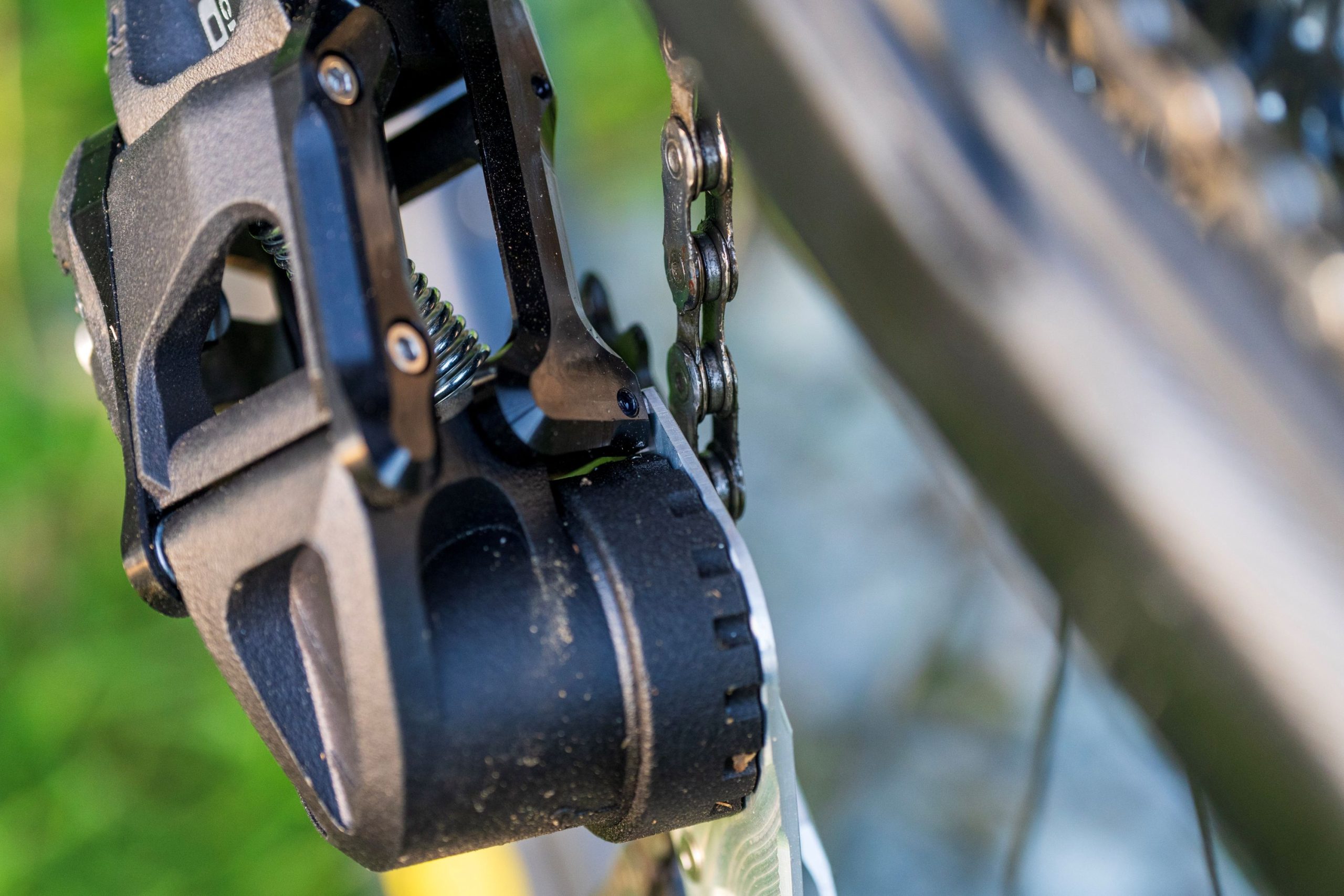
Ratio Technology has launched the mechanical Mech 1x rear derailleur, priced at £295, offering direct-mount and hanger-mounted options. It can work with a range of 12- and 13-speed cassettes with different gear spreads from both Shimano and SRAM.
The brand says it’s the first derailleur manufactured in the UK for 60 years, with metal components made at its factory in the Lake District and nylon parts made using 3D-printing in Kent. The Mech can be fully rebuilt using only a multi-tool.
Ratio director Tom Simpson says its performance should rival electronic systems, but with a lower weight. He suggests poor mechanical shifting is caused not by cable drag but by friction in the derailleur, so Ratio has used quality stainless steel bearings to ensure low friction and resist wear.
There are Full Mount and hanger-mounted options available.
Best known for making devices to adapt cable-pull ratios to enable different brands’ drivetrain components to be used together in a mix-and-match system and its replacement derailleur parts, the Mech is Ratio’s first full derailleur. It can be attached to your bike frame similarly to SRAM T-Type derailleurs and is compatible with UDH dropouts or can be hanger-mounted. It can also be converted between the two.
Ratio built a series of test prototypes that it rode during the winter of 2024-25 to prove and refine the design, subsequently adding a clutch and the interchangeable cable-pull adjuster fins that enable the Mech to be set up to work with different levers.
The three adjustment screws provide compatibility with different cassette-ratio spreads.
While SRAM’s derailleurs lack a B-screw or limit screws, they’re present in the Ratio derailleur. Ratio says this was a starting point for its design, as it 3D modelled a range of different cassette options to choose a derailleur geometry that maintained a consistent B-gap when shifting across the cassette.
So, while SRAM T-Type and gravel Full Mount derailleur users are restricted to a single cassette, Ratio’s system can be used with a range of cassette gear spreads. Along with the adjustable cable pull, this opens up compatibility not only with SRAM, but also Shimano mechanical shifting and across both 12- and 13-speed road and MTB platforms.
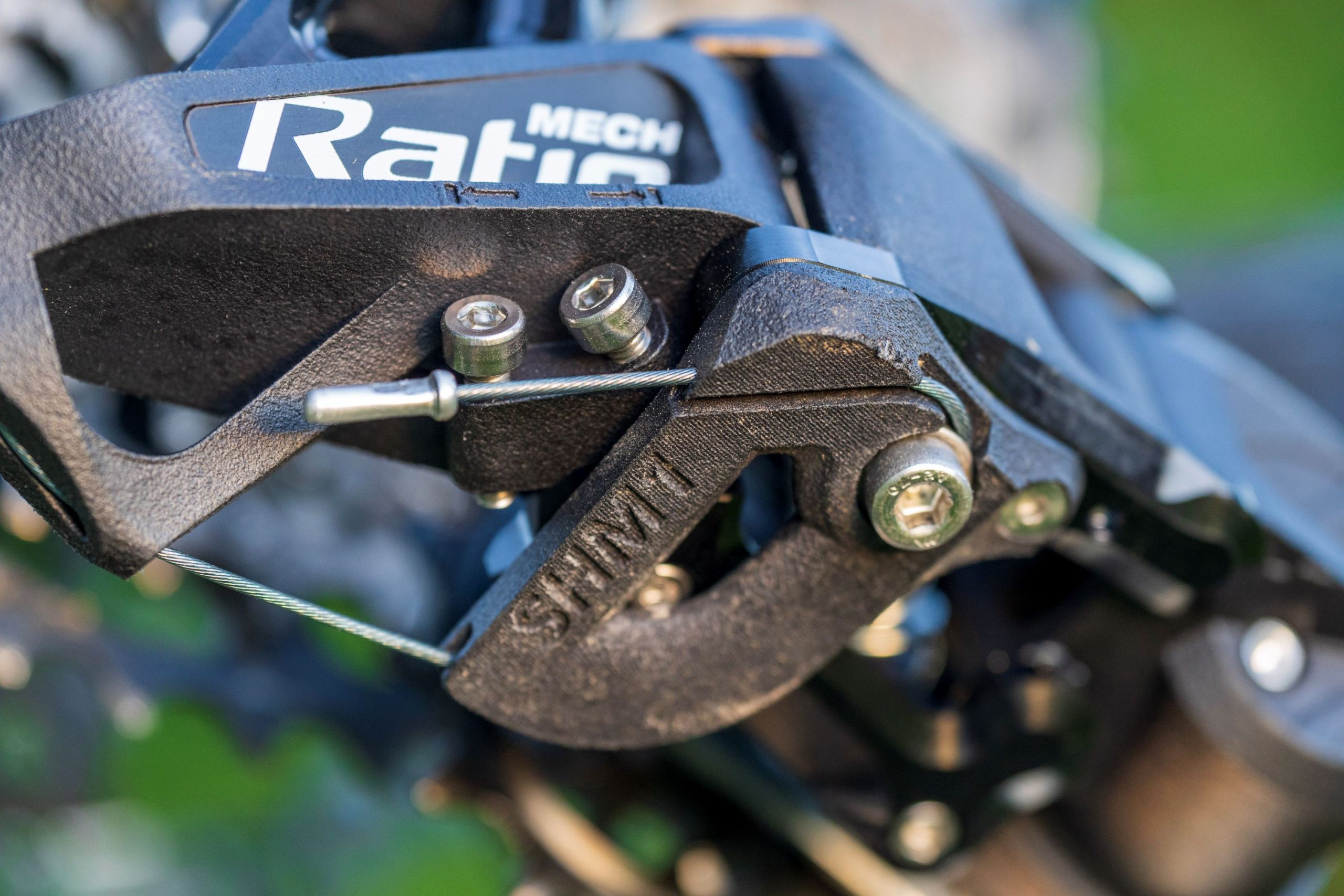
Interchangeable fins enable the Mech to work with levers with different cable-pull ratios.
When we asked whether the direct-mount option might infringe any SRAM patents, Simpson told us: “SRAM’s IP protects the novel and innovative installation process for their Full Mount derailleurs, in which the friction from the clockwise bolt rotation rotates the entire derailleur back to a pre-set cage position to set the derailleur orientation and B gap.
“As we understand it, there is no protection against the concept of mounting a derailleur coaxially with the rear axle; it is not novel, as there are a number of earlier examples, and it is arguably not inventive as the step towards ‘direct mount’ is an obvious one on various elements of the bicycle (the most obvious being the chainring).”
Ratio Mech derailleur options and prices
The Mech derailleur can be rebuilt using only a multi-tool.
The Ratio Mech derailleur is available for direct or hanger mounting, with cage lengths for 46t or 52t maximum cassette sizes and with a choice of seven cable fins. Together, these are claimed to offer compatibility with most 12- and 13-speed 1x drivetrains. Ratio says it will add more 11-, 12- and 13-speed options in future.
It says the Mech is designed for easy setup and can be rebuilt using only a multi-tool. It also offers a Cage Stop feature, which locks the derailleur in position for easier wheel removal. At launch, the Mech will be available in black only, with silver to follow. Sadly, though, you’re going to have to wait for the blue option.
The Ratio Mech derailleur is priced at £295 / $388 / €334 / AU$592.
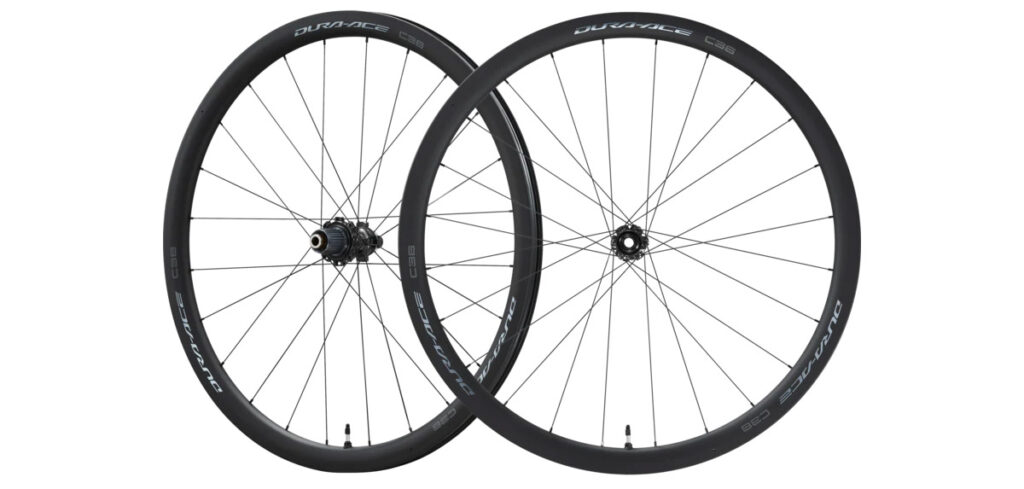
This week’s Zwift release includes a minor configuration fix for the new Shimano DURA-ACE C36 wheelset. The C36 wheels replace the C40 wheels in the Drop Shop, which means if you already own the C40 wheels they will remain in your garage, but once you update to Zwift version 1.101+, you will not be able to purchase the C40 wheels. Which should be fine with everyone, since the C36 is a better wheelset at a better price!
Here’s what the Drop Shop says about them: “With both a lighter, wider all-carbon rim and a lighter hub, the new DURA-ACE C36 won’t shy away from a day of climbing. The new rim is 36 mm deep and still delivers a good aerodynamic efficiency despite its gossamer weight. Meanwhile the hub features an alloy freehub body and new engagement mechanism for increased rigidity.”
The wheels are now available in the Drop Shop, accessible at level 6 and above, for the low price of 150,000 Drops. They are rated 3 stars for aero and 4 for weight, which is impressive given their price and low level requirement. Since Zwift’s 4-star rating system isn’t precise enough for our taste, we ran these wheels through our standard battery of tests to determine exactly how they perform in Zwift and stack up against other wheelsets in game.
Let’s dive in and learn all about the performance of this new wheelset from Shimano…
Aero (Flat/Rolling) Performance
Shimano’s DURA-ACE C36 wheels are on the lower end of aero performance in Zwift, although they are significantly faster than the D40 wheels they replace. While the D40 shows a 9.8-second gain over the baseline in a 1-hour flat ride, the C36 shows a 16-second gain.
As an affordable level 6 unlock, the C36 would be expected to perform in line with other lower-level unlocks. It squares up nicely against other low-level unlock wheels, performing better than all wheelsets at level 9 and below, except the Mavic Cosmic CXR60c which does very poorly on climbs.
Climb Performance
The climbs are where this wheelset really shines. It turns in the 6th-best time of any wheelset in Zwift, which doesn’t sound impressive until you remember it’s a level 6 unlock at only 150,000 Drops!
Shimano’s DURA-ACE C36 wheels put in an Alpe climb just 1.2 seconds behind the Zipp 454 wheels, less than 2.5 seconds behind the fastest wheels in the game across an hour of steep climbing. Very impressive performance for a level 6 wheelset!
Note: all test results above are from a 75kg, 183cm rider holding 300W steady using the Zwift Carbon frame.
Conclusions
While the new DURA-ACE C36 wheels from Shimano aren’t the top performers in Zwift, they are the best all-arounder or climbing-focused wheelset below level 18. In fact, I’d say they are actually the best climbing wheelset below level 24! Definitely a wheelset Zwift racers will want to check out early in their racing progression.
These wheels have been, or will soon be, added to the following posts:
Important note: this post contains speed test results for Zwift frames or wheels. These results may change over time, and a bike’s performance relative to others may also change. We don’t always revise posts when performance rankings change, but we do keep current, master versions of our speed test results which are always available. See the frame charts, wheel charts, and Tron vs Top Performers for current performance data.
Zwift version 1.102 begins its phased rollout today. For most Zwifters, this is a minor update that includes a new NYC route, a wheelset fix, and various bugfixes. But some Zwifters will begin seeing Personalized Recommendations as Zwift begins testing this new feature. Read on for details!
New Big Apple Route(s)
On the heels of the recent New York map expansion, today Zwift releases yet another new route: Times Square Circuit. This route includes an achievement badge for both riders and runners.
Shimano DURA-ACE C36 Fix
Zwift’s release notes include this line: “Updated the performance of the Dura-Ace C36 wheels to better match real-world performance.”
In version 1.101, Zwift removed the Shimano DURA-ACE C40 wheels from the Drop Shop, replacing them with the newer and (supposedly) lighter C36 wheels. There was just one problem: the game showed the new C36 wheels as rated 1 star for weight, meaning they were quite heavy!
Today’s release fixes this problem, and the wheels now show a 4-star weight rating. Watch for a post later today detailing their performance, which looks very strong considering they are unlocked at level 6 and cost only 150,000 Drops. These may just be the climbing/all-around wheels beginners are looking for…
New Level Up Celebrations
A new on-screen celebration happens whenever a Zwifter levels up. You’ll even see it when those around you reach a new level!
Users of the newest Apple devices rejoice: today’s update includes two items that may pertain to you!
macOS: The Ultra graphics profile is now enabled for devices with Apple M5 chips.
iOS: Improved visual quality for devices with Apple A19 and M5 chips.
Apple’s M5 chip powers the new 14-inch MacBook Pro, iPad Pro, and Apple Vision Pro. The A19 chip powers the iPhone 17.
Personalized Recommendations
Zwift promised this feature would begin launching in November, and they stuck to the plan. Today’s update includes Personalized Recommendations, but the feature is only being enabled for a select cohort of Zwifters because Zwift wants to gather feedback and fine-tune the recommendation engine before releasing it to a larger audience.
Due to this limited rollout, Zwift didn’t include Personalized Recommendations in the release notes.
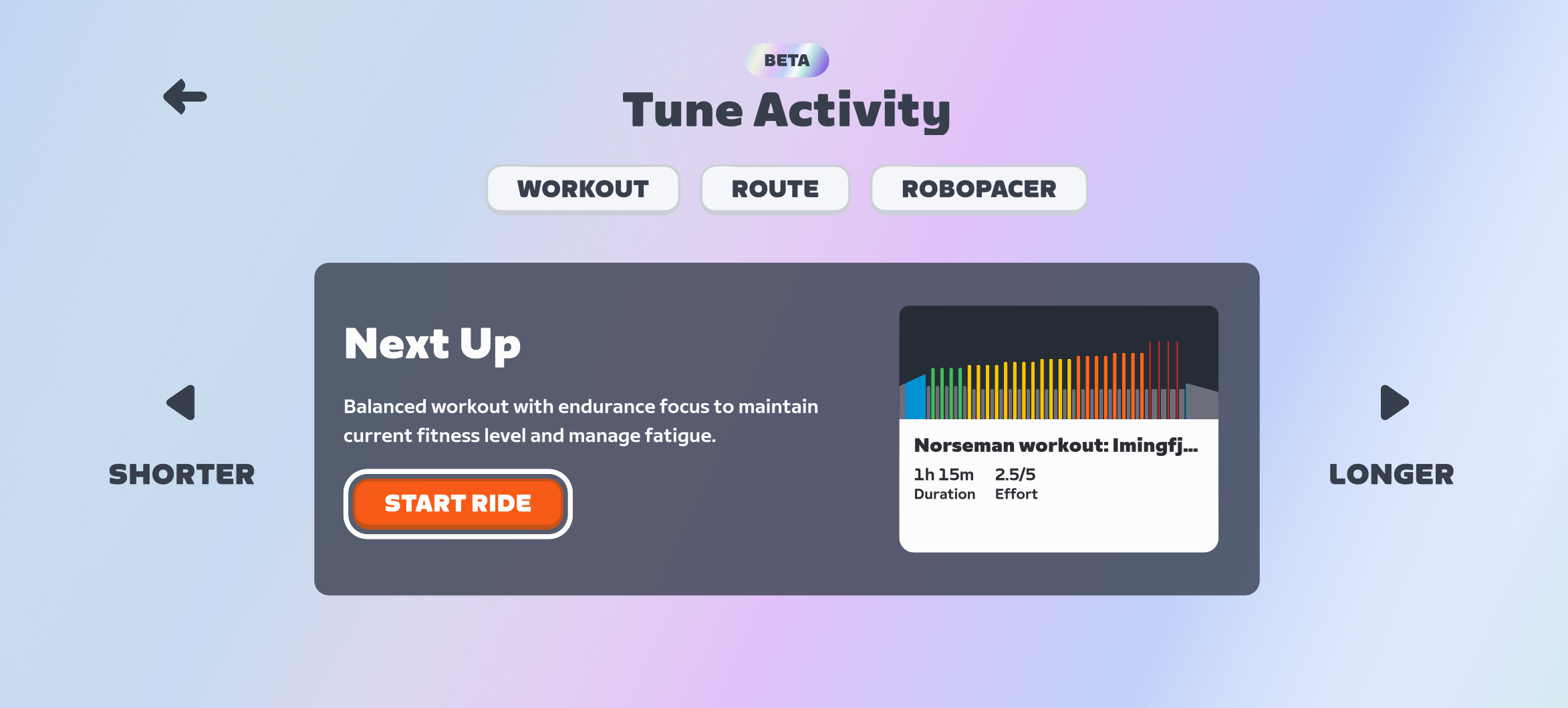
How does it all work? The Personalized Recommendations engine looks at your Zwift activities as well as any outdoor rides if you’ve connected your Garmin, Wahoo, or Karoo account. It then recommends a session for the day based on your habits, fitness, and freshness. These recommendations can be made shorter or longer, and you can choose between a workout, a route, and a RoboPacer. (Zwift tells me event recommendations will come in time.)
While the backend engine is, I’m sure, quite complex, the front-end interface is simple and easy to use. SEe for yourself:
Watch this space for more details as this feature begins rolling out!
More Release Notes
Zwift provided notes on additional tweaks and bug fixes in this update:
Fixed an issue that could potentially show an incorrect starting location for activities published to Strava.
Fixed an issue that could potentially calculate incorrect Stress Points (SP) when sitting idle in Zwift during an activity.
Fixed an issue that could cause heart rate monitors to get stuck in a Connecting state when paired via Kickr Bridge.
Fixed an issue that could potentially cause fitness devices connected via Wi-Fi to disconnect immediately after selection.
Zwift Unlocked Tour: Fixed an issue that could cause the route lead-in distance to not count toward the total distance metric shown in the HUD.
Zwift Unlocked Tour: Fixed an issue that could cause the remaining distance shown below the mini-map to not match the event route distance.
Various visual improvements throughout New York.
macOS: Fixed an issue that could cause fullscreen mode to not take effect.
Android: Improved fitness device connection reliability for devices with Unisoc Bluetooth chipsets (e.g. Samsung Tab A8, Lenovo M10).
Prestige: Season One is a premier-tier cycling esports series on Zwift with full live broadcast coverage, performance verification, and prizes. It all begins this Thursday, November 20, which means I’m getting this post out a bit late! But I believe this series is a big deal, for a few reasons, so I reached out to organizer Dean Cunningham to gather details I could share with the Zwift Insider audience.
Read on to learn all about this groundbreaking series, and the new platform hosting registration and results…
Principals & Partners
The series is organized and promoted by Restart Esports p/b Alex Coh Coaching, utilizing the Leadout Esports platform at its core for all race details, rider/team entries, and results.
Leadout Esports is a project headed by Nathan Guerra, and we’ll be seeing a lot more from them in the coming weeks and months as they begin powering additional high-end racing series. Restart Esports is headed by Dean Cunningham, and you can click below to hear Nathan and Dean discuss Prestige: Season One, the Leadout Esports platform, and visions for the future of cycling esports:
Race broadcast coverage is being handled by ZMS Esports Studio, powering live streams on the Leadout Esports YouTube channel during each race. Broadcasts will include commentary from familiar faces, including Nathan Guerra and Dave Towle.
Official race partners Verge Sport and Precision Fuel & Hydration will bring exclusive discounts to participants and squads, along with prizes for prime and race winners.
Series Format & Structure
The series consists of 4 one-day races on classic Zwift courses scheduled every other Thursday beginning November 20.
These are scratch races with one prime banner on each course. Scoring on the finish line of each race will be awarded as 30 points for 1st place, down to 1 point for 30th place.
To enhance the broadcast, women race first, with men racing a half hour later:
Women’s race times: 1300 EST/1800 GMT/1900 CET
Men’s race times: 1330 EST/1830 GMT/1930 CET
Individual Competition & Prizes
For the individual classification, each event is treated as a one day race. There are no league cumulative standings across the series for individuals. Instead, racers will compete in each race for cash prizes, as well as prizes from the series’ apparel and nutrition sponsors, Verge Sport and Precision Fuel & Hydration. Prizes for women and men are always equal.
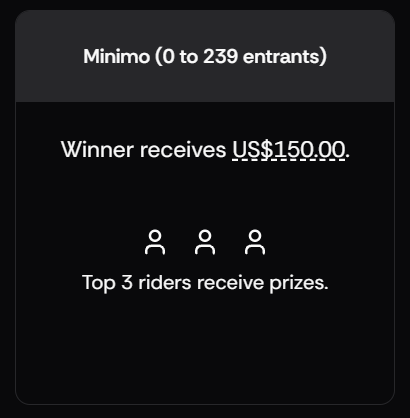
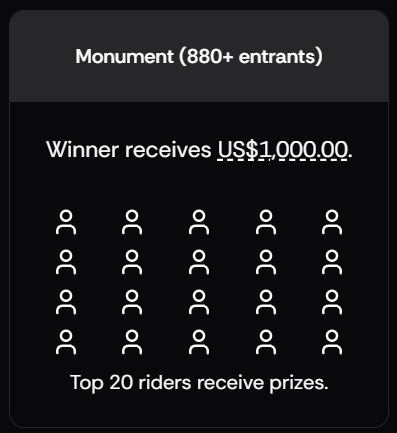
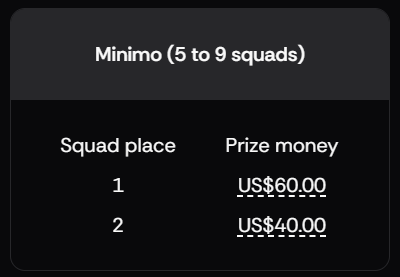
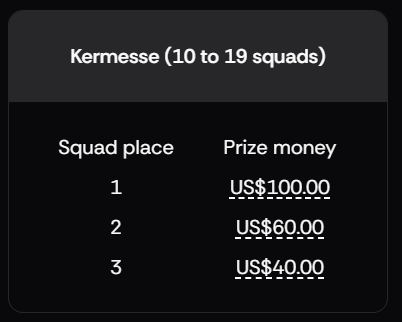
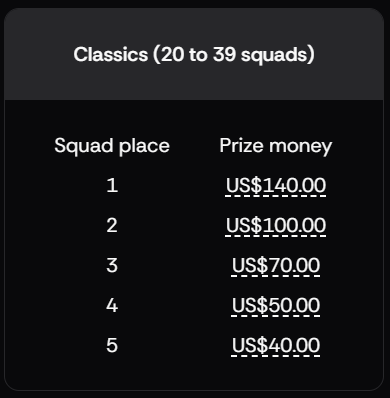
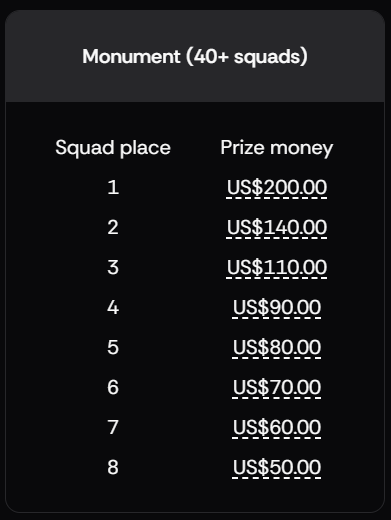
But that’s not all: Prestige offers a unique tiered prize structure that increases with the number of registrations for each race. The community has the power in their hands to grow the prize pool! This is visually represented on the Leadout Esports event page for the series:
Squad Competition & Prizes
Squads exist within teams, and there are 4 riders per squad. Within a team, you can have multiple squads, all competing against each other. This adds an inter-team competitive environment on top of the classic team competitions we have always enjoyed in esports cycling.
Unlike the individual competition, there is a cumulative league scoring competition for squads that carries across all 4 races.
Up to 3 racers on a registered squad, who place inside the top 30 across the race finish line, will see their points allocated to their squad’s point tally. These points will accumulate and form the squad’s total points after each race.
This will eventually accumulate to a final squad league table after race #4, where the squad with the most points will be declared champions. The series squad champions will receive a monetary prize as well as a custom-designed Verge Sport kit for all 4 racers on the champion squad.
Like the individual competition, the monetary prize pool for squads is also in the hands of the community. This prize pool grows in line with the number of squad registrations received for the series:
Age Group Prizes
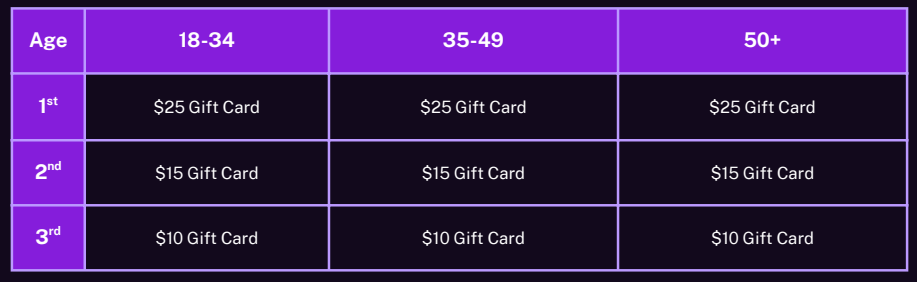
Precision Fuel & Hydration have offered up gift cards as prizes for age group winners across the finish line of each race. Racers who finish inside the criteria for cash prizes will not be eligible for the Age Group gift card prizes. This gives everyone in the entire race a chance at a prize!
Performance Verification
All 4 races in Prestige: Season One will be subject to performance verification.
The following requirements are mandatory for all participants in each race:
Must be 18 years of age or older.
A supplied weight video within 12 hours of the race start time.
The primary device to game for power, cadence, and resistance must be a smart trainer or smart bike from the permitted device list.
Heart rate data for no less than 80% of the entire race.
A dual recording dataset uploaded within 2 hours of race completion. This must show the primary device used for power, cadence, and resistance to the Zwift game overlaid with power and cadence data from a secondary independent power meter on the racer’s bike.
All data provided by racers will be checked, confirmed, and verified by Race Control for the series. Race results will not be set as confirmed until all of these checks have taken place, and no prizes will be allocated to any racer/squad until Race Control is satisfied with the provided data.
Entry Fees and Registration
Prestige: Season One does indeed have entry fees for individuals and for squads.
These entry fees fund further advancements to the Leadout platform. They enable and enhance live stream broadcast capabilities. And they enable the development of tooling/capabilities for Performance Verification. These are all things that are not available in any other race series.
But most importantly, the entry fees enable prize pools for racers and squads. No matter the number of registered racers/squads or prize pool tier that is met, 50-75% of the entry fees are paid back directly to the participating racers and squads, with the rest going towards the development of the platforms and tooling to make the racing experience even greater.
Individual entry stands at $12 USD per race. This is paid directly by each participating racer.
Squad entry for the 4x races in the series stands at $40 USD. This covers a squad of 4x racers for all 4x races in the series. This can be paid by any member on the squad, and is paid in addition to the individual race entry fee.
Prestige is a new series, and the first to be hosted on the just-launched Leadout Esports platform. But Dean from Restart and Nathan from Leadout are veterans in the esports space! There’s a lot of fresh, innovative stuff to talk about here, making this feel like a foundational moment for community-organized, premier-tier cycling esports.
If you’re looking for a heightened experience in the sport, a way to promote yourself and your team to a wider audience, a place where honesty and fair play grant opportunities to win prizes… take a good look at Prestige: Season One.
Questions or Comments?
What do you think of this new series on a new platform? Share below!
Garmin has announced software and feature updates to select smartwatches and bicycle computers today to help you monitor your overall well-being and take your cycling “to the next level”.
Now, Garmin’s latest update brings insights such as smart fuelling alerts and gear-ratio analysis to its Edge 540, 840, 1050 and MTB models.
The smart fuelling alerts prompt you to hydrate and refuel during your rides. Garmin says the prompts are based on “current fitness, course demands, heat and humidity when using power guide or following a workout”.
The gear-ratio analysis enables you to see how much time you’ve spent in each gear ratio after a ride – but you’ll need electronic gears for this feature.
Elsewhere, Garmin says its real-time weather overlays will help you monitor the weather and “make more informed decisions in-ride with radar and wind direction overlays”.
If you use a power meter, you’ll also be able to manage your efforts thanks to the power guide updates, which will provide you with power targets based on “real-time stamina” and wind.
“For mountain rides or races, power guide will now also consider altitude acclimation and adjust power targets accordingly,” Garmin says.
The updates also bring Garmin’s GroupRide data comparisons to more of its bike computers. This enables you to see how speed, heart rate, power, cadence and other metrics compare to riders in your group.
Garmin is also pushing a “health status” feature to its Venu X1, Vivoactive 6, Fenix 8, and Forerunner 570 and 590 smartwatches.
Garmin says the feature will help you monitor your well-being by seeing whether statistics such as heart rate, HRV and respiration are “trending away from their usual range”, either directly on your Garmin smartwatch or in the Garmin Connect app.
“These changes could indicate added stress to the body and could be related to physical activity, potential illness and more,” Garmin says.
The free updates have already begun to roll out to compatible devices. You can update your smartwatch or Edge bike computer either by enabling automatic updates or using the Garmin Express app.
Alongside Garmin’s feature and software updates, the GPS giant has announced 3D maps in its Garmin Connect app for Connect+ subscribers.
“These maps can help users understand the terrain they are covering during an activity and can be viewed in logged activities and custom courses, as well as individual trails in Garmin Trails,” Garmin says.
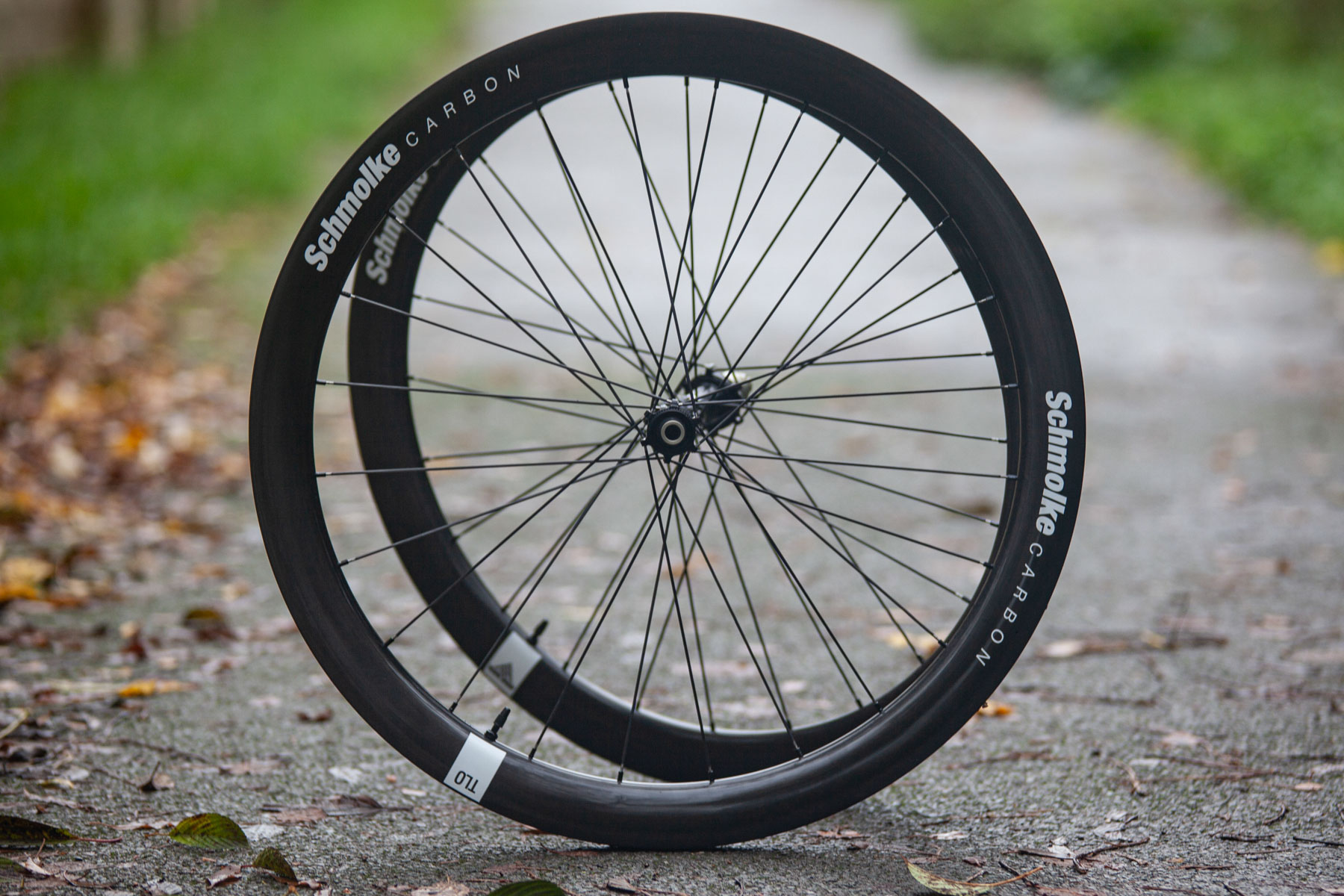
Schmolke’s new TLO 50 wheels break the sub-1kg barrier for a 50mm-deep wheelset.
We’ve seen plenty of ultra-lightweight exotic wheelsets over the years, including the groundbreaking all-carbon construction of Lightweight’s 1,280g Obermayer Evo, Partington’s unique wraparound spoke design of the R-Series MKII (1,218g). There was also the Syncros Capital – with its one-piece moulded rim, spoke and hub design, weighing in at 1,170g.
Schmolke’s TLO (The Light One) wheel range looks somewhat conventional in comparison. It has standard straight-pull hubs, a 50mm-deep hooked tubeless rim and standard 24-spoke patterning – albeit the spokes are carbon fibre.
Look further down the specification sheet and you’ll see an incredible claimed weight of 940g. That’s more than 200g lighter than the competition for a disc-brake tubeless wheelset, and with a deeper rim than its rivals, too.
For climbing fans, Schmolke also has the even lighter 37mm-deep TLO 37, at a claimed 895g.
The wheels are priced between €3,050 and €3,600, depending on the specification.
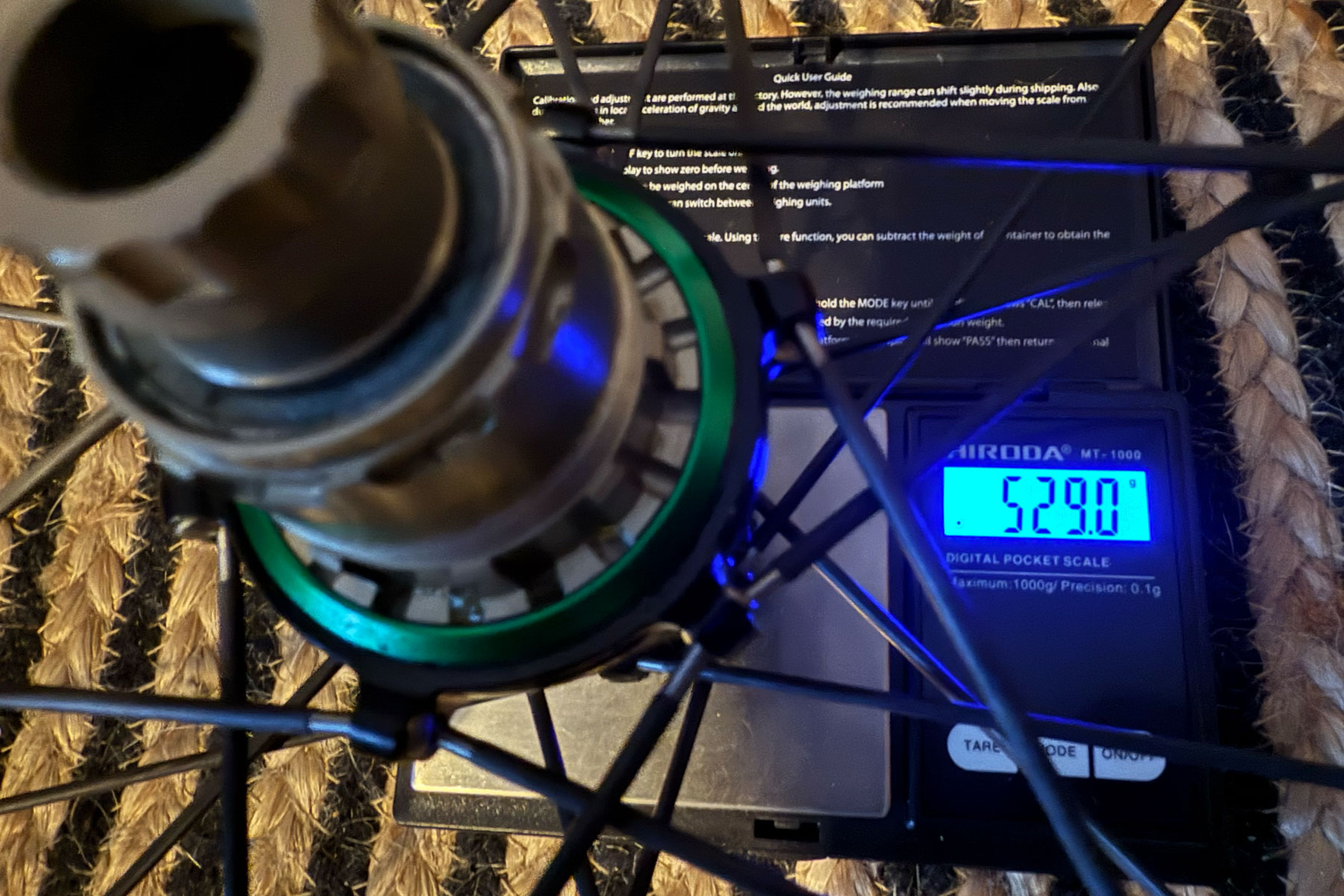
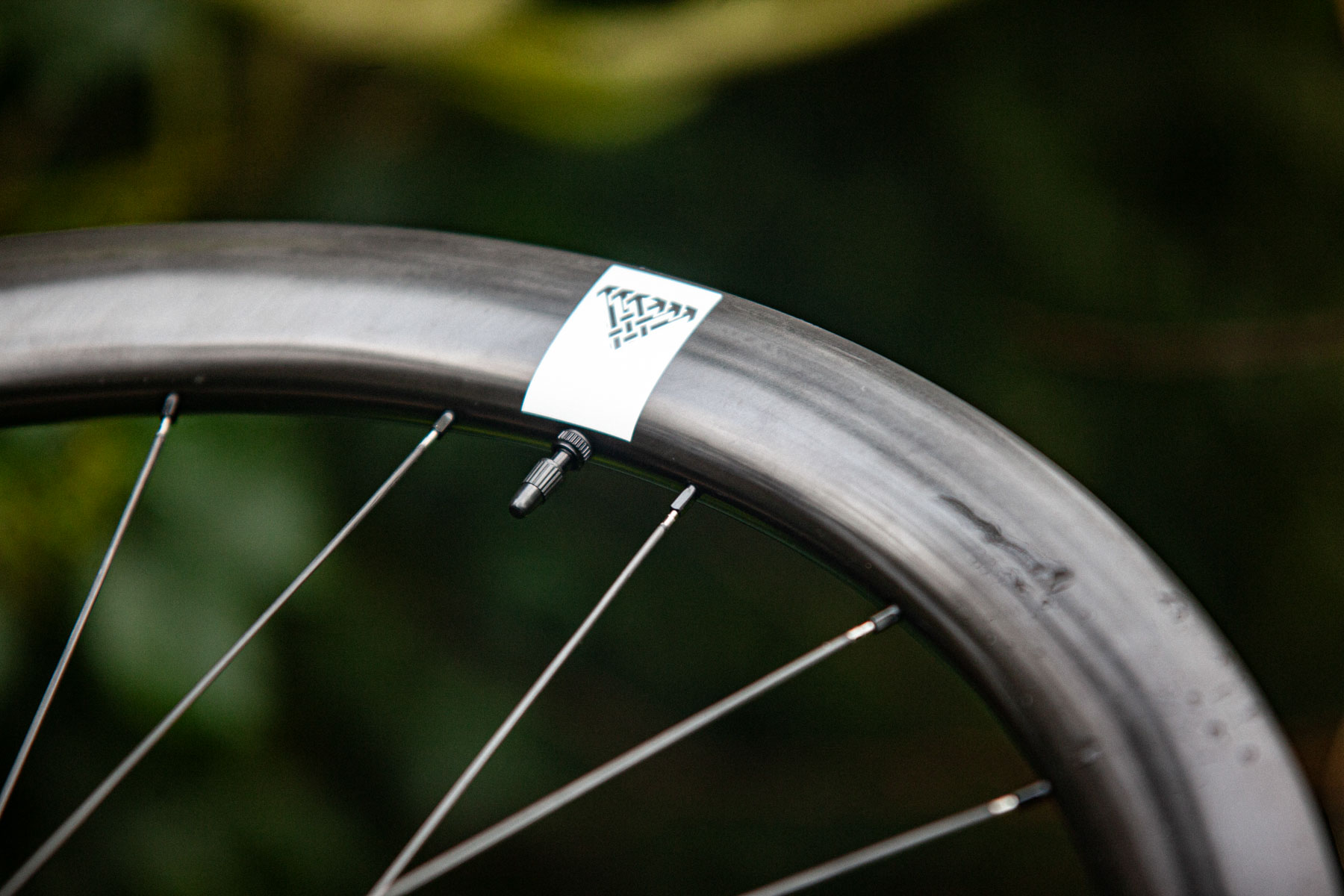
The rear wheel weighs in at 529g, with tubeless rim tape and the valve fitted. Warren Rossiter / OurMedia
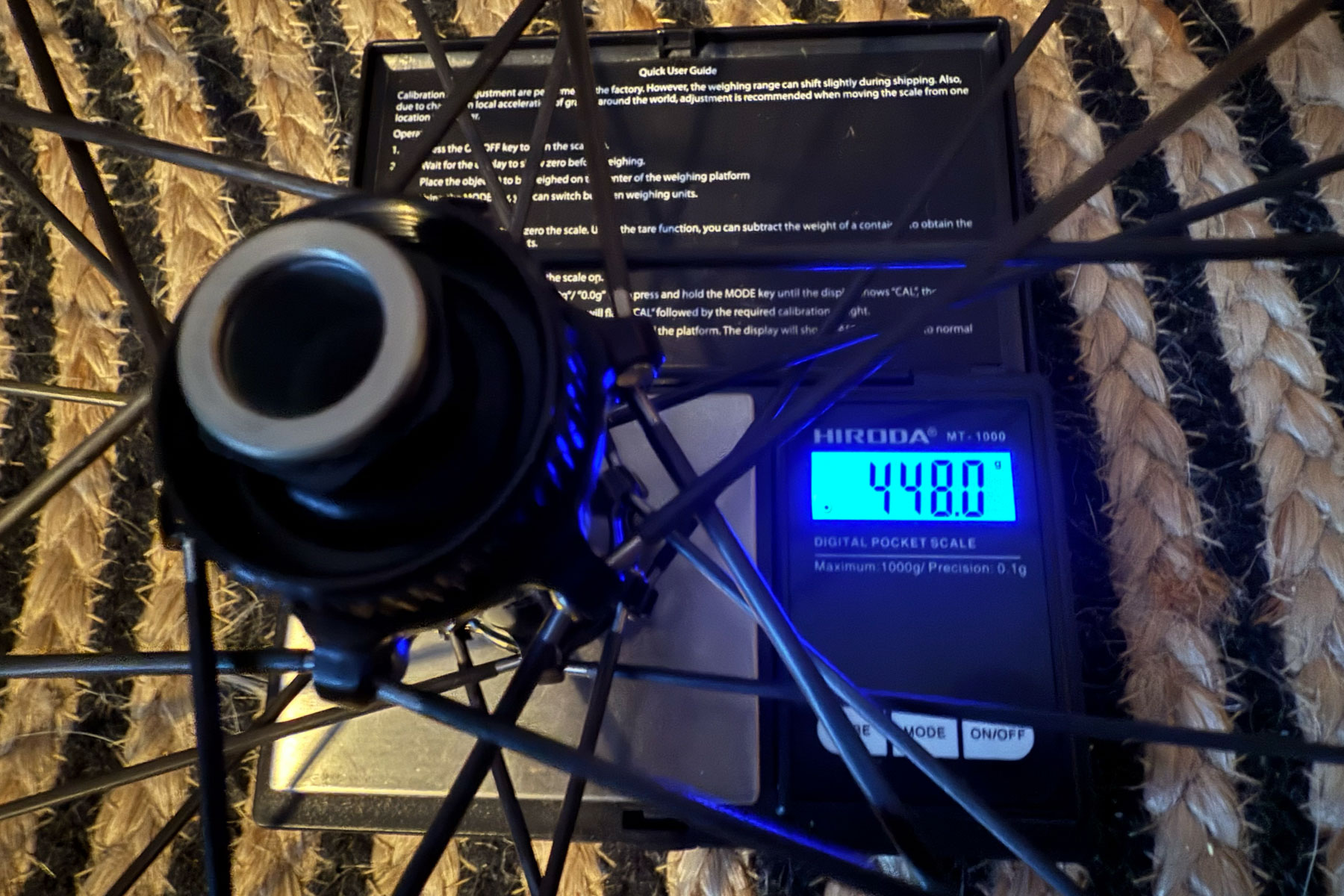
My test pair of TL50s weighed in at 448g front and 529g rear, totalling 977g a pair, including tubeless valves and rim tape. I’d expect the addition of tapes and valves to add around 40g, so it looks as though Schmolke’s 940g claim is accurate.
The rim is designed for modern, wider tyres. Warren Rossiter / OurMedia
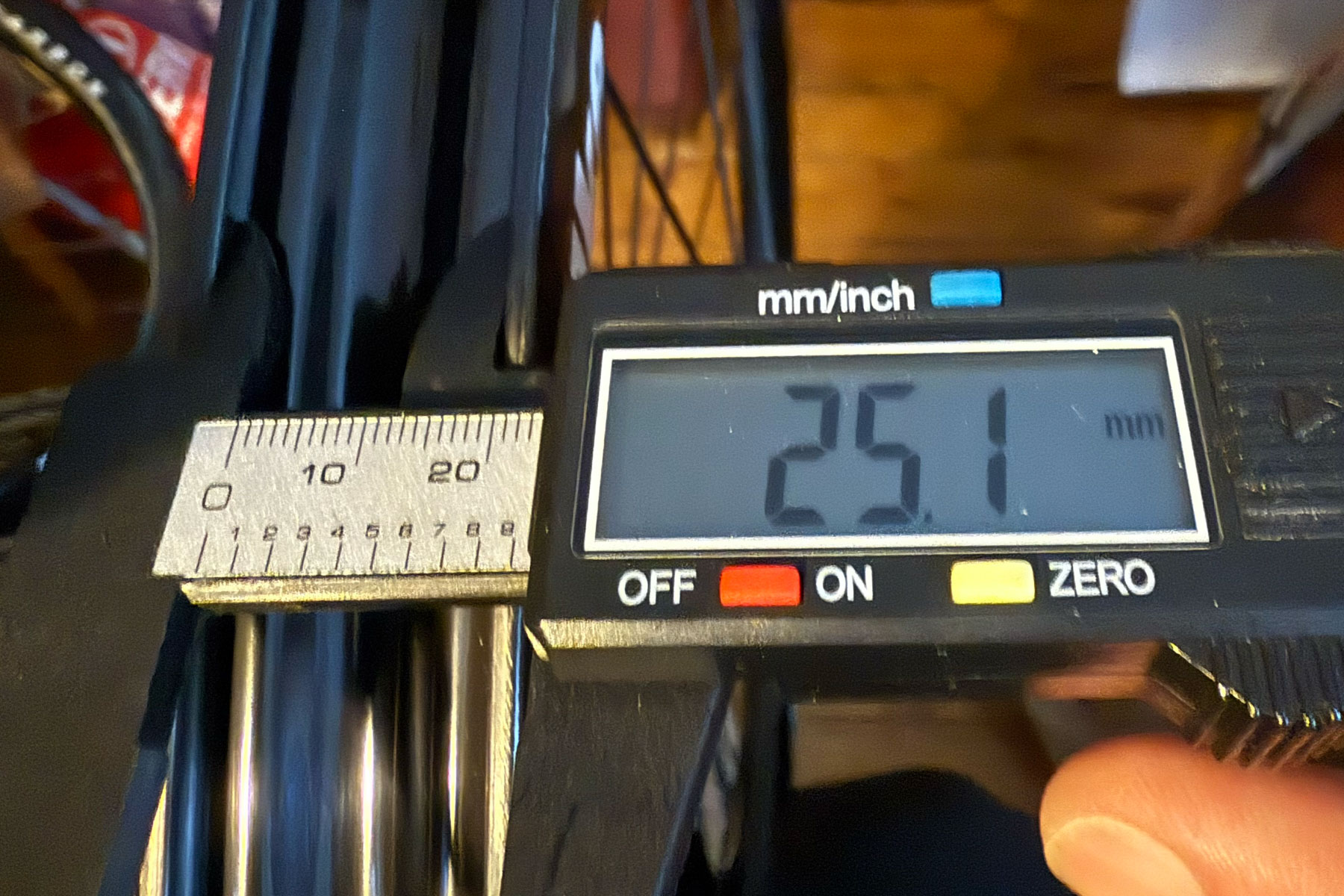
Schmolke hasn’t cheated on the details by making either a narrow or shallow rim design to save weight. With the 50mm rim depth, 32.5mm width and internal width of 25mm, it’s a bang-up-to-date profile, which will ideally suit modern wider road tyres of 28mm and above.
The front wheel weighs only 448g with tubeless tape and valve fitted. Warren Rossiter / OurMedia
Schmolke has chosen a very light hubset and further lightened them with the addition of ceramic bearings.
The combination of Extralite’s 66g CyberFront SPD-3 and 146g CybeRear SPD-3, upgraded with HyperCeramic bearings, shaves more grams from those already super-light hubsets.
Extralite hubs with HyperCeramic bearings help keep weight to a minimum. Warren Rossiter / OurMedia
The carbon spokes use standard threaded ends and are made from carbon, weighing only 1.8g each, compared to a conventional metal spoke such as the DT Swiss Aerolite, which weighs between 4 and 4.5g depending on length.
The advantage of the conventional construction is the spokes can be repaired or replaced by your local bike shop, and they’re rated to 1,200Nm of force.
The rim is made from UD carbon. Warren Rossiter / OurMedia
The 50mm-deep Unidirectional carbon fibre rims weigh in at a claimed 320g, which shows Schmolke’s carbon fibre manufacturing prowess.
In comparison, a 40mm-deep Zipp 303 rim weighs in at around 365g. ENVE’s equivalent SES 4.5 Pro rims weigh a claimed 369g for the front and 383g for the rear.
Technical specifications
Schmolke’s TLO 50s weigh 940g a pair. These are the lightest 50mm-deep wheels we’ve seen to date. Warren Rossiter / OurMedia
Simon Mottram, founder of Rapha, has been announced as a lead investor in the latest funding round of Quirk Cycles, a London-based maker of high-end titanium and steel framesets.
Quirk is looking to raise £500,000 to fund a scaling up of its production and the launch of new models in early 2026.
The objective is to transform Quirk from a bespoke workshop to a global boutique brand.
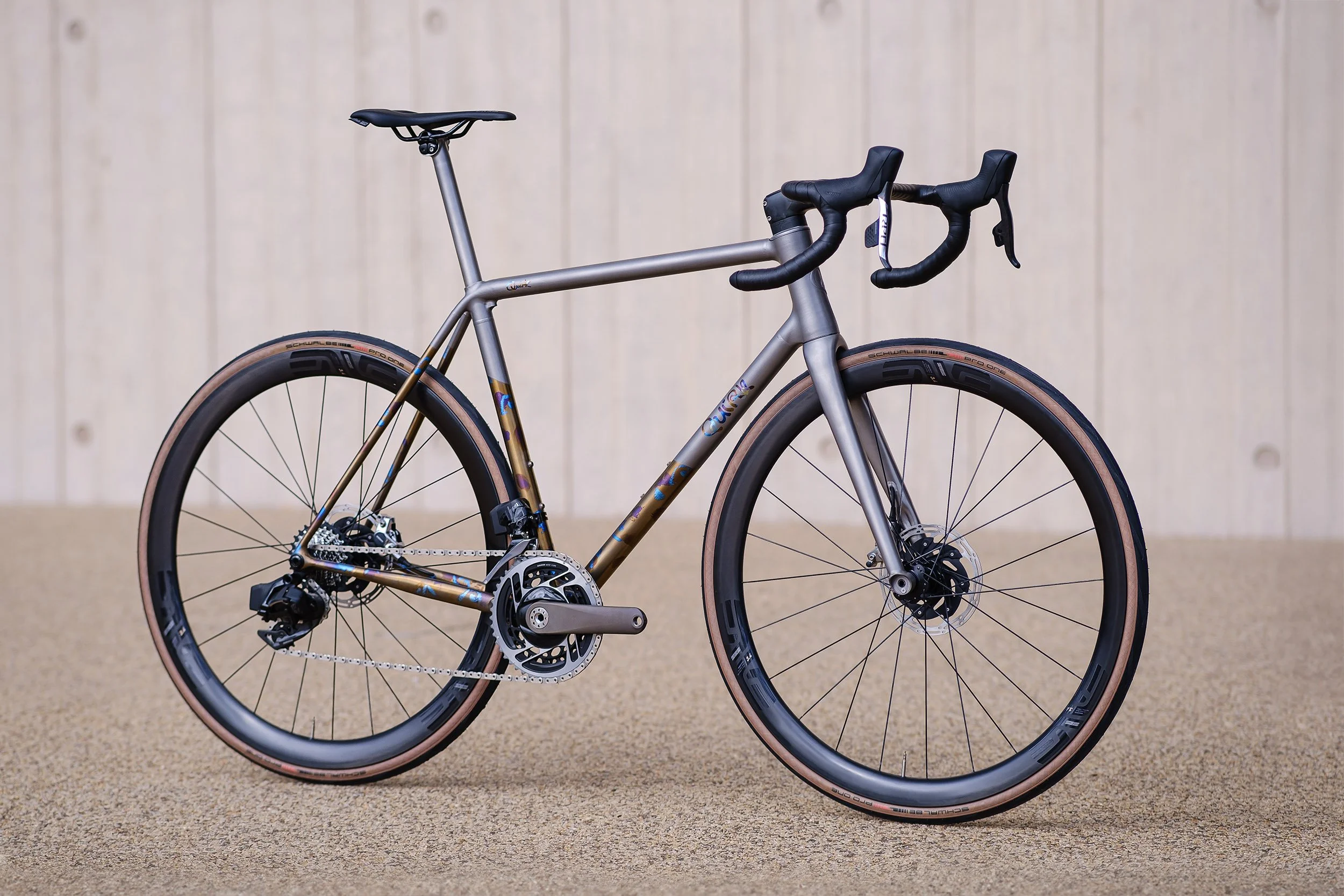
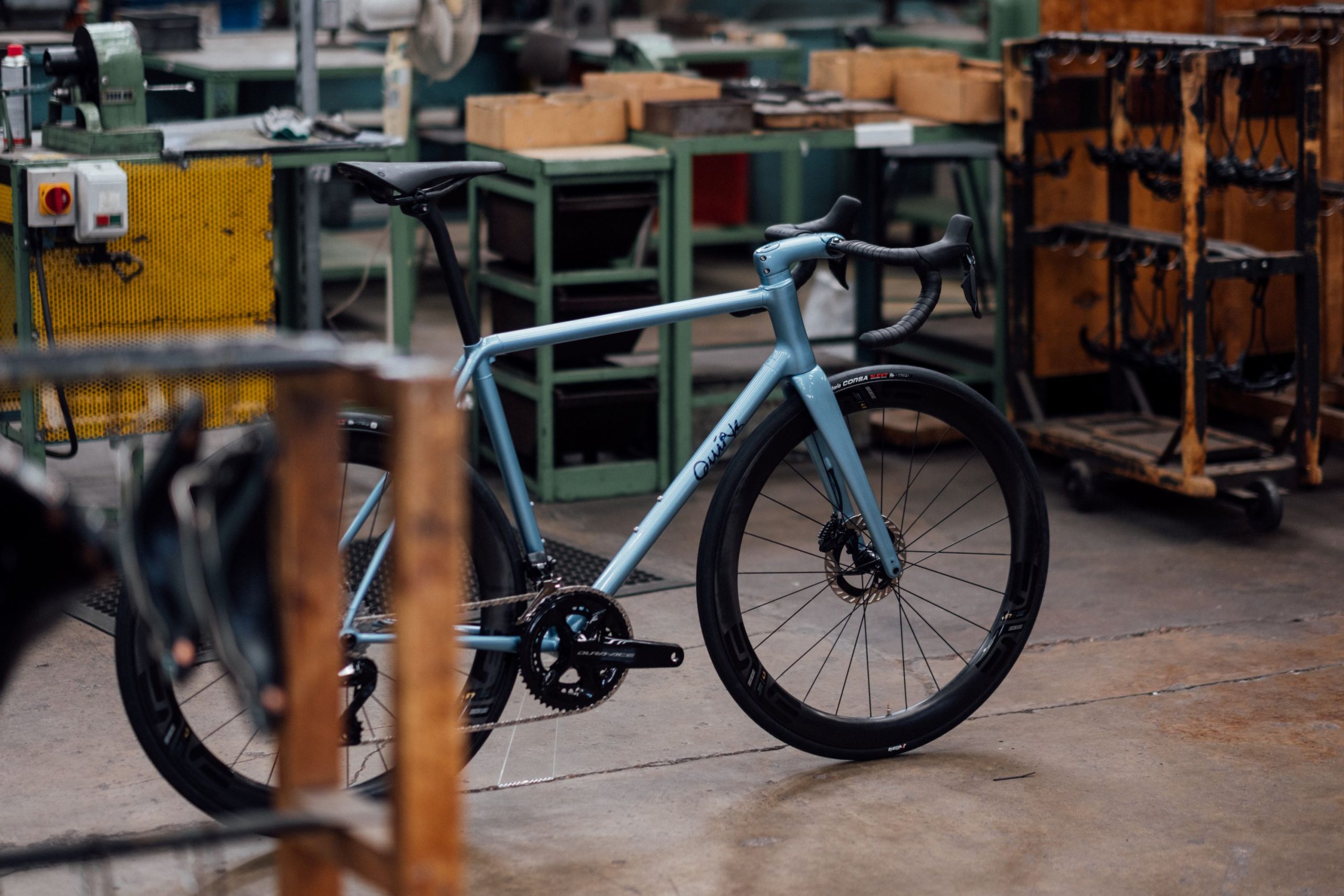
Quirk’s output includes the Titan titanium road bike. Quirk Cycles
According to Mottram: “What drew me to Quirk Cycles is their absolute authenticity – the same spirit that drives every great cycling brand. Rob and his team are building something truly special: a brand rooted in craftsmanship and rider obsession, with the ambition to set a new benchmark in performance and design.
“Quirk isn’t following trends; it’s defining what’s next for boutique performance cycling, and I’m excited to help him scale this vision into a modern, globally respected performance brand.”
Quirk Cycles’ owner, Rob Quirk, declined to say how much Mottram, who has had a lower profile since stepping down as CEO of Rapha in 2021, has invested. He told BikeRadar: “As we’re currently in the middle of the round, we’re not sharing specific amounts from any investor yet.
“What we can say is that Simon Mottram is playing an important role in this stage of our growth. His involvement at this stage is a huge vote of confidence in Quirk Cycles’ vision and strategy.”
Quirk’s other investors remain private.
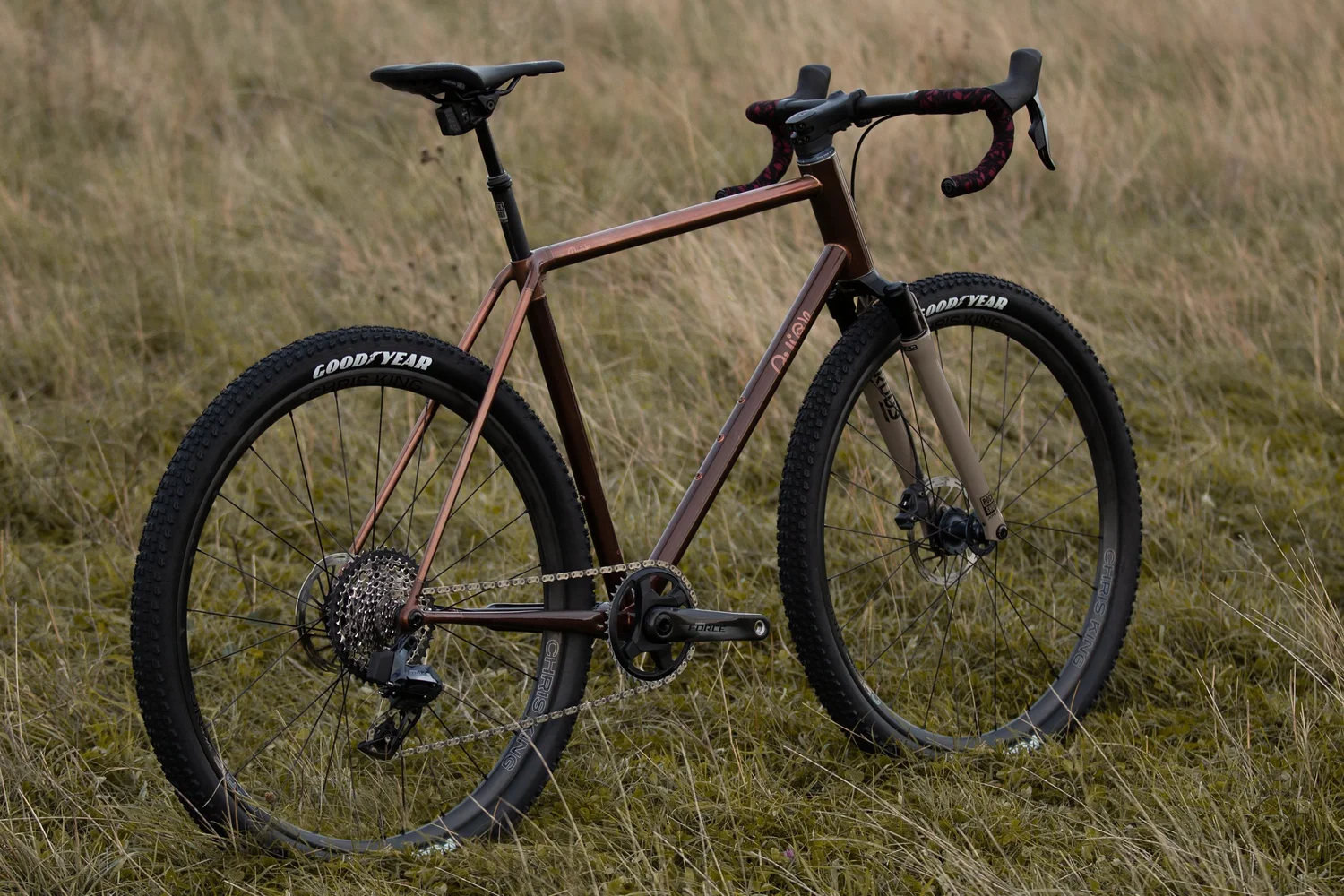
The Supra Chub is a gravel bike with fashionably wide clearance. Quirk Cycles
Quirk says high-end bike brands such as his are weathering the current storm in the cycle market better than more mainstream manufacturers.
He claims that’s down to Quirk standing “at the intersection of innovation and authenticity – two qualities increasingly absent in mass-market offerings” and that “the brand’s commitment to individuality and technical excellence positions it to capture a growing audience of riders seeking connection and meaning in performance cycling”.
One of Quirk’s three new models, due to be launched early in 2026, is the Durmitor performance road bike. Quirk Cycles
Quirk’s current output spans the road, gravel and MTB markets, as well as the fashionable all-road genre. Its titanium Titan road frameset, for example, is priced at £6,500 and its 2.3in-clearance Supra Chub steel gravel bike frameset at £4,500.
It’s planning to add new road, all-road and gravel framesets to its range following the current fundraising, including the Durmitor performance road bike shown above.
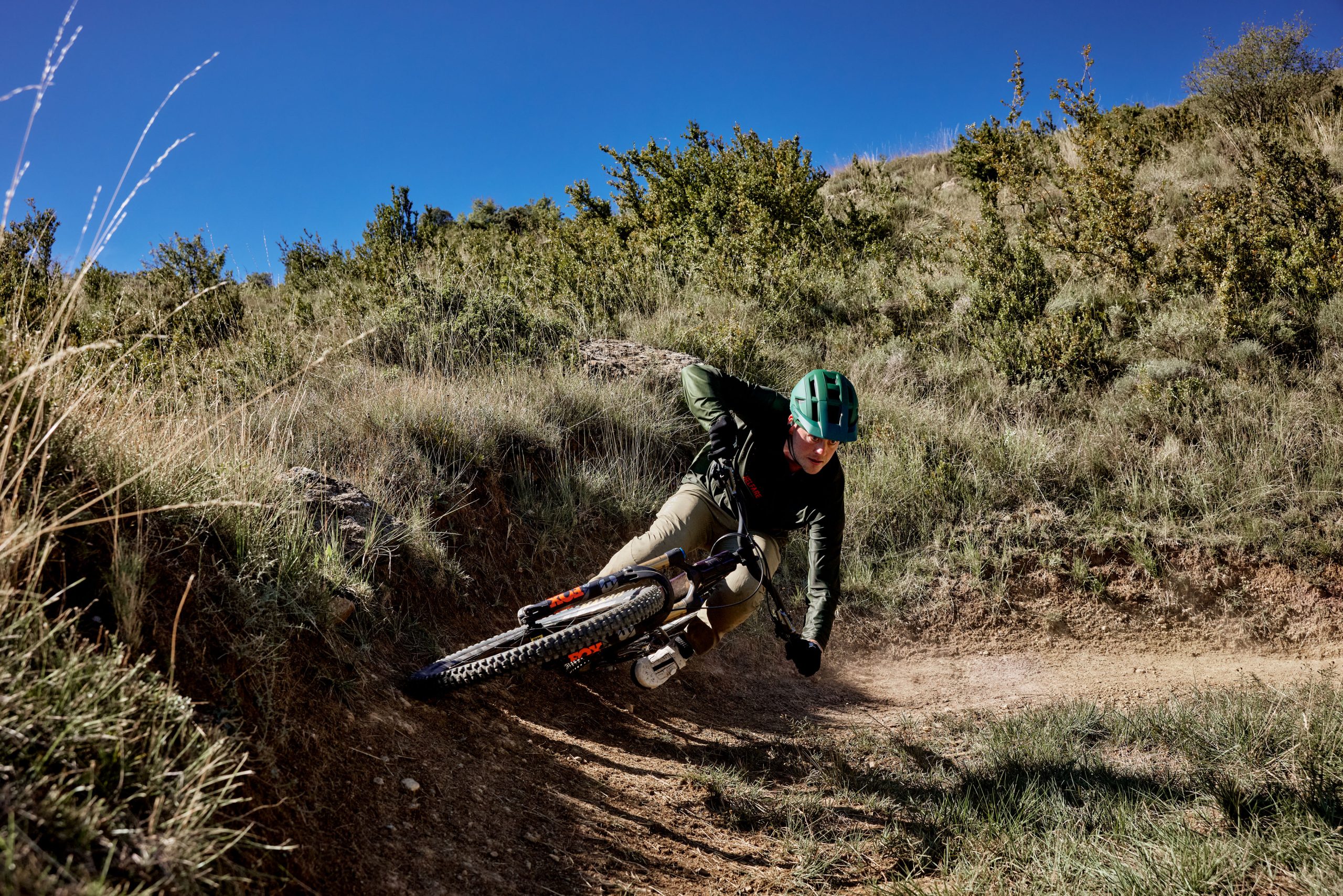
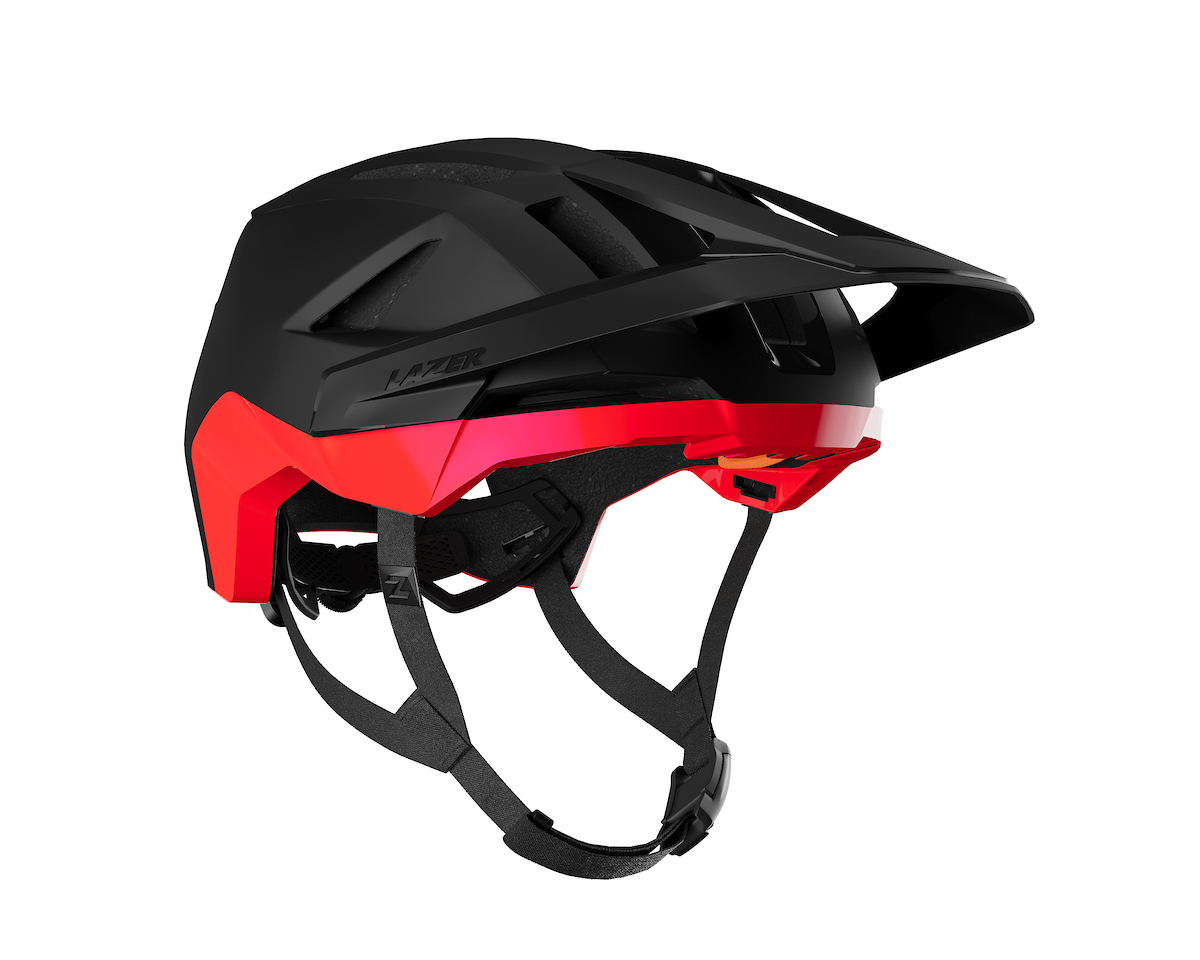
Lazer has enlisted the help of pro downhiller Jono Jones (brother of Matt Jones) to revamp the Impala helmet, using the brand’s new DualCore technology for the first time.
Lazer claims boldly that the “revolutionary” tech employed in the new Impala KinetiCore is “a groundbreaking advancement that elevates safety and performance to new heights. It says DualCore heralds a new era of mountain bike protection, offering “unparalleled shock absorption and protection”.
The new helmet builds on Lazer’s experience with KinetiCore technology, which it launched in 2022. Lazer says that by using two layers of Expanded PolyStyrene (EPS) foam, helmets made with DualCore tech offer enhanced protection.
The new Impala is priced at £199.99 / $199.99 / €199.99.
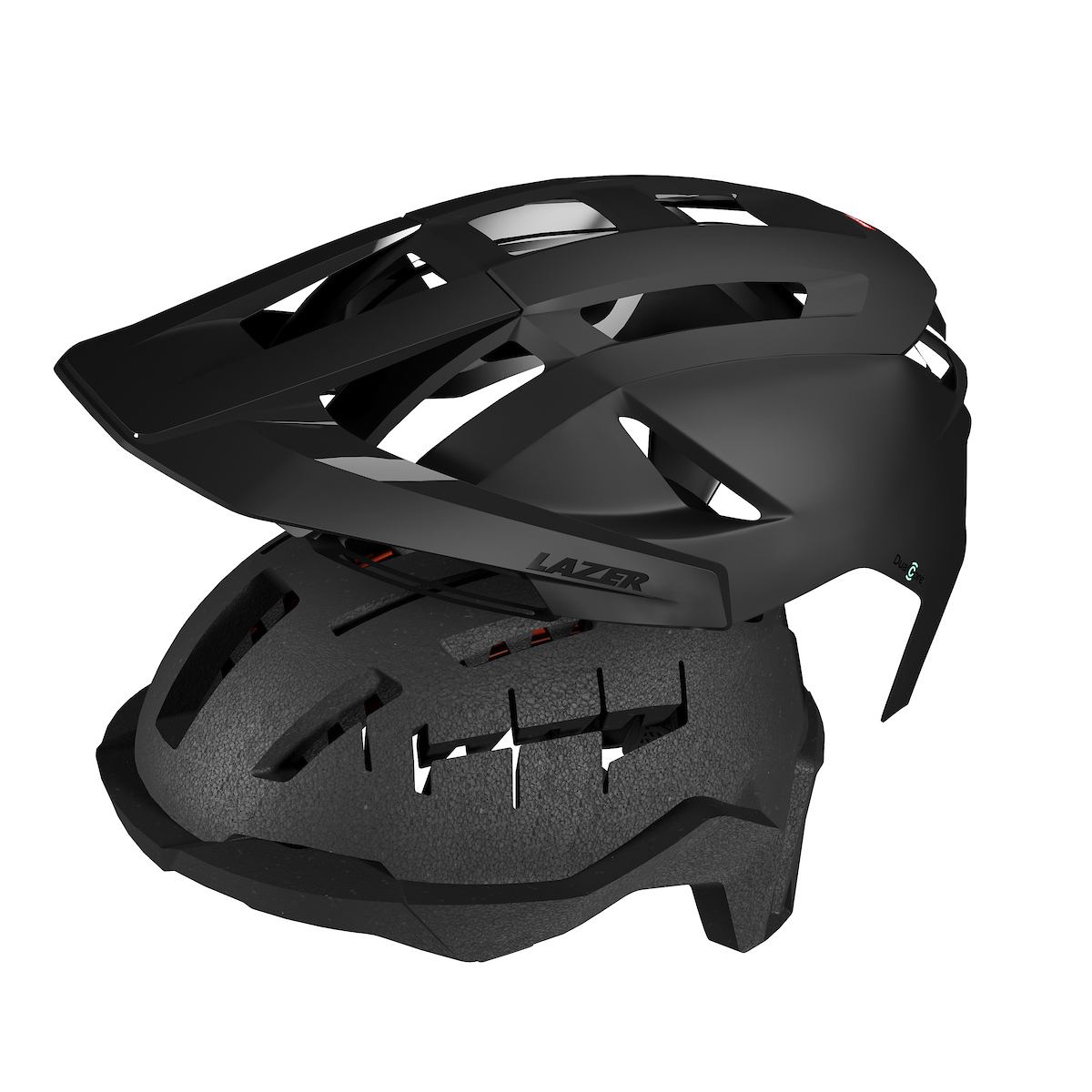
Lazer’s new DualCore technology uses dual-density foam aimed at reducing rotational impacts to the rider’s head. Lazer helmets
DualCore works by integrating two layers of EPS foam into the helmet, inside the shell.
A softer, low-density inner layer is designed to protect against rotational impacts, while a harder, high-density outer layer is engineered to absorb direct impacts.
Lazer explains: “The inner layer of DualCore provides additional protection by absorbing and further dispersing the remaining energy of the shock.
“This layer is specifically designed to offer comfort without compromising on safety. The combination of these two layers creates a synergistic effect that delivers unparalleled shock absorption and protection.”
Delivers every time
Jono Jones helped develop the new Impala. Lazer helmets
Lazer says professional downhiller Jono Jones spent extensive testing time with the new Impala, and his feedback played a crucial role in shaping the final design.
“I’ve put the Impala KinetiCore through its paces on all kinds of terrain, and it’s delivered every time,” says Jones.
Reducing rotational impact forces has been a major goal for helmet manufacturers. Lazer helmets
Helmet brands have devoted a lot of time and resources to this type of rotational impact protection – it’s a key feature in the tests run by Virginia Tech’s Helmet Lab, which inform its helmet ratings.
The Multi-directional Impact Protection System (MIPS) and Release Layer System (RLS) are both claimed to reduce rotational impact in the event of a crash, but operate in different ways. Lazer’s DualCore is another technology aimed at achieving the same goal.
Lazer Impala KinetiCore features
Lazer has added a host of new features to the Impala. Lazer helmets
The latest iteration of the Impala features not only Lazer’s new headline safety technology, but a whole host of features designed to help it compete with other helmets in the sector, such as Canyon’s new Deflectr.
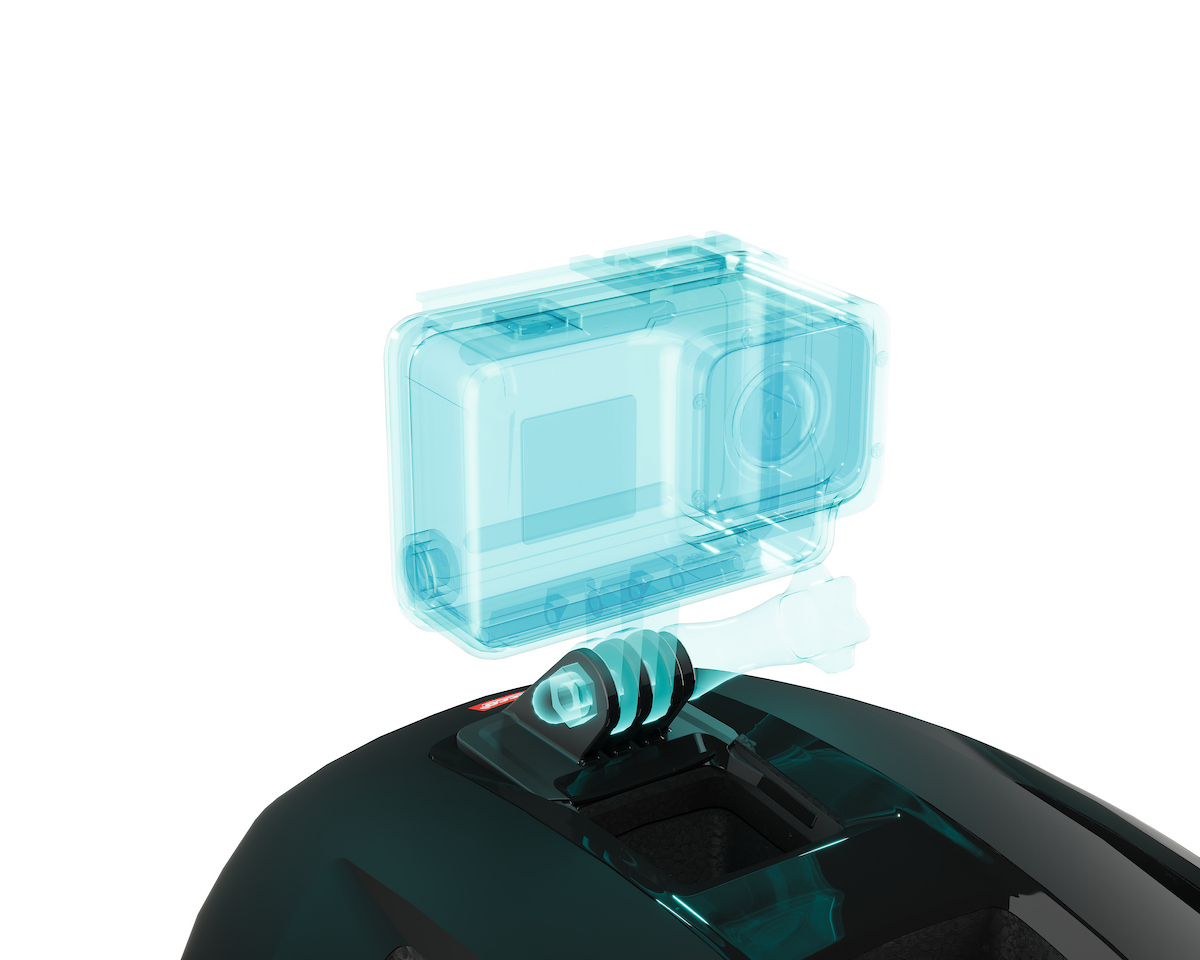
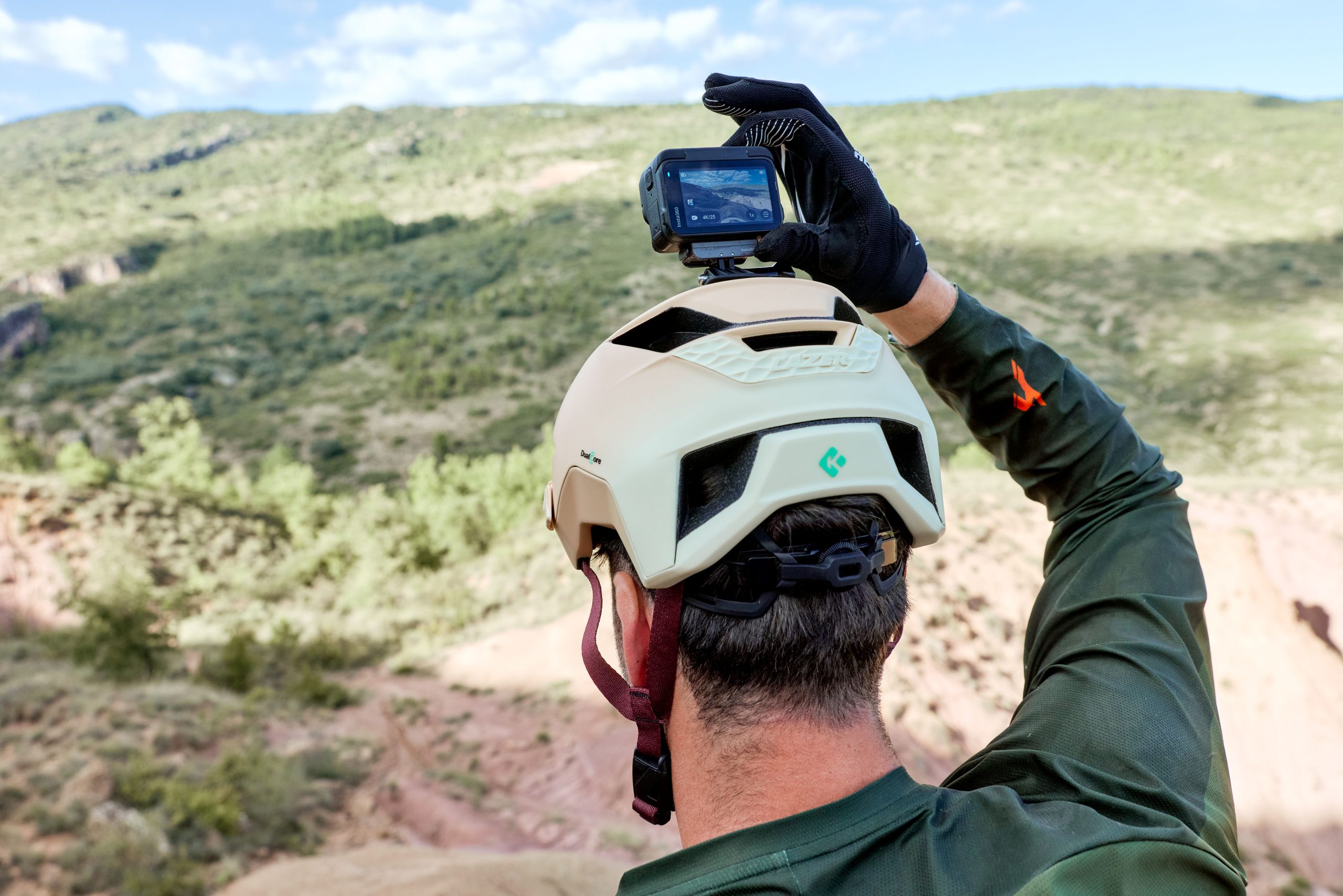
Integrated camera mount
An integrated camera mount is included. Lazer helmets
An integrated camera mount is included, and attaches to the top of the helmet and your action camera.
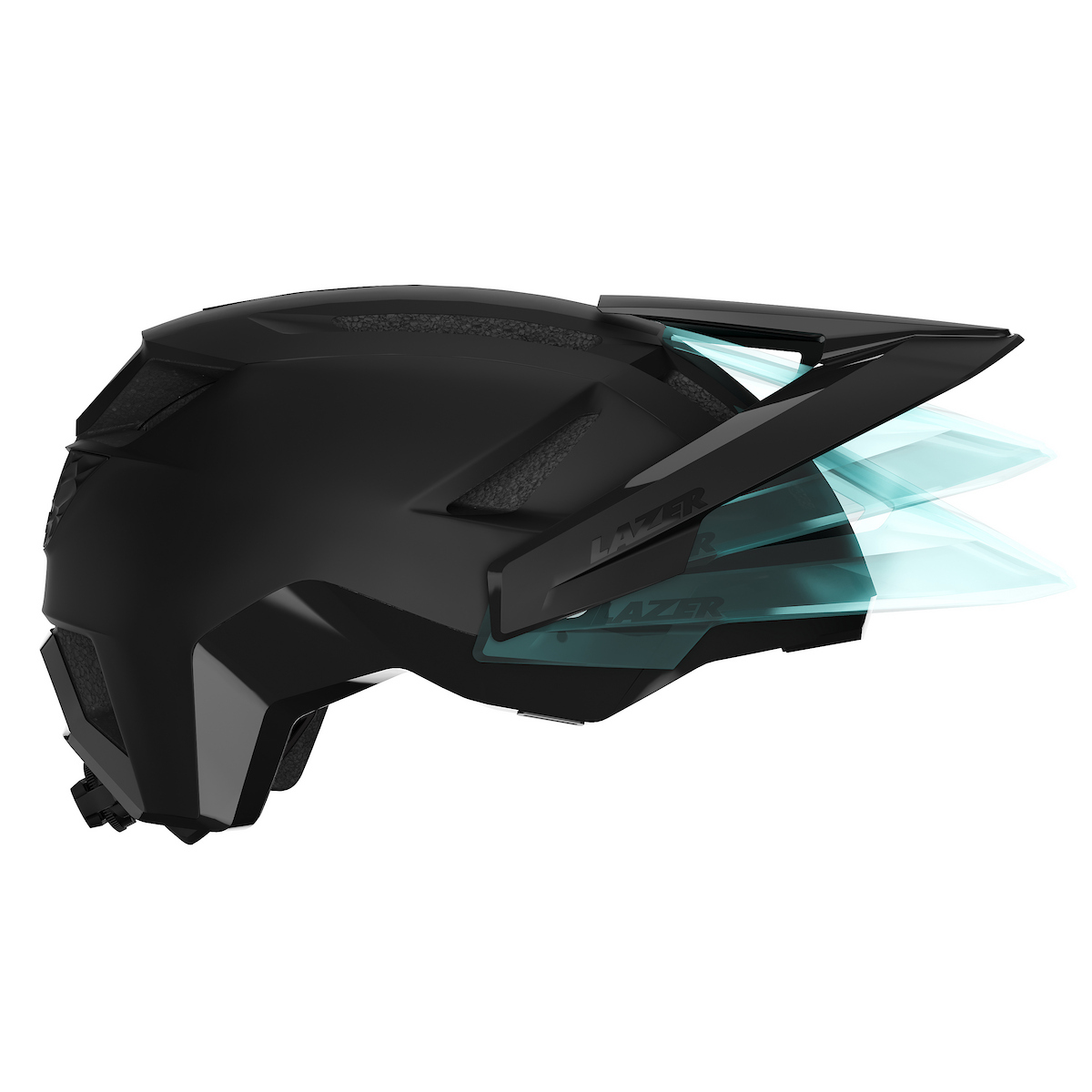
Breakaway peak
The breakaway visor is adjustable between three positions. Lazer helmets
An adjustable three-position peak is designed to break away from the helmet in the event of an impact. Lazer says this will protect the rider’s neck.
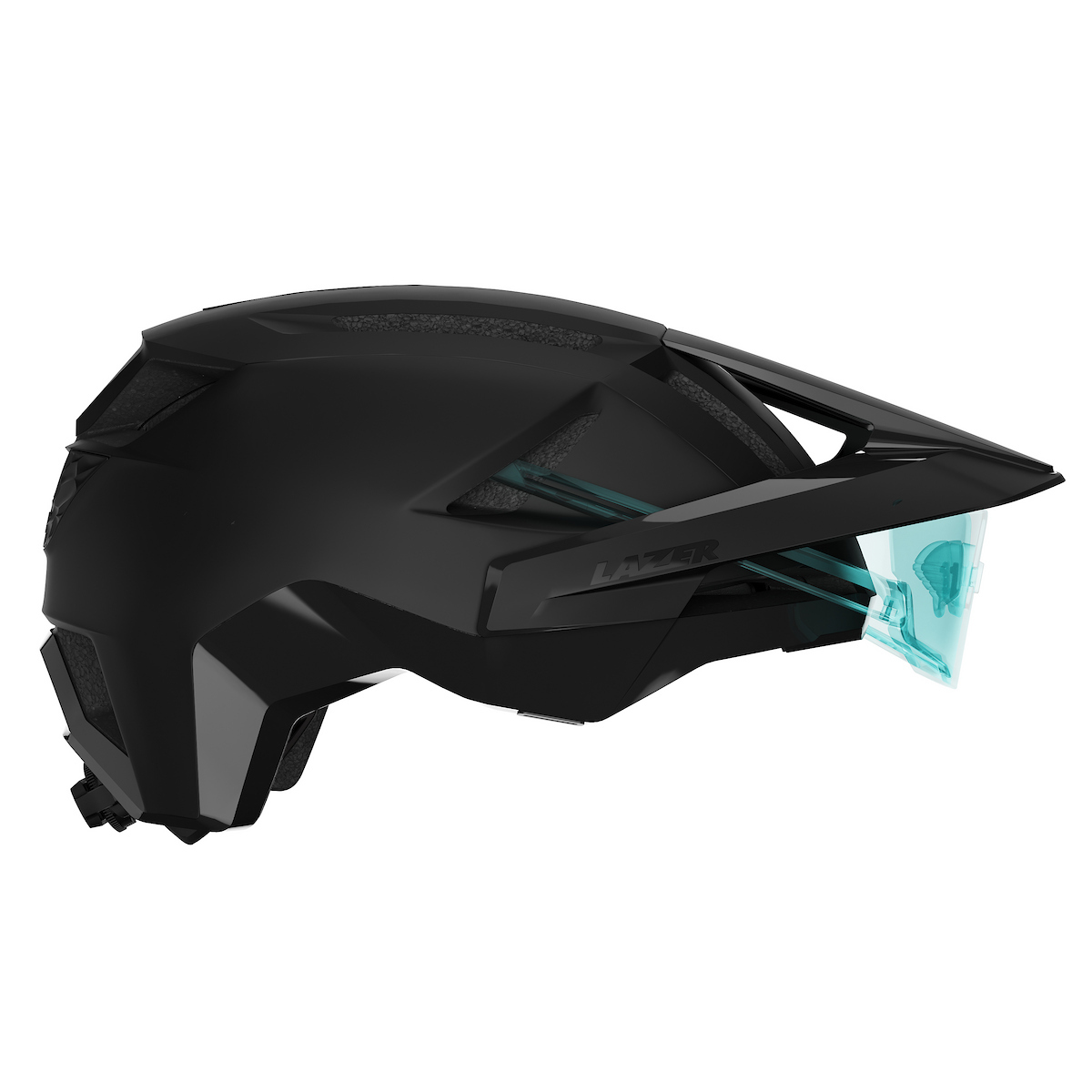
Goggle and glasses compatibility
A glasses dock is integrated underneath the adjustable breakaway peak. Lazer helmets
A grippy panel on the rear is designed to help keep your googles strap in place, with a glasses stowage port included underneath the peak.
Light and reflector
A camera mount and RECCO reflector are integrated into the new Impala. Lazer helmets
Lazer has integrated a RECCO rescue reflector, which it claims will make it easier to find a stricken rider in the event of a crash.
Lazer Impala KinetiCore pricing and availability
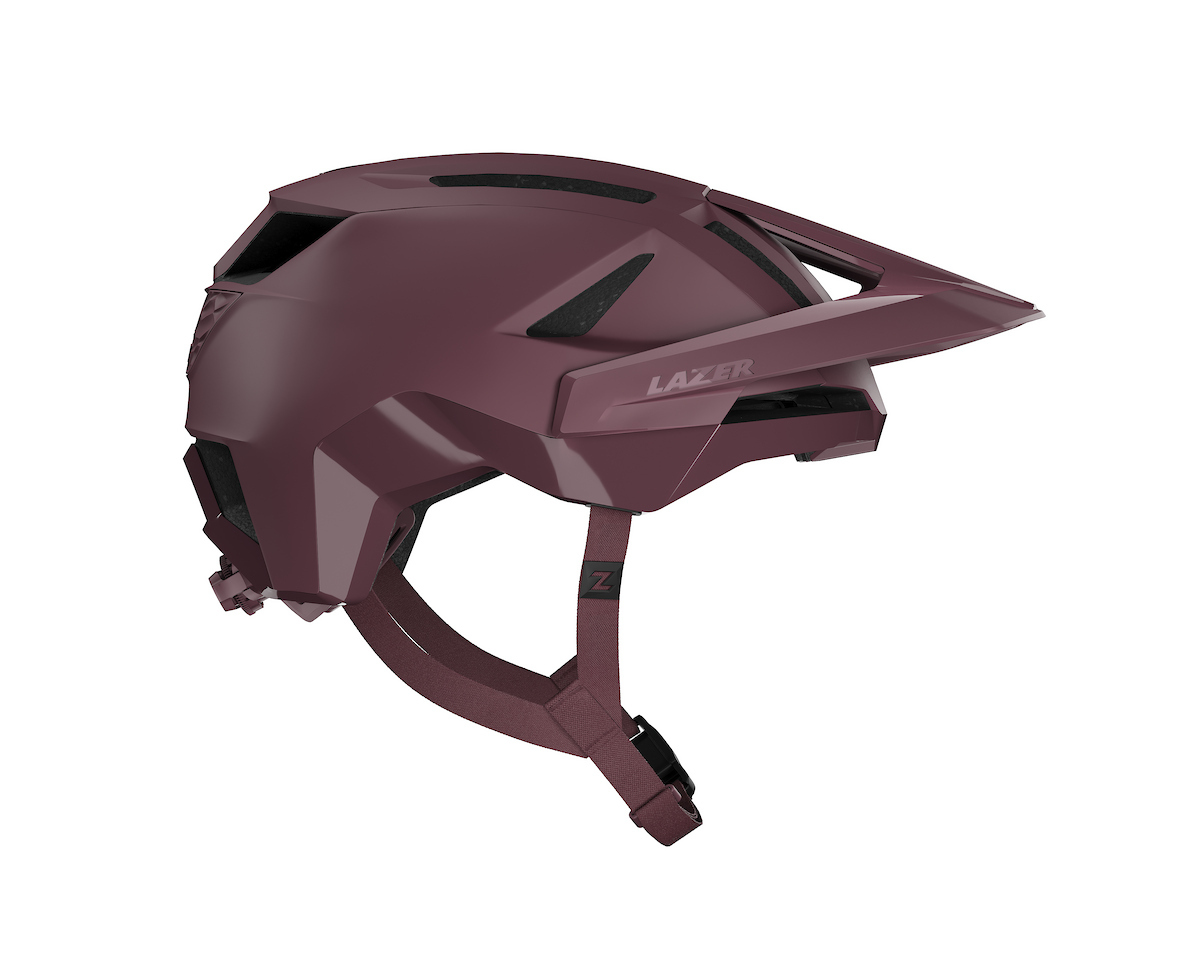
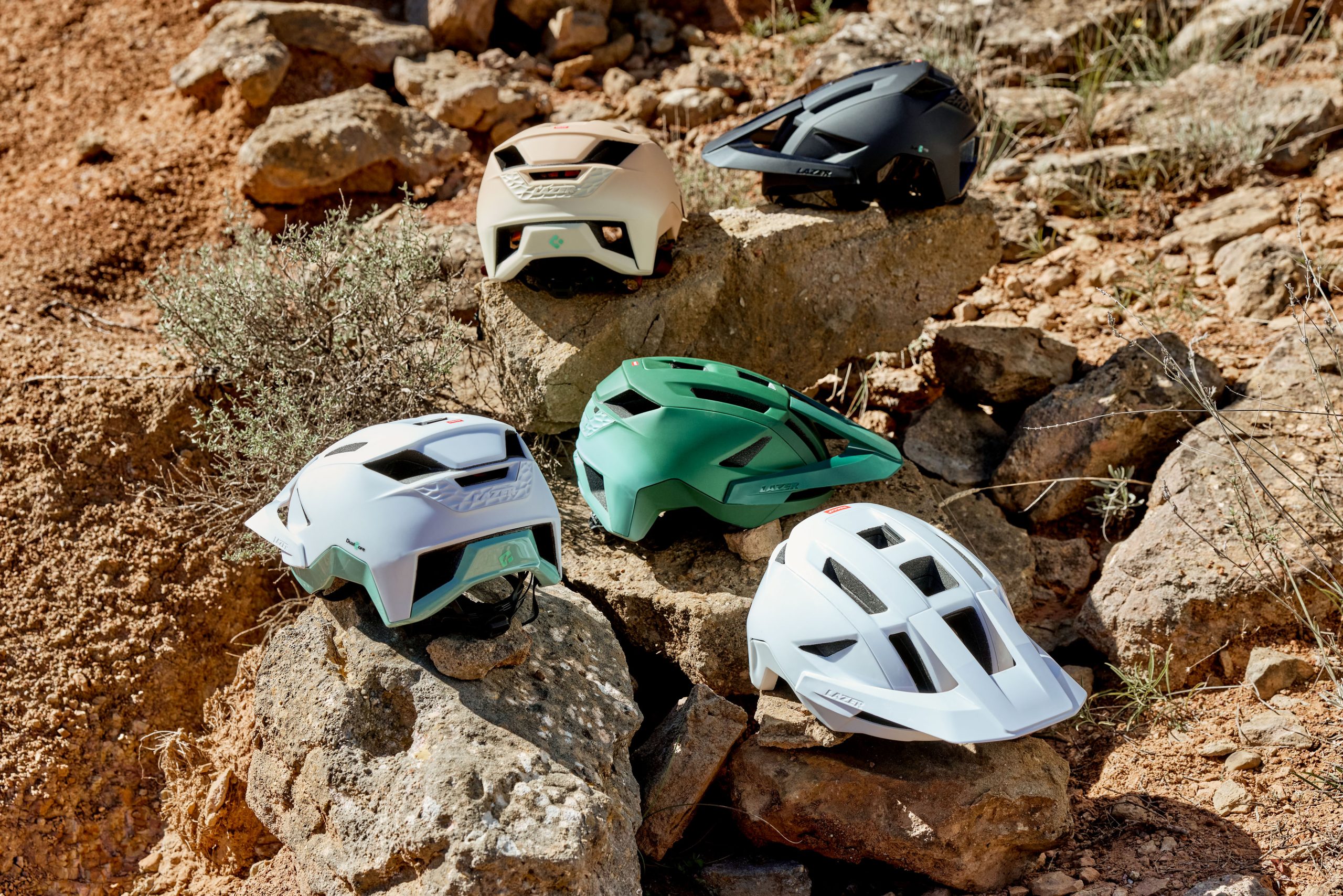
A number of matt colours are available. Lazer helmets
The Impala KinetriCore is available in small, medium and large, with the medium helmet weighing a claimed 370g.
A plethora of colours are available: Matte Coral Peach, Matte Black, Matte Black Red, Matte Mahogany, Matte Space Blue, Matte White Mint, Matte Dark Green Mint and Full White.
The Impala is priced at £199.99 / $199.99 / €199.99.
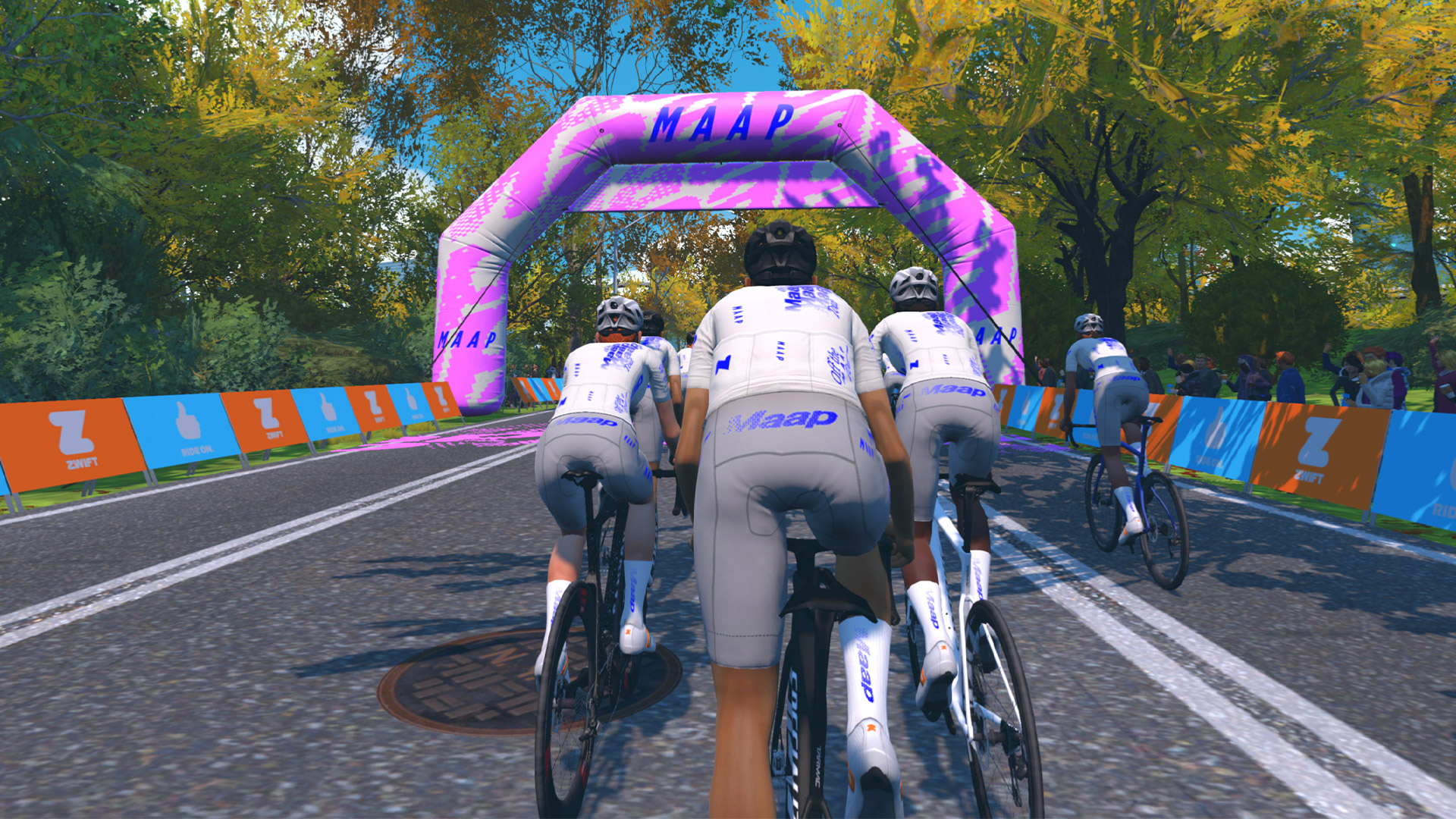
Zwift has just announced this year’s Off the MAAP series, a multi-stage cycling tour returning for its sixth year on the platform. With hourly events around the clock, this is the next big tour on the heels of Brompton Worlds.
Held in collaboration with the Melbourne-born MAAP, this series has historically proven very popular among Zwifters, with hundreds of thousands participating over the years thanks to a fun mix of courses and kit unlocks!
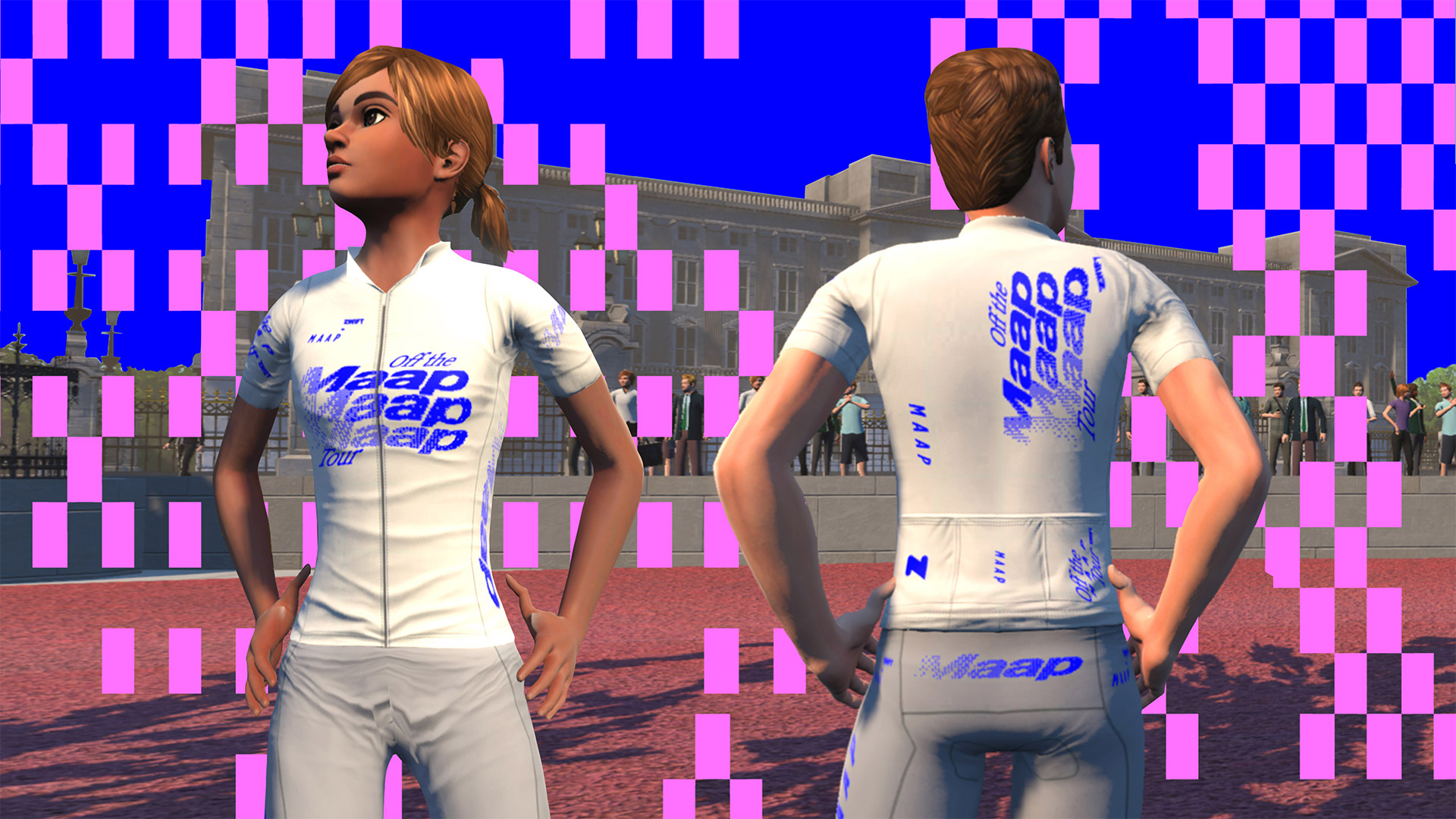
Complete All 3 Stages → Off The MAAP Kit (in-game)
Finish all three stages and you’ll earn access to purchase the limited-edition IRL kit via MAAP.cc starting on December 22. Important: to receive the purchase link, you must be opted in to receive Zwift emails at zwift.com/settings/emails.
IRL Events
Join with MAAP and other Zwifters at the MAAP LaB in Melbourne, Los Angeles, or Berlin for a night of music, beers, pizza, and short-course races on Zwift. (These are TT invitational races, but anyone is free to attend as long as you reserve your spot!)
MAAP says “epic prizes await—plus the first look at the Off the MAAP ’26 kit and a cash purse on the line. RSVP now—spaces are limited.” RSVP links:
Visit the MAAP landing page and fill out the form to enter for a chance to win the ultimate rider’s prize: a year’s supply of MAAP kit, a Zwift Ride with KICKR CORE 2, plus a year’s subscription to Zwift!
Is this a race?
Not officially – Off the MAAP events are set up as group rides and won’t count toward ZwiftPower ranking points, Zwift Racing Score, etc. That said, cyclists know it only takes two riders on the same route to make a race!
Many riders will be racing these events, and if you want to go hard you are free to do so, just as you’re free to ride at whatever pace you’d like.
Conventional wisdom says brighter colours and reflective clothing will increase your visibility when cycling.
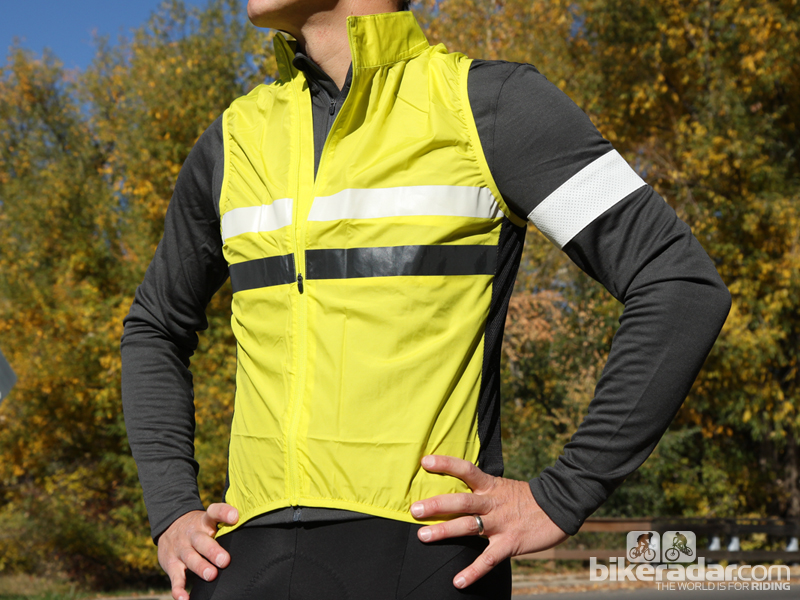
Rule 59 of the UK Highway Code, for example, recommends cyclists should wear light-coloured or fluorescent clothing during the day and reflective clothing and/or accessories after dark.
However, there’s little scientific evidence to support this opinion.
We consulted an expert on the role of human factors in road traffic accidents, who highlighted research on how biomotion can help increase your road presence and maybe reduce your risk of a collision when cycling.
High-visibility clothing is recommended by the UK Highway Code. James Huang/Future Publishing
Cycling UK has reviewed the evidence on high-visibility clothing and other measures to make cyclists more conspicuous, concluding that: “If wearing hi-vis helps people feel safer when cycling and more willing to do it, that is only to be welcomed. It is, though, hard to prove whether hi-vis makes any significant impact on cyclists’ safety and there is very little convincing evidence to support the argument that it does.”
Despite this, there’s still a widely held belief that hi-vis contributes to rider safety.
In January 2025, a UK parliamentary question tabled by Munira Wilson, MP for Twickenham, asked whether the Department of Transport had assessed the merits of requiring cyclists and motorcyclists to wear high-visibility attire after dark.
So what does increase cyclists’ road presence, attract drivers’ attention and reduce the risk of riders being involved in road traffic accidents?
How attention really works
There’s little convincing research to show that hi-vis increases rider safety. Getty / domin_domin
Dr Marc Green, based in Ontario, Canada, is an expert in the role of vision, perception and human factors in transportation collisions, including those involving pedestrians and cyclists.
Green has analysed the available research on the effectiveness of conspicuity aids for cyclists, including lights and fluorescent and reflective clothing. As with Cycling UK, he points out that it’s difficult to come to a definitive conclusion on their benefits, which he says is due to the difficulty of designing an adequately controlled experiment that rules out other factors.
An experiment that asks a driver to ‘spot the cyclist’, for example, primes them to look for a rider, while a driver in a real-world situation might not be looking out consciously for cyclists.
Green contrasts the sensory conspicuity triggered by such experiments with cognitive conspicuity, a function of driver expectations, and says that raising the latter is more significant in preventing accidents.
He draws out the difference between two types of conspicuity. Sensory conspicuity, he says, is more important when a viewer is searching for a known target, but is less effective when encountering an unexpected object.
In contrast, cognitive conspicuity is more important in perceiving unexpected objects and has been suggested by some researchers as the main safety issue for cyclists. These ‘looked but failed to see’ errors stem from driver cognition.
Green says this is largely a function of driver expectation, which in turn is related to prevalence (how many cyclists there are on the roads) and cyclists’ behaviour (whether they obey expected road discipline).
What the data shows
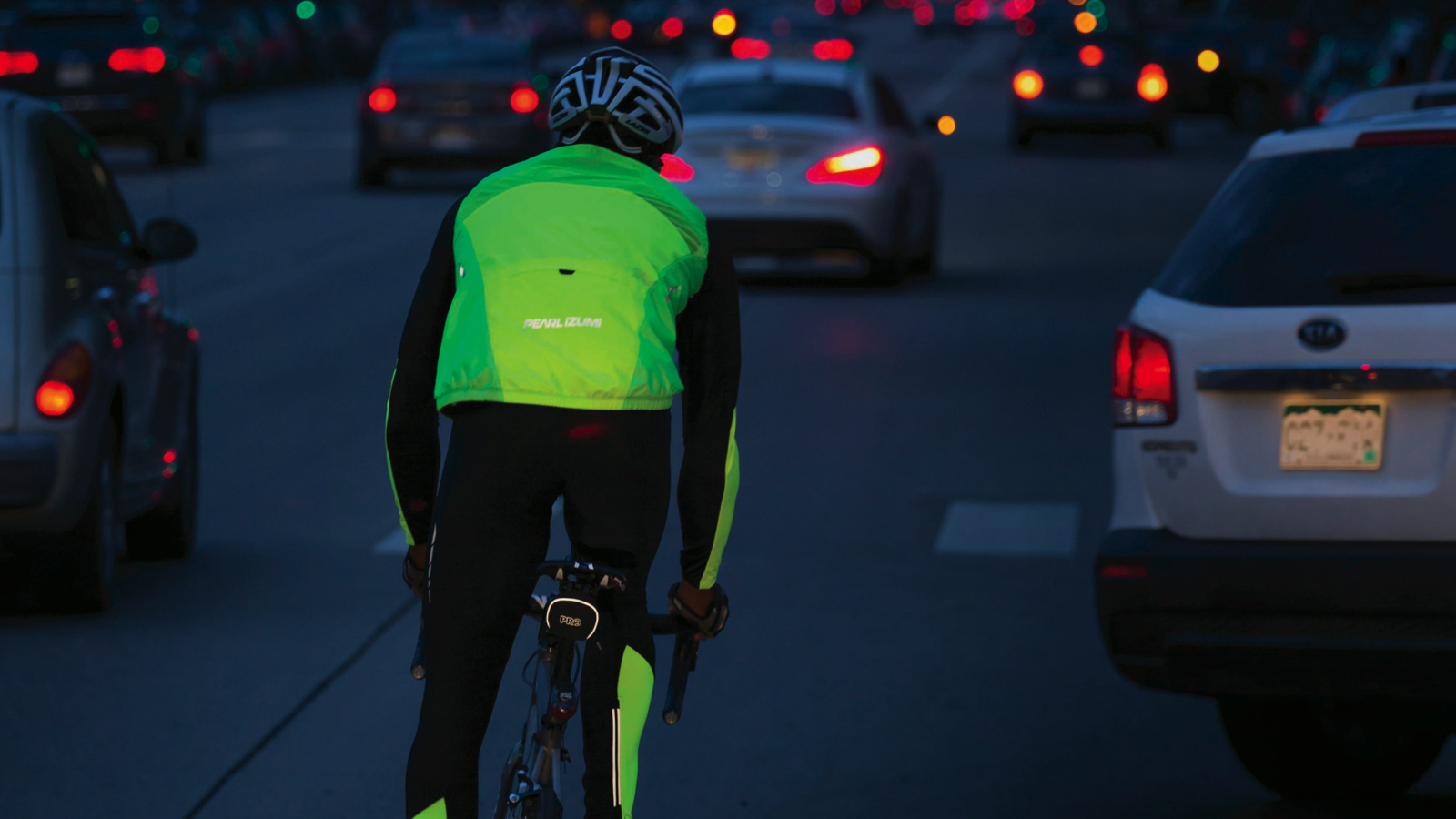
Fluorescent colours on the legs may increase safety over fluorescent upper layers, due to the legs’ movement. Pearl Izumi
He points to one randomised control study, which looked at cyclists travelling in normal conditions.
According to Green, the study showed that: “Bicyclists wearing fluorescent jackets had about half the collisions/near misses of those without. However, some of the benefit may have been due to biological motion.”
This conclusion is borne out by another study that showed fluorescent yellow vests alone did not confer an improvement in the distance at which drivers detected cyclists in daylight. Adding trousers in the same colour did, though, which the authors attributed to the biological motion of the riders’ legs.
What really helps
Research suggests biomotion can increase conspicuity over a static light attached to the frame. Look
Green points to a large number of studies that have found gains in night-time visibility and conspicuity when retroreflective material or lights are placed on cyclists’ joints, particularly when situated on cyclists’ ankles, thighs and knees.
Other research has found that reflective material or lights placed on pedal cranks or riders’ heels improved detection at night, bearing out the evidence that biomotion helps improve detection. In the UK, there’s a legal requirement to have reflectors on pedals.
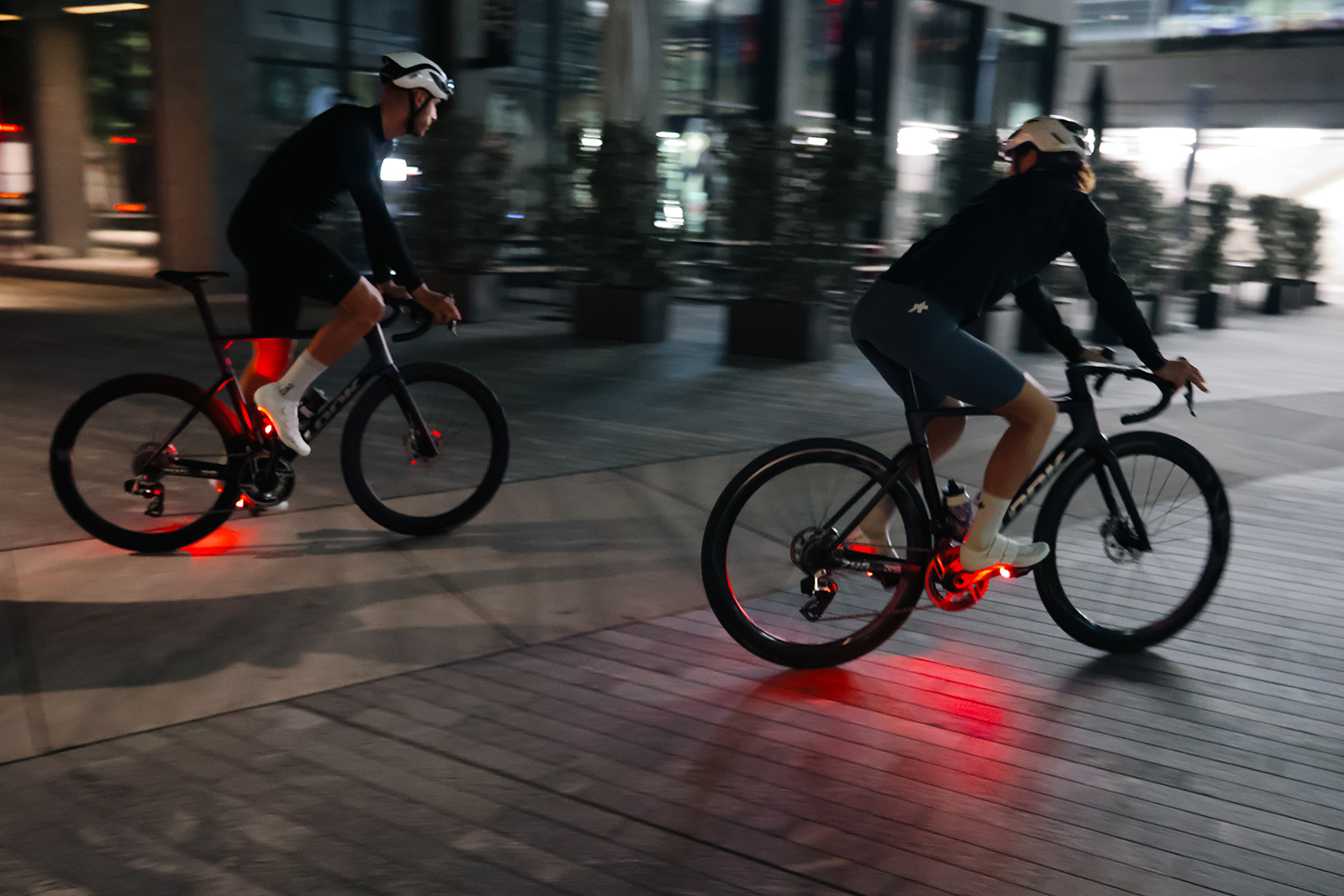
When Look recently launched its Keo Vision pedals, with built-in lights, it cited research from the US that found a moving light was 5.5 times more likely to be noticed than a static constant light and almost twice as noticeable as a flashing light attached to a non-moving part of a bike.
So, the evidence points to the usefulness of biomotion, attaching lights or reflectors to moving parts of a bicycle or rider to increase conspicuity for cyclists.
While a flashing bike light and high-visibility clothing can help, it’s the rotation of the pedals and the movement of the legs that seem to be most significant in attracting drivers’ attention.
Green summarises the available evidence: “It looks to me like this: steady vs flashing makes no difference in rural or other areas where there aren’t a lot of background lights. Flashing is better in urban areas where there are a lot of steady background lights. The flashing is the only way to stand out from a steady background.”
Green points out one disadvantage of flashing lights, though. ”It is difficult to localise single lights,” he says. “Drivers may not be able to tell exactly where you are. Distance is especially hard to judge.”
So there are potential safety benefits in using both a flashing and a constant light or a ‘hyper-constant’ pulsed light at night. Look cites this as an advantage of its pair of pedal lights.
Green concludes: “Conspicuity aids [such as hi-vis clothing] likely have some benefits, but their effect seems relatively weak. The likely reason is that cognitive conspicuity, which is a function of driver expectations, is much stronger than the sensory conspicuity created by the aids.”
It’s a conclusion that Cycling UK’s summary endorses. “Research suggests that retroreflective accessories designed to make you more conspicuous in the dark – especially anything that moves when you pedal (e.g. ankle straps) – are probably worth the investment,” it says.
Riding in the winter can be just as enjoyable as in the summer, but there are some concessions to be made.
Staying warm is essential to keeping the smiles coming, with one particularly wet and cold ride often enough to discourage you from going out on the bike again until springtime.
They also feature the brand’s Zipless DropSeat function, enabling hassle-free comfort breaks and a Women’s 800 Series Conform Pad, which is said to be taboo-breaking in its design.
We gave the Polartec Jacket 4 stars when we reviewed it. Andy Lloyd / Our Media
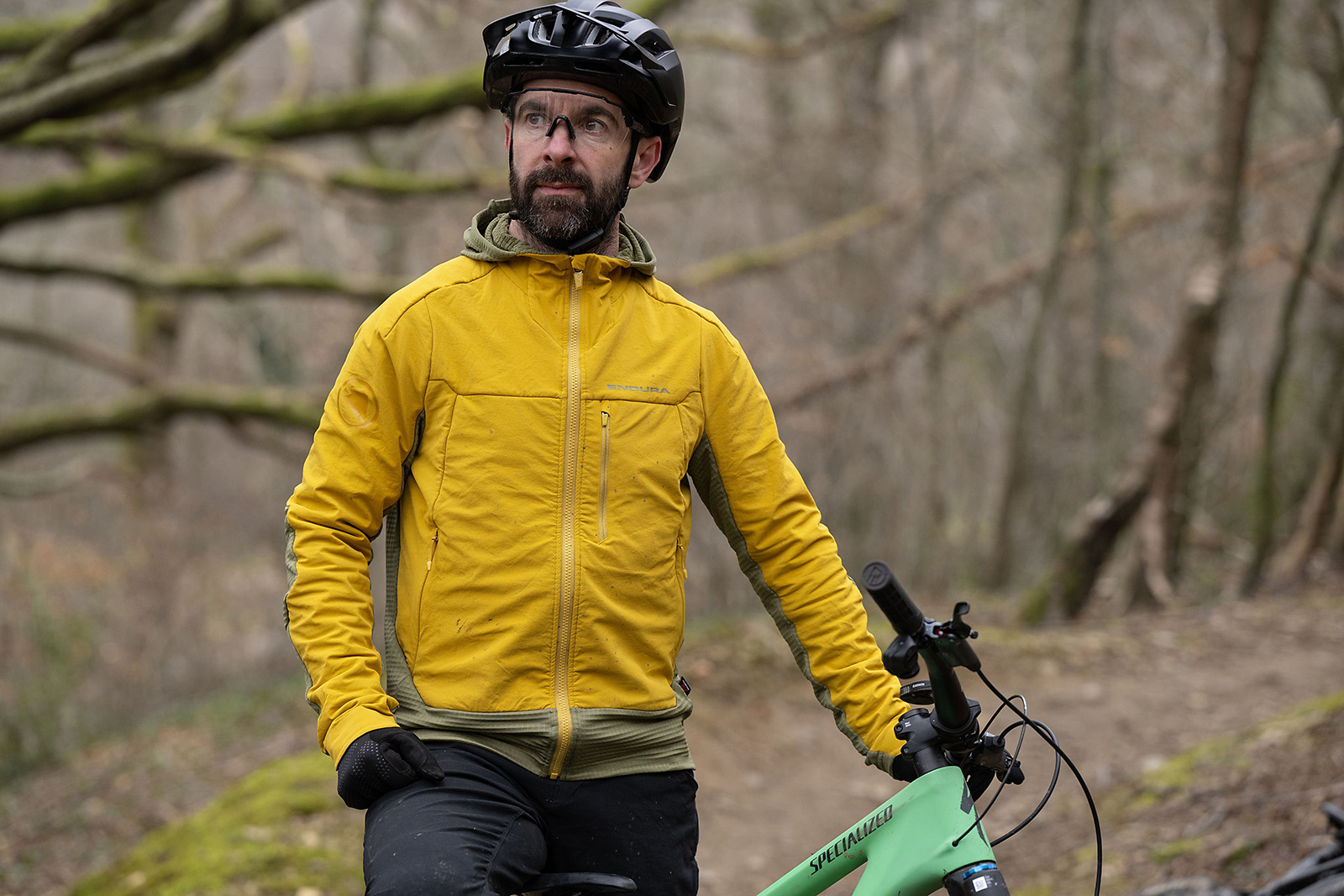
The Polartec Jacket is a thermal midlayer designed for the trails, using Polartec fleece and wind-resistant panels to keep you cosy on cool days.
A full-length zipper should make dumping heat easy on fireroad climbs, while large hand pockets should keep your fingers from freezing at the trail head.
There’s also a slim-fitting hood to fit under your helmet for extra insulation.
Last Thursday, the Financial Times broke the story of the Government’s potential cap on Cycle to Work purchases, quoting a Government source as stating that “taxpayers shouldn’t be footing the bill for luxury leisure”. Since then, there’s been widespread criticism of the rumoured change.
Labour MP Fabian Hamilton, chair of the all-party parliamentary group on cycling and walking, was quoted in a follow-up article in the Financial Times on Saturday as saying that “a crude cap would land on the wrong users”.
Saturday’s FT also quoted Will Butler-Adams, chief executive of Brompton, who stated that putting a barrier between working people and the innumerable benefits of cycling felt short-sighted.
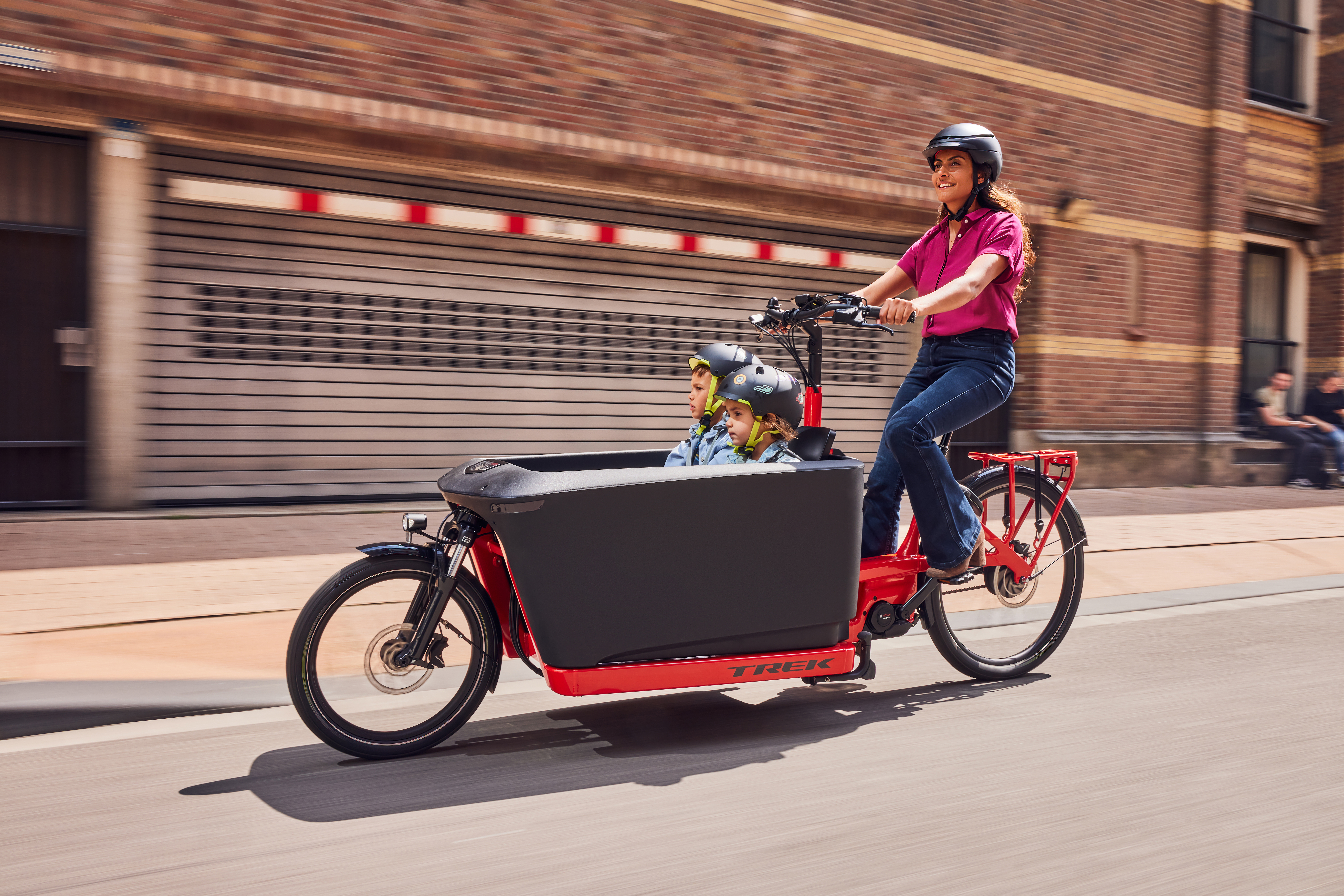
Fully Charged says the value of a typical electric cargo bike purchase is £4,000. Trek
Additionally, the FT talked to specialist retailers of electric bikes, with Dan Parsons of Fully Charged pointing out that none of its bikes retail for under £2,000 and that its average transaction price for an electric cargo bike, allowing a family to replace a car to transport children, is £4,000.
Parsons noted that take-up of the Cycle to Work scheme isn’t confined to London and the home counties, and that it’s a popular choice to fund bike purchases at Fully Charged’s other stores, including its latest opening in Cornwall.
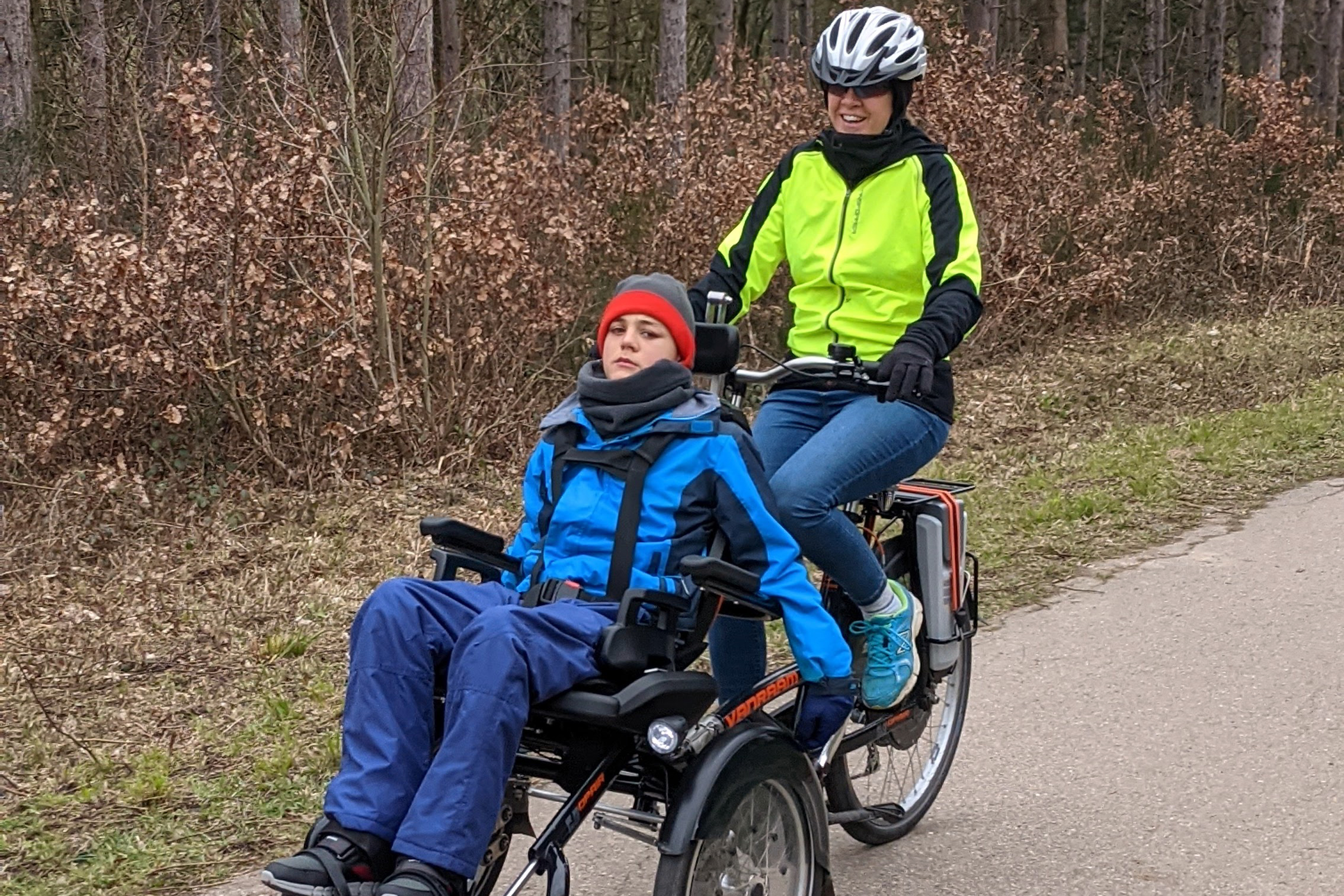
Adapted bikes are made in small volumes and are often expensive. Vicky Balfour
There’s also been comment from cycling bodies, including Cycling UK and the Cycle to Work Alliance.
Cycling UK’s director of external affairs, Sarah McMonagle, points to the return on investment from Cycle to Work: “While capping the scheme may sound like a sensible way for Ministers to save money, in reality, it will cost the government a lot more. For every £1 spent on the Cycle to Work scheme, we see over £4 in returns: boosting productivity, reducing sick days, and saving households money.”
“With the popularity of ebikes and cargo bikes soaring, supporting these trends is not just good for individuals, but for the economy as a whole. Any proposal to cap the scheme must consider people who require higher-cost cycles, such as cargo bikes or assisted cycles for disabled people,” she continues.
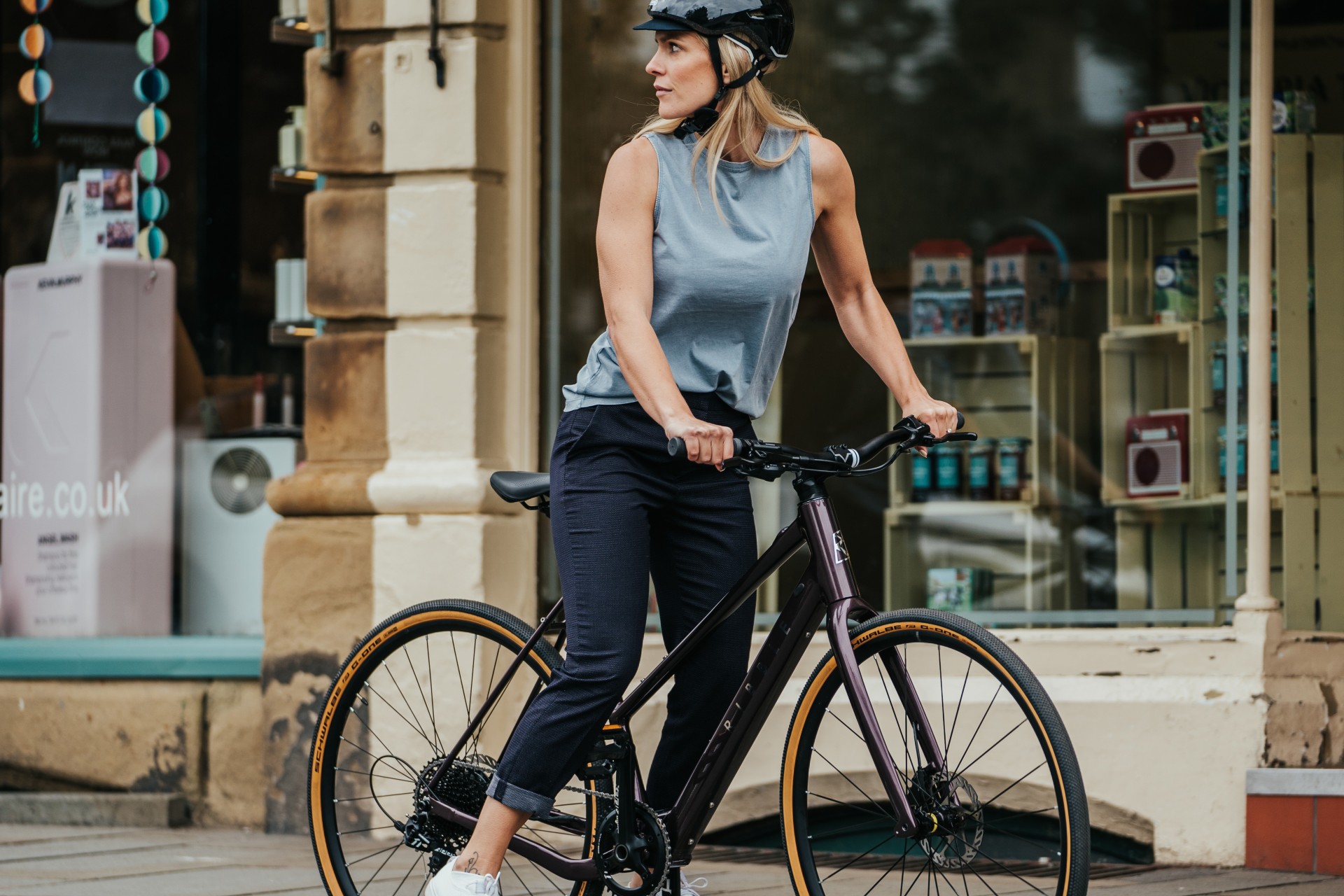
The abolition of the £1,000 cap put electric bikes within range of Cycle to Work purchases. Ribble
Cycle to Work Alliance chair, Steve Edgell, points to the increased range of bikes now available through Cycle to Work, following the abolition of the previous cap.
“In 2019 a spending cap of £1,000 was abolished, as it was preventing people from being able to access the equipment they needed for everyday commutes. By effectively excluding e-bikes and adapted cycles from the scheme, the cap discriminated against older people and those with disabilities,” he states.
Luxury leisure – and with zero VAT.
Commenting on LinkedIn, former Cyclingnews editor, Peter Stuart, points to the zero VAT rating of aircraft seats: “Fuel duty exemptions for aviation fuel mean private jet passengers pay the lowest tax per tonne of CO₂ of anyone in the sky. That, to me, sounds a lot like ‘taxpayers footing the bill for luxury leisure’.”
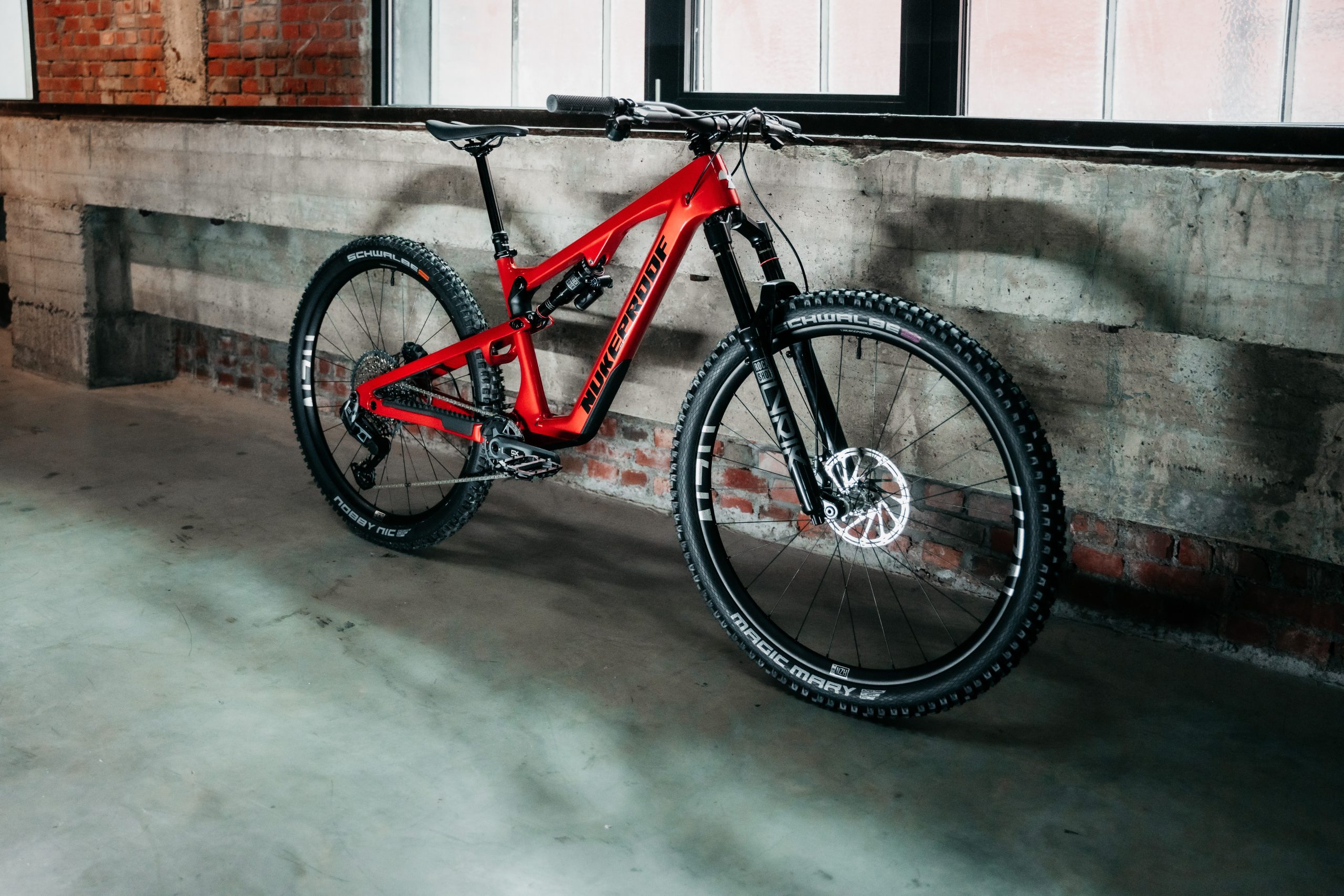
Nukeproof is a brand that has achieved near-cult status since its founding in 1990, thanks to its well-priced performance mountain bikes, and a series of downhill and enduro podiums over the 10 years from 2013.
Now, Nukeproof is back with a range of bikes including a new, competitively priced version 2 of its Reactor and its full range of popular downhill, enduro and trail bikes.
But in the gap left by the brand’s disappearance with the 2023 collapse of Wiggle Chain Reaction and its re-emergence under the auspices of Belgian Cycling Factory, which also owns the Ridley and Eddy Merckx brands, multiple fake Nukeproof websites appeared, according to Clive Gosling, Nukeproof’s global brand director.
Nukeproof is back, with bikes such as the updated Reactor. Nukeproof
“Because nukeproof.com has been inactive while we relaunch the brand, other people have taken advantage of that situation,” Gosling says. That’s resulted in a slew of faux Nukeproof sites online, often outranking the official site in Google search results.
Gosling says the process of taking down each imitator site took at least six weeks and involved Belgian Cycling Factory’s legal department.
“It was a bit like whack-a-mole. As soon as we got one down, another one popped up,” he says.
Back on top: Nukeproof now outranks the imposters in Google searches for the brand.
The result has been, according to Gosling, that even one industry insider he’s worked with on the Nukeproof relaunch has been fooled. That gave a poor initial impression of the Nukeproof brand, due to the low quality of the spoof site they’d accessed, which Gosling says included AI-rebranded Santa Cruz bikes.
“There’s different spoof sites,” Gosling says. “Some look like the real site to fool you into buying something and take your credit card details. Other weird spoof sites are just there for brand information. I’ve got no idea what the purpose of them is.”
Gosling says it’s important to check a site’s online credentials, such as its URL and whether the connection is secure, as well as any contact details to make sure you’re on the bona fide brand site.
The good news for Nukeproof is, following its relaunch, it’s now the top result on Google search again.
Zwift Camp: Build is now underway. This is a 5-stage route-based workout series, with each stage lasting one week and focusing on developing power over a specific time interval.
My plan is to do each of the five workouts before their weeks begin, so I can write a post unpacking the workout and delivering some tips along the way. This post covers Stage 2’s anaerobic workout on France’s Bon Voyage. Let’s dive in!
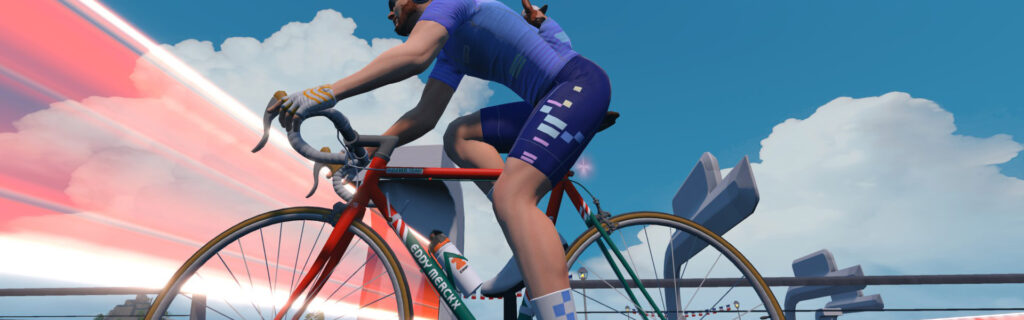
I pulled the 7-Eleven bike out for this ride in France
The second stage of Zwift Camp: Build focuses on what you might call “long sprint power,” with efforts lasting 20-60 seconds. To do so, you’ll ride a lap of France’s Bon Voyage route (31.4km, 155m).
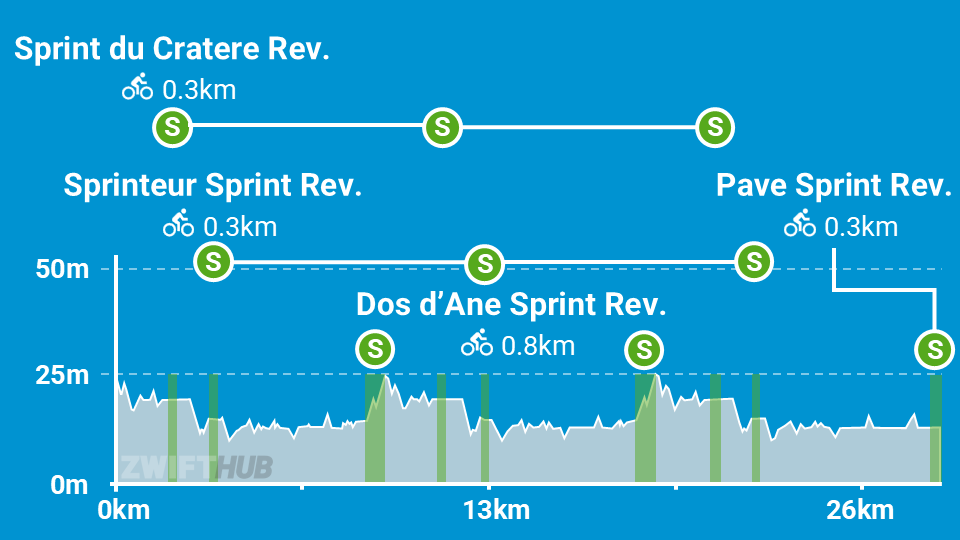
Here’s a profile of the route, not including the lead-in. As you can see, there are 9 sprints on the route itself. But watch out! You’ve got one more on the lead-in, for a total of 10.
Executing the workout is simple enough: just hit every sprint segment hard. (I said simple, not easy!) 10 sprints is a lot, especially when three of them are 1-minute efforts. So expect some suffering.
I went into the workout with semi-tired legs, but figured I could put in a decent effort because I thought we would only be doing three 1-minute efforts, based on the event description.
Unfortunately for me, this workout had more sprints than anticipated. But lucky for you, now that you’re reading this, you know what you’re getting yourself into!
My first sprint, Dos d’Âne Sprint Reverse, began 2.4km into the event. It was a little off, for a few reasons:
It wasn’t clear to me from the on-screen instructions that I was supposed to sprint at the line. (The messaging before most of the subsequent sprints makes this more clear, but this first one did not.)
When I went to turn my Wahoo Headwind fan up partway through the sprint, the fan turned completely off! So I had to fumble around with that.
My legs clearly needed this to be a recovery day.
The sprint was longer than anticipated, taking me 74 seconds to complete.
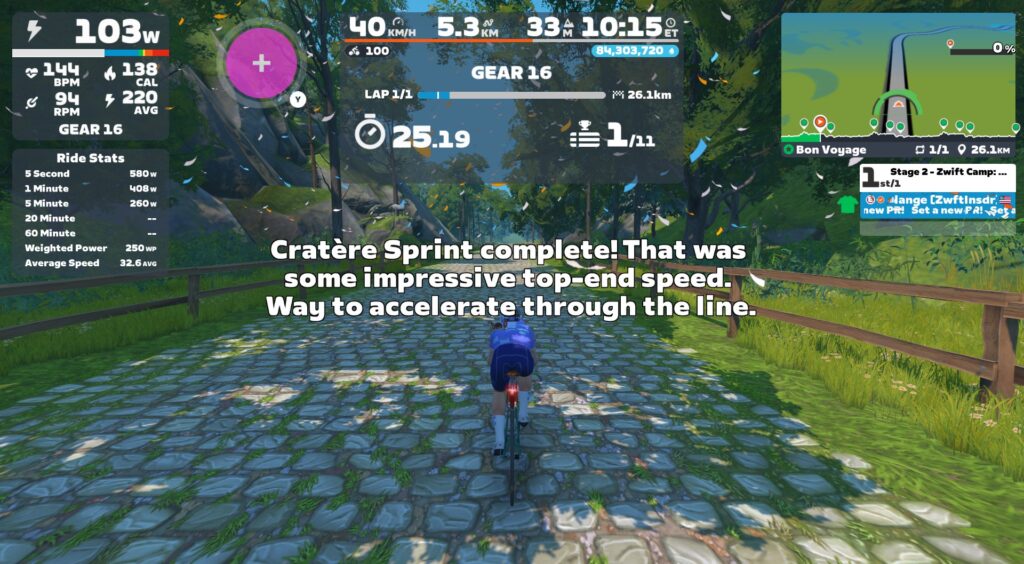
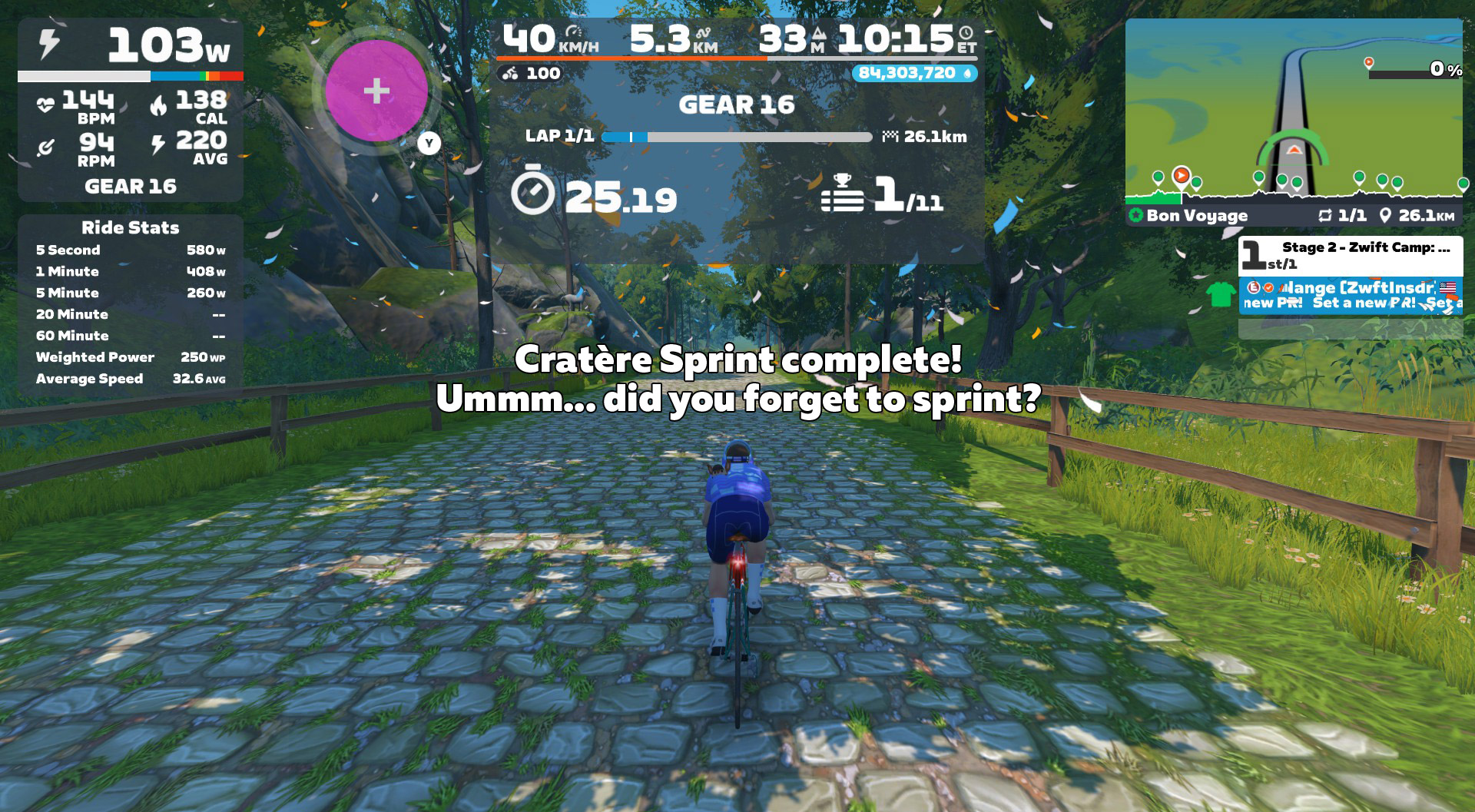
It wasn’t until 4.5km into the ride that a message popped up telling me the next sprint was coming up – Sprint du Cratère – and that I was supposed to sprint on it. That’s when I realized I would be sprinting on every segment on this route. Uh oh. I picked a bad day to have bad legs!
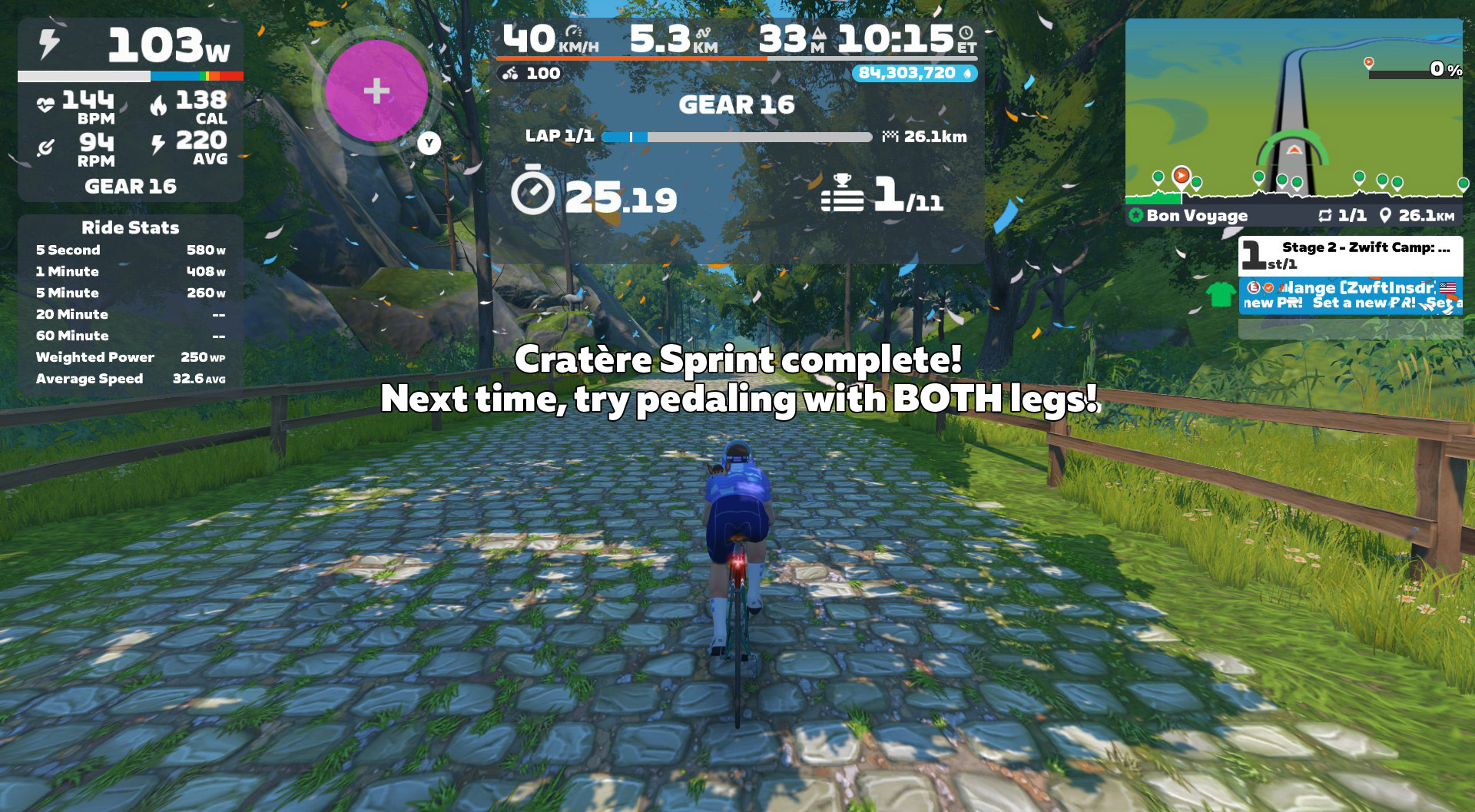
I sprinted rather halfheartedly my first time over Cratère, but the game was very impressed:
Wouldn’t it be cool if Zwift had some intelligence built into these messages, so the response reflected your actual performance? Maybe with a “Snark Slider” in Settings so we could determine how acerbic our coach was. My screen should have said something more like:
This route uses some of the newer HUD features I mentioned in stage 1’s writeup, showing the Ride Stats panel as well as the Lap Splits.
Like stage 1, Ride Stats was more useful than Lap Splits. I appreciated seeing the 1-minute power field on Ride Stats, as that gave me something to chase. But Lap Splits? Totally useless for this workout, because of how the route is laid out and how the Splits were used. (More on this topic in the Suggestion Box below.)
On-screen messaging does a good job of telling you when the next sprint is about to arrive, plus you can see the finish lines approaching on the mini-map profile.
There isn’t much more to say about this workout from an execution standpoint: just sprint hard at every sprint segment, and rest in between.
Again, same warning as stage 1:if you ride this in a group event, it may be harder to dial it down and spin between sprints. But you’ll definitely want to do so, if you want to have the energy for maximal sprint efforts.
HoloReplay Bug
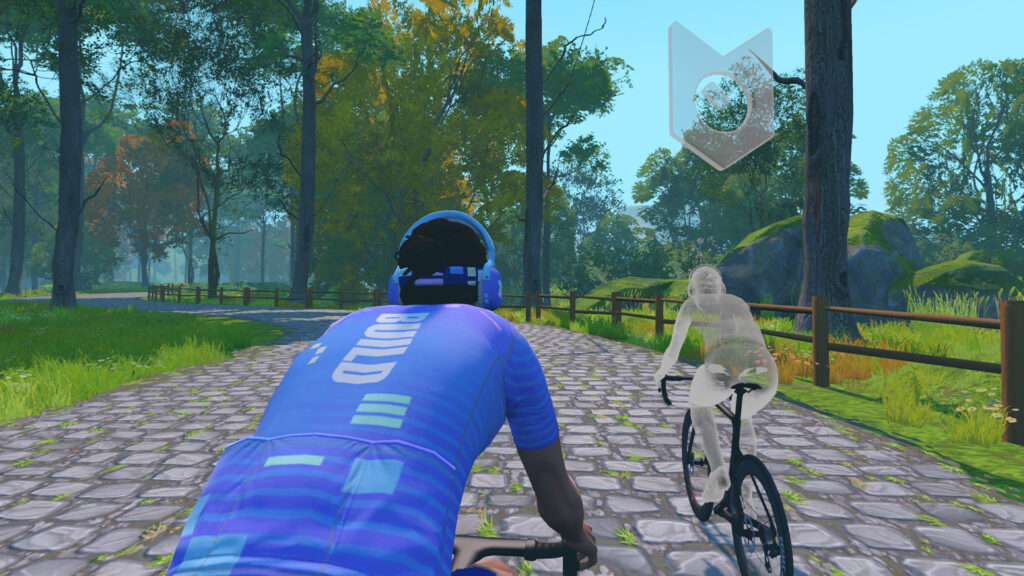
I found Zwift’s HoloReplay to be helpful as a motivator on the sprints, but the same bug is in this workout as in stage 1, causing two different ghosts to appear, instead of just my previous effort. (More on this in the Suggestion Box below.)
Anaerobic capacity is typically measured with a 30-second sprint test
Unlike the neuromuscular system from stage 1, the anaerobic system is highly responsive to training
Strong anaerobic performance is particularly useful in “spiky” cycling disciplines like cyclocross, crits, and MTB racing
Anaerobic Training Tips
The anaerobic system is very adaptable to training, so if you find this is an area you’d like to focus on, you can execute stage 2’s workout more than once! You can also try making your own workout, or using workouts from Zwift’s library.
One classic anaerobic workout is called “Thirty Thirties”. 30 seconds on, 30 seconds off. Repeat this 5-10x, rest for a few minutes, then repeat it again. Do 2 or 3 sets. Fit riders can typically do 3 sets of 10 30-30s. You can do the 30-second hard efforts as free ride segments in a workout, or set them to 130-150% of your FTP if you like ERG mode. You can even do this during a free ride, simply using the game clock as your timekeeper. It’s a simple yet effective workout.
Three tips to maximize your anaerobic workouts:
Fuel properly: Anaerobic work is almost entirely glycolytic, which means it’s fueled by sugar. If you don’t have glycogen stored up to fuel the workout, you won’t be able to put in repeated full efforts in your anaerobic zone.
Go in recovered: If you’re dealing with residual muscle fatigue from yesterday’s workout or tiredness from a poor night’s sleep, you’ll have a really hard time executing a quality anaerobic workout. These efforts are sharp, hard, and repeated. They take focus and mental (as well as physical) energy.
Set accurate targets: if you’re doing these as an ERG workout, make sure your FTP is accurate and your targets are realistic (130-150% of FTP is normal). As with all ERG workouts, an inaccurate FTP means you won’t be training the systems you thought you were training. And nobody’s got time for that!
Suggestion Box
The second workout of Zwift Camp: Build would have gone better if I’d known, going in, that there would be 10 sprints. I would have gone easier the day before, knowing I needed more in the tank.
Here are my suggestions for improvements Zwift could make to stage 2:
No Lap Splits: This route is basically two laps of a circuit, plus a lead-in at the start, and a “lead-out” at the end. So at best, you could time two “laps”. But the way it’s set up, the first lap isn’t auto-triggered until the second time through the Dos d’Âne Sprint, meaning the first lap’s time includes the lead-in. That means you can’t compare it to the second lap’s time… which makes the Splits timers useless for this workout.
Fix HoloReplays: It’s clear that Zwift has hard-coded the HoloReplay functionality into these events, because changing my settings doesn’t seem to make a difference! It wasn’t a big deal for me, and the ghosts still motivated me to push hard. But Zwift should fix these events so they automatically show HoloReplays (just one ghost of your previous effort) for everyone.
Improve the event description: I already mentioned this for stage 1, but stage 2 is a perfect example of how a simple line or two in the event description would clarify what people are signing up for. (Also, the description of stage 2 says “Target Effort: Three 1-Minute Efforts”. But the actual event has you sprinting 10 efforts of various lengths.)
In-game messages that are realistic: OK, this is sort of silly and a major stretch goal at best. But it sure would be cool if the game could respond accurately to my actual efforts on the segments. It has the data necessary to do so. Just hook it up to ChatGPT and let ‘er rip!
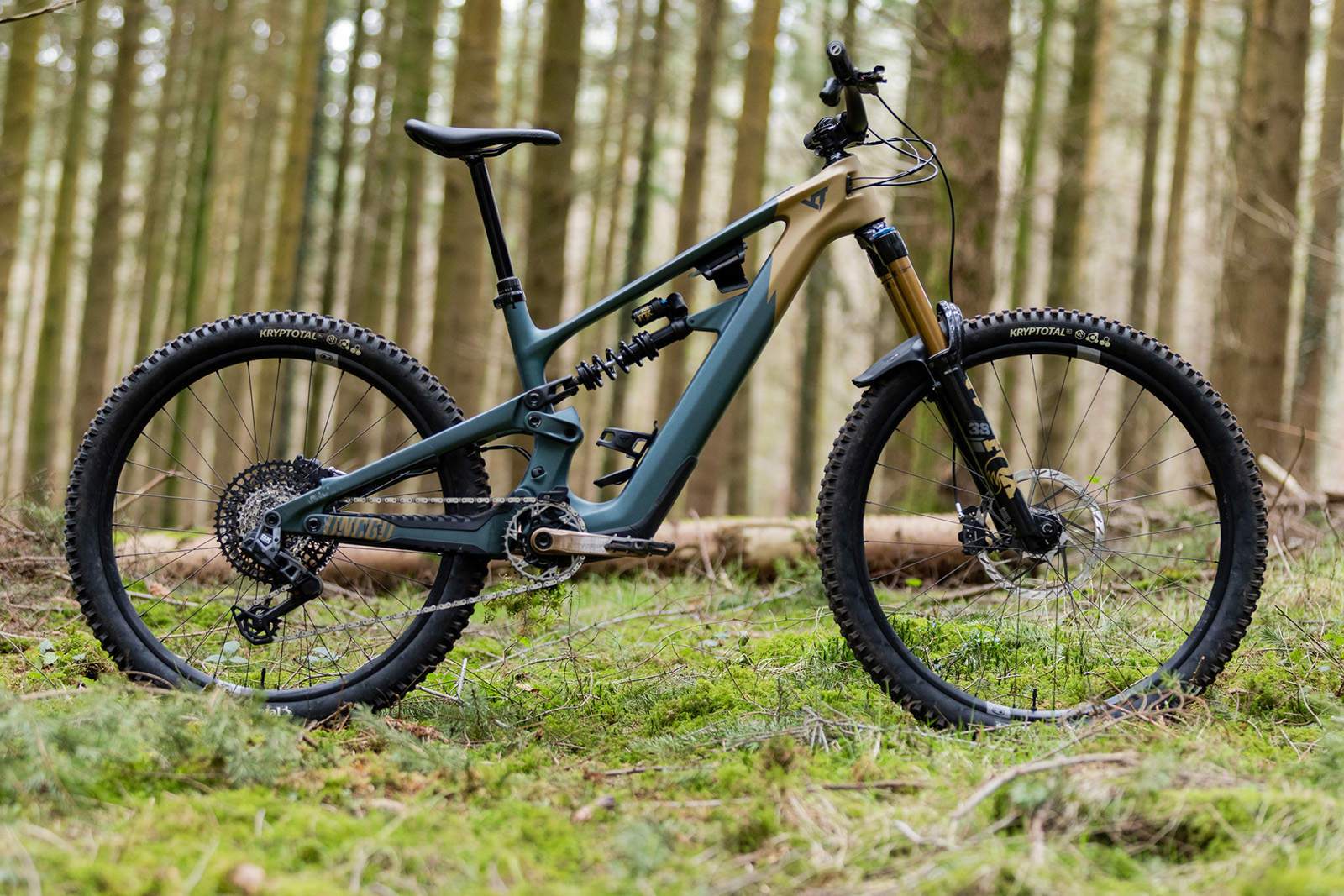
YT Industries has relaunched today under new ownership. The well-regarded German mountain bike brand went into self-administration in July.
However, CEO and founder Markus Flossmann purchased the brand and its assets in September. Since then, his team have been working on the relaunch and fulfilling orders from before YT collapsed.
The relaunch sees almost all of YT’s bike range back in stock, and expected to be available to buy online in the UK and EU over the next few weeks. US availability will be a little later, with new products to follow.
CEO and founder Markus Flossmann has bought back YT and is relaunching the brand.
“Back to the roots. This isn’t a marketing slogan, it’s a promise,” says Flossmann. “We’re focusing again on what made YT strong: uncompromising bikes, fair prices, and genuine passion for the sport. Rough, real, and authentic.”
Although YT has reduced its staffing, it says it has kept the core of the previous team. YT states it’s also focusing on developing a wider global service network, particularly in the USA and UK, to improve service quality and accessibility.
YT expects to have its complete range, including the Decoy, available again. Scott Windsor / Our Media
When YT Industries folded, it left a number of outstanding orders, but Flossmann says fulfilling these or organising a refund has been a priority.
“This is my personal top priority. Every customer who placed their trust in YT will receive what they paid for. That’s always been my promise,” he states. “For us, this is far more than just an administrative process. It’s about trust, responsibility, and credibility.”
If you were affected and your order hasn’t been resolved, there’s a dedicated support email address you can use to contact YT’s customer services: stormsurvivor@yt-industries.com.



 )
)