It’s been a surprisingly strong year for the Nintendo Switch even as sales slow and fans eagerly await its successor, and today the company promoted a bunch of indie games that will fill out the console’s release calendar heading into 2024, from a new Shantae action-platformer to a port of beloved cult-hit sci-fi…
Music gear and plugin maker Arturia is known for its annual Black Friday sale and it’s that time of year again. The sale is officially live, offering deep 50 percent discounts on most of its software instruments and effects plugins.
That means you can snag the stellar V Collection 9 for $300 instead of $600. The latest and greatest collection of vintage synth recreations now features 32 instruments, along with thousands upon thousands of presets. The sounds are pristine, the interface is solid and the presets are easily accessible, thanks to integration with the company’s Analog Lab software. You even get integration with those newer Mac chipsets.
The sale also applies to Arturia’s collection of effects plugins, which recently added a rotating Leslie speaker to its roster of studio-grade effects. Other than that, the collection includes everything you need to finish up high-quality tracks, from compressors to reverbs and beyond. The sale brings the price down to $250 from $500.
The discounts aren’t just for collections of virtual instruments and plugins. You can also get the well-reviewed Pigments synthesizer for $100 instead of $200. This is the company’s flagship modern soft-synth, with two engines working in parallel to create unique sounds. Arturia also frequently updates this software with new engines and effects.
Analog Lab is also on sale for $100 instead of $200, making for an extremely attractive entrypoint to Arturia’s many offerings. The Black Friday sale starts today and ends on December 5, so you have a couple of weeks to set aside plugin money.
This article originally appeared on Engadget at https://www.engadget.com/arturias-black-friday-sale-is-live-and-offers-50-percent-off-flagship-software-200027466.html?src=rss
It’s still kind of wild to us that last year brought a new Predator movie, and a good one at that. After decades of the franchise flopping around unable to figure out what it wanted to be, director Dan Trachtenberg stepped up to the plate with Prey, a standalone prequel that gave us the kind of emotion and thrills the…
The Top500 organization released its semi-annual list of the fastest supercomputers in the world, with the AMD-powered Frontier supercomputer retaining its spot at the top of the list with 1.194 Exaflop/s (EFlop/s) of performance, fending off a half-scale 585.34 Petaflop/s (PFlop/s) submission from the Argonne National Laboratory’s Intel-powered Aurora supercomputer. From a report: Argonne’s submission, which only employs half of the Aurora system, lands at the second spot on the Top500, unseating Japan’s Fugaku as the second-fastest supercomputer in the world. Intel also made inroads with 20 new supercomputers based on its Sapphire Rapids CPUs entering the list, but AMD’s EPYC continues to take over the Top500 as it now powers 140 systems on the list — a 39% year-over-year increase.
Intel and Argonne are currently still working to bring Arora fully online for users in 2024. As such, the Aurora submission represented 10,624 Intel CPUs and 31,874 Intel GPUs working in concert to deliver 585.34 PFlop/s at a total of 24.69 megawatts (MW) of energy. In contrast, AMD’s Frontier holds the performance title at 1.194 EFlop/s, which is more than twice the performance of Aurora, while consuming a comparably miserly 22.70 MW of energy (yes, that’s less power for the full Frontier supercomputer than half of the Aurora system). Aurora did not land on the Green500, a list of the most power-efficient supercomputers, with this submission, but Frontier continues to hold eighth place on that list. However, Aurora is expected to eventually reach up to 2 EFlop/s of performance when it comes fully online. When complete, Auroroa will have 21,248 Xeon Max CPUs and 63,744 Max Series ‘Ponte Vecchio’ GPUs spread across 166 racks and 10,624 compute blades, making it the largest known single deployment of GPUs in the world. The system leverages HPE Cray EX â” Intel Exascale Compute Blades and uses HPE’s Slingshot-11 networking interconnect.
We are now six days into the Epic v. Google legal showdown over whether the Google Play Store is an illegal monopoly with high fees and strict rules designed to control Android app developers. Things are getting wild as Google employees—including the company’s CEO—might have deleted evidence or hidden chats from court…
From SC23 going on in Denver, the PCI-SIG team sent out a news release that they have announced the naming for their next-generation PCI Express cabling… CopprLink…
Enlarge/ A file photo of Tropical Storm Fiona as seen in a satellite image from 2022. (credit: Getty Images)
On Tuesday, the peer-reviewed journal Science published a study that shows how an AI meteorology model from Google DeepMind called GraphCast has significantly outperformed conventional weather forecasting methods in predicting global weather conditions up to 10 days in advance. The achievement suggests that future weather forecasting may become far more accurate, reports The Washington Post and Financial Times.
In the study, GraphCast demonstrated superior performance over the world’s leading conventional system, operated by the European Centre for Medium-range Weather Forecasts (ECMWF). In a comprehensive evaluation, GraphCast outperformed ECMWF’s system in 90 percent of 1,380 metrics, including temperature, pressure, wind speed and direction, and humidity at various atmospheric levels.
And GraphCast does all this quickly: “It predicts hundreds of weather variables, over 10 days at 0.25° resolution globally, in under one minute,” write the authors in the paper “Learning skillful medium-range global weather forecasting.”
Android has long had an iMessage problem. In the US, Apple’s proprietary chat platform reigns supreme, particularly among teens. In fact, many Americans won’t switch for fear of the perceived social stigma that comes with the green chat bubbles iMessage assigns to messages from Android phones. Google has tried a few different things to convince Apple to open the platform, including turning to the European Commission for regulatory relief. For most Android users, that’s meant there’s been little they’ve been personally able to do about the situation. Until now.
Nothing today announced Nothing Chats, a messaging app that supports both RCS and iMessage. Nothing Chats builds on Sunbird, a unified messaging platform that has been available in closed beta since the end of last year. Sunbird allows users to access all of their chats, including iMessage, from a single interface. As of this past April, the app had a waitlist more than 100,000 entries long. Sunbird is one of a few apps that Android users can turn to chat with their iPhone-touting friends. The most well-known player in the space is Beeper, which is the brainchild of Pebble founder Eric Migicovsky.
Nothing
With Friday’s release of Chats, Nothing isn’t just promising to allow Phone 2 owners to “camouflage” themselves as iPhone users. Out of the box, Chats will ship with support for many of iMessage’s signature features, including typing indicators, high-resolution media sharing and proper group messaging. Read receipts and Tapback reactions will arrive at a later date. As mentioned above, Chats also supports RCS, meaning you can enjoy iMessage-like features when messaging your Android friends too.
“We understand that the blue bubble vs. green bubble dilemma, especially in North America — although seemingly ridiculous — is real. Nothing Chats allows for freedom of communication between anyone regardless of their brand of smartphone – which is how it should be,” said Nothing CEO Carl Pei. “We want to remind consumers that they do have a choice when it comes to device selection and that their daily behaviors should not be dictated by any one company.”
So, what’s the catch? “There’s no data saved on the platform, so users don’t have to worry about their privacy,” Pei told Inverse. But there are some concerns. Sunbird, like Beeper, employs a workaround that Apple doesn’t officially support, and that the company would almost certainly argue puts users at risk. Nothing told Inverse Sunbird’s “patented” process for bringing iMessage to Android involves server farms of Mac minis that route a user’s messages through to Apple.
Before someone can access iMessage on Nothing Chats, they must first sign into their Apple ID through Sunbird’s platform. Nothing told Inverse all iMessage content sent through Chats is encrypted, and that “at no point can Sunbird access your messages or Apple ID.” Additionally, Nothing notes the startup will delete a user’s Apple ID credentials after two weeks of inactivity. Still, if you decide to use Nothing Chats to access iMessage, you’re effectively handing over the keys to your Apple ID to a company that isn’t Apple.
Nothing
As for whether Nothing Chats is long for this world: Asked about the possibility of Apple taking legal action against Nothing and Sunbird, Pei told Marques Brownlee he thought the tech giant would “probably [do] nothing.”
In a separate interview with The Washington Post, Pei said Nothing has sold “about six figures’ worth” of Phone 2 devices in North America, Britain and Europe. In other words, it’s a small fish in a big pond. More importantly, Apple finds itself in a regulatory environment where attempting to shut down a platform that is opening up iMessage would draw the attention of regulators in the European Union and beyond.
Nothing Chats will be available to download from the Play Store starting on November 17. For the time being, a Nothing Phone 2 is required to access the platform, with regional availability limited to the US, Canada, UK, EU and other European countries, including Norway and Switzerland.
This article originally appeared on Engadget at https://www.engadget.com/nothing-phone-2-is-getting-imessage-support-this-friday–with-some-catches-194655776.html?src=rss
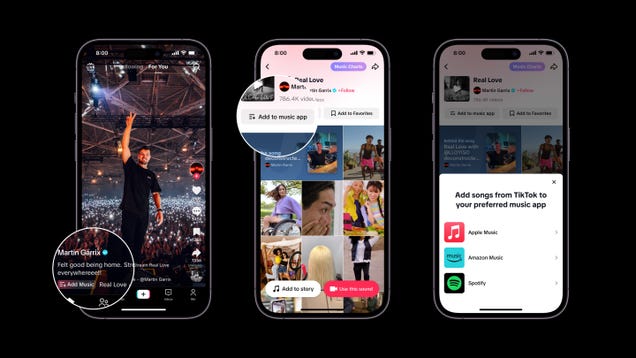
TikTok’s cultural dominance just gained another weapon, and it’s an awfully convenient one: a new feature that will easily allow users to add songs they hear on TikTok to a streaming service like Amazon Music, Apple Music, and Spotify. “Add to Music App” is available in the U.S. and the UK starting today, with plans…
On Tuesday, the Pew Research Center released its latest look at how the US public views scientists and the scientific endeavor. While recent years have shown a decline in the public’s trust in science, these could be viewed as a return to normalcy after a spike in positive feelings during the pandemic’s peak. But this year’s data shows the decline has continued, creating a decline that has now taken us below pre-pandemic levels of trust.
The drop is most pronounced for self-identified Republicans and those without a college education. Despite the decline, however, scientists rank among the most trusted occupations in the US.
A trust deficit
The data used by Pew comes from a survey of nearly 9,000 participants, which provides a margin of error of just ±1.6 percentage points. For some of the individual questions, Pew has been gathering data since at least 2016, allowing it to spot trends in the public’s views. It also has data from all of the pandemic years, including two polls done during 2020, making it easier to spot how that event influenced perceptions of science.
TikTok now lets you save songs you find on the app to your favorite music streaming services, like Apple Music, Spotify, and Amazon Music.TikTok now lets you save songs you find on the app to your favorite music streaming services, like Apple Music, Spotify, and Amazon Music.
On 14 December is the previously-announced launch of 5th Gen Xeon Scalable “Emerald Rapids” and Intel Core Ultra “Meteor Lake” processors via a webcast from NASDAQ that Intel is promoting as the “AI Everywhere” event. AMD meanwhile recently announced an “Advancing AI” event for the week prior. While details on the AMD Advancing AI event are light, it’s all the more interesting now with AMD teasing open standards and open-source around the event…
Did you know there’s an Asahi flavored Ubuntu? And Debian, too. Ubuntu Summit 2023 A subthread of the Ubuntu Summit was Ubuntu on Arm and RISC-V kit: a fast-growing area of interest for many people.…
If you want extra help in the kitchen for this Thanksgiving (and beyond), Amazon has the Breville Smart Oven Air Fryer Pro on sale for $130 off its sticker price. The stainless steel countertop oven is incredibly versatile, offering 13 settings for cooking and heating. Typically costing an eye-opening $450, this oven is down to a tempting $320 in this Amazon Black Friday deal.
The Breville Smart Oven Air Fryer Pro is one of Engadget’s best air fryers for 2023 and the best air fryer toaster oven on the list. It’s powerful enough to act as a secondary oven (or your only one if your primary oven is out of commission), but it can also do things as simple as reheat leftovers or toast a slice (or nine) of bread.
Its modes include air frying, toasting, broiling, baking, pizza, dehydrating, slow cooking and proofing. It has an internal capacity of one cubic foot and can cook an entire 14-pound turkey and fit things like a five-quart Dutch oven, a 9 x 13 pan or 12 muffin trays. It’s also spacious enough to spread out things like fries for optimal crispiness.
The Breville oven has an LCD that makes it easy to choose heating modes. It can indicate when it reaches a pre-heat temperature and automatically begins counting down the cooking time.
The oven supports a temperature range of 80 to 480 degrees Fahrenheit. Breville says its super convection feature can reduce cooking time by up to 30 percent for crispy-golden air frying, dehydration or roasting. However, the oven takes up a decent amount of counter space, so ensure your kitchen has room for the 21.5-inch wide x 17.5-inch deep x 12.7-inch high product before taking the plunge.
This article originally appeared on Engadget at https://www.engadget.com/amazon-cuts-the-price-of-the-breville-smart-oven-air-fryer-pro-by-29-percent-for-black-friday-193021062.html?src=rss
SK hynix had started volume shipments of its LPDDR5T-9600 memory for high-end smartphones, the company announced this week. So far, the company’s LPDDR6 ‘Turbo’ memory with a 9600 MT/s data transfer speed has been certified to work with two range-topping mobile application processors from Qualcomm and MediaTek.
SK hynix’s LPDDR5T-9600 memory is available in 16 GB packages with a VDD voltage range of 1.01V to 1.12V and a VDDQ of 0.5v. Notably, this VDD range is just slightly over the LPDDR5X specfication (1.00V to 1.1V), which shouldn’t be a serious problem, but likely warrants some extra compatibility testing with existing chips.
Smartphone and SoC manufacturers have a great incentive to validate SK hynix’s LPDDR5T-9600 and Micron’s LPDDR5X-9600 memory as these modules offer a 76.8 GB/s peak bandwidth, up 12.5% from 68.2 GB/s offered by LPDDR5X-8533.
So far, SK Hynix’s LPDDR6T-9600 modules have been certified by Qualcomm for its Snapdragon 8 Gen 3 mobile SoC as well as MediaTek for its Dimensity 9300 and some subsequent processors. Meanwhile, SK Hynix confirmed that it had begun shipments of its LPDDR6T-9600 devices to Vivo, which will use it for X100 and X100 Pro mobile application processors.
Following the latest trends, SK hynix mentions that its very fast LPDDR5T-9600 memory will be particularly useful for on-device AI applications. And, of course, faster DRAM is always welcomed for graphics intensive mobile applications, such as games.
“Smartphones are becoming essential devices for implementing on-device AI technology as the AI era kicks into full swing,” said Myoungsoo Park, Vice President and Head of DRAM Marketing at SK hynix. “There is a growing demand for high-performing, high-capacity mobile DRAMs in the market. We will continue to lead the premium DRAM market based on our technological leadership in AI memories, while staying in tune with market demands.”
It’s been nearly a decade since GamerGate, the misogynistic game industry tantrum that harassed women under the guise of demanding journalistic ethics—yet 2023 has felt like we’re not that far past it at all.
After a series of delays, Hogwarts Legacy is now available for the Nintendo Switch console. The wizardly game was released in February for PS5, Xbox Series X/S and PC, with the PS4 and Xbox One versions following in May. The Switch version was also expected during the first half of the year. However, it was pushed to July and finally, November 14.
Hogwarts Legacy developers said the Switch version was delayed to create the “best possible experience” for players. The Switch’s aging hardware may have also contributed to the delay as this isn’t the first setback we’ve seen for third-party publishers bringing their games to the console.
As for gameplay, Hogwarts Legacy is, as you’re probably aware, based on the Harry Potter series. The game is a prequel, set over a hundred years before Harry and the gang entered the school of witchcraft and wizardry. Once the game starts, players can choose and customize their characters, including which Hogwarts House to join. After that, players will learn to cast spells, brew potions and master different magical abilities. Hogwarts Legacy is currently available for $60 in the Nintendo Store. There’s also a deluxe edition with a Dark Arts Pack, featuring a Dark Arts cosmetic set and a new battle arena. The Hogwarts Legacy: Digital Deluxe Edition will cost $70.
Since its release, Hogwarts Legacy has sold millions of copies — making it one of the best-selling games of 2023 so far. But despite its obvious popularity across platforms, Hogwarts Legacy did not snag a single nomination for this year’s Games Awards.
This article originally appeared on Engadget at https://www.engadget.com/hogwarts-legacy-is-finally-available-for-the-switch-192159972.html?src=rss
After a tech entrepreneur and investor lost his password for retrieving $100,000 in bitcoin and hired experts to break open the wallet where he kept it, they failed to help him. But in the process, they discovered a way to crack enough other software wallets to steal $1 billion or more. From a report: On Tuesday, the team is releasing information about how they did it. They hope it’s enough data that the owners of millions of wallets will realize they are at risk and move their money, but not so much data that criminals can figure out how to pull off what would be one of the largest heists of all time.
Their start-up, Unciphered, has worked for months to alert more than a million people that their wallets are at risk. Millions more haven’t been told, often because their wallets were created at cryptocurrency websites that have gone out of business. The story of those wallets’ vulnerabilities underscores the enormous risk in experimental currencies, beyond their wild fluctuations in value and fast-changing regulations. Many wallets were created with code containing profound flaws, and the companies that used that code can disappear. Beyond that, it is a sobering reminder that underneath software infrastructure of all kinds, even ones explicitly dedicated to securing funds, are open-source programs that few or no people oversee. “Open-source ages like milk. It will eventually go bad,” said Chris Wysopal, a co-founder of security company Veracode who advised Unciphered as it sorted through the problem.
It doesn’t have to be the case that a monster movie has great action and truly turgid human drama between the setpieces, but that’s largely been the case for Legendary’s Godzilla reboot, the “Monsterverse.” Sometimes the action being so fun can tip the odds against some truly stupid human beings—see King of the…
Danny DeVito’s wonderfully awful Frank Reynolds from the long-running TV show It’s Always Sunny In Philadelphia has become an internet icon over the last decade, thanks to his wild behavior and meme-worthy antics. And now the famous asshole has been added to the depressing world of The Last Of Us and the results are…