

Logitech is launching a new version of its A50 series of gaming headsets with the Astro A50 X. The key selling point for the fifth-generation headset is its compatibility. Gamers will be able to use it on Xbox, PlayStation 5, PC, and Mac. This official compatibility across platforms is rarely seen in headsets, with users usually needing to
Source: Hot Hardware – Logitech’s Flagship Astro A50 X Wireless Gaming Headset Plays Nice With PC And Console
Monthly Archives: December 2023
India reveals that it has returned lunar spacecraft to Earth orbit

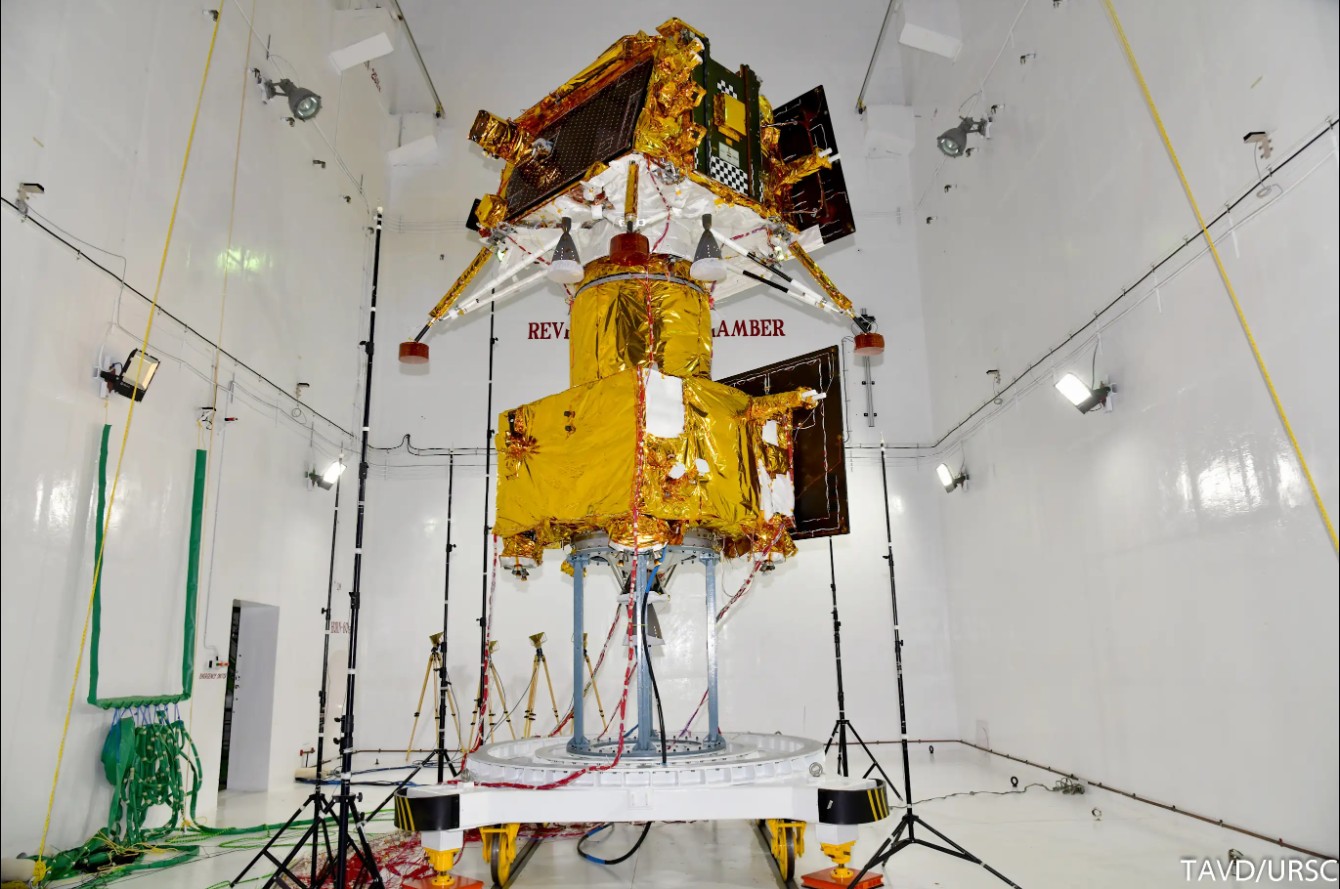
Enlarge / India’s Chandrayaan-3 lunar spacecraft undergoes accoustic testing. The propulsion module can be seen at the bottom. (credit: ISRO)
A little more than three months ago the Indian space agency, ISRO, achieved a major success by putting its Vikram lander safely down on the surface of the Moon. In doing so India became the fourth country to achieve a soft landing on the Moon, and this further ignited the country’s interest in space exploration.
But it turns out that is not the end of the story for the Chandrayaan 3 mission. In a surprise announcement made Monday, ISRO announced that it has successfully returned the propulsion module used by the spacecraft into a high orbit around Earth. This experimental phase of the mission, the agency said in a statement, tested key capabilities needed for future lunar missions, including the potential for returning lunar rocks to Earth.
A capable module
The primary task of the propulsion module was to deliver the Vikram 3 lander into a low-lunar orbit, 100 km above the surface of the Moon. After doing this in August, the propulsion module moved to an orbit around the Moon at an altitude of 150 km. There, its remaining operational goal was to support a science experiment, known as SHAPE, to observe the Earth.
Read 8 remaining paragraphs | Comments
Source: Ars Technica – India reveals that it has returned lunar spacecraft to Earth orbit
OnePlus 12 Launches With A Huge Battery And Snapdragon 8 Gen 3 Firepower

The OnePlus 12 has officially launched in China in an event celebrating the brand’s 10th anniversary. As one of the most anticipated flagship phones, the OnePlus 12 doesn’t disappoint, at least on paper—it will be rocking the latest Snapdragon 8 Gen 3 with plenty of RAM, storage, and a generous battery pack that should push the phone to the
Source: Hot Hardware – OnePlus 12 Launches With A Huge Battery And Snapdragon 8 Gen 3 Firepower
Origin PC Neuron Review: Immaculate Gaming Desktop With Muscle
Origin PC Neuron (starts at $2,200, as tested $4,625) Origin’s customizable gaming PC has lots of high-powered hardware, an attractive design, and a quiet cooling solution that’s up to the challenge. Great attention to detail in build 100% industry standard parts and components Plenty of options in the configurator Excellent gaming performance…
Source: Hot Hardware – Origin PC Neuron Review: Immaculate Gaming Desktop With Muscle

Fedora Workstation 39 Delivers Some Nice Gains For AMD Ryzen 7040 Series Graphics
Here are some benchmarks looking at the performance uplift in migrating from Fedora Workstation 38 to Fedora Workstation 39 on an AMD Ryzen 7040 “Phoenix” series laptop…
Source: Phoronix – Fedora Workstation 39 Delivers Some Nice Gains For AMD Ryzen 7040 Series Graphics
All The Tools You Need to Clean Your Gutters Without Getting on a Ladder
Cleaning your gutters can be a hassle. Leaves and pine needles will drop into them, and they can easily get clogged and overflow, causing you homeownership headaches. Keeping them clear is important, not just during the rainy season, but as winter weather rolls in, as keeping gutters clear will help prevent ice dams from forming on your roof.
But getting up on a ladder to clean out gutters isn’t always the safest or most convenient option. Here are some tools and tool extensions that will help you clear out your gutters without ever leaving the ground.
Use a blower extension
An extension for a standard leaf blower will allow you to clear gutters by stretching the nozzle to roof height and adding an attachment that points down toward the gutter. This universal leaf blower extension kit will work with most leaf blowers and can reach up to 11 feet up. You can also use this extension with a shop vac converted to a blower by switching the vacuum hose from the intake to the exhaust port.
Products recommended:
Here are our top recommendations for tools and tool extensions to help you clean your gutters from the ground.
-
Gutter inspection mirror $24.98
Use water to blast leaves out
To avoid a climb, use water to blast leaves out of your gutters. You have a few options here. The first is a garden hose attachment that will squirt water from your hose up into the gutter, washing leaves up and over the sides. This telescoping garden hose attachment can reach up to seven feet, six inches into the gutter, making ladders unnecessary on first floor gutters.
If you have lower water pressure or a more challenging packed-in leaf situation, using a pressure washer extension is a good choice. This universal pressure washer extension will reach up to nine feet, and can accommodate up to 4000 PSI to blast caked-together leaves out of your gutters. (Just be careful not to use too much pressure, or you’ll risk damaging your gutters.)
Use a long extension pole
If you have a tool that works from the ground, starting with a good telescoping extension pole can set you up for success. A standard seven- to 24-foot extension pole will reach the gutters on most houses, and you can use one pole to swap out multiple tools. Keep in mind that the longer your pole is extended, the more difficult it will be to control.
Use a grabber
If you have a clump of leaves or another object like a ball blocking your gutters, fish it out using a grabber on an extension pole. This gutter cleaning grabber is operated using a rope and a pole and can be mounted on most tool poles. Its jaws will open up to about a foot to accommodate even relatively large objects—but be careful picking up anything too heavy, since the spring operated mechanism isn’t geared for major extractions.
Use a tiny rake
For a low-tech option, you can use attach a telescoping handle to a tiny rake that you can angle to reach into the gutter to remove leaves. Since it attaches with standard fittings like those on painter’s poles, you can use it at whatever extension you like. As it’s small, this rake might be a little too floppy for larger jobs, but it will get the job done for most standard cleanup operations.
Use an inspection mirror
You can also use an inspection mirror to check out what’s in your gutter so you know what tool to use to clear it. Discovering that what you thought was a clump of leaves is really a ball can totally change your approach to the project. Add an inspection mirror to your telescoping pole to see what’s going on from the ground, and check them out again when you’re done to make sure you’ve cleared everything out.
Source: LifeHacker – All The Tools You Need to Clean Your Gutters Without Getting on a Ladder
This NVIDIA Hotfix GPU Driver Solves A Stuttering Issue And A Wonky Discord Bug

NVIDIA rolled out a new ‘Game Ready’ GPU driver for GeForce owners this week, version 546.29 WHQL, which brings optimizations to Cyberpunk 2077: Ultimate Edition (not to be confused with the 2.1 update) and some bug fixes. Since then, however, NVIDIA has made available an optional GPU hotfix—version 546.31—to squash a couple of annoying bugs
Source: Hot Hardware – This NVIDIA Hotfix GPU Driver Solves A Stuttering Issue And A Wonky Discord Bug
Intel, AMD, Red Hat / IBM, Meta & Others Launch The AI Alliance
The AI Alliance has launched as a consortium focused on advancing open, safe, and responsible AI…
Source: Phoronix – Intel, AMD, Red Hat / IBM, Meta & Others Launch The AI Alliance
What Is Copilot and Is It Better Than ChatGPT?
Last year, Microsoft unveiled a special version of its Bing search engine that was also powered by AI. Over the past year and some months, the company has continued to expand its offerings, eventually utilizing that same search engine service as an AI chatbot that it used to call Bing Chat. Now, though, it has rebranded everything involving its AI systems to be called Copilot. But what exactly is Copilot and how does it compare to other AI chatbots out there like ChatGPT and Claude? Here’s what you need to know.
What is Copilot?
Essentially, Copilot is Microsoft’s version of ChatGPT. It even uses the same language as ChatGPT (Microsoft is a major investor in OpenAI), and can be asked similar questions, as well as used to solve complex tasks like math problems, and even to create images using Bing’s Image Creator, all from the same platform.
Copilot is the bread and butter of Microsoft’s AI offerings, and it builds off of GPT-4 really well, while also adding access to the internet—which ensures that Copilot can always provide the most up-to-date information about queries you ask.
You can ask Copilot to write poetry, stories, generate article ideas, and a slew of other things in a similar manner like you would with ChatGPT.
How much does Copilot cost?
Copilot is free. In fact, Microsoft’s Copilot platform is the only way that users can access GPT-4 (the most advanced version of OpenAI’s large language model) for free. All you need to access Copilot is a Microsoft account, which is also free. Chances are, you probably already have one of these if you use a Windows computer.
Why are there multiple Copilot apps?
Perhaps one of the most confusing things about Copilot is that there are multiple offerings under the Copilot umbrella. There’s the Copilot chatbot, then there is Windows Copilot, Copilot for Microsoft 365, and even Copilot for service, Copilot for Sales, and so on down the list.
Ultimately, Copilot is the primary chatbot, though, and you can access it for free. Many of the other versions of Copilot require specific types of subscriptions to use, though Windows Copilot is currently available as a free preview in some versions of Windows 11.
What language model does Copilot use?
Microsoft designed Copilot to work off of the latest version of OpenAI’s GPT model, GPT-4, which is the same model that ChatGPT Plus users get access to. It’s the most advanced model that OpenAI has created, and Microsoft has worked closely with the company to develop it within the constraints of its own systems.
Copilot uses GPT-4 to offer more accurate, reliable, and capable responses than OpenAI’s previous model, GPT-3.5. As I noted above, Copilot is the only reliable way to get access to GPT-4 without having to pay anything. ChatGPT Plus users must pay $20 to access GPT-4 when using OpenAI’s chatbot.
What is Copilot’s chat limit?
Copilot currently offers a 2,000 character limit per chat with the system. This is less than half of ChatGPT’s current 4,096 character limit. (There are ways to bypass those limits in ChatGPT, though we won’t get into that here.)
Despite having a somewhat smaller chat limit, Copilot should offer more than enough space for most of your queries. Note that this limit may change in the future, as it has changed in the past.
How do you access Copilot?
Copilot can be access freely by anyone with a Microsoft account. All you need to do is make your way to the Copilot website and then sign in with a Microsoft account. If you don’t have a Microsoft account, you can always make one to access the AI chatbot.
Microsoft also has not shared any details about making a premium option for Copilot, though that could change in the future.
Is there a Copilot app?
If you don’t want to use the Copilot website, you can always use the Bing app on both iPhone and Android devices to access Copilot. While it isn’t solely dedicated to the AI chatbot, you can still make use of Copilot through the search bar when you open up the application.
How accurate is Copilot?
Since Copilot runs off of GPT-4, it is as accurate as OpenAI’s ChatGPT. However, like most AI chatbots and large language models, Copilot is prone to hallucinating and creating false information. As such, you should always check any of the data and information that Copilot provides you with to ensure that you aren’t plagiarizing or stealing content.
It should also be noted that in the past Copilot was known for taking credit for information that it had actually read from other websites, so it’s important to check the quality of any and all work that you do with the AI chatbot.
Is Copilot better than ChatGPT?
This is a bit of a loaded question, and a difficult one to answer. Because ChatGPT and Copilot both run off of the same language models, they operate in very similar ways. However, users running the free version of ChatGPT, which is locked to GPT-3.5, will find that Copilot is much more efficient and accurate than ChatGPT. If you use ChatGPT Plus, though, and subscribe to use GPT-4, then you’ll be getting similar efficiency.
There is one area that Copilot tends to do exceptionally better than ChatGPT, though, and that all ties into how much Copilot has been built around search. GPT-4 enables a lot of advancements that older LLMs don’t support, including full access to the internet, which is possible thanks to Microsoft’s Bing connection. While you can get internet connection through a plugin with ChatGPT, Copilot was built to take advantage of the billions of bytes of data accessible across the internet. As such, it is by far one of the easiest ways to access the most up-to-date information when utilizing an AI chatbot. It’ll even cite its sources, so you can check where the bot pulled a certain claim from for yourself.
At the end of the day, though, both ChatGPT and Copilot will respond similarly because they use the same large language model, and Microsoft isn’t changing much of what’s happening behind the scenes.
Source: LifeHacker – What Is Copilot and Is It Better Than ChatGPT?
Electric Vehicles are better than gas-powered cars in winter—here’s why

Enlarge (credit: Getty Images)

Objectively speaking, a battery-electric vehicle provides a superior driving experience in cold and inclement weather to its internal combustion engine-powered counterparts—for numerous reasons. Comfort, control, even durability benefits come along for the cold ride. Let me explain.
First, actually, let me concede a point. It’s true that BEVs lose range in colder climates. The two main reasons for that stem from the need to keep both the cabin and battery pack warm, which requires energy that would otherwise go toward going. And, generally speaking, it takes more energy to warm an electric vehicle in the winter than to cool it in the summer.
But bear in mind, all cars lose range in the winter. Air gets denser as it cools, which takes more work to push through. And all the viscous fluids vehicles need take more time to warm up to their respective operating temperatures. And that means your engine, transmission, and differential all have more work to do—requiring more energy—in the cold.
Read 17 remaining paragraphs | Comments
Source: Ars Technica – Electric Vehicles are better than gas-powered cars in winter—here’s why
Spice-infused Oil Is the Key to This Festive Popcorn
I hate to tear you away from the mass produced tri-flavor popcorn tin, but there’s an even more delightful popcorn that’s perfect for cozying up with on the couch. It’s your own homemade holiday-spiced popcorn, and it pairs uncommonly well with hot chocolate and marshmallows. This recipe uses common pantry spices and if you’ve ever baked a pumpkin pie, I’m guessing you have them already. Grab the nearest two-quart pot, and let’s get poppin’.
Unlike my strong feelings for great coffee, I’m not a popcorn snob in the slightest. I like it all—pre-bagged, microwaved, air-popped, or kettle. Recently, despite distinct memories of disliking this method, I’ve returned to the classic stove-top pop. I don’t know what drove me away because I’m quite enjoying myself. Not only does the ruckus of exploding kernels bring a smile to my face every time, but there’s more freedom with flavoring. You can add hot or savory sauces to your drizzling butter, after the popcorn finishes popping, or you can flavor the actual fat you use to heat up the kernels. That’s exactly what we’re doing with this recipe.
How to infuse cooking oil with flavor
Before you add the unpopped kernels to the fat in the pot, add spices first to infuse it. This is a technique commonly used in Indian cuisine called tadka (also called tarka, chhonk, baghaar, and other names depending on the region, or referred to as tempering spices). You add whole or ground spices to oil, or ghee, and allow it to heat up and “bloom.” This can mellow overpowering notes in the raw spices, and the flavors of the toasted spices infuse the oil. If you’re using whole spices, the large pieces can be removed to leave behind a subtle, aromatic fat. Ground spices remain dispersed in the infused oil making for a robust dish, and in this case, popcorn.
How to make holiday-spiced popcorn
To make a bowl of holiday cheer, add the fats to a medium-to-large pot over low heat. You’ll see in the recipe I use both butter and cooking oil. I like the flavor of butter more than just straight oil, but adding a splash of canola oil raises the smoke point so my butter doesn’t burn. Alternatively, you could also use ghee which has a higher smoke point than butter. Add salt, and all of the other spices. Swirl the pot to moisten all of the spices and allow them to cook over medium-low heat for 20 seconds to 1 minute depending on how hot the oil has become. You’ll notice the smells of the spices become quite fragrant, and the butter might start to foam.
Dump the unpopped kernels into the pot all at once. Cover the pot and give it a shake so all of the kernels get coated in oil. Extra points if you get the spiced oil up on the inside of the lid. Then crank the heat up to medium. The oil has already heated up so the popcorn should start to pop within a minute. Shake the pot occasionally as the kernels pop, just to make sure the spiced fat is coating the kernels. Crack the lid when the pot is at rest to let steam escape. Take the pot off the heat once the popcorn has significantly slowed and the pot is nearly full of spice-coated popcorn. Pour the popcorn into a bowl.
If you’re using ground spices like in the recipe, it’s best to crank up the heat when you add the popcorn, and pop the kernels as quickly as possible to reduce scorching of any spices that stick to the bottom of the pot. When I poured my popcorn out, the last five or six popcorn pieces on the bottom had some overly toasted spice areas. Any spices that did scorch actually clung to the pot instead of to the corn.
If you want to avoid scorched spices (it didn’t bother me), then I suggest infusing the oil with the same method but using whole spices instead (like broken cinnamon sticks, whole cloves, and cardamom pods). Then remove the spices and you’ll be left with an aromatic fat to cook the popcorn, or save it as a drizzle post-popping. The flavor won’t be as robust, but it’ll be wonderfully fragrant. My popcorn turned out incredibly flavorful, buttery, and perfectly salted. My whole apartment still smells like toasted gingerbread cookies and warm holiday spices even hours later.
Holiday-spiced Popcorn Recipe
Ingredients:
-
1 ½ tablespoons butter
-
1 tablespoon canola oil
-
½ teaspoon ground cinnamon
-
¼ teaspoon ground nutmeg
-
¼ teaspoon ground cloves
-
¼ teaspoon ground allspice
-
½ teaspoon salt
-
¼ cup un-popped popcorn kernels
Heat the butter, oil, salt, and spices for about 1 minute over medium-low heat to infuse the oil. It will get foamy and you’ll notice the fragrance become rather strong. Add the popcorn kernels, cover the pot and turn the heat up to medium. Shake the pot to coat the kernels with the infused fats. Once the popcorn begins popping, shake the pot occasionally to coat the popped popcorn with more seasoned fat. Take the popcorn off the heat when the popping slows down to one pop every three to five seconds. Pour it into a bowl and enjoy immediately.
Source: LifeHacker – Spice-infused Oil Is the Key to This Festive Popcorn
This Folding Kayak is Surprisingly Seaworthy
Every good thing has its downsides, and for a casual kayaker, the flip side of owning a small boat that you can take out anytime is that you have to get it to the lake somehow—and store it somewhere when you get back home. Car carriers range from the annoying and cheap to the convenient and expensive, but what if there was another way? That’s where Oru Kayak comes in: The company makes kayaks that fold up to the size of a suitcase.
Unlike cheap inflatables (which have their caveats, but can still be fun), a folding kayak promises to be a bit sturdier. There’s no inflating involved, but you do have to figure out how to do origami with corrugated plastic.
For this review, I tried out a 9-foot Lake, Oru’s most basic model, which normally retails for $499. You can spend a lot more than that on more deluxe models, like the 16-foot, $1,999 Coast XT. There are other foldable kayak brands on the market, notably TuckTec, but Oru is the most established.
As noted, these foldable kayaks are no relation to the inflatable kayaks I’ve written about in the past. Inflatables require you to pump them up at the lakeside; if you don’t get them firm enough, they’ll sag under your weight. (Many of the cheap inflatables have a fairly low weight limit, making the front and back of the craft ride high in the water if you’re not, say, a small child.) The Oru Lake promised to be sturdy and seaworthy, so I borrowed one from Oru and took it for a spin.
How annoying is the Oru Lake to fold and unfold?

How the kayak looked after unclasping its suitcase straps
Credit: Beth Skwarecki
Credit: Beth Skwarecki
The Lake promises “1-minute assembly,” but you probably won’t be surprised to learn that that is an optimistic estimate. The first time I practiced putting the boat together in my backyard, I found myself sweating and straining to complete the job. It turned out I did some of the steps in the wrong order and had to undo and redo some of my work; my total assembly time was around 15 minutes.
Once I had some practice under my belt, however, it really was quite quick to get the craft together. My next try, during an actual lake outing, was closer to five minutes. (Oru notes that the plastic can be stiff and hard to fold when it’s brand new, but that over time the fold lines will break in and it will only get easier.)
Helpfully, there is a QR code printed on the boat itself that will take you to an instructional video for both folding and unfolding. The trickiest part is that the boat folds along one set of lines for packing, and an entirely different set for use as a watercraft. When switching from one to the other, you have to unfold certain lines (push hard!) and crease others.
But it does all work, and the pieces fit together nicely. The seat is mounted to an orange rectangle made of stiffer material than the rest of the boat; you place it in the center of the floor. Then you go to the front of the boat and cinch the sides together with buckle straps. At the back of the boat, you do a similar procedure. This cinching is probably the most physically challenging part of the process; when it’s new and stiff, the sides don’t come together easily, and they don’t necessarily meet as neatly in real life as they do in the video, but I expect that with time and some more breaking in, I’ll be able to get closer to the promised one minute.
How does the Oru Lake fare on the water?

Credit: Beth Skwarecki
I took the Lake out for a spin on my local lake one chilly day. (It’s a bit cold for kayak season, but these are the things I do for you, dear readers. Always wear a PFD and appropriate clothing—I wore a wetsuit—when out in cold weather.)
Speaking of PFDs, Oru Kayak sent me one to test. I almost said no thanks, because I have multiple PFDs of my own, but the Oru PFD is one of the most comfortable life vests I’ve worn for paddling. The back of the vest only has flotation foam in the top half, so you can sit comfortably in the kayak’s seat without the seat back bumping the vest around.
The Lake is pretty comfortable to sit in overall. The seat feels good, although the footrest, held in place by the tension of three different cords, is not as stable as it would be in a kayak with more traditional footrests on the sides of the boat.
And, yes, the craft is lakeworthy as promised. I suffered no leaks or surprises. As a 9-foot kayak, it turns a bit to each side with each stroke, but that’s typical of short, flat-bottomed boats. (I would expect the longer, more expensive models to steer a lot straighter.) It doesn’t track quite as straight as my molded plastic Pelican, but that’s a reasonable tradeoff to make for the convenience of a packable boat.
When I was done with my testing, I folded the boat back up. As with the inflatable boats, when you finish using your kayak for the day, it will be wet and somewhat muddy. Oru recommends propping your kayak up for 10 minutes to allow water to drain out of the corrugations of the plastic.
Conveniently, the whole thing packs up into a suitcase-sized package. That is to say, it becomes a suitcase-sized package, complete with handle and closing straps, without you having to stuff it into a separate container. Oru also sells a backpack to help you carry it, but I didn’t see the need; I just chucked the suitcase into the back of my car and headed for home.
Source: LifeHacker – This Folding Kayak is Surprisingly Seaworthy
Daily Telescope: An ancient galaxy behind a veil of dust

Enlarge / Color composite of galaxy AzTECC71 from multiple color filters in the NIRCam instrument on the James Webb Space Telescope. (credit: J. McKinney/M. Franco/C. Casey/The University of Texas at Austin)

Welcome to the Daily Telescope. There is a little too much darkness in this world and not enough light, a little too much pseudoscience and not enough science. We’ll let other publications offer you a daily horoscope. At Ars Technica, we’re going to take a different route, finding inspiration from very real images of a universe that is filled with stars and wonder.
Good morning. It’s December 5, and today’s photo takes us very far from home to a dusty star factory of a galaxy that we need every bit of the James Webb Space Telescope’s power to resolve.
This is the object AzTECC71, and astronomers say we are observing the galaxy as it existed just 900 million years after the Big Bang. And since the Universe is 13.7 billion years old, that is light from a long time ago in a galaxy far, far away.
Read 6 remaining paragraphs | Comments
Source: Ars Technica – Daily Telescope: An ancient galaxy behind a veil of dust
Micron Intros 3500 NVMe SSD: 232L 3D TLC and Phison E25 for the OEM Market

Micron has been on a roll lately with new product introductions despite the downturn in the flash market. The company is currently the only NAND manufacturer shipping products based on 200+L 3D TLC in volume. Thanks to the advantage of higher bit density and rapid maturity in yields, Micron has better leeway in pricing and margins compared to its peers. As a result, we have had multiple 232L product launches in the enterprise (Micron 6500 ION), OEM (Micron 2550), and consumer (Crucial T700, Crucial T500) segments over the last year. In addition to higher bit density, the 232L 3D TLC NAND also delivers significant bandwidth improvements with its 6-plane architecture.

Micron is launching the 3500 NVMe SSD series today. It is the first PCIe Gen4 x4 232L 3D TLC NAND OEM drive in the market. Micron develops SSD platforms for client systems and markets them under the Crucial brand name for direct purchase by end-users. The company has also been releasing the same platforms under the Micron brand for OEMs and system integrators. Obviously, the validation cycles and OEM qualification requirements dictate a slightly different approach to the firmware compared to what is put into the Crucial drives. As a result, the advertised specifications may differ slightly for the same hardware platform based on the target market. The 3500 NVMe SSD utilizes the same hardware as the recently-released Crucial T500 – Micron’s 232L 3D TLC NAND behind the Phison E25 controller operating in 4-channel mode, with the NAND configured for 2400 MT/s and dedicated DRAM on the drive for the flash translation layer (FTL).
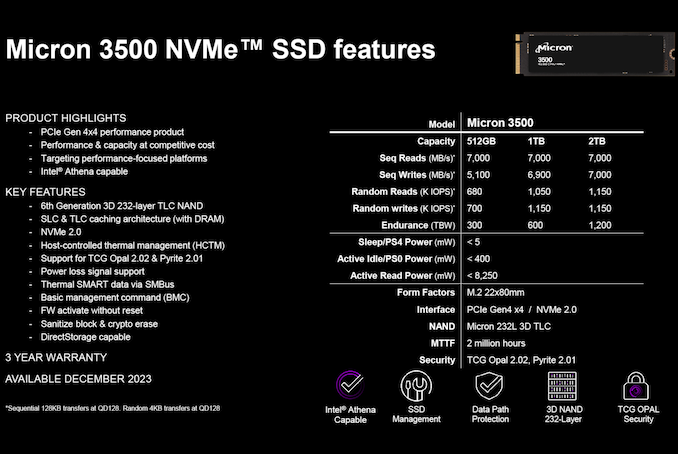
Almost all of the key selling points of the Crucial T500 transfer themselves to the Micron 3500 NVMe SSD. These include class-leading bandwidth numbers saturating the Gen4 links and DirectStorage support. The peak reads are at 7 GBps instead of 7.4 GBps, but that is due to the nature of the systems dictated by OEM qualification requirements. Endurance numbers are the same as the T500’s, but the warranty period is only 3 years (compared to the T500’s 5 years). This actually translates to a higher DWPD rating for the drive, and is a typical demand of the OEMs who qualify these drives for use in their systems. The SSD’s power consumption numbers and wake times from sleep are also geared for Intel’s Project Athena certification – an aspect that is important for OEMs delivering high-performance notebooks. The target market for the 3500 NVMe SSD is high-end workstations and gaming systems. As a result, Micron’s marketing numbers have focused on benchmarks such as SPECwpc storage (part of the SPECworkstation suite). We are looking forward to confirming the claims with our own hands-on evaluation in the near future.

The launch of the Micron 3500 NVMe SSD has enabled the company to cater to the entire range of OEM client systems requiring Gen4 NVMe drives. The entry-level Micron 2400 series with 176L QLC NAND is meant for the cost-sensitive market, while the Micron 2550 moves to 232L 3D TLC with the previous-generation Phison controller. Both drive families are available in multiple M.2 form-factors. The 3500 NVMe SSD fills up the flagship role. With high-end computing systems being the target, the drive will be available only in the M.2 2280 form-factor. It is surprising that a 4TB drive is not available at launch, given that high-end systems are typically hungry for storage capacity. Hopefully, that is a hole in the product stack that Micron will be able to fill in both the Crucial T700 and Micron 3500 NVMe SSD families sometime next year.
Source: AnandTech – Micron Intros 3500 NVMe SSD: 232L 3D TLC and Phison E25 for the OEM Market
TornadoVM 1.0 Released For Running Java On Heterogeneous Hardware: CPUs, GPUs & FPGAs
TornadoVM 1.0 has been released as the open-source software providing an OpenJDK and GraalVM plug-in for allowing Java on heterogeneous hardware from multi-core CPUs to GPUs and FPGAs. TornadoVM allows targeting OpenCL, NVIDIA PTX, and SPIR-V devices for a rather robust array of hardware support…
Source: Phoronix – TornadoVM 1.0 Released For Running Java On Heterogeneous Hardware: CPUs, GPUs & FPGAs
LZ4 Support Revised For Faster Restore From Linux Hibernation
Published originally back in October were a set of patches for allowing different compression algorithms for the Linux hibernation image to yield faster restore times. That work — focused on LZ4 compression support — has been revised as it works toward the mainline kernel…
Source: Phoronix – LZ4 Support Revised For Faster Restore From Linux Hibernation
Engaging primary Computing teachers in culturally relevant pedagogy through professional development
Underrepresentation in computing is a widely known issue, in industry and in education. To cite some statistics from the UK: a Black British Voices report from August 2023 noted that 95% of respondents believe the UK curriculum neglects black lives and experiences; fewer students from working class backgrounds study GCSE Computer Science; when they leave formal education, fewer female, BAME, and white working class people are employed in the field of computer science (Kemp 2021); only 21% of GCSE Computer Science students, 15% at A level, and 22% at undergraduate level are female (JCQ 2020, Ofqual 2020, UCAS 2020); students with additional needs are also underrepresented.

Such statistics have been the status quo for too long. Many Computing teachers already endeavour to bring about positive change where they can and engage learners by including their interests in the lessons they deliver, so how can we support them to do this more effectively? Extending the reach of computing so that it is accessible to all also means that we need to consider what formal and informal values predominate in the field of computing. What is the ‘hidden’ curriculum in computing that might be excluding some learners? Who is and who isn’t represented?

In a recent research seminar, Katharine Childs from our team outlined a research project we conducted, which included a professional development workshop to increase primary teachers’ awareness of and confidence in culturally relevant pedagogy. In the workshop, teachers considered how to effectively adapt curriculum materials to make them culturally relevant and engaging for the learners in their classrooms. Katharine described the practical steps teachers took to adapt two graphics-related units, and invited seminar participants to apply their learning to a graphics activity themselves.
What is culturally relevant pedagogy?
Culturally relevant pedagogy is a teaching framework which values students’ identities, backgrounds, knowledge, and ways of learning. By drawing on students’ own interests, experiences and cultural knowledge educators can increase the likelihood that the curriculum they deliver is more relevant, engaging and accessible to all.

The idea of culturally relevant pedagogy was first introduced in the US in the 1990s by African-American academic Gloria Ladson-Billings (Ladson-Billings 1995). Its aim was threefold: to raise students’ academic achievement, to develop students’ cultural competence and to promote students’ critical consciousness. The idea of culturally responsive teaching was later advanced by Geneva Gay (2000) and more recently brought into focus in US computer science education by Kimberly Scott and colleagues (2015). The approach has been localised for England by Hayley Leonard and Sue Sentance (2021) in work they undertook here at the Foundation.
Ten areas of opportunity
Katharine began her presentation by explaining that the professional development workshop in the Primary culturally adapted resources for computing project built on two of our previous research projects to develop guidelines for culturally relevant and responsive computing and understand how teachers used them in practice. This third project ran as a pilot study funded by Cognizant, starting in Autumn 2022 with a one-day, in-person workshop for 13 primary computing teachers
Katharine then introduced us to the 10 areas of opportunity (AO) our research at the Raspberry Pi Computing Education Research Centre had identified for culturally relevant pedagogy. These 10 areas were used as practical prompts to frame the workshop discussions:
- Find out about learners
- Find out about ourselves as teachers
- Review the content
- Review the context
- Make the learning accessible to all
- Provide opportunities for open-ended and problem solving activities
- Promote collaboration and structured group discussion
- Promote student agency through choice
- Review the learning environment
- Review related policies, processes, and training in your school and department
At first glance it is easy to think that you do most of those things already, or to disregard some items as irrelevant to the computing curriculum. What would your own cultural identity (see AO2) have to do with computing, you might wonder. But taking a less complacent perspective might lead you to consider all the different facets that make up your identity and then to think about the same for the students you teach. You may discover that there are many areas which you have left untapped in your lesson planning.

Katharine explained how this is where the professional development workshop showed itself as beneficial for the participants. It gave teachers the opportunity to reflect on how their cultural identity impacted on their teaching practices — as a starting point to learning more about other aspects of the culturally relevant pedagogy approach.
Our researchers were interested in how they could work alongside teachers to adapt two computing units to make them more culturally relevant for teachers’ specific contexts. They used the Computing Curriculum units on Photo Editing (Year 4) and Vector Graphics (Year 5).
Katharine illustrated some of the adaptations teachers and researchers working together had made to the emoji activity above, and which areas of opportunity (AO) had been addressed; this aspect of the research will be reported in later publications.
Results after the workshop
Although the numbers of participants in this pilot study was small, the findings show that the professional development workshop significantly increased teachers’ awareness of culturally relevant pedagogy and their confidence in adapting resources to take account of local contexts:
- After the workshop, 10/13 teachers felt more confident to adapt resources to be culturally relevant for their own contexts, and 8/13 felt more confident in adapting resources for others.
- Before the workshop, 5/13 teachers strongly agreed that it was an important part of being a computing teacher to examine one’s own attitudes and beliefs about race, gender, disabilities, sexual orientation. After the workshop, the number in agreement rose to 12/13.
- After the workshop, 13/13 strongly agreed that part of a computing teacher’s responsibility is to challenge teaching practices which maintain social inequities (compared to 7/13 previously).
- Before the workshop, 4/13 teachers strongly agreed that it is important to allow student choice when designing computing activities; this increased to 9/13 after the workshop.
These quantitative shifts in perspective indicate a positive effect of the professional development pilot.
Katharine described that in our qualitative interviews with the participating teachers, they expressed feeling that their understanding of culturally relevant pedagogy had increased and they recognized the many benefits to learners of the approach. They valued the opportunity to discuss their contexts and to adapt materials they currently used with other teachers, because it made it a more ‘authentic’ and practical professional development experience.
The seminar ended with breakout sessions inviting viewers to consider possible adaptations that could be made to the graphics activities which had been the focus of the workshop.
In the breakout sessions, attendees also discussed specific examples of culturally relevant teaching practices that had been successful in their own classrooms, and they considered how schools and computing educational initiatives could support teachers in their efforts to integrate culturally relevant pedagogy into their practice. Some attendees observed that it was not always possible to change schemes of work without a ‘whole-school’ approach, senior leadership team support, and commitment to a research-based professional development programme.
Where do you see opportunities for your teaching?
The seminar reminds us that the education system is not culture neutral and that teachers generally transmit the dominant culture (which may be very different from their students’) in their settings (Vrieler et al, 2022). Culturally relevant pedagogy is an attempt to address the inequities and biases that exist, which result in many students feeling marginalised, disenfranchised, or underachieving. It urges us to incorporate learners’ cultures and experiences in our endeavours to create a more inclusive computing curriculum; to adopt an intersectional lens so that all can thrive.

As a pilot study, the workshop was offered to a small cohort of 13, yet the findings show that the intervention significantly increased participants’ awareness of culturally relevant pedagogy and their confidence in adapting resources to take account of local contexts.
Of course there are many ways in which teachers already adapt resources to make them interesting and accessible to their pupils. Further examples of the sort of adaptations you might make using these areas of opportunity include:
- AO1: You could find out to what extent learners feel like they ‘belong’ or are included in a particular computing-related career. This is sure to yield valuable insights into learners’ knowledge and/or preconceptions of computing-related careers.
- AO3: You could introduce topics such as the ethics of AI, data bias, investigations of accessibility and user interface design.
- AO4: You might change the context of a unit of work on the use of conditional statements in programming, from creating a quiz about ‘Vikings’ to focus on, for example, aspects of youth culture which are more engaging to some learners such as football or computer games, or to focus on religious celebrations, which may be more meaningful to others.
- AO5: You could experiment with a particular pedagogical approach to maximise the accessibility of a unit of work. For example, you could structure a programming unit by using the PRIMM model, or follow the Universal Design for Learning framework to differentiate for diversity.
- AO6/7: You could offer more open-ended and collaborative activities once in a while, to promote engagement and to allow learners to express themselves autonomously.
- AO8: By allowing learners to choose topics which are relevant or familiar to their individual contexts and identities, you can increase their feeling of agency.
- AO9: You could review both your learning materials and your classroom to ensure that all your students are fully represented.
- AO10: You can bring colleagues on board too; the whole enterprise of embedding culturally relevant pedagogy will be more successful when school- as well as department-level policies are reviewed and prioritised.
Can you see an opportunity for integrating culturally relevant pedagogy in your classroom? We would love to hear about examples of culturally relevant teaching practices that you have found successful. Let us know your thoughts or questions in the comments below.
You can watch Katharine’s seminar here:
You can download her presentation slides on our ‘previous seminars’ page, and you can read her research paper.
To get a practical overview of culturally relevant pedagogy, read our 2-page Quick Read on the topic and download the guidelines we created with a group of teachers and academic specialists.
Tomorrow we’ll be sharing a blog about how the learners who engaged with the culturally adapted units found the experience, and how it affected their views of computing. Follow us on social media to not miss it!
Join our upcoming seminars live
On 12 December we’ll host the last seminar session in our series on primary (K-5) computing. Anaclara Gerosa will share her work on how to design and structure early computing activities that promote and scaffold students’ conceptual understanding. As always, the seminar is free and takes place online at 17:00–18:30 GMT / 12:00–13:30 ET / 9:00–10:30 PT / 18:00–19:30 CET. Sign up and we’ll send you the link to join on the day.
In 2024, our new seminar series will be about teaching and learning programming, with and without AI tools. If you’re signed up to our seminars, you’ll receive the link to join every monthly seminar.
The post Engaging primary Computing teachers in culturally relevant pedagogy through professional development appeared first on Raspberry Pi Foundation.
Source: Raspberry Pi – Engaging primary Computing teachers in culturally relevant pedagogy through professional development
Today’s Wordle Hints (and Answer) for Tuesday, December 5, 2023
If you’re looking for the Wordle answer for December 5, 2023 read on. We’ll share some clues, tips, and strategies, and finally the solution. Today’s puzzle is of medium difficulty; I got it in 4. Beware, there are spoilers below for December 5, Wordle #899! Keep scrolling if you want some hints (and then the answer) to today’s Wordle game.
How to play Wordle
Wordle lives here on the New York Times website. A new puzzle goes live every day at midnight, your local time.
Start by guessing a five-letter word. The letters of the word will turn green if they’re correct, yellow if you have the right letter in the wrong place, or gray if the letter isn’t in the day’s secret word at all. For more, check out our guide to playing Wordle here, and my strategy guide here for more advanced tips. (We also have more information at the bottom of this post, after the hints and answers.)
Ready for the hints? Let’s go!
Does today’s Wordle have any unusual letters?
We’ll define common letters as those that appear in the old typesetters’ phrase ETAOIN SHRDLU. (Memorize this! Pronounce it “Edwin Shirdloo,” like a name, and pretend he’s a friend of yours.)
Three of the letters are common; the other two are sort of medium-commonness (no Q or X or anything).
Can you give me a hint for today’s Wordle?
Think spry and youthful.
Does today’s Wordle have any double or repeated letters?
No doubles or repeated letters today.
How many vowels are in today’s Wordle?
Technically there are only two vowels today (i.e., from A-E-I-O-U). There’s one other “sometimes” vowel.
What letter does today’s Wordle start with?
Today’s word starts with Y.
What letter does today’s Wordle end with?
Today’s word ends with G.
What is the solution to today’s Wordle?
Ready? Today’s word is YOUNG.
How I solved today’s Wordle
No hits on ARISE; got the OU on touch. For a minute here I thought we were into the infamous POUND/BOUND/ROUND territory, but BANDY registered hits on both Y and N. If the Y isn’t at the end, it’s probably at the beginning, so I correctly guessed YOUNG.
Wordle 899 4/6

⬜⬜⬜⬜⬜
⬜🟩🟩⬜⬜
⬜⬜🟨⬜🟨
🟩🟩🟩🟩🟩
A primer on Wordle basics
The idea of Wordle is to guess the day’s secret word. When you first open the Wordle game, you’ll see an empty grid of letters. It’s up to you to make the first move: type in any five-letter word.
Now, you can use the colors that are revealed to get clues about the word:
-
Green means you correctly guessed a letter, and it’s in the correct position. (For example, if you guess PARTY, and the word is actually PURSE, the P and R will be green.)
-
Yellow means the letter is somewhere in the word, but not in the position you guessed it. (For example, if you guessed PARTY, but the word is actually ROAST, the R, A and T will all be yellow.)
-
Gray means the letter is not in the solution word at all. (If you guessed PARTY and everything is gray, then the solution cannot be PURSE or ROAST.)
With all that in mind, guess another word, and then another, trying to land on the correct word before you run out of chances. You get six guesses, and then it’s game over.
The best starter words for Wordle
What should you play for that first guess? The best starters tend to contain common letters, to increase the chances of getting yellow and green squares to guide your guessing. (And if you get all grays when guessing common letters, that’s still excellent information to help you rule out possibilities.) There isn’t a single “best” starting word, but the New York Times’s Wordle analysis bot has suggested starting with one of these:
-
CRANE
-
TRACE
-
SLANT
-
CRATE
-
CARTE
Meanwhile, an MIT analysis found that you’ll eliminate the most possibilities in the first round by starting with one of these:
-
SALET
-
REAST
-
TRACE
-
CRATE
-
SLATE
Other good picks might be ARISE or ROUND. Words like ADIEU and AUDIO get more vowels in play, but you could argue that it’s better to start with an emphasis on consonants, using a starter like RENTS or CLAMP. Choose your strategy, and see how it plays out.
How to win at Wordle
We have a few guides to Wordle strategy, which you might like to read over if you’re a serious student of the game. This one covers how to use consonants to your advantage, while this one focuses on a strategy that uses the most common letters. In this advanced guide, we detail a three-pronged approach for fishing for hints while maximizing your chances of winning quickly.
The biggest thing that separates Wordle winners from Wordle losers is that winners use their guesses to gather information about what letters are in the word. If you know that the word must end in -OUND, don’t waste four guesses on MOUND, ROUND, SOUND, and HOUND; combine those consonants and guess MARSH. If the H lights up in yellow, you know the solution.
One more note on strategy: the original Wordle used a list of about 2,300 solution words, but after the game was bought by the NYT, the game now has an editor who hand-picks the solutions. Sometimes they are slightly tricky words that wouldn’t have made the original list, and sometimes they are topical. For example, FEAST was the solution one Thanksgiving. So keep in mind that there may be a theme.
Wordle alternatives
If you can’t get enough of five-letter guessing games and their kin, the best Wordle alternatives, ranked by difficulty, include:
-
Dordle and Quordle, which ask you to play two (Dordle) or four (Quordle) puzzles at the same time, with the same guesses. There is also Octordle, with eight puzzles, and Sedecordle, with 16.
-
Waffle, which shows you several five-letter words, scrambled in a grid; you play by swapping the letters around until you solve.
-
Absurdle, which changes the solution after each guess, but needs to stay consistent with its previous feedback. You have to strategically back it into a corner until there is only one possible word left; then you guess it, and win.
-
Squabble, in which you play Wordle against other people with a timer running. You take damage if you spend too much time between guesses; winner is the last one standing.
-
Antiwordle, in which you are trying not to guess the day’s solution. You’re required to reuse any letters that you (oops) guessed correctly, so the longer it takes you, the better you are at the game.
Source: LifeHacker – Today’s Wordle Hints (and Answer) for Tuesday, December 5, 2023
Today's NYT Connections Hints (and Answer) for Tuesday, December 5, 2023
Today’s puzzle is only a little bit tricky. If you’re looking for the Connections answer for Tuesday, December 5, 2023, read on—I’ll share some clues, tips, and strategies, and finally the solutions to all four categories. Along the way, I’ll explain the meanings of the trickier words and we’ll learn how everything fits together. Beware, there are spoilers below for December 5, NYT Connections #177! Read on if you want some hints (and then the answer) to today’s Connections game.
If you want an easy way to come back to our Connections hints every day, bookmark this page. You can also find our past hints there as well, in case you want to know what you missed in a previous puzzle.
Below, I’ll give you some oblique hints at today’s Connections answers. And farther down the page, I’ll reveal the themes and the answers. Scroll slowly and take just the hints you need!
Credit: Connections/NYT
Does today’s Connections game require any special knowledge?
Recognizing a few TV shows and characters will help you.
Hints for the themes in today’s Connections puzzle
Here are some spoiler-free hints for the groupings in today’s Connections:
-
Yellow category – Massive.
-
Green category – Literature.
-
Blue category – Happy.
-
Purple category – Something tall.
Does today’s Connections game involve any wordplay?
There’s a fill-in-the-blank again, connecting disparate items with the same word in their name.
Ready to hear the answers? Keep scrolling if you want a little more help.
BEWARE: Spoilers follow for today’s Connections puzzle!
We’re about to give away some of the answers. Scroll slowly if you don’t want the whole thing spoiled. (The full solution is a bit further down.)
What are the ambiguous words in today’s Connections?
-
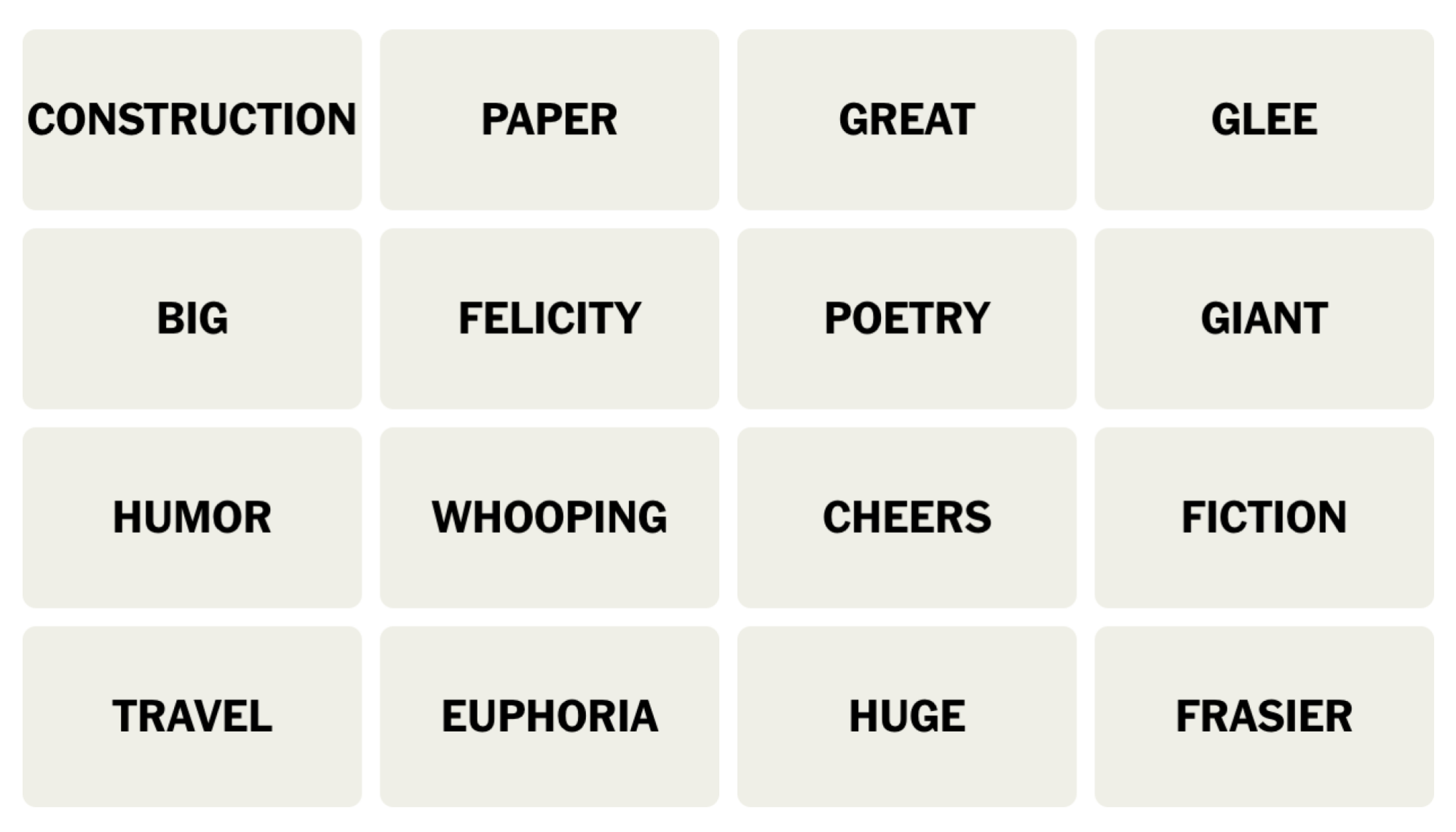
FRASIER, FELICITY, CHEERS, and GLEE are all TV series, but one of these things is meant to represent a TV character and belongs in a different category than the rest.
-
Good HUMOR might seem to go with EUPHORIA, but today you’ll want to think about HUMOR as a category of writing, much like POETRY.
-
CONSTRUCTION and PAPER do not go together.
-
GREAT and GIANT do.
What are the categories in today’s Connections?
-
Yellow: ENORMOUS
-
Green: BOOKSTORE SECTIONS
-
Blue: TV SHOWS WITH HAPPY-SOUNDING NAMES
-
Purple: ____ CRANE
DOUBLE BEWARE: THE SOLUTION IS BELOW
Ready to learn the answers to today’s Connections puzzle? I give them all away below.
What are the yellow words in today’s Connections?
The yellow grouping is considered to be the most straightforward. The theme for today’s yellow group is ENORMOUS and the words are: BIG, GIANT, GREAT, HUGE.
What are the green words in today’s Connections?
The green grouping is supposed to be the second-easiest. The theme for today’s green category is BOOKSTORE SECTIONS and the words are: FICTION, HUMOR, POETRY, TRAVEL.
What are the blue words in today’s Connections?
The blue grouping is the second-hardest. The theme for today’s blue category is TV SHOWS WITH HAPPY-SOUNDING NAMES and the words are: CHEERS, EUPHORIA, FELICITY, GLEE
What are the purple words in today’s Connections?
The purple grouping is considered to be the hardest. The theme for today’s purple category is ____ CRANE and the words are: CONSTRUCTION, FRASIER, PAPER, WHOOPING.
How I solved today’s Connections
WHOOPING is either the cough or the crane, and the crane makes a lot more sense. There’s FRASIER Crane, a CONSTRUCTION crane, origami PAPER cranes. 🟪 GIANT, GREAT, HUGE, and BIG must go together, and they do. 🟨
Next I group HUMOR, GLEE, CHEERS, and EUPHORIA without looking closely at the remaining words. I am one away! And that’s when I realize HUMOR belongs with POETRY, TRAVEL, and FICTION as types of writing 🟩 and my happiness group has FELICITY instead. 🟦
Connections
Puzzle #177
🟪🟪🟪🟪
🟨🟨🟨🟨
🟩🟦🟦🟦
🟩🟩🟩🟩
🟦🟦🟦🟦
How to play Connections
I have a full guide to playing Connections, but here’s a refresher on the rules:
First, find the Connections game either on the New York Times website or in their Crossword app. You’ll see a game board with 16 tiles, each with one word or phrase. Your job is to select a group of four tiles that have something in common. Often they are all the same type of thing (for example: RAIN, SLEET, HAIL, and SNOW are all types of wet weather) but sometimes there is wordplay involved (for example, BUCKET, GUEST, TOP TEN, and WISH are all types of lists: bucket list, guest list, and so on).
Select four items and hit the Submit button. If you guessed correctly, the category and color will be revealed. (Yellow is easiest, followed by green, then blue, then purple.) If your guess was incorrect, you’ll get a chance to try again.
You win when you’ve correctly identified all four groups. But if you make four mistakes before you finish, the game ends and the answers are revealed.
How to win Connections
The most important thing to know to win Connections is that the groupings are designed to be tricky. Expect to see overlapping groups. For example, one puzzle seemed to include six breakfast foods: BACON, EGG, PANCAKE, OMELET, WAFFLE, and CEREAL. But BACON turned out to be part of a group of painters along with CLOSE, MUNCH, and WHISTLER, and EGG was in a group of things that come by the dozen (along with JUROR, ROSE, and MONTH). So don’t hit “submit” until you’ve confirmed that your group of four contains only those four things.
If you’re stuck, another strategy is to look at the words that seem to have no connection to the others. If all that comes to mind when you see WHISTLER is the painting nicknamed “Whistler’s Mother,” you might be on to something. When I solved that one, I ended up googling whether there was a painter named Close, because Close didn’t fit any of the obvious themes, either.
Another way to win when you’re stuck is, obviously, to read a few helpful hints–which is why we share these pointers every day. Check back tomorrow for the next puzzle!
Source: LifeHacker – Today’s NYT Connections Hints (and Answer) for Tuesday, December 5, 2023
Grand Theft Auto VI trailer confirms arrives early with a crime-crazy Florida

Enlarge / “Coming 2025.” (credit: Rockstar Games / YouTube)

Grand Theft Auto VI, like its protagonist Lucia, keeps finding itself in an awkward spot because of “Bad luck, I guess.”
The trailer for Rockstar Games heavily, mightily, impossibly anticipated sequel in its record-breaking series landed on YouTube Monday evening, earlier than its previously published Tuesday morning release. That’s because a pop-up, quickly suspended X (formerly Twitter) account posted it early, and Rockstar rushed to get its official version out, ending with a “Coming 2025” notice.
Grand Theft Auto VI trailer.
It’s a mishap far smaller in scale than most leaks, but it’s notable for Rockstar, which typically lets out very little about its games beyond official trailers. GTA VI had nearly an hour of early gameplay and testing footage leak out in early September 2022, following a network intrusion. A teenager in the UK was arrested on charges related to the leak quickly after Rockstar confirmed its veracity. TikTok videos have also recently surfaced, with computer monitors showing off images of the game’s setting, according to The Verge.
Read 5 remaining paragraphs | Comments
Source: Ars Technica – Grand Theft Auto VI trailer confirms arrives early with a crime-crazy Florida