
By now you’ve likely heard how Intel’s Gaudi2 accelerator hardware is standing up very well against the NVIDIA competition especially in value. There’s nothing new there but an important part to keep in mind — and where Intel is the hands-down winner — is the open-source ecosystem with having a fully open-source and upstream Linux kernel accelerator driver as well as their SynapseAI open-source components in user-space. The Gaudi2 open-source kernel driver support is now considered “very stable at this point” with the upstream state fairing well…
Source: Phoronix – Intel Gaudi2’s Linux Driver Support Is “Very Stable At This Point”, Gaudi2C Device Added
Monthly Archives: December 2023
cp command – How to Copy Files and Directories in Linux
In this tutorial, we’re going to show you how to use the cp command on Linux.
Source: LXer – cp command – How to Copy Files and Directories in Linux
FFmpeg Begins Landing Support For AOMedia's IAMF – Immersive Audio Model and Formats
Yesterday the initial code for supporting the Alliance For Open Media’s Immersive Audio Model and Formats (IAMF) was merged for the widely-used FFmpeg multimedia library…
Source: Phoronix – FFmpeg Begins Landing Support For AOMedia’s IAMF – Immersive Audio Model and Formats
Xfinity Discloses Data Breach But Doesn't Say How Many Users Affected
In a notice on Monday, Xfinity notified customers of a “data security incident” that resulted in the theft of customer information, including usernames, passwords, contact information, and more. The Verge reports: Xfinity traces the breach to a security vulnerability disclosed by cloud computing company Citrix, which began alerting customers of a flaw in software Xfinity and other companies use on October 10th. While Xfinity says it patched the security hole, it later uncovered suspicious activity on its internal systems “that was concluded to be a result of this vulnerability.”
The hack resulted in the theft of customer usernames and hashed passwords, according to Xfinity’s notice. Meanwhile, “some customers” may have had their names, contact information, last four digits of their social security numbers, dates of birth, and / or secret questions and answers exposed. Xfinity has notified federal law enforcement about the incident and says “data analysis is continuing.”
We still don’t know how many users were affected by the breach. Xfinity will automatically ask customers to change their passwords the next time they log in to their accounts, and it’s also encouraging users to turn on two-factor authentication. You can find the full notice, including contact information for the company’s incident response team, on Xfinity’s website (PDF).


Read more of this story at Slashdot.
Source: Slashdot – Xfinity Discloses Data Breach But Doesn’t Say How Many Users Affected
What is the impact of attending a Code Club or CoderDojo?
We support two networks of coding clubs where young people around the world discover the countless possibilities of creating with digital technologies.

- Code Club is a global network of after-school coding clubs for learners aged 9 to 13, where educators and other volunteers help young people learn about coding and digital making
- CoderDojo is a worldwide network of free, open, and community-based programming clubs for young people aged 7 to 17, where they get the opportunity to learn how to create fantastic new things with technology
Every year, we send out a survey to volunteers at all the clubs we support. Today we share some highlights from the findings and what we’re planning next.

Why do we do an annual survey for clubs?
The simple answer is: to help make clubs even better for everyone involved! Educators and volunteers are doing a remarkable job in helping young people learn about computing and coding, so we want to know more about them, about how they run their clubs, and what impact the club sessions have for young people.

By knowing more about clubs — how frequently club leaders run them, what resources they use, what they would like more of — we can continue to improve the learning experience for educators, volunteers, and young people involved in our clubs.
This year in March we sent out our survey to all Code Clubs and CoderDojos around the world, and we heard back from almost 500. As always, the results were very positive, and they also gave us a lot of useful information on how we can continue to improve our support for clubs all over the world.
Who is involved in clubs?
Based on the survey, we estimate that at the time, the network of over 4200 Code Clubs and 700 CoderDojos was reaching almost 139,000 young people globally. The global community of clubs has continued to grow since then, with a now even larger network of volunteers supporting ever more young people.

According to the survey, the majority of young people attending clubs are aged between 8 and 13, but clubs host young people as young as 6 and as old as 18. It was great to hear about the participation of girls, and we’d love to see this rise even higher: respondents told us that 42% of their Code Club attendees and 30% of their CoderDojo attendees are female.
Respondents feel that attending club sessions improves young peoples’ interest and engagement in computing and programming, and increases their understanding of the usefulness of computing.
None of these young people would be able to attend clubs without the great work of teams of educators and volunteers. Based on the survey, we estimate that at the time of the survey, there were over 10,300 Code Club leaders and almost 4000 CoderDojo champions around the world. Many survey respondents said that they were motivated to start volunteering after attending a club themselves.

Community is at the heart of clubs and the clubs networks: over 80% of respondents said that belonging to a global community of clubs helps motivates them to volunteer at their own club.
What is the impact of clubs?
Clubs focus on a wide range of topics and programming languages. Scratch is overwhelmingly popular, with over 95% of respondents telling us that they used Scratch in club sessions in the previous year. Micro:bit projects and Python-based programming were also very popular. Club leaders told us that in future they would like to offer more activities around AI applications, as well as around games and mobile apps.
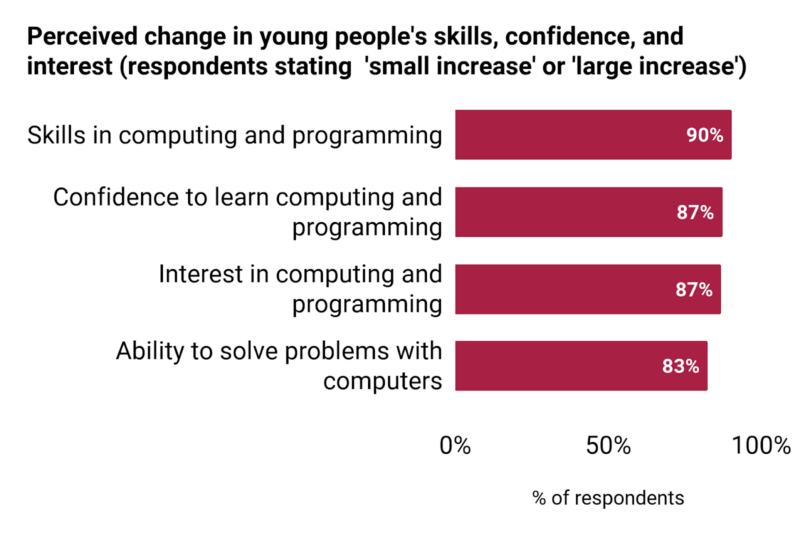
Club leaders told us that being part of a Code Club or CoderDojo affects young people positively. Respondents feel that attending club sessions improves young peoples’ skills and interest in computing and programming, and increases their understanding of the usefulness of computing. Almost 90% of club leaders also agree that after attending a club, young people are interested in additional experiences of learning about computing and programming.
Attending also positively affects young people’s wider skills and attitudes, with club leaders stating that young people who attend improve their personal confidence, independence in learning, and creative thinking.
Young people who attend improve their personal confidence, independence in learning, and creative thinking.
We were pleased to find out that most Code Club leaders, who run their sessions in schools, think that their clubs increase the visibility of computing within their school. Many also said that the attendees’ parents and guardians value their clubs as opportunities for their children.
What’s next?
We want to keep providing clubs with support to increase their positive impact on young people. Thanks to the survey results, we know to focus our work on providing training opportunities for club volunteers, as well as supporting club leaders to recruit volunteers and advertise their clubs to more young people.
You can read the survey report to dive deeper into our findings.
As we take an impact-focused approach to our work, we are currently partnering with Durham University on an evaluation of Code Clubs in UK schools. The evaluation will provide further insights for how we can best support people around the world to run clubs that provide welcoming spaces where all kids can learn to create with digital technologies.
The post What is the impact of attending a Code Club or CoderDojo? appeared first on Raspberry Pi Foundation.
Source: Raspberry Pi – What is the impact of attending a Code Club or CoderDojo?
How to Install Zabbly Kernel on Ubuntu 22.04
Quick guide covering the steps to install Zabbly Kernel on Ubuntu 22.04 Jammy Jellyfish LTS which if required can easily upgrade your Linux Kernel to the latest mainline release.
Source: LXer – How to Install Zabbly Kernel on Ubuntu 22.04
NASA's Tech Demo Streams First Video From Deep Space Via Laser
NASA has successfully beamed an ultra-high definition streaming video from a record-setting 19 million miles away. The Deep Space Optical Communications experiment, as it is called, is part of a NASA technology demonstration aimed at streaming HD video from deep space to enable future human missions beyond Earth orbit. From a NASA press release: The [15-second test] video signal took 101 seconds to reach Earth, sent at the system’s maximum bit rate of 267 megabits per second (Mbps). Capable of sending and receiving near-infrared signals, the instrument beamed an encoded near-infrared laser to the Hale Telescope at Caltech’s Palomar Observatory in San Diego County, California, where it was downloaded. Each frame from the looping video was then sent “live” to NASA’s Jet Propulsion Laboratory in Southern California, where the video was played in real time.
The laser communications demo, which launched with NASA’s Psyche mission on Oct. 13, is designed to transmit data from deep space at rates 10 to 100 times greater than the state-of-the-art radio frequency systems used by deep space missions today. As Psyche travels to the main asteroid belt between Mars and Jupiter, the technology demonstration will send high-data-rate signals as far out as the Red Planet’s greatest distance from Earth. In doing so, it paves the way for higher-data-rate communications capable of sending complex scientific information, high-definition imagery, and video in support of humanity’s next giant leap: sending humans to Mars.
Uploaded before launch, the short ultra-high definition video features an orange tabby cat named Taters, the pet of a JPL employee, chasing a laser pointer, with overlayed graphics. The graphics illustrate several features from the tech demo, such as Psyche’s orbital path, Palomar’s telescope dome, and technical information about the laser and its data bit rate. Tater’s heart rate, color, and breed are also on display. There’s also a historical link: Beginning in 1928, a small statue of the popular cartoon character Felix the Cat was featured in television test broadcast transmissions. Today, cat videos and memes are some of the most popular content online. “Despite transmitting from millions of miles away, it was able to send the video faster than most broadband internet connections,” said Ryan Rogalin, the project’s receiver electronics lead at JPL. “In fact, after receiving the video at Palomar, it was sent to JPL over the internet, and that connection was slower than the signal coming from deep space. JPL’s DesignLab did an amazing job helping us showcase this technology — everyone loves Taters.”


Read more of this story at Slashdot.
Source: Slashdot – NASA’s Tech Demo Streams First Video From Deep Space Via Laser
TomTom and Microsoft team up to bring generative AI to automobiles
TomTom just announced a “fully integrated, AI-powered conversational automotive assistant” which should start popping up in dashboard infotainment platforms in the near-ish future. The company has issued some bold claims for the AI, saying it’ll offer “more sophisticated voice interaction” and allow users to converse naturally to navigate, find stops along a route, control onboard systems, open windows and just about anything else you find yourself doing while driving.
The company, best known for GPS platforms, partnered up with Microsoft to develop this AI assistant. The technology leverages OpenAI’s large language models, in addition to Microsoft products like Azure Cosmos DB and Azure Cognitive Services. Cosmos DB is a multi-model database and Cognitive Services is a set of APIs for use in AI applications, so this should be a capable assistant that draws from the latest advancements.
TomTom promises that the voice assistant will integrate into a variety of interfaces offered by major automobile manufacturers, stating that the auto company will retain ownership of its branding. So this could start showing up in cars from a wide variety of makers. The company hasn’t announced any definitive partnerships with known vehicle manufacturers, but the technology will be integrated into TomTom’s proprietary Digital Cockpit, an open and modular in-vehicle infotainment platform.
This isn’t the first time a company has tried to stuff an LLM inside of a car. Back in June, Mercedes announced a three-month beta program that incorporated ChatGPT models into select vehicles. This tool also leveraged Microsoft’s Azure OpenAI service. TomTom is showing off the AI at CES in January, so we’ll know more about how it actually works at that point.
This article originally appeared on Engadget at https://www.engadget.com/tomtom-and-microsoft-team-up-to-bring-generative-ai-to-automobiles-063002000.html?src=rss
Source: Engadget – TomTom and Microsoft team up to bring generative AI to automobiles
postmarketOS 23.12 Brings the GNOME 45 Desktop to Linux Phones and Tablets
postmarketOS 23.12 has been released today as the latest stable update to this Alpine Linux-based operating system for mobile devices introducing new features, support for new devices, and other enhancements.
Source: LXer – postmarketOS 23.12 Brings the GNOME 45 Desktop to Linux Phones and Tablets
Alphabet, States Reach $700 Million Deal in Google Play Feud
Alphabet will pay $700 million and alter its Google Play policies to settle claims that the app store unlawfully dominates the Android mobile applications market, resolving antitrust complaints brought by attorneys general of about three dozen states and consumers. From a report: The deal disclosed in a court filing late Monday calls for tweaks to Google Play policies designed to reduce barriers to competition in the markets for app distribution and payment processing. The lawsuits that were grouped together in federal court in California had threatened billions of dollars in revenue generated by the sale and distribution of apps through Google Play. Google will also make a series of changes to its business practices as part of the settlement. In a blog post, the Android-maker said: Streamlining sideloading while prioritizing security: Unlike on iOS, Android users have the option to sideload apps, meaning they can download directly from a developer’s website without going through an app store like Google Play. While we maintain it is critical to our safety efforts to inform users that sideloading on mobile could come with unique risks, as part of our settlement we will be further simplifying the sideloading process and updating the language that informs users about these potential risks of downloading apps directly from the web for the first time.
Expanding user choice billing to more people: App and game developers will be able to implement an alternative billing option alongside Google Play’s billing system for their U.S. users who can then choose which option to use when making in-app purchases. We have been piloting user choice billing in the U.S. for over a year and will now expand this option further.
Expanding open communication on pricing: We have always given developers more ways to interact with their customers than iOS and other operating systems. For example, Google Play allows developers to communicate freely with their customers outside the app about subscription offers or lower-cost options available on a rival app store or the developer’s website. This openness has spurred competition and benefited consumers and developers. As part of user choice billing, which we’re expanding with today’s settlement announcement, developers are also able to show different pricing options within the app when a user makes a digital purchase.


Read more of this story at Slashdot.
Source: Slashdot – Alphabet, States Reach 0 Million Deal in Google Play Feud
Volkswagen is returning to physical buttons instead of touch controls
It may seem like blasphemy for an Engadget writer to diss touch controls, but as the demise of the MacBook Pro’s Touch Bar has proven, those aren’t always a good idea — especially on cars. As spotted by Autocar at Volkswagen City Studio in Copenhagen, the ID. 2all concept electric car now features a slightly updated interior, with the most notable change being the return of physical buttons below the central touchscreen. According to the brand’s interior designer Darius Watola, this will be “a new approach for all models” based on “recent feedback from customers” — especially those in Europe who wanted “more physical buttons.”
In Autocar’s Tiguan launch interview back in June, Volkswagen CEO Thomas Schäfer already acknowledged customers’ criticism on the over-reliance on touch controls — namely on the Golf Mk8 and ID.3, not to mention the same trend across the motor industry. The exec went as far as saying the earlier touch-heavy approach — endorsed by his predecessor, Herbert Diess — “definitely did a lot of damage” in terms of customer loyalty.
The future of Volkswagen interiors revealed. Here’s the ID.2 – on sale in 2025.
Classy and not everything on the touchscreen. pic.twitter.com/bXef4fXk99— Steve Fowler (@SteveFowler) December 14, 2023
The ID. 2all is based on Volkswagen’s updated MEB Entry platform, and packs a 223HP motor that can go up to 62MPH in under seven seconds. As far as range goes, this car can apparently travel up to 280 miles on a single charge, but that’s with the larger and more advanced 56kWh battery instead of the base 38kWh version. Expect this concept electric vehicle to cost under €25,000 (around $27,300), when it arrives as a production model in Europe in 2025. The company also recently teased the ID. 2all SUV, which is described as “the brother of the ID. 2all,” but it won’t be out until 2026.
First look at the ID. 2all SUV, the brother of the ID. 2all. The SUV version will arrive in 2026! pic.twitter.com/4SxgTDdH2e
— Stepan Rehak (@StepanRehak) December 14, 2023
Source: Engadget – Volkswagen is returning to physical buttons instead of touch controls
IBM To Buy Software AG's Enterprise Integration Platforms For $2.3 Billion
An anonymous reader quotes a report from Reuters: IBM said on Monday that it would buy Software AG’s enterprise integration platforms for 2.13 billion euros ($2.33 billion) to bolster its artificial intelligence and hybrid cloud offerings. IBM will acquire Software AG’s StreamSets and webMethods platforms with available cash on hand, it said. The two units formed Software AG’s so-called “Super Ipaas” business, which was launched in October.
The platforms provide application integration, application programming interface (API) management, and data integration among other uses. Software AG is majority owned by private equity firm Silver Lake, which currently owns 93.3% of shares in the German software company, following a takeover pursuit spanning several months. That deal valued the whole business at 2.6 billion euros ($2.84 billion). The transaction is subject to regulatory approvals and is expected to be completed in the second quarter of 2024. “The opportunity to bring the StreamSets and webMethods teams together with IBM to innovate in building the future of hybrid cloud and next-generation AI solutions for the enterprise is uniquely compelling,” Christian Lucas, chairman of the supervisory board of Software AG said in a statement.


Read more of this story at Slashdot.
Source: Slashdot – IBM To Buy Software AG’s Enterprise Integration Platforms For .3 Billion
How to Add and Delete Users on Debian 12
This article describes how to add and remove users on Debian 12. If you’re a Linux user, it’s crucial to have basic skills like adding and removing users. This makes your system more secure by ensuring only authorized users can access protected resources and perform specific actions.
Source: LXer – How to Add and Delete Users on Debian 12
Today’s Wordle Hints (and Answer) for Tuesday, December 19, 2023
If you’re looking for the Wordle answer for December 19, 2023 read on. We’ll share some clues, tips, and strategies, and finally the solution. Today’s puzzle is on the easier side; I got it in three. Beware, there are spoilers below for December 19, Wordle #913! Keep scrolling if you want some hints (and then the answer) to today’s Wordle game.
How to play Wordle
Wordle lives here on the New York Times website. A new puzzle goes live every day at midnight, your local time.
Start by guessing a five-letter word. The letters of the word will turn green if they’re correct, yellow if you have the right letter in the wrong place, or gray if the letter isn’t in the day’s secret word at all. For more, check out our guide to playing Wordle here, and my strategy guide here for more advanced tips. (We also have more information at the bottom of this post, after the hints and answers.)
Ready for the hints? Let’s go!
Does today’s Wordle have any unusual letters?
We’ll define common letters as those that appear in the old typesetters’ phrase ETAOIN SHRDLU. (Memorize this! Pronounce it “Edwin Shirdloo,” like a name, and pretend he’s a friend of yours.)
Four of the letters are common, and there’s one letter that’s not on our list but is still used pretty often in English words. In fact, today’s word would make a decent starter.
Can you give me a hint for today’s Wordle?
It’s one of the things you need for a nice holiday dinner with the family—but it’s not food.
Does today’s Wordle have any double or repeated letters?
Nope, no repeats today!
How many vowels are in today’s Wordle?
There are two vowels in today’s word.
What letter does today’s Wordle start with?
Today’s word starts with T.
What letter does today’s Wordle end with?
Today’s word ends with E.
What is the solution to today’s Wordle?
Ready? Today’s word is TABLE.
How I solved today’s Wordle
ARISE and TOUCH gave me the T and the E, and told me there was an A in there somewhere. Not many options were left—TASTE and other obvious possibilities had been ruled out thanks to the letters I’d already tried—so it pretty much had to be TABLE.
Wordle 913 3/6

🟨⬜⬜⬜🟩
🟩⬜⬜⬜⬜
🟩🟩🟩🟩🟩
A primer on Wordle basics
The idea of Wordle is to guess the day’s secret word. When you first open the Wordle game, you’ll see an empty grid of letters. It’s up to you to make the first move: type in any five-letter word.
Now, you can use the colors that are revealed to get clues about the word:
-
Green means you correctly guessed a letter, and it’s in the correct position. (For example, if you guess PARTY, and the word is actually PURSE, the P and R will be green.)
-
Yellow means the letter is somewhere in the word, but not in the position you guessed it. (For example, if you guessed PARTY, but the word is actually ROAST, the R, A and T will all be yellow.)
-
Gray means the letter is not in the solution word at all. (If you guessed PARTY and everything is gray, then the solution cannot be PURSE or ROAST.)
With all that in mind, guess another word, and then another, trying to land on the correct word before you run out of chances. You get six guesses, and then it’s game over.
The best starter words for Wordle
What should you play for that first guess? The best starters tend to contain common letters, to increase the chances of getting yellow and green squares to guide your guessing. (And if you get all grays when guessing common letters, that’s still excellent information to help you rule out possibilities.) There isn’t a single “best” starting word, but the New York Times’s Wordle analysis bot has suggested starting with one of these:
-
CRANE
-
TRACE
-
SLANT
-
CRATE
-
CARTE
Meanwhile, an MIT analysis found that you’ll eliminate the most possibilities in the first round by starting with one of these:
-
SALET
-
REAST
-
TRACE
-
CRATE
-
SLATE
Other good picks might be ARISE or ROUND. Words like ADIEU and AUDIO get more vowels in play, but you could argue that it’s better to start with an emphasis on consonants, using a starter like RENTS or CLAMP. Choose your strategy, and see how it plays out.
How to win at Wordle
We have a few guides to Wordle strategy, which you might like to read over if you’re a serious student of the game. This one covers how to use consonants to your advantage, while this one focuses on a strategy that uses the most common letters. In this advanced guide, we detail a three-pronged approach for fishing for hints while maximizing your chances of winning quickly.
The biggest thing that separates Wordle winners from Wordle losers is that winners use their guesses to gather information about what letters are in the word. If you know that the word must end in -OUND, don’t waste four guesses on MOUND, ROUND, SOUND, and HOUND; combine those consonants and guess MARSH. If the H lights up in yellow, you know the solution.
One more note on strategy: the original Wordle used a list of about 2,300 solution words, but after the game was bought by the NYT, the game now has an editor who hand-picks the solutions. Sometimes they are slightly tricky words that wouldn’t have made the original list, and sometimes they are topical. For example, FEAST was the solution one Thanksgiving. So keep in mind that there may be a theme.
Wordle alternatives
If you can’t get enough of five-letter guessing games and their kin, the best Wordle alternatives, ranked by difficulty, include:
-
Dordle and Quordle, which ask you to play two (Dordle) or four (Quordle) puzzles at the same time, with the same guesses. There is also Octordle, with eight puzzles, and Sedecordle, with 16.
-
Waffle, which shows you several five-letter words, scrambled in a grid; you play by swapping the letters around until you solve.
-
Absurdle, which changes the solution after each guess, but needs to stay consistent with its previous feedback. You have to strategically back it into a corner until there is only one possible word left; then you guess it, and win.
-
Squabble, in which you play Wordle against other people with a timer running. You take damage if you spend too much time between guesses; winner is the last one standing.
-
Antiwordle, in which you are trying not to guess the day’s solution. You’re required to reuse any letters that you (oops) guessed correctly, so the longer it takes you, the better you are at the game.
Source: LifeHacker – Today’s Wordle Hints (and Answer) for Tuesday, December 19, 2023
Today's NYT Connections Hints (and Answer) for Tuesday, December 19, 2023
Today’s puzzle has three relatively easy groupings and one stumper–or at least that’s how it was for me. If you’re looking for the Connections answer for Tuesday, December 19, 2023, read on—I’ll share some clues, tips, and strategies, and finally the solutions to all four categories. Along the way, I’ll explain the meanings of the trickier words and we’ll learn how everything fits together. Beware, there are spoilers below for December 19, NYT Connections #191! Read on if you want some hints (and then the answer) to today’s Connections game.
If you want an easy way to come back to our Connections hints every day, bookmark this page. You can also find our past hints there as well, in case you want to know what you missed in a previous puzzle.
Below, I’ll give you some oblique hints at today’s Connections answers. And farther down the page, I’ll reveal the themes and the answers. Scroll slowly and take just the hints you need!

Credit: Connections/NYT
Does today’s Connections game require any special knowledge?
Nope, nothing too specialized!
Hints for the themes in today’s Connections puzzle
Here are some spoiler-free hints for the groupings in today’s Connections:
-
Yellow category – Something to wear, like a scarf.
-
Green category – What you might say doing stand-up.
-
Blue category – Allure.
-
Purple category – Look for hidden numbers.
Does today’s Connections game involve any wordplay?
Yes, the purple category has a particularly devious type.
Ready to hear the answers? Keep scrolling if you want a little more help.
BEWARE: Spoilers follow for today’s Connections puzzle!
We’re about to give away some of the answers. Scroll slowly if you don’t want the whole thing spoiled. (The full solution is a bit further down.)
What are the ambiguous words in today’s Connections?
-
FREIGHT is cargo, as in a FREIGHT train, or air FREIGHT. But it’s in today’s puzzle not for its meaning, but for its spelling.
-
DRAW and SKETCH may be synonyms if you are an artist, but those words are in different categories today–and neither has to do with visual arts.
-
CHARM and BRACELET do not go together today.
-
WATCH can be a verb, like how you take in a TV show, or it can be an object, like a pocket WATCH or wristWATCH. Something similar could be said of the word TIE. These two words do go together today.
What are the categories in today’s Connections?
-
Yellow: ACCESSORIES
-
Green: COMEDIAN’S OUTPUT
-
Blue: APPEAL
-
Purple: TWO LETTERS + NUMBER
DOUBLE BEWARE: THE SOLUTION IS BELOW
Ready to learn the answers to today’s Connections puzzle? I give them all away below.
What are the yellow words in today’s Connections?
The yellow grouping is considered to be the most straightforward. The theme for today’s yellow group is ACCESSORIES and the words are: BELT, BRACELET, TIE, WATCH.
What are the green words in today’s Connections?
The green grouping is supposed to be the second-easiest. The theme for today’s green category is COMEDIAN’S OUTPUT and the words are: BIT, JOKE, ROUTINE, SKETCH.
What are the blue words in today’s Connections?
The blue grouping is the second-hardest. The theme for today’s blue category is APPEAL and the words are: APPEAL, CHARM, DRAW, PULL.
What are the purple words in today’s Connections?
The purple grouping is considered to be the hardest. The theme for today’s purple category is TWO LETTERS + NUMBER and the words are: CANINE (CA+NINE), FREIGHT (FR+EIGHT), OFTEN (OF+TEN), STONE (ST+ONE).
How I solved today’s Connections
DRAW and SKETCH are suspiciously close to each other–all I know is that DRAW must not be related to SKETCHing. So I consider the meaning of PULL, but what else? Aha–Something’s APPEAL can be its DRAW. Add CHARM, and that’s a group. 🟦
Next, a BIT can be a JOKE or a short comedic ROUTINE. Which also gives us a place for SKETCH to live. 🟩 BELT, BRACELET, TIE, and WATCH are all accessories that encircle a bit of your body. 🟨 Did not figure out the trick with the last group. 🟪
Connections
Puzzle #191
🟦🟦🟦🟦
🟩🟩🟩🟩
🟨🟨🟨🟨
🟪🟪🟪🟪
How to play Connections
I have a full guide to playing Connections, but here’s a refresher on the rules:
First, find the Connections game either on the New York Times website or in their Crossword app. You’ll see a game board with 16 tiles, each with one word or phrase. Your job is to select a group of four tiles that have something in common. Often they are all the same type of thing (for example: RAIN, SLEET, HAIL, and SNOW are all types of wet weather) but sometimes there is wordplay involved (for example, BUCKET, GUEST, TOP TEN, and WISH are all types of lists: bucket list, guest list, and so on).
Select four items and hit the Submit button. If you guessed correctly, the category and color will be revealed. (Yellow is easiest, followed by green, then blue, then purple.) If your guess was incorrect, you’ll get a chance to try again.
You win when you’ve correctly identified all four groups. But if you make four mistakes before you finish, the game ends and the answers are revealed.
How to win Connections
The most important thing to know to win Connections is that the groupings are designed to be tricky. Expect to see overlapping groups. For example, one puzzle seemed to include six breakfast foods: BACON, EGG, PANCAKE, OMELET, WAFFLE, and CEREAL. But BACON turned out to be part of a group of painters along with CLOSE, MUNCH, and WHISTLER, and EGG was in a group of things that come by the dozen (along with JUROR, ROSE, and MONTH). So don’t hit “submit” until you’ve confirmed that your group of four contains only those four things.
If you’re stuck, another strategy is to look at the words that seem to have no connection to the others. If all that comes to mind when you see WHISTLER is the painting nicknamed “Whistler’s Mother,” you might be on to something. When I solved that one, I ended up googling whether there was a painter named Close, because Close didn’t fit any of the obvious themes, either.
Another way to win when you’re stuck is, obviously, to read a few helpful hints–which is why we share these pointers every day. Check back tomorrow for the next puzzle!
Source: LifeHacker – Today’s NYT Connections Hints (and Answer) for Tuesday, December 19, 2023
The Cage Fight With Musk Never Happened, but Zuck Won 2023

This summer, Mark Zuckerberg and Elon Musk blew the internet’s mind by claiming they would fight each other in a “cage match”-style brawl. The rival tech execs were feuding over their platforms’ competition in the microblogging space and their proposed solution to this rivalry was to beat the crap out of each other…
Source: Gizmodo – The Cage Fight With Musk Never Happened, but Zuck Won 2023
SUSE's Captain Container on sailing the open source seas
Peter Smails talks community, licensing, and AI pragmatism. Interview Open source companies do not run on goodwill alone, and industry veteran SUSE is walking the tighrope between pleasing the community and charging cold hard cash for some of its wares.…
Source: LXer – SUSE’s Captain Container on sailing the open source seas
Volcano Erupts in Iceland Near Power Plant, in 'Worst-Case Scenario'
A volcano in southwestern Iceland began erupting Monday, posing a risk to the nearby Svartsengi Power Plant and the town of Grindavik. “We are looking at a worst-case scenario,” said Thorvaldur Thordarson, a volcanologist in Iceland. “The eruption appears big, and only about two kilometers from major infrastructure.” The New York Times reports: Thousands of earthquakes had been detected in Iceland since late October, according to the Icelandic Meteorological Office. In November, with homes and roads being damaged, the authorities declared a state of emergency and evacuated Grindavik, a town of more than 3,000 people near the volcano. More recently, the Meteorological Office warned of a “significant likelihood of a volcanic eruption in coming days.”
Volcanic eruptions are not uncommon in Iceland, which has fewer than 400,000 residents and about 130 volcanoes. Since the 19th century, not a decade has gone by without one, Iceland’s tourist website tells interested visitors. The occurrence of eruptions remains “entirely random.” The country straddles two tectonic plates, which are themselves divided by an undersea mountain chain that oozes molten hot rock, or magma.
The current seismic activity has not affected one of Iceland’s best-known volcanoes, Katla, which some scientists worry is due for an eruption. Katla has erupted five times since 1721, at intervals ranging from 34 to 78 years. The last major one was in 1918. Last month, Icelandic authorities started building defense walls around the geothermal power plant to protect it from lava flows. “Authorities said they were preparing to construct a large dyke designed to divert lava flows around the Svartsengi geothermal power plant, located just over 6 kilometers (4 miles) from Grindavik,” reported Reuters in mid November.
“A spokesperson for HS Orka, operator of the power plant, said it supplies power to the entire country, although a disruption would not affect power supply to Reykjavik.”


Read more of this story at Slashdot.
Source: Slashdot – Volcano Erupts in Iceland Near Power Plant, in ‘Worst-Case Scenario’
Internet Archive: Digital Lending Is Fair Use, Not Copyright Infringement
Ernesto Van der Sar reports via TorrentFreak: Internet Archive has filed its opening brief in its appeal of a court ruling which found its digital lending program copyright-infringing. The Archive believes the decision should be reversed on the grounds that its lending activities amount to fair use. Founder Brewster Kahle believes the legal battle is vital for the future of all libraries in the United States and around the world. [ “This lawsuit is about more than the Internet Archive; it is about the role of all libraries in our digital age,” says IA founder Brewster Kahle. “This lawsuit is an attack on a well-established practice used by hundreds of libraries to provide public access to their collections. The disastrous lower court decision in this case holds implications far beyond our organization, shaping the future of all libraries in the United States and unfortunately, around the world.”]
Whether IA has a fair use defense depends on how the four relevant factors are weighed. According to the lower court, these favor the publishers but the library vehemently disagrees. On the contrary, it believes that its service promotes the creation and sharing of knowledge, which is a core purpose of copyright. “This Court should reverse and hold that IA’s controlled digital lending is fair use. This practice, like traditional library lending, furthers copyright’s goal of promoting public availability of knowledge without harming authors or publishers,” the brief reads. A fair use analysis has to weigh the interests of both sides. The lower court did so, but IA argues that it reached the wrong conclusions, failing to properly account for the “tremendous public benefits” controlled digital lending offers.
One of the key fair use factors at stake is whether IA’s lending program affects (i.e., threatens) the traditional ebook lending market. IA uses expert witnesses to argue that there’s no financial harm and further argues that its service is substantially different from the ebook licensing market. IA offers access to digital copies of books, which is similar to licensed libraries. However, the non-profit organization argues that its lending program is not a substitute as it offers a fundamentally different service. “For example, libraries cannot use ebook licenses to build permanent collections. But they can use licensing to easily change the selection of ebooks they offer to adapt to changing interests,” IA writes.
The licensing models make these libraries more flexible. However, they have to rely on the books offered by commercial aggregators and can’t add these digital copies to their archives. “Controlled digital lending, by contrast, allows libraries to lend only books from their own permanent collections. They can preserve and lend older editions, maintaining an accurate historical record of books as they were printed. “They can also provide access that does not depend on what Publishers choose to make available. But libraries must own a copy of each book they lend, so they cannot easily swap one book for another when interest or trends change,” IA adds. A copy of the Internet Archive’s opening brief, filed at the Second Circuit Court of Appeals, is available here (pdf)


Read more of this story at Slashdot.
Source: Slashdot – Internet Archive: Digital Lending Is Fair Use, Not Copyright Infringement
Timothée Chalamet Isn’t Sure Why Dune Spoilers Are a Thing

The future of the Dune movies are shrouded in a lot of secrecy, especially given the high anticipation for the now long-delayed Part Two. But at least one person at the heart of them is a little confused as to why, when you can get a pretty good gist of what’s to come by reading material that’s been out there for 70…
Source: Gizmodo – Timothée Chalamet Isn’t Sure Why Dune Spoilers Are a Thing