Windows Central: According to my sources who are familiar with the matter, Windows 11 is now in use on over 400 million monthly active devices. Internal Microsoft data seen by Windows Central reveals that Windows 11’s active device usage just recently surpassed 400 million and is steadily climbing to reach half a billion by early 2024. As noted in our Windows 11 review, the OS has been on the market since October 2021, meaning it’s taken Microsoft around two years to reach 400 million monthly active devices with Windows 11. This is a significantly slower rate than Windows 10, which reached the same number in just over a year (and eventually 1 billion users by early 2020). Still, factoring in both platforms’ very different launch parameters is essential.
Let’s talk display technology. Almost all TVs and computer displays these days are based on LED-backlit LCDs. The only other common display technology anymore is OLED, and despite the similar name, those have nothing to do with this post, so let’s set them aside for now—even though they’re arguably a superior technology.
Austrian Audio is not exactly a household name. It was formed in 2017 following the closure of AKG’s offices in Vienna. And it’s mostly stuck to higher-end microphones and headphones. Now the company is dipping its toes into more consumer-friendly territory with the $199 MiCreator Studio, a combination condenser microphone and USB-C audio interface in an incredibly portable package.
At 155 x 60 x 37 mm the MiCreator Studio is quite small, but I’d say a touch shy of pocketable. It’s also surprisingly dense. 13 ounces isn’t exactly heavy, but it’s more than I expected the MiCreator to weigh just by looking at it. The heft makes it feel like a durable and well-made device. The only exception to this is the swappable faceplates. My review sample came with black and red plates, they look nice but feel a little flimsy. And the magnets that attach them to the sides are a little weak and I could see them easily coming off if tossed in bag. At least it comes with a soft pouch you can put it in so everything will stay in one place even if it does get jostled around.
Terrence O’Brien / Engadget
There are a pair of rubber feet on the bottom that allow the MiCreator to sit comfortably on almost any surface with little concern it’ll get jostled around. And the mic capsule is suspended by rubber shock absorbers, so vibration shouldn’t prove too much of a concern. If the tiltable head doesn’t give you enough flexibility, there is screw mount underneath for attaching to a mic stand.
Controls on the unit itself are relatively spartan. On the front is a switch that changes the mic from high gain, to low gain or mutes it. And there’s a knob for controlling monitoring levels or the balance between two sources when you have something plugged into the 3.5mm in/out jack on the back. Below that dual-purpose jack is a dedicated 3.5mm headphone output, and above it is a switch that allows you to set the input level of the additional input.
The switches for changing the input level are probably my biggest gripe with the MiCreator. The difference between the high and low settings are pretty massive. Yes, obviously you can tweak the levels in your DAW and most people will have no issue doing that. But personally I like getting my levels as close to right as possible without touching the gain in my DAW for maximum flexibility.
Terrence O’Brien / Engadget
I also found that the high gain setting still required me to get pretty close to the mic while speaking which resulted in a lot of breath and mouth noises. Probably exactly what you want when recording some ASMR videos, but it wasn’t ideal for podcasting. Again, a lot of this is easily rectified with a decent pop filter. But that’s one more thing to carry and slightly undercuts the portability factor.
Those minor nitpicks aside, the mic sounds great. They’re highly directional so, despite the fact that they’re fairly sensitive condenser mics, background noise is rarely a problem. And they capture a healthy amount of midrange and low end. That’s essential for micing up, say, a guitar amp, and it tends to treat my lower vocal register well. But many will want to toss a low cut on their voice in post production.
That lack of tweakability on the gain is an issue again when you plug an instrument directly into the second input. Something like a synth with a master volume that doesn’t alter tone is fine. But going direct in with my guitar was a little hit or miss. The most reliable way was to go through my pedal board and one of UA’s amp sim pedals to give me better control over volume and tone, rather than relying on amp plugins in a DAW. Austrian Audio gets a ton of credit though for including an instrument cable in the box though that’s standard 1/4-inch TS on one side and 3.5mm TRRS on the other side for plugging into the MiCreator. It might seem like a small thing, but it saves you from having to track down and order a rather unusual cable on your own.
Terrence O’Brien / Engadget
The company also sent over one of its MiCreator Satellites. This is a second mic, without an interface, designed to pair with the MiCreator. It costs $99 but adds a lot of flexibility. For one, it’s the exact same mic as the MiCreator, so you can use them as a stereo pair or for two people in a simplified podcast setup. But the included cable is also long enough for you to put one mic right up against an amp while capturing some room tone with the other. Or, you could mic an acoustic guitar with one and sing into the other. And the Satellite is truly tiny. This is one of, if not the, smallest full-fledged podcast studio you can can get.
If there’s one feature I would have loved to see, it’s a standalone operating mode. If the MiCreator had a small battery and a microSD card slot so it could double as a field recorder, or capture an interview when hooking up your laptop or iPad is not really feasible, I could see it carving out a permanent spot in my day bag.
Still, for $199, or $299 when bundled with a Satellite, the MiCreator offers a surprising amount of value. Frankly it’s better than it has any right being at that price. It’s an excellent condenser USB microphone and a solid (if simple) audio interface in a small, rugged package. It can be a high-quality go-anywhere podcast studio. Or be the primary way a band records new material while they’re out on tour.
This article originally appeared on Engadget at https://www.engadget.com/micreator-studio-hands-on-a-199-portable-recording-studio-worth-more-than-its-price-tag-180021292.html?src=rss
This weekend, SAG-AFTRA and NAVA—the National Association for Voice Actors—teamed up for a panel at New York Comic Con about AI in entertainment. Moderator Lindsay Rousseau, who is also a voice actress, introduced the panel by explaining that “right now there are no legal or legislative protections for our voices, and…
Around 11 miles above Earth’s surface, leftover bits from rockets and spacecraft are lingering in our planet’s atmosphere that could potentially have a lasting effect on the climate.
Google has revealed a string of accessibility updates it’s rolling out for Maps, Search and Assistant, as well as greater availability of some camera-based Pixel features. One of the main focus areas this time around is wheelchair accessibility. A new option that’s gradually becoming available on iOS and Android will allow Maps users to request stair-free walking routes. This feature — which Google says will benefit those traveling with luggage and strollers as well — will be available globally, as long as the company has sufficient data for the region.
Google notes that if you have the wheelchair-accessible option enabled in your transit preferences, this will automatically be applied to walking routes too. Otherwise, when you request a walking route, you can access stair-free directions by tapping the three dots at the top of the screen and enabling the “wheelchair-accessible” option.
On a related note, wheelchair-accessible information will be available across more Google products, namely on Maps for Android Auto and cars with Google built in. When you search for a place and tap on it, a wheelchair icon will appear if the location has a step-free entrance, accessible restrooms, parking or seating.
It should be easier to find and support businesses owned by people with disabilities in Maps and Search too. If a business chooses to identify itself as “disabled-owned,” this will be mentioned in Maps and Search listings. Google previously rolled out similar Asian-owned, Black-owned, Latino-owned, LGBTQ+ owned, veteran-owned and women-owned business labels.
Elsewhere, Google is enabling screen reader capabilities in Lens in Maps (which was previously called Search with Live View), an augmented reality tool that’s designed to help you find things like ATMs, restrooms and restaurants with the help of your handset’s camera. When you’re in a perhaps unfamiliar place, you can tap the camera icon in the search bar and point your phone at the world around you.
“If your screen reader is enabled, you’ll receive auditory feedback of the places around you with helpful information like the name and category of a place and how far away it is,” Eve Andersson, senior director on Google’s Products for All team, wrote in a blog post. This Lens in Maps feature, which is geared toward blind and low-vision folks, will be available on iOS starting today and Android later this year.
On Pixel devices, the Magnifier app uses your camera to help you zoom in on real-world details from afar or to make text on menus and documents easier to read with the help of color filters, brightness and contrast settings. The app is available for Pixel 5 and later devices, but not the Pixel Fold.
Google also notes that the latest version of Guided Frame that arrived on Pixel 8 and Pixel 8 Pro earlier this month recognizes pets, dishes and documents in addition to faces to help people who are blind or have low-vision take good-quality photos. The Guided Frame update is coming to Pixel 6 and Pixel 7 devices later this year.
Meanwhile, Google is offering more customizable Assistant Routines. The company says you’ll be able to add a Routine to your home screen as a shortcut, determine the size of it and customize it with your own images. “Research has shown that this personalization can be particularly helpful for people with cognitive differences and disabilities and we hope it will bring the helpfulness of Assistant Routines to even more people,” Andersson wrote. Google developers took inspiration from Action Blocks for this feature.
Last but not least, Google earlier this year added a feature to the desktop Chrome address bar to detect typos and suggest websites based on what the app reckons you meant. The feature will be available on Chrome on iOS and Android starting today. The idea is to help folks with dyslexia, language learners and those who make typos more easily find what they’re seeking.
This article originally appeared on Engadget at https://www.engadget.com/google-rolls-out-more-accessibility-features-for-maps-search-and-assistant-175237621.html?src=rss
YouTube’s rolling out a whole bunch of new features and design updates, three dozen in total. Some of these tools are for the web app, while others are for the smartphone app and smart TV software. These features aren’t game-changers by themselves, but they add up to an improved user experience. Let’s go over some of the more interesting ones.
It’s now easier to speed up videos for those who just can’t get enough of really fast podcast clips. Just hold your finger down on the video and it’ll automatically bump up the playback speed to 2x. This feature is also useful for searching through a video for a relevant portion, in addition to fast-paced playback. The tool’s available across web, tablets and mobile devices.
The app’s launching bigger preview thumbnails to help with navigation. There’s also a new haptic feedback component that vibrates when you hover over the original start point, so you never lose your place. This will help when perusing videos with your finger on a smartphone or tablet, as the current way to do this isn’t exactly accurate.
One of the more useful updates here is a new lock screen tool to avoid accidental interruptions while you watch stuff on your phone or tablet. This should be extremely handy for those who like to take walks or exercise while listening to YouTube, as the jostling typically interrupts whatever’s on-screen. In other words, your quiet meditation video won’t accidentally switch to some guy yelling about the end of masculinity as your phone sits in a pocket, purse or handbag.
Speaking of guys yelling about the end of masculinity, the company’s finally (finally) added a stable volume feature, which ensures that the relative loudness of videos don’t fluctuate too much. This tool’s automatically turned on once you snag the update.
Even the humble library tab has gotten a refresh. It’s now called “You” and relays a bit more data than before. You’ll have access to previously watched videos, playlists, downloads and purchase all from one place. Again, this change impacts the app on both web and mobile devices.
The rest of the updates are design related, with on-screen visual cues that appear when creators ask you to subscribe complete with dopamine-enhancing sparkles when you finally “smash that like button.” There’s even a new animation that follows the view count and like count throughout a video’s first 24 hours. Some design elements extend to the smart TV app, including a new vertical menu, video chapters, a scrollable description section and more.
YouTube’s latest update is a tiered release and the company says it could be a few weeks before it reaches every user throughout the globe. The popular streaming platform says more features are forthcoming, including a redesign of the YouTube Kids app.
YouTube’s constantly changing up its core features. The past year has seen an enhanced 1080p playback option for web users and the company’s even announced a spate of AI-enhanced creator tools, among other updates. Evolve or die right? The social media landscape, after all, is currently in the midst of something of a sea change.
This article originally appeared on Engadget at https://www.engadget.com/youtube-is-rolling-out-a-new-you-section-as-part-of-a-substantial-update-174512477.html?src=rss
Snapchat introduced two new features Tuesday for users to embed content on their profiles or stories into a website. The social media platform added web embeds for its Lenses, Spotlight videos, public stories and public profiles for users to share an article or website with their followers easily.
A 4chan user alleges they’ve watched a new trailer for Grand Theft Auto VI, Rockstar Games’ years-in-the-making action-adventure game that’s already been leaked so hard we might as well call it a river. And GTA fans, always eager for the smallest morsel about their upcoming obsession, seemed ready to turn off their…
The Android ecosystem is hurtling toward a RISC-V future. The puzzle pieces for the up-and-coming CPU architecture started falling into place this past year when Google announced official RISC-V support in Android and plans to make it a “tier 1 platform” on equal footing with Arm. With the OS support underway, what we need now is hardware, and Qualcomm is stepping up to announce the first-ever mass-market RISC-V Android SoC.
It doesn’t have a name yet, but Qualcomm says it’s developing a “RISC-V Snapdragon Wear” chip in collaboration with Google. The company says it plans to “commercialize the RISC-V based wearables solution globally including the US.” For Google and Qualcomm, this chip represents everyone’s first swing at a commercial RISC-V Android project, and as far as we can tell, it’s the first announced mass-market RISC-V Android chip ever. Qualcomm says the groundwork it and Google lay out “will help pave the way for more products within the Android ecosystem to take advantage of custom CPUs that are low power and high performance.”
RISC-V represents a big threat to the Arm CPU architecture that currently dominates all mobile devices. RISC-V architecture is open source, which can make it cheaper and more flexible than Arm. If companies want to design their own chips, they can do that without paying a licensing fee to Arm. Since the architecture is open source, it’s possible to create a fully open source chip. If you’re a chip-design firm, you can make your own proprietary chip designs and license them, making you a competitor to Arm’s chip-design business.
If you have a pair of in-ear headphones, there’s a good chance they are using a technology that’s several decades old. Despite attempts to introduce different, exotic-sounding systems like planar magnetic, electrostatic and even bone conduction, most IEMs or in-ear headphones still use either balanced armature or dynamic drivers. But there’s another contender, promising high fidelity, low power consumption and a tiny physical footprint. The twist is, it’s a technology that’s been in your pocket for the last ten years already.
We’re talking about micro-electromechanical systems (MEMS), and it’s a technology that’s been used in almost every microphone in every cell phone since the 2010s. When applied to headphone drivers (the inverse of a microphone) the benefits are many. But until recently, the technology wasn’t mature enough for mainstream headphones. California-based xMEMS is one company pushing the technology and consumer products featuring its solid-state MEMS drivers are finally coming to market. We tested the high-end Oni from Singularity, but Creative has also confirmed a set of TWS headphones with xMEMS drivers will be available in time for the holidays.
Where conventional speakers and drivers typically use magnets and coils, MEMS uses piezos and silicon. The result, if the hype is to be believed, is something that’s more responsive, more durable and with consistent fidelity. And unlike balanced-armature or dynamic, MEMS drivers can be built on a production line with minimal-to-no need for calibration or driver matching, streamlining their production. xMEMS, for example, has partnered with TSMC, one of the largest producers of microprocessors for its manufacturing process.
xMEMS
Of course, MEMS drivers lend themselves to any wearable that produces sound from AR glasses to VR goggles and hearing aids. For most of us, though, it’s headphones where we’re going to see the biggest impact. Not least because the potential consistency and precision of MEMS should marry perfectly with related technologies such as spatial audio where fast response times and perfect phase matching (two headphones being perfectly calibrated to each other) is essential.
For now, MEMS is best suited to earbuds, IEMS and TWS-style headphones but xMEMS hopes to change that. “The North Star of the company was to reinvent loudspeakers,” Mike Householder, Marketing & Business Development at the company told Engadget. “But to generate that full bandwidth audio in free air is a little bit more of a development challenge that’s going to take some more time. The easier lift for us was to get into personal audio and that’s the product that we have today.”
To look at, the first IEM to feature xMEMS’ solid-state drivers, Singularity’s Oni, seem like regular, stylish high-end in-ear monitors. Once the music started to flow, though, there was a very clear difference. Electronic genres sounded crisp and impactful in a way that feld more . The MEMS drivers’ fast transient response evidenced in the sharp, punch percussion of RJD2’s “Ghostwriter” and the Chemical Brothers’ “Live Again.” The latter’s mid- and high-end sections in particular shone through with remarkable clarity. Bass response was good, especially in the lower-mids, but perhaps not the strong point of the experience.
Singularity
When I tried Metallica’s “For Whom the Bell Tolls,” I immediately noticed the hi-hats pushing through in a way I’d never heard before. The only way I can describe it is “splashy.” It didn’t sound weird, just noticeable. I asked Householder about this and he wasn’t as surprised. “Yeah, the hi-hats, cymbals and percussion, you’re gonna hear it with a new level of detail that you’re really not accustomed to.” He said, adding that some of this will be the tuning of the supplied headphone amplifier (made by iFi) so it’s partly the EQ of that, mixed with the improved clarity of high frequencies from the MEMS drivers.
There was another surprise with the supplied amp/DAC also — it had a specific “xMEMS” mode. I originally planned to use my own, but it turns out that I needed this specific DAC as the MEMS drivers require a 10-volt bias to work. I asked Householder if all headphones would require a DAC (effectively ending their chances of mainstream adoption), but apparently xMEMS has developed its own amp “chip” that can both drive the speakers and supply the 10-volt bias. The forthcoming True Wireless buds from Creative, for example, obviously won’t need any additional hardware.
This is where things get interesting. While we don’t know the price for Creative’s TWS buds with xMEMS drivers, we can be sure that they will be a lot cheaper than Singularity’s IEMs which retail for $1,500. “You know, they’re appealing to a certain consumer, but you could just very easily put that same speaker into a plastic shell, and retail it for 150 bucks,” Householder told Engadget. The idea that xMEMS can democratize personal audio at every price point is a bold one. Not least because most audiophiles aren’t used to seeing the exact same technology in their IEMs also in sub $200 wireless products. Until we have another set to test, though, we can’t comment on the individual character each manufacturer can imbue on them.
xMEMS
One possible differentiating factor for higher-end products (and competing MEMS-based products) is something xMEMS is calling “Skyline.” Householder described it as a dynamic “vent” that can be opened and closed depending on the listener’s needs. Similar to how open-back headphones are favored by some for their acoustic qualities, xMEMS-powered IEMs could include Skyline that would open and close to prevent occlusion, improve passive noise canceling and other acoustic qualities such as “transparency” mode where you want to temporarily let external, environmental noises come through.
For those who prefer on-ear or over-ear headphones, MEMS technology will likely be paired with legacy dynamic drivers, at least initially. “The first step that we’re taking into headphone is actually a two way approach,” Householder said. The idea being that a smaller dynamic driver can handle the low frequencies, while MEMS drivers currently don’t scale up so well. “It’s really the perfect pairing. The dynamic for the low end, let it do what it does best, and then we’ve got the far superior high frequency response [from MEMS],” he said. “But the long term vision is to eventually fully replace that dynamic driver.”
The ultimate goal would of course be a set of solid-state desktop speakers, but we’re a little way out on that it seems. For now though, there’s a tantalizing promise that MEMS-based in-ears could modernize and maybe even democratize consumer audio, at least around a certain price point. Not to mention that xMEMS isn’t the only company in the game. Austrian startup, Usound, already showed its own reference-design earphone last year and Sonic Edge has developed its own MEMS “speaker-in-chip” technology. With some competition in the market, there’s hope that the number of products featuring it will increase and improve steadily over the next year or so.
This article originally appeared on Engadget at https://www.engadget.com/could-mems-be-the-next-big-leap-in-headphone-technology-173034402.html?src=rss
Lots of people are hearing about Novavax, the fourth COVID vaccine option in the U.S., for the first time, but it’s been authorized for use as a primary vaccine series since early 2022. Previously, it was only available for those who hadn’t received a mRNA vaccine—an alternative for those who either couldn’t or…
The Biden administration is tightening restrictions on China’s ability to buy advanced semiconductors, fueling friction with U.S. businesses that sell to the vast Chinese market. From a report: The Commerce Department on Tuesday said it would significantly constrict exports of artificial-intelligence chips, making it tougher for U.S. companies Nvidia and Intel to sell existing products in China — or to introduce new chips to circumvent the rules.
The move aims to close perceived loopholes in export controls announced a year ago, which themselves had faced strong opposition from the global semiconductor industry and escalated tensions with Beijing.
The goal, Commerce Secretary Gina Raimondo told reporters, is to limit China’s “access to advanced semiconductors that could fuel breakthroughs in artificial intelligence and sophisticated computers.” The chips are critical to Chinese military applications, she said, a nod to concerns that the U.S. could fall behind China in key defense technologies. The updated rules significantly expand the U.S. government’s authority to determine what products U.S. companies can and can’t sell in the name of national security. Shipments of high-end AI chips, including those developed by Nvidia and Intel for the Chinese market, are banned without a license. And “gray zone” chips just below those thresholds will now require notification to the government, which can then deny their sales.
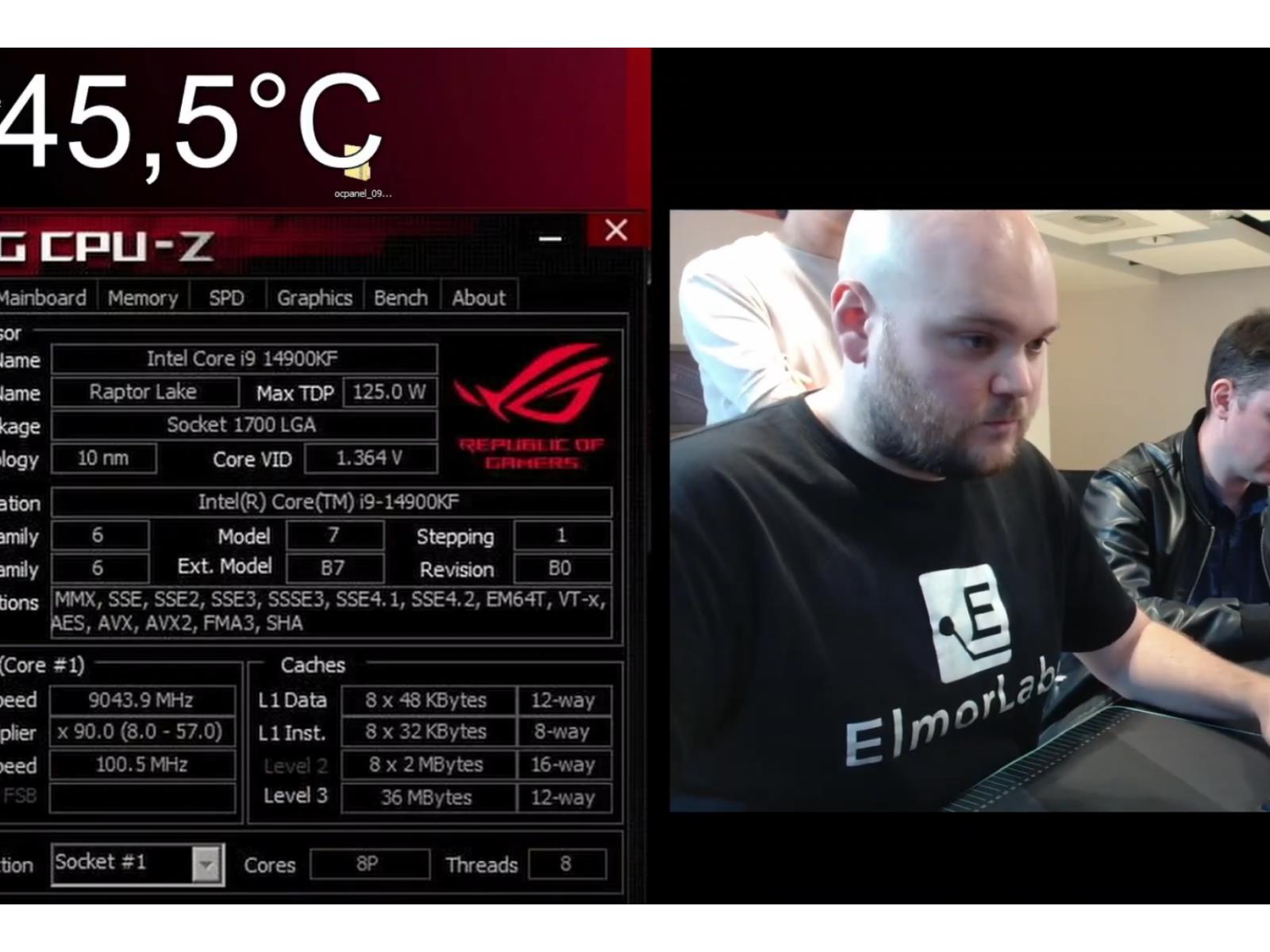
Extreme overclockers Elmor and SkatterBencher in cooperation with ASUS have submitted a record-smashing overclock of Intel’s brand-new Core i9-14900KF (a 14900K without integrated graphics), achieving a stable 9.044GHz and beating the previous world record (also held by Elmor) of 9.008GHz set on the Core i9-13900K. It’s the second time that
‘
Discord is a great voice, text, and video platform that allows friends, family, and communities of all types to connect in a common space. However, it’s been known that Discord has been used for some terrible things, such as the massive leak of intelligence from the U.S. Pentagon. Now, threat actors are leveraging the interconnectivity
In a study from Oxford University, researchers found that by using a combination of wearable sensor data and machine learning algorithms the progression of Parkinson’s disease can be monitored more accurately than in traditional clinical observation. Monitoring movement data collected by sensor technology may not only improve predictions about disease progression but also allows for more precise diagnoses.
Parkinson’s disease is a neurological condition that affects motor control and movement. Although there is currently no cure, early intervention can help delay the progression of the disease in patients. Diagnosing and tracking the progression of Parkinson’s disease currently involves a neurologist using the Movement Disorder Society-Unified Parkinson’s Disease Rating Scale (MDS-UPDRS) to assess the patient’s motor symptoms by assigning scores to the performance of specific movements. However, because this is a subjective, human analysis, classification can be inaccurate.
In the Oxford study, 74 patients with Parkinson’s were monitored for disease progression over a period of 18 months. The participants wore wearables with sensors in different regions of the body: on the chest, at the base of the spine and on each wrist and foot. These sensors — which had gyroscopic and accelerometric capabilities — kept tabs on 122 different physiological measurements, and tracked the patients during walking and postural sway tests. Kinetic data was then analyzed by custom software programs using machine learning.
Oxford
The sensor data collected by the wearables were compared to standard MDS-UPDRS assessments, which are considered the gold standard in current practice. That traditional test, in this study’s patients “did not capture any change” while the sensor-based analysis “detected a statistically significant progression of the motor symptoms” according to the researchers.
Having more precise data on the progression of Parkinson’s isn’t a cure, of course. But the incorporation of metrics from wearables could help researchers confirm the efficacy of novel treatment options.
This article originally appeared on Engadget at https://www.engadget.com/study-wearable-sensors-more-accurately-track-parkinsons-disease-progression-than-traditional-observation-171132495.html?src=rss
The Biden administration laid out new restrictions on Tuesday to limit the primary and secondary sale of United States-made chips to China, according to a CNBC report. The move is an effort to limit the nation’s technological and military progress.
This tutorial will show how to install VMware Workstation 17 Pro on RHEL-based distributions such as CentOS, Fedora, Rocky Linux, and AlmaLinux, as well as on Debian-based distributions such as Ubuntu and Linux Mint.