We haven’t heard much on the state of Amazon’s drone deliveries, but the company still seems focused on exploring the possibilities. A report earlier this year said Amazon had made only a handful of deliveries due to FAA regulations. However, in the announcement of prescription deliveries in parts of Texas, Amazon said its drones “have safely delivered hundreds of household items in College Station [in Texas] since December 2022.”
Amazon
Customers at College Station are now eligible for aerial deliveries of “more than 500 medications” for common conditions like the flu, asthma and pneumonia. Texas has established itself as a hotbed for drone delivery trials. Alphabet’s Wing also began offering them in Dallas–Fort Worth, including a partnership with Walmart.
Beyond a future third drone delivery area in the US, Amazon is planning an international expansion to the UK and Italy in 2024. Drone deliveries will start at one site each before expanding to more locations. Amazon added it will integrate the Prime Air program into its delivery network. In the US, drones will run out of some Same-Day Delivery sites.
Amazon will also start using its MK30 drone, first revealed last November. This model has a range twice as large as previous drones and improved tolerance for higher and lower temperatures. The MK30 can also operate in light rain. It’s smaller, lighter and quieter than previous drones too. But will it attempt delivery while I’m in the shower? Probably.
Netflix has announced two price hikes during its quarterly earnings. It said it’s increasing rates for its Basic and Premium plans. The Basic plan, which Netflix killed earlier this year, moves from $10 to $12 for grandfathered customers, while Premium rises from $20 to $23. Netflix said its ad-supported and Standard plans will remain the same at $7 and $15.49, respectively. Yay?
The company’s move to limit password sharing appears to have paid off too. Paid memberships are up to 247.15 million, a significant 10 percent annual increase.
After years of delays and redesigns, Tesla Cybertruck deliveries will begin to select customers starting November 30, before the vehicle enters full production next year at its Texas Gigafactory. The latest design tweak is the vehicle’s electrical architecture, reportedly now being redesigned to accommodate an 800-volt standard, up from the 400V in existing Tesla vehicles. A lot of luxury and heavy-duty EV models — from the Audi e-Tron to the GMC Hummer EV — use 800V architecture as it enables EVs with large battery capacities to charge faster.
The platform is also helping channels create news-focused Shorts.
At a time when misinformation is rife on many platforms and is arguably even incentivized in some cases, YouTube is attempting to push back (while also being the home of so much of it). In around 40 countries, it’s rolling out a news hub to pull together news from “authoritative sources” in several formats: video on demand, live streams, podcasts and even Shorts. The feature will eventually land on desktop and connected TV apps.
YouTube creators may be able to upload music that sounds like it was actually sang by famous musicians one day. According to Billboard and Bloomberg, the video hosting platform is developing an artificial intelligence tool that can mimic the voice of recording artists. It was also hoping to introduce the feature during its Made On YouTube event in September, where it debuted other AI-powered creator tools including a generative green screen. Obviously, its plan didn’t push through, and it was apparently because negotiating with recording companies is taking time. The technology is new, after all, and there are a lot of questions that need to be answered first.
Billboard says one of the key issues they’re still hashing out is how monetization would work. Will artists be paid for the music YouTube feeds its AI model, or for the output made using the AI tool? Further, how would songwriters be compensated for any of their music used to train YouTube’s AI? Recording companies still reportedly have questions about how the AI model is trained, as well, and about how artists will have the power to opt in or out. If and when the tool does come out, YouTube intends to beta test it first by giving a select group of creators access to the voices of artists who opt in.
While negotiations are taking time, recording companies are receptive to YouTube’s idea, according to the sources. That’s because they’re looking at the use of AI in music as an inevitability, and they’re concerned about getting left behind if they resist licensing deals like what YouTube is offering. As Bloomberg notes, though, YouTube is walking a tricky path and may have to brace itself for legal issues in its quest to explore the use of generative AI in music. OpenAI, for instance, had been sued by a group of authors, including John Grisham and George R.R. Martin, for the alleged use of their novels to train its large language model.
This article originally appeared on Engadget at https://www.engadget.com/youtube-may-soon-let-musicians-lend-their-ai-voices-to-creators-105038588.html?src=rss
In addition to Igalia working with Valve on AMD color management / HDR, Igalia engineers have also been working on the open-source Raspberry Pi kernel and Mesa drivers for the Raspberry Pi Foundation. This work includes the timely enablement of the new Raspberry Pi 5 hardware support…
Just as IBM was posting “future” processor compiler patches in 2019 for what ended up being early POWER10 enablement, they are once again repeating their same compiler enablement technique with sending out “PowerPC future” patches for what is likely to be POWER11…
The government of India said on Tuesday that it plans to put an astronaut on the moon by 2040 and build an Earth-orbiting space station by 2035. Space.com reports: On Aug. 23, India became just the fourth nation ever to soft-land a spacecraft — its Chandrayaan-3 lander-rover duo — on the surface of the moon. In a recent meeting with the Indian government department that manages the country’s space program, Prime Minister Narendra Modi “directed that India should now aim for new and ambitious goals,” according to an official statement. India’s future moon exploration efforts will include a series of additional robotic Chandrayaan missions, a new launch pad and a heavy-lift launch vehicle, the statement added.
India’s delayed Gaganyaan human spaceflight program, now aiming to fly three astronauts to low Earth orbit in 2025, will feature 20 major tests, including three uncrewed missions to test the launch vehicle over the course of the remainder of this year and all of next. […] By the middle of the 2030s, India hopes to have a 20-ton space station in a fixed orbit 248 miles (400 kilometers) above Earth, with capabilities to host astronauts for 15 to 20 days at a time, K. Sivan, former chairman of the Indian Space Research Organization (ISRO), has previously said.
Further down the pipeline of missions, ISRO is planning a Venus orbiter called Shukrayaan-1 to study the surface of that hellishly hot planet. The payloads for that mission are currently being developed, current ISRO chairman S. Somanath had said last month. A second orbiter mission to Mars is also on the books, according to the latest statement. The nation’s first, the Mars Orbiter Mission (MOM), was launched in 2013 and studied the Red Planet’s atmosphere for eight years before it lost contact with Earth in April 2022. The follow-up mission, Mars Orbiter Mission 2 or MOM 2, will likely include cameras to study the planet’s crust and may also include a lander, although many of the mission plans are yet to be finalized.
Oppo’s first two horizontally folding phones caught our attention with their shorter 9:8.4 “golden” aspect ratio, but with the brand new Find N3, the company sided with a more conventional design, which is backed by some new software tricks to boost the multitasking experience. Not to mention an upgraded set of Hasselblad-branded rear cameras, a vastly improved folding durability, and the alert slider inherited from OnePlus — as we’ve already seen on the recent Find N3 Flip.
The new foldable AMOLED display on the Oppo Find N3 comes in at 7.8 inches wide, with a resolution set at 2,240 x 2,268, which ends up being a pixel density of 426 ppi. As far as crease goes, it’s even less visible than before, so it’s definitely fair to call it “virtually crease-free” this time round. The more interesting feature here is the new self-healing coating, which can apparently smooth out scuffs to keep the panel in pristine condition for a little longer.
With the increased body height, the Find N3’s cover display features a more familiar — and arguably more practical — 20:9 aspect ratio (though it’s still shorter than, say, the Xiaomi Mix Fold 3). Here we have a flat 6.3-inch, 2,484 x 1,116 AMOLED panel (431 ppi), and much like the flexible screen, it supports 1,440Hz PWM dimming for less eye fatigue, 1-120Hz refresh rate, Dolby Vision, HDR10+, up to 1,400 nits in High Brightness Mode and up to 2,800 nits peak. This is noteworthy, considering that many earlier foldable phones have weaker display properties on the inner screen.
Oppo
The Find N3 is built with Oppo’s third-generation Flexion hinge, which consists of zirconium-based liquid metal for compactness, as well as the company’s self-developed aircraft-grade steel for strength. The flexible screen is also backed by carbon fiber support plates for structural strength, making the device “36-percent more resistant to warping than past-generation foldables.” Better yet, Oppo got TÜV Rheinland to certify the Find N3’s 1,000,000-fold durability, which is more than double that of the Find N2’s “mere” 400,000 folds, let alone the Samsung Galaxy Z Fold 5’s 200,000 folds. The fold counts remain at 100,000 for both the 50ºC (122°F ) and -20ºC (-4°F) tests. While there’s no Ingress Protection Rating here, Oppo has applied a weather-sealing process to make the Find N3 splash-proof.
Photography is also a significant upgrade here. Find N3 is the first smartphone to pack Sony’s 48-megapixel (4:3), 1/1.43-inch LYTIA-T808 sensor (it’s actually 52 megapixels, 1/1.35 inches in full — 20-percent larger than the main rival’s). This is apparently the first sensor to feature a two-layer transistor pixel structure, which is a cunning trick to let each pixel receive more light, thus more image detail. Sony goes as far as claiming that this chip “rivals the high-quality 1-inch type sensor.” Additionally, this f/1.7, 24mm-equivalent main camera comes with optical image stabilization.
There’s also a 64-megapixel, f/2.6 periscope telephoto camera with an unnamed 1/2-inch sensor — one that’s apparently three times larger than what you’d get on a main competitor’s foldable. With this 70mm-equivalent lens, you get 3x optical zoom and 6x “lossless” zoom (by cropping), both of which are assisted by optical stabilization via a floating prism structure. You can use the same camera in Hasselblad Portrait mode.
Last but not least, the 48-megapixel, 14mm equivalent ultra-wide camera packs a Sony IMX5811/2-inch sensor, which Oppo claims to be 130-percent larger than key rival’s. It comes with an f/2.2 lens, a 114-degree field of view and macro shot support down to 4cm.
Oppo
To complement the photography hardware upgrade, the Find N3 packs a new Oppo Computational Photography (OCP) feature, which captures the original brightness information for fine-tuning each HDR shot “pixel by pixel.” The result is supposedly “a more natural image with rich highlights and shadows.” This sounds somewhat like what the now-retired MariSilicon X imaging neural processor would have handled in the past, but Oppo has yet to dive into the technical details on OCP. On a related note, the ProXDR display mode in the gallery app leverages OCP details to optimize the screen’s peak brightness, in order to make the photos pop; but you can also long-press the ProXDR button to see the photos as-is.
For video calls, you also have the option to use either the external 32-megapixel f/2.4 selfie camera (1/3.14-inch, 22mm equivalent), or the internal 20-megapixel f/2.2 counterpart (1/4-inch, 20mm equivalent).
As for the remaining core phone specs, the Find N3 is unsurprisingly packing Qualcomm’s flagship Snapdragon 8 Gen 2 processor, along with 16GB of LPDDR5X RAM, 512GB of UFS 4.0 storage, a dual SIM tray, NFC, a triple-speaker system (with spatial audio support) and a larger 4,800mAh battery. With 67W SuperVOOC charging support, the device reaches over 80-percent charge in 30 minutes, or a full charge in 42 minutes. You’ll find the new alert slider (silent, vibrate and ring) located right next to the volume rocker, which is above the side-mounted fingerprint reader. The whole package comes in at 239 grams heavy and 5.8mm thick when opened — not record-breaking numbers but still impressive in this category.
On the software side, Oppo justified its shift in aspect ratio by adding some handy multitasking features. In this ColorOS 13.2 (based on Android 13), the new “Global Taskbar” offers an “App Library” button on the far left, which toggles a pop-up menu for quickly launching an app or even dragging it into a split-screen view. There’s also a “File Pocket” button next to that, which is another pop-up menu showing your recent files, images and clipboard items, so that you can easily drag and drop into an active app.
Oppo
Another powerful multitasking feature is “Boundless View,” which is basically split-screen on steroids. By tapping the top bar above your desired app in split-screen mode, you can click on “Expand View” which then automatically widens said app, but still leaving a small portion of the other app in view, thus letting you quickly swipe between apps. Similarly, you can also have up to three apps in this horizontal split-screen view — just drag the third app from the dock to the center of the screen. By expanding all three apps in this split screen, you’ll be creating a “15-inch Boundless View” layout, and you can get an interactive overview with a four-finger pinch at any time. Much like the usual split-screen mode, you can save these Boundless View app combos for quick access on the home screen.
My favorite handy features from before, namely two-finger split screen (swiping down the middle of the screen) and “FlexForm Capture” (partly open the phone while in the camera app), are here to stay. As a bonus, Oppo promises four years of software updates and five years of security updates for the Find N3.
Oppo
The Oppo Find N3, available in “champagne gold” and “classic black,” will be rolling out to global markets soon, with pre-orders starting in Singapore on October 20th. The damage is S$2,399 (around US$1,745) which, to our surprise, is a big jump from the Find N2’s price for the same 16GB RAM and 512GB storage configuration. The China version is offered as a premium kit, which is asking for 12,999 yuan or about US$1,777, and it comes with a kickstand case, a car charger and other accessories. Luckily for folks over there, they also have a more affordable 12GB RAM and 512GB storage variant for just 9,999 yuan (about US$1,367), but this is still a lot pricier than last year’s base model. It’ll be interesting to see how the supposedly near-identical OnePlus Open foldable — launching later today — will differentiate itself from its Oppo twin, be it pricing or software.
This article originally appeared on Engadget at https://www.engadget.com/oppos-find-n3-foldable-goes-big-on-displays-and-durability-094134290.html?src=rss
For this article in the series, I’ll explore the simple process of installing Ubuntu 23.10 on the Intel NUC 13 Pro. First, I’ll explain how to write the Ubuntu ISO to a USB key, and then take you through the installation steps.
The ninth annual Google for India event had a big announcement: the company plans to manufacture its Pixel phones in India, following steady growth in the country’s demand for the devices. Google’s senior vice president for Devices and Services, Rick Osterloh, positioned India as one of the company’s most important markets for Pixel devices. Google aims to begin rolling out locally produced Pixel 8 smartphones in 2024, eventually expanding to other Pixel models.
Google’s contribution to the “Make in India” initiative will see partnerships with domestic and international manufacturers. In a tweet, the CEO of Alphabet and Google, Sundar Pichai, stated, “We’re committed to being a trusted partner in India’s digital growth.” The pivot also allows Google to diversify its production away from China, where supply chain risks continue due to strains between the nation and the United States.
We shared plans at #GoogleforIndia to manufacture Pixel smartphones locally and expect the first devices to roll out in 2024. We’re committed to being a trusted partner in India’s digital growth- appreciate the support for Make In India @PMOIndia + MEIT Minister @AshwiniVaishnaw.
The company’s decision is another win for India’s government, which has attracted international device manufacturers, like Samsung and Apple, to make major investments in local production. Apple first produced iPhones in India back in 2017, but the first devices produced were all older models. Production initially also lagged six to nine months behind China but has improved steadily, first with iPhone 14 production starting within a month of launch. Most recently, a small number of India-made iPhone 15s were available in the region the same day as those produced in China.
This article originally appeared on Engadget at https://www.engadget.com/google-confirms-it-will-manufacture-pixel-phones-in-india-091725837.html?src=rss
It’s been less than a year since ChatGPT catapulted generative artificial intelligence (AI) into mainstream public consciousness, reigniting the debate about the role that these powerful new technologies will play in all of our futures.
‘Will AI save or destroy humanity?’ might seem like an extreme title for a podcast, particularly if you’ve played with these products and enjoyed some of their obvious limitations. The reality is that we are still at the foothills of what AI technology can achieve (think World Wide Web in the 1990s), and lots of credible people are predicting an astonishing pace of progress over the next few years, promising the radical transformation of almost every aspect of our lives. Comparisons with the Industrial Revolution abound.
At the same time, there are those saying it’s all moving too fast; that regulation isn’t keeping pace with innovation. One of the UK’s leading AI entrepreneurs, Mustafa Suleyman, said recently: “If you don’t start from a position of fear, you probably aren’t paying attention.”
What is AI literacy for young people?
What does all this mean for education, and particularly for computing education? Is there any point trying to teach children about AI when it is all changing so fast? Does anyone need to learn to code anymore? Will teachers be replaced by chatbots? Is assessment as we know it broken?
If we’re going to seriously engage with these questions, we need to understand that we’re talking about three different things:
AI literacy: What it is and how we teach it
Rethinking computer science (and possibly some other subjects)
Enhancing teaching and learning through AI-powered technologies
AI literacy: What it is and how we teach it
For young people to thrive in a world that is being transformed by AI systems, they need to understand these technologies and the role they could play in their lives.
Our SEAME model articulates the concepts, knowledge, and skills that are essential ingredients of any AI literacy curriculum.
The first problem is defining what AI literacy actually means. What are the concepts, knowledge, and skills that it would be useful for a young person to learn?
The reality is that — with a few notable exceptions — the vast majority of AI literacy resources available today are probably doing more harm than good.
In the past couple of years there has been a huge explosion in resources that claim to help young people develop AI literacy. Our research team mapped and categorised over 500 resources, and undertaken a systematic literature review to understand what research has been done on K–12 AI classroom interventions (spoiler: not much).
The reality is that — with a few notable exceptions — the vast majority of AI literacy resources available today are probably doing more harm than good. For example, in an attempt to be accessible and fun, many materials anthropomorphise AI systems, using human terms to describe them and their functions and thereby perpetuating misconceptions about what AI systems are and how they work.
What emerged from this work at the Raspberry Pi Foundation is the SEAME model, which articulates the concepts, knowledge, and skills that are essential ingredients of any AI literacy curriculum. It separates out the social and ethical, application, model, and engine levels of AI systems — all of which are important — and gets specific about age-appropriate learning outcomes for each.
This research has formed the basis of Experience AI (experience-ai.org), a suite of resources, lessons plans, videos, and interactive learning experiences created by the Raspberry Pi Foundation in partnership with Google DeepMind, which is already being used in thousands of classrooms.
If we’re serious about AI literacy for young people, we have to get serious about AI literacy for teachers.
Defining AI literacy and developing resources is part of the challenge, but that doesn’t solve the problem of how we get them into the hands and minds of every young person. This will require policy change. We need governments and education system leaders to grasp that a foundational understanding of AI technologies is essential for creating economic opportunity, ensuring that young people have the mindsets to engage positively with technological change, and avoiding a widening of the digital divide. We’ve messed this up before with digital skills. Let’s not do it again.
Teacher professional development is key to AI literacy for young people.
More than anything, we need to invest in teachers and their professional development. While there are some fantastic computing teachers with computer science qualifications, the reality is that most of the computing lessons taught anywhere on the planet are taught by a non-specialist teacher. That is even more so the case for anything related to AI. If we’re serious about AI literacy for young people, we have to get serious about AI literacy for teachers.
Rethinking computer science
Alongside introducing AI literacy, we also need to take a hard look at computer science. At the very least, we need to make sure that computer science curricula include machine learning models, explaining how they constitute a new paradigm for computing, and give more emphasis to the role that data will play in the future of computing. Adding anything new to an already packed computer science curriculum means tough choices about what to deprioritise to make space.
One of our Experience AI Lessons revolves around the us of AI technology to study the Serengeti ecosystem.
And, while we’re reviewing curricula, what about biology, geography, or any of the other subjects that are just as likely to be revolutionised by big data and AI? As part of Experience AI, we are launching some of the first lessons focusing on ecosystems and AI, which we think should be at the heart of any modern biology curriculum.
Some are saying young people don’t need to learn how to code. It’s an easy political soundbite, but it just doesn’t stand up to serious scrutiny.
There is already a lively debate about the extent to which the new generation of AI technologies will make programming as we know it obsolete. In January, the prestigious ACM journal ran an opinion piece from Matt Welsh, founder of an AI-powered programming start-up, in which he said: “I believe the conventional idea of ‘writing a program’ is headed for extinction, and indeed, for all but very specialised applications, most software, as we know it, will be replaced by AI systems that are trained rather than programmed.”
Writing computer programs is an essential part of learning how to analyse problems in computational terms.
With GitHub (now part of Microsoft) claiming that their pair programming technology, Copilot, is now writing 46 percent of developers’ code, it’s perhaps not surprising that some are saying young people don’t need to learn how to code. It’s an easy political soundbite, but it just doesn’t stand up to serious scrutiny.
Even if AI systems can improve to the point where they generate consistently reliable code, it seems to me that it is just as likely that this will increase the demand for more complex software, leading to greater demand for more programmers. There is historical precedent for this: the invention of abstract programming languages such as Python dramatically simplified the act of humans providing instructions to computers, leading to more complex software and a much greater demand for developers.
Learning to program will help young people understand how the world around them is being transformed by AI systems.
However these AI-powered tools develop, it will still be essential for young people to learn the fundamentals of programming and to get hands-on experience of writing code as part of any credible computer science course. Practical experience of writing computer programs is an essential part of learning how to analyse problems in computational terms; it brings the subject to life; it will help young people understand how the world around them is being transformed by AI systems; and it will ensure that they are able to shape that future, rather than it being something that is done to them.
Enhancing teaching and learning through AI-powered technologies
Technology has already transformed learning. YouTube is probably the most important educational innovation of the past 20 years, democratising both the creation and consumption of learning resources. Khan Academy, meanwhile, integrated video instruction into a learning experience that gamified formative assessment. Our own edtech platform, Ada Computer Science, combines comprehensive instructional materials, a huge bank of questions designed to help learning, and automated marking and feedback to make computer science easier to teach and learn. Brilliant though these are, none of them have even begun to harness the potential of AI systems like large language models (LLMs).
The challenge for all of us working in education is how we ensure that ethics and privacy are at the centre of the development of [AI-powered edtech].
One area where I think we’ll see huge progress is feedback. It’s well-established that good-quality feedback makes a huge difference to learning, but a teacher’s ability to provide feedback is limited by their time. No one is seriously claiming that chatbots will replace teachers, but — if we can get the quality right — LLM applications could provide every child with unlimited, on-demand feedback. AI-powered feedback — not giving students the answers, but coaching, suggesting, and encouraging in the way that great teachers already do — could be transformational.
The challenge for all of us working in education is how we ensure that ethics and privacy are at the centre of the development of AI-powered edtech.
We are already seeing edtech companies racing to bring new products and features to market that leverage LLMs, and my prediction is that the pace of that innovation is going to increase exponentially over the coming years. The challenge for all of us working in education is how we ensure that ethics and privacy are at the centre of the development of these technologies. That’s important for all applications of AI, but especially so in education, where these systems will be unleashed directly on young people. How much data from students will an AI system need to access? Can that data — aggregated from millions of students — be used to train new models? How can we communicate transparently the limitations of the information provided back to students?
Ultimately, we need to think about how parents, teachers, and education systems (the purchasers of edtech products) will be able to make informed choices about what to put in front of students. Standards will have an important role to play here, and I think we should be exploring ideas such as an AI kitemark for edtech products that communicate whether they meet a set of standards around bias, transparency, and privacy.
Realising potential in a brave new world
We may very well be entering an era in which AI systems dramatically enhance the creativity and productivity of humanity as a species. Whether the reality lives up to the hype or not, AI systems are undoubtedly going to be a big part of all of our futures, and we urgently need to figure out what that means for education, and what skills, knowledge, and mindsets young people need to develop in order to realise their full potential in that brave new world.
That’s the work we’re engaged in at the Raspberry Pi Foundation, working in partnership with individuals and organisations from across industry, government, education, and civil society.
If you have ideas and want to get involved in shaping the future of computing education, we’d love to hear from you.
This article will also appear in issue 22 of Hello World magazine, which focuses on teaching and AI. We are publishing this new issue on Monday 23 October. Sign up for a free digital subscription to get the PDF straight to your inbox on the day.
If you have a personal WhatsApp account and a business one — or two accounts of the same nature — you’ll soon no longer have to carry two phones to be able to access them both. WhatsApp will finally let you add two accounts to one device, as long as you have a second phone number or a phone that supports eSIM or dual/multiple SIMs.
You won’t even need to log out of one account to be able to access the other. To have simultaneous access to two accounts, go to the app’s Settings page and click on the arrow next to your name to find the “Add account” option. Each account has its own privacy and notification settings, so you can choose to receive alerts from one and not the other, which sounds incredibly useful if you’re on vacation and don’t want to hear from your work or business for a while.
The new feature follows an update earlier this year that gave you the capability to access your account on multiple devices. WhatsApp used to be very strict when it comes to account access and limited you to having one account on one phone. It started exploring multi-device functionality in 2021, though, and rolled out the ability to sync one account across up to four phones in April. This upcoming update, which could make it easier to juggle different aspects of your life while maintaining boundaries, is rolling out for Android devices in the coming weeks.
This article originally appeared on Engadget at https://www.engadget.com/whatsapp-will-soon-let-you-add-two-accounts-to-one-device-070407645.html?src=rss
The U.S. government is receiving dozens of reports of unidentified anomalous phenomena (UAP) each month. “The office has received approximately 800 reports of unidentified objects to investigate as of this past April, up from 650 reports in August 2022, Sean Kirkpatrick, who heads the All-domain Anomaly Resolution Office at the Pentagon told CNN.” From the report: The vast majority are benign objects, such as balloons or drones, but some may be the result of America’s adversaries trying to spy on the US, said Kirkpatrick. “There are some indicators that are concerning that may be attributed to foreign activity, and we are investigating those very hard,” said Kirkpatrick, speaking exclusively to CNN ahead of the release of the annual report on unidentified aerial phenomena.
A portion of the increase in reports comes from the Federal Aviation Administration, which monitors airspace around US airports starting to provide information to the Pentagon. About half of the reports contain enough data that they can be ruled out as “mundane things,” such as errant balloons or floating trash, Kirkpatrick said, but 2-4% are truly anomalous and require further investigation.
Asked if the Pentagon could definitively identify a sighting of an unidentified object as belonging to a foreign adversary, Kirkpatrick said that his office is “looking at some very interesting indicators of things, and that’s about all I can tell you.” But the office, which has more than 40 employees and is expected to grow, can’t say that for sure yet. “There are ways to hide in our noise that always concern me,” Kirkpatrick said, referring to the extraneous readings picked up by US radars and other sensors. “I am worried from a national security perspective.” “The Pentagon is preparing for a flood of new reports as it readies two new portals for submissions: one for historical sightings from current or former government employees and contractors and a second for public submissions of new reports,” notes CNN.
“It is the opening of the public portal, still several months away, that Kirkpatrick says could flood the system with ‘hundreds, if not thousands’ of new reports to sort through.”
Back in February, Meta launched a Telegram-like feature for Instagram called “broadcast channels,” which introduced a one-way messaging feature to the app. It gave creators a way to update their followers without having to post on their main page. Now, the company is expanding broadcast channels’ availability and is also bringing it to Facebook and Messenger. Creators and public figures with Facebook pages will now be able to send messages, including photos, videos and voice notes, to their community.
It’s still a one-way messaging tool, which means only Page administrators can send messages in the channel, but participants can react to them and vote in polls. Admins can launch a channel directly from their page, and Facebook will send their followers a one-time notification to join after they send their first message. Based on the screenshots shared by Meta chief Mark Zuckerberg, broadcast channels will show up in users’ Messenger chats under a tab aptly labeled “Channels.” Participants will get notifications every time the page owner sends an update, but they can mute the channel anytime. Presumably, those who chose not to participate the first time can still access the channel from the page’s profile like people can on Instagram.
Meta says any page admin where the feature is now accessible can start a channel if they want. The feature still isn’t available everywhere, though, and those who can’t find the option to open a broadcast channel yet can join the waitlist for now.
This article originally appeared on Engadget at https://www.engadget.com/meta-brings-instagrams-broadcast-channels-to-facebook-and-messenger-050801437.html?src=rss
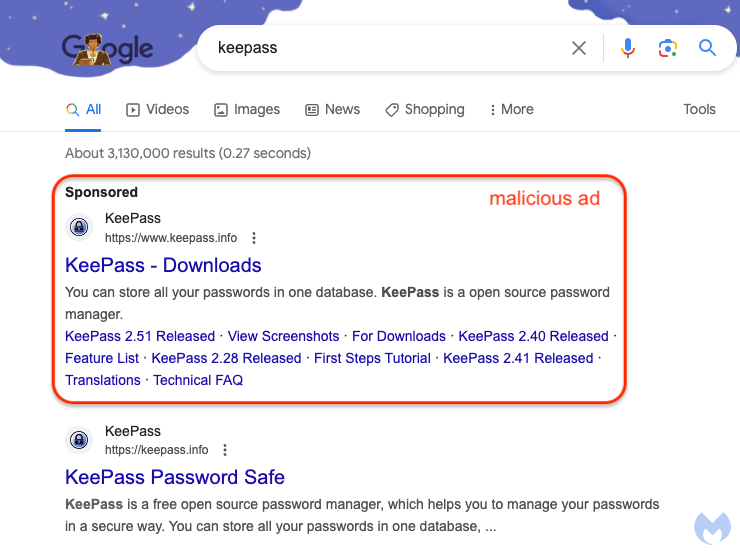
Google has been caught hosting a malicious ad so convincing that there’s a decent chance it has managed to trick some of the more security-savvy users who encountered it.
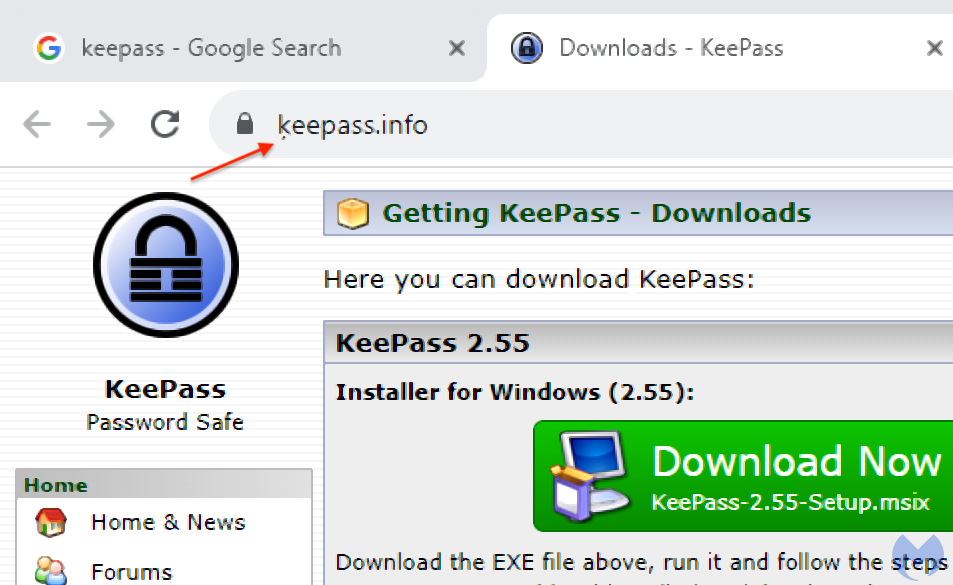
Looking at the ad, which masquerades as a pitch for the open-source password manager Keepass, there’s no way to know that it’s fake. It’s on Google, after all, which claims to vet the ads it carries. Making the ruse all the more convincing, clicking on it leads to ķeepass[.]info, which when viewed in an address bar appears to be the genuine Keepass site.
A closer link at the link, however, shows that the site is not the genuine one. In fact, ķeepass[.]info —at least when it appears in the address bar—is just an encoded way of denoting xn--eepass-vbb[.]info, which it turns out, is pushing a malware family tracked as FakeBat. Combining the ad on Google with a website with an almost identical URL creates a near perfect storm of deception.
An anonymous reader writes: Adobe has unveiled a sparkling, interactive dress — and got the research scientist who created it to model the high-tech couture. Video of the dress debut shows researcher Christine Dierk wearing the slinky strapless number that, upon first glance, looks like the average sequined cocktail dress. With the click of a handheld remote, however, the dress began to shift patterns like something out of a fashion-forward science fiction film. Created under Adobe’s “Project Primrose” initiative, this “digital dress,” as Dierk described it for the audience at Adobe’s MAX conference last week, “brings fabric to life.”
“Unlike traditional clothing, which is static, Primrose allows me to refresh my look in a moment,” the Adobe scientist said, demonstrating the clothing’s capabilities by having its colors go from light to dark in an instant. The digital dress patterns can also, as Dierks demonstrated, be animated, and will even respond to movement — though that last feature appeared glitchy and didn’t work at first. The researcher-turned-model also told the hosts of her portion of the convention that she not only designed the dress with the help of her team at Adobe, but also stitched it herself.
While the specs of this particular smart garment haven’t been published, the high-tech sequins used for smaller Project Primrose offerings, a handbag and a canvas, were described by Dierks and her co-researchers last year in an article presented at a tech conference. As the article explains, those “sequins” are actually “reflective light-diffuser modules” that use reflective-backed polymer-dispersed liquid crystals (PDLC), which are most often used in smart lighting. Technically, all those sequins are tiny screens.
Apple is taking a different approach to social with its Vision Pro headset: making apps social right out of the box. This, according to Road to VR’s Ben Lang, is what Meta should have done all along. Instead, it’s pioneered a social experience on the Quest platform that involves “jumping through a fragmented landscape of different apps and different ways to actually get into the same space with your friends.” From the report: Apple is taking a fundamentally different approach with Vision Pro by making social the expectation rather than the rule, and providing a common set of tools and guidelines for developers to build from in order to make social feel cohesive across the platform. Apple’s vision isn’t about creating a server full of a virtual strangers and user-generated experiences, but to make it easy to share the stuff you already like to do with the people you already know. This obviously leans into the company’s rich ecosystem of existing apps — and the social technologies the company has already battle-tested on its platforms.
SharePlay is the feature that’s already present on iOS and MacOS devices that lets people watch, listen, and experience apps together through FaceTime. And on Vision Pro, Apple intends to use its SharePlay tech to make many of its own first-party apps — like Apple TV, Apple Music, and Photos — social right out of the box, and it expects developers to do so too. In the company’s developer documentation, the company says it expects “most visionOS apps to support SharePlay.” […]
Perhaps most importantly, Apple is leaning on every user’s existing personal friend graph (ie: the people you already text, call, or email), rather than trying to create a bespoke friends list that lives only inside Vision Pro. Rather than launching an app and then figuring out how to get your friends into it, with SharePlay Apple is focused on getting together with your friends first, then letting the group seamlessly move from one app to the next as you decide what you want to do.
Even apps that don’t explicitly have multi-user experience built-in can be ‘social’ by default, by allowing one user to screen-share the app with others. Only the host will be able to interact with the content, but everyone else will be able to see and talk about it in real-time. It’s the emphasis on ‘social by default’, ‘things you already do’, and ‘people you already know’ that will make social on Vision Pro feel completely different than what Meta is building on Quest with Horizon Worlds and its ecosystem of fragmented social apps.
AlmaLinux is creating a Red Hat Enterprise Linux (RHEL) without any Red Hat code. Instead, AlmaLinux OS will aim to be Application Binary Interface (ABI) compatible and use the CentOS Stream source code that Red Hat continues to offer. Additional code is pulled from Red Hat Universal Base Images, and upstream Linux code. Benny Vasquez, chairperson of the AlmaLinux OF Foundation, explained how all this works at the open-source community convention All Things Open. ZDNet’s Steven Vaughan-Nichols reports: The hardest part is Red Hat’s Linux kernel updates because, added Vasquez, “you can’t get those kernel updates without violating Red Hat’s licensing agreements.” Therefore, she continued, “What we do is we pull the security patches from various other sources, and, if nothing else, we can find them when Oracle releases them.” Vasquez did note one blessing from this change in production: “AlmaLinux, no longer bound to Red Hat’s releases, has been able to release upstream security fixes faster than Red Hat. “For example, the AMD microcode exploits were patched before Red Hat because they took a little bit of extra time to get out the door. We then pulled in, tested, and out the door about a week ahead of them.” The overall goal remains to maintain RHEL compatibility. “Any breaking changes between RHEL and AlmaLinux, any application that stops working, is a bug and must be fixed.”
That’s not to say AlmaLinux will be simply an excellent RHEL clone going forward. It plans to add features of its own. For instance, Red Hat users who want programs not bundled in RHEL often turn to Extra Packages for Enterprise Linux (EPEL). These typically are programs included in Fedora Linux. Besides supporting EPEL software, AlmaLinux has its own extra software package — called Synergy — which holds programs that the AlmaLinux community wants but are not available in either EPEL or RHEL. If one such program is subsequently added to EPEL or RHEL, AlmaLinux drops it from Synergy to prevent confusion and duplication of effort.
This has not been an easy road for AlmaLinux. Even a 1% code difference is a lot to write and maintain. For example, when AlmaLinux tried to patch CentOS Stream code to fix a problem, Red Hat was downright grumpy about AlmaLinux’s attempt to fix a security hole. Vasquez acknowledged it was tough sledding at first, but noted: “The good news is that they have been improving the process, and things will look a little bit smoother.” AlmaLinux, she noted, is also not so much worried as aware that Red Hat may throw a monkey wrench into their efforts. Vasquez added: “Internally, we’re working on stopgap things we’d need to do to anticipate Red Hat changing everything terribly.” She doesn’t think Red Hat will do it, but “we want to be as prepared as possible.”
Today is a fun-fest of F-word foursomes, and one of the trickier puzzles we’ve had lately. If you’re looking for the Connections answer for Thursday, October 19, 2023, read on—I’ll share some clues, tips, and strategies, and finally the solutions to all four categories. Along the way, I’ll explain the meanings of the…
We’re gonna go out on a limb here and say not everything is what it seems in the new show Beacon 23. Call it a hunch. Call it intuition. But from the looks of this trailer, there’s some foul play afoot, and when that type of thing happens on a space station far, far away from Earth, we can’t help but love it.